Shared posts

13 Jun 17:27

Can We Self Coach?

by Dave Brock

I posed a question on LinkedIn, “Can we self coach?” The responses are interesting and, for the most part, thoughtful. Paul Lanigan made a comment that neatly sums up my thinking:

“The whole idea of a coach is to shine a light on what we don’t see.”

I think this is an important concept and why any high performer must actively seek coaching from their manager and even mentoring from people they respect.

There’s a huge amount high performers can and should be doing for themselves. They should always be seeking to learn and improve, but in a systematic way. Some thoughts:

  1. You have to have a realistic self-assessment. Be critical of yourself, that is, your strengths and weaknesses, your capabilities, your own goals. It’s sometimes tough to do this (hence a coach or mentor is critical). We have to push our own egos to the side and look at where we can constantly improve.
  2. You have to take the time to inspect and reflect on what you are doing on a day to day basis. For example, after each major sales call (voice to voice or face to face), think about the call and how you did. Did your accomplish your goals, could you have done more? Were you sufficiently prepared, what might you have done better or differently? How could you improve the value you created for the customer in the call? Look at how you spend your time during the day/week. Look at your deal strategies, questioning how you can improve. Look at everything you do in a systematic way. Write down what you might do to improve, how you will do it, what you need to learn and set a time-based goal.
  3. Watch and observe others–particularly other high performers. See what they do differently. Ask them about their thoughts and approaches. Shamelessly copy and experiment with those things they do very well that you aren’t doing.
  4. Constantly seek to learn and improve. Reading, workshops are all helpful. Actively participating in discussion groups or commenting on LinkedIn or other articles helps you share ideas and learn from others sharing their ideas.
  5. Look in non-traditional places. We become prisoners of our own experiences, our peers, managers, even our customers do as well. Look in different industries, different disciplines. Find ideas and approaches that you can shamelessly adapt and apply to what you do. I always like looking at industries and markets that are at least two adjacencies away. For example, most of my work is in complex B2B–technology, industrial products, services. I learn a lot by looking a CPG, Retail, and Fashion. Look at other disciplines. For example, we can learn a lot from manufacturing, engineering or development.
  6. Find a mastermind or some other peer group — other high performers that are looking toe learn as well as share their experiences.
  7. Ask for help! It may sometimes come from the most remarkable places.

We must always look to learn and improve. If we know what we don’t know, we can develop a plan to remedy that.

But there’s always that big question mark. What is it that we don’t know what we don’t know? What is it that we should see but are blind to?

At all levels, we need coaches and mentors. It’s their job to shine a light on what we don’t know or can’t see. It’s their job to help us understand and develop a plan to continue to learn and improve.

We need to look for coaches and mentors less for answers, but for the questions, we should be challenging ourselves with but haven’t yet discovered.

Jim Fiorini had some great thoughts, paraphrasing them:

Ask to be managed and coached. Tell your manager you want to sit down for pipeline, deal, call reviews and whatever. Actively seek their advice and input. Don’t let them off the hook.

If your manager won’t do it, then do everything you can do to move to a manager that will. Do not accept or work for a manager that doesn’t want to coach–you will never improve, you will never achieve your full potential. You owe yourself more.

There’s a lot that each of can and must commit to continually learn, grow and improve. But you can’t do it by yourself. You need someone to shine a light on what you don’t see

Note: The picture for this post came from an excellent post on the same topic: https://www.pickthebrain.com/blog/coach-life/

13 Jun 17:27

4 Examples of When Hiring IT Consultants Is Better for Business

by John Rabito

4 Examples of When Hiring IT Consultants Is Better for Business

The market has come a long way from the days when businesses could get by with just a dedicated IT generalist or network administrator. Advances in enterprise technology upped the ante. Regardless of size or industry vertical, companies in the current market thrive by hiring diverse IT professionals with a command of complex IT tools and services.

However, few organizations have inexhaustible IT budgets to recruit direct hires in every must-have technical role. To avoid performance gaps, more companies are hiring IT consultants for certain skillsets – especially when temporary talent delivers the same outcome as full time personnel. In fact, four pursuits in particular benefit from working with contract IT workers.

1.) Cloud Implementation

Traditional enterprise software and services are being replaced by cloud alternatives. Cloud service costs reflect precise usage and system updates happen in a fluid way that doesn’t interrupt the flow of business. Widespread adoption is at the point where U.S. organizations are budgeting $1.77 million for cloud spending in 2017. The percentage of the budget allocated to direct hire versus IT contractors depends on a company’s long-term vision and environment:

  • Are cloud services low maintenance after the initial migration? Moving databases, servers, or other hardware to the cloud might require a cloud specialist during the migration, but not after. Some vendors provide their own cloud support as part of the package, limiting the extent of the budget needed to employ specific talent.
  • What combination of cloud solutions are you using? Each business is going to benefit from a different set of cloud services. Some might choose to stick with a single all-encompassing vendor, while others go with a hybrid cloud model. If the complexity of services requires hands-on attention to achieve their full potential, hiring permanent cloud specialists is the right choice. Otherwise, temporary consultants are a more cost-effective choice.

2.) App Development

Who doesn’t have their own web or mobile application these days? Customer facing and internal applications demand new levels of functionality and usability to deliver competitive performance. The quality of developer that an organization hires is always going to dictate the application ROI and shelf life. Yet not every project is going to merit a dedicated developer on staff and companies need to reflect on certain queries:

  • Does your IT roadmap call for multiple development projects? This is one reason that having a strong IT roadmap is crucial. Businesses that know their long-term strategies and can predict their future budgets are able to determine whether application development should be delivered by permanent staff or IT consultants.
  • How often will applications need updating? Customer facing applications will always have a shorter shelf life than internal applications because of exponentially evolving trends. Even if your application is not your core service or product, frequent updates might be mandatory. For example, healthcare payer or telecom customer portals require dedicated staff to evolve with competition. On the other hand, many B2B organizations get updates every few years from an IT consultant.
  • Is the skillset in-demand? In-demand skillsets are harder to fill with permanent staff. Developers with hard-to-find programming languages like Python and JavaScript on their resumes know they can gain experience faster and make more money as IT contractors, so more are willing to try short-term roles. And even if companies want long-term talent, an IT consultant is a good way to fill the void until a permanent person becomes available.

3.) Data Analysis

The ability to leverage structured and unstructured data is making businesses more responsive than ever. Big data analysis is improving the way organizations observe trends, overcome obstacles, and implement strategies to ride the waves of change. Companies see that value and IBM predicts the demand for data scientists and data engineers will grow by 39%.

Though a variety of self-service analytical platforms have emerged in recent years, trained analytical professionals deliver governable data and best-in-class results by asking the right questions. That being said, not every project needs a permanent data specialist.

The answers to certain questions determine whether hiring IT consultants or permanent staff is ideal:

  • How often will you use predictive models over manual analysis? Infrequent use of big data makes a full time data scientist a steep expense. Given a clear scope, data scientist contractors can perform analysis and visualize data in a cost-effective way as it becomes convenient.
  • Which departments want big data? If only a single department voices an interest in big data needs, the justification for a full time analyst is low. Additionally, the work of a contract data scientist can be treated as a use case to determine the value of predictive analysis to your business, helping to rationalize recruiting a direct hire in the future.
  • Is your business data-driven yet? Some organizations are in a perpetual state of discovery and evaluation. Those that view data as a cornerstone of their decision-making benefit from a dedicated data specialist. Those still getting to understand the potential of their data should hire IT consultants until the proof of value is established.

4.) Legacy Tech SMEs

For companies running on legacy systems, there is a timer ticking down to when that technology is more hindrance than help. Familiarity with these platforms encourages businesses to avoid change until it becomes burdensome. And when the time to transition finally comes, hiring an IT consultant is almost always the best option.

This choice is far more straightforward than the rest. Legacy skillsets are harder to find and direct hires force companies to lock themselves in with talent who might not be a good long-term fit. Temporary IT consultants allow businesses to complete the transition and then hire a more permanent IT specialist better aligned with the updated IT systems.

Hiring IT Consultants in a Candidate-Driven Market

The current market makes it particularly compelling to hire IT consultants. Candidates that recognize the demand for their technical skills are less likely to stay anchored to a single job. The willingness of companies to pay for in-demand skills allows IT professionals the freedom to explore contract IT positions, knowing that plenty of opportunities exist. It’s that shift that empowers companies to fill the gap in their IT – if they know where to find the best tech talent on the market.

13 Jun 17:26

Why You Need To Negotiate

by Devon Smiley

If we settled for the status quo. If we accepted ‘good enough’ … would we ever have achieved such greatness?

There are so many different ways to run a business. Each of us has our own unique take on what we do and how we do it. Some of us thrive when working face-to-face. Others prefer keeping our clients at screen’s length. Big business. Small business. Product-based. Service-based. Home office, corner office or beach office.

But despite all of these differences, there are some universal business truths. Things that we all need to be doing in order to achieve our best business results – no matter how we’ve chosen to define that success.

The truth today?

You need to negotiate.

Here’s why:

1) No one knows your value better than you do

The only person that knows how much work, investment and time that went into the development of your product or service is you. It can feel a bit insulting when offers come in that are super low, and you may start second guessing your own worth…don’t.

Negotiations are your opportunity to communicate with potential clients, customers, and even vendors what your value is and what your expectations are when you do business with them. If you’re not negotiating, and coming from a place of educating about and illustrating your value, your business results will suffer.

{Example: Personal Stylist} Illustrate and educate on your value right off the bat by creating tiered packages for how clients can work with you. This helps establish the expectations of what your time and expertise is worth. This is a great pro-active negotiation technique, because it helps you avoid receiving awkwardly low offers. In negotiation parlance, you’re ‘anchoring’ the discussion around a set of numbers that will work for you and your business goals.

2) You’ll find flexibility everywhere

In business, it’s rare to come across a term, condition or price that is truly 100% non-negotiable. Why? Because there’s always more to it than meets the eye.

It’s not just about a dollar value – there’s a whole bucket of other variables that come along with that price tag…and each one of them is an opportunity to negotiate and shape a better deal for yourself. The magic comes in uncovering those variables, and then finding creative ways to put them together.

{Example: Event planner} When faced with a ‘no’…your first response should be of the ‘why?’ variety. Finding the perfect venue for a client’s party, and then having them say ‘No, we don’t accept private parties.’ ss a bummer… but why don’t they accept? Did they get burned with a last minute cancellation? Was their dining room damaged by kids run wild? Are they short a few wait staff? When you’re getting a non-negotiable response, figuring out what really lies beneath it will help you get creative, and secure the result you’re looking for.

3) There’s always room for improvement

Good enough? Done? Finished? Perfect? Never – your business is always developing. Each business deal and relationship you have is the same – there’s always room for improvement or change. Even when things are going along swimmingly, and there’s nothing major that screams out for change or negotiation…there may be a little something that could improve your business results. Don’t overlook these seemingly insignificant opportunities. Incremental changes can add up to big results. And even if you’ve had contracts and relationships in place for years and years? Don’t slip into the comfort zone of the status quo – come at it with fresh eyes and see where you can tweak.

[Example: Web designer} You’re on top of technology and have upgraded your skills and offerings…but some of your clients are stuck using older technology and troublesome templates. Your development work takes so much longer, and isn’t as great of an example of your skill set as it once was. Go back and negotiate improvements with your loyal customers. Would a template upgrade make your life easier? (Offer it at a discount to get them on board, and then reap the reward of all that time saved.) Do you need to up your ages-old rates? Ask for it!

4) Because you can!

You need to negotiate…because you can! You are empowered to ask for what your businesses needs. There’s no such thing as being too small, or too new to negotiate. You have wants and needs…and you have a voice.

{Example: You} My negotiation challenge to you: Think of 3 things in your business right now that you could negotiate an improvement on. They can be big things (a multi-year lease?) or small things (moving the start time of a meeting). Can’t think of anything? Think of the last time your gut feeling when working with a client or customer was anything less than ‘Heck ya!’. That’s your sign that there’s something in there you could improve with a negotiation.

LEARN MY 15 EXPERT TIPS FOR BOOSTING YOUR PROFITS WITHOUT CHASING NEW CLIENTS.

Download your free guide now!

13 Jun 17:25

Mark Zuckerberg shares the hiring rule he says separates good companies from great ones

by Richard Feloni

Mark Zuckerberg

Hiring Sheryl Sandberg was one of the smartest business decisions Facebook CEO Mark Zuckerberg ever made.

Sandberg joined in March 2008 at a time when Facebook was ready to scale and needed the acumen she developed in her role as the head of Google's advertisting arm as well as the chief of staff to Treasury Secretary Larry Summers.

Facebook would end 2008 with 450 employees, $272 million in revenue, at a loss of $56 million; last year Facebook had more than 17,000 employees and brought in $27.6 billion in revenue, with $10.2 billion in net income.

In an episode of LinkedIn cofounder and chairman Reid Hoffman's podcast "Masters of Scale," Zuckerberg told Hoffman that his experience with Sandberg taught him that the "single most important thing" when it comes to scaling into a massively successful business is having founders surround themselves with the best people they can find.

"And when I look at my friends who are running other good companies, the single biggest difference that I see in whether the companies end up becoming really great and reaching their potential or just pretty good is whether they're comfortable and really self-confident enough to have people who are stronger than them around them," Zuckerberg said.

He created a test for himself for any direct hire he needed to make. "I've adopted this hiring rule, which is that you should never hire someone to work for you unless you would work for them in an alternate universe," he said. "Which doesn't mean that you should give them your job, but if the tables were turned and you were looking for a job, would you be comfortable with working for this person? And I basically think that if the answer to that question is no, then you’re doing something expedient but you’re not doing something as well as you can on that."

To clarify, you don't need to be hiring the world's most qualified interns — the rule applies to high-level positions reporting to the top. The point is that to be effective leaders, founders, and CEOs need to learn to set aside their egos and hire people they admire.

Zuckerberg took his time with hiring Sandberg. After they met at a Christmas party in December 2007, he would meet regularly with Sandberg and talk for hours about his vision for Facebook and what she thought she could add to it. After a few months, Zuckerberg decided Sandberg passed the test.

"There are all of these things, for example, that Sheryl is much stronger than me at, and that makes me better and makes Facebook better," he said. "I am not afraid or threatened by that. I value that."

You can listen to the full episode of "Masters of Scale" on Stitcher or wherever you get podcasts.

SEE ALSO: Google's Eric Schmidt explains the 2 most important traits a job candidate can have

Join the conversation about this story »

NOW WATCH: Here’s the best way to answer Facebook's most popular job interview question

13 Jun 17:25

Tech dominates ranking of the world's most valuable brands

by Patrick Kulp
TwitterFacebook

It wasn't long ago that classic American icons like Coca-Cola, McDonald's, and Marlboro were considered the pinnacle of branding success.

But over the past decade, Silicon Valley giants have rapidly edged out legacy household names in terms of brand value, according to one of the industry's leading indexes.

Whereas tech companies occupied just three of the top 10 spots in research firm Kantar Millward Brown's BrandZ ranking in 2007, the industry dominated seven of 10 in the firm's most recent tally this month.

It's not that tech was absent from the top of the list 10 years ago. Google has long hovered around the number-one spot — it's hard to beat a brand that's now an everyday verb — and once-ubiquitous Microsoft has had its ups and downs.  Read more...

More about Google, Microsoft, Amazon, Ibm, and Amazon.Com
13 Jun 17:25

A Fast (and Easy) Way to Find All Your Prospects in One Place Online

by John Nemo

27707 / Pixabay

Often maligned or flat out ignored, LinkedIn’s millions of professional groups remain one of the best places online to instantly engage with your ideal B2B prospects.

Imagine walking into a professional networking event or conference where everyone wore color-coded name tags or t-shirts.

In one corner, all the Accounts would huddle together, wearing bright red t-shirts and sharing best practices.

In another area of the room, all the Healthcare CEOs would hold court, discussing the latest in patient care cost reduction strategies.

In yet another corner, Entrepreneurs would gather in bright green t-shirts, filled with optimism and ideas as they shared stories.

If you look closely enough, this is exactly what happens every single day over on LinkedIn.

With millions of professional groups, almost all of which are based around a specific type of job and/or industry type, professionals of a similar feather flock together all day long on the world’s largest social media platform for professionals.

And, if you understand how to hack into the site’s powerful, internal search engine to find those groups, you can quickly grow your business using LinkedIn.

LinkedIn Groups – Best or Bust

LinkedIn groups have received mixed-reviews, and even as someone who coaches business owners on how to use LinkedIn, I’ve had my own love-hate relationship group with them.

At their worst, LinkedIn Groups can be spam-filled, sales pitch festivals that bring no real value or discussion.

At their best, LinkedIn Groups provide a hub of industry and job-specific news, discussions, openings and insights unlike anywhere else online.

Either way, LinkedIn Groups aren’t going away anytime soon.

3 Steps to Market to LinkedIn Groups

In order to find and engage your ideal prospects inside various LinkedIn Groups, you need to follow these steps:

1) Identify the job title of your ideal prospects and perform a search.

For example, say you want to sell your product or service to Business Coaches.

In LinkedIn Search, you type in “Business Coach,” or whatever job title is relevant to your target audience, and then you filter your search by “groups.”

LinkedIn Groups

2) Ask to join these groups.

Next, you’ll see a list of relevant groups based around that job title or industry type. You can also see how many members each LinkedIn Group has.

When you find a Group that looks like a good fit, you can ask to join it.

Some groups may let you join right away, while others have a bit of a vetting process. Either way, as you get ask to join and get accepted into new Groups, you’ll begin to be added into large pools of professionals and you can begin to connect with.

LinkedIn Groups

3) Spend time engaging in an authentic, helpful, and value-added manner.

Once you do get accepted into a LinkedIn Group where your ideal prospects are hanging out, it is not the time start pitching your services.

Instead, you’ll want to demonstrate your authority and build value by creating and/or sharing content that is helpful, answering questions, and responding to comments from other members inside the Group.

Remember, your engagement needs to focus on legitimately helping others. As you have conversations with and then connect to other Group members, you can start sending 1-on-1, private messages to those individuals to further relationships and begin moving toward a sale.

Watch and Learn

Don’t Claim – Demonstrate!

As with any selling on social media, anyone can claim to be an expert. What will set you apart from your competition on LinkedIn (and elsewhere online) is the way in which you can actually demonstrate your expertise and prove your worth.
As you engage in LinkedIn Groups, you’ll find this is a simple yet powerful way to find, engage and eventually sell to the exact audience you need to reach!

13 Jun 17:25

Leadership Lessons from Steve Kerr, Head Coach of the Golden State Warriors

by Mackey Craven

True leadership springs from a deep understanding of simple but profound tenets that can be successfully applied to any team scenario, whether the team in question is setting league records or building a company. Earlier this year, at OpenView’s CEO Forum, I had the chance to speak with one of the great leaders in sports today – Steve Kerr, head coach of the Golden State Warriors.

Kerr’s NBA career highlights reel features an impressive series of accomplishments. As a player, he was a five-time NBA champion with the Chicago Bulls (three rings) and the San Antonio Spurs (two rings). To date, his record for the highest career three-point percentage (45.4%) remains unbroken. Kerr’s winning streak continued when he transitioned into coaching. In his first season as head coach he led the Warriors to win the 2015 NBA Championship, in 2016 he was named NBA Coach of the Year as the Warriors set an NBA record 73-win season, and as of this article’s publication, the Warriors won another NBA Championship (congratulations!).

I talked with Kerr about his leadership style and philosophy given the parallels between his role and that of a startup CEO. Both coach and CEO work hard to get the most out of their teams – encouraging high-performing individuals to work together to win against an incredibly challenging field of competitors. Both are working in a fast-paced environment with high stakes, big personalities and many do-or-die moments.

My conversation with Kerr surfaced a number of insights that can help CEOs of expansion-stage software companies motivate and manage their teams more effectively so they can achieve the kind of dominance the Golden State Warriors see on the court.

Find your mentors, but be true to yourself

Kerr’s first observation about the most important leadership lessons he’s learned from his experience with the Warriors combined two, seemingly opposite ideas: seeking out mentors and being yourself. After he explained, however, the combination made complete sense.

“One of the things I did for a couple of years before I got the head coach job with the Warriors was to visit as many coaches as I could – especially the ones I admired – and really pick their brains, ” Kerr recalls. He met with legendary coaches including Phil Jackson, Gregg Popovich, Lute Olson, Lenny Wilkens and Pete Carroll. “I was able to get an in-depth look at their teams and staffs, and they shared with me the mistakes they’d made as young coaches as well as how they got better as they went along.”

But, even as Kerr was taking in all this wisdom from all these star coaches, he realized that no one person had all the right answers. “The main theme that came across over and over again in these conversations was be yourself,” he says. “There’s no point in trying to be someone else. You can emulate somebody else, but you can’t be someone else. As soon as you start quoting Vince Lombardi, players are going to know it’s fake.”

The bottom line is that while it’s wise to seek out and learn from mentors early on, you need to develop your own, authentic and genuine leadership philosophy and style.

Define your values

One of the most important pieces of advice that Kerr received while he was visiting with different mentors was to take the time to clearly define his philosophy, values and vision for the team. “One of the biggest things for me, as a coach, was the opportunity to implement the things that are most important to me and reflect my values,” Kerr explains. “Sharing those with your team and making those values part of your everyday existence in a way that comes from your heart is where you’ll find traction.”

Kerr got some great tactical tips on how to identify his values when he went to Seattle to sit in on a training camp with Pete Carroll, coach for the Seahawks. “Pete told me to take a look at my own personality and write down the ten most important values in my life,” Kerr says. “Then, he told me to take those ten values and whittle them down to four by really thinking about what would be most important to me as a coach.” Kerr came away from that exercise with four clearly defined values that he has used ever since to guide the Warriors on a daily basis:

Joy

“We are the luckiest people on earth,” Kerr says. “We play basketball for a living. People dream of that, so we never, ever want to lose sight of the fact that this has got to be fun. We make sure that’s reflected each day – we joke around, make fun of each other and include stupid videos in our strategy sessions. Our guys laugh quite a bit.”

Competitiveness

“Winning has to matter, and to win at this level, you’d better be competitive,” Kerr says. “It’s important to keep score constantly, to always keep track of who is winning and who is losing, even in practices. But,” he adds, with a nod to the value of joy, “do it in a fun way.”

Mindfulness

“One of the trickiest things for a pro athlete is finding the balance between over thinking and not paying attention. There’s a sweet spot where you’re dialed in, but still loose,” Kerr says. “We’re always trying to find that balance and have found that mindfulness training can help.”

Compassion

“Playing in the NBA is a dream job, but it’s a difficult one, relatively speaking. Our guys aren’t digging ditches, but they do get booed and traded and cut and injured. It’s not easy,” Kerr says. “Players worry about their careers. They lose sleep when they’re not playing well. So, compassion is a big deal.”

Get to know your team

Another big element of Kerr’s leadership style is strong relationships – real, person-to-person relationships based on compassion, trust and respect. “As soon as I’d accepted the job with the Warriors, I called each of our fifteen players and in many cases traveled to see them,” Kerr says, recalling how he even flew to Australia to visit Andrew Bogut. “I wanted to make sure that I got to know each player on a personal level – find out about their families, who they are and what makes them tick.”

Kerr had learned this technique from coaches he’d played for and admired, including Popovich and Jackson. “I knew those guys cared about me because they went out of their way to find out about my kids and my wife and what I like to do in my free time,” Kerr recalls. “And once you know that they really care about you, then when they yell at you, it’s very acceptable.”

This initial “tour” to meet his players was a great chance for Kerr to spend quality time with his team, but it was also an opportunity for him to lay the initial groundwork for his vision. “I wanted to have my message really well put together for them, both individually and team-wise,” he says. “I wanted to be able to establish what we were looking to do as a team, our goals and where I saw each player fitting in before we even got on the practice floor.”

“It’s really important,” Kerr sums up, “for people underneath you to recognize that you care about them and that they are valued.”

Study your team’s strengths and weaknesses

Of course, an important part of getting to know your team is being able to assess their strengths and weaknesses. “In basketball, you try to be the best you can be based on your talent,” Kerr explains. “In the off-season you assess your weaknesses – which player can we get to fill that hole or to really strengthen a particular position. And then you play, and figure out how good you are.”

At the same time, you need to constantly assess the competition. “Each time you play a team, you are trying to find their weak spot and how do exploit it,” Kerr says. “And, on the flip side, you are also trying to protect your own weaknesses, knowing that other teams will be coming after you in those areas. It’s a constant process of evaluating where you are against the other teams.”

While evaluating your team is an important leadership role, it’s important to approach it with humility and respect. This becomes even more important when you’re heading up a group of high-performing individuals who are already extremely talented in their own right. “I was lucky to inherit a team that was skilled and talented, and it was important to acknowledge that,” Kerr says about when he initially joined the Warriors. “When I took the job, they had already won fifty games the previous year. We needed to come in as staff saying that we knew they were already good, but that we wanted to help them take the next step. The team appreciated that we came in with some humility.” And from there, the focus was on how they could all get better together.

This approach had a far-reaching effect not only on the existing team, but also in terms of recruiting. “One of the reasons we got Kevin Durant was that he had seen our culture from afar,” Kerr says. “He saw our desire to get better and work together. And he saw the fun we were having.”

Empower your team to take ownership

In 2016, Kerr missed the first half of the season – approximately forty games – due to a serious back injury. Despite not having their head coach on the sidelines, the Warriors had the best regular season record of all time in the NBA. While Kerr wasn’t happy about having to miss those games, his feelings are mitigated by the pride he felt in his team’s ability and performance.

“It’s almost like being a parent,” Kerr says. “You’re kids are getting older and you’re no longer telling them what to do all the time, but they’re still doing well. That’s when you know you’ve done a good job as a parent; and that’s kind of how I feel about coaching in general. I actually took a lot of pride in the fact that the team was doing so well while I was out because I recognized that the process had really performed from the previous year, and we were able to carry that over. That’s ultimately what you want.”

Getting to that point of team strength and capability takes a lot of work. “At the beginning of the season, it’s the coach’s job to lay out the vision for the team, but by the end of the season it’s the players’ team,” Kerr explains. “I might call a timeout once in awhile, or draw up a play; but most games, I just sit back and the players play. It’s their team. It’s our job to empower them and get them on the right track so they are equipped to take ownership.”

That’s kind of the end game for any leader – getting the team to take ownership of the plays. It’s the leader’s job to deliver the right vision, create the right environment, and provide the right guidance so that each team member can reach his or her highest potential. Sometimes, that takes some cheerleading, and sometimes it takes some constructive criticism. “Some people need a pat on the back, and others need a kick in the tail,” Kerr says. “I ask my staff all the time what each player needs – a confidence boost or a sharp stick.”

For the Warriors, Kerr has the team meet to watch and critique film each day for ten minutes before practice. “We go over what we are trying to accomplish as a group in a very practical way,” he adds. “The cheerleading comes in behind the scenes. If I were to constantly tell the team how great they are, it would be almost patronizing. But, it’s good for me to tell an individual player when they are doing great work. You need to be able to recognize what each person needs to hear and when they need to hear it. Each person is unique and each day is a little different.”

The post Leadership Lessons from Steve Kerr, Head Coach of the Golden State Warriors appeared first on OpenView Labs.

13 Jun 16:54

How to See the B2B Content Marketing Light

by Ashley Poynter

Stories are powerful. I keep beating that drum because it’s true, and also because I hope the skeptical will see the light. Good storytelling is important at every stage in the game, from awareness and interest to consideration and decision. To be good at B2B storytelling, you need to have a fundamental understanding of content marketing. And whether you’re trying to launch, grow, or improve content marketing, there are a lot of things to consider.

The sales and marketing landscape for B2B is not the same as it once was. Buyers are doing their own research and prefer to gather information on their own before talking to a sales rep.

The new way of B2B marketing is paved with compelling stories that help audiences:

  • Find answers to their most complex questions
  • Discover problems they don’t even know they have
  • Generate awareness around how to solve pain points and options available in the industry
  • Consider the pros and cons of the options available for their deepest, darkest business problems
  • Look to your business for guidance, answers, and ultimately, solutions for the problems they face

It goes deeper than those bullets, but you understand what I’m getting at. Your ability to help your audience depends on your content marketing program. Content marketing is new to some and old hat to others, but one thing is clear – there is always room to improve content marketing and scale.

So what should you look for to grow and improve content marketing? Consider these items:

Guidance on developing your best content marketing strategy, including how to:

  • Define success and establish metrics that matter
  • Define your target audience and develop personas to maximize effectiveness of content
  • Answer the “what”, “where”, and “when” of content development so you get in front of the right eyes with the right message at the right time [includes a content calendar template!]
  • Determine ownership, roles, and responsibilities for streamlined internal processes

Information on building a Content creation roadmap that outlines:

  • Content types and ideas to put your best ideas in the right format
  • Coordination tips to manage internal and external resources
  • MORE content ideas to ensure you never run out of blockbuster content

Content promotion, amplification, and distribution guidance, including:

  • Different types of exposure/outreach and which is best for you
  • Ideas for getting your great content in front of your target audience every time
  • Tracking tips so you can replicate results on best-performing channels

Instructions on how to analyze, measure, tweak, and repeat so you can optimize your content marketing and get extra mileage out of your content

Information on Marketing Automation so you can streamline your efforts and be more intelligent about content marketing

If that seems like a lot of information, it’s because it is. The bad news? You’ll need to dedicate some time to research all of those elements.

The good news? We’ve done the research for you and compiled the most relevant, useful information into our new Definitive Guide to B2B Content Marketing. A first name and an email address get you access to a complete, end-to-end B2B content marketing guide that includes every single bullet listed above. We even threw in nine checklists to make the journey a little smoother.

Smart marketers now have a better opportunity than ever to engage with – and successfully sell to – buyers who do their own research. Be a smart marketer. Get the guide.

The original post that discusses how B2B businesses can improve content marketing appeared on the Content Rewired blog.

13 Jun 16:54

8 Marketing Tactics That Will Boost Your B2B Strategy

by Wendy Marx

8 Marketing Tactics That Will Boost Your B2B Strategy

How is your B2B strategy performing? Is it getting you the results you want? As any good coach will attest, you have to continually grow your team’s strengths to keep up with the competition. The same is true with marketing.

As modern marketing expands and audiences change, new strategies emerge. If you want to stay on top of your game, you need to regularly add new methods to your playbook. With that in mind, we’ve gathered 8 tactics from Influitive’s 2017 State of Customer Marketing Report to bring you up to speed on your marketing strategy

Let’s look at 8 approaches that you can add to your current marketing strategy, and how you can implement them.

8 Tactics That Will Beef Up Your B2B Strategy

1. Case Studies and Testimonials

B2B buyers are inundated on a daily basis with advertisements and marketing pandemonium. How can you break through this noise and earn the trust of B2B buyers in your industry? One very effective way: Customer testimonials.

The unbiased voice of other buyers can make all the difference. Studies show that 53% of B2B buyers rely on peer recommendations before they make any purchase decisions. You can use customer testimonials in a number of ways to get the attention of buyers. For instance, use this valuable material…

  • On your website
  • As snippets on social media images
  • In marketing materials that you send out to your leads
  • In a blog post
  • In a Slideshare
  • In a video (with your customer front and center)
  • In your email marketing campaign

2. Advocate Programs

Your customers are your largest resource — and for many companies, this resource has yet to be tapped. Take your happy customers and encourage them to take your business relationship public. This goes beyond testimonials or case studies, where you showcase your customer’s feedback with your followers. This gets your brand in front of a wider audience by leveraging your customer’s followers.

Create a system that rewards participants with opportunities and benefits that will excite customers. Search out and engage with prospective advocates on social media. When someone puts your brand in a positive light, you can reach out to him or her. You can also reward them by resharing their content on social media, or offering them some additional benefit.

Don’t forget about your employees. They can be a powerful force in your advocacy program. Employees who sing the praises of their brand are few and far between, which makes their voices stand out.

3. Online Community Interaction

Where online do your customer’s conversations take place? LinkedIn groups? Quora? Facebook? Find out where your customers are asking questions, or talking about industry matters. Once you learn where they are, get involved. Begin by determining which issues your customers care about. When you are able to add meaningfully to the conversation, do so.

You can take this a step further by creating your own online forum where customers can share feedback and opinions — all with a comfortable level of anonymity. This creates a trusted database of information that potential customers can tap into before making a purchase decision.

Many companies have successfully set up such online communities, and are reaping the rewards. When you own your own platform, you…

  • Have more control and flexibility of how you interact with your audience.
  • Own it
  • Have more unique design options
  • Have more extensive analytics
  • Won’t have to compete for your audience’s attention — no other brand will be there to steal your thunder

4. Interactive Newsletters

Email marketing is a vital component of strategy for many B2B businesses — 41% of companies still send out newsletters. In fact, 86% of professionals prefer to use email when communicating about business, and three quarters of companies agree that email offers “excellent” to “good” ROI. Many companies are taking this one step further, however, with interactive newsletters.

Your next interactive newsletter could include:

  • Video downloads
  • Surveys
  • Feedback requests
  • Contests
  • Links to in-depth content on your website
  • White paper downloads

5. Customer User Groups

Ever wish you could get inside the head of your B2B buyers? You can! Set up customer user groups and events where you can get to know your customers. Learn more about your customers, their business challenges and product needs. Your groups could include hands-on demos or feedback discussions to encourage open conversation.

These groups are two-way streets. While it gives you the opportunity to learn more about your audience, your audience will have a chance to become familiar with your brand. It fosters a positive relationship where both sides get to know and see the other in action.

6. Cross-Sell or Up-Sell

What do these terms mean? Cross-selling is when you offer more products complementary to the one your customer just bought. Up-selling is when you offer your customer a chance to upgrade a product.

When your customers purchase a product, it shouldn’t be the end of the line. Think about it — they have already done their research, and decided on your brand. Why not show them a compatible product — or an upgrade — that may help them with a similar challenge or fit their needs even more? This strategy shows your customers the array of options within your company. It also shows how well you understand the needs of your customers.

7. Referral Program

Encourage happy customers to spread the word about your brand — and when that word-of-mouth turns into a completed sale, reward the customer who put it into motion.

Let your customers know the rewards of spreading the word to their fellow business owners about your products or services. We cannot emphasize this enough — word of mouth is the leading way to reach potential B2B buyers.

8. Niche Targeting

Some companies aim to be more general in their messaging, hoping it will resonate with more people. This method, however, often comes back with a bland response. But the more specific a message is to someone’s niche, the more excitement it will generate — and the more it will truly resonate with that niche audience.

It really pays to segment your audience into specific buyer personas. Drill down to the specific niche of your target audience you want to reach. Then create messages focused on each niche. You will find your audiences to be more responsive to such messages,

Key Points to Remember…

  • Case studies and testimonials are a key way to break through the constant noise of advertisements, and reach B2B buyers.
  • Make your email newsletters more interactive to engage with your prospects
  • Use customer advocate and referral programs to reward those who sing your brand’s praises to others.
  • Get as specific as possible when you segment your audience, in order to create a message that resonates with individuals.

The more you use these 8 tactics in your marketing, the more you will build your B2B strategy to be unbeatable.

13 Jun 16:43

The 4 Secrets of Building Valuable Relationships

by Ray Kemper

rawpixel / Pixabay

Relationships are the beating heart of every facet of business. While it’s trendy to talk about the need to humanize all our interactions, marketing initiatives are especially successful when they’re founded on personal connections. Whether you’re working with internal teams like sales, IT and Human Resources, or building relationships with partners, customers and vendors, understanding each other’s goals should be foundational. The best relationships mean conversations become meaningful, team output hits the target, and collaboration replaces dissatisfaction.

But don’t such relationships just come naturally? That’s what many people assume, especially if you’re a big extrovert like me. But, a natural connection doesn’t get you off the hook from deliberately cultivating productive connections, especially in our age of digital communications.

The new applications driving our business life may have made tasks easier, but they’ve also made us busier. We communicate mostly through email, instant messaging, text, quick video chats or conference calls with a dozen people. Our efforts to solicit input from sales leaders, distributors, customers and other players usually means that we plow through so many deliverables that engaging personally with any one connection can get lost. Our interactions can be task-oriented and even superficial; as a result, we’re losing out on the potential for higher accomplishment.

The Rewards of Relationships

When clients, and colleagues understand each other, collaboration produces bigger results. Rather than pursuing programs that may conflict, or simply fail to support, each other, they can analyze each other’s aims and create a synergy that accelerates both paths to success and minimize missteps. It could be using the right targeted marketing data to drive a powerful sales approach or really learning about a client’s internal systems to design more efficient processes. Knowing IT’s possibilities can help to design more efficient systems while listening to customers can help create stronger personas and campaigns.

In many ways, relationships operate in a similar manner to cold calling; you need to know something about the prospect before you pick up the phone. By knowing their interests, you can use tools to understand what they’re looking for and what will interest them about your product. That level of awareness helps change an impersonal meeting into a relevant conversation.

The same principles apply to building relationships. By demonstrating awareness at the start of the connection, you’ll have additional credibility to help the other person feel more confident and comfortable working with you. The measurable ROI of any relationship is important – but so are the “soft skills” that help build the value you offer each other.

The Four Traits of Valuable Relationships

While each relationship is unique and varied, some important commonalities exist between how we approach and maintain them:

  • Consistency
    Represent your brand in a consistent way and you’ll distinguish your company from the competition. Too often, teams will roll out the red carpet at the beginning of the relationship and then lapse into a more perfunctory way of dealing with their partners and colleagues. Outreach becomes more infrequent, meetings become impersonal, and soon there doesn’t seem to be a relationship worth preserving.

By consistently delivering a positive experience, from thorough follow-up to engaged conversations, you’ll prove that you are committed at every step of your journey together.

  • Setting the Right Expectations

Even relationships built with good intentions can go awry. The most common culprit? The two teams are working from different playbooks. Ensure you are speaking the same language and really understand the key terms for mutual understanding. When talking about key terms such as defined personas, addressable markets, quality leads, and contactable records, make sure both sides define and understand them in the same way. Unless you set the right expectations at the start, it’s easy to feel disappointment with the results. To make sure everyone’s on the same page, communicate your goals and find out theirs.

What constitutes the finish line? How will you both define success? Are there any fissures in the two team cultures? What resources will partners need to deliver? Holding open dialogues at the beginning can help unearth misunderstandings before they cause too much damage and give both teams a chance to course correct. Shared goals help everyone feel more connected and build the momentum that can accelerate accomplishments.

  • Transparency

Transparency fosters trust because your vendors, clients and constituents have the visibility that makes them feel confident. Share your struggles as well as your achievements so everyone knows where you stand. Being open about your results can encourage your sales team and other departments to be more forthcoming with their own information, helping both of you acquire new insights. Too often, different teams will operate in a spirit of competition rather than collaboration – but transparency shows you’re a trustworthy teammate who’s committed to their success.

Ongoing reviews with your partners and vendors offer a great opportunity to reiterate the mutual benefits of your arrangement. Agree on a reporting process and feedback loop so that everyone knows what information they’ll get and when to expect it. Whether you’ve signed a new client or are trying to tighten alignment with your sales team, documenting roles and ownership is a smart way to understand who’s responsible for each component of the goals.

  • Deliver the Right Solution

This may sound obvious – but it’s surprising how often teams fall short of the mark. After a few meetings, each believes they know what the other needs and months later realize they are drastically off course.

Spend time getting to know the other team’s strategic direction, corporate objectives and challenges so you know how your solution will impact all of them. Instead of asking the IT team to configure your marketing automation solution, find out how you can design a set-up that works for them as well as you. Come forward with multiple solutions and options whenever possible; offering more than one path to go down increases your odds of finding the best solution for both parties.

As we execute on different projects, we may refer to our interactions with different stakeholders and coworkers as relationships. But if we want to harvest insights and process improvements, impersonal communication just won’t do. Only by building meaningful connections will we reap the benefits that drive meaningful results. By following the four steps outlined above, everyone – not just charismatic extroverts – can build and maintain important relationships that drive results.

13 Jun 16:42

Why Cold Emails Are Just Cold Calls in Disguise

by Alex Hisaka
  • in-disguise

Most of us have felt the frustration of getting a cold-call from a sales rep, or worse: a robo-call from an automated machine. Nowadays, it’s rare for businesses to engage in such selling practices, for two main reasons:

1.       They rarely work.

2.       This spammy approach often alienates more potential consumers than it converts to customers.

Cold emailing gets a similar response: Cold outreach is cold outreach. But some companies haven’t been as quick to dispense with their cold email strategies, preferring to lean on email blasts and impersonal copy templates to drive results.

This isn’t just a risky PR play—it’s plain bad sales. Here’s a look at the case against sending cold emails.

Volume is Overrated

In other aspects of sales and marketing, we’ve accepted that quantity is not as valuable as quality. Yet some sales professionals still see email as a tool to reach the masses with a few simple clicks.

There simply isn’t a strong business case to do this anymore. If your sales goals revolve around qualifying leads, filling your pipeline, and closing opportunities, most contacts on your cold email lists aren’t worth your time or effort. You’re better off eschewing volume to focus your efforts on a select group that has displayed signs of being a worthwhile prospect.

With so much inbound activity helping sales teams identify possible leads, why waste time chasing down anonymous contacts through cold emails? Focus your efforts instead on prospects who have qualified themselves as relevant, interested parties. Use available online data to match users to various buyer personas, and target them with a customized approach that includes a much more effective sales messaging strategy.

Actual Personalization Is What Matters

Online users now expect content and experiences to be personalized. When they aren’t—or when that personalization is off-target—it serves as an obvious red flag. This is often the problem with email: It’s easy to identify as cold outreach, often through the sender and subject line alone. This makes it easy for email users to avoid cold outreach altogether by declining to open obviously-cold emails.

A little personalization goes a long way, and it can dramatically improve your email performance metrics, including your cold outreach. As Harvard Business Review points out, one crucial step is to do away with an email template. Craft your own message while leaving room for at least basic personalization.

Even if the entire message isn’t written specifically to each user, it should feature a customized subject line, address the recipient by name, and demonstrate its relevance to that user in the early portion of the email body. To do this, you’ll need to scrutinize your email lists and audience segments—painting with broad brush strokes will lead to irrelevant email outreach and frustrated recipients. As you build these lists, prioritize your audiences so that your resources are devoted first to your most important prospects.

Cold Emails Aren’t Time Savers

Sure, the task of blasting out a cold email to hundreds or thousands of recipients appears to be more efficient than crafting personalized emails to targeted prospects. But it’s important to think about efficient time use as it relates to ROI.

Your cold emails are very likely to drive weak returns. On top of that, you’ll spend more time engaging with middling leads that aren’t as likely to convert as more qualified prospects found through more strategic prospecting and engagement strategies. While cold email starts out as a quick way to reach a large audience, its value fizzles out as the engagement fails to deliver.

Like any form of cold outreach, cold emails can be a necessary evil in certain limited scenarios. But for most salespeople, it’s nothing more than an outmoded means of reaching digital consumers. You’re better off investing time into more thoughtful strategies that focus on a few high-value prospects. It may seem like slower work, but your ROI will make up the difference.

For more digital selling tips, grab a copy of LinkedIn’s eBook, How to Use Social Selling at Every Stage of the Buyer’s Journey.

13 Jun 16:42

B2C Marketing: What No One is Talking About 

by Ellen Gomes

Using rich data is commonplace in the B2B world. It seems though that people have tended to shy away from applying those same data-driven marketing principles to the consumer marketing world or may not have even known that it’s possible. For the businesses that do, it’s a game changer.

B2B marketers have the art of prospecting down to a science. They know exactly what their clients look like and use data insights to guide their ideal targets through the buyer’s journey.

Although the B2C world is different, in some ways there’s a lot to be learned from the way B2B marketers manage their audiences, personalize their customer experiences, and use data to drive strategy.

Let’s take a look at some areas that we’ve traditionally thought of as B2B marketing and examine at the process through a B2C lens.

New Data Economy

I had the pleasure of attending the Marketing Nation Summit recently where Marketo CEO Steve Lucas welcomed us to the Engagement Economy. The process Lucas outlined for success in this new era is to listen, learn and engage. Although this might seem like an obvious way of operating, it hasn’t always been as easy as 1-2-3 for businesses to follow this process.

The area that most organizations have struggled with is the learning part. In order to effectively engage with their customers, organizations must gain insights about who they are, what they care about, and what they are interested in.

Many B2B marketers have successfully overcome this challenge by leveraging third party data to cover information gaps, which allow them to learn as much as possible about their clients, prospects and target accounts. For example:

  • Firmographics—Detailed company characteristics have become widely available through LinkedIn or vendors such as Dun & Bradstreet and ReachForce.
  • Technographics—An organization’s technological profile can now be scraped by companies like Datanyze and BuiltWith.
  • Intent Data—Business users web content consumption can be gathered from social listening tools or web aggregators, like Bombora.
  • Engagement Data—As we all know, this is Marketo’s sweet spot—an engagement platform enables us to track how an individual is currently engaging with your organization across channels and across marketing and sales for seamless communication.

All of this sounds great, right? But you might be wondering if this level of rich data is even available on a consumer level? Well, previously this would have been near impossible. But we have come a long way in understanding individuals to the point that your reliable data options are starting to become plentiful.

In the past, you may have only had someone’s name, address, and their transaction history with your company. While you can glean some insights from this 1st party data, you really need to enrich with 3rd party data to get some real, actionable insights. Let’s look at some of the data points that are now accessible to help drive a strategy for B2C marketers.

  • Contact Information—Accurate and up to date contact information is the first step of engagement. Data append services will allow you to validate and fill in missing contact details as well as update records with the national change of address (NCoA) ensuring you remain in touch with your customers.
  • Demographics —Socioeconomic characteristics can help paint a fuller picture of who your customers are by including information such as; age, gender, education, marital status, religion, ethnicity, and the number of children in the household.
  • Lifestyle Characteristics—These data points take it a step further and allow you to assess details like what type of car they drive, if they are new parents, or their urbanicity category.
  • Professional Information—This is where you can connect the dots of individual consumers and match their profiles with their professional profiles. For example, you can append their occupation, employer, title, business contact information or if they themselves are a business owner.
  • Real Estate Records—Property information allows you to get a better gauge of a household including; real estate value, the number of properties, home ownership, square footage, and length of residence.
  • Wealth Data—You have your customers’ spend history but that is not the same as spending ability. Wealth ratings and scores such as net worth, income, total assets and propensity to spend can be instrumental in helping to maximize your organization’s revenue.
  • Interest Attributes—Lastly, to effectively engage with your customers and prospects it’s helpful to have a better idea of what their interests are and what they care about. For example; what type of charitable organizations they donate to, their political affiliation, their hobbies, and other personal pursuits.

You might be surprised to learn that your company can gain access to these (and many more) consumer data points to enhance your sales and marketing efforts. With these data insights, you can better understand your current customers, find new prospects that look just like your best customers, and craft your messaging to engage your customers and prospective customers most effectively.

If you were surprised to found out your company can gain these deep consumer insights, well it gets even better. You can now also integrate them directly into your marketing automation platform for real-time intelligence.

People-Based Marketing

Another key theme from the Marketing Nation Summit was the recent growth in adoption of Account Based Marketing (ABM). ABM is a B2B strategy where sales and marketing are aligned to penetrate a defined set of target accounts by using personalized tactics for each. This is different than the traditional B2B marketing approach, where broad-reach campaigns are employed to draw in large numbers of inbound leads. Some of the benefits of an ABM approach are a clearer ROI, reduction in wasted resources, and better sales and marketing alignment. The rise in ABM is mainly due to technology advancements making it easier for organizations to closely track engagement within accounts and personalize at scale.

So how does this translate to B2C? There’s a lot to be learned from this more optimized marketing strategy. Firstly, the main principle of ABM is a very targeted approach to filling sales and marketing pipeline, as opposed to casting a large net for lead generation. B2C marketers should embrace this logic by being more proactive in directing their revenue stream instead of trying to convert any and all potential customers that come their way. This can be done through predictive prospecting tactics on the consumer level by using lead scoring (based on the data insights noted above) and only allocating resources towards those that fit the model of their ideal target customer.

The second lesson to be learned here is personalization. At the heart of it all, we are all marketing to people, whether they are part of a target account at a B2B organization or part of a consumer household. By understanding and marketing to real people, not devices or channels, you can successfully engage with your customer and nurture them to become a customer for life. You’ll want to focus on tying all engagement experiences back to the consumer level—in other words, do people-based marketing.

Respectful Marketing

When flipping the script of some of these traditional B2B mindsets to apply to consumer marketing, you might start to wonder if some of these tactics are intrusive? But the truth is, it’s the opposite. By using data insights to drive your strategy you are respecting the needs and interests of your consumer by investing in a way to drive better customer service from day one. To put it simply, putting the customer first.

It’s all about being a respectful marketer, regardless of whether your primary audience is businesses or an end consumer. The goal is to be personal, and relevant. As Lucas, points out in his Blueprint for Success in the Engagement Economy, “The choice is binary. We can choose to engage, choose to demonstrate we understand the values of the buyer, and choose to let them know we want them as a customer, or risk being sentenced to a lifetime of irrelevance.”

People want relationships, and personalized and meaningful interactions with companies they choose to do business with. As marketers, we should strive to overcome the impersonal, high-volume approach to marketing that only leads to frustrated customers.

As we all embark in this new Engagement Economy together as marketers, we should be willing to look at things through a different lens, adopt new technologies to optimize and enhance our campaigns, and think about the customer experience first.

If you are interested in learning more about using consumer-level data to drive your marketing and sales tactics, please join us for this free webinar—Marketing Automation with WE: Using WealthEngine to Personalize your Lead Nurturing.

The post B2C Marketing: What No One is Talking About  appeared first on Marketo Marketing Blog - Best Practices and Thought Leadership.

13 Jun 16:42

You Can Make Your Sales Data a Lot Better with a Little Discipline

by Jim Fowler
jun17-13-hbr-vincent-tsui-analytics-data-01
Vincent Tsui for HBR

Business intelligence is projected to grow to a nearly $26.9 billion industry by 2021, but its solutions are only as good as the data behind it. IBM determined that inaccurate data took a $3.1 trillion bite out of the U.S. economy in 2016. That’s why decision makers require spot-on data and efficient, streamlined systems to maintain it. Otherwise, they’ll end up with what I call a “rat’s nest”: dirty, duplicate, or dead information that obscures useful insights for making smart decisions.

Too many sales teams (and other departments) enter data by hand but create fresh entries instead of searching their systems and updating existing accounts, which muddies their data sets. Manual data entry isn’t ideal — it can be costly, time-consuming, and open to misinterpretation.

Let’s say a prospect from IBM fills out a website lead form and enters “IBM” instead of the full company name. And let’s say that an account existed under the full name, International Business Machines Corporation, so that the entry listed under the abbreviation results in data fragmentation and confusion. Next come duplicate account records with notes, tasks, and contact information haphazardly attached — a total rat’s nest.

Insight Center

The best way to keep data clean is to use a globally known, unique identifier, or a “data backbone.” My company prefers to use URLs as identifiers. They’re free, globally recognizable, high-quality data points that enable you to efficiently gather information on a business’s industry, online activities, and functionality. For example, Cisco is a company that also goes by Cisco Systems, Inc. and Cisco Precision Tools. If sales containers required users to type in one unique URL, http://www.cisco.com, for all those different branches, it’d be much more difficult to create duplicate accounts, which helps keep data clean. Perhaps more important, URLs facilitate communication between people, systems, and even departments. Whether it’s the customer relationship management platforms used by sales teams, enterprise resource planning software used by purchasing teams, or the account-based marketing technology employed by marketing teams, the business intelligence platform can recognize a unique URL and attach it to clean, usable data. Unique identifiers let you know you’re pulling from the sources and contacts you’ve intended to track.

Establishing a data backbone is one part of the business intelligence equation, but fleshing out the ribs (contact information, credit history, competitive intelligence, etc.) can make data seem overwhelming without a good process for managing it. The following strategies can help you improve your business intelligence through better data management:

  • Clean house on marketing and sales contacts. Organizations of all stripes can use their primary identifiers (their backbones — in the above example, URLs) to make sure their sales and marketing teams work from a unified contacts list. Businesses should remove duplicate accounts from data sets, so that marketing, sales, and other departments can work more cohesively when reaching out to prospects. For example, Amnesty International integrated its firmographic data and improved donor relations by avoiding multiple solicitations, which made for timelier campaigns. Using only the most relevant, searchable information, and then assigning it a unique identifier, helps tidy up data for more effective work.
  • Coordinate communication around industry news and events. A business’s competitive data should include opportunities to boost communication on the basis of events and industry happenings. For example, our clients in the sales enablement space draw on our competitive graph, firmographic data, and news alerts to identify trigger events for their users. Say you’re a mobile phone provider looking to roll out a new bundled internet and phone plan at a competitive price. Using data to compile national averages of usage and monthly payments, a sales team can craft its promotional material and pitches around what its product does that the competition does not. Our company’s daily snapshot uses blogs, articles, and other information to detail where a company is positioned in its competitive field. You can take a similar approach by arming sales with valuable information for engaging with prospects.
  • Identify potential prospects according to current clients. Use a competitive relationship graph and firmographic data to help you find new opportunities based on your previous successes. Sales reps can identify lookalike companies, those with profiles similar to existing accounts, to discover other companies that generate similar revenue or that compete in the same space. Pinpointing these possible competitors helps identify prospects faster and more efficiently. This also works for identifying expansion opportunities and new markets. One baby clothing retailer in the UK used business intelligence on sales performance to determine which items to stock in each store and where to potentially expand to new locations.
  • Map and categorize incoming leads. Segmentation is critical in account-based marketing, so it’s important to accurately categorize leads entering your funnel. Attributes recorded in the data system will then direct your marketing team to which leads it should target with certain campaigns. Companies that tailor their strategies this way see increased conversion rates, lower churn, and high customer satisfaction. SM Marketing Convergence Inc., a retail-affiliated marketing company in the Philippines, used business intelligence and visual analytics tools to process more than 200 million transactions made across 500 stores within a year. The report showed what tactics worked and how to segment future leads.

Clean data construction is the way forward, and to ignore the need is to sacrifice your competitive edge. A strong backbone is the key to riding the growing data wave to prosperity.

12 Jun 16:45

2017 Content Marketing Trends: It’s all about Chatbots

by Expert commentator

Why You Should Use Bots to Supercharge Your MarTech Strategy this Year

How long do we have before AI-powered bots become the primary channel for us to read and share content on? From newspapers and magazines to social media and apps, what does the future of content have in store for us?

Unlike traditional media and the printed press which stayed stagnant for decades, it’s no secret that the digital marketplace as we know it changes drastically on a year to year basis.

With the evolution of how we create and consume content, however, staying in the game goes hand in hand with staying on top of the changing types and hacks of content marketing. After all, meeting audiences where they are and how they like it is what will make or break you.

For the past few months, marketing gurus like Rand Fishkin and Neil Patel have been emphasizing on how unique quality content created to target narrower niches is what will make us stand out in 2017. While I couldn’t agree more, I believe there’s still a better way of keeping up and getting your voice heard. Chatbots!

Now that we’re well into 2017, AI enthusiasts are definitely aware of the scope of marrying bots and marketing, but this list is aimed more at marketers and business owners who wish to be fast movers in their space, stay up to date with change and aren’t afraid to take rewarding calculated risks.

Important: The content marketing and strategy trends in this post are all crucial for online success in 2017 and chatbots effectively help in implementing these tactics faster and better.

Without further ado, I present a list of content marketing hacks that could give you a major jumpstart over competitors:

1. Messaging apps: The new content distribution channel

What do WhatsApp, Fb Messenger, Slack, Telegram, Kik and WeChat have in common?

  1. They’re all messaging platforms.
  2. They saw more active users than social media did in 2016. If predictions mean anything then 2017 is only going to see this go uphill from here.
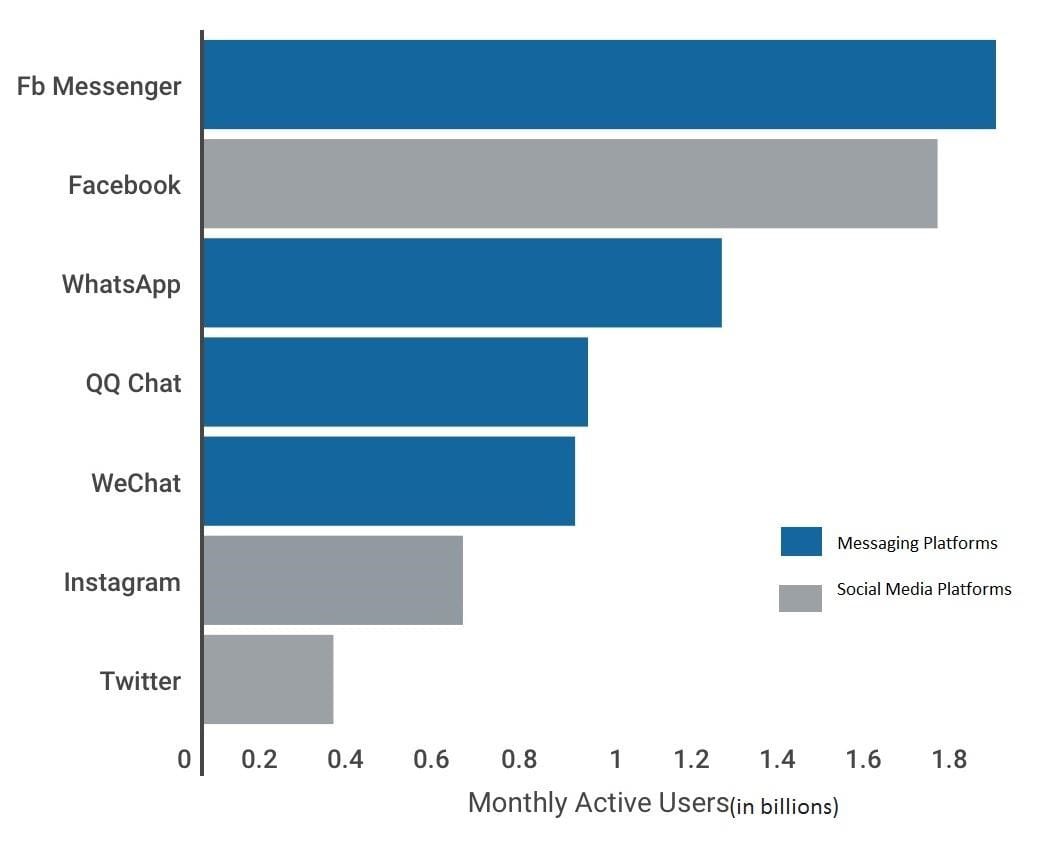
Data Source. Social Media vs Messaging Apps

We, humans, love texting, period.

If you play your cards right, presence on chat could significantly solidify your content marketing goals.

Countless brands, SMBs, celebrities, bloggers and digital marketers are already reaping the benefits of using Fb Messenger to market content.

As we’re shifting from social media to chat, it means only one thing for smart content marketers–another promising content promotion and distribution channel!

Using bots to power conversations

Whether you’re a business owner or a marketer, you want your content or products to get significant traction.

Nonetheless, you’ve got a zillion tasks on your content marketing to-do list and as much as you want to get in on a chat-based platform, chances are you don’t have the time to actually chat with all your prospects.

Shell out big bucks, buy live chat services and hire support agents?

If you’re going to hand over the controls of your online brand voice to someone else, a chatbot is your most reliable and cost-effective bet.

Chatbots can be trained to mimic us, they’re automated and can manage all our interactions on our behalf, in our absence. In essence, bots are the most efficient live chat agents you did not pay to hire!
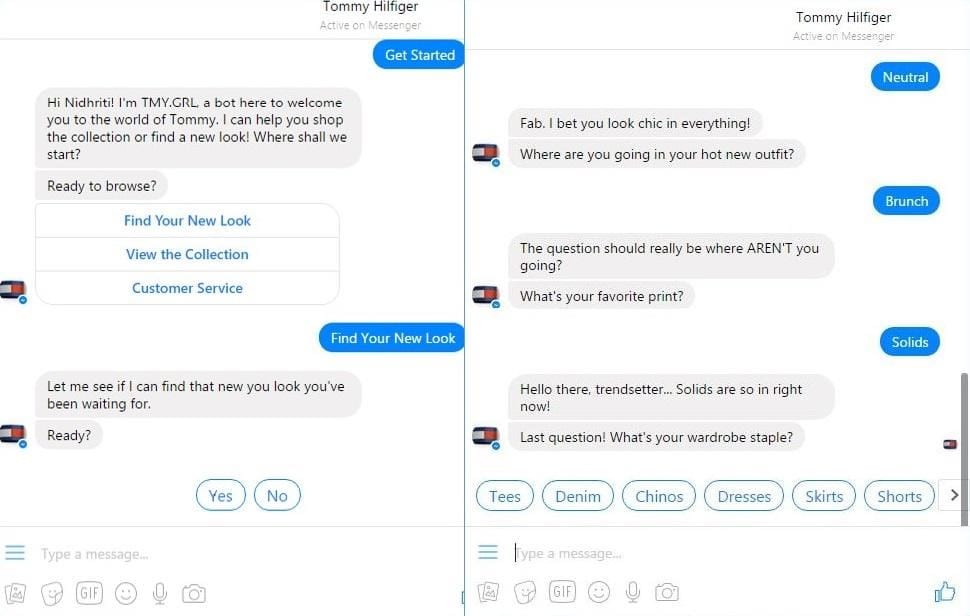
So what happens if you embed a bot into a platform like Facebook, Slack or Telegram?

For starters, YOU don’t actually have to sit online and chat with everyone. How?

They’re friendly and give instant human-like responses – either with plain text, visual snippets or a combination of both.

Bot Tip. Jump aboard the chat wagon to target audiences, start by creating a chatbot, the more information you feed into your bot the more accurate it will get, train it over time to make it smart.

2. Niche-specific quality content will dominate

Back in the day before Google rolled out its Penguin update, creating content meant creating a LOT of content. More content meant more organic search rankings which meant more traffic.

Today, over-saturation and ranking algorithms have made things different.

Readers are known to skim through. They want to read interesting, informational content and they want to read it fast.

In 2017, we’re going to see exceptionally specific pain-point driven content tailored to target clearly segmented and defined audiences.

Traction received by a niche blog post vs. a broader blog post

As shown in the image above, a more targeted topic like the one offering tips to increase engagement on Twitter will get you more views, likes and shares than a broader topic like the one dealing with engagement hacks for social media in general.

Chatbots serve relevant, high-value content

As opposed to blogs and websites, bots allow readers to skip the part where they need to go through a ton of content to find what they were looking for.

SEO Specialist’s bot on Bottr.me: No beating around the bush

On the contrary, chatbots allow readers to just ask, ask specific questions and get super relevant answers which is a key factor this year. Think of all the FAQs!

Any day better than leaving it up to them to discover valuable content, or worse - discover, lose interest and leave.

Chatbots generate content topics and ideas

In a bot-less world, to create an effective long-term strategy you’d probably design a well-thought out content roadmap. Typically, you’d start by figuring out who your target audience is, what their pain points are and how you could add value to them. Then you’d check any audience requests, using tools like UberSuggest, BuzzSumo, Social Mention, Google Trends, see what’s trending around your focus keywords, analyse interactions on Quora and the works.

Bots, on the other hand, simplify this whole process of planning.

Your readers interact with your bot in a Q&A conversational format to get valuable content.
Simply put, your chatbot knows exactly what your reader is looking for and if it doesn’t already have information to give, it will save all those pain points as unanswered questions.

From here, all you need to do is go over to your unanswered section, pick up those questions and create content around them. You can almost hear Chandler saying, “Could there be an easier way?”

Bot tip. Ditch the broad topics, dwell deeper into pain-points, and take your bot’s suggestions to truly understand customer pain points

3. Visuals always have and always will speak louder than words

Last year, visual content was supposed to expand ten-fold and it did. So much so, that we built entire social platforms around it (think Instagram and Snapchat).

Source. Types of content used by marketers last year showing the dominance of visuals

This year, videos alone are expected to represent 74% of all traffic online.

High-definition images and videos primarily work because they’re captivating, they stick and bring a level of transparency between business and their customers.

Besides, video pumps SEO juice and can get you search rankings way faster than written content can.

All in all, if increasing engagement and ROI is a key goal, you should dive into video marketing strategies right away.

Visually Rich Bots
UX matters and so does packaging.

Think of bots as your visual communicator if you will; they package images and videos into rich micro content cards.

These visually appealing cards are captivating, hard to forget and can be made clickable to drive traffic to say your YouTube channel for example.

An ingenious way to ace at video marketing, don’t you think?

Bot Tip. Focus on using the visual medium more to engage readers, Feed images and videos into your bot’s memory, let it do some magic and package your visuals into rich cards

4. Personalization will drive Engagement

As of now, businesses make the most of segmentation tools to divide, customize and target audiences, cash in on influencer marketing, hold hashtag contests, stay responsive on social media, all to boost engagement.

2017 is going to be a whole new ballgame. With competition and need for engagement increasing by the day, you will need to jazz things up further this year and make personalisation actually feel personal.

In practice, personalization will mean more than merely lacing email templates with people’s first names.

So if you thought, your subscribers felt special just to see pre-tailored emails addressed to them, think again!

Chatbots personalize with personality

Perhaps the biggest feather in a chatbots’ cap is its ability to personalise every visitor’s online experience.

First off, a bot not only recommends customized user-specific content but can also hold unique conversations with each and every visitor.

With a chatbot backing you, providing interactive “choose your own” type of experiences is easily achievable.

Trend Story's Bot in action: Uses unique personality to give advice

Bots preserve the style of chatting, personality, and online image by mimicking you while interacting with users. The possibilities!

Bot Tip. Give your chatbot a friendly tone and character, make sure not to make it sound robotic, don’t get overambitious.

In a nutshell:

Content marketing is arguably one of the most evolving forms of marketing as we know it. Staying up to date with trends, strategies, best practices and tips are easier said than done, especially since readers are getting fickle minded by the day.

Chatbots, in this case, are the new black. They will attract, engage and convert. Going by what each platform has to offer in terms of marketing scope, bots by far present possibilities of engagement and conversions like no other.

The cluttered digital space as we know it crowns content as king but the next two years will definitely shape how we consume it. What do you think? Can bots truly augment our marketing efforts? Feel free to express your thoughts in the comment section.

Abhimanyu is among top 100 global thought leaders in the bots space and Founder/CEO of chatbot platform Bottr.me - one smart identity to do things, better and faster. Prior to this he worked with 40+ startups across product & marketing and studied at London School of Economics and IIT.
12 Jun 16:42

All Deals Are Not Created Equal

by Anthony Iannarino

All the deals you make are not created equal. In fact, some are far more valuable than others. Some are worth far less than you might imagine, even if your client spends a lot of money.

Sales with no profit: These deals are empty calories. They have no nutritional value. You can’t execute for your clients without being a profitable business. Revenue is vanity, and profit is sanity. If you can’t make money, there is no reason to take the client. Listen, I know the logo may be great, and you may believe that they serve the strategic value of allowing you to win more clients, but you can net a few bucks and still land the client. If you can’t, that’s a sales problem.

Sales to nightmare clients: There is no reason to do business with bad people. There is no reason to work with people who do things that are illegal, immoral, or people who are generally miserable. They’ll mistreat you and your people, and they destroy your culture in the bargain.

Sales where the client didn’t really agree to change: There are some people who agree to move their business to you specifically because your competitor is terrible. Well, that’s what they tell you. What you will discover is that some people blame their partner for not being able to produce the results they need because they are unwilling to make the changes they need to make on their end. You pick up your end of the stick, and they refuse to pick up theirs.

Sales that take time and energy away from quality sales: There are some sales that take more time and more energy than they are worth. They prevent you from devoting your time and attention to bigger, better, more meaningful opportunities. You can spend as much time and energy winning a small deal as you can winning a big deal. It can also take the same resources to serve small clients, resources that will then be unavailable to your dream clients, once you win them.

Notice that transactional sales did not make this list. Even though you should be strategic, and you should be growing as a trusted advisor, transactional sales are not negative—only transactional behaviors are, and only when something else is needed. There are very high quality sales that are nothing but transactions, and there is some portion of transactional sales that are of low quality.

If you are going to sell anyway, you might as well invest your time and energy in high quality sales. You are a reflection of the clients that you serve.

The post All Deals Are Not Created Equal appeared first on The Sales Blog.

12 Jun 16:42

Why a national real estate crash isn’t in the cards

by Kevin Carmichael
houses under construction

Construction workers build homes on a lot in Vaughan, Ontario. (March Blinch/Reuters)

Ottawa didn’t handle the near bankruptcy of Home Capital Group Inc. all that well.

The authorities behaved like it was 1996, the last time a Canadian financial institution failed. They said little in public, while reportedly doing all sorts of prudent things behind the scenes. Meanwhile, flimsy parallels to America’s housing meltdown spread through international markets via Twitter; the instant-messaging functions on Bloomberg data terminals; and the financial press, which appeared a tad too eager to cover a crisis.

It came a month too late, but someone in Ottawa finally explained in convincing detail why Home Capital could never be Canada’s “Lehman moment.” At a press conference on June 8, Carolyn Wilkins, the No. 2 at the Bank of Canada, laid out all the reasons why a national housing meltdown is so remote.

“It’s quite tempting to draw parallels” with the U.S., Wilkins said. Debt is high and home prices are off the charts. Yet, “at the same time, when you understand what really led to the severity of the financial stress in the U.S., which actually went global in 2008 and 2009, it was related to a number of factors that are not present in Canada,” she said.

None of what Wilkins went on to say was revelatory. But she and her boss, Stephen Poloz, apparently thought it needed repeating. Poloz took the inevitable question about the U.S., and then handed off to Wilkins, who had come with notes on the subject. The list of factors that make Canada different from the U.S. in 2006 and 2007 is long, and Wilkins evidently didn’t want to forget one.

Those factors: American lenders were giving money to anyone, whereas Canadians must do much more to prove they can afford their payments; delinquency rates in Canada are extremely low; and Canadian laws punish anyone who tries to walk away from a loan, meaning “households have a greater incentive to hang on,” Wilkins said. Finally, there is none of the wild financial engineering that Wall Street undertook to profit off America’s housing mania at the turn of the millennium. “We have much less securitization,” Wilkins said. “It’s public and it’s plain Jane.”

The occasion for the press conference was the release of the Bank of Canada’s twice-a-year Financial System Review (FSR), an increasingly readable document that the central bank uses to flag weak spots in the circulation of cash and credit. Canada’s chief economic stewards remain concerned about debt and home prices in Greater Toronto and Vancouver. They say there is a “moderate” risk that housing prices in those places could drop abruptly because values long ago broke their tether with fundamentals. Yet, if that came to pass, the central bank thinks the damage would be regional, not national.

That conclusion is based in part by the recent experience of Alberta, where home prices sunk after oil prices collapsed. Canada’s big banks have binged on mortgages as much as anyone, but they aren’t one-trick ponies. Their various sources of income allowed them to treat Alberta’s troubles as a local issue, leaving borrowing standards unchanged for everyone else. The big banks represent an important buffer. As of the first quarter of 2017, the total value of all mortgages in Canada was about $1.5 trillion. A little more than half of that debt is insured, according to the FSR. That leaves a big chunk uninsured, and on the surface looks like cause for alarm. But most of that uninsured debt is held by one of the six biggest banks or a credit union. A mere 5 percent is owed to smaller banks and non-bank lenders. “Unlike the United States before the crisis, the portfolios and business lines of large banks are well diversified, and stress tests suggest that banks have adequate capital and liquidity buffers to weather a large house price correction,” according to the FSR.

Usually, the Bank of Canada doesn’t mind extra emphasis on what could go wrong. It has no regulatory authority over banks and other market participants, so psychology is the only lever it can pull when it doesn’t want to raise or lower interest rates. It publishes the FSR to make sure investors and regulators are paying attention to all the things that could go wrong. That’s why I’m sure the central bank won’t mind someone pointing out the one way that Canada resembles pre-crisis America.

In the years before Lehman Brothers Holdings Inc. went bankrupt in 2008, Americans turned their houses into cash machines. They borrowed against the rising values of their homes to renovate, buy cars, and purchase more property. The economists Atif Mian and Amir Sufi, whose work I referenced a couple of times recently (here and here), say the surge in home-equity loans factored into the pain that followed. Poorer borrowers couldn’t resist the temptation to finance material desires, blowing up the notion that owning a home is akin to forced savings. When prices collapsed, so did demand because too many consumers were stuck with debts worth more than their assets. Mian and Sufi argue that it was this “demand shock” that triggered the Great Recession, not the collapse of Lehman and other lenders.

Well, Canadians aren’t so different than their American cousins. The Financial Consumer Agency of Canada on June 7 released a study on the country’s newfound love of home equity lines of credit, which often are referred to by their ugly acronym, HELOCs. Their use has increased by 40 percent since 2011, according to the financial consumer agency. That is exactly the kind of rapid increase in debt that tends to precede a recession, according to Mian and Sufi. The agency commissioned a survey that found 720,000 families would struggle to make payments on their home-equity loans if interest rates rose by a mere 0.25 percent, and almost one million would be in trouble if borrowing costs rose a full percentage point. “The product’s characteristics may increase consumers’ vulnerability to over-borrowing, debt persistence and wealth erosion,” according to the financial consumer agency’s report.

When parallels are drawn with the U.S. housing collapse, it’s more that the emphasis is misplaced, not that the comparison is invalid. It would take a lot to topple Canada’s banks, and the country’s housing bubbles are too concentrated to trigger a national calamity. But there is a very real risk that Canada is facing the same sort of stagnant-to-barely-mediocre economic growth that the U.S. has endured for much of the past seven years. Like America before the recession, Canada’s post-crisis economy runs on household debt almost exclusively. A credit binge can help an economy burn hot for a while, but it never lasts.


MORE ABOUT HOUSING MARKETS:

The post Why a national real estate crash isn’t in the cards appeared first on Canadian Business - Your Source For Business News.

12 Jun 16:42

51 Startup Mistakes to Skip [Infographic]

by lee@leebartlettbestseller.com (Lee Bartlett)

How easy it would be if the startup you created was guaranteed to succeed -- free from all the competition and harsh realities of the business world?

Sadly, that can only exist in your dreams. If you truly want your startup to succeed, you need to work harder and smarter than the rest. The reason is that when you create a startup, you have no idea what you don’t know.

As a result, you’re going to face some tremendous hardships. However, there are some principles involved which can make your life easier.

First, come up with a great business idea and then a business plan. Note that your business idea should be in sync with the type of entrepreneur that you are.

If your business personality doesn’t match your business idea, decide what needs to change so that you have the necessary qualities required to run your desired business. After you have a solid business idea, next up is making the business plan. And check out the essentials of starting a business here.

Second, make sure you don’t commit any of the following 51 newbie entrepreneur sins. I spoke with a lot of entrepreneurs, business owners, and small business experts on what they thought were the biggest mistakes most entrepreneurs commit with their startups. Here’s what they had to say.

Loading...

Loading...

12 Jun 16:42

9 Ways You're Projecting Insecurity Over Email

by afrost@hubspot.com (Aja Frost)

Projecting Insecurities in Sales

  • Writing Too Much
  • Apologizing
  • Using Too Many Emojis
  • Using Exclamation Marks
  • Going Too Far with Flattery
  • Using Wishy-Washy Words
  • Writing in Caps
  • Sending Emails Over the Weekend
  • Following Up Too Quickly

Insecurity is poison to a sales relationship. If your prospect picks up on any anxiety or self-doubt, they’ll lose respect for you -- and more importantly, they won’t believe your recommendations are valuable.

So what can you do to project confidence? It’s tricky, especially because in sales you often go from feeling like a champion to a failure in single week (sometimes a single day).

One of the easiest areas to tackle is email. Prospects can’t see your face or hear your voice, meaning following these suggestions will instantly make you seem confident. Here are seven things making you appear insecure and how to fix them.

1. Writing too much

Emails that go on and on scream insecurity. After all, if you believe your message is powerful and compelling, you don’t need to write a book.

Next time you’re sending an email for the first time that’s three-plus paragraphs, stop and pick out the most compelling point. Delete the other sections. You can send these in follow-up emails. (As an added benefit, this makes your messages more varied and gives the buyer a reason to keep opening them.)

Just make sure you don’t leave out the call-to-action -- that's one of the most important parts of your message.

2. Apologizing

Do you begin emails with lines like:

  • “Apologies for contacting you out of the blue.”
  • “Hope I’m not bothering you.”
  • “I’m sorry to trouble you.”
  • “I know we haven’t met, but …”
  • “Hopefully you don’t mind me reaching out.”
  • “I know emails like these can be annoying, so I’ll get right to the point.”

These lines are usually used with good intentions: Reps want to show consideration for their prospects. However, starting with an apology implies you don’t think you’re worthy of the buyer’s time.

If you believe in your product’s value, and you’ve done some basic qualification to ensure your prospect is a potential fit, then you’re not wasting their time. You’re helping them.

3. Using too many emojis

Emojis can add personality to your email and make it a little more memorable. But it’s easy to go overboard. If every line has its own symbol, you’ll look like you’re trying way too hard.

How many emojis is too many? It depends on your market. In many conservative industries, just one smiley face would be completely inappropriate. Yet someone in an informal, modern industry tends to be far more receptive.

Factor in your company brand as well. If it’s playful, you can be playful too. If it’s relatively buttoned-up, reign in the emojis and smiley faces.

My final recommendation: When in doubt, leave it out. You can always wait and see what your prospect does. If they use a smiley face or emoji, you’re free to use one too.

4. Using exclamation marks

I admit, I used to have a real exclamation mark problem. Any time I wrote an email without one, I worried I came across as cold.

But then I realized most of the emails I got from other people didn’t include exclamation marks, and I wasn’t reading them as rude. Those messages simply seemed professional

Now, I never use exclamation marks. They’re never necessary -- especially not in a sales context. You sound 10 times more composed and sure of yourself when you’re not ending any sentences like this!

5. Going too far with flattery

Reps often throw in phrases that highlight their prospect’s intense work schedule. That includes statements like:

  • “I’m sure you’re busy …”
  • “As [title], you must have a lot on your plate …”
  • “I know your schedule is probably jam-packed …”
  • “Is there any way I could borrow just a few minutes of your time?”
  • “You can’t have much extra time, so I promise I’ll be quick.”

Unfortunately, prospects interpret these lines as: “You’re busy, and I’m not.” You lose a lot of authority in their eyes. If your time isn’t in-demand, your product must not be, either.

To avoid this, stop mentioning how busy your prospects must be. Come out and ask for their time instead.

Here’s a revised CTA:

“I have some recommendations around X. Are you free at [time] on [day] to discuss them?”

6. Using wishy-washy words

Words that weaken your statements will make you seem less confident. To illustrate, here’s a watered-down line:

“I think your company may be able to benefit from [solving X, doing Y].”

Using “I think” or “may” would be fine, but both in the same sentence sounds like you’re totally unsure.

Read through your email for wishy-washy language like:

  • “Just”
  • “Maybe”
  • “Potentially”
  • “Might”
  • “I think”
  • “I believe”
  • “I’m guessing”
  • “I suspect”
  • “I have a hunch”
  • “I’m not sure, but …”
  • “I could be wrong, but…”
  • “It’s possible that …”
  • “There’s a chance …”

Remove these terms when possible. Obviously, you don’t want to make promises you can’t keep or statements you can’t back up -- saying “You could be losing $20,000 per year” is preferable to “You’re losing $20,000 per year” unless you can definitively prove the latter.

7. Writing in caps

You might be confused by this point: Doesn’t using CAPS LOCK make your message (and by extension, you) seem more important?

In fact, it does the opposite. Capitalizing entire words comes across as overly aggressive -- as though you don’t trust your message to sound urgent on its own.

Compare these two email subject lines:

  • How ReadQ can hire engineers 3x faster (URGENT)
  • How ReadQ can hire engineers 3x faster

Which would you be more likely to open? Probably the second. It seems less spammy and more legitimate.

There’s almost never a justifiable reason to use caps lock in a sales email, so pretend this button on your keyboard doesn’t exist.

8. Sending emails over the weekend

Think you'll save your prospecting 'till the weekend? Think again. Sales pro Jeff Hoffman warns, "The only thing a lead or prospect will think when they see your email arrive in their inbox at 10:30 a.m. Sunday morning is that you’re not successful enough to enjoy your weekend free of work." He continues, "And why would they want to work with an ineffectual rep?"

While email open rates and click-through rates over the weekend are historically low, that doesn't mean you should take advantage of an empty inbox to reach out to your prospects.

Hoffman puts the last nail in the weekend prospecting coffin saying, "You also risk them thinking your email was sent by mistake, as part of a mail merge or email campaign, which removes their obligation to respond."

9. Following up too quickly

When conducting email outreach, it's important to get your cadence just right -- and make sure you're sprinkling in a healthy number of calls and voicemails as well.

Sales expert Jeff Kalter warns against following up too quickly, however, "Equally dangerous to your sales outcomes, is to communicate with contacts nonstop. Such outreach is unlikely to meet your prospective customers’ needs and can also reek of desperation."

Desperation will immediately turn your prospect off. Instead, take a scientific approach to call cadence timing and touchpoints. You can find more of Kalter's tips for the perfect sales cadence here.

When it comes to sales, fake it until you make it. You might be a brand-new SDR or a recent hire and nervous behind your computer screen, but there’s no reason your prospects have to know that. An assertive email will help you capture their interest, build credibility, and down the line, win the deal.

HubSpot Free Sales Training

12 Jun 16:41

How to Sell from a Position of Strength

by Gerhard Gschwandtner
I rarely hear of salespeople being taught to think and act as if they are running their own business. They are not taught to be responsible for understanding and managing the “cost of sales” and to consider each transactional step in the selling process an equitable exchange of value in the progression toward a purchase decision.
12 Jun 16:41

Transforming Today’s Bad Jobs into Tomorrow’s Good Jobs

by Zeynep Ton
Jun17-08-533765769

All eyes are on the future of work and the impact that automation and machine learning will have on U.S. jobs. The blizzard of conferences, initiatives, articles, and reports on how to prepare for the changes technology will bring to our economy is important. But so is today — and it feels to us like the futurists are leaving behind what’s happening now.

Work currently does not work for millions of Americans. Nearly 11.5 million people who work as retail salespeople and cashiers and in food prep and service — the three largest occupations in the United States — earn poverty-level wages and have unpredictable schedules, few opportunities for success and growth, and little meaning and dignity in their jobs. These workers have bad jobs, and they need and deserve good jobs now, regardless of who’s going to be doing what in the future.

But in fact, transforming these bad jobs into good jobs is a good way to prepare for that future. Keep in mind that many retail and restaurant jobs require nonroutine manual labor, physical dexterity, and social interaction, which, according to MIT researchers Daron Acemoglu and David Autor, are less amenable to automation. But let’s say that automation really does reduce retail and restaurant employment. Good jobs stores and restaurants will do better in leveraging that automation — as well as better serving their customers, employees, and investors today. Here’s why.

Developing Skills that Will Matter in the Future

Thought leaders and futurists name complex problem solving, critical thinking, and creativity as the most important future job skills. But at good jobs companies, these very skills are already demanded, developed, and put to use.

Companies that offer good jobs today — with decent wages, predictable schedules, and opportunities for success and growth — do so by combining investment in people with operational choices that increase their employees’ productivity and contributions. We call this approach the Good Jobs Strategy. One of the key choices they make is empowering employees to make decisions to benefit their customers and involving employees in improvement.

For example, Mercadona, a good jobs retailer that’s Spain’s largest supermarket chain, uses its employees’ creative and problem-solving skills to suggest product, packaging, and transportation improvements that have already saved the company millions of euros. Mercadona’s store employees are empowered to order products and present them in a way that satisfies their customers and improves company performance.

At Costco, another good jobs retailer, store managers are empowered to display merchandise and provide input into the merchandising system. A merchandising algorithm does provide insight into what should be stocked, but the store managers are on the floor every day, putting their own and their employees’ problem solving, critical thinking, and creativity — the skills of the future — to work today. When that future comes, who will have the competitive advantage?

Seeing Automation as a Complement to People

The Good Jobs Strategy enables companies to make the most of their employees’ full potential. So good jobs companies are less likely to focus on machines replacing workers and more likely to focus on machines as a valuable complement to their valuable people.  When one of us visited Mercadona’s fully automated distribution center, the director said, “Its construction was based on one premise: Don’t make a person do what a machine can do. The only effort we want from our employees is for them to give us their skills and their knowledge.”

When asked about automation in retail, a good jobs company CEO who recently visited our class at MIT said he saw automation as a force multiplier. Right now, his employees do many tasks (such as mopping floors and counting change) that don’t directly add to the customer experience. If robots can perform these functions in the future, his employees can focus that much more on providing even better customer experience. “Anyone’s employees can mop a floor,” he said, “but not every company trains and supports their staff to provide excellent customer service.” He knows his company already has a competitive advantage — its frontline workers — and that automation will only increase their value.

Indeed, as our colleagues Erik Brynjolfsson and Andrew McAfee argue in their book The Second Machine Age, humans working hand in hand with machines do better work than either does by itself. Chess-playing computers can now beat even grandmasters like Garry Kasparov, but in so-called “freestyle chess,” human-computer teams beat computers. So if Amazon’s new cashier-free test store succeeds and eliminates the need for people to count change, good jobs companies — including their frontline workers — will probably be delighted!

Ability to Implement New Technologies

A company that engages its workforce now will not only provide good jobs and good customer experience today but also will be best prepared for whatever the robotics revolution brings. It’s easy to forget that technology rollouts require an engaged frontline. Even in the future, robots won’t just walk in the door, wave to the old employees on the way out, and get to work. Customers will need to be educated and supported along the way to greater efficiencies. Systems that work in labs and boardrooms will have hiccups in stores that require troubleshooting. Collaborative, productive, empowered employees will be best equipped to help companies roll out new innovations. They will gain new skills in the process, a win for everyone.

In fact, rollouts have sometimes gone badly — not yielding the expected benefits on very large investments — partly because the frontlines were not involved in the process. For example, when Bob Nardelli became the CEO of Home Depot, he started investing heavily in systems and technologies. In 2005 alone, Home Depot spent $1 billion on automating merchandising and store processes. But these changes, sensible in themselves, were accompanied by reduced investment in associates and were largely forced on the associates and store managers. Many of the systems either failed or fell short of their promised impact due to mismanaged rollouts, lack of user training, or because of lack of fit to in-store needs — in part because store associates were not involved.

Mercadona, on the other hand, spent €600 million between 2005 and 2008 to install the most up-to-date logistics and in-store retail technologies, and the rollout went smoothly because their workers were engaged in the process. Nobody was laid off — so the workers didn’t see the new technology as the enemy. They were well trained in the new technology and had the time — as well as the autonomy — to help customers get used to it. It helped that as part of its Good Jobs Strategy, Mercadona has a laser focus on the customer and the new in-store technologies were developed not just to increase efficiencies but also to make the customer experience better.

So despite a large expense and no downsizing, Mercadona’s productivity went up. Sales per employee went from 179,142 euros in 2005 to 232,260 euros in 2008. That is what the Good Jobs Strategy is all about — now and in the future.

12 Jun 16:41

Innovating in a Highly Regulated Industry Like Health Care

by Naomi Fried
Jun17-12-518638797

When I was Chief Innovation Officer at Boston Children’s Hospital, I often felt that my title should have been Chief Innovation Communication and Relations Officer. In any firm, an innovation program cannot be effective without building bridges within the firm. But, in highly regulated industries, such as healthcare delivery, pharma, banking, and insurance, good relationships and effective communication are especially vital.

Innovating in highly regulated industries can be challenging. But it is necessary, because even firms in these industries must innovate to gain competitive advantages and thrive. For innovation to flourish despite legal and regulatory obstacles, you must address innovation barriers head-on. Here are a few tips based on my experience:

1. Build relationships proactively with internal regulatory and legal folks. That’s right. Seek out—don’t avoid – the staff responsible for legal, regulatory, and compliance within your organization. Innovators sometimes think they are better off steering clear of these gatekeepers and guardians for as long as possible. That’s a big mistake. You can’t avoid working with these folks, and if you don’t find them, they will come and find you.

Insight Center

Talk to your legal, regulatory, and compliance colleagues early, well before your innovation is ready. Discussing your project at the beginning of the innovation lifecycle, when the stakes are still low, gives them time to digest the new idea and provide input and guidance while the idea can still be shaped into an innovation.

When I was Chief Innovation Officer at Boston Children’s Hospital, my team realized our doctors could use videoconferencing to care for critically ill patients in small community hospitals. Our legal department, however, greeted the idea with scowls and skepticism. The lawyers were worried about patient consent, physician licensure, medical liability, and a long litany of other legal and regulatory concerns.

Eventually, after many intense conversations, they came on board. In fact, once our “Teleconnect” program launched, the attorneys actually became some of the most enthusiastic internal advocates for the program.

Sometimes, however, resistance is strong. When that happens, should you circumvent the lawyers and appeal to the CEO? Going above the lawyers can break an impasse. But it also can damage relationships, and make it harder to gain legal or regulatory approval the next time around.

Instead of doing an end-run around your legal and regulatory people, continuously emphasize to them why and how your innovation is important to the business. Explain that killing the project isn’t a good option because it hurts the organization. When the lawyers understand the benefits, they will find ways to drive the innovation forward.

2. Find a champion within your legal or regulatory departments who is interested in innovation. Recruiting a legal or regulation expert who will champion innovation lends internal credibility to your project and can help you navigate not just your organization, but also your industry.

To find this innovation ambassador, be open. Your legal innovation champion could be a far-sighted junior attorney or a seasoned lawyer.

At a biotech company where I worked, my regulatory champion on a social media initiative was a relatively new lawyer. He had joined the company recently and was thoughtful, caring, and interested in exploring the possibilities of social media. He created a useful bridge to other regulatory experts in the organization.

3. Frame conversations as discussions. By asking questions and exploring hypothetical scenarios, you can change responses from legal and regulatory folks from “no” to “yes, but…”

For example, asking “How can we…?” rather than “Can we…?” encourages thinking about how something can be accomplished despite existing restrictions.

At Boston Children’s Hospital, when we began planning our first hackathon, people were concerned about who would own any intellectual property generated at the hackathon. When the question was reframed during a series of discussions, outside innovators and the hospital found common ground and a way to share the IP.

4. Communicate broadly and repeat yourself. One of the most impactful things we did to drive innovation forward was to set up regular monthly meetings we set up with our legal team at Boston Children’s Hospital. This gave us the time and space to discuss emerging issues calmly and collaboratively. While it’s great to have informal check-ins, nothing beats regularly scheduled meetings for ensuring legal, regulatory, and compliance partners are up-to-speed–and on board with your plans.

Similarly, we also had monthly fora where we shared progress on innovations that were underway with a broader team of stakeholders. As Chief Innovation Officer, I also continuously made rounds to all the clinical departments to provide updates and information to the doctors and nurses there. We produced an annual innovation report, which proved an effective way to disseminate information about our progress on a yearly basis. Holding annual “innovation days” provided us with a platform for innovators to share their exciting work. Highlighting the outcomes of prior innovation laid the foundation for future innovation.

Effective, broad internal communication is vital when innovating in any industry, and even more so in heavily regulated ones. Why? In regulated industries, folks throughout the organization – not just legal, regulatory, and compliance experts – may worry about innovation-related risk.

5. Tackle “folk law” head on. In regulated industries, there are clearly industry rules that need to be followed and laws to be aware of. However, there are also often gray areas where the law is unclear. Innovation frequently occurs in that uncharted territory, where regulations may not be well-defined. In the absence of clear laws and regulations, people tend to rely on “folk law.”

Folk law is simply the way things have always been done. Even though folk law is often based on mistaken assumptions, it is treated as if it were an actual regulatory constraint. Folk law develops based on what people are familiar with and comfortable doing. Once restrictions are identified as “folk law,” moving past them becomes easier.

Folk law at a biotech company where I worked dictated that executives couldn’t tweet. Our legal team was extremely uncomfortable with the idea. Once we began to discuss the reasons for their discomfort, it became clear their concern was rooted in the fact that none of the executives had ever been active on Twitter. The folk law that “executives can’t tweet” disintegrated once it was poked and prodded. Soon after, the regulatory team issued a set of internal policies and guidelines around the use of Twitter by employees.

6. Track the competition. Legal and regulatory folks are not always comfortable having their organization be the first to innovate and chart new territory. However, when in-house legal and regulatory experts can see how other organizations in the same industry are innovating and pushing the envelope –and how regulators respond– they often then become comfortable with their own organization following these other leaders.

There is a sense of “safety in numbers.” Tracking how your competition is innovating and sharing it within your organization can help you make the case for innovation with your internal legal and regulatory experts.

7. Be patient. Innovating in regulated industries takes longer than in other industries. People are more uncomfortable with innovation in regulated industries. They are quicker to raise red flags and barricades. But you still can innovate successfully. Involve those people early, while they can help shape the project, and be patient.

Expect setbacks. Innovation is rarely easy, especially in regulated industries. But it becomes easier when you treat legal, regulatory and compliance colleagues as assets rather than as adversaries. With time and patience, and by involving legal, regulatory and compliance folks early, you too can bring innovation to a highly-regulated industry.

Regulated industries need time to adapt, and they need to understand innovation, its risks and benefits. Don’t get discouraged when there are setbacks. (I’ve been there!) Instead, be patient and focus on the ultimate goal. And communicate, communicate, communicate.

A version of this article initially appeared on Innovation Leader.

12 Jun 16:41

How You Should Engage at These 7 Points in the Customer Lifecycle

by Ernan Roman Direct Marketing
Article by Ernan Roman
Featured on CustomerThink.com
Here’s how Fran Horowitz-Bonadies, chief executive officer, Abercrombie brand/Hollister & Co. describes consumer communication in 2017:
"For the past year, we spoke to one-and-a-half million consumers on what they are looking for in their shopping experience… There’s been almost a 180-degree turn on making sure we keep the customer at the center of everything we do. It’s been [our] most important singular focus…"
But, it’s not only about keeping customers at the center of your communication and engagement strategies. Research findings from thousands of hours of VoC research conducted by our firm, ERDM, indicate that customers want unprecedented levels of personalization at 7 very specific points in their lifecycle with a brand. Think about how savvy customers are to identify the following points where they want brands to engage;
• Purchase
• Onboarding
• Reach out when you see Decreasing Engagement
• A Poor Experience
• Surprise & Delight / Thank You
Value Added Cross Selling
Value Added Repeat Sales.
However, to deepen relationships at these key points, brands must shift to truly relevant and value-driven communications. Per the research, traditional transaction / persona / implicit data based communications are not viewed as relevant.
Using the 7 VoC research-based lifecycle points, here are ways that marketers can add value to communications.
New Purchases and Onboarding—You Need to Become Part of the Consumers’ Lifestyle
Bacardi Limited Chief Marketing Officer Mauricio Vergara recently noted:
"We need to get our brands back into culture, so we’re moving away from a traditional marketing model of talking to consumers to really being part of their lifestyle…If we are true to that philosophy of being part of their lifestyle, a brand that they actually relate to in their day-to-day life, we cannot just be present in the high-selling moments… It’s been a learning process…but we’re definitely seeing the payback."
When You See Decreasing Engagement/Poor Experiences – You Need to Understand How to Win Back Trust
V. Kumar, a marketing professor at Georgia State University outlined in a Harvard Business Review article, the key factors marketers need to keep in mind when attempting to win back lost consumers, "Too many companies go after whoever they’ve lost, throwing all these offers at them, hoping something will work," Instead what he recommends is fully understanding which group of lost consumers will yield the best bet to come back and not depart again, then crafting an offer or message that is compelling to that segment.
Here is what the study advises: "firms will be more efficient if they focus on people whose prior behavior suggests a predisposition to return. The researchers found that customers who have referred others, who have never complained, or who have had complaints that were satisfactorily resolved are the best bets. Reasons for leaving are also predictive: Customers who canceled because of price are more likely to come back than those who left because of poor service, and people who cited both reasons for quitting are the least likely of all to return."
For Cross Selling/Thank You/Repeat Sales – Use Value Added and Emotional Engagement to Strengthen Connections
Recently, Yeti — a manufacturer of coolers used primarily for outdoor and camping pursuits — decided to open their first retail location. But, rather than building a transaction based store, the brand decided they wanted an experiential, emotional, connection-building brand immersion. The brand noted, the goal was less to "find a way to sell a lot of coolers to people who come inside and more to create a permanent brand activation that allows people to interact with Yeti in ways that they’ll hopefully take with them in the future."
Corey Maynard, Yeti’s Vice President of Marketing explains "It’s meant to be much more of an immersive Yeti experience…than it is to be a transactional space… Yes, we’re selling coolers…but it was much more important to us that people could have fun with the Yeti brand and see it brought to life …than just be a place that’s driven by transaction." Tony Kaplan, YETI Director of Consumer Experience "YETI’s flagship is not a typical retail store… [it is an] authentic experience that allows our customers to interact with the YETI brand in a whole new way."
In summary, think about the 7 stages in the lifecycle which emerged from the research and see how many opportunities exist for you to deepen your relationships with customers!

12 Jun 16:40

MORGAN STANLEY: The 'one market' that can make Tesla the most valuable company in the world (TSLA)

by Seth Archer

Tesla CEO Elon Musk

Tesla's stock price is already high, but not high enough for CEO Elon Musk.

Musk thinks Tesla can reach the heights of Apple as the most valuable company in the world, but it won't get there on the backs of its new Model 3, solar business, or autonomous truck, Morgan Stanley said in a note to investors.

Instead, the bank views transportation services and related data-centric fields as the key to a bright future for Tesla. "In our view, there’s only one market big enough to propel the stock’s value to the levels of Elon Musk’s aspirations: that of miles, data and content," Morgan Stanley wrote. 

After a recent ballooning in the price of tech stocks, the Wall Street firm was interested in finding which industries could "move the needle" for huge tech companies with market capitalizations approaching a trillion dollars, and moving people and goods around is a ripe target.

Advances in artificial intelligence and increased progress in autonomous cars have made the auto and transportation industry ripe for disruption, with potentially huge windfalls for tech companies getting in on the mobility market, Morgan Stanley said. For example, the firm said Google's Waymo autonomous vehicle program could be worth as much as $70 billion if it controlled even just a 1% share of the global autonomous driving industry.

Luckily for Tesla, the company has already begun work on its autonomous driving technology. The company recently updated its autonomous steering and parking software and plans to release an autonomous tractor-trailer. If Tesla is able to continue this progress and capture as much at 5-10% of the market for autonomous cars, the company could expand its business dramatically.

Capturing the market for mobility services would require a lot to go right for the company, but it has announced plans to launch an autonomous ride-hailing service, in the vein of Uber or Lyft. Details of the service are expected later this year.

Morgan Stanley thinks the high price of Tesla' stock price means currently announced technologies are already priced in. The company traded at a -75.18 price to earnings ratio in 2016 because it burns through cash so quickly, but the current price has been justified by investors that expect the Model 3 sedan to sell well and bring the company into positive cash-flow territory, according to Morgan Stanley.

Morgan Stanley increased its bear case from $50 to $175 and restated its price target of $305 and bull case of $550. Tesla is currently trading around $361 and is up 67.9% so far this year.

Click here to watch Tesla's share price move in real time...

tesla share price

SEE ALSO: Tesla is trading at all time highs

Join the conversation about this story »

NOW WATCH: An economist explains the key issues that Trump needs to address to boost the economy

12 Jun 16:40

How to Vet Influencers for Your Next Campaign

by Alex Ditty

The importance of knowing who you’re working with

influencer_marketing_vetting_whitelists

Whether it’s controversy from an influencer, or different approaches to vetting, influencer vetting has been making headlines recently. As marketers continue to increase their investment into influencer marketing, more are understanding the right and wrong ways to engage their audiences and the importance of proper vetting.

Most recently, the conversation about influencer evaluation has revolved around the concept of “whitelisting” influencers. Essentially, a brand or agency collaborating with a limited list of influencers that they already trust. This practice stems in part from fears of influencer talent “going rogue” or not following the content guidelines of the campaign appropriately.

Brands know the value of influencer marketing, which is why they continue to invest in the tactic. But at the end of the day, it requires placing your brand and its message into the hands of a stranger. So there is a definite need to put protections in place and to establish trust with the influencer. Marketers have turned to these “whitelisted” influencers as a way to reduce those risks.

So the question is, how do you vet influencers? And is whitelisting the best solution?

How to vet influencers

Learn about the influencer.

The first step in vetting an influencer is to learn as much as you can about their account. Whether or not their followers match with your targeted audience is one of the most important deciding factors of success for the campaign. Demographic details such as perceived household income, age, race, and gender can be overlooked when evaluating an influencer, but are all important factors for the audience that’s viewing their content. Additionally, you’ll want to gain an understanding of the influencer’s professional status. You can set expectations for their posting and activity with the campaign based on whether they’re an everyday person doing influencer marketing as a side hustle or a professional who posts for their livelihood. You may find more reliability with the experienced professional influencers, but everyday influencers can provide better authenticity with their posts. Look at all of their available accounts to learn as much as possible about the influencer. Study their previous brand work to determine if you would be happy with those same results.

Determine how their posting style fits your campaign

You’ll also want to evaluate the influencer’s posting style. Admittedly, this is a bit of a subjective test. Different people could assess the influencer’s photo quality and style differently. What’s important here is that you get an idea of how the influencer’s posting style matches the style you’re looking for in the campaign. Scrolling through their feed will give you an idea of the types of photos and videos that they’re sharing. Then, dive deeper into the specific content types to determine which posts receive the best engagement. Are these top-performing posts indicative of the content you’d like created for this campaign?

influencer_identification_metrics.png

Frequency of promoted posts

Keep an eye out for the influencer’s other branded posts It’s usually a good idea to stay away from influencers who share promoted posts too often as your content may get lost in their stream of advertising or seem insincere among so many competing branded posts. Some marketers try to completely stay away from influencers who share about competitors, but that isn’t always necessary. Competitor posts can function as reinforced credibility that the creator really is a fan of that type of product or service. If you’re trying to promote a new fashion line, don’t be afraid of tapping a particular influencer just because they’ve previously shared about another fashion brand. Your brand will fit in line with their follower’s expectations. The most important part here isn’t whether they are sharing competitor posts, but rather, how their followers are responding to these posts. If the audience responds negatively to promoted content, it may be a good idea to find another influencer. The best rule of thumb is: if your product is a natural lifestyle fit for the influencer and their endorsement is believable, there shouldn’t be audience backlash.

Solutions for Marketers

Now that you know how to properly vet influencers, the next step is to learn how to manage those influencers and what resources are available to you to execute the influencer program.

Whitelists

As we mentioned earlier, many marketers are using whitelists to keep track of reliable and relevant influencers to work with. These help marketers simplify the recruiting process by starting with a narrowed list. However, whitelists require you to have experience with influencer marketing and assume that you are familiar with the influencers who are realistic, smart options for your brand.

Agency partners

Marketers also turn to agency partners to help fulfill their influencer marketing programs. When you partner with an experienced agency, you’re able to rely on their knowledge and expertise to both identify the right influencers and validate their relevancy with your program.

12 Jun 16:39

8 Interactive Content Statistics to Guide Your Marketing Spend in 2017

by Robbie Richards

A decade ago, interactive marketing was something we only saw in Hollywood films and video games.

GIF showing the use of interactive content in a Hollywood film

Oh, how things have changed!

In just one interactive content campaign, Zenni Optical generated 29,410 conversions and over $1,000,000 in revenue. But that’s just the beginning. This success, and many others like it, was not a product of some kind of V.R.-enhanced magic we saw in the animation above.

Zenni Optical used a 9-minute quiz, which was, certainly, beautiful and well-produced, but far from “high-tech”. It was a simple campaign almost any business could launch in a day with the right tools. This effectiveness across all stages of the buyer journey, coupled with the relative ease of execution has resulted in 53% of content marketers using interactive content to influence the buyer’s journey.

Sounds promising, right? Right – and yet, why are almost half of content marketers still hesitant to take the leap and start using interactive content – quizzes, calculators, interactive videos, knowledge tests – regularly? This is because interactive content is commonly perceived as complex and expensive to use. To a marketer or manager that’s already challenged by their content schedule, it’s just an extra burden – at least at first glance.

In fact, if you’re trying to pitch interactive content to a client or your own team members, you’re likely to run into some resistance. This is the case for any new technology – and interactive content is no exception. Having said that, this branch of marketing is new – but not so new that there’s no data on it. To help overcome some of these common barriers, we have compiled a list of eight interactive content statistics that definitively show how useful and valuable it can be.

These facts and figures can act as the leverage you need to persuade your organization, a client’s marketing team or your superiors to take a chance on interactive content.They show how the small risks are outweighed by massive potential returns – increase awareness, better educate and engage buyers, and capture more qualified leads for sales teams.Use the statistics to help sell, or justify, your investment in interactive content.

Interactive content generates 2x more conversions than passive content (Kapost)

Effective marketing is ultimately about making money. Not in the sense that marketing always has to drive sales, of course. What really matters is guiding users along a sales funnel or customer journey, and the above statistic illustrates why interactive content shines in this department. So does the following quote by Crazy Egg’s Sherice Jacob:

Interactive marketing focuses less on an immediate sale and more on building a relationship with customers.

88% of marketers say interactive content differentiates them from their competitors (Business2Community)

70% of B2B marketers are creating more content than they did one year ago. I mean, every single day marketers release over 2 million blog posts. These are vast numbers – and its just the tip of the iceberg. It’s fair to say that the internet is flooded with content. And, we’re not just talking static blog posts here. Other channels are becoming equally saturated.

Probably the best example of this is the explosion of video content. People are now publishing over 300 hours of YouTube videos each minute, tallying over 49.3 years of video per day! Some of it is outstanding, some – sub-par, but all of it creates a torrent of noise that makes it hard for users to find and engage with your content. One solution is to use interactive content to create a two-way communication channel with your readers that helps you cut through the noise, better engage readers, and separate yourself from the competition.

Buzzfeed gets over 75% of it’s Quizz traffic from social media (Mashable)

Quizzes are one of the more addictive and shareable forms of content out there. To give you an idea of just how shareable, consider that just one BuzzFeed quiz has been viewed over 22 million times, and liked over 2.5 million times:

"What city should you live in?" - outcome quiz

(Source)

The lesson is that even simple interactive content can enrich your marketing efforts dramatically.

There are many different quiz types marketers can use to engage and capture reader attention. However, there are two main types:

1. Graded quizzes – these give you a score you can then share on social media.
2. Outcome quizzes – these quizzes give an outcome, like the one above recommending which city you should live in.

Both quizz types appeal to our primary desires – the need to know more about ourselves, and show others how awesome we are. Newspapers and publications regularly used graded quizzes to enable readers to show how intelligent they are (and by extension, associate that level of intelligence with reading their paper). As you can see, this simple interactive content type drives massive engagement for publications like Washington Post:

Examples of successful quizzes published by the Washington Post

Crazy , right? Well, outcome quizzes blow those numbers out of the water! In fact, they are consistently the most shared quiz types:

Most shared quizzes in Buzzsumo

SnapApp’s clients have seen over 300% increases in engagement with quizz content. The next stat we’re going to cover is…

Interactive content generates 4-5x more pageviews than static content (LinkedIn)

The biggest challenge for over half of B2B small business marketers is creating engaging content:

Graph showing top challenges for content marketers

And: More than 4 in 5 marketers agree interactive content is an effective way to engage users. This is important because consumers’ attention spans are getting shorter; a recent Microsoft study found them to be 6 seconds long, 50% down from less than 20 years ago:

Human attention span now shorter than a goldfish

(Source)

Interactive content is the key to cutting through the noise and grabbing users by the proverbial eyeballs. This is one of the things that prompted Kissmetrics’ Barry Feldman to say:

Interactive Content is Where the Action Is Now

But engagement isn’t the only area in which interactive content shines. It’s also a powerful educational tool, as you’re about to see in the next point.

93% said interactive content is somewhat or very effective at educating the buyer, versus just 70% for static content (Inc)

Educating consumers is the foundation of any successful content marketing strategy. If you’re not providing valuable information, your audience won’t move further down the funnel, there’s no incentive for users to trust you as a brand – right? Since interactive content is over 33% more effective at educating buyers, it’s easy to see how it can improve your marketing.

From interactive infographics and data visualizations to interactive videos, there’s a lot of ways to improve engagement and data retention:

Educating the audience was the #1 reason for using interactive content

– Content Marketing Institute

And one of the reasons why investment in interactive content is projected to see double-digit growth as we head towards 2018…

88% of B2B marketers said at least 10-30% of their content would be interactive by 2018 (DemandGen Report)

A lot of marketers are jumping on the bandwagon – 99% ramped up or sustained their use of interactive content between 2015 and 2016. And, that trend looks set to continue into 2018.

The takeaway: The numbers don’t lie. There is a reason more marketers are incorporating interactive content into their campaigns, and ramping up that investment each year. There may be no better time to start experimenting with the medium. In the next few years, interactive content will get a lot more sophisticated and competitive. So, get on board now!

79% of marketers agree interactive content has reusable value, resulting in repeat visitors and multiple exposures (Business2Community)

Only 32% of marketers think they are creating enough content, which means a whopping 68% of marketers believe they’re falling short. But, you don’t have to start from scratch every time you start developing a new content strategy. Instead, it makes sense to repurpose your most successful static content into interactive forms that generate twice the conversions.

Many of the interactive content types – like “Inception Explained” – can be used as lead generation and sales tools for up to 5 years. This means that interactive assets are perfect moving pieces for marketing funnels. They don’t need to be swapped out, updated, or replaced very often.

Interactive content is the future of your funnel
– Marketo

It’s also worth noting here that different types of interactive content can be used to increase conversions in the early, middle and lates stages of the sales funnels. For example, while quizzes are great for generating awareness, they are not effective at the end of the sales funnel. Conversely, calculators can be used effectively across each stage of the funnel.

Graph showing different use cases of interactive content at each stage of the sales funnel

Now, you may be thinking: this is all well and good, but this interactive stuff still seems pretty complex. Can I really succeed with it as a small or medium-sized business? The short answer is yes! And, here is a statistic to support the increased accessibility of interactive content.

91% of B2B buyers prefer to consume interactive and visual content (DemandGen Report)

While there are differences in the strategic approach to B2C vs B2B marketing campaigns, the line is becoming more blurred. At the end of the day, B2B business decisions are made by B2C consumers. This means all the regular challenges – content overload, short attention spans, and improved buyer education – are still at play. In fact, many will argue interactive content is more important in the B2B space.

In an article by DemandGen Report, Brian Anderson lists 3 key reasons why B2B need to apply a B2C mentality for better engagement and personalization:

  • Buyers expect information now, as well as expecting modern, digital interactions in a B2B environment.
  • Buyers don’t buy in isolation anymore. They leverage networks and online communities.
  • The business landscape is changing from local to global. Need to go after a global landscape.

Basically – B2B organizations need to understand what the customer is actually looking for. And, since 60% of B2B buyers have already made their purchase decision before ever speaking to a sales person, it’s critical that marketers are publishing engaging content that quickly educates the reader. The best way to do this is by using visual, interactive content types to create a two-way dialogue (not a one-way monlogue) between your brand and the user. This means enabling user to directly engage with your content and get a personalized outcome.

Let’s Recap:

The 9 interactive content statistics shown above have taught us:

Interactive content…

  1. Helps increase conversions
  2. Differentiates your content marketing
  3. Increases engagement
  4. Captures reader attention
  5. Educates readers more effectively
  6. Gaining traction amongst marketers
  7. Preferred by B2B decision-makers

The question is, what are you doing about it?


Most of our clients used to have the impression that interactive content is highly complex and you needed 5, 6, 7 and 8-digit marketing budgets to make it happen. And while money is certainly helpful. It is by no means a “deal-breaker”. There are numerous highly effective, inexpensive (or free) ways you can start incorporating interactive content into your startegy today. Here are five to get the wheels turning:

Interactive PDFs and whitepapers: Use this free tool to turn your static PDFs into interactive lead generation machines.

Quizzes: A quiz isn’t much different from a static blog post. You still take the same text content and images and/or videos; the main difference is doing a little extra research and programming during production.

Interactive visuals: Animated images, when combined with text, are a very simple way to create interactive content – and they deliver many of the same benefits as, say, a virtual-reality enabled content ecosystem.

Utilities: From calculators to automated SEO appraisal tools, giving people utilities that benefit their business is perhaps the single best way to make low-cost interactive content.

Knowledge tests: This kind of content can be entirely text-based, which makes it easy to produce and release. These more formal alternatives to quizzes are a favorite of content thought leaders like HubSpot.

Interactive videos: SnapApp makes it easy to create interactive video experiences – just upload your video and quickly add interactive features like buttons and opt-in forms to the video. If you’re on a small budget, or in the middle of a pilot project, you can also use YouTube’s features to make simple interactive video content.

Here are several more interactive content types worth exploring.


12 Jun 16:39

Sales Enablement Isn’t Just Another Tool for Your Sales Stack

by Matt Wesson

The SaaS market is poised to surpass $112.8 billion by 2019, according to IDC research. That’s more than the annual GDP of the country of Morocco! It’s a big number, but if you’re in the B2B arena it’s easy to see why that estimated growth is going to be pretty accurate.

Technology tools have become a ubiquitous part of modern business. When a new strategy or project is assigned to a business manager, their first reflex is often to look for a tool to help them accomplish it. And the SaaS market is growing so rapidly, managers rarely come up empty handed.

However, there are certain strategies that can’t be accomplished with the simple addition of a new tool. They require a shift in the way you’re currently conducting business, even if it’s just a small one. Sales enablement is one of these strategies.

What is Sales Enablement?

The research firm Forrester may have the best description I’ve seen for sales enablement. Forrester defines sales enablement as “A strategic, ongoing process that equips all client-facing employees with the ability to consistently and systematically have a valuable conversation with the right set of customer stakeholders at each stage of the customer’s problem-solving life cycle to optimize the return of investment of the selling system.”

Sales enablement is becoming more defined and more prevalent all the time.  More and more companies are implementing a dedicated sales enablement function within their organizations. According to CSO Insights in their 2016 Sales Performance Optimization Study, 32.7% of survey respondents said they had a dedicated sales enablement function.

32.7% of survey respondents said they had a dedicated sales enablement function.

What it Requires

Why has sales enablement become so popular in recent years? The answer has everything to do with the modern buyer. Today’s buyer has more information, higher expectations, and more choices. Sales enablement helps prepare, enable, and guide a sales team to meet that more sophisticated buyer by ensuring they have the best content for every stage of the sales cycle.

It’s tempting to think of sales enablement as the creation of content, but it’s really more about distribution. Many companies have little trouble producing content in high volumes. But SiriusDecisions research shows that up to 2/3 of that content may go unused.

95% of buyers choose a supplier that provided them the right content throughout the buying process.

-DemandGen

Sales enablement is focused on fixing distribution and visibility problems, which is crucial for companies to do. According to a DemandGen Report, 95% of buyers choose a supplier that provided them the right content throughout the buying process. Sales enablement matters.

How to Do it Right

So, sales enablement is on the rise and can be a big factor in a company’s success. How do you go about solving for it? While there are dozens of sales enablement tools to store content and make it accessible to your sales team, it’s important to assess the existing platforms and processes of your sales teams.

Change is hard for any team, especially a sales team that has their energy and focus on the job 24/7. That’s why the sales enablement strategies that work best aren’t always the shiny new third party tools, but the clever inclusion of content into existing workflows and platforms.

SalesLoft, for example, provides the ability for our users to not only add content to the platform, but surround it with the context and information required to send it to a prospect. This can take the form of entire emails, saved as team templates for the entire organizations to use, or shorter snippets teeing up an ebook or pricing information.

Regardless of how sales enablement takes shape in your organization, it’s important to consider using the platforms and strategies you already have in place before purchasing a new tool to add to your growing tech stack.

Sales enablement success isn’t about getting the sales organization to adopt a new product or workflow, it’s simply about getting  them to use that other 2/3 of valuable content that is currently gathering dust.

The post Sales Enablement Isn’t Just Another Tool for Your Sales Stack appeared first on SalesLoft.

12 Jun 16:39

THE B2B PAYMENTS EXPLAINER: Why business payments have been slow to digitize, and what's changing that in 2017

by Jaime Toplin

slide1

This is a preview of a research report from BI Intelligence, Business Insider's premium research service. To learn more about BI Intelligence, click here.

As the world around us digitizes, payments are no exception. The way we manage money and make payments has moved from physical channels, like cash and checks, to digital methods, like cards and online platforms. And though that’s been a long-term shift, it’s one that’s occurred rather seamlessly. 

This isn’t the case for businesses, where the business-to-business (B2B) payments process is considerably more complex, and as a result, almost entirely analog for the majority of businesses. When businesses pay one another, like transactions between a supplier or a buyer, the process is cumbersome, involving invoices, waits of 30-to-120-days, multiple banks and platforms, and phone calls. And when those payments happen overseas, even more friction is involved, like letters of credit.

That makes payments a top pain point for sellers and buyers alike, because the existing process is cumbersome, expensive, and often unsafe. And though digital solutions exist, until now, they’ve been too costly and complex to be accessible to the majority of merchants, particularly smaller businesses — the population that’s hurt the most by the challenges of the existing system. 

However, the tides are beginning to turn, and barriers preventing firms from digitizing their B2B platforms are slowly starting to erode. Business payments are finally catching onto consumer payment trends, though it’s still a slow process. As consumer technology becomes more available, back-end innovation is becoming simpler, and cheaper, for payments companies. And as consumer-side digital payments adoption begins to stagnate as the market saturates, B2B is becoming an increasingly palatable greenfield for companies looking for a new, lucrative market.

A new report from BI Intelligence addresses what’s been holding firms back, why they’re moving forward now, and what they stand to gain from making their payments processes digital. It will also discuss potential approaches for moving into the space, and why there’s no “one ideal” B2B payments solution.

Here are some of the key takeaways from the report:

  • The business-to-business (B2B) payments market is a vast opportunity. In the US, B2B payments reached an estimated $18.5 trillion last year, vastly outstripping the consumer-to-consumer (C2C) and business-to-consumer (B2C) realms.
  • The complexity of B2B payments is holding back innovation, but times are beginning to change. Consumer payments innovation and a vast greenfield opportunity are making the space more accessible and more appealing to payments firms, which is translating to broader market availability for merchants.
  • But until digitization permeates all stages of the complex B2B payments process, and allows those disparate segments to work in tandem, we won’t see any major steps towards an industry standard

In full, the report:  

  • Sizes the B2B payments market relative to other major US payment segments
  • Explains how the B2B payments process works, and what makes it so complicated relative to consumer payments
  • Discusses the pain points associated with analog B2B payments
  • Analyzes the factors behind eroding barriers to industry digitization
  • Evaluates what it will take to eventually build up an industry-wise digital payments standard

To get your copy of this invaluable guide, choose one of these options:

  1. Subscribe to an ALL-ACCESS Membership with BI Intelligence and gain immediate access to this report AND over 100 other expertly researched deep-dive reports, subscriptions to all of our daily newsletters, and much more. >> Learn More Now
  2. Purchase the report and download it immediately from our research store. >> Purchase and Download Now

The choice is yours. But however you decide to acquire this report, you’ve given yourself a powerful advantage in your understanding of B2B payments.

Join the conversation about this story »

12 Jun 16:39

Key Influencer Marketing Trends for 2017

by Expert commentator

Why influencer marketing will go from strength to strength this year

If you thought influencer marketing was big in 2016, you thought wrong. At its core, Influencer Marketing is about to explode this year. This year, marketers are doubling down on their influencer marketing efforts, increasing their budgets to include the tactic as a strategic piece of their overall marketing mix. With newer types of marketing methods being introduced each day, influencer marketing is likely to stay in the limelight.

A recent survey has it that around 84% marketers have at least one influencer marketing campaign planned for 2017. Simply put, the Influencer marketing is a type of marketing that focuses on using key leaders to drive their brand’s message to the larger market segment. In other words, it helps you concentrate on the central figures in marketing rather than focusing on marketing as a niche. These key leaders can be anyone from A-list celebrities to Instagram stars and Vloggers. Influencer marketing relies on technology; whereby influencers are expected to spread the word through their personal social channels.

There is no denying that traditional ads are no longer as appealing to consumers as they once were. With so many ads popping out on print, electronic and social media, consumers are left with no choice but to ignore or block them. Unlike traditional ads, influencer marketing is proving its value as an effective marketing tool. Whereas conventional ads are no longer as effective because ad blockers are becoming increasingly popular and easy to use. The same applies to social media and pay-per-click ads that can be avoided through ad blockers. 47% online consumers are using ad blockers and this is set to rise, so the advertising model has to change.

Influencer marketing leverages the popularity and trend-setting power of influencers. For example, you saw your favorite celebrity sharing a post in which she mentioned buying her favorite jeans and affiliation to that particular brand. The next day, you went out to buy the same brand thinking that it would be cool. Influencer marketing is having a critical impact on brand marketing. The trend is being followed by not only big celebrities, but also by small boutiques and businesses. They’ll not shy away from spending money on an influencer having a thousand followers.

Obsessed with my new @fashionnova jeans 🍑Get them at FashionNova.com 😍 #ad

A post shared by Kylie (@kyliejenner) on

Influencer Marketing Trends That will Dominate in 2017

In the 2000s, social marketing was the hot trend, then came content marketing and today, it is influencer marketing. After all, nothing influences a person more than another person, and what could be more influencing than famous celebrities? The core theme behind influencer marketing is to get individuals with a fan following and make them endorse your brand. Sounds simple, doesn’t it?

Influencer marketing is further aided by the fact the online consumers are preferably keeping a distance from most forms of ads. As such, influencer marketing is the perfect way of marketing your service without making them feel offended. So much so that most online consumers gladly participate and become a part of influencer marketing campaigns.

The beginning of 2017 has seen many consumers relying on social media and reviews when buying a product, eating at a restaurant or even places to visit. But, things began to favor influencer marketing several years ago. Back in 2015, Lord & Taylor, a well-known department store collaborated with 50 Instagrammers and asked them to post a picture of themselves wearing a specific dress on a specific day and in exchange, the Instagrammers would be receiving a $1000 - $4000 incentive.

As a result, the campaign reached a total of 11.4 million Instagram users, with about 328,000 brand engagements on Lord & Taylor’s account. This specific dress was sold out in no time. Though this was an advertising and paid incentive, none of the buyers cared, and still bought the dress anyway. Seeing the trend, Adweek predicted that influencer marketing would likely dominate the digital marketing arena in 2016. 2017 will be no different, as the trends will likely expand to other industries as well. Here are some of the top influencer marketing trends to watch out in 2017:

Influencers Or Celebrities?

You might be following a person on social media that you find intelligent, humorous, or loveable. Other followers may be following the person for reasons known to them. In fact, like you, most people may or may not know of his/ her profession, and despite that, they follow. Do you know if your favorite person is a celebrity or not? Likewise, some people may be following a star without knowing the fact.

The big difference between an influencer and a celebrity is easy to judge from their respected levels of engaging with followers. A celebrity was known even before social media. Whereas, an influencer is respected for being herself/himself. Both have the ability to push forward your brand to their respected followers.

Branded Content Will Make Its Way

In all likelihood, branded content will increase, much as it did in the case of TV commercials. They started as necessary commercials but later rivaled soap operas regarding entertainment. One wonders whether the commercial will lose its viability for consumers. After all, people used to see such long, boring commercials on TV all the time. According to Max Polisar of the Awesomeness TV says that presenting a great show is all that viewers care. They don’t mind how long the show goes as long as it stays relevant and interesting. It is all about telling a worthy story to consumers.

Nativity Will Increase

When it comes to influencer marketing, nativity is the name of the game. Renowned influencer marketing platform Blogmint predicts that influencer marketing is not just here to stay, it will increase it reach coming years. Make no mistake about its effectiveness as it is already going an as the favorite hot medium to promote online brands and products by several entrepreneurs.

With up to 60% of online businesses in its fist, influencer marketing is going just one direction i.e. upwards. As such, marketers now realize that nativity is the prime factor that can lure in more market share for years to come. By 2017, this percentage will likely increase to up to 75% if everything goes as planned.

Research Is The Key

Influencer marketing requires plenty of research before you think about getting involved. For starters, there is the identification phase of your campaign. Make sure you don’t pay full rates for the campaign. Though entrepreneurs would love to have complete control over the campaign, it is often not possible. Also, keep an eye on content quality and strategies to engage many customers among other metrics commonly used marketers.

Despite this, it is a must to experience a degree of caution before proceeding with your influencer marketing campaign. As many smart marketers would do, maintain a clear and concise focus on your goals, plan the attack accordingly and ensure it stays within your budget. Also, don’t overlook the importance of micro-influencers. These can be of prime importance if your campaign is targeting a very specific set of audience. Micro-influencers can be quite handy for marketers who prefer their campaigns to be location based.

Influencer marketing is a powerful tool, brands are also able to receive exposure to a wider audience and will allow brands to promote a particular product indirectly. When working with influencers, it’s a way for the brand to build trust and credibility because many of these influencers have already built a loyal following that both trust and look up to them for advice or tips on fashion, food, and overall lifestyle. While you are at it, do ensure that you are honest in your approach and expect the same from your campaign manager. The only way your influencer marketing will meet all your goals will be if both parties involved work with devotion and honesty.

There is no denying that influencer marketing is here to stay and will likely change how we do global marketing in years to come. Though it will take some time to reach there eventually, early signs are a testament to its inevitable, overwhelming success in the online business world.

Not Convinced Yet?

Influencer marketing is the real deal. Influencer marketing is taking over typical advertisements. Think about it for one second, when was the last time you sat through a commercial without bringing out your phone? While you wait until your favorite show comes back on, you scroll through your Instagram or Facebook feed, and without even knowing, you still see advertisements. Your favorite influencers, which you already follow, are reaping products and promoting brands, while still staying true to their unique voice and story.

Overall, influencer marketing is something a brand or business should start (if you haven’t already) investing to be successful this year. Influencer marketing benefits not only the brand but also the influence as well. The brand has the opportunity of getting their campaign message heard by an engaged audience while also reaching out to a group of new consumers. While the influence can be creative and should enhance visibility.

This is just the beginning; influencer marketing will only continue to grow at the fastest speed during 2017. So you better start planning a strategy and start building your influencer network!

Usman Raza is a marketing specialist at Crawford and O’Brien and Headset Zone. Aside from doing SEO, when not working he enjoys spending time with his family. You can follow him on Twitter


12 Jun 16:38

3 Proven Ways to Get Customers to Say, “Yes!” to a Success Story

by Rachel Foster

Title Image of customer profiles and a hand holding a mobile phone with text bubble saying yes!

Creating case studies should be at the top of your “to-do” list if you need content that turns B2B leads into customers.

According to a Content Marketing Institute study, B2B marketers called customer testimonials and case studies the most effective type of content.

Meanwhile, nine out of ten B2B buyers said that online customer success content has a major impact on their purchasing decisions.

Although case studies are effective, you may struggle to get them produced. Many B2B marketers have a hard time finding customers who are willing to share their stories.

Why Customers Say “No” to Success Stories

You’ve probably heard many reasons why customers won’t participate in a case study.

One of the most common reasons is that it’s against their company policies. They may need to adhere to regulations that make it impossible for them to discuss their challenges and successes publicly. Or their legal teams might say veto all case study requests, as they don’t like to disclose their third-party vendors.

Some companies say “no” to success stories because they want to keep their internal processes, technologies, and best practices private. They fear that their competitors will read about what they are doing and then steal their ideas.

Other customers may believe that they are too busy to take part in a case study. They often think that the process is long, complicated, and too much work.

In some of these instances, your customers might agree to a case study if you don’t name their company. But a case study without names and direct quotes can appear phony. It’s better to put your “nameless” customers on hold and find others who are happy to share their experiences.

How to Find Happy Customers Who Will Say “Yes” to Case Studies

You don’t need to go far to find your most satisfied customers. Here are five places to look:

  1. Ask your sales and customer service reps for the names of the people who are the most excited to work with you.
  2. Find out who is raving about you on social media.
  3. Search your email for messages from customers who love your software.
  4. Check third-party review sites to see who gives you the highest ratings.
  5. Make a list of customers who give you referrals and references.

Speech bubble showing customer testimonial and profile picture

The ideal time to ask a customer for a success story, case study, or testimonial is right after they recommend you. If they are sharing the love in public forums, such as on social media or third-party review sites, they will be more likely to say, “yes” to a feature story.

3 Keys to Getting Your Customers Excited About Sharing Their Successes

Many B2B marketers approach case studies from a “what’s in it for me” perspective. They want great content that will fill their editorial calendars and drive sales.

But you also must consider what’s in it for your customers.

Here are three secrets to getting customers to say “yes” to your case studies:

1. Show them the benefits of helping you.

Let your customers know that you will do everything you can to make them look good. For example, you can help them:

  • Display their thought leadership. A case study can highlight a customer’s expertise. They can share it on their blog and on social media to show how they have successfully overcome common challenges in their industry.
  • Gain recognition within their companies. They can show their boss the case study as proof of the great things they are doing for the business.
  • Build their personal brands. They can post the case study to their LinkedIn profile and receive recognition from their peers and future employers.

Company logo with trophy and a thumbs up

2. Address their concerns.

Your customers will want to know how you will use their success stories. Be sure to send them a release form that describes all of the details. Also, send them samples of your other case studies so that they can visualize their final story.

3. Make it easy for customers to take part.

Let your customers know that they won’t need to devote tons of time to your case study. Aim to keep their interview around 45 minutes. Also let them know that your copywriter will create a draft, so they won’t need to do any time-consuming writing. After the interview, the only thing your customer will need to do is review the story and get final approval.

Be sure to send them their interview questions in advance. Some customers are comfortable speaking off-the-cuff but others will want to prepare answers.

Also, let your customers know that you will ask for numbers related to their return on investment during the interview. That way, they can look up the data in advance and won’t need to dig around for additional information after the interview. This will also help you complete your case studies faster, as you won’t need to wait for vital ROI statistics.

Finding customers for your case studies doesn’t have to be a headache. Start with your most vocal advocates and make it easy for them to take part.

It won’t be long before you have a catalog of case studies that helps you turn leads into customers.

12 Jun 16:37

3 Reasons Sales Enablement Roles are on the Rise

by Brian Fravel

Many of us now have jobs that probably didn’t exist when we were kids, or at least, the way we work has changed dramatically due to technology and other factors. The booming market for sales enablement professionals is one of those growing professions. According to LinkedIn, hundreds of job openings are available in this emerging field, but what exactly does this role entail? And how does adding this role make companies more successful?

The research firm Forrester, defines sales enablement as “A strategic, ongoing process that equips all client-facing employees with the ability to consistently and systematically have a valuable conversation with the right set of customer stakeholders at each stage of the customer’s problem-solving life cycle to optimize the return of investment of the selling system.”

The sales enablement function is becoming more defined and includes a variety of solutions. CSO Insights has found that an increasing number of companies are implementing a dedicated sales enablement function. In the 2016 Sales Performance Optimization Study, 32.7% of survey respondents said they had a dedicated sales enablement function. That was up from 25.5% of respondents in the 2015 SPO study and 22.6% in the 2014 SPO study.

There are three key reasons this role is gaining importance:

1. Buyers approach purchases in a new way

Buyers now do a lot of the purchasing research before they ever talk to a salesperson. A research study by Gartner suggests that by 2020, buyers will manage as much as 85% of their purchases without talking face-to-face with a salesperson. Salespeople don’t have the luxury of following a standard, static sales process. They need to be prepared to deliver value and have a conversation on the buyers terms.

Sales enablement helps train, coach, enable and optimize the sales team to meet today’s more sophisticated buyer. In addition, sales enablement teams ensure that sales reps have the content they need no matter what the sales stage. With technology, sales enablement teams can even deliver the content, coaching and training virtually, anytime, anywhere.

2. Content Takes Center Stage

B2B marketers have been focused on content creation to deliver leads for a number of years. Many companies also see the value and importance of sales content throughout the sales cycle. With more and more content being developed, it’s up to the sales enablement team to make sure the right content is 1) created; 2) easily found by sales team and 3) valuable and used by the sales team. However, SiriusDecisions research shows that as much as 2/3 of content goes unused. Sales enablement teams are the ones tasked with fixing those problems, because as a DemandGen Report found, 95% of buyers choose a supplier that provided them the right content throughout the buying process. Armed with the right content, a seller can better sell value and help the buyer.

3. The Need for Sales and Marketing Alignment

Organizations of all sizes have a tendency to create silos when various departments are not communicating or working together. For years, marketing built the brand and drove demand and then sales took over from there. There was a lack of alignment between the two and a lack of accountability to revenue in the marketing department. That is rapidly changing and often the sales enablement function acts as the glue between sales and marketing and is responsible for making sure they stay aligned.

In addition, sales enablement roles use sales and marketing analytics, to optimize training, coaching and content to improve sales rep performance. Exceptional company leaders recognize that the path to growth encompasses more than just sales or just marketing alone. In 2011, Aberdeen Research released a report in which they showed that companies that were superior in aligning marketing and sales experienced an average of 32% growth in annual revenue, compared to a 7% decline in organizations that were lacking this alignment. In Aberdeen’s most recent (2013) report on the subject, they reported that 26% of companies say they’re prioritizing increasing marketing’s visibility into the sales pipeline.

The growth in sales enablement as a key function in organizations is undeniable. The number of people with “sales enablement” in their title on LinkedIn has skyrocketed in recent years. The newly formed Sales Enablement Society is growing rapidly and forming chapters all over the United States. They describe the evolution to be similar to how the CIO position grew out of data processing, or how the CFO role evolved from bookkeeping. The Society (after much debate) is suggesting that a similarly senior role be titled Head of Sales Productivity since many companies treat it as a multi-faceted business function.

Whatever you call it, those that embrace sales enablement first are sure to grow their business. Research from Marketo and Reachforce found that when sales and marketing teams are in sync, companies became 67% better at closing deals. It is no wonder that sales enablement is on the rise.

The post 3 Reasons Sales Enablement Roles are on the Rise appeared first on OpenView Labs.