Shared posts

04 Jun 16:59

Best Practices for Keeping Your Email List Nice and Clean

by John Jantsch

Best Practices for Keeping Your Email List Nice and Clean written by John Jantsch read more at Duct Tape Marketing

If you’ve been in business for a while, you’ve likely built up a quite a long email list. Email remains a convenient, effective way to reach prospects and customers, so it’s great to have a lot of names to send offers and updates to.

However, if your marketing emails are getting low engagement, it may start to raise eyebrows with internet service providers (ISPs). If you continue to have issues with your email list, ISPs will block your emails from ever reaching your customers—even those who are still excited to hear from you.

That’s why it’s important to keep your email list neat and clean. Sending emails only to those who are engaged and happy to be on your list will ensure better open rates and a greater return on your marketing efforts.

If you’ve let your list get to a scary place, now is the time to tidy it up. Here’s how you do it.

Look at Your Bounces

The first place to start when you’re cleaning your email list is to see where it stands now. Take a look at your bounce rates. Email marketing services will pull reports that show you hard and soft bounces.

A soft bounce is an email address that they were temporarily unable to reach. It may be because their server was down, or some other short-term issue. These addresses don’t need to be removed from your list right away, but do know that if the soft bounce continues week after week, it will become a hard bounce and then should be addressed.

Hard bounces are for email addresses that cannot be reached permanently. It might be because the email address has been closed (this happens a lot when someone signs up with their work email and then leaves the company). It may also be something that you can fix on your end, like a typo.

If the hard bounce is something you can fix, you should fix it and otherwise leave the name on your list! If the hard bounce isn’t something you can control on your end, remove that email address from your list.

Check for Typos and Role Addresses

As I mentioned above, a lot of typos in an email list can have an effect on bounce rate. Some typos are obvious and easy to catch—for example, email addresses with “gamil.com” instead of “gmail.com.” Others require a little more digging to fix. For example, you’re not necessarily going to know how a person’s last name or company name should be spelled, but there are ways to identify these issues. Cross check the spelling of their name across information in your CRM database. If their last name is spelled one way in the name section, but then spelled differently within their email address and the email is bouncing, you can assume that the email spelling is incorrect and instead switch it to the spelling reflected in the other portion of the form.

You can also turn to a service like ZeroBounce to eliminate bad email addresses. Their technology scans for and removes invalid emails and spam traps from your list.

Role addresses should also be removed from your mailing list. These are emails that are “support@” or “info@.” These are addresses that are easy to scan for and remove, and eliminating them can have a positive effect on your standing with ISPs.

Opt-In Messaging

Once you’ve gone through your existing email list and cleaned things up, you want to take steps to keep your list in good shape. That starts with opt-in messaging.

For people who sign up via your website, provide them with a double opt-in prompt as they’re entering their information. This means that they’ll click on the “Sign up for our mailing list” button, put in their information, and then receive a second prompt—”Yes! Sign me up for this list”—which they’ll have to click to confirm enrollment. Asking people if they’re sure they want to register will keep those who are on the fence from even getting on your list in the first place.

You can take the same approach with names who have been dormant on your list. You shouldn’t delete them right away on your own, but you can check in with those people who have not read your emails in some time. Send them a re-opt-in message. This gives them the chance to choose to remain on your list. If they do remain, this re-opt-in will perhaps reinvigorate their interest in your list and get them opening messages from you again. If they choose to go, that’s okay, too! They’ve done some of the work of scrubbing your list for you.

Create a Welcome Email

Sometimes people sign up for a new email list and then promptly forget that they’ve done so. A week later, they get the first email from the company and say, “What is this doing here? I didn’t sign up for this!” Suddenly, they’re reporting your email as spam. Get reported as spam often enough, and you can get dinged by ISPs.

That’s why it’s good practice to send a welcome email. Thank your new subscriber for signing up, tell them what they can expect from you going forward, and give them an opportunity to opt out now, in case they’ve already changed their mind.

Better yet, consider establishing a welcome journey series, focused on getting them to a sale even more quickly. No matter what route you choose to take with the welcome email, it will help to manage expectations for both you and them, and allows you to keep your email list clean from the start.

Send Regular Emails

Once you have a list of email addresses you know are valid, from people who are excited to be there, it’s up to you to stay in regular contact!

Setting a regular schedule for your emails keeps your fans engaged and open rates high. People who really want to be on your list will be excited to see your content, offers, and updates on a regular basis. If you only send emails once in a blue moon, it’s possible that even those who like your business will ignore it or question why they’re on your email list.

Sending regular emails is also a great way to weed out those who don’t really want to be there. When a customer or prospect regularly receives an email from a business they’re not excited to hear about, it’s more likely to drive them to unsubscribe. While having someone leave your list may seem like a bad thing, it actually saves you from having to do the work of identifying them as unengaged subscribers and removing them on your end.

Segment Your List

Another great way to keep subscribers happy and engaged is to segment your list. Segmentation means that people will get the content that’s most relevant and important to them, which will keep them opening and reading your mailings.

There are a number of ways to segment. One is by stage in the customer journey. You can provide your best repeat customers special discounts, sneak peeks at new products, and other fun bonus offers. Another is by past purchase behavior. Let’s say you own a toy store. A customer who’s purchased toys for babies in the past likely won’t want information about the newest board games or Lego sets, but they would like to hear about the latest car seat toys.

In the world of email lists, it’s quality, not quantity, that wins out in the end. Building and maintaining a clean list, filled with subscribers who are happy to be there, will help you to decrease your bounce rate, increase your open rate, stay on ISPs’ good sides, and get the most out of your marketing efforts. A tidy email list is a win-win-win, so set aside some time this summer to clean things up and set yourself up for email marketing success.

04 Jun 16:56

What is Your Customer’s Minimum Viable Problem?

by Bob Apollo

Minimum Viable Problem

The concept of a Minimum Viable Product is common in the start-up community. It is normally regarded as an initial release of a product that has just enough features to satisfy early adopter customers and provide feedback for future product development.

The concept has parallels in the case of your customer’s Minimum Viable Problem. This is a business issue, opportunity or threat that is significant enough to justify action, but manageable enough to allow a straightforward buying decision.

This is a particularly critical concept for many B2B sales organisations who are faced with opportunities that initially appear to have momentum, but which subsequently fail to convert because of one of two important reasons…

  1. The underlying business problem was never actually significant enough to justify the necessary investment – and so the project as initially defined turned out to be a non-starter
  2. The problem was significant enough to justify action, but subsequent “solution creep” meant that the decision making and approval process – whether because of the budget required or the number of stakeholders who became involved – became so labyrinthine that achieving a short-term consensus for action became impossible

Like the ancient myth of Scylla and Charybdis, finding a path between these two extremes requires exceptional navigation skills.

If, despite our best efforts to make the case for change, the initial business problem simply is not large enough to justify an investment, there is a natural tendency to try to make the problem bigger – but this very often also involves additional functionality that comes with an additional cost.

If we’re not careful, this can result in a runaway “arms race” in which the problem to be solved is progressively expanded and which – in addition to requiring a larger and potentially more expensive solution – often brings new stakeholders into the decision loop.

Sales people can be tempted to follow this path in order to try and maximise the initial potential customer order size, but this strategy brings obvious risks, particularly if this takes the project cost over an internal approval threshold, or if it brings new people with potentially differing opinions or priorities into the equation.

If the customer’s problem does not appear to be initially significant enough, my guidance is to fully explore all the implications and consequences – good and bad – of the currently defined problem.

Remember that studies of buying psychology demonstrate that decision makers are 2-3 times more likely to take decisive action to avoid a pain than they are in the hope of achieving a gain. Be sure that you have explored all of the negative implications of sticking with the status quo – don’t just focus on the upside of change.

And remember that a smaller, easily justified investment can bring your potential customer on board faster and with less fuss than trying to maximise the initial sale. Assuming that your initial solution delivers on your customer’s expectations, there will always be plenty of time to develop the relationship and substantially expand on the initial order.

The most successful strategy appears to be to target, identify and address your customer’s Minimum Viable Problem first – and then build upon your success.

So – what are your Ideal Potential Customer’s most obvious Minimum Viable Problems? How can you identify, engage and qualify them? How can you make a compelling case for change? How can you get all the stakeholders on board? And how can you make the buying decision a simple and straightforward “no-brainer” for your customer?

04 Jun 16:54

68% of US CEOs think their companies will go bankrupt if they move too slowly. Here's what they see as the biggest opportunities and risks for growth.

by Shana Lebowitz

coworkers in office working together

  • Innovation poses a threat to organizations' growth if they can't keep pace.
  • That's what 400 US CEOs said in a new survey by KPMG.
  • One way CEOs are trying to keep their organizations relevant is by giving employees freedom to experiment without fear of failure.
  • Visit Business Insider's homepage for more stories.

Agility is survival.

That's according to a new US CEO survey from the professional-service firm KPMG.

Of the 400 respondents, 68% agreed that if their organization moved too slowly, it'd eventually be bankrupt. In 2018, just 14% of US CEOs said the same.

All of these execs helm companies with at least $500 million in annual revenue.

kpmg report chart 1

"Agility" is more than a corporate buzzword.

The KPMG report defines it as "a capability that starts with reading and interpreting the signals of change, decision making about investing in a portfolio of new initiatives to create change, and democratizing innovation."

The report highlights Walmart as an exemplar of an agile organization. As Business Insider's Áine Cain reported, the company has been buying up online retailers like Bonobos and Modcloth in an effort to appeal to millennials.

The KPMG survey found that 23% of US CEOs said emerging and disruptive technology pose the greatest risk to their organization's growth. Other top risks include those stemming from climate change (17%) and cybersecurity (16%), both issues thought to require agile responses.

kpmg report chart 2

The report also highlights a "disruption dilemma": While most leaders agree that their growth depends on their ability to challenge business norms, fewer leaders than last year said they're taking a proactive approach to disruption.

Some CEOs simply may not want to replace long-standing company processes. As many as 39% of CEOs surveyed said the best way to remain resilient in an uncertain business climate was to protect their core business.

The line between technology and human capital is increasingly blurred

Interestingly, the growing spotlight on digital technology may have obscured the importance of human capital. The report indicates that 68% of US CEOs said they'd invest in buying new technology over developing their workforce.

But the people/technology divide may not be so black-and-white.

The report quotes Jonas Prising, the CEO of ManpowerGroup, who argues that today's leaders should focus on retraining their employees to succeed in an age of digitization and automation. In fact, a 2019 Manpower analysis predicts that automation will lead to more, not fewer, jobs across the globe. Prising said companies can "upskill" their workforce so they can "perform new and complementary roles to those done by machines."

In an email to Business Insider, Claudia Saran, the chief culture officer at KPMG, described the reskilling of employees as "updating" people the same way you'd update technology.

Ultimately, it's more about adaptation than replacement.

Read more: The CEO of a recruiting giant says a key factor will determine your chances of getting a job in the next decade

In the KPMG report, Saran cites "a high comfort level with disruptive technologies" as a key driver of an innovative culture. Many leaders seem to agree: Ninety-two percent of US CEOs said they wanted their employees to feel empowered to innovate without worrying about backlash if their initiatives fail.

To that end, Saran wrote to Business Insider that leaders should measure and celebrate "attempts," as opposed to merely "wins."

"Instead of overreacting or making the person or team feel reprimanded (especially publicly), which will stop innovation in its tracks, leaders should overtly focus on the learnings from that failure, and how those learnings can specifically be applied to try again or try a different approach," she added.

SEE ALSO: Experts say 'learnability' is the most important skill you'll need to stay relevant at your job. Here's what it is, and how to tell if you have it

Join the conversation about this story »

NOW WATCH: Jay-Z is hip-hop's first billionaire. See how he and Beyoncé make and spend their money.

04 Jun 16:43

Sensemaking, Selling To Customers In The Complex Domain

by David Brock

This post is the sixth in my series on Sensemaking. For links to the other posts in the series, go to: Sensemaking, The Big Issue Facing Both Our Customers And Us.

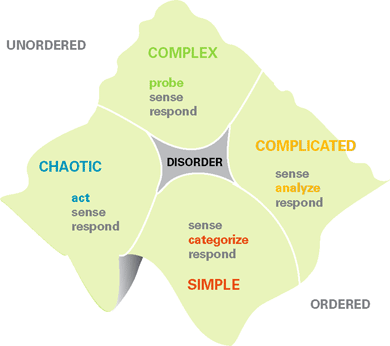
In this post, I’ll do a deep dive into how we sell into organizations operating in the Complex Quadrant. It builds on the previous discussion of selling in the Complicated and Simple Quadrants. As a recap, the Cynefin model is displayed below:

At a corporate or enterprise level, virtually, every organization is operating in the Complex Quadrant.

In the first article of this series, I introduced the concept of “turbulence.”  It’s the convergence of rapid change, transformation, disruption, information overload/overwhelm, increasing complexity, increasing risk, uncertainty and many other things.  Few modern organizations are immune to the turbulence in their markets, industries, and within their own organizations, though they may not be aware of it.

At a corporate level, they are squarely in the Complex domain.  As inevitably happens, “complexity rolls downhill.”  The complexity our companies face invade our functions, departments, and organizations.  And as complexity infects each department and function in the organization, the complexities of getting things done across these functions and departments increases.

So while, the functions or departments we work with may be in Complicated or Simple domains, they are increasingly feeling the pressure and seeing the characteristics of the Complexity domain impacting them.

We see so much data reinforcing this, lengthening buying cycles, increasing numbers of people involved in the consensus buying process, increases in “No decision made.”

It’s important for us to understand the stresses and complexity our customers see at the enterprise level, ultimately starts impacting everyone in the organization.  As a result, many of the departments or functions we deal with are that were in Simple or Complicated quadrants may be moving into other quadrants.

Stated differently, everything that we did to work effectively with customers in the Complicated and Simple spaces no longer works, because they are no longer in those spaces.

In Cynefin terms, in the Complexity quadrant, we are facing unknown unknowns.  Where in the Simple and Complicate domains, we could eventually establish cause effect relationships, as a result put “order” into the solutions, in the Complex domain these cause effect relationships don’t exist.

How do we work with Customers in the Complex quadrant?

In this domain we  tend to “probe, sense, respond.”

Probing is probably where we and our customers spend the most time and resources.  Probing is simply trying to understand what we face and to experiment with alternative ideas to address these issues. 

The probe-sense stages are characterized by experimentation (either those done by our customers, themselves, or experiments that we can share with our customers).  The experiments are provide “safe,” rapid learning environment to help us better understand what’s going on, to help us start to figure out how to bring order to what we face, and to help us learn.

The probing-sensing cycle is iterative, we try lots of different things to try to find something that works.  Over time, we find some things that may work, perhaps not perfectly, but they are good enough, we respond by putting them in place.

All of this is focused on creating understanding, developing new practices based on our evolving understanding, and striving to create order with what customers face.

As sales and marketing professionals, we can create huge value in helping our customers navigate the unknown.

The interesting thing, is that while the customer may be facing things that are unknown to them, they may not be totally unknown to us.  After all, we work with hundreds to thousands of people and organizations facing similar issues–and at various points in their “probe-sense-respond” journey.

We are the beneficiaries of a form of “crowdsourcing,” which we can leverage in helping our customers in addressing their own issues.  We can help with:

  • What questions should they be asking themselves, based on what we have seen of others going through similar situations?
  • What are areas that are interesting to probe, what might be wastes of time?
  • How are other looking at similar situations and what can the customer learn from their experience?
  • What have others seen that works what doesn’t work, and how is the customer’s situation different from what others have experienced?
  • How have our solutions helped in those situations faced by other customers?
  • How do we experiment with potential solutions–perhaps trials, proofs of concept?

A mistake we make, too often, is that we “skip” the probing-sensing parts of what the customer must go through in understanding the issues/problems and deciding how to respond. We believe we know how the customer should respond, because we have other customers that have gone through similar situations.

In our rush for a PO or in our “well intended” desire to be helpful, we try to skip the probing-sensing piece of the process. But our customers need to go through this, otherwise they are incapable of addressing their own complexity. But we can help them do this more efficiently, we can help them accelerate the process, we can help them learn they aren’t alone and can learn from others.

But there is another aspect of the Complex domain that we need to address. It may be situations we and our customers have never seen before, where we have no experience, where we have to go through the probe-sense-respond cycle ourselves.

In reality, we discover these through working with our customers. They face the unknown unknowns. These situations provide us the opportunity to innovate with our customers. We collaborate in the process of probing-sensing-responding, figuring things out together, trying to extract order from the complex.

If you think of most innovation, it’s the result of us confronting the complex and taking action to address it. We see this in many start-ups or in some new product development (not product extensions). Much of what we see in our own product/solution innovation is a result of understanding the complexity our customers face, working with them to make sense of these issues.

If we think of Geoffrey Moor’s Crossing the Chasm, customers in these stages are the Innovators and the very Early Adopters.

While I will address this in another post, you may be getting a sense of the dynamics that underlie the Cynefin model. As we look at the Complex quadrant and begin to understand it better, at some point it moves from unknown-unkowns to unknown-knowns, or the Complicated domain. Likewise, what was Complicated, at some time might become Simple. Finally, as we will learn, and I’ve implied earlier in this post–it can go backwards. What was Simple, can suddenly be Chaotic or Complex.

In my next post, I will move to the Chaotic Quadrant.

04 Jun 16:43

Lead Generation Tools for AV Integrators

by Veronica Green-Gott

Let’s talk lead generation.

As every business owner knows, when new customers (or leads) stop coming in, business dries up. Without business, it’s quite difficult to support yourself, your family, or your employees. So how do you increase your ability to bring in leads? Working with the right tools helps.

When it comes to lead generation for AV integrators, you’ll want to work with a couple of great tools that will help you track, respond, and generate leads for your business.

Great CRM Software

CRM stands for Customer Relationship Management. These platforms help you track, communicate, and increase your sales productivity. Here at New North, we’ve used Hubspot for the past several years. This all-in-one marketing, sales, and website design platform allows you to track form submissions, meetings, notes, and where your leads are in the sales cycle.

What CRM software do you use? If you’ve worked with a cumbersome CRM, then you know how hindering its limitations can be. When you’re trying to increase your lead generation for AV integrators, you need a CRM platform that helps you along in the process and doesn’t slow you down.

However, the best CRM in the world can’t help if you don’t use it. Make sure that you track where your leads are in the sales funnel and include notes on your last meeting, so you know where to pick up again the next time you’re in contact. Pay attention to your productivity statistics and identify areas where you could improve to increase your lead generation. If you’ve seen your contacts decrease, brainstorm new ways to boost them back up.

Social Media Presence

How’s your social media presence? Do you have one? On what platforms?

When it comes to B2B, social media may not be the first thing you think of for lead generation for AV integrators. While I wouldn’t count on it as a continuous source of new leads, it can work in more subtle ways to increase contacts and trust with opportunities. Your social media accounts allow you to create a personable presence with new connections. Use social media platforms as an opportunity to build trust with your followers by showcasing company values.

Remember, when a possible lead is researching your company, they’ll most likely look at your social pages.

Just as a lead can learn more about you from social media, you can also learn more about them. LinkedIn is a particularly powerful platform to research new connections or business opportunities. Through LinkedIn, you can learn more about a person’s position in their company, their interests, how they communicate, and what they value. Through a business Facebook page, you can see what their company values are and how you can appeal to them.

Don’t underestimate social media. It’s a powerful tool to learn more about contacts and leads that come to your website. It just may help you close a deal.

Paid Media Campaign

When you’re running a Google search, how often do you click to the second page? The majority of users on Google never advance to the second page. As a matter of fact, they often don’t scroll down past the top five. As search goes mobile, this is even truer – often, Google doesn’t even show multiple pages (instead opting for a scrollable feed).

A paid media campaign can help with lead generation for AV integrators by pushing your website to the top of the search results.

Your paid media campaign needs to be thoughtfully and strategically crafted. Remember, the broader and more general your search term, the more competitive it becomes to get your ad closer to the top, and the more expensive it will be. A better idea is to focus on niche keywords that a specific subset of your target audience would be searching.

For example, instead of running a paid media campaign for a vague keyword like “marketing,” we would run a paid media campaign for a keyword such as “marketing for AV integrators.”

If you set up your paid media campaign appropriately, you can generate as many leads as you’re willing to pay for. Paid media can jumpstart your SEO rankings and have an almost immediate impact on your lead generation.

Amazing Website

When was the last time your website was updated? If it’s been more than a few years, it’s time for an upgrade. Website design has a big impact on lead generation for AV integrators. We could write a whole blog just on this topic (we have!), but we’ll keep it short and sweet here.

Updating your website design for the specific purpose of generating more leads is much different than making it look prettier or adding a few tweaks here and there. Your website needs to operate as a full sales funnel. Blogs need to provide relevant and helpful information to generate more awareness of your products/services. Insightful pages purposely encourage viewers to click through and develop their interest. Pages with clear intent, like a pricing page, guide them through the consideration phase. A wide variety of opportunities to convert, such as downloading a whitepaper or watching a gated video, allow you to create new contacts.

From that point on, nurturing and closing a contact is up to you. Don’t underestimate how your website can work as its own funnel to guide viewers through the process and generate leads.

Passionate Marketing Team

When it comes to lead generation for AV integrators, you need an experienced team to back you up. New North is here to help.

Data can help you to make very targeted, smart decisions about how you communicate with your customer. That’s marketing automation: the process of using data to make smart decisions to send communications to your customers based on what we know about them. That’s also why we rely on data to develop customized lead generation strategies for your company.

04 Jun 16:32

President Moura on the Importance of Financial Transparency

by Jose M. F. Moura, IEEE president and CEO
Timely, meaningful, and reliable disclosures are critical
Photo of José M. F. Moura
Photo: Carnegie Mellon

THE INSTITUTEIEEE is a distributed management association with many organizational units. Conduct that is transparent and accountable is critical to building trust among members, volunteers,
and professional staff. Wise conduct requires consistent understanding, particularly of financial determinations, at all levels to make decisions that benefit all of IEEE and its members.

IEEE is financially sound. But, as I stated in 2017 in my president-elect platform, my goal was to overcome the then persistent operational deficits. To run IEEE with a balanced budget, healthy reserves, and the ability to invest wisely in our future requires understanding, in sufficient detail, our revenue and cost structures. To do so, we need transparency with preparation and distribution of timely operational financial data at the level of detail needed to consistently manage our distributed organization.

For historical reasons, much of IEEE’s cost of doing business has been bundled together and allocated to its products and services indirectly—sometimes unevenly. We need to modernize this process so we can create more transparency in our financial structure. Better financial transparency is essential to run our businesses efficiently so we can determine exactly what it costs IEEE to deliver each product and service.

Transparent financial reporting should maximize the availability of fiscal information to decision makers at all levels of IEEE. I believe that financial transparency should objectively support the reporting of gross revenues to the units that generate them, and costs should be resolved at a sufficient level of detail to individual products and services and assigned to the unit that incurred them to pay for services the unit requested and agreed to.

Our volunteers and professional staff need the processes and tools that allow effective, efficient, and timely collection, reporting, and assignment of revenue and costs at an appropriate level of resolution. These processes and tools should enable the ability to trace and track revenue and costs in a bottom-up manner from organizational units that then roll up to IEEE corporate financial reporting. Our financial system should be able to record revenues and expenses at the transactional level, coded by projects and/or activities, and assisted by an information retrieval system that supports queries and analytics from different units.

During my tenure as an IEEE volunteer, I and others have helped promote financial transparency and have promoted developing a transparent financial system that explains where each dollar is spent, roots out waste, encourages efficiency, and reduces costs without affecting the quality of the products and services provided to our members.

AD HOC COMMITTEES

As a follow-up to the January IEEE Board retreat, I commissioned several ad hoc committees, chaired by dedicated volunteers and supported by members and professional staff, to address the underlying issues and challenges IEEE faces on its path to becoming a more transparent organization.

The financial transparency ad hoc committee’s charter is to develop a plan for detailed financial reporting at a sufficient level of resolution and to initiate its immediate execution, which includes specific actions, timelines, and funding. The committee will provide a blueprint for operating units to present their budget early in the year, every year, with the costs to be charged for each service provided to another unit. The goal is for costs to be charged directly rather than being indirectly allocated. This will allow operating units to decide which services they need and are willing to purchase. It is vital that Board members, as well as all IEEE sections, regions, societies, councils, and major boards, have access to complete financial information in order to fulfill their fiduciary duty to the organization.

The ad hoc committee on contracting is charged with addressing issues that have been raised with our contracting workflows. Every year IEEE organizes nearly 2,000 conferences, half of which are in partnership with other organizations. Issues related to contracting with conference service providers frustrate volunteers and staff and could degrade the value of the events for attendees.

The committee is to propose practical suggestions that consider risk, timing, and available resources.

The ad hoc committee on conference finance management is developing and implementing policies and systems to provide IEEE with a financial management ecosystem for its conference business. It will provide best-in-class support for conference organizers and their organizational units while minimizing the vulnerabilities related to a distributed, global conference business.

And for a more open organization, the ad hoc committee on transparency in meetings, document classification, and elections is drafting bylaws and policies on executive sessions and election-related governing documents to provide maximum but reasonable transparency while still protecting corporate information.

I will continue to champion transparency at all levels, striving for increased communication and an open and accountable IEEE. Share your thoughts with me at president@ieee.org.

This article appears in the June 2019 print issue as “The Importance Of Transparency.”

04 Jun 16:32

What is the Value Chain and Why It Matters to Your Business

by Ryan Shelley

Why do people buy a product or a service? Because it add value to their lives! Great companies can charge a premium for their goods and services because they have added value not just in the what they produce, but throughout the entire process. In the video below I will walk you through the importance of the value chain and how you can use this concept to grow your revenue.

Video Transcript:

Hey, thanks for checking out this video. If this is the first time you’ve watched, or maybe you’ve been watching a while and have not yet hit subscribe, please do so now. We would love to have you join our community. We publish new content each and every week. And make sure you hit the alerts. That way you know each and every time we publish a new video.

Let’s talk a little bit about value chain. I’m not going to be using any white boards or any slide decks today. I just want to have a honest conversation with you. Value chain is how we add value throughout the entire process. This is both an internal process for our business as well as external process.

When it comes to marketing, there’s no better way to market. There’s no other channel that has more conversion power than referrals. And referrals come from customers who are raving fans, customers that really love what you do and that love it so much they can’t help themselves but to talk about it.

HubSpot talks about this as delighting customers, right? When we talk about the inbound funnel. Well, this really works across every single stage. And if you want your team to add more value, have more ownership, they also need to be raving fans of what you do, and to have a clear idea of what’s going on through the entire process. Now, this starts with the initial hand-off, right? When somebody closes a new deal, how you do a hand off, that’s up to your internal team. Do you have an internal team meeting? Do you have a discovery process? Or is it a little bit more automated. The reality is your team needs to understand how things work internally and how value is being added all along the way.

Maybe an order comes in through the website and the person who intakes that order in the warehouse and ships that box out, they add value throughout the process. Maybe that’s a handwritten note to the client. One really cool way of a company that did that was Piktochart with me. Now, Piktochart does these infographic tools, and you know, I was sitting around one day and the mail came in, and I had bought a subscription to Piktochart, and they sent me a handwritten letter in the mail. Like it was legitimately handwritten. Not one of those letters that you get that kind of look handwritten but that we all know that are fake. They took time to write me a note to thank me for being a customer.

Now, I doubt that the CEO themselves took initiative to do that. Maybe they did early on. Now, but this was somebody on their team that added value in just shipping me a piece of mail. Right? It was a letter. Cost them, you know, a couple cents. But to me, I was like, “Man, that was pretty powerful.” Because it was somebody on their team that took time to say, “Hey, you’re worth a handwritten note.” And in today’s world? I mean, that blew me away.

But again, that started with an internal process where somebody was saying, “Hey, once somebody signs up and they’ve been active on our platform for X amount of days, we’re going to slow down and we’re going to write them a note and tell them that we’re thankful they are a customer of ours.” And that leads to me, the customer, going, “Wow, that was a really powerful experience.” And you have to continue that through the process, and as you do that, you begin to nurture your customers and to make them raving fans.

So that was one way to add value. But you can also add value by sharing wins with your customer, by working alongside them, and maybe answering a few questions that they have and taking time to explain a process. Value chain is the same thing as we’re investing. You invest a dollar and you have X amount of interest on that dollar. Well, if you make an interest of 7% on the first year, the next year, you don’t make 7% interest on a dollar. You make 7% interest on $1.07, and it begins to compound.

The same thing happens when we add value to our customers and to our teams. As you begin to add value through each stage of the process, it begins to compound. And as that value compounds, your products and your services become more valuable, and your team begins to invest more and more time and energy into making sure that they do the best job possible. But it starts with the leader. It starts with the person running the department to take that initiative and say, “Here’s how we can increase our value. Here’s how we can make our customers more excited about what we’re doing.”

Because then what you can do is leverage those customers for referrals. And then, again, even in that you have to do it the right way. You don’t want to say, you know, “Hey, we’ve had a really bad quarter. By the way, if you know of anybody else that wants to have a bad quarter.” I’m just joking. But, you know, we have to make sure that the timing is right, as well. So in making sure that our customers are so excited and so believing in the products and services we provide that they just have to go, “Hey, man, if you need a website, if you need a back massage, if you need coffee, if you need a T-shirt, if you need whatever it is that you’re selling, you have to go to this guy, because when they took care of this for me, it went above and beyond.”

These are the things that we can do to make our businesses stand out, because most business owners, not most, but some business owners, take the easy road. Maybe they have an installed customer base. They just kind of churn out their widgets and they do their thing, and they don’t think about the value add. But if you want to grow and you want to grow a lot and you want to make an impact bigger than only the monetary side of things, value chain is an essential part of your business.

If you’ve got any questions on value chain or any questions on how you can engage your customers more effectively, please comment below. Let’s continue the discussion. And until next time, Happy Marketing.

04 Jun 16:32

Pitch Perfect: How Sales Enablement Can Optimize Your Bank’s Competitive Differentiation Strategy

by Shaalin Parekh

It’s no secret that B2B banking is becoming increasingly commoditized. These days, small- and medium-sized companies are using far more banks than even just a few years ago: according to Gartner’s 2016 Study: “A New Basis for Competitive Advantage,” 53 percent of companies use four or more financial providers. Meanwhile, Fintech competition is also ramping up. In fact, research from the Boston Consulting Group shows that 30 percent of corporate banking revenue is expected to go to new digital platforms over the next five years.

With so much competition in the financial services industry, banks are under tremendous pressure to find ways to differentiate themselves. At Seismic, we hear this every time we talk to prospects and customers. The need for differentiation is also a common theme in banks’ annual reports, where it’s often outlined as a top corporate initiative. And while it’s a major concern for executives, it’s also an issue that relationship managers feel every time they’re out in the marketplace talking to potential customers.

So, what can banks do to differentiate themselves? Fundamentally, they have two main choices. One option is to expand and strengthen their suite of products, which, while important, isn’t always easy to do. The other is to change the way that relationship managers present their products to the market.

It’s All About How You Go to Market

When banks go to market, they rely on their relationship managers to do the heavy lifting for them. They’re the ones who are in the trenches, meeting with prospects and existing clients, building strong relationships, and selling end users on the value of the bank’s offerings.

The problem is that those relationship managers are usually limited in a few key ways. For instance, they’re typically only able to connect with prospects who are already in their rolodex. Plus, when they do finally pitch to those prospects, it’s often with stock standard presentations that look just like everyone else’s. Not only that, but they often miss opportunities to pitch the right products to meet an individual prospect’s needs due to a lack of training, education, and insights. Further, those pitches are often inconsistent and contain information that’s out of date. The result of all of this is lackluster presentations that aren’t personalized to resonate with individual prospects or tailored to address their unique needs.

Fortunately, there’s a better way. With the right sales enablement strategy, you can enable your relationship managers to create personalized pitches that, while consistent in terms of messaging, are tailored to resonate with the individual needs of any given prospect or client.

A few key ways sales enablement will help you tailor those pitches is by:

  • Educating relationship managers on the product set, so they know when and how to best position products
  • Consolidating all educational and client-facing materials in a centralized hub that’s available on any of a relationship manager’s devices
  • Using data to recommend the solutions that are most relevant to prospects’ and clients’ problems, rather than just a laundry list of products that may or may not be appropriate.

Learn how to combat commoditization, improve cross-sell and collaborate

At a time when B2B banking is becoming increasingly commoditized, it’s more important than ever to empower your relationship managers with the tools and resources they need to help differentiate your products from your competitors’. To learn more about how commercial banks are utilizing sales enablement to engage, retain and cross-sell their clients, join us on June 27 at 2 pm ET for a webinar with American Banker entitled The Status of Cross-Selling and Collaboration in Commercial Banks. To learn more or register, please click below.

04 Jun 16:26

How to Develop an Action Plan for Sales Success

by Mike Schultz
Man working in office

Editor’s Note: This guest post was contributed by Mike Schultz, President, RAIN Group.

“Setting a goal is not the main thing. It is deciding how you will go about achieving it and staying with that plan.”  ― Tom Landry, Hall of Fame football coach

Athletes, professionals, and people in general all have goals. These aspirations represent what’s really important to you and what you want in life. They push you forward.

Maybe you want to win a Super Bowl, start your own company, get promoted to VP of Sales, or own a house on a lake.

But how are you going to get there? What are the stepping stones that will lead you to that ultimate destination?

Before you can get into the details, you need to be very specific about what it is you want to achieve in the long-term and short-term.

  • Big picture goal: This is the one thing you want to achieve over the long-term.
  • Three-year goals: These can be two to three goals that put you on the right path to reaching your big picture goal.
  • Annual goals: These are your specific targets for the year.

If you want to achieve your goals, get the most done each day, and even increase motivation, action planning is essential.

You need to come up with a precise roadmap of how you’ll achieve your goals. Once you’ve identified them, here are four steps you must take to reach those milestones.

Step 1: Set Short-Term Priorities

You can’t just go from setting annual goals to weekly goals. You need to break them down into short-term priorities, which will help you arrive at your weekly goals. These include:

  • Quarterly priorities: Start by documenting your 90-day priorities. These are the lynchpins that bring the goals framework together, bridging the gap between the long-term goals, and the actions you’re going to take right now to get there.

    Begin by listing three to five 90-day priorities. One of these should jump out as the most important priority.

  • Monthly objectives: Next create your monthly objectives.

    Ask yourself, “What do I need to get done this month to work toward and achieve my quarterly priorities?”

Step 2: Create Weekly To-Do Lists

When you’ve established your monthly objectives, you can then create weekly to-do lists. Think of your to-do list in two distinct categories:

  • To-do this week: The next planning step is to break down the monthly list of actions into the big things you want accomplished for the week. This is often a list of three to five core activities you’re going to push forward 

  • To-do — core list: This is your catch-all. Maybe there’s a report you need to create for a manager, three run-of-the-mill sales calls on your calendar, a weekly internal sales meeting, a reminder to catch up with a teammate on an important opportunity, etc.

    This differs from the to-do this week list in that it’s typically the longer laundry list. By separating the two lists, you’re forced to prioritize what really needs to get done.

    It’s good to keep that catch-all list, though, as it relieves the mental stress of trying to remember everything.

Step 3: Write Down Your Greatest Impact Activity Each Day

Your Greatest Impact Activity (GIA) is the one activity that, should you do it consistently at high quality, will get you the greatest eventual return on your time investment.

By identifying your GIA every day and putting it first, you make strides toward the long-term reward of achieving the career success you’re seeking.

Your GIA is rarely the easiest activity on your to-do list. It may be making 25 prospecting touches each day, brainstorming value-add growth ideas for a specific account, or developing a big play to win a large new client. Whatever the specifics, it’s the one activity that’s most likely to help you make forward progress toward your goals.

Step 4: Share Your Actions

This last step is critical. Don’t just plan your weekly actions, track them with someone who’ll help you successfully achieve those objectives and hold you accountable.

We call this your Accountability Partner. The process is simple:

  • Pick an accountability partner
  • Choose a day and time you’ll check in with them (e.g. every Monday at 11 a.m.)
  •  Each week, type up your weekly plan and share it with your partner (this can be done via email, or during your designated meeting time)
  •  Check in with your partner at the set time to review activities from the previous week, indicating which tasks you did and didn’t get to (and why you didn’t)
  •  Repeat the process with your plan for the week ahead

If you find you’re falling off the wagon and getting side tracked from your priorities (this happens to all of us at one point or another), tap your accountability partner. Schedule a meeting and discuss ways you can get back on track and stay focused.

People who write down their goals are 20% to 40% more likely to successfully accomplish them. Document your goals and priorities using a goal setting worksheet to help you stay on track.

This simple, 4-step action planning process with a strong emphasis on weekly actions—we recommend just 20 minutes a week planning them—will help you remain focused and boost motivation.

For more tips on how to achieve your sales goals, subscribe to the LinkedIn Sales Solutions blog.

04 Jun 16:25

Verified Expert Growth Marketing Agency: Bell Curve

by Yvonne Leow

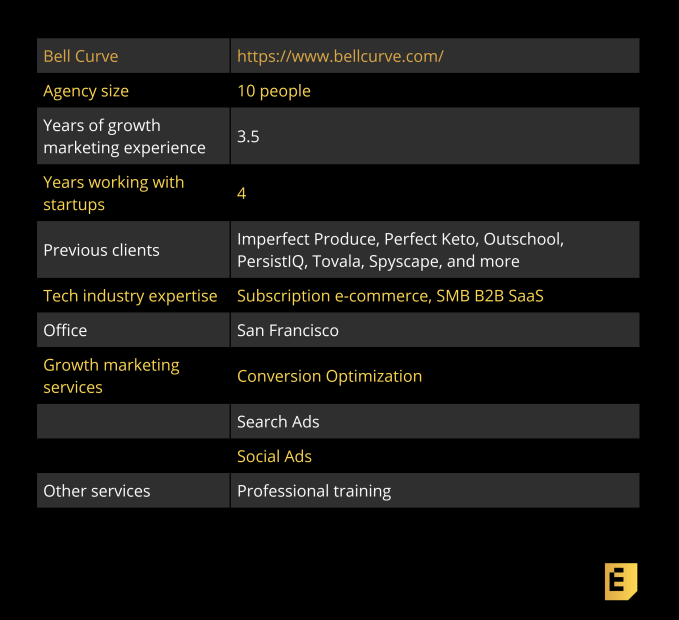
Bell Curve founder Julian Shapiro describes his team as talented growth marketers who have a long tail expertise of various channels and who aren’t afraid to play part-time therapists. As an agency, they’re comfortable grounding founder expectations by explaining “No, virality isn’t a dependable growth strategy,” but “Hey, we can come up with a better strategy together.”

Bell Curve, the agency, also runs Demand Curve, a remote growth marketing training program that teaches students (and marketing professionals) the ins and outs of performance marketing.

For a glimpse of how Bell Curve thinks about growth marketing, check out Julian’s guest posts about how startups can actually get content marketing to work and how founders can hire a great growth marketer.

What makes Bell Curve different:

“Bell Curve runs a growth bootcamp which we took in February. It radically improved our growth rate, gave us access to enough data to experiment with, and as a result we built an engine for growth that we could continue to tune.” Gil Akos, SF, CEO & Co-founder, Astra
“We run a program where we train companies to run ads on every channel. So, what makes Bell Curve unique is that we, by necessity, have a deep understanding of many more channels than the average agency. We have an archive of tactics and approaches that we’ve accumulated for how to do them just as well as the big ad channels.

In effect, companies come to us when they need expertise beyond Facebook, Google and Instagram, which we still bring to the table, but when they also need to figure out how to make Quora ads profitable, how to get Reddit working, how to get YouTube videos working, Snapchat, Pinterest, etc. These are channels people don’t specialize in enough and so we also bring that long tail of expertise.”

On common misconceptions about growth:

“A common mistake people make coming into growth is thinking that growth hacks are a meaningful thing. The ultimate growth hack is having the self-discipline to pursue growth fundamentals properly and completely. So, things like properly A/B testing, identifying your most enticing value propositions and articulating them clearly and concisely, bringing in deep channel expertise for Facebook, Instagram, Google Search, and a couple of other channels. These are the tenants of making digital growth work. Not one-off hacks.”

Below, you’ll find the rest of the founder reviews, the full interview, and more details like pricing and fee structures. This profile is part of our ongoing series covering startup growth marketing agencies with whom founders love to work, based on this survey and our own research. The survey is open indefinitely, so please fill it out if you haven’t already.


Interview with Bell Curve Founder Julian Shapiro

Yvonne Leow: Can you tell me a little bit about how you got into this game of growth?

Julian Shapiro: I actually started by running growth for friends’ companies because they had a hard time finding experienced growth marketers. After a year and a half of doing this, I realized it’d be a more stable source of income if I formed an agency. It’d also allow me to pattern match so I could exchange learnings among clients and have a better net performance.

It all came together very quickly. Once Bell Curve hit about 10 clients, we had enough strategic and customer acquisition overlap that we were able to share tactics, double our volume of A/B testing, and get better results. It also gave us the ability to hire out a full-fledged team so we could start specializing, whereas, as a contractor, I was too much of a generalist. I wasn’t able to go deep on certain channels, like Snapchat or Pinterest ads.

04 Jun 16:22

This Week’s Big Deal: Selling to Larger Buying Committees

by Amanda Bulat
The Buying Committee is Real

Here’s a scenario I’m guessing most B2B salespeople can (painfully) relate to: You’ve done everything right. You identified a key contact at a targeted account, reached out with value, developed a relationship, and persuasively made a case for your solution. They’re on board. You’re ready to close the deal.

One problem though: another member of the buying committee was busy doing her own research, and she has formulated her own preference. “Sorry,” your contact laments, “she has the higher authority.” The company chooses to go with a competitor instead. All of your hard work, out the window.

The expansion of buying committees is one of the most prominent B2B sales trends. Winning buy-in from multiple decision makers was recently ranked by ContactMonkey as one of the three toughest challenges for the modern B2B salesperson. Large enterprises sometimes have a dozen or more people with significant influence on purchases.

Needless to say, this is a big deal. Luckily, there were a few enlightening articles around the web last week offering useful guidance on this front. So we’ve combined some of the best insights we found, along with a few tips of our own, to help you and your team optimize for the era of extended buying committees.

5 Keys for Effectively Swaying a Large Buying Committee

Map Out Committees Early On
It’s often impossible for an outsider to gain a clear picture of an organization’s internal structure and personnel layout, but we’re better equipped to map it out than ever before. One simple first step is to pull up a list of the company’s employees on LinkedIn and seek out job titles that are commonly involved with researching vendors or choosing solutions.

If you’ve already developed a solid relationship with one contact at a company, you might consider asking them outright about additional key players. (“Is there anyone else on your team I should be chatting with about this? Would you mind introducing me?”)

“Realize that in any group, some people’s opinions matter more than others,” writes Rieva Lesonsky of GrowBiz Media at Forbes. “Using social media, online research, and real-world connections, dig up as much inside information as you can about the people involved in the buying process.”

Work with Marketing to Build and Shape Brand Awareness
One pitfall that can disrupt a unified front in the buying committee is when one member takes a liking to your solution, but another has never heard of your company. You can mitigate this risk by collaborating with your marketing colleagues on strategic brand awareness efforts. The set of tools available through LinkedIn makes it easy to target your ads toward particular accounts, titles, or seniority levels.

And remember, it’s not just awareness that matters, but perception.Ads and content need to portray your brand in the right way — the same way you’re trying to sell it. So it’s crucial that the sales team take an interest in helping to create marketing messaging.

“A B2B purchase is an emotional and impactful decision,” LinkedIn’s Bian Salins told Econsultancy in a piece published last week. “Understand your audience’s mindset within the buyer’s experience and take people on a journey they identify with; they don’t just buy into your product, but buy into your brand promise which is fundamental to effective marketing.”

Keep Track of Movement within Accounts
Buying committees aren’t static. People enter, leave, change roles. This is why we consider multithreading (connecting with numerous people at an account) to be so critical, and why the ability to save accounts and leads in Sales Navigator is such an integral feature.

When you do so, you’ll receive sales updates that keep you posted on job changes and other important developments with your prospects. This enables you to react quickly and make sure you’re not losing touch with a committee without even realizing it.

Make Content Easy to Share
Ideally, the compelling content you share with your contacts on a buying committee will be shared with other members. Take steps to facilitate this outcome by ensuring your documents, videos, links, and pricing sheets are easy to pass along. PointDrive is custom-built for this purpose, making it so recipients can share a URL (leading to a customized sales presentation page) rather than forwarding cumbersome email attachments.

As an additional benefit, using PointDrive (a feature available in Team and Enterprise Sales Navigator accounts) assists with the first objective we covered: mapping out the buying committee. That’s because, as the creator and sender of a presentation, you can actually track who it’s forwarded to, and who views it. This is a great way to uncover potentially hidden purchase influencers.

Collaborate and Coordinate with Your Teammates
We talked last week about how sales teams can gain an edge by focusing on the customer experience. At Econsultancy, Lynette Saunders notes the clear benefits, pointing out that “Improving the customer journey experience from average to ‘wow’ can lead to a 30 to 50% increase in KPIs such as likelihood to remain/renew or to purchase another product.”

“The priority for companies,” she adds, “is to make the customer experience seamless across all these channels and to tailor the experience to the needs of different stakeholders. Ensuring that everyone in the business has a responsibility for customer experience and understands their role in improving it.”

One major area of emphasis for sales teams is consistency. I mentioned earlier that we should help marketing define a point-of-view that everyone involved with business development can rally around, but it’s also crucial for salespeople to coordinate with one another. You don’t want two different members on a buying committee receiving drastically different messages from two different reps. You also don’t want the same member receiving outreach from three different reps on your team. These are major hindrances in the customer experience that can sully your brand’s reputation.

Keep clear lines of communication, and maintain detailed logs around customer interactions.

Fill In Your Buying Committee Map

Gaps in buying committee coverage have caused many a promising B2B deal to go off the rails. By heeding these tips, you can work to eliminate blind spots, target the entire committee, and close the deal.
 

Subscribe to the LinkedIn Sales Blog and never miss out on the latest big deal in B2B sales.


04 Jun 16:13

Leadership Skills and How to Hone Them

by Anthony Iannarino

Leadership is a complex array of skills and attributes and it can be difficult to sum up in a concise definition. Some people believe that leaders are born, not made. Others think one can develop and hone leadership skills, just like any other ability. I happen to fall into the latter category.

I have helped dozens of up and coming sales pros to help them become better, more effective leaders. This involves being attuned to new trends, staying abreast of the changing environment and consistently working on building skills that myself and others will need to succeed. Like any other industry, I need to grow and refine my leadership skills in order to stay ahead in sales.

Read on to learn more about leadership skills and how to hone them to improve your chances of crushing it in the sales world.

The 3 Levels of Sales Skills

First things first: Leadership skills come in three tiers.

The Fundamentals

First, you have to learn the fundamentals of selling. This involves learning to close, or gain commitments as well as how to overcome objections and resolve concerns. You also have to learn how to deliver a value proposition that has features and benefits.

This stage also involves learning how to prospect. I call this “opening relationships” and “opening opportunities” because you can’t close any deal that isn’t first opened. Prospecting is just as fundamental to selling as closing, even though we often spend too much time worrying about closing. It’s important to devote just as much time to opening.

Another critical part of the fundamentals is that you learn to tell stories (or present). You have to be able to talk about how you will make things better for a prospect, how you get different results, and how you have helped other people in similar situations.

Once you have a command of these first level fundamentals, you can graduate to the intermediate selling skills.

Intermediate Selling Skills

Great leadership means being able to diagnose your clients needs in some sort of discovery or needs analysis. You can’t easily diagnose your dream clients needs if you don’t know what they are all about. It takes time to master the art of diagnosis.

Because there are now so many people and companies that sell what you sell, you have to be able to differentiate yourself and your offering. Differentiating is difficult, and it takes time to develop yourself to the point that you stand out from the crowd. You have to spend time learning how to differentiate what you do from what your competitors do.

The last of the intermediate skills is negotiation. This means assessing where you can create and capture different levels of value. As you grow, you will learn and develop the skill of creating and capturing more value. But this isn’t an easy skill set to learn initially, especially when so many buyers choose to believe price is the same thing as cost.

Business Acumen

Once you’ve spent time selling (or working in some capacity where you have responsibility for results) you develop business acumen and situational knowledge. You learn how business works, and you have had enough experiences to recognize patterns and ideas that are worth trying.

You also develop the skill of helping people and organizations change. More and more, companies make decisions by consensus, and salespeople have to help lead and manage change. They sometimes have to act as the catalyst for change, something that is not easily done without having had the experiences that develop those skills. This final stage is complex and will continue to develop over time as you learn more about your buyer and their needs.

Sales is a leadership role. The skill of leading others is what allows you to lead your clients, lead your teams, and lead your client’s team–even when you have no formal authority. Leadership is necessary, especially for large, complex deals.

The acquisition of these skills doesn’t occur in a linear fashion. They develop over time, and you develop them through your experiences, your training, and your personal and professional development. None of them are easy to develop, but all of them are necessary and well worth the devotion of time and energy.

Supremely Important Leadership Skills

I couldn’t possibly name all of the skills involved in leadership, but here are some of the critical ones that I think are most important in the sales world and just generally in life.

Fearless Agility

The modern world isn’t showing any signs of slowing down. The constant stream of new technology and the pace at which expectations are changing mean that we need leaders who can keep up. Being able to quickly and effectively think, decide and inspire is a crucial part of staying successful in a world of changing demand.

Empathy

Empathy is one of the most crucial leadership skills because it allows us to build emotional intelligence within ourselves as leaders. Empathy and compassion are the cornerstones of human and allow for mutual understanding of all kinds of issues. Being successful in business means being successful with people and we need empathy to really understand other people’s needs and concerns.

Flexibility

9-5 desk jobs are becoming obsolete as teams are quickly transitioning to work from remote locations, co-working spaces, on their own time, etc. Flexibility is a timeless principle and leaders will always need it to succeed. Being able to adapt to new technologies and a younger workforce will help keep you fresh and effective.

Having a Vision

Great leaders are always looking at the big picture. Having a clear vision and being able to commit to it can differentiate a great leader from a good business person. Leaders who can capitalize on ways to make their vision a reality will soar ahead of the pack.

Listening

Leaders have to be highly skilled listeners. Not only will this help you understand the needs of your team, but it will also help you hone into the needs of your clients and partners. This means listening on multiple levels and tuning into the concerns and requests as well as the emotions behind them.

Humility

Humility means simply recognizing that everything is not all about you. This is immensely helpful to leaders when it comes to preparing for the future. It helps to make sure that you aren’t overlooking the value that other team members can add.

Communication

Leaders can be incredibly smart, hardworking and motivated but if they don’t know how to communicate they are never going to get very far in sales or any business endeavor. Interpersonal interactions are incredibly important and allow leaders to reach individuals and connect with them on their level.

Quick Learning

One often overlooked leadership skill is the ability to learn quickly, over and above just recalling information and knowledge. It is so important to be coachable and adaptable in order to manage the overload of information in the tech world and to be able to respond to the varying needs of new clients in real time.

Authenticity

Honesty, integrity, credibility, and trust have always been the currency that salespeople trade in. But the deeper fundamental is the shift towards embracing transparency and authenticity as an asset in business. In order to succeed, leaders need to develop trust and you need to be authentic in order to encourage people to connect with and trust you.

Self-Discipline

I’ve said it before and I’ll say it again: The master key to sales effectiveness will always be self-discipline. The most successful people I know who use social media work harder than almost anyone else I know.

3 Ways To Improve Leadership Skills

One thing that is consistent across all great leaders is their constant willingness to improve their leadership skills. Skills are not static. I have to work steadily to sharpen and improve them and so do you. Fortunately, there are some basic concepts you can incorporate into your personal edification strategy.

1. Read and Study Leadership

Leadership is a complex array of skills and attributes. There are as many definitions as there are leaders, and an equal number of ideas about the skills and attributes leadership requires. Because there are so many ideas, there is a whole lot of reading material on them. Diving into this material is a great way to continuously improve as a leader.

The role of sales now requires that the salesperson be a strategic orchestrator, leading cross-functional teams made up of members of their own company, as well as the client’s company. We recognize this fact, but there are few (read: none) sales organizations that focus even the smallest portion of the training and development resources towards leadership. This means you are all but certain to have to train and develop yourself.

Go to your local bookstore and buy a couple of books on leadership. I make no recommendation as to what books you should read – you will easily find something that appeals to and engages you.

For my money, I like to read books by actual practitioners, leaders who face challenges that seem insurmountable, like Shackleton, Washington, and Patton. I find it easy to distill their stories into lists of ideas and attributes (but then, I am a list-maker). If you don’t like to read biographies, or if you don’t like distilling the lessons yourself, choose a book that has a number in the title. A book with a number in the title means someone else captured the stories and distilled the lessons into a list for you.

Take the time to write down your ideas as you read. Make notes about the skills and attributes of leadership and collect stories of where you have seen these come into play in your business. Especially write down the failures of leadership and what leadership skills and attributes might have prevented those failures. This exercise alone will ingrain these lessons into your DNA, and you will find yourself thinking of your own leadership problems in the framework you develop.

2. Learn to Own the Outcome

When you sell something, you are responsible for the outcome.

This has always been true. If your client does not achieve the outcome you sold, it stands that you are accountable for their failure.

Leadership is, in large part, about responsibility for outcomes.

Learning to own the outcome means first accepting the responsibility for helping them to achieve the outcome. It also means understanding that you will have to lead others even when you have no authority, other than the authority that accompanies owning the responsibility for the outcome. But it is simply amazing how much authority comes along with owning the outcome. In most cases, you will find no one fighting to take your place as the person responsible for the outcome and even fewer who volunteer to take on the biggest problems.

Leadership is, in part, taking responsibility and tackling the biggest problems.

Essential Reading!

Get my 3rd book: Eat Their Lunch

"The first ever playbook for B2B salespeople on how to win clients and customers who are already being serviced by your competition."

Buy Now

3. Learn to Lead from the Front

Leadership is where the action is. Leaders have muddy boots because they are on the front lines with the people they lead. Leadership, especially as it pertains to sales, isn’t about authority. It is instead about finding the obstacles to achieving your goal or vision and then rallying the resources to overcome those obstacles.

You don’t lead from behind a desk. You rush to the sounds of the guns. You go to where the action is and you make your presence felt. There is very little that you can do to create lifelong relationships in sales that tops being by your client’s side when they are dealing with their most difficult challenge.

You helped create the vision. You sold the vision. Problems showed up. You answered the phone. You rushed to the scene to make a difference. This is what your client expects, and following through on expectations is the true foundation of sales success (as well as the referrals this brings).
To put this into practice you have to step up, take ownership, and lead. Many (most) (all) great leaders got baptized in a similar fire.

Conclusion

Great salespeople have the ability to lead. They have the ability to generate results through the efforts of others on their teams, as well as their client’s teams. But to be a consistently successful leader, you have to keep developing and honing your leadership skills over time. This will help ensure you have everything you need to survive.

The post Leadership Skills and How to Hone Them appeared first on The Sales Blog.

04 Jun 16:13

Make It Small

by Tibor Shanto

By Tibor Shanto

Not a popular refrain among sales types, which may explain why nearly half of B2B reps will miss quota this year. In a world obsessed with ‘big,’ even more so than sales success, make it small may seem counter-intuitive. And so it is, but so is being a card-carrying member the 80% on the wrong side of the 80/20 rule.

While I am not working with sales teams, I am buying. Specifically, tools, apps and services that help my business success. While I am impressed with some of the big numbers presented, I am also skeptical about many of the claims presented. Don’t get me wrong; I am not suggesting the big claims are false, but more the anomaly than the norm. Sure, some clients have realized a 55% increase in “whatever.” However, for the most part, these clients are outside the bell curve, most clients fall inside the curve. They experience more earthly numbers, which is not only OK and acceptable but more importantly, more believable.

I Wanna Believe

The risk is that buyers will discount your claims; you need only look at feedback buyers are providing.

  • Vendors focus on providing material that buyers don’t find very useful or trustworthy
  • Buyers don’t trust all vendor claims, nor do they expect to

The B2B Buying Disconnect – TrustRadius 2017

These are just two of the many opportunities for sellers to calibrate with buyers.

Once they discount claims of success, how soon before they discount what they believe your product can actually do?

Can You Repeat That?

Buyers are looking for predictability and repeatable success. I had one client where, based on their internal measures, my Proactive Prospecting Program increased their appointments by 666%. About 600% of that was environmental; they weren’t prospecting before I showed, then they were. Was it me, sure, could I repeat it, not where there are living and breathing salespeople.

It is much more practical to lead with your average results. I know I can sustain those over several renewals, and potential upsell. On the downside, you are more likely to miss small than miss big by starting small. I doubt most are selling the significant number as “just year one, then, you know…” Most are selling it like typical expectation, no foot point.

If You’re Gonna Fail, Fail Big

When you look at things that drive change, while the “big bangs” make the news, most overnight sensations are years in the making. Leading with a “go big or go home,” attitude may seem inspirational and motivating. But I bet the manager telling you that, doesn’t take the same view of your quota. I would much prefer the take the alternate path, incremental, predictable and repeatable success. A work-flow that allows us to review and adjust, apply and repeat, all in small, manageable increments.

Taking the incremental approach allows you to be more agile and responsive to markets and client expectations. If an increment goes wrong, it is one of many, no big holes. When a big deal goes sour, it brings equally large holes from which to dig out. I remember one year I was neck in neck to be number one in revenues, till a big deal I invested time in, died. The person who ended up being number one, did all with onesie-twosie, in small increments.

If you want to sell more, make it small.

The post Make It Small appeared first on TiborShanto.com.

04 Jun 16:12

Converting Customer Survey Respondents into Social Media Advocates

by David Ensing

Boost Your Company’s Online Presence by Building Customer Trust

There’s tremendous power in customers advocating for your brand via “word of mouse,” and many companies are wondering how to harness the customer feedback collected through surveys to bolster their company’s online presence. The first step in doing this, long before offering the survey, is to establish a good relationship with customers. This begins by ensuring trust with their information, and also by providing a consistently authentic experience.

The two key guidelines to ensure authenticity and trust:

  1. Always ask survey respondents if they want their comments to be posted on your website or various other social media/review sites. This ensures that you gain the individual respondent’s approval before posting, thus bolstering the trust you’ve established with the individual customer.
  2. Invite all respondents, regardless of the positive or negativity of their responses, to post their feedback on your website or various other social media/review sites. This builds trust with your potential consumers by giving them the “real story,” not just a positive one. In this paper, we’ll build on our prior paper by outlining approaches to encourage survey respondents to become social media advocates.

In this post, I’ll be outlining some approaches to encourage survey respondents to become social media advocates for your brand, as well as explaining how you can harness customer feedback to improve brand image.

Providing Links to Company and/or Retailer Facebook and Twitter Pages

One of the easiest options is to provide a link at the end of the survey that directs respondents to click over and leave a comment or post a “like” on Facebook or to “follow” the company on Twitter. We have also seen companies provide these links in the survey invitation email rather than at the end of survey.

For Facebook, in many cases (depending on privacy settings) the respondent’s friends will be notified in their Facebook Newsfeed that the respondent “likes” your company. In the case of Twitter, individuals may see that their friends are following your company.

On these pages, include images that represent your brand, featuring employees or showcasing the products themselves. People will associate the company with the images it appears with. With only a few moments to make an impression, you want to make sure viewers know exactly what you are about.

Third-Party Customer Review and Rating Sites

Another option is to provide a link to third-party rating and review sites, such as Yelp, Trip Advisor, Dealer Rater, and Google+. For some companies and products, these sites greatly influence buyer purchasing, making it important for you to proactively manage how your company/retailers are represented there.

As well, by proactively managing your presence on these sites, you can minimize damage to your company’s/retailer’s reputation from outdated reviews and/or bogus reviews that may be posted by your own employees (too positive) or competitors (too negative). Responding to reviews is a great way to show that your business is listening to what its customers are saying. Extending assistance to a respondent with a bad review can change someone’s mind about your company’s service, and it communicates the message that the goal overall is to proactively solve incidents.

You can drive traffic on these sites by simply providing a link to these sites at the conclusion of your survey. Ideally, these links should lead directly to the company’s or its retailers’ individual pages at the site, rather than just linking to the site’s broader home page (e.g., www.tripadvisor.com). By linking directly to the right page, you make the posting process easier for your customers and ensure they post to the correct place on the site.

That being said, the page URLs can change, so I’d recommend frequent monitoring of these links to ensure they don’t “break.”

One disadvantage to linking customers to third-party rating sites is that many of them (Yelp, Trip Advisor, and Google+ included) require people to sign up for free accounts before posting comments. Keep in mind that you may need to share information from these sites on other visible platforms, so that everyone can have access.

Posting Summary-Level Data on Company and/or Retailer Sites

Another option for sharing survey results is to post a top-level, summarized score, such as that for Overall Satisfaction, on your website. For example, Volkswagen in the UK proudly posts a “Percent Positive Feedback” for each of its retailers. Car buyers can search the Volkswagen UK website to locate retailers in their area and then see the top-level score for each retailer nearby. This helps the customer choose which retailer to visit and drives retailers to focus on delivering a great customer experience.

Sharing Ratings and Reviews to Company and/or Retailer Sites

Possibly the most extensive use of using survey responses to promote advocacy is to post each respondent’s overall rating and comments on the company’s and/or its retailers’ websites. Many companies do this, including Best Buy and BMW.

In both cases, each respondent’s overall ratings and their comments are prominently displayed on the retailers’ sites along with an overall summary score for the retailer (BMW’s program appears to be voluntary, as not all dealerships have survey scores and comments posted). Furthermore, in the case of Best Buy, the overall summary score shows up on the Google search results page when one searches for a store location.

The process of posting every respondent’s individual responses has several advantages. First, each retailer looks much more active. When consumers read online reviews about locations, they look at both the proportion of good reviews to bad reviews and the total number of reviews. Just as one may avoid an empty restaurant, a low number of reviews may deter a consumer from visiting a certain retailer.

By posting all survey responses, you can bolster the perception of an active business, and improve the currency of the information. Unlike third-party websites, you can set the number of reviews displayed on the website, so out-of-date reviews, which may paint a different picture than the reality of today, are removed as they are replaced by more current customer comments. Lastly, by posting feedback from ALL survey respondents, you build consumers’ trust, as they sense a truly realistic impression of performance

Choosing a Plan That’s Best for Your Business

There are several options for converting survey respondents to social media/online advocates and each has its strengths and weaknesses. The answer to which road to take requires a solid understanding of your industry, an appreciation for the influence level of third-party review websites, and, most importantly, a respect for the thoughtful consumers who respond to your surveys.

03 Jun 16:39

How to Succeed at Executive Peer-to-Peer Selling [Podcast]

by Sandler Training

Hamish Knox, Sandler trainer and two-time author, shows you how to succeed with the attitudes, behaviors, and techniques needed to be more successful at selling across the executive level. Get the best practices collected from around the world for using your executives to sell to the prospect's.

Listen Time: 28 Minutes

03 Jun 16:15

How to Execute a Successful Link Building Campaign

by Garry Grant

What is Link Building?

Link building refers to the process of actively increasing the number of links to your website, generally because you’re trying to improve your search engine ranking, or spread the word about your business. It uses assets you create and host on your website to acquire the links – whether that’s an ebook, white paper, case study, infographic, or another helpful resource. You also need to be aware that quality and authoritative links help, but your rankings could suffer from Toxic or malicious links.

Link building takes time and effort, and Google wants to see those links come in naturally over time. Black hat SEOs often turn to buy links, which is a huge no-no to try to cut out the hard work involved in proper link building. While it may help increase ranking temporarily, it always comes back to bite you in the end. But, do it right, and your efforts will pay off tremendously.

Designing Your Link Building Campaign

As tempting as it may be to go out and start asking people to link to your content that’s not an effective way to accomplish it, and will more often than not be a gigantic waste of your time. Approaching it systematically with a clear plan in place will take longer, of course, but it will yield a much higher ROI.

Set Your Goals

Knowing the goals, you’re trying to accomplish with the link building campaign will help you devise the best possible strategy to help you reach those goals. Whatever your goal with the campaign is, it should tie into your overall business goals. If your goal is to build ten links – that’s not a good goal to hit if building those ten links won’t affect the overall success of your business.

Sure, you have a goal to build quality links, the more authoritative links, the better, because those play such a significant role in search engine rankings. But, because link building won’t make you overnight success and impacts aren’t instant, you need more reasonable goals than “Build 100 links.”

Developing Your Assets

Your assets are what you will use to attract and earn the links. What works for you will vary from business to business and from industry to industry. An excellent way to think about it is what you can use to hook people? What will make them care about you and what you have to offer? The most common asset is content, but others include data, products, services, and people. Regardless of which assets you want to use, they need to be created to serve the audience you’re trying to attract.

Think about what kinds of links you need to get. Options include:

  • Homepage links
  • Links to deep pages within your site
  • Links that contain your brand or company name
  • Links that contain keywords you’re targeting

To figure out which ones you need, begin with a detailed link analysis on your current website. Also, take a look at how you’re ranking for specific keywords compared to your competition. Use Open Site Explorer for this analysis, so you know what your link profile looks like at the start. It can help you identify opportunities for improvement, which may help guide you in asset creation or help you see current assets you can use to attract links.

Finding Link Targets

Think about the type of people you should contact, because you don’t want to waste energy on those who wouldn’t be interested in your content. Randomly reaching people will lead to a lower response rate and a hit on your reputation.

Before you start your link building campaign, at least have a rough idea of who you think will care about what you’re doing. Who will care enough to link to it? That’s what matters.

Let’s say you’re putting together a piece of content called, “The Stress-Free Guide to Holiday Meals with Family and Friends” because you know how much people enjoy eating the holiday meals, but stress out about making them or hosting the gatherings.

Who would be interested in this guide?

  • Food bloggers: They make a habit of sharing recipes with their audience all the time!
  • Parent bloggers: They know how stressful it can be managing a household with littles running around, and are usually willing to receive stress-reduction and time-saving tips.
  • Recipe sites: They’re willing to share anything that contains fantastic recipes!

Now that we know who we’re after, it’s time to dig a bit deeper to find them.

Locate Blogger Lists with Google

Search “list of food bloggers,” “list of parent bloggers,” and “list of recipe sites,” and you’ll find no shortage of lists to work through, where someone has already done the hard work of putting together the list.

Use a tool like a Scraper to grab all the URLs from the page. Put them in a spreadsheet for later, and then use URL opener to open all of them with a single click. This way, you can look at them to make sure they are relevant to your content and locate contact information.

Harness the Power of Twitter

You can search Twitter for lists of bloggers and influencers, but you can also use a third party tool, Followerwonk, to search bios. Search again for food blogger, parent blogger, or recipe site, to find Twitter users to connect to. Download your results to a spreadsheet, and you’ll be able to find the websites associated with those people to include in your list.

Researching Link Targets

At this point, you want to do a bit more research on the people you’re targeting. Look at their social media profiles to see what they’re sharing, to make sure they’re still active, and whether they only promote their content or include others, too.

As you go through their websites, take notes of what they’ve shared and what interests them, so you can use it to craft a personalized pitch to them when you contact them later. Using a generic approach shows the person you don’t care about what they have to offer you – and you haven’t’ done your homework. It’s the quickest way to get ignored.

Next, look for contact details for the websites you find relevant. Check the header and footer for a link to a contact page, or an about page that often lists contact details. You can use the ToutApp Chrome plugin to highlight email addresses on the page for you.

Prioritizing Link Targets

Once you have your list of link targets, it’s time to group them by priority so that you can customize your messages accordingly. You can prioritize them any number of ways. However, you feel it is most appropriate for you.

  • By blogger influence, for example, the number of social media followers on Twitter, Instagram, or Facebook
  • By likelihood of linking, for example, food bloggers compared to parent bloggers
  • By domain metrics, for example, domain authority

Outreach

Now it’s time to start talking to people about your campaign. Begin with your high-level targets because they can get you good results if they respond. And, you can use them later for social proof when you reach out to the smaller websites. If smaller sites seen other influencers have picked up on your content, they will be more open to sharing your content when you contact them.

Remember, you’re contacting a real person, so craft your pitches with the information you noted in your research. Call out particular content you like that they created and shared. Focus on real conversation and prove to them the value your content will offer them. They don’t owe you anything, and you’re asking them for a favor. Keep the message short and sweet, but detailed enough to show them why they need to care, and what action you want them to take. Offer to write the content for them, because they may like your content but not have enough time to write about it. However, save that last bit for the most significant influencers because it will require additional time and resources on your part – so it’s not something you want to offer everyone.

Personalize the message with their name, a good subject line, something specific about their work, and a proper email signature. If you come off as a spammer, this and any future attempts to connect will be ignored.

Follow Up

If you don’t hear from someone after that first email, it’s okay. People get busy, and the more popular bloggers and influencers will get lots of emails like this every day. It’s okay to follow up once if you don’t get a reply the first time. This reinforces the fact that you’re a real person and not a spammer using automated software to make contact.

Keep your outreach organized so you can tell who you need to follow up with and when. You can track replies in a CRM or a standard spreadsheet.

If you get negative responses, it can be discouraging, but you should always take the time to reply instead of ignoring it. This builds a relationship because you never know when you could have a better opportunity to work with this person again in the future. Get as much feedback and information as possible so you can use to improve future campaigns.

Tips for Link Building Campaigns

Guest Blog for Other Websites in Your Niche

The author byline is a great way to get links and build your brand back to your site and encourages people who like your work to go back there to learn more about you. You want to guest post on high quality, high profile websites, though, because those are the ones that are going to do the most work for you. If you’re blogging on sites with no authority or traffic, then it’s not going to do you any good.

Find sites in your niche that allow for guest posting, by going to Google and searching “write for us” or “contribute” with your niche keywords. Sites like SEMRush, Search Engine Journal, and Entrepreneur are great for those in the SEO, Online Marketing, or Business niches. Every niche has high powered and respected publications, but you can also find Medium publications that accept contributions if you’re looking for something a little different.

Make Use of Broken Links When Link Building

Prospecting for broken links is an excellent way to connect with people. If you find a broken link on someone’s website that your content could be a viable replacement for, then you have a way to provide mutual benefit.

Use a tool like Check My Links to find broken links and email the site owners to let them know you found a broken link on their site. They’ll likely be thankful you spotted something for them, and you can casually mention you have a link they could replace it with.

Take your time with link building and remember you need different domains in your link profile, too. If your main competition has 1,000 referring domains, you need at least 1,001 to be able to have a shot at competing. You never know what kind of ongoing link building efforts they have, so you should never really stop trying to build links.

03 Jun 16:14

The Steve Jobs guide to manipulating people and getting what you want (AAPL)

by Dave Smith

tim cook steve jobs

  • Steve Jobs launched two of the most valuable and creative companies in modern times with Apple and Pixar.
  • But he didn't reach those heights by following the rules all the time.
  • Here, we teach you how to get what you want using examples from Steve Jobs' life and career.
  • Visit Business Insider's homepage for more stories.

Steve Jobs is widely considered to be a genius, but everyone can learn a thing or two from his tactics.

Jobs faced many obstacles to get Apple and Pixar off the ground. But he had a unique way of crafting his own reality, a "distortion field" he'd use to persuade people that his personal beliefs were actually facts, which is how he pushed his companies forward.

He also used a blend of manipulative tactics to ensure his victories, particularly in boardroom meetings with some of the most powerful company executives in the world.

This guide is designed to teach you how to get what you want in life, or your career, using examples from Jobs' life, many of which were detailed in Walter Isaacson's biography of the Apple cofounder.

SEE ALSO: Here's the full text of Steve Jobs' famous Stanford commencement speech

Pitch with passion. People can be influenced by strong displays of emotion.

Pitching was a key part of Jobs’ repertoire, and it should be part of yours, too. The process of selling — yourself, or a product — is the key to getting others to buy into your ideas.

Before Apple launched iTunes in 2001, Jobs met with dozens of musicians in the hopes of corralling record labels into going along with the iTunes plan. One of the people Jobs pitched to was prominent trumpet player Wynton Marsalis.

Marsalis said Jobs talked for two hours straight. 

“He was a man possessed,” he said. “After awhile, I started looking at him and not the computer, because I was so fascinated with his passion.”

Jobs also pitched ideas to his ad team with a similar passion to “ensure that almost every ad they produced was infused with his emotion.” The resulting commercials, like the "1984" ad and the iPod silhouette ads, helped Apple become much more than just a computer company.


Being brutally honest will help you build a strong following.

When Steve Jobs returned to Apple for his second stint in 1997, he immediately got to work trying to invigorate the company he started, which was suffering from too many products and too little direction.

Jobs summoned Apple’s top employees to the auditorium, and, wearing shorts and sneakers, got up on stage and asked everyone to tell him “what’s wrong with this place.”

After some murmurings and bland responses, Jobs cut everyone off. “It’s the products! So what’s wrong with the products?” Again, more murmurs. Jobs shouted, “The products suck! There’s no sex in them anymore!”

People would buy into Jobs' ideas because he was always earnest about what he said. As he later told his biographer (emphasis ours): “I don’t think I run roughshod over people, but if something sucks, I tell people to their face. It’s my job to be honest. I know what I’m talking about, and I usually turn out to be right. That’s the culture I tried to create. We are brutally honest with each other, and anyone can tell me they think I am full of s--t and I can tell them the same... That’s the ante for being in the room: You’ve got to be able to be super honest."


Work hard, and others will respect you. Respect is a crucial first step to getting what you want.

Steve Jobs had an incredible work ethic. Jobs told his biographer that when he returned to Apple in 1996, he worked from 7 a.m. to 9 p.m. every day, since he was still also leading Pixar's operations. He worked tirelessly, and suffered from kidney stones. But he insisted on motivating both companies by consistently showing up and pushing people to make the best products possible, and they respected him for it.


Disarm people with seduction and flattery.

Whether they’re working for you, or you’re working for them, people continually seek approval for their actions — so they respond very well to affection.

And if you keep giving it to them, they’ll eventually crave it from you. From Isaacson’s biography (emphasis ours):

“Jobs could seduce and charm people at will, and he liked to do so. People such as (former Apple CEOs) Amelio and Sculley allowed themselves to believe that because Jobs was charming them, it meant that he liked and respected them. It was an impression that he sometimes fostered by dishing out insincere flattery to those hungry for it. But Jobs could be charming to people he hated just as easily as he could be insulting to people he liked.


Claim all the good ideas are yours — and if you’re reversing your position, get behind the new idea with full force. Memories of the past can be easily manipulated.

Steve Jobs wasn’t right all the time, but he was a master at convincing people he was. So how did he do it? He stood firmly in one position, and if your position was actually better than his, he wouldn’t just acknowledge it: He’d adopt your position as his own, which would throw you off balance.

Bud Tribble, a former Mac engineer, had this to say in Jobs’ biography (emphasis ours):

“Just because he tells you something that is awful or great, it doesn’t necessarily mean he’ll feel that way tomorrow. If you tell him a new idea, he’ll usually tell you that he thinks it’s stupid. But then, if he actually likes it, exactly one week later, he’ll come back to you and propose your idea to you, as if he thought of it.

An example: When Apple decided to open retail stores for its products, Jobs’ retail SVP Ron Johnson came up with the idea of a “Genius Bar,” which would be staffed “with the smartest Mac people.” At first, Jobs called the idea crazy. “You can’t call them geniuses. They’re geeks,” he said. “They don’t have the people skills to deliver on something called the genius bar.” The next day, Apple’s general counsel was told to trademark the name “Genius Bar.”


Make decisions quickly and definitively. You can (usually) always change things later.

When it came to making new products, Apple rarely considered studies, surveys, and research. It was also rare for a major decision to take several months; Jobs tended to get bored easily and was quick to go with his gut. 

In the case of the first iMacs, Jobs immediately decided Apple would release the new computers in a rainbow of candy colors.

Jony Ive, Apple’s chief of design, said “in most places that decision would have taken months. Steve did it in a half hour.

On the same computer, iMac engineer Jon Rubinstein tried to argue that the iMac should come with a CD tray; but Jobs detested CD trays and he really wanted a high-end slot drive. On that particular decision, Jobs was wrong — burning music could only be accomplished on CD trays, and as that trend took off, the first round of iMacs were left behind. But since Jobs was able to make quick decisions, the first iMacs shipped on time, and the second-generation desktops included the CD drive that could rip and burn music, which was the necessary peg Apple needed to launch iTunes and the iPod.


Don’t wait to fix problems. Fix them now.

When Jobs was working with Pixar on “Toy Story,” which would be the first feature-length film created entirely with 3D animation, the first iteration of Woody the cowboy had gradually turned into a jerk, mainly through script edits handed down by Disney. But Jobs refused to let Disney, one of the biggest companies in the world, ruin Pixar’s original story.

“If something isn’t right, you can’t just ignore it and say you’ll fix it later,” Jobs said. “That’s what other companies do.”

Jobs insisted that Disney give the reins back to Pixar, and in the end, Woody became a very likeable and thee-dimensional character (no pun intended) in "Toy Story," which went on to be a monumental success.

Another example: When Jobs was designing the first Apple Store, his retail VP Ron Johnson woke up in the middle of a night before a big meeting with an excruciating thought: They had organized the stores completely wrong. Apple had previously organized the stores by the types of products being sold, but Johnson realized Apple needed to organize the store based around what people might want to do with those products. 

Johnson told Jobs his epiphany the next morning, and after a brief eruption from Jobs, the Apple CEO told all who attended that day’s meeting that Johnson was absolutely right, and they needed to redo the entire layout, which delayed the planned rollout by 3-4 months. “We’ve only got one chance to get it right,” Jobs said.


There are two ways to deal with problematic people: Either address them head on …

Jobs often saw the world through binary terms: “A person was either a hero or a bozo, a product was either amazing or s--t.” He wanted Apple to be a company of “A players,” which meant regularly cutting B and C players, or pushing them with great fervor — bullying them, to some extent — to become A players.

Before Apple launched the Macintosh, one of the engineers charged with building a mouse that could easily move the cursor in every direction — not just up/down and left/right — told Bill Atkinson, one of the early Apple employees who developed graphics for the Mac, that there was “no way to build such a mouse commercially.” After Jobs heard about the complaint over dinner, Atkinson arrived at work the next day only to discover Jobs had fired the engineer. The first words said by the engineer’s replacement were, “I can build the mouse.” 


... Or "follow the line of least involvement" and ignore them entirely.

Jobs did not like overly complex issues, especially if they required him to make accommodations. So on occasion, he would become totally aloof. As Jobs’ biographer Walter Isaacson said, “Jobs would go silent and ignore situations that made him uncomfortable.”

Jobs used this tactic, which was extremely effective, on several occasions: When Apple’s then-CEO Gil Amelio asked what role he wanted to play in the company after he rejoined via the NeXT acquisition — Jobs couldn’t say “I want your job,” after all — and when he wasn’t sure how to deal with his estranged daughter Lisa.

Chrisann Brennan, the mother of Jobs’ daughter Lisa, described this tactic to Jobs biographer (again, emphasis ours):

“There was a community of people who wanted to preserve his Woodside house due to its historical value, but Steve wanted to tear it down and build a home with an orchard. Steve let that house fall into so much disrepair and decay over a number of years that there was no way to save it. The strategy he used to get what he wanted was to simply follow the line of least involvement and resistance. So by his doing nothing on the house, and maybe even leaving the windows open for years, the house fell apart. Brilliant, no?"


Strike when the iron’s hot, and strike hard.

Success usually tricks people into thinking they can stop working; Jobs had a much different point of view. When his big bet on Pixar paid off, and the company’s first movie “Toy Story” was a huge success with critics and the box office, Jobs decided to take the company public. 

Investment bankers said it couldn’t happen, especially after Pixar had hemorrhaged money for five years prior. Even John Lasseter, Pixar’s creative head, told Jobs he should wait until after Pixar’s second film. But Jobs insisted.

“Steve overruled me and said we needed the cash so we could put up half the money for our films and renegotiate the Disney deal,” Lasseter told Jobs’ biographer.

And that’s exactly what happened. Pixar held its IPO one week after “Toy Story” opened in theaters, and it was a wild success: It exceeded Netscape as the biggest IPO of 1995, and more importantly, it meant Pixar no longer needed to be dependent on Disney to finance its movies. Suddenly, Disney, with its flailing animation department, needed Pixar, instead of the other way around. The Mickey Mouse company would later realize this fact, and pay $7.4 billion to acquire Pixar — effectively making Jobs the biggest shareholder of Disney, keeping Pixar independent, and also saving Disney's once-great animation department in the process.


When you have leverage, use it.

It was huge news when Steve Jobs returned to Apple, the company he helped start but had since lost its “magic.” Jobs insisted he was only an “advisor” to Apple at the time, but those in and around Apple knew he was really in control. Apple's then-CEO Gil Amelio depended on Jobs for the company’s vision moving forward.

So, on his first Thursday back at Apple, Jobs used this newfound leverage to his advantage: He called a board meeting and demanded Apple reprice its stock options by lowering the exercise price to make them valuable again. It was legal at the time, but not considered good business, at least ethically. But even after the board of directors balked at the idea, saying a study would take at least two months, Jobs fired back.

“You brought me here to fix this thing, and people are the key… Guys, if you don’t want to do this, I’m not coming back on Monday. Because I’ve got thousands of key decisions to make that are far more difficult than this, and if you can’t throw your support behind this kind of decision, I will fail. So if you can’t do this, I'm out of here, and you can blame it on me, you can say, ‘Steve wasn’t up for the job.’”

The board gave Jobs what he wanted. But Jobs didn’t stop there: The next day, he demanded all the board members resign, “or else I’m going to resign and not come back on Monday.” He said all the board members had to go, except for Ed Woolard, and that’s exactly what happened. By being able to choose his own board members — and act independently from them — he had the power to control Apple's next projects, which made it possible for gadgets like the iPod to exist.


Demand perfection, and don’t settle for anything less.

Jobs detested anyone who was ready to make compromises to get a product out on time and on budget. He found adequacy to be “morally appalling.” Jobs' goal for Apple was never to simply beat competitors, or even to make money: it was to make the greatest product possible, “or even a little greater.”

He was demanding about everything:

• When the Macintosh booted up too slowly, he badgered the engineer responsible, equating the situation to a matter of life or death.

• He worked with countless artists and advertising agencies to make sure Apple's ads had the right feel, and that the imagery and the audio synced up perfectly.

• Of the iPod engineers, he demanded the ability to access any function on the music player with three button presses, and no more.

• He insisted the production process for all Apple computers be shaved down from four months to two. 

Each one of these individual decisions could be considered nitpicks, but when put all together, Apple created a cult-like following unlike any other. Unlike other tech companies that had come and gone, customers and loyal fans felt like Apple put their interests first, and they were, as a result, willing to pay high prices for those products.

“Steve created the only lifestyle brand in the tech industry,” Oracle cofounder Larry Ellison told Jobs’ biographer. “There are cars people are proud to have — Porsche, Ferrari, Prius — because what I drive says something about me. People feel the same way about an Apple product.”


03 Jun 16:14

The Power of Intentional Onboarding for Product-Led Companies

by Jonathan Kim

The vast majority of SaaS companies are missing out an important growth opportunity.

Recent research found that one of the things the top 10% of SaaS companies have in common with each other is a retention rate that’s 20% higher than the median. More to the point, the typical drop off that led to a decrease in the competition’s retention happened within the first week of use. It’s not hard to connect the dots and figure out that onboarding plays a central role in influencing short- and long-term retention rate.

The critical misstep many SaaS companies make is failing to be intentional about their onboarding experience. Done right, the onboarding experience is a gold mine of opportunity. Done wrong, it can sink your customer relationship before it’s even gotten off the ground. In the same way that it’s easier to retain or upsell an existing customer than it is to land a new one, it’s easier to get a new user to develop a new habit than it is to reengage a lapsed user who failed to develop the habit in the first place. Nailing your onboarding experience is crucial to getting users on the right path right from the start.

My company, Appcues, works with product managers, growth marketers, and customer success teams at bottom-up, product-led companies to help them iterate more quickly and effectively on their onboarding UX. We enable folks to create a superior customer experience that’s personalized to each and every user. This helps them drive adoption, retention and overall customer satisfaction.

And really good UX isn’t just something we do for our clients; it’s something we think about all the time for our own company. Experience has shown us that even a moderate level of effort can deliver huge returns, and a strategic effort can shift a business’ growth substantially. More than just a way to get your customers started with your product, onboarding is a powerful tool that helps you deliver value, provide support, and improve ease of use, all of which results in happier customers, improved activation, increased retention, and higher profitability.

The Onboarding Opportunity: Get Intentional

With its ability to deliver all those game-changing benefits, a well-structured and customer-centric onboarding UX should be high priority; but the sad truth is that most products have no intention behind their onboarding experience. In far too many cases, the product just drops the user into a dashboard with all zeros and no instruction about what to do next. This is the biggest low-hanging fruit I see—to just put some focused thought into how your onboarding can improve the customer experience.

The next-biggest opportunity is to think about the onboarding experience for invited users—what we call ‘the nth user problem.’ Ten out of ten companies that we talk to at Appcues never consider what happens when someone is added to an existing account. In a lot of cases, there’s no onboarding at all, and even when there is some level of invitee onboarding, it lacks the depth of what initial users see. Invited users are rarely driven to webinars, connected with their CSM, or alerted to features that they might like. If a company does think to bring some of this content to invited users, it’s usually via email or a blog post and hardly ever embedded into the product.

As you can see, there is a ton of opportunity to do better.

The problem is that the traditional approach to iterating on your onboarding experience is not built for speed or ease. Frankly, it’s an outdated process that involves getting changes added to the backlog and working with engineering to implement even the tiniest optimization. It eats up a lot of time and makes it almost impossible for product teams to respond to user needs in a timely manner.

We built Appcues to help solve that problem by creating an entirely new, fast, simple, code-free process that allows anyone—product managers, growth teams, marketing staff—to iterate on the user experience. We have a couple of goals for our customers—speed and personalization. Accelerating improvements to customer UX helps companies achieve a much more competitive time to value. Shifting from a one-size-fits-all to a personalized UX with contextual experiences based on who the user is and how they have engaged with a product can make a major difference in engagement and, ultimately, retention.

Easy Ways to Get Started with Intentional Onboarding

If you’re just getting started with a more intentional approach to onboarding, it’s important to know that there’s no universal onboarding solution that will fit every type of product. There are, however, a few things that can be adapted to pretty much any company.

To start, just welcome new users to your product. Not only does this humanize their experience, it helps them remember how they got where they are and why they signed up in the first place. In most cases, they probably came from a marketing website that touts the product’s benefits. They’ve gone through however many steps there are in the signup process, and then they land in the product. Take a moment to say hi, thank them for being there, and close the loop on the conversation you started in the marketing materials. If they clicked through from a landing page about a specific feature, use that information to get them started with that feature. A big part of onboarding’s role is to help people orient themselves within your product so that you can help them build momentum toward getting the value that you promised. Make sure you take every opportunity to guide them.

At Appcues, we use a variety of other tools and techniques to address the cold start issue that exists in any product, and many of these tactics can be adapted for other kinds of products as well. For example:

      • Tool Tip Tour with Video: As soon as someone signs up for Appcues, they get a welcome module that asked if they’d like a walk-through of the product. If they say yes, the product takes them through a “tool tip tour” that teaches them about our editing experience. This presentation ends with a video from one of our product managers who talks about the context the user is about to enter, and from there the user can jump right into building their initial experience.
      • Experience Templates: We also have some templates built into the welcome experience. These templates will actually try to pull in data from the user’s site—logo, metadata about the company, etc.—in order to do some initial customization of the template. This potentially allows the user to just hit publish and they’re off and running.
      • Chrome Preview Extension: We have also implemented a Chrome extension that allows a user to preview—without installing anything—an Appcues module as if they were an end user. This means that someone can see what the product will look like on their site before ever talking with a salesperson or inserting a credit card or involving the in-house dev team. It’s a great way to help remove friction from the process.

The Bigger Picture: Value, Support, and Ease of Use

Onboarding is one element in a broader strategy that focuses on delivering tangible value, providing appropriate support, and always improving ease of use.

Value: Bring It or Go Home.

Our mission at Appcues is to help teams create products that their users love. Everything we do—both in our product and outside of it—is in service to that mission. In addition to working hard to create our own excellent UX, we provide a lot of education through our User Onboarding Academy and our website ReallyGoodUX. This educational content helps us teach people—customers and non-customers—about how to do onboarding really, really well. This valuable content empowers our customers to think about onboarding in a better way.

Another way we provide value is through our full-featured usage-based trial model. Like a lot of startups, we initially tried a limited-time trial. We gave people fourteen days to check out our freemium, but soon figured out that fourteen days wasn’t enough time for people to experience the value Appcues could deliver. Instead, because our price point is relatively low, people would hit the end of the trial period and just buy the product, with the intention of testing it out later. Unfortunately, a lot of people apparently got distracted, didn’t circle back to fully test out the product, and churned. By switching up to a usage-based trial (which included having 100 flows seen by end users), we ensure that a) prospects are going to put this into production, and b) they will get the chance to see the real value in the real world.

Support: Sales Is Not a Dirty Word.

Onboarding is clearly an important support tool that helps your customers get started with your product and—over time—deepen their engagement by adding features or users, etc. Support, however, comes in a variety of shapes and sizes—even for a product-led self-serve company like ours.

Take sales. Internally, we have a lot of debate about the role of sales in our product-led organization. While it’s pretty typical for product-led folks to view sales as—best case—a crutch and—worst case—something that reflects negatively on the product, we’ve always tried to keep an open mind. We’ve found that customers who talk with a salesperson consistently close at a higher rate compared to customers who are left to their own devices. If you can hone in on the economics of these two scenarios, you can create a very effective strategy that combines self-serve and sales-enabled tactics. One of the best ways to clear the usual aversion to sales is to reframe it as a method of helping prospects solve their problems and get the most value out of your product. Flipping the script in this way helps remove the stigma associated with “pushy” salespeople by replacing it with a sincere desire to help people find the solutions that will make their lives easier.

At Appcues, we design our product to be as intuitive as possible in terms of features and functionality. Where sales comes into play is when a customer who is using our product and sees the value it delivers needs to navigate their own organization to get additional buy-in or pitch our product to another internal group. Our salespeople are uniquely situated to be able to empower that champion with sales collateral or to hop on a call to help explain the product value in very concrete terms, illustrated by case studies. Stepping in this way is just another method of supporting our customers’ efforts to get the most value out of our product.

Ease of Use: Always Be Reducing Friction.

All product-led companies struggle with achieving the right balance between handling feature requests and focusing on building out the product led growth engine. There’s no simple answer to this delicate equation, but the bottom line on both fronts is that you need to improve ease of use. It’s almost a chicken-and-egg scenario—the easier it is to use a product (UX and features), the more effective and efficient the product led growth model will be.

At Appcues, we’d like to think of the product and the PLG engine as one and the same, but in reality, we know that’s not true all the time. To help us manage the constant push and pull between these two demands on our resources, we categorize growth projects into three buckets: long-term platform building (which supports our long-term vision), automation (which is particularly important in the free trial experience), and segment-specific work (to address the needs of specific customers like enterprise or mid-market).

No matter which area we’re working in, we’re always focusing on making things easier for users because that serves everyone. It helps customers get more value out of the product while saving them time while at the same time reducing the number of support tickets we have by simplifying and streamlining tasks.

What’s Next: Don’t Get Left Behind.

There’s no question that more SaaS brands are moving toward a self-serve/PLG/freemium model, and it’s a trend that keeps growing. As more companies enter the space, it’s going to get more competitive in all areas, including onboarding. The companies that succeed in this new paradigm will be the ones who understand the importance of integrating the product-led approach into everything they do. It needs to be part of the company’s DNA, permeating all functional areas.

To get to that point, companies will need to execute a cultural shift away from the more traditional sales-driven growth model. While there is, as we’ve noted, a place for sales within a product-led company, it’s important to create an environment that encourages everyone on the team to look at their work through the lens of the product and think about ways to embed tasks in the product. There are opportunities across all areas of product, from the trial experience to onboarding to feature adoption to driving users to webinars and so on. Companies need to be set up in a way that enables people from any team to take advantage of those opportunities. That’s a big part of what we’re working to do at Appcues—to help everyone on the team take ownership of growth.

The post The Power of Intentional Onboarding for Product-Led Companies appeared first on OpenView.

03 Jun 16:10

A Survival Guide to Marketing: The Basics & Trends of Today

by Kelly Watkins

Marketing is one of those disciplines that covers so much territory it can mean very different things to different people. It’s also an area that is always evolving in order to keep up with the constantly changing shopping and buying behaviors of both consumers and B2B buyers. Amidst all this transformation, there are some larger trends that stand out as well as some foundational basics that never change.

One major trend that’s been gaining traction for a while now is a shift away from the tried-and-true (and now tired) gated content model. While this transactional approach—you give me your email, I’ll give you content—worked well in the old world where the marketing funnel was optimized for unit economics, it doesn’t stand up in today’s more crowded and competitive market. Where once all you needed was persistence and volume, you now need to figure out how to succeed in a market where end-user advocacy is playing a disruptive role, prospects aren’t willing to jump through hoops and your audience cares way more about what their peers say than anything your marketing department says. The days of the dog-and-pony show are over. Customers want substance.

This new paradigm presents plenty of challenges to B2B marketing professionals who are trying to adapt on the fly. It was easier when you only had to find and convert one decision maker to ensure everyone else in that organization would fall in line. Now you not only have to recruit individual end users, you also have to turn them into loyal advocates. You need to change the way people interact with your brand. You need to beef up the back end tooling and analytics of your operations to support your new data-driven strategies. You need to be able to create and drive viral, grassroots growth.

Nervous yet?

Thankfully, there are some key foundational marketing tenets that never change. While I’ve worked for some of the most innovative companies out there, including GitHub and Slack, I have always been able to apply certain core strategies to good effect. For instance, it’s always helpful to drill down into your true marketing mission, and it never hurts to get super specific about your audience.

What I find most exciting is that as customers become more sophisticated, marketers have a unique opportunity to up their game in really interesting ways. Take some of the key insights I uncovered at GitHub and iterated on for Slack. We realized we weren’t just selling a product, we were combining a product with a workflow to sell a new (and better!) way of doing something. Both these products also gave us an opportunity to look really closely at how end users, rather than decision makers, could drive our growth. And we also recognized the growing importance of brand voice and the role it plays in developing EQ (emotional quotient) around your marketing.

In order to think productively about what’s next in marketing and which best practices will never change, we need to step back and survey the larger landscape. As I said, marketing means a lot of different things to different people. Understanding the different kinds of marketing and how they are evolving is a great place to start developing your own strategy.

Marketing Flavors and Trends – A Survey of the Landscape

Each aspect of marketing is about different dynamics within the brand/user base conversation. Combining the wide variety of marketing tactics with the countless variations on companies and audiences means there is no universal marketing solution—no one-size-fits-all strategy. That said, there are some overarching trends that affect all kinds of marketing.

For one thing, prospects crave more substance and personalization. They want to feel seen and understood. They are also savvier and more skeptical when it comes to marketing. We’re long past the days of wearing people down until they’re finally willing to talk to us. Instead, the question today is how are you going to provide value in a way that earns you permission to take the conversation further. No matter what kinds of marketing you’re doing, the next era is going to be much more focused on users and value.

Account-based Marketing

People have been talking about ABM being the next big thing for a while now, but whether it is or isn’t depends on how and in which ways you’re executing it. It has potential in the right situation. For instance, if you’re building a more enterprise-oriented company that’s landing six- and seven-figure deals, has a long sales cycle, and a complex buying process, then ABM might be the most appropriate approach for you—find your influencers, your decision maker and create champions inside the company to drive conversion at the buyer level.

Growth Marketing

Growth marketing is tricky to pin down because the definition shifts depending on who you’re talking to. Sometimes, it’s mostly about data-driven automation. Other times it sounds more like a rebranding of a traditional customer acquisition team. The real potential in this area is to focus on user-first customer acquisition that’s built on an intimate knowledge of your audience, what matters to them, and all the details of the user journey. This approach allows for personalized assets and materials and is almost anti-ABM in the way it seeks to treat each prospect as an individual and create delightful, personalized experiences that inspire viral sharing and creative collaboration between the brand and the prospect. Companies that want to take on growth marketing in the most effective way need to be prepared to answer the question, “Why does this matter to me?” at the user level.

Conversational Marketing

This is a really interesting area that is gaining traction thanks to companies like Drift. Like growth marketing, it’s an approach that requires a high level of commitment. If you do conversational marketing halfway, it will fail completely. Anemic automation won’t do the trick here. Prospects need to feel like they’re engaging with a human, not a script.

Brand Marketing

Brand marketing is the components that help increase the credibility of your company and your product. Brand marketing plays a pivotal role by helping influence people’s impressions in a way that shapes their sentiment. It can be a bit of a challenge internally because, traditionally, it’s the aspirational part of every marketer’s career while also being perceived as an expensive luxury item with poor ROI. Because of this dichotomy, a company needs to take a firm stand when it comes to brand marketing. You either really believe in it, or you don’t. Optimally, a company takes on brand marketing only when that approach is somehow connected to the larger growth strategy.

As an example, at Slack, brand marketing was a really important part of our strategy. It helped us boost unaided awareness and shape brand sentiment, both of which were required to get website visitors to get started with the product right when they arrived on the site. To achieve this immediate engagement, we needed to make sure that by the time someone got to the website, they already had not only a pretty significant level of awareness about the product, but also had to be in consideration and have intent. To create this scenario, our marketing needed to 1) influence people early on to see Slack as a credible communication/collaboration solution in a work environment, and 2) make sure that they were able to recall the brand in the moment at work when there wasn’t a Slack ad staring them in the face.

Whatever your motivations for engaging in brand marketing, it’s important to remember that this is a long-term game, not a way to a quick win. Brand marketing is all about laying the early foundational components that help shorten the time to activation by setting the right expectations. This strategy is about consistency and commitment. For anyone interested in pursuing brand marketing, I highly recommend the white paper, “The Long and the Short of It,” which is all about how to think about the difference between measuring brand marketing efforts versus other, more qualitative marketing campaigns.

Product Marketing:

Like brand marketing, product marketing is, in part, a strong foundation upon which you can layer other kinds of marketing. Also, like brand marketing, it’s about shaping the conversation, using a more educational tone. Product led growth (PLG) is a ubiquitous trend that’s flipping the script on the old, buyer-focused approach to growth. Today, growth depends a lot more on winning the hearts of individual employees who have a lot more sway now than ever before. As consumers, employees are used to using great products. They don’t want to settle for anything else at work, so product companies need to take their UX to the next level, removing as much friction as possible and paying attention to all the details of the user flows.

Product marketing is the heart and center of the marketing organization because it’s a very complimentary and necessary partner to product and because it allows you to deliver so much more authenticity and value. Because product marketing is embedded in the product, it has the potential to take the customer conversation to a deeper level that’s not at all superficial.

Product marketing is also an area that can deliver a lot of ROI even in the very early stages of a product, even in beta products. And, in most cases, your first marketing hire should be someone who is a really strong product marketer. And once you’ve found that person, it’s important to put them in a position of influence. Product marketing isn’t just about website copy, email campaigns, and blog content. To get the most out of product marketing, you want to bring the team in on conversations about user flows and pricing and everything else that’s core to your product. Your product marketer should become a unifying force across all aspects of both product and marketing.

Demand Gen Marketing:

While this label feels very dated, it does still have a potential role to play. Demand gen marketing is the invitational aspect of the customer conversation. It’s about inviting prospects to come on the journey with you, and then—as I’ve already said—earning the right to take that conversation to the next level and, ultimately, grow it into a relationship.

Non-negotiable Marketing Basics – Foundational Elements

With all these different kinds of marketing and all the different ways to execute them, it’s no wonder that marketers often suffer from shiny-object syndrome. Marketing is called a discipline for a reason. It’s hard and it takes focus. Marketers are under a lot of pressure from sales, the executive team, the board, funders, etc. They get a lot of praise when things go right, but they also shoulder a lot of the blame when growth stalls. This is why, as marketers, we’re constantly on the lookout for that one new weird trick that will solve all our problems.

That doesn’t exist, of course, and we do a disservice to ourselves when we promote abstract programmatic notions as the Next Big Thing. Instead, we need to start with the big questions and get back to basics with a crawl-walk-run mentality.

Crawl: What are we trying to achieve?

Marketing is a means to an end, for it to be successful, you have to know where you’re going. At Slack, our end goal was getting people to think about work differently, to give them a sense of hope and optimism that there was a way to eliminate the friction that comes with cross-functional teamwork.

Walk: Who, exactly, is our audience?

A lot of companies really struggle with this piece, and the biggest mistake I see is assuming everyone is your audience. Trying to be everything to everyone is a recipe for disaster because it dilutes your message and can easily spread you too thin over too many (and wrong) channels. Get down to the nitty-gritty. See how detailed you can get. You can always pull back if you need to, but start with the highest level of specificity you can muster.

Run: What can we build from here?

Only once you know what you’re trying to do and who you’re trying to help can you start testing things like creative and channels and so forth. At Slack, we had a big a-ha moment when we realized that rather than trying to segment people by their functional areas (marketing team, sales team, engineering team, etc.), we were able to gain more traction if we focused on how Slack makes communication easier when people are out of the office. By realigning our messaging around that moment of highest friction (trying to be productive while commuting, traveling, or working offsite), we were able to easily identify the best opportunities to reach our audience. We did radio during morning and evening drive time, ads in airports, and in magazines that people tend to pick up while they’re traveling.

The Bright Future – Full of Potential

This is a really exciting time to be in marketing. We’re in the early innings of a pivotal transition, and it’s going to be fascinating to see where things go from here. I’m lucky enough to have a front-row seat because of the advising work I’m doing now, and I’m already seeing that things are evolving along multiple tracks. I’m looking forward to staying on top of emerging strategies and tactics while at the same time working to get more clarity around my beliefs about what marketing and should be. Even as things are hurtling along at breakneck speeds, I have some pretty strong views about the importance of preserving and elevating some foundational aspects of the marketing craft, particularly around storytelling and brand.

There are a lot of questions to be asking as companies start figuring out where they want to go with their marketing. What kind of team and organizational design do they need? How do they think about their programs? How do they think about marketing? And, how can marketing become an accelerant in partnership with product to really get them moving toward where they want to be?

Yes. It’s a really exciting time to be in marketing.

The post A Survival Guide to Marketing: The Basics & Trends of Today appeared first on OpenView.

03 Jun 16:07

Is it Time to Add Chatbots to Your Demand Generation Engine?

by Howard J. Sewell

If you’ve ever received a notice of package delivery via Facebook Messenger or resolved a technical issue with your cell phone via online chat, you’ll know that messaging, chat, and real-time communication are already huge trends in the way that B2C companies communicate with customers, and, in turn, the way that consumers prefer to communicate with brands.

chatbots for demand gen

Like so many other trends that first take root in the consumer realm, B2B companies are starting to take note, to the point where chatbots – programs designed to simulate (and stimulate) conversation with online users – are being heralded as the “next big thing” in B2B marketing.

Confession: I was a chatbot skeptic. One, because I’m generally wary of any technology that promises to “revolutionize” B2B marketing, and two, because I struggled to envision the use case for chatbots beyond customer service and support.

However, the more I learn about chatbots, the more I get excited about their potential for B2B marketing, and demand generation in particular. Martech vendors in the space, notably Drift, are elevating the concept of chatbots to something called “conversational marketing,” the notion that chatbots enable B2B marketers to replicate the consumer experience by providing an immediate, real-time, personalized conversation – at scale.

The most common use case quoted for chatbots in a B2B context is increasing the rate at which Web visitors convert to actionable sales leads. Proponents argue that by responding to Web visitors more immediately, in a personalized way, and with a relevant message (based on information already stored in a CRM system, the page the individual is visiting, etc.), engagement rates and sales conversations can increase by an astounding 10X-20X.

One important note – based on this kind of data, some would make the case that chatbots have the potential to replace the traditional registration form. But chatbots aren’t going to replace forms any more than Account-Based Marketing (ABM) has replaced funnel-based demand gen. What chatbots do – in the “converting Web visitors” scenario – is provide a more personalized experience, and allow companies to generate engagement from visitors who just might not be ready to fill out a form. They’re a complementary technology.

And it’s not just about getting more Web visitors to book a meeting with sales. Consider these other possibilities:

* Asking qualifying questions as a way of informing lead scores or preventing unqualified leads from entering the funnel and eating up sales resources

* As part of an ABM strategy or target account campaign, providing a chat experience personalized by company, industry, persona, or even individual contact

* Tailoring conversations to existing customers that drive upsell/cross-sell opportunities, or ask for referrals

* Generating chats in response to a trade show promotion as a way to book qualified meetings at the show

* Inserting chat into a lead nurturing program by triggering relevant conversations with mid-stage (MOFU) prospects exhibiting signs of increased intent

And so on. If you don’t know much about chatbots yet, be prepared to abandon the notion of chat as a technology of generic, bland “how can we help you today?” messages. Designed, structured, and managed correctly, today’s version is timely, relevant, and hyper-personalized. Virtually any B2B company that wants to accelerate leads through the funnel – from Web visit to sales engagement to close – should be seriously considering chat as a potential addition to its demand generation engine.

Photo by Craig Sybert on Unsplash

03 Jun 16:07

Improve Customer Loyalty And Boost Sales By Using Live Chat

by Ashley Hill

200degrees / Pixabay

So many companies have started to implement live chat features on their websites— it’s a trend that cannot be ignored. Especially since it has such a high rate of popularity among consumers.

In fact, 92% of customers feel satisfied when they used a live chat feature, compared with 88% satisfaction when speaking voice-to-voice, 85% when using email or a web form, and even less when using social media like Facebook (84%) and Twitter (77%).

Despite this popularity, there are many companies who have yet to include a live chat feature on their website. They may have (false) preconceived notions about live chats— that they are only a way to generate leads and nothing else. They’re not reliable or personable.

However, with rapidly-improving technology and better training for live chat staff, this is becoming less and less true. Live chat features have made dramatic improvements. Today, they are a great way to get your customers in contact with your company, no matter the time or location.

So why should you use live chat on your website? What are the perks and benefits both you and your clients will enjoy?

Free Up Your Valuable Time

If you’re running a company and a website, you don’t have time to spend answering hundreds of emails or phone with simple questions each and every day. One quick and easy way to free up much of your valuable time is to employ a live chat feature so that these questions get answered in a timely fashion. Visitors to your webpage are happier because they get a quick response to their question, and you have satisfied, informed customers AND a shorter to-do list.

Another perk of many live chat services is that you are able to direct a live chat to the best person who can answer each specific question. There is less time wasted bouncing customer question from employee to employee, because you are able to send questions directly to the person who can best answer the question. This is because many chat hosts offer customizable routing options, which means that questions are sent to the best person to answer the question at the first point of contact.

Reduced Expenses

It’s estimated that using a live chat feature for customer service is 17-30% cheaper than customer service via a phone call. This is because your employees are able to multitask, and with training, can handle 3 or more chats simultaneously.

Chat concurrency, available with live chat hosts like Comm 100, means that your live chat agents are able to help multiple clients at once— usually in less time than it would take for just one phone call. Interactions then are shorter and more efficient, allowing your agents to help more people, more quickly, saving you time and money.

Increased Customer Loyalty

One of the reasons many customers like live chat features is that they are typically able to get an answer to their question right away. Because of this, visitors to your website are much more likely to become satisfied customers. 82% of consumers want an immediate response to their marketing or sales question and this figure climbs to 90% when the question is about sales.

If they can get an answer without having to pick up a phone or send an email, visitors to your website become paying customers, and even repeat customers, because they know they can get the help they need right away from your live chat feature. Of course, your customers can pick up a phone or send an email when they have a question, but with each passing second of waiting for a response, they become less and less likely to purchase anything from your website.

Another reason live chats increase customer loyalty? With consistent chat routing, your clients are more likely to receive the answer they are looking for during their first interaction with your company. Your team comes across as knowledgeable and helpful, and your clients build trust in your brand, creating loyal customers.

Increased Sales

The bottom line? When using a live chat feature, your customers are 3 to 5 times more likely to make a purchase than if they did not use the feature. In fact, live chats have been known to have up to a 6,000% return-on-investment. Live chats increase your chance of converting leads into paying customers, as customers who use the live chat feature are three times more likely to purchase something than those who don’t use live chat.

Live chats are also a great opportunity to upsell or cross-sell. Your agents are able to discover exactly what it is that your customers truly want and help them find it. Your customers are happier with a purchase that is more suited to their needs, and when your customers win, you win.

With a live chat feature, you save time and money and convert more website visitors into satisfied and loyal customers. It’s a win-win-win for you, and it demonstrates to your potential clients that you care about their questions and concerns and want to get them the help, they need right away. What could be better than that?

03 Jun 16:05

Sensemaking, Selling To Customers In The Complicated Quadrant

by David Brock

This post is the fifth in my series on Sensemaking. For links to the other posts in the series, go to: Sensemaking, The Big Issue Facing Both Our Customers And Us.

In this post, I’ll do a deep dive into how we sell into organizations operating in the Complicated Quadrant. It builds on the previous discussion of selling in the Simple Quadrant. As a recap, the Cynefin model is displayed below:

The Complicated Context is, probably, one we think we are operating in most of the time.  Where the Simple Quadrant is characterized by known known and there are best practices and “right answers,”  the Complicated Quadrant is characterized by unknown-knowns.  Stated less obscurely, there can be many possible solutions or answers to the issues we or our customers are seeking to address.

While customers and others in the Complicated quadrant may not know or understand what’s happening, they know they can analyze it and figure it out.  While they may have never faced this before, others have and they can learn from what others have done.  The process we go through in doing this involves sensing, analyzing, responding. 

By this, in sensing, we are really trying to identify everything we can about the characteristics of the problem we are trying to address.  In our sensing process, also start to identify alternative solutions that might help us solve the problem.  This leads us to an analysis stage.  We assess the alternatives,  analyzing the pros/cons, strengths/weaknesses, relative benefits, risks, and outcomes of each alternative.  Ultimately, we select an approach and “respond” by taking action.

Many of our classic problem solving processes and approaches are optimized to addressing issues in the complicated quadrant.

The challenge here is not to identify the “right answer,” but to evaluate the best alternative for our specific situation.  Others facing similar issues may be looking at different alternatives.

As you might expect, those people who have deep expertise in a particular set of problems are sought after and deeply respected by those seeking to solve those problems.

It’s our experience and expertise in working with many customers and organizations on solving these problems that enables us to create great value for customers in the complicated space.

In their sensing process, we can help them understand and characterize all the dimensions of the problems they are trying to address.  We can create great value in this stage by helping them understand things they don’t know. 

In the analyzing process, we can help them define the criteria by which they are going to assess different alternatives.  We can introduce them to others that have faced similar problems.  Through them they can learn from those customers and their experiences.

We can add further value by helping them establish the criteria by which they will select a solution and a path forward.

And when they have chosen their course of action, we can help them “respond,” moving forward in their implementation.

One thing we have to be aware of, as we work with customers in this complicated domain, is  there may be very diverse solutions and paths forward.  Our real competition may not be our traditional competitors, but could be an entirely different alternative.

There are some areas of caution in working with customers in the Complicated domain.  Because there is no one right answer, the customer may be paralyzed, they may seek more and more analysis, trying to find the right or best answer.  Since none exists, they get frustrated and do nothing.

If we are to solve problems in the Complicated domain, or help our customers solve problems, we must put a time limit to our sensing and analyzing stages.  We have to at some point choose the better solution from an array of solutions to our problem.  Since a best solution does not exist, we waste time, resources and opportunity seeking it.   (It’s helpful educating our customers about this very issue.)

Sometimes, the reliance on those with expertise may blind us and the customer to newer or more innovative solutions.  The expertise itself, may limit our abilities to explore more alternatives.

While this may be overly simplistic, if we are looking to hang a picture, we may think of traditional solutions–hammer/nails, screws, traditional picture hangers.  But that entrenched expertise and experience may cause us to overlook newer adhesives, which enable us to hang a picture without putting a hole in the wall.

As we look to solving Complicated problems in our own organizations, we may become prisoners of our own experience of expertise, as a result, we may miss new and innovative solutions in which we have no experience or expertise.  So sometimes, purposefully looking for “out of the box” or creative thinking may be useful–even if we end up going with a more traditional solution.

For example, a number of years ago, we were working with a very large technology company on the topic of innovation.  At the same time, we were working on the same issue with a fashion company in the extreme sports sector.

What we, collectively discovered, were that known/traditional solutions in one domain were completely unknown and innovative when applied to the other domain.  While the solutions couldn’t be applied exactly, they could be adapted to each domain.  Without this very non-traditional approach, they would have limited themselves and what they could achieve.

While this may be redundant, what does all this mean for our marketing and sales strategies?  Fundamentally, what we want to do is help educate the customer on alternatives and how they might assess alternatives.  We may want to provide case studies and examples, of how others have evaluated and addressed similar issues.  We may want to provide the customers frameworks and tools for identifying/characterizing their problems, identifying alternative solutions, and evaluating each alternative.

From a sales point of view, we want to be seen for our expertise and leverage problem solving skills in working with the customer.

In the next post, we will move to the third quadrant, the Complex Context.


03 Jun 16:04

23+ sales forecast templates (and how to use them the right way)

by steli@close.io (Steli Efti)
sales-forecasting

Imagine two sales managers walk into a room.

Sales Manager #1 wants to crush her quarterly targets and has an idea of what it’s going to take to get there. Who knows, maybe she’ll even take home a plaque for salesperson of the year.

Sales Manager #2, on the other hand, doesn’t hope. She knows exactly how many leads need to enter her team’s pipeline every single day to get where they want to be 90, 180, and even 365 days from now.

The difference between these two sales managers can be explained through one simple, yet ultra-powerful tool: A Sales Forecast.

Before you yawn and your eyes glaze over, realize forecasting doesn’t have to be a complicated or tedious tool to manage. In fact, with the 23+ templates and examples we give you in this post, you can track your entire sales process in as little as 5 minutes a day.

Listen: If you’re a sales manager, VP of marketing, or in charge of generating revenue for your business, it’s okay to wonder if Bitcoin will ever bounce back or if the White Sox will ever win another World Series. But it’s not okay to wonder about your sales numbers.

Sales forecasting gives you the super power of always knowing what’s coming down the pipe. In this post, we’re going to show you step-by-step methods, give you templates you can use in your business, and more. But, before we jump into that, let’s dive a bit deeper into its importance and the factors that influence it.

Don’t have time to read the whole post right now? No worries! Get the entire post, including 23+ templates and examples, delivered straight to your inbox right now.

Or pick and choose a section to dive right into by clicking the table of contents below:

The importance of sales forecasting

23+ sales forecast templates for any sales team

Sales forecast examples: See data in action

How to forecast sales

7 methods of sales forecasting

Sales forecasting tools

8 things to consider when designing a sales forecast

4 things that negate a good sales forecast

Additional resources to help make sales forecasting easier

The importance of sales forecasting

Sales forecasting is important because it allows you to see what your business looks like in the future. While your competition may be guessing where they’ll be in 6-12 months, you’ll know exactly where your revenue will be. And that means you can spend confidently on advertising, hiring, and more.

You’ll also have the advantage of spotting potential issues with your lead flow, follow up, and sales process before they rear their ugly heads. So you’ll never be caught off guard and scrambling to make up quotas hours before the 31st of the month.

Instead, you can show up to work each day, check the pulse on your business-generating activities, and take calculated actions to get where you want to go.

For example, if you notice you’re generating 10% less leads than you need to hit your sales quota, a forecast can warn you it’s time to scale up your lead generation efforts before it’s too late. Or maybe you need to double down on content marketing? Or perhaps you just need to pick up the phone and start smiling and dialing?

The point is, you need to know your sales numbers.

sales-forecasting-not-rocket-scienceForecasting doesn’t have to be rocket science.

On the opposite side of things, maybe you notice your lead flow is great, but that one of your sales reps (or sales funnels) is performing better than average. Instead of reacting to this news months after the fact, you can immediately start putting more leads through that funnel, flow, or sales rep and crush your quarter.

Sales forecasting also plays a pivotal role in a number of decisions. For example, say you’ve got a rep who’s calling on leads from one campaign and unable to convert them into customers. That might be a sign to shut off spending on that lead source. Or it could be an early tell that the sales rep needs to be coached… or even shown the door.

That may sound harsh, but having these tough conversations after the fact never helps anybody. But if you’d just known earlier, you might have been able to work with them on the plan to fix the problem and save their job.

It’s not just about turning bad reps around. If you’re blowing past expectations, you can also know when it’s time to start recruiting. Because the reality is, by the time you realize you need more help, it’s already too late.

Lastly, it is a powerful motivation tool for your sales team — especially if you have a longer sales cycle. It allows you to paint a clear picture that the work your team is doing today is going to pay off months down the road—in a big way.

As the great business thinker Peter Drucker said, “What gets measured gets managed.” And sales forecasting is how you measure and manage your sales process from start to finish.

23+ sales forecast templates for any sales team

Every sales forecast has the same goal: to give you a glimpse into what your business will look like in the future. But there are subtle tweaks in each technique for different types of business.

For example, if you’re a small business with a physical location, your forecast will look very different from an e-commerce business that sells mostly through an online storefront. Both businesses still rely on traffic, a sales process, and follow up. But how those variables shake out couldn’t be more different.

So we want to give you templates for any type of business. That way, you’re able to manage your lead flow and forecasting — no matter what type of business you run or are in charge of growing.

WAIT! Need to download a sales forecast fast? Here’s a full list of the 23 templates, including the file type, if instructions are included in the download, whether you have to enter your email to get it and the best features about it. Choose the best one for your business here:

23 Sales Forecasting Templates You Can Download Instantly

Resource File Type Instructions? Examples? Best Feature
Download It Now Excel Yes No Multiple timeframe projections.
Download It Now Google Sheets No Yes Detailed example forecasts.
Download It Now Excel
Google Sheets
PDF
Yes No Built-in profit margin calculation.
Download It Now Excel No No Allows for projections based on lead-driven approach, and projects based on deal stage.
Download It Now Excel Yes No Great for multiple product businesses.
Download It Now Excel No Yes Takes into account costs and markups, great for retailers.
Download It Now Excel No Yes Accounts for seasonality and growth rate, great for e-commerce businesses and retailers.
Download It Now PDF Yes Yes Great, simple monthly report. Best for small businesses.
Download It Now Word Doc Yes No Great for multiple product businesses.
Download It Now Excel No No Has best, worst case, most likely projections, great for companies that do not have a lot of data already, such as a brand new startup.
Download It Now Excel No Yes  Takes into account 36 months of data, presets clear graphs of information.
Download It Now Excel Yes Yes Great for businesses that rely on lots of inventory turnover.
Download It Now Excel Yes Yes Best for businesses with multiple product lines, beautiful output of data.
Download It Now Excel No Yes Takes into consideration lots of costs, good for businesses with a lot of overhead/high costs of goods sold.
Download It Now Excel Yes No Carries data all the way through to the profit and loss statement.
Download It Now Excel No No Takes into account longer deals and projected volume, great for companies with longer sales cycles.
Download It Now Excel Yes Yes Takes into account changing market conditions, good for rapidly changing industries.
Download It Now Excel No No Considers historical growth rate to project future growth, best for businesses with at least two years of sales data.
Download It Now Excel Yes No Allows for scenario planning, you can project based on income goals or target market share.
Download It Now Word Doc No No Allows for projections based on many different variables, such as seasonality, type of service/good sold, profitability per square foot, and more.
Download It Now Excel Yes No Good for small businesses without much data.
Download It Now Excel Yes No Takes into account projected growth rate and increases in marketing/admin costs.
Download It Now Excel Yes Yes Allows for different growth rates for different product lines, great for businesses with multiple products growing at different rates.

Sales forecast templates for startup businesses (beginner friendly!)

sales-forecast-templates-startups

When you’re running a startup business, you’re moving at 90 miles a minute.

It’s a struggle just staying on top of tasks while you’re getting your business off the ground — especially if you’re bootstrapped.

That being said, while it’s tempting to skip forecasting in a startup environment and focus on the more “immediate” business needs, it’s important to know these numbers.

There’s a reason so many startup business find themselves in a position where they need to raise and raise and raise (and give up more and more equity at each stage of growth), and it can be traced back to improper sales forecasting. But with a proper sales plan, you can grow with confidence.

The good news is that just like you keep your startup lean, your forecast can be the same way.

You can do it all for your startup in Microsoft Excel or Google Sheets. The goal is to get the basics down on paper:

  1. The time interval for your sales projection (you can do this on a monthly or quarterly basis)
  2. The price of each item you are selling
  3. The cost of production for each item
Resource File Type Instructions? Examples? Best Feature
Download It Now Excel Yes No Good for small businesses and startups without much data.
Download It Now Excel No No Has best, worst case, most likely projections, great for companies that do not have a lot of data already, such as a brand new startup.


As you can tell, the template for a startup business is simple. The hard part is making accurate projections about your sales future.

But don’t stress. Here are some quick and simple tips for projecting sales in startup businesses:

  • Ask the question: How many widgets will we sell? — If your business sells individual items, start by planning the number of units you think you’ll sell each month. In the beginning, these can just be goals — not true numbers. But as you go through the year, it will give you a sense of how you’re stacking up against your goals. Jump to the section on how to forecast sales below to learn more about what to do when you get some of these real numbers in your database.
  • Look to the past to predict your future — If you have old sales data, this is a great tool for predicting the future. Of course, you’ll need to take into account new variables like increased traffic, leads, or improvements in your sales team’s conversion rate. But the best way to predict what WILL happen is to think about what HAS happened historically, and project those numbers 6-12 months into the future.
  • Think about the steps in your purchase process — For example, as a SaaS company, the number of free trials that turn into paid users is important to knowing what kind of sales you can expect in the future. If you’re not sure where you want to be, get more free trials or fix links in your free-to-paid funnel so you convert free users better. Every startup is different, but think about the steps that your prospect has to go through to ultimately buy, and you can back into your sales projection numbers that way.

Sales forecast templates for small businesses

sales-forecast-templates-small-businesses

You’ve heard the stat that 90% of small businesses fail. But maybe you wondered, “Why?” In many cases, it’s because they don’t manage their cash properly. And, in large part, that can be traced back to improper sales planning.

Just like with startup businesses, it’s tempting for small businesses to skip this process and focus on the more immediate business needs. But, as a small business, you need to at least ballpark what your sales, costs, and profits will be in 6-12 months, or you’ll put yourself at risk of closing up shop too.

For small businesses, we recommend keeping your forecast simple so it’s something you stick to managing and not something that stays on your to-do list for months and months.

All you need is Microsoft Excel or Google Sheets to get started. Here are the best templates you need to begin:

Resource File Type Instructions? Examples? Information Required? Best Feature
Download It Now PDF Yes Yes None Great, simple monthly report. Best for small businesses.

Download It Now Excel Yes No None Good for small businesses and startups without much data.
Download It Now Excel No No None Has best, worst case, most likely projections. Great for companies that do not have a lot of data already, such as a brand new startup.

Sales forecast template for e-commerce businesses

sales-forecast-templates-ecommerce-businesses

Forecasting is critical piece of an e-commerce businesses’ success.

Without a proper process in place, you won’t know how much to spend on advertising, what tactics are working, and what needs to be stopped immediately.

Unlike service-based businesses, e-commerce businesses also need to manage inventory flows. And if you’re not predicting sales properly—for an upcoming holiday sales spike or seasonal sales decline—you could end up without enough product on hand, or owing your suppliers a lot of money… without any way to pay them on time.

Here are some powerful templates you can use:

Resource File Type Instructions? Examples? Best Feature
Download It Now Excel Yes Yes Allows for different growth rates for different product lines. Great for businesses with multiple products growing at different rates.
Download It Now Excel Yes No Great for multiple product businesses.
Download It Now Excel No Yes Takes into account costs and markups. Great for retailers.
Download It Now Excel No Yes Accounts for seasonality and growth rate. Great for e-commerce businesses and retailers.
Download It Now Excel No Yes Takes into consideration lots of costs. Good for businesses with a lot of overhead/high costs of goods sold.
Download It Now Excel Yes No Carries data all the way through to the profit and loss statement.


At the end of the day, the minimum you need to be tracking includes:

  • Traffic to your store
  • Your store’s conversion rate
  • The average order value
  • The total revenue generated
  • Your costs per items sold and ad spend

The templates we’ve provided will help you manage these variables and a lot more.

Sales forecast template for any B2B

sales-forecast-templates-b2b

In B2B marketing, the sales process can be a long and arduous battle.

It’s ultimately worth the months of back and forth, the never-ending game of telephone to get the decision makers on the phone, and wining and dining the clients to get the deal.

But when lead cycles are long, you need to know your numbers so you know what leads are coming into the system, who needs to follow up, and what’s expected to close and when.

That’s where a sales forecast comes into play. For B2B companies, it will (ideally) track the entire journey from anonymous first touch through purchasing all in one place.

Here are a few powerful templates you can use:

Resource File Type Instructions? Examples? Best Feature
Download It Now Excel No No Allows for projections based on lead-driven approach and projects based on deal stage.
Download It Now Excel No No Takes into account longer deals and projected volume. Great for companies with longer cycles.

Sales forecast examples: See data in action

The templates we’ve provided are great, but here’s the truth: Downloading these templates does nothing for your sales team or company if you don’t know how to use them.

To ensure you’re able to use these templates to make intelligent business decisions, we want to give you links to step-by-step resources that walk you through exactly how to put these numbers into the templates in different scenarios.

That way you know exactly what data to put in the sheets, when to update it and how to use it to make actionable decisions in your sales team.

1. Sales forecast for hardware startups

In this resource, you’ll see what a forecast for a hardware startup might look like, and what information you would need if you’re in this industry.

Business Type: Startup
Key Lesson: With hardware sales, seasonality, channel tracking, and getting in front of purchase orders can have a huge impact on your bottom line.

2. Sales forecast for e-commerce digital marketing

Learn what a forecast for a e-commerce company might look like, and what information you would need if you’re in this industry.

Business Type: From startup to established business
Key Lesson: With an e-commerce business, you can get in front of issues early and often by tracking your traffic, conversion rate and advertising costs from the get go.

3. Sales forecast for a fast growth SaaS company

In this post, you’ll see how to forecast sales in a fast growing SaaS company, and what information you would need for budgeting and monitoring growth as the year progresses.

Business Type: From startup to established business
Key Lesson: In an early-stage software company, one of the hardest things to do is project new customers for the year. This is especially true for fast growing SaaS companies, but it’s key to running your business into growth and not into the ground.

How to forecast sales

forecast-sales

Trying to build a sales forecast can be overwhelming, especially when you first get started. A quick Google search tells you to sign up for dozens of fancy tools, software or get a degree in finance to build an accurate plan. But the truth is forecasting can be quite simple — if you follow a step-by-step process. We broke it down into 4 easy-to-follow steps you can use to build a great forecast for your business. If you’re in need of a quick and dirty solution, this is more than enough to get your process underway.

Step 1: Calculate your sales run rate

One way to get a rough revenue forecast is to look at what would happen if your sales kept happening in the future at the same rate they are today.

You do this through a simple equation: Divide your current year-to-date sales by the number of sales periods to date. For example, if you’ve made $120,000 through March 30. Then divide $120,000 by 3 months. That tells you you’re generating $40,000 per month. That’s your run rate. Then, multiply that number by remaining sales periods in the year to come up with an annual projection. So in this example it would be $40,000 * 9 months left in the year. This tells you $360,000 is the sales volume you can expect through the end of the year — if you change nothing about your business.

Projected sales = Run rate (Current sales/number of sales periods this far) x Remaining # of sales periods

This is one of the most basic and, frankly, inaccurate ways to build a sales plan, because it doesn’t take into account seasonality, growth or decline in your business. But, it’s a starting point that you can refine with the following steps.

Step 2: Adjust for historical trends and seasonality

If you have historical data, it’s important to incorporate that, too.

You want to take a look at the previous 12-24 months of your business; look at which months saw spikes and where you saw dips. For example, if your business sells clothing to consumers, it’s common to see a massive spike around Black Friday and Cyber Monday, and a dip off in the summer.

These spike and declines can be massive. In fact, according to Shopify, the world’s largest e-commerce solution for small and medium businesses, “throughout the Black Friday Cyber Monday (BFCM) shopping weekend, November 24th to the 26th, Shopify merchants collectively made over $1.5 billion USD in sales.”

That’s not an average day or weekend — by a long shot.

Also, if there’s seasonality or trends in your business, you should look at the percent increase from your average month that those time periods spike or dip your sales. For example, if your sales typically spike by 30% in November, adjust your sales run rate to take these trends into consideration.

If you don’t have historical data or seasonality in your business yet, don’t sweat it. Just skip this step.

Step 3: Modify sales forecast for anticipated market trends and changes

Businesses aren’t built in a vacuum. You build them in a world where changes are made every day, so you need to consider changes in the marketplace.

Things like changes in overall market growth rate, consumer behavior, and emerging trends can have a huge impact on the numbers you can expect to see in your business.

For example, if you sell in the natural health market, and the industry is projected to grow by 23% in 2019, that can be a benchmark for your growth rate. Double that is really aggressive. It’s possible with a great closing system, but everything has to go right. But a 10% growth projection might be too low.

These numbers don’t define you, but they can be helpful ways to project what could happen.

Step 4: Add your firm’s strategic business plans

The outside world has a huge impact on your business, but what you’re doing internally also affects the results you might expect over the coming months.

Are you launching any new products? How have product launches performed in the past? Are you marketing to new customer segments? How many new customers do you expect these new markets to add to your customer file?

Are prices changing? What would that do to sales if they did? These can all have big effects on your future revenue and important considerations for your sales plan.

Once you’ve included everything in steps 1-4, you’ve got the bones of a great forecast in place. But that’s just one simple and overarching way to build this. There are other—more advanced—ways you can do it, depending on what metrics you have and rely on for growth.

7 methods of sales forecasting

methods-of-sales-forecasting

When it comes to sales forecasting, there isn’t a cookie cutter solution.

Depending on the data you have on hand, the key metrics you need to track, and how confident you are in the data you have, you’ll need to adjust your process so that it provides actionable information to you and your business.

The good news is that we’ve done the hard work of sorting through different methods, explaining how they work, and who each type is right for. So let’s quickly go through the 7 methods and who should be using them.

1. Lead-driven forecasting

What is it: In its simplest form, lead-driven forecasting takes your previous lead conversion rates and projects future sales based on your current lead volume. It can also be used to determine how many leads you need to reach a particular revenue goal.

A more advanced method can help you assign a value to different sales processes by analyzing various lead sources and their previous conversion rates.

This is important when you realize that without a prospect, you don’t have a client, and without clients, you don’t have a business.

To get started, you’ll need to know your leads per month from your previous sales cycle, lead-to-customer conversation rate by lead source, and average sale price by source.

Who it’s for: Those who have clear historical acquisition data on how your lead sources convert and a steady stream of inbound leads.

2. Length of sales cycle forecasting

What is it: This method removes the gut-reaction, guesswork out of a rep. Because it is objective, it only considers how long a lead typically takes to close on an individual rep’s sales, and how long it has taken to close similar leads in the past.

Even better, this method can allow you to apply it to numerous sales cycles. For example, a trade show and a referral takes different close times, and this method allows you to group sales by type and still get an accurate prediction.

Who it’s for: If you have accurate data on when a prospect enters your sales pipeline and through what source, this method can be beneficial. But if your marketing and sales efforts are not closely aligned or this information is not easily communicated amongst both teams, this method may not be for you just yet.

3. Opportunity stage forecasting

What is it: The opportunity stage method looks at your sales pipeline and considers how likely that lead is to close and, thus, turn into sales for your business.

For example, it’s unlikely that a new prospect will close right away. So you might assign the potential close rate of 7%. But someone who has gone through a product demo might be 80% likely to close.

The point is, you can account for where the prospect is by looking at which stage they’re at. For example, if your average deal size is $10,000 and a prospect has gone through a product demo, you can assign a forecasted sales number of $8,000 ($10,000 x 80%).

If a prospect has just entered your funnel, you can assign a forecasted sales number of $700 ($10,000 x 7%).

Who it’s for: If you have good data on the likelihood of a prospect closing depending on where they are in the sales cycle, use this method.

4. Intuitive forecasting

What is it: This is a subjective method, based on trust and open communication with your sales team. Your salespeople are the ones on the ground, getting leads and closing sales, so they can sometimes be a good resource to forecast sales.

Naturally, because this method is more subjective, it is harder to verify and scale. However, it’s a great option if you’re lacking in historical data and your reps can think objectively and talk to you honestly.

Who it’s for: This use-at-your-own-risk method is actually a really good fit for early-stage startups or companies without a lot of historical data or past sales information. It’s a great first step until you have a bevy of accurate data.

5. Test-market analysis forecasting

What is it: If you’re launching a new product or service, this method allows you to do a limited release, see how the market responds, and project sales based on those early data points. It’s not perfect — by a long shot — but it’s a starting point for projections when you do a full rollout.

Who it’s for: If you’re releasing a new product or a startup doing a soft launch, this is a good way to test the waters and get a sense of the volume you can expect when you make it available to everyone.

6. Historical forecasting

What it is: This method looks historical sales data and applies it to the future. If you sold $100,000 in January last year, this model assumes you’ll hit a similar number this year. If you want to make your numbers more forward-looking, simply apply your projected growth rate to last years numbers to come up with this year’s projections.

So if you’re growing at 12% year-on-year and made $100,000 last January, this January projected sales would be $112,000.

Who it’s for: This is a fast and simple solution for any business that has at least one year of sales data to look back on.

7. Multivariable analysis

What is it: Instead of using blanket projections, this method allows you to project based on a number of variables and different closing ratios.

For example, let’s say you have two sales reps selling the same product but different account sizes. The different deal sizes may have wildly different closing ratios. For example, a $1 million account may have a small probability of ever closing, but a $5,000 account may close at 80%—depending on what stage the prospect is in. A multivariable analysis accounts for these kind of factors and more.

Who it’s for: If you have varying deal sizes and close rates and want a more accurate projection of what your sales volume will be 6-12 months in the future, this method can provide a lot of value to the business or sales team that tracks their data diligently.

Sales forecasting tools

Using the proper tools are essential in accurately planning and driving your business’ growth. Good data equals good business decisions, so consider these tools and assets to forecast sales.

1. Sales CRM

You want to accurately and dependably predict your sales so you can set realistic revenue goals within your business. Your reps need to be able to track and share sales, closes, or potential issues with you. That’s exactly why a powerful, easy-to-use CRM is a key tool in sales planning.

In fact, CRM is such an important tool that 91% of businesses use it.

Having a platform to leverage accurate data about your customers and reps’ performance is vital, and can profoundly help you forecast and streamline your sales data. We may be a tad biased, but we really like Close CRM.

In general, sales teams should be regularly tracking their progress—weekly, monthly, quarterly—to see if things are progressing in the right direction. Gain a better understanding of how your team is performing and take corrective measures when there’s fluctuation, or determine what’s working well and why. Perhaps your team is performing well because a rep or two on the team is closing more deals. If that’s the case, reward them and show other members of the team that their hard work pays off. Overall, you should always keep an eye on your sales team’s progress.

To track the progress of your sales team, you could use a boring spreadsheet that requires ongoing manual data entry. But who has time for that when you can be making more calls, sending more emails, and connecting with new leads? A great alternative to the hassle of creating a spreadsheet and inputting data is a CRM like Close. All communication, from calls to emails, flows through the app. Close gathers all of this data to automatically compile these reports for you, allowing you to focus more of your time and energy on what matters most—tracking your sales team’s progress in real-time and taking action so that they can be more productive.

Here’s what our sales team’s dashboard in Close looks like:

sales-crm-activity-overview

2. Internal systems and communication

There are a lot of external factors to consider when forecasting sales—changing economic conditions, competitor advances, legislation, or even the seasonality of what you’re selling. But there are also a lot of internal factors that are key to an accurate prediction.

For example, be sure that you’re crystal clear on your individual and team sales goals. Open communication, using tools like Slack, and defining what success really means to you and your organization is key. Setting realistic goals that fit into your overall sales strategy is vital.

Your sales process can be the foundation of your future growth and an accurate forecast. Be sure everyone—from your reps to sales managers—understand what steps can be repeated to turn a prospect to a client. That process should include a timeline, win rate, etc.

In that same vein, you must have standardized definitions of the key leverage movers in your business. Everyone in your organization should know exactly how to qualify a lead, an opportunity, a prospect, and a close. You’d be surprised how flexible some employees may view these terms, so you want to ensure when reps are reporting on their work, everyone is on the same page. This will lead to your most accurate forecasting.

3. Your team

What’s one of the most powerful resources you have? Your team. Your reps and salespeople are the movers and shakers for your forecasting efforts, so be sure that you keep an eye on them. Fluctuations in your team can drastically impact your predictions. Any changes that occur should be reflected in your sales plan.

Internal policies can have the same effect, so be sure you’re accounting for potential changes in incentive programs, commission structures, etc.

8 things to consider when designing a sales forecast

designing-a-sales-forecast

While revenue in your business may fluctuate year over year, you can begin to establish patterns to effectively forecast sales. Below are several important factors to consider as you begin your process:

1. Your business type

In this post, we’ve shown you the factors that make up a sales forecast, and how to determine which is best for your business. It boils down to a number of factors, such as how old/new your business is, the growth rate of your industry, and how leads turn into sales.

But the biggest factor of all is knowing what data you have on hand, and which will be the most actionable for your business. Don’t sweat about getting it perfect. Choose one of the templates provided, and go from there.

2. Past performance of your business

By considering the past performance of your business, you’ll be able to see how each aspect performs under various economic conditions. That way, you’ll have a good sense of how your business will perform if those factors occur again. By adapting and being flexible in any economic condition, you can develop a more accurate plan.

3. External market conditions

We live in a global business environment, which means that an issue happening in one place in the world can have a real effect on your business or other associated businesses. Companies that have international clients can be the most affected by various issues, such as politics or trade deals. Be sure to study current events in your global markets to make informed decisions and project accurately.

4. The landscape your industry

While your forecast will consider historical company performance and events, it’s also vital to factor in current industry performance. Even if you are unaffected by current global events, market growth, government legislation, policies, and taxation rates can affect your industry. These things can impact your market share, so it’s important to consider them when forecasting your future.

5. Inflation’s effect on your business

From currency value to your clients’ disposable income, inflation has major effects, and you can’t ignore it in your forecasting. Depending on the market or country, you may need to project artificial inflationary adjustments. And because no business has control over inflation, it’s even more critical to factor in these things.

6. The internal workings of your company

There are several internal elements that can affect your forecast. Changes in policy, advertising, quality, price, resources, investors, and leadership are all data points you should work into your forecast.

7. Your promotional strategy

The sales and revenue you’re making now could very well be traced back to last year’s marketing efforts. So as you forecast, don’t discount the marketing techniques you’re doing now or have done. You can use look at those to have a better sense of results to come.

8. Seasonal changes and swings in your business activity

There are several factors beyond the control of the business enterprise, but seasonal demands from your clients can have a drastic impact on your performance. Consider seasonal or recurring events or global trends that you could align your company or branding with, such as holidays, sporting events and more. Understanding and planning for these kinds of events can help you increase your sales and revenues to unprecedented levels.

4 things that negate a good sales forecast

negate-a-good-sales-forecast

To avoid inaccuracies and spot errors in your sales plan, make sure you know some of the main reasons for failure (before it’s too late):

1. Market changes or customer behavior

Customers can be finicky, and a product or service they love may quickly fall out of fashion. It may not always be easy to predict when market shifts may happen and when trends will pass, but you can be sure that your product is unique and offers something they can’t get elsewhere. If your product is similar to something trendy or already in fashion, be sure yours can stand the test of time.

2. Inaccurate sales history 

It’s clear that a proper sales history is vital in successful sales planning. If you don’t have historical data, you will struggle to anticipate the future. Your forecast will be rooted in guesses, rather than predictable data.

3. Customer attitudes

It may be challenging to predict your customer’s changing attitudes to your product or service. Even misinformation about a product can have a significant effect on a client’s attitude. We live in an hyperspeed, review-centric market. Keep an eye out for rumors or trends that can spread swiftly and have lasting effects.

4. Marketplace changes

Forecasts can be affected by company or industry growth, stall outs or declines. Before you dive in, know that it’s almost impossible to account for every outside factor. But with the tips in this post, you’re armed and ready to know how to account for them where you can.

Additional resources to help make sales forecasting easier

resources-to-make-sales-forecasting-easier

Sales forecasts are incredibly helpful in keeping your business thriving. And like any business, your strategy and method has the ability to change and evolve. We suggest revisiting this post regularly as you grow and bookmarking the below resources to become a sales forecasting pro no matter what the world throws at you.

Is your forecast not working? Here’s a fix

At times, forecast can spit out wild and wacky numbers. But it’s not always a fault of your forecasting technique or data. Sometimes, errors can come from issues in your sales funnels or follow up. This post walks you through some potential fixes to your sales funnel and data flow so that you can come with more accurate predictions going forward.

How to choose the right forecasting technique

You don’t have to go to Harvard to see how they think about building these kinds of plans. In this deep dive article, The Harvard Business Review discusses in detail how to tackle sales forecasting down to the smallest details — like what happens if international policies change or consumer preferences pivot. It’s more than you need to get started. But if you don’t want to bite the apple and want to eat from the fruit buffet, take a look.

Why communications is key to accurate forecasting

Sales people are known for making promises to clients. Sometimes that’s not an issue. But when a promise is made that the tech team can’t keep, it can be a big issue. To keep these kinds of issues at bay and help your sales team hit targets without promising everything under the moon, check out this article on keeping information flowing efficiently between your sales and dev teams.

Bookmark the ultimate library of sales resources

Want to blow your sales forecast out of the water? We’ve compiled a giant library with the best sales resources to help your team crush their numbers. From sales scripts, to follow email templates, to tips on crushing demos, we’ve got it all in one place for you and your team.

Don’t have time to read the whole post right now? No worries! Get the entire post, including 23+ templates and examples, delivered straight to your inbox right now.

03 Jun 16:03

Build a Watertight B2B Sales Funnel in 5 Steps

by Josh Bean

FotografieLink / Pixabay

A B2B sales funnel doesn’t just capture new business. It’s also your key to nurturing existing customer relationships and learning where your sales process fails to address the pain points of leads.

By building a watertight sales funnel, you ensure that your conversion rates improve and that you’re adapting to the changing needs and wants of your customer base.

Despite a multitude of reasons to identify and develop your B2B sales funnel, 68% of companies do not track their buyer’s journey, leaving 79% of leads undeveloped and unconverted.

Create a sales funnel that addresses the modern needs of your customer base by following the five steps we’ve outlined below.

How to build the ideal B2B sales funnel

Chances are, your sales and marketing teams are familiar with the B2B sales funnel philosophy: identify and break down the key steps in a buyer’s journey to better understand where actions are taken and opportunities lie.

The classic five-stage B2B sales funnel model has been around since 1898. And while the main phases of this nearly 125-year-old approach are still relevant, the model is outdated overall. Why? Because the B2B customer base has changed.

Your customers today go through a complex and multi-tiered journey when deciding who their business should go to. Unlike generations before them, they can have thousands of results, reviews, and websites at their fingertips in seconds.

According to a Google study, 89% of B2B researchers use the internet to research their customers, and 81% of their customers use the web to scope out businesses in return. So why would you use a B2B sales funnel model that doesn’t address modern, digital business?

The answer is: You shouldn’t.

This is why Forrester issued several reports in 2010 bemoaning the classic model. It’s why CEB issued research in 2012 that showed that many prospects not only didn’t fit the traditional B2B sales model but actively fell through its gaps. As a result, new models have emerged:

  • Forrester’s models: a combination of peer reviews, competitive alternatives, recommendations from friends, and user-generated content that pushes leads through the discover, explore, engage, and buy stages
  • McKinsey loyalty loop: the consumer considers brands, narrows down options, selects a brand, and then uses that experience to make future buying decisions
  • Heinz model: community, awareness, consideration, action, value realized, loyalty, evangelism
  • Marketing made simple: pre-awareness, awareness, research and familiarity, option and shortlist, consideration, purchase, reviewing, repurchase intent or defection
  • JB Media Group’s sales funnel: brand awareness, lead generation, client nurturing, and retention
  • RAIN Group’s buying process: prospecting/pain point, needs/analysis, solution crafting/intervention, solution presentation/selection, win/commitment, and account development/implementation

Those are a lot of models, but they share some common wisdom.

We’ll explore what you can learn from these modern models—and the classic model— to engage with leads to increase close rates and support new business after purchase.

1. Attract customer attention

Your customers have near-countless options and limited time to explore them all. In fact, the average user only spends 37 seconds scanning articles about products and services they’re considering during the exploration and awareness phase.

If you wait until they’re ready to purchase, you’re too late. They’re on to the next option already. Instead, focus on building top-of-mind awareness before customers even know they need your product and ensure that when a pain point arises, they already know to turn to you.

By tailoring content to the buyer personas you want to convert, you ensure they’re not turned away by information that isn’t relevant to them. This may seem simple, but 73% of consumers are turned off by websites that show ads, promotions, and articles that have nothing to do with them.

But how do you know what these customers want before they do and showcase this information in a captivating way? By learning from your existing leads through requests for proposals (RFPs), analyzing conversion rates and the resources customers most use, and tracking where existing buyers take action.

Then, once you know you’re creating content that leads to love, offer downloadable lead magnets and other content marketing incentives to motivate them to provide their email address. You can continue to build awareness by routinely engaging with them through email drip campaigns that showcase your expertise and service.

2. Nurture your relationships

Consistency is the key to ensuring your leads stick with you through each stage of the B2B sales funnel. For 63% of customers, companies have to demonstrate their knowledge and relevancy three to five times before leads begin to believe the business’s claims. If you’re not consistently putting your products and services in front of them, they won’t consider you a valid option when it comes time to purchase.

It can be hard to convince your sales team to produce content for this early stage, as the return on investment isn’t always obvious. But only 4% of visitors to your website are ready to buy, and the other 96% need nurturing to take the next step.

In fact, it takes the average consumer 84 days to go from the awareness phase through to the consideration phase of the B2B sales funnel. This isn’t just about capturing more leads but making sure good, quality leads actually convert. By investing in this crucial stage of the customer journey, companies generate 50% more sales-ready leads and see a 9.3% higher sales quota.

Similar to the awareness stage at the top of the funnel, one of the best ways to nurture relationships with potential customers is through drip email marketing. Send leads content that they find interesting to engage and educate them while keeping your brand top of mind.

To take this method beyond awareness generation, use a customer relationship management (CRM) system to keep track of what content leads most engage with and which customers are reading and clicking through most often. These metrics signal when leads go from curiosity to exploring options and can signal to your sales reps to reach out.

3. Make the first impression count

As the old adage goes, first impressions are lasting impressions. This couldn’t be more true in B2B sales funnels. When your qualified leads are ready to progress down the sales pipeline, it’s important that your sales team demonstrates they understand each lead’s unique pain points.

Remember all those customer surveys, RFPs, and metrics you analyzed in the awareness stage? Use the lessons learned about the challenges leads face most to establish trust and respect.

Reports have shown that companies whose sales reps focused on solving three to four problems their customer faced on the initial call saw an 81-85% success rate of the customer moving down the sales funnel.

In order to ensure customers respond quickly and positively to your first contact, spend time in the awareness stage to identify a handful of pain points that your customers face. Then, come up with a script of the unique ways your product or service helps leads overcome these challenges. Make sure this resource is quickly and easily available to the sales team members who make initial contact as 30-50% of sales are closed by the first vendor to respond to leads.

Additionally, utilize a CRM to note the specific questions and challenges leads bring up when they first reach out and add these to the first call agenda. Initial calls should quickly point out your value, how you can address their needs, and leave time for questions from the customer.

4. Drive home your value

It’s easy to let your foot off the gas when your customers are ready to convert because you’ve had promising calls and emails that seem like the lead will convert on their own. However, this approach costs companies valuable, easy-to-reach business. 47% of larger purchases are made by nurtured leads—those who receive support all the way to the close—than leads left to their own devices.

Help your leads across the last few yards of the sales funnel by implementing the ASK process:

  • Align priorities: demonstrate that you understand your lead’s pain points and review how your service resolves them.
  • Secure commitment: review the additional benefits of doing business with you and answer your lead’s questions.
  • Keep the relationship alive: if you don’t get a yes right away, make sure you check in with your lead later. Even if they don’t become a customer, they may be able to provide valuable insight on improving your sales funnel.

By engaging with your customers consistently from the first contact to the close through follow-up emails and calls, you increase the chance of their conversion and build a positive customer relationship that lasts long after they purchase.

5. Continue to build the relationship after the close

Here is where more modern B2B sales funnels differ from the classic five-stage model. In the past, businesses focused on just getting the purchase, abandoning their sales and marketing efforts past this last B2B sales funnel stage.

But doing so ignores the power of customer referrals and repeat business.

84% of customers convert because they were referred by a friend or colleague, and those who come through an existing customer’s referral are four times more likely to convert.

Your customers know their industry best, and if you nurture that relationship and make sure they’re happy, you can capture quality leads with less work and a greater chance of conversion. You also benefit from return business, which is six to seven times less expensive than the cost of acquiring a new customer, to offset the loss of an existing one.

Like the awareness stage at the very beginning, it all comes back to communication. Check in with your existing customers with surveys and email follow-ups from your sales team. You will learn what they love most about your product, can gather valuable testimonials, and even encourage them to share their experiences with friends and on social media.

If you really want to drive them to refer friends and post reviews, consider offering rewards for these actions like discounts on future purchases and services.

Your B2B sales funnel isn’t just about new leads; it’s about continued growth

The key to ensuring your B2B sales funnel resonates with your customers and guides them seamlessly through the purchase process lies in understanding your pipeline data.

03 Jun 16:03

5 Ways to Optimize Sales Activities with Dashboards

by kniemisto

Any sales leader will agree that data and insights are key if you want your reps to crush their targets and drive productivity through the roof.

One of the best ways to gather these insights in one place is by creating a sales dashboard. A sales dashboard collects key metrics and KPIs from several sources (including your CRM) and displays it in a single, visual hub.

These sales dashboards usually contains between six to ten key pieces of data in a bird’s eye view:

Sales Dashboard example

As a sales manager, the critical pieces of data you should track include:

  • Total number of deals in the pipeline: Is this number continually increasing?
  • Percentage of win rate: Does this stay the same over time?
  • Average deal amount: What’s the average amount of revenue for each new deal?
  • Average close time: For a deal to close, how long does it take from start to finish?
  • Total amount of sales revenue: Within a specific time frame, how much revenue is generated?
  • Sales forecasting: At this rate, what will be the expected growth in sales?
  • Response time to leads: Are leads being replied to fast enough?
  • Follow-up rate over the phone and email: Are our sales reps persistent in their follow-ups?

For each team, you’ll also have additional metrics such as:

  • Time spent selling vs. other sales activities: How much time does your team actually spend on selling versus their day-to-day admin tasks and meetings?
  • Overall sales coverage: How does this stack up against your quota?
  • Amount of leads generated: During a time frame, how many leads has your team produced?

On an individual level, sales reps, and account executives use sales dashboards to measure:

  • Sales goals: How close to the quota am I?
  • Future opportunities: What are the upcoming opportunities to keep an eye on?
  • Total sales: How do my monthly sales compare to previous monthly sales?

The KPIs you choose to visualize will depend on what your organization values the most. To guide you through the process of creating a sales dashboard unique to your organization, here are five ways you can use dashboards to optimize sales activities.

1. Choose the right sales metrics for success

As a sales leader, it’s important to praise and celebrate with your team, or individuals, when they succeed. With your sales dashboard data, you can highlight sales metrics when:

  • The total revenue goes up
  • The win rate increases
  • The quota is attained
  • The average deal size goes up
  • The number of sales reps hitting their quota goes up

When high-performing sales teams see how far ahead they are with their goals, it makes them push even harder past these benchmarks.

It’s also why Josh Slone from Leadfuze recommends focusing on only the metrics that contribute to real business success:

“Only use the data that matters. If cold emails are leading to booked meetings, make sure open rates are improving. If reps are closing 5% of quality phone conversations, strive for five quality conversations each day. But don’t waste time on metrics that don’t definitively send leads down the line. Taking the time to figure out the two or three most solid metrics will help you and your reps move the needle.”

By focusing on these metrics, you’re encouraging your reps to focus on the right sales activities that lead to business-critical goals.

2. Create a more competitive spirit

For that extra spark of friendly competition, leverage your sales dashboards to measure overall team performance vs. individual performance. See the Klipfolio example below, where sales metrics on rep and team performance are tracked such as new monthly recurring revenue (MRR), new accounts, demo calls, and expansion MRR:

Sales Team Leaderboard

When working in an office environment, this sales leaderboard can be displayed on TV seen by all employees. From a creative standpoint, you can use this data to establish sales contests such as:

  • Weekly cash prize: A $100 weekly cash prize for the sales rep with the most demo calls. There can be smaller cash prizes for second and third place.
  • Random daily prizes: The top daily performers of each sales metric get raffle tickets. The more raffle tickets they get, the more chances they have to win the random daily prize.
  • Vote for the best pitch: Sales pitches are anonymously submitted, shared aloud, and voted on. This ends up being a great chance to hear everyone’s pitch and learn about new ways to improve existing pitches.
  • Sales alliances: For a time frame, split up your sales team into groups of two. Encourage them to collaborate and learn together to achieve a specific objective. Whichever team performs the best will be the winner.

These are just several ways that encourage engagement and competition between reps. For more ideas, think about what psychological triggers people are motivated by.

Tim White from People.ai shares his advice on tailoring how you spark competition based on who is competing:

“For younger sales reps, managers need to monitor more tactical behavior such as the number of calls, and the number of emails in order to monitor the quantity of activity. With a more seasoned team, a manager might want to be monitoring what types of roles are being engaged and at what stage of the sales process. Measuring your team with the appropriate metrics will not only help them accelerate deals but will also help keep them from feeling like they’re being micro-managed.”

3. Lead with data transparency

While it feels amazing to show what is working within the sales organization through dashboards, it’s equally important to show what’s not working.

Using these sales insights, you can quickly diagnose issues in your pipeline and come up with the right solutions. Some of the most common issues include:

  • Low MRR
  • Holes in the sales funnel
  • Slow response time to leads
  • Underperforming sales reps
  • Low performing sales activities

For example, if a slow response time to leads is the issue, start an initiative to speed up lead response time. If the previous response time was an average of 20 minutes, then the new metric to hit could be a response time of five minutes.

Over time, this will become the new normal and everyone wins because of this level of transparency. The lead gets a faster response and is more likely to become a customer. The company as a whole is providing value and is, therefore, more likely to generate new recurring revenue.

Keeping an eye on these metrics are effective when looking for “leaky holes” in the sales funnel. But be careful not to get too granular too often, as Payman Taei of Visme warns:

“Dig too deep and (too often) into your data, and you’ll find yourself constantly searching through the bushes trying to figure out trends. Instead, use key indicators at dashboard level; and find the best visual that allows you to absorb the data. This way you can detect periodical abnormalities (that may be positive or negative flags) and then dig down to the detailed level to analyze.”

4. Set new objectives based on historical data

Gut feeling doesn’t cut it for sales managers, but numbers do. That’s why sales dashboards are a sales manager’s best friend when it comes to setting new objectives based on historical data.

Pipeline Risk Profile Example

With historical data, you can see if there are fluctuations during certain periods and account for those ahead of time. You can also predict the likelihood of increased MRR by the performance and tweaks of specific levers.

This same approach goes with your account-based marketing efforts. Paul David from Inbox Insight shares the KPIs to monitor for success:

“By tracking your sales activity alongside any account-based marketing happening within your organisation you can align your activities for maximum effectiveness. For example, if you tag certain target accounts in your CRM you can track useful stats in one place such as: 

  • How many leads you have generated from them
  • The amount of sales activity on those accounts
  • Connection rate and account contacts
  • Number of contacts engaged within the DMU (decision-making unit)
  • Lead scoring to evaluate effectiveness of leads and pipeline opportunities
  • The progression of those accounts through your pipeline
  • The conversion rate you have against your target accounts
  • The quarterly revenue generated from those accounts vs. forecast
  • Predicted account revenue based on historic performance

This will help you learn what needs to happen to drive uptake in response from your most relevant prospects, and attribute a return to any investment your marketing department is making to the actual results produced by sales.”

5. Encourage sales rep autonomy

Contrary to popular belief, it is absolutely beneficial to share “management” numbers from your sales leaderboard with your salespeople. The sales reps who are the highest performers always want to improve and they don’t shy away from trying new experiments. Through sharing these high-level numbers, you show them a complete picture. Trust them to use these metrics to become more effective at doing their jobs and hitting their goals.

Conclusion

With a customized sales dashboard crafted specifically around your organization’s goals, it will keep everyone in the loop on what’s working and what isn’t working. It will show a high-level snapshot of the most important metrics at your organization.

On a continual basis, you can use this data to proactively fix leaky funnels, improve conversions and turn around rep performance.

The post 5 Ways to Optimize Sales Activities with Dashboards appeared first on Marketo Marketing Blog - Best Practices and Thought Leadership.

01 Jun 15:34

Great Selling Is Like Great Music

by David Brock

Over the weekend, my wife and I had the opportunity to go to a couple of concerts. One was with a great symphony orchestra, the other was with a college freshman orchestra.

Both were playing classics, but the difference in the experience was profound. (By the way, both were far more capable than I, I struggle at Chopsticks on the piano.).

With the symphony orchestra, there was a richness or depth to the pieces they played. Each instrument, each player, complimented the other. While some instruments stood out, it was by design, to create a great experience with the other players supporting the soloist. They captured the audience, drawing them into the music and performance.

Together, the experience was moving. The reviewers used words like color, texture, resonance, dynamics, tempo and timbre. While I don’t know what they really meant by the analysis, I knew that we had experienced something moving.

By contrast, while the college orchestra tried hard, there was a sharp contrast in the performance. It was as if each musician were playing the notes, but somehow it didn’t come together–in fact at times was quite dissonant. While they were doing their parts in playing the piece, overall it lacked the depth, richness and color we had experienced with the symphony. At times, it was actually a little painful to listen, as the played the notes. We ended up sitting politely, applauding, and knowing (perhaps hoping) that with experience they would start to sound like the symphony.

There was another noticeable difference between the performances. While the pieces each orchestra played were very complex, the symphony orchestra made it look effortless. By contrast, the college orchestra looked like they were struggling, they seemed to be struggling, rather than letting the music emerge.

Regardless of the music, whether it is the classics, metal, rap, jazz, rock, one sees huge differences in performances of the great professionals and those who are simply playing the notes. One realizes that great music is not a matter of playing the notes. The notes provide the foundation, but it’s the performers that add the real meaning, depth, and richness–making it music.

Selling is something like these two experiences. We all are trained in “playing the notes.” That is we know what we must do and how we should do it. Whether it is in prospecting, discovery, proposing, presenting, questioning, understanding objections, articulating value, closing. We have processes, methodologies, scripts, and a variety of tools to help us execute “selling.”

But there is a profound difference in the experience and results created by those who have mastered selling and those that sell.

We’ve all experienced the selling from those that simply “play the notes.” These sales people are actually quite disengaged, they aren’t creating “music.” Customers recognize this as well, as a result they aren’t caught up in the experience.

On the other hand, we’ve experienced the richness, depth, subtlety, and quality engagement of great sales people. They move (figuratively and literally) people and organizations, they draw people into a shared effort.

The richness, the color, the texture, tempo, timbre of great selling is what differentiates the great sales people–both in minds of the customers and in their performance.

01 Jun 15:34

Determination: The Ability to Persevere

by Anthony Iannarino

To be effective at sales, you need practice and perseverance. Selling is an effort to beat the odds of rejection, and to do so you have to stay determined and be okay with not closing every sale. The best sellers don’t have a 100% track record of closing, but they know how to keep going even when they are discouraged.

What Does It Mean to Persevere?

The definition of perseverance, to paraphrase Merriam-Webster, is to persist in a state of enterprise in spite of opposition or discouragement. It is one of the primary foundational attributes of sales effectiveness and is necessary to succeed. Let’s take a closer look at how it applies to sales and works with the other attributes.

Perseverance follows the first attribute, self-discipline. Self-discipline provides the foundation for the ability to persevere. If you have a disciplined practice and are good at keeping yourself accountable, you will have the ability to keep trying even when things aren’t working. Show up on time every day and always think about how you can make changes to your practice and schedule in order to improve it.

Optimism is the second attribute. It enables perseverance by allowing you to continue to try without being discouraged. Maintaining a positive mental attitude about being a professional salesperson will help you stay dedicated to your work even when times get tough.

Perseverance stands on top of the third attribute, competitiveness. Engaging in a spirit of competition enables you to continue to fight and win in a tough contest. If you learn all you can about your competition and stay aware of what they are doing at all times, you will always be able to discuss why what you are offering is better.

The fourth attribute, initiative, sustains the desire and the ability to be proactive. This means constantly being on the lookout for new opportunities and hunting them down instead of waiting for them to fall into your lap. Having initiative means you are not intimidated by challenges, rather, you thrive on them. You have to accept responsibility for getting what you want in life. By waiting, you cut yourself down and limit your chances of success.

Perseverance also follows the fifth attribute, resourcefulness. While mediocre salespeople easily feel like they have done all they could, great salespeople tap out one resource and immediately go looking for another. Resourcefulness allows you to persevere until you finally find a way to succeed or until you make one. Flood your mind with positive input that helps you stay motivated and counteract negative experiences.

“Nothing in this world can take the place of persistence. Talent will not; nothing is more common than unsuccessful people with talent. Genius will not; unrewarded genius is almost a proverb. Education will not; the world is full of educated derelicts. Persistence and determination alone are omnipotent. The slogan “press on” has solved and always will solve the problems of the human race.”
Calvin Coolidge, 30th President of the United States

Perseverance is the act of deciding on the desired outcome and taking action to achieve it. Perseverance is being resolute in purpose until you achieve your desired outcome. The ability to persevere is what allows one person to continue in their pursuit of an idea or a goal for as long as it takes for that goal to be achieved. You will experience setbacks, large and small, on your way to success. The weak of heart won’t be able to stick it out. Those with perseverance will. It is the ability to continue to chase a dream, even when all of the evidence indicates that it cannot or will not be realized.

To persevere is the ability to continue to try. To persist. To press on.

How to Persevere in Sales

Success in sales requires perseverance, plain and simple.

Perseverance and determination allow the salesperson to hear the word “no” and to continue to pursue their objective undeterred. Determination is what allows the salesperson to pick themselves up, dust themselves off, and try again. It allows the salesperson to keep calling.

Perseverance allows salespeople to continue to pursue their dream clients for years, never failing to nurture the relationship, even when there is no indication that the prospect will give them an opportunity. To others, this seems crazy! Why wouldn’t you just give up? That is what makes the difference between those who succeed and those who aren’t even willing to try.

Perseverance allows the salesperson to believe that the contest is never over, even when the bell has rung. It allows the salesperson to remain engaged with their prospects, even after they choose a competitor. Those who have the ability to stick to their goals even in the face of discouragement and disappointment know that it’s never over – there is always one more round.

This determination continues even after the deal has been won. Prospects and customers value perseverance, and they buy it because they know that it is this attribute that will ensure that the salesperson will help them achieve the outcome they have promised. As the old saying goes, “The way you do anything is the way you do everything.” When your clients see how fiercely you are chasing them, they will know you will apply that same ferocity to the work you do for them.

When Perseverance is Missing

When the ability to persevere is missing, the salesperson accepts “no” as a final answer. The lack of determination feels smart: “They said no, so I am moving on.” But this isn’t smart. The lack of perseverance is detrimental to their success.

The best and most desirable clients always belong to your competitor. And they always start by saying no. You have to learn to expect it as your initial answer.

When determination is missing, the salesperson floats from one “no” to the next, never putting in the time and effort to nurture the relationship. They never create the familiarity that later allows them to gain access to the prospect. The prospect tells every salesperson no, and all but the most persistent simply go away. They only remember the salesperson that perseveres. When there is an opportunity, the shortlist is made up of the few salespeople who were determined to be on that list.

Their perseverance is what makes them worth talking to.

Conclusion

The ability to persevere is an essential attribute of great salespeople, allowing them to succeed where others fail. It provides the salesperson with an immunity to the word “no.” Perseverance allows the professional salesperson to persist in their efforts to acquire new clients and to succeed in delivering the outcomes they have promised.

Essential Reading!

Get my 3rd book: Eat Their Lunch

"The first ever playbook for B2B salespeople on how to win clients and customers who are already being serviced by your competition."

Buy Now

Questions Every Salesperson Needs to Ask

  • Do I too easily accept no as an answer?
  • Do I fail in persisting to pursue the difficult but most desirable prospects because they belong to my competitor?
  • Do I believe that “no” is final? Do I believe that things will always be the way they are now, not recognizing that my prospect’s needs are constantly changing?
  • Am I trying to find an easier path instead of the path I really want to take?
  • Is it ever right to stop pursuing something that you really desire? Is it ever right to quit or give up?
  • Am I failing my dream clients by giving up on them, even though I can provide them with something better than they have now?
  • Will I be the first person my dream prospect thinks of when their needs change? Why or why not?

The post Determination: The Ability to Persevere appeared first on The Sales Blog.

01 Jun 15:34

Everything you need to know about WebAssembly, the technology that fills such a vital need, Apple, Amazon, and other tech giants are racing to support it

by Sean Michael Kerner

Solomon Hykes, docker, sv100 2015

  • WebAssembly, often abbreviated to WASM, is a cutting-edge new development technology that's delivering on the long-held promise of writing code once, and having it run anywhere.
  • It's being embraced by Microsoft, Google, Apple, Amazon, and startups like Fastly and CloudFlare, as a more efficient, better way to run software. 
  • Docker, a hot developer technology, is widely regarded as getting closer to the dream of code that you can "write once, run anywhere." But Docker creator Solomon Hykes has said that WASM is the wave of the future. 
  • Business Insider spoke to several companies about the rush towards WASM, and why developers are excited about it as the next big thing in software development. 
  • Visit BusinessInsider.com for more stories.

The elusive holy grail of application delivery for the past three decades has been the promise of enabling the ability to write application code once and and run it anywhere.

It's a quest that has felled companies big and small — but that might finally now be coming to fruition in a cross-industry effort to push new standards, loosely aligned around the name WebAssembly, commonly referred to by the acronym WASM.

Apple, Google, Amazon and Mozilla are among the many existing vendors that are working to develop WASM. Newer companies like Cloudflare and Fastly, as well as startups like Wasmer, are rushing to enable a new future that delivers on a promise that generations of developers have chased after.

With WASM and the related WebAssembly System Interface (WASI) efforts, backers are building a technology system that can run on any type of web browser, mobile device, or on any server or system architecture, without the need to adjust, re-compile or target any one specific system — which has always been the achilles heel of all application development. Even Java, which when created by Sun Microsystems (and later acquired in 2010 by Oracle) initially boasted the promise of write once run anywhere, has long fallen short of that mark.

WASM itself is something that is supported today in all major web browsers (Google Chrome, Microsoft Edge, Apple Safari and Mozilla Firefox). With WASI, which was initially developed by Mozilla, WASM moves beyond the browser and can run outside of browsers on servers as well. It's still early days, but the potential is there with WASM and WASI to one day run nearly any type of application, in a faster, more efficient way than ever before.

So what exactly are Cloudflare and Fastly customers getting that they weren't without WASM? Fundamentally, WASM is plumbing and is something that most end users will likely never know about. For developers, though, WASM is a watershed, providing a new way to more rapidly deploy code with an increased level of operational performance. The promise of WASM that early adopters like Cloudflare, Fastly, Google and AWS are hoping to benefit from is an easier, more secure way for both their own operations and developer customers to get application code running faster.

Closer to the dream

More recently, Docker, the startup behind the eponymous software container technology, has come closer than anyone ever before in enabling the write once/run anywhere reality. Docker's technology has gone far beyond the company itself, and basically started an industry-wide trend in Silicon Valley and beyond around software containers

Containers, however, also have issues, as they requires developers to specifically target different systems architectures (Intel's x86 and the competing ARM processor architectures) as well as operating systems (Windows or Linux containers). In fact, one of the biggest backers of WASM is none other than Docker founder Solomon Hykes himself.

"If WASM+WASI existed in 2008, we wouldn't have needed to created Docker," Hykes wrote in a tweet in March. "That's how important it is. Webassembly on the server is the future of computing."

Hykes' enthusiasm for WASM isn't just some form of bystander cheering from the sidelines either. He is an investor in startup Wasmer, which is working to build technologies and a platform that brings WASM to the masses of application developers.

"Docker is a great technology and they have a lot of adoption, but the way that WebAssembly works it lets you create a form of a much more optimal container," Syrus Akbary, founder and CEO at Wasmer, told Business Insider. "I saw an opportunity to become a new container system and that's actually one of the mantras of the company."

Comparing WebAssembly to Docker, however, isn't where Mozilla sees the technology headed. Rather, the open source organization Mozilla — perhaps best known for its Firefox web browser — sees WebAssembly's potential as going beyond Docker.

"We expect that the combination of WASM and WASI won't just be an alternative to containers, but an improvement for most use cases," Lin Clark, Principal Research Engineer at Mozilla, told Business Insider.

"Containers became popular because they provide the benefits of virtual machines with an order-of-magnitude lower overhead. With WASM and WASI, we'll likely see another order-of-magnitude drop in overhead while preserving the same benefits. This means that the application will have faster start-up and a smaller memory footprint, making it easier to get these benefits on all kinds of devices," Slark said. 

How WASM Works 

So how does WASM actually work? At its most basic level, WASM enables the translation of different programming languages and their output into one format that is universally understood.

That's a big deal.

Currently, the way that developers work is with different languages that need to be put together into a format that can be executed (the "binary") on a specific operating system. What that means is that developers essentially need to write the same program binary more than once for different deployment models.

The promise of "write once, run anywhere" is just that - the developer only needs to put together the running application code (binary) once and it can run on any platform. For developers and the organizations that employ them, the business value of "write once, run anywhere" is less complexity and improved efficiency, as only a single universal binary needs to be created, instead of organizations needing to spend the time and resources to have multiple formats and versions.

The truly revolutionary aspect of how WASM works is that it takes complex attributes of a supported programming language and essentially abstracts those away. 

WASM provides a different approach to application delivery than Docker, containers for example. With Docker, a technology known as a container engine, that has been specifically tuned for a given operating system, leverages the power of the underlying operating system to run isolated "containerized" applications. Those container applications are portable, but are by no means universal. Developers with containers still need to have different binaries for different operating systems and system architectures.

WASM doesn't require a separate container engine to run. Perhaps more importantly though, WASM runs at so-called native speed on a given system, without the additional performance overhead that a container or virtual machine layer might introduce.

How WebAssembly is used today

WASM isn't all just about future promise either. It's a production reality for some today, even though it's still a nascent technology.

At the very least, what WASM is already providing to companies that have chosen to support the technology is a new option for application deployment. The vendors that are supporting WASM are enabling developers to fulfill the promise of "write once, run anywhere," realizing potential operational, resource and performance gains.

The world's largest public cloud provider, Amazon Web Service (AWS) already enables its users to run WASM applications. According to AWS, WebAssembly has attracted significant attention from developers in recent months, aided by a number of broader developments in the community, and its customers are starting to use it to build applications.

Google is also embracing WASM as a way to help extend its own services and accelerate developer productivity.

"Right now we are seeing teams internally use WASM to augment their existing experiences with functionality that is not on the web platform that we already have code for, or we need to be predictably performant," Paul Kinlan, Web Developer Advocate at Google told Business Insider.

Content Delivery Network (CDN) Fastly also enables its users to run WASM on its platform. Going beyond just enabling its users to run WASM and get the benefit of faster application delivery,  Mozilla's Lin explained that for her, the more interesting part of Fastly's adoption of WASM is how the company uses it as a foundational element of content delivery.

"By using WebAssembly, [Fastly] can have tens of thousands of different customers' modules running in the same process without compromising customer security, while having incredibly fast start up times," Lin said.

Cloudflare supports WASM delivery on its Workers serverless application deployment platform — providing its users with an approach that enables rapid delivery of applications and services, with less overhead than a traditional deployment model, which typically involves servers. Serverless is an emerging approach for computing that enables users to run code on demand, without the need to have a server running in the background. 

Read more: Microsoft explains its big bet on serverless computing, the next major way that developers are going to write cloud software

WASM is also about speed, which is a big deal, especially for the emerging world of 5G deployments.

John Graham-Cumming, CTO of Cloudflare, explained to Business Insider that he sees great potential for workers and WASM with 5G edge deployment use-cases. With 5G, which is the next generation of cellular wireless technology, computing power can be put at the edge of a network in a cell tower, bringing things closer to end users. Having compute power closer to users also means there is an increased need for very low latency application delivery, which is something that WASM enables.

For Graham-Cumming, WASM is just the latest step in the continuing evolution of application delivery. It's an evolution that started with developers putting code on physical machines, which has evolved over time to treat hardware like software. With WASM, there is a further level of abstraction that Graham-Cumming said gives programmers exactly what they want.

"Fundamentally, it comes down to a programmer wanting to write some code and run it somewhere," Graham-Cumming said.

Join the conversation about this story »

NOW WATCH: 14 details in 'Game of Thrones' season 8 episode 4 you may have missed

01 Jun 15:30

The Lifecycle of MSP Leads: Using Content to Convert MSP Buyers

by Judy Caroll

Managed service providers (MSPs) often find themselves in this dilemma — a business prospect listens to your proposed plan of how to manage their system, and they seem to agree with it. However, when they heard how much it would cost them, they forgot all the problems and pains they’d mentioned earlier.

So poof! There goes your prospect! This scenario, however, is not uncommon because a lot of SMBs are still skeptical about managed services. They might have a myriad of reasons why they have difficulty investing in the solution you are presenting to them.

No matter what the reason is, MSPs need to understand that if they want to sell their services successfully, they have to educate their customers. To quote former Hubspot Academy Vice President, Mark Kilens :

The businesses that are the best educators will be the most successful.

Remember, though that leading your customers to a buying decision is a journey that requires steps. In other words, education takes time — a lot of time.

Hence, the million dollar question is — what types of content will help MSP leads transition smoothly from level to level until they arrive at the buying decision?

Creating Product/Brand Awareness Without Being Annoying

The buyer journey starts here, and there’s no better place to build and create awareness for your brand than on your website or blog.

Brand awareness is a tricky business, though. If you don’t do it right at this point, you can potentially hurt your business.

How?

Most often than not, businesses have this impression that building your brand means talking about yourself and your achievement all the time. That’s a big mistake, of course. Have you ever tried talking to someone who only talks about himself all the time?

It’s annoying and tiresome. That’s because each of us has our problems, and our default is always to focus on ourselves rather than the other person. We don’t want another talker, especially if we are looking for a solution to our problem. All we need is someone listening to us.

Therefore, if you keep talking about the latest award you received or a new employee you hired, they might click, but they won’t stay. Your award or your new employee is not the answer to their pain. And you know for sure that clicks do not mean anything unless you are a news website. What you want is a conversion that leads to a sale.

What do your MSP leads want at this point? How do you introduce your brand while making them aware of who you are as a business?

Give them content in the form of how-tos and 101 articles. Through these types of content, you are giving them a step-by-step solution that makes life easier for them. Those solutions introduce the system and technology you have as well as showcase your expertise.

Nurturing MSP Leads at the Consideration Stage

At this point, your prospect already knows a thing or two about their needs and the types of solutions available. They are also beginning to compare solutions and usually choose the top three vendors before they finally decide.

To further strengthen your claim as an expert in the field and demonstrate your desire to help them, use demo videos and case studies on how you can solve the pain point they are experiencing at the moment through demo videos and case studies.

Remember: don’t make a sales pitch during this stage.

Although your prospect is looking for a solution, they are still gathering information. Making a sales pitch during this time can destroy your lead nurturing strategy.

Aside from demos and case studies, you can also present success stories that are both educational and entertaining. No matter what stage they are in their buyer’s journey, help them. If you can satisfy their needs, they will go with you onto the next level.

Getting More Personal at the Decision Stage

During this stage, your prospective customer has a thorough knowledge of your product and the solution you offer him. He might be “holding his wallet” at this point. If you convince him to make the purchase, a highly personalized content that highlights your competitive advantage and unique value proposition.

The type of content at this stage should not only provide all the information your prospect would like to know before buying but also eliminate any objections they have that give them second thoughts.

The ideal content types you can use to accomplish this are FAQs, testimonials, case studies, product/service demos, and product comparisons. You can also offer a free trial or conduct an audit, so your MPS leads and prospects have a first-hand experience of your product.

Wrapping It All Up

Content is indeed essential in attracting, nurturing, and converting customers; thus, MSPs need to consider the purpose of each content they put out there. They also need to understand that at the heart of every successful content marketing campaign is a solid buyer persona. When you, as a service provider, know who your ideal customer is, you’ll be able to create content that will inspire your MSP leads and make them take further action.

Once you have your buyer persona, you also need to consider each sales cycle stage. Put yourself in your prospect’s shoes and imagine what kind of content would you consume at each stage. More so, what type of content would lead them to a purchasing decision?

This article is originally published at The Savvy Marketer.

31 May 18:45

Email List Cleaning: Why and How to Properly Clean Your Email List

by Talia Boettinger

Email List Cleaning will help improve your deliverability.

Spring cleaning is a drag. We get it. But just like it’s important you get rid of all those broken pens and loose paper clips in your desk, it’s also important to give your email list a thorough cleaning. The good news is you won’t need a vacuum for this one.

Table of Contents

  1. What is email list cleaning?
  2. Why should you clean your email list?
  3. How to spot a need of email list cleaning
  4. How to clean your email list (no cleaning supplies necessary)
  5. 5 Ideas to maintain a healthy email list
    1. Use a double opt-in
    2. Ask your contacts
    3. Start a re-engagement campaign
    4. Make it easy to unsubscribe
    5. Never buy email lists
  6. How to clean your list with Mailjet

What is email list cleaning?

Email list cleaning means removing old or inactive contacts from your email database, be it contacts that are no longer engaging with your emails or dated email addresses that are no longer active and might return bounces, blocks or might have even become spam traps.

Cleaning your email list is really quite simple. It’s pretty much exactly what is sounds like: looking over your email contact list and updating it as you see fit. That means getting rid of old, outdated contacts. Just like getting rid of those old pens in your desk.

But wait a minute…isn’t it the more contacts on your list, the better chance you have for a higher opening rate? Actually, that’s not quite true. Removing contacts from your list might seem scary. After all, you put in work to get them there in the first place. But placing your focus in nurturing the contacts who love your brand is the better way to go. Then you’ll be able to show them what your brand can really do.

Email list cleaning means getting rid of old contacts.

Why should you clean your email list?

Simply put, because it can impact your deliverability. That’s a fancy way of saying ‘the number of emails that make their way into your contacts’ inboxes, instead of the Spam folder’. Why should you care about this? I’ll tell you why.

Three words, four syllables: Increase Open Rates.

The way ISPs (Internet Service Providers) learn is from your statistics. They take a look at your open rates and try to gage from there how interested your contacts are in the content you’re sending them. If your open rates are low, this tells the ISP that your contacts aren’t interested.

You need to clean your email list to ensure that the ISP doesn’t take a look at your low open rates and say “This is not valuable, send to spam.” (Tip: it’s more fun if you read it in a robotic voice). If this happens, your open rates will decrease even more, fewer people will be reading your emails, and the ISP will continue to mark it as spam. It’s a vicious cycle, we know.

By cleaning your email list, you’re ensuring your open rates, which is the ratio between emails sent and emails opened, are better. Now, this won’t affect the total number of contacts that read your email; if 4 out of 100 open your email, the number will remain the same if 4 out of 50 contacts read it. The potential ROI from this campaign might remain the same, but email list cleaning will affect your reputation with the ISP. And this is key 🔑.

You don’t want a bad reputation (despite how cool the song by Joan Jett is). The worse your reputation is with an ISP, the more often your mail will end up in spam. Then, because your emails are ending up in the spam folder instead of the inbox, the number of contacts reading your email will be reduced, along with your ROI and engagement. Email list cleaning is what’s going to help you avoid this.

There’s another reason to clean your list (as if you haven’t been convinced yet). By putting your time and focus into contacts that love your brand, instead of subscribers that never interact, you can build better relationships with your active customers. Focusing on the contacts that love your emails lets you create content that suits their needs and interests, which can lead to better conversion rates. You’ll have better customer satisfaction, and higher revenue. It’s a win win.

How to spot a need of email list cleaning

You should always clean your list from blocks, bounces and spam complaints after you send an email, but even if your emails are arriving in your contacts’ inbox, you might still be in need of an email list cleaning.

Basically, the way to figure out if you need to clean your email list is to keep an eye on your open rates. What you’re looking for is an indication that they are starting to go down. If you see that they are decreasing over time, it might be time to clean that list.

Old contacts can be a couple of different things. It could be contacts that are uninterested or disengaged in your brand. These are those people that never open your fantastic emails and don’t know what they’re missing.

If it’s not them, it could be bad email addresses that your messages bounce back from (the WORST). Take a look over your email list with these two types of contacts in mind and start to scrub that contact list clean. Metaphorically, of course.

How to clean your email list (no cleaning supplies necessary)

Ok, you convinced me, I know why I should clean my contact list and I’m ready to begin. But where do I start?

Don’t worry, we’ve got your back.

To clean your email list, you can use two methods:

  • Remove blocks, bounces and unsubscribes after every email campaign.
  • Use segmentation to target inactive users.

Cleaning your list after every email campaign

We promise it’s not as much work as it sounds. After each campaign, take a look over your stats. You’ll want to look for unsubscribes, bounces and spam, and remove them from your contact list before sending another campaign. Diligence is key to cleanliness!

But, what else can you do to optimize your email contact list? Well, I’m glad you asked.

Cleaning your list every few months

You can also segment your list based on the engagement of your contacts. Look for the contacts that haven’t opened your email in the past 3 to 6 months, and send them a ‘we miss you’ reactivation email.

It’s like checking in on an old friend. You send them a little message to see if you still have anything in common, and if they don’t respond… all that’s left is to move on and remove them from your contact list. Because, let’s face it, if they haven’t engaged with you in the past 6 months, the message they’re sending is pretty clear. They’ve lost interest in what you’re offering. But the good news is you are freeing up time and effort to focus on catering to the contacts that can’t get enough of you.

You can segment your lists to email list clean more easily.

5 Ideas to maintain a healthy email list

1. Use a double opt-in

A double opt-in means that when a customer signs up for your mailing list, you fire off an email asking them to confirm their subscription by following a link in the email. Setting up a double opt-in system helps you prevent fake email addresses from entering your database. This means that only those that are interested in receiving your content will confirm the subscription, and there will be fewer bounces, blocks, etc. Think of it as a first defense for a cleaner and healthier list.

2. Ask your contacts

It can be hard to tell if your contacts are simply not interested in what you’re sending them, or if they love it but just don’t feel like taking further action with it. A way to separate these two audiences is to ask questions. We have a couple ideas for how you can do this. So go on, don’t be shy.

  • You can ask your contacts to vote in a poll, with a question about how much they are enjoying your content, or maybe what they would like to see more of. I mean, come on, who doesn’t love a good poll?
  • Request some feedback on something you’ve sent, a new format you’re trying out, or anything else you’re curious about.
  • Ask your contacts to set their own communication preferences directly within the email. You can ask about preferred frequency, topics they might be interested in, etc.
  • Offer your contacts the ability to easily make product or feature requests.

Once you’ve sent out a round of these emails, filter out the contacts that are still not engaging with your content. Voila! Cleaned.

3. Start a re-engagement campaign

Remember when we were talking about those ‘we miss you’ emails? That’s a re-engagement campaign. Low engagement in your content doesn’t necessarily mean that your contacts aren’t interested in your brand, it could just mean they aren’t too interested in the content you’re providing. So before you scrub them from the list completely, see if you can pique their interest a bit. We have a few ideas for you:

  • Offer a free gift, or maybe a discount (no one can resist free stuff). But be careful with this one. It has potential, but what you really want is for your contacts to be interested in the content you’re providing, rather than just re-engaging for the freebee.
  • Give them a special perk, or maybe access to special content. Everyone loves to feel special every now and then.

Another tip is to take a quick glance at the calendar. Sometimes, people love your content, they’re just being bombarded by emails because of the time of year. Like during the holiday season when they don’t want to open even one more email. Just make a note to re-engage with these contacts later on.

A re-engagement campaign to add people back to your list after email list cleaning

4. Make it easy to unsubscribe

It’s never a good idea to hide your unsubscribe link from your customers, or to make the process of unsubscribing difficult, time-consuming or confusing. If they can’t find your unsubscribe link, or don’t want to take the time, they may just mark you as spam. You don’t want that, and we don’t want that for you.

We know it may seem backwards to offer your clients an easy way for them to leave. But, if you’re providing your contacts with quality content (which we know you are), then they won’t even look at that unsubscribe button. Just make sure to make it worth their time by providing worthwhile content.

Mailjets unsubscribe link in our emails

5. Never buy email lists

Repeat after me: I will not buy email lists. Good. Now say it five times fast.

It may seem like a quick and easy way to build up your sender list, but don’t be fooled. It’s far better to build up your own list of subscribers that chose to receive your content.

A bought list is usually poor in quality. They aren’t targeted for your brand, so you’re not going to get good value from interacting with them.

They could also have something called spam traps in them. These are email addresses that used to be valid, but will now get your IP address blacklisted for sending to them.

So before you go to buy that list, remember all those annoying emails you got that you rolled your eyes at and sent to the junk folder. That’s not where you want your emails to end up.