Shared posts

30 Oct 16:04

Understanding Customers by Blending Human Insight and Machine Learning

by Julie Wittes Schlack
.oct17-27-hbr-paul-garbett-information-technology
Paul Garbett for HBR

How can companies use machine learning to efficiently understand the needs and wants of their customers, without sacrificing the insights that come from employees’ intuition and empathy?

My company is in the business of helping other firms create new products and services that will be both functionally useful and emotionally resonant with customers. As part of this work, we solicit materials online from a firm’s customers and potential customers. In a given year, we receive approximately 13 million unstructured text submissions and over 307,000 photos and videos from about 167,000 diverse contributors, all of whom are answering open-ended questions posed by us, as well as generating their own conversations on topics of their choosing. Our challenge: finding the unmet needs and often unarticulated longings in this wealth of content. To do this, we use a method of human-supervised machine learning that we think other companies could learn from. Here’s how it works.

Traditional computer programming relies on articulating a set of explicit rules for the computer to follow. For example:  If the phrase contains the word “mad,” code it as being negative or If the object in the picture has four wheels, tag it as a car. But what happens when the four-wheeled object comes in a box of Cracker-Jacks or a Happy Meal? Should it be tagged as a toy? As a swallowing hazard?

You can see the limitations of this rule-based approach when trying to understand unstructured human expression. To be “mad” is to be insane or angry; to be “mad about” is quite the opposite. And not only can four-wheeled objects be vacuum cleaners or pull toys, but cars can have three wheels.

Nobody can write or articulate all the rules for classifying all things, and they certainly can’t document all of the ways human emotion is expressed. As humans, we learn, classify, and act based on pattern recognition and past associations. We make lightning-fast assumptions based on patterns, purpose, and context.

The type of machine learning we employ—supervised machine learning—also relies on learning from past associations. By providing examples that we’ve already classified, the computer can “learn” from experience without being explicitly programmed, and get smarter over time as that experience accumulates.

Machine learning is only one tool in our always-evolving toolkit. But it’s a very helpful one—and an approach that reflects our commitment to making companies more human—for multiple reasons.

For example, businesses naturally focus on what’s easily measured in their efforts to evaluate and improve performance and customer experience. That bias is amplified in traditional market research, where people are typically asked closed-ended voting and rating-scale questions that yield responses which are easily quantifiable and repeatable. But often the greatest insight is found in spontaneous conversation with customers—not in the online survey that shoppers are asked to complete, but in the photos they take, the tweets they post, and the advice they offer in online forums. So instead of forcing people into the role of “respondent” and limiting their input only to the answers to questions we’ve thought to ask, we encourage our community members to share in multiple ways, knowing that machine learning will make us more efficient in interpreting many forms of organic, unstructured human expression. In that sense, it enables us to be more human, and more customer-centric.

Machine learning doesn’t relieve us of the need for (and the great pleasure of) exploration. Rather, it serves as our metal detector, surfacing the signals in the data and alerting us of where to dig for gold. For example, in a private community that we ran for people with schizophrenia we expected and saw plenty of conversation about symptoms, medications, and side effects. But when we analyzed the unstructured text emerging that group we saw an unusual number of references to art, music, and writing. That led us to more deeply explore the importance of creative expression in these patients’ lives, which in turn informed our client’s messaging and support programs in new and powerful ways.

This sort of analysis comes with risks and limitations. Chief among them are the biases implicit in the training sets themselves, which can lead to wrong, ineffectual, or even unethical conclusions. After all, computers aren’t curious. The machine can’t ask, “Whose perspective haven’t we solicited?” It can’t suggest “What if we asked the question differently?” It remains incumbent on us as thoughtful, self-aware people to do that, and to audit our algorithms for bias.

Moreover, machines lack the human qualities that are so essential to business growth. While they can be taught to recognize sentiment, they can’t be taught to feel. Emotional arousal is crucial to driving both individual and organizational change and building strong consumer relationships. And because computers lack emotions, they lack the power to empathize with or excite ours.

That emotional deficit—which in turn creates a relational deficit—is why we tend to treat machines as tools, not as colleagues. As Kurt Gray observed in a fascinating HBR article, “Trusting team members requires at least three things: Mutual concern, a shared sense of vulnerability, and faith in competence. Mutual concern—knowing that your teammates care about your well-being—is perhaps the most basic element of trust … We mistrust AI not only because it seems to lack emotional intelligence but also because it lacks vulnerability.”

Absent that most vital element of trust—mutual concern—we’ll continue to value and use machine learning, but not “relate” to the machine. But when those human ingredients are in place, companies can forge strong, durable consumer connections that no machine can help build, rather than replace.

30 Oct 16:04

Surgeons Are Using Social Media to Share and Learn New Skills

by Christopher G. Myers
oct17-27-496561195-shuoshu
shuoshu/Getty Images

Learning from others’ experiences is an important aspect of professional development in surgery. That’s why academic surgical departments across the globe hold weekly Morbidity and Mortality (M&M) conferences that gather surgeons together to review particular cases and share ideas for improving their practice.

Research has even found that surgeons in solo practice, with less opportunity to interact with their peers, scored lower on the American Board of Surgeons Maintenance of Certification examination (MOCEX) than surgeons in group practice — unless they reported engaging more often in socializing and speaking with other colleagues.

Yet, as the field of surgery has grown — both in number of surgeons, and in their dispersion across countries — surgeons are less able to rely on casual hallway conversations, conferences, or other informal knowledge sharing strategies to learn from each other and stay sufficiently up to date with new techniques or practices. Whereas new developments and refinements of surgical techniques historically arose among tight-knit communities of surgeons concentrated in large university settings, where many people performed similar cases, modern surgery encompasses a broader array of increasingly specialized procedures that are occurring in a range of settings worldwide. This dispersion of practice makes it more likely that a surgeon today may be the only one to perform certain procedures in a given geographic region (particularly outside of large cities) and that innovative ideas, tips, and best practices may arise from outside of the traditional academic “hubs.”

Enter social media. Facebook, Twitter, and other social media platforms have emerged as powerful tools for keeping surgeons connected. Though online communities have been used in specific cases to share medical knowledge, in more recent years a variety of communities have formed using more accessible social media platforms to facilitate surgeons’ interactions, enhance their practice, and improve patient outcomes. For instance, Facebook groups like the International Hernia Collaboration, founded by Brian Jacob, or the Robotic Surgery Collaboration (RSC) — founded by one of us (Yusef Kudsi) — allow surgeons to share de-identified cases and exchange questions and experiences regarding particular techniques or practices.

Insight Center

These groups have large memberships and generate numerous online discussions every day among practicing surgeons worldwide. We recently published a study in the Annals of Surgery examining the usage and engagement patterns of individuals in the RSC Facebook group from its inception in January 2015 through August 2016. In this time, the group grew to almost 2,000 members (and now has over 4,400), with surgeons from around the globe posting questions, photos, or videos of their techniques for others’ feedback, learning, or discussion. Analyzing data on over 1,200 posts made in the group, we found that the number of posts made per day was significantly greater on mid-week days (Tuesday, Wednesday, and Thursday) than on other days, suggesting that surgeons utilize this Facebook group as part of their weekly workflow rather than in their spare time (on the weekends, for example).

We further found that posts with links, photos, or videos got more “likes” than posts with only text; but text-only posts yielded a greater number of comments, a more active form of social media interaction. This suggests that, even on a multimedia-rich platform like Facebook, a simple story or question can provoke back-and-forth discussion. And ongoing research by one of us (Chris Myers) has shown how this kind of active interaction can be more helpful for learning vicariously from others than passively acknowledging or copying someone else’s experience.

Though our research focused on the use of Facebook groups, other social media platforms have emerged as relevant tools for surgical education and advocacy as well. For instance, Twitter has been used to host “TweetChat” forums on the surgical treatment and management of particular diseases (such as a recent #obsm discussion on adolescent bariatric surgery).

The #NYerORCoverChallenge and #ILookLikeASurgeon movements on Twitter also drew attention to the inequality and underrepresentation of women and other minority groups in surgery, issues that impact surgical education and training.

What Do Surgeons Learn Through Social Media?

Here’s an example: one of us (Amir Ghaferi) learned about a new surgical technique for abdominal wall reconstruction called transversus abdominis release (TAR) from participating in the International Hernia Collaboration (IHC) Facebook group. The group allowed Amir not only to review clinical vignettes, videos, and discussions from world experts but also to post his own complex cases and receive insightful input and feedback from those same experts and the hernia surgeon community at large. He has subsequently incorporated TAR into his practice — and his patients benefit from this technique’s lower rate of skin infections.

Members of the Robotic Surgery Collaboration Facebook group tell us what they learned:

“Textbooks and lectures provide a framework for learning or improving; videos and images from this site complete the process by providing the fine details and [allowing] questions to be answered by experts almost in real-time as one tries something new. This site also allows me to run tricky cases by over a thousand colleagues and experts. … Robotic surgery is progressing and evolving so rapidly that traditional forms of teaching and learning cannot keep up.”
“It gives me real time surgical feedback from my peers on a level that isn’t possible any other way. Not only do I learn but others can simultaneously learn from my mistakes and not repeat them. It permits rapid dissemination of helpful and new techniques which make me a better surgeon for my patients.”
“Being a young attending in an area where not many are doing advanced robotics cases, being able to come to this [group] and learn from everyone here has become not only part of my continuing education, but now part of my daily life and practice. … [It] has definitely made me a better surgeon.”
Source: Survey of RSC group users conducted by the authors, 2017

This is not an isolated example. One member of the RSC Facebook group told us that participating in RSC provides “collaborative input on my own patients and cases from ‘experts’” and reveals “operative options that I hadn’t considered.” Another member described the group as “a safe space to challenge ideas, post videos to get tips on how to do things better, and generally advance medicine collectively.” And one user summarized the RSC experience by noting, “I think the time I’ve spent watching and reading tips and techniques is essentially a ‘robotic fellowship’” that led to a significant improvement in this user’s learning curve.

Unlike local clinical settings, online discussion groups also allow a more diverse collection of individuals to come together and share their unique perspectives on a particular issue. One user told us that RSC provides “professional/social interaction that may not be available at home or with colleagues that I only see at the big conferences.” Moreover, these groups often include non-surgeons — such as surgical assistants and other perioperative staff — who can also learn from the experiences surgeons describe and contribute their own perspectives. One surgical assistant described the group as welcoming and tolerant of non-surgeon members, telling us that “being a member and regular user of RSC has made me a better assistant.”

Overcoming the Barriers

Despite the potential of social media communities for surgical education, there are still several significant managerial and legal barriers to the broad adoption of these platforms. And there are certainly risks to learning from social media, such as if a new technique starts being utilized without first being properly tested in studies. So managing these social media groups requires dedicated effort and oversight (typically from one or more people in a moderating role) to ensure that discussions are focused, factual, and do not infringe on patients’ rights to privacy.

However, since this type of role does not fit neatly into existing paradigms or leadership structures in the field of surgery (nor in medicine more broadly), health care leaders will have to determine how to recognize, validate, and reward these learning-oriented efforts. For example, creating a role for managing social media groups similar to the M&M conference chair, which is recognized and respected, could be helpful.

At the same time, many of the benefits of these groups — including their size, global reach, and cross-institutional nature — make them inherently more difficult to govern and manage, leaving the responsibility for their maintenance and membership to volunteer administrators who must often figure out “on the fly” how best to organize the group. Dedicated guidelines from major professional organizations or support from hospital leadership are thus sorely needed to promote these social media avenues.

Another barrier is the hesitancy of some physicians to actively engage professionally on social media for a multitude of reasons. Arguably, the most pressing and anxiety-producing is the uncertainty around how a surgeon’s social media activity would be treated in a malpractice lawsuit. While no specific statute exists for surgeons’ peer-to-peer interaction on social media, there are prior cases that generally determined that casual conversation or interactions between physicians regarding patients does not rise to the level of a physician-patient relationship, thus providing some legal precedent for protection of the kinds of interactions that take place on social media.

In addition, there is a longstanding tradition in medicine, and in surgery in particular, of protecting peer review and quality improvement efforts (such as M&M conferences) from being subject to legal discovery. This lets clinicians gather feedback from others, which can be helpful in understanding difficult cases, unavoidable complications, and preventable errors. Yet, these protected reviews can currently only occur within hospitals and patient safety organizations, and there are no state or federal statutes that specifically protect social media groups that serve similar functions.

Social media will never completely replace in-depth, face-to-face interactions as a forum for vicarious learning in the surgical community. However, in an era where the practice of surgery is evolving faster, spreading farther, and involving greater numbers of people, social media provides a scalable tool that can augment in-person learning opportunities. Leaders of hospitals, health systems, surgical societies, and other professional organizations should embrace its potential and work to combat its current limitations. Doing so will go a long way towards furthering surgical education and delivering safer, higher-quality care for patients.

30 Oct 16:03

Reclaim Your LinkedIn Connections as Contact Emails Via Download Your Data

by Chris Abraham

How to download your LinkedIn connections as contacts via download your data

In this article, I will reconnect you with your LinkedIn Contacts—Connections— in a format you can use: first name, last name, company, position, and—most importantly—email address. It’s still easy but not completely intuitive. Don’t let LinkedIn hold your LinkedIn Connections hostage, extract all that value from all your commitment to your LinkedIn business connections.

Back on July 23, 2015, LinkedIn removed its contact export tool. Everyone thinks this was selfish and short-sighted. The blowback from the greater LinkedIn community resulted in some semblance of retreat.

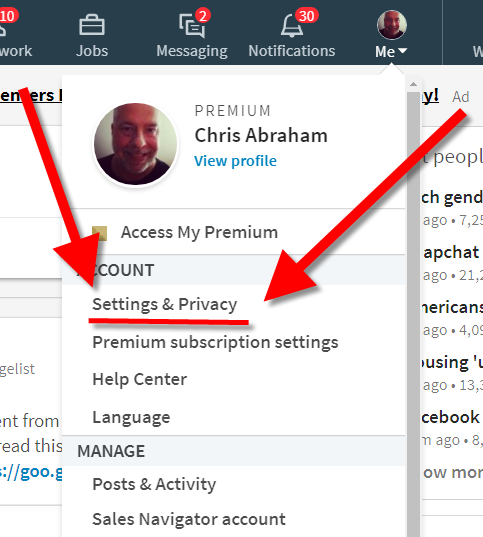
Instead of a contacts export, LinkedIn renamed it as Connections download and it’s part of the Download your data subsection of the Basics section of Setting & Privacy section of the Account drop-down menu when you click on your lovely own face, illustrating the Me button in the top navigation bar if you’re logged in to LinkedIn — the resulting URL, that you can link to directly, is called LinkedIn Member Datamaybe this direct link will make this whole thing easier for us all.

Once you get to the Download your data section, only check the Connections box.

Don’t worry about Imported Contacts because these are only the contacts that you, yourself, synced, shared, or uploaded, to LinkedIn.

Only Connections matters and downloads into a ZIP that looks a little like Basic_LinkedInDataExport_10-24-2017.zip.

Open that up and you’ll see a Connections.csv file.

For those of you who haven’t worked with them, a CSV file, “a CSV is a comma separated values file which allows data to be saved in a table structured format [source]” and can be opened with any spreadsheet app such as MS Excel, Google Sheets, LibreOffice Calc, Apple Numbers, etc.

How to download your LinkedIn connections as contacts via download your data

Before importing your Connections.csv file into your own contacts or into your own Customer relationship management (CRM) variant, you’ll need to open up that CSV file with your chosen editor and make some template changes in order to make that import compatible. I import my LinkedIn Connections into Contactually.

When I download my Connections.csv from LinkedIn, it gives me First Name, Last Name, Email Address, Company, Position, Connected On, and Tags records—an incompatible format for importing into my CRM.

So, I need to download Contactually’s import template on their import contacts page and do a bunch of copy and pasting to make sure we’re all good, including the essential Bucket record.

How to download your LinkedIn connections as contacts via download your data

So, be sure to check the FAQ of your own CRM or online address book to make sure you optimize your Connections.csv content to be compatible with your platforms.

I guess that’s it. Let me know if you have any questions. Happy to help.

I make sure I download my Connections every few months because I am pretty active at making connections on LinkedIn, so I like to keep my BD campaign topped up with folks who are opting in to being my besting on LinkedIn.

Goodluck and godspeed!

30 Oct 15:50

Stop With the Pretty Words Already

by Bonnie Harris

stevepb / Pixabay

My first career was in the restaurant industry. One thing we had to do was attend wine tastings held by the distributor so we could suggest new wines for the chain. Being only 22 years old, and not knowing a thing about wine I was totally out of my element. We had no pretty words to say. The other attendees usually had haughty remarks that indicated their high level of knowledge on this subject. My equally ignorant co-worker and I would make comments on the “legs” and say it was “oaky” without a clue as to what we meant.

And then we decided to make up one standard observation. For just one wine out of the bunch, I would taste it, cock my head and say “it’s oblique. Without being obtrusive.” My writer friends know that phrase means absolutely nothing. But invariably the other snooty guests would nod their heads enthusiastically in agreement. And we realized, nobody really knew anything about wine. We were just parroting pretty words that we thought might be appropriate to the wine, and the occasion.

As content marketing becomes more and more popular I’m seeing more and more variations on this “oblique without being obtrusive” comment within business writing. We’re “building bridges” and “creating journeys” and “transforming customer experiences” right and left. Unfortunately for the average customer or business buyer, these phrases just slide by in a blur. Don’t get me wrong; I’m as guilty as the next marketer in writing way too many of them. But seriously, it’s getting out of hand.

Brands seem to be getting better from a blog perspective but that may be due more to trying to get that green light from the Yoast plug-in, than from avoiding pretty words. It’s where the brand, product or service describes what they do where it gets kind of fuzzy. And unfortunately that’s where most companies need to deliver the straightest scoop of all.

Here are a few examples I found on corporate sites. (Pardon me for making fun of big agencies and consulting firms.) You tell me if you understand what they do or provide. I’ll try to provide my own translation:

  • Winning in an experience-led market means being hyper-focused on the customer and agile enough to offer new, connected experiences that flex to accommodate individual needs. (Accenture)
    • Translation: They’re saying that everybody wants something different and they’ll try to match it with some kind of services that makes people want to buy more stuff.
  • Deloitte’s Operations Transformation practice helps clients implement their corporate strategy, transform their core business and operations, prepare for growth, embrace the digital agenda, and maximize operational efficiency.
    • Translation: They basically know how to run your business way better than you do, and your business will die if you don’t hire them because people won’t buy more stuff.
  • Consumers demand a dialogue and expect an empowered role with the brands they interact with, and the communities they touch. (Edelman)
    • Translation: We’re afraid we have less influence than we used to so we’re trying to prove that public relations can still make people buy more stuff.
  • We are strategic partners matching dynamic, cutting-edge companies with innovators, creators and experts. (Can’t say, friend would stop talking to me.)
    • Translation: We’re a staffing firm but want to sound more glamorous so you’ll pay more for staff/buy more staff.

Personally, I’m really not sure I want an “experience.” I want to find out the answers to my questions quickly and easily to see if I want to buy that “stuff.” to determine if I want to buy. The self-directed buying cycle is taking over just about every brand, product or service provider’s sales funnel. And that type of consumerism demands direct, to the point information.

Have some great examples of pretty phrases in business marketing? Leave them in the comment section. Or try your hand at translating the comments above.

30 Oct 15:48

Do You Want to Play a Game? Perfecting Your Marketing Budget

by Hanna Dodd

PIRO4D / Pixabay

The Game of the Marketing Budget

Do you want to play a game? If you’ve ever seen any of the Saw movies, your answer should be a resounding NO. The same answer should apply to playing around with your marketing programs. Successful marketing programs differ for every company across various sectors. Your budget and marketing strategy should reflect your company’s performance history rather than conform to a template based on industry trends. Don’t play a guessing game with your marketing mix. The ideal marketing budget comes from diverse programs backed by optimal return on investment based on your past marketing results.

Establish the Rules: Looking at Historical Data

You have all the information needed to understand an ideal marketing mix hiding in the corners of your marketing automation platform. Historical data associated with each marketing program reveals which ones were most successful in converting opportunities to leads. Past program results will show the response rates to different types of marketing strategies. This allows you to decide which ones were most effective. One issue commonly over-looked is how performance changes when programs are run together. Though we all wish prospects convert to customers with one marketing instance, reality shows us that’s just not true. The value in evaluating marketing programs together is understanding the journey that converted a sales qualified lead into an opportunity rather than only evaluating their first or last marketing touches. The journey tells you which programs provide positive or negative impact on your company.

Knowing the Players: Optimized Marketing Mix

Optimal marketing mixes create a plan for allocating your budget across programs. We call it optimal because the allocation maximizes revenue by finding which program combinations succeed. It’s important to identify how programs interact together throughout the year. Some programs belong together; complimentary programs run in a series. Others may be substitutes and should never run at the same time. Your marketing mix should represent the best of what each program offers. By optimizing your marketing mix, you can plug in your budget and get a result that shows which programs to run and when to run them.

Mix Up Your Strategy: Diversify Your Marketing Mix

Instead of evaluating a marketing program on its own, combinations of programs provide much more optimized reflections of their performance. The average opportunity requires approximately seven to eleven touches to become a qualified lead for the sales team. If two email programs and a webinar run in series, their success should be evaluated together rather than separately. In practice, each segment of the series receives a weighted value for the conversion of the lead. Then, you can identify which programs run together effectively and improve the efficiency of your marketing programs. Why do an extra webinar when two emails will suffice?

Ranking at the Top: Return on Investment

By comparing the ROI of a program series against another series, the overall understanding of their success in converting opportunities to leads increases. ROI allows you to rank combinations of programs as well as the ideal periods to run them. If you’re trying to meet a deadline, some programs work faster than others. Some programs have greater returns in the long-run. Knowing which time segments of the year are most responsive identifies areas of strength and areas of growth for marketing programs. This information allows you to make a marketing budget that works for your marketing quotas, as well as the company’s overarching mission.

Own the Game, Don’t Play It

The world of optimized marketing is right at your fingertips. Use historical marketing data and programs’ ROI to maximize your returns to revenue within your established budget. Everything about your marketing strategy should be geared towards maximizing impact on pipeline and revenue for your company. In the world of big data, there’s no reason to be blind to marketing optimization. Here at ORM Technologies, we don’t play games (unless they involve major bragging rights in the office).

30 Oct 15:48

Scary Payment Practices That Will Send Shivers Down Your Spine

by Sandra Wrobel-Konior

Myriams-Fotos / Pixabay

Halloween is a scary time for many of us, and choosing an online payment solution could be a real nightmare, if you don’t know what to avoid.

We understand you, you’re thinking about implementing an online payment solution on your website or you want to switch your current payment gateway but it’s too scaring to even try? Don’t let your payment solution wear a scary costume for the whole year. Consider a few things that will help you choose wisely.

To make it simpler, meet some scary practices that you should avoid, even during Halloween.

1. Never-ending integration process

Picture the scene — You’ve spent a few weeks adding an online payments to your website, trying so hard, but there are still errors during the payment process or something just isn’t working well.

What’s more, imagine you have limited or no control over the development and payment process on your website. Not cool, huh?

Keep in mind that some payments may fail, so choosing the solution that gives you full control over the process makes you not only knowledgeable about the reason for failure but also gives you time to take some actions as soon as the charge is done. You need to be aware of anything that happens with payments on your website, you simply need a solution with real-time reports and notifications to always keep you updated.

This is what SecurionPay has to offer — a technologically advanced payment platform, and simple to integrate at the same time. With powerful and versatile APIs that will give you endless customisation possibilities and an effective reporting system.

2. Hidden or extra fees

Sometimes it’s the small things that are the most terrifying, especially when unexpected. Bearing this in mind, you don’t want to let payment provider surprise you with hidden fees or sudden fee changes that appear like a clown jack-in-the-box that pops out and scares all into a frenzy.

What you need is a transparent pricing structure with no hidden or extra fees guaranteed, so you always know how much and what you pay for. Things don’t always look as they seem, so focus on the REAL costs to avoid getting tricked.

3. Bad user experience

Badly designed checkout pages are haunting online businesses so often. And you should know that long and complicated checkout processes will freak your customers out.

Do you really want to give your customers a payment form that scares more than zombies or clowns? All the distractions or redirections during the checkout process are even scarier. It’s a real conversion killer, so keep this fear aside.

One-click payment pages make things faster, so keep customers on your site and don’t force them to visit external services to complete their purchases. Get rid of all the frictions during the checkout process.

4. Limited flexibility

Not having the ability to tailor payments to your business needs can be a major burden. Why? If you think that Halloween is spooky, just wait until you will have to deal with unhappy customers.

Delivering a solution that meets your customer’s specific expectations, based on their behavior, increase their satisfaction and boosts sales in return.

Find a solution that supports various business models and covers their needs and preferences. Seek a payment provider that will let you combine subscription payments with one-time charges and offers conversion-boosting tools, such as one-click payments or cross-sales.

It’s good to know that you can mix various billing models and create any payment scenarios you can imagine. All this leads to simplifying the purchasing process and improving your business success rate.

5. Security concerns

Needles to say that fraud is one of the scariest things for your online business. That’s why you need a solution that will keep your business ahead of the fraudsters and their spooky tricks. Scaring others during Halloween is fun, but scaring your customers may cause you business failure.

Of course, you need a keen sense of alertness to keep the things going, but to deliver more fairy tales than nightmares to your customers, you should seek a payment provider that covers all PCI issues.

A payment provider without extra security layers might put you and your customers in great danger, so look for one that provides machine learning solutions and contains anti-fraud tools, such as non-invasive 3D Secure, blacklisting, etc. to protect your transactions and reduce the number of chargebacks.

6. Lack of support

You may need assistance when you go door-to-door to collect all the Halloween candies, so it’s always good to know that there’s someone around who can help you (and don’t eat all your candies, of course!).

The same goes with payments on your website. Both you and your customers need to be sure that you’ll get an instant help when something goes wrong with payments on your site.

Payment stats you can’t miss this Halloween

Still not so scary? Let’s look at some terrifying stats that will send shivers down your spine.

  • The average online shopping cart abandonment rate is 69.23 percent (Baymard Institute)
  • Fraud losses on UK issued cards increased to £618.0 million in 2016 from £567.5 million in 2015 (Fraud The Facts 2017)
  • 47% of the world’s credit card fraud happens in the U.S. (Barclays report)
  • 86% of identity theft victims reported the fraudulent use of their credit card or bank account information (Bureau of Justice Statistics)

Quite dramatic, don’t you think?

The scariest part is that credit card fraud is happening everyday, at all times. Even though it sounds horrific, calm down — there are solutions like SecurionPay that help you handle these worst-case scenarios.

The lesson for today: A payment provider doesn’t have to be as scary as you think, but you need to double check things before accepting them. Protect your business from the dark side of inefficient solutions, don’t be scared of giving up things that don’t work and revive your dying business. When you do things right, it will have a powerful effect on customer loyalty.

What scares you the most when it comes to payment processing? Feel free to share your worst nightmares in the comments below.

30 Oct 15:47

Why Your B2B Sales Strategies Fail To Convert B2C Leads

by Elijah Masek-Kelly

For years, your business has thrived selling to other companies as a supplier. Those other companies would sell your product to consumers on your behalf.

Everything had gone smoothly.

However, now your new marketing lead wants to reap higher revenue margins by offering your product to consumers directly.

Three months later, your business buyers have deserted you, your consumer sales don’t make up for the B2B revenue losses, and you’re actively interviewing for a new marketing lead.

The problem with porting over an existing marketing program is that B2B and B2C purchasing behaviour is vastly different. Product or service lifecycle, path to conversion, and simple decision-making affect your sales strategy and must be accounted for to find the same type of success.

Winning Sales Tactics That Work for Both B2B and B2C

The difference between B2B and B2C sales does not necessarily come down to the tactic – it’s about the application of it. While the core principal is the same, it’s success depends on creating an approach that will resonate with the target.

Targeted Messaging

When focusing on each level of the purchasing funnel—Awareness, Consideration, and Conversion—benchmark goals are met through audience targeting, call-to-actions, and right-place/right-time messaging.

You must create unique and targeted messaging within each stage of the purchasing journey to keep the sales flowing. Your message to a business owner is going to be different than your message to a consumer.

Customer Education

Regularly delivered content that enhances the conversation will scale to reach all customers. Content makeup changes over time, but if you aim to educate your customer about what your product does, they will hold a higher value for it.

An informed buyer always shortens the sales cycle. Education is crucial to demonstrating your unique value and product usage. However, it is important to keep in mind that education for B2B and B2C customers will be different as they have different requirements and uses for your product or service.

Pexels / Pixabay

Six Areas to Consider with Your Sales Strategy

Rational vs. Emotional Messaging

Business purchasers are logical with their decisions, as costs are generally higher and more stakeholders share responsibility. Consumers’ emotions, however, are susceptible to B2C marketers.

Are you failing to appeal to a consumer’s emotional reaction?

Ability to Pay

For business marketing, some annual moments are more favorable to generate a sale. In some cases, budgets must be spent before the quarter ends. In comparison, consumers may spend whenever they have money, such as paydays or tax refunds.

Do you know who is paying the tab?

Purchasing Times

Pitching B2B buyers during work hours makes sense as purchasing is part of their job. However, your consumer audience has a different purchasing schedule.

Are you expecting a response when no one is home?

Education vs. Research

Both businesses and consumers need information about what you offer. Proper business is conducted with the mindset to create a lifetime partnership, supported by B2B customers that are fully educated on your products and processes. Consumers may perform research to get the gist of your unique value, but neither require nor desire extensive explanation.

If you’re using the same educational content for consumers, is it overwhelming and off-putting?

Stakeholders

Due to the size and importance of B2B purchases, there is likely a chain of command to finalize a sale. In B2C, consumers have the final say. Your calls-to-action may be failing if they are not direct to the consumer. ‘Learn More’ can serve both audiences, but focuses on consideration. ‘Call Now’ indicates you expect a purchase from your next customer touchpoint.

Are your marketing messages respecting the consumer as the final decision maker?

Lifetime Value

Business buyers aspire to create long-term partnerships for their companies. These provide the best deals, enable quick request fulfillment, and leverage shared assets. Consumers want to be loyal to a brand, with less interaction with the company.

Do you expect your B2C customer to be your business partner or your brand ambassador?

Sales Strategies Don’t Multitask Any Better Than You

Your strategies should already be unique to meet your goals, but it’s how you speak to your buyer that matters in B2C. If we conducted our personal lives as we do in business, there’d be no work/life separation, essential to productivity.

The same B2B buyers spend two-thirds of their day as B2C purchasers. If you’re speaking the right language at the right time, you will close more sales.

B2B sales strategies fail because it takes a dedicated message using the right voice to close B2C leads. Adjusting your tone will make all the difference.

27 Oct 16:19

Apple's content strategy becomes more clear (AAPL)

by Kevin Tran

Apple Services Revenue YoYThis story was delivered to BI Intelligence "Digital Media Briefing" subscribers. To learn more and subscribe, please click here.

Apple’s content push is focused on creating dramas and comedies suitable for all ages, and will shy away from things like nudity, profanity, and violence, according to Bloomberg.

Earlier this year, episodes of Apple’s Carpool Karaoke, a show where celebrities drive around Los Angeles singing songs and making jokes, had to be edited to remove inappropriate language, reflecting Apple’s family-friendly content strategy. Moving forward, the company’s first batch of shows won’t be housed in Apple Music and are planned to be available to everyone with an Apple device, though it's unclear exactly where. 

Apple may be looking to appeal to a younger audience that's increasingly turning away from traditional TV. Disney and Nickelodeon saw viewership among children between the ages of 2 and 11 years old drop by 33% and 50%, respectively, from 2010 to 2015, in favor of content on digital platforms. This young demographic is valuable for Apple because they could become long-term subscribers if they become acquainted with the company’s content offerings.

With its content push, Apple wouldn’t be the only company looking to capitalize on a younger demographic. Starz, which largely targets parents with young kids, plans to increase its video library by 40% by the end of this year. Additionally, BBC announced it would invest roughly $44 million (which is a relatively small figure) to develop children's content in July. However, Apple’s advantage is its high device penetration among consumers — there were over 1 billion active iOS devices as of January 2016. The company could make its content prominently displayed through an app on iOS devices, which would potentially expose the content to a large user base. 

Additionally, Apple risks alienating high-profile content creators with its family-friendly content approach. This potential issue is particularly troublesome as it may make it harder for Apple to create relationships in the industry, as creators may flock to other over-the-top (OTT) competitors like Netflix or Amazon instead.

To receive stories like this one directly to your inbox every morning, sign up for the Digital Media Briefing newsletter. Click here to learn more about how you can gain risk-free access today.

Join the conversation about this story »

27 Oct 16:18

E-Learning: Five Reasons It Would Work For Your Organization

by Darleen DeRosa

coyot / Pixabay

Training and developing leaders at all levels is one of the most crucial challenges faced by organizations in today’s fast-paced and demanding competitive environment. However, many companies find it difficult to devote the time and/or money needed to accomplish these objective especially when employees are distributed across the country or around the world. E-learning provides a cost-effective and scalable solution to these challenges.

Since its emergence in the late 1990s, online learning has rapidly become a staple of the corporate environment in America. More than 77% of companies in the United States offer online corporate training for employees to learn new skills or to enhance current skills as a benefit to or a requirement of their employees. Over the years, technology has catapulted e-learning to the center stage, providing an easy and convenient way for employees to fit professional development training into a busy day.

While leaders may be familiar with these technology-driven learning opportunities, they may not fully understand how they will benefit their organization. For HR professionals tasked with searching out training programs, e-learning is a convenient and cost-effective solution. Let’s explore some of the reasons why adopting an e-learning approach to learning and development is better for employees and employers alike.

Decreases Training Costs

Managers across all industries are seeking the most cost-effective ways to deliver training to their employees. According to the Association for Talent Development’s 2016 State of the Industry report, organizations spent an average of $1,252 per employee on learning and development in 2015. According to a study in the International Review of Research in Open and Distributed Learning, IBM reportedly saved $200 million on training in 1999 after the company switched to an online training delivery system. Its employees also were able to complete nearly five times the amount of course material in the amount of time it normally would take to complete one traditional learning course.

An investment in e-learning can help employers in both small and large businesses stay within their budget and reduce program, travel, lodging and meal costs that are associated with professional development and training.

Offers Versatility

E-learning is no longer limited to one form of delivery with the types of technologies available for e-learning doubling over the past several years. Synchronous learning and asynchronous learning solutions are available to meet time constraints, employee needs and learning styles. Some of these methods include the use of video/audio recordings, blended learning, computer-based (CBT) and web-based trainings (WBT), massively open online courses (MOOCs), and self-study. Research shows that 50% of organizations take a more creative approach to e-learning, incorporating complex simulations and games into their learning and development strategies.

Because access to e-learning is not geographically limiting, employees on virtual teams also can engage in consistent and convenient leadership or team development training from a distance. Mobile learning is on the rise with 74% of individuals using mobile technology to access e-learning training. Because of the flexibility of mobile, employees are able to access these training opportunities on-the-go when they want and need them.

Saves Time

Virtual training allows employees to learn and complete coursework in 40-60% less time than the traditional instructor-led classroom. Instead of scheduling hours, days or weeks to devote strictly to attending classes and studying training materials, they instead can study at their own pace and spend more time on a challenging topic or speed ahead through known knowledge areas.

Increases Engagement

Companies that make training and leadership development a priority have a significant advantage in attracting and retaining strong talent. In fact, research by the Corporate Leadership Council shows that employers who prioritize these areas outperform their competitors by up to 19%, experience less frequent turnover and increased employee engagement.

Increases Revenue

42% of companies that use e-learning methods have experienced a revenue increase. Better trained employees who are more engaged and feel that their company is invested in their professional and leadership development are more productive, thereby making your company more productive.

27 Oct 16:18

4 Smart Ways Small Businesses Can Gain a Competitive Edge

by Joseph Chukwube

StartupStockPhotos / Pixabay

With the market sphere filled with similar products and services, businesses have no other option but to join the tough competition.

The established businesses often have the best of connections, solid social proofs, and top-notch experts helping with their marketing and products outreach.

New and/or small businesses, on the other hand, often don’t have these privileges. Hence, it’s often a difficult task for them to craft out space or earn authority in the sphere.

This can be tagged as one of the major drawbacks that cause many startups to shut down after a short while.

Although startups are often advised to follow the footsteps of the established businesses in the sense that “they are obviously doing something right,” most new businesses don’t have the resources or infrastructures to employ the exact same strategies of the established businesses.

Hence, there is the need for startups to come up with new ways to prove their relevance in the market. Below are 4 of such strategies that can be exercised.

  1. Utilize a competitive analysis

No business idea is completely new to the market, and even if you happen to come up with one, other businesses will also implement the same idea in no time. This is to say, competition to dominate in your niche is inevitable as long as business is concerned.

But then, with established businesses having more resources, experience, and connections, how can your small business gain a competitive edge, or even stand a chance of dominating similar small businesses?

By not competing with them.

Yes, effective competition can bolster growth and improvement. But what resources or experience do you have to compete with such established businesses?

What to do at this juncture, however, is to utilize what is called competitive analysis.

This involves closely analyzing the established businesses to:

  • Uncover strategies that work for them.
  • Crucial mistakes they have made in the past.
  • Trends they are currently employing.
  • Organizations and personnel they network with.
  • The marketing approaches they have tried in the past, and the ones currently in place.

Uncovering the above and more about your competitors will help you to tap into the experiences they have garnered over the years.

This simple strategy is the reason entrepreneurs are always on the lookout for the kinds of books the highly successful entrepreneurs read, their morning and night rituals, their exercise routines and so on.

After uncovering the above, place your business model side by side with the uncovered facts to know which to try out first.

This is what differentiates competitive analysis from mere competition.

In competing with the established businesses, you simply analyze what works for them and then try to implement the exact same thing for your business.

In a competitive analysis, however, you analyze what works for the established businesses so you can use the whole facts as a roadmap to try out different approaches and strategies until you discover what works for your business and then you redefine it to make it even better.

Merely competing is wrong because, for instance, an established business may spend hundreds of thousands of dollars in ads while also spending so much more on products and services refinement. But your business currently can’t afford that much fund and if you try to allocate all your funds to ads, your products and services will suffer.

What you do, then, is to analyze how the ads really benefit their business and then come up with ways to also reap those benefits for your business without spending that much money.

In summary, a competitive analysis will help your business to:

  • Discover what works for other businesses and then redefine it to work better for yours.
  • Garner more knowledge and experience from other businesses.
  • Uncover enough business strategies to try out until you discover which works best for your business.
  1. Implement promising business trends before competitors

The business sphere is constantly evolving, with marketing trends arising and dying off.

A few years back, Infographics were new and not many businesses could readily create one.

That made this content marketing strategy quite effective as consumers viewed it as an entertaining and interesting way to access information online.

Hence, businesses that implemented infographics then built more audience around their business and made great conversions.

Fast-forward to the present, however, infographics don’t hold that much value anymore, and businesses that implement it now just won’t get as many conversions as earlier.

This clearly explains the evolving nature of the business sphere.

New business trends will rise, but the businesses that will benefit the most from it are those that are quick to implement it.

And the only way to discover these business trends is by keeping up with the world market, following industry experts on social networks, and being at alert at press releases from business magazines and publications.

  1. Pay attention to your branding and products quality

In the end, it all boils down to the quality of services you offer and how effectively you communicate your products and services to and with the consumers.

Though it’s difficult to convince a customer to ignore others and give your services a shot, it’s the customer’s level of satisfaction that determines whether the customer will be a return customer and also make referrals for you.

Hence, rather than just focusing on different types of marketing, it’s important to ensure your products and services are redefined and fine-tuned.

Also, create a heartwarming business logo, a smart and creative tagline, and a business website with an impressive UI and UE. These will serve as a reminder of your brand and products for the consumer until you successfully win such consumer over.

  1. Freebies and Giveaways still work

A well-planned giveaway can go a long way in gaining exposure for your business and in building repeat customers.

A poorly planned giveaway, on the other hand, will only consume funds that could have better been allocated to other fields.

Because new businesses are still on the verge of convincing and proving their credibility to the consumers, there’s a need to do something that will individually benefit the consumer, and that’s exactly what freebies do.

To ensure your giveaways get to the prospective consumers and not just to freeloaders who have no interest in purchasing from your brand, however, do the following:

  • Carry out a little questioning to determine if you’re approaching the right audience, and to know their level of interest in your brand.
  • Place your logo and/or business name on the giveaway items.
  • Give memorable items that will last quite some time. This, however, doesn’t mean to give really expensive stuff that will affect your finances — a plastic mug with your brand’s logo attached will last longer and have more impact than a pencil.

With the above four approaches, a small business can build a name for itself in the market and equally be able to draw consumers to itself.

27 Oct 16:16

After watching over 100 TED talks, these are the insights that have stuck with me most

by Chris Weller

amanda palmer

Watch one TED talk, and you have a factoid to share with a friend at a bar.

Watch over 100 TED talks across several years — as I have, obsessively — and you begin to think a little differently about the world.

Not every talk is awe-inspiring or illuminating, but the best ones have changed how I think about education, business, psychology, and human behavior.

Here are some of the insights that have stuck with me the most.

SEE ALSO: Scientists followed 5,000 genius kids for 45 years — here's what they learned about success

A meaningful life is more important than a happy one.

An author and psychology expert, Emily Esfahani Smith recently toured the US asking hundreds of people what they considered important in their lives. The answers she received didn't have much to do with happiness, fame, or fortune.

The most important thing to people was that life felt meaningful. 

Follow-up analysis of her data showed meaning contained four ingredients: purpose, belonging, transcendence, and storytelling. The first two are straightforward. The second two refer generally to getting in the zone and taking control of your attitude.

Life might not always be a happy journey, Esfahani Smith's work suggests, but it can be a rewarding one.


Some choice is better than none, but more choice isn't necessarily better than some.

In Barry Schwartz's 2005 talk, "The Paradox of Choice," he reviews the research that says people are misled in thinking they should want as much choice as possible, whether that's the expansive number of salad dressings at the supermarket or array of clothing styles at the mall.

His talk made me realize that decision-making takes a lot of effort. It can be mentally draining to weigh all those options, and we may be better off limiting our menu of choices to just a few. Usually, "good enough" is good enough.


If you want something, you have to ask for it.

Amanda Palmer, former lead singer of The Dresden Dolls, says soliciting help isn't a burden on people. It's actually a precious skill. In her 2013 talk, "The Art of Asking," she recounts asking people on Twitter for instruments, food, and couches to sleep on, all so her shows could go on.

In a similar talk, music journalist Nardwuar explains in his 2011 talk "Do It Yourself!" that if you want something, you shouldn't expect people to read your minds. You have to be tenacious and persistent.

Together, their talks helped me see asking less as a selfish act and more as a natural part of people working together.


See the rest of the story at Business Insider
27 Oct 16:10

Warm winters, scorching summers: New maps project impact of climate change

by Sharon Kirkey

Is this the end of the Great Canadian winter?

A new report says that even if greenhouse gas emissions are reduced, all of Canada is projected to get warmer by the end of the century, while the number of 30 C plus days per year are predicted to “explode” under the current global warming trajectory.

The report by climatologists at the University of Winnipeg-based Prairie Climate Centre looks at how temperature and precipitation are likely to change under two hypothetical warming scenarios: a “low-carbon” one that assumes emissions will slow, and a high-carbon scenario that assumes the opposite — “that humanity will continue to emit more and more greenhouse gases into the atmosphere well into the future.”

“It is of course urgently necessary that we reduce greenhouse gas emissions to prevent the most dire climate-change consequences, but we must also accept the reality that at least some climate-change impacts are all but guaranteed,” writes climate-change researcher Ryan Smith.

How temperature is likely to change in Canada by 2080 if greenhouse gas emissions are reduced

How much warmer and wetter will our future climate be? According to a series of maps produced by the Prairie centre climatologists:

– Under a high-carbon scenario, in some months the Arctic is projected to warm by more than 12 degrees Celsius by the end of this century. Sea ice and snow reflect unwanted solar energy back into space. Without it, the open ocean would absorb sunlight, speeding the rate of global warming.

– The months of December and January are projected to warm faster than the month of June. Warmer winters might sound marvellous, but they make it easier for agricultural and forest pests to survive winter. Cold winters are also vital for winter roads relied upon by “tens of thousands of Canadians,” including First Nations.

– Southern Canada is expected to get wetter through the spring, fall and winter — increasing the risks of the kind of flooding that soaked swaths of Ontario and Quebec this year — but much drier in summer, increasing drought and wildfire risks.

The modelling was based on two 30-year future periods — 2021 to 2050, and 2051 to 2080, using 12 different climate models. The researchers used an average of the models.

Snow covered side street off King St. W., near Spadina Ave. in Toronto, Ont. on Monday March 13, 2017.

Overall, the globe is projected to warm by two to three degrees Celsius by 2051 to 2080, compared to 12 degrees or more for some places in the Canadian High Arctic, assuming the high-carbon future we’re trending towards, Smith said in an email.

Toronto’s summers are projected to warm by four degrees Celsius by 2051 to 2080 in a high-carbon scenario; in comparison, its winters are projected to warm five degrees Celsius. Churchill summers will warm by 3.5 degrees Celsius; its winters by nine degrees.

While Vancouver, Toronto and Montreal are warming at a slower rate (at least compared to the Canadian Arctic), the warming is still “dramatic and worrisome,” Smith said. “Even a few degrees of average temperature change can lead to a drastic climate change.”

For example, Toronto currently averages 12 days per year that reach or exceed 30 C. By 2051-2080, under the high-carbon modelling, that number is projected to rise to 55.

“Sometimes the ‘average mean temperature change’ can be very misleading, especially when we talk of only a few degrees of change,” Smith said. “The reality is that small changes in the mean add up to big changes in the extremes.”

Why is winter changing, and projected to change more? There’s an energy deficit during winter, Smith explained. Longer nights and shorter days mean energy is being lost to space. Greenhouse gases stop this escaping heat.

“More simply: we cool off at night, and nights are longer in the winter, and greenhouse gases prevent the planet from cooling off,” Smith said.

In this July 21, 2017 file photo, researchers look out from the Finnish icebreaker MSV Nordica as the sun sets over sea ice floating on the Victoria Strait along the Northwest Passage in the Canadian Arctic Archipelago.

The less snow the less reflective the surface. “As soon as you get the snow cover gone, boom, it warms up really quickly, because the sun gets absorbed by the ground,” said Danny Blair, a University of Winnipeg professor of geography and director of science at the Prairie Climate Centre.

“Winter, in our future, is going to be very different from the past,” he said. Winters will get not just warmer, but wetter.

The researchers were also struck by the projected average drying and warming in the summer months across the Prairies and into Alberta and B.C., with 20-per-cent drops in precipitation in some regions. “That spells trouble,” said Blair. Drought and forest fires “are even more so going to be a problem in our future.”

Under the high-carbon, far future scenario, the number of hot days “is just going to explode. It’s scary,” Blair said.

Near the end of the century, summers in southern Ontario will have, on average, more than 80 days of 30 C plus — the climate of Nebraska or northern Texas. 

The Prairie Climate Centre is a collaboration of the University of Winnipeg and the International Institute for Sustainable Development.

27 Oct 16:05

New research suggests the ocean could rise more — and faster — than we ever thought

by Washington Post

Climate change could lead to sea level rises that are larger, and happen more rapidly, than previously thought, according to a trio of new studies that reflect mounting concerns about the stability of polar ice.

In one case, the research suggests that previous high end projections for sea level rise by the year 2100 – a little over three feet – could be too low, substituting numbers as high as six feet at the extreme if the world continues to burn large volumes of fossil fuels throughout the century.

“We have the potential to have much more sea level rise under high emissions scenarios,” said Alexander Nauels, a researcher at the University of Melbourne in Australia who led one of the three studies. His work, co-authored with researchers at institutions in Austria, Switzerland and Germany, was published Thursday in Environmental Research Letters.

The results comprise both novel scientific observations – based on high resolution seafloor imaging techniques that give a new window on past sea level events – and new modeling techniques based on a better understanding of Antarctic ice.

The observational results, from Texas and Antarctica, examine a similar time period – the close of the last Ice Age a little over 10,000 years ago, when seas are believed to have risen very rapidly at times, as northern hemisphere ice sheets collapsed.

Off the Texas coast, this would have inundated ancient coral reefs. Usually, these reefs can grow upward to keep pace with sea level rise, but there’s a limit – one observed by a team of scientists aboard a vessel called the Falcor in 200 foot deep waters off the coast of Corpus Christi.

These so-called drowned reefs showed features that the researchers called “terraces,” an indicator of how the corals would have tried to respond to fast rising sea levels. Because the organisms must maintain access to a certain amount of sunlight, they would have tried to grow higher to keep up with fast rising seas – but they wouldn’t have been able to do so over a very large area. And so their growth became concentrated in progressively smaller, stepped regions.

“The reef under stress often has a tendency to kind of shrink to this higher elevated area,” said André Droxler, one of the authors of the study in Nature Communications and a researcher at Rice University. “It creates this pyramid-like system.” (Droxler completed the research with colleagues from Rice and Texas A&M University, Corpus Christi.)

The youngest drowned corals date to the end of the last ice age, around 11,500 years ago – corresponding to what scientists believe were large warming events in the northern hemisphere and so-called meltwater pulses from now melted ice sheets. And multiple drowned reefs off Texas show a similar pattern – and terminate in similar water depths.

“Over 120 kilometers, the reefs behaved the same way. It’s difficult to find any other reason why they would do this,” Droxler said.

Droxler thinks the reef structures suggest eras when sea level was rising by tens of millimeters annually, far beyond the current, roughly 3 millimeters per year. (A 50 millimeter annual sea level rise would produce a meter, or over 3 feet, of rise every 20 years.) The new study therefore concludes that during the last ice age, there were multiple bursts of fast sea level rise – and implies that our future could hold something similar.

“The steady and gradual sea-level rise, observed over the past two centuries [may] not be a complete characterization of how sea level would rise in the future,” the study concludes.

A 3-D representation of Dream Bank, a long-dead reef offshore South Texas. The vertical scale of the image has been increased to clearly illustrate the terrace structures that form due to rising sea levels via a process known as backstepping.

Meanwhile, far away in the Southern hemisphere, a team of scientists used a very similar seafloor mapping technology to detect ancient iceberg “plough marks” etched deep into the seafloor of Pine Island Bay, an ocean body that currently sits in front of one of West Antarctica’s most worrying glaciers, Pine Island. The results were published in the journal Nature on Wednesday by researchers at the University of Cambridge, the British Antarctic Survey, and the Bolin Center for Climate Research in Stockholm.

The seafloor grooves, the researchers believe, were made during a similar era to the Texas coral steppes (the close of the last ice age), and signal a very rapid retreat of Pine Island over roughly a thousand years.

What’s critical about the markings, explains lead study author Matthew Wise of the University of Cambridge, is their maximum depth – 848 meters, or around 2,800 feet. Because ice floats with 10 per cent of its mass above the surface and the remaining 90 per cent below it, this suggests that when the ice broke from the glacier, close to 100 meters (over 3oo feet) of it was extending above the water surface.

That’s a key number, because scientists are converging on the belief that ice cliffs of about this height above the water level are no longer sustainable and collapse under their own weight – meaning that when you get a glacier this tall up against the ocean, it tends to crumble and crumble, leading to fast retreat and potentially fast sea level rise.

In this image obtained from NASA, a close-up image of the crack spreading across the ice shelf of Pine Island Glacier shows on October 26, 2011, the details of the boulder-like blocks of ice that fell into the rift when it split.

“If we think about how thick these icebergs would have needed to be considering these float with 90 per cent of their mass and thickness beneath the sea,” Wise said, “we think of an ice cliff that was at the maximum thickness implied by the physics of the ice.”

The problem is that if it happened then, well, it could happen again. Both Pine Island glacier and its next door neighbor, Thwaites, are known to get thicker as one travels inland away from the sea, which means they are capable of once again generating ice cliffs taller than the critical size detected by the current study.

“If a cliff even higher than the ~100 m subaerial/900 m submarine cliffs were to form, as might occur with retreat of Thwaites Glacier in West Antarctica, it might break repeatedly with much shorter pauses than now observed, causing very fast grounding line retreat and sea level rise,” explained Richard Alley, a glaciologist at Penn State University, by email after reviewing the current study for the Post.

The final study, released Thursday morning in Environmental Research Letters, takes a different approach but provides perhaps the most sweeping verdict.

The study used five “shared socioeconomic pathways” that analyze possible futures for global society and its energy system, and resulting climate change, over the course of this century. These scenarios will feed into the next report of the United Nations Intergovernmental Panel on Climate Change, the most influential scientific body that assesses climate change, according to the University of Melbourne’s Alexander Nauels, the lead author of the current study

The research combined these scenarios with tools to project future sea level rise in light of recent science suggesting that Antarctic ice in key regions could collapse relatively rapidly. That includes possible fast retreat at Pine Island and Thwaites glaciers due, in part, to the problem of ice cliff instability.

The result was that in one scenario assuming high fossil fuel use and strong economic growth during the century, the study predicted that seas could rise by as much as 4.33 feet on average – with a high end possibility of as much as 6.2 feet – by 2100. That includes possibly rapid sea level rise as high as 19 millimeters per year by the end of the century. These numbers are considerably higher than high end projections released in 2013 by the Intergovernmental Panel on Climate Change.

(It is important to emphasize that the highest sea level numbers presented in the new study would result from human choices to pursue large fossil fuel exploitation and economic growth with little attempt to slow climate change. It is far from clear that this is the path the world will actually take.)

On the other hand, if the world limits global warming to the Paris climate agreement emissions target, the study finds that sea level rise might be held as low as 1.7 feet by 2100, on average.

When the IPCC undertakes a similar analysis, Nauels said, it could produce results like these. “I think the numbers will go up,” he said of the body’s report, which is expected in 2021.

So in sum – new research is affirming that seas have risen quite rapidly in the planet’s past, and that major glaciers have retreated quickly because their enormous size makes them potentially unstable. Meanwhile, additional modeling projects these kinds of observations forward and suggests that the century in which we are now living could – could – see similar changes, at least in more severe global warming scenarios in which the world continues to burn high volumes of fossil fuels.

But unlike those submerged corals off the coast of Texas, the difference is that we know this could be coming – which gives us a chance to stop it.


27 Oct 16:02

Improve Web Security by Using Chrome’s Auto-Generated Passwords

by Dan Price

Despite recently discovered Wi-Fi vulnerabilities like KRACK, the odds of your password being compromised in real-time by a hacker are incredibly small. Almost all password hacks come through two sources: brute force attacks (whereby an attack hits your account with tens of thousands of password combinations in the hope one works), and database hacks (when a company’s database of user data is breached). Either way, unique passwords makes you more secure. A strong password like gW$4*9Ps£7! is much harder for a brute force attack to break than ILoveMyDog123, and using a series of unique passwords means all your other accounts will...

Read the full article: Improve Web Security by Using Chrome’s Auto-Generated Passwords

27 Oct 16:02

ARM CEO: Tech Industry Must Build an Immune System to Prevent a Cybercrime Pandemic

by Tekla S. Perry
In a manifesto, ARM’s Simon Segars says tech companies must take lifetime responsibility for the security of every connected device they create
Photo: Tekla Perry

Tech security today is bad, and as people bring more and more connected tech gadgets into their homes, the risks are increasing dramatically. That’s why it is time for the tech industry to step up and take responsibility for protecting the devices they make, and the people that use them.

This was the message delivered by ARM CEO Simon Segars to ARM developers attending the annual ARM TechCon in Santa Clara, Calif., this week.

The theme of security permeated the event, with ARM announcing its Platform Security Architecture, a set of architecture specifications and open source firmware aimed for use in the IoT, along with a programmable security core.

But Segars and other speakers made it clear that this concern about security wasn’t just about what ARM is doing. Segars distributed what ARM is calling a Security Manifesto, urging the tech industry to accept the fact that it has a social contract with users, that security is a collective industry responsibility and that security systems have to allow for human error.

The manifesto also states that security must be a primary design consideration from the beginning, an approach cybersecurity experts have been beating the drum about. [See “Why Hardware Engineers Have to Think Like Cybercriminals, and Why Engineers Are Easy to Fool”.]

“It’s not just a software problem,” Segars said. “If we can do more in hardware, if we design things with the assumption that a compromise is going to happen, we can make the [security] software simpler.”

Segars also said the makers of connected products have to take ownership for security for the lifetime of the product. In the auto industry, he pointed out “you read all the time about recalls, so you know that the car company is taking some responsibility for your safety after you’ve driven off the lot. As imperfect as that is, at least there is an onus on the company that sold me the car to look after that.

Today, he continued, “the tech industry is not like that. In very few cases does anybody who sold you an electronic product take responsibility for it. That has to change.”

And it has to change very soon, because, he said, “as we go into the world of IoT, the threats explode tremendously.”

“When everything is a connected, it is an opportunity for a bad hacker,” he said. Already, he said, hackers have even attacked a connected fish tank.

“I’d like all of you to join us in committing to making electronic products safer than they are today,” he urged.

Segars wants the tech industry to think of protecting against security hacks not so much as building a wall that locks hackers out, but as building an immune system that fights infections.

“These devices are alive,” he said. And “electronic threats are alive in the same way biological threats are alive,” they are constantly adapting to new conditions.

The kind of cyber immune system he described would use intelligence in the devices themselves, in the network, and in the cloud to spot when something is wrong, to quarantine it so it doesn’t damage other systems, and to heal it by triggering a firmware update or other patch, in most cases, without the user of the device having to do anything.  Companies would have to work together to spot and counteract threats, he said.

While Segars focused on what the industry can do against cybercrime, he clearly didn’t want to oversell the power of technology to fix the problem. Instead, users should take more responsibility for their own security, he indicated in a white paper distributed with the manifesto.

And cybercrime experts took the stage to explicitly deliver the message that humans, not just machines, can and will be hacked.

People, they indicated, need to do better holding up their end of the social contract, that is, spotting when they are about to be manipulated by hackers and not falling for it, or at least not falling for it quite as often as they do today.

Mary Aiken, a cyber psychologist who works in forensics (and who was the inspiration for the TV show CSI Cyber), said that even smart people do stupid things online—like load apps on their phones that they haven’t fully checked out, even when they know they have credit card data loaded on their phones as well. In a larger context, she pointed out that storing financial data for half the U.S. population on one company’s servers was probably not a good idea. “Just because we can, doesn’t mean we should,” she said.

Jessica Butler shows a successful email attack.
Photo: Tekla Perry
Jessica Butler shows a successful email attack.

Jessica Butler, a cybersecurity consultant, made it clear that just about any human can be hacked. Her most stunning real-world example featured an email sent to a high-level employee, purportedly from the company CEO, requesting the immediate transfer of a vast amount of money to close an important, but stealthy, deal. The employee made the transfer.

“So many organizations are falling victim to these attacks,” Butler said. “The FBI estimates that these are costing $2.5 billion a year annually.”

“It’s about the people, the process, and the technology,” she said. “I would love us to get to the stage where technology can solve our security problems, but we are very far from that point right now.”

She warned about the exploding threat of ransomware, and its potential move from computers into the Internet of Things. “Would you ransom your smart TV when your favorite show is coming on in half an hour?” she asked. “If I compromise your sex toy, can I get access to information that can be ransomed?”

Individuals, she said, need to step up their use of password managers and two-factor authentication. And they also need to be suspicious. “Beware,” she said, “of links and attachments. It’s terrible advice, I know, because half of what we do at our desks is click on link and download attachments. But you have to be aware. If you get an attachment that you weren’t expecting, pick up the phone and call the person who sent it to you.”

“We need to get people to be our strongest link,” she concluded.

You can download ARM’s Security Manifesto, as well as detailed explanations of ARM’s concerns and vision from Segars and other executives, here.

27 Oct 16:02

Social Channel Security Risks and Ways to Deal With Them

by Ernest Thompson

geralt / Pixabay

Your social media channels have security risks which you must deal with. As a communicator, you’re probably not thinking too hard about what can leak out of your social media. In order to be responsible you must attempt to plug up these leaks so that the people you are communicating with continue to trust you.

I’m going to look at these risks and to give you the tools to minimize them. You may never eliminate them 100%, but you can get very close if you follow all of the points below.

Stopping brute force hacks

Brute force hacks are when hackers use password cracking tools. These tools guess thousands of passwords per second until they find the correct one. Commonly, they will use known passwords from previous hacks, as well as combinations of common words.

They will use these to crack the password for your Twitter, Facebook, Instagram, and other social channels. The way that you are going to stop them is by using strong passwords. To give you an idea, here are some tips for creating strong passwords:

  • Use upper and lowercase letters
  • Use numbers and symbols
  • Stop using words and instead use phrases

Do not pick and choose from the list above, use all three tips each time you create a password.

Stopping multiple account hacks

A frequent issue is a hacker will get hold of one of your passwords on another account, perhaps an older one that you no longer use. They will then use this password across all of your other accounts until they get a match.

You are going to stop hackers by using a different password for every account. If they get access to one password, they only get access to that one account. Remembering all of these passwords doesn’t like fun, does it? Fortunately, you can use one of these password management tools to help you create and store all of these passwords:

Each one that will work with one master password that will unlock all of your other passwords. Your other passwords are stored in an encrypted storage space so that hackers cannot access them.

Protecting your remote employees

When we are talking about social media we are talking about something that does not just happen in the office. People frequently go out into the world to report on things in your industry and broadcast your events.

This leads to risks when they connect to public Wi-Fi. Hackers will frequently set up man in the middle attacks where they create their own Wi-Fi network and then eavesdrop on it. The way that you are going to stop this is with encryption.

The easiest way to get encryption is with a VPN such as IPVanishVPN. Here is how it will work:

  • Your employee well prepare the social media content they want to share from a remote location.
  • The employee will connect to a Wi-Fi network.
  • Immediately upon connecting the employee will connect to their VPN. This will now encrypt everything that they send over the network.
  • The employee can now freely share everything on social media they want without fear that data or passwords will be stolen.

This type of corporate espionage can be highly targeted to events such as conferences. Your employees won’t even know that it has happened if they do not protect themselves.

Using social media management dashboards

An easy way to protect your main accounts is to never give them to anyone. Instead, connect to to your main accounts to a social media dashboard management system. This way, you will only have to create one account for your employees to manage multiple accounts. When those employees are terminated, you only have to take him off of that one account rather than many.

The most popular tools for this include:

Each of these tools will allow you to manage multiple social channel profiles through a single dashboard.

Better communication on support channels

Clearly showing your customers where they should actually get support is important. You don’t want to get into a situation where people do not know how to communicate with you properly, and wind up sharing their banking and credit card details with you through Twitter.

You are going to be much better off pointing them towards your dedicated customer support channels. Put them in your ‘About’ sections and share them periodically:

  • Phone numbers that they can contact
  • Email addresses they can contact
  • Web forms they can fill out

Hopefully, these are going to be more secure means of communication. Particularly web forms which can be protected by HTTPS encryption.

The goal here is risk management. Your customers will inevitably share some sort of information on social media with you that they should not. If you do your due diligence, you will be in the clear if something does happen.

Better training your employees

You need to train your employees to know what is appropriate for them to do on your social channels. This will include teaching them things like:

  • Whose emails they are allowed to share.
  • Which phone numbers they are allowed to share.
  • What sort of conversations they are allowed to have in public on social media, or in the DMs.
  • The types of questions that they should be asking.
  • What phishing attacks are and how to identify them.

You can’t just send your employees off to your social channels without giving them proper information security training. If you do not prepare them, they will make mistakes that will be costly to your brand.

Managing social channel security risks

All social media channels have some sort of security risk. Your ability to manage them will make you a better communicator as you avoid a risk which could damage your credibility. There’s nothing worse than building up a great social channel only for it to be torn down due to poor security preparation.

27 Oct 16:01

Do You Know Who’s in Your LinkedIn Network?

by Charlotte Meredith

Do you have hundreds of LinkedIn connections? Maybe just over 100? Whatever category you fit into, it’s important to ask yourself these questions: Do you know who each of those Connections are? Are they beneficial to keep in your network? Do they add value to your network?

Let’s be clear, LinkedIn is not Facebook where most people think it’s okay to friend request your sister-in-law’s mother’s ex-husband and his kids because you “know who they are.” Your LinkedIn connections should be people who add value to your network in some way. Yes, you can and you should be connected with all family and friends, but let’s refrain from connecting with that one person you went to kindergarten with who has 15 connections.

Take some time to review your network. Are there Connections that you need to rethink? Removing someone from your network is very simple and takes just a few steps.

  1. After logging into your LinkedIn account, click on “My Network” at the top of the page.

2. Click on “See All” under the number of connections you have.

3. Scroll through your connections and when you come across a connection that you don’t feel you need to be connected to, or isn’t beneficial to you, click on the three dots next to the Message link to the far right, and remove the connection.

Being the largest professional network, use LinkedIn to your utmost benefit. Connect with meaningful people who will benefit your network and lead you to more quality people.

When requesting to connect with someone, or receiving a connection request, really think about how this person will impact your presence on LinkedIn. Do they have a large network? Have you worked with them? Did they send you a personal message in their connection request stating why they want to add you to their network? What are you going to include in your connection request message?

Always think long and hard about adding a new connection to your network. It’s more important than you think!

27 Oct 16:00

Red-hot tech stocks aren't as expensive as they look

by Jacqui Frank, Kara Chin and Joe Ciolli

Business Insider executive editor Sara Silverstein speaks with Brian Levitt, the senior investment strategist at OppenheimerFunds. He notes that the market has been favoring growth stocks like the FANG group, rather than their value counterparts, because we've been in a slow economic growth environment. He then goes on to say that he favors looking at a measure like price-sales ratio when assessing companies like Amazon, because they're a better predictor of future returns. Using that, a lot of stocks that look expensive are actually reasonably priced.

Following is a transcript of the video. This transcript has been lightly edited for length and clarity.

Sara Silverstein: When you look at the individual stocks, do you see any standouts that are overvalued or undervalued?

Brian Levitt: Well the market has been favoring growth in a slow growth world, rather than value stocks. It's sort of paradoxical: when there's no growth you buy growth, when there's a lot of growth you buy value. So since we've been in this slow growth environment, investors have been bidding up those names that are growing. In the US, it's the so-called FAANG stocks — Facebook, Apple, Amazon, Netflix, and Google. But also, if you were to compare those stocks to some of the valuations of some of the bellwether stocks of the 1990s — Intel, Oracle, EMC, Cisco, Microsoft — their valuations are also not even close. Some might push back and say well, Netflix, Amazon, on a price to earnings basis, are very expensive. I would tell them to look at a price to sales basis on Amazon, which by the way is a better predictor of returns. On a price to sales basis, Amazon is pretty reasonably priced. That's not necessarily a stock suggestion, it's just simply saying that you need to look a little bit deeper than come up with these hyperbolic statements that the FAANG stocks are overvalued. It's simply not true.


Join the conversation about this story »

27 Oct 15:57

Opinion: Innovation isn't a magic bullet, it requires a work plan

by Harvey Enchin

It’s always tempting, when you’re wrestling with a problem, to seek a single solution — like a software patch that will update your phone or restore your computer. Yet, the global economy is no simple organism. And innovation is no magic patch. Rather, it’s a process of discovery, invention, engagement and application that demands multiple solutions to achieve optimal results.

I raise the matter as a caution — and encouragement — in anticipation of two conferences coming to Vancouver next week. The first is Innovate Now Canada, a forum hosted by CityAge and The Rideau Hall Foundation to explore what Canada needs to do to create a culture of innovation. The second is Scaling Up for Prosperity in a Changing World, a Business Council of B.C. summit that will examine strategies for diversifying our economy and scaling up businesses.

Both offer impressive programs, and both will bring lots of smart people together. But no conference-goer should expect a single, elegant answer to the innovation challenge, no matter how passionate participants are about their favourite prescription.

Some may argue we need big investments in digital infrastructure (and we do). Others may suggest that we should create more innovation clusters (and we should). Still others may say that Ottawa should increase its investments in university research (and you will get no disagreement from me on that). 

But while all of these solutions are necessary, none is sufficient. Digital infrastructure requires innovative content. Industrial clusters need capital investment. And every successful innovation strategy depends upon a growing talent pool (which is a challenge in B.C. due to our lack of investment in post-secondary education).

As to university research, there is continuing debate about the relative contribution of such research to an innovation economy. The recent federal Fundamental Science Review led by former University of Toronto president David Naylor concluded that Canada’s innovative capacity is diminished by the fact that we are losing ground to other countries in research competitiveness. The solution, Naylor recommends, is to increase federal support for basic research, with its potential to produce truly transformative breakthroughs.

At the same time, skeptics point out that Canada has fallen short in harnessing and mobilizing the results of basic research for social and economic benefit.

Both sides advance reasonable arguments. And, in doing so, they confirm the need to avoid looking for single answers to our innovation challenge. The Naylor report is undoubtedly right in arguing that increased investments in basic research are essential to boosting Canada’s innovative capacity. But the skeptics also have a point in saying that more needs to be done to increase the societal impact of such research.

The good news is that Canadian universities are responding to the need to develop mechanisms to maximize the social and economic value of federally funded research activities. Simon Fraser University, for example, has implemented SFU Innovates, a component of our ‘engaged university’ strategy that connects students and researchers with industry and community partners to develop and mobilize innovations.

Our 4D Labs is a state-of-the-art materials science and engineering facility that undertakes research in collaboration with industry, even as it assists SFU researchers to find and develop market applications for their discoveries and inventions.

Innovation Boulevard, a partnership between SFU and the City of Surrey, embeds university researchers in the community where they work alongside professionals, businesses, public agencies and entrepreneurs to develop new health technologies and solutions.

SFU Innovates also supports business incubators and accelerators, including SFU Venture Labs, which is linked to accelerators in Ontario, India and China, and leads the province in capital formation, job creation and revenue growth.

We are advancing social innovation through a program called RADIUS (RADical Ideas Useful to Society), and supporting innovation in Indigenous communities through our RBC First Peoples Enterprise Accelerator. 

SFU Innovates is testament to one university’s commitment to support innovation by developing an interrelated set of mechanisms to help students and researchers leverage the social and economic value of their ideas, discoveries and inventions.

It also provides further evidence as to why addressing Canada’s innovation challenge isn’t about finding single solutions, but about developing multiple solutions that work together.

 Andrew Petter is president and vice-chancellor of Simon Fraser University.

CLICK HERE to report a typo.

Is there more to this story? We’d like to hear from you about this or any other stories you think we should know about. Email vantips@postmedia.com.</p

27 Oct 15:57

These 4 Mistakes Will Destroy Your Conversion Rate

by Julia Tiedt

If you’re a digital marketer, you’ve probably been there: excited about the new content you just released, even more excited when you see it’s driving traffic, and absolutely befuddled that it isn’t driving leads. Why isn’t anybody clicking the CTA or filling out the form?

TeroVesalainen / Pixabay

It’s such a common problem that HubSpot has its own Conversion Guru. Okay, I made that up — his name is Evan Dean (@InboundEvan) and his real title is Principal Channel Consultant, but he’s a true expert on all things involving conversion. Evan works with a variety of different clients across tons of different industries and he sees a lot of common mistakes that hurt conversion rates for businesses. Together, we compiled a list of great ways that you can overcome some of the most common conversion mistakes.

1. High Barrier of Entry

When creating a form, an all too common mistake is using mismatched or invasive form field questions. “The classic example would be asking for a phone number in exchange for a white paper,” says Evan. Phone numbers are really personal — and valuable — to most people, so you risk turning them off by asking for too much. The questions on your form field should align with the value of the offer you are presenting. The further down in the buying process you go, the more specific and detailed your questions can be.

“When reviewing or updating a marketing program, always have a consistent and reasonable system of forms, typically a stair-step method, so that you know you have a go-to short and sweet form that’s going to encourage conversion for your top of the funnel offers,” Evan explains.

It comes down to balance. “If the sales team really doesn’t need certain information and if we don’t need it on the front end, I want to limit my form fields and lower the barrier of entry,” he recommends.

When I want to get more information from leads, but don’t want to ask too many questions, I will put questions in the queue. That way, if the lead has previously filled out a form, I can get new information from that person with every new form they fill out.

I should also mention that not everything needs to be behind a form field. All too often, a new marketer will get a little form-happy and put offers behind a form that should absolutely not be gated — like your company brochure. There is certain information that you simply want prospects to have outright.

Also, when delighting your customers and prospects, giving away “free” resources like an eBook (without using a form) might not be a bad idea. Once they see you as trustworthy, they will be more likely to give you the more sales-specific information.

2. Not Connecting Your Conversion Opportunities with your Converting Content

“An absolutely huge mistake is to forget about your old stuff as far as pages are concerned,” says Evan.

Remember, when marketers create a new content offer, whether that be an eBook or a white paper, it is our best content offer available. It is current and fresh and it’s probably going to have the highest conversion rate on your website. Conversely, when it comes to blogs and pages, the older, tested content usually has more traffic, because it has had a chance to be linked to and shared, have long on-page times, low bounce rates, and be referenced by other people.

“When we go back and look through our blog posts, if you have been creating content for a long time, you are likely going to find that a blog post from 2015 drives the bulk of your traffic, playing into the 80/20 rule,” says Evan. “So it’s 20% of your content that’s driving 80% of your traffic and oftentimes that 20% is going to be older content.”

So when you create a new content offer, don’t forget to go back to those highly viewed blog pages and update them with your new content offers. Look for places that you can naturally link to them in the text as well as places to add them as CTAs.

3. Message Match with CTAs

Does the message highlighted in the CTA match the landing page you have directed the lead to? “The first thing we learn to critique as inbound marketers is consistency in expectation setting for your offers,” says Evan. “If the CTA says you are going to learn more about the product and then you get to a landing page that drives you to schedule a call or buy now, we have been very inconsistent with our message and it is really going to hurt our conversion rates.”

Evan says that he frequently sees CTA’s for “Schedule a Consultation” and then once they get to a landing page, it’s trying to sell the viewer on how the company is better, faster, and stronger than the competition when they should be talking about the value of a consultation. That’s not going to encourage someone to give you their information.

You want to be sure that what your viewers click on is what they get. This ties in a bit with brand trust. They need to know that what they say want is what you are providing them and that you are not fishing for a sale. Don’t be a sleazy salesperson…be an educating marketer!

4. After the Conversion: Don’t Burn Brand Trust

Evan says he sees plenty of mistakes being made after the conversion as well. Building brand trust is a critical part of converting your leads into customers. But all too often, we falter with brand trust when we are first introduced to a new lead. These days in marketing, you don’t want to be pushing people to get on the phone with a salesperson or “contact us” before they are ready or you lose the potential sale and that person’s allegiance.

“When I talk about burning goodwill, it comes down to your workflows,” says Evan. “If someone downloads an eBook from you, and then you email them every day for a week, or I have even seen where it is every day for a month, you are really hurting that goodwill. It’s also hurting your email deliverability scores.”

If a lead is converting in a top of the funnel offer, you want to guide them through converting at middle and bottom of the funnel offers. Don’t bother them too much in the beginning, focus on giving them the information they were seeking and provide an easy path for their next steps.

Where to Go From Here

Take a sweep through your existing forms, landing pages and offers with these four mistakes in mind. Optimize your most viewed forms, landing pages and offers until you start to see increases in conversion rate and then use what you’ve learned to optimize other forms and pages on your site.

Benchmarks are really tricky because there are so many variables and factors, but here’s a general guideline that you can follow for updating your pages:

  • Less than 10% conversion rate: Unless this is a bottom of the funnel offer, like a contact form or demo request, you’ll probably need to make some more drastic changes. There is probably some confusion around the offer itself or why your audience would benefit from it. Consider changing the copy or adding a video to your landing page to help create more clarity. You may even need to reevaluate the offer itself.
  • Between 10-20% conversion rate: Look for smaller ways to improve the conversion rate. A/B test a different title or description copy. Try changing the number of form fields or adding an image that allows users to see what they are getting.
  • Over 30% conversion rate: This is a really solid conversion rate, so don’t go changing things too drastically. Make sure you know exactly what minute changes you are making and test them against your previous version. Try things like adding social proof from happy users to continue to increase your conversion rate.

Every business, industry, and offer is going to be a little different so what worked for one company might not work for another. That’s why when it comes to optimizing your conversion rates, data is your new best friend.

27 Oct 15:57

Trending This Week: Is Your LinkedIn Profile Working For You?

by Steve Kearns
LinkedIn

What is LinkedIn to you?

Some treat it as an online résumé. Others view it as a social media feed for keeping up with colleagues and professional acquaintances. And many salespeople and marketers utilize it as a resource for researching potential prospects and accounts.

LinkedIn is all these things, and we encourage you to use the platform for such purposes. But if you’re in sales, and you aren’t leveraging your profile as a tool to convey your personal brand in the right way, you are missing out on a key opportunity.

Earlier this month, Ian Addison published a post on the Business 2 Community blog arguing that the majority of LinkedIn profiles fail to build trust or support the sales cycle. In our experience, this is unfortunately true, and Addison makes some salient points in his writeup on the topic. Let’s unpack those a little and find takeaways you can apply to your LinkedIn presence today.

Trust is a Must

Declining consumer trust -- toward government, institutions and organizations -- is one of the most urgent challenges for businesses to confront today. High-profile corporate scandals, along with the rapid rise of spam and unsolicited outreach in the digital age, have caused many web users to become increasingly skeptical of sales-related messaging or promotion of any sort.

The chart below, via the State of Sales 2017 report, illustrates this evolving dynamic:

Operating in this environment means we cannot afford to miss out on opportunities to establish that trust factor, and frame ourselves as advocates who look out for the interests of customers rather than our own.

If curious buyers view your LinkedIn profile and see the equivalent of a résumé, focusing only on YOUR work experience and YOUR skills, are they really getting that impression? If not, how many will decline to reach out, or respond to an inquiry?

As Addison puts it: “LinkedIn is the one platform where we can establish our personal brand by providing insight that differentiates us from the competition to establish credibility and trust long before we make the first dial or email draft. But, we can only do this if we think differently about our profile and turn it from a basic resume into an instrument of sales and marketing success.”

A Change in Perspective

There’s nothing wrong with presenting your professional background and summarizing your expertise in a LinkedIn profile. But if that’s all you’re doing, or it’s front-and-center, you aren’t separating yourself from the pack. Pretty much everyone offers up these kinds of details, and for customers, they don’t really mean all that much.

How can you adjust the angle of your profile so that it really speaks to those you want to engage?

Addison suggests that sales pros should align their LinkedIn profiles with an account-based marketing approach, where the goal is not to speak to everyone but instead to connect more directly with the particular type of account they’re pursuing.

“Everyone discusses breakthrough results and the ROI they’ve delivered,” Addison writes. “But the profiles lack commercial insights that would explain why they are the only solution for the specific challenges their prospects are facing.”

In his article, Addison shares some examples of revenue results companies have achieved simply by shifting the orientation of their LinkedIn profiles. It’s a minor change that can make a huge difference.

So today, we challenge you to honestly evaluate your own profile on LinkedIn, and try viewing it through the lens of your target prospect. Does it communicate specific value to them? Does it frame you as a trusted advisor? Does it differentiate you from all the other sales reps out there vying for attention share?

If not, how can you make sure your LinkedIn profile is working for you?

Stay plugged into the best insights for getting the most out of LinkedIn as a sales tool by subscribing to the LinkedIn Sales Solutions blog

27 Oct 15:57

7 Marketing Truths You Can Ignore

by kniemisto

You’ve heard all of the adages when it comes to approaching a challenge: there’s more than one way to skin a cat, different strokes for different folks, or you could put those aside and look at it like bowling. You can get a strike by putting some “English” or “backspin” on the ball and arcing it in from the left or right. You can get a strike by bowling straight down the middle or you can “granny roll” it slowly down the middle. But what works best for one person won’t work best for another, and a misstep always puts you in the gutter.

Certain things remain constant: the ball has to be moving forward, it has to hit the pins, it has to stay out of the gutter, but there is more than one route to a strike. It’s the same with marketing. Now the status quo leads many marketers to believe certain tropes genuinely define successful marketing, but this just isn’t true. They may define it for some businesses but it is not one-size-fits-all.

In this blog, I’ll cover seven common marketing “truths” and the lessons to learn from them.

It’s All About the Sizzle

Sizzle sells the meat because it gives off a smell which acts as an olfactory appetizer. If it doesn’t smell delicious, the sizzle means nothing. For it to smell delicious, the steak itself must be worth eating. The lesson here is that no amount of sizzle (or creative marketing) can offset a lousy product in the long run. The product itself must be substantive. As marketer’s it’s critical that you understand where your product does and doesn’t excel, and that you work with your teams (often product marketing, and product teams) to make sure those concerns are addressed in any future development/iteration.

Benefits Over Features

This is a “bowling ball” situation. You could arc in from the left or right to make a strike; there’s a lot of play. Often a product has previous iterations, and all that differentiates one product from another is features. Features don’t matter if they aren’t a benefit to anyone, however, so your strategy should focus on the benefit of your product or service instead of the features of it. Consider many of the lifestyle companies out there, like Nike and Red Bull. They’ve been selling the same products for years, but their brand story and marketing focus on the benefit of living their lifestyle and that has helped them become successful.

Tell and Sell

If you don’t shut up, you won’t give clients a chance to think about what you’re selling and come to a decision. Savvy buyers will tune you out and put a block up. Telling more doesn’t always sell more. Maybe it can, perhaps it has, but if this is your only strategy, you lose clients. Instead, tantalize them into exploring for themselves by giving just enough information and equip them with the tools to ask the right questions and do helpful research.

Sex Sells

Here’s the thing: with sensually-central marketing, people don’t remember the product, they remember the ad. Switch this for humor. It’s got a broader range, and people remember what the ad was about. Just be sure you’re actually funny and not offensive. If you take risks but get a laugh, it can make you more relevant and relatable to your core audience. Like I mentioned in my first point, be careful not to use humor or sexuality as your sizzle and a proxy for actual value.

Visibility=Profitability

Visibility won’t turn a profit unless visibility comes conjoined with utility, navigability, and desirability. One of the best ways to do this is through technological solutions.

It turns out an appropriate and responsive design of your website is essential as responsive design can respond to a user’s device, screen size, and orientation in real time to provide a fully functional version of a website regardless of whether they’re using a computer or mobile device to access the website.

With over eight billion mobile internet devices out there, such responsivity is integral to profit in the modern age. If your site is merely visible but not navigable, no one will buy anything. To see a profit, you’ve got to have something potential clients can connect with—that means more than simple visibility.

Just Sell Yourself

What if that which constitutes “you” isn’t that sellable? What if you encounter a customer with pointed questions about your products or services? You definitely want to be personable, but such gregariousness should be metered with professionalism and knowledgeability. This is especially true in marketing. A logo and a pithy new slogan may build brand awareness, but it won’t do much to attain new clients or inspire ongoing loyalty in your current ones.

You’ve got to sell value. Demonstrate to clients how what you do can and does save them money. Geico does it in one line: “Save 15% or more by switching to Geico.” It’s a common example because it’s easily illustrative. Find an example in your business that sells value in a similar way.

Worry About Product, Not Tech Trends

This one is slippery. Yes, your products or services must be at the top of their game. But without proper technology utilization, you lose your competitive edge. You want to ensure your marketing efforts have been successful and will be in the future. Don’t just accept common pithy marketing aphorisms based on where they come from, investigate for yourself to find those strategies which best fit your business then employ those strategies.

A great example known to many gamers is the Sega Dreamcast. They made an exceptional product. The Dreamcast was a console gaming system that boasted 128-bit graphics in 1999, a year ahead of Sony’s PlayStation 2. The Dreamcast also came with internet connectivity built in. Today, these things are assumed. Then, they were new.

But because Sega wasn’t properly appraised of the market, or even because they disregarded the data they had collected in that regard, they released the Dreamcast too early, and it essentially flopped. Meanwhile, the PlayStation 2, which was essentially the same thing but built by Sony, is still purchased to this day despite it now being in its fifth generation. Sega no longer makes consoles, they only make games. Questioning themselves and the status quo around the time of the release may have saved them from this fate and changed the gaming landscape as we know it. 

I’d love to hear what marketing truths you ignore. Tell me about your experiences in the comments!

5006-15163-Dreamforce 2017- Blog Banner

The post 7 Marketing Truths You Can Ignore appeared first on Marketo Marketing Blog - Best Practices and Thought Leadership.

27 Oct 15:56

Customers Aren’t A Thing…They Are The Only Thing

by Dave Wakeman

I’ve got a question for you:

How often do you talk to your customers?

Somewhere in the past few months, I wrote somewhere about the idea that customer service is the cheapest and best form of marketing.

I truly believe that.

But that’s not where I want to take this discussion.

Instead I want to spend a few minutes thinking about how often you are actually in contact with your customers and how you can use this customer contact to make better strategic decisions, better marketing decisions, and better people decisions.

When you pose the question about customer contact to most executives, you find out pretty quickly that after the hemming and hawing settles down, most executives and mid-level managers don’t have a lot of contact with customers.

This distance between leadership and customers has never been a good idea, but now more than ever…it is deadly to most brands.

Why?

Because most of the time, your customer has a much different view of what is valuable from your business than you do. But just as importantly, because the relationship between customer and company has changed in a way that not all companies have embraced.

In the days before we had tons of different review sites and consumer reviews were a given, taste makers were the people that helped you or me decide what mattered most and what should get our attention or our money.

Over time, that’s changed.

The fact that people look to peer reviews and are influenced by peer reviews isn’t new. We’ve been embracing that for the better part of a decade now.

The challenge is often in the fact that not only do peer reviews matter on the plus and minus side, but that we still seem to design our experiences as much to avoid the pain of a bad review as we do the pleasure and excitement of a good one.

On top of just having a different view about the value that a customer perceives from your product or service, another aspect of talking more regularly with your customers is that you gain insight into what they value, how they consume your services, and why they aren’t involved more.

These are all very similar things, but they are also ideas that are typically handed off to data analysis now.

Analytics is great. But in most of our organizations, we don’t need more analysis, we need more emotion and more contact between people.

Think about analysis for a second here.

The 49ers just sent out a survey to ticket buyers asking something about how important winning and losing was…knowing a thing or two about market research, no matter how you word the question the likelihood that the customer is going to answer with something along the lines of “Duh, of course winning matters.”

The thing about being in contact with your customers in a more personal one-to-one manner is that you can skew away from the stupid and obvious. Instead, get to the real and impactful.

My real point is that in far too many places, we treat our customers as if they don’t matter.

We treat our customers as if they are a nuisance.

In truth, our customers aren’t just a thing…they are the only thing.

To win the business of the future, we need to start acting like our customers matter because the difference between survival and failure in the future isn’t going to be price, but loyalty.

You aren’t going to get loyalty with indifference. You get loyalty with caring.

That’s what we need to do, care about our customers…and spend more time with them directly.

27 Oct 15:55

3 ways to budget for influencer marketing in 2018

by Expert commentator

How to successfully source and create an influencer marketing plan for 2018

Who are you more likely to trust before buying a product?

Pose this question to contemporary audiences, and they’ll predictably — and understandably —  say friends, family, and people who have previously used the product. Consumers have hit a new level of advertising fatigue, making us wary of any traditional messages and advertisements sellers throw our way.

Download Business Resource – Influencer Outreach Guide

How to convert brand influencers into brand advocates using social media.

Access the Influencer outreach guide

That hasn’t stopped customers from buying though. It’s just that now those purchases get nudged along thanks to recommendations from the tweets, images, and posts a potential buyer sees online. After all, those aren’t talking at you; they’re talking to you in a subtle, casual, and unscripted way.

This is a familiar trip through the sales funnel for the customer, except this time the guide isn’t some traditional third party: It’s influencer marketing, it’s someone or something the customer trusts or admires that’s doing the selling.

And it’s paying dividends, according to a Tomoson study finding that companies that use influencer marketing generate $6.50 for every $1 they invest into it. That makes it a distinctly influential marketing channel in 2018 and beyond.

influencer marketing

Influencers — and their brands — are crushing it online

Think you have to head up a huge company to get the value of influencer marketing? Worried that you have to ditch other types of marketing for this emerging platform? Well, neither is the case.

Influencer marketing affects companies of all sizes by emphasizing customer acquisition, brand awareness, or some mix of the two. That doesn’t mean you need to ditch other forms of advertising in lieu of Instagram messages or LinkedIn articles; it just means that influencer marketing should play a strong part in the mix.

Potential is high for influencer marketing to scale fast and grab consumer attention in 2018. A HubSpot study reported that 71% of customers use social media as a resource for buying decisions, with Facebook (32%) and Instagram (24%) being the most popular options.

As influencer marketing becomes more prevalent, so will metric-collecting avenues and platforms, as every organization and influencer using the approach will want to track its ROI. Fortunately, influencer marketing can be monitored thanks to the awareness of big data and how to effectively use it.

Beyond influencers and brands, influencer marketing also appeals to consumers. It helps them cut through the noise and see which of the practically limited range of products and services will most likely meet their satisfaction. They don’t mind that they’re being swayed because they’ve already built up confidence that their influencers won’t let them down.

Leading starts with a plan

Building influencer marketing into your overarching marketing scheme won’t happen overnight. Unless you want your business limping to finish while others sprint, it’s time to start planning for next year’s influencer marketing today. Here’s where to begin:

1. Evaluate various channels

One size never fits all in influencer marketing. Your job is to get to know your channels and how they perform best for your customers. Otherwise, you could be throwing money at an influencer that isn’t going to provide the effectiveness you’re counting on to pay dividends. At the same time, however, you don’t have to focus on a straightforward message on your preferred platform.

Scottish company Diageo — the home of whisky brands Lagavulin and Oban — posted a 44-minute video on YouTube of actor Nick Offerman sipping adult beverages and relaxing next to a fire. The campaign built off the notoriety of Offerman’s “Parks and Recreation” character, Ron Swanson, who is fond of whisky, woodworking, and, well, silence.

It was as successful as it was simple, going viral, earning a Shorty Award for Best Influencer Marketing campaign, and pushing the brand’s YouTube subscriber numbers from 5,500 to 23,000. It was creative, unexpected, and almost baffling. Diageo saw an effective medium in YouTube and pumped resource into it to yield a successful breakout influencer campaign.

2. Manage spending with tracking and attribution tech.

Any marketing budget can get out of control, including influencer marketing. However, when 56 percent of social consumers claim to check their accounts no fewer than four hours a day, an influencer approach always makes sense.

Digital marketing technology has advanced to the point that it’s much simpler to evaluate the performance of any influencer campaign. The goal is to find trustworthy partners and solutions to maximize tracking opportunities. That way, successful strategies can be honed and repeated to enhance ROI and foster the predictability every company needs to feel more secure.

3. Jump on emerging social platforms

Who would have thought that Instagram would have 500 million users? Once a place for “duck lip” selfies, it’s now a powerful platform for many sectors of the marketplace, notably those representing beauty and fashion. Simultaneously, it’s still a bit of a wilderness, making it a prime target for pioneering ventures.

If you’re not familiar with the place that 74 percent of people say is the hottest ticket around, it’s time to get into this beloved channel. Like all social channels, it’s a way to get around the ad blocking that’s making it so tough to be heard through the clatter. Plus, Instagram has the benefit of consistent growth. And you know that it’s just a matter of time until "the next big thing" flashes on the scene. Use it to regularly stay on the ground floor with emerging newcomers.

Forming partnerships and building loyalty have always been a core goal of marketing departments. From the days of yore when Queen Victoria’s penchant for certain styles generated sales across the world (and led to an era named for the royal matriarch), to today’s vloggers testing out everything from hair straighteners to boogie boards, influencers are poised to be your brand ambassadors.

If you don’t have a line in your budget for influencer marketing, add it. Brands and the people who swear by them have your target audience’s attention nearly every hour of every day, so make the most of that connection with a targeted, refined, and relevant influencer marketing campaign.

Jeff Epstein width= Thanks to Jeff Epstein for sharing their advice and opinion in this post. Jeff is the CEO and founder of Ambassador, a trusted referral software company that empowers brands to increase customers, referrals, and revenue by leveraging and scaling the power of word of mouth. You can follow connect with him on LinkedIn.

27 Oct 15:55

Making Every Call Count: A Consultative Approach to Inside Sales

by Richardson Sales Training

Inside sales professionals have a constant focus on moving quality leads through the pipeline. By reaching out to contacts, they attempt to discover which ones have needs that fit within the scope of offered solutions. Those that qualify progress to the seller.

Inside sales sometimes known as telephone sales is a growing priority for businesses seeking a wider customer outreach through the cost-effectiveness and convenience of technology. However, inside selling cannot succeed on volume alone. More customer conversations will not move the needle unless the seller can adopt a consistent framework to yield value from each interaction.

Inside sales representatives must balance the rapid-fire style of inside sales with dialogue that connects with the customer. This connection is a crucial step lacking in most sales dialogues today, as seen by research from Gallup showing that less than half of customers believe that sellers adequately address their problems. However, a consultative approach offers a scalable framework for understanding customer needs within the structure of inside sales in three ways. First, through careful questioning balanced with insights; second, by eliciting feedback; and third, by practicing active listening.

In Richardson’s new white paper, Unlock the Potential of Inside Sales with a Consultative Approach, we look at how sellers use the consultative approach to turn volume into value. The white paper outlines:

  • How to form a faster connection through the brevity of a value statement
  • Why building trust turns more interactions into better interactions
  • How sellers can use relevant insights keep customers from disengaging
  • The psychology behind the “framing effect” and how using it can help customers overcome inertia.

Click here to download the complimentary white paper. If you’d like to learn more about how to help your sales team elevate their inside sales skills, please contact Richardson at info@richardson.com or 215.940.9255.

The post Making Every Call Count: A Consultative Approach to Inside Sales appeared first on Welcome to the Richardson Sales Blog.

27 Oct 15:54

Everything You Need to Know About LinkedIn Sales Navigator Enterprise

by afrost@hubspot.com (Aja Frost)

On October 10, LinkedIn announced new updates to Sales Navigator.

Previously, there were two versions of Sales Navigator: Professional and Team.

If you’re an individual rep, Professional is still the best choice -- you can keep tabs on your leads and accounts, not to mention search for your next sales role.

If you belong to a sales team, Team is probably ideal. You get 10 more monthly InMails, can use TeamLink to contact your fellow reps’ second-degree and third-degree connections, integrate Sales Navigator with your CRM, and get volume discounts.

High-powered sales organizations now have a third option: Enterprise.

What is LinkedIn Sales Navigator Enterprise?

Members can send up to 50 InMails per month (versus 30 with Team and 20 with Professional).

You can also use TeamLink Extend.

TeamLink -- which comes with Sales Navigator Team -- lets you tap into the network of every other person who has a Sales Navigator seat. That means if you’re on a team of eight, you can get a warm introduction to anyone else who’s connected to your seven team members.

But what if a prospect is connected to an employee at your company -- who you’re not connected to? At larger companies, this is a common phenomenon. And even though that warm intro could make all the difference for your deal, you might never know it exists. The answer is TeamLink Extend.

What’s TeamLink Extend?

TeamLink Extend lets everyone at your company can “opt in” their LinkedIn network to TeamLink. Once they do, you’ll have access to your entire organization’s collective network.

Every Enterprise Edition comes with 1,000 seats of TeamLink Extend.

How much does LinkedIn Enterprise cost?

Pricing starts at $1,600/seat per year before volume and multi-year discounts.

Sales Navigator CRM Sync

It just got easier to log activities in Sales Navigator to your CRM. With this update, notes, InMails, or calls from the Sales Navigator iOS or Android app are now logged with a single click to your CRM.

The update also includes new widgets that’ll let you view LinkedIn Sales Navigator profile details -- including photos, work history, job titles, and TeamLink shared connections -- in your CRM of choice.

PointDrive Integration

PointDrive, LinkedIn’s app for bundling presentations, data, and video into a clean and mobile-accessible format -- is integrated into Sales Navigator Team and Enterprise at no extra charge.

Team members can create 10 PointDrive presentations per seat per month, while Enterprise customers can make an unlimited number.

Campaign Manager

Marketers who use LinkedIn Campaign Manager to run ad campaigns can now precisely target the accounts and leads Sales is pursuing.

When users log into Campaign Manager, they’ll now see two new ad groups: Sales Navigator Leads (i.e. individual contacts) and Sales Navigator Accounts (i.e. companies).

The ad creation process is the same: Marketers will select ad creative and choose a budget and timeline. But now those ads will be shown directly to leads and/or organizations sales reps have been targeting.

Lookalike modeling is another option, letting marketers target new audiences who act and look like their current prospects and customers. These ad groups will update daily, becoming even more precise over time.

Reps will be able to see in Sales Navigator how prospects are engaging with their companies’ marketing campaigns -- and whenever a lead engages with a sponsored post, their rep will get an alert.

Picture a prospect scrolling through their newsfeed. They see a sponsored post from your company on a topic that’s highly relevant. After they read it, they click “Like.” Five minutes later, they get an InMail from the salesperson who’s been talking to them that says, “Saw you liked [X post] from my company. Do you have 10 minutes this afternoon to discuss some of those strategies and how you could implement them at your business?”

LinkedIn Data Validation

Starting in 2018, LinkedIn Sales Navigator Enterprise will come with LinkedIn Data Validation, which uses real-time intelligence to automatically update contact data in your CRM. When a lead or contact changes employers, they'll be flagged as "No longer at company." Not only will this feature help keep your data clean and current, you'll also know immediately if you have to look for a new point of contact, champion, or decision maker. 

These updates have made LinkedIn Sales Navigator an even more powerful tool for social sellers.

HubSpot CRM

27 Oct 15:54

6 Reasons Why Consumer Journey Mapping Matters More Than Ever

by Carol Forden

The consumer journey itself has changed dramatically over the past few years. The route to purchase still revolves around some key stages.

Today, consumers use numerous devices to compare, share, learn and consumer information make purchasing decisions. The journey crosses some touchpoints, ranging from websites to online review sites, large e-commerce sites like Amazon to social media, with every single experience impacting a consumer’s purchasing decision.

As the journey becomes more fragmented, consumers continue to demand consistency

jonbonsilver / Pixabay

Consumers regardless of where or how the interaction takes place, they expect companies to know who they are and what information they need. As a result, marketers need to be investing in consumer journey mapping.

Customer journey maps are a detailed overview of the customer experience. They detail how consumers interact with a brand at every touchpoint. But how do they help brands in real terms? We’ve highlighted six ways…

This leads to the questions:

Do they assist brands in practical terms?

Below are six ways that mapping the customer journey drives the brand experience…

geralt / Pixabay

1. Consumers are requesting a more tailored brand experience

Mapping the customer journey and all potential interactions with a brand, marketers can develop more efficient and customized brand experiences. This allows the brand to have an improved measurement of campaign effectiveness.

Mapping reduces the potential risk of overlooking niche audiences and individual customers, who have not taken the next step in the current map to purchase.

Consumer journey maps that are based on reliable data are critical to paint an accurate picture of your consumers and create an experience that reflects the data

Customer journey maps allow for improved planning to better understand your target audience.

2. Customer Journey Maps Focus on Building Empathy

Marketers develop brand personas filled with traditional demographics and enhanced with rich behavioral, attitudinal and perceptions data. These detailed personas are the core of consumer maps.

Customer journey maps when efficiently done can assist marketers to build empathy with their Brand teams can use the journey maps to help in understanding the buyer’s mindset, perceptions, and motivations to predict future behavior.

If I had to pick one example of a brand that reinforces the focus on and the need for empathy, it would be Airbnb. Putting the customer first is the heart of the Airbnb customer and brand strategy. Using storytelling and storyboarding, Joe Gebbia, Co-Founder explains how the team use storyboarding to get employees inside their customers’ heads.

“Bringing words to life, storyboards show you things that words can’t,” he said. We embarked on an ambitious project to map the entire guest and host terrain of Airbnb, and we did it through illustration”, he says.

“We embarked on an ambitious project to map the entire guest and host terrain of Airbnb and we did it through illustration. We looked at key emotional moments of the journey and we drew them. We visualized them. And what it’s done for us, it’s allowed our entire company to achieve a whole new level of empathy with our customers.”

3. Mapping the Customer Journey Guides Consumers Towards Purchase

The role of marketing in any company is to drive brand awareness and move the customer from considering a product to purchase. Every consumer is different and requires a different approach and every stage of the purchase funnel.

Someone not familiar with your brand or technology will need more information than someone who is. Customer journey maps need to be developed for where and at what stage the customer enters the funnel with content that aligns with their step in the process.

This allows marketers to have a much deeper understanding of where and which stage each unique buyer is at, and what their needs are as they move towards conversion.

Customer Journey maps guide marketing and other aspects of a business to ensure the right message is always delivered to the right person, at the right time.

4. Customer Journey Mapping Identifies Critical Touchpoints

Hans / Pixabay

Walking in your customer’s’ shoes aids in your understanding of the customer on a more personal level. This exercise, allows a brand to align its communication plan to the customer’s needs.

The ability to identify which touchpoints are needed to help achieve consumer-centric goals, and where they are necessary, be it, in-store, on the phone, via a website or a brand’s social media channel, for example.

Customer touchpoint an opportunity to interact with and engage with the customer. The ability to expand these touchpoints give you ‘moments of truth’ that are critical milestones on any customer journey. In-depth audience data provides the opportunity reveal these moments of truth such as pain points, problems they are looking to solve and more.

Real life customer audience data brings a new level of understanding and insights that bring value to an entire business, from marketing to production.

5. Some Steps in the Customer Journey Need More Attention

Real customer data allows marketers to monitor their target audience and analyze behavior; this is the foundation of all customer journey maps. By using actual data points, customer journey maps can be validated, and each length of the stage of the buying cycle established to determine successful mapping.

By using real data, analysis can be done that looks for pain points in the mapping. Marketers can look for points where certain stages are causing irritation for custoemrs and where they are dropping out of the funnel.

Analysis of audience insight data illustrates areas that need improvement. This gives brand teams the ability to focus and deliver the content at the right time and stage to enhance the customer experience.

6. Customer Journey Mapping Keeps Business Objectives Moving in the Right Direction

When executed correctly, a customer journey map involves every department in a company. The map creates a framework for departments to work together to improve overall company performance. Gaps that emerge in the customer journey from the start of the sales funnel to the end can assist business decisions and corporate investments.

Priorities are established by mapping the customer journey and allows for open communication as to why select actions are of a higher priority than others. Another benefit is organizational silos are broken down as the entire company focuses on the needs and expectations of their target audience. In essence, a customer journey map makes organizations customer-centric.

A customer journey map makes organizations customer-centric.

There is no one size fits all customer journey maps, each is unique to the company and as varied as their target audience. The one commonality is the all customer journey maps are based on reliable data that reflects real consumers.

Creating a customer journey map takes time, data and commitment. However, the exercise can and will improve company revenue and focus. When implemented with senior management commitment, the impact throughout the organization and results in a customer-centric commitment to the marketplace.

Originally posted on Carolforden.com

27 Oct 15:54

3 Ways to Go From a Missed Quota to Your Best Month Ever

by mrogewitz@hubspot.com (Michael Rogewitz)

Bad months can be debilitating when feelings of inadequacy take root. I have a mentor who reminds me, “Sales is a game that’s played between your ears.” Negative thinking makes it difficult to succeed, and your insecurity can turn one bad month into bad months. Many times, you’re on track to hit your goal, doing everything right -- and then several deals you were certain would close just don’t.

Other times, you’re running the same plays you’ve used to exceed your number for months when, for some reason, nobody buys.

The only time failure’s a bad thing is when you don’t learn from it. By changing a failure into a learning opportunity, you can get right back on that horse and come out swinging next month. Here are three ways I learn from my mistakes and turn bad months into over-performance and personal growth.

1) Make a mental shift

It’s important to understand that a bad month doesn’t make us bad individuals, or bad sales reps. Tell yourself, “I missed my quota this month, but I’m still a talented person, and I’m going to use this opportunity to get better.” When I’m hitting my number, I’m not actively looking for ways to improve. It’s the tough months that force me to be introspective and get better at what I do.

To shift my mentality, I use positive thinking exercises. I start by pulling up a note saved on my iPhone. I read it to myself before I go to bed and first thing in the morning. It says, “I am a world-class sales professional. I work harder than anyone else. I will be the best salesperson on my team by the end of 2017.” I state this mantra out loud and it instantly boosts my self-esteem and calms my mind. I also turn to positive thinking books like "Think and Grow Rich" and "The Secret."

Then I recite actionable steps towards making the improvements I need to achieve my goals. They are: “I will work out two times a week. I will be in bed by 10:00 p.m. every weeknight. I will meditate five times a week.

Instead of staying up late worrying or skipping the gym in favor of an extra 45 minutes of work, I take care of myself first. Because my mind and body are healthy and rested, I excel at my job. The mental shift defeats negative thinking and helps me reprioritize my workflow and personal well-being.

It’s important to clearly outline the steps that will make you happier, healthier, and more productive. For me, these steps improve my mindset, which is what often holds me back. For you, these steps might be attending a selling workshop or meeting with a mentor.

2) Let go of what you can’t control

Look past what you can’t control. There are always ways to improve how you sell, but there are also circumstances completely out of your control which can rule our sales brain and cause us to fail. Sometimes it’s seasonality. Other times it’s a shift in the market. And some months it's your quality of leads.

Assess deals that went wrong, and be honest about what you could and could not have influenced. Could you have prepared ahead of time to beat a seasonal lull? Did you know a product shift was coming? And are you sure lead quality is the problem, not your outreach? Decide whether you can mitigate or solve these issues moving forward -- but if you can’t, accept that and move on.

3) Focus on what you can control

I have a colleague who created a spreadsheet and documented every deal he hadn’t closed. Next to every deal, he wrote down what had gone wrong and how he planned to handle those situations differently next time.

For example, if he allowed a prospect to push a follow-up meeting out two weeks after a demo -- causing the deal to go cold -- he noted next time he would be firm about scheduling a follow-up meeting within two days of the demo. This type of self-reflection and personal improvement is critical to becoming a world-class sales professional.

I missed quota earlier this year. I had a couple great months and was getting comfortable with my performance. Then, all the sudden, I was hitting 70% of goal without doing anything differently.

I analyzed the month and realized there was one prospect I couldn’t get out of my head. He was a difficult person to deal with, but I really needed him to close. When he hadn’t, it left me short of my goal and shaken.

I realized he’d had gotten in my head because I needed him to meet my number. My success hinged upon getting this one difficult prospect to close. I looked in the mirror and knew my monthly success couldn’t be reliant on just one or two deals closing. Once I had reframed the situation, I needed to create a plan for fixing it.

First, I had to figure out how to find new leads. I spoke to teammates who were generating a lot of volume, and I learned from what they were doing right.

For example, one colleague would send out email blasts and review the activity log after each one. If someone opened two of his blasts, he followed up with them immediately. This email-heavy approach yielded my colleague up to 15 new opportunities each month.

I also set a goal for the minimum number of calls and email outreach I had to do every day to increase my volume -- and I wouldn’t leave the office until I hit those numbers. I solved for my gaps, increased my deal volume, and stopped putting all my monthly eggs in one basket. The following month, I closed more deals than expected and finished well over goal.

A word of warning with this step: It’s easy to want to fix everything you’re doing wrong immediately. Don’t do it. You’ll get overwhelmed and fix nothing. Instead, pick two areas of improvement that will yield the biggest returns. Improve in those two areas before patching other holes in your sales process.

All salespeople miss their quota at some point. What’s important is that you don’t dwell on it. Resist the urge to have a pity party. Instead, shift your mentality, identify what you can’t change, and improve upon what you can. You’ll turn a bad month into a lesson that makes you a better sales professional.

HubSpot Free Sales Training

27 Oct 15:54

What CRM Can Tell You About Individual Leads

by Steve Hamm

janeb13 / Pixabay

Leads might look similar on the surface, but they can vary tremendously. CRM software tells you what you need to know about individual leads so you can treat them appropriately.

Customer lifetime value

Someone might buy a lot of your products, but not be very profitable. Likewise, someone might only place a small order every now and again, but bring a decent profit to your business. While measuring customer lifetime value is often overlooked, tracking it accurately is one of the most important things a business can do.

A lead’s customer lifetime value will tell you how much money you’re spending on each lead and how much money they bring to your business. You can then cut your costs on the non-profitable ones.

Engagement

CRM software can tell you how engaged a lead is. You can look at someone’s email open rates, their participation in your social media marketing campaign, and other metrics. Generally, the more engaged a lead is, the more potential he has to advance in the buying process.

Feedback

You can use a CRM system to get direct customer feedback. One way to do this is to send a survey in your marketing emails.

The software can then organize that information in multiple ways. You can see what each lead said in the survey and adjust your efforts from there.

Likeliness of buying soon

And finally, perhaps the most important CRM metric of them all is the likeliness of a lead buying soon. With this, you can segment your leads into two groups — those likely to buy soon and those not likely to buy soon.

You can then tell you sales representatives to spend more time on the first group. Get the more advanced leads to buy now before you start focusing on the second group.

27 Oct 15:54

6 Ways a SMART Telemarketing Platform Doubles Sales Productivity

by Judy Caroll

http://cdn.business2community.com/wp-content/uploads/2017/10/6-Ways-a-SMART-Telemarketing-Platform-Doubles-Sales-Productivity-4.jpg

When really is the “best” time to call leads? By now, we know the answer to be between 8 and 9 in the morning as well as 4 to 5 in the afternoon. The best day of the week for a sales call? Everyone now knows it’s Wednesdays and Thursdays. That’s based on a widely-cited study from DR. James Oldroyd and InsideSales.com whose findings have now become woven into conventional marketing wisdom.

While Dr. Oldroyd’s research has certainly given us B2B folks some fresh insights on timing our calls, the way that most marketing blogs and news outlets have reported the study’s results leaves a lot to be desired. It’s not hard to find posts that try to promote the study’s findings as the de facto standard for every inside sales rep on Earth to follow, regardless of industry or context.

Will Thursdays work equally work for both an HR manager in the United Kingdom and a CEO at a startup in Singapore? Maybe. But then again, maybe not. The fact is that there’s no single, universally-valid “best” times for reaching out to different prospects via phone calls. The right time to talk to leads will depend on a whole set of factors unique to each individual prospect.

This is where a SMART telemarketing platform comes in handy. SMART is a technology for managing outbound calls that tell inside sales reps which prospects on a call list will most likely pick up the phone and are interested in listening.

This is based on a prospect’s reachability score—computed from that prospect’s lead score, time elapsed since last contact, positive phone contacts, email responses/actions, and website activity. This means SMART calling determines the “best” call schedule for every single prospect instead of assuming that it’s the same for all leads.

SMART calling clearly brings some measurable benefits to an inside sales team’s performance. Here’s a rundown of six ways it boosts sales team productivity (arranged in no particular order):

#1. More talk time, less downtime

With a SMART telemarketing platform, inside sales agents no longer need to carry out many non-value-added (NVA) activities in their workflow. That’s because the system updates reachability scores and lines up calls in real-time.

This means that reps avoid wasting time manually scrolling for the next call or dialing up unavailable prospects. In other words, SMART calling keeps a steady flow of willing and interested prospects on cue.

#2. Better quality of conversations

Lattice Engine estimates that 42% of sales reps feel they don’t have enough information before making a call. That’s a shocking statistic, especially with today’s buyer-led purchase process where prospects expect to speak with knowledgeable sales people.

With the time freed up by SMART calling, inside sales reps can review notes or brush up on a prospect in preparation for a call.

#3. Reinforces earlier touch points

Depending on whom you ask, it takes 6 to 13 touch points to generate a viable lead. What’s even more interesting is that these touch points take place across different marketing channels.

A SMART telemarketing platform gauges a prospect’s reachability not only through her lead score but also with her responses and activities on past touch points such as calls, emails, and website visits.

#4. Higher lead quality

SMART calling prioritizes prospects not only on availability. It also ranks contacts according to their willingness and interest as well. Prospects with higher reachability have higher lead scores and tend to be more engaged on previous touch points.

This implies that leads higher up the calling cue have a higher likelihood of responding or converting once reps interact with them in live conversations.

#5. Purely data-driven

We’ve already become a little familiar with how reachability scores work. The key thing to consider is that reachability is based on actual prospect data. That’s why a SMART calling system is able to measure reachability for each prospect in the calling database.

These computations are made in real-time, so that reachability scores are kept up-to-date once new data points on any of the attributes become available.

#6. Motivated sales team

By helping inside sales reps focus on what they do best (having meaningful conversations with prospects) instead of doing mindless and repetitive tasks, a SMART telemarketing platform helps develop a more motivated team.

SMART calling removes the barriers that get in the way of most sales reps. Rather than spend a huge part of their day making a ton of calls to unavailable or uninterested contacts, reps can now give their full time and attention to what really matters.

The Takeaway

It’s not very smart to simply follow one-size-fits-all tactics in sales and marketing. The best way to find out what’s going to work for you is to test it out using your own data. SMART calling builds on this idea by finding the different “best” times to talk to every decision-maker. It’s no longer just telemarketing, it’s smart telemarketing.

This post originally published at The Savvy Marketer.