Shared posts

09 Jul 19:00

The Power Of The Discovery Process

by David Brock

There are two fundamentals to maximizing your ability to win a deal–unfortunately, both tend to be executed very poorly.  The first is Qualification, or as I like to call it, Disqualification.  This focuses us on pursuing the right deals with customers that are committed to changing.

The second is the Discovery Process.

Too often, sales people skip right over this, going straight to pitching their products/solutions.  We see day in sales people’s clumsy outreach to us.  Whether in an email or a bad prospecting call, most skip over qualifying and understanding what our needs/interests might be–immediately pitching their products.

The other mistake, more “sophisticated” sales people do is “selective discovery.”  They ask questions about problems, goals, needs, but selectively–only looking for something that enables them to immediately jump to presenting their product.  It goes something like:

Salesperson:  “What are your needs?  (Actually a terrible question, demonstrating no knowledge of the customer, the potential areas they might be interested in, but not surprisingly the first need identification question sales people ask?)”

Customer:  “We want a robust system that all our people can use and will support our growth for the forseeable future.”

Salesperson:  “Let me tell you about our product…….”

In their needs identification the sales person is listening to that cue that enables him to launch into talking what he wants to talk about, rather than trying to understand the customer.

Each area we identify with the customer enables us to dive deeply into a more complete understanding.  Taking the example, from above, the customer wanting a robust system, an astute sales person might ask:

What do you mean by a “robust system?”

How is your current system failing you?

What is the impact of that on your business?

How will you know you have chosen a robust system?

What do your expect to achieve with that robust system?

How would you measure your ability to achieve those goals?

One could go on an on in probing the customer to understand what they are trying to achieve, why it is a problem, why it is important to them, and what the impact might be.

Discovery helps you understand people’s attitudes, opinions, hopes, dreams, fears, goals, what’s important to them, and why.

Discovery helps you understand what they know, how well they may understand the area they are looking at, how well they may understand alternative solutions.

Discovery helps you understand how they will buy, who will be involved, the criteria they will use in selecting a solution, their priorities, the process they will use to buy.

Discovery helps you understand what they don’t know but need to learn and understand to achieve what they are trying to do.

Discovery helps you understand where they are at currently, what/why they need to change, how committed they are to change, what they want to achieve and when.

Discovery helps you understand what they need to do on their side to get approval for the change, how they will get support, how they will actually implement the solution and drive the change.

Properly done, in the discovery process, the customer will tell you everything you need to do to earn their business.  All you have to do is respond!

But there’s another important aspect to Discovery.

The customer is going through their own Discovery process.

This is our opportunity to teach them, to help them learn.

Maybe they don’t understand the problems at a deep enough level.  Or they don’t understand what they can achieve.

Perhaps they don’t know what they should be looking for and why.  Or they have overlooked some critical things, or they are missing some opportunities.

Perhaps they don’t know how to organize themselves and make a decision, or critical activities they should consider in buying.  How should the evaluate the alternatives?  Should they do a POC?  What could they learn from people that are already implementing solutions?  How can they more effectively justify the investment to their management, getting approval?  What’s it take to implement the solution, where are the risks, how do they avoid/mitigate them?

Often customers through the normal pressure of day to day business or through lack of experience in buying rush through their own discovery process missing critical things.

The customers’ discovery processes are our opportunity to teach them how to buy and how to achieve their goals most effectively.

Imagine taking the time to do this well yourself and helping the customer take the time so they can do this well.

This process, in itself, enables you to create tremendous value with the customer.  It enables you to differentiate your self from your competition–remember all of them are rushing to the pitch.

Once you have a properly qualified opportunity–the Discovery Process is where you win or lose the deal.


09 Jul 19:00

Can You Make A Sales Call Without Talking About Your Product?

by David Brock

Imagine you have an appointment with your ideal customer.  The only constraint is that you can’t talk about your product.

Could you make the call?  What would it look like?

I suppose you could talk about the weather, exchange chit chat about the World Cup, perhaps the latest baseball games or cricket matches.

But that wouldn’t be very satisfying to you  or the customer.  It probably would be a very short meeting, because your ideal customer probably doesn’t like to have her time wasted.

What could you possible talk about that would be a good use of the customer’s time?

A good start would be to talk about what the customer is most interested in talking about.

But you’d be wasting your time, and possibly be unqualified if you just spoke about any topic your customer is interested in.

You’d have to harness the discussion to talk about challenges they have about the problems you are the best in the world about solving.

But you’d be forced to talk about it from their perspective–not pitching your product features, functions, feeds, and speeds.

You’d be forced to get the customer to talk about the issues and how it impacts them and their organization.  You’d have to drill down asking them to define the issues specifically.  You’d probably then ask them how it impacts them.  You’d immediately get into how important the issue is in the scheme of things.

You might then guide the discussion to what they’d like to change, when, and why.  You’d probably follow that up by asking their goals or “what would it look like if that problem/challenge were eliminated?”

You might help them realize there might be different ways to look at or think about the issues.  Or you might help them understand they may be overlooking important aspects about the problem or things to consider as they look to eliminating the problem.  These, of course, wouldn’t be product/solution capabilities, these would be change and risk management issues.

Through the conversation, you would help the customer shape their thinking about their urgency in addressing the issues, the impact they of the change, you’d help them create a vision of a future state where they be moving past the problem, addressing new opportunities.

Properly executed, by the end of the meeting, the customer will be left with one question.

“How can you help me do this?”

It’s only then that your solution is relevant–in fact critical to them.  At that point they will be hungry to learn how you can help them.

Think about your next critical meeting with a customer.  Imagine what that meeting would look like without ever mentioning your products.  Even if the customer asks you, don’t give into the temptation, shift the conversation away from the product, focusing on the customer.  Develop your call plan, then execute it.

Magic happens when you do this.


29 Jun 15:30

How a California Banker Received Credit for His Unbreakable Cryptography 130 Years Later

by Michael Koziol
Frank Miller proposed the one-time pad in 1882, but his contributions were only recently recognized

Frank Miller was a banker, which makes it surprising that he made an important contribution to cryptography. Now credited as the first person to invent the one-time pad, a simple yet effective way to encrypt a message by shifting each letter by a random number of positions to a new letter in the alphabet, Miller’s achievement would have been lost if it hadn’t been for some fortunate circumstances.

In this month’s IEEE Spectrum article “The Future of Cybersecurity Is the Quantum Number Generator,” authors Carlos Abellán and Valerio Pruneri explain that Miller discussed the one-time pad in his 1882 book Telegraphic Code to Insure Privacy and Secrecy in the Transmission of Telegrams. That means Miller, who lived in Sacramento, Calif., in the late 19th century, was thinking about the one-time pad at least 35 years before the long-assumed inventors, Bell Labs engineer Gilbert S. Vernam and U.S. Army Captain Joseph Mauborgne, proposed the idea.

Photograph of Steven Bellovin with his telegraph codebook collection.
Photo: Steven Bellovin
Steven Bellovin poses with his telegraph codebook collection.

Now we have Steven Bellovin, a professor of computer science at Columbia University, to thank for bringing Miller’s contributions to light. “I had some spare time in Washington D.C., seven and a half years ago,” says Bellovin, “so I decided to go to the Library of Congress and see what they had.” Among the library’s vast collection, Bellovin was looking for very specific books: old telegraph codebooks.

Bellovin collects old telegraph codebooks as a hobby. By the time of his D.C. trip, he already had a substantial personal collection. “By this point, I had a good idea of how 19th-century cryptography worked,” Bellovin says. Those early systems were not very robust, favoring brevity over security—after all, telegraph companies charged by the word, so if you could encode an entire commonly used phrase in a single word, you saved a lot of money. It was Miller’s emphasis on security at the cost of brevity that made his book stand out to Bellovin.

Screen from Frank Millers book
Image: Frank Miller
An excerpt from Frank Miller’s  Telegraphic Code to Insure Privacy and Secrecy in the Transmission of Telegrams.

“I found some titles with ‘secrecy’ or ‘privacy’ in the title. One was Frank Miller’s,” Bellovin says. “I opened Miller’s and said, ‘My God, that’s a one-time pad!’ ” There were a few things that made it clear to Bellovin that Miller was onto the idea of the one-time pad. In his book, Miller discussed the importance of using random numbers. Secondly, he stressed the importance of no repetitions in the numbers used. Lack of repetition denies anyone attempting to decode the message a predictable pattern that might be used to unravel the secret message.

This was more than enough to pique Bellovin’s interest. “My immediate question was, who was this guy?” Bellovin sent emails to David Kahn, who has written extensively about the history of cryptography, as well as the Center for Cryptologic History, to see if anyone had heard of Miller. Then Bellovin started poking around online to see what he could find. “Before I went to bed that night,” says Bellovin, “I had a tentative idea of who he was.” Which was just as well, because neither Kahn nor the Center for Cryptologic History had any idea who this mysterious Miller was.

“I opened Miller’s [book] and said, ‘My God, that’s a one-time pad!’” —Steven Bellovin, Columbia University

It certainly was lucky that Bellovin, with his interest in 19th-century telegraph cryptography, was the one to come across Miller’s book in the Library of Congress and recognize its value, but Bellovin himself notes he had two additional bits of luck in identifying Miller.

“One stroke of luck was that he became prominent in late 19th-century California,” says Bellovin. “All of the big families in that area were connected to the Union Pacific, and his family was connected somehow.” That was enough for Miller to leave his mark on Californian society. The second stroke of luck was that one of Miller’s descendants wrote a family tree book, preserving a record of Miller after his death.

Of course, we’re talking about a man who wrote a telegraphy book almost 140 years ago before fading into obscurity. It’s impossible to identify him with absolute certainty. Still, Bellovin is as confident as he can be. “There were two Frank Millers in Sacramento in 1880, and the other was a laborer,” says Bellovin. Between the two choices—the banker or the laborer—the banker was the one likely thinking about telegraph encryption. “I’m virtually certain I’ve identified the right Frank Miller,” Bellovin says.

Bankers in the 1880s spent a lot of time working with telegraphy. After all, telegrams were the method of choice for long-distance transactions. If Miller the banker was the correct Miller, it’s clear that he was less concerned about saving money on telegraphs, and more about preventing money from being stolen via telegraph. In an era where the Wild West wasn’t quite dead and train heists by robber gangs weren’t unheard of—possibly aided by telegraph operators leaking relevant information—keeping financial transactions secure was just as important as it is today. Miller’s reasoning was likely that a telegraph operator couldn’t leak information he couldn’t understand.

Bankers in the 1880s spent a lot of time working with telegraphy.

There’s also some circumstantial evidence that Miller was thinking about cryptography after a stint in the military working with encryption during the end of the Civil War, including time potentially spent as a member of the team investigating Lincoln’s assassination. Bellovin says there’s some mention of this in the genealogy book he uncovered, but he wasn’t able to verify Miller’s involvement with much certainty.

However, there were limits to Miller’s suggestions for security. There were the technical limitations, for one—there was no way to generate truly random numbers in the 1880s, and many of the techniques we have today are cumbersome or expensive.

Even so, Miller’s ideas lacked rigor in other respects. For example, it was important to authenticate the identity of the telegram recipient, especially for financial transactions. Miller’s suggestion was to include a code word like GUINEAPIG in a telegram, followed by the recipient’s mother’s maiden name.

Maiden name screenshot
Image: Frank Miller
An excerpt from Frank Miller’s  Telegraphic Code to Insure Privacy and Secrecy in the Transmission of Telegrams.

A banker who received a financial transaction by telegram and saw that it included the phrase “GUINEAPIG Smith” would know he was talking to the right person by asking him what his mother’s maiden name was and hearing him answer “Smith.”

Of course, if anyone intercepted the message and was familiar with Miller’s codebook, he would also know what evidence he needed to present to prove he was the intended recipient. Even in the 19th century, it wouldn’t be hard to track down someone’s mother’s maiden name, making Miller’s suggestions for authentication as plagued with problems as today’s security questions are.

And there’s some evidence that others were reading Miller’s book. Bellovin has tracked down three copies of the book—aside from the copy at the Library of Congress, the New York Public Library and the University of Chicago library also have copies in their collection. Bellovin says the New York Public Library’s copy is a second edition, suggesting there was at least some interest for Miller’s ideas.

Bellovin says it would be great if he could prove that Vernam and Mauborgne were aware of Miller’s work, thereby demonstrating that Miller alone was the inventor of the one-time pad. For now, it’s impossible to tell if the men independently developed the idea or if they were inspired by the banker’s work. There’s a possible connection—at one time, Miller and his daughter Edith attended a military ball. One of the officers attending was Parker Hitt, a cryptologist and, crucially, Mauborgne’s mentor. If Miller discussed his ideas with Hitt at the ball, says Bellovin, it’s possible Hitt relayed the ideas to Mauborgne and ultimately Vernam.

“It would be really interesting to prove a direct link,” says Bellovin. “But there’s strong evidence for an indirect link.” But that’s why Bellovin says this is exactly the sort of question that makes history so important. At the end of the day, whether Vernam or Mauborgne independently developed the idea of the one-time pad or were inspired by Miller is a small part in the history of cryptography. But now that we know it exists, we have a fuller understanding of how cryptography developed. “It’s one more small link in that whole story,” Bellovin says.

29 Jun 15:29

Why Hiding LinkedIn Connections Doesn’t Really Help You

by James Potter

illustrade / Pixabay

Most people think that once they’ve gone into their settings and hidden their connections they are now safe to connect with anyone, even competitors.

Well, unfortunately, it is not as clear-cut as that, so let me explain some realities about hiding your connections …

1) When you hide your connections, it doesn’t actually hide all your connections, it only hides the ones that people connecting with you don’t already share a connection to.

So, if you are connected with a competitor they can see the clients or prospects you have if they too are connected to them. This can give insight into your business and potentially encourage them to poach clients from you.

Much better to think carefully about who you are connected to and keep out those that you wouldn’t share your address book with.

2) If someone was to look at your feed of activity (whether they are connected to you or not) they can see who you are interacting with, and this most often is your own connections, and hence this is another way of exposing your connections unintentionally.

3) When you do the right thing and share your own status update that is usually done publicly, and hence any casual viewer (connected or not) can see who interacts with your status update and these are again often your connections.

Of course, you could limit your status update to only share with your direct level one connections but this kind of limits the breadth of value you are trying to share.

4) When you hide your connections, people can’t see who you have worked with, know or provided a service too (other than shared ones, see number 1 above), hence they can’t get a feel for the sorts of people you help and whether you could help them.

All those people that look like your potential client and can add credibility to you (because you know them) are hidden when you hide your connections, and as people get assurance working with people who have worked with other people like them, you might have hidden that value when you hid your connections

5) Your skills section is visible to second level connections; hence they can see all the people that have endorsed you (which would be your level one connections as only level one connections can leave an endorsement!)

This means you are exposing your connections whether you want to or not and this also applies to your recommendations section!

Now at this stage I would challenge you a little on why you connected with real competitors in the first instance.

The feedback I am most often given is that people want to watch what their competitors are up to – which I can understand the appeal of. However, you can always just follow them (and not connect to them) and that shares what they say etcetera without overly exposing your connections.

You also might want to consider whether you really have the time to see what your competitors are up to. If you don’t have the time, then there isn’t any real advantage in being connected to competitors just downsides.

So now might be a good time to think about who you’re connected to and make some changes.

29 Jun 15:25

The “Other” Marketing Science

by Steve Jones

Being the VP of Marketing for a marketing and sales messaging and skills organization is not always easy. My team and I are well trained on our decision-making and psychology science-backed messaging methodologies, and we are expected to utilize these messaging skills to develop world-class demand generation content and campaigns – and for the most part, I am proud to say that we do.

But, as a marketing leader, here is a cautionary tale of where I’ve dropped the ball. At the beginning of every quarter, we hold a half-day team meeting to review how we performed the previous quarter and what our content and campaign strategy will look like in the quarter ahead. For the first half of the meeting this last time, I reviewed metrics and measures like website traffic, inquiries, MQLs, SALs, SQLs, the performance of our tech stack, etc… For the second part of the hour we previewed the campaigns we would run and what content we would develop to hit our upcoming targets. During this time, we all became engrossed in the metrics and data but unfortunately, we spent NO time on our messaging. None…zilch…nada.

Oh, by the way, did I mention we are a messaging company?

I only bring this up to point out that if the marketing leader for a marketing and sales messaging company can overlook the importance of planning and developing the right messaging based on the “other” science, i.e. the science of decision making, any marketing leader can, and probably will. It’s imperative to review and plan for why your prospects and customers make the decisions they make—and to understand the buyer psychology behind the questions you need to answer at each stage of their deciding journey. This will better equip you to create the right messages and content to influence those decisions. In turn, you will produce more positive results for the metrics I mentioned above—the very metrics all of us modern marketers obsess about.


After all, there’s no shortage of ways to track and analyze customer behavior. These metrics tell you what buyers do, but they don’t tell you why they do it. That’s where the science of decision-making comes in.

To learn more about applying this science to create messages and content that influence the most important buying decisions, check out our interactive eBookBecoming a Decision-Savvy Marketer. Learn how to infuse decision psychology into all of your most vital marketing activities by:

  • Matching your messages and content to the buyer psychology of the situations you face
  • Telling the right story when you need to win new customers and when you need to expand with customers you already have
  • Creating campaigns that answer the most pivotal questions your prospects and customers are asking

Great marketing has always, first and foremost, been based on the ability to tell a great story, at the right place and at the right time. Somewhere along the way, between tech stacks and lead waterfalls, many of us have forgotten that the story we tell is still the most important part of our job and ultimately what will set us apart from our competition. Hopefully, my story will help you remember to master yours.

Want to learn more? Get the eBook.

The post The “Other” Marketing Science appeared first on Corporate Visions.

29 Jun 15:23

How Integrating LinkedIn with Other Tools Can Improve Your Sales Prospecting Results

by Alex Rynne
Sales Prospecting

You probably bounce between devices and sales platforms throughout the day. You may also find yourself losing valuable time, as the minutes spent toggling between applications and manually inputting data add up.

Sales Navigator can solve some of your efficiency problems by helping you combine your most important sales tools. Here we explore the ways you can integrate Sales Navigator with other sales applications and lead generation software.

Leverage Powerful Insights

How do you organize your most important contacts? Your CRM, right? There’s no question it is one of a salesperson’s most valuable tools, but every tool can be more efficient. One way to make your CRM work smarter is to sync it with Sales Navigator.

By combining your CRM with Sales Navigator, you can leverage your most important relationship data in one place, and more easily discover relevant insights about the accounts and leads you are working. Consider these benefits:

  • LinkedIn and CRM data combined in a centralized location
  • Lead data from LinkedIn automatically syncs with your CRM
  • Sales Navigator activity is automatically logged in your CRM

With all this info integrated, you can quickly pull out the most relevant data and spend less time on manually inputting, organizing, and analyzing information.

Organize Your Communication

One of the great frustrations of every salesperson is bouncing between communication tools. Gmail and Microsoft Outlook are two of the most popular platforms, and both offer a suite of tools to organize contacts, communication, and documents. However, like with your CRM, your email platform becomes even more powerful when you combine it with Sales Navigator.

By syncing the two you can see your Sales Navigator communication right in your inbox. Instead of switching between email and Sales Navigator, you can access LinkedIn profiles and contact information, as well as save contacts as leads directly from your inbox.

Go Mobile

How much of your time is spent on a mobile device? Mobile usage has eclipsed desktop and continues to grow. And in a B2B world that is seeing more millennial influence, mobile usage is becoming the norm.

This may not be news to you. Salespeople are always balancing multiple projects, and — especially if you’re a frequent traveler — it’s only natural your work will be done on mobile devices. Even if you haven’t adopted a mobile-centric mentality, it seems like only a matter of time before everyone will be mobile-first.

Luckily, Sales Navigator makes going mobile easy. With iOS and Android apps, Sales Navigator is accessible on any device at any time. The app is easy to navigate and pulls in the most important information from Sales Navigator, so you can get what you need on the go.

Keep Everything in One Place

Dynamics 365 is one of the most powerful tools for tracking and analyzing an entire sale. Combining it with Sales Navigator allows you to pull relevant data from LinkedIn into the Dynamics 365 user interface.

Likewise, Dynamics 365 data syncs with Sales Navigator to easily reference relevant information on companies and individuals on LinkedIn. You can also pull your communication — including notes, InMail, messages, and calls — from Sales Navigator into Dynamics 365.

Manage the Whole Sales Process

Each of the integrations above focuses on a single application. The helpful tools allow you to combine Sales Navigator with specific applications that are imperative to the sales cycle. With the Sales Navigator Application Platform (SNAP), you can access all those applications in one place.

By using SNAP, you don’t have to switch between apps or platforms. Instead of opening multiple applications to check on different projects, you can access everything in the same spot. SNAP supports:

  • Business intelligence
  • CRM
  • eSignature
  • Marketing automation
  • Sales acceleration
  • Web conferencing

Improving efficiency is a goal of every salesperson. By organizing your sales tools, you can spend less time entering and toggling, and more time selling.

For more ways to sell smarter, download our guide, Read Me If You Want to Uncover Relevant Sales Insights on LinkedIn.

29 Jun 15:23

Dear CEO: Fix these three things and increase revenue

by dan.mcdade@pointclear.com (Dan McDade)


Companies with optimized sales and marketing organization achieve results by doing three things well. Not 50 things. Just three:

  1. Agree on your market, media and message
  2. Measure what matters
  3. Deliver fewer, but better, leads to sales

The more senior you are in your organization the more likely it is that you think these actions should be (whether or not they can be) handled by others in your organization.

The reality is that not only are they not being managed by others, they’re likely being mismanaged. It’s not that your people are incompetent, they just haven’t been given the right direction. They are herded into a direction of ineffectiveness by the actions or inactions of others in your company. Here is what you must do to fix it:

  1. Agree on market, lead definition, message

Walk out of your office and ask the first three marketers and the first three sales executives you see these three questions:

  1. How do you define our market?
  2. What constitutes a good lead?
  3. What is it that we sell?

I suspect that you will get different answers to these strategic questions.

Here’s a story that drives home the point: Some years ago, I worked with a client that had $100 million in venture capital and an experienced management team. Within three years the client, which had superior products, had blown the money and was absorbed in a fire sale by their largest competitor.

So, what happened? Marketing marketed point solutions to mid-sized companies while sales was only interested in enterprise deals at larger companies. The elephant-hunting sales team was put through an extensive boot camp (at the cost of $15,000 a head) and $250,000 was spent on a logo and tagline by marketing.

The final curtain on this company was a $40,000 plus dinner for 12 (complete with 100-year-old brandy and expensive cigars). Today almost no one knows this company ever existed. This is all because the company did not agree internally on its market, the definition of a lead or what they sold. While this may seem like an extreme example, it is not so extreme that you should ignore it.

  • Generally speaking companies define their market too broadly, resulting in wasted time and effort applied to too many prospects. Are we marketing to IT decision makers in the Fortune 100? Or are we looking for IT security heads at enterprise-level healthcare organizations? Knowing the difference lets us engage the “real” leads in a meaningful and far more efficient way.
  • By the same token, the definition of a lead is not shared by marketing and sales (or even within marketing or sales). If there is not agreement on what a good lead is, there will continue to be infighting between organizations, and waste. Is a good lead only one where a decision will be made in the next quarter? Or do you recognize the value of a longer-term lead and the opportunity there for developing a relationship? Is a good lead only one where a c-level executive is involved? Or do we prioritize influencers in a larger-size deal? This kind of detailed definition, based on testing and analysis, is key to efficiency and effectiveness and staying on course.
  • While most companies say they sell a solution, not a product or service, the message around what that offering (made up of a product, price and delivery mechanism) is more likely than not described differently by marketing and sales executives in the organization. Do we provide staffing, or are we a HR services firm? Are we a niche vendor, consultants, or service aggregator? All involved need to agree and articulate who we are, what we do, and why we’re better and different consistently and concisely.

Political Consultant Roger J. Stone has a great expression: “No one ever built a statue to a committee.” YOU—the one ultimately in charge—need to gather input and then decide. You can’t expect a committee of marketing and sales executives to come to conclusions that will stick. Once you make decisions (about market, lead definition and messaging), stick with them. It’s also your responsibility to enforce the decisions. As you inspect activity you will find non-compliance. End it. The next action provides some specifics having to do with what to inspect.

  1. Measure what matters

In average companies, sales reps close about one out of five leads they qualify. Note that on average, sales reps only qualify about one third of the leads they are provided—so close rates measured against delivered leads are often less than 10%.

Companies where the CEOs pay closer attention close just a little less than one third of the leads they qualify—and they qualify roughly half of the leads they are provided. Close rates for these companies are close to 150% of those in average companies.

How can you do better than average companies? It’s simple—measure what matters.

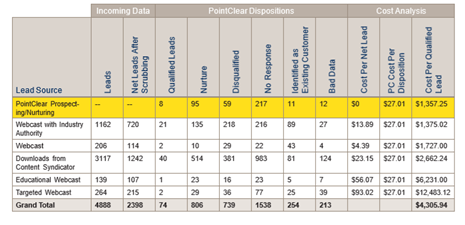
Here’s a real-life case that illustrates why this point is important: Over the past year marketing has generated thousands of “leads” from many sources with the most preferred source called Downloads from Content Syndicator—see table Lead Source Analysis.

The marketing team was thrilled with their results. Sales executives, however, were not thrilled. During the year, marketing spent a lot of money driving thousands of so-called leads—while sales reported that they got absolutely nothing of value from marketing.

A deeper dive pointed to the fact that the relatively low cost per lead was offset by the relatively poor quality of the leads as indicated both by the percent of qualified leads generated, 1.28% as a percent of raw leads, and the overall percent of qualified companies.

While marketing was touting these leads, proactive outbound prospecting, in fact, was producing the most cost-effective yet highly qualified sales opportunities. Other sources, like the syndicator, actually cost cost substantially more—as much as two to nine times more—when you consider the very small number that can be closed.

Following are actual statistics though the source names have been changed to protect the guilty:

image

What to do? In a white paper called How Much Should a Lead Cost (available for the asking), I ask and answer the question as follows: “So, how much should a lead cost? More than you probably think, but probably a lot less than you are paying.”

In addition to analyzing the actual cost of a qualified lead (not just the cost to generate a raw lead), you should also carefully measure the progression of leads through the sales process. You are probably saying to yourself right now: “We do that” or “That is what I pay sales managers to do.” But I guarantee you that it is not happening.

Here is why: In the average company the close rate on sales-qualified leads is about 20%. That means the average sales rep loses four out of five times. What sales rep wants to sign up for that? So, what happens is that sales reps provide visibility into the status of leads only when they are sure they are going to be closed (and won). That is why when you ask the average sales rep what percent of leads they close they will tell you 60% to 80% if they are qualified. But that is baloney. They likely close 60% to 80% of what they were sure they were going to close. But not 60% to 80% of the leads provided to them.

In truth, you may partially be responsible for why this is happening in your company. A new rep might provide more visibility than an experienced rep … until they find out that they spend more time reporting on each potential deal than they do selling because everyone wants to know the status of every deal—practically real time.

Relatively small improvements in the demand waterfall from marketing-qualified lead to sales-accepted lead to sales-qualified lead can make a huge difference on the top and bottom lines. If you have defined your market, media and message and if you are inspecting outcomes and conducting in-depth analysis at every step, you can substantially improve results.

  1. Deliver your sales force fewer, but better, leads

In the whitepaper Why Your Sales Force Needs Fewer Leads (just ask me for it) I open with: “Contrary to popular belief, sales reps don’t need more leads. They need fewer leads—or more accurately fewer raw, unfiltered, unqualified leads.”

Sales reps need leads that have been carefully qualified, properly and consistently nurtured and appropriately developed, increasing the likelihood of a completed sale. The problem is that there is so much confusion (and snake oil) out in the marketplace today that:

  1. Marketing is paid, in fact rewarded for, lead quantity and not quality.
  2. Technology solutions push more, poor quality, leads to sales faster and more efficiently than ever.
  3. Almost 47% of sales reps miss quota.

Why?

Here is a report from marketing: “We’re on track for a great quarter in lead generation. This month we generated 1278 leads from all sources—that’s a 30% gain over last year. And despite higher PPC costs, we continue to keep our leads under $100.”

When sales executives receive these so-called leads from marketing, here is how they respond:

  • Not a senior enough executive? Out!
  • Budget undefined? Goodbye.
  • Next-year decision? No way.

Here is what marketing should be reporting: “This month, marketing added 14 new prospects to the pipeline. A total of 41 sales opportunities are currently under development by marketing. Last month, sales received 10 fully nurtured sales opportunities representing $3.5 million in potential revenue. Attached are the details.”

SiriusDecisions historically characterizes the relationship between marketing and sales as follows: “It’s a bizarre, often co-dependent relationship; working at arm’s length, sales has the latitude to dismiss the leads marketing creates as not qualified or nurtured enough, while marketing can claim that they are holding up their end of the bargain when you consider things purely from a volume standpoint.”

Here’s a real-life example: We once provided services to a large software company and I got a call from our day-to-day contact one morning about our lead cost—he said we were too expensive. I asked him how much our leads cost and he said $650. I asked him how much the other vendor’s leads cost and he said $350.

I asked him what percentage of leads delivered by PointClear were considered high quality and he said 100%. I asked him what percentage of the other company’s leads were high quality and he said about 50%. Then he said, “I know where you are going with this, but can’t you just find some way to reduce the cost per lead—$350 is all we can spend.”

Following that conversation, I telephoned 10 of that software company’s largest partners and asked them about lead quality from the other vendor. They said the quality sucked. I asked them why they didn’t do something about it and they said because they were afraid that the big software company would stop sending them leads. That conversation was about eight years ago and we still do business with the big software company (when they are looking for high quality leads).

However, most of the spend is going through the equivalent of “sweat shops” and they literally waste millions of dollars on low quality, poorly qualified, so-called leads that are never followed up. They have even come up with a way of justifying the spend. They calculate how much the average deal is, assume a 20% close rate and calculate ROMI (return on marketing investment) based on these estimates. Forget that the actual return is in fact almost zero. What is missing in most companies, from an execution standpoint, is the following:

  1. A process to measure the quality and cost per REAL lead.
  2. A judicial branch (that is, the c-level executive) that provides the checks and balances needed to keep the other branches (sales and marketing) honest by evaluating opportunities that are not worked by sales to see if there is a quality or an effectiveness problem.
  3. A group to nurture leads until they are sales-ready; and to take opportunities back if sales cannot gain traction for one reason or another. Right now, these opportunities are disappearing into a black hole.

Almost every CEO I talk to wants more leads and higher quality leads. Let me know if I can help you evaluate where you are and put you on the road to where you want to go. Call me at 678-533-2722 or email me: dan.mcdade@pointclear.com.

29 Jun 15:22

The Sales Cycle: The Backbone of a Successful Sales Effort

by Meg Prater

Very few successful sales strategies revolve around throwing random tactics at the wall and seeing what sticks. Instead, you’ll need a clearly defined sales cycle to grow your business.

Sales cycles offer a regimented framework that lets your team know what to do as the customer moves through their journey. Here we'll learn what a sales cycle is, get a feel for the stages that typically comprise one, and how to effectively put one in motion.

Free Download: Sales Plan Template

What is a sales cycle?

Why should I have a process for my sales cycle?

Stages of a Sales Cycle

Best Practices for Creating Your Sales Process

Sales Cycle Management

What is a sales cycle?

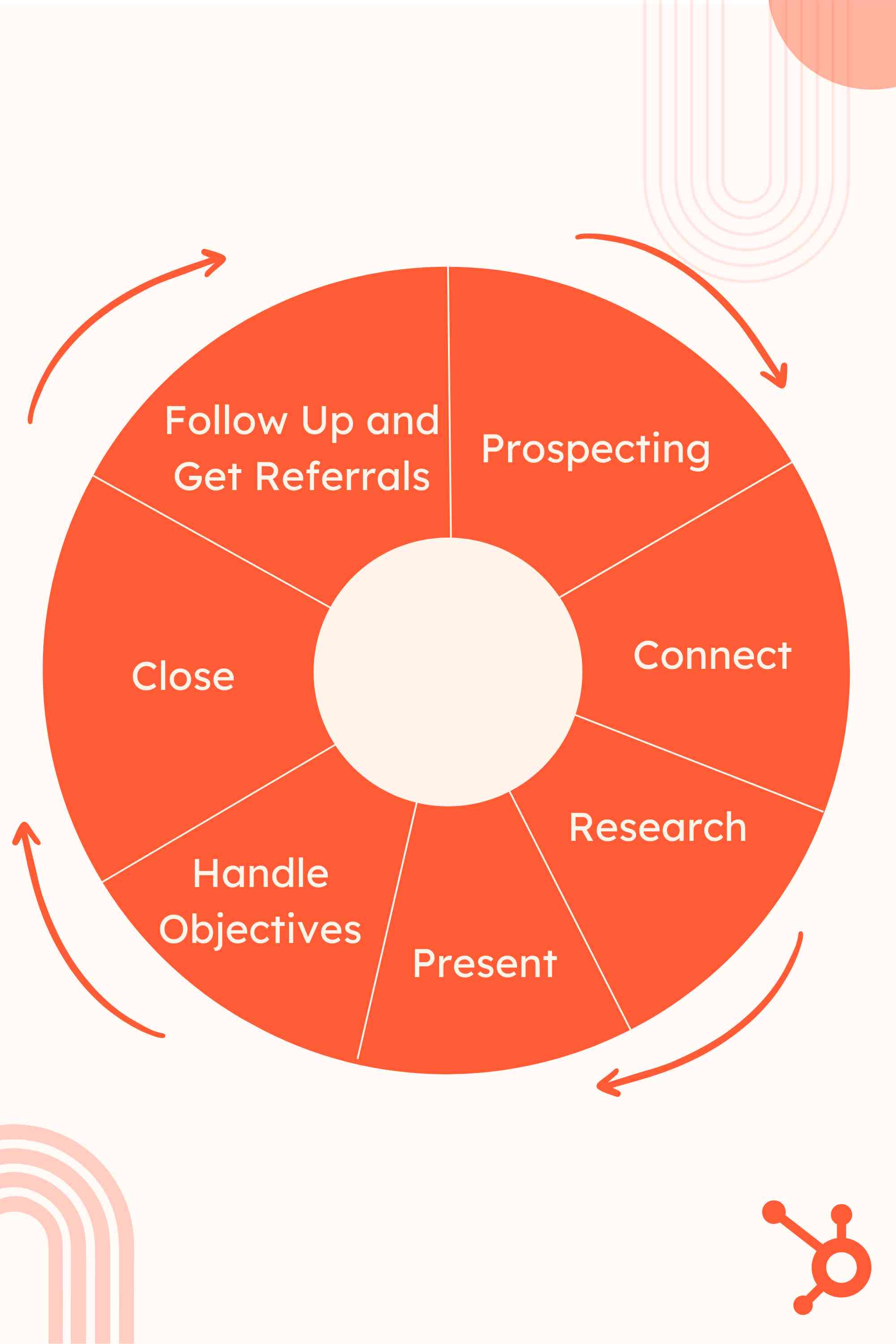
A sales cycle is the tactical process that a salesperson uses to convert a prospect into a paying customer. Sales cycles are often confused with sales methodologies — frameworks for implementing sales cycles. The sales cycle is more tactical, and often includes stages such as 'prospect,' 'connect,' 'research,' 'present,' and 'close.'

It's in your company's best interest to have a sales cycle in place. It allows you to better organize your sales pipeline, prioritize leads, and ultimately evaluate the efficacy of your sales efforts.

Having a clearly defined sales cycle gives your reps a common roadmap. Your reps need the flexibility and know-how to pick up where another left off — if need be. But, there's no "where they left off" if there's no sales cycle to guide their efforts.

what is a sales cycle, a sales cycle is the tactical process that a salesperson uses to convert a prospect into a paying customer.

A sales cycle also sets up the infrastructure for reps to prioritize leads and understand how far along prospects are in their buyers' journeys. If they can identify where they are in the context of a sales cycle, they'll know how to best approach the leads they're pursuing.

So, should your team have a sales cycle?

Salespeople treasure the art of improvising. They have to because it’s one of the few ways they can deal with highly unpredictable consumer demand.

However, building a common sales cycle for your organization can create cohesion and avoid confusion.

Here are three reasons we recommend having a sales cycle.

1. It makes your sales training process easy.

When you only rely on your sales team to learn new skills on their own, it takes time to have a consistent and structured training process. While your team will learn through trial and error, they must follow a clear path to secure success.

However, a well-defined sales process will create consistency throughout the sales cycle and help you build an effective training strategy.

Your trainees will know exactly which steps to take, how to execute them, and what results to expect.

2. It helps you structure your team right.

The sales cycle helps you to deliver a product or service that aligns with your prospects’ needs. With a sales cycle in place, you can better organize your company’s sales pipeline and prioritize leads.

A clearly defined sales cycle provides your sales reps with a roadmap that they can follow to land more business.

Following the sales cycle steps will enable your salespeople to identify predictable patterns within each customer and contextualize your company’s offerings based on those patterns.

3. It helps you track team performance.

While there’s no perfect sales process, we recommend including a sales cycle in your team’s structure precisely to track performance and analyze results. This helps ensure your sales team only closes deals they can support and sell profitably.

How did your reps do? What worked well for them? Where did things go wrong or right? Did they deviate from the cycle? What happened if they did?

Having perspective for evaluation is essential to understanding how both your reps and business are performing — a sales cycle provides just that.

To understand a sales cycle, you must understand its different stages. Here's a breakdown of each one.

Stages of a Sales Cycle

Designing your sales process to align with your prospects’ buying journey will help you reach your goals. A typical sales cycle includes the following stages.

Seven stages of the sales cycle

1. Prospecting

In prospecting, you identify companies and people who are a good fit for your products and services, then develop them into leads.

The sales team establishes an association with potential buyers and develops relationships throughout this stage.

Identify sales-qualified leads (SQLs) who meet your criteria and make a judgment on how close they are to becoming an opportunity. At this stage, you will determine whether they’re a fit for your company.

2. Connect

After identifying your SQLs, you need to connect with those leads. Contact them directly to determine their current needs. Then, introduce your business and educate them on the value of your solution and how it can help them solve their problem.

You can do this in a variety of ways, including:

  • Discovery calls.
  • Outbound emails.
  • Signup forms.
  • Demo requests.

Present your product or service as an opportunity for them to achieve their goals. Emphasize your value proposition and show how it can help them meet their needs.

Make it simple for your leads so that they can understand what you’re offering, why it’s right for them, and that you can implement it.

3. Research

This is when you learn your prospect’s needs, goals, and challenges as much as possible. This research stage validates your assumptions and gets a better idea of what customers need.

A discovery or qualifying call is the best way to start this phase. It allows you to dig deeper and make an informed decision on whether your prospect fits your portfolio.

Before you hop on a call, create a list of questions to help you gain more insights into their business and industry. Some of these questions may include the following:

  • What’s the budget for the project?
  • What are your biggest challenges and opportunities?
  • What’s the timeframe for this project?

Use a discovery call to assess whether you and your prospect are a good fit. Then, create a pain point plan to keep them on track through the sales cycle.

4. Present

In this sales cycle stage, it’s time to spark their interest and clarify your value proposition.

You’ll present to a team of decision-makers interested in your product or service and field questions from your prospects.

Present how your solution can help them achieve their goals and review your solution’s benefits. Gauge their interest and adapt your messaging to meet their needs.

5. Handle Objections

You should expect pushback from your prospects about the price or schedule for the project.

Listen intently to your prospect’s concerns, understand the context of their pains, and acknowledge their challenges. Your job is to address their concerns and handle their objections before they can sink your deal.

Overcoming objections involves answering questions about cost, timeline, resources, and service level agreements.

6. Close

Selling your solution decisively and efficiently is the key to closing the deal. It’s time to negotiate a mutually beneficial agreement for both parties.

At this stage, you can answer their questions about pricing and delivery differently depending on their reaction to your initial proposals. If you get pushback, work with them to refine the proposal until they agree.

Signal their agreement by asking if they are ready to move forward with you. If they agree, draw up a contract with your terms and conditions and sign it.

7. Follow Up and Generate Referrals

Landing a deal is only the beginning. To build long-lasting success, you must communicate with your clients and their teams to keep them up-to-date on your progress and deliver the results they expect.

Serve your new customers well while in your pipeline. A good customer experience ensures that your customers are happy and will spread the word about your expertise. And if you can, exceed their expectations and set your business apart from the competition.

Find opportunities to ask for customer referrals and feedback. Customers who are happy with your product or service will gladly tell everyone about it.

Best Practices for Creating Your Sales Process

When creating your sales process, you need to identify the specific steps of the selling cycle and which ones will help you close deals. Use these best practices when creating your roadmap.

Start with the consumer in mind.

A successful sales strategy involves knowing your customers’ needs, goals, and challenges. It consists of creating a value proposition that will address their pain points and keep them moving through the process.

Digital sales tools are essential but should only support the process. Ideally, you want to keep technology from dictating how you interact with your customer.

Align sales with your marketing team.

If your sales and marketing teams align, you can avoid selling a product that doesn’t fulfill the promise made during the marketing cycle. Sales and marketing should develop a cohesive strategy to help you get more leads and close more deals.

Use social proof.

The social proof effect is when your prospects trust the opinions of others who have purchased your product. As a salesperson, you influence this and could use this to your advantage by sharing positive feedback from previous customers.

Actively share case studies with your prospects to build their trust and show your ability to deliver.

If you're a salesperson or sales leader, sales cycle management allows you to evaluate the stages of the sales cycle to see where improvements or adjustments need to be made. Tools, like a CRM, aid in sales cycle management.

Sales cycles are a pivotal part of every salesperson's day. It's important to be familiar with the cycle your team abides by — and use it as your compass to navigate the storm that selling can be.

sales plan

28 Jun 16:43

4 Email Marketing Hacks That Will Help You Stand Out From Your Competition

by Rohan Ayyar

4 Email Marketing Hacks That Will Help You Stand Out From Your Competition

So you’re a digital marketer. I’m willing to bet money on the fact that you (or your company) already use email marketing as a key tool in your marketing toolbox. You’re in good company too.

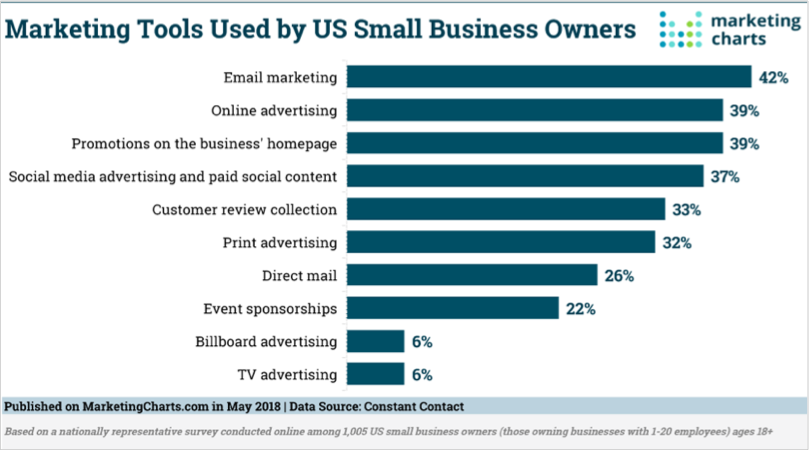
Email marketing ranks #1 in the list of methods or tactics used by businesses to reach out to new customers and build awareness.

Email marketing hacks image 1

This reliance on email is not without good reason. Not only is email marketing an extremely low-cost marketing tool, it’s also the one that offers the best bang for your marketing buck. According to a study by The Relevancy Group, Q2 of 2017 saw 21% of revenues for businesses come from email marketing alone.

That double digit figure however, doesn’t come with bland ol’ emails that look exactly like the previous one. As consumers’ exposure to personalized communications grows, what was yesterday’s “hack” has become today’s “must-have” or “fundamental.” Here are a few things you must look out for if you want each one of your emails to create an impact and bring in conversions.

Email Marketing Hack #1. Pre-header text

An oft-overlooked piece of email marketing, pre-header text (also known as “preview text”) is that bunch of words you see in your inbox, immediately following the subject line itself. Many otherwise-perfect emails run into a brick wall here, when they forget to remove standard text like “View in a web browser” from the beginning of their emails:

Email marketing hacks image 2

Email marketing hacks image 3

Leading email service providers like Gmail and Yahoo allow marketers to say a little more to their users beyond the subject line, before they even open their email. Consider it a bonus chance to reel in that elusive open, click or conversion!

Where once marketers had to depend on custom code to include pre-header text in their emails, that process has now become incredibly simple with the slew of marketing automation platforms out there. Most have WYSIWYG interfaces where you can type pre-header text into a form field, and voila, the pre-header text is set!

Things to keep in mind when optimizing your pre-header text:

  • Think of pre-header text as your second subject line. Spend equal thought in crafting and perfecting it.
  • Unlike subject lines, in many cases, the pre-header text will not be cut off and full sentences are often visible, depending on the device being used to view it. Don’t skimp on the length in favor of brevity on this one.
  • Adding a call to action that builds on the introduction offered in your subject line is a great way to improve open rates.
  • Last but most important, don’t miss out on adding pre-header text to all your emails.

Email Marketing Hack #2. “Smart” content

When speaking of smart communications, how can one not mention the iMessage app. From auto suggesting responses to auto filling personal information from phone data, there’s a wealth of capabilities it offers that make it a truly “smart” messaging app.

Emails have now begun taking inspiration from these smart messaging apps to offer content that’s tailored to every aspect of a user’s profile, making the email hyper-relevant to the user. And we all know that relevant content delivered to the user at the right time is a strong bet for a likely conversion. From web browsing data to transactional data to a user’s profile data, companies sit on a gold mine of data sources waiting to be tapped and crafted into effective marketing messages.

Spotify dug deep into users’ listening data, preferences and usage history to create this hyper-personalized email for its premium users. The campaign drove a staggering 75% engagement rate with 57% of subscribers calling it a “memorable email.”

Email marketing hacks image 4

Truly smart emails leverage even the most innocuous data points. Fast food chain Chick-Fil-A used smart emails that identified a user’s device and served up different emails based on the device detected (iOS, Android, desktop etc.) to drive it’s app download campaign. The emails hit their mark brilliantly, with Chick-Fil-A eventually ending up with the #1 trending app in the iTunes Store.

In addition to using “smart content”, you also need to “be smart” with your content. For instance, although videos in emails are becoming commonplace these days, you still want to make sure your audience gets your message exactly as you want them to, and so you’re better off including an animated gif, for which support across all email clients is exceptional.

You can learn from tech tutorial and gadget blogs like iGeeksBlog – even if you’re explaining something like how to record your iPhone screen, you can turn it into a series of stitched images or gifs instead of an actual recording.

Email marketing hacks image 5

This way, you succeed in educating your subscribers without any chance of frustrating them in the process.

Email Marketing Hack #3. Embedded surveys

Market research owes a great deal to email marketing over the last decade. With the ability to reach millions of respondents in one go, email makes data collection simpler than ever before. Unfortunately, market researchers fall prey to one of the inherent flaws of email marketing – conversions can only be as strong as an email’s click through rate. Let me explain.

Most email surveys have buttons that say “Take Survey” or “Start” that take the user to a new browser tab and kick off a standalone survey. Trouble is, not enough people bother clicking on this CTA button, resulting in poor response rates and thin data.

Enter embedded surveys.

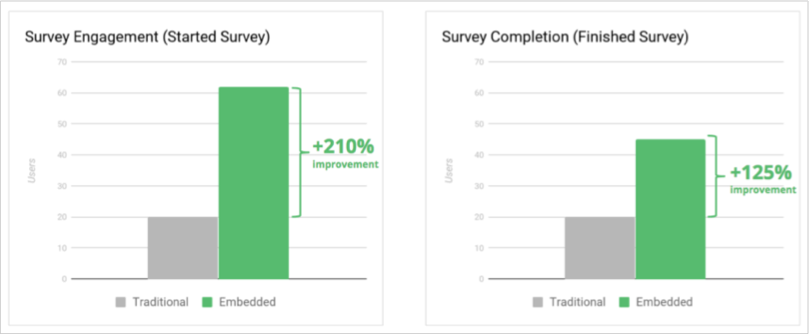
By including the entire survey inside the body of the email, marketers can prevent the inevitable user drop-offs and collect exponentially higher responses than they would have otherwise.

Email marketing hacks image 6

Data shows that embedded email surveys increase survey response rate by 125% compared to traditional surveys that take the user out of their email inbox.

Email marketing hacks image 7

Embedded surveys can be used for a variety of purposes including soliciting a user’s product review, NPS or customer satisfaction ratings, completing customer profiles, requesting users’ interest and more.

Some things to keep in mind with embedded surveys:

  1. Keep the survey short and simple. Too many questions will make your email bulky and unreadable, not to mention, lower your response rates.
  2. Experiment with radio buttons, open text fields, check boxes or even buttons to keep the survey easy on the eye as well as easy to take.
  3. Check whether your email marketing platform supports embedded surveys. Most platforms do. MailChimp lets you use custom tags or integrate with SurveyMonkey or Google Forms, Google schema for email allows users to fill forms and write reviews from within Gmail, and so on.
  4. Different email clients render embedded surveys differently. Check how your survey renders on the most popular email clients before sending one out.

Email Marketing Hack #4. Creative design

You likely put lots of care and thought into your website and product design, so be sure to carry that design thinking over to your email campaigns. Using a color scheme and cohesive design can help raise brand identification by 80%.

Take Spirit Airlines, for example. Their website includes bright yellow as the main color, with accents of black and red. They also include cartoon drawings and a font that almost looks handwritten. These same design patterns translate perfectly over into their email campaigns, so recipients can easily recall their brand. Spirit’s colors also make them stand out from their competition, as many airlines tend to include more muted or standard colors, such as white, blue, red and grey.

Email marketing hacks image 8

Add in the unexpected by including things like gifs or videos for a visual that is sure to catch people’s eye, like GrubHub did with their email campaign. Since a food delivery service tends to have quite a long list of competitors, including a short video played on repeat that illustrated their overall message made GrubHub’s email truly unique.

Email marketing hacks image 9

Wrapping up

Even though 269 billion emails are sent and received every single day, a mere 21% of them actually hit those all-important customer eyeballs. Of the emails that are read, even fewer get acted upon. Given the potential that email marketing holds, you owe it to your business to equip your emails with every advantage you can to help them hit the mark. The tactics we discussed here are fast becoming email staples that no business can do without.

What’s taking you so long?

28 Jun 16:40

Pricing: ProfitWell’s Patrick Campbell on Monetizing Your Customer Base [Podcast]

by Kyle Poyar

SaaS pricing, every business thinks about it, but the majority rarely act. In this episode of BUILD, hear from Patrick Campbell, Co-founder & CEO of ProfitWell, on the importance of pricing, the impact of freemium, and the metric you should use to drive value for your customers. Plus, Deputy COO, Craig Harris, weighs in on his business’ go-to-market model and how it impacted the company’s big pricing initiative.

Prefer to listen in iTunes? Click here.

The post Pricing: ProfitWell’s Patrick Campbell on Monetizing Your Customer Base [Podcast] appeared first on OpenView Labs.

28 Jun 16:37

5 Things I Vowed Never to Do as a Sales Keynote Speaker

by deb.calvert@peoplefirstps.com (Deb Calvert)

I'm fortunate to be invited to lots of conferences and events as a sales keynote speaker. I get great opportunities to learn from others while I'm at these events. Even before I became a keynoter and regular at sales conferences, I’d go to them whenever I could -- even if it meant spending money out of my own pocket. That's because I see the value in learning from others who are up there on stage.

28 Jun 16:37

How NOT To Set Your Prices

by Devon Smiley

There’s a mistake I see people making that isn’t necessarily 100% a negotiation mistake…but it sure as heck impacts the results you’re able to get when you do make your ask. And that mistake is crowdsourcing your prices.

why you need to avoid crowdsourcing your prices.png

Crowdsourcing for opinions on some things is fab. Which shade of blue to use in our branding, whether headshot A or B looks friendlier – but asking a group of people to chime in and tell you what you should be charging is at best unproductive – and at worst dangerous to the health of your business.

Here’s why.

Not enough info.

You can’t possible illustrate all the features and benefits of the product or service you’re offering in a single group posting. So the answers you get are based on incomplete information.

Wrong people.

Not everyone is your target market. And if they’re not in your market, then they’re not going to connect with the real value of what you’re doing. So the numbers you get can be really off base.

Too emotional.

Money is emotional for most people. In that big ol’ group of people you’ve asked for input on your pricing there are going to be a few who are struggling with really bad money mindset, or who are in the midst of a super stressful financial situation. If they’ve just been handed a $2,000 bill for a car repair, there’s no way their response to you isn’t going to be influenced by that. But you’re not going to know that.

strategic pricing for entrepreneurs small businesses.png

Crowdsourcing can hurt you whether the answers skew low or high. Too low and you’re selling yourself short and getting stuck without profit. Too high and you lose credibility in negotiation with clients.

Instead, focus on figuring out the value of what you do, the financial reality of doing it, and what your business needs. Here are some articles and resources to help.

28 Jun 16:36

14 critical activities every sales person needs to master

by bob@inflexion-point.com (Bob Apollo)

Multiple checklistsWhenever we attempt break down the key success factors in managing complex B2B sales opportunities, it soon becomes apparent that there are a number of critical activities that need to be mastered between the first contact with a potential customer and the conclusion of a successful sale.

And when we go on to compare the differences between our top sales people and their less-effective colleagues, it is usually equally obvious that the competence and skill with which they perform these critical activities has a profound impact on their outcomes.

Over many years, and following dozens of sales effectiveness assignments, I’ve identified 14 critical factors that seem to have a consistently important impact on sales success. I wonder how my experiences compare with yours?

Now, 14 factors might seem like a lot to master - and it probably would be for simple low-value transactional sales. But don’t forget that these observations are in the context of complex, lengthy, high-value B2B sales.

With that in mind, let’s also acknowledge that the amount of resource - not just the sales person’s time - required to win these complex deals is substantial, as are the rewards of winning and the costs of losing. Mistakes tend to be expensive!

These complex B2B deals suffer from multiple potential points of failure, and they rarely give sales people the opportunity to pull off one of those mythical heroic last-gasp manoeuvres that transforms a failing deal into a success. The foundations of failure are often too deep and have usually been laid much earlier.

Consistently successful sales people (and their managers) have learned that making the right choices and doing the right things from the very start of the sales cycle is a much more reliable and ultimately far less nerve-wracking way of winning.

And that’s really what the following 14 critical activities are about: distilling the accumulated experience of the most effective sales performers into a framework that guides every competent sales person in what they need to know and do during key moments in the sales cycle:

Critical activity #1: prospecting

Effective prospective involves targeting the right issues (the ones you are best positioned to solve) and engaging the right contacts within the right organisations (the ones you have the best chance of doing business with) at the right time (when the prospect is motivated to act). Are you confident that all your sales people are currently doing an equally competent job of this?

Critical activity #2: first conversation

It is said that we never get a second opportunity to make good first impression, and that is certainly true in the opening remarks of any sales interaction. What we say in these first few moments influences what happens throughout the rest of the sale. Are all your sales people currently saying the right things during these pivotal moments?

Critical activity #3: assessing our prime contact

Whether we’re responding to an inbound enquiry or reaching out to a potential target, we need to judge whether our initial prime contact has the potential to be a mobiliser and change agent sooner rather than later. Top sales performers have learned to assess this early. Their weaker colleagues often behave as if they are grateful to be talking to anyone. Where do your sales people sit along this scale?

Critical activity #4: discovery process

The discovery process is another pivotal period in the sale. Top sales people have learned to resist the temptation to pitch their solution until they have fully understood the prospect’s situation, challenges and implications. Less effective sales people tend to turn the conversation towards their solution the moment the prospect acknowledges a need (and sometimes without even waiting for this stimulus). How many of your sales people are suffering from a hair trigger?

Critical activity #5: initial qualification

It’s important that we start to qualify the opportunity from an early stage - but that we also recognise that we may not be able to find out everything we need to know until we have progressed our dialogue with the customer.

At this early stage, the traditional BANT approach is as much of a hindrance as it is a help. Here’s what we need to find out early on:

  • Is the prospect’s key problem clear, and is it one we are really good at solving?
  • Does our prospect have a compelling business reason to act?
  • Is the organisation the sort of company we can do successful business with?
  • Is our prime contact a proven mobiliser and change agent (see #3)?
  • Is it obvious how the project is going to be funded?
  • Urgency: Is there a clear reason why this project needs to happen now, rather than later?

At first, our potential opportunity might not have perfect scores against all of these: but an honest assessment of these factors will allow us to judge whether we might need to proceed with caution.

Critical activity #6: advanced qualification

As we learn more about the prospect, we can complete our advanced qualification. Here’s the additional information we should expect to know by this stage:

  • Have we fully engaged the decision group, are where do we stand with them (see #7)?
  • Do we understand our customer’s detailed functional requirements, and can we satisfy them?
  • Do we understand the prospect’s decision criteria (formal and informal), and are they favourable to us?
  • Do we understand the prospect’s decision process and timeframe, and is it realistic?
  • Have we identified all the prospect’s alternative options, and where do we stand against them?
  • Do we understand the relative priority of this project compared to all their other current investment options?

If we’ve still got blind spots in any of these areas at a late stage in the sales cycle, these need to be recognised as key risk factors.

Critical activity #7: decision group engagement

Top sales people realise the importance of identify and engaging as many members of the customer’s decision-making group as possible but place particular emphasis on working with and through powerful sponsors who are also proven mobilisers and change agents. Less effective sales people often find themselves overly dependent on a single point of contact who ultimately proves unable to drive their organisation’s change agenda. How many of your sales team’s current opportunities are single-threaded through one insufficiently influential individual?

Critical activity #8: conceptual sell

I’ve written before about the downsides - in complex sales environments - of delivering a premature “product demonstration”. Before we go into the detail of our solution, it’s often best to lay the foundation by explaining our high-level approach to solving their problem and why we’ve chosen to do what we do. Top sales people use conceptual sales strategies to trigger memorable “ah-ah!” moments that persist throughout the rest of the sale. How often are your average sales people able to create these “ah-ah!” moments?

Critical activity #9: solution sell

Once we have laid the conceptual foundation, we can then explain how our proposed solution meets their detailed functional requirements - but rather than doing a generic and often confusingly wide-ranging “product” demonstration, we can focus our attention on the handful of memorable capabilities that are particularly connected with the prospect’s most important criteria and priorities. How many of your sales people are selling a customised solution rather than a generic product?

Critical activity #10: establishing value

Most significant purchase decisions require some form of business case, and yet the majority of sales proposals lack a compelling financial justification. Top sales performers have learned that this isn’t just about building a Return on Investment (ROI) projection - it’s also about showing the customer the impact of inaction that would result from a decision to stick with the status quo. How many of your sales people are able to consistently articulate this sort of value?

Critical activity #11: proposing

Submitting a proposal is often regarded as a pivotal moment in a sales campaign. But in truth, what happens before and after the formal submission is far more important. We must always ensure that the proposal reflects a series of already tested agreements. We need to ensure that the executive summary sells the need for change just as strongly as it sells the benefits of our solution. And we should always arrange a post-proposal review meeting before we submit our document. How often is this happening in your current sales proposals?

Critical activity #12: negotiating

Most high-value contracts go through some form of negotiation - and it is often detailed and intensive. But the foundations need to be laid far earlier by establishing our unique solution value (see #9 and #10) in ways any other competitor would find hard to replicate. And then when they are engaged in the negotiation, top sales people can be confident of their value and know where their give/get boundaries are. Less confident sales people often imagine they can discount their way to a sale.

Critical activity #13: final approval

Even after we’ve negotiated a win-win agreement and have been told that we have been selected and that our sponsor would like to proceed, they will often have to navigate a formal approval process, in which the project will be competing for attention and funding against a range of often completely different potential investment priorities. Unfortunately, many apparently promising projects get derailed or delayed at this late stage. Recognising this, top performers collaborate with the project sponsor to put together the strongest possible project justification. Weaker sales people often just trust in the process and stand aside and wait for the outcome.

Critical activity #14: order confirmation

It should be obvious that we can’t call the sale closed without a legitimate order from the customer - but it’s dangerous to assume this will happen automatically. Many less experienced sales people have found that a promised order is delayed because a signature was missing or because the new vendor on-boarding process has not yet been completed. Top sales performers are maniacally focused on making sure nothing falls between the cracks

In summary

So, there you have it - 14 critical sales activities. Miss any one of these - or fail to perform them to the required standard, and the opportunity may be put at risk. Ignore any significant number of them, and your sales people’s chances of success will plummet.

You might be in an environment that excludes a few of these factors. You might be in an environment where other critical activities have proven to be consistently important. But whatever your circumstances, it’s a fair bet that your top sales performers - whether consciously or unconsciously - are covering off these critical activities.

And it’s a similarly fair bet that your weaker sales people will be ignoring some of these critical activities or performing them in a half-assed fashion.

But if they are unaware of these factors or have not been properly trained, guided and coached in their application, it’s an equally fair bet that your organisation will be missing forecasts and revenue targets as a consequence.

Need any help?

If any of these ideas resonate with you - if you’d like to improve your sales organisation’s competences in any of these areas - please drop me a line or (even better) book a call and I’d be happy to share my experiences of helping organisations like yours deal with them.


ABOUT THE AUTHOR

Apollo_3_white_background_250_square.jpgBob Apollo is a Fellow of the Association of Professional Sales , a regular contributor to the International Journal of Sales Transformation and the founder of UK-based Inflexion-Point Strategy Partners. Following a successful career spanning start-ups, scale-ups and corporates, Bob now works with high-potential tech-based B2B-focused scale-up businesses, equipping them to Sell in the Breakthrough Zone® by systematically creating, capturing and confirming their distinctive value in every customer interaction.
28 Jun 16:36

The Sales Leader’s Role in Conquering the Complex Sale

by Alice Heiman

Too often we leave salespeople out in the field to fend for themselves on some very complex and challenging high dollar deals with companies 10 to 100 times our size. Crazy, right?

In our organizations, we need to be clearer about the sales leader’s role in the complex sale. So here is what they need:

  • To clearly understand the complex sale and what makes it challenging.
  • To understand their role in moving the sale forward.
  • To learn how your coaching can lead to closing more of these complex deals.

3 Facts for Sales Leaders

  1. As the sales leader, you will always have a role in the complex sale.
  2. That role will change as your company grows.
  3. Conquering the complex sale requires strategy.

Clearly understanding the complex sale and what makes it challenging is covered in this BrightTalk and in this post. So, let’s focus here on understanding the sales leader’s role in moving the sale forward.

Who are the Sales Leaders?

As the sales leader, you may be the company owner, a senior sales leader or a sales manager. In every case, you have a role.

What is Your Role?

Managers spend time doing a lot of things that leave them little time to help their teams build strategy or coach salespeople to close deals. How many of you would say you spend 50% of your time on strategy and coaching? 80%? Imagine if you could spend more time coaching and leading strategy. How would it shorten your sales cycle? How many more deals would close?

3 Keys to Closing More Complex Deals

  1. Strategy – building strategies with your team to advance the sale.
  2. Positioning – Positioning all of the right people at your company with all of the right people at your company.
  3. Coaching – continually providing the coaching needed for positioning and strategy to advance the sale.

Essential Components of Your Role

  • Keeping the funnel full
  • Fully qualifying opportunities
  • Getting properly positioned
  • Education on the buying process
  • Managing timelines
  • Managing expectations
  • Developing strategies
  • Handling internal complexities

Coaching Can Lead to Closing More Complex Deals

Coaching is the key. You can train them to do strategy and positioning but without the continued coaching they won’t get the same results.

Questions You Can Ask when Coaching

  • What did you do to prepare for the sales call?
  • What was your objective for the call?
  • Who did you meet with?
  • What did you do to bring value and insight?
  • Where are they in the buying process?
  • What action did you commit to?
  • What action did they commit to?
  • What other solutions are they considering?
  • When will they make a decision?
  • What are the next steps?

Closing the Complex Deal

Let’s practice. Choose a real opportunity that is not already a done deal but somewhere in the process.

“I have the opportunity to sell Company Name, our Product Name(s), $ or #units for implementation on Date with a close Date.”

Current Position

  1. Who are the buying influences you know for this sales opportunity?
  2. How will our solution meet each of their needs?
  3. What other solutions have they considered?
  4. Who else will be involved in making the decision?
  5. What is the best way to include everyone involved in the decision-making process?
  6. What is their budget?
  7. On what factors will they make their decision?

Timing

  1. What is their timeline for implementation?
  2. What is their timeline for making a decision?
  3. Based on those two dates what is the close date the buying influences have agreed to?

Company Resources

  1. Is there anyone from your company you have involved or need to involve?
  2. Are there any resources you need to move this opportunity forward?
  3. What are your next steps?

Did I cover what I promised?

  • Clearly understand the complex sale and what makes it challenge – I hope you will go watch the BrightTalk if you haven’t already
  • Understand your role in moving the sale forward – What can you do to make sure you play your role?
  • Learn how your coaching can lead to closing more of these complex deals – I gave you some ideas, if you need more, please schedule a call with me.

Watch my BrightTalk, The Sales Leader’s Role in Conquering the Complex Sale if you want to get more information on how to close these complex deals.

The post The Sales Leader’s Role in Conquering the Complex Sale appeared first on Alice Heiman, LLC.

28 Jun 16:35

B2B Blogs Your Prospects and Clients Hate to Read

by Jeremy Durant

As you build out the editorial calendar for your B2B blogging and content marketing strategy, it’s important to understand who your target audience is and what they want to read. It’s also critical to understand what they don’t want to read. It’s a waste of time to create content that your prospects and clients aren’t interested in or, worse yet, really dislike reading.

Now, we don’t think that companies purposely put out content that their audience hates, we believe it’s just a misunderstanding of needs/wants. While the content needs of audiences vary from industry to industry, there are several B2B blog types that are universally disliked and should be avoided at all costs. These are the types of blog posts your company should avoid creating:

Advertorials

Have you ever started reading an article or a blog post that has a promising topic and introduction only to realize mid-way through that it’s selling you something? It’s monumentally frustrating and often will leave a bad taste in your mouth. This is how advertorials often make readers feel.

The goal of blogging as part of a B2B content marketing strategy is to provide value. Notice that we didn’t say “sell products or services.” Creating an article that is subtly, or not so subtly, selling something doesn’t provide value. Stay away from creating advertorials that have a salesy angle and only discuss your firm’s products or services.

Keyword Stuffed Articles

Ugh. Just ugh. Whether you are skilled at search engine optimization (SEO) or not, you’ve likely come across a blog post that is just stuffed to the max with a keyword or keywords. It’s so obvious since every other sentence has that keyword. It makes it tough to concentrate on the central theme of the post.

SEO is not an end in itself. It’s a means to an end, to get your B2B blog in front of the right audience. However, it shouldn’t turn them off as soon as they get to your blog. Avoid creating blog posts that are jam-packed with keywords. Instead, focus on two or three keywords and let them naturally appear in the blog post. Successful content marketing is one that the target audience doesn’t even know is content marketing.

Pointless Puff Pieces

Blah, blah, blah. You’ve likely been to a party, wedding, or social gathering where you got stuck next to the person who just talks about themselves and all the great things they have done. What a bore. Don’t let your B2B blogging efforts fall into that boring, puff piece place.

The best way to avoid creating drab puff pieces is to step back and ask what the audience gets out of the blog post.

  • Is there an actionable takeaway?
  • Do they know have the skill or knowledge to do something?
  • Did you give them tips to save them time or money?

If the answer is no, then it’s likely a puff piece that talks all about your company and doesn’t provide your prospects and clients with anything of value.

Features of Products/Services

Your B2B web design should have a section that focuses on the features of your products or services. This should not be the blog section of your website. While it is important to share new innovations in your products or services, never focus on the features alone. Features are worthless. The only time features have any value is when they are discussed in conjunction with the benefits to the end user.

Stay away from writing blog posts that focus solely on the features of your products or services. Yes, it may have taken your engineering team months to roll out a new feature for your software application, but your prospects and clients don’t care about that. What they care about it how it helps them. Instead, draft a blog that briefly discusses the new feature but instead focuses on the benefits to the end user and includes a use case, preferably with great results.

Takeaway

The takeaway here is that you want to ensure that any B2B blogging your content marketing team does provides value for the end user, whether it’s something that saves them time, shows them how to do something, or helps them save money. Always focus on what’s in it for the end user.


28 Jun 16:35

Execution > Ideas Alone

by Anthony Iannarino

There is no end to the number of ideas that may benefit you in improving your results. Everything you might do differently is likely already known. The internet is the greatest leveler when it comes to the immediate delivery of insights and ideas that could be useful to you when it comes to learning something that might help you produce better results.

The internet is also the greatest distraction in the history of humankind.

The Next Idea < The Last Idea

The next idea, no matter how smart and useful it is, is not likely to be any more beneficial to you than the last idea. The insight, no matter how remarkable, is not more useful than the last insight. No matter how novel or unique the idea is, it will not change your results unless you execute on the idea. Execution is the greater variable when it comes to improving your results.

Spending the day searching the internet to find the one thing that you might be missing to improve your results will have the exact opposite effect. All the ideas that draw your attention likely have value, but none of the ideas will do anything to improve your results without you doing the work.

Execution > Ideas By Themselves

Deeper Is Better Than Wider.

It is important to understand what ideas and concepts exist in the domain in which you are trying to improve. Understanding what choices might be available to you allows you the flexibility and of freedom to adjust what you’re doing to generate new results. For the ideas to be useful, however, you must actually apply them. Noticing them does nothing, outside of drawing you deeper into the rabbit hole.

Deeper is better than wider in this case because deeper is an indication that you are executing an idea well enough and long enough to see the improvement that it offers you. Deeper means staying with an idea until you have done the work necessary to be able to execute it a level of mastery before you move on to something else.

Why Seekers Struggle

Curiosity killed the cat. It is a good thing to be interested in all kinds of ideas and concepts. It’s a very good idea to be interested in understanding your world. Wide knowledge provides you with greater awareness and makes you a more interesting person generally.

The challenge for seekers, however, is that they never stop seeking long enough to go deep on a single idea. Because they never go deep on a single idea, they never gain mastery of that idea, and the lack of execution means they invested their time in looking at something without any application.

Seekers are very much like a hamster on a wheel. They aren’t going anywhere, but they continue to run faster and faster, believing that eventually, they’ll get traction.

Pick One Thing

Pick one thing and go deep. Find the idea that you believe brings you the greatest chance of improvement now and push the chips all in on that idea. Go deep, avoiding the next big idea and the next shiny object. Build mastery by executing the one thing you believe to be most worth your time. By doing so, you will get some improvement, and you will likely gain greater insight into what you should work on next.

The post Execution > Ideas Alone appeared first on The Sales Blog.

28 Jun 16:34

Scaling Your B2B Product? Be Sure to Consider These Areas First.

by Justin Zalewski

With growth comes challenges. When your B2B startup begins entertaining larger deals, your customers’ needs grow in complexity. And when you scale to meet those needs, it’s easy for your product to fall short. The good news is that you can learn from the experiences of other B2B SaaS companies to predict where many of these shortfalls will occur.

In working with product leaders at B2B SaaS companies, we’ve seen similar patterns and themes as these companies scale. Every company is different, and not all of this is exclusive to B2B SaaS, but we find these to be the most common areas that need attention when scaling:

  1. Roles and Permissions
  2. Onboarding Experience
  3. In-Product Communication

You won’t be able to anticipate every problem, but you can shore up these known troublemakers. Knowing what to anticipate as you scale enables your team to better prepare and to reduce future headaches.

Roles and Permissions

Large enterprises have greater expectations and requirements around workflow and accountability within any product. This means that as you scale your product, you may need to create additional, differentiated layers of permissions to accommodate for different types of users and to meet the workflow needs of your customer’s organization.

These workflow requirements in a product reflect the complexity of growing organizations and they exist for the same reason—accountability. Large organizations need these processes in place to ensure quality and fit their existing workflows. If your product doesn’t provide the levels of control needed, your ability to sell to larger enterprise customers may be limited.

As an example, Octiv is a document generation platform that was recently acquired by Conga. When we worked with them to design the initial version of their product (they began as a Studio Science Labs company), permissions levels were simple. Organizations had standard users, managers, and admins—with each tier assigned a default set of permissions. However, as Octiv grew to pursue deals with larger enterprise clients, the requirements around roles and permissions became exponentially more complex. Collaboration within documents also became a higher priority, which has its own implications on permissions. In addition to different user types, large organizations required granular controls over which users could view, edit, comment, and manage documents. Through several iterations, we designed features within Octiv that allowed their customers to assign granular permissions to different user types, invite outside collaborators, and build specific approval workflows.

We often seek to minimize complexity whenever possible to create a more seamless experience. However, in this case, the added complexity was necessary. Adding this new level of control enabled Octiv to appeal to a new tier of customer, pursue increasingly larger deals, and continue to scale.

Onboarding Experience

The importance of the customer onboarding process shouldn’t be a surprise. In just minutes—or perhaps even seconds—a potential lifetime user can either start building loyalty toward your product or can turn away for good. The onboarding experience is critical from the start, but as you scale, even seemingly minor improvements to your retention rate can have significant long-term effects on your ARR.

If your onboarding experience starts with a series of popovers showing customers where all the different features are, that’s a clear sign that it’s time to reevaluate. These kinds of popover-based tours can be useful, but they are too often used to introduce customers to a product during onboarding. This results in a lackluster first-time experience. Your onboarding process should be informative, but don’t think of it as a ”hit list” of features that you have to explain. Instead, think of it primarily as creating an amazing first impression. It’s a selling opportunity.

Rather than requiring users to chase popovers around the screen for those first critical moments within your product, spend some time thinking about how you can make your users’ first experience with your product as engaging as possible.

Before designing your onboarding experience, consider the following:

  • What do customers need to know to get the most out of your product?

    This informs the educational portion of your onboarding experience, which can vary in importance and scope depending on the complexity of your product. This doesn’t need to be a deep dive into the full feature set, but instead should focus on the most critical fundamentals to get customers started. Remember that onboarding goes well beyond the first time experience and you can always progressively introduce deeper functionality to them when the time is right.
  • What is the moment within your product that customers realize value?

    Based on your understanding of your existing customers, what milestone do they have to hit in your product before they realize the value your product provides them? The first form they build? Once they’ve added 5 team members? If you don’t know, then ask them.
  • What is the fastest way to get them to that moment?

    Once you know the moment of value that you’re trying to get to, figure out how to prioritize this. It doesn’t necessarily need to be the normal flow within your product, as long as you get them there in a way that feels seamless and makes your product’s value obvious to them.

The sooner you can get a user to see the value they get from the product, the better your chances of retaining them. This not only solidifies the value you provide them, but also helps users understand how to navigate the product. With some worthwhile thought and effort, your onboarding process can serve to welcome, educate, and even inspire your customers.

In-Product Communication

As you scale, somewhere along the way, you’ll reach a point where your customers are using other products to communicate about the work happening in your product. This is the time to consider providing in-product communication.

Let’s say customers are using your product to manage and edit documents, but their communication and collaboration is happening in email (or Slack, depending on the industry). When your customers consistently use a platform outside your product to talk about work that’s being done within your product, bringing this communication into your product can improve engagement, create a more seamless experience, and provide greater value for your customers.

The decision to add messaging should not be taken lightly. As anyone who has implemented communication into their product will tell you, it’s no small task, and adds significant overhead. With these steep costs in mind, the question to consider is whether adding this feature will drive engagement, retention, and/or revenue to the point where the benefits outweigh the costs.

There are also different kinds of collaboration, so take the time to understand exactly how your users need to work together and communicate. For example, are they collaborating with specific tactical input on documents, events, or projects? Or are they using more free-form communication and discussion? The answer should help you decide how to move forward. A strong appreciation for how your customers are using your product will be key in designing the right type of communication features.

Plan Ahead

Permissions, onboarding, and in-product communication are three of the most common areas to anticipate growing pains when scaling your B2B product. To be clear, this is no substitute for genuine customer research. In fact, customer insight is the only way you will know when exactly to focus on these aspects. Be proactive and keep your finger on the pulse of your customers’ needs so that you’ll know when it’s appropriate to add these to your roadmap.

Don’t wait until these three areas become a pain point for your customers—or a dealbreaker for prospects. Growing pains are unavoidable, but anticipating how your roadmap will need to shift as you scale will ease the burden.

The post Scaling Your B2B Product? Be Sure to Consider These Areas First. appeared first on OpenView Labs.

28 Jun 16:34

Email Segmentation: Best Practices for Segmenting Your Email Marketing

by Susan Gilbert

Use Email Segmenting to Improve Your Marketing and Communication

Have your click-thru and open rates been on the decline? You might be missing out on valuable prospects if you are not sending your email marketing messages out to specific and targeted list.

According to Wordstream email is the third most influential source of information for B2B. And Leighton Interactive reports that segmentation will continue to be an effective tool now and in the future.

In order to attract an interested lead you need to specifically cater to a particular group of subscribers with remarkable content that they have already expressed interest in.

Automations for specific lists from your website and other marketing campaigns are not only more relevant, but these emails also save your business from wasting valuable time and help build better relationships with your subscribers. A personalized approach that includes valuable promotions can go a long way in encouraging someone to make a purchase.

In each phase of segmenting your lists you are honing in on the specific pain points of your leads by focusing on the “why” of signing up in the first place. According to marketing expert, Neil Patel, the “batch and blast” approach yields very little results. As you can see in the chart below, the more specific the approach the better the outcome:

If you provide something of interest and assistance to your subscribers and customers with added value for them your emails will not forgotten. This can happen in several different ways:

  • New product and feature announcements to those who have not yet made a purchase
  • A video or personalized look at how your business operates
  • Tips and tricks the subscriber may have missed online from your brand
  • A discount code for previous customers who have not bought anything for a while
  • Friendly reminders on what subscribers might be missing

These are all great opportunities you can use to transform a visitor into a prospect and after gaining their trust in a targeted message that appeals specifically to their needs and desires.

How to Create a Segmented Email Campaign

If you use any of the major email services such as Aweber, MailChimp, ConverKit, ect. then you may already have an autoresponder in place. In order to make this more effective you will want to recreate this according to each list that you may have. If you are just starting at building up your list plan ahead of time to segment now in order to to save more time later. Here’s a few ways to make this more simple:

1 – Use a keyword ‘tag’ for the type of list generated

In your email client you will want to create a ‘tag’ according to the links clicked on from your website or advertising campaigns. If you are using Aweber they now offer a Click Automation system, which segments your subscribers according to their interests. The goal is to send your messages to a very select group instead of all of your lists in order to generate more interest.

2 – Give current customers and subscribers a reason to stay

Show your subscribers that your business is interested in learning more about their specific needs with targeted questions — in return for their answers offer them with a free eBook, report, tips, ect.

Incentives increase open rates with the reward of adding something of value that your audience can really use. Once they have tried what you have the offer they will be more likely to return for a full purchase.

3 – Hook the reader with a great headline

Test out your subject lines before you create a campaign with a good headline analyzer. The more broad or common the title the more likely your message will be deleted and not even be read. The best types of headlines appeal to the reader’s emotions right away and provide them a reason to open your email. Here are a few creative uses to follow from Hubspot:

  • Use conversational worlds like, “Uh-oh” that don’t sell directly
  • Include humor
  • On occasion use emojis to capture their attention
  • Create a sense of urgency such as something that will expire soon
  • Peak the reader’s curiosity
  • Write something that is intriguing
  • Appeal to a specific problem such as affordability
  • Provide a warning

4 – Set up follow up emails for each segmented list

Remind your subscribers what they opted into and why. I usually schedule my follow up emails to go out ever second or third day for the first week — with that said you should schedule according to your own emailing agenda. It’s important not to send too many messages to your prospects and overwhelm them with information.

5 – Refer to a specific product or service interest

Send out related information and tips in regards to what your subscribers have signed up for. Ask the reader’s opinion or feedback on what they liked or didn’t, and how your business can better meet their needs. Not only can you remind the reader about your company, but you can write better messages specifically tailored to them through their specific communication.

Email segmentation in your marketing campaigns can greatly improve your open and click-thru rates, and later on conversions. Measure which of your lists are responding the most to your messages so that you can improve your approach and reach them where they are at.

28 Jun 16:31

Understanding Keyword Research: Everything You Need to Know

by Becky Shindell

keyword-research

Keywords have been a hot topic in the internet marketing world for awhile, and most businesses understand the importance of them. We all know, after all, that choosing the right keywords can make your marketing campaigns– both organic and PPC– more successful, so they shouldn’t be ignored.

But what exactly are “the right keywords?” How are brands able to find the right terms and phrases to optimize their sites, content, and ads for without relying on shoddy guesswork and a little luck?

Keyword research can answer all of these questions, and in this post, we’ll go over:

  1. Why keyword research matters
  2. How to conduct it step-by-step
  3. The best tools you should be using along the way

What Is Keyword Research?

Keyword research is the process of using different tools to discover new search terms and identify those that will be most profitable for you to be targeting.

This sounds simple, but it can be a little more complicated than just entering in a search term and seeing what comes up. You’ll also want to factor in things like which keywords your competition is using and what’s working for them, specific dialects of language your audience uses that may be different from what you expected, and search volume vs. high competition ratios.

There’s a lot to consider when it comes to choosing the right keywords, but with the right process and the right tools, you’ll be just fine. We’ll cover both in just a minute.

Why Does Keyword Research Matter?

Keyword research will help you sort through all those different considerations discussed above, and ultimately provide you with a list of keywords that will be the most valuable and effective for your specific brand. It can help you find the balance of high search volume and low competition, and expose weaknesses in your competition’s armor that you can use to get the edge on them.

Keyword research can help you detect the right search phrases to use for both your main site and your AdWords campaigns, covering your bases to get the most clicks from all kinds of search traffic. Since keywords for organic campaigns (including content marketing) and PPC campaigns will sometimes be different, that’s important.

And all of this, in the end, will ideally lead to more traffic to your site and more sales. And that’s the end goal for pretty much every business.

Keyword Research Step-by-Step

We’ve gone over the importance of keyword research, so now we’ll take you step-by-step through the process and SEMrush tools we use to find the perfect terms for each ad, site page, and piece of content we create.

1. Look for Keyword Suggestions

When you get started with keyword research, the natural place to start is to start looking for keyword suggestions that may work for your content. In some cases, you may have topics or site page titles in mind that you want to optimize. Other times, if you’re stuck, it makes sense to reverse engineer the content, starting with keywords and general topic ideas first and working your way back.

Whichever strategy you choose, the following tools can help you come up with incredible combinations of keywords and help you start to sort out which will be most valuable to you:

  • Topic Research, which can help you with both content marketing and keyword research at once by helping you generate ideas by providing research and other content around a single topic to draw inspiration from.
  • Keyword Magic Tool, which is a personal favorite tool. It has an extended database that contains billions of global keywords alongside the ability to refresh metrics for keywords in real time. It also has powerful filtering capabilities, like the ability to filter for questions or by SERP type like instant answer, article, or news. All you have to do is enter in a single keyword, and they’ll give you plenty of keyword suggestions.
    If you’re looking for a one-stop-shop tool, any and all keyword research can be conducted here thanks to a workflow that’s designed to identify long-tailed variations of your seed keywords and give you more data about them.
  • Phrase Match, which can help you identify long-tail keywords that contain your targeted keyword in an extended phrase.
  • Related Keywords, which can help you to find related keywords to the term you’re researching. This can help you uncover powerful phrases you may not have thought of on your own, and can give you new ideas for future content.

As you’re conducting your research during this stage, save all the keywords that could be most valuable to you.

2. See What Your Competition is Ranking For

Once you have a general idea of the terms that you want to target, it’s time to take your direct competition into account. It’s important to see what terms are helping your competitors get traffic on both organic and PPC landing pages.

You may want to outbid them, create better copy, and target their most high-value PPC keywords to get that traffic for yourself. In other cases, if they have significantly higher site authority, you may want to opt for other keywords that you can rank for outside of their sphere instead.

Either way, you’ll want to conduct research on both their organic and PPC campaigns. These SEMrush tools can help you do that:

  • Keyword Gap, which can help you conduct a gap analysis of up to 5 different websites, comparing them side by side. You’ll get to see the similarities and differences in their keyword portfolios, giving you some insight into how you can surpass your competition.
  • Organic Research, which allows you to take an in-depth look at your competitors’ organic keywords, giving you insight into their SEO strategy.
  • Advertising Research, which allows you to research and identify your competitor’s AdWords PPC keywords that they’re using to generate paid traffic.

During this stage, look at your previous list of keywords. Does your list need to be adjusted? Do you have new keywords to add to it, or some to remove or change? Note that it’s best to not make any final decisions until the next stage.

3. Strike the Balance of High Volume and Low Competition

You’ve compiled all the background data that you need, and now you need to focus in on the search terms you’re considering optimizing for so that you can ensure that you’re striking the strongest balance possible between two different factors.

You want search volume that’s high as possible, and keyword competition that’s as low as it can be.

Naturally, high keyword volume often has high competition, too, which often means more difficulty to rank in the SERPs and higher CPC costs. Some businesses can afford this, but for a lot of smaller or newer sites, trying to target the most high volume keywords could actually keep you from ranking at all just because the competition is too stiff.

Use this stage of the keyword research to help you find that balance, giving you keywords you can rank well for and still use to get traffic to your site.

Here are the tools that can help with this:

  • Keyword Overview, which will instantly give you a great snapshot of information about a keyword, including search volume, competition level, and current CPCs.
  • Keyword Difficulty Tool, which can help you quickly assess the difficulty levels of specific keywords, giving you a better idea of whether or not you want to optimize for it.

4. Monitor Your Progress

After you’ve chosen your keywords and optimized for them accordingly, you’ll want to carefully track your progress and their effectiveness over time. You’ll want to check in for both PPC and organic campaigns, but paying particularly close attention to the paid campaigns is a a good choice.

The SEMrush tools that can help you with this are:

  • Ads History Reports, which focus on both keyword analytics and advertising research. These will show you independently which keywords drove the most traffic, had the best CPCs, and resulted in the highest search volumes.
  • Position Tracking, which can help you track your ranking in the SERPs on a daily basis across both mobile and desktop devices. You can see how you’re ranking on a national and local level, which is a valuable feature for local businesses in particular. This tool also lets you track your competitors alongside your own performance, giving you a well-rounded and big-picture view of how new changes affect you.

Conclusion

Keywords will have a direct impact on the success of both your PPC search campaigns and your organic SERP results, so doing diligent and accurate research to find the right phrases will make a world of difference. With the right terms being such a central part of your success, you can’t afford to undervalue research, so utilize the tools and steps discussed above to make sure you’re targeting and optimizing for the keywords your audience is using.

28 Jun 16:27

How I Increased My Email Prospecting Response Rate by 1400%

by pritesh@uninstall.io (Pritesh Vora)

When was the last time you responded to a cold email? You probably can't remember -- for good reason. Most people simple delete outreach emails from reps they haven't met or mark them as spam. Even if some prospects do read the email, few bother to respond.

However, a well-crafted prospecting email is a powerful weapon in any salesperson's arsenal. I used seven principles to take a prospecting email from bad to great, and raised my response rate from 1% to 14% in the process.

In this blog post, I'll analyze the real emails I sent to prospects before and after my revisions, then explain the rules I used to upgrade my sales emails.

Email 1: The Before

Location-based Audience Overview

Hi Tim,

We are a company which has created an intelligent messaging platform by building more accurate audiences with location time and real-world behavior. PFA our offerings presentation for your reference. Below is also a brief on our offerings for a quick review. Look forward to hearing from you and connecting soon.

Our location and user profile analytics platform enables Ad-networks and DSPs to increase their eCPMs by up to 500%. By directly measuring locations through smartphones and leveraging big data principles, we are able to understand consumer behavior.

Our offerings:

  • Anonymous user location tracking: Our tool gathers location dynamics with minimal battery life and data consumption. It can then utilize location information to build rich user behavior that can be efficiently used for targeting.
  • Notification platform: We offer a unique platform of delivery of campaigns/ promotions through the notification
  • Real world audience insights: Our core product offering allows us to build audiences based upon data from the location histories of millions of unique devices. Utilizing data and analytics from our best in-class location panel gives you the most informed view of offline consumer behavior. This gives marketers an accurate and robust solution for reaching their target customers with confidence and relevance.

Would love to explore opportunities.

For details please visit www.XYZ.com.

Regards,
Pritesh

send-now-hubspot-sales-bar

How did this email perform?

  • Sent: 100
  • Opens: 11
  • Response Received: 1

Where this email went wrong

I won't sugarcoat it -- these results were pathetic. A number of mistakes are made in this terrible prospecting email. Here are the most glaring errors:

  • Structure: The email does not have an orderly flow, and jumps from one point to another.
  • Subject Line: It's vague and lacks context. There is no incentive for the prospect to open or read the email.
  • Opening Sentence: The message opens by introducing what my company does. Why would I want to read an email from a stranger taking about what his company does? People might have been willing to let this in 2005 when the average volume of email received was a fraction of what it is now, but few people would bother to read this today. Most people who opened this email probably didn't read beyond the first line.
  • Inappropriately Placed Call-to-Action: The very first paragraph includes the line: "Look forward to hearing from you and connecting soon." This line has no business in the middle of an email.
  • Salesperson-Centric Content: Lots of features are mentioned without specifying any benefits relevant to the recipient's company. The email says nothing about why that particular recipient should be interested in what I have to offer.
  • Close: The end of the email is absolutely criminal. It includes no call-to-action whatsoever and is just a random closure.
  • Length: Few prospects will bother to read an email this long.
  • Attachment: Finally, the email contains an attachment, which triggers many companies' spam filters.

My miserable response rates prompted me to start learning about how to write better prospecting emails. Over a period of seven months, I overhauled my email prospecting strategy and started seeing response rates of 14%, a 1400% increase. While your response rate will depend on the nature of your product and your industry, such a marked transformation is quite possible if the right approach is followed.

Find out your industry's email open rate benchmark and start being better than  average. Now.

Email 2: The After

Here’s another real email from the most recent prospecting campaign I ran.

Question about increasing [Company Name] App Usage

Hi Tim,

Been following [Company name] for a while. I just love the concept as well as the scale you have achieved. Kudos for taking the plunge :) (This section changes in each email depending on my recipient.)

I believe you will agree that the ultimate delight for a customer is when you reach out to them at the right time and the right place with the content they would love to see.

Would you be interested in a solution that notifies users about relevant products that they have recently searched for when they are within 50 feet of merchants that are carrying these products? I believe this is an excellent way for your app to engage potential customers and drive sales.

If this solution interests you, would you be available on Thursday at 11 a.m. for a quick 10-minute call?

Cheers,
Pritesh

send-now-hubspot-sales-bar

How did this email perform?

  • Sent: 100
  • Open: 56
  • Response Received: 14

What did this email get right?

  • Structure: This email follows a logical flow, something completely absent in the first email.
  • Subject Line: The subject line is effective because it refers to something my target audience is highly interested in.
  • Opening Sentence: The email begins by talking about the recipient. I changed the first paragraph in each email, personalizing it to assure prospects that I'm not just a random stranger shooting in the dark, but someone who has taken the trouble to get to know a bit about them. Try to build a connection to break the ice and make prospects want to read the emails further.
  • Buyer-Specific Content: The email highlights a very specific problem that's very important to my target audience and is consistent with the subject line. The body of the email informs my prospects what's in it for them and encourages them to read more. I emphasize how I can provide value by citing a specific use case relevant to their industry in simple, human language.
  • Close: I use a definitive two-part call-to-action: I ask for a small commitment (a 10-minute call) and provide a preferred time.
  • Length: This email is far shorter than the earlier one, which increases the likelihood that people will read it all the way through.

7 Winning Principles of Sales Prospecting Emails

Based on my experience, here are seven key elements you need to keep in mind to dramatically improve your prospecting email response rates.

1. Personalize

Mass emails no longer work -- period. If you want results, you must customize your emails with information demonstrating you know the recipient. Not only will the reader find it easier to relate to your email, but it will show you've done your homework and have spent time trying to understand the prospect's company.

2. Research

It's essential to research the industry and your personas before crafting your email so that you can provide value and appeal to their priorities from your first interaction. This is the foundation of writing personalized emails.

3. Visualize the Email's Structure

Before writing your email, draw a rough picture of the structure of your email. This structure form the basic template you use to create more personalized emails. Be clear about what the different sections of the email are, and what you are trying to convey in each section.

This exercise will give you immense clarity and give you a powerful foundation to personalize each email.

4. Use a Unique Subject Line

The objective of the subject line is to get people to open your email. One of the most common mistakes that salespeople make is to use the same subject line for every email. You should create 4-5 different subject lines depending on your personas and use them based on who you are sending emails to.

5. Get Straight to the Point

Prospects have short attention spans, so emails have to get to the point and be as brief as possible. If your email does not interest them in the first one or two seconds, you can forget about them reading past your first two lines, let alone getting a response. Focus on crafting an email that takes less than 30 seconds to read and quickly expresses how your company can uniquely solve a problem.

6. Include a Call-to-Action

I cannot emphasize the importance of a call-to-action enough. Including a clear ask has single-handedly gotten me so many responses leading to closed business that I always wonder why I didn't do it sooner. In my case, I asked for a reply confirming the meeting or call.

It’s a simple yet powerful tactic to get more responses. Of course, the underlying assumption is that your product solves an important problem of theirs, so make sure you don't go straight for a request without building value.

7. Focus on Benefits

One of the fundamental principles of selling is to talk about benefits and not features. Yet, most salespeople still talk about features far too early. There are two common reasons why we do this.

First, feature-descriptive emails are easier to write when you bulk email people. We don’t invest time to think about what the target customer wants and what is the exact problem they are trying to solve. However, if you want a respectable response rate, you will have to invest enough time to write emails with personalized benefits.

Second, we often fail to distinguish between a presentation and collateral. The purpose of a first-touch prospecting email is to make the reader interested to know more. It's not supposed to be a substitute for a website or a presentation (which won't even be effective until later in the sales process when you can customize it to your buyer's specific needs). Features come into the picture at a later stage in the buyer’s journey, but a prospecting email is the first touchpoint, where features are irrelevant.

Therefore, make sure you focus exclusively on benefits in your cold emails.

Writing powerful cold emails isn’t rocket science. If you are not getting a satisfactory response rate to your cold emails, start applying the above principles to your next set of emails. The more you experiment, the better your emails will become.

New Call-to-action

28 Jun 16:26

High-Profit Prospecting Secrets: Know the Customer’s Customer

by Mark Hunter

How do you separate yourself from your competitors?

One of the easiest and most overlooked ways is by referencing early in the prospecting phase a key point about the prospect’s customer.

Time and time again I’ve shared this strategy with sales teams, and the success stories I hear back in the weeks and months following are always incredibly positive.

Check out this short video from a keynote where I talk about this sales secret:


The beauty of this strategy is how well it works in all types of prospecting situations.  If what you sell is seen as a commodity customers buy on price, your ability to bring just one new piece of information about the prospect’s customer can be enough to get you a conversation that is not price focused.

Every customer is going to want to know more about what you know about their customers.

You may be prospecting OEM suppliers or someone buried deep in the supply-chain, and again they’re going to want to know what’s happening at the other end.  These people are often so buried in the fine print of the contracts on which they are working, they have little to no insight as to why they’re doing what they do.

If you sell at the C-level or to other higher up people, getting a meeting with them is always a challenge.  The last thing they want to do is to spend time with a salesperson; however, that all changes if you’re bringing them valuable insights.

Regardless of who you sell to, they have a customer they need to take care of.  The sooner you bring them information on these customers, the sooner they will see value in you.

All it takes is for you to have one piece of information, and with that you can use it to lead off a phone call, a voicemail or even an email.  The key is for the prospect to see quickly how you are not merely a salesperson but you’re a key source of information.  Your objective is to use the insight to gain a meaningful conversation with the prospect.

This strategy is a key reason I stress prospecting by industry, as what you learn about one customer’s customer will often apply to other prospects you want to reach.

A coach can help you excel in your sales career! Invest in yourself by checking out my coaching program today!

Copyright 2018, Mark Hunter “The Sales Hunter.” Sales Motivation Blog. Mark Hunter is the author of High-Profit Prospecting: Powerful Strategies to Find the Best Leads and Drive Breakthrough Sales Results

28 Jun 16:26

How To Walk Away From A Business Deal Without Burning Bridges

by Amy Volas
How to walk away from a business deal

I know what you’re thinking. “How to walk away from a business deal..? Wish I had the luxury to have a few of those…”

I get it. As salespeople, and especially as salespeople in today’s world, the pressure is greater than ever to deliver.

Unattainable sales goals are very prevalent. Salespeople are missing their targets more than ever before. But here’s the truth—no matter how high the pressure or the stress, my 20 years of experience in sales has shown that bad business is never worth pursuing.

It does way more damage in the long term than it helps in the short term. And in turn, you’ll be left spinning your wheels trying to play catch-up rather than getting ahead of the game with your targets.

That said, what do you do if you’re in the middle of a deal that isn’t panning out? How to you extricate yourself from the situation without totally burning bridges and creating a negative ripple effect in your marketplace and your network?

You can do it. And many times it will actually set you up for greater success later. Here’s a great example of why and how this works. This is followed by the step-by-step approach you should take to do it and have your customers/prospects love you for it at the same time.

Why Not Burning Bridges Matters (An Example)

The background

At one point in my career, I was handed a MEGA enterprise account from an inside sales team under the premise of having “the best and biggest accounts with the best salespeople.”

But as I soon found out, the person who originally set up the deal in the first place (on the last day of the previous quarter I might add) did so in such an unrealistic fashion. All parties, thus, were destined for failure. And the customer was PISSED.

The beat-down

The entire first call was nothing short of an hour-long beat-down. They did not like being duped and wanted out—with nine months left to go in their contract.

I was able to disarm them by listening, being empathetic, and trying to figure out where things went wrong. I even flew out to visit them on more than one occasion to discuss how we could get them the most value possible for their money (including switching up their service/product plan and a full blown training program that I personally oversaw across multiple locations).

The split

We ultimately both agreed that this arrangement wasn’t the right fit and created an action plan for how to phase the relationship out. This royally killed me on my numbers, but I pursued anyway because it just didn’t make sense.

The comeback

Fast forward 3 years where I was working with a different company with a better solution that could absolutely help them, they didn’t forget the way I handled the previous interaction with them.

And not long after, we closed a 6-figure deal. Furthermore, they are still a great contact to this day!

Folks, sales is a long game and the world is small. The people you’re talking to today could be your customers 15 years in the future too. Or, even your employer. So bottom line—make sure you have the best interests of everyone you interact with in mind at all times.

You never know when you’ll run into them again in the future.

Here’s how to step away when you’re already in the middle of a deal that’s not smelling quite right and earn your customer’s respect in the process.

Related: PODCAST 09: Unraveling the Power of The Transparency Sale

How to Walk Away from a Business Deal—The Step-by-Step Guide

Step #1: Stop, collaborate, listen

Something isn’t feeling right? Make Vanilla Ice proud – STOP. COLLABORATE. LISTEN. Hit the pause button and look at the big picture, both individually and with your team internally.

Ask yourself:

  • Is it actually a bad situation or can it be corrected?
  • Are you in a contract?
  • What obligations do you have to fulfill?
  • Is this a new customer or existing?

Each of these things will have an impact on how you move forward. Many times, the situation is not as bad as you think it is and can be corrected by setting/resetting the stage (read: better communication).

If that’s not the case though, you’ll want to be prepared for the conversation that needs to happen.

Study the contract for any obligations you might have to fulfill and review your touchpoints with the customer so far. Look for creative solutions and ways to benefit both parties and articulate that. Bounce ideas off your team members and get feedback.

The goal here is to figure out what is going on and make sure you can articulate it. The more work you do up front, the better you’ll be able to handle the coming conversation in a non-emotional fashion in the moment (critical to making sure they remember you favorably).

Step #2: Get on the phone and call a timeout

If things really do appear to be destined for failure based on your analysis, don’t assume. Do some rediscovery and ask the right questions. But do it right away. Putting it off will only make the backlash worse later.

Start the conversation with questions. Make sure to understand your customer’s goals NOW vs. before and whether they are still the same as yours (this applies whether they are an existing customer or new customer).

If they have changed, make sure you understand WHY.

Remember, the purpose of this call is to confirm or deny whether this deal is good for BOTH of you. Listen actively and pay attention to the space between where you need to. Empathy goes a long way in this situation!

Related: Why active listening is the sales skill you need to learn NOW

Step #3: Reach a consensus and set expectations

If after the call it’s clear that your goals are dramatically different, the next step is to lay it all out on the table and outline why it’s time to move on.

But, never cut things off cold turkey. You don’t want to leave them high and dry and fending for themselves (especially if they are an existing customer).

At the end of the day, even if what you’re providing isn’t the right solution, it likely is a partial solution. And if your customer is already using it, leaving them in the lurch is going to leave them and their business spinning.

Instead, have a discussion about your findings and the outline you built and set a timetable for when the partnership will end. Help them find the right solution if you can, whether that’s a referral if you haven’t entered an agreement yet or simply sticking with them long enough until they can find it the one that is right.

They WILL remember this—very few people genuinely want to help others around them when there’s nothing immediately in it for them in the short term.

Related: 10 Ways to Make Customers Fall in Love with Your Business

Wrapping This Up: Key Takeaways

Your customer’s need for a solution is greater than your need to make a sale.

I know that’s scary as a salesperson, but it’s true. Sales is a long game, and this mindset and your timing will set you up for success in the long run. Sometimes at the expense of your short term, but not very often if you’re spending your time pursuing the right leads.

Related: How to sniff out a bad deal before you sign the contract

One other note—this little bit of honesty and transparency you’ll bring to the table will make you stand out like Shaq on the average street corner in New York. There are so few people who actually do this and it’s magnetic as a buyer when you find someone who does.

Be helpful and they will remember you.

The post How To Walk Away From A Business Deal Without Burning Bridges appeared first on Sales Hacker.

28 Jun 16:26

Two Serious Dangers of Insufficient Sales Insight Gathering

by Steve Kearns

The benefits of gathering thorough insights in sales prospecting are well established. But let’s look at this topic from another angle. What are the risks you run by skimping on research and reaching out cold?

As we’ll explain, there are two primary dangers, and both can be quite costly.

Time Wasted Chasing Hopeless Leads

“Your most valuable asset, far and away, is your time,” wrote Kelly Riggs last year. “The sales value of time is simply incalculable.”

Who could disagree with that? We can spend our time on any number of productive activities. Frittering it away on frivolous tasks sets us back immensely. But unfortunately, this happens all too often when reps follow a scattershot prospecting approach.

Researching B2B buyers does require a time investment up-front. Gathering and organizing information about prospective accounts and decision-makers doesn’t happen instantly and shouldn’t be rushed. But this initial expenditure almost always leads to far less time wasted once you move to the outreach phase.

A sophisticated sales prospecting strategy involves identifying key attributes and aligning them with your ideal customer profile, in order to quickly gauge whether or not a person or company is a likely fit. This step will filter out a high percentage of hopeless leads, enabling you to concentrate on the ones with real potential. It’s all about transitioning from a quantitative mindset to a qualitative one.

Studies have suggested that as much as half of all sales time is wasted by unproductive prospecting. For many teams, this is the single biggest opportunity to become more efficient and cost-effective.

Frustratingly Fruitless Sales Conversations That Go Nowhere

When you’re not qualifying and filtering your prospect lists through research, much of the indiscriminate outreach is likely to go unnoticed or ignored. But that’s not even the worst outcome.

In cases where you are able to actually get through and engage in conversation with a poorly vetted prospect, it can lead to frustration — on both ends — and a diminished reputation.

Think about it this way. Time is priceless to B2B decision-makers, just as it is to sellers. When they take a call or respond to answer a message from a salesperson, and it quickly becomes apparent that the rep didn’t do their homework, thee prospect is apt to become irritated. The negative impression this leaves might be communicated to other peers and colleagues, hurting your future chances with more viable candidates.

Data clearly illustrates the costs of insufficient research in sales prospecting. But again, we find opportunity here: only 18% of prospects are completely satisfied with sales approaches they’ve received, while 54% feel that the majority of callers fail to research their business.

With so many people getting it wrong, it’s easier to stand out when you get it right.

Embrace ABM and Social Selling to Steer Clear of Danger

Companies that adhere to an account-based marketing (ABM) blueprint, framed around a more focused and insight-driven pursuit of high-value targets, tend to avoid these pitfalls. Superior lead qualification and account research are inherent to this strategy.

An ABM framework drives collaboration between sales and marketing. The marketing team helps research and prioritize prospects, while also providing customized content to help fuel sales engagements. Social sellers can gather their own useful insights while helping create inbound opportunities.

Meanwhile, outreach is almost always more precise and purposeful.

“Instead of burning up resources to target a broad range of clients through somewhat relevant topics and pain points, account-based marketing concerts all of its effort on a small group of highly-targeted prospective accounts,” explains Gil Allouche with regards to the ROI value of ABM.

The absence of in-depth research as part of the sales prospecting process is a costly mistake that today’s B2B organizations can ill afford. These damaging outcomes are all too easily avoided with the proper preparation and groundwork.

To learn more about finding the right information and honing your prospecting efficiency, download Read Me If You Want to Make the Most of Sales Insights on LinkedIn.

28 Jun 16:26

How To Convert Your Social Media Traffic To Sales

by Lenny Johnson

Social media has exploded, 58 percent of consumers follow brands through social media. Facebook alone has over 2 billion monthly active users and is responsible for 85 percent of all e-commerce orders.

But it’s more than just e-commerce stores, in April of 2017, Facebook announced that there were over 5 million active advertisers using their ad platform. And there are success stories from the Orlando Magic which got 52 times their return on investment (ROI) on Facebook Ads, to Jimmy Beans Wool a 7x ROI, and even The Museum of Science in Boston with a 3x ROI.

Your business simply can’t ignore social media marketing anymore and if you’re already marketing on social media, there’s always room for improvements. It’s not enough to simply create an account or run ads. The resources you spend on social media has to lead to sales.

Here’s how you do it.

Create a sales funnel

The biggest mistake I’ve seen brands marketing on social media make is trying to sell a product through an Ad directed to people who have never heard of them before. It doesn’t work and is the fastest way to burn money on social media.

Before anyone can buy what you’re selling you need to establish a level of trust first. That means the customer has to have multiple interactions with your brand first, up to eight interactions according to Salesforce. This is why you need a sales funnel first.

A sales funnel is made up of three stages:

  1. Top of the funnel: The person is unaware of your brand.
  2. Middle of the funnel: The person has now had some interactions with your brand.
  3. Bottom of the funnel: The person has now had plenty of interactions and is ready to buy.

The way you move people from the top of the funnel to the bottom of the funnel is to offer relevant information and build a relationship with them over time.

To ensure that you get the best bang for your buck on social media, you have to prioritize getting your visitor’s contact information. That way you can build the relationship till they’re ready to buy from you. How you get their information depends on your audience and your offering.

E-commerce stores can offer a discount in exchange for an email address, and service based businesses can offer free ebooks or even a consultation. With a form set up to capture your visitor’s contact information, usually their emails and names, you can move onto the next step.

Analyse your social media channels

Once you’ve established a social media presence you need to know which of your social media channels are driving the most growth. There’s no one size fits all for this, depending on who you target and what you do. Some channels will be better than others.

Another mistake you can make when marketing on social media is to try to be everywhere at once. It’s better to have one great channel that works than 7 mediocre ones.

The only way to know which channels are actually driving sales and not burning money is to audit your channels. Your priority here is to know which of the social media platforms are supplying you with a steady stream of customers and potential customers.

Basically which social media channels are your signups and sales coming from. You can use an analytics tool like Google analytics to measure this, but if you find it to be complicated you can use a paid tool like Orbi, which simplifies the process.

Set a goal

You can’t really know how well your social media campaign is doing if you have nothing to compare it with. Once you know what channels to focus on you have to set targets. Your goal can’t be too high or low.

Lucky the team at Sumo analyzed email signup benchmarks and revealed that websites on average convert at 1.95 percent, but the sites of the top 10 percent of marketers convert at 4.77 percent.

With this, your goal should be to reach and then exceed the average conversion rate and later optimize to the level of the top 10 percent of marketers.

Optimize your funnel for social media

You can take advantage of the fact that your visitors are coming from social media platforms to boost both conversion and promotion.

You can do this by:

Including a social signup button: Generally, the less information you require from your visitors the more likely they are to sign up. Adding a social signup button means there’s less for your subscribers to do.

Adding share buttons: Your visitors are probably already logged in to their social accounts when they visit your website, so why not encourage a share after they sign up or as they view your content.

Get active on social media

There’s no set it and forget it fix on social media. At this point, you’ve optimized your website for converting social media traffic to valuable leads. Now you have to get busy with your account and create a presence.

Engage with your audience

Share regular meaningful content with your customer base. It’s crucial not to focus on promotion always. People won’t form a relationship with your brand if you’re always pushing them to buy. A good ratio is 20 percent promotional content and 80 percent engagement content.

Use retargeting Ads

A retargeting ad is the greatest feature in your social media toolkit. It allows you to continue building a relationship with a visitor who might otherwise never have another interaction with your brand. Facebook, Instagram, and Twitter allow you to retarget your website’s visitors on their platforms.

Use social listening tools

As your brand becomes more active on social media, It’ll start to receive more mentions from people on the platform. The only way to stay on top issues involving your brand is to use a social listening tool like Mention. That notifies you when your brand name is used so you can join the conversation and address inquiries or complaints.

Social media marketing is vital in today’s digital world. Though with so many platforms it’s easy to get overwhelmed. The key is to focus on your top channels, optimize your website for capturing data so you can continue the relationship, set a clear goal and engage your customer base.

28 Jun 16:25

Using LinkedIn to Dominate Any Sale {Video}

by Keith Zadig

LinkedIn is one of the most widely used social media websites for professionals today. With over 500 million users worldwide, utilizing the platform to enhance sales engagement can really make an impact on any sales process.

In this video, Austin Kerr, an enterprise sales team member at SalesLoft’s, shares with us how to use LinkedIn to dominate the sales process. Austin explains the importance of LinkedIn for researching leads, connecting with peers, or having an up-to-date profile to make the best first impression.


Hey everyone, my name is Austin Kerr. I am a member of the enterprise sales team here at SalesLoft, and today I want to talk to you about one of the sales person’s most popular tools: LinkedIn.

Today, 61 million LinkedIn users are in senior level influencing positions, and 40 million are in decision making positions. So, it’s no surprise that LinkedIn is so heavily used. In fact, it’s the second most used social media network behind Facebook. It’s comprised of over 500 million professionals, and it’s chocked full of technical information like job history, title, and company, as well as qualitative information like interests and recent posts.

Let’s take a look at three ways that you can use LinkedIn to successfully dominate any sale.

Odds are your LinkedIn profile is one of the first results when you Google your name. This means that it’s the first impression that people have of you. So make sure that it aligns with the way that you want them to view you. Make sure to have a professional profile picture and a concise, descriptive summary. The summary is your elevator pitch. Highlight your most relevant experience and what you can offer to your target audience.

Now, let’s talk connections.

Networking is probably the reason that you’re on LinkedIn in the first place. When you’re growing your network focus on those that hold real value. Otherwise, the things that matter will just get lost in the noise. Focus on professional relationships that you’re actually interested in developing. Look for those that you can share knowledge with, gain advice from, and also offer solutions to. When you find a connection with a prospect, whether it be a mutual friend, previous employer or alma mater, mention that in your initial email. A mutual friend or a common interest is a warm lead.

Now that you’ve established a strong foundation with LinkedIn, let’s take a look at how sales engagement software can help.

A whopping 52% of other steps within SalesLoft are already LinkedIn actions. Now you can formalize this whether you’re already using LinkedIn to sell, or just getting started. Add various LinkedIn steps directly to your cadences to prompt specific, recorded actions. Whether you request to connect, request an introduction, or send an InMail, be sure that you use the same litmus test that you use for communicating via other channels. Am I adding value? If not, hold off until you can. You can simply add any of these steps to any of your cadences to vary your touchpoints. These activities live where you live, whether that be SalesLoft, Salesforce, or your email inbox.

Thanks for watching. I hope you’ve learned how to get the most out of LinkedIn in every deal. Feel free to drop questions or comments below. Thanks for watching, and have a great day.


Have you heard? SalesLoft now offers a brand new option to add to your cadences: LinkedIn Sales Navigator steps! Find out more here.

The post Using LinkedIn to Dominate Any Sale {Video} appeared first on SalesLoft.

28 Jun 16:25

How to Optimize your LinkedIn Profile for Sales

by Tejas Kinger

If you are in sales, you’ve probably heard of “social selling”. Over the past few years, social selling has gone from being a theoretical concept to an integral part of the modern sales process.

In an IDC whitepaper, analyst Kathleen Schaub states that 75% of B2B buyers and 84% of C-level executives use social media when making purchase decisions. They’re looking for ideas, answers, and a trusted partner to help them achieve their goals.

The first step in getting started with social selling is by revamping your LinkedIn profile. Just as you are scouting for more buyers on LinkedIn, trying to learn more about them, they are looking at your LinkedIn profile to judge whether they’d want to do business with you. With seven out of 10 professionals describing LinkedIn as a trustworthy source of professional content, having a relevant, up-to-date LinkedIn profile is a no-brainer.

So, what should an ideal LinkedIn profile for sales look like? With a little bit of help from Jake Jorgovan, CEO, Leadcookie, we’ve put together a quick guide on optimizing your LinkedIn profile.

Optimize your LinkedIn profile for search engines:

Even before you actually begin the process of optimizing your LinkedIn profile per se, it is a good idea to take a look at your LinkedIn profile URL. LinkedIn allows you to customize your profile URL to an SEO-friendly version following the format: www.linkedIn.com/in/johndoe. If your name is taken try something that resembles it closely.

It is also a good idea to zero-in on a relevant long-tail keyword for your professional headline, job title and optimizing your job description around a variety of secondary keywords to improve your profile’s visibility.

Add your LinkedIn URL to your email signature, other social channels and any other web pages you maintain and create inbound links to your profile.

Include a high-resolution professional photo:

Your LinkedIn profile picture is the face of your professional brand. It’s likely to be one of the first things people see when they search for you by name on LinkedIn. By uploading a professional photo you can increase your LinkedIn profile views by 11%.

A “professional” photo doesn’t mean a boring one. Ensure that you are smiling, you appear approachable, relaxed, and friendly because that’s just the kind of person someone would want to work with and buy from. While this isn’t a rule of thumb, it is a good idea to ensure that about 60% of the photo is taken up by your face and it is shot against a simple and clear background.

Make a strong statement with your LinkedIn headline:

The first step to making the content on your LinkedIn profile “sales-ready” is to craft a strong headline. Ensure your headline projects creativity, appeals to your target audience, attracts the right people and helps to answer the question, “Who do you help and how do you help them?”. In a nutshell, don’t use your headline to convey just your designation, instead ensure your headline reads like a mini value proposition statement.

Use your LinkedIn summary to solve for specific pain points:

Ideally, use the 3×3 formula for your LinkedIn summary. 3×3 = Three paragraphs with a maximum of three sentences each.

Reiterate your purpose from your LinkedIn headline in the first paragraph of your summary. Use the summary to expand on your personality and experiences, by describing what you do and why you do it.

Use the second paragraph of your summary to elaborate on specific projects that you’ve undertaken which have helped solve for specific pain points.

Use the third paragraph as a concise call-to-action that makes it clear as to why and how a prospect should get in touch with you.

Make it easy for your prospects to contact you:

While this one might seem obvious, not filling out contact information is one of the most overlooked aspects of a LinkedIn profile. Make sure to list your email address, phone number (optional), Twitter handle, blog, and company website to make it easy for prospects to get in touch with you.

Plus, LinkedIn gives higher authority to profiles that are 100% completed.

Engage prospects with your experience:

Use the experience section of your LinkedIn profile to intrigue your prospects and build credibility. While this looks like your run-off-the-mill résumé, you should write it keeping your ideal buyer persona in mind.

List your professional positions and your job titles. List 3-5 big-ticket responsibilities under each using industry-specific long-tail keywords and supplement these with statistics. Focus on the value that you bring, the results you helped clients achieve, and the methods and tactics used.

LinkedIn allows you to embed content and videos right into the experience and summary sections of your profile page. This is a great way to display promotional videos, demos, whitepapers, ebooks, or any sales collateral that your company has created.

Honors and awards:

Okay, so maybe you haven’t won that Oscar yet, but if you have won any career-related awards, use this section to your advantage. List any work-related award you have won and with each listing add a short, two-line description.

But remember, don’t get too carried away and keep it strictly professional (high-school awards are a big no-no).

Use education, skills, endorsements, and recommendations to build credibility:

Your prospects are looking for someone with the right skills and knowledge, plus users who list their education appear in searches up to 17 times more often than those who don’t. List your educational qualifications in reverse chronological order. Don’t hesitate to mention additional certificate courses/online courses and workshops that you have undertaken.

LinkedIn allows you to add practically ANY skill to your profile, before you add a skill, make sure it matches your job role and responsibilities as shown in your LinkedIn profile. Your prospects are likely to notice an obvious mismatch if it exists, and that could send your credibility nosediving. While LinkedIn allows you to list up to 50 skills, and while there are no best practices that point to the ideal number of skills that you should list, you need to be selective about the skills you list at the top.

Endorsements are a simple way to prove you’re genuinely proficient at the skills you list on your profile. The more endorsements you have, the more legit you appear. But the million-dollar question here is, how do you get more endorsements? The answer is straight-up simple. Simply ask (politely, of course), and you will find many people willing to help you out. Strive for a high quantity of endorsements that your buyer personas would be impressed with. Make sure to identify which skill is of importance to your prospects and start by trading endorsements with the people you know.

Recommendations are a high-quality trust signal. While you obviously can’t write a recommendation for yourself, you can most certainly request for one. However, try not to ask for a recommendation unless you’ve worked with someone for at least six months. Aim for at least two recommendations for each of your most important former positions. While recommendations from co-workers are great, recommendations from former clients are even better as they may help by bringing in more business in the form of referrals.

Your groups, connections, and the people and companies you choose to follow:

Show your prospects that you share common interests by joining groups that they are in and by actively participating in them. In addition to groups in your industry, consider groups that share common backgrounds or beliefs, like an alumni group for your alma mater.

Build your network focusing on quantity as well as quality. Use the ‘add a note’ option while sending connection requests to people you have interacted with either in-person or online. While it is okay to send connection requests to anyone you have never interacted with, make sure to personalize the connection request and be upfront about the reason you wish to connect with them. Build your network by connecting with all of your prospects, existing customers, and co-workers. Also, accept connections liberally that are plausible to maximize second or third level connections because the more people you are connected to the more likely it is you will appear in other people’s searches.

Finally, the people and companies you choose to follow can tell prospects more about who you are as a salesperson. Follow thought leaders in the sales profession to show your commitment to professional development. Follow companies that are your existing customers as well as those that would make good potential prospects.

Optimizing your Linkedin profile for inbound sales is the first step towards successful social selling. While it might seem like a daunting task at first, once you set the ball rolling, keeping in mind a few best practices, you can easily create that killer LinkedIn profile and wow your prospects.

Loved it? Liked it? Have a tip that we may have missed? We’d love to hear from you in the comments section below.

28 Jun 16:25

‘Don’t Talk With Your Mouth Full!’ and Other Sales Call Tips from Mom

by Judy Caroll

Genetically speaking, you’re more like your dad than your mom. But just because you inherit more of your dad’s DNA doesn’t mean your mom plays a lesser role in shaping who you are. In fact, a Gallup poll finds that more than half (53%) of adult Americans believe their mothers have a stronger influence in their lives.

So, in celebration of Mother’s Day, today’s post revisits some of the timeless pieces of advice mom gave us when we were growing up. We might not have realized it back then, but these nuggets of wisdom kept us healthy, got us out of trouble, and prepared us to become responsible adults.

And now, these same old “momisms” can help us engage in better sales conversations with our leads and prospects. Here’s how:

1. Always say “please” and “thank you”.

As a young person, you probably lost count of how many times your mom told you to mind your manners and be polite. As your mom explained, saying “please” meant you acknowledge someone had to go out of their way to do something, while “thank you” meant you were grateful for the effort.

Clearly, your mom was on to something. Saying “please” and “thank you” during sales calls isn’t just good manners, it’s good sales practice, too. According to stats cited by Converza, calls that convert are twice more frequently handled by agents with good phone etiquette.

2. Do your homework

Even the most laid-back mom in the world frequently tells her kids to turn off the television and go do their homework. That’s because mothers understand the value of completing assignments and know the best use of their children’s time.

It’s easy to see why this age-old piece of motherly advice is relevant to doing sales calls. Around 42% of sales reps feel they don’t have enough information before calling a prospect, which is surprising given that being unprepared ranks as one of the top turn-offs for B2B buyers.

3. Don’t talk with your mouth full.

When your mom kept barking at you not to talk with your mouth full, she wasn’t just trying to make you conform to some arbitrary dinner table convention. She wanted you to avoid forming socially awkward, potentially wasteful, and possibly unhealthy (think choking) habits.

But beyond practicing good table manners, keeping your mouth shut while chewing helps you appreciate the importance of doing one thing at a time. Just as there’s a time for engaging in conversations over dinner and a time for finishing your plate, the various activities that make up a sales call also need to follow time management best practices to be effective.

4. Don’t break your arm patting yourself on the back.

Whenever we got a little carried away with self-congratulations, mom was always there to serve us a slice of humble pie. She just seemed to know how to help us strike a balance between modesty and confidence.

It turns out we could also use a healthy dose of humility in our sales calls. An analysis of more than 25,000 sales calls discovered that the most effective calls all tend to avoid self-promotional language, sidestep criticizing competitors, use collaborative terms, and focus on prospects’ pain points/objectives.

5. What part of ‘no’ don’t you understand?

Remember that time you saw a really cool toy commercial and begged your parents to buy it for Christmas? Or when your best friend got a pet snake and you wanted to get one too? Each time you asked, it was always mom who voiced out her disapproval using this classic line, which by now should be permanently drilled into our heads: “What part of ‘no’ don’t you understand?”

As reps, we’re trained and equipped to handle prospects’ objections, but sometimes a “no” really means “no”—no matter how we try to get around it. In certain situations, it’s better to leave uninterested prospects alone and move on, instead of pushing for a meeting or a sale.

Keep in mind that only 17% of sales people believe they’re pushy while half of the prospects think they actually are.

6. “I don’t know” is not an answer.

Nothing annoyed mom more than hearing an “I don’t know” from her kids. When mothers asked us about something, they always expected definite answers. But more often than not, due to any number of reasons, we’d rather not answer her directly.

Every time we come across an undecided prospect (or a prospect pretending to be one), it saps the momentum out of the sales call. That’s how your mom probably felt, too. So, never take “I don’t know for an answer” to your sales questions.

To get clearer responses, keep your questions simple, ask about one thing at a time, make sure your questions follow a logical sequence and sell prospects on the next step (not the deal).

The Takeaway: Mom’s wise words still ring true in our adult lives. As sales professionals, these timeless lessons also give us practical guidance to approach how we do what we do.

This article originally posted at The Savvy Marketer

28 Jun 16:25

Can You Shortcut ABM and Still Make it Work?

by Howard J. Sewell

In marketing circles, there’s little argument these days that a well-planned, well-executed Account-Based Marketing (ABM) strategy can pay real dividends. It’s also true, however, to say that, as a full-blown strategic initiative, ABM can be a major undertaking and a significant investment in time, effort, and technology.

In the marketplace, this disparity between, on the one hand, the appeal of ABM as a marketing strategy, and, on the other, the resources required to make it work, creates a conundrum for those companies eager to give ABM a try but unwilling to make the investment required as a first step.

Shortcut ABMWhich, in turn, begs the question: are there shortcuts to ABM? Can a company make do with less than the careful planning, audience definition and profiling, sales enablement, executive buy-in, personalized content, and dedicated technology typically required of a successful ABM initiative and still make it work?

Similarly, can a company skip the complex process of strategic planning that ABM demands, jump right into account-based campaigns and still expect measurable results?

In most cases, the answer is no. (I’ve written previously in this space about how ABM is a strategy, not a campaign.) However, there are a few scenarios that may provide a viable option to dip your toe into something, if not quite ABM (“ABM Lite?”), as part of a pilot initiative to prove value and win budget for a broader, more strategic initiative:

1. Target account campaigns.

If you already have good content, adapted for different personas or industries, the technology to drive automated, multi-touch nurture emails, and a willing and capable sales team, you may not need a full-blown ABM solution, at least not at first. Add predictive technology, ideally equipped with intent data, and use advanced scoring to “bubble up” high value accounts with a propensity to buy. Develop a multi-touch, multi-channel campaign to market to those account contacts with display ads, nurture emails, and a meeting-setter direct mail campaign. Create alerts and a sales outreach strategy for salespeople to go after engaged contacts, and voila: an “ABM-ish” target account campaign.

2. Cross-sell/upsell to existing customers.

If the potential buyers for your new or expanded offering are current customers, you can create early, mid- and late-stage nurture content that speaks to the pain points or opportunities that the new solution addresses. Develop coordinated plays – campaigns that incorporate multiple touchpoints from colleagues in sales, marketing, and customer success – to educate customers and encourage them to take a demo or consider an upgrade. Add a solution like Engagio Playmaker to coordinate plays between departments. Call it ABM-y Customer Marketing.

3. Generating leads from key accounts.

Let’s be clear – true ABM is not measured by leads. But short of a more dedicated, coordinated effort to generate account-level engagement from specific, key influencers, you can still generate leads from key accounts and lay the foundation for a more concerted ABM initiative at some later date. For example, many publishers and networks in the content syndication space will now accept target account lists as lead filters, albeit at a premium CPL. Again, it’s not ABM, but it can set the stage for a broader initiative, or even run in parallel to an ABM campaign as part of a more general, “air cover” strategy.

Are there shortcuts to true ABM? Alas, no. If you expect to build a true ABM initiative, you need to put in the work, with all the planning and investment that entails. Can you create ABM-like campaigns and still generate results? Sure. Just don’t call it ABM.

Photo by Dan Gold on Unsplash

28 Jun 16:25

How Costly Is It to Not Engage Customers? 

by Jeannie Walters

engage customers

If you’ve never thought about how you engage customers, then what’s to stop them from becoming actively disengaged? Sometimes we set ourselves up for this! It even echoes back to us in the way we engage within our own organizations.

Consider this real-life scenario:

I used to have a joke with some colleagues at my first job. We were constantly walking into meetings in conference rooms with LONG agendas that could get pretty boring and stuffy.

There was a joke of how to save yourself if you had drifted off and were lost when someone asked you to engage in the conversation.

The amazing way to snap out of it and yet STILL look like you were in the game? Some variation of this statement:

Well, I’m wondering how it will affect our costs and budget.

Why did that work so well? Because everyone cares about the money. The leaders of any organization have their eyes on the bottom line, and any business person understands how the goal is to make more money than was spent. Better yet, to make more money than last month.

Instead of focusing solely on the revenue generated by increasing customer retention, improving customer engagement and creating more customer loyalty…

What happens when we do not engage customers?

It Starts with A Sale

A customer isn’t a customer until they purchase something from you, right? Yes but no. The Customer Experience begins before the sale, and if your prospects feel their experience with your brand is anything less than divine, they might never make it to even consider a purchase.

Prospects see how you treat current customers, then form opinions about your brand. With social media and the amplification of customer service issues, any brand risks losing customers before they event get them.

engage customers

How many prospects hear about a nightmare of a customer experience, either as a viral video or simply a story from a friend, and decide your brand is simply not worth it?

What if you could capture 10% more sales from your current prospect base? What if you could capture 1% more? Not getting customers in the first place is a COST to your organization.

And Then The Sale Goes Awry

Maybe you’ve avoided the pitfalls of poor prospecting. There are lots of ways the sale experience can impact the overall customer experience. Whether it’s a salesperson throwing your merchandise in a bag roughly or it’s a complicated negotiation, not examining how you engage customers during the sale experience can hurt you.

sales engagement

Jeannie and Adam interviewed Merit Gest, author of Myth Shift: Challenging The Truths That Sabotage Success, to discuss powerful engagement and onboarding strategies for customer-focused sales teams. Listen in!

If a transaction leaves the customer thinking, “I’ll never shop here again,” then it did more harm than good.

Many see making the sale as the end-game. But when the sale doesn’t engage your customer positively, you’ve already cost yourself good will. That lack of good will from a new customer often translates into poor word of mouth marketing and a lack of loyalty in the future.

How much does that cost your organization in renewals, repeat sales, and customer lifetime value?

Or Maybe It’s Just Apathy

It doesn’t always take a big moment for a customer to disengage. Sometimes it’s just the way communications are handled after being a loyal customer.

Communicating in a way that’s generic, punitive or just plain boring can feel like the company simply doesn’t care. Maybe it’s not the first communication that leads to chipping away at the trust for the brand, but it could be the second or the twentieth.

engage customers

Feeling a total lack of engagement means that customer is more likely to move to a competitor who shows just a little more care. How many customers have you lost to competitors who just try a *bit* harder to engage customers of their own?

The real costs of not engaging with customers are often written off as the “costs of doing business.” In my humble opinion, that’s just phooey. The costs of doing business should not include losing customers who feel ignored, neglected or disengaged.

Next time you’re trying to determine the return on the investments of proactive and personalized experiences to engage customers, think about the real costs of NOT doing so.

26 Jun 20:59

Project Success Metrics: Keeping Projects on Time & on Budget

by Eileen O'Loughlin

If you ask five different people to define “project failure,” you’ll likely get five different answers. This is because project failure is subjective, determined by both a project’s success criteria and the metrics used to evaluate its performance during and after its end.

One project might be deemed a success if it adheres to the planned timeline, another if it stays within its initial budget, and still another if it avoids scope creep. But if someone else were to gauge success by associated level of customer satisfaction, and these projects didn’t meet customer expectations, each of these could also be called a failure.

Because failure is subjective, it’s essential to build success criteria into a project plan, and it’s even more important that each stakeholder is aligned under the same definition of success.

Misalignment results in miscommunication, discontent, and the eventual fragmenting of teams into silos—a recipe for ineffectiveness.

But if each stakeholder is working together toward the same goal and they agree on which constraint to prioritize over another, then each project will successfully deliver value.

Project Success Metrics: Keeping Projects on Time & on Budget

In this article, we’ll review five success criteria that are commonly used to measure the success or failure of a project and highlight tools you can use to track performance.

Jump to:


1. Scope
2. Schedule
3. Budget
4. Achievement of Business Goals
5. Customer Satisfaction
Conclusion

How to measure project success

1. Scope

Scope is the intended results of a project and the work that must be done to achieve those results. It outlines the specific goals, deliverables, features, etc., that a project is expected to deliver, plus the tasks, deadlines, and costs it will take to get there.

If you don’t have a fully defined scope at the start of a project, then scope should not be your primary success criterion. Keep in mind that a key trademark of Agile is a lack of fully defined requirements before kickoff, so Agile projects should use a different metric.

When you increase a project’s scope, you must also increase budget and/or time. All too often with scope creep, stakeholders want to add requirements after a project is underway but don’t want to compromise on other constraints.

WHAT’S AT RISK: In the past year, 52% of projects experienced scope creep, according to Project Management Institute (PMI)’s 2018 Pulse of the Profession report.

How to track scope: During project planning, work with stakeholders to create a work breakdown structure that:

  • Identifies all project requirements
  • Divides requirements into smaller deliverables
  • Outlines tasks required to complete deliverables (and key resources*)
  • Estimates the time required to complete each task
  • Determines the project’s critical path

*Resources play a significant role in understanding the scope of your project. You have to know your team’s bandwidth, the utilization of key resources, and how pay rates impact the budget.

Once you understand the critical path and how resource constraints impact the project plan, you can use Gantt Charts to visualize the project.

Seeing the project laid out across a calendar is a great way to get all stakeholders to understand the scope of the project and how specific requirements are achieved over an allotted time and budget.

Gantt Charts also double as a project tracking tool; managers can use them to keep an eye on performance and ensure projects are on track to deliver the intended scope.

Gantt chart in Wrike outlining the launch of an organic cosmetics line

A Wrike Gantt Chart outlining the launch of an organic cosmetics line (Source)

2. Schedule

Schedule is your project timeline. It encompasses not just your final close date (or product launch, as the case may be), but also important milestones and task deadlines along the way.

The most common reason that projects exceed their initial schedule is overworked employees. Rather than expecting employees to give 100% to a project, acknowledge that, realistically, they can devote just 33% of their available time to projects, according to Gartner.

In “Resource Capacity Planning for PPM Leaders: Crawl Before You Walk” (full report available to Gartner clients), analysts Robert Handler and Mbula Schoen say:

“Forcing people to jump from one activity to another unrelated activity through overcommitment imposes a cost of 20 minutes to two hours in terms of the efficiency and effectiveness of project work.”

To avoid schedule overruns, you need to plan slack—or float—into your timeline and your resource capacity.

If schedule is your most important success criterion and you notice your timetable starting to slip, you’ll need to increase your budget to get more people on board to help recoup your time losses or decrease the scope of the project to accomplish what you can by the deadline.

WHAT’S AT RISK: In the past year, 48% of projects were not completed within their initial schedule, according to PMI’s 2018 Pulse of the Profession report.

How to track schedule: There are numerous tools that can help you track your project schedule, including Gantt Charts and calendars. But it’s important to keep in mind that you also need to monitor resource constraints.

Specific KPIs to track that can help keep your project on schedule include:

  • Percentage of tasks completed
  • Overdue project tasks
  • Missed milestones
  • Schedule performance index: Earned value (EV) / planned value (PV)

Viewing tasks and resource utilization in TeamGantt

Viewing tasks and resource utilization in TeamGantt (Source)

3. Budget

Budget is what your project will cost. How much are you estimating to spend to complete the scope of work? What funds are you investing in the project?

When projects exceed their initial budget, it’s almost always the result of poor planning. You need to identify every possible expense (wages, materials, design, testing, etc.), estimate the cost for each line item, and also plan for things to go wrong.

To avoid cost overruns, it’s important to plan contingency into your budget, not only to account for unexpected costs but also in case your estimates turn out to be inaccurate.

Most experts agree you should add anywhere from ten to 30% contingency to project budgets. And if a project is high profile, you may want an additional risk response budget.

Budget is intricately tied to the other success criteria mentioned here. If this is your primary constraint (as is often the case), and your actual costs start to exceed your planned spend, you’ll need to compromise on schedule, scope, and/or customer satisfaction in order to break even.

WHAT’S AT RISK: In the past year, 43% of projects weren’t completed within their initial budget, according to PMI’s 2018 Pulse of the Profession report.

How to track budget: To accurately track budgets, you’ll need automated tools, not spreadsheets. Consider creating an expense database to help you more accurately estimate project costs in the future.

Specific KPIs to track that can help you keep your project on budget include:

Viewing tasks and resource utilization in TeamGantt

Viewing time and materials (T&M) performance analytics in Mavenlink (Source)

4. Achievement of business goals

Achievement of business goals is how your project performed against its business case. Did it achieve the expected benefits (both tangible and intangible)? Did it deliver the expected return on investment (ROI)?

With the fast rate of change brought on by digitalization, it’s not uncommon for the business problem or objective that initially incentivized a project to shift over time, or disappear altogether. Redundant projects waste time, money, and resources—plus, they don’t deliver anything of value to your organization.

WHAT’S AT RISK: In the past year, 31% of projects did not meet their original business goals and their business intent, according to PMI’s 2018 Pulse of the Profession report.

How to track achievement of business goals: You likely have a queue of projects awaiting a green light. Before any initiative is given the go-ahead, have a cross-department committee review the business case to ensure it still aligns with organizational goals.

Questions to ask include:

  • Is the project unique?
  • How does the project rank in relation to business goals? (Is it high, medium, or low priority?)
  • What is the risk-return profile? (High risk, high return, low risk, low return)

Then, once the project is underway, periodically review intent versus business needs to ensure the project will ultimately deliver value.

A sample matrix prioritizing projects by business objective

Example matrix showing projects prioritized by business objective

5. Customer satisfaction

Customer satisfaction refers to the degree to which project results meet—or exceed—expectations. This encompasses the quality of deliverables, overall customer experience, customer service, and communication between internal and external stakeholders throughout the project life cycle.

This success metric is critically important, and yet it’s often compromised the most. Does it matter if you win by one or by 100 if they’re both wins? That depends on the project, and the other success criteria on the table.

Keep in mind, however, that 52% of customers have switched providers in the past year because of poor customer service, according to Accenture’s Global Consumer Pulse survey. And having switched, 68% won’t go back.

WHAT’S AT RISK: According to Gartner’s 2018 IT Key Metrics Data 2018 report (available to Gartner clients), 26% of internal project participants (ranging from CIOs to IT personnel) do not feel that they adequately satisfied customer expectations, rating their perceptions of customer satisfaction as “expectations not met” or “somewhat disappointing.”

How to track customer satisfaction: There are several ways you can gather and analyze feedback from your customers, including:

  • Social media listening
  • Customer surveys (include open-field responses, not just a number rating)

A sample matrix prioritizing projects by business objective

Building a customer satisfaction survey in Nextiva (Source)

Conclusion

“Fast, cheap, or good—pick two.”

This adage about the iron triangle is popular for a reason. It still applies—and is probably truer than ever—with the additional constraints of stakeholder satisfaction and achievement of business intent added into the mix.

Early in planning, identify which project constraint is most important to your project and make that your defining success criteria.

Most importantly, ensure that each stakeholder is aligned under, and helping to support, the successful delivery of that metric.

How else do you measure the success of projects? Are there other success criteria you use to evaluate performance? Tell me in the comments below.