Shared posts

12 Jul 16:03

Your Guide to Writing the World’s Best Email Subject Lines

by Marijana Kay

Your Guide to Writing the World’s Best Email Subject Lines

Before it hit shelves, F. Scott Fitzgerald’s The Great Gatsby was almost titled The High-Bouncing Lover.

Doesn’t have the same ring to it, huh?

Writing your email subject line is a lot like choosing a book title: You have to get it right, or people may never open it — no matter how fantastic the content is inside.

In fact, 47% of email recipients admit to opening email based on the subject line alone.
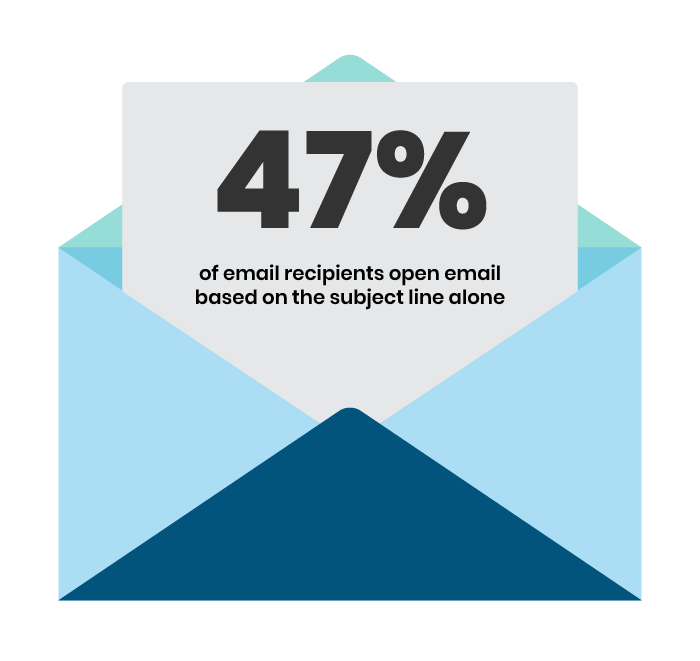
47% of email recipients open email based on the subject line alone

One of the most common questions we hear is: “what do I write in the subject line of an email?” Many people wonder how to write perfect email subject lines.

While there’s no single formula to create the best subject lines for email marketing, the following battle-tested guidelines will get you pretty close to perfect. They can help you make your messages even more appealing to your subscribers.

Apply them to your email subject lines, and you could be the next Fitzgerald of the inbox.

(Looking for an email service provider that lands you in the inbox — and not the spam folder? Get AWeber Free today! We have 20 years of industry-leading deliverability!)

Email Subject Line Best Practices

Your subject line can single-handedly make or break your entire email campaign. We put together this list of best practices to help you create attention-grabbing subject lines for your email marketing campaigns.


Personalize your email subject lines

Here’s some emails I recently received:

Boring subject line examples using personalization

Did any of them make me feel special? Not particularly.

Many years ago when companies first started using first name personalization, it worked. It grabbed your attention. But now, variations of “Hello {!firstname_fix}” have become the norm in email marketing, not the outlier. Because of that, it’s lost its novelty. 

But that’s not the type of personalized email subject line I’m talking about. To truly create an email subject line that gets attention, you need to make the content unique to that individual subscriber.

You need to go above and beyond to connect with each customer. You can do this by personalizing your message based on location, past purchase behavior, and content they’ve engaged with. Think of what information you have on your customers. Now use that to create a personalized experience for them.

What if I took the same email blast subject lines examples above, but made them personalized based on my experiences with those brands?

Exciting subject line examples using personalization

Now that made a difference.

So what’s the best way to accomplish this? With your next email subject line best practice - segmentation.

How to use segmentation

At AWeber, we recommend segmenting your audience and sending each segment tailored messages with unique subject lines.

“You can craft an open-worthy email by appealing to an individual’s interests. People enjoy emails relevant to their wants and needs,” says Shayla Price, a B2B marketer.

Here are some ways to do just that:

  • Ask questions on your sign up form.
    Then use that information in your email subject lines. For example, if you write a fashion blog, you can ask your subscriber for his or her favorite color when they sign up to your mailing list. Then, you can send them emails based on their color choice — like “15 gorgeous [color] dresses under $50.”
  • Send location-based emails.
    Traveling to a conference? Speaking at an event? Meet up with your subscribers in different cities. “We’re in [city] next week! See you there?”
  • Retarget subscribers.
    Did a subscriber abandon a product in his or her shopping cart? You could send an email like “Forget something? Here’s a 20% off coupon!” Or did a subscriber not follow through on an action, like registering for your webinar or workshop? Use that info to tailor their next message. “Only 12 hours to sign up for [event]!”

Create urgency in your subject line with FOMO

Fear of missing out — or FOMO — is a powerful psychological driver of email opens and engagement. Email subject lines that create a sense of urgency, scarcity, and exclusivity can boast a 22% higher open rate.

This can be done by giving your subscribers a deadline to accomplish an action.

Here are some other effective FOMO email subject line examples:
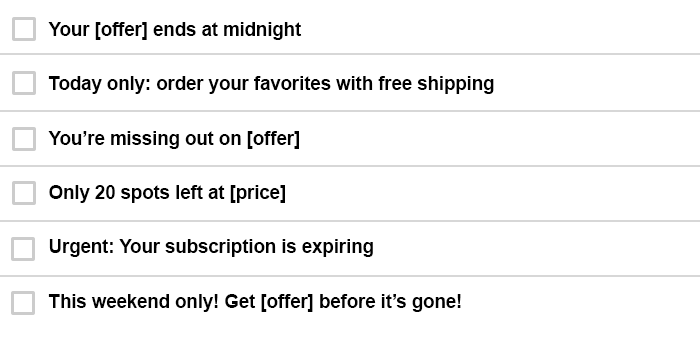
FOMO email subject line examples

Avoid spam triggers in your subject line

Email spam filters are triggered by specific words, phrases, and symbols in your subject line and email content. AWeber uses a content filtering tool called SpamAssassin™ to help you avoid content filtering. This tool is widely used by internet service providers (ISPs) to filter incoming email.
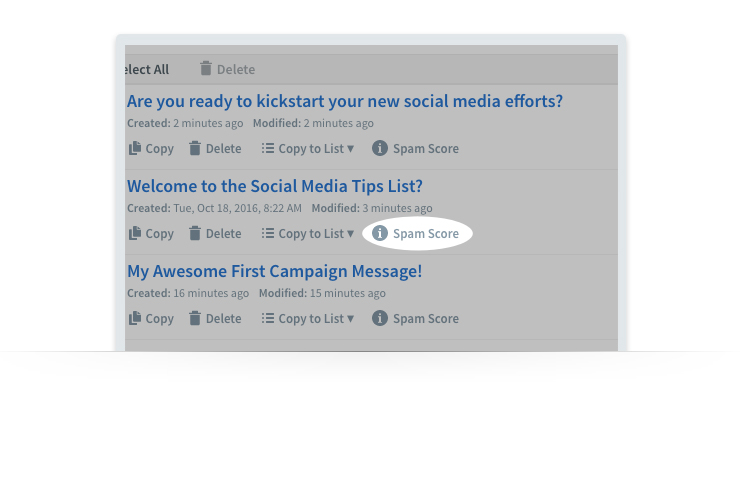
AWeber Email Spam Score

By clicking on that score, you can instantly view the content in your messages that are triggering the SpamAssassin™ ruleset.

So what are some words, phrases, and symbols that are red flags to spam filters? There are a ton, but here’s a few to give you an example:

  • Excessive punctuation like multiple exclamation points!!!!!!! or ellipses ………
  • TYPING IN ALL CAPS
  • Symbols like “$$$” and “*****”
  • Phrases like “cheap,” “cash off,” “incredible deal,” “satisfaction,” “winner”

Also, as many as 69% of email recipients report email as spam based solely on the subject line. Make sure your subject line doesn’t come across as spammy to your subscriber, too. This will happen if your subject line is deceiving in any way, such as leading with “RE:” when it’s not an actual reply to an email.

Be direct in your subject line

Skip the wit, wordplay, humor, rhymes, or puns in your subject lines.

Stick with straightforward headlines instead. These “boring” subject lines convert extremely well. That’s because they explain the value inside the email. The readers know exactly what to expect from the message and the benefits they’ll receive from opening it.

Here are some straightforward email subject line examples:

Examples of direct email subject lines

But there’s one catch: Your messages have to consistently provide value. If your messages fall short of their promised value, your subscribers will feel cheated. Then, good luck getting them to open your messages moving forward. 

However, if your emails are constantly packed with important, personalized content, your audience will open your emails — no matter what the subject line says.

Ask questions to pique curiosity

There’s a reason most television season finales end with cliffhangers: Humans crave nice-and-neat endings. So when you don’t give it to them, they’re unsettled. They have to know what happens next, and they’ll tune in the next season for closure.

Use this craving to your advantage. Fuel your subscribers to open your emails by injecting curiosity into your subject lines. You can ask a question:

  • Jo at Copy Hackers: “Are you missing these 3 copy techniques?”
  • Men’s Health Daily Dose: “Will Creatine Boost Your Gains?”

Or promise an answer inside your message:

  • Jessica Stansberry: “You should be going live ___ times per month! [open for the answer]”
  • Sophie Gray: “This is the ONLY Reason You Should Workout”

Or tease a surprise, giveaway, or gift:

Or make readers say “huh?!”

  • Chubbies: “Sincerely, future Dwight”
  • Really Good Emails: “Emails can be tasty

Added Tips for Writing Email Subject Lines

Email subject line tip #1: character length

How long should your email subject line be?

No one can agree.

Litmus recommends around 50 characters. Yes Lifecycle Marketing says emails with subject line up to 20 characters have the highest average open rate, unique click rate, and click-to-open rate. An analysis from Retention Science found that subject lines with 6 to 10 words results in the highest open rates. And Return Path advises using 61 to 70 characters.

So in reality . . . it depends. (Sorry, I know that’s no one’s favorite answer.) Every industry — and audience — is different.

But here are some important things to keep in mind when you’re testing various subject line lengths — no matter what industry you’re in:

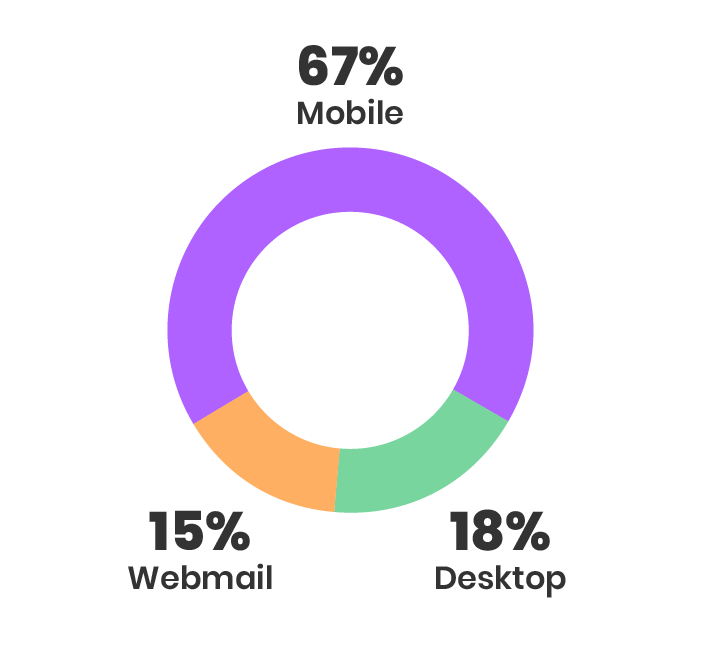
Chart showing 67% of email opens are from a mobile device
  • Is your preheader text cut off? If so, will your subject line still make sense without it?
  • Are there words you can cut to be more concise or clear?
  • Is your message clear and direct?

Email subject line tip #2: use emojis

In a busy inbox, an emoji (or a special character, like a carat ^, hashtag #, or tilde ~) can stand out. In fact, emojis may increase your open rates by 29%.

  • AWeber Blog: “Why you need a hook 🎣”

At AWeber, we use emojis in our messages every so often to pack a punch, or to shorten a subject line. For instance, we might use a 💡 instead of writing out the word lightbulb to keep the entire subject line visible on mobile devices.

Some emojis look very different from one Internet Service Provider (ISP) to the next. So don’t forget to test your emails in various ISPs like Gmail, Hotmail, and Yahoo!, too. Here are 3 Ways to Test Your Emails Before Hitting ‘Send.’

If you choose to use emojis, beware: Emoji usage in marketing messages is on the rise. So there’s a chance your emoji may not stand out as much as you’d like. Our advice: Test them with your readers. See if your readers act positively to emojis through increased open rates.

What’s next?

There’s no single formula for writing the most successful email subject lines. But if you mix-and-match the subject line rules and tips above, you’ll be able to optimize your open rates over time and come up with a formula that works extremely well with your audience.

To find out which types of subject lines your audience likes best, run an A/B split test. Leverage what works, then test again. The type of subject line that works for your audience today might not be as effective six months from now. Watch your open rates closely so you can adapt and improve.

Want to try out a new subject line today? Log in to your AWeber account to get started. Don’t have an AWeber account yet? Get AWeber Free today!

I’d love to hear from you, what was one of your best eblast subject lines that worked?

Post written by contributing writer Marijana Kay and Sean Tinney

The post Your Guide to Writing the World’s Best Email Subject Lines appeared first on AWeber.

12 Jul 16:03

The Phone Is Still the Very Best Tool for Booking Appointments.

by Anthony Iannarino

First, there is no other medium that allows you to convert your confidence that you can create value for your dream client should they agree to meet with you. Your confidence doesn’t come across the same way in an email. Email asks tend to be sterile, devoid of emotion, or too cute for their own good.

Second, and equally important, is the fact that the communication is asynchronous. You can respond to your dream client’s questions and concerns, concerns they are likely to express as a method of getting you off their phone. Because you are on the phone, you have a shot at resolving that concern (provided you have the confidence). An email can be deleted or ignored. Any attempt to resolve a concern can feel like you are arguing.

Third, the key to obtaining commitments is trading enough value in exchange for the time you are requesting. Offers that are spoken with confidence that they deliver value seem to be more effective than offers made over email. If the value proposition for the meeting isn’t exactly right, you have a chance to remedy that with an improvement to your pitch. When what you are selling is a meeting, there must be something that makes it worthwhile for your prospective client.

Finally, your voice is unique to you. It can identify you, transforming you from a first and last name into a human being. Not only can the client hear your voice, they can get a sense of you as a person, what we might call your real voice, or personality if you are willing and able to share that over the phone. All these things are made more difficult over email.

Email is about efficiency. But results in prospecting don’t easily lend themselves to improved efficiency. Results tend to follow effectiveness. If one medium is more effective, using it more often is a better choice than looking for shortcuts.

The post The Phone Is Still the Very Best Tool for Booking Appointments. appeared first on The Sales Blog.

12 Jul 16:02

5 Things to Do When Launching an Engineering Startup

by Jen Bosavage
How you can lessen the challenges and enjoy more of the reasons why you became an entrepreneur in the first place?
Digikey

Figure 1. Planning ahead helps an entrepreneur succeed at working for him or herself. Source: Nick Youngson / CC BY-SA 3.0

The freedom that comes with being your own boss can't be beat: You make your hours, find your clients and reap the financial benefits. However, the reality looks more like working all hours, babysitting clients and haggling for payment.

How you can lessen the challenges and enjoy more of the reasons why you became an entrepreneur in the first place?

Pitch Perfect


What are you building, or what is the service you are providing? You must be able to articulate what your business purpose is and not by using technical jargon. Every entrepreneur — even one who is an engineer — is a salesman, so practice your "pitch" in a way that your customers understand your engineering value yet aren't intimidated by your language. Remember, customers are coming to you often because they are not engineers themselves, but have a problem for which there is a technical solution.

Write Your Plan

Whether your plan is formal or informal, you need one. What are your goals and how will you reach them? Just as a teacher would create a lesson plan to be ready for class, you need to be prepared to run your business from launch to marketing to a routine work day. Determine what supplies and resources you'll need, including overhead, equipment and staff. You will oversee every aspect of the business, from designing business cards to running payroll to finding leads. Now is the time to identify gaps in your personnel coverage and fill them.

Understand Your Limitations

As a one- or two-person engineering firm, you will most likely see success working an underserved niche. You might have researched this segment and targeted it before launch, or it may have evolved as your core business months after opening the doors. It's important to realize that as a small business, you can't compete point for point with the big competitors, but you can offer engineering insight that larger firms can't. The big names struggle to identify with small and midsize business (SMB) customers. One of your strengths is being an SMB. You are uniquely positioned to offer products and services that the larger companies can't. Often, your customers' challenges are similar to your own. Therefore you have a perspective that is valuable and different from the big players.

Line Up Funding

You might be able to startup with a line of credit from your bank or even your credit card. But for engineers requiring tooling, high-tech equipment or software licensing, you will need to find an investor. To start finding and vetting potential investors, join small business groups, both locally and online, as well as your college alumni association. The local chamber of commerce or Small Business Administration (SBA) chapter can be good resources. For example, the Small Business Investment Company (SBIC) program helps small businesses find investors. More than $21 billion of capital has been channeled through this program. Each SBIC is privately owned, but are licensed and regulated by the SBA. The SBIC directory is available here.

Don't Settle

All your tools — whether of hardware, software or human capital — should be the best. The challenge you likely face is having a limited budget, so you have to make the most of it. Invest in the right tools to make prototypes. Bad production quality can ruin a fledgling operation. Create ways to encourage the brightest minds to want to work for you, whether as employees or interns. You might have an awesome location, convenient work hours or an affinity for pets in the office. Make your firm attractive to the types of people you want as workers as well as clients. Offering a competitive salary is only the beginning. You have one opportunity to make a first impression, be prepared to make it great.

12 Jul 15:49

No Two Leads are Alike

by Zach Heller

Salespeople are all trying to refine their sales approach. Sales managers are all looking for that perfect script. Businesses think that if they can just figure out the right combination of emails, in-person meetings, offers, and benefits, that they can sell to anyone.

But the truth is, there is no one-size-fits-all solution to selling. And that’s because every lead is different.

Customers are human beings. And companies are unique. You can’t expect that exact same technique to work for everyone.

How Are Leads Different?

  1. Leads come from different sources. It is unwise to assume that a lead that finds your product or company organically is the same quality as one who was driven through an advertising campaign.
  2. Leads come with different amounts of knowledge. Some people will do a lot of research before you ever connect with them, while others will need a basic introduction.
  3. For B2B sales, leads will have different amounts of power. Some of the sales leads that you speak with will be able to pull the trigger, while others will require approval from several layers of management.
  4. Leads will be in different financial situations. For B2B or B2C sales, one of the biggest things for salespeople to understand is how pricing and discounting will impact different types of buyers.
  5. Leads will have a different understanding of the competitive arena. Some leads will know who your competitors are and what they offer, while others will be starting their research with your brand.

These are just a few of the many ways that sales leads can vary. They will turn up at different places in the sales funnel, asking different types of questions and expecting a personalized experience.

So the question becomes, how is your sales team equipped to handle them?

What’s a Sales Team to Do?

  1. Ask lots of questions. The best salespeople are great at getting the information they need to craft the appropriate strategy. Asking questions at the outset of a conversation allows you to ascertain who the buyer is and what they are looking for.
  2. Target specific segments of the market. It’s important for companies to know what types of customers they are most likely to convert. Rather than trying to create a one-size-fits-all approach to selling, fine tune an approach that works for one specific segment of customer.
  3. Prepare for surprises. Having the right kinds of promotional resources (case studies, whitepapers, testimonials, etc.) for different stages of the sales funnel will allow a salesperson to tailor their strategy to each individual buyer, rather than a static sequence that will work for some leads and not others.
  4. Measure and optimize. The worst thing a sales team can do is settle into a pattern without understanding how they’re performing. We need to continually update our approach based on real-life feedback and metrics, always pushing to convert more customers.
12 Jul 15:49

Why Scaling Your Sales Team Isn’t Just About Adding Reps

by Adam Henshall

sales team

Building an initial sales approach is something loads of us have attempted to do at some point or other.

Sales ends up being one of the key ways companies grow and scale. We all know this.

But there’s a big difference between doing effective outreach for your startup on a high-touch basis where you’re still understanding customer needs and figuring out approaches, and turning this knowledge into a sales machine with a full sales team that can operate in a financially efficient way.

Understanding yourself in the market and growing to be the company you want to be require different slightly strategies.

This growth from tiny solopreneur kind of structures to managing teams with effective documented practices is what this article will be all about!

We’re going to take a look into some expert insights from Close.io‘s recent webinar with their CEO Steli Efti, Process Street’s CEO Vinay Patankar, PandaDoc‘s Director of Inside Sales Mike Paladino, and Groove‘s VP of Sales Mike Sutherland.

We’re going to pull out the key questions to help scale your sales in a way that works:

  • What do you want to scale?
  • Is now a good time to scale?
  • How do you build a process for scaling?
  • How do you get a sales teams to follow the process?
  • When and how do I add people to a sales team?

And finally, we’ll give you 10 free process templates for different areas of sales for you to start using in your business today.

You can watch the whole webinar here: How to build a scalable sales process (Q&A webinar)

What do you want to scale?

sales team inbound outbound

Source

There are many different approaches you can take to building a sales process.

Let’s look at 4 different terms:

  • Inside sales: This refers to having sales people working in your office or remotely and dealing with completing sales simply from their desk. This is a common approach within the SaaS industry particularly when targeting small to medium sized enterprises. High value sales in this space may still require something different like…
  • Outside sales: This is where salespeople travel to where the customer is to sell to them directly. This could involve visiting to understand how their systems and processes work, and how your product could fit into that. Or it could be more consultancy based sales where you need to see how your services could assist the company in question.
  • Inbound sales: This is where you sell to people who come to you. This may involve marketing materials which customers see and use to make the decision to reach out to you. Lots of SaaS sales will work in this way; particularly for companies who operate with a freemium model which lets users try before they buy.
  • Outbound sales: This is your classic Hollywood idea of sales. You work out what kind of companies might be interested in your services and you reach out to them one by one to try to bring them aboard. Think cold-calling and cold-emailing.

In all honesty, there is often a great amount of overlap within any single company in regards to which strategies are employed.

We employ a lot of inbound sales strategies where leads come to us and get qualified from there. Yet, we have also used sales development reps who have reached out to companies who look to be a good fit for our services.

As Vinay discusses in the webinar, it is important to test your channels to understand which approaches are best for you and your company.

Vinay advocates for finding your best channel and iterating your processes from there. With each major process iteration you could see a 10% rise in how effective it is – so it makes sense to find the best performing channel and iterate on it in a focused manner in order to maximize its usefulness.

Once each iteration begins to make little extra difference to attainment, then you’ve probably optimized that channel to a point where resources could be better used opening up a new channel alongside and working on boosting that channel.

Mike Sutherland of Groove reminds us of the effectiveness in an early stage of employing outbound approaches in order to better understand how our own product relates to the market. Talking with customers and understanding their pain points is always going to be effective in not just boosting sales, but also improving your product and its fit.

The key takeaways

Test your channels and determine which is your best performer. Utilize the limited resources you have to optimize that channel until you reach a point of diminishing returns.

Is now a good time to scale?

sales team growth

Source

Everyone’s business is different.

The key constraints on your ability to scale in the real world might be related to your production systems and whether you can manufacture a physical product to meet demand. Or it could be whether you have all the necessary staff on the team to provide the services your company wants to offer at scale.

I’ve encountered this twice myself.

Once when working in software development where we jumped forward to take on new customers because we were motivated by money. In the end, we didn’t make loads of money off the new clients, we lost money. We weren’t ready to offer the volume of new services we were able to bring in through sales.

The second time was when my app idyoma was first available in the AppStore and Playstore. We knew we would struggle to keep customers happy given the product was still an MVP app and it required a carefully built userbase structured in geographical clusters. But we got excited by rising downloads and removed our self-imposed constraints to growth. We were too cocky and damaged the business in the process.

In the webinar, Vinay touches on the need to understand your product, your process, and your business properly before you begin the scaling process:

“Make sure your fundamentals are strong before you scale”

You need to know your numbers.

How much does it cost for you to bring a qualified lead to the table? What percentage are you converting at each stage of the pipeline? How consistent are your results and can you begin to predict your future results with some accuracy?

As Steli summed up nicely:

“Scaling is about predictability”

If you’re going to invest significant resources, both time and money, into growing your sales and your sales team, then you need to be able to fairly accurately predict what this investment will lead to.

The key takeaways

You have to understand thoroughly how your business works, particularly your sales pipeline and the processes embedded within. You want to know the buyer personas, the numbers for each, the lifetime values, the customer acquisition costs. You can attain these through tests and through consistency.

How do you build a process for scaling?

sales team iterate processes

Source

Creating a process is a pretty central theme of a lot of our output. Unsurprisingly so.

We have plenty of materials geared toward documenting workflows, creating Six Sigma processes like DMAIC, and writing standard operating procedures.

But sometimes these intensely technical elements aren’t needed.

In the early days of building and then scaling a sales process it’s better to think in terms of principles and best practices. Agile methodologies which encourage iteration, embeddedness, and flexibility are important to keep in mind throughout the lifecycle of building and optimizing processes.

As Steli points out in the webinar, it’s a really effective way to approach processes if you think of them like products. You can operate with different versions – knowing that this version is not necessarily the final version, but it is a necessary step to understanding and formulating the final process.

Start simple.

Simply writing the process down and having it understood by the various people involved is the first step to having a process based sales system.

Though, you have to be careful even in the early stages.

As Vinay points out when discussing the two mistakes teams often fall into:

  1. Trying to grow too fast. Attempting to achieve too much in the early stages of process design can lead you into processes which limit output as much as aide it. It also takes up your time and resources.
  2. Documenting your process is a great way to start. But like any product, a documented process should be tested and validated before you decide to expand it across a team. Too many companies simply standardize what they do without testing whether they’re standardizing something good.

Starting simple and testing out early iterations of processes as a team is a great way to discover what works and what doesn’t.

Moreover, doing this as a team and looking to have each team member contribute to the process design results in insight from every stage of the pipeline while also increasing buy-in from the team as a whole.

Mike Paladino of PandaDoc points out that you want all the people who have to use the process to feel a sense of ownership over the process. This will both make it better and make it more closely followed as time goes by. Plus, when there are things which could be improved, an engaged employee will feel a greater willingness to jump up and make suggestions for further improvements.

Lastly, as you’re building this process, Mike Sutherland emphasises the importance of making it clear and actionable. There’s a difference between a guide and an actionable process.

A series of guiding points might not result in effective process adherence. If you don’t have people following the process then how can you be testing and validating it? You can’t.

Design it for someone to use, not for it to look fancy to investors.

The key takeaways

Treat the process like a product. Build a simply working MVP of the process and iterate it from there. Make it user friendly and involve all stakeholders in its creation. This process can then be the base from which your growth occurs.

How do you get sales teams to follow the process?

sales team performance statistics

Source

Here, we can kick off with a bit of a statistical look at process adherence.

As you’ll see from the graph above, high performing organizations have strictly enforced, automated, or closely monitored sales processes 50% of the time.

There’s a clear relationship here between working hard on your sales processes and you sales processes working for you.

As we’ve mentioned previously in the article there are two key features which come in to play here:

  1. Involving stakeholders in the process design results in them using the process more and wanting to improve it more.
  2. Well followed processes result in more consistent data and a better optimization process, meaning improved output.

But there’s more to it than just this.

A clearly actionable process, one that can involve assigning tasks to other team members, putting stop tasks in place to enforce actions, or using conditional logic to build flexible complex processes, keep sales reps on track even when circumstances or scenarios have more variables.

Vinay points out that one of the most effective ways to get reps to follow a process is to make it easier and better for them to follow it than not. This comes down to good process design over time as you iterate.

He points out that sales reps typically only spend 32% of their time selling! The rest is often taken up with admin.

“If you can reduce the amount of admin that a rep has to do to complete that same process, they’re much more likely to adopt it and keep using it.”

It’s for this reason that we at Process Street have built in automation elements to our product, and continue to do so; including integrations with Zapier‘s library of over 1000+ other apps and webapps.

If you want to really dig deep into automating administration tasks and letting your sales reps focus on what they do best, then check out our ebook: The Ultimate Guide to Business Process Automation

But not everything is simply down to processes in the pipeline.

You need to improve the operations of the surrounding areas of the company to support and scaffold the sales teams. This involves management strategies to bring the most out of your teams.

Mike Paladino recommends keeping sales figures and results open and transparent. You can leverage the natural competitiveness of your sales reps to drive them forward to succeed. This can boost productivity while also encouraging them to adhere to the process to improve their own performance.

You could even look to, as Vinay describes, tie process adherence into the commision package, giving an added financial incentive to process adherence.

Ultimately, company culture will play a role in what gets adhered to and what doesn’t. Building a culture of accountability is vital to getting your reps to follow the documented steps you’ve all worked so hard to optimize. As Mike Sutherland sums it up:

“Promote and celebrate wins”

The key takeaways

Build processes which make your reps’ lives easier. Support them in their attempts to make sales and champion them when they do. If this means automations then do it, if it means incentives then do it. Build systems which help your reps and your reps will appreciate them.

When do I add people?

sales team building

Source

If you’re at the stage where you know your fundamentals and you’ve built out processes which are strong and stable, then you can think about expanding your teams.

However, it’s worth bearing in mind that processes which work for a team of 5 may not always work as well for a team of 50.

Many companies attempt to grow too far too fast.

Just like a product, you should keep validating your process as the use cases or environments it is employed in change. Reviewing the performance and continuing to iterate is the key element of taking an agile approach to your sales process.

Mike Sutherland describes how Groove operate about 50/50 between inbound and outbound approaches. Even if you feel that both of these strategies generate leads, it isn’t always the case that these leads are the same.

As you grow, you may want to have some staff who qualify inbound leads and some who qualify outbound. You have extra staff and resources now so you can provide a more tailored breakdown of your segments. This may mean breaking your initial process a bit.

Growth can force you into reworking the process you optimized.

Steli’s recommendation was not to rush. Scaling is about predictability. So change small things and gradually build.

He recommends looking at scaling your lead generation first before you scale the other roles within the process. This can help you understand how much space you have to scale into. You can’t reasonably scale beyond the number of leads you can generate in any one channel.

These careful approaches to growth help make sure that it happens on your terms and you’re in control.

The key takeaways

To take Mike Sutherland’s 3 key points:

  1. Be deliberate
  2. Measure
  3. Iterate

Even if your investors are pushing you to hire more staff and expand like crazy, make sure you’re in control. The world of startups is littered with companies who lost control of their processes in the name of growth. Zenefits being an obvious candidate.

10 free Process Street sales processes to boost your revenue

sales team sales processes

Each of these templates is fully customizable and you can add or remove sections to your heart’s content.

You could either use them as inspiration or plug them directly into your business and iterate on them from the go.

If you want to use any of them, just click on “I want this for my business” button in the top right of the screen and it will be added to your Organization within Process Street.

  1. Sales training process checklist
  2. Weekly sales prospecting checklist
  3. Cold calling checklist
  4. BANT sales qualification call process
  5. Sales presentation template
  6. Sales pitch planning checklist
  7. Closing the sale checklist
  8. Order processing checklist
  9. Monthly sales report
  10. Upselling Process for SaaS Companies

And we’ll leave you with the whole reason why we focus so hard on building the right processes. It’s not to simply have a sexy process library. It’s to help salespeople sell more.

Check out the webinar for more:

What are your sales processes in your business? What do you think makes a good sales process? What makes a bad one? Let us know in the comments below!

12 Jul 15:49

5 Surefire Ways to Win Back Lost Leads

by Nicole Bryan

Tons of companies focus on and spend heavily on lead generation. 74% of those companies spend more than $50 per lead generated and 5% spend more than $1000. According to Salesforce, it takes 6 to 8 plus touches in order to generate a viable sales lead, 84 days to convert that lead into an opportunity, and 18 days to convert that opportunity into a deal. This process is exactly why it is so disheartening when a lead sleeps out of your hands.

With the resources, energy, and time you have invested in lead fostering and relationship building, you should definitely never give up on the lost leads. The key to successful selling is optimism, so kick it up a notch when going after lost leads. It is easy to get discouraged but with these five highly effective techniques and tips, you can win back the lost leads and get them back into your sales funnel.

  1. Analyze and Resolve the Reasons of Losing Leads

Root-cause analysis and asking yourself the right questions are the first steps to determine why you lost the leads. Here are a few questions to ask yourself below:

  • Why type of lead did you lose? Was the lead hot or cold?

If it was a hot lead, there are still chances of striking before it cools off. A simple follow-up call to the lost lead could reveal what made them lose interest in the first place. Once you find out why they became uninterested, you can take further corrective action or at least gain the knowledge for future leads. When it comes to the cold leads, you shouldn’t stop pursuing them either. You first need to establish if the deal is cancelled entirely with zero potential for further discussion.

  • Did the merchant push their decision to a further date? Did you failed to follow-up?

It happens – we all forget to follow-up sometimes. There is nothing wrong at all with giving a quick apology to the customer. Leave the ego or hesitation aside and make that follow-up call ASAP.

  • Did the merchant get a better deal from your competitor? Or, did you offer the wrong product-solution with respect to the merchant and their business needs?

In the former, you can offer a better deal than the competitor and increase the chance of conversion. However, speaking on the latter, if the lead has gone astray because your solution did not have the right features for their business or because the customer could not afford it, then those are genuine reasons. If you have other products or cheaper solutions, definitely offer. If there is absolutely nothing you can do after that point, at least take their reasoning as useful feedback so as to improve upon your product features or pricing.

  • Is your response time slow?

Response time with leads can make it or break it on sales. A research study showed that the odds of the lead entering the sales process are 21 times greater when contacted within five minutes versus 30 minutes after the lead was submitted. With the world being a much busier place today, customers expect a quick turnaround time, and every minute delayed is a lost opportunity to convert that lead. A simple and concise follow-up message such as “Thank you for contacting us, we will get back to you within 24-48 hours” can give a great first impression about your responsiveness.

  • Did the merchant fail to understand your product?

This could happen when either the merchant did not get all of the information on the point-of-sale product from your website, brochures, and emails or there was something missing in the product demo during your sales pitch. To prevent this from happening again, ensure that all your product information sources are comprehensive and up-to-date. Make sure you have your sales pitch down and that it is informative enough to the customer.

  1. Give Your Leads a Limited-time Offer or a Promotional Offer

Limited-time offers are psychological triggers that create a sense of urgency among your prospective clients. A simple discount code with a validity period, or a message such as “only 24 hours left to get this product at a discount rate” force the leads to make a quick decision, typically in your favor, because they don’t want to miss the deal.

  1. Amp Up Your Marketing Efforts

Today, customers are present on multiple touch points – emails, social media, mobile, laptop, desktop, and many more. It would be a smart marketing strategy to focus on as many channels and devices as you can. In order to makes sure that your message reaches every lead at all stages of the buying cycle, you have to create a multi-channel and multi-device strategy. Make sure your marketing strategy is able to generate highly targeted leads through email marketing campaigns, Facebook advertising, link building, social selling, tradeshows, etc.

A great way to ramp up your marketing efforts is through a drip campaign. A drip campaign is a focused lead nurturing program aimed at both new leads as well as making old leads re-enter the sales pipeline. It is usually executed through email marketing where pre-written and auto-generated messages are “dripped” (sent) repeatedly to your leads over a period of time. Drip campaigns create high visibility and familiarity with you and what you offer through exposure, which nurtures their trust.

  1. Change Contact Timing and Mode

No matter who you are, everyone hates when they get a call or email at an inconvenient time by someone who is just trying to sell you something. This may be something your customers are experiencing with your sales strategy – if you’re calling or emailing on a Friday, in the evening, or around holidays, you may be contacting them around the wrong time. Try switching up connecting with your lost leads at different times.

It may also come down to how they prefer being contacted. You may have some leads that prefer phone calls, some that prefer LinkedIn or Facebook messaging, some that prefer texting, and some that prefer only emailing. It is important to find out this information when you’re first getting in touch with leads. Write the details down and try your best to create a unique contacting strategy for each one. Beyond that, try switching between various modes of contacts such as emails, phone calls, text messages, voice mails or social media platforms (without irritating them.) Between changing the times of contact and the mode of contact, there may be a few leads that coming bounding back into the sales funnel.

  1. Invest In Digital Signature Technology

Getting signatures to finalize a contract can be one of the most difficult challenges for a reseller. Even if the merchant has approved the contract, there can be a long wait time between when they say “yes” and when they actually sign the paperwork. Especially because signing physical paperwork requires mailing, scanning, or faxing the completed documentation back to the reseller. This is where digital signage comes in.

Digital signature technology allows the merchant to sign the documents online. This can help:

  • Reduce turnaround times
  • Ensure that no signature is left out
  • Increase overall sales productivity
  • Better communication between the reseller and merchant

A lot of times the lead is not lost but rather needs to be re-engaged back into the sales cycle. All you have to do is make it a conscious effort to bring them back. Following these 5 tips and techniques above will help bring enthusiasm and interest in your leads and could lead to your next new customers.

12 Jul 15:49

Best Practices and Tips: Making Money from Company Social Media Accounts

by Tommy Wyher

Social media is everywhere whether it is breaking stories in the news or in the news due to a celebrity making an insensitive comment. The fact that social media has such a large reach around the world can make those proficient at it quite a bit of money. Company social media accounts can be used to make a profit or even fund a marketing campaign. Those companies with quite a following on social media can fund their entire marketing department simply by earning money with every post. Making money from a company social media account has to be done with tact though as it can hurt a brand image if done incorrectly. The best practices for making money from company social media accounts are below.

Content Can Pay For Itself

Creating content that attracts traffic as well as leads helps the ROI for the content stay healthy. Those companies that create video content for social media, YouTube and other platforms can make the money back via the traffic the video garners. A marketing department that has the ability to create content that draws enough traffic to cover the content creation fee will have a budget to utilize elsewhere. The worst thing that can be done is to create content and pay for it when it is generic. Generic content used to be able to convert but in today’s world, consumers are pickier about the content they engage with as the market has been saturated with content.

Don’t Promote Garbage or Low-Quality Businesses

One problem that a company can run into is partnering with a product or brand that simply is of poor quality. No amount of money is worth compromising the trust of followers who some of which are current customers. Do the appropriate research before partnering with another brand and ask for product samples. Telling a potential partner that the company cannot work with them due to the quality of their product or work needs to be done with tact. The relationship could be beneficial if the company improves their quality of work. One tactic could be to let them know the company is suspending sponsored posts for a while to work on its own social media marketing strategy.

YouTube Partner Program

YouTube can be the perfect platform for a company account to start earning nearly immediately. Being able to put together great video content that helps educate consumers can give the company a huge return financially. Great pieces of content are thought-provoking but also teach the reader which can be done through a series of tutorials. This could be something as simple as best practices for WordPress based sites or something a little more complicated like how to set up a successful PPC program. Becoming an industry thought leader via YouTube videos allows a company to increase brand exposure as well as sales. Those companies that dedicate themselves to educating consumers also gain the trust of consumers. Selling paid promotions in the introduction or conclusion of the video is another way to generate income. Make the company an influencer on YouTube and watch the offers for paid ads pile up! Start attracting new YouTube subscribers to begin earning on this platform as soon as possible.

Free Form of Advertising

Social media being free allows a company to get a return when they have invested little to no money. Any sales that are generated only have the overhead of the person who is paid to manage the account or a contractor that handles the social media content themselves. Setting up a publishing schedule that is in line with the best times of the day for engagement for a specific account will help expand the reach even more.

Partnering With Influencers

Influencers have the ability to make a brand thousands of dollars from one post. Even something as simple as allowing an influencer to take over the social media accounts of the company for the day can make a huge difference. Expanding the potential customer demographic to the network that the influencer has can help convert in sales. For a digital marketing firm, the company could offer to help promote the brand of the influencer as a form of payment. The right influencers will make it easier than ever to sell products via social media as some influencers have a large amount of trust from the follower community that they have formed. For those e-commerce businesses, it can be extremely profitable to have an influencer promote a product that is not selling. This will help target the weak areas of product sales with nearly guaranteed conversions.

A company can really help their bottom line if they use their social media accounts as another form of revenue producing. Do not tarnish the brand’s name in any way to do this as the products and services of the company are the main revenue generator.

12 Jul 15:48

How to Create Mobile Emails that Convert

by Matt Harris

TeroVesalainen / Pixabay

The screens we gaze into on a daily basis are getting smaller and smaller. Last year, Google’s Android displaced Microsoft Windows as the world’s most popular OS. And users have been spending more time on their mobile devices than their desktops since 2016.

All this adds up to the fact that email is no longer a desktop-focused medium. Mobile users, however, approach email with a different mindset, with limitations in both time and screen size impacting how an email is received.

Fortunately, worries about mobile’s influence on email efficacy are unfounded, as long as you know how to tailor your communications. Below are a few general guidelines.

1. Write emails worth reading.

People don’t just open more emails on mobile, they spend more time reading those emails than those on desktop. Think about it — remember the last time you were eagerly awaiting an email? Maybe you were expecting to hear about a job or were settling a personal matter. If the email arrived while you were on mobile did you hold off reading it until you could see it on desktop? Of course not. You opened and read it in the moment, on the device you were using at the time.

In the same way, a discount offer or news about a new product are welcomed and read by any customer who has already demonstrated interest by signing up for your email list. What’s different from a few years ago is that machine learning makes it easier to target customers with finely-crafted, personalized messages, allowing you to ensure each message is relevant to each recipient.

2. Consider context with your call-to-action.

There was a time when e-commerce was a desktop-focused phenomenon, but today, more than half of visits to shopping sites come via smartphones. Though more conversions still happen on desktop, that’s also changing. Mobile shopping accounted for 34 percent of online purchase revenue last year, according to an estimate from Adobe. By 2020, ‘m-commerce’ could account for as much as 49 percent of online retail sales, according to Javelin.

Marketers need to consider the context in which a customer might receive a mobile email and then imagine actions that will make the most sense for the user in that context. For example, because the user is mobile, they might be physically close to a retail store, a possibility that is less likely from a desktop device, so providing a location-based ‘stores near you’ CTA might be a good option. Click-to-call is another great example of an action that’s more logical on a smartphone than on desktop.

3. Limit obstacles

Filling out forms on desktop is annoying, but on mobile it can be beyond frustrating. When you’re on a mobile device, every tap and swipe matters.

To limit users’ frustration, don’t make them fill out huge forms or hunt around to find what they’re looking for. With your mobile users in mind, consider streamlining the process of obtaining or entering data as much as possible. You could also play to the fact that your customers are likely reading your email on a mobile device, with a playful nudge to take care of the more detailed stuff when they have access to a computer… “Hey, we know this might be a bit tough on your phone – come back to it when you’re at a computer.

4. Be concise

Research from Boomerang determined that the optimal length for an email — the length that elicited the best response rates — was between 50 and 125 words. That’s three or four very short paragraphs, at most.

While many email marketers have been making the case that shorter is better for some time, mobile gives their argument added weight. People checking email on their phones are often killing time, perhaps in the backseat of a cab or waiting in line. Whatever the case, the content is more easily consumed when it’s ‘snackable’ — in other words, designed for short engagements.

5. Make the experience as quick as possible

According to Google, 53 percent of users will abandon your site if it takes longer than three seconds to load. The same holds true for the amount of time it takes your email to load upon opening. But not only that, a CTA that leads to a slow-loading, non-mobile optimized landing page will send your customers right ‘round the bend.

So make sure your emails are designed to open quickly on mobile, for sure, but take care that any page your CTA leads to will load quickly, work properly, and look great on mobile as well.

And speaking of being concise, this post has already clocked in at more than 600 words — or up to 12 times the length of an ideal email. If you’ve read this far, thanks. Especially if you’re reading on your phone.

11 Jul 15:55

Open source hasn’t made tech more open

by Nithin Coca
There are two institutions dominating the top of the tech food chain today. On one side are big tech companies like Google, Facebook, Amazon, Microsoft and Apple, as well as China's big three of Baidu, Alibaba and Tencent. Alongside them are the mass...

11 Jul 15:52

Could marketing be a revenue source?

by Drew McLellan

revenuePreviously, I told you about the book, Killing Marketing, by Joe Pulizzi and Robert Rose. Their premise is that marketing has evolved to the stage where it needs to be completely re-invented, and we need to think of our organization’s marketing departments as media companies, that is to say, as a revenue source.

On the surface, it sounds like quite the stretch.

The book quotes Peter Drucker who said: “the purpose of marketing is to create and keep a customer.” In this case, the authors are emphasizing the word create. They believe that marketing has moved from just persuading someone who is already interested in buying what you sell to literally creating the audience in the first place, via your own generated media.

This is where the book risks losing readers. If you run an architectural firm or serve your clients by moving their goods across the country in your truck, the idea of launching a magazine or creating a YouTube show probably holds very little appeal. But when you start considering the broadest definition of media, it gets a little more interesting and might be better aligned with what you are already doing.

The big shift in thinking here is that rather than marketing to sell a product, you market to create an audience. Once you understand that audience and earn their trust, you can monetize that relationship by knowing exactly what they need/want, offering it to them and build revenue in the process.

Instead of saying, “I want to talk about stuff we sell, and hopefully that will catch the attention of people who might want to buy our stuff” you could say, “I will talk about the topics and issues that matter to the people who typically buy our stuff. After we’ve earned their trust and continued attention, it will be easier to sell our stuff to them.”

The truth is – we’ve all been consumers of this sort of strategy. Walt Disney launched his empire by creating cartoons and movies. He then moved into TV. From there, he started creating products and experiences to serve the audience he created.

It would be easy to dismiss this idea as being reasonable for consumer-focused companies but not for the business-to-business model. But it actually works even better for the B2B organization because your audience is naturally more defined and niched.

By now you’re probably wondering what kind of media are we talking about? Here’s a partial list.

  • A content-rich website that provides information and opinion pieces
  • A forum or message board/group chat engages your core audience
  • A weekly podcast or YouTube video
  • Monthly educational webinars
  • Regional events to create networking and learning opportunities
  • A national event with speakers and CEU courses
  • Research (you can sell the report/results) that informs your business decisions and offers insight to your audience

That list is daunting, isn’t it? It looks expensive from both a money and time resources perspective. How does that become a revenue stream rather than an ever-growing drain on your company’s budget?

  • Sell sponsorships and advertising spots on many of the items above
  • Charge a fee for the events and courses you offer
  • Create premium content that you put behind a payment firewall
  • Sell subscriptions for access to ongoing research or other media
  • Build/rent out your mailing list to other companies who are interested in the same audience

I’m barely scratching the surface of what’s possible. I don’t believe this is an all or nothing strategy. Every business could bake some of this thinking into their marketing, or should we say revenue plan. It’s an interesting premise and just imagine what you could do if your marketing was self-funding!


The post Could marketing be a revenue source? appeared first on McLellan Marketing Group.

11 Jul 15:52

Overcoming Sales Objections: Start With This Question

by deb.calvert@peoplefirstps.com (Deb Calvert)

One simple question will help you with overcoming sales objections and change the way you handle them. You’ll be far more effective if you use this simple technique.

11 Jul 15:37

Lessons Learned from 20 Years at the Leading Edge of SaaS

Over the weekend, I read Tien Tzuo’s book, Subscribed. Tien is the founder and CEO of Zuora, and former CSO/CMO at Salesforce, where he started in 1999. He has been working in SaaS for nearly 20 years. He’s a thought leader in the world of subscriptions, and I learned a tremendous amount from his book.

There were three key themes that resonated with me. First, the shift to a subscription business model reinforces customer centricity. Second, pricing is one of the most powerful growth levers subscription companies have. Third, balancing customer mix across three-tier plans is critical to long-term success, and there is a right way to think about it.

In the book, Tien talks about Fender, the guitar company. Though tens of thousands of people have salivated over Fender’s guitars - notably Wayne Campbell and his love affair with the Stratocaster - 90% of people who pick up a guitar churn. They stop playing because it’s too hard to achieve small wins. Fender wrote a mobile application to help aspiring guitarists learn how to play music within minutes. This reduced churn by 10 percentage points, doubling the size of the market. The mobile application requires subscription, introducing a new revenue model for the business. Fender redefined the notion of a sale and customer success.

Pricing is one of the most powerful growth levers you have as a subscription company. It seems like complex topic, and one I have written quite a bit about. Tien shares a simplifying viewpoint. There are only two kinds of subscription pricing: consumption and capability. Consumption pricing means charging by the seat, the API call or the CPU cycle. Capability pricing means charging by new features and functionality. Subscription companies should choose one or the other.

Many startups adopt the bronze, silver, and gold plan strategy. Tien has worked with Madhavan from Simon-Kucher, who wrote an excellent book on pricing called Monetizing Innovation. According to Madhavan, if 70% of your customers are in the entry-level tier, your business will not survive. The demarcation between pricing buckets is not successful. The bronze tier offers too much value. The goal is to achieve 70% of customers in silver and gold tier.

We’ve been fortunate enough to partner with Tien in his journey at Zuora. Every time I see him, I learned something new, and his book was no different. It’s full of insights about how to build subscription companies from someone who has operated in the space for more than 20 years. And a leader who has facilitated the transformation of hundreds of businesses into subscription companies.

11 Jul 15:36

How Value-Added Resellers Can Use Competitive Analysis to Get Ahead

by Nicole Bryan

With the payments industry growing every single day, Value-Added Resellers need to work even harder to stay ahead of their competition. Competitive analysis helps give resellers useful and valuable insights about how they are performing against others in the industry. Not only will it help you identify new opportunities and stay on top of industry trends, it will also help you to increase your business revenue.

Keeping up with the competition will help you to analyze your strengths and weaknesses. It will equip you with a new set of knowledge that you can apply to your sales strategy. Putting in the time and energy to research the competition will help you to develop a strong strategy in order to achieve realistic business goals and stay ahead of other resellers.

  • Keep Up With Industry Trends and Visit the Competition’s Sites

Putting in the time and effort to keep up with industry trends will help you stay ahead of the curve. Just simply knowing what the new and hot trends in the payments industry are will help you to generate ideas and make plans to expand your business. Checking out websites like PYMNTS.com, PaymentWeek, and Payments Source can give you a deep understanding of what trends are affecting the payments realm.

Aside from industry websites, simply checking in on your competitor reseller websites will give you a wealth of information related to their products, services, and potential pricing structure. Get a good understanding of how their offerings differ from yours. Another good thing to look out for are buzz words and key words – check out every page structure and get a good idea of how they word their product descriptions. Having a firm grasp on key words can help with search engine rankings for your own site.

  • Interview Your New Customers

New customers can offer a great deal of information about you and your competition. You can ask them the reason they left their previous situation, why they prefer your services over others, and what you could offer to make your services even better. Not only will these one-on-one interviews help you re-evaluate your strengths and weaknesses, they will also help better your relationship to the customer. Asking them questions and taking a vested interest in their feedback will show them that you value them as more than just a customer.

  • Sign-up for Free Newsletters

Newsletters are a great way to keep track of the competition. Zero in on your competition and subscribe to the resellers that you have identified. Once you have subscribed to their email newsletters, you will be able to regularly keep up with all the latest information that they send out. This is an easy way to stay up-to-date on what your competition has going on because it goes straight to your inbox. This can also help you better your current e-newsletter or potentially push you to start your own if you haven’t already.

Bettering your own newsletter will help you get closer to your current customers and also potentially rope in new customers. If your competition sends out information about promotions, upcoming events, or industry tips, that could be a great indicator of what you should include in yours, if you haven’t done so already.

  • Monitor the Social Media Accounts of Your Competition

At this point in 2018, a majority of your competition will have some form of a social media presence. Keep an eye on their accounts across Facebook, Twitter, LinkedIn, etc. Having a firm grasp of their social media accounts can provide you insight into how you should be running yours or at least give you an idea of the kind of content they put out. Having an understanding of how other resellers create online buzz through social media can help you to improve your own presence. More importantly, you can get an idea of the kind of information that works best over social media.

  • Attend Industry Conferences

Attending conferences in the payments industry are an absolute must, especially since it puts you in a position to be face-to-face with other resellers. These events expose you to a number of ideas and marketing tactics that might work for you. Conferences that are related to your niche or expertise are an incredible opportunity to know the best business practices out there. A lot of them also offer classes and seminars that can provide you with the kind of information you need for selling your point-of-sale products. These events also give you the opportunity to interact with new vendors and suppliers that can help you to grow your current business and offerings.

Staying ahead of the competition is essential. The payments industry has grown so much and will only continue to expand. The reseller market is poised to get bigger, with more unique and diverse people selling the latest and greatest payment technology. Bettering your own business practices and sales strategies with the competition in mind will yield the kind of results and revenue generating that every reseller hopes to have.

11 Jul 15:36

A Customer-Driven Growth Framework

by Sujan Patel

Your people. Your product. How you promote it.

These are all key parts of any growth framework, but there’s another element to growth that’s often sold short: the customer.

Even today, many companies are so laser-focused on customer acquisition that they neglect to take care of their existing customers.

They’re losing out. Big time.

Happy customers that feel valued bring you new customers. They’re also a priceless source of information that can help you further optimize your growth framework.

Here’s how to create a growth framework that’s driven by your business’s greatest asset – your customers.

The 5 C’s of the C Factor

There are many ways to put the customer at the forefront of a growth framework. I do it using the 5 C’s of the C factor:

  • Customer experience
  • Communication
  • Content
  • Community
  • Customer advocacy

Let’s run through what they mean, and how you can put them into practice as part of your own growth framework.

1. Optimize the Customer Experience

Optimizing your customer experience isn’t something that’s “nice to do,” if you happen to have the time and resources to do it. Optimizing your customer experience is essential. In fact, a study by Walker indicated that by 2020, customer experience will have “overtaken both price and product as the key brand differentiator.”

This is why consumers will pay more for better customer service, and why improving your customer experience should be an ongoing objective that plays a central role in growing your brand.

So how can you do this?

Start by implementing an onboarding process that serves to optimize the first 60 seconds of each customer’s experience with your product. Ensure customers get a “win” within that time frame.

To do this, look at what customers see after they convert. Is it clear what they need to do next? Is it easy for them to do it? Make absolutely sure that new customers know what they should be doing next and that they realize the value of your product as quickly as possible.

From there you can look at expanding your onboarding process. Ensure customers who make it past the 60-second mark have the information and support they need to maximize the value they get from your product. Make sure they know they can contact you for help. Better yet, offer concierge onboarding (where you work one-on-one with customers to get them started).

2. Communicate

In other words – talk to your customers. This should go beyond onboarding and extend to relationship building. Make it your mission to not just communicate with your customers, but to actually connect with as many of them as you can.

Check in with new customers the moment they sign up. Ask them what problems they face day-to-day, and what they want to get out of using your product. Provide them with the tools and info they need to overcome their pain points and get the best from your product, and – once again – make damn sure they know that you’re available should they need anything else.

But don’t stop there.

Implement a schedule for checking in periodically with existing customers.

This shows that you genuinely care about helping your customers succeed. Better yet, it prompts inactive customers to return, and customers who might be struggling to pipe up and ask questions (a heck of a lot of people won’t speak up unless directly asked – they will simply stop using your product).

There are no set rules about how often you should check in, but it makes sense to contact new customers relatively frequently, and reduce the regularity of communications once they’ve settled in (I tend to find that every 90 days is about right).

3. Create Content

Say the word “content” (in a digital context) and many people visualize things like web copy or content created with the goal of attaining links.

These are both valid forms of content that tend to form part of any effective digital marketing campaign. But there’s another type of content that brands often overlook in favor of the former – customer-centric content. That’s content that’s designed primarily for the purpose of helping your customers.

Creating content of this nature entails revisiting your customers’ pain points and using your findings to inform the subjects you cover.

The content itself might come in the shape of blog posts, illustrated guides, or video (or, in many cases, a mix of all three). Regardless of the type of content, the key point is that it serves to help make your customers’ lives easier – whether that’s directly via your product, or in another element of their professional lives.

To maximize the value this content delivers, you can (and should) leverage keyword research to optimize it for better performance in the SERPs, link to it in drip campaigns, and distribute it to customers as part of your onboarding process.

4. Create a Community

Communities help you engage your customers and offer a platform for them to engage with each other. An active community can even take some of the weight off your shoulders when it comes to troubleshooting problems, since your best customers may well take on some of the hard work.

Saying that, it pays to incentivize engagement. Decide how you’ll measure a customer’s value in the community (usually a mix of frequency of activity and a voting or scoring system), and what you’ll offer as a reward (disco5unts or free upgrades are logical choices).

Make sure you’re taking steps to encourage new customers to join and engage with the community. Incorporate this into your onboarding process and push the benefits of using it to interact with other customers.

Another point to consider is the platform you use. Obvious choices include Facebook, Influitive, Salesforce, and Slack – but don’t just choose the one you’re most familiar with. Talk to your customers to help you identify the best platform for them.

5. Create Customer Advocates

Customer advocates are reportedly 83% more likely to share information and 50% more likely to influence a purchasing decision than regular customers.

They also spend twice as much as other customers, and can be worth 10x the value of their initial purchase.

This means that creating and nurturing customer advocates should form part of any growth framework.

So how do you turn a regular customer into an advocate?

You make a point of offering unbeatable customer service at all times. You think and act as brands like Zappos and Amazon do. You go above and beyond what customers expect, to offer an experience that ensures they not only never want to go anywhere else, but they want to tell everyone else about it.

That said, only a small minority of customers are likely to ever become true advocates (regardless of how you treat them), and to leverage them as part of your growth framework, you’ll have to find them.

NPS surveys can help you do this. They’re super-simple, one-question surveys that ask customers to state how likely they would be to recommend you, on a scale of 1 to 10. Anyone who chooses 9 or 10 is either a current advocate, or a potential one

Once you know who these people are, reach out to them, work to strengthen your relationship, and when the time feels right, ask them to write reviews or testimonials.

For better or faster results, you should be thanking them for being such awesome customers. Show your gratitude with special privileges like account upgrades or reduced pricing, or by gifting them branded swag.

Key Takeaways

Ready to pull this all together? Here’s a quick recap of the 5 C’s of the C factor.

Customer experience – optimize your customers’ initial experience with your product. Help them experience a “win” that serves to emphasize the value of your product, within the first 60 seconds of signing up.

Communication – talk to your customers. Ask about their pain points and for feedback on your product. Aim to build real relationships with them.

Content – create content that addresses those pain points, and helps customers get the most out of your product.

Community – create a community that allows you to engage with your customers and them with each other, and that serves as a first port of call for user queries.

Customer advocacy – use NPS surveys to identify your very best customers, then engage them, reward them, and encourage them to promote your brand.

Can you think of any other ways to incorporate the customer into a growth framework? It’d be great to hear your ideas – comments are below.

11 Jul 15:33

So, Um, You Really Need to Stop Using These 47 Crutch Words

by nshah@hubspot.com (Niti Shah)

Uh ... Um ... so as I was saying ...

Well, basically ...

You know?

At first glance, you might think I'm just a writer suffering from a nervous breakdown after one too many blog posts. But, really, these are called crutch words -- a collection of words we fall back on when we've lost our footing while speaking.

We all use crutch words. They help us fill the gap in a conversation or speech when we're unsure of how to proceed, or haven't quite thought out the best way to position something.

Crutch words weaken the point you're trying to make. When you pepper your argument with unnecessary words, it distracts from the purpose of the message and dilutes its strength.

Even something as simple as "It's nice out" sounds much more confident and appealing than "So, um, it's nice out." Whether you're making a presentation to prospects, pitching a new project to your boss, or speaking on a call, the last thing you want to do is come off as nervous, unsure, or confusing.

Each person has their own set of crutch words, but there are quite a few that are very common. To help you rock your next conversation or speech, I've put together a list of common crutch words to watch out for and suggestions for how to cut them out of your speech so you aren't relying on them as heavily.

Note: Remember, aside from the non-words, crutch words are still words. This means that there is a right way to use them. But more often than not, they're used incorrectly or unnecessarily, which is why they made this list.

The Extraneous Exclamation

Image source: via GIPHY

An exclamation is a sudden interjection, often expressing surprise, anger, or hesitation. Those first two are alright, but when you're speaking, you're most often inserting exclamations in that last category -- hesitation. This can make you come off as unsure, unprepared, or nervous.

But good news! This is an easy crutch to catch, as it isn't a part of your sentence and sticks out like a sore thumb (you didn't plan on using "um" when explaining something).

Um: In the middle of my speech, I, um, lost my train of thought.

Uh: Uh, this speech is about, uh, not using crutch words.

Ah: Ah, you know it's funny, I use crutch words all the time.

Er: Er, I think there's never a good time to use these exclamations during a presentation.

The False Start

Image source: GIPHY

Sometimes, you might start a sentence without fully thinking it through. Often, this results in starting with unnecessary words such as "and," "so," and starting, pausing, and re-starting sentences. Unless you mean to occasionally start with one of these words as a stylistic choice (maybe you're trying to be ultra-colloquial), you need to find the balance between using a word, and making it your crutch.

Here are some words to look out for:

And: Working in sales is fun. And ... did you know I'm working on a new presentation?

So: So, raise your hands if you've given a presentation lately.

Anyway: Anyway, it can be nervewracking.

And so: And so I usually take the afternoon to rehearse.

Okay: Okay I think I can handle speaking in front of 200 people.

Well: Well let's get right to the point.

Like I was saying: Like I was saying, though, trying to watch out for crutch words will help make the presentation more coherent.

If you notice these words creeping into your speech when you aren't sure what to say next, just pause for a moment to gather your bearings before continuing. Your audience won't even notice the little stop in the presentation.

The Awkward Ending

Image source: GIPHY

Have you ever started a sentence, forgotten exactly what you were trying to say, and just ... ended it very awkwardly?

The awkward ending can be an interrogative tacked to the end of a statement that turns it into a question that the audience doesn't actually need/want to answer. Another common awkward ending is when you don't end the sentence right away, and when you finally do, there's one heck of an awkward pause at the end.

Right?: You get that feeling, right?

You know?: It's that nervousness you feel when you're standing in at the front of the room, you know?

Okay: So you've practiced what you're going to say, okay. But what's next?

Know what I mean?: It's actually time to present, now, and it's different, know what I mean?

You get the idea: Sweaty palms, higher heart rate, you get the idea.

And so on and so forth: This is when it's important to take a moment to breathe, make a mental note to watch for crutch words, and so forth and so on.

I guess: At this point, you have to just trust that you can deliver, I guess.

So ... : You're up next, so ...

Well ... yeah: You'll do great. Just breathe, speak clearly, and well ... yeah.

... Ugh.

The Totally Mostly Useless Adverb

Image source: GIPHY

There is literally an epidemic of the incorrect and over-use of adverbs. Adverbs are great! They add flavor to your otherwise boring verb. However, you need to make the call between when it's adding value to your point and when it's just there as a filler.

I personally have only recently been able to get over the "literally" phase, but I catch myself overusing "basically" and "definitely" quite a lot. Crutch words are like whack-a-mole: You get some under control, and new ones pop up.

Just: It's just not necessary to always use adverbs.

Almost: You almost need to catch yourself before you use them.

Basically: It's basically just unnecessary, you know?

Actually: I guess there are times you can actually use them, though.

Definitely: There are definitely real uses of adverbs.

Literally: I use them literally all the time.

Really: Adverbs are really great for describing verbs.

Very: It's very enlightening to know when to use them.

Truly: I truly feel I have a grasp of the concept of adverbs.

Essentially: It's essentially just inserting in extra words to give my sentence more of that wow-factor.

Absolutely: It's absolutely necessary to use them.

Seriously: I seriously don't know if I'm using them correctly.

Totally: I'm totally failing at this right now, right?

Honestly: I honestly don't know how to make this better.

Obviously: We obviously need adverbs, just not all the time.

The Overcompensating Adjective

Image source: GIPHY

Like adverbs, adjectives have a place in your presentations. They help describe things in a way that helps your audience better visualize and connect to your point. You know you're using a crutch adjective, however, when you frequently use it to describe just about anything: "That's a fantastic idea." "This is a fantastic example of image resizing in emails." "We've got a fantastic agenda."

When you overuse adjectives, they lose their meaning. Is your example of resizing emails really fantastic, or is a 30% increase in ROI fantastic? If you use it multiple times in a speech to describe various levels of fantastic, it loses meaning entirely.

Great: Great, let's get started. I'm going to show you a great example of a crutch word.

Fantastic: This is a fantastic example of a crutch word.

Awesome: Instead of letting a noun stand on its own, I have this awesome habit of adding an extra adjective to it.

Excellent: This excellent case study explains why we should be mindful of crutch words.

Definite: There is a definite possibility of also sounding unsure.

The Diluting Preposition(al Phrase)

Image source: GIPHY

Prepositions are tricky. They're necessary ... except when they're not. Often the misuse is just a culprit of falling into colloquial speaking habits. An example of this is adding unnecessary prepositions: "off of" should really be "off"; "call up" can be left as "call".

Prepositional phrases can also be unnecessary if there are more concise ways to say the same thing. This can make you sound like you're rambling or stalling.

Here are some examples of prepositions that are common crutch words/phrases when used incorrectly in a sentence.

Like: Have you, like, used prepositions before?

Of: I personally am just going off of what I learned in grade school.

Up: It's common to trip up over your words when you're nervous, so take a breather before starting.

About: I'm about two seconds away from a nervous breakdown.

At the present time: At the present time, I'd like some cake.

In order that: In order that you and I remain friends, you will need to bring me some cake.

In the process of: In the process of bringing me cake, please consider not using needlessly long prepositional phrases.

Next Steps: Reducing Your Reliance on Crutch Words

Now that you're aware of common crutch words, you may be wondering, "what's next? How do I stop using these crutch words?"

Crutch words, like any bad habit, can take some time to get out of your system. Don't be disappointed if during your next presentation (or next 100), you still find yourself using them. Even the most professional speakers let them slip out sometimes! It's all about making little changes over time to strengthen your public speaking. Each time you don't use a crutch word when you usually would have, consider it a victory!

Here are some tips to get started on your path to overcoming your crutch words.

1. Identify Your Crutch Words

Remember, each person has their own crutch words -- the list above is simply a collection of the most widely-used ones. Use it as a starting point, then dive into your own speaking habits.

If you've recorded videos of your presentations, go through them and listen for any words you seem to be leaning on. Practice speaking in front of a mirror, or record yourself speaking and listen for patterns. Where do you pause? What do you say when you stumble over a sentence? What do you fall back on when you need to steer conversation back to your original point?

2. Monitor Your Presentations for Crutch Words

Not all presentations have dry runs -- but if you get a chance to practice beforehand, actively monitor yourself for your list of crutch words. Each time you catch yourself, start that part over. When you get up in front of your colleagues or that crowd, you'll have practiced without it and not using your crutch words will come more naturally.

Familiarize yourself with your crutch words. Write them down on a piece of paper and glance at it before you begin speaking. Just having a fresh reminder to not use them can mean the difference between a weak argument and a compelling one.

3. Practice Your Public Speaking

Practice makes perfect! There's a whole world of resources out there on public speaking, so take advantage. You can watch videos of TED Talk speakers such as Amy Cuddy, read guides on the topic, or even join public speaking clubs such as Toastmasters where you can practice in front of your peers who are all trying to improve, too.

Most importantly, keep speaking! Volunteer for speaking opportunities. Speak up in meetings. Practice your next business presentation. Actively giving yourself more chances to catch crutch words will help you stop using them over time. You'll sound more confident, persuasive, and come off as a more engaging speaker in no time.

HubSpot Free Sales Training
11 Jul 15:33

Why your reps don't have good value conversations and how to fix it

by george@membrain.com (George Brontén)

Everybody knows that value conversations are important to sales success, but remarkably few sales teams consistently execute on the concept. It can be frustrating to teach reps the importance of value-based selling, to enroll them in training, and to watch them continue to try to sell features or have generic sales conversations that go nowhere.

11 Jul 15:32

Warren Buffet’s Investment Checklist – The Secret to His Success?

by Vinay Patankar

gb 1

Warren Buffet is known as a god among investors and entrepreneurs. He is currently the 3rd richest person in the world and the Chairman and CEO of Berkshire Hathaway, a holding company that owns hundreds of brands including GEICO, Dairy Queen, Heinz and has major investments in American Express, Coca-Cola, and IBM.

Warren Buffet is known for making stellar investment decisions. Putting his money on business fundamentals and long-term success rather than worrying about new fads and market movements.

So, what is the secret to Warren Buffet’s success?

In Robert Hagstrom’s book The Warren Buffett Way, John Wiley & Sons Inc., New York, 1994 he reveals a checklist that Warren Buffet uses when making investment decisions.

Obviously, this is a high-level check before due diligence but it’s the first step Warren Buffet takes when making an investment decision. Read it, use it.

Warren Buffet’s Investment Checklist

Is the business simple and understandable?

“An investor needs to do very few things right as long as he or she avoids big mistakes.” Above-average returns are often produced by doing ordinary things exceptionally well.

Does the business have a consistent operating history?

Buffett’s experience has been that the best returns are achieved by companies that have been producing the same product or service for several years.

Does the business have favourable long-term prospects?

Buffett sees the economic world as being divided into franchises and commodity businesses. He defines a franchise as a company providing a product or service that is (1) needed or desired, (2) has no close substitute, and (3) is not regulated. Look for the franchise business.

Is the management rational with its capital?

A company that provides average or below-average investment returns but generates cash in excess of its needs has three options: (1) It can ignore the problem and continue to reinvest at below average rates, (2) it can buy growth, or (3) it can return the money to shareholders. It is here that management will behave rationally or irrationally. In Buffett’s mind, the only reasonable and responsible course is to return that money to shareholders by raising the dividend, or buying back shares.

Is management candid with the shareholders?

Buffett says, “What needs to be reported is data – whether GAAP, non-GAAP, or extra-GAAP – that helps the financially literate readers answer three key questions: (1) Approximately how much is this company worth? (2) What is the likelihood that it can meet its future obligations? and (3) How good a job are its managers doing, given the hand they have been dealt?” “The CEO who misleads others in public may eventually mislead himself in private.”

Does management resist the institutional imperative?

According to Buffett, the institutional imperative exists when “(1) an institution resists any change in its current direction; (2) just as work expands to fill available time, corporate projects or acquisitions will materialize to soak up available funds; (3) any business craving of the leader, however foolish, will quickly be supported by detailed rate-of-return and strategic studies prepared by his troops; and (4) the behaviour of peer companies, whether they are expanding, acquiring, setting executive compensation or whatever, will be mindlessly imitated.”

Is the focus on Return On Equity?

“The primary test of managerial economic performance is the achievement of a high earnings rate on equity capital employed (without undue leverage, accounting gimmickry, etc.) and not the consistent gains in earnings per share.”

What is the rate of “owner earnings”?

Buffett prefers to modify the cash flow ratio to what he calls “owner earnings” – a company’s net income plus depreciation, depletion, and amortization, less the amount of capital expenditures and any additional working capital that might be needed. Owner earnings are not precise and calculating future capital expenditures requires rough estimates.

Is there a high-profit margin?

In Buffett’s experience, managers of high-cost operations continually add to overhead, whereas managers of low-cost operations are always finding ways to cut expenses. Berkshire Hathaway is a low-cost operation with after-tax, overhead corporate expense of less than 1 percent of operating earnings, compared to other companies with similar earnings but 10 percent corporate expenses.

Has the company created at least one dollar of market value, for every dollar retained?

Buffett explains, “Within this gigantic (stock market) auction arena, it is our job to select a business with economic characteristics allowing each dollar of retained earnings to be translated into at least a dollar of market value.”

What is the value of the business?

Price is established by the stock market. Buffett tells us the value of a business is determined by the net cash flows expected to occur over the life of the business, discounted at an appropriate interest rate, and he uses the rate of the long-term U.S. government bond.

Can it be purchased at a significant discount to its value?

Having put a value on the business, Buffett then builds in a margin of safety and buys at prices far below their indicated value.

(source)

Want this as an executable checklist?

We have added Warren Buffets investment checklist to our examples inside Process Street. If you want access to this and the other templates in our examples library (plus the ability to make your own) sign up for a free account at http://process.st.

Click here to get the interactive checklist

11 Jul 15:32

Link Building’s Role in an AI World

by Markerle Davis

Due to the advances in AI, the way in which link building is done will change. The process can be augmented and automated to a certain extent, however, a manual touch will still be required. There are various link building tasks that take up a lot of time, yet are simple enough to be handled by machines. This includes locating sites where links can be placed and monitoring those links. However, AI will execute tasks that humans might not be capable of achieving via advanced pattern recognition.

The current state of link building

Link building used to be about spammy tactics such as link farms and link exchanges. However, Google has caught on to these practices and penalized the websites taking part. Currently, plenty of link builders are utilizing the power of guest posting in order to gain links on reputable websites.

PIRO4D / Pixabay

However, this has downsides, such as having to invest resources, time or money into content production. Also you have no power over how the webmaster is going to react to content submission – they might reject content you worked hard producing.

Relationship building nowadays is a common perquisite to getting the link. It makes sense that you’re likely to get something you want with a higher chance of success after building a relationship. Furthermore, relationship building is a great business habit you should be doing anyway.

The future of marketing

In the last 10 years, marketing has come a long way. Now all the buzz is surrounding social media and how influencer marketing generates the best value for the cost out there. Therefore, it is safe to assume that the future of marketing will look much different than it does today. The question is: how do you identify the marketing trends to take advantage of them before anybody else?

SEO is still a powerful way of marketing your brand, after all it is one of the highest ROI forms of marketing out there. Attracting “free” organic traffic for your website on a daily basis can be the difference between being profitable and going out of business.

For any business, a long term marketing strategy is much better than aiming for the short term, and content marketing is a no-brainer investment. It has the power to influence the way your leads view you as a brand and the products you sell. It’s also a way of attracting traffic on a regular basis. If you put out educational, entertaining or news-type content daily, then it gives people a reason to return to your brand on a daily basis.

One of the often-overlooked features of content marketing is the power to establish yourself as an authority in your industry. The potential customer will view you as knowledgeable about the products you’re offering. Therefore, they will trust you a lot more when it comes to making the pitch to sell them something. Moving into the future, it is imperative that your content marketing strategy includes as many platforms as possible.


Google was founded on the principles that backlinks shape the search engine results, and that isn’t going to go away anytime soon. However, the way in which we create backlinks for our business will change and AI will have a big role to play. In the next section you’ll learn the way methods are changing with regards to AI based link building.

Changing methods

AI has the power to execute a large number of simple tasks, which can follow a formula in a short period of time. With regards to linking building this provides a huge advantage, and eliminates a great deal of work for the marketer.

For example, when prospecting new sites, AI can help locate potential candidates. It will do this by taking into account the publishing frequency, last publish time and the user experience/design. The sites that are a great fit will be recorded onto a spreadsheet, and the marketer can manually investigate the websites.

AI can also identify the influencers and blogs that are worth pursuing for a link. Using software like Watson Analytics, industry terms can be searched in order to identify the influencers which have relevant audiences.

However, you don’t want any influencers on your list, only the ones with a good reputation. AI can help figure out the reputation of an influencer by looking at various metrics. A list will be created from which you can select the candidates that match the marketing requirements.

Future methods and actionable tips

Figuring out potential websites isn’t the hard part. Understanding which site will have the greatest impact on your websites rankings is the secret to success. After all, you’ll only have a limited number of resources so going after every websites is a mistake – you need to choose your battles wisely.

In the future, AI will have a better understanding of which link building candidates are going to provide the best SEO boost. AI will introduce a number of patterns to link builders that they weren’t even aware of. For example, when you are trying to rank for the keyword “jacket”, a DA of 40+ might be required. However, for “yellow jackets”, a DA of 20-30+ should be acceptable.


As we move forward, voice search will be a revolutionary technological breakthrough that all marketers will have to pay attention to. It’s the new frontier that will change the way people search for stuff and buy products. Marketers who choose to ignore this new frontier will be left behind by those not afraid of change.

Conclusion

The future of AI in the role of building backlinks and marketing in general is exciting as big changes are coming. It’s vital to be in the know and to take advantage of new techniques as soon as they are available. Being the first marketer to adapt a new technology successfully pushes you ahead of the competition.

To summarise, backlink building will become more automated and executed at a much bigger scale. However, manual intervention is still required to add the human touch. For instance, you may need to build a personal relationship in order to acquire a high-quality link.

11 Jul 15:28

What Kind of Video Do You Need in Sales Communication?

by Bruce McKenzie

“Are Salespeople Relevant to the Modern Buyer?” is the question posed in an article by Tamara Schenck about about CSO Insights’ 2018 Buyer Preferences Study. At first glance, its results seem to say “Sometimes.” Most buyers only engage with salespeople after they have identified their needs. Many buyers have already identified a solution before engaging with sales. So, what are the implications for sales communication content, and for video content in sales communication particularly?

Schenk’s most telling point is that the later salespeople are engaged, the more they have to catch up. Differentiation becomes difficult because “there is less time and space to inspire with creativity.”

What can inspire with creativity? Well, there’s often a great deal of creativity packed in blog articles, white papers, research reports and the like — traditional mid- and late-funnel content. But it may go unshared. It might be unnoticed because buyers never see this content or don’t immediately recognize its relevance.

Sales enablement: the case for video in sales communication

Sales enablement programs, Schenk argues, should ensure that salespeople have individualized “value messages” — inspiring ideas about the buyer’s issues — for each phase of the customer’s path, and relevant to buyer roles and industries.

That’s a tall order, but it helps make the case for video in sales communication. After all, not everyone needs to read the complete article or white paper to be inspired by its best ideas. Video is one of the two most effective content types later in the sales process, according to sales enablement research by Seismic’s SAVO Group. The other is case studies. And video makes it easy for a champion to share information as part of an internal evangelization effort. (Here’s a ~30-second video that makes the case for sharing videos later in the sales process.)

Research reports are typical “mid-funnel” content. Here’s an example from a series of videos based on a 451 Research report. The TechTarget campaign featuring these videos got 3X the industry average response. As you’ll see, the video is more of an argument than a product pitch.

Most buyers only engage with salespeople when they have fully identified their needs — and many identify solutions before they engage with sales. Source


Just one differentiator

I’m a fan of the one-thing-to-remember-you-by approach when differentiation is difficult, as it is late in the sales process. And if that one thing can be expressed in a chart or illustration, so much the better, because you can make a shareable video out of it. There’s some fascinating academic research indicating that charts change hearts and minds better than words do. The study finds that charts are vastly more effective in eliminating firmly held “misperceptions” than text. In fact, in one experiment, viewing a chart led most people to admit they’d been mistaken, while reading data as text content increased the misconceptions. So look for the visual that makes your point with clout — and build a powerful piece of video for sales communication around it.

11 Jul 15:26

The Framework for a Solid Sales Playbook

by Shawnna Sumaoang

In the old days, a sales playbook may have been nothing more than a fat 3-ring binder with some tabs in it. While talking on the phone to a prospective buyer, a salesperson could tuck the receiver under his ear, grab the playbook off the shelf, and flip through the tabbed sections in it to find the play he was looking for. Then, as now, the sales playbook was a source of cumulative knowledge from the sales team and guidance from sales management, gathered together into a single resource. It spelled out best practices and diagrammed the required steps to lead the prospect through the sales cycle to the desired finish: the sale.

The sales landscape has transformed drastically since then, and yesterday’s playbook won’t cut it anymore. Sales has become more complex than ever. In fact, 64.5% of sales reps report that they are experiencing more complex sales processes. The buyer’s journey has taken the place of a more rigid sales cycle so that sellers need to be able to react as the process unfolds and provide personalized responses to prospective buyers at a moment’s notice. In the age of the modern buyer, they come to the sales interaction better prepared and better informed than ever, with expectations for a fully digitized and seamless experience.

Like the sales landscape, sales playbooks have evolved and are now a crucial component of sales enablement strategies that serve to make sellers more efficient and effective. According to Aberdeen Research, this is why 42% of best-in-class companies use sales playbooks (versus just 14% of laggard firms), resulting in better attainment of quota, higher rates of customer retention, and higher lead conversion rates.

Today’s sales playbook has to be practical and easy to use. It must be adaptive and interactive to keep up with ever-changing content needs — therefore, it must be digital. It must be targeted to today’s buyer throughout his or her journey while providing insight and value to the sales team and across the organization.

Today’s digitized sales enablement platforms are the best means of accomplishing effective collaboration. Modern tools can bridge the gap between sales and marketing, allowing sellers to effectively connect to the buyer’s journey and take the lead in the sales conversation. This creates a win-win for all parties — for the seller when she closes the deal, for the marketing team that works to support the sales effort, and for the buyer when he finds an effective solution to his business problem.

The key to this process is a modern sales playbook built on today’s technology.

  1. Define your sales methodology. 51% of sales playbook users follow a specific, named sales methodology, versus 36% of all other firms.
  2. Map your sales process to your buyer’s buying process.
  3. Design clearly defined plays, making it straightforward for the seller to take effective action in a given specific scenario.
  4. Emulate your “A” players and harness their knowledge within the playbook.
  5. Keep it succinct and don’t make the seller have to sift through and consider which content is most pertinent.

Start laying the groundwork for successful sales playbooks with these five steps. For more on sales playbook best practices and tactical steps on getting started, read the How to Land the Modern Sales Playbooks whitepaper today.

11 Jul 15:26

Developing a Partner Program: The Handbook for Success

by Amity Kapadia

With marketers adopting more personalized strategies, like nurturing via email workflows or developing a partner program, B2B buyers are looking beyond traditional methods of engagement and are pursuing building relationships with organizations.

The trend is undeniable. Instead of purchasing large booths (which come with large price tags), B2B marketers are putting more resources than before into digital marketing initiatives. According to Demand Gen, 8 out of 10 of the most effective demand generation channels for B2B marketers are digital, with the top 3 stated as email, search, and website.

Now more than ever, it’s important to be where your audience is and for the majority of B2B organizations – that’s online. In fact, 9 out of 10 B2B buyers say online content has a moderate to major effect on purchasing decisions.

And that’s not all.

With 67% of the buyer’s journey now done digitally – think content, social, influencer, and partner marketing – understanding the value of online marketing is a must. More so, only 2% of cold calls result in an appointment. So instead of focusing on outbound efforts, marketers are looking at how to build relationships, while leveraging inbound marketing tools.1

What does this mean for organizations looking at the future of customer relationships?

Forrester predicts that B2B marketers will:

– Put the customer at the core of their purpose
– Redefine its charter to better engage the new business consumer
– Optimize engagement with artificial intelligence (AI)
– Prioritize operational excellence

In the B2B marketing world, partner marketing plays a crucial role in acquiring new business. Engaging and building positive brand relationships with prospects via channel partners, value-added resellers, and agencies produces immediate results similar to customer referrals.

And since 91% of customers say they’d give referrals, but only 11% of salespeople ask for them, partner marketing can position your business for the same effects, but without the giant chasm that exists between providing referrals and asking for them.

Getting Started with a Partner Program

Leveraging technology is critical when it comes to developing your partner program. It’s crucial to adopt best practices and update outdated business processes by leveraging automated partner programs. Here’s how to get started:

Partner Program Image 1

Step 1: Focus on the Audience

Prioritize increasing the quality rather than the quantity of your partners in your program.

Utilize the Portal Registration Page: The portal registration page allows you to collect additional information from your partners such as their company website and other useful details. Once they enroll via the registration form, partners will automatically be logged into the portal for easy sharing.

Auto-Enroll Partners: For relationships you’ve established with existing partners, auto-enroll them into your program to make participation turnkey.

Kickoff the Program: Don’t just hope that partners will find your program. Announce your program launch through dedicated emails to start seeing results quickly.

Build a Program Overview Landing Page: Provide partners with a comprehensive overview of the program by having a dedicated page to point them to.

Partner Program Image 2Step 2: It’s All About Engagement

Keep your program top-of-mind with partners, influencers, resellers, and more by proactively engaging with them often, and will valuable assets.

Implement a Direct Entry Form: Partners tend to have a more personal relationship with your brand and are likely to have contacts they want to recommend for individualized follow-up. A Direct Entry Form allows partners to enter contact information of a referee into a form that lives in your portal.

Encourage Employee Promotion: Provide employees that have high touch points with your partners with copy or a graphic that they can use in their email signature to promote the program.

Create an Educational Guide or Video: Send a toolkit with all of the details to new partners in a welcome email and include a link on your program overview landing page. Include information on what and where to share, how to utilize the portal, recommendations for seeing success and more.

Send Dedicated Emails: Encourage engagement by providing useful program information in dedicated emails. These emails can offer suggestions for seeing success or even highlight top performers.

Build a Community: Create a place where your partners can share with one another. A private Facebook group is a great place for partners to share with each other and your brand.

Partner Program Image 3Step 3: The Incentive Matters

Ensure you’re offering the right incentive at the right time by understanding what matters to your partners.

Utilize a Revenue Share: Most partner programs offer a commission that is a percentage of the total purchase. Monetary commissions, such as PayPal, are most successful.

Offer a Dual Incentive: Rewarding both the partner and the referee can provide a substantial lift.

Implement Limited-Time Rewards: Boost participation by offering partners exclusive rewards in addition to their base commission. For example, you could award conference tickets based on top performance during a specific month.
Leveraging Partner Marketing to Develop Customer Relationships

Across industries, establishing a trust-based relationship from first interaction is extremely important. Online or in-person, today’s buyer is more likely to turn to partners, peer-to-peer referrals, brand connoisseurs, and industry leaders when considering various product offerings.

In fact, B2B buyers are typically 57% of the way to a buying decision before actively engaging with sales. This underscores the importance for marketing to pave the path at every step of the journey for consumers to learn about and engage with your brand.

[1] B2B Marketing & Sales Statistics

11 Jul 15:25

3 Tips for Choosing an Enterprise Sales Engagement Platform

by Keith Zadig

It should come as no surprise that sales engagement software is a big value-add to sales organizations. Whether it’s to gain visibility into pipeline activity or increase ramp time, sales engagement platforms provide an opportunity to improve efficiency and get the most out of your sales team. In fact, research shows that top-performing reps use data, intelligence, and productivity tools 30% more than average performers. Sales engagement platforms have become a competitive advantage!

There’s a lot to consider when choosing the right solution for an enterprise organization. In this video, Julie Mai, a member of our Enterprise Sales team at SalesLoft, shares 3 Tips for Choosing an Enterprise Sales Engagement Platform.


Hi, I’m Julie Mai, a member of the Enterprise Sales Team here at SalesLoft. Today, I’d like to talk to you about questions that buyers have when they’re looking at sales engagement software. First, let’s take a step back and talk sales engagement software and why it’s something that you’re looking at now.

Sales engagement for enterprise teams is something that’s being considered now, but it’s often a slow thing to be adopted. Digital transformation projects are taking place across the enterprise. As we’re looking at these projects, it’s very common for sales to be the last area to be considered. Sales engagement software should allow sales reps to be able to do their job more effectively and more efficiently while delivering great value to the organization.

When talking to organizations, one of the things that they commonly ask is “how do we get visibility into our pipeline and into rep performance?” By getting a baseline of the activities that your reps are performing, you’re able to get visibility into these processes and set some standards, and also to have better expectations across the team. Sales leaders have been trying to replicate their best reps since the beginning of time. There should be no mystery around what your best reps are doing, and sales engagement software automatically records those activities and allows them to be more productive day in and day out.

Another bonus is that your new reps will be able to ramp much more quickly. Before organizations will invest in these sorts of solutions, they need to make sure that the business case is there and that they will see a clear ROI. Your sales engagement vendor will work with you to look at your current processes and to think about the art of what could come.

Your vendor should also have implementation teams and customer success teams that will allow you to take that initial investment and parlay it into even greater savings in time for your organization. Ensuring that you have a smooth adoption process allows us to make that business case as part of the buying cycle, but also to ensure that it comes through as far as the implementation and your ongoing days.

Thanks for watching! I hope you’ve learned the answers to some of your questions in enterprise solutions. Thanks, and have a great day.

The post 3 Tips for Choosing an Enterprise Sales Engagement Platform appeared first on SalesLoft.

11 Jul 15:24

Channel Sales Roadmap (Part 2): Distribution Channel Management

by Lisa Masiello

The way technology products and services are bought, sold, deployed and used have changed forever. As an ISV (Independent Software Vendor) or other technology provider, you need to change with it to maintain a competitive advantage and drive sustainable revenue growth.

The Internet of Things (IoT) has caused an explosion in the amount of data that is created, shared and stored every day. Cloud computing has enabled companies of all sizes to use technology that was historically only available to the largest enterprises with the biggest budgets. Business executives are now taking control of IT resources, eliminating their CIO’s involvement, and meeting their departmental goals more quickly by deploying cloud-based line of business applications on their own.

In Part 1 of the Channel Sales Roadmap, I reviewed some of the reasons why you might want to have an indirect distribution channel as your new sales model and helped you assess if there is truly a need for your new product or service by evaluating the components of an effective go-to-market strategy.

Once you have developed your go-to-market strategy and decided that an indirect distribution channel is right for your business, the next step is to ensure that your company is “all in” and ready to execute on a channel strategy.

We will now address how to prepare your internal teams for this shift in strategy and mindset.

rawpixel / Pixabay

Distribution Channel Management: Getting Your Internal Team in Order

An effective sales strategy is not simply the responsibility of sales, just as a go-to-market strategy is not simply the responsibility of marketing. Effective, efficient and successful indirect distribution channel preparedness is achieved when everyone in your company is committed to and focused on channel success.

Internal Channel Preparedness

To achieve successful channel integration outside of your company, it is critical that everyone in your organization is on board and understands their responsibilities:

Leadership Backing:
It is essential that all members of your executive management team from your CEO to CIO, COO, CMO, and others are fully on board with this new road the company has decided to travel down. This is a critical corporate decision, transitioning from a direct sales model to a channel sales model or adding a channel model to your existing sales strategy. If employees see that even one member of the executive management team is not fully on board, they will not give the implementation 100% effort and it will be doomed from the start. It needs to be a priority for everyone.

Personnel Adjustments:
Although your sales, marketing, and support teams understand who their target customer is and what their needs are, supporting channel partners who are in the middle between you and your customers is quite different. To build a knowledgeable and supportive internal channel team, you will need to determine:

  • Could select employees within your organization transition from their current roles to channel management roles or will you need to hire additional outside personnel to fill those roles?
  • How will you separate the responsibilities between onboarding, enabling and supporting your channel partners?
  • Will you provide in-field sales assistance?
  • Will specific members of your team be required to travel to partner offices to participate in joint sales meetings with customers or train your partners’ team on new solutions?

Channel Management:
Some members of your team may work exclusively with channel partners, providing onboarding success, channel growth or technical support. Other employees may have partial responsibility for the growth of direct sales as well as the growth of channel sales. If their time will be split between direct sales and the channel, it is critical that they fully understand their responsibilities and the time and resources which should be allocated to each.

Expertise Required:
Working with channel partners requires a different mindset, skills, and expertise to be successful. Evaluate the skill sets of your current team to determine if they could make the transition to an indirect distribution channel and what types of people you will need to hire to round out the group. Develop training scenarios where you focus on possible roadblocks and objections your team may face and walk through how to overcome them to successfully close a deal.

Distribution Channel Resources:
You must evaluate and take inventory of all of the resources that will be needed, paying special attention to resources required during the onboarding and enablement process. This may include sales collateral, training presentations, support documentation, marketing materials, just to name a few. You will need to arm your channel partners with materials and messaging which resonates with their customers. Enable them to customize your materials, so they can present their unique value proposition and differentiate their business from their competitors.

One critical question to ask yourself is who will be responsible for generating leads? If you will sell into a market you already know well, you may want to take on the responsibility for lead generation and then distribute those leads to your partners for follow-up. Alternatively, if you are entering a new market or transitioning from SMB customers to enterprise customers with whom you have little experience, you may ask your channel partners to be responsible for lead generation since they already understand the needs of those customers.

Next Step

In Part 1 of this Channel Sales Roadmap, we looked at how building your go-to-market strategy and launching a new product/service is much more complex than simply ensuring that your solution works.

In Part 2, we have looked inside your company, bringing up issues you need to take into consideration to make sure that your internal systems, personnel, and materials are ready to take on a new distribution channel. Most importantly, we addressed the fact that channel success starts at the top with 100% buy-in from your CEO and executive management team.

In Part 3, we will discuss the actual steps you need to take to recruit, evaluate, and support your partners now that you have chosen an indirect distribution channel as your sales model.

11 Jul 15:24

PR for B2B Startups: How to Boost Your Exposure

by Wendy Marx

PR for B2B Startups: How to Boost Your Exposure

Is PR for B2B startups really necessary? While you may think that you have the stand-out ideas and product to ensure startup stardom, let’s consider a couple facts… Every year, around 100 million startups are launched throughout the world. Of that number, it is estimated that a little over 50% fail in the first four years.

Does this mean that failure is inevitable? Hardly!

Sometimes all it takes is knowing the right PR strategies for startups to get your business the exposure to catapult you to success.

Why PR Is Important for Startup Success

PR has made a big difference for many budding businesses. Consider just a few ways that you can use PR to help your startup inch ahead of the pack.

Enhance your credibility. Reputation is an important component of success for any startup. PR helps you to create the kind of insightful content and media exposure that earn you a reputation as an industry expert.

Give your brand a voice. Initially, it can be hard to nail down a unified voice for your brand. PR helps you to create a consistent voice and messaging to help shape your brand and share it with your target audience.

Generate awareness. Awareness is not simply the fact that people know you exist. You want people to talk about you and understand that you’re different from your competitors. PR helps to spark conversations around your brand and create the best kind of awareness.

Whether you decide to use the expertise of a PR firm that helps B2B startups or handle your PR in-house, public relations is a key way to rock your startup launch. But what PR strategies for startups should you use?

Let’s now look at 8 incredible PR secrets for startups that will launch you from anonymity to startup stardom.

8 Powerful Ways to Rock PR for B2B Startups

1. Establish Your Message

Before you do anything else, it’s time to sit down and determine your message. There are a few questions you need to answer in order to nail down your message. These include:

  • What are you?
  • What do you do?
  • What problems do you solve for your target demographic?
  • What makes you different from your competitors?
  • Why should people care about your brand?

These questions are especially important if you’re entering an already crowded space. You need to differentiate yourself from your competitors and help your audience see how you are different.

Create a messaging document that clearly spells out your key messages and positions, including how you differentiate yourself from your competitors.

It can be difficult to create a message that resonates in the B2B space — let’s face it, B2B can get complicated, even for seasoned veterans. But you need to simplify it. For example, if your product or service has 20 different functions, mentioning them all will overload your audience. Narrow it down to one key item that covers it all. Simplifying your message doesn’t make your startup less important. It just makes it shine brighter.

Your story is what gets people excited. Think back to Apple’s message when it launched its first iPod. Steve Jobs uttered those famous words: “1,000 songs in your pocket.” It was succinct, but also made a powerful point. Jobs didn’t have to say that there was nothing like it on the market or present an exhaustive list of features — those five words said it all!

Simplifying your message doesn’t make your startup less important. It just makes it shine brighter.

2. Share Positive Comments

Comments are inevitable for every company, whether they’re new or old. But a secret to startup success is publicizing those comments. Whether it’s a comment you received in an email or on social media, use it to spread the word about your company.

You can talk about your brand until you’re red in the face — it will only get you so far. On the other hand, when a third party drops a positive review or comment about your brand, it will push it ten times further.

Why is this so effective? People are naturally distrustful of anything remotely self-promotional or salesy. They look for reviews from impartial third parties to influence their decision. This is why influencer marketing works so well (more on this in a little bit). If you can’t afford influencer marketing yet, look for and share other people’s comments.

A great, free tool to help you do this is Google Alerts. Set up an alert for your company name, your personal name, and anything else that identifies your brand. Once you’ve set this up, you will receive an alert when anybody mentions you or your brand online. Post them on your website and social media to provide social proof to potential customers.

3. Build an Early Follower Support System

Follower support system

Support is crucial in those early startup years. It is important to have a solid base of followers at the ready before you even pull that launch trigger.

A great tool to help you find new followers is social media. Choose networks where your target audience lives — for many B2B companies, this means Twitter, LinkedIn, and Facebook.

Take to your social networks to talk about your brand and any upcoming products and services you plan to launch. This will fuel excitement. Those who are interested will follow you to keep up with details. More importantly, they will be there when you’re ready to launch. Use the full range of social features, such as live video or contests, to engage your audience in your brand.

Another way to promote your brand and increase your followers is to guest blog. What blogs in your niche have a large following? What kinds of blogs does your ideal audience read? Once you’ve found one that takes guest bloggers, craft a post that will showcase your expertise and boost your credibility. Link to your startup’s webpage in your bio to make it easy for people to find you.

4. Build Relationships with Journalists

Journalists are your key to press coverage. In reality, in every industry there are a swarm of people that compete for a journalist’s attention. How can you be heard with so much noise? How do you stand out?

It all begins with a relationship. You should begin cultivating this relationship around six months before you launch. The key to this relationship is being helpful. Forget about what you need. Offer journalists stories that will excite their audience and serve their needs, not your own. Like, retweet or comment on their stories. Like everyone, journalists appreciate recognition.

This helps you to build a relationship. Then, when you’re ready to launch, you already have a rapport with which to work. Once you find a journalist whose beat fits your industry, do your research to find out what kind of stories the reporter covers. What stories did his or her audience like and share the most on social media? Use this information to craft your own pitch.

If this is too overwhelming or you don’t have enough time to cultivate these relationships, then it would be a good idea to hire a PR firm who already has established relationships with the media.

5. Write a Knockout Press Release

Press releases, while often pooh poohed, are a helpful tool to explain your story. Don’t approach your press release as a sales pitch — it will just annoy journalists. Instead, tell a story that shows the journey that your startup has taken and why it’s important. Storytelling is an important part of your press release strategy — it captivates the attention of journalists and shows them how timely and effective your news is.

There are a few must-have components to any press release. These include:

  • A press release headline that absorbs your audience and makes them want to know more.
  • A quote from an executive within your company that will humanize your brand and breathe some life into your release.
  • Multimedia, such as images, infographics, and videos, that will hold the attention of your reader.
  • A call to action to learn more.

Don’t send your press release to the world but to a few journalists along with a note explaining the gist of your story. Or consider simply sending a note and then asking the journalist if he or she would like to see a release.

Only issue a release publicly after journalists have had first dibs on your news. Otherwise, by the time a media person sees it, it’s old news.

6. Create an Attractive Landing Page

Don’t let potential customers fall through the cracks. If their interest wanes, you run the risk that they will move on to one of your competitors. Collect their contact information with a landing page so that you can invite them back once your new product or service goes live.

What makes an attractive and effective landing page? Here are a few points to keep in mind:

  • Don’t overload it with useless information.
  • Keep it simple and to the point, with a clean design.
  • Include your logo and at least one image to engage visitors.
  • Use action words and language that motivates your audience.

Keep your form simple as well — if you ask for too much information, it may scare your visitors away. If possible, limit the information to name and email address.

You’ll learn how many people are interested in your product or service and you’ll have a way to reach out. Send periodic emails updates on your progress pre-launch — and, most importantly, get people stoked for it. Nurture any interest into serious leads and customers.

7. Tap Into the Power of Influencer Marketing

Third party approval can be key in customers choosing one brand over another. Especially as a startup, it’s important to have as many on your side as possible, including influencers.

How does influencer marketing work? Find an influencer that fits your industry, and who your target audience turns to for advice and insight. While some believe that the perfect influencer must have the largest following possible, that’s far from the truth. Micro-influencers (who have around 15,000 followers) are fast rising in popularity as the more effective choice. This is because their followers are often more loyal and more likely to heed their advice.

How do you use an influencer? One option is to have an influencer beta test your product or service. If the influencer gives it a glowing review, use the review to add credibility to your brand and expand your reach. Naturally, with the influencer’s OK. If there are things the influencer dislikes about your product or service, use the feedback to improve your offer and get it ready for the final launch. The influencer will appreciate that you took his or her feedback to heart.

Other ways to work with an influencer include collaborating on content, having the influencer guest post or conduct an interview or webinar with the influencer. Don’t be afraid to think outside the box and create your own influencer marketing strategy to drive your startup to the top.


8. Find Online Communities to Join

Hundreds of online communities in every imaginable niche exist. Join every community that touches on your niche, whether this is on LinkedIn, Google Plus, Quora, or another community-based site.

Once you’ve joined this community, avoid shameless self-promotion. Instead, add meaningful comments to conversations and post relevant material that community members will enjoy.

Once you’ve established yourself as a helpful, thoughtful person, casually mention your startup, what makes you different, and the benefits of your upcoming launch.

9. Make Your Founder Your Star

People want to see the woman or man behind the startup. The person who conceived the startup, obsessed over it in sleepless nights, and invested blood, blood, sweat, and tears to get it off the ground.

Your founder needs to be on the frontlines of your company — making announcements, writing blogs, getting in front of your company. If you assign another member of your team, even one you believe is better suited to the limelight, it will only come across as insincere and even fraudulent.

The more involved your founder is in every step of your startup’s public relations, the more genuine your launch will appear. That’s what the media, as well as your target audience, wants to see.

Take the extra step and give your founder the media training he or she needs. A launch comes with interviews, appearances, and statements. You’re in the last leg of the race — you don’t want a little slip up to ruin all your hard work.

10. Time Your Launch Carefully

You can get every other detail of your launch spot on, but all of that work could be for naught if you don’t time it properly.

For starters, don’t start creating buzz around your product or service too early. If you do, you run the risk that your audience will lose interest and move on to something else. When you finally do launch, they will have forgotten all about you.

On the other hand, if you put these strategies into place a mere week before your launch, you won’t have time to gain the traction you need.

Ensure your launch doesn’t coincide with any major holidays, events, natural disasters, or big news. For example, if you hear that tech giant Apple is poised to launch a new product at the same time as your tech startup, then it’s time to rework your timing.

Lastly, get your product or service is locked down and in tip-top shape before you launch. Do beta testing and get experienced third parties involved to confirm that every aspect of your offer is ready for the scrutinizing public eye.

Powerful PR Strategiesfor B2B Startups (1)

Whether you go it alone or use an experienced PR firm that helps B2B startups, PR can make a big difference in the success of your startup. Use these PR strategies for startups to grow your business and get killer exposure for your brand.

11 Jul 15:24

Is insurance a rich enough game to disrupt?

by David Riggs
Martha Notaras Contributor
Martha Notaras is a partner at XL Innovate.

For the last decade, the largest technology companies have increasingly looked outside of tech to grow their operations. From automotive to retail to groceries, these companies use massive competitive advantages in the form of data, consumer relationships and software engineers to fundamentally change markets.

Now, companies like Apple and Google and Amazon are eyeing innovation across the insurance landscape. For example, Amazon is teaming with JPMorgan and Berkshire Hathaway to create a new way to approach health insurance, focusing first on the group’s own employees. On the retail side, Amazon is selling product insurance and extended warranties at the point of sale and investing in insurtech startups. Meanwhile, Tesla is developing an insurance product specific to the Model S. Waymo, Uber and Lyft are certainly having similar conversations internally.

Obviously, these are all preliminary steps. Insurance is a complex, multifaceted and, yes, risky business. In the end, whether or not companies like Amazon become insurers themselves depends on their appetite for risk, their ability to innovate and the potential pay off.

To start, let’s look at the reasons why tech giants are well-suited to upend the space.

They have direct consumer relationships

Like many businesses, a large aspect of a successful insurance business is distribution. Just look at brokers, which are a major means of distribution for insurers today — their cut can be up to 30 percent of the cost of an insurance policy. Brokers also see better margins than insurers themselves, usually around 10 percent net margins. Facebook, Amazon, Apple, Microsoft and Google (FAAMG) possess direct relationship with billions of consumers and could, over time, disrupt the broker business.

They have deep data and analytics

The big secret in insurance is that insurers are actually terrible at using their data. Different departments (marketing, underwriting, claims) rarely work together, and their data tends to be siloed. FAAMG, on the other hand, has put data at the core of their offering; they know how to leverage analytics and AI to create better products.

Tech giants may be tempted to use their troves of data to compete with insurers directly.

They also have access to data that insurers can only dream of having: global geospatial imagery of homes, infrastructure and buildings; location, browsing and advertising data; even real-world behavioral data from smartphones and IoT devices. Combining all these signals can create a very complete picture of human behavior, interests and risk profile.

They have an army of software engineers and a monopoly of AI talent

Tech innovation has long been a challenge for insurance incumbents. Old systems are difficult to displace in any industry, but the complexity of insurance, tradition of relying on the past to predict the future and silos of data can make it a Herculean effort. Tech giants, on the other hand, regularly cannibalize their own revenue with new products and can enlist tens of thousands of engineers to develop fantastic digital customer experiences and bring large-scale efficiencies to back-end insurance systems through better software and AI.

So, yes, FAAMG has a number of major advantages over insurance incumbents. But for tech giants, new verticals and initiatives are also longer-term decisions around margins and market scope. It’s an obvious point, but if FAAMG wants to jump into insurance, they’ll want a decent return. Can they find that in insurance?

There are a number of reasons why it might be a tough sell.

Ultra-low margins

Average insurance net margins are 3-8 percent, and 25-30 percent gross margins, which are meager for tech standards. Software companies average around 80 percent gross margins and around 15 percent net margins. Even consumer hardware like the iPhone — a costly endeavor by software standards — sees 55-60 percent gross margins.

Within insurance, health tends to have the highest margins, followed by property and casualty (i.e. home and auto insurance), followed by life insurance. So if anything, healthcare is probably the closest thing to “low-hanging fruit” — but it’s not exactly attractive to most companies outside insurance.

High risk

Such low margin also means that one major event can destroy a company’s balance sheet for an entire fiscal year (think disasters like hurricanes, fire, flood, etc.). In addition, tech companies don’t have the historical data and actuarial scientists that insurers have spent decades building up, so they might be more prone to misjudging their overall risk exposure.

Complex administration

For insurers, evaluating and underwriting policies is an expensive endeavor. Claims, customer support and back-end are costly and complex. That said, most insurance companies are already outsourcing the development of core administration software to companies like GuideWire and Duck Creek, and then customizing the software to meet their specific needs at the last mile. So it’s not as huge of a leap as it once was to think that the likes of Amazon or Google could develop similar infrastructure in-house to rival incumbent systems. Or, they could easily buy one of the development companies outright and subsume that expertise.

Amazon makes a big move

Still, the creation and underwriting of policies is something tech giants have avoided to date. Amazon has been working on warranties for certain products as an add-on to their margins — but these were backed and administered by The Warranty Group rather than Amazon itself. Before that, Amazon acted as a sales channel for SquareTrade and built up an understanding of the warranty business before diving in deeper. Tesla, as another example, announced it was selling Tesla-branded tailor-made policies for its vehicle owners, but those policies were backed by Liberty Mutual.

What role will tech giants in the U.S. play in the insurance landscape?

Then, in January, Amazon made a well-publicized announcement, in tandem with Berkshire Hathaway and JPMorgan, around its intention to create a private healthcare option for their workers. We don’t know much about the initiative, but Amazon has been working on a healthcare technology project codenamed 1492 for some time. Rumors point to a “platform for electronic medical record data, telemedicine, and health apps.” Amazon’s technology paired with Berkshire Hathaway’s insurance knowledge and JPMorgan’s financial expertise makes the creation of a new health insurance entity more likely. If so, this would be a significant shot across the bow of U.S. healthcare insurers.

Of all the tech giants, it would not be a surprise if Amazon were the first to jump into insurance. Amazon has mastered the art of building massive businesses off of razor-thin margins. They’re also targeting health insurance, which presents the best margin opportunity. They can test their offering within the company first and then scale across their massive consumer base. Finally, they have a history of building out complex back-end services for their own purposes before offering it to their customers — just look at AWS.

Will other tech companies follow Amazon’s lead?

Signs point to yes. Recently, Google’s sister company, Verily, “has been in talks with insurers about jointly bidding for contracts that would involve taking on risk for hundreds of thousands of patients.” In addition, Apple will be opening a network of medical clinics for its employees.

It may not stop at health insurance. There’s no question technology is changing human behavior and society, and as the developers of much of this new tech, FAAMG will inevitably be pushed closer to other sectors of insurance, as well, including home and auto.

Autonomous vehicle fleets will make companies like Tesla, Google and Uber the owners of tens of thousands of cars, subjecting them to the risk that comes with that. Meanwhile, IoT hardware and accompanying services are bringing tech giants into the living room. That’s a literal statement when it comes to Amazon Key. Nest, Google Home and Amazon Echo are more innocuous, but provide all sorts of data about what’s going on inside the home and could, someday, help inform the creation of real-time home insurance policies.

East Asia as a leading indicator?

It also can be instructive to look at markets outside the U.S. In East Asia, businesses are taking a more aggressive posture vis-à-vis insurance. BaiduAlibabaRakutenTencent and LINE have all shown some level of appetite for offering their own insurance products. These companies can verify identities, enforce trust and access the behavioral and financial data necessary to provide better policies than many insurance incumbents in those countries.

They also are exploring new ways of looking at risk and changing user behavior: Tencent’s WeSure is paying users to stay healthy by walking more, while Yongqianbao, a lending company, tracks unconventional digital data to determine credit risk, such as phone brand (iPhone users are less likely to default) and whether they let their phone batteries run down.

Still, the question remains: What role will tech giants in the U.S. play in the insurance landscape? Will they act as a channel for existing insurers, as a provider of data and analytics to those insurers or even as a provider of direct insurance themselves?

Insurance may not be lucrative-enough for tech giants in the short-term, but as real-time data and analytics are used to create insurance policies, tech giants may be tempted to use their troves of data to compete with insurers directly. Until then, we can expect insurers and tech giants to form alliances, as they have in East Asia, with tech companies using insurance and warranties as a value-add for their customers, and insurers using tech companies as a sales channel. Regardless, the story of FAAMG (and others) in insurance is undoubtedly just getting started, and we’ll have to check back in as the landscape develops.

11 Jul 15:23

Prospecting Does Not Have to be the Activity You Hate

by Mark Hunter

We’ll never get anything out of our pipeline if we don’t put anything into it.  More importantly, the quality of what we put into it is going to determine the quality we get out of it.

Look at how you prospect and be very serious about asking yourself if what you have is a process or just some activity you go through.  The percentage of salespeople that has a solid prospecting process is small.  I’ve never seen a formal study on this issue, but from my own experience in working with salespeople, I would put it at less than 10 percent.

The reasons are both simple and complex as to why so few have solid plan they can believe in and execute routinely.

Below are some questions you need to ask yourself about how you prospect:

Where does prospecting fall in my daily list of priorities?

How many highly-qualified prospects am I working with at any one time?

Is the length of time it takes for me to close a prospect decreasing over time?

What is the percentage of deals I have to discount to get the prospect to buy?

What is my lifetime value of a new customer?

What is the most effective part of my prospecting process and what part am I currently working on to improve?

Do I see prospecting as an activity or a lifestyle?

Check out this 14-second video regarding prospecting being an activity vs. it being a lifestyle:


Unless you have some element of superhuman control over your mind, making the flip to viewing prospecting as a lifestyle takes time. But you must take the first step.

First thing you can do is block your time to give you dedicated windows of time on a regular basis to prospect.  This time needs to be sacred prospecting time.  It’s not time you skip over and it’s not time you allow other things to encroach on. You must focus the time 100% on only prospecting.

You know this issue of prospecting is my focus. It’s why I wrote the book, “High-Profit Prospecting,” and it’s why I need you to join me for a FREE special webinar, July 19:

Rebuilding Your Prospecting Process
Thursday, July 19
11 am Central Time
REGISTER TODAY!

And don’t forget that a coach can help you excel in your sales career! Invest in yourself by checking out my coaching program today!

Copyright 2018, Mark Hunter “The Sales Hunter.” Sales Motivation Blog. Mark Hunter is the author of High-Profit Prospecting: Powerful Strategies to Find the Best Leads and Drive Breakthrough Sales Results

11 Jul 15:23

How Texting Works to Increase Business Sales

by Brian Mikes

Did you know in 2016, 31% of sales were on a mobile device… and in 2018 that number is expected to skyrocket!

If that doesn’t give you a reason to focus on mobile marketing – specifically Text message marketing – than I don’t know what will!

I understand text marketing can be difficult to understand… I know you may not know how texting works… or how you can use texting to boost your business.

Don’t Worry… We’ve put this overview together to help get you up to speed quickly.


Free-Photos / Pixabay

We’ll offer some texting inspiration… so you can launch your own successful business texting campaign.

We’ll cover why texting is so powerful.

We’ll even talk about how to write some of your marketing text messages.

If you want to increase prospect responsiveness, get people into your brick-and-mortar business, and connect with customers, keep reading.

How Texting Works for Business

Before we get into the how, let’s talk about the why.

The benefits of incorporating texting into your business communications are many, and touch on every stage of the buying journey.

Texting Generates Leads

You can get leads in lots of ways, both online and offline, but texting has the power to generate HIGH QUALITY LEADS.

Here’s why… text messaging is native on all cell phones… no need to download an app.

Phone numbers are unique and specific. People don’t give them up easily, and they are rarely faked! (think of all the fake emails people have used to signup for online offers) If someone gives you a phone number – it’s rare that it’s faked.

You can generate leads by making a simple offer:

  • Allowing consumers to opt-in to receive promotions and coupons
  • Offering a free estimate or quote for your service
  • Inviting people to schedule an appointment or demonstration
  • Opening the door to questions

Just remember, never text someone unless they’ve give you permission! Don’t go breaking the law.

Best of all, once you get a lead you can use texting for the next step in the journey: Qualification.

Qualifying Leads via Text Message

With a lead’s cell phone number, you can quickly and easily qualify that person as a potential customer or client. Lead qualification tells you:

  • If the lead’s info is correct
  • If the lead is worth your effort and time
  • If you can reach the lead when it counts

All of these are crucial to nurturing leads and closing sales. You can qualify in a few different ways.

You might send a text asking the lead to reply with a verification code. You could go the personal route and send a quick question or acknowledgment of the lead’s potential needs.

Something as simple as texting a question – or a link to a survey can give you tons of information… not to mention the “BIG DATA” demographic information that’s available too!

Once you’ve qualified the lead, you can move on to the next step: The sales follow-up process.

Following up with Simple Texting

Following up is one of the most difficult stages of the buyer’s journey.

How many times should you follow up with a lead?

Many times leads are abandoned because calls and emails go unanswered.

The fact is it’s difficult, if not impossible, to know if those messages are even received by the lead.

But 95% of texts get read within 3 minutes of sending them. If you send a sequence of follow-up texts, it’s a great way to warm up buyers – and eliminate “tire kickers”!

Many times your follow-up information sequence can keep a prospect warm, and might even accelerate the sales process. It’s a perfect example of how texting allows you to nurture relationships.

Wondering what to text to prospects?

Here are some ideas that will allow your automated texts to look personal…

  • Include leads in VIP offers and exclusive product releases
  • Provide event reminders
  • Send out limited-time-offer campaigns
  • Push product information, blog posts, or other information

VIP and exclusive offers make leads feel special to your brand. You’re taking the time to send them a quick, unobtrusive message to say they’re special to you. So special they’re receiving a special reward–just because you set them apart from others. Great for early-bird lists!

Event reminders send the same message–the lead is special to you. It sends the message, “I want to meet with you.” It can also help them remember to show up if they’ve forgotten to mark their calendars. Great for webinars and facebook live events.

Limited-time-offer campaigns create a sense of urgency, and again send the message that your leads are important to you. A great way to give your best prospects special deals and disocunts

Don’t forget product information, blog posts, and other info. It’s a great way to share how your product works, why it works the way it does, and Case Studies (which people love).

Types of Business Texts

Now that you understand how texting can complement the buyer’s journey and help move it along, let’s talk about the two types of business text messages you can send.

They fall into these categories: Triggered texts and individual follow-up texts.

Triggered texts are typically automated. Automation doesn’t mean a text can’t be personal. These texts are useful for any stage of the buying journey.

You can customize triggered texts to fire off when a lead contacts you via text message for qualification. If too much time has passed since a lead texted you, a triggered text can rekindle that connection.

Inside of Betwext, we use drip campaigns (also called auto-responders) to push information to interested prospects. I know of one client who has set up a weekly drip campaign for 6 months… this gives him the ability to connect and share information with his prospects – especially those on the fence.

Individual follow-up texts are texts you write and send yourself. They’re not automated… and often they are sent one-to one.

Often times individual texts are sent when replying to a customer question.

Frequently prospects and customers will text back questions – like location and store hours… or product details. Individual responses via text are vey powerful here!

Are you getting a better understanding of how texting works?

Now for a Bonus…

Bonus Texting Tips

I know we spent a lot of time discussing the customer journey. But texting doesn’t end with a customer handing over their money.

Don’t forget to use texting to ask people for reviews…

Ask them to rate and review your products or services.

Ask them to fill out a customer survey.

and most importantly of all… start them on the next buyer journey.

Now that you have a customer who has faith and trust in you, now is the time to offer them something new. Think about an add on product or service, or simply a repeat order.

This can be amazingly powerful, when used in the right way!

Final Thoughts On How Texting Works…

Now that you know how texting works for businesses, it’s time to get out there and start using this valuable tool.

I hope todays article gave you some great ideas on how to use business texting to improve your operations. To learn more about getting started with business texting, or to learn how to promote your small business check out our special report… “The Ultimate Guide to Mobile Marketing

Remember text message marketing is very powerful… and it’s a tool that anyone can use to grow their business!

11 Jul 15:23

7 Ingredients of Great B2B Marketing Teams

by Jay Baer

7 Ingredients of Great B2B Marketing Teams

B2B marketing is more complex than ever before. A familiar refrain, one that unfortunately continues to be true.

More tools. More technology. More competition. More customer expectations.

Every B2B marketing team faces these same obstacles. Yet, some of them succeed disproportionately. Why?

To be a great B2B organization, you must now employ and manage a superb marketing team. Today’s marketers must be fast, intelligent, nimble, and—at all times—data-driven.

At Convince and Convert, we know a successful marketing team after working with some of the world’s most iconic brands. Certain commonalities are present in essentially all great B2B marketing teams. I’ve narrowed it down to seven ingredients for success. Some may recognize you, but a few may surprise you.

  • Clarity on Goals and Success
  • Align Marketing and Sales
  • Prioritize Responsibilities
  • Make Decisions with Data
  • Encourage People to Have Ownership
  • Provide Real-Time Feedback
  • Advocate for Positive Company Culture

Great B2B Marketing Teams: 7 Success Ingredients

There is no magic pill or a one-size-fits-all solution to building a highly successful team. What we see, though, are seven themes that repeatedly surfaced in our work with marketing leaders:

Clarity on Goals and Success

The lead-off question with our clients is, “What are your team’s goals?” That’s usually followed by asking, “How will working with us get you closer to success?”

A marketing team that can’t clearly define what they’re working towards is in trouble. Having generic goals or overly complicated objectives are red flag warnings. Make the finish line visible to everyone on the team. This way you  stay focused on the right things. Include micro-goals, too, like mile markers in a race. Then the team can celebrate small wins en route to completing a marathon.

On the Masters of Scale podcast, host Reid Hoffman asks every guest, “What is the most creative measure of success that you’ve ever set for a team? Answers from top entrepreneurs are full of variety and inspiration. 

Each team has its own measurements and style, but everyone knows the importance of goal accountability. The key is that all team members are clear on WHAT the scoreboard is, and each has access to a real-time view of how they are tracking.


What is the most creative measure of success that you've ever set for a team?
Click To Tweet


Remember, not everything that is measured matters, and not everything that matters can be measured (in a traditional way).

Align Marketing and Sales

Aligned teams have a shared understanding of the organization’s overarching strategies and the needs of internal stakeholders and external audiences.

As customers self-educate deeper in the funnel before talking to a sales rep, marketing’s role increases drastically. Marketing’s impact, in theory, has the same outcome as hiring more sales reps. The best B2B marketing teams are closely aligned with sales and view their job as empowering the sales department’s success.

Our own research with Ascend2 found that collaboration becomes easier when marketing and sales goals are aligned — more than three-quarters of integrated marketing and sales teams said collaboration was extremely easy, compared to 28% of those who aren’t fully aligned.

Alignment must get off the strategy page and into the habits of teams. Encourage collaboration amongst marketing and sales every day, not only in meetings. The advantages are clear when multiple viewpoints come together to benefit the organization.

Prioritize Responsibilities

Marketers have more projects to tackle than ever. Keeping tabs on each of them can become a full-time job in and of itself. Tools can assist, but often choosing the right tool becomes its project. 

Using a project management system like Teamwork Projects helps keep everyone organized and on-task, but prioritizing what projects to tackle and when is a massive driver of B2B marketing success.

So how do top marketers handle tools, priorities, and the goals they serve? For starters, they begin with their most essential apparatus: strategy.

The strategy should detail how the team works toward achieving its primary objectives. For most B2B marketing teams, the top aim is to create an engaging, exceptional customer experience.

Strategic direction should dictate the overarching responsibilities and channels of each marketing team. Staying afloat while balancing marketing responsibilities like SEO, content marketing, and social media management does not leave much room for additional work. 

The best marketing teams also build flexibility and grant team members ownership to move forward with short-term focused projects and test or trial new opportunities.

Make Decisions with Data

There are many tactics, playbooks, and frameworks in B2B marketing—maybe more than ever. But ultimately, top marketing leaders look to data to lead their decision-making.

QUOTE: Many top marketing leaders mention data-driven decision-making as a key element of their success and growth.

Being a data-driven organization is not a fad — it’s a must-do for B2B marketers to demonstrate an understanding of their customer.

Any this-or-that decision can be answered with research or testing. Want to try out a new content type or reach a new audience? Create a test that compares A to B and measure its performance.

Using data goes beyond analytics and performance metrics. Encourage marketing team members to incorporate research and insights from third-party sources. Avoid analysis paralysis by seeking assistance from data scientists and analysts who can help make sense of what data is available.

Many top marketing leaders mention data-driven decision-making as a key element of their success and growth.

Encourage People to Have Ownership

No matter how good your strategy, how perfect your tools are, and how wonderful your people – disagreement and dilemmas will happen. I promise.

However, when disputes arise, great marketing teams almost invariably solve the problems themselves. They do so with outstanding communication between the affected parties. While no team member is looking to sow or create conflict, the ability to foster a culture where people can get to resolution without senior intervention is crucial to growth.

Hiring and developing self-starters will help set examples for the team as a whole. Jason Keath, CEO at Social Fresh, noted that self-starters are a key component of a strong team. Empower these marketers to lead a project or assist with a greater contribution. Give them additional ownership to research, find answers, discover roadblocks, and suggest solutions.

Provide Real-time Feedback

Successful B2B marketing leaders are constantly providing input to their teams. They may have annual review cycles, but they don’t wait for those to praise or course-correct their people.

This ingredient is closely associated with the rapid and dramatic acceleration of digital maturity and necessary skills caused by the COVID-19 pandemic. The past two years have forced organizations and employees to close the gap on new workforce skills.

Successful leaders are focused on skill-building to increase their team’s aptitude. McKinsey found that redeploying talent to new roles is the second most critical way to close skill gaps.

Assuring that there is a forum for observations and reaction makes managing teams much less cumbersome and does wonders for eliminating surprises lurking in the shadows.

Advocate for Positive Corporate Culture

We are watching The Great Resignation happen in real-time. About 30% more people than average quit their jobs in 2021. Many of you reading this are participating in some way, either willingly seeking out a new job or reacting to losing or filling critical members of your team.

A top reason for resignation is that employees no longer tolerate crappy working conditions and culture. Toxicity in the workplace is real, but it wasn’t discussed out in the open — unless you consider between junior level employees over happy hour or in boardrooms during annual Leadership retreats.

Executive team advisor Liane Davey describes toxicity in the workplace not only from a policy and process standpoint, but also for culture, leaders, employees, and customers. Marketing leaders can’t afford to overlook toxicity, and the best leaders address this head-on to ensure team and company culture are the safest they can be. 

Putting Into Action

The best marketing teams have a mix of hard and soft skills and empower their marketers. Which of these seven ingredients of great B2B marketing teams do you see in your own team?

Which do you need to work upon?

The post 7 Ingredients of Great B2B Marketing Teams appeared first on Content Marketing Consulting and Social Media Strategy.

11 Jul 15:23

Use Sales Velocity To Close More Deals Faster

by Justin McGill

You’re familiar with your sales funnel.

After all, it’s the path that your possible buyers will take to get to the point of a closed sale. But are you truly taking advantage of all the resources at your disposal?

I’m not just talking about a good CRM.

There are content resources for your reps, revenue forecasting and tracking tools, and formulas. For instance, you can track your sales velocity (how quickly buyers are entering and moving through the sales funnel) so that you can actually see how well things are working.

Keeping tabs on this number (sales velocity) can help you:

  • Determine problem areas in your sales process
  • Help split test new ideas, pitches and all other aspects of your marketing/sales
  • More accurately determine your future sales and revenue forecasts
  • Increase revenue and margins

What is sales velocity anyway?

Well, there’s velocity, which is really just the speed of something. In this case, the speed at which you sell your products/services.

In other words, if your sales velocity is getting better, then your buyers are moving along the path to a closed deal faster.

So, if your velocity is high, then the period between the potential buyer entering your sales pipeline and actually closing the deal is shorter. This is a great way for sales and marketing managers to track their team’s performance.

Not to mention, it’s great for small business owners.

Discovering and properly using your sales velocity will help you increase your margins and will also help you when it comes to managing a sales team, as you inspire them to sell big, sell more often and sell quickly, as they meet their quotas.

How to measure your sales velocity

The way you measure your sales velocity is really easy, and even if other companies have different ways of doing it, it all comes down to the same number.

So you start with the number of qualified opportunities that you have at the top of your sales funnel.

You multiply that number with your sales team’s close rate, averaged. Then, you multiply that number by the average deal value. Take that number that you have now, and divide it by the number of days that it generally takes for a prospect to go from opportunity to signed client.

That final number is your sales velocity, and it also represents how much money your team is bringing in every day.

Sound confusing? We created this visual (below) for one of the posts on LeadFuze to help.

Now What?

So if you know what your sales velocity is, what do you do with this magic number?

How do you even tell if your number is good, bad, or anywhere in between?

If you’re not tracking your velocity, what you want to focus on is just being able to know what’s your number. That’s step one.

And here’s another thing. It’s not about what’s “good.”

Yeah, that’s right.

The sales velocity number isn’t what matters in this equation. You don’t even need to compare it with anyone else’s, just your own. You’ll want to keep a close eye on your number as it changes from week-to-week and month-to-month.

This is mainly because your sales velocity is there to make sure that your team is becoming better and better at what they do — selling. You want that number to become greater and greater over time. If it gets slower, you want to figure out what the problem is, and then fix it.

How do I improve the number?

Increasing your sales velocity is all about growing the numbers that you used in your first mathematics problem.

These include:

  • Number of opportunities
  • Close rate
  • Deal size
  • Shorter time in the funnel

The number you start out to improve dependents on you. Look for low hanging fruit and capitalize by fixing those issues quickly.

You’ll want to ask some honest questions. The answers should help you determine where to begin.

  • Where are your leads coming from right now? (Inbound, outbound, referrals?)
  • What are you doing to increase your opportunities and your leads?
  • Are your leads getting hung up in your sales pipeline in any particular place?
  • Have you been appropriately teaching your salespeople how to sell?
  • Have you figured out the optimum price to charge for your service?

Figure out the answers to these questions. Then, brainstorm ideas to solve them. Here are three to get your mind headed in the right direction.

Getting more leads

The quickest way to getting more leads could vary, but it’s usually either doing more of the best thing you’re doing, or doing something new.

For instance, if you’re currently using Facebook ads (and they’re working), you could increase the ad spend. This should equal more leads. That said if you think it’s topped out and no more leads would come in via ads…

Try something different.

If you are only using inbound traffic to get leads, try cold emailing some prospects you find for yourself or vice versa. If you’ve never tried asking your current clients for referrals —give it a shot.

A new channel for leads is often the lowest hanging fruit for improving your sales velocity.

Shorten the sales cycle

So many companies don’t have the resources that;

a.) Their clients want
b.) Their sales reps need

Which leads me to the number one way to shorten the life cycle — content.

Whitepapers, blogs, tutorials, videos, live chat and a host of other options can be created/implemented to educate and nurture buyers when they’re ready to be nurtured. It’s mind-boggling how many businesses and marketing departments don’t have something written to give to prospects who want to know more.

Rant over.

Get content, and you’ll likely see that average buying time shrink.

Raise Prices

Increasing how much you charge is nerve-racking for most business owners (and not possible for the sales and marketing departments).

So, discretion is advised here.

However, many businesses don’t charge enough. This one will take some research and possibly change your value proposition.

Here’s what I mean.

In most markets, there are price ranges — low-end to high-end. Determining where you fit in your industry will take researching the pricing of your direct competitors. If you find yourself on the low-end, figure out if your product has the same features/quality of the higher-end products on the market.

If so, you may need to position yourself a little better. Rolex timepieces sell differently than Casio watches (and to a different customer base).

Proving sales velocity to your sales team

If you’re a small business owner (or sales/marketing manager) trying to get your team on board with the sales velocity method — you may find that it’s easier than you think.

Sales velocity can be very inspiring and help your team track progress and reach higher goals than they have in the past.

Make it easy for your team to keep up with the velocity of the group as a whole, and how it changes.

You can do this by printing and putting up the info on a board or write it out on a whiteboard, or by investing in some cool sales tech. Wherever it is, make sure it’s visible and accessible.

11 Jul 15:23

What Is Reputation Management?

by Kent Campbell

What is reputation management? Reputation management is the effort to influence what and how people think of a brand or person.

Character is who you are. Reputation is who other people think you are. For all the effort and attention that we give to character, it’s reputation that really matters, especially in the business world. And that is why reputation management exists.

Reputation management goes by a variety of names —;online reputation management (ORM), rep management, brand perception. Whatever you call it, the goal is to shape public perception about a person or business, though you may be surprised to learn just how little control brands and individuals actually have over their reputations.

In this article, we’ll first provide a more detailed explanation of reputation management, which will demonstrate just how important it is. Second, we’ll show you the limited amount of control you have over your reputation. Finally, we’ll float the question, Can reputation be managed?

If you truly want to understand reputation management, this article is your essential primer. If your company’s reputation is at risk (newsflash — it’s always at risk), then grasping the basics of reputation management is critical for your business’s ongoing survival. If you want to shape your own personal reputation, then knowing what’s at stake, who’s in control and how to influence people’s perceptions starts with the same foundational question: What is reputation management?

What is reputation management?

Here is our definition of reputation management:

What is reputation management? Reputation management is the effort to influence what and how people think of a brand or person.

Definitions can only take you so far. In this section, we’ll build out this nascent definition of reputation management by explaining seven critical aspects:

1. Reputation management happens mostly online.

A vast amount of communication happens online. We meet friends, we solve disagreements, we hear about businesses, we read the news, and we spend our leisure time. It’s inevitable, therefore, that reputation management happens mostly in the online space; in fact, the terms reputation management and online reputation management are now virtually synonymous.

Reputation management happens where communication happens. Since communication happens online, reputation management companies use social media and SEO tactics to achieve their goals.

2. Reputation management is a sales and marketing tactic.

Reputation management lives within the wide world of sales and marketing, and though it can be described as a “tactic,” it’s hardly negligible. In reality, reputation management lives at the heart of sales and marketing. Why? Because what people think of a brand influences everything about that brand.

3. Reputation management is essential for a business’s survival.

We’re not overstating the case when we write that reputation management is essential for a company’s survival. Enron vanished in the wake of corruption and the ensuing PR backlash. Other giants like BP, Wells Fargo and United Airlines have been able to withstand reputation blowups, but not without serious costs.

https://youtu.be/VrDWY6C1178

In the fall of 2017, officers forcibly removed a passenger from United Airlines flight 3411 from Chicago to Louisville. Following the massive negative public exposure, investors watched in horror as United Airlines hemorrhaged nearly a billion dollars in market cap value.

United Airlines is still flying the skies, but not without a permanently marred reputation. Other companies — smaller ones, or less capably equipped ones —;would simply crash and burn in the wake of this kind of reputation disaster.

4. Reputation management is important both for personalities and businesses.

In this article, we’re mostly focusing on reputation management as it applies to businesses, but it’s important for individuals too. It’s an area of interest for the billionaire hedge fund manager attempting to cover up an extramarital dalliance gone public. It’s critical for the singer who accidentally made a big real estate photography mistake even bigger.

Since personalities often are businesses, it makes sense that they would benefit from reputation management. Most people in the modern world cannot live their lives in anonymity. If people know your name, people will Google your name. It’s just what people do.

Those of us mere mortals without an outsize personality or billions to our name can afford to manage our reputations ourselves. A flattering photo on Facebook, an Instagram highlights reel, and a resume on LinkedIn that only slightly exaggerates our finer points, and we’re good to go.

Individuals with more at stake — like a money-making personality or billions to their name — may need to bring in the big guns.

House on Hill

A Malibu beach home that touched off one of the most famous reputation management scandals in modern history.

5. Reputation management is a burgeoning industry.

As we’ve just pointed out, if your reputation is down the tubes, so is your business. In fact, 87 percent of customers will reverse a purchase decision after viewing negative content about a brand or product online. It’s no surprise, then, that businesses shell out tens of thousands of dollars a month in an effort to preserve or improve their reputations. If you knew you could prevent a potentially devastating crisis, wouldn’t you pull out the credit card?

As search engines have all but replaced word-of-mouth referrals, online reputation management has become an industry that purports to exercise massive sway over public opinion. A company’s reputation is their Yelp rating, New York Times takedown or viral Colbert burn. What appears at the top of the search results is what people see, believe and respond to.

6. Reputation management is abused for nefarious purposes.

Like nearly everything in life, reputation management has an ethical dark side. You can’t simply decide that reputation management is inherently evil or good. It’s used for both.

One Business Insider articles takes a bazooka shot at reputation management, starting with the headline: “Inside The Sleazy World Of Reputation Management, Where People Pay To Control What You See On The Internet.”

The article’s opening salvo paints a heart-stopping picture of basement-dwelling, socially deprived desperadoes, eager to corrupt the world with their dark arts:

There is an entire industry dedicated to making bad things on the Internet quietly disappear and making promotional, good things about a person or a company look totally legitimate, even when they’re just PR spin.

And, yes, reputation management does have its abusers, just as there are those who misuse the natural beauty of a stick by beating someone on the head with it.

Some thieving types will hire reputation management practitioners to cast aspersions on a company so the masterminds can short its stocks and make out like actual bandits. Others will take a flamethrower to a CEO’s reputation, again benefitting from the subsequent drop in stock prices.

Thankfully, the bulk of reputation management is not bad.

7. Reputation management is a legitimate and effective practice.

Reputation management exists, in part, because people are more likely to believe, share and spread negative news than they are positive news.

Reputations need tending. Yet many businesses lack the time, expertise or knowledge to touch up their Wikipedia entry, polish up the About Us page or solicit a few more positive reviews on GlassDoor.

A local mom and pop coffee shop may need professional insight into improving their Yelp ratings. An online retailer may want help sprucing up their Amazon product descriptions and ratings.

SEO, technical optimization, social response tools, reputation monitoring, link portfolio management and a bevy of other methods and techniques used in online reputation management are legitimate, ethical and effective.

In sum, reputation management has to do with influencing what people see and how they think about you or your brand. In today’s plugged-in world, reputation management happens in the digital sphere and is a core component of a brand’s marketing strategy — in fact it’s critical to their overall survival. As reputation management grows in importance for both individuals and businesses, we can acknowledge its unethical manifestations while realizing just how effective it can be when used properly.

Who controls the reputation of a brand?;

Perhaps the most salient reputation management question to answer is Who’s in control of the reputation? This is the single biggest sticking point in understanding reputation management, and it’s a huge reason why reputation mismanagement is so rampant. Misunderstanding this crucial first point leads to a multitude of sins, false steps, confusion and outright blunders.

Let’s answer the question as clearly possible: A brand or individual has very limited control over their reputation.

Although there is no scientific way to analyze what portion of your reputation is under your control, there’s a helpful way to visualize it. If your reputation is the large blue box below, the portion that you control is the white box in the lower left —;and it’s very small.Your Reputation

Reputation, as it turns out, is largely out of our hands. At the risk of being redundant, here’s the definition of reputation management once more: Reputation management is the effort to influence what and how people think of a brand or person.

At its best, reputation management is only an effort. And note that reputation management attempts to influence how people think. Shaping someone’s thinking? You can probably come up with a whole lot of reasons why that is A) not a good idea, B) fraught with obstacles and C) nearly hopelessly ineffective.

And that’s our point. Reputation management deals in the murky waters of psychology, where cognitive biases, individual perceptions and past experiences wield enormous power.

What do you control about your reputation?

In terms of your business’s reputation, you control your business’s actions. And it’s possible that even on that point, your control is limited. Running a business is obviously a large task. Businesses have a lot of moving parts. Many businesses have a lot of employees, each of whom has some degree of autonomy in how they function, what they say and how they live their personal lives.

Though you control some things in running a business, you don’t control everything. You can’t. And that leaves your reputation in the hands (more precisely, the minds) of those who perceive your company.

The actions that you undertake as a business leader do shape reputation in some way. If, for example, you decide to embezzle millions of dollars, put cyanide in your doughnuts or openly support weapons smugglers, these actions will have a marked impact on your reputation.

What don’t you control?

Almost everything. Even if your actions are cautious, circumspect and limited in their scope of impact, your reputation takes on a life of its own in the public mind. You can’t control it.

To make this point, let’s use a simple example. Let’s say you run a spaghetti restaurant. Quality, sanitation, employee training, recipes, ambiance — you’ve worked hard to make sure that everything is perfect, that your sauce is well-seasoned and that your spaghetti is piping hot when served.


Free-Photos / Pixabay


One day, you serve a customer your tastiest spaghetti dish at the normal serving temperature of 113 degrees. The customer, unfortunately, was expecting their plate of noodles to be 119 degrees. Early in life, they had a horrible experience with colder-than-expected pasta, a memory that is now mixed up with being cut off from their family, experiencing poverty and losing their hair. The customer rises up from the table in a rage, accusing you of being the worst spaghetti restaurant in the entire Western Hemisphere, spitting their spaghetti back into the dish, and causing all the other restaurant patrons to gaze at their own noodles with horror and revulsion.

Instantly, your restaurant’s reputation is suspect. Even if the other customers enjoyed the dish, their experience at the restaurant is forever tainted by the customer with some unfortunate life experiences and maladjusted expectations. Your reputation may suffer.

Yes, it’s an extreme example, but the point is you had no idea, let alone control, over the individual with the troubled family history and androgenetic alopecia.

Take another example —;the explosion of an engine on a Southwest aircraft.

The incident tragically resulted in the death of one passenger. Upon investigation, it was found that the faulty engine was compromised due to metal fatigue, an issue that was beyond the scope of even the most rigorous routine inspections.

Southwest experienced a surge in public interest after the incident.

What did people see when they searched for information related to Southwest?Southwest 2

Search results like these are obviously not beneficial to a brand. But how much control did Southwest have over the entire affair — from the metal fatigue, to the tragedy itself, to the ongoing investigation and fallout? Very little.

The development of reputation happens in much the same way as the process of communication:Funnel 1-1

You, as the sender, communicate your reputation through your employees, branding, messaging, web presence and all the other elements of a brand. The receiver, which is any individual in the general public, decodes this message according to the specific channel of communication. Once in the receiver’s mind, the message is layered with all the life experiences, interpretations, biases and other complex issues that affect how a person understands information.

You can see how the communication of a reputation could easily go off the rails at any point in the process.

Reputation is largely outside of your control. As advanced and effective as many reputation management techniques are, it’s not possible to change how people think. Therefore, reputation management focuses on what people see.

Can reputation be managed?

Can reputation be managed? It’s clear that you cannot control what people think about you or your business. What you can adjust is what people see, which then affects how they perceive you and the reputation they form of you.

So, we offer a qualified yes. Reputation can be managed, to a degree.

The word “managed” conveys a greater degree of control than most reputation management practices can truly effect. Much of what reputation management attempts to do is to adjust a very small scope of reputational issues. Most of these issues are online.

Here are some of the sources of reputation problems that reputation management does attempt to deal with:

  • Negative news articles – News articles are often the first thing that people see when they Google your business’s name or peruse their news feeds. Even though people are aware that fake news exists, we still tend to believe what we read in the news.
  • Negative online images – Celebrities and ordinary citizens alike have been the subject of leaked photos. Thankfully, there are legal guidelines that stipulate when such images may be removed from search indices.
  • Wikipedia – Wikipedia is the cultural default for information on virtually every conceivable subject. Unfortunately, Wikipedia can be biased and unedited. Reputation management must pay close attention to this site that consistently ranks high in the search engines.
  • Blog posts – Anyone can write anything they want about anyone they want. The result is a riot of misinformation and confusion. This is another arena in which reputation management can and does exercise substantial impact.
  • Ripoff reports and scam sites – Like malicious blogs, some review sites are nothing more than conduits of complaint for disaffected consumers (or worse, malicious reputation destroyers). If these reports go mainstream, they can destroy brands.
  • Review sites – Review sites like Yelp exist to help the consumer make guided choices based on what other customers have experienced. But what if a single malcontented consumer ruins an otherwise great company with a negative review? In an ideal world, the number of good reviews would counteract the outlier, but sometimes a single negative review can shutter a business for good.
  • Social media – Social media has a shorter shelf life than anything else in this list, but it still matters. Social media is the method of choice for people recommending brands, spreading gossip, airing complaints and criticizing public figures.

Search results can linger for years. A single reputation blowup will fester in the search indices and in people’s minds for such a long time that the false news ossifies into gospel truth. It lingers, that is, until something changes it. And that’s where the science of reputation management comes into play.

Using techniques from the field of search engine optimization, cognitive psychology, user behavior and human-computer interaction (HCI), reputation management professionals can restore equilibrium back to search results, review sites, information portals and other sources of publicly accessible information.

Reputation can be managed. The scope of management is limited, since we can’t control what people think. But we can control what people see online to some extent, and that can go a long way toward preserving a positive reputation and keeping a business alive.

So, what about your reputation?

Reputation management is more necessary today than it has been in the history of humankind. Between Twitter and news media and review sites, the spread of information is relentless.

At the risk of sounding like doomsday prophets, every brand and every business today are at risk for reputation damage. Tech-savvy antagonists know how to create and distribute false information. All it takes is a single fake-but-compromising Photoshopped image on 4chan, a fake review on Google, or a spam comment on your Amazon product and you are facing a crisis that could destroy your brand.

Reputation, as this article should have made clear, is largely out of your control. But there are things that you can do — both proactively and reactively — to manage your reputation.