Shared posts

19 Jul 13:52

4 Ways to Build Your Business Ecosystem (and Why It Matters)

by Ralph Welborn

The Red Queen is a character from Alice in Wonderland. Remember her? She’s the character who runs faster and faster but stays in the same (competitive) place. She’s an apt metaphor for many — or most — organizations who recognize that they have to do something differently because after all, technologies advance, markets shift and customer expectations change. But do what differently? Transform, of course (a fancy word to invest in digital, in innovation, in IoT, in AI or in whatever is the shiny new object of the day). Why? Because everyone else is.

And therein lies the problem.

Let’s get real. If everyone is investing in the same technologies in similar ways, what will be different in three years’ time from a Red Queen perspective?

Our competitive landscape has changed for good — as measured by existing or new competitors nibbling away at our customer base, competitive position and/or profitability. If this isn’t rough enough, consider two data points:

  1. Economic profit accrues to the top quintile in a “power-curve” pattern, leaving well over 85 percent of organizations to wrestle over incremental improvements in an ever-worsening position vis-à-vis market leaders in an increasing winner-take-all world.
  1. Digital transformation, a hoped-for solution to change one’s competitive position, struggles over 75 percent of the time to meet its objectives.

Bluntly, what made organizations successful in the past is not what’s needed to be effective in the future. A senior executive of a national insurance company realized, this triggering an ah-ha moment for him. The core asset (set of capabilities) of an insurance company has been how it prices risk. “What happens,” he asked, “when our core asset shifts from pricing risk to preventing accidents?” He acknowledged that “What has always driven our value to our customers will change… because the capabilities needed to price risk are completely different from those to prevent accidents.”

One quick point to take away from this anecdote is that doing more of the same, just faster and cheaper, isn’t going to work over time. Trying to outrun everyone else who are also investing in digital transformation and the newest, ever-changing technologies of the day traps you into running the Red Queen race, premised on “We’ll out-execute” everyone. It’s a strategy that can work for awhile, but not over time.

So, what do you do?

You look at the lessons of high growth companies, those who’ve cracked the code not only of high growth but, more importantly, of high economic profit and multiple multiples that far exceed their competitors.

Apply these four lessons from high growth companies:

  1. Ask (and answer) the new strategic question. Our competitive landscape has changed for good. A new competitive landscape requires a new strategic question. The new question changes how you look at your competitive environment. And how you look at something changes how you make sense and take action on it. This is what bold leaders are starting to pay attention to and starting to execute around.

The question?

Where is the value being created — and destroyed — in the ecosystem in which we, and our customers, are engaged, and what do we do about it?

Asking this question forces you to look at your competitive landscape from an ecosystem perspective, rather than that of your business and even your industry perspective. Doing so logically leads you to ask: What is my ecosystem? How is it changing? What is driving those changes? What role do we play within it, with what implications on where we focus and how we execute within it? Which leads to the second lesson.

  1. Plant a flag on a “problem” to own… and own it! Explosive growth has always come from identifying points of friction, non-consumption or market breakdown. Tackling these is the key to figuring out where to “plant your competitive flag.”

Note that planting a flag has little to do with refining your existing set of products and services, which is an “inside-out” perspective. Instead, it requires starting from an “outside-in” view regarding what are critical points of friction, non-consumption or market breakdown, and what’s required to tackle those. And then, and only then, figure out what products and services are needed, including the ones you have today.

In essence, figuring out where to plant your flag will determine new sources of value you can deliver, which has material implications on how you engage with customers, the products and services you deliver and, consequently, how you both extend and create new revenue streams.

The first two lessons help you figure out where to play in a changed competitive world. The final two lessons help you figure out how to execute on it. So, pay attention!

  1. Clarify — and mobilize around — your new 20 percent. Capabilities (skill sets, behavioral profiles and technology assets) are the infrastructure of execution. No capabilities, no execution. No execution, no customers. No customers, no business. Pretty straightforward. Until it’s not.

Twenty percent of an organization’s capabilities drive roughly 70 percent of the value they deliver. (Try this exercise and you’ll see). A changed competitive world requires a new 20 percent of capabilities critical to capturing the 70 percent of new value that you want to deliver. The question becomes: What is that new 20 percent, and what do you do about it? Which takes us to the fourth lesson.

  1. Orchestrate your ecosystem. Ecosystem has become the hot word of the day and, for that reason, mostly devoid of meaning, or simply a different word for partner network. But that’s not what this lesson is about.

A changed competitive world requires a new strategic question — answers to which take you logically to a new business model (merely a fancy word for how you orchestrate your capabilities to deliver value): an ecosystem-centric one.

Orchestrating your ecosystem involves figuring out what is the new 20 percent — not only yours, but those of your partners — and figuring out how to harness, or orchestrate, all of these capabilities to capture new sources of value in new ways.

These are the lessons of the growth leaders of tomorrow that you can take today. My suggestion? Use these four lessons to “stress-test” where you’re focused and how you’re executing today.

What’s in your strategy today?

19 Jul 13:43

A startup founder who sold 2 companies says entrepreneurs should quit trying to sell their businesses if they want to become self-made millionaires — here's what they should do instead

by Zoë Bernard

Godard Abel

In less than 20 years, Silicon Valley veteran Godard Abel has built and sold two companies for hundreds of millions of dollars.

His first company, BigMachines, sold to Oracle for over $400 million in 2013.

Just three short years after BigMachine's sale, Abel was in acquisition talks again. This time, it was for his new software platform company, SteelBrick.

In 2016, Abel sold SteelBrick to Salesforce for a reported $360 million. 

Now, Abel is building yet another new company. His third startup is business reviewing site G2Crowd, which raised $45 million in five years from investors including Accel, LinkedIn, and Chicago Ventures.

In tackling his latest venture, Abel has spent a lot of time considering what makes a company an attractive investment to a prospective buyer. As entrepreneurs clamor to Silicon Valley in hopes of becoming self-made millionaires, Abel says that he sees startup founders making the same mistakes again and again as they attempt to sell their companies.

In an interview with Business Insider, Abel outlined the top five critical errors entrepreneurs make as they consider potential buyers for their companies:

1) They try to get acquired.

Selling a company is a little bit like dating, says Abel. If you're looking for a prospective partner, often the worst thing you can do is to make yourself too available. 

"Great companies are bought, not sold," said Abel. "The buyer comes to you — it's not the other way around." 

With both companies he's sold, Abel said he's never attempted to snag the attention of a prospective buyer.

"It's never been our mindset to try to sell," said Abel. "We're always busy trying to build a business. If you want to build a winning company, then you want to build a product. Build something beautiful and someone will probably want to buy it."


2) They overplay their hand.

"People get arrogant," said Abel. 

Abel said he's encountered several entrepreneurs who played hard to get after they were approached by an interested buyer. Often, said Abel, this reluctance ends up costing founders the deal.  

"When you're dealing with a big company like Salesforce or Oracle or Google, they'll make an offer when they want to make an offer," said Abel. "It's fine to say no, but they probably won't come back. Usually, when they want to do it, they want to do it now. If you're perceived as arrogant or overly reluctant, it will ruin the deal."


3) They don't have their house in order.

"If another company is going to spend hundreds of millions of dollars on your company, they want to know your house is in order," said Abel.

Typically, this means that startups should keep meticulous records of everything: customer agreements, legal issues, lawsuits, patents, employee agreements, and trademarks. 

"In the M&A process, you get into deep due diligence," said Abel. 

When Abel sold his second company to Salesforce, he estimates that he handed over more than 2,000 different documents for the company to review. 

To streamline this process, Abel recommends starting early.

"Always make sure you're making your employees sign confidentiality agreements. Makes sure you have the necessary IP protections. Get all of the appropriate patents and trademarks for your technology," he said. "A lot of deals blow up because companies haven't done their due diligence."


See the rest of the story at Business Insider
19 Jul 13:42

Top Benefits of Using Social Media for Business

by Yasmin Bendror

“Why should my business be on social media? I do feel it’s important, but is it really that important?

or “It’s so much work. I don’t know where to begin.”

Does this sound familiar?

I hear this so often and just recently had this conversation with some business owners at a networking meeting.

So I thought I would share my thoughts and hopefully this will help you.

Here’s the thing: I believe that social media for business is no longer an option!

No matter what industry your business is in, a strong social media presence offers tremendous opportunity for your business, that can really make a huge impact.

Did you know that social media users can check their accounts as many as 17 times a day. That’s crazy! (Pew Research Center)

There are now 3 billion people using social networks across the globe.

Top Benefits of Using Social Media for Business

Here’s my list of the TOP benefits that you will experience by using social media for your business:

  1. Raise awareness of your products and/or services
  2. Build an engaged community of fans and customers
  3. Drive visitors to your website
  4. Increase brand awareness
  5. Increase leads
  6. Boost sales
  7. Increase Search Engine ranking
  8. Be visible
  9. Stay top on mind
  10. Position you as a leader in your niche
  11. Increase communication with your customers
  12. Attract new opportunities
  13. Give better customer experience
  14. Engage 1-on-1 with your audience AKA direct access to customers!

Really.

By consistently posting on social media you see these results.

REMEMBER…

…Keep your content entertaining and informative. Content that engages, helps, educates and delights your audience is key.

Your followers will be glad to see your new content in their feeds, keeping you top of mind so you’re their first stop when they’re ready to make a purchase or use your services.

…Good content is the infrastructure of your social media outreach!

To create good content you need a strategy and plan that will help you:

  • Be consistent [this is key!]
  • Create well thought out, valuable content
  • Plan time-sensitive content

A plan will make you:

  • Get organized
  • Feel in control
  • Free up your time

Content creation and consistent posting doesn’t have to be a struggle. It can be easy, if you follow a plan.

Done right, you WILL see results on social media. I promise.

18 Jul 16:35

Qualifying? 3 Bad Questions to ask customers when selling a product

by deb.calvert@peoplefirstps.com (Deb Calvert)

Your time is valuable. Every precious minute you spend with a prospect who will never be a viable buyer is a minute you’ve wasted. You need to qualify prospects to be sure they’re serious and capable, not just price shopping or browsing. The problem is that empowered prospects are impatient with your qualifying questions.

18 Jul 16:24

How I customize my Gmail to boost my productivity

by Devon Delfino

Gmail

  • Gmail has more than one billion active monthly users, who each has the option of customizing its features to fit his or her individual wants, needs, and goals.
  • Tweaking your Gmail settings can help you stay organized and prevent email from becoming a time-sucking chore.
  • Here are eight ways you can customize your Gmail to optimize all of its benefits.


Many people rely on email for just about everything — whether it's to communicate with your coworkers and friends or track the shipping of an order you placed for a client.

Email became even more of a vital tool for me once I joined the ranks of remote workers and started my freelance writing business at the beginning of 2018.

That shift helped me see the areas where I could lean in to making my email work harder for me, instead of the other way around. Even though the most recent update to Gmail gave me helpful tools that didn’t require activation, like the ability to snooze emails, fully optimizing the features of Gmail did take a little work.

Here are eight Gmail customization hacks that I find to be the most useful:

SEE ALSO: The 8 smartest things I did when I started my new job

1. Create an engaging signature

A good email signature can showcase your skills, help future employers access your best work, increase your LinkedIn connections, and get people to sign up for your newsletter.

My signature includes my name and title, and links to my website, LinkedIn profile, and Twitter account.


2. Fuse your to-do list with email

I’m the type of person who usually keeps an inbox open on my laptop at all times, even though I know it blurs the line between work and life and can occasionally put a damper on productivity.

So I decided to make my inbox multifunctional by installing Sortd, an extension that combines my inbox with my to-do list. I use it to track conversations and follow ups, to hold myself accountable to daily goals, to make sure things don’t fall off my task list and, most importantly, to invoice my clients on time. This separates incoming messages in my inbox from the things I need to do in a given day.


3. Create a dummy account

I have two email accounts — the one I use daily for work, and the one I use for one-off things like creating a Craigslist ad to sell old furniture. This keeps my work life separate from everything else and lets me sign up for newsletters or subscriptions without clogging up my regular inbox.


See the rest of the story at Business Insider
18 Jul 16:22

The Right Way to Onboard, Train, and Coach your SDRs

by Brandon Redlinger

In Account Based Sales Development (ABSD), growing and managing your SDR team is as important to success as figuring out who to call, and what to say. These individuals are the front lines of your Account Based Everything strategy. You not only need to hire the right people for the job, but you’ve got to onboard, train, and coach them to success.

This takes more than bringing on a bunch of Sales Development Reps, giving them a list of companies, and saying, “Good luck.”

Allow for a ramp-up period

New SDRs don’t start contributing to revenue on day one; they have to ramp up. Your onboarding process needs to be as rigorous as your hiring process.

The good news is that, as an industry, we’re getting better at onboarding. In a 2016 Bridge Group study, ramp time (time to full productivity) fell from 3.8 to 3.2 months despite the fact that companies are hiring less experienced reps.

The faster you ramp them up, the sooner they’re feeding your pipeline and the more value you get from them for the duration of their tenure as an SDR.

Make onboarding specific to SDRs

Bryan Gonzalez of TOPO suggests making SDR onboarding different than a general introduction to the company, market, and product. Instead, he recommends hands-on onboarding that focuses on specific SDR skills.

Teach core skills such as:

  • Buyer-centric messaging
  • Outreach best practices
  • Live call execution

Use hands-on management

Gonzalez also recommends that early training include a hands-on manager, someone who can stay with your new SDR on the front line, giving coaching and training from the very beginning.

He believes onboarding should take one intensive month, instead of three.

‘Trial by fire’ too early could actually prolong ramp time, instead of shortening it. Don’t drop SDRs into the deep in, guide them to success with a hands-on management approach.

Include a playbook, curriculum, and certifications

TOPO recommends an SDR Onboarding Framework that includes three components:

TOPO SDR onboarding

In a playbook, include everything an SDR rep needs to do their job effectively. Capture the entire SDR role, and kick off the onboarding program with this guide.

In your curriculum, build a specific sequence of training modules organized into two-hour sessions focused on key topics (like buyer personas, for example.)

You can use certifications to reinforce lessons, increasing the retention of the onboarding material through testing and certification on key skills. Consider, for example, an objection handling test.

After onboarding, continuously train your SDRs

Creating effective SDRs doesn’t stop after onboarding. The best teams are built on continuous training. Whenever possible, use people who have been in the SDR role to contribute to – or even deliver – the training modules.

“Nothing beats role-playing as a form of training” – Aaron Ross and Marylou Tyler, Predictive Revenue

Your SDR training program needs to be as formal and systematized as the onboarding process. Include job-specific skills such as:

  • Effective researching
  • Call preparation
  • Personas and their drivers
  • Core industry trends and issues
  • Plays and their touches
  • Product training and updates
  • Your tools and internal processes
  • Overviews of your competitors
  • Objection handling
  • Use cases and case studies

Good training doesn’t just improve SDR performance, it improves job satisfaction and helps keep them in the role longer.

Reinforce positive behaviors with coaching

Coaching, like training, is a continual aspect of managing SDRs.

Remember, SDRs are often entry-level workers. With proper coaching, you’re turning inexperienced graduates into pipeline creators. That doesn’t happen without front-line coaching sessions in which the manager can zoom in on specific skills gaps and reinforce positive behaviors.

In 4-6 hours per month, Sales Development Managers should commit to three activities with each SDR:

  1. Observe what they’re doing – watch them interact
  2. Diagnose their behaviors – and align them to the defined processes
  3. Prescribe specific actions – to encourage correct behaviors and enhance skills

Among all the behaviors of your SDRs, coaches should focus on the most critical skills: outreach, messaging, call skills, Play cadences and metrics.

Although the SDR has one of the shortest job tenures of any role in business (between 14 months and 2.4 years depending who you ask), with proper onboarding, training, and coaching, you’ll get the maximum output from these young professionals who can deliver serious results to your Account Based Sales Development program.

Interested in building your world class Account Based Sales Development team? Watch this free on-demand webinar.

What are your SDR training tips?

18 Jul 16:20

How You Changed Your Client’s Perception

by Anthony Iannarino

You have tremendous business acumen and situational knowledge. You understand your client’s business well enough, and you know where your business and theirs intersect exceptionally well. You were able to capture their mindshare by sharing with them an understanding of why they have the challenges they’re having, how to make changes that produce better results, and you gained their trust and support. You won the account on your merits as a value creator and someone worthy of being a strategic partner.

But as you started to execute with your team, you and your client started to experience the day-to-day challenges of implementing. It required a lot more of your attention, and sometimes around the more transactional tasks that must be done. Even though these tasks do not belong to you, they either weren’t getting done or weren’t getting done fast enough for you or your client, so you jumped in there and became another pair of hands. You made sure that whatever needed to be done was done effectively.

As time went by, your client depended on you to help them execute and achieve the outcomes you sold them. A lot of what started to show up was more transactional work that belongs to someone else on your team. There was that one time an order was lost, and they asked you to track it down because it was important. Another time they had an invoice problem and 11 invoices needed re-typed. You had a tough time finding somebody to do it, so you did it yourself. Your client was grateful for your effort. And then they called for help as they prepared for an internal meeting and needed reports. You generated the reports and added four-color charts to make sure that their meeting was a success.

Because you owned the transactions and not the outcomes, you’ve managed to move from a peer, a trusted advisor, and a strategic partner, to a typist, a clerk, and an administrative assistant. Even though all of the things that you did were necessary, you’ve changed your perception from a value-creating change agent to something less than that.

Bringing on the new, large, and important clients may require that you do whatever is necessary to produce the outcomes you’ve sold. None of this is to say that you cannot lend a hand to your team under certain circumstances. Instead, it’s a reminder that you are responsible for the outcomes you sell not all the transactions that surround that outcome. It’s also a reminder that the value you create for your clients must be something of greater and more strategic value.

Stay in your lane.

The post How You Changed Your Client’s Perception appeared first on The Sales Blog.

18 Jul 16:19

The Future of Connection on Facebook: How Stories May Change the Marketing Game

by Nick Nelson

How Facebook Stories Will Change Social Media Marketing

How Facebook Stories Will Change Social Media Marketing “You have part of my attention – you have the minimum amount.” This scathing remark, delivered by actor Jesse Eisenberg while portraying Mark Zuckerberg amidst a heated deposition in the 2010 film The Social Network, has a certain pertinence today with regards to the company Zuckerberg founded back in 2004. As Facebook’s news feed algorithm becomes increasingly restricting for brands and publishers, many of us are finding it difficult to capture even the minimum amount of our audience’s attention on the platform. The search for elusive reach on the world’s largest social media channel has led some marketers to explore Facebook Groups as a way to stay visible with users. But it appears the more critical frontier may be Facebook Stories, a feature that is rapidly on the rise and — according to the company’s own top execs — represents the future of connection on Facebook. [bctt tweet="#FacebookStories — according to the company’s own top execs — represents the future of connection on #Facebook. #SocialMediaMarketing" username="toprank"]

A Primer on Facebook Stories

The Social Network, referenced earlier, is a biographical drama depicting the inception of Facebook and the power struggles that took place. The film was extremely well received, earning eight Oscar nominations and winning three: Best Adapted Screenplay, Best Original Score, and Best Film Editing. Certain people portrayed in the movie have criticized its inaccuracies (it wasn’t exactly kind to Mr. Zuckerberg, as the opening quote in this post illustrates), and writer Aaron Sorkin doesn’t deny playing loose with the facts. “I don't want my fidelity to be to the truth,” he told New York Magazine. “I want it to be to storytelling.” A reputed screenwriter, Sorkin understands the power of stories, which have an ability to hook and captivate audiences in a way few other styles of communication can hope to match. This dynamic is undoubtedly driving the growth of “Stories” — series of images and videos played in succession, perfectly suited for mobile screens — across all social media platforms. This chart via Block Party’s report, Beyond the News Feed: Why Stories Are Becoming the New Face of Social Media, visualizes the unmistakable trend well: Facebook Stories Usage Trend Interestingly, Snapchat — which largely sparked the popularity of this format when its “My Story” feature launched in 2014 — has remained stagnant while other players have gained fast traction. You can definitely count Facebook among them. Originally rolled out on mobile in 2017, Facebook Stories made their way to desktop earlier this year and the feature now boasts 150 million daily active users. Like the versions on Instagram and Snapchat, this content is ephemeral — Facebook Stories and all of their comments disappear after 24 hours. But the convention itself is here to stay. “We expect Stories are on track to overtake posts in feeds as the most common way that people share across all social apps,” said Zuckerberg (the real one, not the Eisenberg character) during a fourth-quarter earnings conference call. This sentiment is shared by Facebook’s Chief Product Officer, Chris Cox, who laid out a more specific and imminent timeline at the company’s annual conference in early May:
The increase in the Stories format is on a path to surpass feeds as the primary way people share things with their friends sometime next year.
Needless to say, this is a story marketers need to be tracking.

The Other Side of the Story

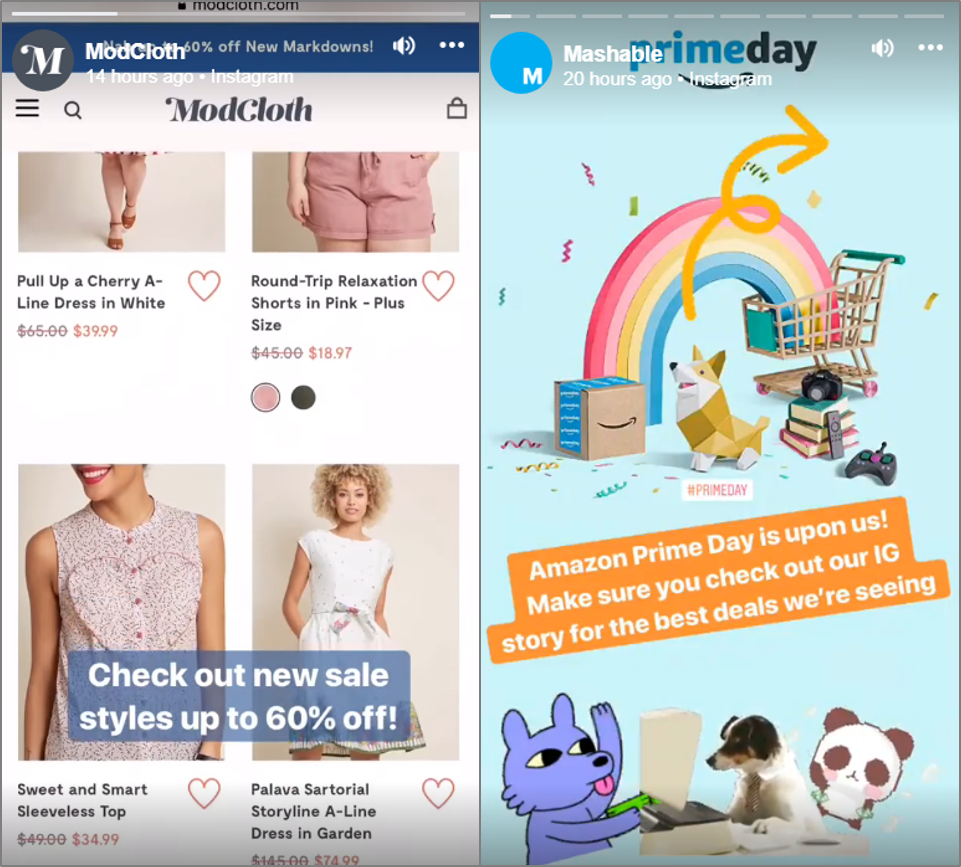
Okay, so we know that Stories are quickly becoming a mainstream method for sharing content on social media, and we know that Facebook is making a firm commitment to the format. What does all this mean to us as marketers? Add to Your Facebook Story This is definitely a tool that companies can use, if they are so inclined. You have the ability to post them from your brand page, and (at least for now) it may increase your content’s odds of getting noticed. Relatively speaking, this feature isn’t being used all that much, and Facebook’s clear emphasis on growing it means that Stories are carving prime real estate above the news feed. Some view this as the next great social media marketing opportunity on the platform. Earlier this year, Bud Torcom wrote in a piece at Forbes that Facebook Stories are “like California’s mines and creeks before the 1849 gold rush.” He sees this format transforming campaigns through experimentation, experiential marketing, influencer integration, and visual pizzazz. Michelle Cyca sees similar potential, as she wrote on the HootSuite blog, calling Stories “a way to reconnect with users who aren’t seeing your content in their Newsfeed the same way” and calling out examples of campaigns that drove lifts in awareness by incorporating the tactic. The idea of added organic reach is enticing (if fleeting, knowing that the onset of ads will turn this — like all Facebook marketing initiatives — into a pay-to-play space), but what really intrigues me about Stories is the almost infinite grounds for creativity. [caption id="attachment_24532" align="alignnone" width="600"]Facebook Stories Examples Facebook Stories Examples from ModCloth and Mashable.[/caption] It’s a very cool method for visual storytelling. It’s a low-barrier entry point for social video (no one is expecting premium production quality on these). And it presents an accessible avenue for toying with emerging technologies — most notably, augmented reality, which is being strongly integrated into Facebook Stories in another step down the road Snapchat has paved. [bctt tweet="The idea of added organic reach is enticing, but what really intrigues me about #FacebookStories is the almost infinite grounds for creativity. - @NickNelsonMN #SocialMediaMarketing" username="toprank"]
Where Does the Story Go Next?

“You don't even know what the thing is yet. How big it can get, how far it can go. This is no time to take your chips down.” This advice — delivered to Eisenberg’s Zuckerberg by Justin Timberlake’s Sean Parker in The Social Network — referred to Zuck’s budding Facebook venture, but could just as easily apply to any social media marketer eyeing Stories as a way to connect with their audience. The downside is minimal. What have you got to lose? A little time and effort, perhaps. The possible benefits are extensive however. These include:
  • Prioritized placement on user feeds
  • Engaging bite-sized video content
  • Powerful visual storytelling for brands
  • Ability to experiment with new content styles and emerging tech like AR
  • Gaining familiarity with a format that could well represent the future of social marketing
More than anything, though, Facebook Stories are intriguing because they offer a real chance to capture part of a user’s attention — maybe even more than the minimum amount. [bctt tweet="#FacebookStories are intriguing because they offer a real chance to capture part of a user’s attention — maybe even more than the minimum amount. - @NickNelsonMN #SocialMediaMarketing" username="toprank"] And since brands generally aren’t tapping into this functionality as of yet, early adopters can jump ahead of the curve and beat their competition to the punch. If there’s one primary takeaway from Facebook’s story (as reflected in The Social Network), it’s the tremendous business value in being first. Just ask the Winklevoss twins. At TopRank Marketing, we’re all about helping companies tell their stories through a wide variety of digital channels and tactics. Give us a shout if you’d like to hear more. What are you thoughts on the future of Facebook stories? Tell us in the comments section below.

The post The Future of Connection on Facebook: How Stories May Change the Marketing Game appeared first on Online Marketing Blog - TopRank®.

18 Jul 16:19

To See the Future of Competition, Look at Netflix

by Bill Taylor
jul18_17_912865028
Noam Galai/Contributor/Getty Images

I’ve been following Netflix since 2005, when I first visited its headquarters in Silicon Valley and interviewed Reed Hastings, its founder and CEO. I don’t think I’ve learned more about strategy, technology, and culture from any other company I’ve studied. It’s a stretch to claim that everything I know about business I learned from watching Netflix, but there’s no doubt that many leaders can see glimpses of the future of competition and innovation by looking at how the company does business.

Despite this week’s news that the company had added fewer new subscribers than expected, if there were an Academy Awards show for business performance, Netflix would still sweep this year’s categories — the corporate equivalent of “Titanic” or “Lord of the Rings.” Wealth creation? The company, which is barely 20 years old, has a stock-market value of nearly $165 billion, more than Disney. Cultural sway? Netflix recently got 112 Emmy nominations, the most of any network or streaming service, toppling HBO, which had received the most nominations for 17 years. Management cred? Its reputation is so strong that a simple PowerPoint slideshow about its culture and HR policies has been viewed more than 18 million times.

Here are three lessons from the rise of Netflix that apply to every company:

Big data is powerful, but big data plus big ideas is transformational. Netflix is a technology juggernaut whose analytics, algorithms, and digital-streaming innovations have changed how customers watch movies and TV shows. But this technology has always been in service of a unique point of view — building a platform that shapes what customers watch, not just how they watch. The company has vast amounts of data on the viewing habits of its 125 million subscribers, from which movies and TV shows they liked or disliked to how long they watched an individual episode or how much they binged a new series. This powerful data system creates a rich social system that influences the movies and shows members see, based in part on which shows they’ve liked in the past what other subscribers see and like.

Here’s how Reed Hastings explained it in 2005, when the company had just 3.5 million subscribers. “It’s possible to totally misunderstand Netflix,” he told me. “The real problem we’re trying to solve is, How do you transform selection so that consumers can find a steady stream of [entertainment] they love? We give everyone a platform to broaden their tastes.” This point of view has driven Netflix from the beginning, and it underscores the power of original ideas in business success. The core takeaway: Technology matters most when it is in the service of a compelling strategy.

If you aim to disrupt an industry, you must be willing to disrupt yourself. Netflix could be the dictionary definition of a Silicon Valley disruptor, a new entrant that reshaped the logic of an entire industry. Yet what’s truly remarkable about the company’s trajectory over the last two decades is how dramatically it has disrupted itself in service of its mission. Netflix began, of course, with a pretty simple innovation — crushing Blockbuster by shipping DVDs by mail and abolishing late fees. It then transitioned from mailing content to streaming movies and TV shows digitally. Today, Netflix is most noteworthy as a creator of content; it will spend a staggering $12 billion this year alone on programming.

Here again, Netflix is entering an industry by challenging its conventions. As a recent cover story in New York magazine noted, the company’s approach to programming “has upended so many norms of the TV business,” from eliminating pilot episodes to inventing “the idea of binge-watching” to replacing “demographics with what it calls ‘taste clusters’ — an approach to niche programming fueled by technology. At every step, Netflix’s dramatic strategic moves invited external skepticism and required deep internal rethinking of what had worked before. The key lesson: For companies and leaders alike, you can’t let what you know, all your past success, limit what you can imagine going forward.

Strategy is culture, culture is strategy. Most analysis of the rise and reinvention of Netflix emphasize its strategy and technology (as I have thus far). But what struck me about Reed Hastings from the first time I met him is that he and his colleagues think just as rigorously about people and culture as they do about digital streaming and content. When it comes to who it hires and what it promises them, how it makes decisions and shares information, even what it does about vacations, Netflix has invented (and reinvented) a range of practices that are designed explicitly to connect what the company aims to achieve in the marketplace to how it organizes the workplace.

Last year, the company updated its manifesto on Netflix Culture, a detailed statement of its principles, policies, and practices with respect to the human factor in business. What’s unusual about the manifesto is how sharp the language is; there is no hint of HR boilerplate. “Many companies have value statements,” it begins, “but often these written values are vague and ignored. The real values of a firm are shown by who gets rewarded or let go.” So what kind of people get rewarded at Netflix? “You say what you think, when it’s in the best interest of Netflix, even if it is uncomfortable,” the manifesto says. “You are willing to be critical of the status quo” and “You make tough decisions without agonizing.” Moreover, “You are able to be vulnerable, in search of truth.” The essential point: Great companies understand that they have to work as distinctively as they hope to compete.

It’s always dangerous to try to learn too much from the performance of a single organization — even the most successful companies are bound to experience setbacks and disappointments. (It wasn’t all that long ago, after all, that GE was considered a model of world-class management.) Still, as more and more of us turn to Netflix for entertainment, the company bears watching as a source of insights about the future of business and work.

18 Jul 16:19

If You’re a Modern Communicator, Then You THINK AHEAD

by Deirdre Breakenridge
Screen Shot 2018-07-15 at 8.54.53 PM

I know a lot of professionals who are storytellers. But, here’s a little profile test to see if you’re a modern communicator who shares stories that resonate and create impact with your audiences.

Deirdre Breakenridge, NBC CT News InterviewFirst, if you consider yourself a modern communicator, then you’re ready to (1) navigate media and build relationships through new channels, (2) you understand the shifts in consumer preferences and behavior by analyzing data, and (3) you’re continuously evolving with technology. In addition, your approach to storytelling is flexible and you easily adapt to a global communications landscape.

But, let’s take the profile of the modern communicator a step further … most of all you’re trained to THINK AHEAD. Do you?

The approach is simple. First, you need mastery of the “THINK” part, and then the proficiency of the “AHEAD” steps to create communication that connects, resonates and helps you to grow your relationships with customers and your loyal advocates.

Here’s how the THINK AHEAD approach breaks down, so you’re a storyteller with purpose, who stands out and builds stronger relationships in a fast-paced, ever-evolving and very noisy media landscape.

Start with THINK:

“T” is Timing. Modern communicators know how to attach their stories to the timely and relevant news. The more you can be a part of an unfolding story and you can add value and context to a meaningful conversation (whether it’s local, regional or national) the more you’ll be recognized for what you have to say.

“H” is Heart. You must have a heart or empathy for those who are on the receiving end of your communication. This takes tremendous discipline and a great deal of EQ (Emotional Quotient) to be able to walk in someone else’s shoes. You’re able to show compassion and empathy, especially when passionate voices collide, opinions vary and yes, tempers flare.

“I” is Independent. When there is a lot of noisy communication and you see parties taking respective sides, you have to trust your gut and go with your instincts. Sometimes the communities and groups that generally share your opinions may not be upholding your values. Don’t jump on the bandwagon and don’t be a part of “group think.” Remain independent when you have to and always be true to your own brand.

“N” is New Navigation. You have to be ready to step out of your comfort zone and to navigate in new and exciting ways. This means embracing new channels and methods to reach people that don’t always feel comfortable and familiar. Modern Communicators can never be too complacent. When complacency sets in, you may also be missing opportunities to grow relationships and meet people in places where they prefer to congregate. Operate in your “uncomfortable” zone for maximum growth potential.

“K” is Knowledge. Modern communicators always have to be learning and growing. Professional development will keep you 10-steps ahead of your customers, and other important stakeholders. If you’re the smartest person in the room, then you’re hanging out with the wrong people. You should always be challenging yourself with new opportunities to learn.

When you can master the THINK part, then you’re ready for the AHEAD steps, which break down as follows:

“A” is Anticipate. Modern communicators know the facts, understand a situation thoroughly, before they communicate and learn as much as they can about the people or groups with whom they want to connect.

“H” is Head Off. When you head off any issues or concerns, as a modern communicator you can neutralize potential adverse situations before they bubble up, from small molehills into massive mountains. Heading off the negative also means acknowledging what’s occurring, and letting people know you’re aware, accountable and getting more information.

“E” is Evaluate. Make it your job to evaluate situations by gathering input from all parties involved. You can’t get part of the story to solve a problem or to stop an existing condition from getting worse. When you can evaluate and speak with everyone involved, you’ll have a much better handle on the situation so you can move toward action and resolution.

“A” is Action. In a dynamic, real-time communications landscape, you have to act quickly. You can’t just say what you’re going to do, you have to show it and mean it. Saying “sorry” is always a good start. A good heartfelt, “Mea Culpa” will get the ball rolling. But, then you have to take additional steps to make sure you’re demonstrating you’re sorry and making good on your promises moving forward.

“D” is Determine Success. Modern communicators are always learning from past missteps or the successful ways they’re able to THINK AHEAD. When you can take the time to see what’s worked in your communication and what hasn’t, you’re ready to make your engagement stronger and create better relationships that lead to loyalty and advocacy.

When modern communicators can THINK AHEAD, the success of the approach shows in all of their communications and resulting relationships. Modern communicators are known for their ability to raise the bar on storytelling and for their strong bonds. They’re respected, trusted and connected in their communities.

Do you match the profile of the modern communicator because you THINK AHEAD? If you want to learn more about modern communicators, building relationships, navigating new media and how to be more effective in your business communications, then check out my book, Answers for Modern Communicators.


18 Jul 16:18

Creating The Perfect LinkedIn Profile For A Digital Marketing Job

by Joana Ferreira

27707 / Pixabay

LinkedIn is one of the best tools out there for finding jobs, but it’s also a great tool for recruiters and hiring managers to vet their candidates before inviting them to interview or when deciding on who to hire.

If you’re looking for a career in digital, a strong CV may get you an interview, but a strong LinkedIn profile will set you apart. A strong LinkedIn profile doesn’t just mean you’ve filled out all the fields, there are a few extras that will make you stand out above the crowd and show the potential employer that you’re serious about digital. Let’s start with the essentials and then go through those extras.

The Essentials

1. Profile photo

Choose a neutral profile photo with a plain background. Remember this is a professional network, not your Instagram account. So, a photo of you on a night out with your friends is not appropriate, and please no selfies.

2. Background Photo

This is a fairly recent LinkedIn feature, and one that not many people use. If you don’t add your own background photo, LinkedIn simply uses the standard background photo, so you’ll recognise if someone hasn’t got one. In terms of adding to your profile quality, it’s more of an aesthetic preference, but from a marketing point of view it shows that you’re familiar with all of LinkedIn’s features and experiment with all of them. It’s also a chance to add a bit of personality, for example mine is a photo of the entrance to a beach, highlighting my passion for travel.

3. Headline

Create an attention-grabbing headline that will showcase your best qualities. Most people will put their job title as their heading, and there’s nothing wrong with that. But if you’re not currently employed, then think about how you can use this headline to showcase what you can offer. For example, ‘experienced blogger with over 50,000 monthly visits’ stands out a lot more than ‘marketing student looking for full time job’.

4. Summary

In this section, LinkedIn is giving you 2000 characters to tell your story. This is your chance to showcase what you can offer a potential employer and give them reasons to invite you to interview. Use this to highlight personal qualities you can bring to a business and any experience you have gained over the years.

5. Work History

If you’re just starting your career in digital, you may not have much work experience, but there’s no reason to leave this section blank. If you have a part time job, or have done any internships, you need to add these to your profile and include detailed descriptions of what you did and what skills you gained. Use keywords like team-work, time management, multi-tasking, communication, quality control etc. to highlight to potential employers that while you may not have direct experience in the job you’re applying for, you have transferable skills.

6. Education History

If you’re studying for a degree, this is a great way to highlight your achievements. Don’t just list your degree but mention any modules or topics you were particularly interested in, or your dissertation topic.

7. Languages

If you speak any other languages (even if you’re a beginner), add them to your profile. It may not be relevant to the job, but it makes you stand out!

8. Certifications, Honors & Awards

If you have received a certificate, an award or any other type of honor, then make sure to state these on your profile. It highlights your ambition and your competitive spirit, all of which will make you stand out above the crowd.

9. Voluntary experience

Any voluntary experience, big or small, will help boost your profile, particularly if you haven’t got that much work experience yet. It shows you have a good work ethic, and value experience over money.

The Extras

Everything up until now is essential and will form part of most people’s LinkedIn profile. But the below are a few little extras that’ll make you stand out.

1. Personalised URL

If you want a career in digital, learning about the SEO value of a URL is a basic step. It’s very easy to add a personalised URL on LinkedIn and not having one will only tell your potential employer that you might not be aware of this feature – which won’t look good if you’re applying for a job in digital.

2.Skills & endorsements

Create a list of skills and ask your network to endorse you. This makes you stand out as someone who is recognised by your network as possessing these skills. Think about things like team work, creative thinking, copywriting, problem solving, leadership etc. Recruiters often search for people that have been endorsed for particular skills, so not only does this look good on your profile, but it’ll help you get found by recruiters or potential employers.

3. Recommendations

Ask your network to recommend you. Any previous employer or colleague can write a recommendation for you, and this stands out to employers. If you’re lacking in the work history department, then ask a lecturer or a fellow student whom you’ve worked with to provide a recommendation.

4. Long form articles & publications

Now this is where you truly show your advanced LinkedIn skills, and where you’ll really be noticed by that potential employer so read carefully. LinkedIn has a feature that allows you to publish long-form articles. Think of this like your personal blog on LinkedIn. USE THIS! If you’re interested in a career in digital marketing, content forms a large majority of all strategies, so if you don’t have any work experience in content you can make up for it by having fantastic long-form content on your LinkedIn profile. But write about topics that are appropriate for a professional network (i.e. don’t write about make-up and food). Think about maybe exploring digital marketing topics or highlighting anything that you’re learning. Show that you have an opinion and a critical mind, this will really make you stand out.

Similarly, if you have any publications out there, you can link to these via your profile and create a portfolio on LinkedIn. This could be anything from blog articles to websites.

5. Grow your network

Having a great profile is important but having a large network will just give you that extra boost. So, make sure you’re connecting with as many people as possible on LinkedIn. Friends, colleagues, teachers, lecturers, employers, anyone you’ve met at networking events etc. Most people have a LinkedIn profile these days and most are happy to connect with you to grow their own network, so don’t be shy, ask for that connection. And make sure to follow any influencers too so you can learn from them and stay up to date.

6. Network!

Just like any social networking platform, you need to stay active to stay relevant. Don’t just create a profile and hope that the job leads come in but spend some time every day looking through your newsfeed, posting an update, posting articles, commenting on other articles and so on. This tells your potential employer that you’re interested in the industry you want to work in, that you know how to network and that you have something to say. All of your most recent activity is displayed directly below your summary so it’ll be one of the first things a potential employer sees.

So that’s it, follow the above steps and you’ll have a LinkedIn profile to be proud of. Recruiters will be able to find you by searching for people with the relevant skills or keywords listed on your profile, and potential employers will be impressed by your sleek, professional, and up to date profile.

And don’t forget, you can also search for job vacancies via LinkedIn and in some cases apply using just your LinkedIn profile, yet another reason to make sure you maximise your LinkedIn image.

18 Jul 16:18

Technology Only Gets Us So Far

by David Brock

I’m a great fan of much of many sales technologies.  There are tools that dramatically improve efficiency.  These allow us to get more accomplished, more easily and in less time.  There are tools that give us greater insight into the customer–both the enterprise and individual.  We can leverage customer searches of our sites, the materials they have downloaded, and communications they may have had to give us better insight into their interests.

AI and related tools deepen those insights and help us better determine the timing of when a customer might be interested in a conversation.  These tools can even help us think about the issues most critical to the customer at the moment.   We can “micro-target” and be immediately relevant to our customers and prospects.

But, all of this gets us only so far.

At some point, we actually have to have a conversation with the customer.

We have to translate all this data and insight into actually engaging, person to person.

And that’s where things break down, both for us and for the customer.

Customers need these conversations, but dread them, trying to push them as late in their buying cycle as possible, leveraging other sources of information and research (remember, similar tools exist for our customers).

But at some point we’re “forced” to actually engage each other–voice to voice, face to face, eyeball to eyeball.

We have to engage another human being.

Each of us has our own hopes, dreams, fears, desires.  Each of us has differing behavioral and communication styles.  Each has differing levels of knowledge, interest, attitudes, and opinions.

The messy, sloppy part of buying and selling is all about human interaction.

But if we, and our customers, are to be successful, it’s this part of the process that’s most important in achieving our goals.

The fundamentals of this process are always the same, but the actual execution will vary person by person, with each interaction.

The fundamentals start with understanding, empathy, caring.

Questioning, listening, probing help us in engaging our customers to learn and to help them learn.

Curiosity plays a role–they drive our probing and discovery, they drive the ability of the customer to learn.

We are helped in this by our knowledge and ability to apply that knowledge in relevant/impactful ways–sometimes called creating value.  In doing this, we have to remember it’s something we don’t do to or for the customer, but with the customer.

As happens when at least two human beings get together, we bring baggage, per-conceived ideas, mistaken impressions, lack of knowledge, and many other things which impact our abilities to connect with each other.  Masterful sales people know how to navigate these with the customer, their teams, and others.

Ultimately, complex buying and selling comes down to human to human interaction and how effectively we engage each other.

Ironically, we seem to spend more time on all the other parts, often doing everything we can to minimize and avoid this human to human interaction.

Some will argue, that much of this interaction can be eliminated—and it should be.  There are many transactional or very simple buying decisions.  But this isn’t new, it’s existed at least since the very first catalog was ever mailed to a customer (RIP Sears Roebuck).  The tools enabling each of us to do this keep reaching new levels.  Increasing numbers of transactions will be done through technology enabled channels–perhaps our bot talking to the customers’ bots.

But there is always the challenge of the complex buying decisions.  Whenever more than one person is involved in the process–whether multiple buyers reaching consensus, or sales people seeking to engage with them.

The messiest part of buying/selling is that human to human interaction.

And this seems to be the area that too few look to master.


Afterword:  Thanks to my friends Charlie Greene and Andy Paul for stimulating this post.  Charlie wrote a great post on the same theme, Seduced by Tools and Processes.


18 Jul 16:17

Pitch Perfect: 25 Tips for Pitching Over the Phone

by Julie Hansen

TeroVesalainen / Pixabay

I work with several inside sales teams who deliver their pitch strictly over the phone. While not a formal presentation, discussing your product, idea or service over the phone still requires the same thoughtful planning, preparation and execution.

There are some additional challenges sellers face when pitching over the phone however, like not being able to see your prospect (and vice versa) or have a deck or visuals to support your message. I’ve compiled 25 of my favorite tips for overcoming those challenges and improving your success rate. What would you add?

25 tips for pitching over the phone

  1. Find your confidence. Don’t be fooled into thinking they won’t see you sweat. A lack of confidence comes through loud and clear in your voice. For tips on getting into a confident state, click here.
  2. Dress the part. Flip flops or dress shoes? Which makes you feel more professional and confident? How would you show up in person? How you feel about yourself is strongly reflected in your voice, so choose wisely.
  3. Visualize your prospect. The more you focus on talking to a unique individual rather than a generic prospect, the more connected your prospect will feel to you.
  4. Limit background noise. Pets, kids, deliveries, notifications. Shut it all down.
  5. Keep talking points handy. Just because they can’t see you doesn’t mean they can’t hear you shuffling through your notes.
  6. Practice. Enough said.
  7. Record yourself. Listen for both messaging and delivery. But don’t be too hard on yourself. Pick 1-2 things to work on at a time.
  8. Prepare an outline. You don’t have to use a script, but at least have a pitch flow and memorize key points that you want to ensure land on your listener.
  9. Prepare questions. Without body language to go by, it’s easy to make a lot of assumptions. Eliminate the guesswork by asking specific questions on a regular basis to gauge interest and comprehension.
  10. Don’t answer your own questions. It’s tempting but resist the urge. You are training your prospect how you expect them to engage. Answer your own questions and you’ve set a dangerous precedent.
  11. Speak with punctuation. When you arrive at the end of a sentence, put a period on it and STOP. Yes, silence feels deadly, but if you don’t leave some space in your pitch, you may never really know what you prospect thinks.
  12. Create a compelling opener. Your opening needs to reassure your prospect that taking your call was a good decision. Prove that by coming up with a short, compelling opening. See 5 Outside-the-Box Opening ideas here.
  13. Answer “so what?” With so many distractions available to your prospect, you need to constantly relate everything back to how it benefits them.
  14. Narrow your focus. Don’t try to cover too much. Focus on making a strong impression with 2-3 key ideas rather than a blur of topics.
  15. Use open-ended questions. A successful pitch is one where the prospect is talking at least half the time. Make it easy for them to engage by feeding them appropriate questions.
  16. Have a back-up plan. What if you get voice mail at your appointed time? What if the prospect has to cut your call short? You won’t panic if you have a plan.
  17. Smile. Research proves that a smile can be heard in your voice. But make sure it’s a “real” smile by focusing on something to be happy about.
  18. Stand. Energy transfers across technology as well. But you have to try harder on the phone. Standing increases your energy and allows your body to fully support your voice.
  19. Cut to the chase. Don’t spend a lot of time on small talk. Get to what your prospect is really interested in within the first minute.
  20. Warm-up your voice. So much is riding on the sound, tone and quality of your voice.
  21. Use your hands. Gestures mean you’re engaged and that will come across to your listener. So buy yourself a good headset so you can gesture freely.
  22. Show you’re listening. Your prospect can’t see you nodding or smiling. Interject some listening sounds, like, “uh huh, mmmm, right”
  23. Command the call. You asked for this call, so take charge. Confirm how much time you have, get agreement on the agenda, and park questions that may derail you.
  24. Summarize often. Summarizing is even more important on the phone without visual support of your message. Try summarizing at the end of every topic, after answering questions, and when you are wrapping up.
  25. Final piece of advice. Have fun. If you’re not having fun, neither is your prospect. You don’t have to tell jokes, but this shouldn’t feel like a trip to the dentist either.
18 Jul 16:15

How Tech Debt Is Bankrupting Content Marketing

by Robert Rose

tech-debt-bankrupting-content-marketingThe pizza was delicious. It was May 2014, and the content marketing team was celebrating the one-year anniversary of its digital magazine for one of the most prestigious financial services brands in the world.

By all accounts, every goal had been met. It launched on time and only slightly over budget. The audience was growing steadily, and the sales group loved the insight and new opportunities that the magazine produced. Content marketing was a hit at the firm.

The lead account director for the content agency sidled up to the content marketing director and congratulated him. “You know,” she said, “we’re ready to start phase two. We’ve got a promotion and audience development plan, and the audience analytics dashboard ready.” The content marketing director smiled. “I know, I know. I think we’re ready. Let’s sit down on Monday and road-map that.”

Monday never came.

Tech credit card hits its limit

The following week, the team learned the new vice president of digital worked with the CIO to institute a new “One Site 2015” initiative. The company was to centralize all blogs and microsites into the main corporate website and integrate it into the main enterprise CMS.

The content marketing director desperately pleaded his case. Re-platforming the magazine’s WordPress site and Google Analytics into the enterprise CMS would take months and hundreds of thousands of dollars. And, it wasn’t even clear that there would be any benefit.

He lost.

The content marketing team spent the better part of six months re-platforming the magazine into the enterprise CMS. Some magazine features that didn’t meet corporate security and IT conformance were lost. The magazine’s look and feel changed because the enterprise CMS “can’t do that.” The audience promotion and development plan, along with the analytics plan, were sidelined.

Then, a new CMO joined the firm, and budgets were put on hold. Her first order of business was to change the corporate brand architecture, and subsequently the website design. All sections of the website (including thought leadership) were part of that redesign. And, they would innovate by upgrading to the newest version of the enterprise CMS, which included marketing automation and personalization capabilities. Once again, the audience promotion and measurement strategy had to wait.

The content marketing team spent a year re-platforming the magazine yet again. As it turned out, personalization took the budget too high, so even after hundreds of hours of planning and architecting, the personalization part of the solution would be phase two for the magazine.

In June 2017, the team quietly celebrated. It successfully relaunched the magazine as one of the website’s phased releases. Gone was the original magazine design and in its place the new magazine section looked much like the corporate website. There wasn’t enough time or budget to create templates to match the magazine’s original design or features.

As it turned out, the upgraded CMS was more complex to use. The content marketing team now spent hours instead of minutes preparing posts. New workflow rules required posts go through extra regression testing through IT, taking publishing from days to weeks. The cadence slowed to a crawl. Subscriber growth stalled. The team now spent 50% of their time working in the technology, managing digital assets, addressing the new configurations, looking at personalization features, and trying to integrate enterprise analytics.


An upgraded CMS was complex to use. Posts took hours, not minutes, to prepare. Sound familiar? @Robert_Rose.
Click To Tweet


In November 2017, the content marketing director was called into the CMO’s office. “Why,” the CMO wanted to know, “are there no real results from the thought leadership content?”

The content marketing director started to explain the last two and a half years, but the CMO interrupted: “I’d like you and your team to provide me a business case for why this ‘content marketing’ idea will provide value.”

In February 2018, three months shy of its 5th birthday, the financial services company’s digital magazine was killed. The content marketing team was restructured, and the content marketing director left the company. Content marketing, as a tactic, remains at the company. It is simply a handful of writers creating “investor outlook” PDFs emailed to clients and tracked through the enterprise CMS.

Technology debt: Higher than ever

This story is extreme (and true) but all too common. With the constant pressure of innovation and results, C-suite leaders underestimate the true cost of incrementally upgrading existing technology infrastructure, while they ironically incur more and more time, money, and effort to “innovate” their way out of a constant state of software implementation. This invisible but insidious resource drain is called “technical debt.”


An invisible but insidious drain on #contentmarketing is “technical debt,” says @Robert_Rose.
Click To Tweet


Technical debt is an increasingly known IT challenge in larger businesses. According to an Accenture survey, 69% of C-suite executives report that “technical debt makes their IT function much less responsive to changes in the market.”

As a recent MIT Sloan Management Review article put it:

(A)s IT software and infrastructure age, and as more features are added to legacy systems, technical debt grows and puts additional fixed operating costs on the company, diverting precious investment in innovation and new capabilities.  

In marketing, the issue is more pronounced. In a recent study, half of marketers (50%) say “too many technologies” is their top frustration, followed closely by “integrating technologies” (49%). The average number of marketing software technologies in a company is 16 and ranged as high as 98 in larger organizations. Is it any wonder that 80% of marketers say their least favorite thing is “learning and using new marketing technologies”?

In most cases, the primary challenge is the inability for the business to move quickly due to the old, legacy systems that are patched, upgraded, and hacked together to try and keep up.

However, the marketing challenge has an added burden. Many content and digital marketing teams seem perpetually stuck in a software selection or implementation cycle. The net result is either a blindside by corporate IT strategies (as in the above story) or digital content marketing strategies that look at the landscape of marketing technologies, asking “how can we learn how to do that?” The sad truth is teams never “learn to do that” because just as they start, some new technology implementation awaits around the corner.

In short: Marketers continue to make the minimum interest payment on the technology debt that grows every day.


Marketers make minimum interest payments on tech debt that grows every day, says @Robert_Rose.
Click To Tweet


Getting debt relief: Realizing the ultimate form is change

There are, however, ways out of this mess. One critical factor for content marketers is to have a formulated strategy, which includes a technology landscape, from the beginning. In other words, as content marketers we must get out of “how can we learn to do that” and get into “this is what we aim to do, and here’s what we need to do it.”

It’s critical to create and maintain an early, often, and honest discussion with both the CMO and CIO about the view of the customer’s journey. The word “alignment” gets thrown around a lot when the relationship of the CIO and the CMO are discussed. But success or true alignment is not built from a mutual understanding of separate agendas. Rather, the technology and marketing teams must come together to develop a single collaborative strategy for customer/audience engagement.


Technology & marketing teams must come together to develop a single collaborative strategy. @Robert_Rose
Click To Tweet


This communication – as part of a content marketing business case – can be built on three fundamental core values:

1. Orchestrating content experiences, not guiding siloed buyers’ journeys

Put simply, managing a portfolio of content-driven media experiences should not be focused on pulling people through some singular technology-driven buying path or journey. Rather, companies should look to decouple customer/audience data management, and experience presentation and management, and optimization of those experiences. I spoke to this approach and a new way of selecting technologies in the keynote talk at CMI’s Content Tech event this year.

2. Meaning-driven, not data-driven

Data by its definition has no meaning. It is a collection of facts, figures, and attributes about people or their behavior. To make data meaningful, businesses must develop new strategies to find the emotional value in data that is given rather than gathered. Focusing on connecting interactive experiences is critical. I wrote about this last year in CMI’s original research report: The Symphony of Connected Interactive Content Marketing.


Businesses must develop new strategies to find emotional value in data that is given not gathered. @Robert_Rose
Click To Tweet


3. Organizing for agility, not speed

Much has been made about the need for marketing departments to be more agile, but it’s not necessarily about moving faster. The inability to find the calm in the chaos and the constant pressure of more capability are due to a fear of moving too slowly. Rather, a reinvented content marketing team can find joy and reduce technical debt in the balance of creating strategic, customer-centric experiences that evolve customers and reorienting to more agile strategies. I’ve written quite extensively about what we call “content creation management” and some organizational thoughts – most notably outlining a process for content marketing to take root.


Reinvented #contentmarketing teams reduce tech debt by customer-centric & agile strategies. @Robert_Rose
Click To Tweet


Technology is not change – it is what facilitates change

Ultimately, marketers cannot measure themselves by how fast they can deploy new technology. That’s like saying that you can get out of debt by purchasing more, less expensive cars. You not only accrue more debt, you spend all your time learning how to drive all the cars you have.

There is simply no way to accurately predict what the content marketing organization will need to look like in five years. It’s only been 10 years since any business could even think about how to address such media disruptions as Facebook, or the iPhone, or Android. It’s been less than two since we started talking about voice-activated search.

What will the next five years bring? Who knows. Virtual reality? Artificial intelligence? Pokemon Go round two?

Instead of looking at each new enabling technology (hardware or software) as a need for a new innovative capability or team, node on a matrixed structure, or even a weed that needs to be pruned in your legacy garden, marketers should look at structures where collaboration, content, and data flow more fluidly to handle any new disruption that threatens the focused strategy.

To get out of technical debt, content marketing organizations absolutely need to be built to change – constantly. You need to deploy technology nimbly and decouple from the mother ship of legacy systems. CMOs and CIOs should stop trying to figure out what content and marketing should change into and focus on giving content and marketing the ability to change.

That would be a huge down payment on the principal of our technical debt.

Get more insight from CMI’s chief strategy advisor and other experts in content marketing to help you avoid tech debt and other challenges to your content marketing program. Register today for Content Marketing World Sept. 4-7 in Cleveland, Ohio. Use code BLOG100 to save $100.

Cover image by Joseph Kalinowski/Content Marketing Institute

The post How Tech Debt Is Bankrupting Content Marketing appeared first on Content Marketing Institute.

18 Jul 16:09

How to Craft Epic Emails that Break Through the Noise

by Syed Balkhi

Take a look at your inbox. How many emails from companies are unread? Probably a lot. Many get deleted before you ever open them and others are left to sit untouched for months.

Now think about what emails you do open and read. What do they offer you and how do they grab your attention from your cluttered inbox?

82 percent of people check their inbox at least once a day which makes email marketing a highly-effective way to speak directly to your target audience, but you’ve got to do it right to get noticed. If you want to craft emails for your business to promote your products, build your brand or get users to read your content, you need to make sure they stand out from the crowd.

There are some tactics you can use that will make your emails irresistible, here are tips for how to craft epic emails that break through the noise.

Choose a catchy subject line.

You could craft an awesome email but you’re wasting your time if it never gets opened, that’s why it’s important to create a catchy subject line that will hook people right away. A poorly written subject line can stop a potential lead from opening your email, in fact, according to the folks at Convince and Convert, 69 percent of email recipients report email as spam based solely on the subject line.

Catchy email subject line from OptinMonster [Screenshot]. Retrieved from gmail.com via https://optinmonster.com/

A good subject line will pique the interest of recipients without giving too much away. You can use a tool like the Email Subject Line Grader by Net Atlantic which will grade your title on ethe ffectiveness of copy, word count and balance and also give suggestions on how you can improve it. Another tip that will grab the attention of users and evoke emotion is to include emojis in the subject line. It’s a fun and effective way to engage readers and encourage them to click.

Use personalization.

How do people in real life get your attention? They call out your name and you stop what you’re doing when you hear it. That’s what personalizing your emails will do. Instead of a generic “Hey”, use your customer’s name, like “Hey Allie!”, to make sure they pay attention to your emails. Remember to double check the spelling of the name before you send it.

Sephora Personalized Email [Image]. Retrieved from https://www.campaignmonitor.com/blog/email-marketing/2017/12/8-brands-using-email-personalization-like-pros/

Take this a step even further by including more personal touches. You could refer to the last purchase they made, include the city they live in, or even send special promotional emails on your customer’s birthdays. Personalized emails make people feel special and less like they ’re getting a message from a robot.

Keep it short and to-the-point.

Don’t make your readers scroll through a long-winded email to get to the point, after all, emails are meant to be a convenient way to communicate quickly. If you want your email to be read then keep it short, break it up into small paragraphs and get to the point.

Take a look at this email from Pinterest for example. Pinterest just wants you to keep pinning, there’s no need for a long email to get that message across. They make it super simple by using minimal words and showing you some pins you might be interested in. Don’t write a novel when you can get your message across faster and have it absorbed by more people by keeping it short and sweet.

Pinterest Email [Image]. Retrieved from https://blog.hubspot.com/blog/tabid/6307/bid/34146/7-excellent-examples-of-email-personalization-in-action.aspx

Provide useful information.

Providing readers with information that’s truly useful to them is one of the best ways to make your emails stand out. It’s obvious that people would rather read an email that educates them about a topic they’re interested in or helps them solve a problem vs. reading a sales pitch from you.

For example, take a look at this email from Cook Smarts. They provide a useful meal planning newsletter to their subscribers to help them out in the kitchen.

Giving useful content to your audience will give them a taste of what you offer and will position yourself as an authority in your industry which will make it easier for you to sell to them. Create content that people will benefit from reading and they’ll be waiting by their computer for your next email to drop in their inbox.

Make it look good on mobile.

With smart phones, more people are reading their emails on-the-go. According to Adestra, 61 percent of email opens happen on mobile and that number will probably keep rising. Don’t risk losing a ton of readers because your email isn’t viewable; make sure your email displays nicely on mobile.

Mobile Email vs. Desktop Email [Image]. Retrieved from https://www.targetinternet.com/5-examples-of-mobile-optimised-emails/

The average mobile screen will only show four to seven words of the subject line so you also have to consider how your subject line will appear on mobile. You don’t want your title to get cut off awkwardly, use a tool like TestSubject that will allow you to preview what it will look like across the most popular devices.

Email allows you to have a plethora of qualified leads at your fingertips, who you can send a message anytime you want, but you’ll only see results if those emails actually get opened and read. Now you have the skills to craft epic emails that will stick out a mile ahead of all the other boring emails that fill user’s inboxes. So don’t wait any longer to start your newsletter or email marketing campaign, it’s an amazing way to promote your business and boost sales.

18 Jul 16:09

To Sell or Not to Sell: How to Know Who Not to Sell To

by Kasia Kowalska

TeroVesalainen / Pixabay

The quintessential salesman was typified in Alec Baldwin’s “coffee’s for closers” speech in Glengarry Glen Ross. Since the sales department is the money powerhouse of a company that turns profit, it can be easy for salespeople to become single-minded in pursuing the next sale. Salespeople are so busy always closing that they forget to ask another question: Do I know who not to sell to?

Don’t sell to everyone.

It’s highly likely that your organization has spent a lot of time defining what makes it unique. Whether that’s your employees’ qualifications and expertise, your world-class service, competitive rates, or that je ne sais quoi feeling, you know what it is.

But often when companies are asked, “Who is your ideal client?” the answer is, “Everyone who will buy from me!”

Chances are, you’ve experienced the brunt of a bad customer. You sink all of your time into doing your best work on their projects and at the end of the day, they’re still unsatisfied. Not only is this demoralizing for your employees, but it’s costing your organization in time, money, and resources.

HubSpot’s Marketing Agency Growth Report 2018 shows that nearly 60% of agencies say that acquiring new customers is a big focus while another 16% admit they face client retention problems. Customers that are not the right fit cost money, time, and frustration when customers that are the right fit can accelerate the sales process, increase profits, and improve employee engagement.

The key to finding your right customers is knowing who not to sell to.

Let Your Ideal Customer Profile Set You Free

At the face of it, an Ideal Customer Profile is simple. It defines which customers are a good fit for your services and products and which ones are not (if you are a B2B company, this is at the company level). However, on a bigger scale, nailing down just the right description can be a bit tricky.

A word of advice before moving on: don’t fear FOMO. Many organizations resist making an Ideal Customer Profile because they are afraid they are walking away from profits. Just because you’ve developed a profile doesn’t mean you can’t say yes to customers outside of it or the profile can’t evolve as your organization evolves. Sometimes setting boundaries can be the most freeing.

No One’s Ideal Customer Is ‘Everyone’

When defining whom your ideal customer is, you will also define who not to sell to. Categories you might want to consider include:

Demographic Information

  • Age
  • Location
  • Company size
  • Structure
  • Yearly revenue
  • Industry(ies)
  • Marketing budget

Personality

  • What is their communication style?
  • Where do they go to find new information?
  • What social networks do they frequent?
  • What conferences do they attend?

Goals and challenges

  • What is their biggest challenge?
  • What are the common pain points?
  • What knowledge gaps do they have?
  • What are their job responsibilities?
  • How do they define success?

Tips and Tricks to Help You Define Your Ideal Customer

What result are you selling?

Customers don’t buy products. They buy results. In hardware terms, when you buy a ½ inch drill bit, you are really buying a ½ hole. When you think about how great your products or services are, you should be considering what the end result is. For example, at Growbots, we sell data and email automation software to our customers. The result we are selling is time efficiency and improved productivity. Our tools supercharge the lead generation process and give back hours to salespeople a day. That is time they can use to close more sales (with the right customers!) and generate revenue for the company.

This information alone helps us narrow down who our ideal client might be and who not to sell to. We should likely target companies with a dedicated sales team that struggle to find viable leads.

When you look at your company, what results do your customers want? How do you provide that?

Your ideal customers will align with your company values.

Just like how your employees influence your office culture, your customers influence your sales culture. If your employees are working with customers who are difficult, unreasonable, or even downright abusive, it can quickly tank your office morale. Choosing customers that have a similar energy to your company will go a long way to ensure that you can maintain a healthy, happy, productive relationship into the future.

Keep an eye out for red flags.

Just how there are positive identifiers you can assign to your ideal customer, you can also define what you don’t want in a customer. These are characteristics that will lead to conflict. Maybe you have learned your red flags the hard way.

For example, at Growbots, we can offer 1,000 leads a month to our customers with our basic package. Customers that only have about 1,000 potential leads will quickly run through any value we can offer. Your red flags might be customers in a specific location due to geographic or legal restraints. It might be customers that use Apple products because your software is only Windows compatible.

Specifically defining your red flags ahead of time can help you know who not to sell to to reduce customer churn and increase revenue.

Set the Stage for Success By Knowing Who Not to Sell To.

Knowing the customers that aren’t a good fit for you is just as important as knowing which ones are.

Taking the time to define your Ideal Customer Profile will not only reduce customer churn and increase customers’ satisfaction, but it can help you refine your outbound sales messages to speak uniquely to their needs. With an Ideal Customer Profile, you can make savvy decisions across your business from what products to develop and how, to where to market and what message to use.

Do you have any tips and tricks to know who not to sell to? Let us know in the comments.

18 Jul 16:08

How to increase your sales conversion rates (Q&A webinar)

by Ryan Robinson
LeadGenius-FullContact-Baremetrics-PredictableRevenue-Close Webinar Graphic (1200 x 630)-1

Here's the recording of today's webinar about how to increase your sales conversion rates (and stop leaving leads on the table). Tune in below!

One of the most painful problems that often haunts B2B founders and sales teams, is getting a high-value lead all the way to the finish line on a deal... just to see them change their minds or even worse, go silent.

In today's webinar, we brought together several top sales leaders to speak all about how to increase your sales conversion rates, so you're not chasing the wrong leads or leaving good deals on the table. We cover how to get better at prospecting so that you’re only bringing in the right leads in the first place, arming yourself with the right research & data, dealing with objections, having the right follow up strategy, how and when to ask for the close, and so much more...

Tune in to watch the full recording of our webinar right here:

A big thanks to our panelists today!

Predictable Revenue was founded by Aaron Ross, of the award-winning, bestselling book Predictable Revenue, where they teach companies how to double, triple or more—their number of new sales. Their framework helped Salesforce increase revenues by over $100 Million.

Baremetrics provides metrics, forecasting, analytics, insights and engagement tools for companies using Stripe, Braintree, Chargify, Recurly and more! With easy to use dashboards, they give visibility into important business metrics like MRR, LTV, and churn, while also providing actionable insights and reports around the health of your business.

LeadGenius provides custom B2B contact & account data, using a unique combination of data science and skilled human researchers to produce the highest quality data available on your prospects—with consistent volume, flexible targeting, and quality-assured results.

FullContact is an open, cloud-based identity resolution and insights platform that enables people to fully identify, describe, and authentically connect with each other, human-to-human, which enables a much deeper understanding of your prospects.


Still have sales conversion rate questions?

Ask away in the comments below!

We'll weigh in and get to the many questions that went unanswered during today's webinar.

Thanks for tuning in!

18 Jul 16:08

IT Consulting Leads: Finding New Business for Your Tech Consulting Firm

by Judy Caroll

We’ve all been there before, we’re stuck in front of our monitors, and we’ve found that we’ve run out of leads. The feeling can happen in any industry and looking for new IT consulting leads is not insulated from this.

Take it from us; there is no such thing as running out of leads, we’ve solved this problem in the past. In this article, we’ll show you how you can find, nurture and make the most out of the leads you have.

Are you stuck in a rut and have run out of IT consulting leads? Then, this article is designed for you.

Getting New IT Consulting Leads

Like any lead generation or lead nurturing campaign, the IT industry does not really differ if you really think about. The basics are pretty much still the same.

There are a couple of ways of generating new leads. If you are still a new startup then you have no choice but to really go out in the field to meet new people. Events are a great place to start and you should also look into creating sales funnels using your own name as your main vehicle for representation.

Build a LinkedIn profile and connect with the movers and shakers in your particular niche, then harness these connections in generating leads. Make sure that you are an accurate representation of what your brand is trying to sell. And, of course, include your landing page somewhere in your bio.

Segment and Categorize

We’re sure you’ve got a list of people that you’re ready to tap into, but how many of these people can you reach? It is at this time that you can utilize the principles of account-based marketing and create campaigns explicitly designed for them.

Instead of spending your time looking for new leads, why don’t you try to win some of the people that are already on your list with segmented campaigns?

The Traditional Email Campaign

Say what you want about email, but we can tell you that it still works. Once you’ve segmented your list, create value in the emails you send. Remember to integrate your email efforts with a proper CRM application so that you can automate and monitor with ease.

Take after the lessons of ABM and make sure that you personalize your campaigns with each niche market segment that you are targeting. This makes your email campaigns more effective.

Building Up a Repertoire on Social Media

You can harness the power of social media to create sales funnels as we’ve mentioned earlier. Platforms like Facebook and LinkedIn are great places to start.

Join groups and make sure you’re connected with the right type of people. Don’t push sales on anyone, but instead make sure that you’re active enough that you build a reputation as a thought leader in your industry.

Of course, you still have to optimize your profile – make sure everything is filled out and that you are representing your industry well – but this is a long-term strategy for building sales commitments that are centered on relationships.

You can’t be too sales-y here, but you will find that you can quickly generate leads by just engaging with people.

Content Matters

If you want to establish yourself as a resource for valuable information, then the type of content that you release should speak volumes about your company.

Engage in interactive content marketing whenever you can.

Retargeting Maneuvers

There’s this phrase that digital marketers use called “pre-suasion” and it’s the act of trying to market to a certain client base before you even put forward your proposal. It works by getting your brand in front of them before you even meet with them.

You can utilize a retargeting strategy to make sure that your message appears on their screens when you’re not around. It involves a nifty ad campaign, but we can tell you that it works because even we have tried it before.

You can utilize ad retargeting – even with video – in various social media platforms.

Retargeting for tech companies

Example banner ad

Landing Pages

How optimized are your landing pages? Are you sure that your CTA buttons are built in a certain way? Are your forms too long? If your lead generation pipeline breaks during the conversion stage, then you won’t be doing your business any good when it comes to actual conversion.

Which leads us to…

The Feedback Process

Make sure that you record feedback correctly and that you monitor your analytics in order to ensure that you can tweak your campaigns for the better. Get your Google Analytics on point and learn.

This is the opportunity for you to do split testing, too, and it allows you to become more efficient and effective with your resources.

So there you have it, a few simple ways that you can develop new leads for your IT consulting business!

This article originally published at The Savvy Marketer.

18 Jul 16:08

When to Use 'Dear Sir or Madam' & When to Use These 13 Alternatives

by Meg Prater

When is it appropriate to use "Dear Sir or Madam?" In today’s business world, that answer is "Never." I’ll also accept, "Fifty years ago" and "Hell no," for good measure. But it’s polite! It’s business formal! You’ve seen it done countless times! So, why should you avoid it?

The average office worker receives approximately 121 emails each day and only sends about 40. That means, not only are people receiving more email than ever, they’re responding to fewer as well.Free Download: 25 Proven Sales Email TemplatesIdeally, you want to grab your recipient’s attention in 30 seconds or less, and starting with "Dear Sir or Madam" is not a great way to do this.

Don’t let your first impression be the wrong one, and never sacrifice good communication skills for what seems like a quick-and-easy win. Here are a few reasons why you should never use "Dear Sir or Madam" and several alternatives to employ in its place.

Why You Shouldn’t Use "Dear Sir or Madam"

1. It’s lazy

In the age of the internet, it’s possible for you to find almost anyone’s name and information. Spend time on a company’s website or LinkedIn page to gather clues about who you should email.

If you need to send an email to the company’s marketing manager but don’t have their information, send an exploratory email to the generic company inbox -- usually found on the "About Us" or "Contact Us" page.

Briefly introduce yourself and ask for the administrator’s help in connecting with the right person. For example:


Hello [Company name],

I have a question for the marketing manager in charge of your social media accounts. Are you able to provide me with that person’s name and email address or connect us directly?

Thank you,

Meg Prater

send-now-hubspot-sales-bar

It will require a little more time than sending a direct but unaddressed message to the team or person you’re trying to reach, but this approach also signals you’re interested in learning who this person is and how to address them correctly.

You’re also more likely to get a response to this request for help than if you send a canned email addressed "Dear Sir or Madam."

Another common scenario in which to use "Dear Sir or Madam" is when turning in a cover letter or resume for a job. It can be difficult to know who you’re submitting your application to, but this isn’t an excuse to slap a "Dear Sir or Madam" on your greeting and call it good.

Instead, customize it to the department you’re applying to or the hiring manager who will inevitably read your letter.

For example, if you’re submitting a cover letter for a job in the Sales Department, address your application to, "Dear Hiring Manager," or "Dear [Company name] Sales." These salutations are friendlier, less formal, and give you an accessible, conversational first impression.

2. It’s exclusive

Not everyone will identify with "Sir" or "Madam." You never want to offend or assume the gender conformity of a business associate or peer. If you do guess a contact’s gender -- and guess wrongly -- you’ll immediately raise red flags and risk your ability to do business with them.

Before you’ve even begun to tell them the reason for your email, you’ve proven you haven’t taken the time to learn who they are. So, why should they take the time to hear what you have to say?

As a rule of thumb, never assume your email recipient identifies with "Sir" or "Madam," even if their name or email address leads you to believe one or the other of these greetings would be appropriate. Take the time to learn who they are, and if you have their name, use it in your greeting.

3. It’s a symptom of a larger problem

There are usually two scenarios in which you use "Dear Sir or Madam" and neither are promising. Either you really don’t know the recipient’s name and you’re going to send them an email anyway or you’re sending bulk email you don’t have the time or resources to personalize.

These situations are symptoms of a larger outreach problem. If you don’t know the name of your email recipient but still feel you must email them, consider modernizing your outreach strategy. Emailing someone you don’t know is called "cold email" and is generally considered a bad thing.

Take time to learn who you’re emailing, connect with them first by following and engaging with them on social media, and enjoy better response rates and richer relationships born from "warm outreach."

If you’re sending bulk email and find yourself without the time or resources to customize your outreach, this is a larger problem. A recent study by Experian shows transactional or triggered emails receive eight times more opens and greater revenue than regular bulk emails.

Bulk email is also more likely to send your emails -- even your non-bulk emails -- to spam. And many businesspeople have found bulk emails have stopped working for them altogether.

Personalized emails are what earn today’s salespeople the open. Learn who you’re emailing, what’s important to them, and why they should listen to what you have to say.

4. It’s like saying, "Hi, I’m a stranger"

"Dear Sir or Madam" is like starting an email with, "Hi, I’m a stranger," or "You don’t know me but …" If you’re a salesperson, you don’t want this to be the tone you set for prospect outreach.

You want to be as familiar and friendly with as possible -- and that requires you to research and get to know them.

If you’re reaching out to a business associate for the first time, your first impression should be that of someone who’s proactive and curious about learning who they are.

And if you’re submitting a cover letter or resume, your first email should be one that sets you apart from the crowd -- something "Dear Sir or Madam" does not do.

'Dear Sir or Madam' in an Email

I've explained why you shouldn't use 'Dear Sir or Madam,' but how do you put that advice into practice when you're composing, say, an email?

If you can't find any information about the person you're emailing, it might be appropriate to use, "To Whom It May Concern." It's formal, respectful, and inclusive.

Before using this greeting, however, ask yourself, "Who is the intended recipient of this message?" If that answer is, "Anyone," use "To Whom It May Concern."

'Dear Sir or Madam' Cover Letter

When addressing someone in a cover letter, it's important to be formal without resorting to "Dear Sir or Madam."

If you conduct your research and still can't find who to address your email to, consider using an alternative like, "Dear Hiring Manager," or "Dear [Team name]." For example, if you're applying for a position on a company's sales team, you might say, "Dear Sales Team."

This ensures your language is broad but also personalizes your greeting slightly.

"Dear Sir or Madam" Alternatives

We’ve talked about why you should leave "Dear Sir or Madam" in the Mad Men era, but you need something to use instead. So, what should it be? Here are a few good alternatives:

  1. "Hello, [Insert team name]"
  2. "Hello, [Insert company name]"
  3. "Dear, Hiring Manager"
  4. "Dear, [First name]"
  5. "To Whom it May Concern"
  6. "Hello"
  7. "Hi there"
  8. "I hope this email finds you well"
  9. "Dear [Job title]"
  10. "Dear Recruiter"
  11. "Dear Customer Service Team"
  12. "Dear Search Committee"
  13. "Good Morning"

Tact, effort, and time are the three magic ingredients required for sending responsible, successful business emails. Make sure you give each piece of correspondence the same attention -- no matter how small or insignificant it might seem.

And make sure you don’t kill all your good work in the greeting with crutch words, a lackluster message, or the wrong sign off.

New Call-to-Action

New Call-to-action
18 Jul 16:08

Why Awards Aren’t Always as Prestigious as They Seem, Except When They Are

by Randy Milanovic

If you’re searching for a marketing or web firm to help you establish a new online presence, then it makes sense to work with an award-winning firm, right?

Hm. Maybe not…

fake-awards

In the absence of any outside information, that would certainly seem like a smart choice. After all, an armful of metal (or acrylic) paperweights is a sign that a designer or team is well-respected within the industry and celebrated by their peers. Except, of course, when those achievements don’t mean that at all.

As it turns out, some awards aren’t actually as prestigious as they seem. I know this from firsthand experience because I used to play the award game myself earlier in my career.

Nonsense you say? Let’s look at a few issues that plague this field of work…

1. It’s a Pay-for-Play Award Model

Let me explain how some (almost all) awards are given out. They begin when an industry group or marketing association sends out a call out for submissions. Normally, there’ll be a swack of categories so firms can submit multiple entries.

The registration period will extend for some time, and ‘entry’ fees will be collected for each. The whole thing culminates with a celebration or event where the awards are given out. Nearly everybody gets a trophy to take back to the office.

Although it is never really stated explicitly, there is a definite pay-for-play model here. The participating companies submit their work for a fee (often $75-250 each), and as a benefit of winning they get a chance to promote their agencies as being award-winning. That might be good news for their marketing and sales activities (because it is one), but it isn’t helping business owners make informed decisions about who to trust.

2. Some Firms “Give Back” in a Backhanded Way

Another way many agencies earn awards is nearly as sinister. It involves creative teams “donating” their time to nonprofits or causes in exchange for complete creative freedom. That is, the web designer agrees to come up with a layout for free, but the charity in question has no say over what they’ll receive in return. the agency argument is that paying clients would never give them such creative license.

This allows the web design team to flex their creative muscles without having to worry about constraints, like real-world results. They can experiment with unusual visuals, counterintuitive navigation menus, or strange font and colour combinations. Or maybe they’ll just drop an F-bomb in the headline for effect. The result is bound to be unconventional, which means they’ll probably win an award for it. However, the finished product might not (usually not) have a lot of business value for the charitable group that receives it.

At Kayak Online Marketing we are all about giving back to the community, and we donate our services a few times a year to groups we think can benefit, like Habitat for Humanity. However, coming up with strange web designs just to win awards isn’t worth the effort for us and wouldn’t be beneficial to the groups we honestly want to help.

3. The Real Award Is the Hardest to Win

One other reason I tend to discount the value of awards is that they don’t have a lot of value to actual clients. The accolades are almost always given based on aesthetics, not real-world results.

Granted, there is a connection between the two, but it isn’t always as strong as you might think. You can produce a web layout that looks great but does nothing to improve your search position or generate real leads. Likewise, prospects will come to your pages – and return to them – based on the strength of your information and your ability to engage your buyer personas, not because it was pretty or contained an F-bomb.

In our world, the biggest award you can win is a successful outcome for your client. That means a game-changing website that transforms their business. When they start giving awards for that, I’ll pay a little more attention.

What Are You Really Looking for in a Designer and Consultant?

Let’s face it: the reason the design industry has these problems with awards is because business owners and creative directors know that you are going to be impressed. It’s a cognitive bias they leverage. So it’s up to you to be a bit smarter and more critical in your thinking.

Certainly, seeing that a creative team you want to work with has won awards isn’t a bad thing. But you shouldn’t be tricked into thinking that you have more information than you actually do, either.

hubspot-platinum-award-400

Take awards into account when looking at web designers just like you would samples and client testimonials. However, if you’re looking for real-world results with your next website – in the form of real lead generation, for instance, then make that the focus of your search. Check out case studies and verified results. Listen to their long-term plans. And, most of all, see if they can back up their claims by winning awards they don’t pay to receive.

Follow these steps and you’ll find a design team that can win the ultimate web design award by helping you to create more business opportunities through your website.

18 Jul 16:08

3 Ways Sales Engagement Platforms Support Field Sales {Video}

by Keith Zadig

If your organization includes both inside and field (outside) sales reps, coordination between the two teams is essential. When they work together, it creates a seamless process that promotes collaboration and contributes to overall sales success. To promote collaboration, organizations should invest in a sales engagement platform that allows for visibility between the teams, helps prioritize sales leads, and improves time management.

Sean Southworth, an Account Executive at SalesLoft, shares with us three ways he utilizes the SalesLoft platform to master field sales. Sean relies on the platform to align communication between the office and field teams, with the end goal of providing customers a seamless, personalized buying experience.

Sean Southworth here, Account Executive with SalesLoft. Today, I’d like to talk to you about using sales engagement software as a field rep. There are several ways you can prospect as a field sales rep, and I’m going to show you three ways that I use SalesLoft to master field sales.

First, I’d like to talk about prioritizing leads. Being on the road means time management is crucial and you often have a large territory to manage. In order to stay in front of opportunities, I create multiple cadences focused on each initiative I’m working. I also use Live Feed, which allows me to see actions in real time, and this is where speed to lead comes into play. When top target accounts are active, say, viewing or clicking on emails, I can strike when the iron is hot and connect with them when I know they’re viewing my content. It’s all about timing and being top-of-mind with your customers when the opportunity presents itself.

Having a supportive team in the office that I can rely on is critical for a field sales rep. Since field reps are in transit a lot, it’s beneficial for in-office team members to have a clear insight into what I’m doing within an account so we can strategically target it together. Good communication between all team members helps ensure that no information is lost. In-office support frees up time for field reps like me to focus on my upcoming meetings. It also positions your organization as aligned and creates a team mentality that we all succeed together.

Lastly, I create cadences to quickly and efficiently follow-up from on-site meetings, because the worst thing that can happen after you’ve spent all the time on-site with the prospect is for you to drop the ball and not follow-up. The cadences I use have templates embedded with bullet points so I can quickly follow-up and stay efficient and on point. This allows me to stay personalized and focused without spending a lot of time crafting my follow-up messaging.

Thanks for watching. I hope you’ve learned a little bit about how to use sales engagement software as a field rep. Please feel free to leave any questions or comments below.

The post 3 Ways Sales Engagement Platforms Support Field Sales {Video} appeared first on SalesLoft.

17 Jul 16:36

How to Monitor Your Competitors to Increase Conversions

by Megan Leap

monitor competitors increase conversions

In 2015 Shareaholic released statistics about the state of social media in that day’s market. According to the site, social media had grown to be the number one referral traffic source on the web, overtaking email campaigns and direct advertising. In all, it was driving 31.24% of overall traffic on its own.

During 2017, a controversial and aggressive year in online news and discussion, search overtook social media. But the social side is creeping back up, and it is clear that the importance of narrowing focus on social campaigns can’t be overstated.

The Big Problem with Social Media Referral Traffic

With the above stats in mind, let’s not try to hide the elephant in the room: Social media traffic doesn’t convert that well and for two obvious reasons:

  1. Intent!!! This is the biggest one. Social media users are not there to buy: They are browsing pictures or talking to friends. Your offer distracts them rather than giving them what they wanted. Unlike search traffic where users are there to find what you are looking for, social media traffic isn’t matched to the users’ expectations
  2. Attention span. Somewhat related to #1, social media traffic is mostly lurkers. They are in a hurry, vaguely interested in you, always willing to go back to whatever they are doing. It’s tough to prompt them to make a pause and start paying attention.

Hard doesn’t mean impossible though. With the right tools and tactics, you can put that traffic to good use.

This article outlines one specific tactic to learn to convert your social media traffic: monitoring your competitors.

1. How to Identify and Monitor Your Competitors

When entering the niche, you are likely to know your major competitors well. Searching Google for your target keywords will give you even more ideas. When searching, make notes. Getting organized from the very start will save you lots of time going forward.

SproutSocial has a neat spreadsheet template to help you get your competitors in order.

social media competitors spreadsheet

Keeping a spreadsheet makes it more scalable: when expanding your team, you’ll be able to hand your data to new team members easily. You can extend the spreadsheet beyond social media and also note competitors with creative CTAs or link acquisition methods. The more integrated your spreadsheets are, the better because no marketing channel is an island. These days, everything from link building to conversion optimization can either help or destroy your end result.

When adding more accounts to your spreadsheet, add your competitors’ name to your social media monitoring tool. Awario is a brand monitoring solution you may find helpful here because it makes monitoring very well-organized:

  • You can organize mentions into alerts while keeping your “big picture” view over at your dashboard
  • You can choose your data sources and keep all of them (which include Twitter, Facebook, Pinterest, Instagram, Youtube, Reddit, news/blogs and web)
  • You can add mentions to “favorites” (which is my favorite feature because it keeps my team very organized) to keep track of most important ones

awario competitors

Once you have your spreadsheet going and monitoring dashboard set-up, you can proceed to understand the data:

2. Track Your Bigger Competitors and Build Your Social Media Editorial Calendar Around Them

Tactic: Research your competitor’s navigational queries and build your social media promotions based on your findings.

That huge brand that is taking up most of the market share? Those probably aren’t the guys you should be looking to take down. Their customers aren’t as likely to be looking for a smaller alternative, and anyway, the company has the money, reputation and force of influence to shut you down.

It doesn’t mean you shouldn’t be paying attention. What your huge competitors can do for you is to provide data, LOTS of it.

While it may not be that easy to use your own data yet (if you are starting out, there’s not much to analyze), your bigger, more established competitors are being searched and discussed every minute.

Treat your biggest competitor name as your keyword: Research the context, questions and sentiment around it. Find angles you can use for your own marketing:

Check out my article on keyword research here where I describe how I use Serpstat to research my niche and navigational queries (those queries that contain your or your competitor’s brand name). First, copy-paste your competitor’s brand name and export the list:

serpstat competitor

Now take this list and put it though Serpstat’s clustering feature:

serpstat group

Grouping your competitors’ navigational queries gives you an outline of topics to build your social media promotion around. Do you want to know what your competitors’ customers want most? See what they are searching for in Google.

This type of research is the perfect first step to building your social media strategy. All you need to do now is to start addressing struggles and questions of competitors’ customers on your social media channels and you’ll have their attention!

3. Monitor Your Competitors’ Unhappy Customers and Be There to Help

Tactic: Monitor your competitors’ unhappy customers and steal them by helping them (as well as use them to improve your site and your product!)

This is one of the most under-utilized, yet the most effective (from experience) tactics: Don’t just monitor your own brand and your own customers. Include your competitors’ customers too!

Twitter is the perfect medium for this tactic for two reasons:

  • It’s open, public and searchable
  • It supports negative sentiment search

If you are unaware of the latter tip, try searching for the following:

[“your competitor name” 🙁 -from:@yourcompetitor]

  • Keep the space between the brand name and 🙁
  • Use “” if the brand name consists of more than one words
  • Add -from:@yourcompetitor to filter out your competitor’s own tweets:

Now import this search to your Twitter engagement platform, and encourage your team to interact with each and every of them. No need to actually go ahead and offer your business as an alternative. Don’t oversell! Instead, be helpful and you’ll have much better results.

I use Tweetdeck for this because it lets me set up desktop alerts, so I am there immediately, much faster than the competitor. Timing is everything!

tweetdeck competitors

Who knows—you may even find some tweets to use for testimonials or your social media campaign. Look how Gillette got attention to their brand (Disclaimer: Use this specific tactic at your own risk!)

gillette competitive

4. Identify Your Competitors’ Most Successful Tactics on Facebook

Tactic: Investigate your competitors’ Facebook business pages, and see what works best for them.

Last but not least: use your competitor’s social media marketing successes for your own inspiration. There’s nothing bad in using others’ successful tactics—that’s what powers progress.

An easy tool to spy on your competitor’s facebook tactics and analyze them is Buzzsumo’s Facebook analytics tool. This tool will help you identify your competitors’ most engaging Facebook updates. You can use these to build up your own page engagement, and then use remarketing to get more out of your Facebook ads.

Input your competitors’ Facebook username, wait for the tool to generate updates, and then experiment with different sorting and filtering options:

  1. You can sort by overall number of interactions to see the most successful updates on top
  2. You can filter by type of content to see your competitors’ videos, giveaways, images, links, questions, etc.
  3. Filter by date to recent, successful updates

buzzsumo facebook competitive

Now use these ideas to brainstorm your own updates, and put them into your own social media editorial calendar. These are just a few examples. I am sure using these ideas, you can come up with many more.

The post How to Monitor Your Competitors to Increase Conversions appeared first on Convince and Convert: Social Media Consulting and Content Marketing Consulting.

17 Jul 16:02

Google Responsive Search Ads: 13 Facts & Best Practices You Need to Know

by Mark Irvine

Google never disappoints at their annual Google Marketing Live event, and this year was no exception. Among the many new ad features and tools they announced Tuesday, one stuck out as a real potential game-changer – Responsive Search Ads.

Responsive Search Ads are potentially the most revolutionary change coming to your search campaigns since 2016, when Google first released Expanded Search Ads.

So, what exactly is changing? Here are 13 things advertisers need to know about Responsive Search Ads.

1. What Are Responsive Search Ads?

Responsive Search Ads are Google newest, largest, and most flexible search ad format. Unlike traditional search ads, where you write your headlines and descriptions together to create 1 static ad text, when writing a Responsive Search Ad you can write up to 15 different headlines and up to 4 different descriptions. Collectively, those headlines and descriptions can be arranged in 43,680 different permutations, which means the ad testing possibilities are nearly endless!

Google will then automatically test different combinations of headlines and descriptions and learn which combinations perform best. Over time, your Responsive Search Ads will serve the best message to different searchers depending on the keyword they search for, their device, their past browsing behavior, and other signals.

google-responsive-search-ad-in-action

2. How Big Are Google’s Responsive Search Ads?

Google’s new Responsive Search Ads can show up to three 30-character headlines, a display URL with two 15-character path fields, and up to two 90-character description fields.

Compared to Expanded Text Ads, that’s an extra headline, an extra description, and 10 more characters to play with in each description text. All said, that makes these Responsive Search Ads the largest ads to ever reach the SERP – with up to 300 characters of total text. That’s twice as long as an Expanded Search Ad!

Ad Component NEW Responsive Search Ad Expanded Text Ad
# Headlines Shown Up to 3 2
Headline Length 30 Characters 30 Characters
Domain Taken from your ad’s Final URL Taken from your ad’s Final URL
# Display URL Path Fields Shown 2 (Optional) 2 (Optional)
Display URL Path Field Length 15 Characters 15 Characters
# Descriptions Shown Up to 2 1
Description Length 90 Characters 80 Characters
Total Max Length 300 150

Google’s Responsive Search Ads are also eligible to serve alongside any of your ad extensions – which expand their presence on the SERP even more!

3. How Do I Create Responsive Search Ads in Google Ads?

Responsive Search Ads are currently in beta and are only able to be created in certain accounts. Current WordStream customers should contact their Customer Success reps to learn how to participate in the limited beta.

Responsive Search Ads will be available to all advertisers later this year.

To create Responsive Search Ads in Google Ads, visit the Ads tab. Hit the blue “+” icon to create a new ad, and select “Responsive Search Ad.”

create-a-responsive-search-ad-1

From there, you’ll be guided to create each different component of a Responsive Search Ad – the Ad’s Final URL, the display URL Path Fields, up to 15 different Headlines and up to 4 different descriptions. You can also add a tracking template by expanding the Ad URL options.

create-google-responsive-search-ad-2

Hit “Save New Ad” and your new Responsive Search Ad will be reviewed and, if approved, go live!

4. Will Responsive Search Ads Always Show All 3 Headlines & 2 Descriptions?

No! Just like how Responsive Display Ads show in different shapes and sizes depending on a user’s screen size and the page’s content, Responsive Search ads are similarly flexible. Smaller screens (like mobile) or busy SERPs may show fewer components of a Responsive Search Ad, so don’t expect to always see your 3rd headline or 2nd description.

However, your responsive search ad will always at least show 2 headlines and a description, so it will never be smaller than an expanded search ad!

5. How Do Google’s Responsive Search Ads Perform?

Responsive Search Ads are bigger and at many times better than Expanded Text Ads. According to Google, Responsive Search Ads have a 5 – 15% higher CTR compared to standard search ads! But averages tend to lie – not all advertisers will see the same benefit, so be sure to follow the following best practices to get the most out of your new Responsive Search Ads.

6. Responsive Search Ads Perform Best with More Headlines & Descriptions

Every Responsive Search Ad needs to have at least 3 headlines and 2 descriptions to show. However, the bare minimum is seldom best. The strength of Responsive Search Ads is that they allow for more variants and testing than traditional search ads. You can test up to 15 headlines and up to 4 descriptions at once – so use them! Aim to get at least 10 different headlines and 3 descriptions in your Responsive Search Ads.

7. For Best Performance, Highlight Something Different in Each Headline & Description

Avoid repetitive and boring variants of the same headline. Google actually won’t even show your Responsive Search Ad if your headlines or descriptions are too similar!

  • Use your creativity and highlight different value props, offers, and call to actions with each element of your responsive search ad.
  • Be sure to include a top keyword in at least 2 of your headlines. Use Dynamic Keyword Insertion to insert your Keywords into Responsive Search Ads.
  • Be sure to have at least 3 headlines that do NOT include your keywords. This will prevent your ads from becoming overly repetitive and allow you to highlight more value to searchers.
  • Have headlines & descriptions of different lengths. This will increase the likelihood of you serving a 3rd headline or 2nd description. Don’t try to maximize the character count in each element every time.
  • A good Responsive Search Ad has a lot of unique messages that can be combined. Avoid repetitive language or the same call to action!

google-responsive-search-ads-headlines-descriptions

8. You Can Pin Headlines & Descriptions to Specific Positions in Responsive Search Ads

Google’s Responsive Search Ads will automatically test different headlines in different positions to see how they perform in headline 1, 2, and 3. And every headline won’t show every time. The same is true for your descriptions. This allows Google to find the very best message for each different user, keyword, and device they search on.

However, if you have a specific message that you always want to include in your ad (a brand message or a disclaimer, for instance) you can make sure it always shows in your ad by “pinning” that headline or description.

When writing your important headline that you always want shown, hover over to the right of that headline and a pin icon will appear. Clicking the icon will give you several different options to make sure your headline always shows. This also works with important description text.

write-headlines-google-responsive-search-ads

“Showing this headline in any unpinned position” will make sure that message always shows, but it may appear in headline 1, 2 or 3. If you want a message always appear in a particular headline or description spot you can specify that as well. Keep in mind though that headlines 3 and description 2 won’t always show, so pinned messages in those positions won’t always be part of the responsive search ad.

9. Pin Very Sparingly!

Pinning headlines or descriptions will make sure the essential parts of your ad always show. However, they also restrict the messages and automatic variant testing that Google performs for these Responsive Search Ads, which may negatively impact your ad’s performance. Pinning just one headline reduces amount of testing Google can perform on these Responsive Search Ads by over 75%! Pinning 2 headlines reduces the opportunities for testing down 99.5%!

10. Are Expanded Text Ads Going Away?

No! Google is not getting rid of Expanded Search Ads anytime soon. You can keep your best ads running and keep testing new ETAs!

In fact, Google recommends that you keep running at least one ETA in each ad group alongside your new Responsive Search Ads. This will both help you as your test out your new Responsive Search Ads and make sure your ads appear as often as possible.

11. Test Only One Responsive Search Ad per Ad Group

Google is automatically testing the different elements of your Responsive Search Ads against one another, so there’s no reason to include multiple Responsive Search Ads in the same ad group. Testing more than one responsive search ad can prevent your ads from testing different variants of your ads and will slow down the optimization of your Responsive Search ads.

12. When Will Responsive Search Ads Be Available?

Responsive ads are currently in beta. Contact your Google rep (or your Customer Success rep, if you’re a WordStream customer) to see if you can get added to the beta. If not, they should be rolling out to all advertisers in the next few months.

13. What Should I Do to Prepare for Responsive Search Ads?

Review your current ads today! Use the Google Ads Grader to quickly find your top performing ads and use those elements as seeds as you begin to think of alternative headlines and descriptions for your Responsive Search Ads. Comb through your account for all the different messages, value props, offers, and calls to action that currently perform well in your account.

You know what you’ll need to write a great Responsive Search Ad – a lot of high quality headlines and descriptions! Don’t wait until everyone on the block has access to Responsive Search Ads to get started on your copy variations.

17 Jul 16:01

7 Skills That Aren’t About to Be Automated

by Adam J. Gustein
jul18_17_764779651
John Fedele/Getty Images

Today’s young professionals grew up in an age of mind-boggling technological change, seeing the growth of the internet, the invention of the smartphone, and the development of machine-learning systems. These advances all point toward the total automation of our lives, including the way we work and do business. It’s no wonder, then, that young people are anxious about their ability to compete in the job market. As executives who have spent our lives assessing and implementing digital technology in every type of organization, we often get asked by them: “What should I learn today so that I’ll have a job in the future?” In what follows we’ll share seven skills that can not only make you unable to be automated, but will make you employable no matter what the future holds. 

Communication. In a world where U.S. adults’ total media usage is nearly 12 hours a day, on average, communication skills are essential for getting people’s attention and moving them to action. The most basic form of communication is constructing a compelling story. The good news, from a competitive standpoint, is that most people have turned their brain over to bad software, resulting in the all-too-familiar “death by PowerPoint.” Instead of just listing facts, compelling storytellers use both soft and hard data. This is true whether the speaker is Albert Einstein imagining himself on a train nearing the speed of light to explain relativity or John F. Kennedy quoting John Winthrop’s saying, “We must always consider that we shall be as a city upon a hill – the eyes of all people are upon us.” In effective communication, story and fact, rhetoric and science intertwine to enlist the emotions of others to take action on a topic or an initiative. And although efforts have been launched to create robot authors, and the impact of robots on fake news and echo chambers is undeniably significant, the ability to communicate compellingly will always be in high demand and hard to automate.

Content. Of course, communication must be about a particular topic. And if you know a great deal about a given domain, you have a rich base on which to draw. Moreover, if you have an appreciation for the dynamics of that domain, you have something mere Googling can never replicate. Even deeper, if you have a reputation for excellence in a domain, it will feed on itself and give you preferential access to new knowledge and information because of your insider status.

In professional services, experts can write their own ticket. Take Rohit Kumar, the principal and leader of National Tax Policy Services at PWC, where Adam works. Kumar is well known on Capitol Hill and with global tax experts because he has deep and broad knowledge of the subject and understands the dynamics of how policy will shape up now and in the future. Again, it is those with a combination of expertise and the ability to move new knowledge forward who will stay ahead of the robots.

Context. Automated systems are usually very bad at recognizing context. For example, the original Google car found it hard to compute the context within which it was operating. So, a physical extension of the computing/sensing system — a laser range finder — was added. This problem of extending the automatic reasoning of AI systems to understand the context of their decisions is highly complex, and creative innovation, like the one at Google, is usually needed to push the effort forward.

Likewise, understanding the context, business model, competition, and leadership of a client or an employer makes your understanding of content more useful. For example, if you are suggesting cost reduction and balance sheet restructuring to GE, where activist investor Nelson Peltz, one of the founders of hedge fund Trian Fund Management, has a major stake, your pitch has a very different meaning than it would at News Corporation, where Rupert Murdoch still has effective control of the company. This type of contextual understanding shows that you have a knowledge of the dynamics of a business’s position and is very hard for even the best robots to grok.

Emotional competence. Even with the advanced capabilities of AI products such as Amazon’s Alexa, machines are rudimentary in their ability to understand the emotional tenor of a person, meeting, or organization. Yet, as the neuroscientist Antonio Damasio noted in Descarte’s Error, our option set may be shaped by rationality, but it is emotion that binds us to action. Moreover, we have found that the defining characteristic of executive decisions is that there is no right answer, and the options are laden with emotional consequences: Whose career will soar? Whose will be gored? Who will get promoted? Who will lose their job?

The most basic level of emotional competence is being able to recognize the emotions at play in the context of analysis and action. The next level is the ability to successfully intervene in an emotionally complex situation, when people are hurt or uncertain. At the highest level, emotional competence involves persuading individuals and groups by evoking emotion (while simultaneously recognizing that some team members don’t buy into what you’re saying).

Teaching. Machines have made great contributions to the quality and accessibility of education, from massive open online courses (MOOCS) to teaching simulations to Khan Academy lessons. In commercial organizations, though, where teaching requires understanding the context of a person’s development within the organization, managers and coaches shine. For example, when Ben Horowitz was the director of product management at Netscape, he faced a problem: Many managers on his team felt overworked, yet their efforts did not translate into successful evangelism for the products they were in charge of. He wrote a short document titled Good Product Manager/Bad Product Manager and used it to train his team on his basic expectations. What happened next shocked him: “The performance of my team instantly improved. Product managers that I previously thought were hopeless became effective. Pretty soon, I was managing the highest-performing team in the company.”

Horowitz may have been surprised, but we aren’t. People are a key investment in any organization, and in our experience teaching is crucial to ensuring their success. Like any investment, people come with a degree of risk. You don’t know from past performance how someone will do in your organization. You may have hired someone who looked good on paper but hasn’t produced much since being hired, or someone who’s doing well where he or she is but isn’t demonstrating the skills needed for promotion. In both cases your investment is flat, maybe even losing money – and if your investment in people is flat, chances are that your business returns are flat too. How do you catalyze breakthrough performance in your business? Start with your people. Identify their gaps in knowledge and skills and work personally with them to fill those gaps. This is something robots will never be able to effectively do.

Connections. In 1973, Mark Granovetter and Harrison White published a paper that outlined the strong power of weak ties. Everyone, they argued, has strong ties: family, friends, coworkers, and so on. But those who have both strong ties and a large network of weak ties can traverse multiple organizations with ease. One of the defining distinctions between people “in the C-suite” and the actual CEO is that CEOs usually have many more weak ties in a variety of domains.

Although social media make it easier to create and traverse personal networks, humans manage the shape and tenor of those connections. And don’t forget the so-called friend paradox, which holds that on average, your friends have more friends than you do. A few people have many, many connections, while most have only a modest number. If you are one of the networkers, then you’re fine. If you are not, you should befriend one and free ride on his or her connections – people are generally willing to share.

An ethical compass. As computers become more capable, executives are realizing just how important ethics and the capacity for moral judgement are in the field of applied AI. However, the essence of moral judgement is that there is no easy algorithm to maximize “value”, so systems that rely on algorithms are inadequate in situations involving such judgments. The prototypical case of the robot driver caught between hitting an oncoming bus and killing the car’s passengers or avoiding the passengers’ death by veering onto a sidewalk and killing a group of schoolchildren demonstrates this point. We don’t have an optimization function for such situations. The more we leverage human talent with machines, the more important it will be to have leaders who not only recognize but embrace the great moral dilemmas that organizations face. The fact that the world will be increasingly controlled by machines lacking an ethical compass amplifies the importance of having people in our future workforce who possess strong moral values. 

So, there you have it: seven skills that a robot doesn’t have and won’t have in the foreseeable future. To be sure, robots will help people develop these types of skills, but a person – preferably you – will possess them. In combination, the elements on our list can make you commercially independent, whether you decide to join a company, make a living in the gig economy, or start your own organization.

17 Jul 16:00

7 Crucial Reasons You Need SMS For Network Marketing

by Brian Mikes

Let’s face it, SMS marketing is a great way to reach a large audience quickly. If you’re looking to improve your reach, here’s why you should be using SMS messages for network marketing.

Network marketing is all about expanding your personal and professional network and making strong connections with those people. It’s about creating success for you and for others by motivating your team to work hard and work together every single day.

It’s all about Communication!

7 Crucial Reasons You Need SMS For Network Marketing

As a result, you’re always in contact with someone.

Whether you’re reaching out to a new lead or doing a one-on-one with an existing client, your phone is constantly buzzing. Meanwhile, your social media messages and emails are piling up, too.

This is why you need SMS messaging for network marketing. Automated text messages can transform the way you interact with your market and your existing team.

The list of benefits is as long as my arm…

Here are seven benefits of using SMS for Network Marketing.

Trust me, there are more than 7 benefits to using SMS messages for your business. I’m going to highlight the big ones for you to consider. So, if you’re on the fence about using text marketing, keep reading… you’ll be a Texting convert in no time.

Now, on to the list…

1. Reach More People With SMS Messages

When you’re pulled in many different directions, it’s hard to focus on the people right in front of you. You want to focus on the people who need you now… but every good businessperson knows you must be fostering new connections.

How can you balance it all?

By using text message marketing of course.

How?

First realize a business text marketing system will allow you to reply individually to prospects and customers. You can answer questions, give directions, send links and info, and really connect in real time. This is known as one to one texting… no blast messages here!

At the same time, good text marketing systems allow you to also be cultivating relationships with prospects and customers… and your downline! This is where you can send out an autoresponder or drip sequence to educate and stay top of mind.

Good texting systems have this drip feature and it’s easy to use. You can send a message a day if you want. Or, for longer-term education and follow-up set up a message a week for the next 3 months. You’ll always be top of mind – automatically!

Finally, you can send out blast messages to key groups… announcing a new product or service, having a sale, or doing something special for your downline… Mass text messages are the way to go!

But just reaching out isn’t the only way to connect.

2. Create Targeted Conversations With Text Messages

Why is texting easier than email?

Not only can you better manage all the conversations you’re having, but you can make them more effective, too. Constructing a text message is so simple… it’s a maximum of 160 characters… or 300 if you use a special MMS message. Writing a short message is much easier than writing out a long, engaging social media posts, or detailed emails.

Another advantage is your ability to segment your contacts. Have one list for employees… have another list for prospects, yet another for your downline, and yet another for your VIPs.

You can send a particular group a special text message about an upcoming event, a new product, a special offer, and more. The trick is to keep it short and sweet and make sure what you’re sending offers value.

3. Send Direct Links With SMS Messages

Whatever your text messages are about, try to include a direct link.

YES – when you text someone, you can simply add a link… and the cool thing is, if you do it right, you can make your link look like a button in the text message!

In a text message, the link is front and center for your contact. There’s no extra work for them to do, they just need to click. This is why click-through rates on SMS messages blow all other types of marketing out of the water!

It’s easy to do and gets results…

4. Enjoy Easier Planning And Execution With Texting

Speaking of doing things a little bit easier, consider all the planning and execution that you’re putting into marketing your networking business right now.

Writing and scheduling blog posts, interacting on Facebook, Twitter, Instagram, Pinterest, Linked in… in addition to your regular email outreach… it gets overwhelming.


5. Build Your List Of Leads With SMS messages

Another reason to invest in SMS texting is to help grow your leads.

betwext Text Marketing Demo

Think about all the business cards you get at events or all the strangers whose numbers you get on a normal day. You want to capture their info, but it’s difficult. Business cards get lost, promises of follow-up get forgotten, sign in sheets are sloppy and illegible… and what if you’re speaking in front of 500 people?

Texting is the answer.

What I do when I meet people is I tell them to pull out their phone and text the word DEMO to my number: 480-508-9444.

Nobody objects. And I can share my information and knowledge, and people can communicate with me directly.

Think about how much time it takes to capture lead information. Name capture with texting makes it easy! Remember, after they sign up, you can send the whole group a blast text… or individually text with people one to one!

But you can’t just rely on texting 100% of the time…

6. Combine Texting With Your Online and In-Person Efforts

Text marketing is amazingly effective. Response rates are through the roof, and it’s easy to use.

But… you can’t stop your other marketing. Email, Social Media, and face to face interactions are all important, and they work best when used in conjunction with texting!

Actually, they can support one another very effectively.

For example, use texting at conferences to capture prospect info. Use your Facebook account to ask people to join your texting list… use text messages to announce new blog posts… Use email to send important info and order confirmation info… then follow-up with a text and a link to a survey.

Use your texting system to reach out to the leads you’re getting online.

As more and more people sign up on your email list or send you a social media message with their phone number, you’re able to instantly say a quick thank-you or a short welcome. These messages are fairly simple, but they’re incredibly effective.

Such a quick turnaround on your end shows leads that you really care. It tells them that you’re passionate about sharing your knowledge and creating new successes together.

7. Texting = High Rewards at a Low Cost

The final reason to invest in text message marketing is very straightforward – it’s cost effective.

Once you understand the ins and outs of text message marketing, you’re able to do so much more with it.

It goes from a lead generation tool and something you touch base with to an integral part of all your communication systems. Before you know it, you’re using SMS messaging to market an upcoming event, talk about an awesome training course, offer special rates, and more.

There’s no limit to what you can do, and it’s all available at a significantly lower price than many other marketing tools. Not to mention, the value is amazing!

You just need to pick the best texting provider for your situation…

Grow Your Network Marketing Business Now

If you’re looking to rapidly expand your network marketing business, you need to seriously think about investing in text marketing.

This one tool can transform the way you approach all aspects of your business, making every single effort more effective. It changes how you reach out to leads, motivate your team, and market new opportunities.

17 Jul 15:55

Four Tips For Speaking With Confidence To Gain More Business

by Sandler Training
FOUR TIPS FOR SPEAKING WITH CONFIDENCE TO GAIN MORE BUSINESS

A lack of confidence when interacting with potential buyers is a sure way to sabotage a sales discussion. Here are four ways salespeople can improve upon their interpersonal skills and become more confident when dealing with prospects.

17 Jul 15:49

Get Closer to Your Sales Prospects with Help from This New Guide

by Sean Callahan
Relationship Selling on Sales Navigator

By and large, buyers don’t do business with random sales reps who pop out of nowhere to pitch their solution. Artificial advocacy and cookie-cutter outreach don’t move the needle anymore. A certain level of genuine trust is critical, and in order to build it, we must get closer to our prospects.

Relationship selling is the name of the game for today’s B2B sales teams, and LinkedIn Sales Navigator is designed to help sales pros do just that, serving as your conduit to deeper insights and better connections. But no tool is all that valuable without the know-how to optimally use it.

To equip sellers with ample direction, we’ve put together a new guide, Get Closer to Your Prospects: How the LinkedIn Sales Team Leverages Sales Navigator to Target, Understand and Engage Prospects.

Much like the Secret Sauce guide for marketing on LinkedIn, this digital handbook features exclusive tips on getting the most out of LinkedIn products from actual LinkedIn pros who use them in the field. We’ve gathered input from several high-performing account executives, sales development reps, and relationship managers who have been able to level up the productivity of their teams through Sales Navigator.

Among the nuggets you’ll find within our latest Guide:

  • Expert guidance on tapping into Sales Navigator’s most powerful capabilities, like Advanced Lead and Company Search
  • Tactics for using Lead Recommendations to generate pathways to new deals and to expand your presence in target accounts
  • Why the “first-mover advantage” is so crucial, and how to attain it with real-time sales updates
  • Simple instructions for integrating your CRM with Sales Navigator to create a unified sales experience
  • Advice on breaking the ice and jumpstarting interactions with InMail messages
  • Pointers on developing customized content packages with PointDrive, and using engagement data to surface new information around buying committees
  • Tips to help you take full advantage of your organization’s extended professional network through TeamLink

There is no conversion without a conversation. LinkedIn helps sales professionals spark meaningful engagements that set the stage for fruitful relationships, and the proof is in the numbers — according to LSS insights research, Sales Navigator users connect with more than twice as many decision makers as non-users.

At a time when purchase decisions and buying committees are growing more complex, we need to look beyond the single sale and toward the big picture. A persistent focus on relationship selling falls in line with this strategic view, and Sales Navigator can help your team adopt and excel with these practices.

Let the experiences of successful users guide you by downloading Get Closer to Your Prospects, and access the full extent of Sales Navigator’s potential.

17 Jul 15:47

5 Best Practices for Successful B2B Email Marketing

by Rachel Foster

B2B Email Marketing

It seems that every week, we learn about a shiny, new way to engage B2B customers.

However, there’s nothing quite as powerful (and affordable) as email marketing. In fact, 59% of B2B marketers say that email is their most effective channel for revenue generation. A study has shown that email marketing delivers $38 for every $1 spent.

Email outperforms other channels including social media. According to McKinsey, you are 40x more likely to acquire a new customer from an email than from Facebook or Twitter. Meanwhile, you are 6x more likely to get a click from an email than from a tweet.

As a B2B marketer, you have the opportunity to use email to nurture prospects and convert them into customers. Then, email can help you turn your these new customers into long-term loyal fans who recommend you to others for many years to come.

What Are Your B2B Email Marketing Goals?

Many B2B companies only send emails when they have something to pitch.

But a strategy that’s focused entirely on self-promotion doesn’t make for successful B2B email marketing. Your emails should be part of a larger marketing strategy that strives to build relationships with prospects and customers. Once you build a relationship, you will find that it’s easier to sell your products or services.

Start by understanding your customers’ journey. What information do they want across every stage — from awareness to brand advocacy? You may have gaps in your content and the opportunity to create messages that resonate with buyers across all of these stages.

In the early stages, the primary focus of your emails is to build trust and to gently introduce your brand. These emails are crucial, because research shows that it takes up to 13 interactions with your business to generate a qualified sales lead. You can check off quite a few of those interactions from the inbox.

After a prospect becomes a customer, it’s essential that you stay in touch and continue to provide relevant, valuable content via email. This keeps your customers engaged and your business top-of-mind. Note that your current customers are more valuable to your company than prospects. Acquiring a new customer costs five times more than retaining your current one. But that’s not all. Current customers spend 67% more than new ones on average and, over their lifespan with your business, are worth up to 10 times their initial purchase.

Successful email marketing strategies aim to build, and then meticulously maintain, relationships with customers.

The 11 B2B Emails That You Need to Send

As noted earlier, the types of emails that you send depend of where your customer is on their journey. In the early stages, you’ll focus on education and conversion. After conversion, you’ll focus on deepening your relationship, encouraging advocacy, and promoting products or services that could help them as their needs evolve.

To make it simpler, let’s sort your B2B email marketing strategy into two main categories: Reaching prospects and enriching relationships with current customers.

7 Emails That Help You Engage Prospects and Turn Them Into Customers

B2B Email Marketing

Here are seven emails that will help you convert leads into customers:

  1. A lead nurture series – Send a new prospect up to nine nurturing emails after they opt into your list. This series can include customer testimonials, FAQs, and any other information that they need to sign up for a free trial or demo of your solution. You can also package your lead nurture series as an email course where you help a prospect solve one of their challenges.
  2. A welcome email for prospective customers – You can include your welcome email in a lead nurture series or send it on its own. The goal of this email is to set expectations. You want the customer to understand when you’ll send emails and what type of information you’ll send.
  3. Round ups – To keep in touch with prospects, you can send periodic emails that curate content from different, respected sources that you know will be helpful to your subscribers. These interactions can demonstrate your value to the prospect.
  4. Blog updates – Whenever you write a blog post, be sure to notify your subscribers via email. Otherwise, they may not see your latest posts.
  5. News – In addition to blog posts, send out important news and announcements about your business. Self-promotion should be kept to a minimum, though. A good rule of thumb is to send out three value-driven emails for every one self-promotional email.
  6. Testimonials and case studies – In an effort to convince a prospect that your products and services deliver results, send them social proof in the form of testimonials and case studies.
  7. Inactivity – At least twice a year, you should send out an email to your least active subscribers to ask if they still want to stay on your list. If you don’t get a response, delete them. It may be painful to get rid of hundreds (or more) names, but it’s necessary to improve your open rates and keep your list healthy. Sending emails to inactive subscribers can also negatively impact your deliverability rate and get your emails marked as spam.

4 Emails That Strengthen Relationships With Your Current Customers

Here are four types of emails that can help you engage your current customers and keep them happy:

  1. An onboarding series – Use your onboarding series to welcome new customers or move free trial users to paid subscribers. This series should cover all of the steps that customers must know to get up-and-running with your product or service.
  2. A welcome email for new customers – Express your gratitude to new customers by sending them a thank you. You can include this email in your onboarding series or send it as a one-off.
  3. Product updates – When you release a new update, your customers should be the first to know about it. Use email to stay in touch with customers and keep them informed about the latest developments in your products or services.
  4. Surveys – Check up on customers by sending them emails that link to surveys. To ensure that you maximize your responses, be sure to limit how many questions you ask. Ideally, keep your surveys under 10 questions or a few minutes to complete.

5 B2B Email Marketing Best Practices

Here are five keys to creating B2B emails that customers open, read, and click:

  1. Send on the right frequency

    Live up to your customers’ expectations by sending emails on a frequent and dependable schedule. Many companies have haphazard send schedules— they may send out two emails one month, bombard customers when they launch a new marketing campaign, and then go silent for months. That’s no way to build a relationship with your subscribers. Whether you send once a day, once a week, or several times a week, be consistent with your send schedule.

    For the record, research shows that more than 60% of your subscribers would like to hear from you at least once a week.

  2. Choose the right time

    What day of the week is the best day to email your list? According to an analysis of 10 studies on email marketing, Tuesday is the winner. Wednesdays came in second place in several of the studies. Meanwhile, experts recommend scheduling messages on Tuesdays and Thursdays if you email your list twice a week.

    While these studies provide insights into when B2B buyers are the most likely to open emails, their findings may not apply to your customers. Be sure to check your analytics to determine when your emails get the most opens and clicks.

  3. Personalize your emails

    B2B Email Marketing

    Think about the messages that you are the most likely to open. Chances are, they aren’t mass sales emails. When faced with an overflowing inbox, you may first open a personal email from someone that you know and trust.

    Research has shown that personalizing your email messages boosts click-through rates by 14% and conversions by 10%. Meanwhile the Direct Marketing Association found that segmented and targeted emails generate 58% of all revenue.

    Review your email marketing and marketing automation settings to discover if you have any opportunities to segment your audience in new, profitable ways. For example, can you segment based on job titles, how frequently a subscriber interacts with your content, which products or services they use, or their stage on your sales cycle. Your segmentation possibilities are limitless.

  4. Make your emails mobile friendly

    Professionals now open 55% of their business emails on mobile devices. As mobile usage continues to increase, it’s more important than ever to ensure that your emails look good on any screen. Don’t ask your subscribers to pinch or zoom just to see the tiny text of your emails. Also format your links so they are easy to open from a small smartphone screen.

    Before you send any email, test it against multiple browsers and mobile devices. This will help you give all of your subscribers a great experience.

  5. Limit your emails to one call to action

    The point of every message is to get subscribers to take the next, easy step. Usually, this is clicking a link in the email to view a piece of content or a landing page.

    If you put too many calls to action in your email, your subscribers will get distracted and fail to do the one thing that you really want them to do. Focus on the single, most important call to action and save your other messages for future emails.

Next Steps

Email marketing is still a powerful way to reach B2B buyers. But getting it right requires a well-planned strategy.

Start by understanding your customer journey. Then, create emails that will engage customers throughout every stage – whether they are early-stage prospects who are researching their problems to late-stage leads who are ready to buy.

17 Jul 15:47

How Service Professionals Use LinkedIn For Lead Generation

by JoAnne Funch

LinkedIn is ideal for business consultants, coaches, advisors, speakers or other B2B professionals to connect with their ideal customers

LinkedIn remains the #1 social network for professionals looking to connect and generate B2B leads and yet, there are many companies along with the sales and marketing professionals that continue to ignore the power of LinkedIn for lead generation.

As LinkedIn has previously reported, “information is power, and as access to information increases, the buyer’s ability to control the sales process also increases.

Gone are the days when, upon discovering a need, buyers pick up the phone and reach out to a handful of companies to get info, advice, pricing, etc. And gone, too, are the days when sales reps can pick up the phone, reach decision makers and help them uncover a need they did not previously know existed.”

Reputation Management

As a business owner selling professional services, or a sales manager for a company selling professional services, you are most likely using LinkedIn for reputation management, prospecting, building awareness and professional authority. This article will help you focus on how to ‘Increase Your Skills & lead generation results.’

How service professionals use LinkedIn for lead generation in a strategic way.

We have used the term B2B (or Business to Business) in sales for as long as I can remember to define a market niche. With that said, business has changed in terms of how we prospect. Buyers are now two-thirds of the way through the buying process before contacting a sales person. That means they most often let their fingers do the walking online.

Today, we need a shift our thinking from B2B to P2P – People to People!

Develop a client-centric LinkedIn Profile

Sorry to keep beating this LinkedIn profile topic to death, but I work with professionals every week updating their profiles because they simply don’t know how to attract their ideal clients. A well-written LinkedIn profile makes the difference in gaining a connection or being ignored!

A client-centric profile is written so it speaks to your ideal client. Tips for creating that profile include:

• Make the shift from resume to resource
• Create a headline that includes a typical keyword of your title plus a few words that describe how you help or a few words that make you interesting.
• Summary should include details of: your ideal client – their problem – your solution.
• Experience sections should include: What you do, who you serve, your key skills or expertise, results you produce and key accomplishments.
• Be seen as a thought leader and subject matter expert resulting in positioning you as the vendor of choice through your accomplishments, posts and articles.

Bottom line, you have about 6-8 seconds to make a great first impression, don’t leave this step to chance.

Know How to Search for the Ideal Connections

You should be able to easily define who your ideal clients and referral partners are. Connecting strategically rather than randomly ensures you are using your time and LinkedIn as a tool effectively to produce opportunities.

• Know who the decision-makers are.
• Map out your buyers by title, keywords and geographic region.
• Develop a search string using Boolean terms to make finding them on LinkedIn simple.
• Identify who your influencers know – ask for introductions. I suggest you provide them a prewritten brief note they can use to make an introduction easy for them.
• Make sure you’re connected with those that already know, like and trust you, to maximize your reach.

At the same time as you connect with those you know and have worked with, I encourage you to get curious about developing a more open network of people outside your comfort zone versus a closed network where you are connected by the same people.

I write about how to develop a strategic network which is a step by step guide, free to download
7 Ways to Transform your LinkedIn Network from a Data Base to Valuable Business Connections.(Click the title to download)

Obtain the Right Recommendations

These days we are conditioned to not make a purchase without reading the reviews first. We do this with books and products on Amazon to hotel rooms on Trivago to restaurant reviews on Yelp and Google. So, it should come as no surprise that prospects will be reading your LinkedIn recommendations.

The goal of your LinkedIn recommendation is to influence prospects to engage with you – right?
Before you ask for your next recommendation, ask these questions to frame your request:

– What does my ideal buyer care about?
– What are their challenges?
– What would success look like to them?
– What results have I delivered that will solve another ideal client’s challenge?

I suggest you obtain new recommendations every year because you will stand out and be more relevant than your competition. Think of it this way, will someone want to do business with the person whose last recommendation was 5 years ago, or the person who has a recommendation from a few months ago?

Build Engagement Strategy

When using LinkedIn for lead generation along with building top of mind awareness, it is imperative that you engage with those in your network. In other words, don’t start building a data base of people you never intend to communicate with.

Building an engagement strategy should be part of your overall marketing strategy – LinkedIn is a tool that will simply help you to build off these steps:

• Getting found
• Build trust and influence
• Educate and Inform your target audience
• Nurture Relationships
• Convert leads to sales

Engagement is the process of building relationships and shouldn’t end at the invitation. You want to send additional messages to continue the conversation and add value to your new connections.

Engagement also includes commenting on posts and articles your new connections are posting. It requires you to take some time everyday to scan the newsfeed and look at your targeted connections profiles to see where there is an opportunity for you to get involved.

Other tactics to engage can include;

– Endorse your key connections’ profiles for 2-3 of their skills
– Make an unsolicited introduction to someone else that would add value to them
– Pay attention to causes they care about and may volunteer for and ask questions
– If you share a prospect’s alma mater, engage with some commonalities

Develop & Share Relevant Content

Content marketing is what builds trust, educates and influences your defined target market. Your goal is to drive interaction and sales opportunities. There are many forms of content you can create and share on LinkedIn including:

• Writing articles on the publishing platform inside LinkedIn
• Sharing your company blog posts
• Video in the newsfeed
• Visuals – custom images, original photos, charts, infographics

Remember your goal with content is to educate your target market on solutions that solve their challenges. To be successful, the quality of your content must be top-notch, high-value while not coming across as promotional. Hiring out content writers, graphic artists could be worth the investment considering the results you are looking for.

Resources are plentiful online, but here are a few:

BrandPoint – content development company
Upwork
Freelancer

“LinkedIn has reported that B2B buyers are five times more likely to engage with a sales professional who provides content with new insights about their business or industry”, so being helpful and sharing valued information IS the high-value that will set you apart.

Pay attention to what your competitors are doing, it could be you might easily dominate your niche simply by stepping up a solid content strategy.

Conclusion

If you are a business consultant, coach, advisor, speaker or other B2B professional and looking for strategies to connect with your ideal customer you probably already know LinkedIn is the tool to use, and you probably have been using LinkedIn for years maybe even with some success.

As modern-day buyers have changed, we need to update and change too. My colleague Dan Janal who is a well-known book writing coach, developmental editor and ghostwriter, came to me recently wanting to know how to better use his time and how to stand out on LinkedIn these days with so much noise online. He has been on LinkedIn for about 10 years and had thousands of connections that weren’t really working for him. With the tips outlined in this article along with some specific updates to his profile, Dan’s profile views have increased, he is now attracting and engaging with his target audience resulting in inquiries and appointments.

17 Jul 15:47

Tips for Qualifying Sales Leads Faster

by Kyle Taylor

Do you want to spend more time booking meetings and closing deals? Of course, you do! The ability to quickly qualify sales leads enables us to do just that. To efficiently qualify a sales lead, a salesperson must conduct research, utilize sales tools, and have a checklist of targeted questions prepared for the discovery call.

It’s no secret that qualifying leads can be challenging. In fact, 22% of salespeople say it’s the most challenging part of the sales process. That’s why we’re sharing the following tips. Read on and learn to quickly recognize which leads are worth pursuing, and which will likely result in a dead end.

Why is it Important to Qualify a Lead?

Before we dive into the “how,” let’s first understand the “why.” The reason for qualifying a lead is important is simple. The qualification process maximizes your time to achieve the highest return. Time is money, and unqualified leads distract from other opportunities.

What’s a useful method for scoring a quality lead? We’re glad you asked! First developed by IBM, BANT stands for budget, authority, need, and timing. This method helps identify quality leads that meet these four key criteria. To maximize your time, you should determine whether the solution aligns with the budget, if your contact has the authority to make decisions if there’s an urgent need, and what the timeline is for implementing a solution.

Before the Call

Develop a Hypothesis of Need

We’ve covered developing a hypothesis of need. Its purpose is to create a theory about what pain points the customer is experiencing before the initial call. Understanding whether the solution brings value to the customer helps determine whether a lead is qualified. If you can’t hypothesize why your solution solves a problem, then it’s time to move on to opportunities where your offering is a better fit. It’s better to find out you have a square peg for a round hole upfront rather than waste a month failing to make it fit.

During the Call

Have a List of Targeted Questions

Targeted questions control the conversation and probe into the BANT criteria. Think of it like dating. Having a list of deal breakers helps determine if the conversation should continue. She has 10 cats? Bullet = dodged.

Don’t be shy with the number of questions you ask. There’s a strong correlation between the number of questions asked and success rate. Research shows that asking between 11-14 questions is ideal.

Examples of targeted questions include:

What’s the challenge you’d like to solve?

The number one priority is understanding the customer. You want to get an overview of what they do and the challenges they face. This helps you discover if they match the market you’re targeting. Remember to practice active listening. It allows you to ask the right questions and develops a mutual understanding.

What’s prompting you to look for a solution now?

Where is the customer now, and where would they like to be? Understanding the customer’s ultimate goal helps build a roadmap for finding a solution. It also helps develop a sense of urgency. To gauge urgency, ask the prospect to rate their level of need on a scale of 1-10. Anything above 7 indicates a high sense of urgency.

What have you previously done to fix the issue? What were the results?

Understanding the past helps to address the future. If there was an attempted solution that previously failed, find out why. This will help identify potential roadblocks and determine the best course of action. It also gives you an opportunity to point out how your solution differs.

Who will be using this solution?

Solutions are most effective when used by the audience it was designed for. A water gun wouldn’t be useful to a fireman. Similarly, if a lead doesn’t align with your target audience, then it’s time to move on.

How would the solution fit into your daily workflow?

Understanding what the customer views as an ideal end state helps you know what features to focus on during the sales pitch. Imagine you’re a car salesman. If the customer says they need four-wheel drive, then highlighting the speaker system isn’t necessary. It’s easier to earn a sale when you focus on what’s important to the customer.

What’s the budget for solving this problem?

55% of survey respondents listed budget as the most common reason for a deal to fall apart. Knowing the budget helps determine if the price of your offering is a nonstarter. If they’ve allocated $1,000 to fix a problem, but your solution costs $10,000, then the sale won’t go through.

Who signs off on a new project?

It’s better to have decision-makers included early in the process. Doing so reduces the number of conversations needed before getting to the close, and reduces the risk of miscommunication.

Based on what you’ve seen, do you think this solution could work?

Evaluating how the conversation is evolving is essential. Practicing active listening makes it easier to fully grasp a need and provide a roadmap for solving a challenge. If a prospect is qualified, communicating how your solution addresses a specific need will be straightforward. You’ll also likely benefit from a reduced time to close.

Close the Deal or Move On

The purpose of the discovery call is to learn more about a lead and determine if it is qualified. After you’ve asked targeted questions, it should be clear whether the lead is worth pursuing. If a lead is qualified, explain the next steps and restate the key takeaways at the end of the conversation. Doing so reiterates the potential impact of your solution to the buyer. Recent TOPO research supports this. Their study found that 87% of top performers utilize this practice in their sales process.

Approaching the qualification process objectively is critical. No matter how excited you might be about a prospect, if the facts don’t add up, then it’s time to move on. Barking up the wrong tree can mean missing valuable opportunities that could have resulted in a close. After all, the goal is to never waste resources chasing leads that won’t generate sales. Learning to qualify leads quickly takes practice, but mastering this part of the sales process pays off.


Want to learn the habits and behaviors that separate top sales performers from their peers? Download the latest research here!Best Practices of Top Performing Sales Reps

The post Tips for Qualifying Sales Leads Faster appeared first on SalesLoft.