Shared posts

06 Aug 16:52

How to Turn Sales Pilots into Smokin' Deals

by Sean Higgins

Navigating a pilot can be the difference between winning and losing in sales. Whether you target the Fortune 500 or are simply trying to secure your first 10 customers, pilots can open the door for future deals. A pilot project is a small-scale test designed to look at feasibility, cost, and the ROI of a product or service.

Companies love pilots because they enable them to try multiple projects and see which ones move the needle for the business. They also help companies explore new technology in a low-risk manner without much commitment. As a sales leader, your team needs to know how to land pilots and turn your pilots into actual deals.

Securing a Pilot

The first question you need to ask yourself when looking at a pilot opportunity is “Does the pilot actually make sense here?” Here are a few characteristics of a deal with pilot potential:

  • A Fixed timeline: You’re able to provide the benefit over a small period of time and then turn it off. This works with many software projects or with small scope service projects. Delivering a product or solution over a short amount of time makes it easier to leave the customer wanting more post-project.
  • Unclear ROI: If the customer has expressed interest but is unsure about the exact benefit the offering will provide (common with newer products and markets). Here, the pilot is an opportunity to prove the value to the customer while winning a small deal in the process.
  • Budget constraints: The customer likes the offering but doesn’t have enough money in the budget to acquire the entire thing. Be careful here. Just how new sales reps like to drop price immediately on a tough phone call, sometimes lowering the deal scope on a pilot can be a crutch to avoid that awkward silence on a call.
  • Feature restrictions: Making sure the pilot is actually different than the real offering. You wouldn’t give away a car every time someone asked for a test drive, so why give away your entire product? If you can’t limit the scope of your offering, a pilot will rarely make sense for your team.

Once you meet the criteria above, you’re in good territory positioning your offer as a pilot. One last word of warning for securing a pilot: Don’t give away your pilot for free. If it requires a salesperson’s time to set it up, getting a nominal fee will ensure your contact can get budget when the actual contract comes up for negotiation.

If you’re still acquiring your first handful of customers, pilots can be a great way to get more exposure in the market. When pitching pilots directly, it’s a good idea to connect with a company’s innovation department. They’re often a key stakeholder when running new tests and -- in some cases -- provide budgetary support to other business units.

Turning Your Pilot into a Lucrative Deal

There are several components of successfully turning a pilot into a deal. Generally, you’ll need to show either clear usage metrics and/or a clear ROI post-pilot. Examples of usage metrics are as follows:

  • How many people logged in during the pilot?
  • How many active users did you have?
  • How many value-add activities did those folks perform?
  • How can you translate these figures into actual value for the company?

If you have a software, service, or product that influences top-line revenue, the ROI process is pretty simple:

  1. How many new leads did you generate over the pilot?
  2. What is the estimated close rate and the overall contract value?

That’s how much revenue the pilot generated. Now, what if you could run that year-round? How much would you expect to make in top line? Showing the benefit -- and how greatly it outweighs the cost -- can help you make a clear ROI pitch to your stakeholders.

If, on the other hand, you influence a cost center (support, development, accounting, etc.) you’ll want to show one of the following:

  1. Cost savings over what the client was using before for your solution.
  2. Time savings that translates into even greater value.

Point one is straightforward if your prospect is paying, for example, $10,000/month for accounting software and your pilot provided the same capabilities for $500/month. That’s clearly a massive savings.

With the second criteria, however, you need to save time and show how that time can be repurposed effectively. Saving five minutes at the end of each meeting doesn’t help the company, if that time is spent unproductively.

With these ideas in mind, start your pilot by asking your prospect what success looks like -- and working backward from there. Build the case for your ROI every week or month the pilot is running, and you’ll be able to show more than a data point. You’ll have a line of all the value generated over the life of the pilot. This reduces purchase risks for your customer and earns you revenue in the process.

So, go ahead, get your product into the hands of more customers with a pilot program and see the results pile up in your bank account.

HubSpot CRM

06 Aug 16:50

B2B sales: what should we be measuring?

by bob@inflexion-point.com (Bob Apollo)

Money Chart SquareIf we’re in sales, there are two obvious monetary measures of our success: revenue and margin. Revenue is particularly important for organisations that are primarily concerned with driving top line growth. Margin is particularly important for organisations that are primarily focused on growing a profitable bottom line.

The relative importance of these two metrics can vary according to what type of business and what stage of development we are in, but I can’t recall coming across a B2B sales organisation that hasn’t defined one or the other (or both) as their primary success metric.

But what else should we be measuring?

The obvious answer is that we should be measuring the key factors that are most important in ensuring that we are on track to achieve our revenue or profit targets.

But what are those metrics? I’ve observed a tendency amongst some organisations to place undue emphasis on activity-level metrics - for example the number of calls made or the number of meetings booked or completed.

Whilst these activity-based metrics have some general predictive value, over-emphasising them can drive behaviours that are more focused on quantity than quality, and which fail to drive revenue or profit in the way we might hope.

It’s common to measure sales pipelines in terms of the number and value of opportunities, but a larger-is-always-better mindset can result in dysfunctional behaviours here, as well. For example, we can inadvertently encourage sales people to keep weak opportunities in their pipeline rather than qualify them out.

Emphasis on outcomes

The best way of avoiding these measurement traps is to focus our attention on outcomes rather than activities. We need to recognise that activities must always have a measurable purpose - and that purpose is to make tangible progress towards our revenue and goals.

It’s much more effective to measure advances. How many of those activities resulted in tangible progress? How many of them resulted in a customer commitment to move forward in their buying decision progress and to invest their time and energy in a valuable next step?

Measuring the number and percentage of calls, meetings and other activities that result in a measurable customer advance is much more effective in both assessing the quality of our activities and our progress towards achieving our revenue and profit targets.

It not only has genuine predictive power, it also provides valuable learning opportunities. What are the activities that are most likely to result in genuine progress? What is it that our more effective sales people do to improve their chances of success in these activities? How can we equip the rest of our sales organisation to emulate these winning behaviours?

It’s probably inevitable that we will conclude that our progress towards our ultimate goals will be enhanced by choosing to do fewer things more effectively:

  • To make fewer calls, but to plan them better
  • To have fewer meetings, but conduct them more effectively
  • To do fewer demonstrations, but with better results
  • To submit fewer proposals, but with higher success rates

Once we have identified and addressed our quality challenges, we can of course turn our attention to increasing the tempo with which these high-quality activities happen. But if we believe we can work our way out of a revenue shortfall by doing more of the same things as badly as we were doing before, we are deluding ourselves - and probably burning our sales people out in the process.

Pipeline management

The same principles apply to pipeline management. It is a well-documented fact that it takes far longer to lose a deal than to win one. Research by Altify and others suggest that the deals we end up losing hang around in sales pipelines at least 2-3 times longer than the deals we end up winning.

Progress and momentum are critically important in assessing the true quality of our sales pipelines. Of course, there are some critical foundations that need to be established - for example, it is essential that every member of the sales team applies consistent criteria to accurately place every opportunity at the correct stage in the pipeline.

Having established that consistency, we can turn our attention to establishing outcome-based sales pipeline metrics:

  • How long, on average, does it take winning opportunities to progress from stage-to-stage and from top-to-bottom of the pipeline?
  • What are the stage-to-stage conversion rates of our most successful sales people?
  • How do these metrics vary from one type of opportunity to another (for example, new vs. existing business)?

Armed with these benchmarks, we can not only forecast much more effectively but also transfer the learning from our top performers to the rest.

One of the most common conclusions is that our top performers have a completely different shape of their personal sales funnel compared to their less effective colleagues. They tend to invest more time in discovery, to qualify out much more ruthlessly, and to progress and convert qualified opportunities that have reached the middle of the funnel much more effectively. Their post-qualification close rates are typically far better than their less effective colleagues.

Measure what matters

Let’s make sure that we’re measuring what matters. In particular, let’s make sure that we never confuse activity with progress, or inadvertently drive our sales people to do more of the wrong things rather than motivating them to make intelligent quality-based choices.

Whatever we choose to measure, let’s make sure that achieving the metric provably improves our chances of achieving our ultimate goal. Take a look at the metrics you are applying to your sales process today, and if you can’t say with confidence that they are allowing you to do this, I’d suggest that you revisit what you have chosen to measure.

Have you any other thoughts on important sales metrics? Please add a comment, give me a call or drop me a line.

ABOUT THE AUTHOR

Apollo_3_white_background_250_square.jpgBob Apollo is a Fellow of the Association of Professional Sales , a regular contributor to the International Journal of Sales Transformation and the founder of UK-based Inflexion-Point Strategy Partners. Following a successful career spanning start-ups, scale-ups and corporates, Bob now works with high-potential tech-based B2B-focused scale-up businesses, equipping them to Sell in the Breakthrough Zone® by systematically creating, capturing and confirming their distinctive value in every customer interaction.
06 Aug 16:48

7 Essential Selling Skills Every Sales Rep Needs in 2022

by Meg Prater

This isn't exactly revolutionary or insightful to point out, but selling skills are pretty important when it comes to selling skillfully — and if you want to be an adept and effective salesperson, you need to do exactly that. So it's always in your best interest to consistently learn, grow, and bolster your sales skillset.

But where should you start? What skills should you prioritize? What exercises can help you get there? And what are the most important themes to keep in mind when improving how you sell? We'll answer all of those questions and more in this article.

Download Now: Sales Training & Onboarding Template [Free Tool]

It might sound obvious, but you can't conduct successful sales efforts without having at least basic selling skills. You need to know how to source information on prospects, communicate with them effectively, and craft enticing value propositions if you want to make it in the field.

The best sales efforts involve a lot of thoughtfulness, engaging rhetoric, and a personal touch. You want your prospects to know you've thoroughly considered their needs, understand where they're coming from, and sincerely believe that the solution you're selling is the one that will work best for them.

Covering all of those bases leans on your ability to nail some essential selling skills — here's a look at seven of the most important ones every salesperson should have a grip on.

1. Leading With Empathy

Every sale should be inherently buyer-centric — a process where you, as a salesperson, take on a helpful, consultative role to help improve your prospect's life or business with your product or service.

Corny as this might sound, the best salespeople don't sell purely for the sake of selling — they sell because they believe their product or service is the best solution to fit their prospects' needs and interests.

You can't reach that frame of mind without demonstrating empathy — taking the time to consider your prospect's circumstances, focusing on relationship building, and staying mindful of how your prospects are feeling to inform how you pace your sales efforts.

Ultimately, you need to be conscious of the fact that you're engaging with real people, so always maintain a human element with every sale. You should want to solve for the prospect more than you want to sell to them.

2. Staying True to Your Sales Process

Sales is both an art and a science, and effective sales efforts are the result of striking an appropriate balance between the two. So while you should be able to demonstrate some "artistic" finesse and think on your feet, your approach should be underscored by some "scientific" discipline.

Your org has a sales process in place for a reason. Very few — if any — successful companies set their salespeople loose and say, "Figure it out as you go." If you want to consistently conduct efforts that deliver the results you're looking for, you have to abide by some sort of structure.

Understand your organization's process, and stick to its steps — you can add your personal touch within its boundaries. Sales will always require some degree of direction, and that "direction" is generally a byproduct of how well you can adhere to your sales process.

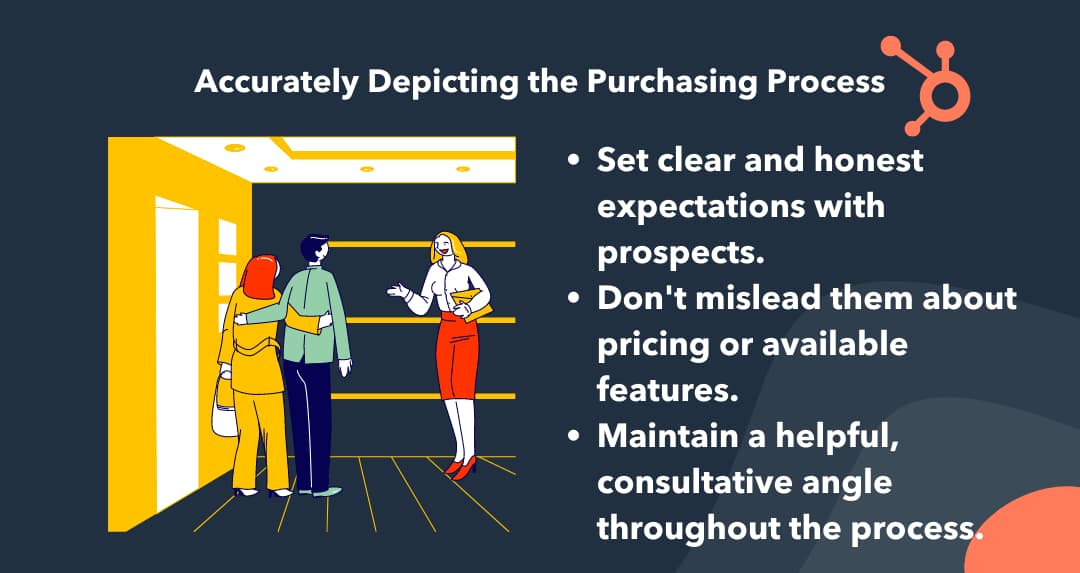
3. Accurately Depicting the Purchasing Process

Being able to set and meet reasonable expectations with buyers is central to building trust and establishing productive relationships — that starts with you being upfront about the nature of the purchasing process as a sale progresses.

Honesty and integrity won't be lost on prospects. Like a number of other points on this list, this one rests on the value of sincerity and the merit of taking a consultative approach to selling. Again, every sale should revolve around helping the prospect — above all else.

If you mislead them about what the purchasing process looks like, what features they'll have access to, or how much they're ultimately going to pay for your offering, you'll undermine your credibility and potentially lose out on a deal during the home stretch.

Make sure you can back up every promise you make, and be as clear as possible about what they're getting at the price point they purchase at. If you don't, you run the risk of bringing on a disgruntled customer that will churn quickly, vocalize their frustrations, and hurt your reputation down the line.

selling skills accurately depicting the purchasing process

4. Conducting Effective Buyer Research

You can't appeal to a buyer if you have no idea who they are, what they do, and what their business needs might be. If you want to successfully engage with a prospect, you need to have most — if not all — of those factors drilled down.

That starts with conducting extensive buyer research, and the best salespeople know what to look for, where to look for it, and how to effectively analyze those findings. Pore through your prospect's company website. Learn everything you can about what their business does.

Try to find insight into how their organization is performing. Familiarize yourself with its industry, so you can better understand its place in its competitive landscape. See if you can find out which solutions it's currently leveraging.

Do some research on the specific contact you'll be speaking with. What's their background like? What do they do at their company? Can you identify any interests they might have to help you build rapport?

Try to address as many angles as possible here. Put together a holistic picture of your prospect and their business, and start to tailor your communication to best connect with them — whether that be through something like a personalized gift, some industry-specific insight, or any other way you can think of to let them know you're locked in on their interests.

5. Developing Extensive Product Knowledge

You can't sell a product or service effectively if you don't know it inside and out. Understanding everything there is to understand about your offering informs other key elements of your sales efforts.

You can't anticipate or handle objections if you don't know the issues prospects consistently raise about your product or service's functionality. You can't structure an effective value proposition if you don't know what kind of value your product or service can offer. You can't differentiate yourself from your competitors if you don't know the features your offering has that theirs don't.

Take the time to thoroughly study your product or service. Know what makes it an exceptional option and where it might lag behind competitors. Know who stands to gain the most from it. Know what it costs and why it costs that much. Know its every last feature, bell, and whistle.

Know all of that and more. If you can develop extensive product knowledge, you'll be in a better position to craft thoughtful, personalized value propositions that prospects will be receptive to. That, in itself, is the key to conducting effective sales efforts.

selling skills developing extensive product knowledge

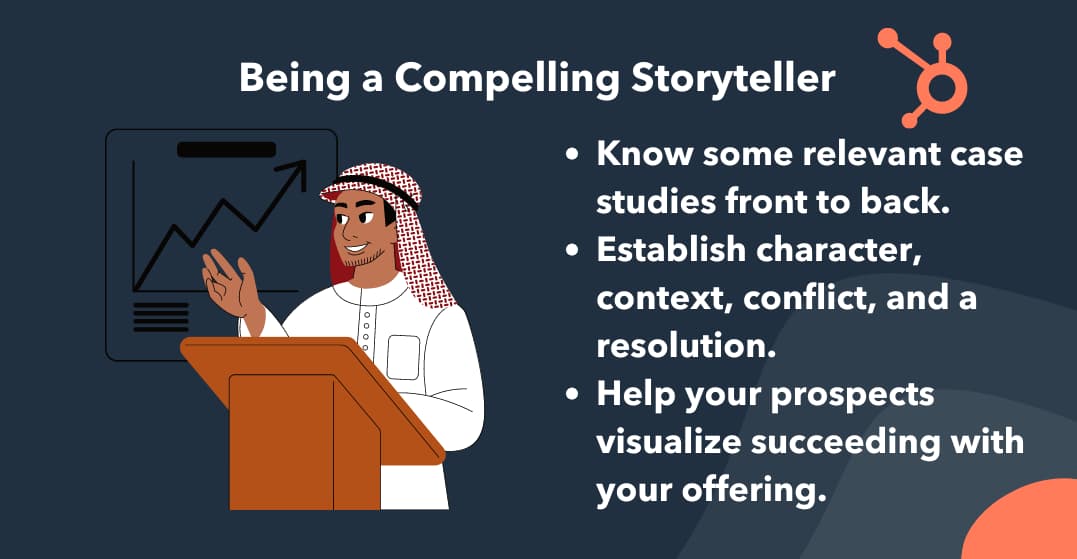
6. Being a Compelling Storyteller

Communication with prospects needs to be engaging if it's going to be effective. You want your buyer to have a personal stake in the sale — and using compelling storytelling to shape your pitches, presentations, and other correspondence with them helps that case.

Know some relevant case studies front to back — and leverage those stories to help your prospect imagine how they would use your product or service. Be sure to cover elements like character, context, conflict, and an ultimate resolution.

Say you represent an edtech startup that sells a platform for automating curriculum management and classroom assignments. Right now, you're presenting to a mid-size community college that relies on outdated legacy software to handle those processes. In that case, you wouldn't just want to tout your platform's bells and whistles or throw numbers at your prospect.

You might tell a story like, "Earlier this year, we sold our solution to Drollinger College — a community college around your size in Colorado that had a similar tech stack. I keep in touch with the administrator, Emma, and the head of IT, Shawna. They were initially reluctant to move on from their legacy system because they thought the transition and growing pains from implementing a cloud-based curriculum planning solution might not be worth the trouble.

"But when we took a comprehensive look at the amount of money that went into fixing errors that stemmed from mostly manual curriculum planning and inefficient classroom assignments. They warmed up to the idea of giving our platform a shot.

"Shawna told me that they were shocked at how seamless and simple the implementation process was — in large part because our customer success and support teams are so active in guiding the implementation process. And about a month after they were fully operational, Emma actually emailed me and said, 'Where were you all my life? I just wish we had found you sooner.'

Since starting with us nine months ago, the school has already improved average degree velocity by 20%. They're expecting to save $25,000 from streamlining curriculum scheduling this year alone, and they haven't received a single complaint from professors about classroom scheduling."

selling skills being a compelling storyteller

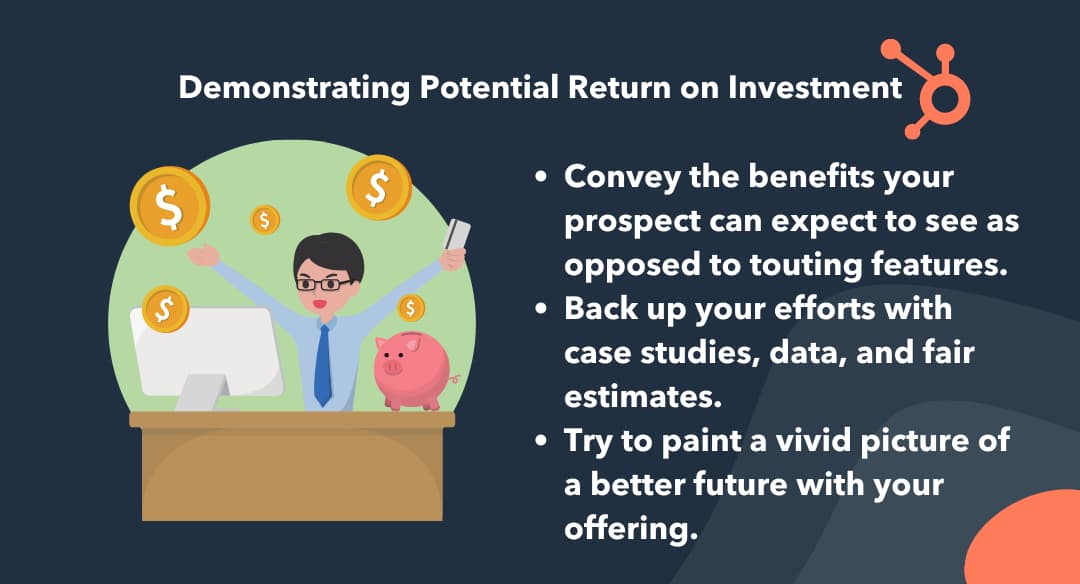
7. Demonstrating Potential Return on Investment

You need to paint a clear, persuasive, and believable picture of the results a purchase will yield when engaging with prospects. If you’re selling expensive software with a traditionally lengthy implementation period, be sure to convey the hard benefits of making that kind of investment of time and capital.

Case studies, data from your client base, and your own estimates — based on information your prospect gives you — can help you paint a more vivid picture than simply saying something like, "This is worth it because it will save you time."

It’s also helpful to connect current customers with your prospects for an unvarnished opinion of your product or service. Positive reviews from an engaged customer base have been proven to have significant sway on new prospects' decision-making — in fact, a recent study by BrightLocal showed positive reviews make 73% of consumers trust local businesses more.

Selling Skills Exercises

Selling skills exercises include a variety of games, activities, and training methods that can help reps bolster the stronger elements of their sales acumen and develop the ones that need some work.

Some prominent, engaging examples include:

    • Sell Me This Pen: This famous (or infamous) exercise involves having reps try to sell a trainer — acting as a prospect — an obscure object. The point is to tease out a need from that "prospect" themselves before providing a solution. It helps reps learn to convey return on investment and can potentially improve their storytelling skills.
    • Match Game: If your business sells multiple products or services, make a list of the key ones. Then, write out quick scenarios where a potential customer would benefit from each one. Shuffle both lists and have salespeople match the problem to the solution. This helps reps develop product knowledge and understand how to piece together an effective value proposition.
  • What's a … ?: This game works particularly well for newer reps. Once they've been onboarded, inform them that the rest of the company might approach them at random and ask them what your company, product, or service does. Upon being asked, the reps need to provide a clear, concise, compelling answer that addresses the question and conveys value. This can help them accrue product knowledge and demonstrate ROI.

There's a host of other games and exercises you can engage in to improve either your team or personal performance. For more information on those, check out this article.

Selling Skills Used to Engage Customers

The list of skills detailed in this article is far from exhaustive. You, as a salesperson, need to consistently identify and work on areas for improvement as they become obvious — learn from every sale and incorporate the lessons that come with your experience into your broader sales repertoire.

The underlying theme of every skill you can develop is this: Engage your prospects. And that theme can manifest itself in a lot of ways. Conducting extensive buyer research enables you to engage your prospects with more pointed outreach and pitches.

Being a compelling storyteller makes your communication more engaging by nature. Leading with empathy allows you to engage potential customers through more personal appeals. And every other point detailed here follows that same trend.

Do what you can to develop and hone your selling skills. Building up your sales acumen is an indefinite process, so always be mindful of what you could be doing better and act on that insight whenever you can.

New Call-to-action

06 Aug 16:41

Worthy Goals and Metrics for the Modern Sales Leader

by Sean Callahan

I once overheard a sales candidate say to a VP of Sales, upon seeing the team rankings on the office door he was about to enter, “You’ve got to love the sales leaderboard. Tells you everything you need to know.”

Sure, it’s true that the sales leaderboard remains the most immediately telling report for team and rep performance – you’re bringing in revenue or you aren’t. What’s not to like about that? It’s like using the bottom line to measure company performance – you’re profitable or you aren’t. But contrary to some people’s beliefs, these reports hardly “tell you everything.” If investors only analyzed the bottom line of the companies they invest in, their clients would be broke. It’s no different for sales leaders. If you rely solely on the sales leaderboard, you risk missing insights that affect the profitability of your sales team. And that’s also why it makes sense to broaden the goals we chase and the metrics we use to track progress beyond simple revenue targets.

Recently we expounded upon modern sales goals for today’s sales pro. In this post, we do the same for the modern sales leader.

Modern Goals for Sales Leaders

Today’s sales leaders recognize that social selling activities are quantifiable and that it’s possible to measure these activities like any traditional sales metric, such as closed revenue. To that end, more sales leaders are identifying and tracking leading indicators of sales success to help their teams focus on the activities that matter.

Help Your Sales Team Establish an Effective Online Presence

Is your team losing sales without even knowing it? Or do you have reps who consistently pull in quality prospects using their strong online presence but the lessons go unnoticed, and aren’t transferred to the rest of the team? Track and measure these activities to determine the effectiveness of your sales reps’ profiles. Low numbers may indicate a need to develop a stronger, more active profiles that clearly convey value to the ideal buyers whom your sales reps need to impress. Here are a few metrics to track:

  • Number of profile views as it relates to inquiries
  • Number of articles the rep posts to the LinkedIn publishing platform (can be a huge advantage, but not for everyone)
  • If a sales rep doesn’t want to publish content, how often do they personalize marketing or third-party content and share it with their prospects
  • Number of page views published articles get, or the engagement rate of shared content
  • Number of followers the sales rep gains, or number of key contacts who engage with the sales rep’s social activity

Help Your Sales Team to Identify the Right Prospects

Track and measure these activities to determine how well your reps perform at searching for (and more importantly, finding) strong buying candidates. Low numbers here may signal the need for more training or accountability:

  • How often the rep uses the Lead Builder functionality in Sales Navigator
  • How many saved searches the rep consistently performs to identify new prospects
  • How many leads the rep saves in Sales Navigator so that they can better monitor a prospect’s LinkedIn activity

Help Your Sales Team to Engage with insights

These activities show how well reps embrace the concept of leading with value versus coming out of the gate with a generic sales pitch. If these numbers are low, the rep may need additional training or assistance with crafting insightful, personalized messaging via social content updates, emails, and InMail messages. Check in on LinkedIn, Twitter and any other social networks that make sense to see if reps are sharing content and their perspectives.

  • Number of shares, likes, and comments the rep’s posts receive among named sales contacts (engagement in general is good, but it shouldn’t divert reps from trying to gain actual interest from the right people)
  • Qualified leads secured from LinkedIn Groups and other relevant online forums
  • Number of saved accounts (companies) in Sales Navigator
  • Percentage of sales outreach that garners a response, by channel

Assist Your Sales Team’s Efforts to Build Stronger Relationships

Reps who focus on initiating and cultivating relationships using social selling best practices should see higher numbers in the following areas. If they aren’t, they may need coaching around requesting introductions through their extended networks, how to follow up on a warm introduction, and building relationships with more buying committee members at their target accounts.

  • Number of personalized connection requests
  • Acceptance rate on connection requests
  • Number of connections at named accounts
  • Number of buying committee members identified at named accounts
  • Number of “get introduced” requests

Driving Profits

Anyone can “drive revenue” if they are empowered to cut price. But driving revenue efficiently? And at a high profit margin? That takes talent. If you notice opportunities are slow to close or numerous prospects fall out of, or get stuck in the pipeline, make sure your rep is not falling back on old habits like leading with a pitch instead of insights or following up for the sake of following up alone.

  • Average time to close
  • Pipeline attrition rate
  • Average revenue per sale
  • Average margin per sale
  • Renewal rate among existing customers (if your sales reps are expected to stay involved post-sale, applying a metric like this can quickly shake up the sales leaderboard as you know it)

That’s a bunch of metrics you may not be measuring, but don’t worry about measuring them all. Every industry, every sales organization is different. That’s why it’s important to correlate each metric with pipeline metrics and win rates, so you get a better feel for what’s a true leading indicator at your company and what isn’t.

In general, though, by helping your reps to establish an effective online presence, identify the right people, and build stronger relationships, you are positioning your team to succeed in the modern selling environment. For more insights from sales experts and sales leaders in the field, be sure to subscribe to the LinkedIn Sales Solutions blog

06 Aug 16:39

Where is Your Strategic, Finite Target Account List?

by Mike

Selecting “Targets” is the first step in the New Sales Driver framework outlined in New Sales. Simplified.

Selecting Targets is first for a reason. It’s one of the very few chances we (in sales) have to be strategic. If we’re really honest, most of what we in sales do is about execution, not strategy. Those who excel at picking up new business typically do so because they become masters at executing the sales attack, not because they’re great sales theoreticians! The time we really get to engage our brains and to put serious thought into our strategy is when we are deciding whose business we want – which target customers and prospects to pursue for new business.

Another reason that Selecting Targets is the first part of the framework for outlining a success new business development-focused sales attack is because our target list should be driving what goes into our calendars and where we are intentionally investing our precious selling time. It makes sense: Your list should dictate where you spend your time. Unfortunately, however, way too high a percentage of salespeople spend (waste) the majority of their time living in reactive mode, hoping (an awful sales word)  for a lead, or that a customer will raise its hand looking for help.  And you know that as long as you are content living in reactive mode and earning a living by chasing opportunities under your nose, you really don’t need a target account list. But, and this is a BIG BUT, the moment that you decide to become proactive, strategic, and intentional about whose business you want and are committed to pursuing, the very first thing you require is a list.

If I was coaching you personally, within ten minutes of our initial conversation I would be asking you to show me your Target List. If you are serious about winning New Sales, then you must have a Target List. And notice I didn’t say “account list” or “prospect list.” Nope. I don’t want a list of your accounts. Nor do I want you to scroll through screen after screen in your CRM, or thumb through page after page in some Book of Lists. And I’m not asking to see your pipeline of current opportunities. I want you to have a strategic, finite, written (or printed) list of the accounts you are committed to pursuing – those from which you are willing to be held accountable for securing discovery meetings and creating new sales opportunities. That’s your Target List!

If your sales role is like most salespeople today, it is likely that you have some type of hybrid sales job. You are expected to maintain and grow revenue from your existing accounts, and you also charged with acquiring new business from new customers. That is why it is absolutely imperative that you invest the time and brain power to create a Target List for yourself that looks something like the image at the top of this article. You need a two-pronged list. On one side of the ledger I want you to list your Growable Accounts. I hope the key word there is blatantly obvious: Growable. Not all customers are created equally and not all deserve an equal share of your time, focus, and energy. If you don’t think the customer is Growable, then I don’t think you should put that account on your Target List!  I’m not saying not to “serve” the account, but I am emphatically saying that if you are serious about winning more New Sales, then you should not be focusing your precious selling time on a customer that you can’t grow. If they can’t buy more  – of the same thing, or new things (cross-selling), or bigger things (up-selling) – then they don’t belong on your Target List.

For some of you reading this article, that previous paragraph sounds obvious, and maybe even unnecessary. But based on what I’m observing recently in many of the companies where I’ve been leading workshops and speaking at sales kickoff meetings, I know for a fact that the message of strategically targeting GROWABLE customers  is actually like a bucket of cold water over the head for some sellers. Too many salespeople are operating on auto-pilot, doing a milk-run, cruising their territories and account lists while giving little or zero thought to which existing accounts are worthy of their time and attention. Friends, let this be one more reminder that, in sales, we are not paid to do work. Our job is not to cover the territory, or manage accounts – regardless of what silly title someone may have put on our business cards. Our job is to GROW REVENUE. And the best way to do that is to proactively, intentionally, and strategically over-invest time and focus working Growable Accounts and and Ideal Profile Prospects.

Can I encourage you to disengage the auto-pilot and engage your brain and that of your manager to invest the appropriate energy determining which of your existing accounts, if pursued with abandon, deserve more of your time and focus? I’ll cover tips on creating your list of Ideal Profile Prospects in a future post. For now, I wish you great strategic targeting and great selling.

06 Aug 15:34

How to Drive an Agile Mindset Across Your Marketing Team

by Bob Van Rossum

The agile methodology is widely used in project management and software development but is now quickly making its way to other areas of the enterprise, including marketing.

How does the agile framework impact marketing in today’s digital age? The ability to innovate and improve the customer experience relies on marketing teams who are able to move fast enough to keep up with the evolving demands of consumers. In a world where consumers have no desire to wait, organizations with slow marketing delivery run the risk of becoming irrelevant and outdated.

Related Video: Demystifying Agile Marketing

Source: McKinsey on Marketing & Sales

Digital Marketing Recruiters: Is Agile the Future of Digital Marketing?

Modern technology allows marketers to reach and engage with customers in ways that weren’t possible just a few years ago. In order for marketing departments to keep up with the brisk pace of technological change and push forward new ideas, products, services or campaigns, they must be innovative, break down silos and gets things done quickly.

Agile marketing aims to improve transparency, speed and the adaptability of the rapid marketing environment; using analytics and data to prove the validity of potential solutions through small experiments and quick campaigns.

As digital marketing recruiters, we see many organizations that are risk-averse fail to move quickly and adopt new ways of marketing. Becoming fully agile isn’t simple but there are many effective agile practices that can be integrated into your marketing team and organization to bring your marketing ahead and squeeze the most ROI out of your campaigns.

Success Today Isn’t Promised Tomorrow

Marketing programs that experience steady growth and meet business goals and metrics are less likely to try something new and may become stagnant. This complacency causes them to miss out on something that could possibly transform their marketing.

What have you tried out in the past 30, 60 or 90 days that you’ve never done before? If you haven’t tested any new marketing strategies out, why not? If you’re in a good place with your campaigns and seeing successful results, that’s great! However, nothing’s ever promised in the fast-paced world of marketing.

While you should continue to invest in and nurture marketing tactics and strategies that work and drive results, don’t disregard innovative ways to keep your brand above the noise. Your marketing should constantly be testing, learning, and evolving. If you’re in a good place with your campaigns, leverage the ability to dedicate some resources to new initiatives.

Playing it safe, moving at a slow pace, and avoiding new tactics will get you mediocre results, setting you behind the competition. The iterative approach in agile marketing allows you to push out different ideas, test them, and evaluate what worked and what didn’t in real-time. If an idea fails, you can move on and try something else much faster.

Related: speed of your executive search post

Build a Fully Capable Team

digital marketing recruiters the future of digital marketing

Agile marketing isn’t possible without the proper leadership in place, and simply won’t work if it doesn’t have the right buy-in with management. Digital leaders must understand and accept agile to properly guide their marketing department in doing so as well. An adjustment in the culture is necessary, where leaders must accept the risk of moving faster.

Do you have the right marketing org chart in place? One of the biggest factors that lead to successful agile marketing is a team of talented marketers who can work up to speed. Before you start to assemble your agile team, you must ensure you have the right roles and talent onboard. You must allow your marketers to have the freedom and support to think of innovative ideas. Millennials, in particular, are incredibly digitally-inclined and have many cutting-edge ideas. Without top marketers in place, how do you expect to build assemble a team that’s expected to bring brilliant ideas forward?

The exact structure of your agile team will depend on your organization and the goals you’re trying to meet, but they should generally be small so responsibilities and tasks are managed easily, and everyone is held accountable. The team that is charged with implementing, testing, and measuring different ideas should work closely together in an “agile war room.”

These teams will have daily meetings where each member will report on what he or she accomplished the day before, and what their goals are for the day. The iterative process and continuous collaboration agile teams work under allow marketing to deliver quick solutions and rapid feedback. Leaders of the agile team should create a list of things to try out, and go through them in quick cycles.

Intelligent marketers who are given the support and bandwidth to build great marketing campaigns will get the job done. Once your agile team starts to build credibility and drive results, your organization can progressively add more teams that take control of different functions.

The marketing department’s head leaders will need to overlook the activities of the war room team and check up on their efforts every so often. While your war-room team certainly must be agile, encouraging a nimble mindset throughout your entire marketing department is equally important.

Reap the Benefits of Agile Marketing

By avoiding time spent on meetings, approvals, and feedback, the iterative and adaptive process of agile marketing enables teams to get more things done, quickly. It significantly boosts productivity, performance, and internal communication through close cross-functional collaboration and a break down in silos.

Agile teams run small tests, making it easier to measure results and gauge what truly works and doesn’t. Through well-established agile tactics and quicker response to changes, rapid iterations of different marketing ideas pave the way to incredibly innovative ideas and rewarding campaigns.

More importantly, the consumer is always at the center of every strategy and tactic, enhancing the customer experience.

Conclusion

By encouraging and pushing agile marketing, you can transform your efforts and drive growth faster than ever before. The success of an agile marketing strategy depends on the talent and leadership your marketing organization has at hand. With all of these working pieces put into place, your marketing will be able to deploy tests quickly, evaluate the results and improve your efforts at a pace that’s aligned with the rapid speed of marketing.

06 Aug 15:33

How to Succeed at Channel Selling

by Sandler Training

Sandler trainers and new authors, Marcus Cauchi and David Davies, join us to talk about selling through retails, distributors, reps, and other third parties. Whether you are currently using other channels to sell your products or services or you are exploring new channels, you should listen to these two experts and read their new Sandler book.

06 Aug 15:21

Of Course It Matters Whether You Won or Lost…

by Bob Apollo

Greek Vase Run Right

You’ve probably heard some variation of the saying “it matters not whether you won or lost, but how you played the game”. The modern use of the phrase (in a slightly different form) is attributed to the American sports commentator Grantland Rice, but the principles have their roots in the spirit with which the original Olympic Games were conducted over 2,500 years ago.

For anyone in sales repeatedly playing and losing – no matter how well-intentioned – is hardly likely to form the foundation of a successful career. We want to win, but we want (or should want) to win in an ethical, principled manner that sees our customer as a partner and not a combatant.

Systematically learning what works and what doesn’t – and progressively doing more of the former and less of the latter – ought to be the critical foundation of any successful sales organisation. And yet the essential raw materials – in the form of effective win-loss analysis – are all-too-often missing or flawed…

It’s been my experience that the most effective sales people tend to be particularly adept at learning and applying the lessons of both success and failure. In fact, I believe that these top performer’s capacity to learn and adapt is probably one of their most consistent characteristics.

But all too often, this invaluable learning is neither understood nor applied across the rest of the sales organisation. And even when organisations implement win-loss reports, the underlying analysis and the resulting conclusions (assuming there are any) are often incomplete, flawed, biased and of little practical value.

Self-assessment doesn’t work

This is particularly true when our less-effective sales people are asked to self-analyse their reasons why an opportunity was won or lost. I have never seen (nor do I ever expect to) the reason for loss to be self-assessed as sales incompetence, nor the reason for success to be identified as brilliant marketing.

If they are to be in any way effective, win-loss analyses cannot be “tick the box” exercises. They require thought, reflection and the involvement of an unbiased third party. And they cannot be complete without input from the most important contributor – the prospect or customer.

I’ve conducted independent win-loss analyses on behalf of a number of clients over the years, and these exercises have inevitably yielded invaluable insights into how the prospective customer approached the buying process and how and why they came to their ultimate decision to either buy or stick with the status quo.

Internal, self-conducted win-loss analyses – in addition to being generally incomplete, flawed or biased – also tend to concentrate largely or exclusively on the latter half of the sales cycle and on the sales person’s success or failure in “closing” the opportunity.

Start at the beginning

But it turns out that the most important insights are typically upstream of that point. In fact, many of the most strategically important lessons are to do with what caused the prospective customer to become concerned about the status quo in the first place and how they went about researching and identifying their options at the start of their buying decision journey.

Well-constructed win-loss analyses help us to better understand these all-important early stages of the buying decision process, such as:

  • The trends that most concern senior executives in the organisation
  • The issues, threats and opportunities that are most likely to cause them to start researching their options
  • The common demographic, structural and behavioural characteristics of our most valuable customers
  • The roles that are most likely to become successful change agents within the organisation
  • The specific catalysts or trigger events that are most likely to put the issue on their radar in the first place

These early-buying-stage insights allow us to target the right messages at the right people in the right organisations at the right time.

Understand their journey

And by asking the right questions about their buying decision journey, such as:

  • How and where they started to research their options
  • How they determined which solutions to look at in more detail
  • What key stages they went through in their buying decision process
  • Who else was involved in their internal process, and what roles they played
  • Which solution options they considered and rejected, and why
  • If they decided to buy, how they decided what to buy
  • If they decided not to buy, why they decided to stick with the status quo

We can build up a much clearer picture of what we need to look for, what we need to know, what we need to do, what we need to avoid, and how we ought to qualify potential sales opportunities.

There’s another unexpected benefit from conducting an intelligent win-loss analysis process: we’ll often be in a better position to judge how much future potential this particular customer or former prospect might represent.

Is the effort worth it?

Is this harder to do than adding a few fields to a CRM screen? Yes.

Does disseminating the lessons learned require conscious effort? Undoubtedly, Yes!

Is the effort worthwhile? The last time Gartner looked at the issue, they concluded that the minority of organisations that were doing a half-way decent job of win-loss analysis saw an up to 50% increase in sales win rates compared to their less committed peers.

06 Aug 15:21

The best SEO book in the world? A surprising discovery.

by Mark Schaefer

By Mark Schaefer

I have written about my loathing for arbitrary rankings and especially these “influencer lists.” But every once in while I see a list that captures my attention … and last week provided an extraordinary surprise.

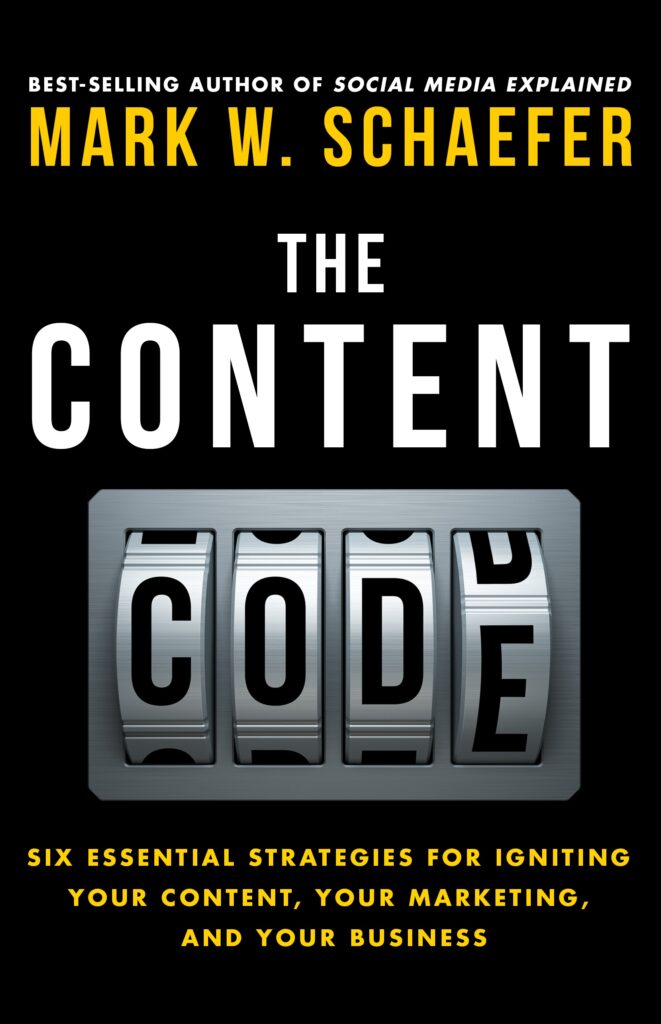
Book Authority just named my work, The Content Code, as the best book on SEO in the world (out of 58 books on the subject).

The thing that is remarkable about the award is that I never thought of my book as an SEO book — it’s not even listed in that category on Amazon.

But it does make sense. And the success of the book goes back to a controversial decision I made about SEO for my business and my blogging career 10 years ago. I’d like to discuss that decision today and why it might be relevant for you, too.

Why SEO sucked

Before I dissect this lesson, let me thank BookAuthority for this honor. The site uses a proprietary, independent methodology  to identify and rate the best nonfiction books in an objective and data-based manner. They are not associated with any publisher or commercial venture. So … good job with that, and thank you.

Now back to our regularly scheduled programming:

In 2008, social media and content was just coming into the mainstream as marketing ideas. Google was dominating the search space and everybody was trying to figure out how to win those coveted first spaces on the organic results … including me.

I’ll never forget attending an early SEO conference and learning about all the dirty “black-hat” tricks that were going on back then. One guy stood up and talked about how he was hiring shut-ins to pose as other people posting content to try to get links back to customer sites.

I asked him, “Isn’t this patently unethical?”

He responded: “Yes. But big companies are willing to pay me millions of dollars to this and if I don’t do it, they’ll find somebody else who will.”

And he wasn’t kidding. His client list included some Fortune 500 companies.

As I learned about the SEO business, even the “white hat” shops seemed to be dabbling in some gray areas when it came to ethics, links, and content. I made a decision that I would never, ever fall into that trap. I did not want to be associated with anything this slimy. I was either going to make it or fail, but I wasn’t going to play these gray-area SEO games and tricks.

Google truth

best seo bookMy decision was not just based on ethics. It was also based on logic.

I thought, “There is NO WAY Google can let these guys win. If they are going to survive as a company, they can’t let the bad guys rule the organic results. Google has to reward the best, purest, most helpful content in the long-run.”

And so, I engaged in none of the weird SEO strategies of the day. This might sound like a rational and enlightened plan today, but believe me, it was unnerving going down a path by yourself. Literally, I watched the whole industry going a different direction, so my plan was radical at the time and there was no certain success.

But, I was right.

Month by month and year by year, Google changed their algorithm to beat back the link merchants. Every change they made moved the industry closer to what I had been practicing all along, and something I wrote about in my very first blog posts 10 years ago. The key to winning in the digital world is:

  • Creating meaningful content
  • Engaging with a relevant audience
  • Being authentically helpful

To me, this wasn’t SEO, it was common sense. But today — finally! — SEO is starting to look more like common sense than a secretive black market for links.

In this era, SEO is content marketing, more or less. There is still some horse-trading for links going on but eventually Google will find a way to punish those people too.

The next step in SEO

Today, my SEO strategy is essentially the same as it was 10 years ago: focus on content that is extremely useful and interesting to my audience.  I use the Yoast WordPress plug-in to try to make my posts more discoverable. My website also gets a little TLC from my friend Douglas Karr, who I have hired to fix the things that break. Let’s be honest. Websites are mysteries.

If I could go back in time, I would have added a fourth bullet point to my original list of three rules of success, and it would be this: Ignite your content.

Ten years ago when I wrote that original advice, any sort of content on the web was a novelty. It didn’t take much to build an audience for a blog, podcast, or video channel. Today, it is insanely hard to accomplish that. There’s just too much stuff.

The economic value of content that is not seen and shared is zero. How do we get our content to IGNITE throughout our audience, and beyond?

A few years ago, I tackled that issue in The Content Code. The book is not just the evolution of content marketing, it truly is the evolution of SEO, too.

So yeah. maybe it is the best SEO book … and it all started with an unconventional approach to blogging 10 years ago. It was an unnerving risk at the time, but it has been the best path for me and my customers and I hope you’ll also discover this truth in The Content Code.

Keynote speaker Mark SchaeferMark Schaefer is the chief blogger for this site, executive director of Schaefer Marketing Solutions, and the author of several best-selling digital marketing books. He is an acclaimed keynote speaker, college educator, and business consultant.  The Marketing Companion podcast is among the top business podcasts in the world.  Contact Mark to have him speak to your company event or conference soon.

Illustration courtesy Unsplash.com


The post The best SEO book in the world? A surprising discovery. appeared first on Schaefer Marketing Solutions: We Help Businesses {grow}.

06 Aug 15:11

Why You Should Never Start a Follow-Up Email With "I Haven't Heard From You"

by pcaputa@hubspot.com (Pete Caputa)

If you're like me, you probably receive countless unsolicited sales emails and voicemails every month -- and most of them are really bad.

To give you a taste, here are the opening lines of follow-up emails I received in the past few weeks. Notice anything?

  • "I just left you a voicemail as a follow up to my message yesterday."
  • "I have been trying to reach you."
  • "I just wanted to make sure you got this email (copied below) from earlier and didn't miss out."
  • "Hope you got my second voicemail."
  • "It’s been challenging to reach you."
  • "I'm sure you have lots going on. I have not heard back from you ... "

Each of these salespeople attempted to guilt me into responding.

I followed up with some of these reps to determine if this approach gets responses. A few said it works fairly well -- they get single digit response rates when opening follow-up emails with this line.

One salesperson -- the top-performing rep on his team -- even sent me his five-email sequence where four out of five messages start with laying down a thick coat of guilt.

Jeff Swank, a high-performing salesperson at HubSpot, brings an old email to the top of a buyer’s inbox by using the subject line "email buried?" and writing one short sentence in the body -- "Just want to follow up in case this email got buried."

He's not the only one on the HubSpot sales team who sends these kinds of emails. For several years, we actively taught our salespeople to reference previous connection attempts when reaching out to inbound leads that one final time before taking them out of the pipeline. And it worked … for a while.

But now I’m wondering -- has it gone too far? Has guilt become the prospector’s go-to emotion? Are salespeople using it too soon and too often in their emails and voicemails? And are there some subjects you just shouldn't discuss over email?

I think the answer is yes -- using guilt in prospecting emails is a huge mistake.

Does Guilt Work in Sales?

Less than 1% of sales phone calls are returned and less than 24% of sales prospecting emails are opened. This to me shows that buyers do not feel guilty about ignoring prospecting attempts from salespeople. 

Mark Suster, successful entrepreneur and busy guy, sums up why decision makers ignore emails like so: "I’ve learned that some people just can’t process 100% of email. The more senior people are, the more demands they have on their time. The older they are, the more out-of-work responsibilities they have."

Does provoking feelings of guilt make some buyers feel bad? Probably -- but bad feelings don’t move the needle for salespeople. What does is responses.

And do guilty feelings make buyers more likely to get back to you? Not usually. Instead of rushing to answer your email, what’s more likely is their guilt will snowball into sadness, frustration, or annoyance -- not exactly the feelings salespeople hope to provoke.

"Guilt is not a very good motivator,” Susan Krauss Whitbourne, Ph.D., a professor of psychological and brain sciences at the University of Massachusetts Amherst, notes. “In the overall scheme of emotions, guilt is … one of the 'sad' emotions, which also include agony, grief, and loneliness."

Yikes.

Personally, I'd love to get back to everyone if I had time, but I don’t. And I certainly don't have time to oblige every "15 minute request” for a call that usually comes right after the guilt trip, like in the example email below. (Names are changed to protect the guilty, or in this case, the guilt-inducing.)


Hi Peter,

Hope you got my second voicemail. Between you and me, never been an answering machine person.

Would you have 15 minutes to connect? Apologies for the bombardment. I just see HubSpot as a great potential fit to partner with X company.

What is a good time for you for a 15-minute call either today or tomorrow?

Looking forward to speaking with you!

Thank you,

Mary

send-now-hubspot-sales-bar

Do I feel bad for not getting back to “Mary”? Somewhat. But realizing that my time is best spent doing the things I decide to do (and based on the sheer volume of email I receive), I have no choice but to stop worrying about getting back to everyone who messages me -- even the people I know and especially the people who I don't know and who don't know me.

Which brings me to my next point …

You Can't Guilt Someone That Has No Obligation to You

Now, I'm not going to say that you should try to avoid making someone feel guilty at all costs. But you should recognize and internalize this critical point: Guilt won’t sway people who feel no obligation to you. And with that in mind, I think the only appropriate time to provoke guilt is when someone already committed to doing something and didn't follow through.

Janine Popick, founder of email marketing firm VerticalResponse, recently shared a story where guilt provoked her to respond. Here's the note she received from a potential partner she had agreed to work with in a previous communication.


Just wanting to be practical here. Since I haven't seen or heard back from my many messages to you, I have to assume it will be impossible to bring your offerings to our audience.

I hope I may be mistaken, but the long silence prompts me to think I should just take you off this list. While I would love to see the great solutions you create as part of our world, I have to accept that silence likely means no.

If I'm mistaken, do feel free to let me know, but if I don't hear from you, I'll be clear with our team that working with [Company] isn't of interest to VerticalResponse here.

Wishing you all the best (and hoping to be very wrong).

send-now-hubspot-sales-bar

"Whoa! I felt like crap!” Janine wrote of her reaction to the note. “I instantly emailed her back, apologized, and told her why we've been a bit quiet."

While this guilt-tripping email elicited a response from Janine, the approach should be used sparingly and caringly, like in this example.

In addition to being sent only after Janine failed to follow through with a commitment she expressly made, the sender unleashed the guilt only after several previous follow-up attempts, and gave Janine a clear and easy out.

Another way to soften the blow of an email like this is to excuse the lack of response, by writing something along the lines of, "I understand you are busy. Please don't feel guilty for not responding," and then providing the prospect an out.

According to Mark Suster, an apology works too: “I know how busy you are. I hope you don’t mind I'm putting this at the top of your inbox.”

When to Use 'Haven't Heard from You' 

As we've outlined above, using "Haven't heard from you" in email or voicemail communications is usually rude, attempts to guilt your recipient, and just plain doesn't work. 

When you'd like to provide a polite and gentle nudge to your prospect, first consider waiting five to ten business days before contacting them again.

This acknowledges they're busy and gives them time to respond to you on their own (which is always preferable to a nudge email). It also prevents you from looking desperate -- which is never a good way to begin a business relationship.

But, when you've waiting the appropriate length of time and you're ready to reach out again, test these alternatives, instead of "I haven't heard from you":

'Haven't Heard from You' Alternatives

  1. "Wanted to resurface this email ..."
  2. "Following up to make sure this email didn't get buried."
  3. "I know your inbox is a busy place. I wanted to reach out in case my original message got lost."
  4. "Bumping this up in your inbox ..."
  5. "I know how busy you are, I hope it's alright I'm moving this conversation to the top of your inbox."
  6. "Please don't feel guilty for not responding, I know how busy you are!"
  7. "Usually when I don't hear back from someone, it means you're just not interested in what I'm offering right now -- and that's O.K. ..."
  8. "I know your busy, I'll follow up in a few months to see if this is more of a priority for you."
  9. "I'm sure your inbox is crazy. Would it be better if I gave you a call?"
  10. "Since this is time-sensitive, I thought I'd reach out again."

Lay the Groundwork for Relationships, Not Guilt Trips

If the guilt angle isn't the right way to improve response rates, what is? In my opinion, salespeople should try initiating a relationship first. And in order to do this, reps need to slow their roll.

Instead of trying to get responses along the lines of “You might be able to help me -- let’s talk,” salespeople should aim for something closer to “I can relate -- I’d like to get to know you.” Build a relationship first, and then your buyers might actually feel guilty when they miss one of your emails.

Here's how to prioritize relationship-building in your prospecting:

  1. Do research. Just like buyers research vendors, salespeople can and should research their prospects. Most companies and many individuals publish information about themselves online, and review sites exist for almost every product or service these days. Internet resources aside, it's not too hard to talk to your prospect's employees, partners, customers, or vendors to learn more about them.
  2. Change your goal. Salespeople should send prospecting emails with the goal of initiating a relationship, not pitching their offering. Here are 28 email templates that will help you do just that. These templates don’t stir up negative emotions like guilt; they inspire positive emotions like pride and appreciation -- especially when you position your pre-outreach research front and center.
  3. Offer value before you ask for anything. Your buyers are overwhelmed and drowning in email. Want to build a relationship? Find a way to make their lives easier. Then they’ll be a lot more receptive to doing something for you down the line.
  4. Be timely and relevant. The beauty of attracting prospects to you instead of pushing your message onto them is that they're making the first move. It becomes your opportunity to respond -- not their obligation.

In that crucial first email, most salespeople try to snag their buyers’ interest by explaining the value of their product. If that doesn't elicit a response, many resort to guilt laden follow-on attempts.

But this strategy works only a small fraction of the time, and does nothing to forge a relationship between buyer and seller. After all, prospects don't look kindly on people who try to give them guilt complexes.

The key to effective prospecting is building relationships first. Initiate a relationship by being interested in the other person. Do your research and then write customized messages based on what you find.

Better yet, attract buyers to you through social prospecting, blogging, and website optimization, and then use that engagement to increase your timeliness and relevance, and ultimately your connect and close rates.

This quote from Suster sums it up well:

"My goal is not to make [people] feel guilty. That’s silly. If they’re important that’s the last thing I’d want to do."

If you’re overloaded and struggling to keep up with email, so are your buyers. Have some empathy, and put away the guilt. Oh, and stop using these other bad sales phrases, too.

HubSpot CRM templates

06 Aug 15:11

How Storytelling Can Power Your Success in Sales, Marketing & Beyond

by Devon McDonald

Editor’s Note: The following article is based on a recent episode of OpenView’s BUILD podcast. You can listen to the full episode featuring Andy Raskin, Strategic Messaging expert here.

It may sound cliché, but it’s also true: the world is changing. The traditional approach to telling your company’s story isn’t enough to make you stand out from the competition. So says Andy Raskin, a highly sought after consultant who works directly with CEOs and their leadership teams to develop strategic stories that play a critical role in powering success in sales, marketing, fundraising, product development, and recruiting.

I had the opportunity to talk with Andy about what he’s learned from working on projects for brands like Salesforce, Square, Uber, Yelp, and VMware, not to mention a number of OpenView’s own portfolio companies. He had a lot to share about best practices in the months leading up to and following a major rollout.

Story and Why It Matters

One of the biggest misconceptions Andy runs into again and again is that creating a story is a task often delegated to marketing, when in fact it’s much bigger than that. As Andy learned from Ben Horowitz at Andreessen Horowitz, story isn’t marketing, it’s strategy. And it will have a profound effect on your business if you’re willing to dig deep into it.

“When I first began working in tech, I thought of the product as the main thing you’re building and story as the wrapping paper that you put around it to make it look pretty and help sell it. Now, having learned from people like Ben Horowitz and others, I’ve come to believe that the story is the main thing you’re building, and the product is prop for making that story come true.”

The story acts as your north star around which to align your entire business, including your product roadmap, features list, sales pitch, and – yes – your marketing. Because story drives all these things, it can’t be developed in a marketing silo. Marketing has a large and important role, but the CEO needs to own the big story decisions because the CEO is the person who can say, “If we’re going to tell this story, maybe we need to build out some additional functionality” … and make it happen.

To sum up, story is not just the window dressing on your big idea. It is your big idea. It’s the starting point and the end game all wrapped up in one.

How to Craft a Story: 5 Steps

When is the right time to develop your brand’s story? “Typically, companies call me when there have been some signs of success, but that success has been driven – as one founder put it – by the ‘brute force’ of the founding team,” Andy says.

These companies are on the cusp of a new level of growth – moving from a stage where the founding CEO is in every sales call to a stage where things are starting to scale across the entire organization. These companies have also often hit the dip that happens after early adoption, creating fall-off and a trough that leads to an opportunity to build the strategic narrative for the first time. “At this stage,” Andy says, “they start realizing that their growth is dependent on having a simple and really powerful story.”

And that’s when Andy gets to work.

Step 1: Create Your Story Team (And make sure it includes the CEO)

Andy always asks the CEO to create a story team of four or five people led by the CEO. CEO leadership is so critical to the success of the story process that Andy turns down projects if the CEO can’t commit to being fully involved. It’s not just that the CEO is the only person with the authority to define a company’s high-level strategic story, the CEO is also the only person who can empower the team to make the big, hairy choices that great strategic messaging requires.

Step 2: Switch the Metaphor

“A lot of folks, when they think about the company’s story, boil it down to some version of, ‘Here’s why we’re great,’” Andy says. “But, you need to switch to what is happening in the customer’s world that is creating stakes, meaning, opportunity and risk.”

Andy accomplishes this by helping the story team switch from a doctor-patient metaphor (in which the company is the doctor diagnosing the prospect’s pain and offering products and services to relieve it) to a wizard-hero metaphor (in which the company is the wizard or wise man/woman who helps the hero – the customer – understand the true stakes and empowers them to take action). This approach allows you to tell a story that expands beyond the humdrum world of selling to pain so you can tell a more rousing and epic story that serves as a wake-up call inspiring prospects to buy.

Step 3: Figure out the Customer Story

Crafting the bones of that epic story requires a true understanding of the big change that’s happening in the prospect’s world. What has changed the rules of the game so that there will now be new winners and losers and new strategies for winning?

“We’re essentially attacking the existing narrative that exists in the customer’s mind. Because that status quo is no longer tenable.”

Andy uses a Star Wars example to help illustrate the principles of creating this new narrative. “There’s this great moment in the beginning of Star Wars: The New Hope where Luke has been bellyaching for ten minutes about how he wants to get off the planet, be a pilot, and have adventures. And then Obi-Wan comes to him and says, ‘Hey, let’s get off the planet. I’ll teach you to be a pilot, You can have adventures. I’ll teach you about the force and everything.’ And what does Luke say? ‘You know what. It’s getting kind of late. I have to go home.’ But then, the Empire bombs Luke’s home, killing his uncle, and Luke realizes that he’s now very much in danger and probably going to die. This creates stakes. Luke suddenly realizes that Obi-Wan is offering him the chance to thrive and prevail in a life-and-death situation. That’s a whole different story that will inspire him to act.”

Andy and the story team usually take a few months to talk to customers and gather input from the internal team in order to get a handle on the customer story. Interestingly, they only ask one question about the company’s products: How have these products changed your life? After that, Andy shifts focus to what has changed in the prospect’s world to create new opportunity and risk. He pushes past the usual pain point conversation – which is typically unexciting and therefore ineffective – so he can get at what’s actually at stake for the prospect. In other words, he finds their Obi-Wan moment.

Step 4: Build the Story

Early on, Andy took a unique approach to building the story. Instead of the traditional “messaging pyramid” or “positioning statement,” he uses the sales narrative – basically the sales deck – as the underlying structure for his messaging architecture. He uses this format because (done right ) the sales deck has all the relevant pieces of the story, which makes it the perfect foundation for other content like the company website, etc.

Step 5: Take Your Story for a Road Test

Finally, it’s time to take your story for a spin. Andy recommends taking it out on sales calls in order to get some real-world reactions and feedback. He also suggests having the CEO or other executives present it at conferences or other events where the audience includes potential prospects. By seeing how the story is playing with the audience, you can refine and polish it so it’s ready to roll out to the entire team.

From there, the best approach is a gradual rollout that lets you introduce the story to a few people at a time. The road test is the perfect chance to get some of your sales team involved, letting them weigh in, and giving them some ownership in the story. Integrating their experience and input will then make it that much easier bring the story to other members of the team because it won’t feel like something that was cooked up in a back room. You’ll be able to share what happened when you took the story out to actual projects, how prospects engaged with it, and how the story is creating results.

Tips for DIY Story Development

For companies who want or need to tackle the story process on their own, without the guidance of an expert, Andy has a few words of advice to help avoid common pitfalls.

Worth repeating: Make sure the CEO drives this process.

Having the CEO lead and own the story development process is especially important for DIY teams. This isn’t something that can or should be delegated. It’s that important.

Do the legwork to collect critical customer input.

“Customers will put things in a way you never considered,” Andy says. “When your team is thinking about going in a couple different directions, customer input will instantly make it very clear which one is the right one.” This isn’t a step you want to skip.

Don’t punt on the “promised land.”

The “promised land” is an element of the story that articulates the new-and-better future you’re committing to creating for the customer – the positive change you will make in the customer’s life. As an example, Andy cites Airbnb’s “Belong anywhere” idea or the promised land offered by a pizza place near his San Francisco home (a world away from the real pizza of his childhood home in Brooklyn), “Believe in pizza again.”

The pitfall many companies fall into is being vague about the promised land. “They say they’re going to create change, but they’re not saying anything specific about that change,” Andy explains. “They’re not really taking a stand; they’re just punting.” For example, we’ve all seen brands that promise to “transform” or “disrupt” their industry without addressing exactly how they’re going to create change. Without the how, the promise falls flat.

Be strategic about what you leave out of the story.

Probably the hardest task DIY story creators face is deciding what to leave out of the story. There’s always so much to say, but Andy warns that adding too much will drain the meaning from the whole thing. Helping the story team navigate the often emotional process of picking and choosing what to say is one of the benefits of working with someone who can bring a clear, unbiased outside opinion.

What to Expect After Your Story Launch

Andy typically sees improvements in three key areas in the months after he and a company team launch a new strategic story:

  • Sales teams become more effective. Conversations with prospects are no longer about the company or the product, they are about the change in the customer’s world and how that change demands new strategies for determining winners and losers. It’s a totally different – and much more successful – approach.
  • Investor pitches get better. Andy Wilson, CEO of Logikcull, sent Andy an email after their story launch and said, “Our recent $25 million raise from NEA was partially due to having a great strategic company story.” This is due in part to the fact that one of the first questions investors ask is the question of due diligence, and the strategic company story addresses that by talking to customers to find out why people need the product, what’s at stake, and how the company can articulate the promised land they need to deliver.
  • Company morale improves. A consistent, clear, and simple story with emotion and stakes isn’t powerful only with customers, it helps get everyone – including employees and candidates – on board. A strategic story makes it easier to sell your company to new hires and recruit the best new team members.

At the Heart of any Good Story is Emotional Connection

“Some people make the mistake of thinking that the story is about educating prospects about what’s happening in their world. That’s not what the story is. The story is telling them that we understand what’s happening in their world. We’re trying to show empathy and create an emotional connection.”

Prospects already know what’s happening in their world. Instead of trying to tell them what they already know, a strategic story helps you get to what Andy calls “that’s right,” a concept he picked up from the negotiation book, Never Split the Difference, by former FBI hostage negotiator, Chris Voss. The technique is about using active listening – respectfully listening to someone and then repeating back a summary of what they said and iterating based on feedback – to elicit a “that’s right” response. Sometimes, the response is a head nod, and sometimes it’s someone literally saying, “That’s right.” Either way, when your story gets this reaction, it’s a turning point. It means your audience is willing to open up and talk about how the changes in the world are affecting them or their company. They are willing to be vulnerable and tell you what’s really going on. That’s gold if you’re a salesperson.

That emotional connection is the point of your strategic story.

“When you get really clear on your story, there are pieces that become the north star for your product roadmap.”

“But the guidance a strategic story provides about how to prioritize which features to build really comes from understanding, on a much deeper level, what’s at stake for the customer and the promised land – the story you want to make come true for the customer.”

The post How Storytelling Can Power Your Success in Sales, Marketing & Beyond appeared first on OpenView Labs.

04 Aug 15:29

12 Technology Categories That Will Transform Careers and Create New Opportunities

by Daniel Burrus

As technology continues to impact our lives, workers at every level in today’s ever-changing labor market need to be prepared with skills to adapt and succeed in the workplace.

The problem is, we live in an uncertain world, and because of the high levels of uncertainty we all face, people of all ages and career levels are finding it difficult to know what new skills to learn, what courses to take, and what degrees to get that will provide them with the most opportunity going forward. Uncertainty keeps us stuck in the present.

Certainty, on the other hand, gives us the confidence to make a bold decision, to move forward with confidence, and to invest time and money to learn new things. Over the past thirty years, I have developed a proven methodology to anticipate disruption and change before it happens, allowing you to find the confidence that certainty provides. This new science of certainty involves a scientific method of separating Hard Trends — trends that will happen — from Soft Trends — trends that might happen. This method is currently being used by many Fortune 500 companies, including IBM, Deloitte, and Pratt & Whitney to name a few, as well as the Pentagon to provide an accurate roadmap of the opportunities that are ahead.

That’s why I wrote my latest bestseller,The Anticipatory Organization, and why I’m now helping you to connect the dots on how the 12 Hard Trends driven by technology I outline below will transform every career, and create new ones. By providing an accurate roadmap for anyone who wishes to increase their personal career relevancy in a world of transformative change, you can make career and education decisions with confidence. The list highlights technologies that are now and will continue to transform present and future careers. As you read through the list, ask yourself how each one will play a key role in your industry and your personal career path.

  1. Mobile Hardware, Software, and Interactive Services will continue to rapidly evolve, creating many new careers, asall phones become smartphones, wearable capabilities expand, and our primary computer and tablets continue to evolve as our laptop replacement. This new level of mobility will allow any size business to transform how it markets, sells, communicates, collaborates, educates, trains, and innovates. Augmented Reality (AR)and Virtual Reality (VR) will become increasingly mobile, playing a major role in direct and indirect job creation.
  2. Remote Visual Communications is rapidly evolving into a primary relationship-building tool for businesses of all sizes asemployees use smartphones, tablets, and laptops, in combination with current enterprise-level video conferencing systems combined with mobile conferencing apps, to communicate at new levels with customers, partners, and employees.
  3. Social Business Enterprise Management will continue to grow rapidly as organizations shift from an Information Age “informing”model to a Communication Age “communicating and engaging” model. New careers will emerge as Social Software for business rapidly grows with applications to enhance relationships, collaboration, networking, social validation, and more. Social Search will increasingly shape careers as marketers, researchers, and those on Wall Street create applications and services to tap into millions of daily tweets, Facebook conversations, and much more, providing real-time analysis of many key consumer metrics.
  4. Cybersecurity and Forensics careers will grow rapidly as we become increasingly connected and dependent on computer systems and machines using intelligent sensors connected to just about everything. Careers in data and information forensics will grow rapidly as the need to solve cyber crimes increases.
  5. Additive Manufacturing (3D Printing) will create many new careers in manufacturing as this revolutionary technology allows any size company to manufacture quickly, locally, and with far fewer costs. Additive manufacturing builds things by depositing material, typically plastic or metal, layer by layer, until the final product is finished. Examples of final products today include jewelry, iPhone cases, shoes, car dashboards, parts for jet engines, prosthetic limbs, and much more.
  6. Virtual Reality (VR), Augmented Reality (AR), and AI enhanced Simulations, coupled with the Gamification of Education, will create many new careers as corporations and educational institutions at all levels accelerate learning by using advanced simulations, VR, and skill-based learning systems that are self-diagnostic, interactive, game-like, and competitive, all focused on giving the user an immersive experience thanks to a photorealistic 3D interface.
  7. Advanced Cloud Services and Virtualization will be increasingly embraced by businesses of all sizes, as this represents a major shift in how organizations obtain and maintain software, hardware, and computing capacity. IT is rapidly becoming an on-demand service that is rapidly transforming all business processes, resulting in a rapid evolution of current careers as well as creating new careers in every functional area.
  8. Big Data and Real-Time Analytics describe the technologies and techniques used to capture and utilize the exponentially increasing streams of data with the goal of bringing enterprise-wide visibility and insights to make rapid critical decisions. This new level of data integration and analytics will require many new skills and cross-functional training in order to take advantage of new opportunities as well as break down the many data and organizational silos that still exist.
  9. AI, Machine Learning, and Intelligent ePersonal Assistants (Chatbots) using natural language voice commands was launched with Apple’s Siri, which was rapidly followed by Google, Microsoft, Amazon, and others all offering what is rapidly evolving into a mobile electronic concierge on your phone, tablet, and television. The technology will rapidly evolve, and soon every profession from retailers to maintenance workers will have an Alexa-like assistant. Adding an epersonal assistant to support an existing product and/or service will create many new careers.
  10. 3D Web will transform today’s Internet experience (which is like looking at a flat piece of paper with a few photos, embedded video, and a few hyperlinks) to a true 3D experience, similar to today’s video games, where you can virtually walk into a showroom, look around, and both listen to and see the new car you are interested in, or whatever the website is trying to show you. This will employ many new graphic artists, designers, and programmers.
  11. Connected Intelligent Sensors and Machines using chips, microsensors, and both wired and wireless networks will create a rapidly growing Internet of Things (IoT),sharing real-time data, performing diagnostics, and making remote repairs. Many jobs will be created as we add intelligent connected sensors to bridges, roads, buildings, homes, and much more. In just a few years, there will be well over a billion machines talking to each other, and people will install them.
  12. Advanced Robotics and Automation will take a giant leap forward thanks to networked sensors, artificial intelligence, and Amazon-like voice communications, taking the next level of repetitive jobs from humans. This will create many new career opportunities from design, programming, and installation to service and maintenance to name just a few.

You don’t have to know the physics of a telephone in order to use it. You do have to know it exists and how to creatively use it to accomplish your goal. Don’t wait until next year or the year after, or until you’re laid off. Invest the time to identify what you need to learn right away so that you will thrive both now and in the future, either in your current career or a new one.

04 Aug 15:29

3 Strategies to Help You More Effectively Market to Millennials

by Miranda Marquit

YesManProductions / Pixabay

As you grow your business, one of the most important things you can do is tap into the millennial dollar.

But how do you market to millennials?

You probably already know that technology is an essential part of the equation. After all, millennials grew up in a world of technology.

But at the same time, it can be hard to reach them because they are used to technology — and often filter out more direct marketing efforts aimed at them.

So, how can you reach them more effectively? Here are three strategies that might help you in your efforts to get millennials on your side:

1. Make Your Marketing Interesting and Shareable

When you market to millennials, it’s important to understand that they trust people in their social networks. Because of this, your social media marketing campaigns need to focus more on providing something interesting and useful that people want to share in their networks.

It’s a lot like word-of-mouth advertising — but online. Look for ways to build positive buzz and get millennials interested in your brand by offering something worth sharing with their friends and other network members.

It’ll be more effective in the long run, and you might be surprised at the conversions you get.

2. Cultivate a Brand Image of Doing Good

I’m someone who is very close to millennials in age, as well as philosophy. I understand the interest that many millennials have in causes that go beyond them.

If you can show that your brand has a purpose beyond just making money and that you support worthy causes. You do need to be genuine, though. The reality is that millennials also value authenticity. So you need to find a cause that you truly believe in, and that can also be attractive to millennial sensibilities.

By partnering with a non-profit, or showing that you care by joining Pledge 1% or similar initiatives, you can show that you’re socially conscious, as well as a hip brand.

There’s a lot going on here, and you need to make sure that you’re paying attention to what matters to consumers as you work to connect with them, no matter the platform you use.

3. Use Multimedia Efforts

It’s also important to speak to millennials where they are — using methods they prefer. In many cases, this can actually mean video. According to research, most millennials look at video content as part of their research before making a purchase decision.

Don’t rule out using high-quality video as you put together a campaign designed to market to millennials. You can use good video efforts to reach millennials who like that type of content.

However, even as you put together well-produced videos, don’t forget about live video, which can also sometimes reach people.

And don’t forget about some other types of media, including audio. Podcasts can be one way to reach millennials.

While you don’t have to try to be everywhere and do everything, think about where your millennial audience hangs out, whether it’s Instagram or Snapchat or some other network. Also, consider what type of media works well with your product or service and make it a point to use that media to reach your potential millennial consumers.

Even though Gen Z is on its way up, the truth is that by next year millennials are expected to be the biggest consumer demographic. Learning to market to millennials effectively is an important part of you efforts.

04 Aug 15:27

Once Upon A Time: How to Tell a Story to Sell Your Company

by Kyle Crocco

Once upon a time your business climbed to the top through its powerful storytelling. People flocked from all over the internet to visit your website because of your moving tale. Inspired by your words, the visitors wanted to learn more about your products and services, and your sales skyrocketed. Since your products and service matched your great story, people were pleased with your company and eagerly retold your company story to their family, friends, coworkers, neighbors, and to random people at bus stops, often interjecting themselves into conversations to do so.

As the story spread from person-to-person like a virus, more and more people used your products and services. Thought leaders, pundits, and morning talk show hosts took notice and talked about your company on television, blogs, and even in print magazines, spreading your story further and further, so that people who had shunned social media ended up hearing about it. Eventually, your company became so successful everyone could recite your story whether they used your products or not.

That’s the power of storytelling. And we can all learn it.

Welcome to Matthew Luhn’s storytelling world

When Matthew Luhn, a former Pixar story artist and animator of 20 years, was growing up in San Francisco, he wasn’t born a storyteller. Instead, he came from a long line of toy shop operators. His great-grandparents sold toys, his grandparents sold toys, and his father decided toys were cool to sell but being an animator at Disney would be cooler.

Matthew’s father drew and drew and drew—even while serving in Vietnam, but when he returned from duty, like a good soldier he went back to work in the family toy store to carry on the tradition. And there, his father’s dream of animation died. Then one day he became sick. And Matthew, a four-year-old, made a drawing of his father with a stomach ache.

Everything changed. Matthew’s budding talent inspired his father. His father made it his new goal to mentor Matthew to be the Disney artist he never had a chance to become. He showed Matthew how to draw, took him out of classes to see films, and even let him deface the Eiffel tower with his drawings. Matthew became good enough to be accepted to the prestigious school of Cal Arts, which had been developed by Walt Disney to train future animators.

However, Matthew didn’t get hired as a Disney animator. Instead, he was hired to be a Simpsons animator. While he was there, he stumbled into the writer’s room and discovered his true desire was not to animate as much as to create the stories he was drawing for. He also wanted to return back to his hometown, San Francisco. So when Pixar called to offer him a job on the very first computer animated film, Toy Story, he leapt at the chance to move to San Francisco to work for Pixar.

Matthew was one of the first 12 animators at Pixar—but he still ached to be a storyteller. So after he finished animating the toy soldiers for Toy Story each day, he would stay late to help create characters and draw storyboards for the story artists. Everything seemed on track for achieving his dream and entering the story department. Then Disney took one look at the first version of Toy Story, hated it, and pulled the plug on the film. With no film to produce, all the animators were let go.

Undaunted by this setback, Matthew found a job with a small animation company, doing storyboarding for commercials and animated TV shows. He struggled to pay the bills, working in the family toy store like his father, grandfather, and great-grandfather before him. But anybody who has fallen in love with Woody and Buzz knows that’s not the end to his story.

When Pixar called to say Toy Story was back in production and wanted him as an animator again, Matthew boldly asked to come back as a story artist. Pixar said no; they didn’t need people in the story department at this time, but that they would keep Matthew in mind if things changed.

Matthew didn’t want to give up on his dream of being a storyteller. In the meantime, to pay his bills, he moved back in with his parents and even borrowed money from a friend to fix his car. Just when all seemed bleak, Pixar called again. This time it was for Toy Story 2 and they wanted Matthew to work on the story team. The rest is a twenty-year story of success working on films like Toy Story 3, Monsters, Inc., Finding Nemo, UP, and Cars, among many others.

The best story wins in business

If you liked Matthew’s life story, it’s not just because it’s a good story, it’s because he follows successful storytelling patterns that he teaches in his new book The Best Story Wins: hook, transformation, universal themes, and the three-part structure of setup, build, and payoff.

His life story begins with a hook, where he develops his character, establishing his desire for storytelling, shows the complications along the way that interfere with his dream—which get ever more dire—until he finally reaches a climax and achieves his goal of being a storyteller for Pixar.

Along the way, the audience is captivated and moved as he loses his job and has to move home, but sticks to his passion for storytelling despite having no money. We all feel relief and happiness when he’s finally rewarded for his passion by getting the job in the end. However, it’s not just autobiographers who can use these storytelling techniques. Companies can use stories to increase sales, improve their marketing, and boost their brand. Leaders can use stories to become better leaders.

Steve Jobs used story when he introduced the iPhone. He hooked the Apple audience by saying this was a day he had been looking forward to for 2.5 years—he was finally going to introduce the iPhone. But then he brought everyone down saying all smartphones before this were dumb, emphasizing the struggles of using outdated technology. Then he brought the audience up again highlighting all the advanced features of this intelligent iPhone. And he continued to bring the audience up and down, showing the obstacles and how they were overcome, connecting with his audience through story—until he finally unveiled the phone, making an event so memorable, we still talk about it to this day.

And you can do the same. If you follow the methods suggested from Matthew’s 20 years of experience helping create hit films for Pixar, then maybe, just maybe, we’ll be telling your story someday to some random person at the bus stop because the story is that good.

04 Aug 15:23

Transform Your Tactical Sales Operations Group into a Strategic Revenue Operations Function

by Garrett Ryan
Nobody wants to be the bad guy.  Setting up rules and guidelines for the sales force to follow feels an awful lot like being a parent to a group of rowdy teenagers.  Enter this information here, follow this new process
04 Aug 15:21

These are the trends creating new winners and losers in the card-processing ecosystem

by Dan Van Dyke

Payments Ecosystem 2018

This is a preview of a research report from Business Insider Intelligence, Business Insider's premium research service. To learn more about Business Insider Intelligence, click here.

Digital disruption is rocking the payments industry. But merchants, consumers, and the companies that help move money between them are all feeling its effects differently.

For banks, card networks, and processors, the digital revolution is bringing new opportunities — and new challenges. With new ways to pay emerging, incumbent firms can take advantage of solid brand recognition and large customer bases to woo new customers and keep those they already have.

And for consumers, the digital revolution is providing more choice and making their lives easier. Digital wallets are simplifying purchases, allowing users to pay online with only a username and password and in-store with just a swipe of their thumb. 

In a new report, Business Insider Intelligence explores the digital payments ecosystem today, its growth drivers, and where the industry is headed. It begins by tracing the path of an in-store card payment from processing to settlement across the key stakeholders. That process is central to understanding payments, and has changed slowly in the face of disruption. The report also forecasts growth and defines drivers for key digital payment types through 2021. Finally, it highlights five trends that are changing payments, looking at how disparate factors, such as surprise elections and fraud surges, are sparking change across the ecosystem.

Here are some key takeaways from the report:

  • Digital growth is accelerating the pace at which payments are becoming faster, cheaper, and more convenient. That benefits both nimble startups and legacy providers that invest in innovation.
  • Mobile payments are continuing to take off. On mobile devices, e-commerce, P2P payments, remittances, and in-store payments are each expected to rise as customer engagement shifts from more established channels.
  • Power is shifting to companies that control the customer experience. As the selling power of physical storefronts shifts to digital devices, the companies that control the apps and platforms that occupy users’ attentions are increasingly encroaching on payment providers’ territory. 
  • Alternative technologies are moving from the idea stage to reality. Widespread investments in blockchain technology last year are beginning to result in services hitting the market, promising to further squeeze margins for payments providers. 

In full, the report:

  • Traces the path of an in-store card payment from processing to settlement across the key stakeholders.  
  • Forecasts growth and defines drivers for key digital payment types through 2021.
  • Highlights five trends that are changing payments, looking at how disparate factors, such as surprise elections and fraud surges, are sparking change across the ecosystem.


Join the conversation about this story »

04 Aug 15:20

6 Ways to Drive Revenue with Highly Relevant Email Newsletters

by Jared Evers

The world of ad revenue is changing for publishers. While ads used to be displayed primarily on media sites and on social media, they’re now displayed in email as well. In fact, email newsletters filled with ads and sponsored content represent a huge opportunity for publishers who want to drive revenue.

There are plenty of ways to increase revenue as you craft and curate your newsletters. You can get paid for your content via subscriptions, sell ad space within your emails, and host sponsored content—all with the aim of generating revenue.

Today, we’re sharing how you can generate revenue using your email newsletters. We’ll focus on three primary opportunities: subscription models, ad space, and sponsored content to highlight 6 ways to drive revenue with highly relevant email newsletters.

Use a subscription model

One of the most popular methods to drive revenue for publishers is to charge a subscription for content. After all, it costs money to receive a newspaper or magazine in print, and that method was translated to the internet long ago.

Even though we’re in the digital age, content subscriptions still represent an opportunity for revenue. But you have to create email marketing campaigns that highlight paid content to encourage readers to subscribe.

1. Balance freemium and premium content

If you’re using a paid subscription model, then you must balance what you give away for free with premium content. The goal is always to encourage more casual readers, those who read the free content, to sign up for a premium subscription.

One way to inspire the transition from free to paid content is to show the beginning of an article or post in the email body. This entices the reader and makes them feel like they have privileged access to the content.

After the intro or first half of the article has been reached, then a CTA is placed below, prompting to read the rest of the article by clicking through. Once the reader is on the website, the rest of the article is hidden until they sign up for a subscription. If the article is really good, the reader will hopefully convert and add to your revenue.

Another way to drive revenue is to offer a mix of free content and paid content. Your email could contain the copy from a free post, for example, then give links to paid posts either at the beginning or end of the email. The same effect occurs: people will see the free content and may be more inclined to click through to the paid content, thus increasing the chance of converting to a paid member.

Either of these methods can work extremely well if you have premium content. The New York Times does this to drive not only 12% of their website traffic but to increase subscriptions as well.

Here’s a great example of sending a free article, with opportunities to view premium content—which would require a subscription to view.

Email Marketing Content - Free and Paid Content

If you’re a content marketer or publisher, you’re probably already following one of these methods with your email marketing campaigns. The crux here is to make the content relevant. Using a preferences center to sort out types of newsletters can guide your content to extreme relevance.

2. Send automated content

Automation makes everything easier. Integrating your email marketing platform with third-party services will make everything smarter and segmenting easier. On the heels of talking about sending free content, it’s important to speak to using an RSS feed or blog integration to automatically pull content into an email template.

Most blog hosts provide RSS abilities, so you just need to pull the details from those and place it into a recurring email (see how here). Automatically push published content into an email, and then provide relevant suggestions based on the topic you’ve designated for that post.

By sending out content automatically, and bringing in similar or supporting content that might be premium, you can increase engagement with your audience, relevance with supporting articles, and conversion from the combination of both.

Sell ad space in your email marketing campaigns

Publishers and content marketers have long relied on print and website ads to create revenue. The world of ads has opened up to email marketing campaigns, potentially making your emails even more profitable.

There are a few models of newsletter ads that you can implement into your email marketing campaigns. We highlight more in our Guide to Cultivating Loyal Readers, but summarized below are some ad opportunities you can put into action today.

3. Create dynamic content banner ads

Banner ads have been huge sources of revenue on websites for ages. Now you can utilize banner ads in your email content to make even more from your email marketing campaigns.

The key here is relevance. We’ll continue to highlight relevance as we speak to other types of ads because this is hugely important if you want to get results for your advertising partners.

When it comes to banner ads, they need to be appropriate for the recipient. It doesn’t make sense to have ads for cosmetics in an email marketing campaign that highlights home improvement.

Apart from matching the content, it’s also important to match the recipient. Utilizing demographic information based on gender and location is a great start. You can tailor your ads to fit the type of person you’re emailing to. Going a step further, if you can incorporate these demographics with past campaign information—emails opened, content clicked on— you can begin incorporating dynamic banner ads based on segments you’ve created.

4. Send a series with next-step ads

Challenges and mini-series can be really successful spots for ads. These are series of emails centered around a very specific topic, like a challenge to “Lose 10 Pounds in 30 Days” or a series on “Planning Your Next City Exploration”. Series are typically sent at a different cadence than your normal newsletter, helping people hone in on these pieces, especially if they’re relevant to what the person is looking for.

Because these series are so specific, they’re perfect placements for relevant ads.

There’s opportunity at the top or bottom of every email in the series to include an ad directly tied to that topic. Using the two mentioned above, you could sell ad space to a company that sells at-home workout equipment or shipped meals that are low-calorie for the weightloss series. Likewise, you could sell ad space to hotels, printed guides, or city passes in a city exploration series.

Utilizing content relevance to drive your ad spots serves your email marketing campaigns in multiple ways:

  • Ad buyers should see better results
  • You can create more revenue because of better ad results
  • People don’t get annoyed by seeing completely unrelated ads in the midst of your content
  • Your content remains authoritative because the ads are relevant

5. Use transactional emails

Transactional emails, sometimes called “system-triggered” emails, are automatic emails that are triggered by an action, such as signing up for a newsletter, creating an account, or placing an order (see our transactional email post here). Because some of these emails, like welcome emails, have such high open rates (a potential 86% lift above regular emails), they’re perfect for ad spots.

Many retailers include promo codes in their welcome emails, offering a discount as a thank you. This is a prime position for a sponsored ad. You could offer thanks to the new subscriber by including an ad at the bottom that includes a discount. You’d probably want to stay away from purely promotional ads, but discounts can be viewed as gifts if positioned the right way.

Topshop – Welcome Transactional Email

Since welcome emails (and other transactional emails) get such high open rates, these spots should be sought after by your ad partners.

Host sponsored content

You’re not cornered into sending out your content exclusively. If you have a list of decent size, other content marketers might be interested in promoting content that highlights a product or service they’re trying to sell.

6. Sponsored content posts

In the midst of your content newsletter, there are definite opportunities to include content from other companies and marketers. While it’s important to maintain your brand standards, you should be able to incorporate other content and get paid for it.

Check out this example from Apartment Therapy.

Apartment Therapy – Email Newsletter – Sponsored Content

You’ll see in their list of content the promoted post in the bottom right. They serve up tons of great, relevant content, and include promotional posts in the curation. This example shows how easy and natural it can be for your email marketing campaign to incorporate sponsored content.

Notice in that same email from Apartment Therapy that they also include an extremely relevant banner ad. For an email comprised of content about home and living, a spray mop is a perfectly relevant ad to see. Relevance can lead to revenue.

Wrap up

The way the ads mentioned above become applicable and relevant makes them very natural to see, which leads to higher conversions. Higher conversions sell more ads, allowing your email newsletters to drive even more revenue.

It’s worth the effort to make these ads look natural in the lineup of your email marketing campaigns. If your readers are having a great experience interacting with them, you’ll be able to generate more revenue as your ad partners see the value behind those placements.

04 Aug 14:55

Website Design for Lead Generation: The Perfect Landing Page that Drives Organic Traffic

by Jaime Nacach

Website Design for Lead Generation: The Perfect Landing Page that Drives Organic Traffic

Generating organic search traffic is hard. If anyone tells you it’s simple, they have lied to you!

Consider this scenario: If your website is fairly new, all your content pages will take 5 to 12 months because they can rank highly on Google. It’s a fact!

Why? It’s because Google has to test your new content against the competitors’, in order to determine which one is most valuable and answers the user’s search intent (not query).

More so, Google wants to know if your content fills the gap that your competitors have ignored or missed out on — before they can rank your page in their top organic results.

Content Gap

It doesn’t matter how many links you build to your new pages. It may not rank in the top 50 either. Worse, you could get penalized if you attempt to manipulate your rankings with lots of unnatural links and not allowing Google to do their thing.

However, you can speed up this entire process by designing your website for conversion, and optimizing the landing pages properly.

The better your site structure, the more chances you have to rank high in Google search results pages and stay there. Let’s examine some of the proven ways to do it.

1. Target your personas, not search engines

Who are your ideal website visitors, buyers, and potential email subscribers?

These are the people to optimize your landing page for. Before writing your landing page, you should have a persona/profile of your ideal customer. Is she a nursing mother or a marketing executive?

Here’s a good example of a persona:

Persona

You need to list as many details about this ideal customer as possible. Then write your landing page as if you’re having a conversation with the person using their own terms and style. The benefits of doing this include:

  • Connecting better with your potential customer.
  • More organic traffic as they use conversational terms to search (especially in voice searches).

When Michael Karp wanted to write about how to fly a Quadcopter, he wrote a post he thought would give the user the best experience possible. This led to 20,314 organic page views in 6 months to this post.

Pageviews

In addition, the post captured 2,335 emails. You can never lose when you write to provide value for your ideal user — especially after mapping out your persona on a paper or using any of the tools out there.

2. Develop a hierarchy before you launch your website

A site hierarchy separates your website content and pages into levels and makes your content easy to navigate for both search engines and potential visitors.

You probably have more than a landing page on your website. These landing pages could be for different products or purposes.

Kim´s Restaurant

Will the landing page be a category directly from your domain name (for instance www.example.com/landingpage) or grouped under a product (for instance www.example.com/shoes/winter-shoes/landingpage) it’s meant for?

A perfect site structure will improve your organic listings in the search engine by providing site links.

Site links are basically the listing format in the organic search result that show your site’s home page and other internal and relevant links.

Copyblogger

You need to specify this hierarchy before you create your website. This makes your website more organized and easier to crawl for search engines.

3. Ensure your main navigation pages are visible in the header

Making your main navigation pages visible allows visitors to have access to the important pages of your website and improves the user experience.

Sales and Marketing Automation

What’s the most important benefit of having your essential pages appear in the main menu?

Well, in addition to the benefits stated above, it also reduces the bounce rate of your landing page as readers are able to visit other pages after consuming the content of your landing page. This tells search engines that your website has provided some value.

4. Adopt a clear and strong internal linking structure

Internal linking is one of the ranking signals that shows your website is an authority site. Linking your landing page to pages that explain some keywords about your industry shows your website is an authority on that topic and provides value.

Hence, better rankings for the broad topic. To raise the value of your landing page, link to important pages on your website, especially pages that already gain search traffic.

With the use of internal linking, the NinjaOutreach team was able to increase their organic traffic by 40%.

Analytics

Likewise, links from important pages to your landing page will also help to improve its performance in the search.

5. Use SEO-friendly URL structure to boost ranking

An SEO-friendly URL structure is one that includes your keywords rather than just a page number. Having important keywords in your URL help your landing page to rank for those keywords.

SEO Friendly URL

Avoid a URL like this:

https://domain.com/cat/?cid=7484

Instead, adopt a URL like this:

https://domain.com/wild-cats

This is because the search engine is able to read the URLs easily and understand what the page is all about. Searchers are also able to know what your page is about before they click the link.

Some of the best practices to follow for an SEO-friendly URL are:

i). Make it short:

Don’t try to add every word in your headline to your URL. Decide the most important keywords for your landing page and add it to your URL.

You can remove words like ‘the’ or ‘and’ as they don’t affect the meaning of your URL. Long URLs are usually truncated by Google which means some of your keywords will be hidden.

ii). Avoid repetition of keywords:

Don’t try to include a certain keyword many times in the hope of giving it a better chance to rank. This could lead to a spammy URL structure.

This is an example of a landing page with an SEO-friendly URL structure from AgileCRM. You can see that the URL only has 5 keywords compared to 11 in the headline.

Call Center Software

When you search the string ‘call center crm’ on Google, AgileCRM’s landing page comes at number #1. This is also a search string that has 1,000+ search volume per month.

That’s a decent amount of traffic to the website. This also shows the importance of an SEO-friendly URL.

6. Optimize your landing pages for long-tail searches

In most industries, today, ranking for the short and popular keywords may be almost impossible due to the level of competition. That’s why it’s a bad strategy to work towards it.

One other thing is that you don’t know the intent of someone searching for that keyword. For instance, someone searching ‘shoe’ shows no intent. It could be for research purposes or to buy or to get an information.

Sure, ranking for such a keyword will lead to a lot of organic traffic. But a large number of them will have a different intent to what’s on your landing page.

However, optimizing for long-tail keywords gives you these potential benefits:

  • Lower competition
  • A better target of search intent
  • Better conversion

Even though long-tail keywords have low volumes, they make up 70% of search traffic.

The Search Demand Curve

In a study by a New York-based SaaS company, Conductor, they found that in 9 months, long-tail keywords accounted for more rank movement than head keywords.

Keyword Rank

7. Identify and fix your website’s technical SEO Issues

As the popular saying goes, don’t fix it if it isn’t broken. But you have to be vigilant when it comes to your website’s SEO. Because many things could be broken while you’re ignorant of them.

What are the common technical SEO issues you can have on your website that can negatively impact your search rankings?

i). No Indexation:

If your page does not show up on Google, there’s no way you can get organic traffic from it. First of all, you have to know that your page is visible to the search engine crawlers. You want to be sure that your website is indexed.

You can do this for your whole website using the search string ‘site:yoursitename.com’.

This will bring out all the pages on your website that have been indexed by Google. You can also use the search string ‘site:yoursitename.com landing page title’ to see if your landing page is indexed.

Site moz.com

If it’s not, you have to check for the possible reasons and resolve them.

ii). Submit XML Sitemap:

This helps search engines to crawl and index your website pages. You can submit your sitemap on the Google webmaster tools or the Bing webmaster tools.

iii). Missing Title or Description Tags:

The title tag is used to indicate the overall theme or topic of your website. This can make it easier for the search engines when people search for keywords in that topic.

iv). HTTPS Address:

The https address shows websites that are safe for users especially if they take credit card payments. Regardless of taking payments, Google takes users’ safety as one of its ranking factors.

By July 2018, Google will brand every website using HTTP as ‘Not secure’ in the Chrome browser. This could only have a negative impact on your landing page.

HTTP Pages

v). Images Text:

It’s important to apply the alt text to images you use on your landing pages (and website in general). This helps search engines know what your picture is about when ranking results for image search.

vi). Rel=canonical tag:

Many times, it’s possible to have more than a single address leads to the same page. This can cause confusion for search engines and even if all these address rank, it would split the authority of the page.

Example

To avoid this, you use the rel=canonical tag to specify the preferred address Google should rank. With this, only one address builds authority and you avoid duplicate content. You can rank your page faster this way.

Speed

vii). Increase the Speed of Your Website:

Speed is one of the determinants of your ranking as it affects the user experience. Some of the steps you can take to optimize your site for speed are:

  • Use small image files
  • Reduce the scripts on the page
  • Reduce page elements

Conclusion

As Seth Godin said years ago, every page should have the same goals as a landing page. For every visitor on your website, they have to land on a page even if it’s not a ‘landing’ page.

A landing page should have an objective and be optimized to fulfill it as effectively as possible. Getting more organic traffic gives your landing page more opportunity to capture more leads.

I’d love to hear from you, which of these website design best practices have you implemented already? Feel free to share your results with us.

04 Aug 14:54

3 unexpected things that $9 billion Stripe discovered about why Lyft, GoFundMe and other online 'marketplaces' are so different

by Becky Peterson

Will Gaybrick Stripe

The marketplace economy is hot.

Just ask Stripe, the $9 billion payments company that has become part of the basic wiring for thriving online marketplaces.  

These marketplaces allow a diverse range of buyers and sellers to connect and do business, whether it's riders and drivers on Lyft's platform, or homeowners and furniture assemblers on TaskRabbit's service. 

Stripe's application programming interface (API) lets companies that operate marketplaces receive payments in their apps or on their websites. It's used by a range of companies, from Facebook and Glossier to Lyft and TaskRabbit — which means Stripe has access to a lot of data about companies' revenues and consumer habits.  

It's a booming segment that includes a range of well known companies, like the commerce platform Shopify, the crowdfunding site GoFundMe, the on-demand food delivery app Postmates, and the restaurant reservation company OpenTable.  And there are some unique aspects of the marketplace economy that can mean the difference between success and failure.

In research shared with Business Insider, Stripe looked at hundreds of these marketplaces running on its API over a two year period. It samples a span of companies of various ages and sizes, across different industries and geographic locations. 

These are the three key trends Stripe saw in marketplaces around the world. 

SEE ALSO: Cybersecurity company Tenable shoots up 31.5% to a $2.7 billion market cap on its first day of trading — here's what the CEO said about it

1. Marketplaces, no matter how big or small, experience a sharp revenue growth bump

Stripe found that the typical marketplace triples in revenue each year, regardless of its size.

This 300% hypergrowth, according to Stripe Chief Financial Officer Will Gaybrick, has been a long time coming. 

"In many ways this is inevitable because marketplaces are canonical of the internet," Gaybrick told Business Insider. But costs prevented all but the most well funded startups from building secure e-commerce companies for a long time, leaving marketplaces an untapped market, he said. 

Then came services like Amazon Web Services, which dramatically reduced the need for high-cost servers and databases, as well as companies like Stripe, which eliminated the need to build a custom payment system for each and every app out there, Gaybrick added.

"For a long time, it was pretty hard to compete if you were someone trying to enter the online marketplace economy because of infrastructural challenges," Gaybrick said. "I think what you're seeing now, which Stripe has played a not-immaterial role in, is the coming of age of marketplaces."


2. Keeping sellers happy is way more important than buyers

Seller retention is one of the most important factors in growing revenue, Stripe found.

Increasing seller retention by just 1 percentage point predicts 10 times more revenue than when buyer retention increases by 1 percentage point, according to the research. 

This means that one of the most high-impact moves a platform can make is to add seller benefits, Gaybrick said. 

One example of this is instant payment. Stripe found that 55% of sellers in marketplaces would switch to a competitor just to be able to get paid instantly.

With that in mind, the company built an instant payment feature for Lyft, which enables drivers to get paid for rides as soon as they are completed.

"If you're an Uber driver and you could go to Lyft and get paid faster, that's enough to make that switch." 


3. Being first isn't enough to stay on top

Stripe's research disproved the conventional wisdom that the first to market will own the business.

"Late comers move just as fast as the first movers," Gaybrick said.

Stripe found that while first movers often capture initial market share, that's not enough to maintain their lead unless they make further investments in the platform that keep them on top. 

Stripe thinks this is because marketplaces aren't exclusive, and many of the sellers that provide services on one app also provide services on other competing apps. Buyers can also test out multiple competing apps at no cost to themselves, and make a decision based off of which they like best. 


See the rest of the story at Business Insider
04 Aug 14:50

Sales Leaders Focus on Others

by Mark Hunter

Real leaders focus on others. They don’t focus on themselves.

Recently, I was with Bob Burg, the author of the Go-Giver series of books.  (Yes, I strongly recommend you read every one of them.)  Bob personifies the leader who moves the focus away from himself.  Watch this 68-second video and you’ll quickly see what I mean:


Leadership is about helping others, and it’s about helping others in a way that lifts them up.  This is the same whether it be a person we manage or a customer to whom we are selling. The more we elevate the other person, the greater the receptivity of the message.  If you think this is nothing more than a “participation trophy” mentality, you’re mistaken.

It’s about finding the positive in what the other person is doing and building on it.

Sales and leadership are one in the same. You know I talk about the parallels between the two a lot, but as Bob says in the video, it’s about shifting the focus to how we can bring value to the other person.

When you get done talking to someone, can you clearly say you brought value to them?  Too many salespeople and managers leave this out and they make the conversation about themselves, whether it be an introductory prospecting call or a routine conversation.  The only conversation that will be seen as valuable will be the one where the other person walks away feeling they received value.

Sales does not have to be complicated when we put the focus 100% on the other person.  The prospect doesn’t care how great you and your company are. They don’t care what else you make; they care about themselves.

Be deliberate in your discussions, not with canned questions but with a keen interest in truly understanding them.

And don’t forget that a coach can help you excel in your sales career! Invest in yourself by checking out my coaching program today!

Copyright 2018, Mark Hunter “The Sales Hunter.” Sales Motivation Blog. Mark Hunter is the author of High-Profit Prospecting: Powerful Strategies to Find the Best Leads and Drive Breakthrough Sales Results

04 Aug 14:50

Forbes Article Highlights What it Really Takes to Succeed in Sales

by Mark Hunter

I am pleased to be featured on Forbes.com, where I share what it really takes to succeed in sales. Bruce Weinstein and I had a great discussion, and I don’t want you to miss even one of the insights.

To see the full article, go to the link Want to Close More Sales? It Takes More than Charisma.

And don’t forget that a coach can help you excel in your sales career! Invest in yourself by checking out my coaching program today!

Copyright 2018, Mark Hunter “The Sales Hunter.” Sales Motivation Blog. Mark Hunter is the author of High-Profit Prospecting: Powerful Strategies to Find the Best Leads and Drive Breakthrough Sales Results

04 Aug 14:49

Proactive Vs Reactive Marketing for Selling a Franchise

by Paul O'Brien

Every Franchisor is looking for ways to generate good quality enquiries and leads for selling greenfield (new) and existing franchises, but many Franchisors are still using reactive marketing techniques.

So why is this a bad thing? What is the difference? How can everything be done better?

After talking to many Franchise Recruitment and Marketing personnel, it was obvious that, unless their knowledge of digital and media marketing was extensive, and they had the marketing dollars to try everything out and confirm what worked and what didn’t, there was a major gap in understanding what was available in the market and what was essential for selecting the right mediums and how to make sure that a franchise recruitment and marketing team gained the best benefit from these services.

After talking to Manish Khanna, the MD of Netvision Digital Marketing, Business2Sell and Franchise2Sell who is using all forms of listing and digital marketing techniques for generating enquiries for potential franchisees for franchisors, we were able to put together a comprehensive overview and understanding of what works in the industry and how to gain the best results.

To understand this better, you need to firstly understand the difference between reactive and proactive marketing campaigns and how to use this for generating leads and inquiries for selling your franchises.

Reactive Vs. Proactive Marketing for Selling a Franchise

The question that you may be asking is, what is the difference between Proactive and Reactive Franchise Marketing.

What is a Reactive Franchise for Sale Marketing Campaign?

Reactive Marketing is using media methods like advertising in print media like magazines, newspapers, online listing websites, etc.… This type of marketing is placing an advert into the paper, a magazine or listing for franchisees on a listing website. Anywhere where you advert can become lost in the crowd and sales you are hoping for someone to come across your advert and then make an inquiry.

What is a Proactive Franchise for Sale Marketing Campaign?

Proactive marketing is using methods where you select the audience and place your advert in front of them, this can include everything from Electronic Direct Mail (i.e., E-mail Marketing, Remarketing Advertising, Pay Per Click (PPC) Campaigns, Social Media Advert/Post Campaigns) and Offline Advertising (i.e., Letter Box Drops, Catalogues, etc…). These campaigns go to the person and if done correctly, can be tracked and monitored to confirm the success of the campaign, and a cost per lead/conversion value can be worked out.

Competitor Research and Analysis

2 Essential Points For a Successful Proactive Campaigns

To gain good quality leads and inquiries and to reach the right people through this method, then you need the following requirements:

  1. The Right Target Audience – Analyse your target audience (i.e., the right people you are looking for inquiries from), this includes the following:
    • People who are or may be looking for a business or franchise,
    • People are reading/searching about your industry,
    • Understand the best age group and gender who are searching for these opportunities,
    • Confirm that the person actually has the financial means of buying or financing the purchase of your franchise.

This can all be obtained by the right marketing companies who either already has a database of similar people and inquiries or can research who you are looking for.

  1. Requirements for Advert for Conversion – You need specific content in the advert to capture the audience which you are after, this includes the following:
    • Images – Depending on your industry, you need to have the right images to attract people to look at your advert, things like mouth-watering food, attractive or interesting people in images, attractive store images, etc….
    • Readability – The easier the advert is to read, the more chance that it will be read from start to finish.
    • Size of Advert – As you know the maxim size of content and text, but remember that short is sweet, so make sure that your advert is
      • Structured,
      • To the point, and
      • Size of Advert/Listing – Long enough to get your point across and convert, but not too long that you waffle on and lose your audience.
    • Offering – Make sure and potential franchisees understand a basic overview of what they will get for their money.
    • Unique Selling Point (USP)/Point Of Difference – This is essential for selling a business of franchise opportunity, if you don’t let the potential buyer/franchisee know this then you are just another business which comes down to price point.
    • Call To Action (CTA) – You need a call to action, whether it be asking them to contact now, limited offer, limited position, etc. to give them a reason to want to click, rather than coming back to it.

Social Media and Google can identify the right demographics to searches. Companies have the information about their database to identify key attributes, so the right company and/or people can do this for you and make sure your Conversion Rate and Pay per click are optimized so that you aren’t throwing too much money at campaigns which don’t work.

Reactive Marketing for Franchises for Sale

Issues with Reactive Franchise Marketing for Franchises

This type of marketing is placing an advert in the paper, a magazine or banner/listing on a website for franchisees on a listing website. Anywhere where you advert can become lost in the crowd, and you are hoping for the following:

  1. Firstly, someone sees the advert,
  2. Secondly, they are actually interested in buying a business/franchise,
  3. Thirdly, they are interested in your business/franchise,
  4. Fourthly, they are the right fit for your franchise.

3 Essential Points for a Successful Reactive Campaigns

To gain good quality leads and inquiries and to reach the right people through this method, then you need the following requirements:

  1. The Right Target Audience/Readership – You need to have a media platform that is targeting your audience as follows:
    • People reading/ searching about buying a business or franchise,
    • People are reading/searching about your industry,
    • People are reading/searching for your opportunity, actually have the financial means of buying or financing the purchase of your franchise.

For every tick which you have above, it improves the percentage chance of finding the right person for purchasing your franchise opportunity.

  1. Massive Exposure – The higher the number of readers/visitors of this medium the better chance that you will have the right person read the advert. But you also need the following:
    • The Right Audience – As per the above points, an advert in the right medium and target audience has a lower requirement of exposure. i.e., you’re not paying for an audience who has no interest in buying a business.
    • The Right Advert – As per below points, the right advert will have a higher chance of converting. i.e., You get to capture the right person and make them inquire.
    • The Right Company – Make sure that the magazine/website owners are proactive in their distribution/listing methods. For example:
    • A listing website needs to monitor the adverts and cycle them – otherwise, they are a list which can have little to no exposure (no matter how many visitors) because the listing may be on page 67 where no one will find it, or
    • A magazine needs to either have paid readers (I.e., people actually buy the magazine to read it) and/or delivered to key locations (i.e., waiting rooms, hotel rooms, etc…). Distribution is no good if no one reads it.
  1. Requirements for Advert/Listings for Conversion – You need specific content in the advert to capture the audience which you are after, this includes the following:
    • Images – Depending on your industry, you need to have the right images to attract people to look at your advert, things like mouth-watering food, attractive or interesting people in images, attractive store images, etc….
    • Readability – The easier the advert is to read, the more chance that it will be read from start to finish.
    • Size of Advert – As you know the maxim size of content and text, but remember that short is sweet, so make sure that your advert is
      • Structured,
      • To the point, and
      • Size of Advert/Listing – Long enough to get your point across and convert, but not too long that you waffle on and lose your audience.
    • Offering – Make sure and potential franchisees understand a basic overview of what they will get for their money.
    • Unique Selling Point (USP)/Point of Difference – This is essential for selling a business of franchise opportunity, if you don’t let the potential buyer/franchisee know this then you are just another business which comes down to price point.
    • Call To Action (CTA) – You need a call to action, whether it be asking them to contact now, limited offer, limited position, etc. to give them a reason to want to click, rather than coming back to it.

If you have all 3 points covered by having experienced and knowledgeable content writers and research of marketing medium options, then you have a very good chance of success.

In Summary

There are a lot of things to consider when constructing marketing campaigns and the adverts used. It is always better to test your adverts and campaigns in smaller amounts to test for success before spending a fortune on a campaign which may or may not work, but in general proactive campaigns have a higher success rate than reactive marketing campaigns as they are more targeted and generally target the 100% who may be interested in looking at your opportunity verse the 5% who are already looking and where you have competition to work against to win the franchisee over.

04 Aug 14:49

Hit Your Mark With These 10 Actionable Digital Marketing Tactics

by Ibrahim Kareem

Online marketing refers to any form of marketing that happens on the internet. It involves a wide range of techniques and technologies such as social media, email, search engines and mobile devices.

The internet changed the way people engage with businesses and brands. Today, consumers use platforms like social media and search engines to research information about products and services before making final decisions.

For marketers and businesses, online marketing provides a great way to connect with customers and prospects through cost-effective personalised communication.

In this article, you’ll find 10 of the most effective online marketing strategies and tactics that work in 2018 and beyond.

Content Marketing

Content marketing is a form of marketing that focuses on creating, publishing and distributing valuable content in order to inform, attract and convert prospects into customers.

Content marketing is one of the most powerful online marketing techniques. It has many benefits and can help you:

  • Build trust and rapport with your audience
  • Become an authority in your space
  • Generate leads and online sales
  • Reach more customers
  • Increase brand awareness, and much more

Search Engine Optimisation

SEO is an online marketing technique that focuses on gaining relevant traffic from search engines to your website. Some of the biggest search engines are Google, YouTube, Bing and Yahoo.

Every business or entrepreneur on the internet can benefit from SEO. Here are some reasons why:

  • Potential customers and buyers are using search engines every day
  • Traffic from search engines consists of people who are already interested in your products and services since they’re actually searching for solutions to the problem you solve.
  • An effective SEO strategy will save you from spending on paid advertisement
  • SEO can help build trust and credibility with your audience
  • For most websites, search engine traffic has the best conversion rates
  • It’s easy to track and measure SEO results

Social Media Marketing

Social media is the child of the World Wide Web. According to Statista, a leading provider of market and consumer data, the number of worldwide users is expected to reach some 3.02 billion monthly active social media users by 2021.

With such incredible statistics, social media is a powerful way to for marketers to connect with prospects and customers. It can help you:

  • Increase website traffic
  • Increase brand awareness
  • Gain leads and conversions
  • Improve communication and interaction with your audience

Marketing Automation

Marketing automation refers to software platforms and technologies used to automate repetitive marketing tasks such as sending emails, managing a help desk ticketing system, managing some aspects of your website, managing social media platforms, customer relationships and much more.

Marketing automation improves productivity and workflows. It also makes it easy to measure your online marketing campaigns.

Influencer Marketing

With influencer marketing, you focus your marketing activities around individuals who have influence over potential buyers. An influencer can be a celebrity, blogger or a social media user who has significant engagement with their audience.

Here’s a good example of influencer marketing. In 2014, “YouTube celebrity PewDiePie teamed up with the creators of a horror film set in the French catacombs under Paris, creating a series of videos in which he underwent challenges in the catacombs.” The result? The content received double the views as the movie’s trailer.

Email Marketing

Email marketing is one of the most effective online marketing strategies. According to various marketing experts, businesses obtain a return of $44 for every $1 spent on email marketing. And in 2017, the median ROI for email marketing was 122%.

Getting started with email marketing is pretty simple. Here’s a general overview of the process to follow:

  • Plan your email marketing strategy
  • Choose your email marketing tools
  • Build an email list
  • Set up your email marketing campaign
  • Send your emails
  • Track and measure your performance

*Consider adding incentives for customers subscribing to email list.

Mobile Marketing

Mobile marketing is an online marketing strategy that focuses on reaching a target audience on their smartphones, tablets and other mobile devices. This could be through email, websites, SMS, apps, and more.

With over 80% of internet users owning a smartphone and mobile search queries surpassing desktop queries, mobile has transformed the way people engage with brands.

Here are some tips for developing an effective mobile marketing strategy:

  • Understand your mobile audience
  • Design your website and content with mobile platforms in mind
  • Make strategic use of mobile apps and SMS/MMS

Inbound Marketing

Hubspot defines inbound marketing as a marketing strategy aimed at attracting customers through relevant and helpful content. Inbound marketing involves channels like blogs, social media and search engines.

Here are some key benefits of inbound marketing:

  • Attract qualified prospects
  • Build trust and credibility
  • Much cheaper than outbound marketing
  • It’s long lasting

Affiliate Marketing

Affiliate marketing is a partnership in which a business rewards affiliates for sales or traffic generated from the affiliate’s own marketing efforts.

Whether you’re a merchant or an affiliate, there are many benefits to affiliate marketing, including:

  • Opportunities for partnerships and collaboration
  • Effective use of your marketing and advertising budget
  • Easy to track and measure
  • Increased exposure

Pay-Per-Click (PPC)

Most of the online marketing strategies discussed above are cost-free. Pay-Per-Click, on the other hand, refers to an internet marketing model in which you pay a fee each time your advert is clicked.

Some popular examples of PPC platforms include:

  • Google Adwords
  • Facebook Ads
  • Bing Ads
  • LinkedIn Ads

If you have the budget, Pay-Per-Click is the best way to get faster results. Besides, it’s cost efficient since you only pay when someone clicks on your advert, and it allows you to target effectively.

04 Aug 14:49

LinkedIn Navigator is Only a Tool and Does Not Drive Sales & Revenue Opportunities

by Ian Addison

Think about traditional email campaigns. Before LinkedIn, b2b firms used to buy “lead lists” to get contact info for prospecting. The conversion rate on these lists is less than 1%, which is why most experienced sales managers recommend against them.

Now, sales and marketing teams are using LinkedIn Navigator as lead lists and achieving the same 1% or less conversion. They may be expanding their networks and getting “likes,” but not closes and revenue.

Navigator finds people, not revenue opportunities….

Most experienced leaders describe how sales is a relationship game because it’s based on trust, and the fact that they all come to this conclusion is pretty telling in and of itself. Personal connections win, and this knowledge helps VPs and CXOs to screen incoming messages as “tells” of the relationship. Yet, when sales and marketing approach social media, they’re taking a volume based approach and forgetting that we need to make a personal connection to get senior buyer attention.

In speaking with the VPs of Sales at supply chain companies like CH Robinson and DHL, as well as technology companies like Oracle and RICOH, I’ve learned that sales teams are using LinkedIn Sales Navigator to build massive lists of prospects that they “think” they should reach out to in bulk, with template messaging, because they “may” need their services.

They are betting on “maybes,” pushing out content and messaging and trying to pull the leads in. However, sales shouldn’t be pushing or pulling as I mention in Buyers Should Be Pulling Sales Through the Buying Journey. Instead, we should focus our time and effort on creating real, personal, insightful social conversations with prospects, not leads.

A “lead” only becomes a “prospect” when Sales and Marketing can….

· Identify a differentiated value prop for a specific company (not just industry/region)

· Share specific commercial insight exposing previously unconsidered costs or risks

· Demonstrate your understanding of the buyers’ specific process gaps & impacts

· Help them think differently about how to solve their specific challenges

· Show the buyer how you’re different from specific competitors they’ll consider

· Provide emotionally charged stories with specific and personally relevant proof

· Quantify their specific pain, hard & soft costs, risk protection, or growth opportunity

Then, a “prospect” only becomes an “opportunity” when…

· We can “show, not tell” buyers that specific process gaps exist and are worth solving

· And the customer personally acknowledge their specific process gaps & impacts

This way your 1st conversation is on how you’ll close their gaps, rather than why they should consider a change. Following this approach from end-to-end also lets you continually accelerate by skipping unnecessary steps.

In short, treating prospects and opportunities like “leads” with a volume approach creates a win rate of 10% or less. Conversely, using a strategic approach to create trust through a personal connection ensures you touch only qualified opportunities with a reliable 50-70% chance of closing.

My grandfather told me years ago that haste makes waste, and it took me a good 30 years to figure out he was right. Sales, marketing and business development should not be using LinkedIn Sales Navigator until the right prospects have been identified. In More Leads Are Destroying Your Revenue Performance, you’ll see how taking the volume approach in haste creates unreliable results because the leads are not opportunities.

With the volume approach, it’s like we’re all so excited to go to the beach that we get in the car and forget our swim trunks!

Here are 6 ways Sales & Marketing can work together before using LinkedIn Navigator to target “opportunities” instead of “leads,” creating a 50%+ win rate on their top targets with a repeatable process:

1. Farm your existing account opportunities.

It’s not possible to segment leads, prospects, and opportunities until we understand where we win and where we lose. By going internal before external, marketing is able to create case studies & personal branding for sales leadership based on your past successes and target markets. More importantly, marketing can take the opportunity to uncover what value the client is receiving, what value they are missing, and what value the sales team is missing which can be used to increase margins or up-sell.

Per CMO.com, sales support falls off after the “buying vision” is created. Therefore, it’s a great opportunity for you to differentiate from your competitors. This is how regional 3PL’s and WMS firms edge out large networks like Ryder to earn awards from targeted fortune 25 manufacturers.

Because marketing is creating penetration opportunities that were out of reach for the past 3 years, the same approach is now being taken to expand revenue and margins with targeted distributors and channel partners.

2. Investigate your current LinkedIn connections.

Only after being armed with the knowledge of what our customers like about our service and what they don’t, we can now segment leads/prospects/opportunities and craft unique messaging for each showing our personal relevance to their needs.

Over the past decade, most executives and sales reps have accumulated hundreds or thousands of “dead” LinkedIn connections. They are referred to as dead because there’s been no engagement, and there’s been no engagement because the prospect couldn’t find their personal value if they were previously handled like a “lead.”

By re-engaging dead connections who did not respond to previous template/volume-based outreach, national companies like Schneider Logistics (TMS) have qualified – and won – multiple $500k opportunities. These went on to produce 6-9 month sales cycles rather than the previous 12-18 standard by avoiding unnecessary procedures.

3. Focus on your NAMED, targeted accounts.

Similar to how marketing should qualify prospects based on proven success, sales should also qualify the accounts that are most desirable to them. This guarantees absolutely that 100% of marketing’s time and budget are invested exclusively where Sales wants to progress. Sales can prove revenue through close rate and deal size, this gives the Marketing manager influence past “clicks and likes.”

Profiles, case studies, and personal messaging should be purpose-built for the named target accounts, which is how a 3-year old Los Angeles-based software firm contacted the CFO of GE Healthcare to replace Oracle as their order management platform. This prospect would be considered unreachable for any other start-up company, and the targeted approach has been used elsewhere to reverse a “no” into a “yes” for large awards like UPS and Agility.

4. Identify your similar opportunities.

When a concern, challenge or opportunity is discovered from a client or prospect, Marketing can research accounts which match their profile who are highly likely to have a similar challenge.

For example, when completing voice of the customer research for a 3PL serving manufacturing companies, we learned that a CPG manufacturer had a strong concern about the “On-Time, In Full Initiative” Walmart was implementing. They’ll be squeezing the profit margins of manufacturers by 3% if not able to maintain an 85% OTIF score, and we found their clients had scored as low as 10!

From this new view, we were able to identify other CPG companies like Unilever with a similar supply chain structure and delivery network, which are highly likely to have the same challenges.

5. Monitor your industry trends.

It’s difficult for one person to be in two places at the same time. While Sales is off building relationships and working towards the close, Marketing can monitor news feeds weekly to watch for industry-related changes or disruptions. This is also one area where Marketing can tap into “BIG IDEA” themes, as customers like to be kept up to date about relevant news.

For example, when Walmart and Amazon make changes to their business requirements, that causes ripple effects into their networks and vendors. If you can show specific companies that may be impacted how to proactively resolve the upcoming challenges in ways your competitors don’t, you will spark an opportunity. In addition to the immediate active funnel success, the topic was repurposed for outbound marketing which earned 12 new contacts at 5 new prospect manufacturers within a week.

6. Heavily screen your inbound opportunities.

Inbound is not to be forgotten! The real question is how and why they came, and here I advise you to step with caution. Unfortunately, companies like CEB and Gartner have described that 70% of inbound leads will absorb a sales rep’s time even when they have no intent to buy. For this reason, inbound should be handled by Marketing and NOT given to Sales until qualified.

By intercepting the inbound and qualifying for pain points, budget and other factors before a call, you can disqualify questionable opportunities before Sales spends time on the phone. This way, you guard the team against bad meetings as well as helping them to produce good ones.

Building a repeatable 50-70% close rate requires tight Sales & Marketing alignment.

With these processes in place, you’ll now have full scuba gear rather than forgotten trunks. By identifying prospects and opportunities versus leads, while using custom content to fuel personalized conversations, you create a direct connection between Marketing and ROI driving up close rate & deal size.

This is why Sales & Marketing need to work together to uncover the opportunities BEFORE diving into LinkedIn Navigator because we need the right stories, content, and messaging aligned with our personal brand and named targets to get past the 10% hump.

To see examples of targeted vs template profiles and content, you’re also welcomed to join my Beyond Lead Gen community.

03 Aug 15:37

4 Tips for Using Analytics in the Talent Acquisition Process

by Sandra Hess

People analytics is a hot topic in the HR industry today. In fact, a recent study of over 10,000 businesses revealed that over 70 percent of these companies consider the use of people analytics to be a major priority. Unfortunately, despite this high number of employers who realize the importance of using analytics in HR, very few know how to maximize its full potential, especially when it comes to aiding in the talent acquisition process.

What is People Analytics?

People analytics, sometimes referred to as talent analytics, is the process of analyzing valuable employee and/or candidate data in order to make data-driven HR decisions. HR analytics serves three primary purposes — measure the effectiveness of HR processes, evaluate current workforce performance and to recruit top talent. When used correctly, people analytics is extremely effective at tracking and predicting future performance of both current employees and prospective candidates.

Tips for Using Analytics in the Talent Acquisition Process

There are several things HR teams should keep in mind when integrating people analytics into the talent acquisition process.

Know What Type of Data You’re Collecting

The passage of the GDPR privacy rules in the EU is forcing employers around the globe to revisit their employee and candidate data collection processes. Use this time to review the type of data you are collecting, especially data that pertains to talent acquisition. This could include demographic data, such as type of degree, location and years of employment; previous performance data, such as performance reviews and customer service rankings; and pre-hire assessment data, such as simulation and personality assessment results.

Remember that it’s not necessarily about the quantity of data you collect, but the quality, and in this case, how you use the data that is important.

You also don’t want to sell yourself short by not collecting enough data. It’s vital that you look closely at the type of data you collect and make sure you are only collecting candidate data that will enable you to make sound hiring decisions.

Develop a Data Management Process

Collecting candidate data can easily get out of hand if you do not have a data management plan in place. Develop a process for collecting, storing, managing and securing candidate data. You may need to bring your IT team in to help develop a data management process that works best for your company, yet still protects the security of your applicants’ data. HR platforms, like ATS (Application Tracking Systems) software also can help manage HR data.

Application Tracking Systems software also can help manage HR data

Define Your Question

One of the biggest challenges facing HR departments is knowing where to begin. It can be difficult to find efficient ways to sort through large amounts of data. The best way to begin is to start by defining your question — what answers are you hoping people analytics to provide. Are you looking to diversify your workforce? Are you looking to isolate the root cause of attrition? Do you want to focus on applicants with specific soft skills, such as communication, empathy, leadership or adaptability? Do you want to identify candidates with specific skill sets, such as data entry accuracy or computer literacy?

Determine Solutions

Once you have defined your question and know what type of results you are looking for, you can start the process of building solutions. Find ways to utilize your people analytics to extract the data you need. For example, if you are looking for candidates with specific soft skills, such as decision making, you can use data from pre-hire assessment to identify ideal candidates.

With people analytics in place, you can stop weighing so heavily on resumes and start hiring candidates that are not only qualified, but that also are ideal for your specific company. Data-driven results won’t happen overnight. Instead, it vital to put a people analytics plan in place, measure the results regularly and make adjustments to your analysis processes when necessary. Learn more about how to integrate people analytics into your talent acquisition processes by contacting FurstPerson today.

03 Aug 15:26

100 Real Estate Slogans to Inspire Your Own [+How To Create One]

by Meg Prater

Real estate slogans are more than just catchy phrases — they're your brand’s first impression and a powerful tool to set you apart in a competitive market. I think there’s a lot of competition in the real estate business in the contemporary world. With so many realtors vying for attention, having a memorable slogan can make all the difference in attracting clients and closing deals.

Free Resource: Real Estate Strategy Template

If you want your brokerage or personal brand to stand out, crafting a unique and compelling slogan is essential. But don‘t worry if you’re feeling stuck — I've got you covered!

In this article, I've curated 100 inspiring real estate slogans to ignite your creativity and help you craft a tagline that perfectly captures your business. Plus, I have also included some humorous real estate slogans to add a fun touch to your brand.

Table of Contents

How To Create A Winning Real Estate Slogan in 7 Steps

Crafting a standout real estate slogan is more than a creative exercise — it‘s an opportunity to communicate your brand’s values, connect with your audience, and differentiate yourself in the real estate market (which is already competitive enough).

A well-crafted slogan can resonate deeply with potential clients and become a cornerstone of your marketing strategy. I suggest following these steps to create a slogan that truly reflects your brand and drives results.

Step 1: Define your brand identity.

Start with introspection. What makes your real estate business unique? Are you known for personalized service, luxury listings, or a deep understanding of your local market? Clarify your mission, vision, and values. This foundation will guide your slogan to align seamlessly with your brand's essence.

Step 2: Understand your audience.

A slogan should resonate with the target clients. To do that, I recommend researching their preferences, priorities, and challenges. Are they first-time homebuyers, seasoned investors, or luxury property seekers? The better you understand their needs, the more impactful your message will be.

Step 3: Highlight your unique selling proposition (USP).

What sets you apart from other real estate professionals? Whether it’s your exceptional negotiation skills, community connections, or innovative use of technology, ensure your USP shines through in your slogan. My suggestion would be to focus on benefits rather than just features to appeal to your audience's aspirations.

Step 4: Incorporate emotion and inspiration.

Real estate is a deeply personal and emotional journey for most clients. Infuse your slogan with language that evokes trust, hope, or excitement. Connect emotionally with buyers by emphasizing the transformation of a property into a personal haven.

Step 5: Keep it concise and versatile.

A great slogan is memorable and works across all platforms — business cards, social media, advertisements, and signage. Aim for brevity and clarity; your message should be impactful at a glance.

Step 6: Use wordplay or rhythmic elements.

Clever use of rhymes, alliteration, or puns can make your slogan stand out. Just ensure that creativity doesn’t compromise clarity or professionalism.

Step 7: Test, refine, and gather feedback.

Before you finalize your slogan, I recommend sharing it with colleagues, friends, or focus groups to gauge its effectiveness. I’d ask if it’s memorable, easy to understand, and accurately represents the brand. Then, I would be open to refining my ideas based on constructive feedback before finalizing my choice.

Catchy Real Estate Taglines

1. “Find your dream home.” Pardee Properties

Simple and straightforward, Pardee Properties promises to help its clients find their dream homes, something all of us can relate to.
pardee properties homepage with real estate slogan

Source

What I love: Pardee Properties keeps it straightforward. Their website proves they know how to close high-transaction home deals.

2. “Getting you home since 1995.”This tagline highlights experience and reliability. It suggests a long history of success with a focus on delivering results for customers.

Pro tip: Combine a sense of tradition with trustworthiness. Make potential clients feel confident that they’re working with a seasoned, dependable partner in their home-buying journey.

3. “Follow your dream, home.” Engel & Völkers

This slogan combines two common sayings — “Follow your dreams” and “dream home” — to inspire their clients that they can achieve their dream of owning their own home.
engel & volkers homepage with real estate slogan

Source

Pro tip: For many, buying a home feels aspirational. Your slogan should reflect that this is a wonderful dream they can actually achieve.

4. "Search. Invest. Relax.”

Finding the perfect property, making a wise investment, and enjoying peace of mind is a wishful way everyone wants to do real estate. This slogan captures the essence of a hassle-free real estate journey.

Pro tip: Highlight how your services streamline the process. Emphasize that clients can trust you to handle the complexities while they focus on enjoying their investment.

5. “Annie gets it done.” — Ann Cutbill Lenane

This slogan oozes a can-do attitude of a realtor who fulfills her obligations to you. What’s even more beautiful is the social proof all over the website to support Annie’s bold claim. For instance, Ann is ranked as Elliman’s #1 Manhattan Broker for Transactions.

real estate slogan from ann cutbill lenane

Source

She has also been voted the Real Estate Board of New York’s Broker of The Year and transacted billions of dollars in sales in Manhattan over her 38-year career.

Pro tip: When building your personal brand and slogan, make sure you have data to back up your claims.

6. “Bringing real solutions to real living.”

I like how this phrase emphasizes a practical and tailored approach to real estate. The focus is on meeting the real-life needs of clients.

Pro tip: Try to use a results-driven and client-centered approach.

7. “Dream locations, dedicated support.”I like the dual promise of finding idyllic properties while also providing unwavering client assistance.

Pro tip: Ensure potential clients find their ideal home while ensuring they feel supported every step of the way.

8. “Search. See. Love.”

This slogan just outlines what the home-buying process should be. But by stripping away the tough parts so many of us dread, it does the unthinkable: make home buying sound fun.

Pro tip: These three words are simple, catchy, and punchy. When it comes to slogans, less is more.

9. “Maximizing comfort, minimizing the process.”

Buying a home can be overwhelming, so the slogan reassures clients that the real estate team will handle the complexity, making it a smooth journey for them. The slogan reflects that the client’s well-being is prioritized.

What I love: This slogan reassures clients that their experience will be stress-free and comfortable, allowing them to focus on the excitement of finding their perfect home. It positions the team as both caring and efficient, making the often-daunting process of home buying feel more approachable and pleasant.

10. “Crafting spaces for every story.”

This phrase emphasizes personalization. It suggests that every home is uniquely designed to reflect the individual journey and aspirations of its owner.

Pro tip: Highlight the emotional connection clients can have with their homes.

11. “Painting your perfect home.”

The metaphor of painting is a smart way to convey the idea of creating a home. It’s a great way to suggest that the company helps clients craft their ideal living space, much like an artist bringing a canvas to life with careful attention to detail.

What I love: I love the artistic imagery in this tagline — it evokes creativity and individuality, making the home-buying process feel personal and unique. It speaks to clients who are looking for more than just a house; they want a space that truly feels like their own masterpiece.

12. “Our listings are hotter than your morning coffee.”

The slogan conveys energy and enthusiasm and makes the company feel approachable. Alternatively, this highlights the company’s property listings as fresh, enticing, and highly sought-after.

What I love: I love how this tagline uses humor and a relatable comparison to grab attention.

13. “Opening doors to new beginnings.”

This slogan symbolizes fresh opportunities. It reflects hope and optimism. It made me think as if I’m being promised a brighter future by stepping into the new home.

Pro tip: Highlight the emotional significance of finding a home. Connect with your clients by emphasizing the life-changing moments that come with starting anew.

14. “Step into your dream space.”

This slogan made me envision myself in my ideal home. It does a decent job of conveying a sense of excitement and personalization. I began thinking beyond simply envisioning my dream home and focused on turning it into a reality.

Pro tip: Focus on creating a vivid, aspirational picture for your clients. Use language that sparks imagination and excitement about finding their perfect space.

15. “Building trust, one transaction at a time.”

In my opinion, reliability and integrity are very important in the real estate process. This tagline emphasizes a commitment to cultivating long-term relationships with clients through each interaction.

Pro tip: Highlight your dedication to transparency and honesty throughout the buying process. Ensure your customers feel valued and confident in their decisions.

16. “Home happens here.” — Howard Hanna
real estate slogan from howard hanna

Source

Simple yet powerful — the slogan captures the essence of finding a place where life can unfold. It evokes a sense of belonging and possibility, suggesting that the journey to “home” begins with Howard Hanna’s real estate team. It puts an emphasis that the right home is not just a transaction, but the foundation for a new chapter in life.

What I love: This slogan is short, memorable, and emotionally resonant. It makes the process of buying a home feel personal and significant. Reading this, I was immediately reminded that a home is far more than just a building — it's where memories are created and life unfolds.

17. “Pick. Purchase. Prosper.”

I feel that there should be a seamless progression from choosing the perfect property to making a smart investment to reaping long-term benefits. This phrase conveys a sense of success and growth tied to real estate decisions.

Pro tip: Showcase how clients can achieve financial security and try to focus on the outcomes.

18. “Your vision, our blueprint.”

A blueprint is a roadmap to turning a dream into reality. It suggests a collaborative, personalized approach where every detail is designed to match the client's specific needs and desires.

Pro tip: Showcase both creativity and professionalism. Make it clear that every home journey is unique and carefully designed.

19. “We listen, we care, and we show you really nice kitchens."

This tagline humorously emphasizes the company’s focus on understanding clients’ needs while highlighting one of the most important aspects of a home — the kitchen. It’s a playful yet reassuring way to show they prioritize what matters most to buyers.

What I love: I love how this tagline strikes a balance between humor and sincerity. It feels warm and approachable, making clients feel heard while adding a light-hearted nod to the universal appeal of a great kitchen. It’s simple, memorable, and relatable.

20. ”Properties of Distinction.” – Aston Chase
real estate slogan from aston chase

Source

This tagline exudes elegance and exclusivity. In my opinion, this statement is appealing to clients who seek unique and high-quality real estate offerings.

What I love: It’s concise yet powerful, making it ideal for premium real estate marketing. The phrase suggests sophistication and a commitment to excellence — something that is likely to resonate with discerning buyers.

21. “Homes that spark possibilities.”

For me, this slogan is a great way to suggest that the spaces being offered are more than just a place to live — they’re a foundation for growth, creativity, and new adventures.

Pro tip: Emphasize how your properties inspire clients to dream big and envision their future.

22. “Living beyond expectations.”

This is a smart way to convey the idea of offering more than what clients anticipate. It suggests that the homes being offered have exceptional features, comfort, and style that will enhance the living experience.

What I love: Focus on exceeding client expectations at every stage of the process.

23. “WFYNH: Work From Your New Home.”

I love this one — it’s a catchy way to attract an audience who are used to working remotely. It positions the home as more than just a living space but also an ideal environment for productivity and balance in today’s work-from-home culture.

Pro tip: Create slogans that are up-to-date and tap into the contemporary growing trends.

24. “Live your life, I’ve got this.” Heather McMaster

Heather’s statement is meant to inspire confidence in her clients. She promises to take care of their needs and desires while they can continue living their lives, trusting in her expertise.
real estate slogan from heather mcmaster

Source

What I love: Heather McMaster makes the process of buying a home feel less complicated. You just need to find a place you love; she’ll take care of the rest.

25. “Scenic living, tailored assistance.”

I think this is a great way to combine the allure of picturesque properties with a personalized, client-focused approach.

What I love: I love how this one emphasizes not just finding a beautiful place to live, but also receiving exceptional, customized support throughout the process.

26. “A welcoming home for all.”

This tagline emphasizes inclusivity and warmth. It suggests that every client, regardless of their background or needs, can find a place where they truly belong.

What I love: I love how this tagline promotes a sense of community and belonging, making everyone feel valued.

27. “Top-Ranked Manhattan Real Estate Broker.” — Noble Black
real estate slogan from noble black

Source

When you’ve done over $3 billion in individual sales, include it in your slogan. Don’t want to feel like you’re boasting? That’s also fine. Just tell your audience that you’re among the top-ranked brokers in your area, like Noble Black does.

What I love: You want a broker who knows your market inside and out. Noble Black’s slogan assures that you’ve already found an expert.

28. “Equipping vulnerable families to become land and homeowners.” — New Story

This charity pioneers solutions to address global homelessness. The key to this slogan is that home is so much more than a building. It’s a place to feel safe, connected, and at rest. The slogan also ties in nicely with the company’s name with the repeated use of “story.”

Pro tip: Your slogan should complement the name of your business. Make sure the two go hand in hand.

29. “Where life meets luxury.”

A perfect way to convey the perfect blend of comfort, elegance, and high-end living.

Pro tip: Make potential buyers feel like they’re investing in a lifestyle, not just a home.

Creative Real Estate Taglines

30. “We are where you want to live.” — Douglas Elliman

real estate slogan from elliman regions

Source

You pay realtors because they have lots of reach, and the Elliman team wants you to know they’re everywhere. No matter where you want to live, they can help.

Pro tip: Your slogan should reinforce your specialty. In this case, Elliman focuses on their wide range of regions.

31. “Make yourself at home.” — Corcoran Group

This New York, Hamptons, and South Florida brokerage recently unveiled its simple, new slogan. We can fast-forward our thinking past the open houses, packing, and moving trucks straight to the good stuff: being home.

Pro tip: “Make yourself at home” is a familiar phrase. By using something simple and intimate, the Corcoran Group sets the tone for the buying experience.

32. “Your vision, our mission.”

This slogan emphasizes a collaborative approach. It showcases dedication to understanding and fulfilling each client’s unique needs with precision and care.

Pro tip: Build trust by showing how you prioritize their vision at every step of the journey.

33. “Helping you unlock the home of your dreams.”

This tagline conveys a sense of partnership and support. It emphasizes the idea that the real estate company is there to enable you. The word “unlock” adds a subtle metaphor, implying new beginnings.

Pro tip: Keep it simple. The idea is to resonate with anyone looking to find their perfect home. Highlight the company's role as a trusted guide.

34. “Find the right home at the right price.” — Redfin

Slogans ought to deliver on their promise, and Redfin hits the mark with this one. Their website allows users to find homes of their choice easily and within their budget. With their slogan, Redfin clearly states they’re ready to meet the needs of the modern buyer.

35. “Nooklyn is how people find and share apartments.” — Nooklyn.com

realty slogan from nooklyn

Source

Whether buying or renting, finding the right place to live is a personal and unique experience. This trendy company helps New Yorkers search for apartments, find roommates, apply, and pay.

The idea of finding a nook of your own is one that many of us can relate to, and Nooklyn is smart to use it to their advantage.

What I love: Just by reading the slogan, you know Nooklyn focuses on renting — not buying.

36. “Expect Better®.” — Better Homes & Gardens Real Estate

Better Homes and Gardens® leverages their brand history and credibility for their real estate business (and slogan!) with the following: “For over 100 years, the Better Homes & Gardens® brand has been the go-to source for inspiration, creativity and know-how for people seeking to better their lives. It’s only fitting that our agents would carry on this proud tradition by bringing these same values to each of their clients as they help them buy and sell their homes.”

Pro tip: Use your slogan to instill confidence and high expectations in your clients. Don’t be afraid to let your brand do the heavy lifting.

37. “Find your place.” — Compass
real estate slogan from compass

Source

Compass beautifully ties its brand name to its slogan. I mean, what do we use compasses for if not to find a place we’re going to?

What I love: People’s identities and homes are intertwined. Compass lets clients know they’ll find the right place.

38. “A higher form of realty.” Saunders & Associates

real estate slogan from saunders

Source

This clever play on words immediately grabs the attention and communicates the excellent service Saunders & Associates promises to provide.

Pro tip: Wordplay is a fun and efficient way to communicate your message to your audience.

39. “Where luxury lives.” — Christie’s International Real Estate

real estate slogan from christie’s international real estate

Source

Christie’s International Real Estate uses its slogan to address its customers and exclude those who aren’t a fit. This messaging is built for their target market.

Pro tip: If your real estate business focuses on luxury properties, your slogan should reflect your target audience. This will attract qualified buyers and turn away people who aren’t a fit.

40. “We love it here and you will too.” — The Boutique Real Estate Group

The slogan speaks directly to audiences who cherish luxury. Everyone loves luxury. So it makes sense to have a slogan that’s a mirror of what the company represents.

What I love: Home should be a place you love. The Boutique Real Estate Group uses its slogan to reinforce this idea.

41. “Your next home is here.” — Coldwell Banker

real estate slogan from coldwell banker

Source

For many of us, buying a home is a dream — and one that’s not easily attainable. Coldwell Banker’s slogan welcomes those of all budgets, promising to help them achieve their dreams and find their home.

Pro tip: Buying a home can be intimidating. A great slogan puts buyers at ease and makes the process feel attainable.

42. “#1 Real Estate Team In The Nation — 4th Year In A Row.” — The Jills Zeder Group

This slogan is a heavy-hitting social proof that obliterates every objection that Jills Zeder’s prospects may have. Awards or ratings from a recognizable body like the Wall Street Journal make for a fine slogan.

Pro tip: Social proof is powerful. Use your past success to propel your business forward.

43. “Where dreams find their address.”

The imagery of “dreams” finding an “address” evokes a feeling of fulfillment and permanence. It suggests that your company helps turn dreams into reality by connecting people with the perfect home.

What I love: I love how this tagline blends aspiration with a sense of belonging. It feels poetic yet professional.

44. “Navigate the Market With Confidence.” — Colin Co

One visit to their website and it’s clear that Colin Whitenack has a knack for quality. The logo is bold and catchy. This slogan signals that you’ll love where you’ll live once you work with this company.

What I love: There are many steps to buying a house. However, with Colin Whitenack, the process will be worth it.

45. “Where clients are like family, come join our family.” — The Archibeque Group

Want customers to understand your business values instantly? Put them in your slogan. That’s what The Archibeque Group did. By defining what they’re about, they immediately communicate what their customers can expect and invite prospects to join.

What I love: Home buyers want real estate agents that are invested in their success. The Archibeque Group reassures clients that they’re in good hands.

46. “Building relationships, one home at a time.”

This tagline emphasizes the personal touch and care that the company brings to each transaction. It gives me a feeling as if the real estate company is on a journey of helping people.

Pro tip: Shift the narrative from transactions to experiences. Basically try to create an emotional bond that people will remember.

47. “Let our family bring you home.” — William Raveis Real Estate

rela estate slogan from william raveis real estate

Source

Over time, family-owned companies can outperform larger companies. So, William Raveis is smart to tap into our innate preference for family-owned businesses by leading with it in their slogan.

What I love: When making a major investment, service is important. William Raveis Real Estate has a slogan that ensures a great experience.

48. “Local Expertise. Global Connections.” — The Kerwin Group

Kerwin sells to high net-worth clients, so trust is a crucial factor for social proof. Communicating this in the slogan is a great first step. Complimenting the slogan with excellent testimonials is next and Kerwin’s does that.

49. “The evolution of luxury starts here.” — Aaron Kirman

Aaron hits on the aspirational side of what rich home enthusiasts want: something luxurious. You also don’t need to scroll deep into the website to see the slogan shining all through the web design.

Pro tip: Make sure your slogan aligns with your product. For high-priced businesses, reinforce the importance of luxury.

50. “Longevity is no accident.” — Nourmand & Associates

Nourmand and Associates have been in the real estate business for over 45 years. They must be doing everything right to last this long in the industry, making the slogan to be the best fit for their company.
real estate slogan from nourman and associates

Source

Pro tip: The history of your business can be a valuable selling point. If your business has experience, consider highlighting it in your slogan.

51. “Find a Home to Suit Your Lifestyle.” — Century21

You’ll certainly know what quality looks like when you’ve been in the real estate industry for over 50 years. That's the Century21 story. They know what’s excellent, average, and bad, and they want customers to settle only for the best.

What I love: No one wants to settle when picking a home. Century21 reminds you that you won’t have to, and you’ll find the perfect fit.

52. “Find a home that suits your lifestyle.” — Sotheby's Realty
real estate slogan from sotheby’s realty

Source

There’s no way you won’t find an exceptional home that suits your lifestyle with Sotheby’s realty. Their slogan also communicates their ability to help each client find the home which will be a perfect fit for them.

What I love: Everyone has a different idea of a perfect home. Sotheby’s Realty assures that you’ll find exactly what you want.

53. “A smart move.” — EXIT Realty

realty slogan from exit realty

Source

This slogan is perfect in two ways. First, if you want to leave your home or buy a new one, hiring an EXIT agent is a smart move. Second, the slogan implies you’re making a smart move by selling or buying a house … and that the moving process will be smooth with EXIT!

What I love: This slogan makes use of a common phrase. This clever tagline pulls buyers in.

54. “A better way to buy New York City real estate.” — Elika Real Estate

Elika Real Estate gets many things right with this slogan. It’s niched to a specific city. It’s niched to home buyers. It’s straightforward. All perfect ingredients for a memorable slogan, don’t you think?

Pro tip: If you're focusing on a specific geographic area, mention the region in your slogan.

55. “Where Legacy Meets Innovation.” — Coldwell Banker Warburg

Coldwell Banker Warburg brilliantly uses alliteration to make this slogan simple and memorable. They also arrange their values in order of decreasing importance to customers as integrity comes first and innovation comes last.

56. “I’ll sell your home faster & for more money.” — HomeSmart/Bruno Arapovic

Big promise. Big returns. Big expectations. That’s what the HomeSmart slogan is all about. They tell you what they do and what you can expect using the simplest and most compelling words.

What I love: Clients know exactly what to expect from the business.

57. “Who you work with matters.”

Let’s face it. It’s not uncommon to find undedicated realtors. Realtors may not communicate well. They are often commission-driven. They take outcomes personally. And their work with customers often ends in sour experiences.

Pro tip: If you’re a team of one, make sure your role in the selling/buying process is central to your brand.

58. “Discover where your heart belongs.”

This tagline evokes a sense of warmth and connection, focusing on the emotional aspect of finding a place to call home.

Pro tip: Remind potential customers that the process is about more than bricks and mortar. It’s about finding a place where life feels right.

59. “Integrity. Passion. Excellence.” — Neal Ward Properties

Neal Ward properties does an excellent job of summing everything a client wants in three simple words. Clients seek realtors who have a drive to do their job, a heart to put them first, and the expertise to get them the best.
realty slogan from neal ward

Source

What I love: When searching for a home, clients want to know they’re working with someone knowledgeable who is passionate about finding them a home. Neal Ward Properties shows they can deliver, all in three words.

60. “Your future starts here.”

This tagline conveys a sense of optimism and new beginnings. Everyone needs or deserves a new beginning.

What I love: I love the forward-looking focus of this tagline. It’s a line that made me envision my next chapter.

61. “Your Advocates In Finding The Best Place For Your Business To Do Business.” Commercial Real Estate

This slogan makes sure clients know the Commercial Real Estate team is on their side. Moreover, Commercial Real Estate’s success lies in helping clients successfully achieve their goal of selling or buying a property.

What I love: Commercial Real Estate reminds customers that they’re truly invested and share their clients’ goals.

62. “When home matters most, go with the most trusted.” RE/MAX

RE/MAX’s tagline focuses the client’s attention on the crucial role the agent plays in the process of buying and selling property. With the right agent — which RE/MAX will provide — success is guaranteed.

Pro tip: If your real estate business is known for its agents, put them front and center in your slogan.

63. “From ‘for sale’ to ‘sold,’ we make it seamless.”

From listing a property to closing the deal, the potential client is being reassured that every step will be handled with efficiency and ease.

What I love: The tagline projects clarity and confidence. It also addresses potential client concerns about the complexity of buying or selling a home.

64. “Local expertise. Global connections.” Neill Bassi

With these two concise sentences, Neill Bassi communicates his expert knowledge of San Francisco to assist clients in his region along with the prestige of his global connections.

What I love: Neill Bassi shows that clients can get the best of both worlds with his business.

65. “Helping everyone find their place in the world.” Lila Delman

real estate slogan from lila delman

Source

Who doesn’t want to find their place in the world? Lila Delman plays on the common theme of finding one’s place metaphorically and applies it to her ability to help everyone find the physical place they can call home.

What I love: Lila Delman shows that she can help clients find both a home and a new piece of their identity. That’s a powerful message!

66. “A fresh approach to real estate.” Judy Citron

real estate slogan from judy citron

Source

Although Judy Citron doesn’t specify what her fresh approach is, many clients who have been burned by past poor experiences with realtors may find this tagline relieving.

What I love: Judy’s visuals also communicate the connection between her last name and her idea of “fresh.”

67. “Homes sell faster when their beauty and quality are reflected in MLS.” HomesUSA

real estate slogan from homesusa

Source

HomesUSA helps major homebuilders sell the houses they’ve built. Their slogan appeals to the builder’s pride in the beauty and quality of their work, offering to help them sell faster through their multiple listing service.

What I love: HomesUSA offers a specific service. Readers know the business is an MLS right away.

Funny Real Estate Taglines

68. “You Bring the Boxes, We Bring the House!”

This tagline is both fun and straightforward, which makes it memorable. It’s relatable to anyone who’s been through the process of moving and knows that packing and boxes are a big part of the experience.

I think this is a great way to say that our real estate team will take care of the important part – finding the right house. It also gives a sense of teamwork and ease, making the moving process seem less daunting.

What I love: This slogan makes the home-buying process feel simple and stress-free. It reassures clients that while moving is a lot of work, finding the perfect home doesn't have to be.

69. “Looking for a house? We have a knack for getting you there (even if we need a moment to check the map)!”

This tagline acknowledges (in a playful way) that sometimes, even the best navigators need a little help finding their way. It adds a personal, human touch, showing that the team is approachable.

The humor in admitting they may need a “moment to check the map” makes the process feel more light-hearted. It also builds this sense of reassurance in potential clients that they’ll reach their destination in the end.

Pro tip: Make your slogan feel less like a corporate pitch and more like a conversation with a friendly guide. Use subtle ways to emphasize that your team is there to help.

70. “Need a place to hide from responsibilities? We’ve got homes with secret rooms!”

A lighthearted slogan that taps into the fantasy of escaping from the pressures of daily life. It speaks to the desire for a retreat or personal space where one can “hide” from responsibilities.

The mention of “secret rooms” adds a fun, almost magical element. Someone on the hunt for a unique home with a touch of adventure or privacy will surely be enticed. It also plays on the idea of a home being a sanctuary, a place to escape and recharge.

What I love: This slogan is not just about finding a house – it’s about finding a home with personality, one that offers a whimsical sense of escape.

71. “We won’t tell your old home you’re moving on ... promise!”

This is a playful and humorous twist to the emotional experience of leaving behind an old home. It acknowledges that moving can feel like a breakup, and the tagline lightens the mood.

It shows empathy toward clients’ attachment to their current home. It also emphasizes that the real estate team is there to make the transition smooth and stress-free.

What I love: This slogan strikes a balance between humor and sensitivity. It is also relatable to anyone who feels nostalgic about leaving their home.

72. “House hunting? We won’t judge if you want a secret room for your snacks.”

This tagline is playful and relatable, recognizing that everyone has little quirks and personal preferences when it comes to finding their perfect home. It also shows that the real estate team is approachable, understanding, and ready to find a home that matches their clients' desires.

Pro tip: Make the home-buying process feel fun and stress-free. Show that your team values personal preferences. And there’s no better way of doing that than by adding a humorous and approachable touch.

73. “Helping people pretend to be adults, one house at a time!”

This tagline uses humor to tap into the universal experience of feeling like you’re not quite an “adult” yet, even when you’re checking off all the big milestones like buying a house.

It lightens the serious nature of real estate. It also makes the home-buying process appealing to first-time buyers who might be feeling overwhelmed.

What I love: This slogan is relatable and makes the process of buying a home seem less daunting. It brings humor to a significant life event, showing that even though buying a house can feel like a huge step, you don’t have to have it all figured out to make it happen.

74. “Homes for sale: perfect for sleeping, eating, and dodging your in-laws!”

This slogan keeps the lighthearted and humorous tone, focusing on the idea that a home is not just for living, but also for escaping family drama. It adds a relatable and funny touch to the home-buying process, especially for those who enjoy their personal space.

What I love: It’s a fun, relatable way to tell buyers how their new home will be a sanctuary for peace and privacy.

75. “House hunting? We won’t judge if you need an extra bedroom for all your Pinterest projects.”

There is a common obsession with saving bedroom and home images on Pinterest. The slogan gently pokes fun at the idea of needing extra space for all the DIY and crafting plans that often come from hours spent scrolling through Pinterest.

Pro tip: When marketing your real estate company, show that you are someone that accommodates all the passions and hobbies that make a house feel like home.

76. “Searching for a home? We’ll find one with more space than a wizard’s castle.”

This tagline playfully suggests that the team can find a home with ample room. The imagery of a wizard’s castle evokes a sense of wonder and excitement, making the process of buying homes sound adventurous.

What I love: This slogan sparks the imagination, helping buyers visualize a home that’s not just spacious but full of charm and potential.

77. “Looking for a home? We’ve got options where the only neighbors are the stars.”

This tagline evokes a sense of serenity, exclusivity, and tranquility, suggesting that the homes being offered are in secluded, peaceful locations with minimal human interference.

It plays on the idea of escapism, perfect for those seeking privacy or a retreat away from the hustle and bustle of city life.

The subtle reference to “the stars” also adds a touch of romance and wonder to the home-buying process.

Pro tip: Paint a vivid picture of privacy and serenity. Make the home-buying experience feel less about just a property and more about finding a personal sanctuary.

78. “We’ll find you a home with closets big enough to hide from adulting.”

This is an example of using humor effectively to connect with people and also offer them a lighthearted escape in the form of the perfect home.

Pro tip: Make your brand feel approachable and in tune with modern life. The idea is to be memorable and to also give a subtle reassurance to clients.

79. “Get some space this year.”

This phrase adds a witty twist to the idea of needing “space” by playing on the common phrase “I need some space.” It suggests that this year is the perfect time to find a new home that provides the room to breathe, live, and grow — both literally and figuratively.

What I love: The way this slogan blends humor with practicality is commendable.

Unique Real Estate Taglines

Now, I’ll give you some unique real estate taglines. Feel free to take ideas from these or use them as inspiration to create your own.

80. “Turning listings into love stories.”

81. “Find your comfort zone here.”

82. “Matching homes to hearts since day one.”

83. “Settle without settling.”

84. “Homes as unique as you are.”

85. “Navigating the journey to your front door.”

86. “Helping you check off your dream home.”

87. “Crafting comfortable futures together.”

88. “Where your home story begins.”

89. Finding the place you’ll call forever."

90. “Your pathway to the perfect property.”

91. “Your wish is our command.”

92. “Relax, your perfect home is waiting.”

93. “From the first hello to the final handshake.”

94. “Giving you keys is on our bucket list."

95. “Sorry, I’m too focused on finding your perfect place.”

96. “Settle down on your terms.”

97. “With us, move without fuss.”

98. “Turning spaces into stories."

99. “Your home, built on a concrete plan.”

100. “Your perfect match in real estate.”

Picking the Right Real Estate Slogan

Choosing the perfect slogan for your real estate business may take some time and effort, but trust me, it's worth it. A great slogan can be a game-changer in setting you apart from the competition.

I recommend starting by brainstorming ideas that truly capture your brand’s essence. Make a list. Ask for feedback from trusted colleagues. Even better, if you have existing clients, ask them to help narrow it down. Before you know it, you'll have a catchy and memorable tagline that perfectly represents your business and resonates with your audience.


03 Aug 15:26

Dominating Your Competition Is Not a Luxury, It’s a Necessity

by Chris Orlob

Becoming the absolute leader in your market is not a luxury.

It’s a necessity to survive.

The old battlecry of “If we can get 1% of a $10 billion market, we’ll be rich!” is some of the biggest maladvice in business history.

It sounds so good on paper (the young VCs always think they’re going to make their careers with these investments).

But it’s not how markets work in reality.

The (brutal) reality of how markets work is if you don’t become #1 in something, you are highly vulnerable to being expelled from your market and left out in the cold.

You’ll survive on nothing but scraps (otherwise known as the “low end of the market”).

These are the economics of B2B markets: they collude around, and hoist up, the market leader.

And they shun also-rans.

For buyers, moving forward with the market leader is a means of avoiding risk.

In many instances, they are staking their reputations on the vendor they choose.

They get awful queasy with the idea of buying from the vendor who has “1% of the market.”

Why Market Leadership is Imperative in B2B

Buyers are inundated with choices in virtually every B2B product category.

Competition is proliferating.

Where a category was once “lightly competitive” years ago, it’s now swarming with look-alike alternatives.

Let’s take the marketing technology industry as an example of this phenomenon.

7 years ago, there were 150 players in the Martech industry:

That’s already a lot to sort through.

Despite that, competition has proliferated even further.

There are now 5,000 players in the Marctech space (that is not a typo):

This isn’t just happening in the marketing technology industry.

Competition is proliferating in almost every B2B category.

Your category isn’t going to become less competitive over time, either.

It’s going to become more competitive.

How do I know?

You’ll soon have to deal with global competition:

Soon, you won’t just have domestic competitors to worry about.

You’ll have to insulate yourself from competitors that come from outside your native country.

When buyers have so much noise to sort through, they default to purchasing the market leader.

They go with #1.

It’s the safe, proven choice.

After all, #1 is probably #1 for a reason.

Become #1 in Something

None of this is to say you have to be a “unicorn.”

You don’t have to overtake a huge, multi-billion dollar market (though that’s certainly a worthy goal to aspire to).

The idea is that you must become #1 — the undisputed market leader — in something.

But “something” can be quite narrow indeed, if that’s the scope your resources will allow.

It can be as broad as the #1 CRM in the world.

And it can be as narrow as the #1 Israeli wine provider in Los Altos.

In other words, you have control over the scope of your playing field.

But note that the broader you define your playing field, the more resources you’ll need to become #1.

A Unique Product is not Enough to Differentiate

However broadly or narrowly you define your playing field, relying on your product’s uniqueness for competitive advantage will get you creamed in today’s world.

The battleground for competitive differentiation has shifted.

Competitive advantage used to be a game of product superiority and uniqueness.

But given the explosion of choices in products I outlined earlier, that’s no longer a sustainable way to differentiate.

It’s just a ticket to enter the game.

In fact, focusing too much on differentiating via product features could actually have a counterproductive effect.

It draws your customer’s attention too much to products and features, which they are already overwhelmed by.

When customers are drawn to comparing products, they create the dreaded “comparison spreadsheet.”

You and your competitor are then pitted against each other in a vicious competitive bake off.

The “spec war” ensues.

You one-up your competitor with Feature A.

They match you, and raise you Feature B.

This dance continues until customers decide that you’re at parity with each other, and start grinding you both down on price.

The “winner” — if you can call it that — is the vendor who cuts their price the steepest.

That’s the best case scenario.

The worst case scenario is the customer — in their confusion — makes no buying decision at all.

So, if it’s not product differences, what is the most effective battleground to differentiate against your competition?

The Battleground for Dominating Your Competition

Sales conversations — what your sellers say, do, and write during the sales process — is where the perception of difference is created.

Companies that are leaving their competition in the dust often have more or less the same products their competitors offer.

But they approach their sales conversations so differently that there’s not even a basis for comparison.

While their competitors are talking about their products and its benefits, these market-leading companies are telling a story about their customer’s business.

They’re talking about how the world is changing, how their status quo is being threatened, and how they can make good on these changes as an opportunity.

The only place their product has in the conversation is serving as a linchpin (not protagonist) in the story.

When you approach your sales conversations this way, customers see you as a strategic partner.

And they disqualify your product-pushing competitors early in the sales process.

Dominate Your Competition with These Selling Strategies

So how do you make sure your sales team is having great sales conversations?

It’s a big topic, but I can lend a hand.

Our data science team at Gong.io analyzed 24,077 competitive sales deals — and the sales conversations within those deals.

The goal was to understand how the best salespeople sell against the competition, according to the data.

We turned everything we learned — five core competitive selling strategies — into a webinar.

Register for it here:

Win More Competitive Deals with These Five Selling Strategies.

I hope you enjoy it, and cheers to taking your market by storm.

The post Dominating Your Competition Is Not a Luxury, It’s a Necessity appeared first on OpenView Labs.

03 Aug 15:21

Chinese tech stocks tumble from more than just trade tensions

by John Artman

Editor’s note: This post originally appeared on TechNode, an editorial partner of TechCrunch based in China.

Reports of trade tensions between China and the US in the past few months have been hard to ignore. In early July, the US imposed $34 billion on Chinese goods, prompting the Shenzhen Component Index, dominated by technology and consumer product stocks, to fall to its lowest point since 2014, igniting fears among investors.

“The U.S. tariffs, coupled with a falling yuan, will significantly increase the cost for many Chinese technology companies that rely on imported raw materials, such as semiconductors, integrated circuits, and electric components,” Zhang Xia, an analyst for China Merchants Bank Securities, told the South China Morning Post.

Additionally, the U.S. commerce department announced yesterday it will place an embargo on 44 Chinese companies—including the world’s largest surveillance equipment manufacturer Hikvision—for “acting contrary to the national interests or foreign policy of the United States.” The move caused the companies’ share prices to fall by nearly six percent.

However, the focus has shifted to more than just the trade war. And a number of big Chinese tech companies have seen their share prices plummet for other reasons.

Pinduoduo, China’s latest e-commerce giant to list on the Nasdaq, found that an initial public offering (IPO) is not a panacea. Conversely, its listing has drawn attention to the company’s counterfeit products. And investors are not happy.

Tencent’s shares have nosedived by over 25 percent since its peak in January, erasing $143 billion in market value over the past seven months.

Search giant Baidu also hasn’t been immune. The company’s stock price dropped by nearly 8 percent this week following news that Google plans to re-enter the Chinese market.

Government crackdowns

While IPOs are usually a cause for celebration, Pinduoduo has proven this past week they can also be bad for business. The company—which has integrated e-commerce and social media—caters to low-income consumers living outside first and second-tier cities. It has been plagued by accusations of facilitating the sale of counterfeit low-quality goods.

Just days after going public, its share price tumbled by 16 percent, falling below its offer price of $19. The drop was, in part, initiated by requests made by television maker Skyworth to remove counterfeit listings of its products from the e-commerce firm’s marketplace.

The company announced (in Chinese) this week that it had removed 10.7 million listings of problematic goods. However, this did little to assuage concerns from investors and regulators after the latter launched an inquiry into Pinduoduo’s product listings. Its stock price dropped to 30 percent below its closing price on its first day of trading, wiping out over $9 billion in value.

This is unlikely to be helped by the fact that seven U.S. law firms have launched investigations into the company on behalf of its investors. The statement issued by the firms shows that investors suffered financial losses after Chinese regulators began looking into the company’s dealings. The company met today with regulators and agreed to improve its products’ vetting procedures.

However, it’s not only e-commerce platforms that have been affected. Video streaming service Bilibili has seen its stock price drop by almost 21 percent since July 20. The decline comes amid renewed efforts led by the Cyberspace Administration of China (CAC) to crack down on what it deems to be “vulgar” or “inappropriate” content.

The company has subsequently had its app removed from app stores in the country for one month. Nasdaq-listed Bilibili responded by saying it is “in deep self-review and reflection.”

Screenshot of the drop in Bilibili’s stock price. Accessed August 3, 2018

Rumored competition

Baidu, which runs China’s biggest search engine, found that even unconfirmed competition can cause stocks to tumble. In a move which could mark its re-entry into the Chinese market, news broke this week that Google has plans to launch an Android app that could provide filtered results to users in China.

Baidu currently commands nearly 70 percent of China’s search market. Google shut down its search engine in China in 2010 over censorship concerns, giving up access to a vast market. China’s online population now exceeds 770 million, double the entire populace of the U.S. and more than that of Europe.

Baidu’s income is still highly dependant on ad revenue, which increased by 25 percent in the second quarter. Google’s return is clearly seen as a threat, causing Baidu’s stock price to fall from $247.18 on July 31 to $226.83 on August 2. This marks the most significant fall since the company announced the departure of its chief operating officer Lu Qi in May.

Steady decline

Nonetheless, all these losses seem insignificant in comparison to Tencent’s. The company saw its stock price increase by 114 percent in 2017, reaching a record high in January 2018. However, since then, the price has dropped by nearly $130 per share, eviscerating a considerable portion of its market value. In July alone, its stock price fell by 9.9 percent. The company’s devaluation tops Facebook’s $130 billion rout following its earnings call last month.

In April, the company lost over $20 billion in value after South African investment and media firm Naspers — an early and loyal backer — announced it was trimming its stake by two percent. Additionally, Martin Lau, the company’s president, sold one million of his shares in the company. This, added to the Naspers sale and warnings of margin pressure, led to a loss of $51 billion in market value.

“Investors are increasingly pricing in lower expectations for Tencent’s interim results,” Linus Yip, a strategist at First Shanghai Securities in Hong Kong, told Bloomberg.

Yip expects the downward trend to continue, and not just for Tencent. “Overall, tech companies are facing a similar problem. They have been enjoying fast profit growth in the past few years, so it will be difficult for them to maintain similar growth in the future as the competition grows and some segments are saturated,” he said.

03 Aug 15:18

3 Retargeting Strategies to Boost Conversions

by kniemisto

Back in 2016, we surveyed the retargeting landscape and gave some tips on how to get started. For the uninitiated, retargeting is an online marketing strategy that keeps your brand in front of users who have bounced out of your site. By placing a tracking pixel on your website, you can follow them when they leave and place an ad on another unrelated website, just to remind them of how awesome your products or services are—and persuade them to come back over. This is most commonly done through search retargeting, in which ads are served up based on recent searches, and email retargeting, where scripted emails are triggered based on specific user behaviors.

Over the past few years, retargeting has continued to grow as an effective way to acquire new leads and customers. Here are some stats to consider: retargeted customers are three times more likely to click on your ad, and 70% more likely to convert. As a result, 50% of marketers plan to increase their retargeting budget in the next 6 months, and 20% have a dedicated budget for it. Some of our advice from then still holds true, along with other new trends worth discussing.

In this blog, we’ll take stock of the digital marketing landscape in 2018, discuss what’s changed and what’s new, and see where you should be investing your energy.

1. Content Is Still King

The goal of retargeting is to drive conversions, but you need to give people something of substance to facilitate that process. The great thing about retargeting with content is that it provides an opportunity to connect with and provide value to prospects who aren’t yet ready to buy without coming across as too pushy. For someone who currently only casually interested in your product, a well-timed whitepaper or ebook could go a long way towards moving them towards purchase. Assuming you have a well-established set of content already created for other purposes, this tactic should come at no extra cost.

To decide which pieces of content to use for your campaign, figure out what your top performers are based on behavior data. How you define that is up to you—time on page or views/downloads can be good places to start. If you have the capability, sort your content by multi-touch revenue created; if an asset has a proven track record facilitating conversions, it’s perfect for retargeting ads. Next, segment your content, so that users are receiving the right thing at the right time.

Here’s how we segment at Marketo:

Buyer Stage

Ideal Assets

Awareness: users know about your brand, but have yet to engage Infographics, cheat sheets, slides, case studies
Engagement: users have demonstrated interest with downloads or form-fills, but are not quite ready to buy Ebooks, whitepapers, definitive guides, webinars
Conversion: users are prepared to buy, and are choosing between you and your competitors Competitive reports, Magic Quadrants, live demos


By segmenting your best performing content like this, you are in the best position to nudge people towards pulling the trigger.

Timing is Everything

Even with perfectly crafted content for the right audiences, your retargeting strategy will fall apart if your timing is off. Wait too long, and you risk losing their interest, move too fast, and you may creep them out. Nailing down the timing of your retargeting efforts will depend on the type of audience member you are targeting and the type of product you are offering.

Here are some best practices:

Strike fast: Your first retargeting ad should show up soon after first contact. Catch these first-time visitors before they forget about you and go with your competition.

Then slow down: After your introduction, slow down, so you don’t wear out your welcome. Create a “frequency cap” that controls the cadence of your display ads. And for those who successfully convert, make sure you have controls in place to pull them out of your ad stream.

Sync with key events: Important occasions are a great way to reactivate your audience without coming across as too intrusive. Consider retargeting with a registration discount ahead of your next trade show or informing your audience of an upcoming product launch or service upgrade.

Monitor behavior: Use a tool that can track how users are using your website to ensure that your retargeting efforts reflect recent behaviors like page visits, form fills, and recent downloads.

Attribution Matters

15 years ago, the norm was two touchpoints before purchase—now that number is up to six. If you are giving full conversion credit to the first or last ad a user clicked on, you are doing it wrong. By oversimplifying the sales process, you deny yourself the opportunity to optimize spend in the right channels. Furthermore, without the ability to point to the tangible impact of various marketing efforts, you risk having budget reallocated to “higher performing” departments.

There is no one-size-fits-all solution for revenue attribution, as that will depend on your buyer journey. This can be difficult, however, with research from AdRoll finding that the biggest barriers to attribution implementation are lack of knowledge and technology limitations. So how do you solve the revenue attribution puzzle? Consider investing in marketing attribution software like Bizible, which combine behavioral and ad data with sales outcomes to help you make the right marketing decisions. Gaining this data gives you the insights needed to properly optimize your retargeting campaigns. Without this information, you are shooting in the dark, spending your money randomly instead of putting it to its best use.

Putting It All Together

Remember that most website visitors do not convert on their first visit, so retargeting them is essential to keep in touch and stay top of mind until they are ready to buy. With the right message and the right timing, you are in the driver’s seat to accomplish this goal. And with meticulously measured attribution, you are in position to prove it’s all worth it.

Are there any other retargeting strategies I missed? Tell me about them in the comments.

The post 3 Retargeting Strategies to Boost Conversions appeared first on Marketo Marketing Blog - Best Practices and Thought Leadership.

03 Aug 15:17

6 Strategies for Overcoming Reader Objections

by Matt Brennan

Pexels / Pixabay

Your readers are busy people. They may be new to your website and unfamiliar with your business or industry.

They also have a very specific problem, that if left unaddressed for long enough, they’ll move on. It’s up to you to keep them interested to the point that they’ll want to buy.

They don’t want to live with whatever problem brought them to you in the first place, but most people are slow to act – and have a running dialog in their head before they’re willing to pull out their wallet and take action.

How do I know it really works?

That’s too much money.

The last time I bought something online it failed miserably…

This might be a luxury and not a necessity.

If you’re writing a sales letter you can picture your reader standing over the garbage can ready to toss your letter the second they lose interest. If it’s a landing page or website copy, they’re ready to close the browser window, or move on to the next search result.

overcoming reader objections

Overcoming Reader Objections

Make Every Word Count – If your readers sense that you’re struggling to get to the point, they may not have the patience to finish. The first thing you’ll want to do is identify with the struggle that brought them there.

Let them know they’re in the right place. Tell them that you know their problem is real and they’re not alone. They don’t have to suffer in that particular way anymore. Next, you show them the way.

Any words, sentences or paragraphs that obscure this can be deleted. Each marketing piece should have one central idea. If you veer too far off that idea, you’ll lose your reader. Go through your copy and be merciless. Delete what doesn’t support your central idea.

Copy that Leads the Reader to Action – It starts with a compelling headline. Your job is to first and foremost draw attention to your business amongst a crowded field. Your headline should provoke curiosity, state the benefit, or otherwise give the reader a reason to choose you.

It doesn’t stop there, though. The job of each sentence is to keep the reader moving to the next. This holds true from the headline down to the call to action. The more effectively you can keep your readers moving through your copy, the less chance they’ll have to form these objections in the first place.

Provide Social Proof – The most common form of social proof is testimonials or reviews. Your previous customers have an effective voice when it comes to speaking on behalf of your business. If you have a web page or letter aimed at a specific product or service, it helps to have some testimonials that will back that up. Your website should have testimonials that cover the broad range of services you offer.

This isn’t the only type of social proof however. Consider white papers, case studies, and social media as well. There are also a lot of businesses making good use of video testimonials as well. Building this kind of trust will help you in overcoming reader objections.

Living a Better Life – Too many companies are satisfied to go through a list of product features. The problem is your customer doesn’t care how the product works. They care how it will help them.

How does your product make your customer’s life better? How can you convey the experience in the most attractive light possible? Your readers buy based on emotion. Selling the experience shows them exactly how your product can help. This is done by showcasing the benefits.

Acknowledge Objections Head On – People appreciate the direct approach. If you’re writing a blog post about fixing a leaky sink – go ahead and tell your readers that it’s hard work. People who aren’t accustomed to the DIY lifestyle may be inclined to call the plumber – and that’s ok. (It’s also what you want them to do.)

Losing weight is hard work – even with the best product on the market. In a landing page or sales letter, it may mean addressing the price by giving a comparison.

For example:

You may be thinking that $800 is too much for our weight loss product. But when you consider that the alternative is a lifetime of diet products and pills, you’ll be saving money in the long run.

Show Your Value – Your reader has a running list of alternatives in their head as they read. It’s up to you to show why your product or service is preferable to the alternatives. This is usually best done in the call to action.

If you have a healthcare product, maybe it solves a problem that is previously unsolved without unpleasant side effects.

If you sell business copy machines, maybe the value is in the fact that it’s more efficient to make 30 copies of something – front and back. One of the most of effective ways I’ve found to do this is with the phrase “You could…”

You could continue trying to lose weight by popping pills.

You could continue spending an hour of your work day on meeting preparation.

You could go on trying the same ineffective business strategies.

The implied line is “But you know better.” The value is right there in plain sight.

Conclusion

It’s critical to win your reader’s mind in order to convert them into a customer. They may not be sold the second that they come across your marketing materials.