

Ugh, god.
MIT Technology Review: Many solar panel manufacturers around the world are suffering because of the continuing decrease in solar panel prices. However, one of the world’s largest manufacturers—First Solar in Tempe, Arizona—is thriving. The company just announced that its thin cadmium telluride panels set a new record efficiency and that it will upgrade its production lines to take advantage of the new development. The company has also acquired Tetrasun, a startup with high-efficiency silicon technology. First Solar’s success is due, in part, to the lower production costs of its panels than those of its silicon-based competitors. The company was also one of the first manufacturers to expand into the development and installation of solar plants. Those projects, which have provided a steady market for First Solar’s own panels, have allowed the company to diversify its incomes and better balance its costs. Its continued success also results in more investors and financing. Raffi Garabedian, First Solar’s chief technology officer, believes that the company’s cadmium telluride thin panels, which have a slightly lower efficiency than silicon panels, will match silicon’s efficiency within five years.
The future of interfaces often looks just like the present, but in neon.
 When Ubisoft announced Far Cry 3: Blood Dragon on April 1, everyone assumed it was a joke. Retro, 16-bit style, and a plot set in the "futuristic year 2007" all indicated a prank built on nostalgia for videogames from the 1980s. But the game appears to be real, retro-futurism and all.
 To design Far Cry 3, the artists had to create a computer interface that would look futuristic in the 1980s, even though the story is set six years ago:
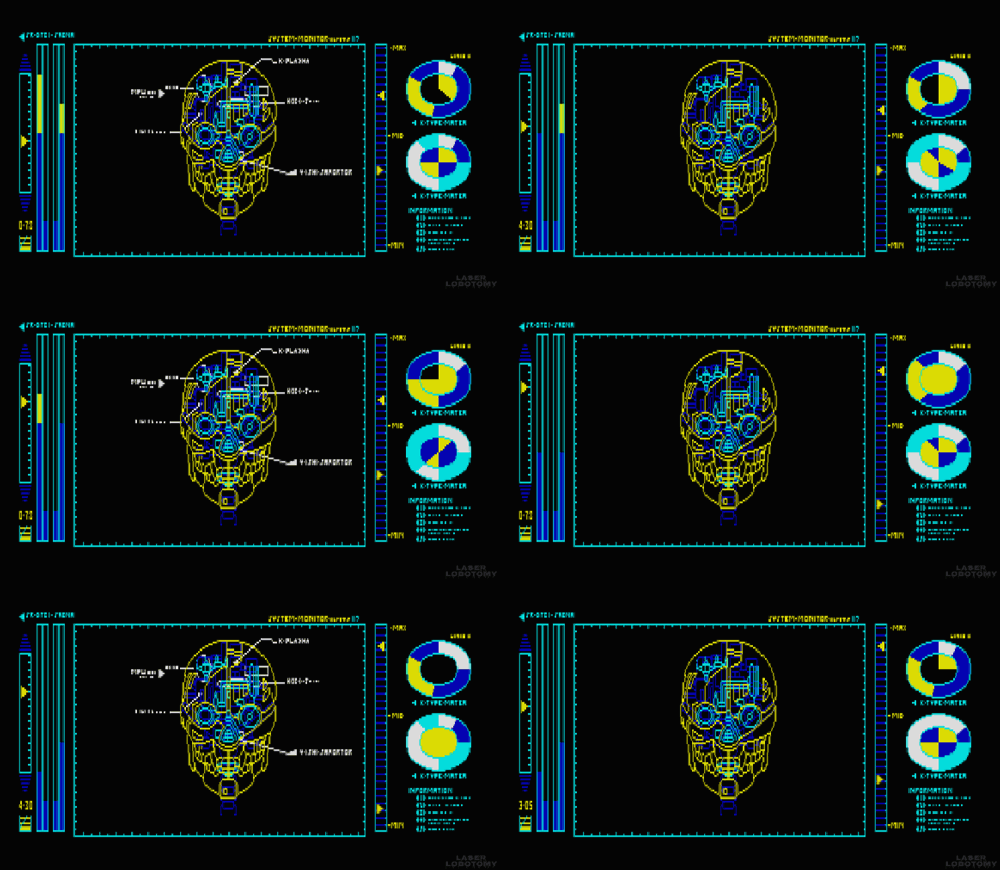
Of course, the 80s wasn't the only era for ridiculous sci-fi interfaces. The Awl has a great piece on how Minority Report's interfaces, which seemed so futuristic in 2002, were just a fancy packaging of already-existing technology.
Here are some other cool interfaces from science fiction:
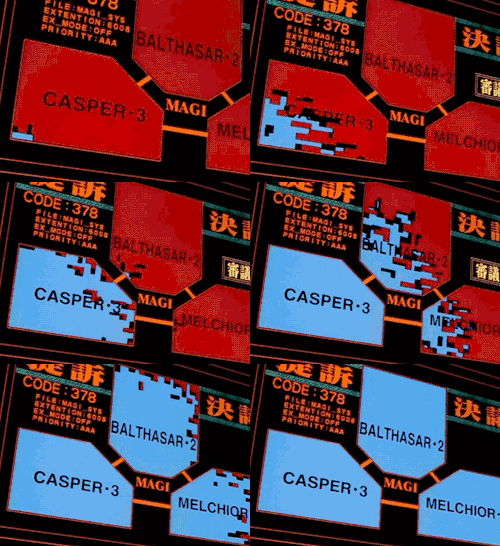
Magi, a trio of supercomputers from the anime series Neon Genesis Evangelion, are shown here in the process of being hacked. If only cyber threats were that easy to spot!
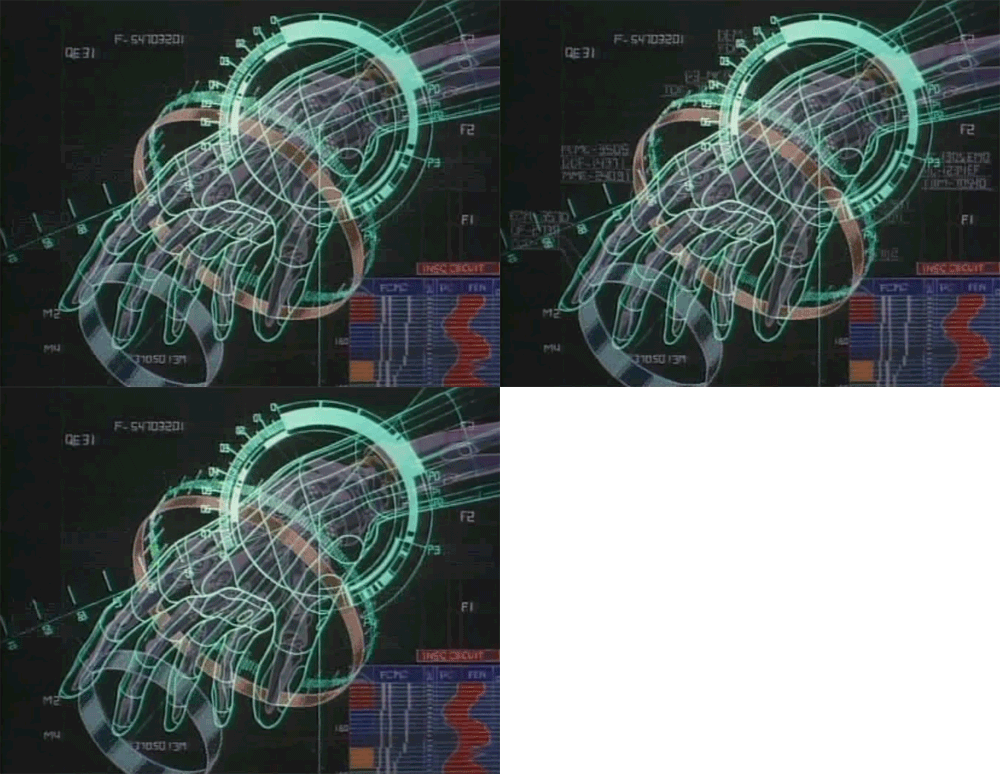
This image comes from the anime miniseries AD Police, a cyberpunk detective story made in 1990.
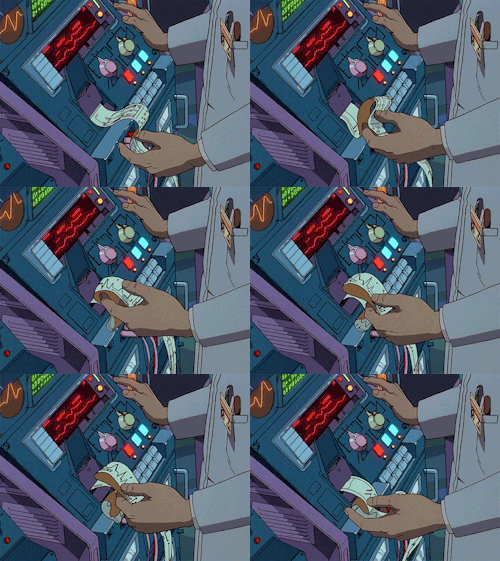
A computer that prints out what looks like electrical schematics on receipt paper.

Here is a image of a backlit keyboard from 1988's Akira.
All these animated .gifs come from the "Futuristic User Interface" tag at VisualPunker's tumblr. There are plenty more to check out.

    
|
“Orbiting Earth in spaceship, I saw how beautiful our planet is. People, let us preserve and increase beauty, not destroy it!” -Yuri Gagarin
Fifty-two years ago today, the first human being left Earth, and we began our journey into outer space. But back in 1961, we didn’t really know how far outer space stretched, or where all the matter and energy in the Universe came from.

Image credit: NASA, 1962.
That all changed with the discovery of the Cosmic Microwave Background (by Penzias and Wilson, with the Horn Antenna, above), and subsequent measurements that led us to the Big Bang picture of the Universe. Beginning from a hot, dense state the Universe expanded and cooled, forming baryons, light nuclei, neutral atoms, and finally stars, galaxies, clusters and superclusters of matter, where finally human beings formed on our little world, and looked out — and back — into the Universe.

Image credit: ESA and the Planck collaboration.
The Big Bang gave us a way for all of this to make sense, in the context of relativity. We now know, thanks to a slew of measurements, including the latest from Planck, that the Universe is currently made up of about 4.9% normal matter, about 26% dark matter, and 69% dark energy.
It’s a remarkable success story for the Big Bang.

Images credit: ESA & the Planck Collaboration (top), Planck Collaboration: P. A. R. Ade et al., 2013, A&A Preprint (bottom).
But this doesn’t explain everything, at least, not on its own. For example:

Original image source unknown.
All of these problems could simply just be the way the Universe is, of course. We get one Universe that we can see and access, and — as bewildering as it might seem — not every question we have about it is going to be answerable. There are a finite number of particles, and hence a finite amount of information, in the Universe, and the clues to answer all our questions might not be accessible to us.
But there was a brilliant idea thrown out there by Alan Guth in late 1979/early 1980, which is that you can’t extrapolate arbitrarily far back in the history of the Universe. Not to arbitrarily early times, not to arbitrarily high energies. Instead, before you could describe the Universe as hot, dense, expanding and cooling — i.e., before the Universe could be described by the Big Bang model — there was a period where it was dominated by the energy inherent to spacetime itself, and it expanded exponentially.

Image credit: Ned Wright’s Cosmology Tutorial, http://ned.ipac.caltech.edu/.
This period of exponential expansion — known as cosmic inflation — would basically force the Universe to be flat. Not necessarily truly flat, as it could either be positively curved (like a hypersphere) or negatively curved (like a hyper-saddle), but flat enough so that, from our perspective, it’s indistinguishable from flat. Just as panel D above (or the Earth, when you look out your window) appears flat, so the entire observable Universe would appear flat to us.
This also allows the Universe to be the same temperature and energy density everywhere, as well, since a tiny region that expanded exponentially became the spacetime that contains the entire Universe! And — so long as the exponential expansion lasted at least some 10-30something seconds — every direction in our Universe would have the same average energy and temperature properties.
And then, some 13.8 billion years ago from our perspective, this period of exponential expansion had to end!

Image credit update: Narlikar and Padmanabhan, retrieved from Ned Wright.
That means we had to go from a “false vacuum” state, where there was lots of energy inherent in space itself (which is what would cause the exponential expansion), to a state where the energy of empty space was much lower.
Of course, energy is conserved in this Universe, as best as we can tell, so it has to go somewhere. And where did all of that energy inherent to spacetime go?

Image credit: Retrieved from http://case.ntu.edu.tw/hs/wordpress/?p=41808.
Into matter and radiation, of course! So all of that field energy gets dumped into the particles we know (in a process called cosmic reheating), at a temperature that’s low enough that no magnetic monopoles get created. In fact, we can place an upper limit on the temperature of the Universe after inflation has ended, and it’s something like 0.1% of the Planck energy, which may well be below both the String and Grand-Unified-Theory energy scales, even if they are relevant to our Universe.
But wait, there’s more!

Image credit: Ned Wright, via http://www.astro.ucla.edu/~wright/cosmo_04.htm.
This is still a Universe governed by quantum laws, and that means quantum fluctuations happened even during inflation. But rather than being confined to one region of spacetime, because it’s expanding exponentially, these fluctuations get stretched across the entire observable Universe!
This means that today, we should see a spectrum of fluctuations that’s nearly scale invariant, but slightly tilted (e.g., slightly less than ns = 1), that has a very tiny roll (on the order of 0.008), and that should be of a magnitude that’s a few parts in a hundred-thousand.

Image credit: Planck Collaboration: P. A. R. Ade et al., 2013, A&A preprint; annotations by me.
And, lo and behold, that’s exactly what we’re seeing! That’s right, inflation has met all the tests of a good scientific theory:
And there it is. Inflation happened, gave the seeds for structure in an otherwise uniform Universe, and then created a bath of matter and radiation in almost perfect (but, importantly, not quite), almost isotropic, almost homogeneous way. And it sets up everything our Universe needs for the Big Bang.

Image credit: U&I Software, http://www.uisoftware.com/. I just like this picture.
Once that happens, your Universe begins cooling as it expands. Now the radiation is free to have its wavelengths stretched as the Universe expands, the volume of the Universe increases even though the number of matter particles stays constant, and, eventually, gravity does its thing. Over time, the great cosmic structures we’ve come to discover form, and that’s our Universe!

Image credit: John Dubinski (U of Toronto).
That’s the story of how we started from nothing and made it to today. But today, we also know that the energy inherent to spacetime isn’t zero, but rather is some small-but-finite value!

Image credit: Wikimedia commons user Emok.
That’s what we see when we hold two plate apart in a vacuum (the Casimir effect); that’s what we see happening all through the Universe with distant supernovae (dark energy).

Image credit: Suzuki et al. (The Supernova Cosmology Project), ApJ (2011); Union 2.1.
So yes, the Universe was once, in the distant past, dominated by energy inherent to spacetime itself. When this period ended, the Universe could then (and only then) be described by the Big Bang, which is where all the matter and energy in our entire Universe as we know it comes into being. And now, that the Universe has diluted — or expanded and cooled — so severely, we can finally see that there’s still a little bit of energy inherent to spacetime itself left: that’s dark energy!
We don’t understand all the caveats of inflation, or of dark energy, for that matter, including whether or not they’re related. But just a generation ago, we didn’t know anything at all about the energy inherent to spacetime, and now we know it to be an integral part of our Universe’s history! So when we say the Universe “Started With A Bang,” that’s just our observable Universe, and all the matter and energy in it. But something was before: empty spacetime, expanding exponentially. In physics, that’s also known as nothing, and it’s where everything came from, and where everything will return to in the future. Let’s never stop working to understand it a little better.

$50 billion: the amount Russia will invest in an ambitious space program to put a person on Mars, build a moon base, and shoot down foreign threats
9%: the portion of Americans who would have sex with a robot
7 millimeters: the average distance that nipples traveled toward the shoulders each year among women who didn't wear bras
60,000 tons: the estimated weight of a mysterious ancient stone artifact discovered under the Sea of Galilee
30 days: the time it would take to get to Mars using a new fusion rocket
$2.7 billion: the amount spent on crowdfunding in 2012, a three-fold increase from 2010
2017: the year the new exoplanet-hunting mission, called TESS, will launch
$5.3 million: the amount someone paid this week for a letter describing DNA that Francis Crick wrote to his son in 1953
1,000: the years humans have to colonize another planet before facing extinction on Earth, according to physicist Stephen Hawking
$200: the cost to produce a new DVD player that tests for HIV
1 billion: the number of stars the spacecraft Gaia will map of our galaxy's 100 billion

|
|
The small Baltic republic of Estonia is run like a corporation. But its president believes government must to play a crucial role in areas of digital policy such as secure ID.
Toomas Hendrik Ilves must feel one-of-a-kind when he attends international summits. His personal trajectory has nothing in common with the backgrounds of other heads of state. Born in Stockholm in 1953 where his parents had taken refuge from the Soviet-controlled Estonia, Ilves was raised mostly in the United States. There, he got a bachelor’s degree in psychology from Columbia University and a master’s degree in the same subject from the University of Pennsylvania. In 1991, when Estonia became independent, Ilves was in Munich, working as a journalist for Radio Free Europe (he is also fluent English, German and Latin.) Two years later, he was appointed ambassador to — where else? — the United States. In 2006, a centrist coalition elected him president of the republic of Estonia (1.4m inhabitants).

One more thing about Toomas Hendrik Ilves: he programmed his first computer at the age of 13. A skill that would prove decisive for his country’s fate.

Last week in Paris, president Ilves was the keynote speaker at a conference organized by Jouve Group, a 3,000 employees French company specialized in digital distribution. The bow-tied Estonian captivated the audience with his straight speech, the polar opposite of the classic politician’s. Here are abstracts from my notes:
“At the [post-independence] time, the country, plagued by corruption, was rather technologically backward. To give an example, the phone system in the capital [Tallinn] dated back to 1938. One of our first key decisions was to go for the latest digital technologies instead of being encumbered by analog ones. For instance, Finland offered to provide Estonia with much more modern telecommunication switching systems, but still based on analog technology. We declined, and elected instead to buy the latest digital network equipment”.
Estonia’s ability to build a completely new infrastructure without being dragged down by technologies from the past (and by the old-guard defending it) was essential to the nation’s development. When I later asked him about the main resistance factors he had encountered, he mentioned legacy technologies: “You in France, almost invented the internet with the Minitel. Unfortunately, you were still pushing the Minitel when Mosaic [the first web browser] was invented”. (The videotext-based system was officially retired at last in… 2012. France lost almost a decade by delaying its embrace of Internet Protocols.)
The other key decision was introducing computers in schools and teaching programming on a large scale. Combined to the hunger for openness in a tiny country emerging from 45 years of Soviet domination, this explains why Estonia has become an energetic tech incubator, nurturing big names like Kazaa or Skype (Skype still maintains its R&D center in Tallinn.)
“Every municipality in Estonia wanted to be connected to the Internet, even when officials didn’t know what it was. (…) And we played with envy…. With neighbors such as Finland or Sweden, the countries of Nokia and Ericsson, we wanted to be like them.”
To further encourage the transition to digital, cities opened Internet centers to give access to people who couldn’t afford computers. If, in Western Europe, the Internet was seen as a prime vector of American imperialism, up in the newly freed Baltic states, it was seen as an instrument of empowerment and access to the world:
“We wanted a take the leap forward and build a modern country from the outset. The first public service we chose to go digital was the tax system. As a result, not only we eliminate corruption in the tax collection system — a computer is difficult to bribe –, but we increased the amount of money the state collected. We put some incentives in: When filing digitally, you’d get your tax refund within two weeks versus several months with paper. Today, more than 95% of tax returns are filed electronically. And the fact that we got more money overcame most of the resistance in the administration and paved the way for future developments”.
“At some point we decided to give to every citizen a chip-card… In other words, a digital ID card. When I first mentioned this to some Anglo-saxon government officials, they opposed the classic ”Big Brother” argument. Our belief was, if we really wanted to build a digital nation, the government had to be the guarantor of digital authentication by providing everyone with a secure ID. It’s the government’s responsibility to ensure that someone who connects to an online service is the right person. All was built on the public key-private key encryption system. In Estonia, digital ID is a legal signature.The issue of secure ID is essential, otherwise we’ll end-up stealing from ourselves. Big brother is not the State, Big Brother lies in Big Data.”
“In Estonia, every citizen owns his or her data and has full access to it. We currently have about 350 major services securely accessible online. A patient, never gets a paper prescription; the doctor will load the prescription in a the card and the patient can go to any pharmacy. The system will soon be extended to Sweden, Denmark, Finland, Norway, as our citizens travel a lot. In addition, everyone can access their medical records. But they can chose what doctor will see them. I was actually quite surprised when a head of State from Southern Europe told me some paper medical records bear the mention “not to be shown to the patient” [I suspect it was France...]. As for privacy protection, the ID chip-card works both ways. If a policeman wants to check on your boyfriend outside the boundaries of a legal investigation, the system will flag it — it actually happened.”
As the Estonian president explained, some good decisions also come out of pure serendipity,:
“[In the Nineties], Estonia had the will but not all the financial resources to build all the infrastructure it wanted, such as massive centralized data centers. Instead, the choice was to interconnect in the most secure way all the existing government databases. The result has been a highly decentralized network of government servers that prevent most abuses. Again, the citizen can access his health records, his tax records, the DMV [Department of Motor Vehicles], but none of the respective employees can connect to another database”.
The former Soviet Union had the small Baltic state pay the hard price for its freedom. In that respect, I recommend reading CyberWar by Richard Clarke, a former cyber-security advisor in the Clinton administration, who describes multiple cyber-attacks suffered by Estonia in 2007. These actually helped the country develop skillful specialists in that field. Since 2008, Tallinn harbors NATO’s cyber defense main center in addition to a EU large-scale IT systems center.
Toomas Hendrik Ilves stressed the importance of cyber-defense, both at the public and private sector level:
“Vulnerability to a cyber attacks must be seen as a complete market failure. It is completely unacceptable for a credit card company to deduct theft from its revenue base, or for a water supply company to invoke cyber attack as a force majeure. It is their responsibility to protect their systems and their customers. (…) Every company should be aware of this, otherwise we’ll see all our intellectual property ending up in China”.
–frederic.filloux@mondaynote.com
Related columns:

submit to me pleaseee whatevergoeswillgo.tumblr.com/submit
and follow me on twitter https://twitter.com/#!/WhateverGoesWG