
Nano Letters
DOI: 10.1021/acs.nanolett.9b01822
Author(s): C. Schelte, P. Camelin, M. Marconi, A. Garnache, G. Huyet, G. Beaudoin, I. Sagnes, M. Giudici, J. Javaloyes, and S. V. Gurevich
Time-delayed dynamical systems materialize in situations where distant, pointwise, nonlinear nodes exchange information that propagates at a finite speed. However, they are considered devoid of dispersive effects, which are known to play a leading role in pattern formation and wave dynamics. We show...
[Phys. Rev. Lett. 123, 043902] Published Fri Jul 26, 2019
Author(s): D. Faccio and E. M. Wright
Superradiant gain is the process in which waves are amplified via their interaction with a rotating body, examples including the evaporation of a spinning black hole and electromagnetic emission from a rotating metal sphere. In this Letter we elucidate how superradiance may be realized experimentall...
[Phys. Rev. Lett. 123, 044301] Published Tue Jul 23, 2019
Author(s): Tamara Bardon-brun, Dominique Delande, and Nicolas Cherroret
We show that optical beams propagating in transversally disordered materials exhibit a spin Hall effect and a spin-to-orbital conversion of angular momentum as they deviate from paraxiality. We theoretically describe these phenomena on the basis of the microscopic statistical approach to light propa...
[Phys. Rev. Lett. 123, 043901] Published Tue Jul 23, 2019

Nature Reviews Materials, Published online: 21 June 2019; doi:10.1038/s41578-019-0120-5
Materials with vanishingly small dielectric permittivity, known as epsilon-near-zero materials, enable strong ultrafast optical nonlinear responses within a sub-wavelength propagation length. This Review surveys the various observations of nonlinear phenomena in this class of materials.
Author(s): Xiao-Dong Chen, Wei-Min Deng, Fu-Long Shi, Fu-Li Zhao, Min Chen, and Jian-Wen Dong
Recently, higher-order topological phases that do not obey the usual bulk-edge correspondence principle have been introduced in electronic insulators and brought into classical systems, featuring in-gap corner or hinge states. In this Letter, using near-field scanning measurements, we show the direc...
[Phys. Rev. Lett. 122, 233902] Published Fri Jun 14, 2019
Author(s): Yang Luo, Gong Chen, Yang Zhang, Li Zhang, Yunjie Yu, Fanfang Kong, Xiaojun Tian, Yao Zhang, Chongxin Shan, Yi Luo, Jinlong Yang, Vahid Sandoghdar, Zhenchao Dong, and J. G. Hou
We demonstrate single-photon superradiance from artificially constructed nonbonded zinc-phthalocyanine molecular chains of up to 12 molecules. We excite the system via electron tunneling in a plasmonic nanocavity and quantitatively investigate the interaction of the localized plasmon with single-exc...
[Phys. Rev. Lett. 122, 233901] Published Wed Jun 12, 2019
Author(s): P. Forn-Díaz, L. Lamata, E. Rico, J. Kono, and E. Solano
In the ultrastrong coupling regime, light and matter can no longer be distinguished: their coupling strengths are as large as their own energy scales. Even for simple two-level systems, this represents a new regime to explore within the quantum Rabi model. There has been considerable theoretical and experimental progress on the physics of these systems in recent years, as presented in this review. Key experimental results are discussed in a set of current platforms arising in quantum information research, including superconducting and semiconducting devices, and other hybrid quantum systems.

[Rev. Mod. Phys. 91, 025005] Published Fri Jun 07, 2019
Nature Reviews Materials, Published online: 04 June 2019; doi:10.1038/s41578-019-0113-4
Topological nanomaterials exhibit enhanced topological surface states and are thus promising for next-generation electronic devices and quantum computations. This Review discusses synthesis and transport results of topological nanomaterials, with a special focus on 1D topological superconductivity realized using topological insulator nanowires.


Nature Reviews Physics, Published online: 28 May 2019; doi:10.1038/s42254-019-0056-0
Using quantum states of light for imaging both reveals quantum phenomena and enables new protocols that result in images that surpass classical limitations. Such systems require both quantum light sources and often the ingenious use of detector technologies.Author(s): Sebastian Franke, Stephen Hughes, Mohsen Kamandar Dezfouli, Philip Trøst Kristensen, Kurt Busch, Andreas Knorr, and Marten Richter
We introduce a second quantization scheme based on quasinormal modes, which are the dissipative modes of leaky optical cavities and plasmonic resonators with complex eigenfrequencies. The theory enables the construction of multiplasmon or multiphoton Fock states for arbitrary three-dimensional dissi...
[Phys. Rev. Lett. 122, 213901] Published Wed May 29, 2019
Author(s): D. Pierangeli, G. Marcucci, and C. Conti
A new optical processor for solving hard optimization problems breaks previous size records and is based on a highly scalable technology.

[Phys. Rev. Lett. 122, 213902] Published Fri May 31, 2019
Author(s): Mohamed ElKabbash, Ermanno Miele, Ahmad K. Fumani, Michael S. Wolf, Angelo Bozzola, Elisha Haber, Tigran V. Shahbazyan, Jesse Berezovsky, Francesco De Angelis, and Giuseppe Strangi
Quantum emitters located in proximity to a metal nanostructure individually transfer their energy via near-field excitation of surface plasmons. The energy transfer process increases the spontaneous emission (SE) rate due to plasmon-enhanced local field. Here, we demonstrate a significant accelerati...
[Phys. Rev. Lett. 122, 203901] Published Wed May 22, 2019
Author(s): P. Scarlino, D. J. van Woerkom, A. Stockklauser, J. V. Koski, M. C. Collodo, S. Gasparinetti, C. Reichl, W. Wegscheider, T. Ihn, K. Ensslin, and A. Wallraff
A superconducting resonator coupled to a semiconductor double quantum dot allows for a detailed study of coherence properties of charge qubits.
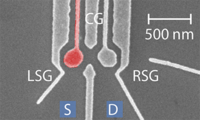
[Phys. Rev. Lett. 122, 206802] Published Wed May 22, 2019
Author(s): Yao Wang, Yong-Heng Lu, Feng Mei, Jun Gao, Zhan-Ming Li, Hao Tang, Shi-Liang Zhu, Suotang Jia, and Xian-Min Jin
Topology manifesting in many branches of physics deepens our understanding on state of matters. Topological photonics has recently become a rapidly growing field since artificial photonic structures can be well designed and constructed to support topological states, especially a promising large-scal...
[Phys. Rev. Lett. 122, 193903] Published Thu May 16, 2019


