Shared posts

26 Nov 19:48

Over nine thousaaaaand times more productive!

Vegeta, what does Nathan Myhrvold say about the productivity differential between top software developers and average ones?

Nathan Myhrvold, it turns out, says: "I was speaking colloquially when I said “10,000X” - it is not meant to be an utterly precise measurement.“

But hey, "the general effect has been verified in a bunch of studies.”

It’s worth noting that the Myhrvold claim is a double mutation of the original “10x meme”. The most obvious mutation here is that 10x gains three orders of magnitude.

But an even more deleterious mutation is the one from “difference between best and worst developer”, to “difference between best and average developer”.

Knowing how Internet memes work, I wonder if someone will take it one step further and claim something more outrageous as being backed by “a bunch of studies”… In fact I wonder if it has already happened…

26 Oct 07:14

All Scrollbars Are Fleeting

by mhoye

“For over a thousand years, Roman conquerors returning from the wars enjoyed the honor of a triumph – a tumultuous parade. In the procession came trumpeters and musicians and strange animals from the conquered territories, together with carts laden with treasure and captured armaments. The conqueror rode in a triumphal chariot, the dazed prisoners walking in chains before him. Sometimes his children, robed in white, stood with him in the chariot, or rode the trace horses. A slave stood behind the conqueror, holding a golden crown, and whispering in his ear a warning: That all glory is fleeting.” – Patton (film)

I wish, just at this second, that the executives at Sony and Microsoft (though not exclusively them, to be sure) each had an employee, assigned personally to them, with a single task.

Their job is this: at any moment, day or night, at the instant that executive is about to begin something, they will decide arbitrarily, according to their whims and utterly without regard for the importance of the situation, to say the words “software update”.

At that point, the executive in question is obligated to simply stop. To be still, and do nothing. Perhaps they can decline – they can simply choose not to do whatever they were about to, knowing they’ll have to pay for this time later regardless – and after a period of time, perhaps five minutes, perhaps an hour, their employee will then simply say “restart”, and they can go on their way.

Over and over again, until they learn.

26 Oct 04:57

Non-framework approach to JavaScript apps - hexagonal.js

by Andrzej Krzywda
This week we have officially launched and announced hexagonal.js.

The announcement was welcomed with a fair amount of interest. Jan Filipowski at the Arkency blog did a great job of explaining the basic ideas.

I'd like to cover the topic of hexagonaljs not being a framework.

What is a framework?

Some time ago I asked "What is a framework?". I liked the following answer:

In the case of a framework, your code is called by it. In the case of a library, your code call it. Rails is a framework, and provides libraries too.

I have a love/hate relationship with frameworks. That's why I struggled for months, what to do with the ideas that we're now calling hexagonal.js. I didn't want it to be a framework. That would ruin the whole experience.

Let me tell you a story on how it all started and why we didn't want it to be a framework.

The technical story of haxagonal.js

The first ideas were created when we were working on social web games at GameBoxed. Given the scale we were operating on (sometimes 4-5 social apps/games a month) we needed a high degree of reusability. Reusability requires good modularity. Often, we've had apps that have the same "logic", but they had much different GUI, sounds, FB integration etc.

We got the idea of use cases as objects from the DCI approach (DCI is much more than that!). We've experimented with the concept that it's the use-case that drives everything. Driving something (like playing sounds) meant calling it. Calling it directly meant creating a coupling between the use-case and the SoundAdapter, which didn't sound like a good idea.

One approach was to use events. The use case would trigger an event and the adapter would bind to it. It resulted in less coupling. It wasn't bad. To me, it wasn't yet the final solution, though. I didn't like the fact, that the use-case objects were full of "trigger someEvent" statements.

When I looked at the events, I realised that they happen usually at the beginning or at the end of a method in the use case.

Before, After....

Wait, wasn't that what AOP was about?

Introducing some simple AOP techniques (thanks to awesome Raganwald's library!), we have achieved exactly what was needed. This is what we currently call a Glue code. It's almost like a configuration, in most cases. No logic, just declarations.

Hexagonal architecture

We started with MVC in mind. The most basic rule of MVC is that when the model changes, the views are notified about it. After some time, we've realised that it's not only about views, unless you try to fit "playing sounds" into the View layer ;)

In a hexagonal architecture, GUI is just one of the adapters. It's usually the most important one, but technically, still, just an adapter.

In many apps, the GUI is the only adapter.

ServerSideAdapter, PusherAdapter, SoundAdapter, FirebaseAdapter, FacebookAdapter, LinkedInAdapter - those are just examples of the adapters, that we used so far.

It's not a framework

Given all of the above, we were struggling on how to bring this idea to people, without making them depend on any framework. The whole idea is a bit anti-framework.

Hexagonal.js is not even a library. It's mostly an architectural style adapted to JavaScript apps. We provide many examples (and more in progress..), that can guide you. You can copy them, fork them and have a good starting point.

It's probably a slightly unusual approach to deliver some ideas to you. It's not a framework, not a library.

Hexagonal.js is a set of good patterns that are extracted from real-world production apps. It was used to build dozens of apps, with a good speed of development.

You can look at the examples we already have. Look at the use case object, the glue and the adapters. It's a pattern that reappears in every hexagonaljs app. There is also an example of using it from a Rails app.

Tell us what you think about this approach. We've published it to bring more ideas. We're open for suggestions!

Thanks for reading.


24 Oct 21:33

Flight

by cheimonette

When I was a kid, my bedroom window faced what I still believe to be the most beautiful alleyway in San Francisco. The alley sloped upwards from our house, which stood at the lower end, with the surrounding neighbors’ driveways and back yards connecting all along the alley’s spine. Our neighbors’ gardens overflowed with camellia bushes and rose trees, edged by fences piled high with climbing morning glories and honeysuckle and clematis. My room was on the second floor, and I could see right into everyone’s back yard. Our neighborhood was mostly full of elderly couples even at that time, and I would watch an old man though a picture window, at the upper end of the alley, slowly mount his stationary bicycle at 6 A.M. every day and stare gloomily into space for an hour while he pedaled. There was a dyed, painted, and very sour-looking lady with silver hair who often worked in her rose garden, and whose livid purple gardening gloves I could see even through the heaviest fog. A little, speedily balding cantor from the neighborhood synagogue used to trot out on sunny afternoons in flowered Bermuda shorts with a plastic lawn chair, and listen to opera music while sunning himself and dreamily turning the pages of a ragged newspaper.

Around the time of my thirteenth birthday, the couple next door to us, a truly ancient man who looked entirely constructed of dried papyrus, and a bedridden lady who I had never seen, put the house up for sale. I found out that the lady had died of cancer, and her husband did not want to keep the house. Within a few months another couple had moved in. The man was an uninteresting-looking businessman with a bland face and grey hair, in appearance not unlike the father in “Calvin and Hobbes”. He would shuffle out into the garden on occassion to watch his young wife and two small children play together. Once I was delighted to see him hand his little girl a bottle of beer and let her sip it a few times, but he never again displayed any vestige of personal distinction. I thought his wife quite beautiful, and often wished to peek over our fence and talk to her. She had curly brown hair that fluffed all around her head oddly and made her look like a slovenly angel when the sun shone through it. She wore jeans and men’s shirts, was wonderfully tall, and her lean arms and neck were covered in freckles the color of pupils in sepia photographs. My favorite thing about her was that she would sometimes pause over her children, who were docile and blond like Golden Labrador puppies and only rarely whimpered for attention, and she would gaze for a long time up into the sky. There wasn’t anything up there to see, except clouds. I made sure to lean out the window and follow her line of sight several times, and there was never an aircraft or a bird or a stray balloon to watch. I thought that she looked up into the sky to use it as a blank canvas to receive the rich artistry of a profound imagination.

During my earlier childhood (say, ages five to eleven) I was bold in the use of our alley. I visited the neighbors and peered over their fences until they complained to my mother, and made friends with all the cats and dogs who frequented the neighborhood. I built a structurally unsound go-cart out of wood and wagon parts with my father and sped down the alley, crashing deliberately into garage doors when I frightened myself by going too fast. In the evenings, I liked to blow up an old balloon and use a Ping-Pong paddle to keep it from falling to the ground, bumping it gently into the air every time to catch the golden light from the sunset. My parents sometimes allowed me to earn five dollars by washing their car, a job I executed poorly but thoroughly. On weekends I put on a leotard, a homemade set of cat ears, and a tail I later learned was meant to be part of a rat costume, and climbed over our fence and up the alley to wander around the neighborhood by myself, meowing when mothers with strollers and men walking dogs looked at me strangely. The majority of this boldness vanished during the year that I was twelve, after which I preferred to read and draw and write, and watch the daily activity of the alley in the safety of my room.

So by the time the young wife moved in next door, it was too late for me to just lean over the fence and say hello to her. I had grown shy, and my peculiarities as a little kid began to catch up with me in high school. It was the 90s, and I felt bewildered with my classmates’ obsessions with dating and fashion and modern music. I bungled my way through 18th century philosophy books while the other kids watched MTV. While the computer nerds learned how to code in the dank computer lab, and the potheads were stealing bites of a piece of space cake in the bathroom, and a blond boy with eyeliner was kicked out of his mother’s house, I wandered around the little garden behind the music room, gnawed on unripe pomegranates, and pretended I believed in tree spirits and fairies. Although I never excelled in much besides art and English literature, my teachers seemed to find me refreshing after having to suffer through the petty sea of hormones and impulsive thinking that largely constitute up the lives of teenagers. I don’t think that I was really less superficial than the other kids; I simply had no group of friends. Quentin Crisp once said that no one is boring who will tell the truth about himself. I agree, and the fact is that people of any age behave more honestly when they are alone.

By the time I was fifteen I was desperate to make contact with an outside world of which I knew even less than most fifteen-year-olds. The Internet had just begun to rise from the primordial ooze, and I ventured into AOL chat rooms, armed with not-quite-clever-enough lies and a murky soup of desires that I was unable to articulate even to myself. After sneaking out of bed late one night and watching a gangster movie in which a house was set ablaze from a flaming brick hurled into a parlor window, I got the idea to start sending my young neighbor anonymous notes. I began to write terrible poetry. It wasn’t blank verse about love or being a misunderstood genius, and it wasn’t a poor imitation of an admired writer, all of which I understand is the usual literary output of teenagers. Therefore I did have the merit of being original. What made my poetry awful was an overly wordy, melodramatic style, combined with truly radioactive levels of self-importance (these are not terrible qualities by themselves, but combined they make for some seriously clumsy and pedantic writing).

I don’t think that my notes ever frightened her. My romantic attentions were entirely taken up by a tomboyish blond girl at my school who had a lumbering boyfriend who looked just like her (a truly impressive obsession that I was far too cowardly to reveal to anybody at the time), and even then I had a fairly good sense of how to, at the very least, appear to respect personal space. I never wrote about myself, or about her or her family, or made any oblique references to love or sex. I simply wrote imaginative poetry about dreams, metaphors, philosophy, or the bits and pieces of abstract physics, which I picked up on the sly while I was supposed to be studying Newtonian mechanics. I would write to her on a piece of lined paper, fold it up carefully into an airplane, and send it sailing into her yard, always under cover of night. I never knew if she read them. The planes usually sank out of sight beyond the fence, and I never saw her pick one up. She continued to dreamily alternate between watching the sky and watching her children play in the garden, for three more years. I then went to college, and when I came home after my first semester, she and her family had moved away.

Although my poetry was forgettable (except for a single line that I recall, about children praying to the ceiling through closed eyes), I had never written such private things to anybody in the world before. I was a fairly secretive child and had been an outrageous liar when younger (I once stubbornly insisted to my entire cabin at summer camp that I had grown up on a farm where there were nine cows named after the Greek Muses, several ostriches and a monkey named Lester). At fifteen, I discovered that what I really wanted was to be understood. I believed that my young neighbor and I thought similar thoughts and saw similar visions. I imagined that she would find my white, lined airplanes, and be secretly delighted that the sky she stared up at so often had finally yielded strange gifts meant only for her. I believed that she would see herself in my poems, and that they would be little passages communicating intellectual kinship and solidarity, that when she would lie awake next to her boring husband, or fix breakfast for her vapid, blond, puppy-children, she would feel that there was someone else in the world who thought as she did.

Oh, the solipsism of youth. But you see, I never knew for sure. I never spoke to her. I have thankfully developed many gratifyingly material relationships with the outside world, which has in return grown from a mere macrocosm of myself into a universe of previously unimagined proper nouns. Nevertheless, my experience of being a creepy teen that watched my young neighbor and sent her paper airplane poetry was my first lesson in how to be an artist. Many begin their lives learning how to blend gracefully into shared social habituation and normalize themselves to the lives of those around them. Like me, many do not begin this way. We usually find, later, some other way to make contact, from the inside out. As though I had travelled deep into the Arctic Circle and discovered there among the icebergs a perfect replica of my own room, I suddenly realized what an artist was, and that I was one. It would be about ten more years before I began to shake myself free of my reluctance to leave the safety of my loneliness, and now, nineteen years later, I can say with complete, self-aware honesty that I have indeed discovered my own dear room in the howling, icy wilderness, in the shape of my community and my partners and my ever-increasing sphere of friendships.

I would like to thank my young neighbor, wherever she is now, for being the recipient of my writing. C/O neighbor woman, golden brown hair, freckles.

Thank you.

19 Oct 04:34

Get to work

by Emily Blake
What are you writing right now?

I hope you have an answer. If you don't - if you hem and haw and make excuses, or if you mumble some words knowing you haven't touched your screenplay in months, stop it. Quit what you're doing and get to work.

I think the biggest threat to most screenwriters is our own self-doubt. We all have it. You get on this high when things are good. The pages flow, the ideas seem perfect, we're already planning the Oscar speech. But then one person reads our latest work and hates it, and we are riddled with fatalism.

Or maybe you never get that far. Maybe you're so convinced that your writing sucks that you can't finish anything.

It's normal. It's also some shit you have to get over if you want to write a great script.

EVERYBODY sucks. They know they suck. Even the best writers, the people you admire and respect and want to be like some day, the people you think are natural geniuses - they are absolutely certain that they suck. But they do the work anyway.

I suck. But I figure I'll keep writing anyway because I don't know what else to do. When I get notes that tell me I have to start over from scratch because nothing works, I have a routine that keeps me working. I pitch a fit for ten minutes. I rant and rave and shout and slam shit around and kick and pout. And after I get that out of my system, I get back to work.

For me, it comes down to faith. No matter how daunting the work feels in the beginning, or after you get a particularly prickly set of notes, the solution is almost never as difficult as it sounds like it will be in that moment. So I tell myself this sucks and I'm mad and I don't wanna and boohoo, and then I remind myself that I can do this. I know I can do this. I don't know how yet, but I know I'll figure it out.

Once I've decided I'm done feeling sorry for myself, I work on figuring out the solution to my problem. Solving puzzles is way more fun than moping around feeling like suckitude. When you have a big story problem, the best solution is to go after the stuff you thought was absolute. Those scenes I just KNEW had to be in the script? What if I scrap them completely? What else could I put there? Often, the answer appears as soon as I let go of certainty.

But the main thing is, believe that the answer will present itself. Believe that you can do this. And if your script isn't working - if somehow you just feel wrong - go back to start. What's not working, and how can you make it work? Because you can. You have to know you can. If you doubt that, you'll never finish the script.

So I'll ask again, what are you writing right now? Give me an answer.
21 Jul 19:52

Connection lost. Retry in 3…2…1 (Full view here.)


Connection lost. Retry in 3…2…1

(Full view here.)

21 Jul 19:51

My opinions, let us share them. 


My opinions, let us share them. 

11 Jul 04:17

Professional Distraction

by Sterling

“Professional Distraction,” reads my business card.

To some, this may seem at odds with what I describe as my Bodhisattva aspiration to be of genuine benefit to sentient beings.
One of my Hustle Meditations was featured recently on a Buddhist blog called The Under 35 Project (featuring young Buddhist and Buddhist-inspired voices; check it out at www.under35project) One reader left a rather scathing comment, which included his shock

“…that the author considers her work to bring ‘genuine benefit to … others in all [her] interactions.’ While her work might bring momentary sensual arousal, I was under the impression that in buddhism we do not consider this a genuine benefit. To me she seems to be feeding people’s cycles of craving and desire, perpetuating their unhealthy habits of thought and feeling, causing the kleshas to burrow further into their beings.”

Additionally, I had a teacher recently who summed the entire first turning (teaching) of the Dharma as “training in not being distracted,” in using the practice of meditation to tame the mind so that one can focus, and eventually rest in the present moment. Without buying into patterns of craving and aversion, we might even experience ourselves on the spot as awake, and luminous.

How could one be helpful in waking people up to their own goodness, while billing herself as a distraction?
I concede that at first glance my self-created title may be a little misleading. Even as I smile at the cries of “blasphemy,” I’d like to clarify my intention and share some of my experience.

Plenty of my clients are coming to the club already rolling in kleshas (negative emotions or mental states that cloud the natural wakefulness of the mind) which could very well manifest in negative actions. I take the very fact that they have come to visit me as indication that they would rather not go and drive their fists into a wall, or pace grooves into their carpets, or scream at members of their family out of frustration at their day. They would rather not act out their mental stories of inadequacy or overwhelming emotion in harmful, possibly violent, ways. I see this when I look into their eyes. They would rather change their minds, connect with someone not quite so invested, be seen.

What if I were indeed a distraction, but what if I could distract one from the wearisome mental chatter left over from the week and day, giving one something lovely to engage with in the present moment? What if my smile, the movement of my dance, the delightful naked canvas of my body, could invite one to relax, soften, and even possibly let it go? What if our play could wake us up? From this perspective, perhaps these late night sessions might not be considered so harmful. Perhaps they could even be described as “therapeutic.” It wouldn’t be the first time I have heard that word in connection with what I do.

I strive to give my clients something present and delightful with which to engage. I try to see their goodness, which is often more than what anyone has done for them all day or week or month. I love talking about what is going on our lives, encouraging a perspective of gentleness and kindness. Certainly I am a story teller and a performer, but in my work I try not to lie or lead my clients to expect something I am not offering. We have interactions that have a clear beginning, middle, and end. On the spot. Many times, radiant.

04 Jul 01:00

Higher social class predicts increased unethical behavior

Higher social class predicts increased unethical behavior:

"Mediator and moderator data demonstrated that upper-class individuals’ unethical tendencies are accounted for, in part, by their more favorable attitudes toward greed."

04 Jul 00:59

TSA's new Instagram shows all the dangerous items that presented no danger

by Cory Doctorow

The TSA has launched an Instagram account, showing all the "dangerous items" they steal confiscate from air travellers. The message is clear: we are keeping you safe from in-flight danger.

But what they don't show is all the grand-jury indictments for conspiracy to commit air terrorism that they secured after catching people with these items -- even the people who were packing guns.

That's because no one -- not the TSA, not the DAs, not the DHS -- believe that anyone who tries to board a plane with a dangerous item is actually planning on doing anything bad with them. After all, as New York State chief judge Sol Wachtler said (quoting Tom Wolfe), "a grand jury would 'indict a ham sandwich,' if that's what you wanted." So if there was any question about someone thinking of hurting a plane, you'd expect to see indictments.

I had this discussion with a TSA agent at LAX last week. He asked me why I'd opted out of the pornoscanner -- he'd been my pat-down assistant that day -- and we got to talking. I said that as a frequent flier, I was very interested in safe airplanes, but that I didn't think the TSA contributed to that. He disagreed and cited all the stuff he confiscated, but admitted, when I asked him, that he didn't think that anyone actually planned to do anything bad to airplanes with the stuff he took away, nor did he think they'd do something unplanned and dangerous to the airplane with it.

"But," he said, "maybe someone who did want to crash the plane might take the bad thing away from them and attack it."

"That doesn't sound like a very reliable plan," I said. "If you were a terrorist and that was your plan, you'd have to spend a lot of time in the air waiting for someone to open his laptop bag and show you that he forgot to take his handgun out of it before he boarded."

"Yeah," he said. He thought for a moment. "This is really above my pay-grade."

(via Cnet)


04 Jul 00:55

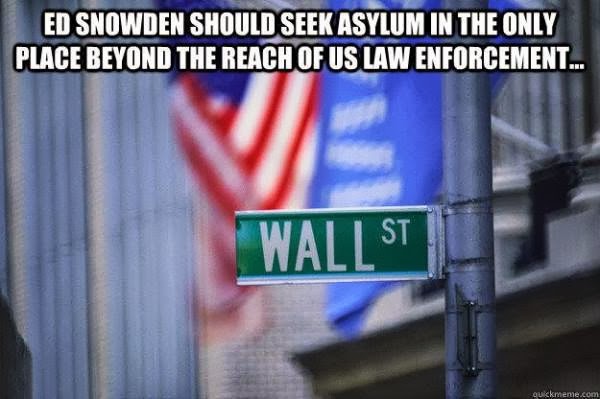
Snowden should seek asylum in the one place safe from US prosecution: Wall Street

by Xeni Jardin

Spotted on @dangillmor's feed, via Rick Falkvinge, photoshopper unknown.


04 Jul 00:55

Duck Duck Go search engine founder talks about data privacy [video]

by Mark Frauenfelder

[Video Link] Mark Hurst, founder of the Gel conference, says. "Duck Duck Go founder Gabriel Weinberg gave a great talk (about his search engine, and Google's practices that people may not know about) at Gel."

This 15-minute talk is full of eye-opening stuff. Every year, more lawyers are requesting users' Google records for court cases, for example.


04 Jul 00:53

Can The GOP Double-Down On The White Vote?

by Andrew Sullivan

Brit Hume recently downplayed the importance of the Hispanic vote:

Weigel explains why continuing to focus on white voters is attractive to many Republican politicians:

As they contemplate 2014 and 2016, Republicans are looking at elections where the white share of the vote may increase compared with 2012. They compare elections when Barack Obama was on the ballot against elections when he wasn’t. The white shares of the vote in 2008, 2010, and 2012 were, respectively, 74 percent, 77 percent, and 72 percent.

But Waldman thinks that winning a larger share of the white vote requires attempting to win minority votes:

[I]f you decide that you’re going to focus your efforts on turning out the white vote, you won’t only be sending a message to Latinos (and African Americans, and the fast-growing Asian American population) that you’re not interested in them, you’ll also be sending a message to moderate whites that your party might not be the kind of place they’d feel comfortable. This goes double for young white voters, who have grown up in a much more diverse culture than their parents and grandparents, and aren’t going to be so hot on joining the Party of White People.

Relatedly, Drum argues that the GOP should stop worrying about who gets “credit” for immigration reform:

Democrats get tremendous mileage by demonizing Republicans and winning ever greater shares of the Hispanic vote. Once immigration reform passes, they can’t do that. There will always be smaller issues out there, but they just won’t have the same impact as immigration reform. Taking that off the table sucks the air out of the Dem balloon and gives Republicans a better chance of setting the terms of the political debate, both within and without the Hispanic community. That’s why it’s a net winner for them, not because they’ll get “credit” for allowing it to pass.

The question is whether their ideology allows them to tolerate anything that might also get support from Democrats and Independents, let alone president Obama. These next couple of months will tell us a lot about whether we are watching a nose dive they can pull out of in time. So far, sadly, the omens are not good.


03 Jul 04:16

Wonkbook: Is this the laziest Congress ever?

by Ezra Klein, Evan Soltas

Welcome to Wonkbook, Ezra Klein and Evan Soltas's morning policy news primer. To subscribe by e-mail, click here. Send comments, criticism, or ideas to Wonkbook at Gmail dot com. To read more by Ezra and his team, go to Wonkblog.

Six months into its term, there's little evidence that the 113th Congress will be the worst Congress ever. But they might be the laziest.

On Monday, simply by doing nothing, they allowed the interest rate on student loans to double, from 3.4 percent to 6.8 percent. That might be permissible if they were busy with more important things, like inventing a cure for cancer that's also a source of endless clean energy. But they're not even working this week.

The 112th Congress passed 220 laws. That's the fewest of any Congress since we began keeping track in 1948. But the 113th Congress is on track to pass even fewer laws than that. "Just 15 bills have become law this year, compared to 23 over the same period in 2011," writes Dashiel Bennett at the Atlantic Wire. It's the do-nothingest Congress ever!

That doesn't make it the worst Congress ever. In fact, it doesn't even make it the worst Congress lately. Looking back at my 14 reasons the 112th Congress is one of the worst congresses ever, the 113th still has a ways to go. For instance, they haven't derailed the recovery and nearly crashed the global economy, as the 112th managed to do during the debt-ceiling shenanigans of 2011. And that list doesn't even include sequestration, which the 112th created and didn't manage to avert. The 113th Congress has inflicted a bit of damage by doing nothing -- those student loans being a great example -- but the 112th Congress almost blew up the world through gridlock.

Another contender to the crown would be the 107th and 108th Congresses. Here, the story isn't gridlock leading to bad policy, but congressional action leading to bad policy. These congresses got us into wars with Iraq and Afghanistan without paying for them, passed the Bush tax cuts without paying for them, passed the Medicare Prescription Drug Benefit without paying for it, completely missed the housing bubble, and much more.

By contrast, the 113th Congress simply isn't doing much. Sure, they're less popular than dirt mixed with mud, but the 112th Congress was less popular than Nickelback! But thus far, the 113th has avoided shutdowns and debt-ceiling brinksmanship and they've managed to avoid leading us into any new, completely unpaid-for wars. So hooray?

But they've still got a year-and-a-half on the clock. That's time they could use to pass immigration reform and secure their reputation as a Congress that did something big and important and overdue. Or it's time they could use to learn some tricks from their predecessors and shut the government down or nearly breach the debt ceiling.

Wonkbook's Number of the Day: 43 percent. That's the share of the uninsured who were unfamiliar with the individual mandate under the Affordable Care Act.

Wonkblog's Graphs of the Day: U.S. auto exports are growing, breaking 1 million.

Wonkbook's Top 5 Stories: 1) immigration reform's rumbles; 2) fleshing out marriage equality; 3) it's still the economy; 4) abortion law is changing; and 5) regulating power plants.

1) Top story: Give us your tired, your poor and your brilliant?

Foreign-worker provisions stir debate in tech community. "The pitched arguments of both sides, which are likely to resurface in the House when it takes up its version of an immigration overhaul, cloud a complicated reality. There is little empirical evidence to suggest that foreign engineers displace American engineers as a whole. If anything, one recent study suggests, the growth of immigrant workers in American companies helps younger American technical workers — more of them are hired and at higher-paying jobs — but has no noticeable consequences, good or bad, on older workers." Somini Sengupta in The New York Times.

GOP groups offer lawmakers political cover. "Their message: if we ever want to take back the White House, we have to stop devouring our own. As the party assesses its chances for the 2016 presidential campaign, many Republican strategists believe that they need as robust a primary field as possible, with more than just one or two viable potential contenders. A messy fight over a subject as touchy as illegal immigration is a prospect many Republican leaders are eager to avoid." Jeremy W. Peters in The New York Times.

@daveweigel: Jeb Bush's role in the immigration debate -- just blathering, basically -- probably less harmful w/ the base than Rubio's.

Immigration deal would boost defense manufacturers. "The border security plan the Senate approved last week includes unusual language mandating the purchase of specific models of helicopters and radar equipment for deployment along the U.S.-Mexican border, providing a potential windfall worth tens of millions of dollars to top defense contractors Watchdog groups and critics said that these and other detailed requirements would create a troubling end-run around the competitive bidding process and that they are reminiscent of old-fashioned earmarks — spending items that lawmakers insert into legislation to benefit specific projects or recipients. In the past several years, Congress has had a moratorium on earmarks." Matea Gold in The Washington Post.

Immigration and entrepreneurship. "[I]s it true that immigrants are unusually entrepreneurial? The data available suggest that yes, immigrants are overrepresented among America's business founders and innovators In 2010, the business formation rate per month among immigrants was 0.62 percent, meaning that of every 100,000 non-business-owning immigrants, 620 started a business each month. The comparable rate for nonimmigrants was 0.28 percent (or 280 out of every of 100,000 non-business-owning adults)." Catherine Rampell in The New York Times.

@mattyglesias: Step 1: Kill VRA. Step 2: Kill immigration reform. Step 3: Find a way to alienate old white people. #strategy

PONNURU: A subnation of immigrants. "For some people, the debate over the immigration bill before the Senate ended on June 18. That day, the Congressional Budget Office released two reports, one suggesting that the bill would increase economic growth in the U.S. and the other suggesting it would reduce the deficit over the next two decades." Ramesh Ponnuru in National Review Online.

CILLIZZA: How Rubio won on immigration. "Marco Rubio made a giant gamble by going all-in on the immigration debate in the Senate. And he won — big time Rubio then methodically did everything he personally could to make sure that the certain opposition of some faction of conservatives did not paralyze the effort to pass the bill. What Rubio understood from the start was that the key to the bill succeeding was not convincing every Republican to vote for it — since that would be impossible." Chris Cillizza in The Washington Post.

Music recommendations interlude: Andrew Belle, "The Ladder," 2010.

Top op-eds

BERNSTEIN: The missing piece to the recovery is full employment. "A simple statistical model of the relationship between annual hours and unemployment shows that since the mid-1970s, for every point the unemployment rate falls, annual hours of work go up by 3.7 percent for low-income workers from the bottom fifth of the income scale, 1.7 percent (about half as much) for middle-income workers, and 0.8 percent (half as much again) for high-income workers. But these are broad historical averages. During the late 1990s, the last time the United States economy was at full employment, low-income workers were remarkably responsive to strong labor demand." Jared Bernstein in The New York Times.

YGLESIAS: Outsource the CEO. "The surprise revealed in a great new database of executive compensation—compiled by Equilar on behalf of the New York Times and covering U.S. firms with more than $1 billion in revenue—is the striking lack of method to the madness: America's CEOs are paid a lot largely because other American CEOs are also paid a lot This reflects the fact that nobody really knows how to judge a CEO's worth." Matthew Yglesias in Slate.

BROOKS: Why they fought. "These letter writers, and many of the men at Gettysburg, were not just different than most of us today because their language was more high flown and earnest. There was probably also a greater covenantal consciousness, a belief that they were born in a state of indebtedness to an ongoing project, and they would inevitably be called upon to pay these debts, to come square with the country, even at the cost of their lives. Makes today's special interest politics look kind of pathetic." David Brooks in The New York Times.

CHEMERINSKY: Justice for Big Business. "A majority of the justices seem to believe that it is too easy to sue corporations, so they narrowly construed federal laws to limit such suits. These decisions lack the emotional resonance of the cases involving race and sexuality, but they could have a devastating effect on people who have been wronged by companies." Edwin Chemerinsky in The New York Times.

FELDSTEIN: Start the taper now. "[E]xperience shows that further bond-buying will have little effect on economic growth and employment. Meanwhile, low interest rates are generating excessive risk-taking by banks and other financial investors. These risks could have serious adverse effects on bank capital and the value of pension funds. In Fed Chairman Ben Bernanke's terms, the efficacy of quantitative easing is low and the costs and risks are substantial." Martin Feldstein in The Wall Street Journal.

TONELSON: A false renaissance in manufacturing. "Manufacturing's robust growth last year did raise its percentage of inflation-adjusted total economic output to 12.5 percent. That's a big change from its nadir of 11.5 percent in 2009. But this improvement is only a return to levels that industry reached regularly during the previous bubble decade, when manufacturing is widely thought to have atrophied in relative terms largely in response to the financial sector's bloat." Alan Tonelson in Bloomberg.

Haunting interlude: The last words of the condemned.

2) Fleshing out marriage equality

Obama administration extends federal-employee benefits to same-sex couples. "In a memo to federal agencies on Friday, the Office of Personnel Management said federal workers will have until Aug. 26 to change their enrollment for most benefits, including health, dental, vision, life, and long-term care insurance. They will have two years to alter their status for retirement benefits, the document said." Josh Hicks in The Washington Post.

FEC asked to recognize rights of married gay couples on campaign donations. "The Democratic Senatorial Campaign Committee on Monday asked the Federal Election Commission to treat married gay couples the same as opposite-sex spouses, part of an early push to bring federal statutes in line with the Supreme Court's decision last week striking down part of the Defense of Marriage Act The commission ruled in April that the 1996 Defense of Marriage Act (DOMA), which defined marriage as solely between a man and a woman, prohibited married gay couples with a single income to donate through one check." Matea Gold in The Washington Post.

Same-sex marriage fight could cost tens of millions. "Since 2012, Freedom to Marry has invested $5.8 million through its Win More States Fund directly into state campaigns, and leveraged another $2.4 million from other groups. Marc Solomon, the group's national campaign director, said that the group aims to "raise at least $20 million between now and the end of 2016 to win more states and in order to finish the job and get back to court as quickly as possible."" Juliet Eilperin in The Washington Post.

Fail interlude: This attempted robbery was over before it began.

3) It's still the economy

This recovery needs investment. "Among the figures, here's perhaps the central question for this quarter: Why is private investment still so weak? And is it about to roar back? Spending on personal consumption, adjusted for inflation, has grown $441 billion, or 4.7 percent, since the start of the recession. Real private investment, by contrast, is still $206 billion short of its pre-recession level. It's only when you put aside homes and commercial structures that investment has grown. And that gets to the problem: Businesses and households have been reluctant to make longer-term economic commitments. Most important, they're afraid of building. Investment in residential and commercial real estate, once 9 percent of gross domestic product, is still half that." Evan Soltas in Bloomberg.

Explainer: 2013 is halfway over! This is how the economy is doing, in 11 charts. Neil Irwin in The Washington Post.

Firms paid 12.6 percent tax rate in 2010. "A government watchdog agency found that large, profitable U.S. companies on average paid U.S. federal income tax equaling 12.6% of their world-wide income in 2010 When foreign, state and local taxes are included, the average effective tax rate of large profitable U.S. companies increases to about 16.9%, the study found." John D. McKinnon in The Wall Street Journal.

U.S. factories buck global slowdown. "The Institute for Supply Management on Monday said its broad index, in which any reading above 50 indicates expansion, rose to 50.9 last month from 49 in May. The report showed growth in new orders, production and inventories. However, in a potentially troubling sign for Friday's jobs report, the employment index contracted for the first time since September 2009." Brenda Cronin in The Wall Street Journal.

And a revitalized U.S. auto industry cranks up exports. "The U.S. auto industry, in tatters just four years ago, is emerging as an export powerhouse, driven by favorable exchange rates and labor costs in a trend experts say could drive business for many years Last year, more than one million cars and light trucks were exported from U.S. auto plants, the highest recorded and a more than threefold rise from 2003, according to the U.S. International Trade Administration." Christina Rogers and Neal E. Boudette in The Wall Street Journal.

Banks seek d tente with CFPB. "Big U.S. banks are working behind the scenes to ease tensions with a new federal consumer regulator whose approach to policing the financial sector has triggered industry criticism The CFPB's moves highlight a balance the agency is trying to attain as it approaches its two-year anniversary. Agency officials want to counter persistent criticism from companies and some Republicans on Capitol Hill that it is insensitive to the concerns of companies. CFPB officials also want the agency to be seen as a tough but effective consumer regulator." Alan Zibel and Dan Fitzpatrick in The Wall Street Journal.

Great interlude: What's the most intellectual joke you know?

4) Law and public opinion on abortion

What makes Ohio's new abortion law unique. "While Texas' legislation was notable for packaging together several barriers to abortion, Ohio's law contains something unique to the state. Clinics must have an agreement with a local hospital to transfer patients there in the case of an emergency, but public hospitals are barred from entering into those agreements. Opponents of the restriction say they will be used as an excuse to close clinics that have no way of complying. Another way the new law is unusual: the director of the state department of health, a political appointee, has the unilateral power to revoke variances given to clinics without a transfer agreement." Rachel Weiner in The Washington Post.

Explainer: The abortion ban Texas is debating? It already exists in 12 other states. Sarah Kliff in The Washington Post.

How aboot that Obamacare! Why health reform won't turn us into Canada. "The crux of the difference between the American and Canadian health care systems is who provides coverage. The Canadian government sponsors health insurance for all citizens, regardless of income or age. While the Affordable Care Act will increase the prevalence of government-sponsored insurance, it will give access to all Americans." Sarah Kliff in The Washington Post.

HHS knows how to make health care insurance even more exciting: Bring it to libraries. "The Health and Human Services Department (HHS) said Monday that it is providing information about the healthcare law to local libraries and training librarians to help people find certified "navigators" to help make sense of the law's coverage options." Sam Baker in The Hill.

Poll: Many uninsured are unaware of individual mandate. "Although a majority of uninsured respondents knew about the mandate, 43 percent were unfamiliar with it — compared with just 14 percent of those who have insurance." Sam Baker in The Hill.

Study: ObamaCare rule covering 930K young adults. "More than 930,000 young adults have health insurance thanks to an ObamaCare rule making them eligible for coverage on their parents' plans, according to a new study. Researchers at Indiana University found that young adult men are twice as likely as their female peers to obtain health coverage through their parents The report found that gaining coverage under the mandate did not affect the probability of employment, but it was associated with fewer work hours." Elise Viebeck in The Hill.

Health Quality Partners gets more time on the clock. "[O]n Thursday, Medicare hit "snooze" on the doomsday clock. HQP, they said, could have another 18 months [F]or those who want to see the health-care system move towards a new model that emphasizes the management of chronic illnesses rather the treatment of acute illnesses, HQP's reprieve is a big deal." Ezra Klein in The Washington Post.

Paging Kevin Drum interlude: Now robots are coming for all the golfing jobs, too.

5) Regulating power plants takes a step

EPA sends White House revised emissions rule for new power plants. "The Environmental Protection Agency on Monday sent its revised greenhouse gas emissions rule for new power plants to the White House, The Hill has confirmed. The contents of the proposed rule, which now rests in the White House Office of Management and Budget, remain sealed." Zack Colman in The Hill.

Obama's environmentalism is just a campaign issue to the GOP. "When President Obama announced strong measures to combat climate change last week, environmentalists who felt he had long soft-pedaled the issue for political reasons rejoiced But many Republicans were just as gleeful — in the belief they had been handed a powerful issue to use against Democrats in the 2014 midterm elections in energy-rich states from Texas to Minnesota." Trip Gabriel in The New York Times.

Senate leans toward Gina McCarthy confirmation for EPA. "The Senate seems likely to confirm Gina McCarthy as head of the Environmental Protection Agency in July despite warnings that President Barack Obama's new climate agenda could torpedo her nomination McCarthy should win support from Republicans who have traditionally opposed filibustering presidential nominees even if they have been critical of the climate change plan Obama announced last week to limit power plants' carbon emissions." Darren Goode in Politico.

Reading material interlude: The best sentences Wonkblog read today.

Wonkblog Roundup

This terrifying chart shows we're not growing enough food to feed the world. Brad Plumer.

Let's not shut down the Internet to ward off cyberattacks. Timothy B. Lee.

Google Reader dies today. Here's why I'm not replacing it. Ezra Klein.

How aboot that Obamacare! Why health reform won't turn us into Canada. Sarah Kliff.

Update: If this was a pill, you'd do anything to get it. Ezra Klein.

The abortion ban Texas is debating? It already exists in 12 other states. Sarah Kliff.

'Doing the Best I Can': Fatherhood in the Inner City. Harold Pollack.

Everything you need to know about the student loan rate hike. Dylan Matthews.

Et Cetera

Key federal student loan rate doubles. Nick Anderson in The Washington Post.

Defying liberal critics, Sen. Feinstein defends NSA. Jeremy W. Peters in The New York Times.

Got tips, additions, or comments? E-mail me.

Wonkbook is produced with help from Michelle Williams.


03 Jul 04:16

William Shakespeare's Star Wars: exclusive excerpt

by Mark Frauenfelder

William Shakespeare's Star Wars, by Ian Doescher, is a retelling of the movie as presented by the Bard of Avon. It's published by Quirk Books, which is known for its fun remixes of classics (Sense and Sensibility and Sea Monsters, Pride and Prejudice and Zombies, Android Karenina) but this book is kind of the opposite - a modern tale as told by a 16th century playwright. Nicolas Delort's woodcut-style illustrations are a fabulous mixture of old and new.

Here's an excerpt (PDF).

William Shakespeare's Star Wars


03 Jul 04:16

Takes Your Breath Away

by Josh Marshall

I hope this doesn't just state the obvious. But it is simply amazing to watch how Southern states, ruled by Republicans, have moved so quickly, after the Supreme Court's VRA decision to push through a series of new laws the only aim of which is to limit black voting: voter ID laws, ends to same day registration, early voting, weekend voting. Here's yet another example from North Carolina. But we noted numerous other examples within a day of the decision coming down.

Okay, sure, what did I expect? I've been writing about this for years. Everything I've written and so many other better than I could has predicted this. But still, to see it, it's another thing again. This is supposed to be the 21st century. And yet, in a broad swath of the society we're in an ersatz version of the late 19th century.


03 Jul 04:15

US drone strikes kill more civilians in Afghanistan than manned fighter aircraft

by Xeni Jardin
Spencer Ackerman, formerly of Wired News and now with the Guardian, reports today: "A study conducted by a US military adviser has found that drone strikes in Afghanistan during a year of the protracted conflict caused 10 times more civilian casualties than strikes by manned fighter aircraft." The new study was referenced in an official US military journal, and shows that US officials' claims that unmanned planes can target more efficiently than manned counterparts are not true. [guardian.co.uk]


03 Jul 04:15

These tech companies are spending millions on high-priced lobbyists

by Timothy B. Lee

Two Silicon Valley companies, Google and Facebook, have dramatically boosted their lobbying in recent years. In just a decade, Google has gone from having no D.C. presence at all to spending more than $16 million last year. That was more than double any other tech company's spending that year. Facebook only arrived in D.C. in 2009, but by last year it had racked up a $4 million lobbying bill, placing it fifth behind Microsoft, HP, and the Entertainment Software Association.

This chart was compiled by the Mercatus Center's Adam Thierer and Brent Skorup using data supplied by the Center for Responsive Politics. In a new paper, they decry growing "cronyism" in the technology sector. "The danger of creeping cronyism in the high-tech field is that it will dull entrepreneurialism and competition in this highly innovative sector," they write.

Theirer and Skorup argue that skyrocketing lobbying spending proves the need for deregulation. "When policymakers dispense favors, they usually expect something in return," they argue. Only by eliminating the regulatory schemes that allow policymakers to dispense favors can government eliminate the incentive to get into the lobbying game, they believe.

But that may be easier said than done. Take spectrum policy, for example. Thierer and Skorup decry the "politicization of spectrum policy," and advocate the use of auctions to take the politics out of spectrum allocation decisions. In their view, giving spectrum to the highest bidder eliminates the potential for favoritism.

But others believe that the auction approach is itself a giveaway to the largest wireless companies. They predict that AT&T and Verizon will win most of these auctions, leading to a highly-concentrated wireless industry that's highly profitable for these two firms and bad for everyone else, including consumers. They believe the public would be better served by an "unlicensed" model where spectrum is shared by everyone who wants to use it. They argue that this approach, which is used for the popular WiFi standard, will lower barriers to entry and create a more vibrant, competitive wireless marketplace.

A principle like "don't give favors to special interest groups" doesn't tell us which of these approaches is better. Both strategies leave less room for favoritism than the sometimes arbitrary procedures the FCC has used in the past. But each approach to spectrum policy benefits some firms at the expense of others. And so Google, Microsoft, AT&T, and other firms are hiring lobbyists to help them advocate the approach that will benefit themselves the most.


03 Jul 04:10

That Should End Well

by Josh Marshall

Muslim Brotherhood leader calls for "martyrdom" to end Egypt protests.


03 Jul 04:10

I am a whore, a sacred whore, blessed of Babalon, and follow in...


I am a whore, a sacred whore, blessed of Babalon, and follow in her wake.

03 Jul 04:10

Police State Watch

by Andrew Sullivan

They’re so trigger-happy they shoot the dog of a man filming cops to check on their behavior. The man has had run-ins with the cops before, and was arrested for playing his car music too loud, thereby obstructing justice. After he put his dog in the car, he gave himself up peacefully, only to have the dog jump out of the window to come to his side. One cop then shot multiple times at the man’s dog, not to wound but to kill. If you’re a dog lover, this video of the event is way too much to watch. But if you care about abuse of police power, the story is important.


03 Jul 04:09

Salty Current: Why psychiatry is an important skeptical and social justice issue

Salty Current: Why psychiatry is an important skeptical and social justice issue:

Though I do believe in evidence based medicine and psychopharmacology, I think this is a very good point:

"More broadly, the brain disease model doesn’t just reflect a hyper-individual culture; it profoundly depoliticizes mental suffering."

03 Jul 04:07

How RSS feeds lost the web

by Lydia DePillis
Zephyr Dear

8. Twitter and Facebook have large corporations working very hard to make sure they are ubiquitous. RSS does not.

All this really does, though, is remind me that an RSS-based social network, built on signal-to-noise ratio, would just be a better place than these madding crowds.

July 1 has come and gone: Welcome to the post-Google Reader world. For some of us, it is a poorer one, since we've had to re-wire our brains to consume words through a different filtering device. Others, like Ezra, have decided to dispense with RSS feeds entirely, figuring that they contributed to the narrowing of his media diet to a defined set of blogs.

Many more people, though, never adopted RSS feeds in the first place; even Google's numbers were on the decline. For all the moaning in the blogosphere, it's fair to say the average Internet user hasn't even heard of an RSS feed, let alone set up a web application to mainline content directly into their brains. Sure, services like Digg Reader and Feedly will make a go of the medium, but their eventual peak user base seems limited. Why did RSS never become universal in the way that Facebook has, and Twitter seems on track to do?

A few reasons.

1. RSS feeds are a linear stream of content. Even if you categorize different types of blogs, the idea is to prevent you from missing anything. Unless you're a reporter and need to consume all information about a certain subject, or just a true obsessive who's bothered by leaving anything unread, for the casual reader there's not a lot of marginal utility to a channel that puts it all in front of your face.

2. Web sites were never completely sold on allowing their stuff to be RSS'ed. Some of them offered a whole page full of easy-to-plug-in feeds, but others made it difficult, since somebody who reads the full text of a post in a reader isn't contributing a page view to your site--which is how writers get paid by advertisers. Some popular bloggers found that diehard RSS users circulated content much more widely, leading to higher readership overall, but if everyone read things through a reader, the online advertising economy would be much harder to sustain. So news sites were much more enthusiastic about adding a Tweet button or a Facebook Like button, because all of sharer's followers or friends would have to visit that site to see what the fuss was about.

3. As easy as they might seem to power users, RSS readers are a relatively sophisticated tool for navigating the web. Just like desktop e-mail and chat clients, there's a higher barrier to entry, and on an ongoing basis, they can feel like a chore--it's easy to fall off the wagon and not get back on. Besides, they solve a problem that most people don't even know they have. How many Internet users think, "Huh, there sure is a lot to read out there, where can I find a good RSS reader?"

4. Web sites are a lot better than they used to be. Readers are a great way to homogenize content that's hosted on disparate, ugly interfaces. But it's downright pleasant these days to read blogs hosted at the New York Times, Wired, or the Verge--or at least, there's less of a compulsion to strip them of garish colors and typefaces in favor of bland, featureless text.

5. People are narcissists. When someone shares content on Twitter or Facebook, their own message is primary, and the link comes second. Retweets and likes provide an endorphin rush of validation. That kind of active propagation makes the sharer a co-creator, and who doesn't want to feel like they were part of something's success?

6. RSS readers, as Andrew Chen points out, lack the kind of reply function native to a blog post or e-mail subscription. Your comments are visible only to your friends, so it's difficult to participate in a really public conversation--and even comment sections have gotten more valuable as the web's matured, making the opportunity cost a little higher.

7. The Internet is a hurly burly place these days (it was even in 2009, when Steve Gillmor wrote RSS's original obituary). There's joy in unpredictability, and excitement in the new, the simultaneous, the immediate. Which doesn't mean more dedicated readers can't balance their consumption with an RSS-based application that allows them to catch up on what they've missed. But for the most Internet users, the social online world is enough.


03 Jul 03:57

Glory | Radical Face I sat and dreamed at the foot of your...

Zephyr Dear

This awesome person likes a lot of the music I like


Glory | Radical Face

I sat and dreamed at the foot of your bed

You split my skull, reached inside my head

You pulled out the pictures I’d been wishing I’d forget

And you stitched me up then

And wiped the blood from off my chin.

03 Jul 02:37

Screenwriting Tip: One way to deal with multiple time jumps

by Scott

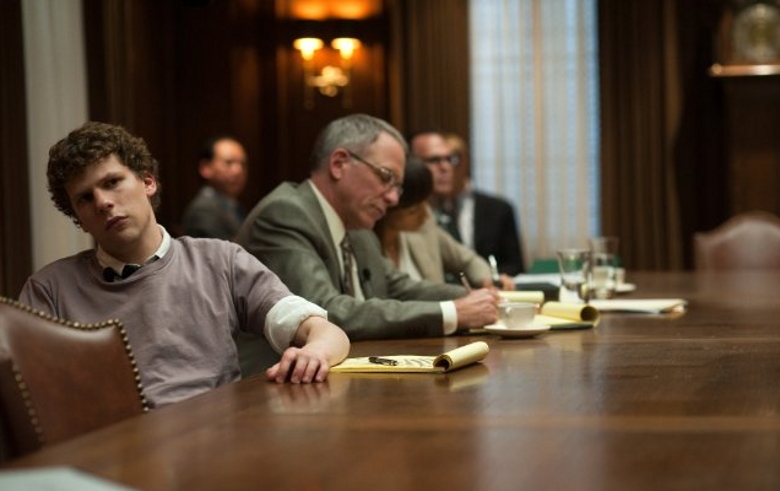
Let’s say you are Aaron Sorkin and you are tasked with writing a screenplay for The Social Network. One problem you have is to craft a narrative that covers several years and multiple time jumps.

Or you are Eric Roth and confronted with adapting a novel “Forrest Gump” that covers several decades.

Or you are Herman J. Mankewicz and Orson Welles facing the daunting task of writing a script for “Citizen Kane,” one that also extends over many decades, requiring several time ellipses.

Here’s the problem with multiple time jumps:

How to do that and create a sense of pace and narrative drive?

How to sustain a script reader’s attention so they make those time jumps with you and not get lost or lose interest in your story?

One solution: Create a narrative device in the present that allows you to pluck out the most important and entertaining scenes and sequences in the past. Then while cutting out the dull parts, you can pull together those elements into a coherent and compelling narrative.

Mankewicz and Welles did this in Citizen Kane by creating a reporter (Thompson) whose task it is to investigate the life of Charles Foster Kane, and stitch together a narrative, jumping from one character witness and their remembrance, that answers the mystery: Who is Charles Foster Kane?

Eric Roth planted Forrest on a park bench, telling his ‘tall tales’ to a series of strangers while waiting for a bus, his voiceover narration stitching together each time jump.

Aaron Sorkin latched onto the two legal depositions to provide a framework in the present to jump back into the past to craft together a coherent plot that sustained a narrative drive.

If you have a story that covers a long period of time and involves multiple time jumps, the simple fact is you are dealing with a challenging narrative. Every single time you have an ellipsis, you are inviting a script reader to break out of your story and into the mundane matters of their lives — I need to wash the cat! — anything but read your script.

Your goal is to create a seamless flow from FADE IN to FADE OUT, and if you are dealing with a long time frame in your story, a device whereby you set up something in the present that naturally allows the narrative to jump back and forth in time, from present to past, past to present is one way of dealing with this issue.

If you stop and think about it, there are a ton of movies that use this device. Can you think of some?

Please join me in comments for a discussion on this subject.

03 Jul 02:35

Getting Freaky in NC

by Josh Marshall

A lot of news moving tonight. But I wanted to flag that North Carolina Republicans are now trying to push through a set of abortion restrictions on the model of what's moving in Texas. To add another thread of bizarreness, the new abortion restrictions have been tacked onto an existing bill to ban sharia law in the state.


03 Jul 02:29

INTP Confession #241

I recently had to end a friendship because of guilt. I had analyzed him for a month before i started the friendship to make sure I could use him. Then I proceeded to manipulate him and his feelings whenever I wanted amusement or felt like having a fight. His emotions were just so easy to understand and I couldn’t help myself. But he started to get too attached, he started caring too much. I eventually told him what I was doing, he was okay with it, he offered himself to me. I am an awful person.

03 Jul 02:25

Obamacare's employer mandate shouldn't be delayed. It should be repealed.

by Ezra Klein

Delaying Obamacare's employer mandate is the right thing to do. Frankly, eliminating it -- or at least utterly overhauling it -- is probably the right thing to do. But the administration executing a regulatory end-run around Congress is not the right way to do it.

The Affordable Care Act includes a provision penalizing employers with more than 50 full-time workers who either don't offer health insurance or whose employees who can't afford insurance without taxpayer help. Those penalties begin in 2014. At least, that's what the law says.

It's a bad bit of policy. In fact, when it first emerged during the Senate's negotiations, I called it "one of the worst ideas in recent memory." The reasons are well summarized in this brief from the Center on Budget and Policy Priorities, which looks at an earlier, but structurally similar, version of the idea:

- By imposing a tax on employers for hiring people from low- and moderate-income families who would qualify for subsidies in the new health insurance exchanges, it would discourage firms from hiring such individuals and would favor the hiring — for the same jobs — of people who don't qualify for subsidies (primarily people from families at higher income levels).

- It would provide an incentive for employers to convert full-time workers (i.e., workers employed at least 30 hours per week) to part-time workers.

- It would place significant new administrative burdens and costs on employers.

By tying the penalties to how many full-time workers an employer has, and how many of them qualify for subsidies, the mandate gives employers a reason to have fewer full-time workers, and fewer low-income workers.

There are other kinds of mandates that don't fall afoul of the same problems. "The employer mandate in the House bill was much better constructed from a policy point of view," says Topher Spiro, director of health-care policy at the Center for American Progress. "It was based on the percentage of payroll you spent on health care rather than on how many workers you had, so there's not this weird disincentive related to part-time workers. But it didn't have the political support to pass."

The irony is that the worker-based employer mandate got passed in part because employers preferred it to a payroll-based mandate -- a fact that puzzled Senate health aides at the time, but that they made peace with in order to pass the bill.

Part of the reason is that the mandate, as written, affects relatively few employers. "You've got 5.7 million firms in the U.S.," says Wharton's Mark Duggan, who served as the top health economist at White House's Council of Economic Advisers from 2009 to 2010. "Only 210,000 have more than 50 employees. So 96 percent of firms aren't affected. Then if you look among those firms with 50 or more employees, something on the order of 95 percent offer health insurance. So it's basically 10,000 or so employers who have more than 50 employees and don't offer coverage." Those companies probably employ around one percent of American workers.

But that's still a lot of employers, and a lot of workers, and so the health-care law has gotten a stream of bad press as one employer or another threatens to cut hours or fire workers in order to dodge the penalty.

It's also proven difficult to enforce. Implementing the mandate requires a complex reporting process that's left the administration flooded with comments from anxious employers -- even those who offer insurance and have nothing to fear from the provision.

On Tuesday night, the White House solved that problem, at least temporarily, by announcing that that the penalties won't go into effect until 2015. They say they plan to use the interregnum to simplify and streamline the reporting process. Until then, compliance will be "voluntary."

But the White House didn't get an act of Congress delaying the penalties. They simply directed the Internal Revenue Service to refrain from enforcing the penalties.

The announcement came, accordingly, in a blog post by Mark Mazur, Assistant Secretary for Tax Policy at the Treasury Department, prompting Ben Domenech, a fellow at the conservative Heartland Institute, to snipe: "Little known fact: Constitution made Assistant Secretary for Tax Policy [the] fourth branch of government."

Domenech has a point: This is a regulatory end-run of the legislative process. The law says the mandate goes into effect in 2014, but the administration has decided to give it until 2015 by simply refusing to enforce the penalties.

The administration says this kind of thing happens all the time. "I think you'd be harder pressed to find some example where there wasn't some discretion on how to implement major policies than one where everything went exactly by the books," says one senior administration official involved in implementation.

Be that as it may, the regulatory solution reflects the fact that the legislative process around the health-care law is completely broken. Republicans won't pass any legislation that makes the law work better. Improving the law, they fear, will weaken the arguments for repeal. But Democrats, of course, won't permit repeal. So Congress is at a standstill, with no viable process for reforming or repairing the Affordable Care Act as problems arise. And so the White House is acting on its own.

As written, the employer mandate probably shouldn't go into effect in 2014, or 2015, or ever. It should be reworked in Congress and then the replacement should be signed into law by the president. The White House's delay might be better policy, but the way the delay was passed is part of a deeply broken process.


03 Jul 02:17

"If two people can attack you by loving each other you’re not a “real man,” you’re a Care Bear..."

“If two people can attack you by loving each other you’re not a “real man,” you’re a Care Bear villain.”

-

Luke McKinney (via marchingjaybird)

Actual truth about Homophobia.

(via knitmeapony)

01 Jul 01:56

Photo