
Shared posts
02 Apr 04:41
 A Review on Night Enhancement Eyedrops Using Chlorin e6
The spice expands consciousness. The spice extends life. The spice must flow.
by jwz
Ben PlowmanFinally, real life has caught up with Riddick.
A Review on Night Enhancement Eyedrops Using Chlorin e6The patent claims that a mixture can be made which, when applied to the eye, will absorb to the retina and act to increase vision in low light. The mixture put forth in the patent is a simple combination of Ce6 and insulin in saline. It is mentioned in the same, that dimethlysulfoxide (DMSO) can be used in place of the insulin. We propose a combination of the two could lead to the most noted effects. For testing purposes, the mixture from the patent (Ce6, Saline, Insulin) was used with the addition of DMSO for increased permeability.

25 Mar 03:45
"The next morning, the prince went to Aschenputtel’s house and tried the slipper on the eldest..."
Ben PlowmanThe important detail: he just recognized her. So why not just look at all the faces of the girls in the village instead? It always bothered me how the prince chose shoe size as a unique identifier. Maybe if you live in a castle and have never been in a payless you just assume everything is exactly fitted to the wearer?
“The next morning, the prince went to Aschenputtel’s house and tried the slipper on the eldest stepsister. The sister was advised by her mother to cut off her toes in order to fit the slipper. While riding with the stepsister, the two doves from Heaven told the Prince that blood dripped from her foot. Appalled by her treachery, he went back again and tried the slipper on the other stepsister. She cut off part of her heel in order to get her foot in the slipper, and again the prince was fooled. While riding with her to the king’s castle, the doves alerted him again about the blood on her foot. He came back to inquire about another girl. The gentleman told him that they kept a kitchen-maid in the house – omitting to mention that she was his own daughter – and the prince asked him to let her try on the slipper. The girl appeared after washing herself, and when she put on the slipper, the prince recognized her as the stranger with whom he had danced at the ball.”
-
-
Cinderella - Wikipedia, the free encyclopedia
There’s a lot more foot mutilitation in the Brothers Grimm version of Cinderella than made it into the movie.
24 Mar 17:50

jakovu:dama3: tastefullyoffensive:Babylonian era problems....
Ben PlowmanWELL ACTUALLY I think they just marked on wet clay and then fired them but w/e.
Babylonian era problems. (photo via tbc34)
old school hate mail
Imagine how pissed you have to be to engrave a rock
24 Mar 06:45
aspirethesenses:Beaver City, Nebraska, 1989. (by: Marrilee...
Ben PlowmanEvery city in Nebraska is Beaver City if you know where to look.

24 Mar 06:44
Modified atomic force microscope allows for high-speed, high-res imaging of live neurons
Ben PlowmanFirst the imaging of tiny bacteria, and now this!
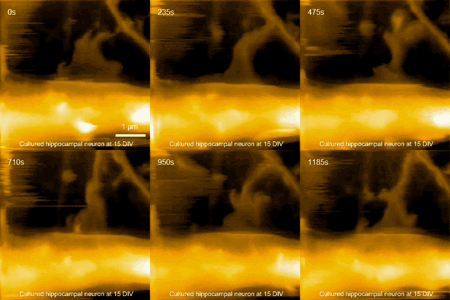
Extreme closeup of a hippocampal neuron in action (Credit: Max Planck Florida Institute for Neuroscience)
Researchers at the Max Planck Florida Institute for Neuroscience and Kanazawa University (Japan) have imaged structural dynamics of living neurons with unprecedented spatial resolution and speed by using a modified atomic force microscope (AFM).
The AFM is a leading tool for imaging, measuring, and manipulating materials with atomic resolution — on the order of fractions of a nanometer — by scanning (“touching” and “feeling”) its surface with an extremely fine needle (the diameter of the tip is about 5 nanometers) on the surface. However, it can’t be used with neurons and other living cells without damaging the sample, and it’s too slow (it takes many minutes to acquire an image).
Imaging living neurons and other cells
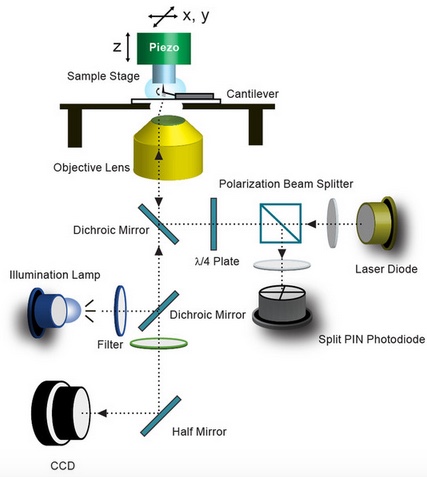
A schematic illustration of the long-tip high-speed atomic force microscope (LT-HS-AFM), including an arc lamp for fluorescence excitation and a CCD camera to capture bright-field and fluorescence images (credit: Mikihiro Shibata/Scientific Reports)
In their March open-access publication in Scientific Reports, Ryohei Yasuda and Mikihiro Shibata at Max Planck Florida Institute for Neuroscience in collaboration with Kanazawa University describe their new long-tip high-speed (LT-HS-AFM) system. It operates at a scanning speed orders of magnitude faster than that of conventional AFM.
To avoid damaging biological samples, using an extremely long, sharp needle attached to a highly flexible plate and a high-speed (800 kHz) light tapping-mode scanning system combined with an extremely soft cantilever to apply low force on the sample. The system uses a wide-area scanner to image large area of mammalian cells (up to ~5 × 5 square micrometers) and optical microscopy to facilitate the positioning of the scanning tip on samples.
The new device images without any sign of cellular damage, it’s optimized for fast scanning (seconds per image) to capture dynamic events in living cells, and has a spatial resolution up to 100 times better than a standard light microscope.
In particular, this study demonstrates the capability to track structural dynamics and remodeling of the cell surface, such as morphogenesis (how the form is created) of filopodia, membrane ruffles, pit formation, or endocytosis in response to environmental stimulants.
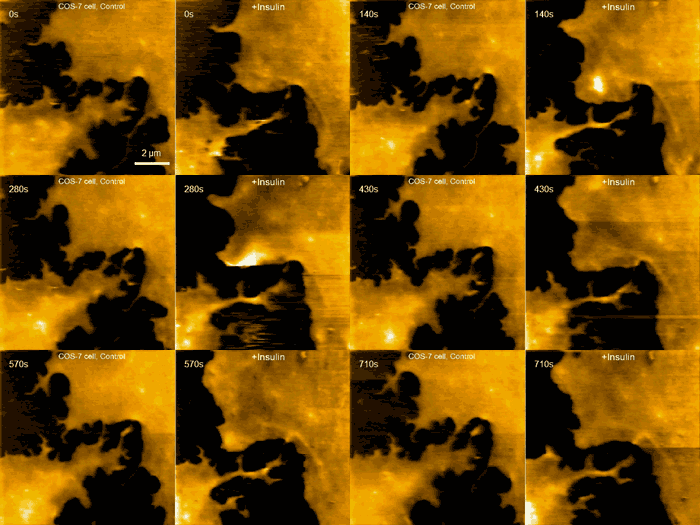
Examples of this capability are seen in the movie above, where morphological changes of a finger-like neuronal protrusion in the mature hippocampal neuron are imaged, and in the movie below, where a fibroblast is imaged before and after treatment with insulin hormone, which intensely enhances the ruffling at the leading edge of the cell.
Fibroblast pre/post treatment w/insulin hormone (credit: Max Planck Florida Institute for Neuroscience)
Yasuda says the researchers hope to visualize the morphology of synapses at nanometer resolution and in real time in the near future. Since morphology changes of synapses underlie synaptic plasticity and our learning and memory, this will provide us with many new insights into mechanisms of how neurons store information in their morphology, how it changes synaptic strength, and ultimately how it creates new memory, he suggests.
Abstract of Long-tip high-speed atomic force microscopy for nanometer-scale imaging in live cells
Visualization of morphological dynamics of live cells with nanometer resolution under physiological conditions is highly desired, but challenging. It has been demonstrated that high-speed atomic force microscopy is a powerful technique for visualizing dynamics of biomolecules under physiological conditions. However, application of high-speed atomic force microscopy for imaging larger objects such as live mammalian cells has been complicated because of the collision between the cantilever and samples. Here, we demonstrate that attaching an extremely long (~3 μm) and thin (~5 nm) tip by amorphous carbon to the cantilever allows us to image the surface structure of live cells with the spatiotemporal resolution of nanometers and seconds. We demonstrate that long-tip high-speed atomic force microscopy is capable of imaging morphogenesis of filopodia, membrane ruffles, pit formation, and endocytosis in COS-7, HeLa cells and hippocampal neurons.
24 Mar 06:34
What is Your Password?
Ben PlowmanI want to hate jimmy kimmel but then occasionally he does brilliant things.
What is Your Password?
18 Mar 05:16
superdrivel: Try not to be mad, y’all, it’s going to a good...
Ben PlowmanWHATTTT. You fedex your hair for coke again? Even after last time when you got scammed?


18 Mar 04:40

i used to live 8 minutes from astroworld! Only went twice...
Ben PlowmanDuuude I remember $.999 gas. The number of gallons exactly matched the price and it was soooo pleasant for some reason.
i used to live 8 minutes from astroworld! Only went twice though. It was a terrifying and magical place. Easily one of the best places within walking distance of the Astrodome. Way better than the Conoco that sold all three grades of gas for the same price ($0.999 per gallon)
15 Mar 06:36
inflammation, my inner flame, my life force
Ben PlowmanYou getting old too? I ran too far recently and pulled a rib, or something? I don't know what I did but my ribs have hurt for about ten days now.
inflammation, my inner flame, my life force
10 Mar 23:59

First detailed microscopy evidence of nanobacteria at the lower size limit of life
Ben PlowmanCool shit. Until now we could only confirm bacteria which we know how to grow in petri dishes.
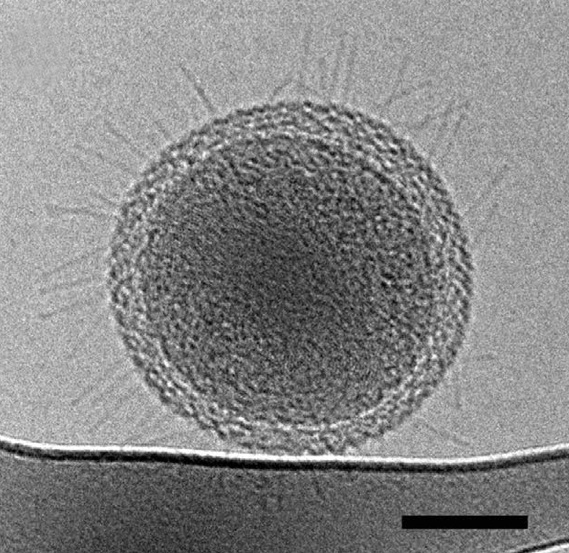
This cryo-electron tomography image reveals the internal structure of an ultra-small bacteria cell like never before. The cell has a very dense interior compartment and a complex cell wall. The darker spots at each end of the cell are most likely ribosomes. The image was obtained from a 3D reconstruction. The scale bar is 100 nanometers. (credit: Berkeley Lab)
Scientists have captured the first detailed microscopy images of ultra-small bacteria believed to be about as small as life can get.
The existence of ultra-small bacteria (aka “nanobacteria” or “nannobacteria”) has been debated for two decades, but there hasn’t been a comprehensive electron microscopy and DNA-based description of the microbes until now.
They are about 200 nanometers (.2 micrometers) in width with a volume of only about 0.009 cubic nanomicrons (millionth of a meter). About 150 of these bacteria could fit inside an Escherichia coli bacteria cell.
The diverse bacteria were found in groundwater and are thought to be quite common. This is the smallest a cell can be and still accommodate enough material to sustain life, the researchers say.
The bacterial cells have densely packed spirals that are probably DNA, a very small number of ribosomes, hair-like appendages, and a stripped-down metabolism that likely requires them to rely on other bacteria for many of life’s necessities.
Enigmatic
Numerous hairlike appendages radiating from the surface of this ultra-small bacteria cell could enable the cell to connect with other microbes and obtain life-giving resources. The scale bar is 100 nanometers. (credit: Berkeley Lab)
The bacteria are from three microbial phyla that are poorly understood. Learning more about the organisms from these phyla could shed light on the role of microbes in the planet’s climate, our food and water supply, and other key processes.
“These newly described ultra-small bacteria are an example of a subset of the microbial life on earth that we know almost nothing about,” says Jill Banfield, a Senior Faculty Scientist in Berkeley Lab’s Earth Sciences Division and a UC Berkeley professor in the departments of Earth and Planetary Science and Environmental Science, Policy and Management.
“They’re enigmatic. These bacteria are detected in many environments and they probably play important roles in microbial communities and ecosystems. But we don’t yet fully understand what these ultra-small bacteria do,” says Banfield.
To concentrate these cells in a sample, they filtered groundwater collected at Rifle, Colorado through successively smaller filters, down to 0.2 microns, which is the size used to sterilize water.
The frozen samples were transported to Berkeley Lab, where Birgit Luef (a former postdoctoral researcher in Banfield’s group who is now at the Norwegian University of Science and Technology) characterized the cells’ size and internal structure using 2D and 3D cryogenic transmission electron microscopy.
The images revealed dividing cells, indicating the bacteria were healthy and not starved to an abnormally small size.
The bacteria’s genomes were sequenced at the Joint Genome Institute, a DOE Office of Science User Facility located in Walnut Creek, California. The genomes were about one million base pairs in length.
Among their findings: Some of the bacteria have thread-like appendages, called pili, which could serve as “life support” connections to other microbes, and the bacteria lack many basic functions, so they likely rely on a community of microbes for critical resources.
The research, led by scientists from the U.S. Department of Energy’s Lawrence Berkeley National Laboratory and the University of California, Berkeley, was reported Friday, Feb. 27, in the journal Nature Communications.
The research was supported by the Department of Energy’s Office of Science.
Abstract of Diverse uncultivated ultra-small bacterial cells in groundwater
Bacteria from phyla lacking cultivated representatives are widespread in natural systems and some have very small genomes. Here we test the hypothesis that these cells are small and thus might be enriched by filtration for coupled genomic and ultrastructural characterization. Metagenomic analysis of groundwater that passed through a ~0.2-μm filter reveals a wide diversity of bacteria from the WWE3, OP11 and OD1 candidate phyla. Cryogenic transmission electron microscopy demonstrates that, despite morphological variation, cells consistently have small cell size (0.009±0.002 μm3). Ultrastructural features potentially related to cell and genome size minimization include tightly packed spirals inferred to be DNA, few densely packed ribosomes and a variety of pili-like structures that might enable inter-organism interactions that compensate for biosynthetic capacities inferred to be missing from genomic data. The results suggest that extremely small cell size is associated with these relatively common, yet little known organisms.
10 Mar 04:25
"Robert Hendricks, an attorney for Uber, told the court that the company is a technology platform,..."
Ben PlowmanStrangely, I believe the same thing applies toward FedEx drivers. They are all independent contractors and thus cannot unionize.
“Robert Hendricks, an attorney for Uber, told the court that the company is a technology platform, not a transportation business, and is simply licensing its product to drivers. “We make our money from licensing our software. When they use it successfully we can be compensated,” he said. “There is a difference between benefiting from a transaction and from a service.””
- Judge: Uber, Lyft drivers may have employee status - San Francisco Business Times (via iamdanw)
- Judge: Uber, Lyft drivers may have employee status - San Francisco Business Times (via iamdanw)
04 Mar 19:41
radicalarchive:Communique issued by the Weather Underground,...
Ben PlowmanJeez, they pivoted pretty hard: http://www.wunderground.com/

03 Mar 19:36
this is my new favorite video Hercules reads his script entirely...
Ben PlowmanHighly recommended.
this is my new favorite video
Hercules reads his script entirely wrong
(reads the word disappointed, when he was supposed to sound disappointed)
28 Feb 11:26
lavendersteam: dan mintz (voice of tina on bob’s burgers) did an...
Ben PlowmanThought it was a goof. Not a goof: https://www.youtube.com/watch?v=eqtAiETy4Io


24 Feb 02:58
bonny-notion:found this in a doctors officeim not convinced they...
Ben PlowmanHaha, these are all just chores. Also worth noting: all of these things are much more hilarious on drugs.


23 Feb 01:14

Photo
Ben PlowmanThe animatrix was super good and dark. Made me like anime for the first time, tbh. This part was especially freaky: https://33.media.tumblr.com/712483da0014a31d38bd364489c9d8dc/tumblr_mvebywfMUv1s39hlao2_r1_500.gif
22 Feb 22:24

postscript how could you
Ben PlowmanI laugh every time I see this.
postscript how could you
22 Feb 05:25

welcometobusinesstown:The Intrapreneur is an agile agent of...
Ben Plowmanhahaha, we've all been there.
The Intrapreneur is an agile agent of dynamic corporate change. /
gettin close to home here
14 Feb 09:03

A New Artificial Skylight System Nearly Indistinguishable from the Sun Itself
by Christopher Jobson
Ben PlowmanWhere did they find these rooms and furniture? It looks like some kind of render demo.


In what may be one of the most ground-breaking developments in creating artificial sunlight, a group of Italian scientists recently announced CoeLux, a new kind of skylight that perfectly mimics the feel of daylight. The creator’s claim the system is so effective that it tricks unknowing individuals into thinking they are looking up at the actual sun.
The inventors are somewhat tight-lipped about how CoeLux works, but it involves filtering a light source through a layer of nanoparticles that mimic Earth’s atmosphere. Because of this, not only does the color match sunshine but the quality does as well. In the photos above—which CoeLux insists aren’t digitally altered—you can get an idea of how realistic the light is, and see it in action in the video.
The light is currently available in three different configurations that mimic sunlight at different points on the globe including tropical, mediterranean, and nordic environments. Applications for CoeLux might involve anywhere light is scarce, from extreme environments like scientific outposts to underground parking garages or even in hospitals. You can see more on their website. (via PetaPixel)
Andreasmb, Benjaminsavage and 8 others like this
12 Feb 18:02

skunkbear: The top image is a photograph of a lush rainforest...
Ben PlowmanCool as shit. Star Trek grade scanning powers.
The top image is a photograph of a lush rainforest canopy. The bottom image colors each tree based on its species.
How? It’s all thanks to a special lab built by ecologist Greg Asner inside a twin-turboprop airplane. From a few thousand feet up, the Carnegie Airborne Observatory uses lasers, spectrometers and other instruments to build a detailed 3-D model of a forest, identify different species of vegetation and quantify carbon sequestration. It’s a lot quicker than tramping through the jungle and taking these measurements on foot.
A fun tidbit from the full story:
"On one occasion, he and his team mapped more than 6,500 square miles of the Colombian Amazon at night — about the size of Connecticut plus Rhode Island — flying with all their lights out to avoid being shot at by the FARC, the Colombian rebel force.”Images: Greg Asner, Carnegie Airborne Observatory
06 Feb 16:36

rasputinette:circuitfry:archivealicorn:Good fucking job, tumblr....
Ben PlowmanCould not reproduce.
Good fucking job, tumblr. Putting every single character in its own for quotes… oy vey
STAFF YOU DID WHAT
this is so beautiful and fucked up, i’m crying
this is bordering on obfuscation
06 Feb 16:35
The misunderstanding of you not realizing that post is from Saturday Night Live (a comedy show) has gone mainstream and it's SPECTACULAR
Ben Plowmanhahaha, tumblr is great.
Oh I know all about Weekend Update. You must not come to superdrivel often, where media is gender-neutral monarch. Saturday Night Live is as mainstream as it gets.
The point is that Unicode is not a company. Unicode does not make emojis. Unicode is a standard, and it would be far more offensive to make an exhaustive set of race/ethnicity-specific icons. Have a browse http://unicodelookup.com/#symbol
The issue appears to be with Apple’s (or whatever company’s) choices when they made their icon set.


03 Feb 07:11
some trees are very, very large (by me)
Ben PlowmanYeah right, that tree is clearly by Alan.

29 Jan 21:35
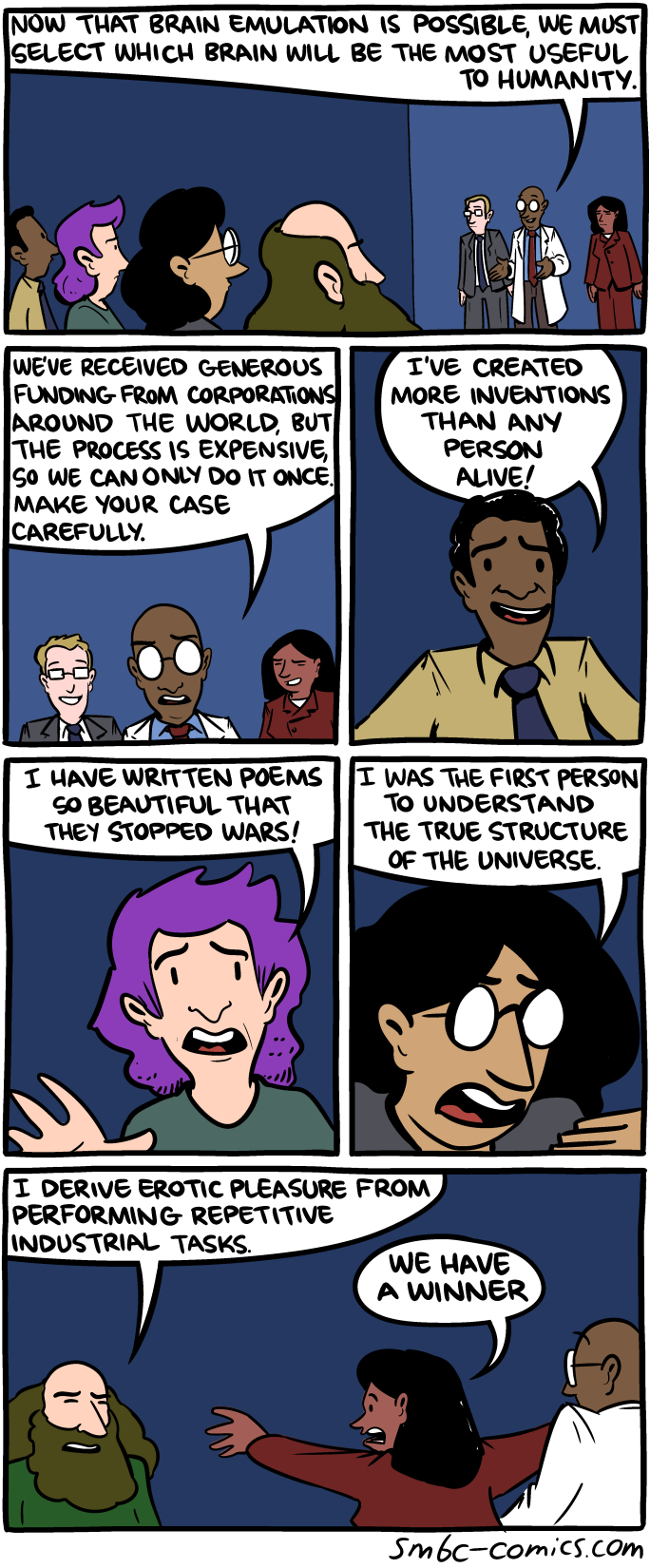
So far, the experiment has worked. Those of you paying attention are now part of a secret society.
January 19, 2015
So far, the experiment has worked. Those of you paying attention are now part of a secret society.
Gubetti, aaronrsturm and 2 others like this
29 Jan 07:46
gifsboom: That Precision.[video]
Ben PlowmanThe first time two robocapable countries go to war is going to be both fascinating and unimaginably horrifying.

