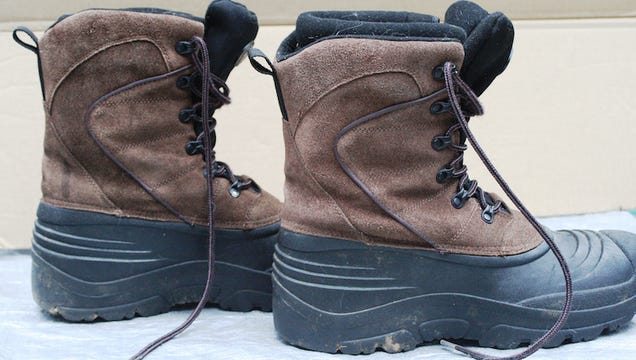
A good pair of winter boots aren’t cheap, so you want to make sure you buy ones that will protect your feet for a while. Here are the factors to keep in mind when comparing your options.

A good pair of winter boots aren’t cheap, so you want to make sure you buy ones that will protect your feet for a while. Here are the factors to keep in mind when comparing your options.

Even if there’s snow outside your window or it’s absurdly cold out there, now’s the time to start thinking about your garden.


If you want to lose weight, diet and exercise are both important. However, that doesn’t mean they’re equally important. This video explains why changing your diet has a bigger effect on your weight loss than exercise.


We all the know the moment when you get down to “that last bit” of honey in a jar. It may not seem like enough to do much with, but a tablespoon or two of honey is a perfect partner for almost any cheesy plan.


If you’re emailing recipes to yourself, printing them out, or still keeping index cards, there’s a better way. Grab your Android phone, there are a ton of great recipe apps out there, but we have one we think is the right blend of features for the right price. Paprika is the app for you.

Blanching tomatoes, or boiling them briefly and then plunging them in icy water, is a technique that makes it easier to peel the tomatoes without turning them to mush. Recipes for tomato soup or sauce often require blanching the tomatoes as a first step. Read on to learn how to blanch tomatoes in no time at all.


For a fast approach, try the one used in busy restaurants.
Gainesville Times - Northern VA News |
ReStore gets warm welcome Gainesville Times - Northern VA News Traci DeGroat, the president and CEO of Habitat for Humanity Prince William County, worked throughout the day meeting and greeting new and old friends at the new Manassas locaation. DeGroat said the at the former Food Lion location at 10159 Hastings ... |
Prince William County community calendar Washington Post Dale City winter farmers market 10 a.m.-1 p.m. Dale City farmers market, Dale Boulevard, Dale City. Call Betty Finney at 703-670-7112, Ext. 227. Free. Lucasville School open house In celebration of African American Heritage Month, the one-room ... and more » |
 Target’s gender-neutral approach to children’s toys is seeping into other aspects of the retailer’s business. Over the weekend the big box store unveiled a new brand of kids’ home decor that comes without boy or girl designations.
Target announced Sunday that the brand, called Pillowfort, will debut at stores later this month, marking yet another step in the retailer’s move toward a more gender-neutral store format.
The line, which will replace the long-running Target house brand Circo, will still feature pinks and blues, but with more prints, patterns, and neutral motifs including trees, arrows, astronauts, and bicycles.
“It was an aisle of pink, fairy princesses, ponies and flowers,” Julie Guggemos, Target’s senior vice president of design and product development tells the Minneapolis Star Tribune of Target’s current offerings for children’s bedrooms. “And for the boys it was rockets and dinosaurs. Well, you know what? Girls like rockets and basketball. And boys like ponies. Who are we to say what a child’s individual expressing is?”
That means that Target shoppers will continue to see products with hearts and basketballs, but that they will more likely be in neutral colors such as white, black, and yellow. In all, the brand contains 12 whimsical themes, like “Tropical Treehouse,” “Stellar Station,” and “Ocean Oasis.”
Guggemos says that the company didn’t exactly set out to create a gender-neutral line. Instead, the approach was driven by consumers who previously criticized the company for using gender-based signs in the toy aisles.
“It gets back to listening to mom, understanding what she’s looking for from Target and making sure we’re delivering the products and the content that’s going to be right,” Chief Executive Brian Cornell tells the Star Tribune.
While developing the new Pillowfort line, the company asked children to create collages of their ideal bedrooms and questioned parents on what they would like to see. In the end, most chose neutral designs.
“Girls were picking prints that the boys picked and vice versa,” Guggemos said. “They’re not afraid to express who they are. We picked up on that right away and decided we were getting in our own way a little bit with some of those paradigms … It’s time to change.”
The company isn’t doing away completely with boy- and girl-specific bedding and room decorations. It plans to still offer an assortment of princesses, superheroes, as well as licensed brands like Star Wars and My Little Pony in the department.
Target plans to next tackle its children’s house brand of clothing. A new apparel line will debut this summer, replacing the Cherokee and Circo brands.
A spokesperson tells the Star Tribune that while the company isn’t going to adopt a unisex or androgynous approach to apparel, some common themes will be found in both boys’ and girls’ clothing.
Target takes gender-neutral approach with new kids home brand [Star Tribune]

Since Amazon began allowing customers to post reviews on product pages, various waves of bogus reviewers have attempted to game the system by posting fictitious or dishonest write-ups. While Amazon has recently taken legal action against people paid to write fake reviews for products, and the site has a ban on most forms of “paid” reviews, there’s a new crop of compensated reviewers who are receiving free or discounted products in exchange for then writing “honest” reviews. But some of these users are writing dozens of reviews a day, sometimes for products they couldn’t possibly have tried.
This newer form of fake, paid Amazon reviews are creeping in thanks to marketing sites that offer free and deeply discounted items if buyers promise to then share their honest feelings on Amazon.
• Third-party marketers are selling products, or giving them away, in exchange for “honest” Amazon reviews.
• Amazon allows such reviews, so long as the compensation is clearly disclosed in the review and the writeup is truthful.
• Some people who receive free/discounted items are posting reviews for products they could not possibly have tried.
• They are also posting dozens of reviews daily, upwards of hundreds of reviews a month (almost all 5-star reviews), without being flagged by Amazon.
• Ignore star ratings and read the full text of reviews to get an idea if the reviewer (A) actually tried the product, and (B) has similar standards to yours.
• Amazon users can filter reviews so that only “verified” purchases show up. This will also filter out people who bought items through Amazon at a deeply discounted price.
• Use sites like FakeSpot.com to scan through reviews to help determine whether or not the content may be useful to you.
While Amazon’s review guidelines prohibit most “paid” reviews, they do include an explicit exception “when a free or discounted copy of a physical product is provided to a customer up front” if the user “clearly and conspicuously disclose[s] that fact” in their review.
That’s because e-tail giant has its own form of a “free stuff for reviews” in Amazon Vine, which allows select customers to get pre-release access to some products.
But Amazon knows who Vine members are and what they’ve received through the program. Amazon does not, however, necessarily know if a reviewer purchased an item through some discount marketer with the promise of writing a review.
In an effort to avoid the Amazon police and to stave off legal concerns (more on that in a minute), these marketers require that reviews comply with Amazon policy and include disclosures like “I received this product in exchange for my honest and unbiased review.”
But it’s those very statements that are giving regular Amazon customers an indication of just how bad this problem can be.
Case in point — no pun intended — Consumerist readers directed us to the Amazon page for this phone case for the Lumia 650 smartphone.
 Click image to see full size.
When we began researching this story, there were 10 reviews posted on this page, many of them mentioning how well the phone fits on their Lumia 650: “It fits snuggly and provides good protection,” reads one review. “it is great fit my phone great,” opines another user.
All of the reviews indicated in some fashion that they had received the case for free or at a discount, and all but one of the reviews was a five-star writeup, potentially leading a shopper to possibly believe that this is a decent product.
Except there aren’t yet any shoppers looking for this case, because the Lumia 650 hadn’t been released when these reviews were written. Perhaps it’s possible that all 10 of these reviewers managed to get an early release of the device?
Three of the reviewers involved also posted their email addresses on their profiles, so we wrote them to ask, but have yet to hear back from any of them.
In one week in January, a reviewer named “Andrea” wrote up approximately 200 5-star opinions, including reviews for cases for at least 14 different phones:

Out of curiosity, we looked at what else these users had reviewed, and every single one of them with a public profile appears to have spent an inordinate amount of time writing up their supposedly honest feelings about dozens of products — a day.
We looked at the list of reviews since Jan. 1 for each of these users and found that they averaged more than 400 reviews each in just those few weeks. The fewest was around 100 reviews since Jan. 1, while one user managed to somehow crank out approximately 950 reviews in a single month.
Assuming eight hours of sleep per day, that’s nearly two reviews an hour for every single waking hour, every day of the week for 31 days.
So what are these people reviewing? Apparently anything they can get at a deep discount in exchange for a review.
In just a few hours, one reviewer posted her thoughts on a USB travel charger, melatonin pills, two USB cords, novelty wine glasses, a selfie stick, a bunion splint, and phone cases — lots of phone cases.
And not just for a single type of phone. A quick scan of one user’s list turned up multiple reviews — all from Jan. 2016 — for cases or screen protectors for each of the following devices:
Galaxy Note 4; Galaxy E7; iPhone 6S; iPhone 6S Plus; iPhone 5C; Galaxy S6; Galaxy S7 Plus (a device that doesn’t even exist); Galaxy Grand Prime; Galaxy Centura; HTC One A9; LG V10; Galaxy S5; ZTE Grand X Max; Galaxy Alpha; Lumia 950; Moto X; Lumia 550; Lumia 850; Lumia 650; ZTE Allstar; Huawei Union; Galaxy Avant; Droid Turbo 2; Galaxy S6 Edge; Nexus 6P; LG Optimus F6; OnePlus One; Alcatel OneTouch Idol 3… and that’s when we just gave up taking notes.
By the way, all these reviews — 5 stars. In fact, we had to scroll past approximately 650 reviews to Jan. 10 before we got to one from this user that was not a 5 star writeup.
Yes, it is possible (inasmuch as virtually anything is possible in an infinite universe) that there is someone out there legitimately purchasing hundreds of items a month — many of them redundant, based on previous purchases — then taking the time to write glowing reviews for each of those items.
But in the real world of limited possibility, all of the above signs point to many of these reviewers being blatant fakes — or at least meriting further scrutiny from Amazon.
So why are these reviews allowed to be posted? Shouldn’t the very fact that someone received something for free call into question that person’s ability to provide an unbiased point of view? At the very least, that reviewer can’t be fully relied upon to tell other shoppers whether something is worth the real price of the product.
Then again, if someone receives an item as a birthday gift, they aren’t expected to disclose that in a review. And almost all publications that review products — from cars, to appliances, to books, music, movies, and video games — get these items without spending a dime.
But the difference is that no one gets a birthday gift on the condition that they then review it. And while professional reviewers have been known to be cut off from free products by companies that feel they were treated unfairly, pros who routinely rave about everything they try rarely carry much authority with readers.
Given the obvious red flags shown in the examples above — too many reviews, too many raves, use of easily identifiable language showing that these products were discounted in exchange for reviews — you’d think that Amazon would be able to filter out these users’ feedback, much in the way that Yelp’s algorithm automatically hides reviews it deems questionable; those writeups are still available for reading, but they aren’t included in the star ratings and aren’t shown unless the reader deliberately unhides them.
After we brought the questionable reviews for Lumia 650 case to Amazon’s attention, some of the reviews were taken down. As of now, only one of the ten reviews from compensated users remains. Interestingly, it’s the only one that did not give the case five stars.
“We do not allow paid reviews and terminate accounts that abuse the system or violate our guidelines,” an Amazon rep tells Consumerist. “That being said, the vast majority of reviews on Amazon are authentic, helping millions of customers make informed buying decisions every day. Our goal is to make reviews as useful as possible for customers.”
Is Amazon actually doing anything proactive to prevent the spread of these dubious reviews? Aside from pointing to the recent legal actions taken against allegedly fake reviewers, the company would not provide any information on any efforts to track and/or filter users with questionable motives, though a source at the company did say it is aware of the problem and how the presence of apparently fake reviews hurts real customers and Amazon’s image.
First off, as we’ve advised on all crowdsourced review sites, ignore the star rating, not just the average rating for a product but for each individual review. What is a 3-star product for one person might be a 5-star product for another. Sometimes people knock off stars for reasons you wouldn’t even consider, like the color of a DVD player’s remote control, or because they simply don’t like the company that makes a product. Read the actual text of the review and decide for yourself if it’s of any relevance to your needs.
Filter reviews so that you’re only seeing “verified purchases” from Amazon customers. Yes, this will remove all the reviewers who legitimately bought a product elsewhere, but at least you’ll know that the reviews you do see are from people who paid for it.
Some of these discount marketers have tried to game this “verified purchase” badging system. Rather than sending the reviewer the product directly, the reviewer buys the product through Amazon with a promotional code that allows it to be purchased at a discount. However, Amazon now only places the “verified” badge on reviews from a customer “who purchased the product at Amazon and didn’t receive the product at a deep discount.”
Amazon would not say what level of a discount triggers that “verified” threshold, or whether that rule also applies to customers who purchase items directly from Amazon (as opposed to third-party sellers on the site).
Then there are third party sites like FakeSpot, which analyzes not just the reviews on an Amazon product page, but other reviews written by the users on that page.
Putting the Lumia case URL into FakeSpot turned up a “thumbs down” from the site and a poor rating of “73% low quality reviews.”

“Our analysis has detected product exchange for reviews,” reads the results page. “We believe these reviews are harmful for real consumers because of the inherent bias and our opinion reflects that.”
Combining these three tactics won’t guarantee that you avoid fake reviews, but they will give you a better sense of whether or not the reviews for a product have been overrun by compensated shills.
Aside from diluting real reviews to the point where Amazon customers don’t know who to trust, is anyone really doing anything they could get in trouble for? That depends, according to some lawyers we spoke to.
If people are deliberately posting false reviews to hurt a company, that’s certainly something that can, and has been, the subject of legal action.
“Fake unfavorable reviews are actionable under product disparagement laws and other causes of action related to defamation,” explains Regina Austin, the William A. Schnader Professor of Law at the University of Pennsylvania.
When the fake reviews are negative, it’s usually the manufacturer being slighted that does the suing, says Austin, not the customers who are getting bad information. It’s much more difficult to argue harm from bogus positive reviews.
But if a company makes a concerted effort to distort Amazon reviews — either negatively or positively — then that could lead to the involvement of a regulator like the Federal Trade Commission.
“There would have to be a pattern of conduct on the part of the advertiser to encourage consumers to post reviews that are overly glowing or not truthful,” explains Dana Rosenfeld, former assistant director of the FTC’s Bureau of Consumer Protection.
So who is ultimately liable in such a case? Certainly, the individual reviewers shoulder the blame for writing the actual reviews, but the more likely target of a regulatory complaint would be either the discount marketer or the manufacturer paying that marketer to get their products reviewed.
Yes, the discounter requires “honest” reviews and transparent disclosures, but — at least judging by the examples we’ve seen — they are not questioning why some of their customers seem to love everything they review, or how some of these people are posting reviews for items that they couldn’t possibly have used yet.
Rosenfeld tells Consumerist there’s nothing inherently wrong with an Amazon page full of glowing reviews — even ones for which reviewers receive some sort of compensation — so long as they accurately reflect the reviewer’s experience, are truthful, and adequately disclose any incentive provided by the advertiser.
“If, however, a significant number of the paid-for reviews reflect results that are nearly impossible to achieve, or the review pertains to a product not yet released, then there could be liability on the part of the advertiser if it does not take steps to remove the reviews,” she explains. “These reviews could be the result of the advertiser or affiliate marketer affirmatively encouraging such reviews or willful ignorance.”
“The manufacturer has an obligation to monitor what their marketing partner is doing,” explains Rosenfeld.


Burrito lovers have had weeks to prepare for the hours-long closure of Chipotle restaurants today, and in that time several competing fast Mexican chains have promoted special offers for the lunchtime crowd. But it looks like Chipotle may also have a deal for its temporarily abandoned customers: a raincheck for a free burrito.
While Chipotle, which closed today for a four-hour long meeting to discuss food safety issues and initiatives, aims to win back the confidence of its customers, some rival chains are hoping to turn the eatery’s missed lunch into revenue of their own, offering promotions timed to the closures.
Freshii, which specializes in burritos, wraps, soups, and other fast-casual eats, announced weeks ago that it would offer a half-off promotion Feb. 8 (that would be today) for its Mexican-inspired dishes.
It's here! #chipotfrii https://t.co/MizeFtfEbH https://t.co/hxDK1b4dLe
— freshii (@freshii) February 8, 2016
Under the promotion, the company will discount five Mexican dishes at its 200 locations. The deal is limited to one per customer.
“Like millions of other people, we at Freshii are big fans of Chipotle,” Freshii Founder and CEO Matthew Corrin said in a statement on the promotion. “Founded almost three decades ago, Chipotle has been a pioneer of fast-casual food. We figured the least we would do was look after their customers while Chipotle pauses to recalibrate.”
But if those customers decide they like Freshii better, that’s even better, the company says.
On The Border also jumped on the closure discount bandwagon, announcing last week that it would offer $5 to-go Burrito Boxes or Border Bowls.
TODAY ONLY! $5 Border Bowls & #Burrito Boxes! #CHIPSnSALSA included pic.twitter.com/LVKQjiT9YG
— On The Border (@ontheborder) February 8, 2016
The boxes and bowls contain come with your choice of grilled meat, Portobello mushroom, or vegan filling, along with typical Mexican fare toppings like cheese, rice and pico de gallo. Chips and salsa are also included in the deal.
As for Chipotle, the company is live-Tweeting the company-wide meeting and offering customers a raincheck for today’s missed lunch.
Text “Raincheck” to 888-222 for a free Chipotle burrito. This is not a drill. pic.twitter.com/YukvTq2mo9
— Kinja Deals (@KinjaDeals) February 8, 2016
The deal, which includes a coupon for a free burrito, is available for customers who text “raincheck” to a dedicated number.

“If we messed up your lunch plans today, follow the steps and we’ll hook you up,” a Tweet promoting the deal states.
After texting the number, customers receive a link to input their name and ZIP code. A coupon for a free burrito will then be texted to the customer “in the next few days.”
The company’s Twitter account previously debunked rumors that it was giving away $1 burritos all week, noting that the deal was from a hoax news site.
@MagicMolly21 False, unfortunately. That was a fake story put out by a hoax news site. -Gabe
— Chipotle (@ChipotleTweets) February 8, 2016
Chipotle will reopen its stores at 3 p.m. local time.


Papa John’s is touting its new “Quality Guarantee” initiative to “underscore its commitment to delivering quality pizzas to customers,” the chain says. Though it’s not expecting you to hate your food, of course.
“Papa John’s didn’t need a ‘Quality Guarantee’, but if we want to live by our commitment to provide ‘Better Ingredients and Better Pizza’ we have to be able to deliver,” said founder, chairman, and CEO of Papa John’s, John Schnatter.
Anyone who’s displeased with their food will have to tell Papa John’s why they’re unhappy in order to get a new pizza. Examples of unsatisfactory quality include: temperature (cold), undercooked/overcooked pizza, skimpy toppings, wrong pizza/toppings, and damaged pizza, Papa John’s terms and conditions state. The offer does not apply to any issues regarding delivery time, sides, drinks, or desserts.
Here’s how it works: Customers who ordered pizzas directly from Papa John’s can call the restaurant where their pizza was ordered within 30 minutes of the time of delivery or pickup to report their unsatisfactory pizzas, with their receipt available to reference order info.
If you picked the pizza up from the restaurant, you’ll have to go back to that same location with the unsatisfactory food. If you had your order delivered, the new pizza will arrive at the same location.
You also can’t eat more than two slices of the offending pizza if you want a new one, and Papa John’s reserves the right “to collect your original pizza order at the time you receive your replacement pizza.”


For most vehicles, shifting into “Park” seems to be a simple task. But for thousands of people who own Fiat Chrysler cars, that’s not the case. Federal regulators expanded their investigation into these vehicles after receiving more complaints about crashes and injuries because drivers say they have inadvertently left their vehicles in gear with the engine running because the electronic gear shifter is confusing.
The National Highway Traffic Safety Administration nearly doubled the number of vehicles under investigation for the issue after finding more than 100 crashes and a dozen injuries involving Fiat Chrysler cars.
With the expansion, NHTSA is investigating more than 856,000 model year 2014 to 2015 Jeep Grand Cherokees, and 2012 to 2014 Dodge Charger and Chrysler 300 sedans with 3.6-liter engines.
According to a notice [PDF] filed by NHTSA, the investigation, which was first opened in August 2015, centers on vehicles equipped with Monostable electronic (E-shift) gearshifts.
The shift system operates electronically and the gear requested by the driver is transmitted from the sifter via the CAN Bust to the Transmission Control Module which makes the requested shift.
However, in some vehicles, the gearshift doesn’t actually move, but springs back to a centered or neutral position.
If a driver opens his or her door when the gearshift isn’t in “park,” a chime rings and a message pops up to alert them that the transmission is not in “park.”
The engine also will not turn off normally without the transmission in “park.”
“This function does not protect drivers who intentionally leave the engine running or those who do not realize that the engine is still running after an attempted shut-off,” investigators said.
As a result, drivers may exit the vehicle when the engine is running and the transmission is not in “park,” leaving the unattended vehicle to roll away, NHTSA states.
NHTSA’s Office of Defects Investigation is aware of 314 consumer complaints about the issue, 267 submitted to Fiat Chrysler and 69 submitted via NHTSA’s database.
In all, 121 have resulted in crashes or fires, with 30 incidents involving injuries to drivers or passengers such as a broken nose, facial lacerations requiring stitches, sprained knees, severe bruising, and trauma to legs.
“While in ‘park’ and idling, the vehicle rolled forward and struck objects 20 yards away causing $1,500 worth of damage to the right front bumper,” one complaint states. “My wife parked the car and had exited the vehicle, when after about 30 seconds it rolled forward and struck headstones in a cemetery. The car still indicated it was in ‘park’ when my son reentered the vehicle.”
In another complaint, the owner of a 2014 Jeep Grand Cherokee says the vehicles rolled from the “park” position without warning. When the woman attempted to stop the car, it ran over her hip, causing injuries that required medical attention.
Owners of affected Charger and Chrysler 300 vehicles offered similar experiences to NHTSA.
“When I put the car into ‘park,’ it pops into reverse,” the owner of a Chrysler 300 writes in a complaint. “Then I hit the engine off button, but since it is in reverse, the engine stays on. Then I open the door to get out, thinking the engine is off and the car is in ‘park,’ and it starts rolling backward. This has happened six times.”
The owner of another 2014 Chrysler 300 writes in a complaint that, on occasion, when the vehicle is in “park” it rolled away. In one instance, the owner was able to stop the vehicle and shift it back into part on the third attempt. However, he suffered injuries to the neck and back that required medical attention.
Fiat Chrysler tells the Associated Press that the company is cooperating with the investigation, and noted that it changed the shifters in the 2016 Grand Cherokee and 2015 Charger and 300 sedans.
Still, NHTSA has opened an engineering analysis to assess the scope, frequency, and safety-related consequences of the alleged defect.

Every year, after the major flower-giving holidays, readers send us photos of what they ordered and what they actually received. It’s a dismaying scene, and what we really want is to never publish another of these features again. That’s why we’re sharing what we’ve learned about the flower business from readers and from florists in the 10 years that Consumerist has been around.
While you might see a deal advertised online though a national wire service that promises a dozen red roses delivered to your sweetest for $50, this deal has a catch. The local florist that actually fills your order may end up losing money on the deal.
Wire services were useful thirty years ago when you didn’t have easy access to contact information for a florist near your faraway loved ones, that’s no excuse today. Just make sure that the local florist you contact is real (more on that in a bit).
Tina Semock, a florist in the Chicago area, explained to us that she isn’t part of a floral wire service like FTD or Teleflora because it simply doesn’t work out for her economically.
“The site will tack on a $10 or $15 ‘service fee,’ which you would think goes for delivery,” she explained to Consumerist. “That goes right in [the wire service’s] pocket. The florist doesn’t see any of that… You’re paying $20 or more just to place your order online.”
That’s right: you could be paying the wire service 40% or more of the total just for the privilege of not bothering to look up the phone number or website of the nearest florist to your loved one’s home or office. Don’t do that.
You’re sending flowers to your mom, who lives in Omaha, so naturally you type “Omaha florist” in Google to find a nice local florist. You end up on a landing page that lists hospitals and schools in Omaha, and that says they deliver to Omaha, so you place your order. You’ve fallen into the fake local florist trap.

These sites pretend to be florists local to your recipient, but are actually affiliate sites that skim a percentage off your order and then pass it along to one of the national wire services, which in turn takes more money off the top. The actual florist filling the order gets even less money… and the quality of the flowers they use will probably be crappier in turn.
How can you avoid this? When searching for a florist in a city in that city or town, make sure that their website gives a local address and phone number located in that city or town on their website.

Cross-check with your favorite online yellow pages source or Yelp to make sure they’re a real store that really exists. If you’re feeling really ambitious, give them a call.
Since virtual reality flower shopping isn’t yet a thing, we’re forced to use two-dimensional pictures to shop for flowers. That’s why the three-dimensional penalty is important. It’s why flower arrangements seem so much smaller when they arrive in person.
A florist explained to us that the reason why flower arrangements appear so much smaller in real life. “[A]ll of those pretty pictures you see on [wire service] websites are arranged in a 2-dimensional layout, with all blooms tilted toward the camera,” she explained to Consumerist.
“It’s deceptive – the photo arrangements are done in a way that implies a “round” arrangement (like a ball sitting on top of a vase) – it’s implied that there are more flowers that you can’t see.”
How can you avoid disappointment? Count the flowers.

Both of these photos show a 12-bloom arrangement, but the picture on the left implies twelve more roses on the other side that aren’t there in real life. You expect the arrangement that arrives to be taller and fuller unless you’ve counted the flowers.
It’s a minor botanic miracle that enough roses are ready at exactly the right time, and if the harvest doesn’t come out just right, shortages can mean higher prices. However, a florist with Bloomers in Chatham, NJ points out that maybe you should think outside the dozen roses.
“There’s a lot more to Valentine’s Day arrangements than red roses and baby’s breath,” she points out. Have confidence that your significant other will appreciate something unusual.
Keep in mind, after all, that at a peak flower-ordering time, florists’ expenses and what’s in season will be different. What you order for your anniversary in August and how much it costs will be different from what’s available to them wholesale during a holiday in the winter, and the price will differ accordingly.
Consider calling the local shop you plan to use and asking for a “florist’s choice” bouquet. By giving them the opportunity to make something special with what’s most plentiful on hand, you’ll get a bigger and fresher bouquet than if you chose an image on the website.


From small planes like the Cessna to the hulking mass of a Dreamliner, the FAA says there are 320,000 piloted aircraft registered with the agency right now, compared to 325,000 people who have registered their drones, FAA administrator Michael Huerta told media outlets at a press conference, including USA Today.
There could be even more drones out there than 325,000, potentially, as each drone registration number can apply to any number of aircraft an owner wants to fly. To that end, Huerta says the average operator has 1.5 recreational drones.
“We’re very encouraged by the registration numbers we’ve seen so far,” Huerta said. “Safety is at the heart of this new registration system. We need to bring the unmanned aircraft enthusiasts into the culture that has characterized aviation throughout its history – that is a culture of safety and a culture of responsibility.”
There’s a deadline of Feb. 19 to register any previously owned drones, and if you get a new one, you’re supposed to register it before it flies for the first time.
FAA: Drone registration eclipses that of regular planes [USA Today]

WASHINGTON (AP) — The latest Democratic debate found Hillary Clinton in a defensive crouch about her Wall Street ties and making iffy claims about that longtime relationship. Rival Bernie Sanders offered a fumbling account of a campaign ad that boasted of endorsements that were bogus.
A look at some of their assertions, and how they compare with the facts:
CLINTON: “I went to Wall Street before the crash. I was the one saying you’re going to wreck the economy because of these shenanigans with mortgages. I called to end the carried-interest loophole that hedge fund managers enjoy.”
THE FACTS: Clinton was not nearly as tough-talking with Wall Street as she suggested in that remark and in her previous characterizations of her December 2007 speech. In a video of the speech obtained by ProPublica, she thanked her “wonderful donors” in the audience, said banks were not the actors primarily to blame for the emerging crisis, “not by a long shot,” and praised Wall Street for its contribution to the economy.
At the same time, she said Wall Street had a hand in worsening the crisis and called for voluntary steps on foreclosures and subprime mortgages.
Altogether, she delivered a mixed message, not the unalloyed lecture that she portrayed Thursday night or in an earlier debate, when she claimed the speech’s basic message to Wall Street was: “Cut it out.”
___
SANDERS: Asked about his campaign ad that cites two New Hampshire newspapers among groups endorsing him, said “As I understand it, we did not suggest that we had the endorsement of a newspaper… We never said, never said that somebody, a newspaper endorsed us that did not. What we did say is blah, blah, blah, blah was said by the newspaper.”
THE FACTS: Sanders’ 30-second TV ad, titled, “Endorsed,” lists a variety of groups that it says are backing his candidacy, including postal workers, nurses, an environmental group and The Nation magazine, repeatedly using the word “endorsed.”
Onto that list it seamlessly adds The Telegraph in Nashua and the Valley News, quoting favorable comments printed by both newspapers. Neither newspaper citation includes the word “endorsed,” but that nuance is unlikely to be noticed by viewers. Both newspapers have said they haven’t made any editorial endorsement in the Democratic race.
___
CLINTON on Wall Street: “They are trying to beat me in this primary.”
THE FACTS: Wall Street is not the anti-Clinton monolith she implied. People in the securities and investment industry gave more than $17 million last year to super political action committees supporting her presidential run and nearly $3 million directly to her campaign, according to OpenSecrets.org, a campaign-finance watchdog. Wall Street is the top industry donating to her effort, ahead of the legal profession, nonprofit institutions and others.
Clinton is taking heat from Sanders over her Wall Street ties, which go back decades.
The Washington Post reported Thursday that Clinton has brought in more money from the financial sector during her four federal campaigns — for Senate and president — than her husband, Bill Clinton, did in his quarter-century political career. In all, more than $44 million was raised for her campaigns. This includes more than $1 out of every $10 of the money contributed for her 2016 campaign.
Clinton has often talked about how much she has raised from teachers, as opposed to big corporate interests. But the $2.93 million given directly to her campaign last year by people in the securities and investment industry surpassed the $2.88 million given by people in education, OpenSecrets found.
___
SANDERS: “Almost all new income and wealth is going to the top 1 percent.”
THE FACTS: This has been a mantra by Sanders, but it relies on outdated numbers. In the first five years of the economic recovery, 2009-2014, the richest 1 percent captured 58 percent of income growth, according to Emmanuel Saez, a University of California economist whose research Sanders uses.
That’s a hefty share, but far short of “almost all.” In the first three years of the recovery, 2009-2012, the richest 1 percent did capture 91 percent of the growth in income. But part of that gain reflected an accounting maneuver as the wealthiest pulled income forward to 2012 in advance of tax increases that took effect in 2013 on the biggest earners.
Many companies paid out greater bonuses to their highest-paid employees in 2012 before the higher tax rates took effect. Those bonuses then fell back in 2013. And in 2014, the bottom 99 percent finally saw incomes rise 3.3 percent, the biggest gain in 15 years. Average wages also showed signs of picking up last year as the unemployment rate fell, suggesting the bottom 99 percent may have also seen gains in 2015.
___
CLINTON: “I am against American combat troops being in Syria and Iraq. I support special forces. I support trainers. I support the air campaign.”
THE FACTS: Clinton makes a dubious distinction. Although it can be debated whether certain types of military personnel fit the definition of “combat” troops, there is little doubt that special operations forces like those now operating both in Syria and Iraq do.
In the fall, a special operations soldier was killed in a firefight in Iraq during a joint U.S.-Kurdish commando raid on an Islamic State prison.
The Pentagon recently sent up to 200 special operations troops to Iraq to carry out a range of risky missions, including raids against Islamic State targets.
Pilots of fighter aircraft, bombers and other warplanes that have flown over Iraq and Syria, dropping bombs and missiles on Islamic State targets on a daily basis, certainly are engaged in combat.
Clinton said she supports Obama’s reluctance to take the lead in ground combat in Iraq and Syria. But many military members are now engaged in combat.
___
SANDERS: In a discussion about the North American Free Trade Act, Sanders said that “trade agreements over the last 30 years were written by corporate America, for corporate America, resulted in the loss of millions of decent-paying jobs, 60,000 factories in America lost since 2001.”
THE FACTS: It’s not that simple. Since NAFTA took effect in 1994, opening trade with Mexico and Canada, the U.S. has lost 4.5 million manufacturing jobs, but it’s not easy to assign blame. In a report last year, the Congressional Research Service concluded that NAFTA’s effect on the nation’s economy “appears to have been relatively small.”
Trade generally is a small part of the U.S. economy, and smaller still when talking about just trade with the two neighbors. Technology is likely the bigger culprit for job losses; robots and other machines make it possible to produce more with fewer workers.
___
CLINTON on Trans-Pacific Partnership trade deal: “I said that I was holding out that hope that it would be the kind of trade agreement that I was looking for. I waited until it had actually been negotiated because I did want to give the benefit of the doubt to the administration. Once I saw what the outcome was, I opposed it.”
THE FACTS: As Obama’s secretary of state, Clinton was far more enthusiastic about the Pacific trade deal taking shape than she became once she was running for president and trying to appeal to the liberal wing of her party. As secretary she had given speeches around the world in support of the deal under negotiation, saying in Australia in 2012 that it “sets the gold standard in trade agreements,” a cheerleading sentiment she echoed elsewhere.
She’s stated since that the final agreement didn’t address her concerns. But the final version actually had been modified to drop certain provisions that liberal activist groups had opposed.
___
Associated Press writers Lisa Lerer, Robert Burns and Paul Wiseman contributed to this report.
EDITOR’S NOTE _ A look at political claims that take shortcuts with the facts or don’t tell the full story
The post AP FACT CHECK: Clinton, Sanders missteps appeared first on WTOP.
RICHMOND, Va. (AP) — A legislative panel has approved a bill that would require students to use the bathroom that corresponds with their biological sex.
The Daily Press reports (bit.ly/20cHUqU) that the bill would mandate that school systems and state agencies adopt policies designed to keep transgender people from using the bathroom of the gender with which they identify.
The House General Laws subcommittee endorsed the bill Thursday.
Opponents said transgender people should be allowed to use the bathroom of their choice. Supporters called it a common sense measure that would address parents’ concerns.
A transgender student in Gloucester who was born female sued after his school board barred him from using the boy’s restrooms. A federal judge ruled against him in September and his case is being considered by a federal appeals court.
___
Information from: Daily Press, http://www.dailypress.com/
The post Virginia panel OKs transgender school bathroom bill appeared first on WTOP.
BLACKSBURG, Va. (AP) — Natalie Keepers told a judge that she was bullied — just like the 13-year-old girl she is accused of plotting to kill.
And like seventh-grader Nicole Lovell, the 19-year-old Virginia Tech student had endured health challenges, though Keepers’ were of the emotional variety: suicidal thoughts, cutting herself, stress and anxiety that required medication.
The similarities emerged in a Blacksburg courtroom Thursday as Keepers and her lawyer argued that she should be released on bail while she awaits trial for allegedly helping plan Lovell’s slaying and then improperly dumping her body just across the state line in North Carolina, two hours south of Virginia Tech’s campus, where she was a student. Bond was denied.
Keepers’ classmate, 18-year-old David Eisenhauer, is charged with kidnapping and killing Lovell, who survived a liver transplant and other health scares only to have her life ended after apparently climbing out her bedroom window last week. Eisenhauer also is being held without bond.
In court, Montgomery County Commonwealth’s Attorney Mary Pettitt described how authorities believe Eisenhauer and Keepers planned Lovell’s stabbing death but left key aspects of the crime a mystery. She did not suggest a possible motive nor describe the killing itself.
But the prosecutor said messages on the girl’s phone led to the suspects and accused the college students of deciding together in a fast-food restaurant that Eisenhauer would cut her throat.
Defense lawyers argued that Keepers’ mental health could unravel behind bars.
“We understand the allegations are disturbing and serious,” attorney Kristopher Olin said. “But they are just allegations.”
Keepers told the judge that she began cutting her body and had considered suicide “a few times” after being bullied in school five years ago. She said she’s been in therapy and taking Prozac since then.
She’s also allergic to the gluten in jail food, Olin added.
Judge Robert Viars Jr. decided Keepers should remain behind bars after Pettitt said she “is in the same position as the person who carried out the murder.”
The prosecutor said Eisenhauer initially denied his involvement when police found his messages on Nicole’s phone, but eventually he said he drove to the girl’s home, watched her climb out her window and greeted her with a “side hug” before they drove off to pick up Keepers.
Keepers insists she was not present at the killing itself but she went along for the ride, Pettitt said. And once Nicole was dead, Keepers helped load her body into Eisenhauer’s Lexus, the prosecutor added.
Pettitt said Keepers revealed the plot after officers tracked her down but that she first tried to warn Eisenhauer, sending him a one-word text message reading “Police.”
Nicole’s parents, David Lovell and Tammy Weeks, attended the bail hearing but made no comments before leaving for their daughter’s private funeral, where several hundred mourners paid their respects.
Friends and neighbors have described Nicole as a lovely if awkward girl, clinging to childhood ways while exploring older behaviors.
A neighbor said she told 8-year-old friends before she vanished that she planned to sneak out to meet her 18-year-old “boyfriend,” a man she said was named David, whose picture she displayed on her phone. Authorities have not confirmed that this was Eisenhauer’s photo.
A 911 call on Jan. 27 alerted police that Nicole was missing, Pettitt said. Weeks discovered that the door to her daughter’s bedroom had been barricaded, and that her phone and her “Minions” blanket also were gone.
An examination of emails and social media showed that Eisenhauer and Nicole last made contact at 12:39 that morning, shortly before she disappeared, the prosecutor said.
Like others her age, Nicole was tech savvy, posting on Facebook and chatting using the Kik messenger app. Unlike other young teens, she had to take daily medicine to keep her transplanted liver from failing and endured bullying over a disfiguring tracheotomy scar in her neck, a reminder of the months she spent in a coma.
Keepers told the judge that she has problems, too. Shackled, handcuffed and wearing an orange jumpsuit, she said she’s not getting her full dosage of anti-anxiety medicine in jail.
“I’ve learned how to love myself and to take care of myself and deal with any stress that I have,” Keepers said, describing how she had promised a friend that if she stopped cutting herself, she would get a tattoo of a semicolon, representing that her life was not ending, but taking a new path.
Her father, Tim Keepers, said he and his wife, Sara, first heard of Eisenhauer in October. He said the young man had “dropped everything” last year to rush their daughter to a hospital for an emergency appendectomy.
Eisenhauer and Keepers went to high schools five miles apart in Columbia, Maryland. Excelling in the classroom and on the track, Eisenhauer was focused on competing with top college runners while pursuing a career as an engineer.
Keepers, for her part, displayed a packed resume on her LinkedIn profile, including a summer internship with NASA, where she made how-to videos for engineers. Her father choked up in court Thursday when he said she had planned to follow his footsteps into aerospace engineering.
___
Nuckols reported from Washington. Associated Press writers Allen G. Breed in Blacksburg, Virginia; Jessica Gresko in Washington and Juliet Linderman in Columbia, Maryland; contributed to this report.
___
Follow Ben Nuckols on Twitter at https://twitter.com/APBenNuckols . His work can be found at https://bigstory.ap.org/content/ben-nuckols .
The post Woman charged in teen’s death says she, too, was bullied appeared first on WTOP.
WASHINGTON (AP) — Two emergency medical technician firefighters have been reassigned after failing to diagnose a gunshot wound to a patient they treated.
District of Columbia Fire and EMS Department spokesman Timothy Wilson says the two employees have been reassigned to duties away from patient care after a preliminary investigation.
During Saturday night’s incident, crews responded to a report of a shooting in Washington. Two firefighters found one person with a gunshot wound and took that patient to a hospital. They also found a second person and failed to detect the gunshot wound. Hospital staff treating the second patient later detected the wound.
Wilson says the two firefighters have also been reassigned for additional training.
It’s unclear how the department learned of the missed diagnosis.
Officials continue to investigate the matter.
The post Firefighters reassigned after not diagnosing gunshot wound appeared first on WTOP.
WASHINGTON — Despite claiming records of “D.C. Madam” Deborah Jeane Palfrey could be relevant to the upcoming presidential election, her former lawyer will not be allowed to argue for their release, after a ruling by a federal judge.
Sibley claims to have 815 names and 40 escort agency records that have remained unsealed, but has refused to say how he believes the records could affect the election.
In his ruling, Roberts says Sibley has been suspended from practicing before D.C. federal court since 2008.
“Sibley’s motion purports to refer to records subpoenaed on behalf of the defendant that it seems would properly be in the possession of the attorney of record for the defendant, not in Sibley’s possession,” the ruling says.
Sibley and Palfrey had a sometimes rocky relationship leading up to her trial and conviction for racketeering, money laundering, and mail fraud.
Despite firing Sibley, he has maintained Palfrey’s records since Judge Gladys Kessler ordered Palfrey and her lawyer to cease distributing them.
“Why Sibley would have possession of subpoenaed records in a case from which he has been terminated and why he would not instead have turned all copies of them over to the defendant’s continuing counsel of record is not set forth in the motion,” Roberts wrote.
Palfrey faced a maximum penalty of 55 years in prison, but she committed suicide before sentencing in May 2008.
Contacted by WTOP after the ruling, Sibley says he is reviewing his options.
The post Judge: Ex-lawyer for ‘D.C. Madam’ can’t argue to release her records appeared first on WTOP.
WASHINGTON (AP) — What happened in Iowa didn’t stay in Iowa. And when it reached the stage in the latest Republican presidential debate, Ted Cruz had some explaining to do.
Cruz wasn’t quite square with the facts Saturday night when he explained why and how his campaign spread the false insinuation that rival Ben Carson was quitting the race after the Iowa caucuses. The episode was among a number of fumbles from the field in the intense confrontation before Tuesday’s New Hampshire primary.
Among them:
—Chris Christie misstated the U.S. policy on paying ransom to hostage-takers.
—Donald Trump botched tax numbers.
—In his zeal to condemn the Obama administration’s immigration record, Cruz once again vastly overstated deportations under the previous two presidents.
Some of the claims and how they compare with the facts:
CRUZ on why his campaign spread inaccurate suggestions to voters on Iowa caucus night that Carson was quitting: “My political team saw CNN’s report, breaking news, and forwarded that news to our volunteers.”
THE FACTS: Cruz’s campaign took accurate reports from CNN and twisted them to make it appear that Carson was quitting. The motive: to convince caucus-goers that support for Carson would be wasted and they should back the Texas senator instead. Even while apologizing to Carson for the tactics, Cruz tried to deflect blame.
CNN on air and in tweets said Carson, in an unusual move, planned to go home to Florida after the caucuses, instead of directly to New Hampshire to campaign for the next contest. But that information was coupled with assurances from the Carson campaign that he was not getting out of the race, but rather planning to attend the National Prayer Breakfast in Washington after Florida.
Based on that, the Cruz campaign pushed out its own story line, saying Carson would reportedly “stop” campaigning after Iowa and would be “making a big announcement next week.” In addition, a key Cruz supporter, Rep. Steve King, tweeted that Carson was planning “the equivalent of suspending.” Candidates who quit a primary race “suspend” their campaigns.
___
TRUMP: “Right now, we’re the highest taxed country in the world.”
THE FACTS: Far from it. The U.S. tax burden pales in comparison with that of other industrialized countries.
Taxes made up 26 percent of the total U.S. economy in 2014, according to the 34-nation Organization for Economic Cooperation and Development. That measure looks at the entire tax burden, which is different than tax rates that can be gamed through loopholes, deductions and credits.
In Sweden, the tax burden is 42.7 percent of the economy. It’s 33.6 percent in Slovenia (Trump’s wife, Melania, was born in the part of Yugoslavia that became Slovenia). Britain clocks in at 32.6 percent, while Germany’s burden is 36.1 percent.
Where is the tax burden lower than the United States?
South Korea, Chile and Mexico.
___
CRUZ on whether waterboarding is torture: “Under the law, torture is excruciating pain that is equivalent to losing organs and systems, so under the definition of torture, it is not. It is enhanced interrogation, it is vigorous interrogation, but it does not meet the generally recognized definition of torture.”
THE FACTS: One generally recognized definition, the United Nations Torture Convention, does not limit the meaning of torture to physical, disabling pain. It defines torture as “severe pain or suffering, whether physical or mental,” and mental anguish is at the core of waterboarding, which simulates drowning and now is banned by the U.S. Even so, there is no consensus that waterboarding, for all its severity, constitutes torture in legal terms.
The U.N. convention, for example, says suffering inflicted as part of “lawful sanctions” may not fit the definition of torture.
Cruz would not rule out restoring waterboarding as president. He said it would not be commonplace, and he would not let low-level officers do it.
___
CRUZ, defending his vow to deport 11 million people living in the U.S. illegally: “I would note that in eight years Bill Clinton deported 12 million people. In eight years George Bush deported 10 million people. Enforcing the law. We can do it.”
THE FACTS: Statistics from Immigration and Customs Enforcement show that roughly 1.6 million were deported under Bush, not 11 million. Under Clinton, about 870,000 immigrants were deported, not 12 million, according to the Migration Policy Institute. So far, about 2.4 million have been deported under the Obama administration.
To get the swollen figures, Cruz appears to be combining deportations with arrests made by the Border Patrol in the previous administrations, according to the institute.
___
RUBIO: “Under Chris Christie’s governorship of New Jersey, they’ve been downgraded nine times in their credit rating. This country already has a debt problem, we don’t need to add to it by electing someone who has experience at running up and destroying the credit rating of his state.”
CHRISTIE: “Incorrect and incomplete information.”
THE FACTS: Incomplete, perhaps, but Rubio is right that the state’s credit rating has been downgraded nine times since Christie took office, a reflection of concern by the major rating agencies about New Jersey’s fiscal health and pension system. It did not go down nine notches, however. Each of the three major agencies downgraded the state’s rating three times.
___
CHRISTIE: “The president and his former secretary of state are for paying ransoms for hostages. When (you) do that, you endanger even more Americans around the world to be the subject of this type of hostage-taking and illegal detention.”
THE FACTS: President Barack Obama said exactly the opposite in June, when the White House reaffirmed its opposition to paying ransom to terrorist groups that hold American citizens hostage.
The president said such payments only serve to endanger more Americans and finance “the very terrorism that we’re trying to stop” — points that Christie actually echoed during the debate.
Though the new White House policy precludes ransom payments by the U.S. government, the Obama administration did leave open the door to communication with hostage-takers — whether by the government, families of victims or third-parties — and said relatives who on their own decide to pay ransom won’t be threatened with prosecution.
___
RUBIO on fighting the Islamic State group: “The Kurds are incredible fighters and they will liberate the Kurdish areas, but Kurds cannot and do not want to liberate and hold Sunni villages and towns.”
THE FACTS: The Kurds are overwhelmingly Sunni. Rubio did not distinguish between Sunni Arabs and Sunni Kurds. The areas predominantly held by IS fighters are in Sunni Arab territory. They did infiltrate Kurdish regions in both Iraq and Syria, but it is problematic to paint this picture with a broad sectarian brush.
___
Associated Press writers Jim Drinkard, Alicia A. Caldwell, Jill Colvin, Eric Tucker and Vivian Salama contributed to this report.
EDITOR’S NOTE _ A look at political claims that take shortcuts with the facts or don’t tell the full story
The post AP FACT CHECK: Fumbles from the Republican field appeared first on WTOP.

Pakistan International Airlines has no idea where many of its passengers are right now, while its in the midst of a serious strike by workers who are against privatization plans, reports Bloomberg. The carrier has had to cancel 200 flights or so thus far while employees have been refusing to work over the last week.
“We have no data available on how many and where passengers with confirmed PIA tickets are waiting, because the entire system is shut, servers are down and no booking is being done,” a spokesman told Bloomberg.
Pakistan’s largest airline said it has some idea about 2,500 passengers stranded in Europe and North America, but there are a whole lot more it can’t quite account for at the moment.
The airline is working on tracking down its stranded passengers: it’s got a deal with Etihad Airways and is talking with Turkish Airlines to fly passengers stranded in Europe, the U.S., and Canada, a spokesman said. Saudi Arabia Airlines is also pitching in to fly back 2,000 passengers from the kingdom.
Bookings have dropped as the news of the stranded passengers has spread, the airline said.
World’s Most Overstaffed Airline Can’t Find Stranded Passengers [Bloomberg]

 Last spring, a woman wearing a full-skirted dress walked into a RadioShack store in Florida and used the garment to conceal electronics with a retail value of more than $1,100. That was no one-time crime of opportunity, it turns out: people who appear to be the same woman and her male companion were spotted on camera again at the same store, though the items this time were lower value.
This time, only about $400 worth of merchandise is missing, but the woman did change her outfit. Instead of a floral dress, this time she wore a black sleeveless one. The full skirt wouldn’t look out of place at all in any tropical area, but there’s a secret inside the skirt.
The police aren’t really sure how the garment works. “Detectives believe she has some kind of bag or pockets sewn into the inner lining of the skirt,” a police spokesperson explained to the Sun-Sentinel.
In the video footage, you can see her slip boxes inside a hidden pocket or slit in the front of her skirt. The dress was clearly made or modified for this purpose.

The couple were clearly aware that there were cameras, and that no one was monitoring them in real time. The woman looks directly into the camera at one point.
If you happen to know anything about the crime, contact Broward County Crimestoppers online or at 954-389-2010.
Same crime this year? Weston shoplifter changes her skirt, but not her technique, detectives say [Sun Sentinel] (Warning: auto-play video)
PREVIOUSLY:
Police Seek Woman Who Stuffed $1,140 In Electronics Inside Her Skirt


A sea lion pup on the skinny side apparently made her way down a ramp from the beach and went through a door left open by a restaurant cleaning crew, the chef told Reuters.
The staff was amused when the pup climbed into a booth “almost like she wanted to have dinner,” he added.
It’s unclear whether the marine mammal could afford any of the items on the menu at the white table-cloth restaurant, she wasn’t given the chance to put in an order anyway: a rescue team from SeaWorld San Diego arrived to pull the barking pup from the booth and transport it to the theme park for care, a spokesman for the tourist center said.
The pup was malnourished and lethargic, at less than half the normal size for its age, the spokesman said, adding, however, that SeaWorld staff is “guardedly optimistic” they can nurse her back to health and release her into the wild eventually.
Sea lion takes a booth at San Diego restaurant on the beach [Reuters]


The 29-year-old was arrested on Thursday after his drone allegedly crashed into the 40th floor of the building, NBC New York reported.
Police said the small aircraft he was piloting eventually came to rest on the 35th floor of the landmark building, and was retrieved by security staff.
When he asked building security workers to give him his drone back, they called the police on him instead, Reuters reported. Police say he’s now facing reckless endangerment and navigation in and over the city charges.
NBC New York identified the man as a Twitter user who Tweeted last night that he’d been filming with a drone and that it had gotten “stuck” on the Empire State Building, as in, stuck “with security.”


What they found was that the most effective repellents had high proportions of picardin or Deet, with one brand based on oil of lemon eucalyptus, Repel Lemon Eucalyptus, scoring well in their tests. Recommended brands include Repel, Sawyer, Off! Deepwoods, and Natrapel.
Zika is new to the Americas, there is no vaccine for it, and the disease has been potentially linked to a serious birth defect. The disease is spreading quickly, and the catch is that most people who are infected have no symptoms. Experts also aren’t sure how or at what point in a pregnancy the virus causes microcephaly.
While there’s evidence that the virus is sexually transmitted as well, the main infection route is through mosquitoes. While the disease is currently circulating in central and South America, patterns from other mosquito-borne diseases predict that it will eventually hit tropical parts of the United States. Infected travelers have brought it here, but infected mosquitoes haven’t made the trip yet.
Insect Repellent Ratings [Consumer Reports]


A long-running fight between British Airways and cabin crew staff has come to an end today with the decision that recently hired female flight attendants are no longer forced to wear skirts on the job.
Unite, the union representing British Airway crew members, announced Friday that the airline had lifted its ban stopping women from wearing pants after a years-long dispute.
[Ed. note: Yes, we know that “pants” means underwear in England, and that we should probably be referring to the garment as “trousers,” but that’s a silly word.]
“British Airways’ stance was unbefitting of a modern airline in the modern age and demonstrates that Unite will not allow cases like this to go unchallenged,” the union said in a statement. “Not only is the choice to wear trousers a victory for equality it is also a victory for common sense and testament to the organizing campaign of our members.”
[Ed. note: See what we mean about “trousers”? It’s just a goofy word and it should be retired, like “bumbershoot” and “velocipede.”]
Crew members who joined the company after 2012 have been subject to a dress code that mandated women wear a skirt, unless they applied for a waiver on medical or religious grounds.
Unite says that a recent survey found that 83% of female members wanted the option to wear pants.
A spokesperson for British Airways tells The Guardian that employees who would like a pair of pants as part of their uniform can request them through their manager.
Female British Airways cabin crew win the right to wear trousers [The Guardian]

Washington Post |
Campaign reform group calls White House response to secret money petition 'offensive' Washington Post The White House responded Friday to more than 100,000 Americans who demanded that President Obama force federal contractors to disclose their campaign contributions within 24 hours — by telling them to wait and see. Nearluy 118,000 individuals ... Rootstrikers: White House Response Is 'Offensive'Broadcasting & Cable White House Proposal Of $10-Per-Barrel Oil Tax Likely Dead On Arrival In CongressHouston Public Media Black History Month: President Obama's Best Moments In The White HouseNews One Reuters -Chron.com (blog) all 990 news articles » |
You can spend months, and thousands of dollars, putting together a trip abroad, but no matter how much effort you take to avoid travel trouble, unforeseen circumstances can force you to change your plans. Thankfully, most airlines flying to and from the U.S. have a policy that lets passengers cancel tickets within 24 hours of booking. Note that we said “most airlines” — not all.
• All commercial airlines doing business in the U.S. must offer a 24-hour window for most travelers to back out of their reservation.
• Airlines can choose to either allow travelers to cancel their tickets within 24 hours, or choose to place a 24-hour hold on a reservation.
• Most airlines only offer the cancellation option. Some offer both. American Airlines & Turkish Air are two of very few who only allow the hold option.
• To take advantage of the hold, you have to actively opt into it. Paying for your ticket when you book means you no longer have the choice to back out of the reservation.
As we’ve mentioned before, in 2012 the U.S. Department of Transportation put in place new guidelines [PDF] requiring that all commercial airlines flying into and out of the country to give travelers who book their flights at least seven days in advance a 24-hour window to back out of that purchase.
There are two ways an airline can choose to follow that rule — by either giving passengers 24 hours after booking to cancel their ticket without penalty, or by letting them choose to place a hold on that reservation for 24 hours before charging them for their ticket.
Click Here For Hold & Cancellation Policies For More Than Two Dozen Airlines
Almost all major airlines, both domestic and international, have the 24-hour cancellation window as their default. Some offer both the possibility to cancel and the option to place a one-day hold. Very few only give customers the choice to hold their reservation, so many travelers assume that they have 24 hours to nix a ticket. If they assume incorrectly, it could end up being a costly mistake.
Consumerist reader “John” (Not his real name; you can tell by the quotation marks) was somewhat familiar with the 24-hour rule when he booked an upcoming flight on Turkish Airlines. So when his plans changed almost immediately after booking, he thought he’d be able to cancel because he was still within the 24-hour window.
What John didn’t know what that Turkish Airlines is one of those rare airlines that does not offer the option to cancel your ticket without penalty. In fact, in our survey of cancellation policies for 15 of the biggest international carriers, Turkish Air was the only foreign airline that doesn’t have this 24-hour cancellation window. (American Airlines is the sole major U.S. carrier that only offers the hold option.)
“When you make a reservation on a flight to/from the U.S. one week or more prior to your flight departure through any of the Turkish Airlines sales channels based in the U.S. (call center, ticket offices, website) we will allow you to hold your reservation at the quoted fare for 24 hours without payment,” the airline says in its terms and conditions. “During this time you may cancel your reservation without any penalty. If at any time you pay for your reservation and a ticket is issued, the fare rules will apply.”
Unlike other airline’s cancellation policies, which do not require the customer to take any action in order to enjoy the brief window of protection, customers of Turkish Airlines and American Airlines must actively opt in to the 24-hour hold.
That means that travelers who don’t notice this option — or don’t even know it exists — and pay when they first book their travel, they have no way to get that airfare back without penalty.
John tells Consumerist he purchased four flights on Turkish Airlines for a February trip from San Francisco to Dubai. When he found out that the carrier still flew over Syria and parts of Iraq, he felt it may not be the right route for his family.
“I contacted their support… well within the 24-hour period to get a refund,” he recalls. “The call center rep had no idea about this and said at best they could refund me was €90 [around $100] which is nothing compared to the total cost of the flight.”
According to John, he didn’t know that the airline only subscribed to the “hold” option because the carrier charged his credit card immediately after he booked the flight.
“As far as I could tell they never told me about this 24 hour hold,” he tells Consumerist.
So is the opt-in for the “hold” window really that hard to find on the Turkish Airlines site, or did John somehow miss an obvious box that he should have checked?
We went through the process of booking a flight (well, everything except actually buying the ticket) on Turkish Air from San Francisco to Dubai Consumerist.
Outside of the terms and conditions page, we found no reference to the hold window until we get to this page, right before you enter your payment info (click image to see full size):

In case you missed it, there are two paths to follow at the bottom of that page. Clicking on the “I want to pay via Credit Card/Debit Card” option brings up the section where you enter your payment info, along with the following box:

None of that gives any indication that, by agreeing to pay for your ticket now, that you’re giving up your right to back out of the transaction within 24 hours. Even clicking on the other path, the one declaring “I want to make reservation (& will pay later),” provides virtually no information that this is how Turkish Air meets its obligation under the DOT’s 24-hour rule:

Instead, a potential passenger would have to read through several sections of the Terms and Conditions, or General Conditions of Carriage documents for pertinent information, including a cancellation timeframe and where you can cancel the purchase.
So let’s continue to follow the “Reserve (& Pay Later)” path. After selecting this option, you receive a confirmation email stating that the fare must be paid for in 24 hours or the itinerary would be canceled.
We went so far as to reserve that flight from San Francisco to Dubai. Through the resulting confirmation email, we were able to access our not-yet-paid-for reservation and were given a specific time in which the flight price would expire if not officially purchased.
As opaque as the hold process might be, actually canceling the reservation was fairly simple. We were able to look up our reservation on the Turkish Airlines website using the code provided in our confirmation email. From there we clicked the cancellation button and checked the box to ensure that was really what we wanted to do.

While Turkish Airlines’ policy may be difficult for some to find on their website, it appears to fall in line with DOT guidelines.
According to the requirements, carriers are expected to include information about their specific policy “in their customer service plans and to post the plans on their websites; they are also expected to incorporate the 24-hour reservation requirement into their general cancellation policies and make appropriate disclosure wherever those polices are provided to the public.”
To ensure airlines abide by the 24-hour reservation hold or cancellation policy, the DOT checks websites for both domestic and international carriers periodically and investigates consumer complaints. Any airline found to be in violation of the rules is subject to a civil penalty of up to $27,500.
Still, the process doesn’t help Z. who now has four tickets to Dubai he’d rather not use. For now, he’s contacted his credit card company about a possible charge back.
While it’s possible that airlines may choose to change their preferred option under the 24-hour hold or refund regulation, here are the current policies (as of Feb. 2016) for more than a dozen major international airlines flying to and from the U.S.
Click Here For More Hold/Cancellation Policies, Including All U.S. Carriers
(NOTE: To read an airline’s full policies, click on its name)
| Airline | 24-Hour Hold? | 24-Hour Cancel? | Policy Details |
| Air Canada | N | Y | Passengers can receive a refund of the price of their ticket or cancel the transaction within 24 hours. |
| Air France | N | Y | Travelers can request your refund within 24 hours of purchase. |
| Air India | N | Y | Air India allows you to cancel reservation without penalty and receive 100% refund if you cancel within 24 hours of purchase. |
| Avianca | N | Y | Travel booked through Avianca’s U.S. ticketing locations, U.S. telephone reservations line, or U.S. website can be canceled without penalty and refunded within 24 hours of purchase, if the reservation is made one week or more prior to scheduled departure date. |
| British Airways | N | Y | You may cancel a reservation made on ba.com or through the British Airways call center within 24 hours of ticketing for a full refund by calling British Airways, as long as the booked travel is one week or more from the date of purchase. |
| Cathay Pacific Airways | N | Y | Bookings made at least one week before departure via Cathay’s U.S. site, involving itineraries to/from U.S., can be canceled within 24 hours after purchase for full refund. |
| Emirates | N | Y | For itineraries booked on Emirate’s U.S. website involving flights to or from the U.S., where the booking is made at least a week before departure, you may request a refund within 24 hours of booking without penalty. |
| Japan Air | N | Y | Tickets can be refunded without penalty for online reservations if requested within 24 hours after completing the reservation. |
| KLM Royal Dutch Airlines | N | Y | You can apply for a refund if you want to cancel your ticket within 24 hours after booking. |
| LAN/TAM | Y | Y | LATAM will allow reservations to be held at the quoted fare without payment, or if purchased, cancelled without penalty, for at least 24 hours after the reservation is made if the reservation is made one week or more prior to the flight’s scheduled departure. |
| Lufthansa | Y | Y | Customers can hold a telephone reservation made directly with Lufthansa’s telephone reservation center without payment for up to 24 hours. Or, customers can cancel their reservation without penalty, for at least 24 hours after the reservation is made (on the phone or online), if the reservation was made at least seven days prior to departure. |
| Qantas | N | Y | Customers who purchase a ticket in the U.S. may cancel their reservations and obtain a ticket refund without charge within 24 hours of ticketing when purchase is one week or more prior to departure of the first flight in the itinerary. |
| Singapore Airlines | Y | Y | Consumers can cancel a reservation made using the Singapore Airlines website without penalty for 24 hours after the reservation is made. Or the airline will hold a reservation for 24 hours without payment. In either case, the reservation must be made at least one week prior to the scheduled departure. |
| Turkish Airways | Y | N | Reservations can be held for 24 hours at a quoted fare, as long as the booking to/from the U.S. is one week or more prior to your flight. |
| Virgin Atlantic | Y | Y | Passengers can hold a telephone reservation at the quoted fare without payment, or they can cancel a website booking without penalty for a maximum of 24 hours after the reservation is made, as long as that reservation is made one week or more prior to scheduled departure. |

In recent years, a narrow majority of the U.S. Supreme Court has repeatedly sided against consumers’ access to the justice system, concluding that a 90-year-old law gives companies the authority to effectively skirt the legal system by preempting customers’ lawsuits. That’s why some legislators have decided it’s time to change that law.
Back in 1925, Congress passed the Federal Arbitration Act. That law says that, when both parties to a contract agree to settle their disputes in binding arbitration — as opposed to a court of law, neither party can later try to force the other into having that matter settled in the legal system.
A spate of Supreme Court decisions over the last 30 years have resulted in companies increasingly using arbitration, not to quickly settle legal disputes with other companies, but to prevent large numbers of customers from filing potentially damaging class action lawsuits.
Today, Sen. Patrick Leahy from Vermont and Sen. Al Franken from Minnesota announced the Restoring Statutory Rights Act [PDF], states that the 1925 Federal Arbitration Act “did not, and should not have been interpreted to, supplant or nullify the legislatively created rights and remedies which Congress… has granted to the people of the United States for resolving disputes in State and Federal courts.”
It would create an exception in the Arbitration Act for disputes involving individuals and small businesses. The only way individuals would enter into arbitration is if they agreed to do so after the dispute has been filed. That’s very different from the current process, which automatically shunts all customer disputes into binding arbitration.
Our colleague George Slover, senior policy counsel at Consumers Union, says that the bill “restores the Federal Arbitration Act to what Congress intended — arbitration as a way for businesses to decide to handle their business disputes, but not as a way to insulate their misconduct from accountability to consumers.”
The bill also seeks to resurrect the authority of state law precedents in states that had previously held certain types of arbitration clauses as unconscionable.
“Congress must act to stop these abuses,” says Leahy in a statement. “The Restoring Statutory Rights Act will ensure that critical State and Federal laws can actually be effective, by ensuring that citizens cannot be stripped of their ability to enforce their rights using our independent justice system. It will also ensure that when States take action to address forced arbitration, they are not preempted by an over-broad reading of our Federal arbitration laws.”
The Arbitration Act was written in 1925, when contractual agreements were primarily made between two businesses. And when two more companies sign contracts, there tends to be a back and forth and a shared understanding of the terms of the eventual agreement.
In the intervening decades, it’s become standard for consumers to be compelled to sign off on lengthy, mouseprint contracts for every phone, cable TV package, bank account, new computer, piece of software, video game console, and just about anything else they could think to buy. And unlike contractual agreements between two businesses, customers generally lack any ability or authority to demand changes in these terms.
Between consolidation in many important industries (telecom and financial, among others) and the increased use of arbitration agreements, consumers have fewer ways to vote with their wallets. If you don’t like the arbitration clause in Company A’s contract, there’s often little point in switching to Company B or C because they probably have an identical clause. And Companies D and E, which didn’t have that clause, no longer exist because they were acquired by the competition.
“Forced arbitration has crept into virtually every sector of Americans’ lives,” reads a letter [PDF] from advocacy group Public Citizen in support of this legislation. “These contractual provisions compel people to give up their ability to enforce their legal rights in court before a dispute has even arisen. Most people do not even realize that forced arbitration clauses are buried in the fine print of contracts for employment, consumer products, financial goods and services, and even student enrollment agreements at for-profit schools.”
This is all a way of saying that it’s doubtful that the drafters of the Arbitration Act presaged a day when an individual customer could not sue their credit card company when it breaks the law.
In 1984, the Supreme Court made an important ruling in Southland Corp. v Keating — a dispute between 7-Eleven franchisees and their parent company — that, perhaps inadvertently, resulted in setting the groundwork for the anti-consumer practices to come.
In the Southland decision, SCOTUS held that the Arbitration Act didn’t just apply to disputes in federal courts, but also in state courts. Because of that decision, even when customers try to sue a company for violating a state law, the company can compel that customer into binding arbitration.
Dissenting from the majority, Justice Sandra Day O’Connor wrote that the decision in Southland was “unfaithful to congressional intent, unnecessary, and… inexplicable.” She acknowledged that “arbitration is a worthy alternative to litigation” but accused the majority of “judicial revisionism” that “goes too far.”
Maybe you’re asking, why is arbitration so bad? It’s just like going to court, but in an office building, right?
Nope.
While the process may expedite matters and does serve to declutter a clogged legal system, when it comes to consumer disputes, arbitration cases are often limited in scope and damages.
Thus, the company will likely be represented in arbitration by lawyers who are well-versed in the process and the issues involved, while the wronged customer must find an attorney willing to represent them for what is likely to be a meager award, if any. That roadblock alone prevents many harmed consumers from even attempting to go down the arbitration path.
And if there’s a significant legal error in a court case, you can try to appeal to show that the outcome would have been different. Not so in arbitration.
Once again, this involves a curious interpretation of the law by SCOTUS. In the Hall Street Associates v Mattel ruling from 2006, the nation’s highest court held that, even when there is a clear legal error that should have resulted in a different result for the arbitration, the courts can’t get involved.
Additionally, most arbitration clauses don’t just prevent the customer from suing in court, they also bar the customer from joining together with similarly wronged consumers in a class action. These customers can’t even pursue a joint arbitration action. Each individual must go through the arbitration process on their own.
And since arbitration results are often secretive and create no legal precedent, it’s possible that two different people could get two completely different results even though their claims are identical. Whereas, if those customers had been part of a class action, the outcome of the case would have applied equally to all plaintiffs.
Since 2010, the SCOTUS majority has repeatedly shown its disregard for class actions, ruling against consumers’ access to the legal system in three separate cases.
First, in AT&T Mobility v Concepcion, the court was asked whether a few paragraphs of fine print buried in AT&T’s lengthy customer agreement — a contract that can’t be altered in any way — is sufficient to bar customers from filing joint grievances.
Writing for four dissenting court members, Justice Stephen Breyer explained that allowing a company to require arbitration in order to block class-action suits gives that business the ability to insulate itself “from liability for its own frauds by deliberately cheating large numbers of consumers out of individually small sums of money.”
This point was driven home three years later in the American Express v Italian Colors Restaurant ruling.
In that case, a restaurant was seeking to prove that American Express’s business practices violate antitrust laws, but in order to prove that point, the plaintiff would need to spend more money than they could ever hope to receive through individual arbitration with AmEx. Should the restaurant be allowed to sue in court, where the damages could be larger? Or perhaps be permitted to spread out the cost of litigation with other plaintiffs in a class action?
Once again, SCOTUS said no, ruling that the Arbitration Act “does not permit courts to invalidate a contractual waiver of class arbitration on the ground that the plaintiff’s cost of individually arbitrating a federal statutory claim exceeds the potential recovery.”
In writing for the three dissenting court members (Justice Sotomayor recused herself), Justice Elena Kagan summarized the majority’s opinion in three words: “Too darn bad.”
She said the ruling was a “betrayal of our precedents, and of federal statutes like the antitrust laws… The majority disregards our decisions’ central tenet: An arbitration clause may not thwart federal law, irrespective of exactly how it does so.”
A number of consumer advocates argue that, by allowing companies to skirt the legal system by making it too costly for consumers to hold them accountable, they have effectively been given a “get out jail free” card, or a “license to steal,” by the courts.
More recently, in DirecTV v Imburgia, the court once again demonstrated the lack of authority that state courts have in deciding arbitration-related matters.
That case involved a previous version of DirecTV’s arbitration agreement, which said it could be invalidated “if the law of your state” did not permit agreements barring class actions. Since California courts had previously found class-action bans to be unconscionable, various state judges had ruled against DirecTV’s attempts to force customers into arbitration.
But the SCOTUS majority ultimately held that such state-level precedents were “an obstacle to the accomplishment and execution of the full purposes and objectives of Congress” in drafting the Arbitration Act.
Justice Ruth Bader Ginsburg says the SCOTUS majority are misinterpreting the Arbitration Act to “deprive consumers of effective relief against powerful economic entities that write no-class-action arbitration clauses into their form contracts.”
Last October, the Consumer Financial Protection Bureau began the process of drafting rules that are intended to limit financial institutions’ use of arbitration to ban class actions.
“Consumers should not be asked to sign away their legal rights when they open a bank account or credit card,” said CFPB Director Richard Cordray at the time. “Companies are using the arbitration clause as a free pass to sidestep the courts and avoid accountability for wrongdoing. The proposals under consideration would ban arbitration clauses that block group lawsuits so that consumers can take companies to court to seek the relief they deserve.”
The banking industry has been pressuring lawmakers to limit the CFPB’s ability to draft these rules. Last year, as a divided Congress tried to cobble together something resembling an omnibus spending bill, Reps. Steve Womack (AR) and Tom Graves (GA) tried to slap on amendment prohibit the CFPB from using any of its funding to restrict the use of forced arbitration clauses until after the Bureau effectively redid its three-year study on the issue. That effort ultimately failed, though bank-backed lawmakers have said they will continue to fight the CFPB on Capitol Hill.

