Shared posts

24 Apr 02:37

Comcast now lets some customers watch TV sans classic set-top box

by Cyrus Farivar

(credit: Mike Mozart)

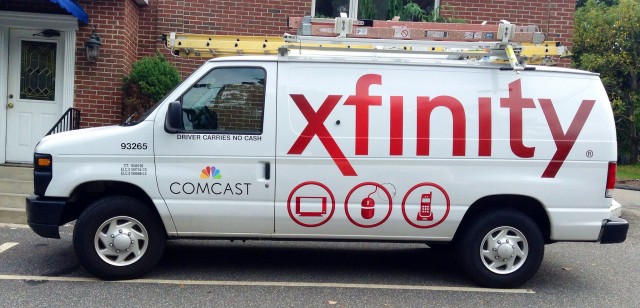
As expected, Comcast will officially offer a paid television service over the Internet. For now, the new service will only allow Roku and Samsung Smart TV owners to purchase access to the cable giant’s broadcast offerings. The program likely will be expanded over time.

As Ars reported two months ago, the Federal Communications Commission approved a Notice of Proposed Rulemaking (NPRM) that would force pay-TV companies to provide content and programming information to makers of third-party hardware and applications. This would create a software-based replacement for CableCard, allowing other companies to build set-top boxes or mobile applications that display a pay-TV subscriber's channels without a physical CableCard. (That vote has gotten support from the White House as recently as last week.)

Comcast’s new "Xfinity TV Partner Program" appears to be in direct response to that FCC move, although the company stated earlier this year in an FAQ that such a service was coming in 2016.

Read 4 remaining paragraphs | Comments

24 Apr 01:52

Body’s defenses against common viruses may mess up neurons, spark depression

by Beth Mole

(credit: Wikimedia)

Getting sick is definitely a bummer. But besides feeling icky and being stuck in bed, viral infections may cause us to actually be depressed. While scientists have been clued into this connection for a while, there was little data on how everyday viral infections, like the flu, might mess with our moods.

Now, data from a new mouse study shows that common viruses may spur sadness by causing the cells that line the blood-brain barrier to release signals that hush the chatter between neurons in the area of the brain responsible for mood. The findings, published this week in the journal Immunity, may finally explain the link between infections and mental health problems, and it could point researchers towards new strategies for treating depression and other mood disorders.

Researchers have been collecting hints of the connection between mental health and infections for years. Though it was first dismissed as people simply being blue about getting sick, doctors now accept that there is a condition called “sickness behavior.” This condition is marked by cognitive deficits, drowsiness, general malaise, and other depression-like symptoms in those with an infection. Moreover, in a 2013 Danish study, researchers found that people who had been treated for a severe infection were 62 percent more likely to suffer from mood disorders. Perhaps related, those that had an autoimmune disease were 45 percent more likely to have such a mental health issue.

Read 8 remaining paragraphs | Comments

24 Apr 00:47

NRA Commentator: People Who Hate Guns Should Own Body Armor As A “Passive Way To Protect Yourself From ... - Media Matters for America (blog)


Media Matters for America (blog)

NRA Commentator: People Who Hate Guns Should Own Body Armor As A “Passive Way To Protect Yourself From ...
Media Matters for America (blog)
A bizarre video released by an NRA News commentator touted several reasons to own body armor, including the claim that “if you don't like guns and want nothing to do with them, you have every right to make less than smart decisions with your life, but ...

24 Apr 00:43

Healthy Paws: Pet First Aid & Emergencies, Part II – When to Worry?

by wtopstaff

Healthy Paws

Editor’s Note: Healthy Paws is a column sponsored and written by the owners of Clarendon Animal Care, a full-service, general practice veterinary clinic. The clinic is located 3000 10th Street N., Suite B. and can be reached at 703-997-9776.

Last time, we talked about getting comfortable with the at-home exam so that you are comfortable knowing what is normal for your pet.  This week, we’ll focus on what constitutes an emergency and give you some guidelines for when to seek immediate care.

Things that warrant immediate veterinary attention include:

  • Any severe difficulty in breathing – increased abdominal effort to breathing, bluish-discoloration to the gums, open-mouth breathing in cats
  • Anaphylaxis (severe allergic reaction) – typically manifested as collapse or extreme lethargy, severe vomiting or diarrhea that is acute in nature, or severe facial swelling**
    • **Mild facial swelling may sometimes be treated on an outpatient basis or even at home with the advice of your veterinarian and is rarely life-threatening; however, in severe cases the swelling can be so significant as to partially occlude the airway, making immediate treatment vitally important
  • Ongoing bleeding that is not responding to applied pressure
  • Dragging limbs, ataxia (“drunk” walking), or inability to walk
  • Extreme lethargy/depression
  • Temperature greater than 105 degrees F
  • Prolonged seizures or more than 2 seizures in 24 hours
    • A single seizure does not always warrant immediate veterinary attention if the patient is alert and “back to normal” quickly thereafter; however, we always recommend contacting your veterinarian if your pet has a seizure and has no previous history of them
  • Bite wounds — with penetrating bite wounds, what we see from the surface is often “only the tip of the iceberg” — thus, it’s usually best to seek veterinary attention for all but the most superficial of bite wounds
  • Protracted vomiting and/or diarrhea – in many cases, a single episode of vomiting or diarrhea does not need immediate attention; however, if it is accompanied by lethargy or other symptoms we recommend at least consulting with your veterinarian.
  • Fractured limbs or penetrating wounds
  • Injuries to the eye — in general, our rule of thumb with any acute issue affecting the eye is that it should be seen as quickly as possible to ensure treatment is started in a timely manner
  • Known or high suspicion of ingestion of a toxin/poison or foreign object
  • Last but not least, you know your pet best of all, so even if there is not an obvious or clear-cut problem but you just feel that something is “off” we recommend consulting with your veterinarian.

What can I do while getting veterinary help?

  • Stay calm
  • Contact your veterinary hospital, or the emergency hospital if after-hours, to get advice and to let them know you are coming in so they can be fully prepared
  • If known trauma, keep your pet warm and keep movement to a minimum
  • Drive carefully on your way in!

We are fortunate to have many great emergency hospitals in the area, which serve as an excellent resource for you and your pets during hours when your primary veterinarian may not be available.

The American Veterinary Medical Association recently released a video on pet CPR, which we encourage everyone to watch at least once.

And, as we mentioned in the last installment, there are some really great online resources available:

Check out Clarendon Animal Care’s Calendar of Upcoming Events, including the AWLA Walk for the Animals on 5/7, Taste of Arlington on 5/15, and a Yappy Hour to benefit AWLA on 5/26!

The post Healthy Paws: Pet First Aid & Emergencies, Part II – When to Worry? appeared first on WTOP.

24 Apr 00:34

Man who landed gyrocopter on Capitol lawn gets 4 months

by wtopstaff

WASHINGTON (AP) — A Florida man who landed a one-person gyrocopter on the lawn of the U.S. Capitol in Washington in 2015 as a stunt to protest the influence of money in politics was sentenced Thursday to spend four months in jail.

In sentencing 62-year-old Douglas Hughes, Judge Colleen Kollar-Kotelly said he displayed a total lack of concern for his safety or that of others. She said he knowingly violated airspace restrictions around the nation’s capital, some of the most restricted U.S. airspace, and didn’t seem to appreciate how dangerous his actions were. It was only by chance that no one was harmed, she said at a hearing, which lasted hours.

Hughes has said his April 15, 2015, flight in the bare-bones aircraft was a way to call attention to the influence of big money in politics and protest government corruption. The former mail carrier from Ruskin, Florida, was carrying letters for each member of Congress on the topic of campaign finance and the tail of his aircraft displayed a postal service logo.

Hughes pleaded guilty in November to a felony of operating a gyrocopter without a license.

Prosecutors had asked the judge Thursday to sentence Hughes to 10 months in prison, arguing that his flight from Gettysburg, Pennsylvania, to the nation’s capital put countless lives at risk. Hughes “craved attention” and “violated important public safety laws because he wanted people to pay attention to his political views,” prosecutors wrote in a document filed with the court ahead of sentencing.

Hughes’ attorneys, meanwhile, had argued in their own memo that he should be allowed to remain out of jail and said his actions were “in the nation’s proud tradition of nonviolent civil disobedience.”

“The attention his flight gained, Mr. Hughes hopes, will force the nation to finally confront the issue of campaign finance rather than continue to ignore the problem. For this reason, Mr. Hughes should be considered a hero for his conduct,” his attorneys Mark Goldstone and Tony Miles wrote.

In writing and in court they compared Hughes’ flight to the acts of civil disobedience undertaken by Martin Luther King Jr., Rosa Parks, Harriet Tubman, Henry David Thoreau and the freedom riders.

But Judge Kollar-Kotelly disagreed, saying the actions of those historic figures were directly related to breaking laws they found unjust.

“He’s not in that league,” she said, calling his actions a “stunt,” a word Hughes also has used.

Hughes said outside of court that there weren’t any laws related to campaign finance that he could break. He said he was “not totally pleased nor terribly displeased” with the sentence.

“Yes, it was worth it,” he said.

He said it is not his intention to break any laws in the future but that he would consider taking an action that would result in another jail sentence if it would advance his cause.

___

Follow Jessica Gresko on Twitter at https://twitter.com/jessicagresko . Her work can be found at http://bigstory.ap.org/content/jessica-gresko .

The post Man who landed gyrocopter on Capitol lawn gets 4 months appeared first on WTOP.

24 Apr 00:32

Man arrested in death of 2-year-old

by Keara Dowd

WASHINGTON — An Annandale, Virginia, man has been charged with the death of a 2-year-old girl in Arlington after leaving her in the backseat of a car.

Arlington County Police says that 32 year-old Daiquan Fields was supposed to drop off the girl and two of her siblings at two separate places Wednesday morning. After he dropped off the older children, he returned to their home in Fairfax County, not realizing the toddler was still in the car.

Fields got back in the car later to pick up the child’s mother, and when he arrived at the 1100 block of S. Hayes Street, he realized the girl was still in her car seat. When she was unresponsive, Fields immediately called 911.

Fields, who is an acquaintance of the child’s mother, has been charged with felony child neglect and involuntary manslaughter.

Anyone with information about this incident is asked to contact Detective N. Brooks of the Arlington County Police Department’s Homicide/Robbery Unit at 703-228-4169 or NKbrooks@arlingtonva.us. Information may also be provided anonymously through the Arlington County Crime Solvers hotline at 1-866-411-TIPS (8477).

The post Man arrested in death of 2-year-old appeared first on WTOP.

24 Apr 00:32

Firms that paid for Clinton speeches have US gov’t interests

by wtopstaff

WASHINGTON (AP) — It’s not just Wall Street banks. Most companies and groups that paid Democratic presidential candidate Hillary Clinton to speak between 2013 and 2015 have lobbied federal agencies in recent years, and more than one-third are government contractors, an Associated Press review has found. Their interests are sprawling and would follow Clinton to the White House should she win election this fall.

The AP’s review of federal records, regulatory filings and correspondence showed that almost all the 82 corporations, trade associations and other groups that paid for or sponsored Clinton’s speeches have actively sought to sway the government — lobbying, bidding for contracts, commenting on federal policy and in some cases contacting State Department officials or Clinton herself during her tenure as secretary of state.

Presidents are not generally bound by many of the ethics and conflict-of-interest regulations that apply to non-elected executive branch officials, although they are subject to laws covering related conduct, such as bribery and illegal gratuities. Clinton’s 94 paid appearances over two years on the speech circuit leave her open to scrutiny over decisions she would make in the White House or influence that may affect the interests of her speech sponsors.

Rival presidential candidate Sen. Bernie Sanders and Republican critics have mocked Clinton over her closed-door talks to banks and investment firms, saying she is too closely aligned to Wall Street to curb its abuses. Sanders said in a speech in New York that Clinton earned an average of about $225,000 for each speech and goaded her for declining to release transcripts.

“If somebody gets paid $225,000 for a speech, it must be an unbelievably extraordinary speech,” Sanders said at an outdoor rally at Washington Square Park last week in advance of the New York primary. “I kind of think if that $225,000 speech was so extraordinary, she should release the transcripts and share it with all of us.”

Clinton said again Thursday she will release transcripts of her paid speeches to private groups or companies when other political candidates do the same. She compared such disclosures to the long-standing practice of politicians being expected to release their income tax returns, which she did far earlier and more thoroughly than Sanders in the campaign.

“Now there’s a new request to release transcripts of speeches that have been given,” Clinton said during a town hall. “When everybody agrees to do that, I will as well because I think it’s important we all abide by the same standards. So, let’s do the tax return standard first because that’s been around for a really long time.”

Clinton has said she can be trusted to spurn her donors on critical issues, noting that President Barack Obama was tough on Wall Street despite his prolific fundraising there. But her earnings of more than $21.6 million from such a wide range of interest groups could affect public confidence in her proclaimed independence.

“The problem is whether all these interests who paid her to appear before them will expect to have special access when they have an issue before the government,” said Lawrence M. Noble, general counsel of the Campaign Legal Center, a Washington-based election watchdog group.

The AP review identified at least 60 firms and organizations that sponsored Clinton’s speeches and lobbied the U.S. government at some point since the start of the Obama administration. Over the same period, at least 30 also profited from government contracts. Twenty-two groups lobbied the State Department during Clinton’s tenure as secretary of state. They include familiar Wall Street financial houses such as Morgan Stanley and Goldman Sachs Group Inc., corporate giants like General Electric Co. and Verizon Communications Inc., and lesser-known entities such as the Institute of Scrap Recycling Industries and the Global Business Travel Association.

Clinton’s two-year speaking tour, which took place after she resigned as secretary of state, “puts her in the position of having to disavow that money is an influence on her while at the same time backing campaign reform based on the influence of money,” said Noble, a former general counsel at the Federal Election Commission. “It ends up creating the appearance of influence.”

Clinton dismissed those concerns in a town hall in Columbia, South Carolina, saying that “the argument seems to be that if you ever took money from any business of any kind, then you can’t fulfill your public responsibilities. Well, that’s just not the case.”

Clinton’s spokesman, Brian Fallon, said in a statement, “Hillary Clinton’s record shows she has consistently taken on these very same industries, and to suggest she would deviate from that at all as president is completely baseless.”

Despite months of controversy over her speeches to Wall Street patrons, Clinton’s biggest rewards came from Washington’s trade associations, the lobbying groups that push aggressively for industry interests. Trade groups paid Clinton more than $7.1 million, the review showed.

The National Association of Realtors spent $38.5 million on government contacts in 2013, the same year it paid Clinton $225,000 to appear at the group’s gathering in San Francisco. A group spokesman said Clinton was among former U.S. officials invited to share their experiences but said she was not paid as part of its lobbying activities.

The Biotechnology Industry Organization, which represents biotech and pharmaceutical firms, spent between $7 million and $8.5 million annually on lobbying since 2008, including contacts with the State Department — during Clinton’s tenure — on the agency’s biotech discussions with foreign governments. The trade group, which hosted Clinton for $335,000 at its event in San Diego in June 2014, has won more than $425,000 in federal payments since 2008 in work for the National Science Foundation and other agencies. The group did not respond to phone calls or emails for comment from AP.

The financial services and investment industry accounted for about $4.1 million of Clinton’s earnings. Its ranks included not only Wall Street powerhouses like Morgan Stanley, Goldman Sachs and Bank of America Corp., but also private equity and hedge funds like Kohlberg Kravis Roberts & Co. LP and Apollo Global Management LLC and foreign-owned banks such as Deutsche Bank AG and the Canada Imperial Bank of Commerce. Goldman Sachs, which gave Clinton $675,000 for three speeches in 2013, and Morgan Stanley, which paid her $225,000 for one speech the same year, both spent millions lobbying the U.S. during Clinton’s term at the State Department.

Nearly three dozen of Clinton’s benefactors spent more than $1 million annually on contacts with officials and Congress during the same year they paid her to appear at their corporate or association events, according to federal lobbying records. Many earned millions more in government contracts — indications of the regulatory and policy stances the groups might advocate during a Clinton presidency.

General Electric, which paid her $225,000 for a speech in Boca Raton, Florida, in January 2014, has the most extensive government portfolio. GE has spent between $15.1 million and $39.2 million annually on lobbying. The company has won nearly $50 million in government work since 2008, including $1.7 million from the State Department for lab equipment and data processing during Clinton’s tenure. The firm also lobbied the State Department all four years under Clinton on issues including trade and Iran sanctions.

As secretary of state, Clinton visited a GE aviation facility in Singapore and touted the State Department’s role aiding GE industrial and military deals abroad. Clinton met with GE Chairman Jeffrey Immelt once about the agency’s efforts to salvage a planned business exposition in Shanghai and also talked with him by phone, according to her calendars.

A GE spokeswoman said, “GE works closely with the U.S. government and State Department, which often advocates for U.S. exporters.”

Clinton sought to defuse the issue of her Wall Street speeches during a February debate with Sanders by explaining that she “spoke to heart doctors, I spoke to the American Camping Association, I spoke to auto dealers, and, yes, I spoke to firms on Wall Street.”

Even the sponsors Clinton cited in her defense engaged in public advocacy — an indication of how many might seek favors if Clinton were elected.

The Cardiovascular Research Foundation, a fundraising group for cutting-edge heart medicine, paid Clinton $275,000 for a speech in Washington in September 2014. That same year, the organization joined other medical and health care groups in urging the Federal Drug Administration to reconsider its generic labeling rules. Foundation spokeswoman Irma Damhuis said Clinton was invited as a “recognized thought leader,” adding that “decisions on keynote speakers are made without a political agenda.”

The National Automobile Dealers Association paid Clinton $325,000 for a convention speech in New Orleans in January 2014. That same year, the trade group spent $3.2 million lobbying federal officials on taxes, automotive and trucking issues, labor and finance. A spokesman said the group’s lobbying and convention activities were separate.

The camping group also paid for lobbying in recent years, including $40,000 in 2015 on Transportation Department administrative actions, according to federal records. The group’s New York and New Jersey affiliate paid Clinton $260,000 for a March 2015 speech in Atlantic City.

Deirdre Petting, an executive with the national group, said its lobbying was separate from the affiliate’s decision to invite Clinton for the event.

The post Firms that paid for Clinton speeches have US gov’t interests appeared first on WTOP.
24 Apr 00:31

Police: Officer pointed gun at driver in road-rage incident

by wtopstaff

WASHINGTON (AP) — A Washington, D.C., police officer has been charged after authorities say he pointed his department-issued gun at a driver during an off-duty road rage incident.

The Washington Post (http://wapo.st/1WJH9Hu ) reports 46-year-old Michael Minor was arrested Wednesday.

He faces a charge of assault with a dangerous weapon stemming from a Feb. 20 incident, in which police say Minor drew his service weapon and later fought another driver along Interstate 295 after the two drivers almost collided as they merged onto the highway.

Police spokesman Officer Hugh Carew says Minor has been placed on non-contact duty status.

Police Chief Cathy L. Lanier says in a statement that the department will continue to hold officers to high standards in the wake of Minor’s actions.

It isn’t immediately clear if Minor has an attorney.

___

Information from: The Washington Post, http://www.washingtonpost.com

The post Police: Officer pointed gun at driver in road-rage incident appeared first on WTOP.

24 Apr 00:28

Virginia governor enables 200,000 felons to vote in November

by wtopstaff

RICHMOND, Va. (AP) — More than 200,000 convicted felons will be able to cast ballots in the swing state of Virginia in November under a sweeping executive order Gov. Terry McAuliffe announced Friday.

The Democrat said restoring the rights of felons to vote and run for office will help undo the state’s long history of trying to prevent African-Americans from fully participating in our democracy.

“This is the essence of our democracy and any effort to dilute that fundamental principle diminishes it, folks, for all of us,” McAuliffe said on the steps of Virginia’s Capitol, before a crowd of more than 100 people that included many felons. Left-leaning advocacy groups were there as well, handing out voter registration forms.

Republicans called the order a bald-faced political move by McAuliffe — a close friend of Democratic presidential front-runner Hillary Clinton — to help his party hold onto the White House.

“I am stunned yet not at all surprised by the governor’s action,” House Speaker William J. Howell said in a statement. “This office has always been a stepping stone to a job in Hillary Clinton’s cabinet.”

Republicans said ex-offenders who committed violent crimes, like murder, should not be allowed to vote or have other civil rights restored.

“Terry McAuliffe wants to ensure that convicted pedophiles, rapists, and domestic abusers can vote for Hillary Clinton,” said Senate Republican Caucus Chairman Ryan T. McDougle.

Kimberly Carter, 45, filled out a voter registration card shortly after watching the governor’s speech. Now working as a customer service representative, she said she’s been prevented from voting her entire adult life after a drug arrest in her late teens.

“You make a mistake, 20 years later you’re still paying for it,” she said.

Nationwide, nearly 6 million Americans are barred from voting because of laws disenfranchising felons, according to The Washington-based Sentencing Project. Virginia, Iowa, Kentucky and Florida are the only states that still remove voting rights for felons for life unless a state official restores them.

Such policies make black Americans of voting age four times more likely to lose their voting rights than the rest of the adult population, disenfranchising one of every 13 African-American adults nationwide, but Virginia is even more punishing. It’s among three states where more than one in five black adults have lost their voting rights, according to a recent Sentencing Project report.

Howell said Republicans are reviewing whether McAuliffe overstepped his legal authority. Republicans pointed to a letter written by a lawyer for Democratic Gov. Tim Kaine in 2010 rejecting the idea that the governor had the ability to grant blanket restoration of rights.

McAuliffe said he is certain he has such authority after consulting with legal and constitutional experts, including Virginia Attorney General Mark Herring.

Constitutional scholar A.E. Dick Howard, who presided over the most recent rewrite of the Virginia Constitution 45 years ago, said McAuliffe has broad discretion in restoring civil rights, and has now ended one of the last remaining legacies of an earlier constitutional convention that was “committed to white supremacy.”

“The last ghost of the 1902 convention was buried today,” Howard said.

The governor’s order enables every Virginia felon to vote, run for public office, serve on a jury and become a notary public if they have completed their sentence and finished any supervised release, parole or probation requirements as of April 22. The administration estimates this population to include about 206,000 people.

Thereafter, the governor will act month by month to restore the rights of felons who complete all these requirements.

Previous governors in other states have granted broad restoration of voting rights in the past decade, but McAuliffe’s action is the largest to date, according to the Sentencing Project.

There were 5.3 million registered voters in Virginia as of April 1, according to the Virginia State Board of Elections.

McAuliffe, who won election in 2013 by slightly more than 50,000 votes out of more than 2.2 million cast, brushed aside suggestions about political motivations, citing his longtime advocacy for restoring rights.

“This is something that’s in the marrow of bones, this is something I feel very deeply about,” McAuliffe said.

Before Friday’s order, McAuliffe’s administration had restored the rights of more than 18,000 felons — more, they said, than the past seven governors combined. Former Gov. Bob McDonnell, McAuliffe’s immediate predecessor, was also a strong advocate for restoring rights.

NAACP President and CEO Cornell William Brooks said he hopes more states follow the lead of Virginia’s governor.

“History shows when people are denied the right to vote, the loss of representation weakens our neighborhoods and communities, and furthers systemic inequality,” Brooks said in a statement.

___

Associated Press reporter Alanna Durkin Richer contributed to this report.

The post Virginia governor enables 200,000 felons to vote in November appeared first on WTOP.

24 Apr 00:22

McAuliffe restores voting rights to 200,000 felons

by Max Smith

WASHINGTON — More than 200,000 convicted felons had their rights to vote restored Friday by Virginia’s governor, but not their rights to carry or transport guns.

Gov. Terry McAuliffe’s order restoring the rights to vote, hold public office, serve on a jury and act as a notary public for all felons who have completed their sentences specifically excludes any changes that would allow felons who have finished serving their entire sentences to “ship, transport, possess, or receive firearms.”

Republican leaders in the General Assembly slammed the order.

“With this action, what scant civility remains between the General Assembly and this governor has been stretched to the breaking point,” Senate Majority Leader Tommy Norment said.

House Speaker Bill Howell said he was “stunned” at the broad use of executive power that simply serves to help “deliver Virginia to Hillary Clinton in November,” but acknowledged that felons should have the chance to have their rights restored.

Republican leaders cite a 2010 legal opinion within Gov. Tim Kaine’s administration that found this type of blanket restoration of rights would be rewriting how Virginia had handled the restoration of rights in the past.

McAuliffe led Clinton’s 2008 presidential campaign, and has been a long-time Clinton ally. She tweeted her support for the move Friday afternoon.

Democrats back the move as a way to ensure those who have paid their debt to society are allowed to fully reenter the community, especially since many those impacted by the order are believed to be members of minority groups.

“This is a life-changing day for hundreds of thousands of Virginians who will once again have a voice,” Attorney General Mark Herring said in a statement.

“In restoring the rights of our fellow citizens who have long ago served their sentence, Gov. McAuliffe is turning a page, providing hope, and empowering hundreds of thousands of Virginians who have been disenfranchised for far too long,” the statement says.

The post McAuliffe restores voting rights to 200,000 felons appeared first on WTOP.

23 Apr 23:51

Use Egg Wrappers Instead of Tortillas for Protein-Packed Sandwiches

by Melanie Pinola

Pinwheel sandwiches are beautiful and easy to make. If you’re avoiding wheat or just want to vary your sandwich wrapper, try using eggs.

Read more...

23 Apr 23:13

Visit the Filming Locations of Popular Movies and TV Shows With This Map

by Patrick Allan

If you’ve ever wanted to visit the filming locations of movies like Star Wars: The Force Awakens and Ghostbusters, or shows like Game of Thrones and Twin Peaks, this interactive map is for you.

Read more...

23 Apr 21:26

The Prince Playlist

by Eric Ravenscraft

Today, we lost legendary artist and performer Prince . Instead of our usual weekly featured playlist, we’ve gathered up a collection of Prince’s live performances to remember how fantastic a person and artist he truly was.

Read more...

23 Apr 21:10

Cope With a Job Loss or Layoff By Volunteering

by Kristin Wong

Getting fired or laid off can be a frustrating, emotional experience. You’re not sure what to do with your time, and worse, sometimes you start to question your value. Volunteering gives you a productive outlet for coping with the situation.

Read more...

23 Apr 01:58

The Benefits of Scaring Yourself for Fun

by Patrick Allan

Whether it’s a roller coaster, haunted house, or horror movie, people love to scare themselves for entertainment. It might seem odd, but it turns out making yourself feel fear actually comes with some decent perks.

Read more...

23 Apr 01:57

How to Host a Game of Thrones Fantasy League Draft

by Patrick Allan

Game of Thrones has so many characters, plot lines, alliances, and events that the drama unfolds like a season of your favorite sport. In fact, it’s possible to turn the show into a fantasy football-like draft. Here’s how.

Read more...

23 Apr 01:55

Appeals Court: Snowboarders Don’t Have A Constitutional Right To Ski Slopes

by Chris Morran

While it might be not-cool for a private ski resort to bar snowboarders from the ski slopes, does that change when the resort on government land? Would telling snowboarders to go elsewhere be a violation of their Constitutional rights? No — at least according to a federal appeals court.

Back in 2014, we told you about a lawsuit filed by a group of snowboarders against the United States Forest Service, which controls most of the land on which Utah’s Alta Ski Area is located. The snowboarders alleged that Alta’s ban on snowboarding violated their rights under the Fifth and Fourteenth Amendments, both of which say that no one shall be deprived of “life, liberty, or property, without due process of law.”

Much of the Alta Ski Area — one of only three resorts in the U.S. to ban snowboarders — is located on federal land, and the U.S. Forest Service must periodically re-approve the resort’s management plan. That plan includes the ski area reserving the right to exclude any activities it deems a risk to other skiers, might mess with its snow, or is otherwise inconsistent with its business model.

The snowboarding plaintiffs contend that, by signing off on Alta’s ban, the Forest Service is depriving them of their constitutionally protected rights, and that the ski area’s only basis for barring boarders is an irrational dislike of the sport.

In 2014, the District Court dismissed the snowboarders’ lawsuit, saying that the plaintiffs had failed to demonstrate a “state action.” While the government does approve the management plan and receives some money from Alta, the Forest Service’s connection to the snowboarding ban is not sufficient to make the case that the U.S. government was banning the practice.

The snowboarders appealed, arguing that the District Court failed to accept the facts presented as true, and to grant all reasonable inferences in favor of the plaintiffs.

However, in a ruling [PDF] released earlier this week, a Tenth Circuit Court of Appeals panel notes that while a court might accept facts as true, there is no obligation to accept that the plaintiffs’ “legal conclusions as true.”

“Threadbare recitals of the elements of a cause of action, supported by mere conclusory statements, do not suffice,” writes the appeals court, quoting from a 2012 Tenth Circuit decision.

Regardless, the appeals panel says it reviewed the facts presented by plaintiffs and asked whether they do indeed back up a claim that the snowboard ban violates the Fourteenth Amendment.

There are a number of ways for a court to consider whether the government’s connection to a private action crosses the line — has the government involved itself so much in the affairs of a private party that a “symbiotic relationship” has developed? Is the connection between the government and the private party so close that the action of the private party “may be fairly treated as that of the State itself”? Is the private party a “willful participant in joint activity” with the state? And has the private party been given authority that is “traditionally exclusively reserved to the state”?

Even if the answer to any of these is “yes,” the court must still determine whether the disputed action is actually attributable to the state.

The plaintiffs had argued that statements from Alta management — like the general manager, who allegedly said the snowboard ban is legitimate because “the Forest Service says it’s OK” — indicated that the Service had explicitly given its approval of the ban.

The snowboarders had also claimed that the fees paid by Alta to the Forest Service shows that the government “depends on Alta to operate the resort on National Forest land for the public,” and that without those fees, “the Government would be forced to either assume or abandon the operations or enter into an identical arrangement for another entity like Alta to assume operations.”

However, the appeals court counters that the $400,000/year paid by Alta to the USFS is only .1% of the Service’s annual budget, and represents just one of more than 120 ski resorts in the country with a similar arrangement. So, in the court’s view, if Alta Ski Area were to vanish, it would not have any significant impact on the operations of the USFS.

Also, because the government did nothing to contribute to the development of Alta other than to lease the land for the resort, the appeals panel concluded that the snowboarders’ argument was stretched too far.

“[T]he complaint at best establishes that the Forest Service knows about the snowboard ban,” explains the court, “and continues to approve its permit each year notwithstanding the ban.”

As for the Service’s annual re-approval of the Alta management plan, the court notes that the USFS “doesn’t make Alta’s permit contingent upon a snowboard ban or otherwise encourage a snowboard ban.”

[via Courthouse News]

23 Apr 01:55

In 6 Cities, Amazon Same-Day Delivery Available In More White ZIP Codes Than Black Ones

by Kate Cox

Effective same-day delivery is kind of the holy grail of online retail right now: being able to get your hands on that thing you need right now when you need it is the one advantage brick-and-mortar stores still have, and it’s the one Amazon in particular wants to chip away at. The list of cities where Amazon promises Prime subscribers access to same-day delivery keeps getting longer, but there’s a snag: not all addresses within a city are considered equal, and the pattern to the areas without access looks distressingly familiar.

It makes sense that not every single ZIP code out there can be equally reached by same-day delivery services. Some cities are large and sprawling and complicated, sure, and even in the more compact ones there might be some roads that are just tricky to take a truck down. Warehouses might be juuuuuuust out of range for the far-flung corners of a metropolis. Exceptions will always happen.

But reporters at Bloomberg went looking at those exceptions, and what they found in many of the nation’s biggest cities isn’t just haphazard: it’s a pattern with a clear and troubling correlation to hand.

For example, those exceptions makes a lot less sense when the no-go zone is one tiny little island in the middle of a geographically compact city — as in the Roxbury area of Boston, perhaps Bloomberg’s most immediately egregious example:

Bloomberg's map of Amazon Prime same-day delivery in Boston

Likewise, the map of our nation’s capital — designed from the start as only ten miles on a side, and since 1846 even smaller — has a rather… abrupt demarcation in it:

Bloomberg's map of Amazon Prime same-day delivery in DC

And what do Roxbury and Southeast DC have in common? They’re the areas of their home cities with the highest concentration of black residents.

What has happened in both of those cities, Bloomberg found — as well as in Chicago, Dallas, Atlanta, and New York — is that those little “pockets” (or glaring lines) where same-day delivery is unavailable correlate very neatly to the pockets (or glaring lines) of the neighborhoods’ racial make-up, as reported on the census.

Amazon’s certainly not doing it on purpose; no one is sitting around their office in Seattle, twirling a handlebar mustache while brandishing a cigar and exclaiming, “I know: Racism!”

Instead, it’s a problem we’ve seen before: when an algorithm or a computer or a human wielding those tools uses proxy data, like ZIP code and income correlations, what it often ends up with is a big fat pile of unintentional, but still present, racial bias.

Amazon tells Bloomberg that its plan in each city it goes to is to “start out small,” where there’s already a high concentration of Prime members, and then “end up getting big” as they expand the program, which makes a perfect amount of sense from Amazon’s point of view. But there are a lot of cities — including these six — where “highest number of existing subscribers” is probably going to correlate to “wealthiest areas,” which also tends to correlate to “whitest areas.”

In other words: customers who, behind a screen, are all anonymous and who live mere yards from each other are still treated differently under the data.

A Washington, D.C. area Prime customer who lives in one of the neighborhoods without same-day delivery tells Bloomberg, “I still get two-day shipping, but none of the superfast, convenient delivery services come here. If you bring that service to the city, you should offer it to the whole city.”

Bloomberg's interactive map of race vs. Prime same-day access in Chicago
There’s a lot of segregation in most American cities still; neighborhoods, and therefore the ZIP codes that define them in databases, don’t necessarily see a lot of black and white families living side by side. That allows for high concentrations of pretty much any data point in one kind of ZIP code or another, and if you don’t have eyes inside the company — any company — specifically looking for it, it’s a pattern you may not see until it’s already done.

Or, as the D.C. customer put it to Bloomberg: “They [Amazon] are offering different services to other people who don’t look like you but live in the same city,” and so long as the effect continues to exist, the cause doesn’t really matter.

Amazon Doesn’t Consider the Race of Its Customers. Should It? [Bloomberg]

23 Apr 01:54

3 Reasons Comcast’s Samsung App Is Not The Answer To Set-Top Box Reform

by Chris Morran

Yesterday, only weeks after the FCC voted to draft rules that would require pay-TV companies to open up the set-top box market to competitors, Comcast announced a deal with Samsung that will allow owners of certain TVs to access their cable TV without the need to pay for a cable box every month. The industry and its supporters are heralding the news as a clear demonstration that the FCC should just shut up and stop all its regulating, but the reports of the set-top box’s death are greatly exaggerated.

This is not to say that the Comcast app is a bad thing or that it’s not a step in the right direction. In fact, we confirmed the positive aspects of the app with Comcast.

It could be used to replace set-top boxes. Unlike many current pay-TV apps, which generally require the subscriber to have at least one receiver in their home, Comcast claims the new app will only require the modem (which you probably also lease from Comcast; but one step at a time, right?).

Comcast also says the app will have cloud DVR capability, meaning you wouldn’t need a set-top box to record programming. We’ve heard some complaints from readers about the quality and reliability of Comcast’s cloud-based DVR, so that might be something to take into consideration. We also don’t know if there will be any monthly charge for DVR service using the app.

The bad news: Comcast will be charging for that cloud DVR service. We don’t know how much, but it’s not free.

Not surprisingly, the Comcast-connected Future of TV Coalition — a fake grassroots organization that continues to make patently false statements about the FCC plan — has put out an effusive statement effectively claiming the Comcast app as the Holy Grail of pay-TV.

“If the FCC’s set-top box proceeding is truly just about freeing consumers from monthly box fees, today’s announcement underscores how absurd the arguments for government intervention are,” reads a statement from the Coalition. “Apps, not federal box mandates, are the fastest and most effective way to expand consumers’ options for video devices.”

First off, the FCC rules are not “federal box mandates.” Instead, they would require that pay-TV companies make their content available for distribution through boxes and apps that compete with the boxes and apps that have almost solely been accessible through the cable providers.

Second, the Coalition statement conveniently glosses over the timing of this news and its relation to the FCC actions. Comcast has been in busy for more than four decades, but the company just happens to release the news about this app shortly before the open comment deadline on the FCC’s set-top box rulemaking process.

It’s amazing how industry tends to do pro-consumer things whenever regulators step up with the threat of new rules — and just as amazing how they tend to claim that they were planning this all along.

Regardless of whether this announcement is a well-timed effort to derail the FCC’s rules or just a happy coincidence, the fact remains that there are several reasons that a single app is not sufficient to discount the entire idea of set-top box reform.

1. Access Is Still Limited

Comcast may have partnered with a popular TV maker in Samsung, but the app will not be retroactively available on all existing Samsung Smart TVs, only on those made this year. So in order to avoid paying upwards of $10 per month for a set-top box, you’ll have to pay hundreds — possibly thousands for a new Samsung. If you have multiple boxes in your house, it could be quite some time (or cost you quite a lot of money) to rid yourself of these monthly lease fees.

Roku also announced that the Comcast app will be coming to its devices later this year, but that appears to be an over-the-top streaming service, as opposed to the Samsung app which is an actual live cable TV feed and should not suffer from the stutters, lags, or other hiccups often associated with livestreaming video.

And as we noted above, if you want the DVR aspect of the Comcast app, you’ll have to pay something to Comcast each month, so it may replace your box, but it’s not letting you get rid of the cost.

2. Limited Portability

One of the ideas behind offering competing set-top box devices and apps is that consumers would someday be able to take that device or app from one pay-TV provider to another. If you drop Comcast and switch to DirecTV or FiOS, you wouldn’t need to be able to buy a new box or switch to yet another app. The same would be true if you moved out of Comcast territory and into an area with a different provider.

In the Samsung case, only Comcast customers benefit, and only if they remain Comcast customers in the Comcast footprint. Switch providers and you’ll need a box to go with that fancy new TV; ditto if you relocate to Cablevision country.

3. An App From Comcast Is Not Competition

Competition is a good thing, often resulting in innovative and affordable products. In most of the country, Comcast only faces competition in the pay-TV market from the satellite providers, Dish and DirecTV. But each of these providers have their own proprietary set-top boxes that only work on their feeds. And they all charge a lot of money for these boxes, as we’ve shown in our recent detailed looks at various companies’ monthly bills.

The Comcast and DirecTV bills we looked at each charged $10 for a single DVR, with additional fees for multiple boxes and whole-home DVR service. The Dish bill we’re currently breaking down (and will post in the coming week) charges $12/month for a single DVR.

When Sens. Blumenthal and Markey tried to get the pay-TV companies to provide detailed information about their set-top box revenue, no cable company offered up anything close to a complete picture, leading the senators to do their best guesswork. They came up with a figure of $20 billion a year in fees spent by consumers.

For an opinion piece in The Hill, economist George Ford used generously conservative numbers — he appears to have used pricing solely for non-DVR receivers and doesn’t include estimates for things like whole-home DVR service or cloud DVR — in an apparent attempt to politicize the issue.

Even Ford’s industry-friendly math comes out to a total of more than $13 billion — $145/year per cable subscriber that goes into the hands of pay-TV companies. Yes, that’s less than the rough $20 billion figure from Blumenthal and Markey (and the actual figure is likely somewhere in the middle), but it’s no “get out of regulation free” card for the pay-TV industry.

Some cable providers have long contended that set-top boxes are not a profit center for the industry. A recent, non-partisan, analysis of box fees calculated that they result in around $1.2 billion a year in free cash flow for Comcast, which is not really a figure to brush off. The analysis also contends that these fees are “just video revenue in disguise,” meaning they are a way for cable companies to pad bills without raising the advertised price of their services. Sadly, that report also concludes that cable operators will just make for any lost box revenue by raising rates.

23 Apr 01:54

General Mills Brands Tweet About Death Of Music Legend Prince, Reconsider, Delete

by Laura Northrup

When you’re running a corporate social media account, it’s very difficult to balance posts that will get people talking about your brand, and posts that will get people complaining about your brand. Brands found themselves with this dilemma when the unexpected news came that musician Prince died today. Should they acknowledge the news? Ignore it? Make themselves part of the conversation? Two brands that are part of Minneapolis-based General Mills posted tributes, then thought better of it and took them down.

prince_RIP

Those brands were Cheerios and Hamburger Helper. We began seeing screen grabs of the Cheerios tweet soon after it was posted, but no trace of the post or apology on the official Cheerios account, so we contacted General Mills about the post.

They confirmed that it was genuine, and they took it down for the reason everyone assumes they did. “As a Minnesota brand, Cheerios wanted to acknowledge the loss of a musical legend in our hometown,” a General Mills representative wrote to Consumerist. “But we quickly decided that we didn’t want the tweet to be misinterpreted, and removed it out of respect for Prince and those mourning.”

Hamburger Helper similarly also posted a Prince-related tweet, and quickly deleted it.

(screen grab by Julia)
23 Apr 01:53

Judge: Ashley Madison Customers Can’t Be Anonymous If They Want To Sue Cheating Site

by Mary Beth Quirk

It’s understandable why someone who uses a website to cheat on their significant would want anonymity — mostly, they don’t want to get caught. But the former Ashley Madison customers seeking to sue over the massive data hack last year that exposed personal information for 30 million users or so will have to attach their names to the lawsuit, a federal judge ruled recently.

There are currently 42 plaintiffs seeking to represent a class of users of Ashley Madison, an online dating service that helps people cheat. Those plaintiffs want to sue Avid Life Media, the parent company of Ashley Madison, as John Does, “to reduce the risk of potentially catastrophic personal and professional consequences that could befall them and their families,” according to court papers (h/t New York Times).

They claim that Avid didn’t safeguard their personal and financial information, and peddled a “full delete removal” service for $19 a pop that didn’t actually purge user account information from its database. The plaintiffs are also accusing the company of populating the site with accounts from fake female users to lure customers.

Judge John A. Ross of the United States District Court in the Eastern District of Missouri said in his ruling [PDF] that plaintiffs in cases that involve accusations of rape, child sexual abuse, and other sensitive matters have been allowed to be anonymous. But in other court cases, the mere embarrassment wasn’t enough to outweigh the presumption of openness and public scrutiny in judicial proceedings.

“At the same time, there is a compelling public interest in open court proceedings, particularly in the context of a class-action suit, where a plaintiff seeks to represent a class of consumers who have a personal stake in the case and a heightened interest in knowing who purports to represent their interests in the litigation,” he wrote.

The sexual preferences and habits of the plaintiffs “do not constitute information of the utmost intimacy” that would require withholding their names, the judge wrote.

It’s not like no one has seen their names anyway, the judge added, what with that whole “massive data leak all over the internet” thing.

“Moreover, the personal and financial information plaintiffs seek to protect has already been released on the Internet and made available to the public,” Judge Ross wrote in a ruling dated April 6 that was first reported by Ars Technica earlier this week.

Those who still want to go forward class representatives, who have a fiduciary obligation to represent the entire class of plaintiffs and who “generally receive an incentive award as compensation for work done on behalf of the class,” will have to disclose their identities, the judge wrote.

If they don’t want that role, they could dismiss their complaints and then proceed as class members — if and when a class is certified. Class members won’t have to be identified by name.

23 Apr 01:53

Uber Drivers Are Independent Contractors, Will Receive Up To $100M In Settlement

by Ashlee Kieler

For the better part of three years, Uber drivers have sparred with the ride-sharing company over the status of their employment: are they independent contractor or actual employees? Today, Uber has agreed to settle two lawsuits over the issue, paying up to $100 million to the drivers who will remain independent contractors. 

Uber announced Thursday that it planned to settle the two lawsuits, paying $84 million to 385,000 drivers who sued the company in California and Massachusetts. The payout could increase by $16 million if Uber’s valuation reaches at least 1.5 times its current level when the company either goes public or is acquired.

While the payout may be a victory for the plaintiff drivers, Uber is walking away with what is likely the bigger win in the long-run — being able to continue to labeling drivers as independent contractors instead of employees.

The lawsuits alleged that drivers for Uber are misclassified employees, who should have their vehicle expenses covered by their “employer,” Uber.

The business model employed by Uber allowed the company to grow rapidly without the worry of covering driver expenses such as gas and mileage, or providing benefits such as health insurance, Social Security, overtime or sick days.

Drivers submitted declarations to the court back in 2015 saying, in part, that Uber misled them about the benefits that employees receive, such as having their employer pay part of their Social Security taxes, and having vehicle costs reimbursed.

The deal, which still needs to be approved by the court, would distribute the $84 million among drivers in California and Massachusetts who performed at least one trip up until the date of the preliminary settlement approval, the Los Angeles Times reports.

Payments will be determined based on miles driven with a passenger in the car, with drivers who logged more than 25,000 miles receiving $8,000 or more.

As part of the agreement, Uber agreed to make changes to its business practices, including creating a policy for deactivation of drivers. Instead of doing so at-will, Uber says it will provide drivers with warnings and give them opportunity to correct any issues before they’re taken off-line.

A panel will also be created so that drivers who feel they were unfairly terminated can appeal the decision.

While these changes won’t generally impact a passenger, one stipulation of the settlement will: tips.

Under the agreement, Uber will make it clear to riders that tips are not included in Uber’s fares. As such, drivers will be permitted to solicit tips from passengers.

“Uber has become an important part of many drivers’ lives, whether they drive all week or for a couple of hours to help pay the bills,” Travis Kalanick, CEO of Uber said in a blog post. “Uber is a new way of working: it’s about people having the freedom to start and stop work when they want, at the push of a button. As we’ve grown we’ve gotten a lot right—but certainly not everything.”

By settling the cases, Uber appears to be trying to put the matter behind it, however, that may not be the case. Earlier this year, a similar settlement reached by Lyft was rejected by a judge.

[via The Los Angeles Times]

23 Apr 01:52

Carnival Says Cuba Cruises To Move Ahead As Planned After Policy Shift

by Ashlee Kieler

Carnival Cruise Line’s Adonia ship will depart the Port of Miami as planned on May 1 with Cuban-Americans on board after the company reached an agreement with the government of the island nation. 

Earlier this week, Carnival announced that its maiden voyage to Cuba could be delayed unless the destination country doesn’t change a policy that prohibits nationals from returning to the island by sea.

Carnival CEO Arnold Donald said on Friday that the company had worked closely with Cuba to allow cruise ships to operate in a similar manner as current air charter operations to the island.

“We made history in March, and we are a part of making history again today,” Donald said. “More importantly, we are contributing to a positive future. This is a positive outcome and we are extremely pleased.”

The policy change comes a day after a Miami judge said he would consider a lawsuit against Carnival.

The lawsuit challenged Carnival’s refusal to allow Cuban-born consumers to book trips on the upcoming voyages, calling the policy discriminatory. The company had said at the time that it had to adhere to Cuban law.

Carnival reversed that stance earlier this week, announcing it would begin accepting reservations from people born in Cuba in hopes that the Cuban government would overturn the prohibition on travel by ship before May 1.

Last month, Cuban authorities said they’d granted permission to Carnival for the 740-passenger Adonia’s inaugural voyage from Miami to Havana departing May 1.

The trips will be the first time in more than 50 years that a cruise ship has traveled from the U.S. to the island nation.

Travelers will set sail on seven-day cruises with Carnival’s Fathom brand, which offers cultural exchange programs. That’s one of the approved categories of travel to the island nation under new rules which allow for “people-to-people educational travel.”

23 Apr 01:51

U.S. Investigating Mitsubishi Over Falsified Fuel Mileage Data

by Ashlee Kieler

Two days after Mitsubishi revealed that employees manipulated mileage test data for 620,000 vehicles sold in Japan since 2013, U.S. regulators have opened their own investigation into the carmaker to find out if the same shenanigans occurred stateside.

Officials with the National Highway Traffic Safety Administration directed Mitsubishi to hand over any information on its vehicles sold in the United States, Reuters reports.

“We’ve requested information from Mitsubishi about this issue,” a spokesman for NHTSA said, declining to specify which models the agency sought data for.

For now, there’s no evidence that Mitsubishi cars in the U.S. include the same fuel inaccuracies as the 625,000 small cars sold in Japan, which included some vehicles manufactured for Nissan.

According to Mitsubishi tire pressure data was manipulated to make mileage appear 5% to 10% better than it actually was for 157,000 Mitsubishi eK wagon and eK Space light passenger cars, and 468,000 Dayz and Dayz Roox vehicles produced for Nissan Motor Co.

Mitsubishi president Tetsuro Aikawa apologized for the falsified data on Wednesday, noting that while he was unaware the irregularities were happening, he felt responsible, the Associated Press reports.

“The wrongdoing was intentional,” Aikawa said. “It is clear the falsification was done to make the mileage look better. But why they would resort to fraud to do this is still unclear.”

The falsified data was first spotted by Nissan when the company was assessing the current model in preparation for its next-generation vehicle.

“In response to Nissan’s request, Mitsubishi admitted that data had been intentionally manipulated in its fuel economy testing process for certification,” Nissan said.

Both automakers have stopped the sale of the so-called minicars, which are generally popular in the country for their great mileage, the AP reports.

U.S. auto safety regulator looking into Mitsubishi fuel economy issue [Reuters]

23 Apr 01:50

Costco Expected To Raise Membership Fees By 10% Sometime In The Next Year

by Mary Beth Quirk

The cost of a yearly Costco membership could be going up in the near future: according to analysts at UBS, the retailer is probably going to raise prices by 10% by late this year or early 2017.

Annual fees will go from $55 to $60 for a basic membership and from $110 to $120 for its executive membership, analysts said in a research note following a meeting with top Costco executives, reports Business Insider.

“If its comp were to dramatically slow in the meantime or if there were some major macro disruption, it might delay this increase,” analysts wrote. “But, it sounds like that’s not likely.”

This shouldn’t be a totally huge surprise to Costco members, as the warehouse club usually raises membership fees every five or six years. The last time that happened was in November 2011, so the timing is just about right.

Although Sam’s Club is a cheaper deal at $45 for its basic membership or $100 for the higher tier, our esteemed colleagues at Consumer Reports found that Costco is still slightly preferred by customers.

Costco memberships are about to get more expensive [Business Insider]

23 Apr 01:49

Fiat Chrysler Recalling 811K Dodge, Jeep Vehicles Over Confusing Gear Shifts

by Ashlee Kieler

Two months after federal safety regulators expanded their investigation into Fiat Chrysler vehicles after receiving more than 100 complaints about crashes and injuries resulting from drivers inadvertently leaving their vehicles in gear with the engine running, the carmaker is officially recalling 811,000 SUVs and sedans equipped with the confusing electronic gear shifter. 

Fiat Chrysler announced Friday that it would recall 811,586 model year 2012 to 2014 Dodge Charger and Chrysler 300 sedans and model year 2014 to 2015 Jeep Grand Cherokee SUVs in order to alleviate confusion about when the vehicle’s transmissions are in the “park” position.

The carmaker says the recall was initiated to “enhance” warnings and transmission shift strategy after an investigation by the National Highway Traffic Safety Administration and Fiat Chrysler found some drivers have exited their vehicles without first selecting “PARK.”

According to a notice [PDF] filed by NHTSA, the investigation, which was first opened in August 2015, centers on vehicles equipped with Monostable electronic (E-shift) gearshifts.

The shift system in the affected vehicles operates electronically and the gear requested by the driver is transmitted from the shifter via the CAN Bus to the Transmission Control Module which makes the requested shift.

However, in some vehicles, the gearshift doesn’t actually move, but springs back to a centered or neutral position.

If a driver opens his or her door when the gearshift isn’t in “park,” a chime rings and a message pops up to alert them that the transmission is not in “park.”

The engine also will not turn off normally without the transmission in “park.”

“This function does not protect drivers who intentionally leave the engine running or those who do not realize that the engine is still running after an attempted shut-off,” investigators said in February.

As a result, drivers may exit the vehicle when the engine is running and the transmission is not in “park,” leaving the unattended vehicle to roll away, NHTSA states.

So far, the company says it is aware of 41 injuries related to the issue. Vehicles involved in those incidents were inspected and no evidence of equipment failure was found.

NHTSA’s Office of Defects Investigation previously announced it was aware of 314 consumer complaints about the issue, 267 submitted to Fiat Chrysler and 69 submitted via NHTSA’s database.

In all, investigators identified 121 incidents that have resulted in crashes or fires, with 30 incidents involving injuries to drivers or passengers such as a broken nose, facial lacerations requiring stitches, sprained knees, severe bruising, and trauma to legs.

“While in ‘park’ and idling, the vehicle rolled forward and struck objects 20 yards away causing $1,500 worth of damage to the right front bumper,” one complaint states. “My wife parked the car and had exited the vehicle, when after about 30 seconds it rolled forward and struck headstones in a cemetery. The car still indicated it was in ‘park’ when my son reentered the vehicle.”

In another complaint, the owner of a 2014 Jeep Grand Cherokee says the vehicles rolled from the “park” position without warning. When the woman attempted to stop the car, it ran over her hip, causing injuries that required medical attention.

Owners of affected Charger and Chrysler 300 vehicles offered similar experiences to NHTSA.

“When I put the car into ‘park,’ it pops into reverse,” the owner of a Chrysler 300 writes in a complaint. “Then I hit the engine off button, but since it is in reverse, the engine stays on. Then I open the door to get out, thinking the engine is off and the car is in ‘park,’ and it starts rolling backward. This has happened six times.”

The carmaker said on Friday the upcoming enhancements will combine warnings with a transmission-shift strategy to automatically prevent a vehicle from moving, under certain circumstances, even if the driver fails to select “PARK.”

Owners of affected vehicles will be notified when service becomes available.

23 Apr 00:10

These Cheap LED Strip Lights Can Change Colors, and React To Music

by Shep McAllister

You can’t control it from your smartphone like a Philips Hue Lightstrip, but this TaoTronics LED strip light can glow eight different colors, and even includes several modes that will make the lights flash and change to match whatever song is playing in the room. Plus, unlike a Hue system, almost anyone can afford this thing at $25. Each strip is 16.4' long, but they can be cut to length.

Read more...

22 Apr 19:40

Today's Best Deals: AeroGardens, USB Power Receptacles, Bladeless Fans, and More

by Shep McAllister

AeroGardens, Dyson fans, and USB power outlets, kick off Friday’s best deals.

Read more...

21 Apr 17:01

Comedy Central, MTV, Nick Jr. Coming To Sling TV Streaming Service

by Chris Morran

This morning, Dish Network and Viacom announced a contract multi-year renewal that keeps Viacom channels like Comedy Central, MTV, BET, and Nickelodeon on the satellite service, and will also add a number of Viacom-owned channels to Dish’s Sling TV streaming service.

While Sling has offered pay-TV mainstays like CNN, ESPN, and TBS since its launch in 2014 — and recently added a plan that adds several FOX-owned channels — it has thus far lacked access to Viacom’s most popular cable offerings.

Details are slim, but Dish said today that at least Comedy Central, BET, Spike, MTV, and Nick Jr. (note the apparent omission of Nickelodeon) will be included. The company mentions the vague “others” to come, but doesn’t say whether the Viacom channels will be part of the base Sling lineup or if they’ll be put into add-on packages for purchase above the base price.

While Sling’s slender channel lineup has allowed Dish to sell the service for as little as $20/month, the lack of certain networks has kept the service from offering a full cable replacement. The PlayStation Vue service from Sony already includes these Viacom channels, along with offerings from NBC Universal, FOX, Turner, and others. However, Vue’s lowest monthly rate is double that of Sling’s base subscription rate.

Sling also recently bolstered its offering by including live access to local FOX stations and regional FOX Sports channels in several markets. The company is currently running a beta test on a service that allows a single account to have multiple users accessing up to three streams simultaneously.

21 Apr 15:59

Today's Best Deals: Simplehuman, French Press, Cheap VR, and More

by Shep McAllister on Deals, shared by Shep McAllister to Lifehacker