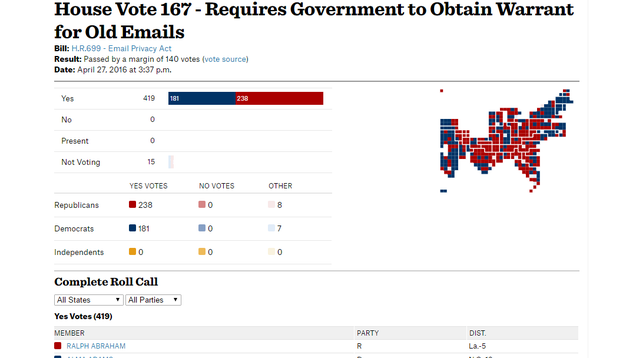
Do you know how your elected government representatives have voted on bills and the bills they’ve sponsored? With ProPublica’s Represent, you can easily find out.
Do you know how your elected government representatives have voted on bills and the bills they’ve sponsored? With ProPublica’s Represent, you can easily find out.

Prepping breakfast ahead of time means fewer rushed mornings and more time relaxing before a long day, or spent with your family. These meal suggestions from The Kitchn are delicious, simple to make the night before, and can even feed a group of people.

Rainbow colored food is, for some reason or another, becoming a trend. It’s in our lattes. It’s in our bagels. Even our pizza isn’t safe. I’ve even done some research into why we keep eating these things (the colors might trick our brains into tasting flavors that aren’t there). Now you can jump on the bandwagon while tying one on now, and we got an expert to show us how its done just in time for Cinco de Mayo.
ANCHORAGE, Alaska (AP) — An Alaska couple faces child neglect charges after authorities said their two teenage daughters lived in the basement of a filthy, mold-filled house without heat or power while the couple stayed in a camper in the driveway.
Timothy Hogan and Patricia Haugstad-Hogan of Anchorage were charged with misdemeanor counts of child neglect and contributing to the delinquency of a minor. The two were arrested in March and are out on bail.
Charging documents said the parents were living in a camper in the driveway of their home when the girls ran away Christmas Eve and reported their living conditions. The documents also said the girls had never been to school and told police they felt trapped. One of the girls has since turned 18 years old and the other is 16.
It’s unclear if the girls were forced to stay in the basement under lock and key. Anchorage police are not releasing further information apart from the details in the court papers. Prosecutors did not immediately respond to requests for comment.
Christy Lawton, director of the state Office of Children’s Services, said in an email that the two girls did not return to the family’s home after they showed up Dec. 24 at Covenant House, which provides services to homeless teens. Lawton said her office worked with police and Covenant House officials during the investigation. Her agency assumed emergency custody of the girls in early January, according to Lawton.
Reached outside the home Wednesday, Haugstad-Hogan said she wasn’t at liberty to comment on the case. The couple’s attorney, Jon Buchholdt, also declined to discuss it.
In the criminal complaint, Anchorage police Detective Will Cameron wrote that the sisters lived in the basement for about five years and told him they “have no opportunity to meet friends, socialize or contact outside family members within the Anchorage area.” The girls said they had not had heat or power since May 2015, according to the detective.
The court documents said police searched the house in late January and found it “in complete filth.” Cameron wrote the house was filled with garbage to the point of almost covering it from floor to ceiling. Yellow mold was found along the kitchen ceiling, and black mold was found in each room.
The couple is scheduled to appear in court May 16.
___
Follow Rachel D’Oro at https://twitter.com/rdoro
The post Authorities: Pair lived in camper, daughters in filthy house appeared first on WTOP.
SEATTLE (AP) — A massive habitat restoration effort by the U.S. government doesn’t do nearly enough to improve Northwest salmon runs, a federal judge ruled Thursday, handing a major victory to conservationists, anglers and others who hope to someday see four dams on the Snake River breached to make way for the fish.
In a long-running lawsuit, U.S. District Judge Michael H. Simon in Portland, Oregon, rejected the federal government’s latest plan for offsetting the damage that dams in the Columbia River Basin pose to salmon, saying it violates the Endangered Species Act and the National Environmental Policy Act.
It was the fifth time since 2001 that the court has invalidated the government’s plans, and rulings in the case show increasing impatience with federal agencies, including NOAA Fisheries, the Army Corps of Engineers and the Bureau of Reclamation. In his 149-page opinion, Simon found that for the past 20 years, the agencies have focused on trying to revive the basin’s 13 endangered and threatened salmon and steelhead runs by restoring habitat without compromising the generation of electricity.
“These efforts have already cost billions of dollars, yet they are failing,” he wrote.
Meanwhile, he said, federal agencies have “done their utmost” to avoid even considering breaching the Snake River dams — despite strong suggestions to do so by Judge James Redden, who oversaw the case from 2001 to 2011.
Among those who sued the government are the Nez Perce Tribe and the state of Oregon; conservation groups including the Sierra Club, National Wildlife Federation, American Rivers and Columbia Riverkeeper; and fishing organizations including the Pacific Coast Federation of Fishermen’s Associations.
The judge ordered the government to come up with a new plan by March 2018, but he said the invalid 2014 plan could nevertheless remain in effect until then because it does provide some level of protection for the salmon. He said he would not dictate what options the government must consider in the new plan, but he noted that a proper analysis under federal law “may well require consideration of the reasonable alternative of breaching, bypassing, or removing one or more of the four Lower Snake River Dams.”
Many biologists say breaching the dams is a crucial step for bringing back populations of salmon and steelhead that were decimated when the dams blocked upriver passage to their breeding grounds. Allowing the water to flow freely would also reduce its temperature, especially important in the face of global warming.
Last summer, hundreds of thousands of adult salmon died because of warm temperatures in the reservoirs behind the Columbia and Snake River dams, said Todd True, a lawyer with the environmental law firm Earthjustice who represents some of the plaintiffs.
“We need to seriously consider a plan that retires and removes the four lower Snake River dams,” he said in a written statement. “Only action on this scale has the potential to allow wild salmon to survive and recover in light of the vivid threat they face from a warming climate.”
Oregon officials have suggested another approach: spilling more water over the dams to improve salmon survival rates.
The federal agencies were disappointed in the ruling, NOAA spokesman Michael Milstein said in an emailed statement.
“The decision will require time and effort to analyze and fully understand,” the statement said. “We sincerely appreciate the region’s unprecedented collaboration and commitment on behalf of salmon, and the important progress that it has produced. We’ll continue our efforts with our partners to protect salmon and steelhead in the Basin and work toward their recovery.”
The Bonneville Power Administration, which operates the dams and has touted the habitat restoration efforts, declined to comment Wednesday except to say it was reviewing the decision.
Northwest RiverPartners, an alliance of farmers, utilities, ports and businesses, intervened in the lawsuit on the side of the government. In a written statement, spokesman Terry Flores said the government’s plan was “the most science-based, comprehensive and expensive effort to restore an endangered species in the nation.”
“The decision potentially unwinds years of collaboration between federal agencies, Northwest states and tribes, and other stakeholders,” Flores said. “The ruling does not provide a path forward for the region, other than re-doing the plan’s analysis and conducting an evaluation of alternatives, including dam removal, under the National Environmental Policy Act.”
In addition to suggesting the agencies consider breaching the dams, the judge found several aspects of the government’s plan inadequate. It failed to properly consider the potentially catastrophic impact of climate change on the fish and was based on a dubious legal framework that allowed the agencies to conclude the species were “trending toward recovery” even with very little actual improvement in salmon numbers, he said.
The post Judge: Plan for restoring Northwest salmon runs not enough appeared first on WTOP.
URBANA, Ill. (AP) — A dog that had been shot and suspended from a rural eastern Illinois bridge is eating and recovering from a long list of injuries.
A University of Illinois Veterinary Teaching Hospital spokeswoman tells The (Bloomington) Pantagraph (http://bit.ly/23rTCiU ) that the Labrador mix, known as Bear, is getting better but still needs 24-hour care for an unknown amount of time.
Bear was found April 20 tied to a high spot on a bridge near Sibley, Illinois, with his mouth taped shut so he couldn’t bark. He had wounds from gunshot pellets, a broken jaw, infected eyes and other injuries.
A crowdfunding effort has raised more than $21,500 to pay for Bear’s veterinary care.
Police continue to investigate the case.
___
Information from: The Pantagraph, http://www.pantagraph.com
The post Dog shot on Illinois bridge recovering from injuries appeared first on WTOP.
ASHEVILLE, N.C. (AP) — A North Carolina tow truck driver certainly isn’t “feeling the Bern.”
Kenneth Shupe tells FOX Carolina (http://bit.ly/1SMV9yz) that he stopped hooking up a woman’s car to his tow truck Monday after he noticed a sign supporting Democratic presidential candidate Bernie Sanders in rear window of the vehicle.
Shupe, who supports Republican Donald Trump, says he told her that he couldn’t tow her car because she was “obviously a socialist.” He tells the station that he told her to “call the government” for a tow.
Cassy McWade, who was left stranded, says she believes that the Shupe wouldn’t want someone to do the same thing to him if the situation were reversed. Her mother calls it an act of “bigotry.”
Shupe says he respects their beliefs and hopes that they respect his views.
The post Tow truck driver leaves Bernie Sanders supporter stranded appeared first on WTOP.
Starting on June 9, California will officially be the second state — after Hawaii — to bar most people under the age of 21 from smoking, buying, or possessing traditional cigarettes.
Gov. Jerry Brown signed a series of bills on Wednesday that revamped the state’s smoking laws, including measures that bump the minimum legal age to partake in tobacco products up from 18 and restrict the use of electronic cigarettes in public places, the Los Angeles Times reports.
The bill package, which was supposed to be voted on last year, officially passed the state’s Senate and Assembly during a special session on healthcare that began in March.
Now that the bills have been signed into law, they will go into effect on June 9.
State Sen. Ed Hernandez, who introduced the age increase bill, tells the L.A. Times that the measure will help save lives.
“The governor’s signature on Tobacco 21 is a signal that California presents a united front against Big Tobacco,” Hernandez said. “Together, we stand to disrupt the chain of adolescent addiction.”
The passage of the minimum age bill comes just two months after the Los Angeles Board of Supervisors voted to increase the legal smoking age from 18 to 21.
While the Los Angeles age limit increase covered all consumers, the state measure provides an exemption for those under 21 who are in active military service.
The L.A. Times reports that the bills were championed by the coalition called Save Live California, consisting of the American Cancer Society and the American Lung Association. The groups contended that 95% of adult smokers start before the age of 21.
Under other legislation signed on Wednesday, electronic cigarettes are considered to be tobacco products and cannot be used in restaurants, theaters, bars, and other places where smoking is banned.
The devices also cannot be marketed to minors.
California’s smoking age raised from 18 to 21 under bills signed by Gov. Brown [The Los Angeles Times]

Whenever we forget how interconnected the American food system is, a recall of a single basic ingredient happens to remind us. Today, the pathogen is Listeria, and the basic food item is sunflower seeds. They’re a tasty snack item by themselves, as well as a common ingredient in trail mixes and a crunchy salad topping. Seeds from a single supplier may be contaminated, and now everything from kale salads to trail mix flavored candy have been recalled.
Listeria is a potentially serious foodborne illness because of its ability to escape the digestive tract and hang out in the bloodstream. In healthy people, it might cause gastrointestinal distress, fever, severe headache, and stiff muscles. Possible complications include miscarriages or stillbirths in pregnant women, and meningitis for people who are very old, very young, or immunocompromised.
 JUST SUNFLOWER KERNELS
Kroger Sunflower Kernels
Kroger Salad Toppers Sunflower Kernels
Market District bulk sunflower seeds: Carmel, IN; central Ohio; Pittsburgh; and Northeast Ohio
Dakota’s Best Biggy’s Roasted and Salted Kernels
Planters Sunflower Kernels
SALADS
Trader Joe’s Broccoli Slaw & Kale Salad With White Meat Chicken
TRAIL MIXES
Kroger Cranberry Delight Trail Mix
COOKIES AND CANDIES
Mountain Thins “Trail Mix” Flavor

When OxyContin hit pharmacies 20 years ago, its primary selling point was that a single dose of the opioid pain medication lasted 12 hours, “providing smooth and sustained pain control all day and all night,” per the press release. But a new report claims Purdue Pharma, the makers of OxyContin, have long known that the drug doesn’t always live up to this promise, resulting in an increased likelihood for abuse and addiction.
An in-depth review of internal and court documents by the L.A. Times turned up evidence that Purdue became aware during the clinical trial phase — long before OxyContin hit the market — that some patients were not getting the promised long-term pain relief from the medication.
In fact, seven years before the drug’s release, OxyContin was tested on 90 women — none of them regular users of painkillers — recovering from abdominal and gynecological surgery. According to the Times, more than one-third of these women complained about their pain returning within eight hours, and around half of them said their pain had come back before the full 12 hours.
A later trial on cancer patients had to be redesigned after a large number of test subjects dropped out because they found OxyContin to be ineffective in managing their pain. The rejiggered study allowed patients to take supplemental “rescue” medication in-between their doses of OxyContin. Yet another study using cancer patients found that 95% of those in the test group had resorted to taking a secondary painkiller at some point during the trial.
The FDA standard only required that Purdue could demonstrate that the drug was effective for 12 hours in at least half the patients, meaning that it was within tolerable limits for one-third of patients to not see that level of relief.
For what it’s worth, the FDA official who led the review — and subsequent approval — of OxyContin went to work for Purdue after leaving the agency not long after the drug’s 1996 release.
Purdue never tested the drug at intervals shorter than 12-hours and, in spite of the fact that a substantial portion of patients had not seen the full half-day of pain relief, the company chose to make this 12-hour feature the core of its marketing.
It continued to do so even after patients and doctors began reporting back that the drug did not always last as long as it needed to.
When some doctors began instructing patients to take OxyContin more frequently, the Times reports that Purdue responded by urging these physicians to instead prescribe higher doses.
Even as some doctors were complaining that upwards of 80% of their patients were only seeing 4-8 hours of relief from OxyContin, sales reps were told to convince these physicians to stick to the 12-hour guidelines because testing had shown that “100% of the patients in the studies had pain relief on a q12h dosing regimen.”
The reps were also reminded that they could encourage doctors to increase the amount of OxyContin prescribed every 12 hours because there was no upper limit on that number.
But, as the Times points out, a boost in dosage primarily benefits Purdue’s bottom line, as a bottle of 10mg OxyContin bills brought in $97 for the company in 2001, compared to $630 a bottle for the 80mg version of the drug.
Sales reps were told that, by encouraging doctors to sell the larger doses, they could “blow the lid off” their sales stats and earn bonuses, like a trip to Hawaii
Within five years of its release, OxyContin was bringing in $1 billion a year in revenue. By 2010, that number grew to $3 billion, accounting for one-third of all sales revenue from painkillers.
For more on Purdue’s addiction to 12-hour OxyContin, check out the full L.A. Times report.

After a prolonged, seven-year process of drafting regulations for e-cigarettes, the Food and Drug Administration has finalized rules that treat e-cigs, hookah tobacco, pipe tobacco, and premium cigars the same as traditional cigarettes and cigars.
The FDA’s first step in regulating the popular alternative to traditional cigarettes includes banning sales to minors and requiring manufactures to put health warnings on the devices.
While the FDA released proposed rules in April 2014, prior to today’s announcement there was no federal law prohibiting retailers from selling e-cigarettes, hookah tobacco, or cigars to people under age 18.
Under the new rules, which will go into effect in 90 days, manufacturers and retailers will not be allowed to sell these products to people under 18 years of age; will be required to verify age by photo ID; will not be allowed to sell these products in vending machines; and can not distribute free samples.
The rules also require manufacturers of all newly-regulated products, to show that the products meet the applicable public health standard set forth under the Family Smoking Prevention and Tobacco Control Act (TCA) of 2009, and receive marketing authorization from the FDA, unless the product was on the market as of Feb. 15, 2007.
Through the review process, manufacturers would be required to submit separate applications for every e-cigarette, different flavor, and nicotine level.
This will take time, the FDA says, noting that it plans to allow manufacturers to continue selling their products for up to two years while they submit information, and up to one additional year while the FDA completes its review.
Under the reviews, the FDA will use science to weigh the potential benefits of e-cigarettes against any potential health risks, for both the individual users and the whole population.
Like all previously regulated products, to receive approval through the FDA review, manufactures must register and provide product listing to the agency; report ingredients and harmful and potentially harmful materials; undergo premarket review and authorization; place warnings on product packages and advertisements; and refrain from selling modified risk products — “light,” “low,” or “mild” — unless authorized by the FDA.
Mitch Zeller, director of the FDA’s Center for Tobacco Products, says that the rule announced today lays the foundation for regulating non-traditional tobacco and nicotine-delivery products, and defends the FDA’s drawn-out process from critics who believe these rules could have been finalized more expeditiously.
“The agency considered a number of factors in developing the rule and believes our approach is reasonable and balanced,”Mitch Zeller, director of the FDA’s Center for Tobacco Products, said in a statement. “Ultimately our job is to assess what’s happening at the population level before figuring out how to use all of the regulatory tools Congress gave the FDA.”
In 2009, the FDA sought to impose restrictions on the devices, which it described at the time to be medical devices designed to deliver nicotine, but a federal court struck down that attempt. The following year, the agency declared it had the power to regulate the devices under its authority to regulate tobacco products.
E-cigarettes, and their potential health risks, have been at the center of heated debate between supports and opponents of the devices.
Companies who manufacture the devices believe they should be exempt from FDA regulations, contending it would stifle innovation, damage small businesses, and hurt consumers trying to quit smoking.
Still, there is no clear data on the health impact associated with the devices. Supporters contend that the devices help consumers stop smoking traditional cigarettes, while opponents argue the devices are attractive to teenagers and secondary risks, such as poisoning and a tendency for the devices to explode, could be more deadly than traditional cigarettes.

There are some video games you don’t have to explain to anyone, even if they were born way after those games first delighted fans. Among those are this year’s inductees into the Video Game Hall of Fame that were chosen from 15 finalists and make up the second group of games to join the list. If you’ve ever traveled digitally to Oregon or went on quests with Link, you’ll know which games we’re talking about.
Space Invaders, The Oregon Trail, Sonic the Hedgehog, The Legend of Zelda, The Sims, and Grand Theft Auto III were all chosen to make up the class of 2016 honored Thursday at the hall, which is inside The Strong museum in Rochester, NY.

Other contenders included in the thousands of nominations but that missed the final cut: John Madden Football, Elite, Final Fantasy, Minecraft, Nurburgring, Pokemon Red and Green, Sid Meier’s Civilization, Street Fighter II, and Tomb Raider.
The Strong is also home to the National Toy Hall of Fame, and opened the doors of its World Video Game Hall of Fame last year to honor all kinds of electronic games, from arcade to console, computer to handheld and mobile. In order to be considered, games must have had sustained popularity and influenced the video game industry or society.
Last year’s inaugural class ushered in Doom, Pac-Man, Pong, Super Marios Bros., Tetris, and World of Warcraft.

 If you’ve read a recipe in the newspaper and quietly wondered where you would find some of the ingredients, the New York Times has found a new way to solve that problem. They’ve partnered up with Chef’d, an ingredient-delivery service, to create a branded meal subscription that combines the convenience of having your dinner delivered with the cachet of the New York Times brand, yet the inconvenience of having to cook the food yourself.
Meal-delivery services, if you’re not familiar with the idea, remove the shopping and meal-planning components from home cooking. They deliver recipes along with the quantity of each ingredient that you’ll need to make them.
This business is an easy target for mockery, but is actually not a bad business idea for anyone involved in the newspaper-branded version. Like all news organizations, the New York Times needs to find ways to bring in money when online ads and subscriptions simply don’t bring in as much cash per reader as print advertising once did.
“Our audience spends a lot of time cooking at home,” the Times executive in charge of brand development, licensing, and syndication explained to Bloomberg Technology. “So for us it was a natural area to investigate.”
The meal subscription service gets a new partner with a built-in audience, and customers get meals curated by a brand that they trust. That subscription service, Chef’d, has other co-branded meal subscriptions, offering plans based on Weight Watchers and the fitness site Tone It Up.
New York Times to Start Delivering Meal Kits to Your Home [Bloomberg]
The New York Times Cooking [Signup]

A couple months back, we told you of the Texas couple that was being sued for a few thousand dollars by a petsitter over a negative Yelp review that allegedly violated a “non-disparagement” clause in the petsitter’s contract. That suit was quickly dropped, but a new complaint filed by the petsitting business has ramped up the allegations and the dollar amount, now seeking between $200,000 to $1 million in damages.
For those coming late to this story, in Oct. 2015 the Texas couple hired a local petsitting operation to watch after their dogs and a Betta fish while they were on vacation in California. In a subsequent Yelp review, the pet-owners expressed their dissatisfaction with the service, taking issue with the company’s fees and billing, an apparent lack of updates from the sitter, the fact that the sitter didn’t leave the house keys behind as requested. The couple also claim that their fish might have received sub-optimal care in their absence.
The original lawsuit was filed in a justice of the peace court, accusing the couple of violating a non-disparagement clause in their contract with the petsitters.
These non-disparagement — or “gag” — clauses, which generally penalize customers for making negative comments about a transaction (even when the comments are true and accurate), have been the topic of increased scrutiny in recent years.
California outlawed such clauses in consumer contracts two years ago, and the U.S. Senate has passed a bill that would do so on a nationwide basis. An identical measure, with bipartisan support, was recently introduced in the House.
Interestingly, the petsitters’ non-disparagement clause seems to be nearly identical to the one previously used by online retailer KlearGear, which failed gloriously in its efforts to collect thousands of dollars from a customer who dared to share her honest opinion of her experience with the company.
The petsitters dropped their initial complaint against the couple, but in late March filed a more extensive lawsuit in Dallas County district court.
This complaint not only continues to allege violations of the non-disparagement clause, but adds allegations of defamation and business disparagement.
In the lawsuit, the petsitters contend that when the couple returned home from their trip, they “admitted that their two dogs were well cared for,” but then proceeded to launch an “ongoing campaign to tell the world” that the petsitters “almost killed their fish or at least potentially harmed it.”
The plaintiffs claim that all the negative attention brought by news stories based on the customers’ statements has resulted in “numerous rape and death threats… in addition to other forms of harassment such as identity theft, impersonations, crank calls, etc.”
Facing upwards of $1 million in damages, the couple is currently being aided by Paul Levy, an attorney with Public Citizen. You may remember Levy from the recent saga of the former dentist/convicted felon who tried to unmask an anonymous YouTube user in an effort to scrub the internet of reports of his previous bad actions.
“The non-disparagement clause says that you shouldn’t do anything to damage the reputation of the company,” Levy recently told CBS Dallas/Fort Worth, which was first to report this story. “You’d think that what really damaged the reputation of the company was bringing the suit in the first place.”
The court will soon be asked to determine whether or not the petsitters’ lawsuit is a SLAPP — a Strategic Lawsuit Against Public Participation. Generally speaking, SLAPPs are frivolous lawsuits intended to strongarm the defendant into ceasing an activity that irritates the plaintiff.
Texas state law includes what is known as an “anti-SLAPP” statute, allowing for defendants in these cases to seek dismissal of the case.
Levy tells Consumerist that he’s in the process of drafting an anti-SLAPP motion in the petsitter lawsuit. That motion is due to be filed next week.
You might have noticed if you clicked the above link to the original Yelp review, you are greeted by a window explaining that “this business has issued legal threats and/or taken legal action against reviewers for exercising their free speech,” while reminding visitors that businesses do not have the right to remove honest reviews of firsthand experiences with these companies:


 Burger King’s new Grilled Dogs are on the permanent menu in both plain and chili dog form, but Burger King is testing something new: people in some markets have spotted a Whopper Dog on the menu. That’s a fast food mashup that sounds surprisingly edible. If you spot one in the wild or get a chance to try one out, let us know!
By the way, in case you’ve ever wondered what an assembly diagram for a Whopper or a hot dog looks like, here you go:
@Jas_Archibald this is happening! A whopper dog pic.twitter.com/dPFEAbHzLq
— Megan Lewis (@Meganlivina23) May 4, 2016

A month after admitting that it was deliberately broadcasting lower-resolution video to AT&T and Verizon wireless users, Netflix has introduced a new tool that will let users around the world choose how much of their data plan they want to blow through binge-watching House of Cards.
Earlier today, Netflix announced an updated version of its iOS and Android apps that includes a new “Cellular Data Usage” setting that allows users to decide for themselves how much data they spend on movies and tv show viewing .
Under the new setting, Netflix customers can switch off the default setting — which allows users to stream about three hours of content per gigabyte of data — to a usage amount that better fits their preferences and available data.
Netflix says it came to the default setting after testing found that, on cellular networks, this level provides a balance of good video quality with lower data usage to help avoid exceeding data caps and incurring overage fees.
For customers who have a more robust data plan (or no data cap at all), Netflix will allow them to adjust the setting to stream higher bitrates. On the other side, those with a lower data cap can choose to stream at a lower rate.
“Our goal is to give you more control and greater choice in managing your data usage whether you’re on an unlimited mobile plan or one that’s more restrictive,” Eddy Wu, director of Product Innovation at Netflix, said in a statement.
To set your cellular data usage, got to “App Settings” on the Netflix app, pick “Cellular Data Usage,” and switch off the automatic default setting. Then choose between an unlimited, higher, or lower usage setting that best works with your data plan.

The new option comes a month after Netflix admitted that it throttled its own streams on AT&T and Verizon networks because of data caps.
For five years, Netflix says it capped its own mobile data streams at 600 Kbps on most wireless networks around the world.
According to the company, the throttling was justified: If you hit your data cap and get socked with overage fees you won’t be watching any more Netflix this month — and you might cut back in future months, too. Therefore, in the interest of keeping customers watching and subscribing, they throttled the streams.

Airbnb and VRBO are shaking up the hospitality industry by letting anyone with a spare room become an innkeeper. Uber and Lyft are disrupting the for-hire car market by letting you turn your car into a taxi. While these new platforms might be opening up the so-called “sharing” economy, some of them may also be a bit too willing to share user data with law enforcement.
For its annual “Who Has Your Back?” report, the Electronic Frontier Foundation chose to focus on some of the big names in this growing field, looking at how each of them handles and reports on law enforcement requests for user data.
The report looked at 10 of the bigger players in the sharing arena: ridesharing platforms Uber, Lyft, Getaround, and Turo; delivery services Instacart and Postmates; homesharing sites Airbnb, Flipkey, and VRBO; and freelance gig platform TaskRabbit.
Each of these companies was then rated on the following six issues:
• Do they require a warrant to access user content?
• Do they require a warrant to disclose the user’s possible location?
• Do they publish a transparency report regarding requests from law enforcement?
• Do they publish guidelines regarding their law enforcement related policies?
• Do they alert users to demands from the government for user data?
• Do they push lawmakers in Congress for stronger privacy protections?
“These companies collect information on what you buy, where you sleep, and where you travel—whether you are offering services, or purchasing them,” explains Rainey Reitman of the EFF. “Often they go even further, collecting contents of communications and geolocation information from your cell phone. But are these companies respecting their users’ rights when the government comes knocking? For much of the gig economy, the answer is no.”
Only two companies — Uber and Lyft — were able to answer yes to all six questions, while five companies (Getaround, Postmates, TaskRabbit, Turo, and VRBO) came up short in every category.
FlipKey, which is owned by TripAdvisor, received four out six stars from the EFF. Its policies and practices seem to be in line with making sure that authorities go through the proper legal channels to obtain user data, but it doesn’t publish a transparency report, nor does it make its law enforcement guidelines public.
Airbnb and Instacart were the only two other services to merit any stars. They both require warrants for accessing user data, but not for location-based information. Unlike FlipKey, they do publish their law enforcement guidelines, but the don’t provide a transparency report to their users, nor do they share information about data demands made by the government.
“We see a clear trend in our report: while some sharing economy companies have prioritized standing up for user privacy in the face of government demands, many others have not,” says EFF Senior Staff Attorney Nate Cardozo. “This is a wake-up call to the gig economy companies and the people who use them. It’s time for these services to catch up with the rest of the industry and safeguard our data from government overreach — ensuring that law enforcement access to this trove of information is fair, just, and only in accordance with the rule of law.”

We get it: in the summer, you want to be free and unencumbered, without a purse on your shoulder or a heavy wallet in your pocket. However, a tobacco store in Kentucky has an important seasonal rule that they want their customers to keep in mind: they do not want your crumpled, sweaty dollar bills that you’ve just pulled from your sock or your bra.
Here’s the actual sign on the door.

Most customers find it funny, and those people have clearly never worked as a cashier at a mostly-cash retail establishment in the summer. I did, and 16 years later still periodically think about damp, crumpled “boob money,” as the sign puts it.
“[Customers] dig deep into their not ‘so-called pockets’ to bring me some nasty money that we don’t want to accept anymore,” the store manager explained to TV station WFIE.
One might think that bluntly saying that they don’t want some customers’ money would hurt business at the store, but it has done the opposite: the sign and the policy have attracted attention, and more people are stopping by to check it out.
Owensboro business no longer accepting sweaty money [WTIE]

PotomacLocal.com |
Sudley Road named after forgotten Sudley community PotomacLocal.com Like many road names throughout Prince William County, Sudley Road and Sudley Manor Road find their beginnings with the influential Carter Family. In the 1750s, Landon Carter was deeded a portion of land from the Middle Bull Run tract in northern ... |
Prince William County crime report Washington Post These were among incidents reported by Prince William County police. For information, call 703-792-7245. DUMFRIES AREA. ASSAULTS. Brockenbrough Dr., 3600 block, 11 a.m. April 15. During an argument, a woman assaulted a male acquaintance and ... and more » |
WASHINGTON — You can see — and sit in — the interior of an original 1965 Ford Mustang next to the interior of the Mustang’s 2015 incarnation, side-by-side at a museum in Alexandria, Virginia.
The U.S. Patent and Trademark Office asked Ford to help tell the story of the evolution of patent trademarks and intellectual property in the automotive industry, and the side-by-side Mustang is on display at PTO’s National Inventors Hall of Fame Museum in Alexandria.
The split-personality Mustang is part of the museum’s new, permanent Intellectual Property Power Exhibit.
Visitors can sit in either side of the car and compare features and styling details, from the 1965’s AM radio, roll up window, vent air window and retractable color-keyed seat belts to the 2015’s touch screen display.
The display will also include the sounds of the 1965 and 2015 Mustang V-8 engines at idle.
Ford did not apply for any specific Mustang styling patents when the Mustang was launched. The 2015 Mustang Convertible has 36 individual styling patents.
Watch a video about the arrival of the exhibit:
The post A 1965 Mustang and a 2015 Mustang, side by side appeared first on WTOP.
WASHINGTON — The D.C. Fire incident commander who rolled a car window up in the face of a Metro Transit Police deputy chief as riders sat stranded on a train filling with smoke last year had not had the proper training to qualify for the position, the National Transportation Safety Board said.
Investigators say he had only completed two of four incident command training courses, and had not been trained to set up the unified command needed for a response to the smoke incident near L’Enfant Plaza that led to Carol Glover’s death.
The Metro Transit Police deputy chief had come back up from inside the station to fill other first responders in on what was going on. Eventually, firefighters split up as they headed down the tracks to look for the stuck train. The first group went down the Green Line tunnel, while another group ended up reaching the back of the smoke-filled train on the Yellow Line tracks.
The NTSB says the fire department should have set up an incident command post for all agencies involved.
D.C.’s Homeland Security and Emergency Management Agency did have a command bus available, but it did not arrive until after the incident was essentially over. There was also not a large enough medical response to help Metro riders who had been stuck in the smoke.
In addition to those issues, Metro had not held a full-scale tunnel evacuation drill since March 2010, which also meant 911 operators and the D.C. Fire Department had not participated in regular drills related to Metro.
A rail operations controller said after the incident that the right hand did not know what the left hand was doing.
“That’s why you need training; that’s why you need procedures; that’s why you drill,” NTSB member Robert Sumwalt said. “To take the chaos, and turn it into something more manageable.”
The NTSB report approved this week also blames D.C.’s 911 call center for additional delays in sending a response, since the dispatch took more than twice as long as called for by national standards.
Investigators also recommend better signs at tunnel entrances and splits to help first responders find their way to trains or other incidents in areas they may not be familiar with.
Overall, the NTSB concludes that at the time of the Jan. 12, 2015, smoke incident, the D.C. Fire Department was unprepared to respond to a mass casualty incident in Metro’s underground system.
Since the incident, the fire department, Metro and the region have joined for more frequent emergency drills as called for by the NTSB.
D.C. also has a new fire chief since the incident, and Gregory Dean has introduced a number of changes, including the use of private ambulances to help respond to calls.
The region’s fire chiefs and Metro have also worked together to establish regular radio testing in tunnels to be sure communications problems are addressed more quickly in the future.
The post DC Fire commander at deadly Metro smoke event wasn’t trained for job appeared first on WTOP.
WASHINGTON — Tusa and Asa, the red pandas at the Smithsonian National Zoo, will break in their new Asia Trail habitat May 10.
A window to the retreat will give visitors a glimpse into the lives of red pandas.
Construction on the indoor retreat began last November.
Zoo officials say Tusa and Asa will serve as ambassadors for their species, illustrating the social nature and behavior of red pandas to staff and visitors.
The post Red panda habitat reopens at National Zoo next week appeared first on WTOP.
A Chinese company that peddles purses and wallets bearing the IPHONE name has the right to keep selling those products, despite Apple’s efforts to keep the trademark all for itself.
The Beijing Municipal High People’s Court ruled in favor of Beijing Xingtong Tiandi Technology Co., which makes wallets, handbags, smartphone cases, and a plethora of other leather goods emblazoned with the word IPHONE, reports The Wall Street Journal.

The ruling upheld previous decisions in the ongoing legal saga between Apple and Xingtong. The court’s verdict found Apple failed to prove that the brand “iPhone” was famous in China before Xingtong applied for its trademark in 2007.
Though Apple first registered its iPhone trademark for computer-related products in China in 2002, according to state-run Legal Daily, those registrations only apply to specific categories of goods. When Apple registered iPhone, it didn’t register the name for leather goods.
Apple didn’t begin selling iPhones inside China until 2009 the accessories maker argued, and again, no one could get the two confused because Apple doesn’t sell purses.
Although no mobile devices besides Apple’s can be called iPhones, the ruling stymies the tech company’s quest to wholly own the name, at least, for now.
“Apple is disappointed the Beijing Higher People’s Court chose to allow Xintong to use the IPHONE mark for leather goods when we have prevailed in several other cases against Xintong,” Apple said in a statement Wednesday. “We intend to request a retrial with the Supreme People’s Court and will continue to vigorously protect our trademark rights.”
Apple Loses an iPhone Trademark Battle in China [The Wall Street Journal]

Ask any ice cream lover — or novice, really — and they’ll tell you there’s a fundamental difference between Rocky Road and Cookies ’n Cream flavors: one obviously contains cookies and the other marshmallows and nuts. Yet somehow, the two flavors were mixed up during production, leading the Texas-based creamery to recall the products.
Blue Bell announced it would voluntarily recall select lots of Rocky Road pints produced at its Brenham, TX, plant because they might actually contain Cookies ’n Cream ice cream.
While some ice cream lovers might find the mixup a tasty surprise, for those with certain allergens it could be dangerous.
Blue Bell says the Cookies ’n Cream flavor contains undeclared allergens soy and wheat, which may present a serious or life-threatening allergic reaction risk to people who have an allergy or severe sensitivity to soy or wheat.
The recall was initiated after an employee of the plant discovered the incorrect packaging while restocking a retailer.
So far, no illnesses have been reported related to the mistake.
The affected pints can (no surprise here) be identified as a Rocky Road pint with a Cookies ‘n Cream lid, and contain Cookies ‘n Cream Ice Cream.
They can also be identified by the following code located on the bottom of the pint: 022918576.
Consumers who have purchased these items can return them to the place of purchase for a full refund.
The recall comes five months after Blue Bell said it resolved a massive listeria-contamination that temporarily lead to empty retailer shelves nationwide and the temporary closure of several plants.

For a while, Walmart tried a bold staffing experiment: they reassigned employees serving as greeters, a position that serves as both a friendly face and a theft deterrent. Instead of standing at the door, former greeters were to help guide customers to the checkouts, or help them find items in the aisles. That experiment began four years ago, and Walmart brought some greeters back about a year ago. Today Walmart announced that greeters will return to their rightful place in all stores.
Greeters aren’t just about making people feel welcome and providing employment for local senior citizens, of course. They’re about protecting the store against theft, checking receipts and watching customers as they leave.
The new position will be called a “customer host,” and will be easy to spot because they will wear a yellow vest instead of a blue one. In addition to deterring shoplifters and making customers feel welcome, their duties will also include “keep[ing] entrances clean and safe.”
Not all stores will have customer hosts, though: they’ll be reserved for only about a third of the mega-chain’s stores. Those will be the stores that deal with more shoplifters. Customer hosts will be — shall we say — younger than greeters, on the whole, and will have special training
Current greeters, Walmart says, will be able to apply to work as greeters in other nearby stores, for the customer host job, or for a different job in the store where they already work.
Offering Customers More at the Door [Walmart]
Wal-Mart Brings Back Greeters to Entrance After Successful Test [Bloomberg]

Many bank accounts, and almost all credit cards, wireless services, private student loans, and payday loans contain clauses in their contracts that strip consumers of their right to sue these companies, and their right to join others in a class action, effectively allowing businesses to sidestep the legal system. While lawmakers in Congress debate the issue, and the U.S. Supreme Court has repeatedly given its approval to these practices, the Consumer Financial Protection Bureau is making good on its pledge to restore consumers’ constitutional right to having their day in court.
Yes, we know that your eyes glaze over when you read the words “mandatory binding arbitration,” and that’s exactly what companies that use these clauses want — for consumers to be so bored by legalese and fine print that they just shrug and sign away their rights without knowing it.
In fact, when the CFPB released its report on arbitration in March 2015, it found that even though virtually all Americans are directly affected by at least one forced arbitration clause, that a stunning 75% of consumers don’t know whether or not they have the right to sue their banks or credit card companies, and that fewer than 7% of those with arbitration clauses could even understand the clauses that they had unwittingly agreed to.
Not only do arbitration clauses strip of your right to a jury trial if you have a legal dispute with these companies, most of them include a ban on class actions, even in arbitration. So if several customers are all wronged by a bank in the same way, they must each go through the arbitration process individually. Additionally, arbitration rulings set no precedent and rulings are often nothing more than a check mark in a box declaring which side won. Thus, the fact that one customer might be successful in arbitrating their claim does not guarantee that others would get the same result using the exact same evidence.
Aside from the annoyance of having to go the arbitration route solo when there is a class of similarly affected consumers, some cases are simply too expensive to mount on an individual basis.
Look at the case of American Express v. Italian Colors Restaurant. In that lawsuit, merchants who accepted American Express were trying to bring an antitrust lawsuit against the credit card network. They argued that, in spite of a ban on class actions in their merchant agreements, the only way they could possibly afford to put together a complaint of such a massive scope was as a group. Individually, the costs would outweigh any resulting damages awarded.
However, in 2013 a slim majority of the Supreme Court ruled that AmEx’s ban on class actions was legal. Writing for the dissenting minority in that ruling, Justice Elena Kagan summarized the majority’s opinion in three words: “Too darn bad,” and called it a “betrayal of our precedents, and of federal statutes like the antitrust laws.”
Many consumer advocates argued that with this ruling SCOTUS gave companies a free pass to commit abuses that are too expensive for a single party to prove on their own.
“Forced arbitration is a get-out-of-jail-free card that lets banks, payday lenders, and debt relief scammers avoid accountability when they violate the law,” explains Lauren Saunders, associate director of the National Consumer Law Center. “Forced arbitration and class action bans force consumers into a biased, secretive, and lawless forum, preventing either a court or an arbitrator from ordering a lawbreaker to repay all of its victims.”
The same holds true for cases where the dollar amount of any damages would be too low to merit an individual complaint. According to the CFPB report, fewer than 2% of credit card customers said they would even consider consulting an attorney over a small-dollar legal dispute with their card company, and so only a very few would ever think to enter into arbitration, meaning the company can continue its bad actions unchecked.
But a class action only needs a small number of plaintiffs and evidence showing widespread malfeasance, meaning that not only could more consumers get their money back, but that the company will be held to account for its bad behavior.
At the same time as the nation’s highest court was repeatedly affirming its anti-consumer view of arbitration agreements, the Dodd-Frank financial reforms of 2010, which created the CFPB, also directed the Bureau to look into the use of arbitration in financial services, and to draft regulations in the public interest that are consistent with the results of that study.
And so this morning the CFPB is releasing its proposal for public comment. As expected, it’s not an outright ban on the use of arbitration agreements. Instead, affected companies — in the financial and credit fields — would only be able to use arbitration clauses if they do not also include a ban on class actions. And rather than leave it up to lawyers for these companies to determine how to word this particular clause, the CFPB will provide specific language to be used.
And since companies claim that arbitration actually benefits consumers, these businesses will be required to provide information to the CFPB regarding the number of arbitration claims that are filed against it and details on the awards provided to consumers who arbitrate.
“Signing up for a credit card or opening a bank account can often mean signing away your right to take the company to court if things go wrong,” said CFPB Director Richard Cordray. “Many banks and financial companies avoid accountability by putting arbitration clauses in their contracts that block groups of their customers from suing them. Our proposal seeks comment on whether to ban this contract gotcha that effectively denies groups of consumers the right to seek justice and relief for wrongdoing.”
Since the CFPB began the rulemaking process in 2015, the banking industry has made several attempts to scuttle the CFPB’s efforts to rein in arbitration.
The Womack-Graves Amendment — named for Reps. Steve Womack (AR) and Tom Graves (GA) — to the Financial Services and General Government Appropriations Act sought to compel the CFPB to effectively redo its entire three-year arbitration study before moving forward with any regulations. That rider ultimately got the axe, but its supporters have vowed to continue fighting against restrictions on the practice.
Last week, Rep. Sean Duffy of Wisconsin — whose campaign has received more than $300,000 from the financial, credit, banking, and investment industries thus far in the 2016 election cycle and who received more than $350,000 from these same industries only two years ago — wrote a letter to CFPB Director Cordray, informing him of a pending investigation into the arbitration rule by the House Financial Services Committee, and demanding that the Bureau produce information regarding any communication between CFPB officials, consumer advocacy groups, and organizations representing trial attorneys.

ERROR: The item, "SHIRT.WOOT PRODUCT WRITEUP" cannot be displayed at this time. The cause of this error is most-likely one of the following:
If you would like to see the writeup, please contact the website, "SHIRT.WOOT.COM" and demand they rectify whichever of the above transgressions they have committed.
Sincerely,
Cat Catly
CEO of the Internet
Fairfax County Animal Watch Washington Post The following incident was reported by the Animal Control Division of the Fairfax County Police Department. For information, call 703-246-2253. Biting irony: Cross Chase Ct., 8600 block, 1:53 p.m. April 22. A loose dog bit an officer — who was ... and more » |
Prince William County community calendar, May 5-11, 2016 Washington Post Woodbridge Toastmasters Club An open house meeting. Learn effective communication and leadership skills. 7:30 p.m. Ebenezer Baptist Church, 13020 Telegraph Rd., Woodbridge. 703-898-7171. woodbridge.toastmastersclubs.org. $68 membership fee. and more » |