Shared posts

16 May 02:42

Atheist group’s anti-Ark Encounter billboard rejected

by wtopstaff

WILLIAMSTOWN, Ky. (AP) — Two billboard companies have refused to display an advertisement by an atheist group to protest the Ark Encounter amusement park in Kentucky.

Tri-State Freethinkers president Jim Helton tells news outlets the group recently raised $10,000 for a billboard. The proposed design depicts Noah’s Ark with people drowning around it and the words, “Genocide and Incest Park: Celebrating 2,000 years of myths.”

The advertisement has been turned down by billboard companies Lamar and Event Advertising and Promotions LLC.

Helton says the group is considering erecting the billboard outside of Kentucky, if it can find a taker.

The Ark Encounter, a 510-foot wooden ship as described in the Old Testament, is under construction. It’s a product of Answers in Genesis, which also owns the Creation Museum.

In March, Answers in Genesis President Ken Ham called the billboard campaign an attack on Christianity.

The post Atheist group’s anti-Ark Encounter billboard rejected appeared first on WTOP.

13 May 02:27

Persistent hole in Beltway snarls traffic twice

by Rick Massimo

WASHINGTON – A patched-up piece of the Capital Beltway came undone twice on Wednesday morning, delaying traffic on two separate occasions while crews made emergency repairs — and the authorities say the work isn’t finished yet.

A patched-up hole on the bridge deck near Ritchie Marlboro Road re-opened at about 6:30 a.m. At least eight vehicles were pulled over with severe tire damage.

Maryland State Highways Administration workers repaired the road, and all lanes reopened at about 9:20. The first patches didn’t hold, says Dave Dildine in the WTOP Traffic Center, and the two center lanes were blocked for repairs again at about 10 a.m.

The road was reopened at about 10:30.

The highway administration says crews will return during the overnight hours next week, when the weather improves to permanently repair and resurface the bridge. They say the steel plate they covered the hole with around 10 a.m. should suffice until then.

WTOP’s Dave Dildine contributed to this report.

The post Persistent hole in Beltway snarls traffic twice appeared first on WTOP.

12 May 13:52

Court Allows Copyright Lawsuit Against Star Trek Fan Film To Move Forward

by Chris Morran

While there has been much discussion about Paramount’s copyright claim on the Klingon language, the judge in the studio’s lawsuit against the makers of a Star Trek fan fiction movie has chosen to not opine on that particular dispute while giving the go-ahead for Paramount’s larger copyright complaint to move forward.

A district court judge in California has denied the request by makers of crowdfunded film project Axanar to have the Paramount lawsuit dismissed. They argued that, among other claims, numerous individual elements of their planned production — including costumes, names of planets and places, the Starfleet emblems, and of course the Klingon language — are not protected by copyright.

The judge took issue with that argument, explaining that while some individual aspects of the Star Trek universe may not enjoy copyright protection, those same pieces do get that protection when considered together.

“When viewed in a vacuum, each of these elements may not individually be protectable by copyright,” writes the court. “Plaintiffs, however, do not seek to enforce their copyright in each of these elements individually. Rather, Plaintiffs’ copyright infringement claims are based on the Star Trek Copyrighted Works as a whole… The Court finds it unnecessary to analyze whether the allegedly non-protectable elements of the Star Trek Copyrighted Works are eligible for copyright protection because Plaintiff describes these elements in the Complaint solely in an effort to demonstrate how the Axanar Works are substantially similar to the Star Trek Copyrighted Works.”

In short, that means the judge isn’t going to answer the question of whether or not Paramount actually owns the Klingon language. Instead, it will look at the use of the Klingon language (and the other allegedly non-protectable elements) in the context of the entire project.

Which brings us to the filmmakers’ other bone of contention with Paramount: That the studio jumped the gun by filing a copyright complaint against a movie that hasn’t even begun filming.

Again, the court was unmoved by this line of reasoning, saying that Paramount’s claim wasn’t based on infringement of a specific Star Trek script or storyline, but on the entire universe that encompasses multiple TV shows, movies, and other works.

Thus, the judge said that it determining the similarity of the fanfic movie and the originals will likely be based on questions of “similar character, theme, setting, and mood.”

Additionally, while the filmmakers contend that the fanfic script is not finished, Paramount has pointed to published notes about there being a “fully revised and locked” script, along with the fact that one scene has already been completed.

To the court, this is sufficient for the case to move forward to trial, which is now set to begin in Jan. 2017.

“Although the Court declines to address whether Plaintiffs’ Claims will prosper at this time, the Court does find Plaintiffs’ claims will live long enough to survive Defendants’ Motion to Dismiss,” concludes the judge.

In a blog post, the folks at Axanar say they are working to reach a settlement with Paramount “so we can move forward with telling the story of AXANAR in a way that satisfies both the studios and the over ten thousand fans who financially supported our project.”

12 May 13:52

Pepsi, Frito-Lay Quietly Adding GMO Ingredient Labels To Some Foods

by Chris Morran

Whether or not you agree with mandatory labeling for foods containing genetically modified or genetically engineered ingredients, the Vermont law requiring this information on food sold in that state will go into effect on the first of July. Some companies — including Mars, Campbell Soup, and General Mills — have announced decisions to implement these labels nationwide, while PepsiCo appears to be quietly putting labels on its products.

pepsigmoOur colleagues at Consumers Union recently spotted this can of Pepsi at a store in New Hampshire. It carries a notice that the beverage was “Partially Produced With Genetic Engineering.”

And it’s not just Pepsi beverages. The company’s snack foods are also getting the new labels, which, as you can see from the soda can example, are not the invasive in-your-face bursts or banners that opponents of the labels have made them out to be.

Not far from Consumer Reports HQ in New York, CU also found some Lay’s potato chips — produced by the folks at PepsiCo subsidiary Frito-Lay — with similar language placed in an unobtrusive (arguably hard to find) spot on the back of the bag:

GMOLays2 LaysGMO

We’ve reached out to PepsiCo for comment and clarification on the extent to which it intends to introduce these labels, but have not yet heard back.

However, a Frito-Lay customer service rep did tell Consumers Union that the company does plan to label products on a nationwide basis, and that the “Partial” terminology can be used on any product that uses less than 75% of ingredients from GMO sources.

Why So Quiet?

PepsiCo’s reluctance to publicly announce the labeling may have something to do with the company’s tangential involvement in a pending lawsuit challenging the legality of the Vermont law.

Shortly after Vermont passed the labeling rules, a coalition of four trade groups — the Grocery Manufacturers’ Association, the Snack Food Association (of which Frito-Lay is a member), the International Dairy Foods Association, and the National Association of Manufacturers — filed a lawsuit claiming the labeling requirement is unconstitutional, and seeking an injunction barring Vermont from enforcing it.

As part of that lawsuit, Vermont attempted to subpoena records from three food producers (Frito-Lay, ConAgra, and Kellogg) and five agribusiness companies (Monsanto, Dow, DuPont, Bayer, and Syngenta).

The state is trying to get Frito-Lay to turn over the results of the company’s surveys on consumers’ attitudes toward the use of GMOs and “natural” food labels. Frito-Lay refused to comply with the subpoena, so in April the Vermont AG’s office filed a motion to compel [PDF] the company to turn over the documents. That issue is now being hammered out before the federal court in Vermont.

Meanwhile, the status of the larger lawsuit looms over the July 1 start date for the Vermont labeling rules. In April 2015, the district court denied the trade groups’ request for an injunction. As was expected, the groups appealed that decision. The Second Circuit Court of Appeals heard arguments on the matter in Oct. 2015 but has yet to issue a ruling.

The legal debate over the injunction has not yet stopped the rest of the case from moving forward toward trial. However, both sides recently asked the circuit court to delay the trial pending the outcome of the Second Circuit’s decision. That’s because the appeals court has been asked to chime in on the plaintiffs’ assertion that they are likely to win at trial. Whatever the appeals court rules will then color how the lawsuit is viewed in the trial court.

12 May 13:52

WhatsApp Launches Desktop App For Mac OS, Windows Users

by Mary Beth Quirk

WhatsApp’s billion or so users now have another way to call and text their friends, with a new desktop app the company launched this week for Windows and Mac.

The desktop version is available for Windows 8 and up and Mac OS 10.9 and beyond, and will sync with any WhatsApp conversations you have on your mobile device, the company said.

“Because the app runs natively on your desktop, you’ll have support for native desktop notifications, better keyboard shortcuts, and more,” reads the company’s announcement.

WhatsApp users could already use the app on their computers through a web app, but the desktop app differs in that previously, you’d have to have your smartphone on if you wanted to use the web version. That’s not exactly ideal for many folks.

This could be great news for anyone who had an older device running WhatsApp, after the messaging platform announced it would be ending support for some Nokia and BlackBerry phones by the end of this year.

The Facebook-owned messaging app is expected to get video calling along with other new features in the near future, in order to keep up with its buddies in the industry, including its sibling, Facebook Messenger.

12 May 13:51

Mitsubishi Says Fuel Mileage Falsified In All Vehicles Sold In Japan; U.S. Regulators Order Additional Tests

by Ashlee Kieler

Last month, Mitsubishi admitted to falsifying fuel data on some vehicles sold in Japan for more than 25 years, leading to an ongoing probe by U.S. regulators. Now, that investigation is being expanded following the automaker’s acknowledgement that it fabricated the fuel economy data on all models sold in Japan. 

The Associated Press reports that Mitsubishi announced on Wednesday that the fudged fuel records are not limited to the company’s minicars, known as “kei,” and instead may extend to all current and discontinued models sold in Japan.

While there’s currently no evidence that Mitsubishi cars in the U.S. include the same fuel inaccuracies as the 625,000 small cars sold in Japan – which included some vehicles manufactured for Nissan – U.S. regulators have already opened at least two probes into the matter.

In fact, the AP reports that the Environmental Protection Agency has now ordered additional testing to verify gas mileage on three sedans and two SUVs sold in the U.S.

The National Highway Traffic Safety Administration previously directed Mitsubishi to hand over any information on its vehicles sold in the United States.

“We’ve requested information from Mitsubishi about this issue,” a spokesman for NHTSA said at the time, declining to specify which models the agency sought data for.

Mitsubishi previously said that tire pressure data in affected vehicles was manipulated to make mileage appear 5% to 10% better than it actually was for 157,000 Mitsubishi eK wagon and eK Space light passenger cars, and 468,000 Dayz and Dayz Roox vehicles produced for Nissan Motor Co.

The falsified data was first spotted by Nissan when the company was assessing the current model in preparation for its next-generation vehicle.

A week after the scandal broke, an ongoing internal investigation by Mitsubishi found that the carmaker has used unapproved fuel testing methods for the vehicles sold in Japan for the last 25 years.

The unapproved method measured the effect of deceleration during fuel-economy testing. The method, which tends to give a more flattering mileage rating, is approved in the United States but not in Japan.

“I’m truly sorry that customers were led to buy vehicles based on incorrect fuel-efficiency ratings,” Mitsubishi’s president and CEO Tetsuro Aikawa said at a news conference last month. “All I can do is apologize.”

Aikawa says the company is unaware who ordered the cheating, but that the investigation is ongoing.

The carmaker has arranged for a panel of three lawyers to continue investigating the issue from an outsider’s point of view. The group is expected to have a report completed within three months.

Mitsubishi’s MPG mess spreads to all models [The Associated Press]

12 May 13:50

Toy Company Legal Battle Shows Cabbage Patch Dolls Still Prompting Fights

by Mary Beth Quirk

Long gone are the days of parents tussling it out in toy store aisles over Cabbage Patch Dolls, those squish-faced darlings of the early’80s, but there are still people willing to duke it out in the name of the doll. This time, they’re toy companies, and they’re fighting each other in court.

Though the Cabbage Patch line doesn’t pull in anywhere near the $600 million a year it enjoyed in its heyday, the brand is still doing pretty well, with $50 million a year in revenue, Bloomberg reports in an in-depth look at the doll fight of our time.

The battle for those millions is going down right now between the company that holds the marketing license for the dolls now, Wicked Cool Toys, and Jakks Pacific Inc., the previous license holder.

Here’s what it boils down to: the brand’s owner, Original Appalachian Artworks Inc. has been giving the marketing license to different companies over the years. After a decade with Jakks, OAA handed the license to Wicked Cool Toys in 2014, a company that was started in 2012 by a former senior Jakks executive named Michael Rinzler. Cue litigation avalanche.

Jakks sued [PDF] Wicked Cool Toys and a man named Jeremy Padawer in New York court last September, seeking $20 million in damages. Padawer had worked on Cabbage Patch Kids when he was working at Jakks. He then moved to join Rinzler at Wicked Cool Toys, which didn’t sit too well with his former employers: Jakks accused Padawer of disparaging the company and leaking information, in order to convince OAA to take the license away from Jakks and give it to Wicked Cool Toys.

Wicked Cool Toys and Padawer denied those charges and countersued, accusing Jakks of cutting advertising for the Cabbage Patch line and flooding the market with low-priced dolls right before it lost the license, as part of an effort to tarnish the brand before it moved to a new company. Those moves cost Wicked Cool Toys at least $4 million in sales, the suit says.

The lawsuit also alleges that CEO and co-founder Stephen Berman was in charge of a hostile workplace at Jakks, one with homosexual slurs, physical abuse and intimidation. Berman didn’t comment to Bloomberg.

Jakks says the claims the countersuit makes are baseless, and that it’s all an attempt to get back at it for filing its lawsuit, in a filing asking the court to dismiss the action.

Besides, there’s nothing wrong in cutting prices of your own product, even if it happens to be at an inconvenient time for another retailer, said an attorney representing Jakks.

“Wal-Mart can’t complain about how Amazon prices its goods or how Amazon advertises,” he said at a hearing in Manhattan. “Even if we told other retailers we don’t like them, it’s all good, that’s competition.”

For more on the latest legal brouhaha over Cabbage Patch dolls, head over to Bloomberg for the full story.

If you’re feeling nostalgic, here’s a news report from the 1980s covering Cabbage Patch Kids mania:

The New Fight Over Cabbage Patch Kids Has Sabotage, Choke Holds and Slurs [Bloomberg]

12 May 13:48

Health Insurers Looking To Pay Less When Drugs Don’t Work As Advertised

by Chris Morran

If a drug maker says their new prescription medication will reduce cholesterol by a certain percentage, or that it will counter symptoms of some chronic illness, but it doesn’t quite live up to its marketing, should the insurance companies still pay the price they originally agreed to? A growing number of insurers are making deals that tie the price of a drug to its real-world performance.

The latest of these so-called “value-based” contracts between a major insurer and drug companies involves Cigna, which announced this morning that it is tying the price on an entire new class of cholesterol-reducing drugs — known as PCSK9 inhibitor drugs — to how well the drugs succeed in actually reducing certain types of cholesterol.

There are currently only two drugs in this new class, Repatha and Praluent, made by Amgen and Sanofi/Regeneron, respectively. Cigna will track the cholesterol levels of its insured patients on these drugs. If the results meet or exceed what was achieved in clinical trials, the original negotiated discounts for the drugs remain the same. If these drugs don’t perform as well as expected, Cigna will receive additional discounts.

The full retail price — before any sort of negotiated discount by the insurance company — for a year’s supply of either of these drugs is around $14,000.

The Wall Street Journal notes that while this appears to be the first time an insurer has reached a value-based discounting deal with an entire class of drugs, it’s just the latest in a growing number of pricing agreements intended to protect insurers against drugs that aren’t effective as advertised.

Since 2014, more than a dozen of these sort of deals have been made with a variety of drugs, especially those medications with sticker prices that run into five or six digits annually for a single patient.

For example, AstraZeneca’s cancer treatment drug Iressa (gefitinib) can cost several thousand dollars for a single bottle of 30 pills. Last year, the drug maker agreed to reimburse Express Scripts for patients who stop treatment before reaching a third refill on their prescription.

While value-based pricing can protect insurers and pharmacy benefits companies from subsidizing substandard drugs, the work involved with tracking patient’s medical records can be onerous and can in some cases require years of research to determine if a drug is working as promised.

One concern with this model is that drug companies are actually getting paid more than they should at the outset of a drug’s release because of promises of a possible discount later. So rather than the insurance company drive a hard bargain and demand a steep discount right off the bat, some in the industry are worried insurers might accept a softer discount at the start because of that potential for significant savings down the road.

11 May 12:19

Autobahn Indoor Speedway Opens Wednesday at Manassas Mall - Patch.com


Patch.com

Autobahn Indoor Speedway Opens Wednesday at Manassas Mall
Patch.com
Half of all revenue during the grand opening will benefit Northern Virginia Family Service's SERVE program. Manassas, VA. By Greg Hambrick (Patch Staff) - May 10, 2016 7:39 pm ET. ShareTweetGoogle PlusRedditEmailComments0. Autobahn Indoor ...

11 May 12:17

Spirograph Super Set & Travel Bundle

Buy this Spirograph: if spending all afternoon creating circles upon circles upon circles of colors sounds like your kinda fun.

Don't buy this Spirograph: if you get dizzy easily.

Left to its own devices, this Spirograph would: break outside the bounds of its precision ring and Spiro the world!

Benjamin Franklin said of this Spirograph: "Spirographs are proof that God loves us and loves to see us happy."

At a karaoke bar, this Spirograph sings: "You Spin Me Round" by Dead or Alive.

Kahootz Spirograph Bundle
Model Numbers: Super Set: 1016
Travel Set: 1020
Origin: China
Safety: Conforms to ASTM D4236
Recommended Use: Spirograph wheel holes have been designed to accommodate most types of pens, pencils, and markers found in the market. We recommend using pens with a point size of 1mm or smaller.

In the Box:

  • (1) Kahootz The Original Super Spirograph Design Set - includes:
    - (31) Precision Spiro-Tracks
    - (21) Spirograph Precision Wheels
    - (2) Spirograph Precision Rings
    - (2) Spirograph Precision Racks
    - (1) Reusable Spiro-Putty (0.31oz / 9g)
    - (3) Design Pens
    - (12) Sheets of Jumbo Design Paper
    - (2) 25-Page Design Pads
    - (1) 24-Page Design Guide Book
    - (1) Carry Along Storage Case with Built-in Work Surface
    - (1) Special Edition 50th Anniversary Die-Cast Spirograph Wheel
  • (1) Kahootz The Original Travel Spirograph - includes:
    - (1) Travel Spirograph
    - (6) Spirograph Precision Wheels
    - (1) Design Guide
    - (2) Design Pens
    - (1) 24-Page Paper Pad
11 May 00:53

Small bite, big flavor: A chef’s guide to DIY dumplings

by Rachel Nania

WASHINGTON — When Chef Aulie Bunyarataphan opened Bangkok Joe’s along the Georgetown waterfront in 2003, it was the only dumpling bar in town.

Thirteen years later, that is no longer the case. The number of dumpling hot spots in the District has skyrocketed to double digits, and the juicy bite-sized pockets are more popular than ever.

Power-lunchers dine on shrimp and scallop sui mai at Wolfgang Puck’s The Source, trendsetters supplement their Taipei curry chicken ramen with pan-fried gyoza at Toki Underground, and farmers market regulars snack on Chinese pork and cabbage dumplings while perusing produce Sundays in Dupont Circle.

Let’s not forget what happened when David Chang announced he was bringing his beloved baos to the nation’s capital: The news sent the city into a frenzy.

What’s with all the dumpling love? Bunyarataphan says, what’s not to love?

“It’s a small bite, it’s easy to eat … kids love it, adults love it. I think it’s fun to share among friends. It’s a great food,” she said.

The dough-wrapped bites of meat and vegetables also tend to be inexpensive, ringing in around $1-$2 apiece.

Every country has its own version of the dumpling — Italy has the ravioli, Spain has the empanada and Poland has the pierogi — and Thailand is no different.

Bunyarataphan says nearby countries, such as Malaysia, Vietnam and India, have a heavy influence on Thai cuisine, and the dumpling draws its inspiration from China. That is why before opening Bangkok Joe’s, Bunyarataphan spent time working in a Dim Sum house to master her dumpling-making techniques.

Once she conquered the folding and wrapping skills, she added her own twist on the ingredients with traditional Thai flavors.

The free-standing dumpling bar at Bangkok Joe’s, which just reopened this spring after a short hiatus, serves 12 different dumplings — including winter squash pot stickers and larb duck dumplings — as well as a number of wontons and rolls. Two of the most popular items on the menu are the panang chicken bun and the Szechuan BBQ pork bun.

Unlike many of the buns out there, Bunyarataphan does not fold her baos over like a taco. She wraps the dough around the filling in a pinched-purse shape so that the meat steams and the juices stay locked in place.

“It’s a little bit more work on the prepping, but people like it,” she said.

There’s no need for dumplings to be limited to restaurant dining rooms and takeout containers. You can make the bite-sized comfort food at home. It isn’t the type of dish you want to tackle on a busy Monday night (the dough, itself, takes about an hour to come together), but it makes for the perfect weekend project.

“It’s not that hard; you just need a little bit of technique,” Bunyarataphan said.

Once you have the dough down, you can stuff the dumplings with any filling of your choice. Bunyarataphan says a typical Thai dumpling might include an iteration of chopped pork of chicken, mixed with oyster sauce, soy sauce, chopped onions, garlic powder and scallions. Vegetarians can opt for a combination of cabbage, carrots, shiitake mushrooms, garlic and taro root paste to bind it all together.

So break out your chopsticks and steamers: it’s time to get rolling.

Bao Bun Dough Recipe:

3 cups wheat flour
1 cup milk
1 tablespoon yeast
1 tablespoon sugar
½ cup warm water
1 tablespoon of oil

In a large mixing bowl, measure out three cups of wheat flour.

In a separate, smaller bowl, activate the yeast with the sugar and warm water. Add the yeast mixture to the flour, followed by the milk and the oil.

Combine the ingredients with a fork until they come together. Transfer the mixture onto your countertop or cutting board and knead the dough until it’s smooth, about 10 minutes. You may need to add a little more milk or oil if the mixture is too dry.

Let the dough rest in a covered bowl for about 30 minutes, and then knead the dough again for 10 minutes.

Return the dough to the bowl and let it rest for another 15 to 30 minutes. It should puff up and have a softer appearance.

Cut the dough ball into quarters. Roll each quarter out into a log-like shape and cut the log into about 1-inch pieces.

Turn the pieces flat-side up, then take a rolling pin and flatten them out into small circles, one at a time. (Tip: Don’t make the circles too flat; it’s best if the middle is thicker than the sides.)

Next, add a small scoop of filling into the center of the dough circles. (You can find recipes for great fillings here, here and here). Using Bunyarataphan’s folding and twisting technique, wrap the dough around the filling.  (See the video on slide 11.)

Place the rolled-up buns on a small piece of parchment paper and continue wrapping the others.

Place the buns in a bamboo steamer and steam for about seven minutes, or until the filling is cooked through.

The post Small bite, big flavor: A chef’s guide to DIY dumplings appeared first on WTOP.

11 May 00:52

Local college students targeted in growing ‘sextortion’ threat

by Neal Augenstein

WASHINGTON — Two students at George Mason University have reported being victims of “sextortion,” in which sexually explicit video images of the victims are used to extort money.

University police say in the past week they have received reports of two separate incidents, “in which unknown suspects gained the trust of Mason students over the internet and enticed the students to broadcast sexual acts over their webcams.”

While the students cooperated with the request, “the suspects then recorded the footage of the victims and threatened to circulate the videos on the internet unless the victims paid $5,000,” said police, in an alert to students.

Ju’Riese Colon, executive director of outreach and prevention of the National Center for Missing & Exploited Children, said the group has been collecting data on sextortion cases since 2013.

“What we’re seeing most is these are adults who are soliciting children for these images,” said Colon. “It doesn’t matter if it’s a young woman or a young man, sextortion affects kids of both genders.”

The incidents come weeks after a Justice Department survey, the National Strategy for Child Exploitation Prevention and Interdiction. The survey focuses on changes to the child sexual exploitation threat since a 2010 review, and potential threats over the next five years.

The threat continues to morph along with technology.

“Mobile devices have fundamentally changed the way offenders can abuse children. Apps on these devices can be used to target, recruit or groom, and coerce children to engage in sexual activity,” according to the Justice report.

Sextortion can be devastating to a teenager’s psyche, said Colon.

“For kids who are 14, 15, 16, their image is everything — they live their lives online,” Colon said. “Their reputation is at risk, it often leads to other things such as cyberbullying and suicidal ideation.”

Colon says victims often feel trapped, and can be coerced into sending more images until the problem is advanced.

“They’re scared,” said Colon. “They’re scared what their parents and friends will say, and wonder where the images will end up.”

Unfortunately, young people are reluctant to admit they are being extorted.

“Once they’ve done it, they know it was wrong,” said Colon. “They always feel it’s going to stop, if they send one more picture, and that’s just not the case.”

Colon said victims should seek help.

“It is much better to get the assistance of law enforcement to find the person who’s doing this, and try to get those photos back, than it is to handle it yourself,” she said.

The National Center for Missing & Exploited Children has resources to help victims of sextortion.

The post Local college students targeted in growing ‘sextortion’ threat appeared first on WTOP.

11 May 00:51

Puppies seized from Fairfax pet store now ready for homes

by wtopstaff

Photo: Pup available at Fairfax County Animal Shelter/Fairfax County shelter via Facebook

Nearly 50 puppies that were rescued from a Chantilly pet store last fall are now healthy and ready for permanent homes, says staff at the Fairfax County Animal Shelter.

The dogs were taken from Dreamy Puppy in late November after Animal Control officers had received multiple complaints from citizens about the health of the puppies in the store, Fairfax County Police told NBC4 at the time.

Officers removed between 46 puppies from the store and took them to a veterinarian to be examined. The Dreamy Puppy location in Chantilly appears to now be closed.

The puppies have since been given medical care and have been living in foster homes. The county animal shelter said on its Facebook page yesterday that the dogs are now ready to go to homes. But getting to this point did not happen without a legal battle.

“After months of court hearings and testimony from expert witnesses, we are thrilled to announce that the court has awarded custody of all 46 puppies to Fairfax County,” shelter staff wrote. “These foster families have been caring for these puppies for more than five months, and it has truly taken a village. Some of the puppies required extensive medical care, and we are grateful to have been able to provide it.”

“The fosters have cared for the puppies like part of their families, providing transportation to the shelter for regular and routine exams and vaccinations, seeing to the puppies’ everyday needs, and most of all providing invaluable love and socialization during a formative time in these puppies’ lives.”

Some of the puppies have been adopted by their foster families. However, a number of pups are still looking for homes. Those pets will be available for adoption beginning Tuesday.

Read more about animal adoption on Fairfax County Animal Shelter’s website.

The post Puppies seized from Fairfax pet store now ready for homes appeared first on WTOP.

11 May 00:51

Baby Ducks Rescued from Arlington Storm Drain

by wtopstaff

Baby duck rescued from storm drain (Photo courtesy @AWLAArlington)

An Arlington animal control officer rescued six baby ducks from a storm drain Monday morning.

The Animal Welfare League of Arlington, which provides animal control services in the county, announced the duckling rescue via Twitter yesterday.

Here’s what happened, according to AWLA’s Chelsea Lindsey.

Officer Corcoran was called out this morning for six ducklings who had fallen through the grates of a storm drain. Officer Corcoran was able to use a large net to get all six ducklings out of the water at the bottom. She put them in a crate and waited nearby for the mother to come back, but she never returned, so Officer Corcoran brought them back to the shelter and they were taken to a wildlife rehabber in Falls Church who will care for them until they are old enough to be released back into the wild.

Photo courtesy @AWLAArlington

The post Baby Ducks Rescued from Arlington Storm Drain appeared first on WTOP.

11 May 00:51

Gallons of coal ash water being released into local creek

by Kathy Stewart

WASHINGTON — After a long battle, coal ash water is being released into Quantico Creek, which will eventually flow into the Potomac River.

On Monday, Dominion Virginia Power began releasing more than 200 million gallons of the wastewater into the creek. The water is being treated and tested before its release. The process will take about a year to complete and will cost $35 million.

The water is from Dominion’s ash ponds at Possum Point Power Station in Prince William County. The ponds, which have been used for decades, store coal ash — a byproduct from burning coal.

The power plant has not burned coal since 2003.

The county and the power company battled over the wastewater’s release. The power company agreed to treat the water more rigorously before it is released.

Cathy Taylor, a senior adviser for environment and sustainability at Dominion, said after the nine-step wastewater treatment process, the water quality will be above state recommended standards.

She said the water will go into a holding tank and stay there until tests confirm the water is safe for the environment. If needed, the water will be retreated and retested to make sure it’s safe.

The testing is being done by an outside party. Each test lasts an hour and the results will be made public on Dominion’s website.

In an email, Potomac Riverkeeper Dean Naujoks said “the treatment technology Dominion is using is not the best available technology, which the Clean Water Act requires, and is being used on NC for Duke Energy Coal Ash Ponds. The Potomac River deserves the same level of protection!”

Dominion says it’s using the best available technology for the facility, in which the coal ash is being processed from, and the body of water it’s being discharged into.

The post Gallons of coal ash water being released into local creek appeared first on WTOP.

11 May 00:50

Mall shooting suspect had turned in 7 weapons voluntarily

by wtopstaff

WASHINGTON (AP) — A federal security officer charged with killing three people in Maryland, including his estranged wife, voluntarily surrendered seven guns after a March court order, authorities said Tuesday.

Those weapons lined up with a list his wife provided, so officials didn’t suspect he was withholding a weapon used in the shootings.

Lt. Col. Mark Roccapriore of the Prince George’s County Sheriff’s Office said in response to questions from The Associated Press that Eulalio Tordil of Adelphi turned in seven guns that were “consistent with” a general list of five that Tordil’s wife provided in seeking a protective order against him in March.

Gladys Tordil alleged in a court filing that her husband had threatened to harm her if she left him and had previously subjected their children to “intense-military-like discipline,” such as pushups and detention in a dark closet. She also made sexual abuse allegations. When asked to list weapons Tordil owned or had access to, she wrote in one place: a .40-caliber weapon, a .45-caliber weapon, a revolver, an M4 assault rifle and a hunting gun.

Roccapriore said Tordil’s work-issued weapons were taken after a temporary protective order was issued in early March. A judge ultimately ordered Tordil to turn in all his weapons to the sheriff’s office, but Montgomery County State’s Attorney John McCarthy said Monday that Tordil apparently withheld multiple guns. McCarthy said Tordil used a .40-caliber Glock purchased in 2014 in Nevada in shooting two victims Friday in Maryland. His wife was fatally shot Thursday.

McCarthy said Monday that officials believe that in addition to the .40-caliber Glock, Tordil also had a rifle and a handgun that were not surrendered. McCarthy acknowledged during a press conference that officials rely to some extent on honesty in asking a person to turn over weapons.

Officials wouldn’t have known Tordil still had access to a .40-caliber Glock based on what he turned in and his wife’s list. His wife wrote that he had a .40-caliber weapon. Tordil turned in a .40-caliber Smith & Wesson, Roccapriore said.

Roccapriore, the bureau chief of field operations for the Prince George’s County Sheriff’s Office, said deputies cross-reference weapons turned in as a result of a protective order against any provided list and would follow up with the court if, for example, fewer weapons were surrendered than expected.

Two of the seven guns Tordil surrendered were registered in Maryland, Roccapriore said. Maryland law requires residents to register handguns and assault weapons in the state within 90 days of purchase or moving to the state. It was not clear whether or not Tordil was in compliance with the law.

___

Follow Jessica Gresko on Twitter at twitter.com/jessicagresko. Her work can be found at http://bigstory.ap.org/content/jessica-gresko

The post Mall shooting suspect had turned in 7 weapons voluntarily appeared first on WTOP.

11 May 00:49

The Staples-Office Depot Merger Is Dead

by Laura Northrup

The opinion issued today by U.S. District Court judge Emmet Sullivan doesn’t actually say that the country’s biggest office supply chain, Staples, can’t acquire the #2 office supply chain, Office Depot. As the Federal Trade Commission requested, the judge granted a preliminary injunction stopping the merger. That prevents the companies from merging until the FTC is done with their administrative antitrust case, but representatives of the two companies previously said that they would break the engagement if the FTC prevailed.

In hearings a few weeks ago, the two office supply stores didn’t even bother to put up a defense, claiming that the FTC’s case was weak and the judge should simply let Staples go ahead and acquire Office Depot already.

The FTC’s antitrust case didn’t have much to do with the concerns of regular consumers: we, after all, can go buy our pens and notebooks and printer cartridges in warehouse or discount stores, or order them up from Amazon. Their concern was with the companies’ commercial business keeping big and small companies and wholesalers in paper clips and office furniture. That’s different from selling office supplies to consumers, since it requires bidding on contracts and generating invoices.

There are no effective national competitors in that sector, the FTC argued, since most suppliers are regional. While Amazon has been developing business-to-business sales, their operation is tiny in comparison. Could it compete with a merged Staples and Office Depot someday? Sure, an Amazon executive explained in testimony that wasn’t made public, but they aren’t prepared to do so now. The companies proposed selling a portion of their commercial office supplies business to a competitor that would like to have more of a national presence, but that divestment offer didn’t do much to convince the FTC or the judge.

Judge Sullivan ultimately decided that a merger of Staples and Office Depot wouldn’t be good for the customers who actually matter, writing, “there is a reasonable probability that the proposed merger will substantially impair competition in the sale and distribution of consumable office supplies to large Business-to-Business customers.” While the merger would have affected retail consumers, ultimately we weren’t all that important.

Judge’s Order [PDF]

11 May 00:42

NRA's Ted Nugent Promotes Fake Video Of Hillary Clinton Being Shot - Media Matters for America (blog)


Media Matters for America (blog)

NRA's Ted Nugent Promotes Fake Video Of Hillary Clinton Being Shot
Media Matters for America (blog)
National Rifle Association board member Ted Nugent, who will deliver a speech at the NRA's annual meeting this month, shared a fake video that depicts Hillary Clinton being graphically murdered by Bernie Sanders with a handgun during a presidential ...

and more »
10 May 23:58

Today's Best Deals: Logitech Gear, HDR TV, Philips Hue, and More

by Shep McAllister
10 May 22:19

Counterfeit Foods, and How to Spot Them

by Patrick Allan

That Parmesan cheese is actually wood, that honey has corn syrup, and the cake is a lie. There’s no guarantee the food you’re buying at the store is what it says it is, so keep an eye out for these usual suspects if you don’t want to waste your money on fake, inferior products.

Read more...

10 May 22:06

Use Chickpea Liquid to Make the Fluffiest Egg-Free Pancakes Ever

by Claire Lower on Skillet, shared by Andy Orin to Lifehacker

Egg abstainers, your breakfast prayers have been answered. Serious Eats has developed an egg-free (actually, completely vegan) recipe for thick, fluffy pancakes, and the secret is in a can of chickpeas.

Read more...

10 May 22:06

Turn an IKEA Wine Rack Into a Wall-Mounted Herb Garden

by Heather Yamada-Hosley

Your own private herb garden in your kitchen means fresh herbs whenever you want them, but you don’t need an outdoor garden to build one. Here’s how you can use a cheap IKEA wine rack to create your own inexpensive wall-mounted garden.

Read more...

10 May 21:57

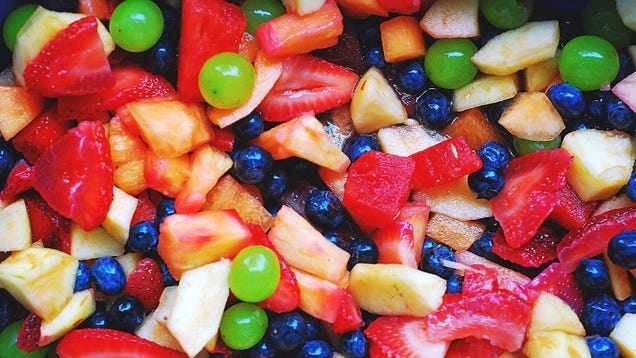
Mix the Perfect Fruit Salad With the Mad-Libs Method

by Patrick Allan

A great fruit salad is more than just a bowl of fruit; it has to have a wide variety of flavors and textures. This simple Mad-Libs-style formula will help you create an unforgettable fruit salad every time.

Read more...

10 May 21:50

New York, New Jersey Airports Threaten To Ditch TSA, Hire Own Security Screeners

by Ashlee Kieler

The fight over long lines at security checkpoints got a bit more intense late Monday, as the Port Authority of New York and New Jersey threatened to hire its own security staff to replace Transportation Security Administration screeners unless something is done to combat excessive wait times. 

The Port Authority issued the ultimatum in a letter to the TSA, noting that if passengers don’t start getting through security at JFK, LaGuardia, and Newark Liberty airports faster it will hire a private security company to do the job, WABC-TV reports.

“We can no longer tolerate the continuing inadequacy of TSA passenger screening services,” the letter states, adding that, “long waits are prompting complaints from passengers, terminal operators, and airlines alike.”

The TSA, which previously promised it would to employ a number of measures to cut down on those excessive wait times, said it was doing the best it could and would address the Port Authority’s concerns directly.

“The TSA’s primary focus is the current threat environment as the American transportation system remains a high value target for terrorists,” the agency said in a statement.

Measures TSA said it would implement include increasing staff at checkpoints and asking Congress for more money to pay for security officers’ overtime as well as cover “critical short-term needs.”

Travel experts tell WABC-TV that private security employees taking over screening could be more efficient for airports.

“Privatizing it would hold the people who are selected to be the screeners more accountable. It would cost the federal government infinitely less, and it would make the process a lot more streamlined and seamless,” Manny Gomez, a security expert, says.

The use of private security companies is not unheard of. More than 20 airports currently use non-TSA screeners.

Port Authority calls for private company to handle security if TSA doesn’t improve [WABC-TV]

10 May 21:50

Frozen Vegetable Recall Expands Again, Covers 16 More Products Sold Nationally

by Ashlee Kieler

The massive frozen vegetable recall linked to a listeria outbreak that has so far resulted in two deaths and eight illnesses, has once again expanded. According to notices posted with the Food & Drug Administration, NORPAC Foods recalled Natural Directions Organics Mixed Vegetables and Natural Directions Organic Green Peas, while Picsweet issued a recall of 14 varieties of frozen vegetables that contain green beans or green peas from supplier CRF Frozen Foods. The vast vegetable recall kicked off two weeks ago when CRF announced the voluntary call back of frozen organic and traditional fruit and vegetable products manufactured or processed at its Washington facility since May 1, 2014 after finding traces of listeria in the food. [Food & Drug Administration]

10 May 21:50

FDA To Reconsider Definition Of “Healthy” On Food Labels

by Chris Morran

When you see a some food marketed as “healthy” or “natural,” do you know exactly what, if anything, those terms mean? The Food and Drug Administration has decided to rethink its requirements for what it takes to market a product as “healthy,” while advocates and lawmakers are pushing the agency to define “natural” in a way that more people would understand.

The Wall Street Journal and the Associated Press report that the FDA’s reconsideration of the healthy food labels comes in the wake of a challenge from Kind LLC, the makers of fruit-and-nut bars.

In March 2015, the FDA sent Kind a warning letter, advising the company that two of its products were in violation of federal food labeling laws because they didn’t meat the federal standard for using the term “healthy.”

In order to meet that definition, the bars would have needed to meet FDA-established maximum limits for levels of fat, saturated fat, cholesterol, and minimum amounts of certain nutrients.

Kind made changes to its labels come within compliance of the FDA labeling standards, resulting in the agency recently closing out its warning against the company, but the bar-makers have also petitioned [PDF] the FDA to rethink its stance on “healthy,” noting that the existing standards prevent a number of foods that many people consider healthy — including nuts, avocados, olives, and salmon — from being labeled that way.

“FDA formulated those regulations more than 20 years ago, when available science and federal dietary recommendations focused on limiting total fat intake,” argued the petition. “Today, these regulations still require that the majority of foods featuring a ‘healthy’ nutrient content claim meet ‘low fat’ and ‘low saturated fat’ standards regardless of their nutrient density. This is despite the fact that current science no longer supports those standards.”

Now the FDA has confirmed that it is indeed reconsidering these standards and will seek public comment on what factors should be used when determining whether something can be labeled “healthy.”

A rep for the agency explained to the Journal that “we believe now is an opportune time to reevaluate regulations concerning nutrient content claims, generally, including the term ‘healthy.’”

The FDA did not give a specific timeline on when it would begin the process of rethinking the “healthy” label, other than to say it would happen “in the near future.”

While it’s at it, the FDA might want to rethink its definition for the term “natural,” as a new survey from our colleagues at Consumer Reports shows that a large majority of Americans don’t know what the term means when it comes to food labels.

That’s because, unlike the term “organic,” which has very specific standards for being used on a label, “natural” is a vague word whose use is not specifically regulated.

And yet, according to the CR survey results, 73% of consumers seek out foods labeled “natural,” while only 58% look for “organic.”

Around two-thirds of survey respondents believe the natural label means more than it does, with nearly half of them incorrectly believing that “natural” claims on food labels must be independently verified. Meanwhile, a majority of shoppers believe that “natural” foods should contain no artificial ingredients or processing aids, no toxic pesticides or no genetically modified ingredients.

The CR survey comes on the heels of a letter [PDF] sent yesterday by lawmakers to FDA Commissioner Robert Califf, urging the agency to finally get around to defining “natural.”

Citing the results of the CR survey, the letter — signed by Senators Richard Blumenthal (CT), Frank Pallone (NJ), Ed Markey (MA), and Rosa DeLauro (CT) — argue that “Any rule should clear up these misconceptions” about what natural means. At the very least, the lawmakers believe that the use of “natural” should preclude the use of “any artificial foods, ingredients, or synthetic substances.”

10 May 21:49

Amazon Launches Its Own YouTube-Like Service: Amazon Video Direct

by Ashlee Kieler

Amazon already squares off against Netflix and iTunes in the streaming video subscription and rental marketplaces, so it’s probably not a shock that Amazon now has YouTube in its sights with a new platform for amateur moviemakers called Amazon Direct Video.

The “self-service” program aims to allow video creators — who have an Amazon account —  to upload original or licensed videos to the service to reach a wider audience and earn money from royalties and advertising, Amazon said an announcement for the service on Tuesday.

Video creators, who will earn royalties from their videos based on minutes streamed, can choose how their content is viewable through Direct Video, including allowing viewers to stream, download, rent, or buy videos.

Creators can also bundle multiple videos together — a la Netflix — or present their videos in a TV-like “season” format that sells as a subscription add-on.

“For the first time, there’s a self-service option for video providers to get their content into a premium streaming subscription service,” Jim Freeman, VP of Amazon Video, said in a statement.

Amazon says that content producers can earn extra funds from their content through the AVD Stars program.

The program will distribute $1 million a month to the makers of the 100 most popular programs videos within the AVD service. Video creators and providers who use AVD to make their titles available in Prime Video will automatically be enrolled.

The Wall Street Journal reports that Amazon said it will keep 45% of revenue it takes in from ads appearing during free broadcasts. It will also keep 50% of revenue from channel subscriptions and video purchases or rentals. Prime videos without ads will net content providers $0.15 for each hour streamed in the U.S. and $0.06 per hour overseas.

The new service, which will be available through Amazon’s video app, set-top boxes like Roku, or the Amazon website, could prove to be a competitor with YouTube, where video creators have long posted original content.

While YouTube has nearly one billion viewers, Amazon says its service will provide content makers with an already robust audience of tens of millions of Prime members who get video streaming as part of their subscription. It’s unclear how Amazon plans to monitor the service or handle instances in which video makers may upload content that isn’t theirs.

10 May 21:48

Dean Foods Buys Ice Cream And Intellectual Property From Friendly’s, Will License Back Trademark To Restaurants

by Laura Northrup

You may remember that ice cream parlor and restaurant chain Friendly’s filed for bankruptcy back in 2011. Since then, the chain closed some restaurants and kept going. Now the nation’s largest dairy distributor, Dean Foods, wandered past the remaining business that Friendly’s has, and likes what it sees in the ice cream case. It’s acquiring the retail and ice cream making parts of the business, but not the chain of restaurants.

There are still 260 Friendly’s restaurants left, if you were wondering. Dean Foods will buy the Friendly’s trademark and intellectual property as part of the transaction, and will lease the trademark for the restaurants back to the company affiliated with Sun Capital Partners that runs the restaurants. Presumably, they will also supply the restaurants with large quantities of Friendly’s brand ice cream.

Dean Foods has acquired dozens of dairy brands across the country and has united them under one brand to rule them all, and used to be the supplier to Walmart for its store-brand milk, but the mega-retailer has decided to open its own processing facilities and handle that itself. Dean mostly deals in commodity milk, and has been trying to differentiate its products by creating brands like flavored TruMoo milks, and the DairyPure brand. The problem, however, is that most milk-drinkers seek out and buy just… milk.

Dean Scoops Up Friendly’s Ice-Cream Assets for $155 Million [Bloomberg]

10 May 21:43

New Rules Will Shed Dim Light On Antibiotics Overuse In Farm Animals

by Chris Morran

Even though three-quarters of all antibiotics sold in the U.S. are used on farm animals, there is very little information available about how much of which drugs are being fed to cows, pigs, chickens, and turkeys. Newly finalized rules hope to provide more details on how these drugs are being used, but critics say the new data is only a small part of the bigger picture.

Every year, drug makers are required to report their total sales of antibiotics intended for use in farm animals, which is how we know that recent voluntary restrictions put in place by the FDA have not resulted in any decrease in sales for these drugs.

In 2015, the FDA announced it would revise these reporting rules to include species-specific sales data, with the hope that knowing this information might help regulators have a better idea on how to actually reduce antibiotics overuse.

The FDA has now finalized that rule change [PDF], and while critics of antibiotics overuse say the new reporting requirements won’t do any harm, they also question whether they will ultimately provide the precise information needed to guide industry reform.

The primary concern is that the information reported only comes from the drug makers, who don’t have detailed data on what actually happens to their drugs once they are purchased. Many livestock antibiotics can be purchased legally, without any sort of prescription, online or at farm supply stores, so only the farmers can provide the information that FDA and other stakeholders seek.

Steve Roach, of Food Animal Concerns Trust and Keep Antibiotics Working, says that while drug industry estimates of species-specific sales are “better than nothing,” they “fall far short of what is needed to adequately monitor FDA’s efforts to combat antibiotic resistance.”

That sentiment is echoed by Avinash Kar of the Natural Resources Defense Council, whose concerns about the rules haven’t changed since they were proposed last year.

“This is a modest improvement over FDA’s current reporting requirements,” Kar tells Consumerist, “but we need more and better data on on-farm use of antibiotics.”

He explains that it’s not just the amount of drugs used that we need to understand, but data on the purpose for using these drugs. The 2013 FDA guidance called on drug makers to stop selling these drugs for growth promotion, but almost all of the antibiotics marketed for that purpose were also approved for medical treatments. It’s believed that many farmers are still providing the same amount of antibiotics to their animals, but have shifted the justification from growth-promotion to the vague “disease prevention.”

09 May 21:18

Is It Illegal To Use An App To Track Your Kid, Spouse, Or Employee?

by Chris Morran

There are a number of well-known apps that allow you remotely track your phone if it’s lost, or that track the movement of another device but do so with that user’s knowledge. What about those apps that let you track another phone — and maybe intercept calls and texts — without the other person having any idea?

At the request of the Senate Judiciary Committee, the Government Accountability Office looked at the marketing of 40 different tracking apps to determine how many were touting features that could violate federal laws against wiretapping, stalking, fraud, and deceptive business practices.

The GAO report [PDF] doesn’t name specific apps, but it does look at a wide range of targeted end-users for these applications — from parents who want to track their kids’ movements, to employers who want to keep tabs on workers’ whereabouts, to suspicious spouses who want to see if their loved one is loving someone else.

WE KNOW WHERE YOU ARE

In all, about 1/3 of the apps included in the report were advertised as having a surreptitious use, meaning the person whose device is being tracked (and possibly snooped on) is unaware. As you can see from the chart below, only two categories — apps for parents to track kids, and apps for tracking elderly and Alzheimer’s patients — were mostly transparent about the tracking, while the apps sold to employers and suspicious spouses were largely under-the-radar to those being tracked:

fig2gao

MORE THAN JUST LOCATION

Knowing where the device is located at any given moment only tells part of the story, which is why many of the apps in the GAO report include additional features, like the ability to intercept and read emails and texts, access to the other user’s call history, photo gallery access, browser history, social media posts, record phone calls, and — creepiest of all — using the other smartphone’s speaker to listen in on conversations.

Not surprisingly, all but one of these additional snooping features was primarily marketed for surreptitious use, with some — like the ability to listen into phone calls or nearby conversations — never sold as something that would be disclosed to the target of the snooping:

fig3gao

DON’T DO THE THING WE SELL THIS APP TO DO

As the GAO notes, there are a number of federal civil and criminal statutes that may be in play here, depending on the extent of the snooping and the disclosures made to the person being tracked.

The federal wiretap statute prohibits the interception of wire, oral, or electronic communications unless at least one party involved consents. The Computer Fraud and Abuse Act says you can’t access a protected computer (which now includes smartphones) without authorization, or that you can’t exceed what ever authorization you’ve been given. Federal anti-stalking laws prohibit the use of electronic devices for said stalking, and the good old FTC Act outlaws deceptive business practices.

All of which would explain why the GAO found that a number of these apps have clauses in their terms of use that would seem to prohibit the very things they market to users.

Of the 40 apps in the report, 13 had disclaimers that directly contradicted the marketing language used to sell the apps.

The report cites the following marketing language from one app for suspicious spouses:

    “You would be surprised as to how much information you can find about someone just by accessing their phone. So how can you monitor cell phone activity without having to physically peak [sic] at the phone at regular intervals? Install [our product]. The software will provide you all the information you need to find out the truth about a suspected affair.”

Yet the terms for that same app attempt to negate the touted purpose of the software:

    “[Our product] is designed for monitoring your children or employees on a smartphone you own or have proper consent to monitor (in compliance with applicable laws), and you must inform anyone who uses a device upon which the software is installed that their activity may be monitored. You should NEVER attempt to spy on a cell phone you don’t own, monitor your spouse, significant other or adult children with any cell phone monitoring product without the consent and knowledge of such persons. Doing so may be illegal, and violate local, state, and federal laws in your country and you could be subject to civil or criminal penalties. We will cooperate with authorities in investigation of any allegations of misuse.”

This two-faced marketing/legal approach is similar to the successful tactic deployed by the makers of a phone-spoofing app that was used to illegally harass a Boston-area woman. The app’s marketing included testimonials from users who had employed the spoofing in apparent violation of the law, but the app’s terms of use explicitly state that such behavior is forbidden. In the end, both a U.S. District Court and an appeals panel ruled that the app company couldn’t be held liable.

BREAKIN’ THE LAW?

While the makers of the spoofing app may have escaped legal responsibility, federal law enforcement has come down on at least one developer for producing an app that snoops on phone calls and nearby conversations.

In Nov. 2014, the maker of the StealthGenie app entered a guilty plea to sale of an interception device and advertisement of a known interception device, violations of the federal wiretapping statutes. The developer was sentenced to time served but ordered to pay a $500,000 fine.

That same month, a California woman entered guilty pleas for possessing and using StealthGenie and other spyware.

Among the groups that the GAO consulted for its report — including academics, a tech policy group, a consumer advocacy organization, domestic violence prevention groups, a wireless carrier, an app developer, and a civil liberties organization — the majority felt that using these apps surreptitiously to interrupt communications was a violation of the wiretap law.

The issue wasn’t as clear with regard to apps that only collect location data surreptitiously, noting that some federal courts have previously held that location data on its own is not “content.”

The other three laws that may apply to these apps have not yet been tested in the legal system, but the GAO notes that some stakeholders believe the Computer Fraud and Abuse Act could possibly be used to prosecute someone who installs software on another person’s smartphone. One gray area would involve a situation in which the person installing the app has a phone- or plan-sharing relationship with the person being tracked.

“In such cases, the person might be able to argue that, as the holder of the account, he or she was an authorized user and had a right to access and install an app on the phone,” writes the GAO.

The federal stalking statute could apply to those using these tracking apps to intercept another person’s emails, texts, calls, or location information, when their behavior also meets the specified intent and other criteria established in that law. However, as the GAO explains, many stalking cases are brought in state courts and stalking statutes vary from state to state. While all 50 states have laws against stalking, not all explicitly address the use of electronics and software to track victims.

“However, the Violence Against Women Reauthorization Act of 2013 amended the federal stalking statute to permit prosecutors to pursue cyberstalking cases regardless of where the victim and offender reside,” explains the GAO. “The revised statute allows prosecutors to also focus on whether the offender used an electronic communication system capable of interstate commerce, such as a smartphone, to stalk the victim.”

While that update has allowed the DOJ to better address cyberstalking, there is still the issue of prosecuting app makers. Stalking cases primarily prosecute the alleged stalkers, not the companies that abet or encourage the bad behavior. One state prosecutor tells the GAO that it’s difficult to bring charges against app developers because many of them are overseas. Additionally, because it takes so long to put together a case against one of these app makers, the targeted company has time to change its name, its marketing strategy, or the design of the app.

Finally, the FTC Act has previously been applied to settle a case with a company that allegedly engaged in surreptitious tracking of a third party’s use of his or her computer through computer-based software, so there’s no reason to think it wouldn’t apply with regard to the same questionable practices on smartphones.