
The right kind of sound can relax your mind, hone your focus, drown out distractions, or get you pumped to kill your to-do list. We've assembled some research and free resources to help you create your own best workspace soundtrack.

The right kind of sound can relax your mind, hone your focus, drown out distractions, or get you pumped to kill your to-do list. We've assembled some research and free resources to help you create your own best workspace soundtrack.

A study from The Ohio State University found that eating could reduce aggression between you and your spouse.

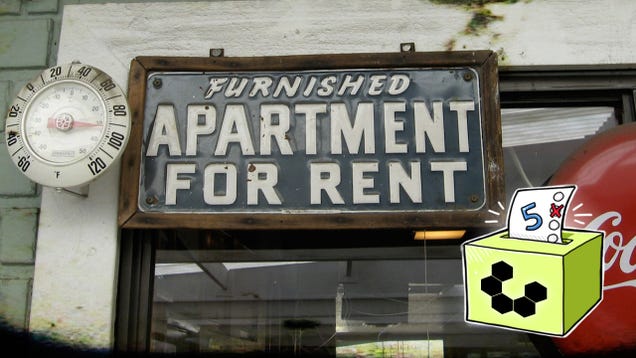
Looking for a new apartment or rental used to mean combing neighborhoods looking for "for rent" signs and sifting through newspaper classifieds. Now you can take your search on the go, or do it on your laptop or tablet. Here are five of the best apartment search tools to help you find the perfect pad.


If you haven't heard, a lime shortage is descending upon us all. The Kitchn has a list of substitutions for limes in all your recipes.


You probably know about a lot of the things you can get at the dollar store, but weblog Consumerist notes that a few lesser known items—like wrapping paper—are perfect for dollar store deals.


From avoiding crowds to taking advantage of your body's natural rhythms, there's a best time of day to do just about anything. Here's a list of some of the best.


If you are always late to appointments, it's time to change that habit . Learning to embrace downtime can help.


Does it feel like the salespeople in upscale retail stores seem kind of snobby? A recent study suggests rudeness could actually boost their sales.

 I don’t know about you, but when I hear the word “artisan,” my mind automatically turns not to sepia-toned photos of craftspersons putting their passion into creating something you can’t get elsewhere, but to a chain of roast beef restaurants with more than 3,000 that is co-owned by a private equity firm and Wendy’s. Thank goodness, some Arby’s are helping to make my vision of artisan foods a reality with a test of mass-produced sandwiches with grill marks on them.
BrandEating reports that Arby’s customers in Evansville, IN, are getting the chance to try out these new “Artisan Melts,” a name that is at best 50% accurate.
“Arby’s is committed to an ever evolving, collaborative and innovative approach to product innovation and R&D,” a rep for the company tells BrandEating, explaining that there are no current plans to expand this test beyond the Evansville market. “This is simply a test of new operational processes and equipment.”
These sandwiches might be good — heck, they might even be great — but could the food marketing hivemind agree to press pause on using “artisan” for at least a few months?

 There are innumerable bits of information floating out there on the Internet, some useful, some not so much. How do you sort through the flotsam and jetsam, and separate the detritus from the worthy nuggets? That’s where We Tried It comes in, a new series from Consumerist. It’s when that link your friend posted about that thing stops being a link, and starts getting real*.
In this week’s edition of We Tried It, the link in question involves a Sanka ad from 1940 about “making coffee in your icebox” and was submitted by my enterprising colleague, Boss Meg “Why Do You Always Call Me Boss Meg?” Marco.
THE CHALLENGE
THE INGREDIENTS
For this effort, I decided to use my oldest, cracked ice cube trays because they look so good in pictures.
I used skim milk because that’s how I’m used to my coffee tasting. I’m sure there’s a similarity between hot and cold versions of your preferred milk, though the ad warns not to use cream. Because I listen to instructions, I didn’t even try it with cream because I’m also not a glutton for punishment.
As for the coffee — no, I didn’t make a pot of Sanka, I used what I had in my pantry. But only because the ad’s reason for using it is to to sell Sanka, obviously, and the only “reason” given to prefer it over others is because it has less “caffein”:
So make your iced coffee with Sanka Coffee. It’s 97% caffein-free, and can’t keep you awake. It’s real coffee… all coffee… and is delicious iced. Best of all… you drink it and sleep!
THE PROCESS
I let the ice cubes chill out in the freezer, instead of my 1940s ice box, for a few days only because I was waiting for a sunny day that took forever to arrive. Iced coffee is best when it’s nice out, right?
Removing them from the tray was a bit of a messy hassle, so be warned that you’ll probably end up with brown fingers by the end. As you can see, 10 cups of extra-strong coffee made about two dozen cubes. I made an extra glass in cased I mucked things up somehow.

I heated the milk on the stove in a pan for about five minutes, until it was hot but not boiling. I figured you don’t need a photo of that, because you can probably imagine it for yourself. I’ve got one if you’ve got a need to see it. Then, I poured it into the glass…
THE RESULTS
So the thing is, I was completely expecting to be grossed out, turned off and otherwise hate this. There’s something about hot milk by itself that just… yurgh. But because I like strong iced coffee, I also like a good amount of milk, which this certainly has. And it did look gross — brown cubes are inherently unattractive, after all.
And because the cubes take a while to melt, even in warm liquid, you’ll have a decidedly milk-heavy ratio going on for a little bit, which some might not like.
THE VERDICT: IT’S NOT TOTALLY NASTY — Go for it, if you want.
I liked it, enough that I drank the whole thing and another one while writing up this post later. But the real question is — is this any more convenient than just making hot coffee and putting in regular iced cubes, then adding cold milk? Or heck, use coffee ice cubes and then put those in your coffee for a real kick, and to keep the coffee from getting watered down.
You’re bound to have equal access to either hot milk or hot coffee, as well as your chosen liquid in cube form. So if you don’t feel like heating anything up, just prepare a pot beforehand, stick it in a pitcher in your fridge and pop in whatever cube you want.
My suggestion? Make a pot of hot coffee, keep it in a pitcher, add regular ice cubes. Or coffee ice cube in hot coffee. Or COLD coffee. the sky is the limit!
Found a kitchen or DIY experiment — old or new, it doesn’t matter — you want me to try? I’ve got my limits, but I’m open to suggestions. Send an email to tips@consumerist.com with the subject line WE TRIED IT.
*Totally intentional reference to The Real World. But only seasons 1 through maybe 15?
Follow MBQ on Twitter if you’ve got stuff you want her to try: @marybethquirk

Va. water tower gets 6-month reprieve, city council to determine whether to ... Greenfield Daily Reporter MANASSAS, Virginia — A 100-year-old water tower in Manassas will stand for at least another six months. The Washington Post (http://wapo.st/SpIp5s ) reports the Manassas City Council will wait that long before discussing again whether to demolish the ... and more » |
 It’s a big day for Comcast: not only did they win a big old golden poo this morning, but also they formally took the first step in the regulatory dance that stands between them and their purchase of Time Warner Cable by filing a mountain of paperwork with the FCC. The massive document contains all of Comcast’s explanations for why the merger is the best idea ever… and it’s a doozy. Let’s take a closer look at their arguments, shall we?
Formally called the “Applications and Public Interest Statement,” the filing [180-page PDF] explains who the parties are, what their business is, and why their merger would be for, and not against, the public interest. It’s basically a deep expansion of Comcast PR’s greatest hits: “Applicants compete in a dynamic, expanding, and highly competitive marketplace” is one we’ve heard before, as is, “Because the parties do not compete for consumers, there is no plausible theory of competitive harm arising” from the merger. In fact, the vast bulk of the filing is spent explaining why and how the marketplace is currently competitive and will remain so post-merger.
Wouldn’t it be great if all that active competition was actually real? Consumers sure would benefit! But it’s not, and we don’t. Competition in the TV and broadband space is minimal at best, and Comcast’s legal masterwork of window-dressing doesn’t change that. No matter how they frame the arguments — geographically, financially, or technologically — the fact remains that competition, already minimal at best, will not increase with this deal.
The Geography Argument
“The transaction presents no competitive concerns because … Comcast’s and TWC’s service areas are distinct and the companies do not compete in any relevant market.” — p. 127
It’s true that Comcast and Time Warner Cable don’t actually compete against each other directly in any areas. Comcast has been waving that flag since the first day the merger was announced, and it’s a true fact. It just also doesn’t matter.

Cable competition in Los Angeles. Click to enlarge.
We’ve been through this before: TWC and Comcast might not compete with each other but unfortunately, nobody else really competes against them in many markets, either.
As Comcast bigwig David L. Cohen pushed hard in both a media call and in a blog post, post merger there would be “no reduction in consumer choice” anywhere. “Customers will still have the same number of video, broadband, or phone options before the deal as after it.” And that is indeed true.
But anything times zero is still zero, and Comcast’s stance isn’t useful. There already is no competition for huge numbers of consumers, and making the biggest company bigger is really not going to help on that front.
Comcast’s argument about overlapping coverage areas is, at this point, mostly important for their response to challenges of it. According to Comcast, the reason we don’t see high levels of broadband access competition is really because we’re not counting right. If we’re just looking at the cable and fiber companies, Comcast says, we’re doing it wrong.
The Technology Arguments
Contrary to the picture some have painted of DSL as a defunct service, between December 2008 and December 2012, DSL-based broadband connections grew at an average annual rate of 25 percent, exceeding cable broadband’s pace of growth at an average annual rate of 18 percent.” — p. 48
“Competitive forces are also present – increasingly and robustly so – via mobile wireless services offered by well-capitalized and aggressive national wireless providers. For a large number of Americans, wireless is already a meaningful broadband alternative.” — p. 51
If David L. Cohen has any buddies running DSL companies, surely they are right now thanking him for doing them a solid. Today Comcast is absolutely singing the praises of DSL, apparently the nation’s greatest broadband technology. The “new DSL,” as Cohen continuously proclaimed, is a worthy competitor to cable.
In their filing, Comcast asks us to consider AT&T in particular: “AT&T’s DSL and FTTN [fiber] U-verse services significantly overlap both Comcast and TWC … and AT&T has affirmed its plans to continue to enhance and expand these services.”
Here’s where Comcast and Time Warner Cable are available, according to Comcast:

Comcast’s “no, really, we don’t compete with TWC” coverage map, via their website.
Now here’s where AT&T provides wired broadband services, according to the National Broadband Map:

The parts of the country where AT&T provides broadband access, via the National Broadband Map.
Even if AT&T’s service is every bit as splendid as Comcast insists, it’s still a complete non-factor for millions of broadband consumers in tons of cities and states, including the densely populated urban corridors of both the northeast and the West Coast. Meanwhile Verizon FiOS isn’t expanding, Google Fiber is still only in three cities even if it might expand, and both Verizon and AT&T are trying to cut back on what land line service they offer.
So much for wire-line competition. But there’s still 4G LTE, as Comcast stresses. So what about wireless competition?
The 4G Fallacy
The cable industry is well aware of the possibility of material mobile broadband substitution for cable broadband within the next few years. With the increasing ubiquity of 4G wireless connectivity and the multitude of enabled devices including smartphones and tablets, these predictions are increasingly becoming a reality. … 4G wireless broadband technology can deliver speeds that rival those of wireline cable and telco companies — well over 50 Mbps downstream.” — p. 54-55
Comcast is trying their hardest to sell the idea that mobile broadband is viable competition to wired broadband service. Your phone, they say, is every bit as connected as your house. Therefore, competition already exists and is robust.

Where Comcast/TWC coverage overlaps with 4G LTE coverage, according to Comcast.
To give credit where it’s due, Comcast is indeed partially right about 4G. Wireless broadband really is a huge and growing factor to consider in the internet landscape. We’ve looked at the numbers before: more than half of the country does use their phones for internet access, and about a third of people who own smartphones use them almost exclusively for their internet access.
But although mobile broadband may be a truly competitive option five or ten years from now, it certainly isn’t yet. Cohen reluctantly admitted that “wireless pricing today for some consumers is not competitive,” but implied that those consumers are the minority.
They aren’t.
The average monthly mobile bill these days runs about $144 per month, give or take. Verizon Wireless is the largest mobile phone carrier in the country, and under their newest pricing plan, introduced in February, a bill of approximately $140 per month will get a user 10 GB of data use. Users who go over their threshold pay $15 per 1GB of extra data.
Meanwhile, your average family pays about $150 per month for their home TV and broadband service. If that service is with Comcast, then it has a 300 GB “data threshold” and the overage charge, when it’s enforced, is $10 per 50 GB.
 The numbers are only rough averages, and comparing two very different services is handling the proverbial apples and oranges. But the overall message is still clear: mobile, wireless broadband is still a much more expensive way to move data than a traditional broadband connection is.
Of course, we don’t all necessarily need that much data. For someone who never does anything more complicated than check their e-mail, perhaps mobile-only is already a viable alternative. Most of us aren’t such low-volume users, though. Use Netflix or Hulu at all? HD video uses roughly 2 GB of data per hour streamed. 10 GB would get you a couple of movies, or about half a season of prestige TV. But not both. And nothing else on top of it, either.
Mobile wireless is not only limited and pricey; it’s also unreliable. If you live in an area (like Manhattan) with too many users trying to connect to a fancypants 4G LTE network, you may get kicked down to much slower 3G connectivity. And that’s if your carrier even offers LTE service where you live. And although LTE network connections can offer download and upload speeds on par with their traditional broadband brethren, on average they don’t yet.
What Happens Next
With today’s filing, Comcast has drawn up their battle lines. As predicted, they’re pushing back hard on the idea of broadband competition. They insist that they’ll make TWC customers’ lives better, get more poor families using the internet, and keep being the best at net neutrality.
The reality, though, is a lot hazier. Comcast’s behavior has a decidedly spotty record, and the company already has an outsized amount of clout.
Head executives from both Comcast and Time Warner Cable, along with a handful of other pro-business and pro-consumer witnesses, will testify before the Senate Judiciary Committee tomorrow. From there, the process rolls on.


(Evan)
No one wants to think they’ll be unable to take care of themselves, but it’s likely to happen eventually, with one study saying there’s a 70% chance you’ll need some kind of care after age 65. Today, we’re thinking to the future. Long-term care insurance will help pay the bills should you need some kind of care, so you had better learn How To Not Suck… At Long-Term Care Insurance.
And this kind of care isn’t just for older folks. You could be in an accident or have an debilitating illness and need help. In fact, 40% of those who receive long-term care are under 65.
And we’re not talking about a long weekend. The average need for care is 1,040 days, according to the American Association for Long-Term Care Insurance
So who pays for the cost of care?
You will, unless you have long-term care insurance, or LTC insurance.
Here are 15 things you may not know — or that you need to know — about LTC insurance.
1. Medicare won’t cover the cost for most long-term care scenarios.
It will cover the kind of skilled short-term nursing care you might need after a hospitalization or an accident, but it won’t pay for permanent assistance. Medicaid will cover nursing home care, but only for those with limited assets, and you won’t have much say about what facility you’ll go to if Medicaid is paying the bills.
2. LTC insurance can be expensive, but paying outright for care is costlier.
The median cost for a home health aide for eight hours a day is $44,000 a year, and nursing home care in a private room averages $84,000 a year, according to a 2013 Genworth study. Some parts of the country are even more expensive. (Check this map to see the cost of care in your area.)
3. It’s not just nursing homes.
Lots of different kinds of care are covered by LTC policies. Each policy will spell out the details, but most will cover home health aides, assisted living, nursing homes and even adult day care..
4. You’re not too young.
Like life insurance, the younger you are, the cheaper the policy will cost. Maybe you don’t need a policy in your 20s and 30s, but start thinking about it when you’re in your 40s. If you wait too long, your health could change and make a policy more expensive, or you could even become uninsurable.
5. Your employer may offer LTC insurance at a less expensive group rate…
But many policies are not portable, meaning you can’t take them with you after you leave your job. If you want a group rate, check with your professional associations or alumni groups to see what’s offered.
ITEMS 6-13: TERMS YOU NEED TO KNOW
(Apologies in advance for the insurance jargon in the next several items, but any policy you consider will be filled with terms you need to understand before you buy.)
6. Daily or Monthly Benefit Period:
This is the amount of money your policy will give per day or per month for care. Also know the lifetime cap on your policy.
7. Inflation Rider:
This will increase the cost of your policy, but it’s well worth it. An inflation rider means the benefit you receive will rise with the cost of living. Think about what care may cost in 20 or 30 years. Scary, indeed.
8. Elimination Period:
This is the amount of time that must pass before your policy pays on a claim. Ninety days is common (so you’d pay for care for 90 days before the policy kicks in) but taking a longer elimination period will lower the cost of your policy.
9. Shared Benefits Rider:
This is a product made for married couples. It allows you to share your benefits with your spouse. For example, if your spouse uses up all his benefits, he can dip into yours.
10. Paid Up Premiums:
If you have a fat wallet today, you can opt to pay higher premiums for a set time period, say, 10 years, and at the end of that time frame, the policy is paid up and you won’t owe anything more in your lifetime. This is also called an accelerated premium option.
11. Free-Look Period:
This is essentially a buyer’s remorse clause. If you decide you don’t like, don’t want, or regret the policy you purchased, you usually have 30 days to change your mind and get a full refund.
12. Non-forfeiture/Guaranteed Renewability:
The non-forfeiture provision will help you if the insurance company decides to increase the cost of your policy. You’ll be able to keep your policy in effect, but for a smaller benefit, rather than it be cancelled outright. A policy that’s deemed to have guaranteed renewability means the insurance company can’t increase your premiums unless all similar policies in your state get an increase. It can’t be cancelled, either.
13. Exclusions:
Because nothing in life is easy, some reasons for needing care may be excluded from your policy. Self-inflicted injuries, alcohol and drug abuse and some mental illnesses are generally excluded.
14. If you’re thinking about a policy, get your spouse on board.
You could save as much as 40 percent if you both opt for the insurance.
15. There are some tax incentives available to offset to cost of LTC policies.
There are partnerships between some states and private insurers, you may be able to deduct premiums as part of your medical expenses on federal returns and some states offer similar incentives.
Also make sure you work with an insurance company that will be around in 20 or 30 years when you may need to make a claim. Imagine paying all those years and getting nothing? Egads.
To learn more about the costs, check out the American Association for Long-Term Care Insurance.
Next week: Our insurance series wraps up with a look at the essentials of disability coverage.
Have a topic you’d like to see covered in How To Not Suck? Or maybe you’re an expert who would like to share your insight with Consumerist readers? Send us a note at notsuck@consumerist.com.
You can read Karin Price Mueller’s stories for The Star-Ledger at NJ.com, follow her on Facebook, and on Twitter @kpmueller.
PREVIOUSLY ON HOW TO NOT SUCK:
15 Things You Need To Know About Life Insurance
15 Things Everyone (Including Renters) Should Know About Homeowner’s Insurance
15 Things You Need To Know About Buying Auto Insurance
How To Not Suck… At Going To Small Claims Court
How To Not Suck… At Buying In Bulk
How To Not Suck At Planning Your Wedding, Part 5: Spending Your Wedding Cash
How To Not Suck At Planning Your Wedding, Part 4: The Honeymoon
How To Not Suck At Planning Your Wedding, Part 3: The Costly Little Extras
How To Not Suck At Planning Your Wedding, Part 2: The Stuff People Pay Too Much For
How To Not Suck At Planning Your Wedding, Part 1: The Most Expensive Steps
How To Not Suck… At Teaching Your Kids About Money
How To Not Suck… At Valentine’s Day Gifts
How To Not Suck… At Merging Your Money When You Marry
How To Not Suck… At Borrowing For College
How To Not Suck… At Saving For College
How To Not Suck… At Pre-Paying For Your Funeral
How To Not Suck… At Making Financial New Year’s Resolutions
How To Not Suck… At Last-Minute Christmas Gifting
How To Not Suck… At Saving For The Holidays
How To Not Suck… At Charitable Giving
How To Not Suck… At Disputing Credit Report Errors
How To Not Suck… At Lowering Your Utility Bills
How To Not Suck… At Home Inspections
How To Not Suck… At Understanding Credit Card Rewards
How To Not Suck… At Getting Ready For Tax Season
How To Not Suck… At Picking A Retirement Plan
How To Not Suck… At Deciding When To DIY
How To Not Suck… At Getting Out Of Debt
How To Not Suck… At First Year College Budgets
DISCLAIMER: Any websites, services, retailers, or brands mentioned in the story above are only intended as some of many options available to consumers, and do not constitute an endorsement by Consumerist, Consumerist Media LLC (CML) or its staff. Per Consumerist’s No Commercial Use Policy, such information may not be used by others in advertising or to promote a company’s product or service. In addition, this policy precludes any commercial use of any of CML’s published information in any form, or of the names of Consumers Union®, Consumer Media, Consumer Reports®, The Consumerist, consumerist.com or any other of CU or CML’s publications or services without CU or CML’s express written permission.

It’s 2014, and we’re living in an increasingly globalized economy. International trade has been ramping up for centuries, and a carefully-plotted web of agreements keeps goods, services, and money moving around the world. The U.S. is already a part of many such agreements and organizations — NATO and NAFTA might sound familiar — but a new international trade agreement, under negotiation right now, has a lot of watchers very worried about potential consequences for everything from healthcare to copyright law in the United States.
The agreement kicking up all the concern is the Trans-Pacific Partnership, or TPP. Most of the nations involved in the process have had cooperative trade arrangements for years — so why is this particular treaty gaining so much attention? The answer is threefold: the process, the contents, and the fact that it’s still in the works and can be changed. Let’s take a look at all those parts.
Who’s involved?
The countries taking place in the negotiations include Canada, the U.S., Mexico, Peru, Chile, New Zealand, Australia, Malaysia, Brunei, Singapore, Vietnam, and Japan.
The enormous free trade deal has been in progress in one way or another for the better part of a decade; the U.S. jumped on board in 2009. Together, the involved nations represent about 40% of the global economy, according to the LA Times.
That’s an awful lot of Pacific rim countries that aren’t China.
Noticed that, eh? As the Washington Post pointed out, such a large agreement among other nations can be used to counterbalance China’s enormous economic weight, in a sense. Whether that’s a good thing or not depends on who you ask.

What traded stuff does this agreement cover?
The thing about your modern, 21st century trade agreement is that it’s not really just about trading goods. Long gone are the days when international trade was only about agriculture, manufacturing, and import tariffs.
Those things — farming and manufacturing — are still absolutely key, and central parts of the TPP. But in the “knowledge economy,” trade is also about patents, copyright, digital goods, and a whole lot more.
The known categories in the 29 chapters of the agreement include regulations relating to intellectual property and copyright law, banking regulation, agriculture, pharmaceutical regulation, environmental protection, tobacco sales, apparel manufacture, labor law, and regulations about publicly vs. privately owned utilities and enterprises.
The history and background of the economic factors contributing to this sort of thing are huge and messy. For an easy-to-understand explainer, there’s a comic book up at Economix Comix that looks at free trade, trade treaties, and the economic background, causes, and effects of such a massive free trade agreement.
Wait, the “known” categories? Does that mean there are unknown ones? Possibly? Probably? The biggest challenge is that nobody actually knows for sure what this agreement covers.
One of the biggest objections to the TPP, in both the United States and in other participating nations, is that it’s even hard to know exactly what to object against. Trade negotiations are almost always secret proceedings, and this one is no exception. For everyone who isn’t privy to what goes on behind the closed doors, everything we know comes from a few leaked drafts that have dribbled out over the years.
Okay, negotiations are secret. But then everyone gets to find out what’s in it before it’s actually signed, right?
Yes, sort of, but also sort of not.
Trade agreement formation, in the United States, is basically a three-step process:
With regular laws, details get agreed on, disagreed on, and hashed out as a bill moves back and forth through the House and Senate. Lawmakers get to pick and choose which parts they like and which parts they hate, and try (ideally) to compromise on those points to create a better law, that everyone can live with. For better or worse, that’s the system with which American laws are made.
But with international agreements, there’s something called fast-tracking. It’s exactly what it sounds like: a short-cut through the approval process. If Congress grants the President fast-track authority, that means the fully-negotiated, finished treaty goes to the Senate for a vote: no amendments, no filibusters, no changes or negotiations. It’s a wholesale yes/no, binary option.
Fast track authority was first enacted in 1974, and a series of bills since then have extended it. The most recent was the Trade Act of 2002, but the authority granted by that extension expired five years later, in 2007, and has not been renewed since.
The Obama administration has been making noise about renewing the fast-track authority since 2012; a bipartisan bill to that end was introduced in the House (HR 3830) and the Senate (S 1900) earlier this year.
 So this thing’s going to get fast-tracked through the Senate.
Quite possibly! Also quite possibly not. The politics of this one are not breaking down along the standard party lines in the way one would usually guess.
Govtrack.us gives the House bill a 63% chance of being enacted, but spots the Senate version a lowly 3% chance. And there are plenty of groups out there pushing hard against fast-track authorization.
There a lot of techie/internet sites and groups against this. Why?
While most of what’s in the TPP is still a secret, the drafts of two chapters have made it out into the wild, via Wikileaks. One of those two chapters covers environmental and climate issues but doesn’t contain very much in the way of firm regulation or enforcement mechanisms.
The other, though, is all about intellectual property rights. That IP chapter contains some really questionable provisions about copyright, digital files, and internet use.
For example, the TPP contains a restriction on the creation of temporary copies of files — a provision that the EFF calls “profoundly disconnected from the reality of the modern computer.” (Because your computer does that dozens of times a day just to function.) It also would impose criminal penalties for “non-commercial copyright infringement,” continue expanding copyright durations, limit fair use, increase penalties for avoiding region-locking media, and more.
Overall, the IP chapter has a lot in common with the previously-abandoned ACTA treaty and the narrowly-avoided SOPA bill of 2012.
So international agreements change U.S. law?
They can indeed. Much in the same way that state laws are subject to being overridden by tougher federal standards, when a nation agrees to participate in an international agreement like this, their laws become subject to its terms.
A case from Australia is perhaps the most famous recent example of this. Australia adopted a law requiring plain packaging — that is, without visible branding symbols, and bearing a large health warning — on tobacco products. The Asian subsidiary of tobacco giant Philip Morris, based in Hong Kong, promptly turned around and sued Australia, claiming that the new law violated the terms of a trade treaty between Australia and Hong Kong.
While Australia’s High Court ruled that the plain packaging law did not violate Australia’s constitution, the trade dispute is still pending with the WTO, and other nations are now involved.
In fact, international agreements have already been the primary driver of U.S. digital copyright law. The current major legislation under which most IP/internet/copyright issues fall, the Digital Millennium Copyright Act (DMCA) of1998, includes provisions directly in response to international agreements from 1996.
Now what?
Since the TPP is still under negotiation, there are still a bunch of different possible outcomes. It could go forward as-is, it could fall apart entirely, it could be a bunch of different things in-between.
The last big negotiation session for all participating nations was in Singapore in February, but a number of sticking points remain. Some of them are being hashed out in smaller meetings of just two and three countries. Some appear not to be going anywhere at all.
DC political observers go through waves of pessimism and optimism about the TPP. This week they appear to be feeling both hopeful and doomed at the same time.
Insiders and watchers do seem to agree on one key point: without fast-track approval, the TPP won’t make it through. The negotiations won’t necessarily all be moot at that point — that’s a lot of work to waste and the parties who want concessions will still want them. Those points could be re-formed into a number of smaller agreements, or a new major multilateral agreement — but the TPP as we know it would be a no-go in the U.S.

Felony Hit-and-Run Arrest in Manassas Patch.com A man has been arrested in an afternoon hit and run Thursday, according to Manassas City Police. Michael P. Denigris, 68, of the 9100 block of Big Springs Loop in Bristow, is charged with felony hit and run. Denigris was granted bond at $2,000. Police ... |
High School Starting Later Next Year: What Do You Think? Patch.com The Manassas City Public Schools announced last week that high school students in the city will be heading to school at 8:10 a.m. beginning next year. Currently the school day begins at 7:20 a.m.. The school board is making this move, in part, to ... |

