Adequate Man Don’t Declaw Your Cat | Jezebel Rob Kardashian’s New Home Design Apparently Caused Major Beef Between Kourtney and Faye Resnick | Paleofuture Is This a Time Traveler at a Mike Tyson Fight in 1995? | Gawker How to Kill a Three-Year-Old in NYC Without Getting Arrested |
Shared posts
23 May 04:14
Adequate Man Don’t Declaw Your Cat | Jezebel Rob Kardashian’s New Home Design Apparently Caused Majo
by Kinja! on Kinja Roundup, shared by Alan Henry to Lifehacker
Scott Weigand likes this
23 May 04:13


The 10 Best Natural Tinders You Can Find In a Forest, and How to Use Them
by Patrick Allan
Whether you’re lost and cold in the wild, or just need some help starting your campfire, these natural tinder options are what you need.
Justin likes this
23 May 04:13


Brussels Sprout Chips Are a Super Easy, Healthy Snack
by Claire Lower on Skillet, shared by Andy Orin to Lifehacker
You’ve most certainly had—or at least heard of—kale chips, but kale isn’t the only leafy green that can be transformed into a crispy snack. Brussels sprout chips are just as easy as the kale version and (I think) a little bit tastier.
23 May 04:12
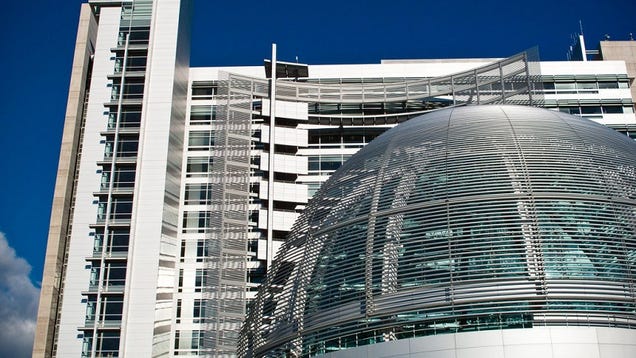

The 25 Best U.S. Cities for Finding a Job In 2016
by Patrick Allan
Finding a job can be a struggle, but it always helps to look in the right places. These are the best cities to try and land a job this year, according to Glassdoor.
23 May 04:12


How Being Tired Affects Your Thinking and Performance
by Belle Beth Cooper
Something I notice every time I get really tired is that I become really clumsy. When I find I’ve dropped several cups, bumped my knee on a desk and opened a door into my face in the space of a couple of hours, that’s usually a sign that I’m overtired.
Justin likes this
23 May 04:11


Keep Your Picnic Table Ant-Free With Some Pie Tins
by Patrick Allan
Ants love the messes that are associated with outdoor meals, so there’s always an anthill near every picnic area. If you want to keep them from crawling on your seat and into your food, you can make some mini ant moats with pie tins.
Scott Weigand likes this
22 May 15:03
As Scope of 2012 Breach Expands, LinkedIn to Again Reset Passwords for Some Users
by BrianKrebs
A 2012 data breach that was thought to have exposed 6.5 million hashed passwords for LinkedIn users instead likely impacted more than 117 million accounts, the company now says. In response, the business networking giant said today that it would once again force a password reset for individual users thought to be impacted in the expanded breach.
 The 2012 breach was first exposed when a hacker posted a list of some 6.5 million unique passwords to a popular forum where members volunteer or can be hired to hack complex passwords. Forum members managed to crack some the passwords, and eventually noticed that an inordinate number of the passwords they were able to crack contained some variation of “linkedin” in them.
LinkedIn responded by forcing a password reset on all 6.5 million of the impacted accounts, but it stopped there. But earlier today, reports surfaced about a sales thread on an online cybercrime bazaar in which the seller offered to sell 117 million records stolen in the 2012 breach. In addition, the paid hacked data search engine LeakedSource claims to have a searchable copy of the 117 million record database (this service said it found my LinkedIn email address in the data cache, but it asked me to pay $4.00 for a one-day trial membership in order to view the data; I declined).
Inexplicably, LinkedIn’s response to the most recent breach is to repeat the mistake it made with original breach, by once again forcing a password reset for only a subset of its users.
“Yesterday, we became aware of an additional set of data that had just been released that claims to be email and hashed password combinations of more than 100 million LinkedIn members from that same theft in 2012,” wrote Cory Scott, in a post on the company’s blog. “We are taking immediate steps to invalidate the passwords of the accounts impacted, and we will contact those members to reset their passwords. We have no indication that this is as a result of a new security breach.”
LinkedIn spokesman Hani Durzy said the company has obtained a copy of the 117 million record database, and that LinkedIn believes it to be real.
“We believe it is from the 2012 breach,” Durzy said in an email to KrebsOnSecurity. “How many of those 117m are active and current is still being investigated.”
Regarding the decision not to force a password reset across the board back in 2012, Durzy said “We did at the time what we thought was in the best interest of our member base as a whole, trying to balance security for those with passwords that were compromised while not disrupting the LinkedIn experience for those who didn’t appear impacted.”
The 117 million figure makes sense: LinkedIn says it has more than 400 million users, but reports suggest only about 25 percent of those accounts are used monthly.
Alex Holden, co-founder of security consultancy Hold Security, was among the first to discover the original cache of 6.5 million back in 2012 — shortly after it was posted to the password cracking forum InsidePro. Holden said the 6.5 million encrypted passwords were all unique, and did not include any passwords that were simple to crack with rudimentary tools or resources [full disclosure: Holden’s site lists this author as an adviser, however I receive no compensation for that role].
“These were just the ones that the guy who posted it couldn’t crack,” Holden said. “I always thought that the hacker simply didn’t post to the forum all of the easy passwords that he could crack himself.”
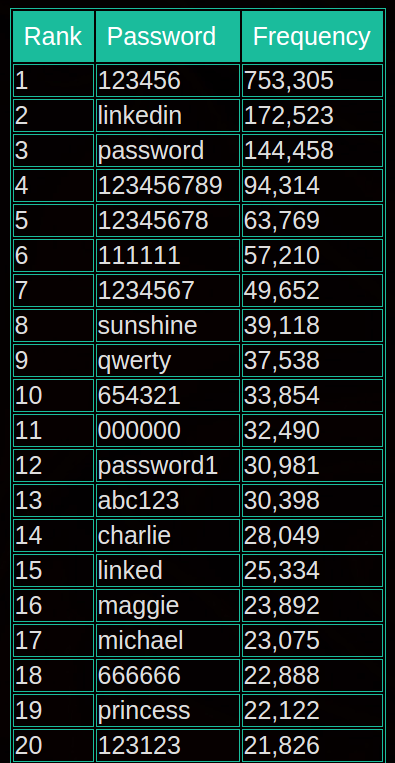
The top 20 most commonly used LinkedIn account passwords, according to LeakedSource.
According to LeakedSource, just 50 easily guessed passwords made up more than 2.2 million of the 117 million encrypted passwords exposed in the breach.
“Passwords were stored in SHA1 with no salting,” the password-selling site claims. “This is not what internet standards propose. Only 117m accounts have passwords and we suspect the remaining users registered using FaceBook or some similarity.”
SHA1 is one of several different methods for “hashing” — that is, obfuscating and storing — plain text passwords. Passwords are “hashed” by taking the plain text password and running it against a theoretically one-way mathematical algorithm that turns the user’s password into a string of gibberish numbers and letters that is supposed to be challenging to reverse.
The weakness of this approach is that hashes by themselves are static, meaning that the password “123456,” for example, will always compute to the same password hash. To make matters worse, there are plenty of tools capable of very rapidly mapping these hashes to common dictionary words, names and phrases, which essentially negates the effectiveness of hashing. These days, computer hardware has gotten so cheap that attackers can easily and very cheaply build machines capable of computing tens of millions of possible password hashes per second for each corresponding username or email address.
But by adding a unique element, or “salt,” to each user password, database administrators can massively complicate things for attackers who may have stolen the user database and rely upon automated tools to crack user passwords.
LinkedIn said it added salt to its password hashing function following the 2012 breach. But if you’re a LinkedIn user and haven’t changed your LinkedIn password since 2012, your password may not be protected with the added salting capabilities. At least, that’s my reading of the situation from LinkedIn’s 2012 post about the breach.
If you haven’t changed your LinkedIn password in a while, that would probably be a good idea. Most importantly, if you use your LinkedIn password at other sites, change those passwords to unique passwords. As this breach reminds us, re-using passwords at multiple sites that hold personal and/or financial information about you is a less-than-stellar idea.
19 May 15:01
Johns Hopkins ends use of live animals to train med students
by wtopstaff
BALTIMORE (AP) — One of the country’s premier medical schools will no longer use live animals to train its students.
Effective next month, Johns Hopkins School of Medicine in Baltimore will eliminate a popular but controversial course in which students operate on live, anesthetized pigs. After their surgeries, the pigs are euthanized.
Medical school spokeswoman Audrey Huang said the course was eliminated after a yearlong review board found it wasn’t essential. Huang added that the course was popular among medical students and has received glowing reviews from alumni.
Johns Hopkins is one of two accredited medical schools in North America that use animals in medical education, according to animal rights group the Physicians Committee for Responsible Medicine.
A bill was introduced in the General Assembly this year to ban the practice.
The portion of the course, a surgical clerkship, in which students operate on the pigs was optional, Huang said, but every student that enrolled opted to conduct the surgery.
“The students have historically always been huge fans of this course,” Huang said. The medical school’s curriculum undergoes regular review, Huang said, to “make sure we’re teaching at the cutting edge and that nothing gets stale.” Despite the class’s popularity, she said, it was time for a change.
“The dean’s office and the task force that reviewed the course felt that the class isn’t essential for turning out a great physician in training,” she said, “and it was the essential aspect of it that led to the decision.”
The post Johns Hopkins ends use of live animals to train med students appeared first on WTOP.
19 May 14:45

Mitsubishi President Steps Down Amid Fuel Data Scandal
by Ashlee Kieler
Weeks after Mitsubishi president Tetsuro Aikawa apologized for his company’s role in falsifying fuel data in thousands of vehicles in Japan, the executive has stepped down.
Aikawa, who denied personal involvement in the ongoing scandal, announced Wednesday that he would step down and take responsibility for the mileage cheating issue, the Associated Press reports.
The resignation is expected to be approved by shareholders on June 24.
A successor for Aikawa was not announced on Wednesday, but with Nissan’s recent deal to acquire a 34% stake in Mitsubishi, it’s possible the carmaker’s new leader could be from that company.
Nissan initially tipped Mitsubishi off to the fact that its vehicles included falsified fuel economy data.
A week after the scandal broke, an ongoing internal investigation by Mitsubishi found that the carmaker has used unapproved fuel testing methods for the vehicles sold in Japan for the last 25 years.
The unapproved method measured the effect of deceleration during fuel-economy testing. The method, which tends to give a more flattering mileage rating, is approved in the United States but not in Japan.
Regulators in the U.S. have since opened an investigation to ensure vehicles stateside are not affected by the issue.
Aikawa apologized for the falsified data when the news broke, noting that while he was unaware the irregularities were happening, he felt responsible.
“The wrongdoing was intentional,” Aikawa said. “It is clear the falsification was done to make the mileage look better. But why they would resort to fraud to do this is still unclear.”
“I’m truly sorry that customers were led to buy vehicles based on incorrect fuel-efficiency ratings. All I can do is apologize.”
Mitsubishi Motors president to resign over mileage scandal [The Associated Press]
19 May 14:45

Why Is Aldi Covering Actual Prices With Confusing “Lower Price” Stickers?
by Ashlee Kieler
When you’re in the supermarket and see a big, loud “Lower Price” sticker covering up an everyday price and showing a discount of anywhere from $.20 to $5, you’d expect that the price being covered up would be the original, higher amount. That’s why some Aldi shoppers are confused about why the discounted price on the sticker is the same as the price it’s covering up.
Consumerist reader E. was shopping at an Aldi in Connecticut when she realized that the price being advertised on these “Lower Price” labels was identical to the price underneath.
The original labels were covered with a temporary sales label. All you have to do is just peel off the sale label to see that the original price is same as the sale price, E. says.
For example, a product’s sales tag lists the original price at $1.49. That number is crossed out and the tag shows a new price of $1.19, with a smaller line that shows “save $.30.” However, when you peel back the sale tag, the normal price display shows the product is… $1.19.
E. tells Consumerist that she asked a manager on duty at her store to explain these price tags. He said he was unsure and would check. She has yet to hear back from the grocer.
We went to an Aldi store near the Consumerist Midwest Outpost in Iowa to see if the issue was a one-off or perhaps a company-wide practice.
Inside the store we found roughly a dozen items with the same sale tags that E. described.


Was this a case of a company falsely inflating original prices to make discounts look more attractive? Several retailers have been accused of that type of allegedly deceptive practice, but a rep for Aldi tells Consumerist that there is no such trickery here.
- When a new lower price is promoted in-store, it is not a sale price, it is the new price for the product that will be offered on an ongoing basis. When we lower a price, we add two price signs, one that advertises the new lower price and one behind it with the new price. This allows our teams to work efficiently.
In other words, the “Lower Price” sticker is really just a way for Aldi to advertise that a price has been reduced. The more permanent label underneath has the identical price because that is what the item will continue to be sold at after the promotional sticker has been removed.
This is efficient for Aldi. It puts up both labels at the same time and can just take off the “Lower Price” sticker after a few weeks without having to adjust the label on the shelf. Similarly, if some rambunctious child (or errant shopping cart) knocks off the sticker, the remaining label will still accurately reflect the price.
However, it may be confusing to shoppers who are used to other stores using these sorts of stickers to advertise temporary discounts. Additionally, consumers are more aware of potentially misleading pricing practices after some high-profile lawsuits against national retailers.
Kohl’s, Kate Spade, Macy’s and Bloomingdales have all been accused, in various lawsuits, of deliberately marking up products to higher prices in order to advertise deep discounts.
Retailers — a grocer, big box store, or other company — are required to abide by a Federal Trade Commission guidelines when advertising sales prices.
“One of the most commonly used forms of bargain advertising is to offer a reduction from the advertiser’s own former price for an article,” the guidelines state. “If the former price is the actual, bona fide price at which the article was offered to the public on a regular basis for a reasonably substantial period of time, it provides a legitimate basis for the advertising of a price comparison.”
However, when the “original” price is not bona fide, “the purchaser is not receiving the unusual value he expects. In such a case, the ‘reduced’ price is, in reality, probably just the seller’s regular price.”
Still, the guidelines note that a former price is not necessarily fictitious just because no sale was advertised for the original price.
“The advertiser should be especially careful, however, in such a case, that the price is one at which the product was openly and actively offered for sale, for a reasonably substantial period of time, in the recent, regular course of his business, honestly and in good faith—and, of course, not for the purpose of establishing a fictitious higher price on which a deceptive comparison might be based.”
19 May 14:42

Judge’s Opinion: Staples And Office Depot Aren’t Desperate Penguins On An Iceberg Yet
by Laura Northrup
At the beginning of 2015, Staples proposed an acquisition of the then freshly merged Office Depot and OfficeMax. They insisted that the cost savings would help them battle online rivals and keep their costs low to stay competitive. Ultimately, a federal judge sided with the FTC and put a temporary stop to the merger, and ultimately the companies gave up on the idea of merging. The judge’s opinion has been released, and now we know why.
The companies’ retail business didn’t have very much to do with it at all. Consumers can buy pens or paperclips at Walmart or from Amazon easily, while it’s less difficult for large national businesses to do so. This is a world that’s largely hidden to anyone who doesn’t handle procurement for their own workplace, but there are specific needs that large companies –– say, the Fortune 100 –– have when shopping for office supplies.
In opening arguments, an attorney for Staples and Office Depot compared the two companies to penguins on a melting iceberg, working together to stave off disaster. In this metaphor, perhaps Amazon is a whale lurking in the ocean next to the iceberg.
The problem is that smaller regional competitors can’t offer low enough prices since they deal with wholesalers instead of the manufacturers. Amazon does source from manufacturers, but they don’t have the infrastructure yet to bid on commercial contracts and handle payment by invoices.
When a company sends out a request for proposals, they want vendors to compete for the lowest bid. There’s intense competition, and if Staples and Office Depot were to merge, they would have no competition in the national market. The largest customers of office supply companies pay about half what consumers would for the same items in a Staples or Office Depot retail store.
“Here, the record evidence shows that large B-to-B customers do not view any alternative sources for bulk procurement of basic office supplies that would retain the current competitive conditions of the market,” the judge wrote in his opinion.
As explained to the court by large customers of Office Depot or Staples like McDonald’s and the utility AEP, for companies with offices spread nationwide and who purchase more than $500,000 worth of office supplies for year, having a national supplier that’s equipped to provide a high level of service is important.
Some of the advantages of buying from one of the two big suppliers include:
- Nationwide delivery to desks (so they don’t have to hire employees to deliver supplies)
- Sophisticated information technology, such as special limited online catalogs
- Streamlined invoicing
- Next-day delivery so they don’t need to store large amounts of supplies
- Delivery to a wide geographic area for offices across the country
The companies’ argument depended on the coming threat of Amazon business, but they couldn’t prove that Amazon Business is about to take over their market. Most of the figures on Amazon’s present and future were redacted from the record and Amazon’s request, but even the executive in charge of Amazon Office couldn’t say whether they will be capable of competing on a national level with Staples and Office Depot within three years.

Leaving only one vendor capable of that is precisely how monopolies work.
MEMORANDUM OPINION [PDF]
19 May 14:41

McDonald’s Changing McPick Again; Lets Operators Pick Part Of Menu
by Ashlee Kieler
McDonald’s replacement for its long-running dollar menu — McPick 2 — has seen several variations since it was announced last year. Those revamps will continue, as the Golden Arches plans to allow local restaurant operators to customize the menu to their region.
Burger Business reports that the latest McPick 2 menu — expected to launch next week — will feature a mix of national and local offers, but will stick with the 2 for $5 deal.
The menu will feature three classic menu items — the Big Mac, 10-piece McNuggets, and the Filet-O-Fish — and up to three local favorites, which can range from anything from core items like the Quarter Pounder to all-day breakfast menu items.
“Customers have told us that what they want is the ability to have choice and flexibility in which items they can bundle for a certain price point,” Adam Salgado, VP-Marketing for McDonald’s, told Burger Business.
Variations to the McPick meal deal aren’t new or entirely unexpected. When McDonald’s announced the McPick 2 micro-menu last year it made it clear that it might change the details of the menu after the pilot, but that it planned to stick with the “McPick” concept and name.
The first version of the deal — 2 for $2 — included just four options: a McDouble, a McChicken, small fries and the company’s new mozzarella sticks.
Three months later, the company changed the offering to the more expensive 2 for $5 offer that included the Big Mac, Quarter Pounder, Filet-O-Fish, chicken nuggets, and fries.
Most recently Consumerist spotted some locations offering a McPick 2 for $4 menu featuring all-day breakfast items.
Salgado tells Burger Business that customers shouldn’t expect changes to the McPick menu to end anytime soon, and that the deals are evolving.
In fact, the deals could be changing more frequently, as operators can select their own menus — at their own price points — for the offer when there isn’t a national promotion period.
To make things a bit more confusing for customers, McDonald’s says that in addition to the McPick 2 for $5 menu, operators can also run their own meal deals simultaneously.
These menus are more of a bundle deal, Burger Business reports, with some locations offering a $4 bundle of a Sausage, Egg & Cheese McGriddle with a Hash Brown and small coffee, and others promoting a $5.99 bundle of 20-piece Chicken McNuggets and a basket of fries.
Exclusive: National/Local McPick 2 Coming [Burger Business]
19 May 14:41

Maker Of Skippy Shops The Organic Aisle, Scoops Up Nut Butter Company Justin’s
by Mary Beth Quirk
Another day, another trendy organic food brand gobbled up by a large food conglomerate. This time it’s nut butter company Justin’s out of Boulder, CO, which was just bought by Hormel Foods– maker of Skippy peanut butter — for $286 million.
Justin’s will continue to operate out of Boulder as a subsidiary of Hormel, Justin Gold, the namesake and founder of the company that makes nut butter spreads, squeeze packs, and chocolate peanut butter cups, said.
“It’s a great family business, wonderful people,” Peter Burns, president and chief executive officer of Justin’s tells The Denver Post of Hormel. “We’ve gotten to know them, their core competencies. They own a great brand and are proficient in the natural and organic space.”
In discussing the deal with analysts this morning, Hormel executives said they expect Justin’s to have net sales of $100 million in fiscal 2017, and grow from there. And in case there was any doubt about why Hormel wants Justin’s, well, it’s all about the big “O” and those in-demand cool kids of the consumer world, millennials.
“The Justin’s brand gives us a great platform in natural and organic special peanut butter spreads, the fastest growing portion of the nut butter category,” James P. Snee, president and chief operating officer, said during the call. “Justin’s also further balances our portfolio of brands toward younger, more health conscious and on-the-go consumers with (the company’s) pioneering squeeze packs, affordable snack that comes in all seven of Justin’s nut butter flavors.”
This isn’t Hormel’s first run down the organic aisle: last year the company bought Applegate Farms LLC, owner of the Applegate natural and organic meats brand.
Boulder nut-butter company Justin’s bought for $286M by Skippy maker [The Denver Post]
19 May 14:39

Sports Authority Store Closing Sales Will Start Around May 25, End Around August 31
by Laura Northrup
If you’re looking for a great deal on some athletic clothing or sports gear, get ready to head over to Sports Authority… maybe sometime in July. Deep in debt and unable to reorganize itself to keep going, the company declared bankruptcy in March. Liquidators outbid competitors for the remaining stores, and Dick’s and Modell’s only wanted a few dozen stores combined anyway.
You can look forward to sales that begin just before Memorial Day, and conclude before Labor Day. The rough start and end dates are May 25 and August 31, according to bankruptcy court documents (p. 68) While this could change pending any changes of Sports Authority’s plans or the liquidators’ plans, and might vary by region, you can still expect that the store closing sales will keep going for the better part of the summer.
You’ll see familiar faces in the store, since at least at first the liquidators will hire current employees to run the store while it closes. At first, you’ll generally see merchandise marked up to its full retail value, which is not necessarily what you would have paid before the liquidation sale. Then the markdowns begin, ending when there’s nothing left but dregs from the warehouse for 90% off, and the shelves and fixtures are for sale.
FURTHER READING:
Why Are So Many Sporting Goods Stores Going Bankrupt?
The Death of the Great American Sporting Goods Store [Racked]
19 May 13:02
Prince William County community calendar, May 19-25, 2016 - Washington Post
Prince William County community calendar, May 19-25, 2016 Washington Post Woodbridge Toastmasters Club An open house meeting. Learn effective communication and leadership skills. 7:30 p.m. Ebenezer Baptist Church, 13020 Telegraph Rd., Woodbridge. 703-898-7171. woodbridge.toastmastersclubs.org. $68 membership fee. and more » |
19 May 13:01
Prince William County crime report - Washington Post
Prince William County crime report Washington Post These were among incidents reported by Prince William County police. For information, call 703-792-7245. DUMFRIES AREA. ASSAULT. Briar Rose Lane, 1900 block, 11:16 a.m. May 3. During an argument, a woman attempted to stab a female acquaintance ... and more » |
19 May 13:01
Coming Attractions - Gainesville Times - Northern VA News
Gainesville Times - Northern VA News |
Coming Attractions Gainesville Times - Northern VA News Dr. Al Munzer, a Holocaust survivor, who had his family sent to a concentration camp and his mother was the only one to survive, will speak to the Manassas Chapter of the National Association of Active and Retired Federal Employees. He will relate his ... |
19 May 12:59
Manassas homes damaged by gunfire - FOX 5 DC
FOX 5 DC |
Manassas homes damaged by gunfire FOX 5 DC MANASSAS, Va. - Prince William County police are investigating gunfire that caused damage to homes and a vehicle in a Manassas neighborhood. Police say officers responded to a home in the 9400 block of Westmoreland Avenue on Tuesday at 11:57 p.m. ... and more » |
18 May 15:10

Today's Best Deals: Portable Hammocks, Affordable Shoes, Fancy Straws, and More
by Shep McAllister
Camping hammocks, Crocs shoes, and fancy leftover containers kick off Wednesday’s best deals.
18 May 15:09

The 3 Myths Banks Are Using To Defend Their “Get Out Of Jail Free” Cards
by Chris Morran
Earlier this month, the Consumer Financial Protection Bureau proposed rules intended to restore some of those constitutionally granted rights that the Supreme Court has stripped away in recent decades. Faced with the possibility of having to be held responsible for their bad actions, some industry groups are coming out in force against the rules, presenting the same laughably thin argument that consumers ultimately benefit by not being able to sue the companies they do business with.
The latest risible screed against the proposed arbitration rules comes from Thomas Donohue, President and CEO of the U.S. Chamber of Commerce (which is not a governmental agency, but a private industry lobbying organization), whose pro-arbitration blog post effectively hits on the same three flimsy talking points the banks and credit card companies have been repeating.
Myth #1: Class actions don’t pay
Not only do most consumers’ bank accounts and/or credit cards come with arbitration clauses that strip the account holder of their right to sue, almost all of those clauses contain an explicit ban on class actions. So not only do you have to go through an arbitrator, but you must do so individually.
Donohue points to data from the CFPB’s own report showing that the overwhelming majority of class actions fail, and that those that succeed result in a small average benefit to the class members. He also trots out the CFPB’s figure of the $35/class member average payout to poo-poo class actions. If that number is so meager, why are these companies trying to fight it?
Let’s use a hypothetical to explain why companies love arbitration and want to do everything to prevent class actions (aside from actually doing things that don’t get them sued).
Company A has 500,000 customers and is illegally overbilling 20% of them who live in a state that outlaws a particular type of fee. That means that all 100,000 of those customers could have a legal dispute with Company A, but they unwittingly signed away their right to sue Company A, and their right to join in any sort of class action. So each of those 100,000 wronged customers must go through the ordeal of finding legal representation, attending arbitration hearings, and then maybe getting a reward.
Problem is, very few lawyers will take on a single consumer’s arbitration dispute because it’s not worth their time. Some arbitration clauses also force the customer into arbitrating their case in a specific venue, so you could have to travel all the way across the country for the possibility of minimal rewards. Arbitration also sets no legal precedent, so even if one customer prevails, another customer might fail using the exact same evidence.
Let’s not forget that a 2008 Supreme Court ruling in Hall Street Associates v. Mattel held that, even when an arbitrator makes a clear legal error that should have resulted in a different outcome, the courts can’t get involved in fixing that mistake.
Given all that information, only a few people out of the possible class of 100,000 plaintiffs would likely seek arbitration against Company A. Let’s be incredibly generous and say 50 wronged customers go through the whole arbitration process. To give you an idea of how unlikely that number is, figure that, between 2010 and 2012 a grand total of 1,847 individual arbitration disputes were filed involving the entire banking, credit, and financial industries.
Let’s further assume that each of these 50 customers prevails and are awarded $5,000 each. In that insanely unlikely and optimistic scenario, Company A is out $250,000, has admitted no wrongdoing, has set no legal precedent, and has gotten away with illegally overcharging 99,950 customers.
Then there’s Company B, which is identical in every way to Company A except it doesn’t use a forced arbitration clause or a ban on class actions.
It only takes one or two of those 100,000 potential plaintiffs to step forward and go through the hassle of finding an attorney to sue Company B in court. Once the class of plaintiffs is certified, the 99,998 other customers don’t have to do anything to make their case.
Using the much-maligned $35/class member figure that Donohue is so quick to trot out: multiply it by the entire class of 100,000 wronged customers. That’s $3.5 million, 14 times the total payout of the incredibly unlikely scenario presented for Company A.
That $3.5 million amount doesn’t include the cut for the plaintiffs’ lawyer, so figure that Company B would actually be on the hook for closer to $8 million in this scenario — 32 times the total of the arbitration scenario — not to mention having been held publicly accountable for its bad behavior.
Myth #2: Blame the trial lawyers
Yes, obviously, as the party that stands to reap the most financial benefit from class actions, trial attorneys have been pushing for an end to forced arbitration.
But to hear the head of the Chamber of Commerce play the lobbyist card against Big Lawyer is worth a guffaw or two.
Total lobbying by the legal industry in 2015 was just north of $13.2 million, with trial lawyer lobbyists at the American Association for Justice responsible for nearly half of that.
Meanwhile, the Chamber of Commerce has spent more than $22 million in just the first few months of 2016.
Let’s not forget about the other industrial lobbyists who have a stake in this game: Commercial banks, who spent nearly $65 million lobbying the government last year, or the credit companies that ponied up $31.5 million in 2015.
All of these organizations — each of which has an interest in companies being able to use arbitration to avoid accountability — heavily outspent the entire legal industry, let alone its biggest lobbyist.
So the fact that the CFPB is putting forth rules that would effectively end forced arbitration in financial services contracts is either a testament to the apparent amazing efficiency of the trial lawyer lobby, or the fact that maybe there’s just something evil about taking away consumers’ rights.
Myth #3: This is all an end-run around Congress and the Supreme Court
Donohue also accuses the trial lawyers and the Obama administration of trying to pass “midnight regulations,” by squeezing an arbitration-killing rule in the backdoor after a divided U.S. Supreme Court affirmed the use of forced arbitration in consumer contracts.
What he fails to mention are the current legislative efforts to end arbitration, including the Restoring Statutory Rights Act or the more recent Justice for Telecommunications Consumers Act, which seeks to specifically end class-action bans on phone, internet, and cable contracts.
These bills — introduced by senators who have indeed received sizable campaign contributions from trial attorneys — stand little chance of even making out of committee, but they are at least attempts to go through the normal legislative process.
Compare that to the recent truly backdoor effort sponsored by pro-arbitration lobbyists, in which a couple of Congressmen tried to slap on a rider on a must-pass piece of legislation that would effectively force the CFPB to redo its entire study.
At the time, Donohue’s group — along with the American Bankers Association, the Consumer Bankers Association, and the Financial Services Roundtable — actively lobbied lawmakers, falsely claiming that the CFPB had not sought proper feedback on the arbitration report, even though it had been open to a public commenting period.
In the end, the pro-arbitration rider was kicked off the spending bill, an indication that maybe lawmakers on Capitol Hill aren’t as enamored with arbitration as Donohue thinks they are.
It seems likely that the Supreme Court will ultimately get to decide whether the CFPB has the authority to stop banks from banning class actions. The industry has thus far given indications that it plans to sue to make sure you can’t.
Recent decisions by the Supremes have come down in favor of forced arbitration, but very narrowly. The 2011 decision in AT&T Mobility v. Concepcion — which held that arbitration clauses and class action bans are enforceable in consumer contracts — was a 5-4 decision.
In 2013, the court split 5-3 in American Express v. Italian Colors, which upheld the enforceability of class actions bans even in cases where the plaintiffs could not possibly afford to mount a case individually. Justice Sonia Sotomayor, who had dissented in Concepcion, recused herself because she had been involved with the case before being appointed to the Supreme Court.
Any industry challenge to the CFPB rules will be heard by a court that is now without one of arbitration’s staunchest defenders, the late Justice Antonin Scalia. His replacement has yet to be named, so it’s likely that his replacement will play a deciding role in determining the constitutionality of the CFPB’s rules.
18 May 15:09

Uber Allows Users To Track Other Riders’ Trips In Family Profiles
by Ashlee Kieler
After years of turning a blind eye to Uber users who broke the company’s rules by hailing rides for people other than themselves, Uber recently introduced the “Family Profile” option to allow multiple riders to share the same account. Now the company is letting people in the same “Family” track each other’s rides.

Uber launched Trip Tracker on Tuesday, a function that provides automatic updates and the ability to follow a ride being taken under a Family Profile account.
Trip Tracker was added as a safety feature, in part to be offer Family Profile members (who don’t really need to be related) piece of mind when sending others on their way.
“At Uber, we are constantly looking for new ways to use technology to improve safety for riders and drivers,” Marie Hagman, senior product manager for Uber, said in a statement. “So, the next time one of your family members is headed out – you’ll know when they are on their way, which route they are taking and when they’ve arrived.”
Here’s how it works: once someone in your Family Profile requests a ride, you’ll be notified with the option to track the ride. You can then follow the ride’s progress on the map inside the Uber app.
Because Uber’s Family Profiles can include riders in different cities, the Tracker will be able to show trips taking places in different cities, states, or countries.
18 May 15:08
Boy with autism reads to shelter dogs so they won’t feel lonely
by wtopstaff
(GARDENA, Calif.) — A 6-year-old California boy is helping shy rescue dogs come out of their shells by reading them storybooks.
Jacob Tumalan, 6, who has autism, began reading to pups after his aunt, Lisa Dekowski-Ferranti, brought him to Carson Animal Shelter in Gardena, California, where she and her daughter Lindsay volunteer.
Mom Katie Tumalan told ABC News that Jacob’s weekly visits to the shelter have improved his reading skills and even helped him come out of his own shell a bit.
“My son has always had a big problem with loud noises and a lot of activity around him,” Tumalan of La Habra, California, said. “When he’s there, he looks like he’s pretty focused and he could block a lot of that out. At times he’ll cover his ears, but he stays in tune with the dogs while reading his books, so that’s pretty awesome to me.”
Tumalan said her niece Lindsay started a group called “Rescue Readers,” where children volunteer to read to the animals at the shelter. Jacob joined, and has been reading every Thursday after school for the last six months.
Jacob’s Aunt Lisa told ABC News that her daughter Lindsey hopes to recruit additional “Rescue Readers” this summer.
“I am very proud of him,” Jacob’s mother said.
Copyright © 2016, ABC Radio. All rights reserved.
The post Boy with autism reads to shelter dogs so they won’t feel lonely appeared first on WTOP.
18 May 13:29

Amazon's Running a Crocs Sale...They Aren't All Hideous!
by Shep McAllister
Today only, Amazon’s offering Crocs shoes for the whole family starting under $20 per pair. The cheaper models are the swiss cheese rubber monstrosities you’re probably thinking of, but there are also some decent looking “real” shoes available as well.
18 May 13:23
Animal rescue: 70 dogs, cats seized in South Carolina
by wtopstaff
WALTERBORO, S.C. (AP) — Authorities say more than 70 dogs and cats have been seized from a South Carolina home where a number of dead animals also were found.
Nancy Foard of the Hilton Head Humane Association tells local media outlets that 67 dogs and six cats were rescued Monday. Most were emaciated and had fleas, while some also had other injuries.
Hilton Head Humane Association Director Franny Gerthoffer says the owner faces charges, including animal cruelty, that carry as much as $10,000 in fines.
The name of the pet owner has not been released. Gerthoffer says the owner has hired an attorney and is trying to get the animals back.
Officials say the Hilton Head group was contacted by Colleton County officials to come to the home and rescue the animals.
The post Animal rescue: 70 dogs, cats seized in South Carolina appeared first on WTOP.
18 May 12:22
District: Jump-rope with cat intestines was part of lesson
by wtopstaff
SAN ANTONIO (AP) — A Texas school district says no one will face punishment after video surfaced of high school students using a cat’s intestines as a jump rope during a lesson.
Officials with the North East Independent School District told KENS-TV (http://bit.ly/25aRmCS ) the incident happened earlier this month during an anatomy class at Winston Churchill High School.
The district said the teacher felt the lesson was “effective” for demonstrating how long and tough intestines are.
Spokeswoman Aubrey Chancellor says the lesson was not meant to be disrespectful. She says neither the students nor teacher will be punished because there is no “ill will.” But she says the district will update the lesson plan.
Animals rights group PETA told the TV station the school should replace “cruel and crude” dissection methods with animal-free lessons.
___
Information from: KENS-TV, http://www.kens5.com
The post District: Jump-rope with cat intestines was part of lesson appeared first on WTOP.
18 May 12:13
 In all, the analysis found that half of these loans are part of a sequence of 10 or more loans, while just 15% are part of a sequence of three loans or fewer.

1-in-5 Auto Title Loans Lead To Vehicle Seizure
by Ashlee Kieler
When seeking an infusion of cash to make ends meet, consumers may turn to payday loans, cash advance loans, or auto title loans. While each of these short-term, high-interest loans pose a financial risk to borrowers, only one has the ability to take away what is often a person’s largest asset: their vehicle. And, according to a new report, one-in-five consumers who take out a single-payment auto title loan have their car seized by lenders.
The figure is the result of a Consumer Financial Protection Bureau analysis of nearly 3.5 million single-payment auto title loans issued between 2010 and 2013.
According to the report [PDF], four-in-five of the loans — about 80% — that eventually led to the seizure of a vehicles were renewed the day they are due because borrowers cannot afford to repay them with a single payment.
The CFPB found that just 12% of borrowers manage to be take out a loan and repay it with one payment.
Nearly half of the remaining borrowers end up taking out four or more consecutive loans, creating a long borrowing sequence.

Rolling over loans tacks on additional fees and interest to the original loan, increasing the debt burden for borrowers.
“What starts out as a short-term, emergency loan turns into an unaffordable, long-term debt load for an already struggling consumer,” the CFPB found.
Additionally, the CFPB found that another two-thirds of these loans were issued to borrowers who would eventually take out seven or more consecutive loans, leaving the consumer stuck in debt for more than year.
“Our study delivers clear evidence of the dangers auto title loans pose for consumers,” CFPB Director Richard Cordray said in a statement. “Instead of repaying their loan with a single payment when it is due, most borrowers wind up mired in debt for most of the year. The collateral damage can be especially severe for borrowers who have their car or truck seized, costing them ready access to their job or the doctor’s office.”
18 May 12:13
Virginia requiring cameras with ignition interlock devices
by wtopstaff
RICHMOND, Va. (AP) — Virginia is making changes to its anti-drunken driving ignition interlock program.
Ignition interlock devices require drivers to blow into them to start their cars to determine whether they have had too much to drink.
Under changes Gov. Terry McAuliffe approved this week, all ignition interlocks in Virginia will have to be equipped with cameras. That means that officials will be able to see if a driver gets another person to take the breathalyzer test for him or her.
The new rules also make changes aimed at ensuring drivers don’t skip blood alcohol content tests they’re supposed take while operating the car.
The new regulations were developed by the Commission on Virginia Alcohol Safety Action Program. The governor’s office says they’ll take effect when they’re published in the Virginia Register.
The post Virginia requiring cameras with ignition interlock devices appeared first on WTOP.
18 May 12:11
Sharon Bulova, chair of the Board of Supervisors, said the public deserves a third-party assessment of the culture of its fire and rescue department.
Bulova: ‘Bad actors’ in fire department lead to call for outside audit
by Megan Cloherty
WASHINGTON — Fairfax County leaders recommended an independent audit of the fire department following allegations and a civil rights lawsuit filed by a female firefighter alleging sexual harassment and mismanagement.
Related Stories
“I don’t want anyone to think we think bad behavior is pervasive but we do want to make sure where it exists we address it,” she said.
The board is actively looking for a consultant who knows the fire industry and can give the public an accurate report.
“Every once in a while we have bad actors and they spoil things for the majority of very good people,” Bulova said.
In the last six weeks, Guy Morgan, who heads the department’s Professional Standards Office, was placed on administrative leave following discovery of inappropriate online posts, and Fire Chief Richard Bowers launched an investigation into firehouse cyberbullying following firefighter/paramedic Nicole Mittendorff’s suicide.
The post Bulova: ‘Bad actors’ in fire department lead to call for outside audit appeared first on WTOP.
18 May 02:28
Sweet tooth: Florida alligator caught swiping watermelon
by wtopstaff
Florida alligators are known for eating many things: turtles, birds, the occasional human limb.
But one large gator with an apparent sweet tooth was recently photographed sliding into a canal with a whole watermelon clamped in its jaws.
“Gator caught stealing watermelon out of watermelon field in Hendry County,” a Florida Agricultural Crimes Intelligence Unit officer wrote May 13 on the group’s Facebook page. Sgt. Charles White of the Hendry County Sheriff’s Office took the photo.
The image had been shared thousands of times by Tuesday. Hendry County is east of Fort Myers, largely agricultural and in the center of the southern part of the state.
The photo stunned Steve Stiegler, a wildlife biologist in the alligator management program at the state’s Fish and Wildlife Conservation Commission.
“Um,” he said, chuckling. “This would be unusual. Watermelons are not generally part of an alligator’s diet.”
He added that the gator in the photo appears to be about 10 feet long.
Alligators are predatory carnivores that eat fish and frogs when they’re small.
“As an alligator gets larger, it will eat larger fish, larger vertebrates such as snakes, birds, land mammals that get too close to the water or attempt to swim across the body of water,” Stiegler said.
He said that for an unknown reason, people who illegally feed alligators often give them marshmallows. Indeed, on the Facebook post of the gator watermelon thief, several people reminisced about tossing marshmallows to gators in Florida.
That’s a no-no, Stiegler said.
“That alligator probably has a sweet tooth, and one of the more popular treats for people who illegally feed alligators are marshmallows. Alligators can taste sweet, and somehow this alligator got a taste of a watermelon and he’s gone back for more.”
___
Follow Tamara Lush on Twitter at http://twitter.com/tamaralush
The post Sweet tooth: Florida alligator caught swiping watermelon appeared first on WTOP.
18 May 02:22
Maryland woman charged with cruelty and neglect of ferrets
by Abigail Constantino
SILVER SPRING, Md. — Eleven ferrets were found in a Montgomery County house last Friday in isolated and unsanitary conditions, and a woman is facing animal cruelty charges.
On May 13, Montgomery County police responded to an animal cruelty complaint on the 10000 block of Markham Street, where officers found the ferrets in the the basement of the house.
Lisa Oestereich, of Silver Spring, Maryland, was arrested and charged with 33 misdemeanor counts of animal cruelty.
The animals had “no nutritious food of sufficient quantity or quality as it was contaminated by feces and insects,” said the lead officer on the case in a news release.
All the ferrets had very long, unkempt nails and several of the ferrets had fleas and hair loss.
The ferrets were taken into protective custody and the house was condemned.
The ferrets are available for adoption at the Montgomery County Animal Services and Adoption Center. Anyone interested in learning more about the adoption process should visit the center.
The post Maryland woman charged with cruelty and neglect of ferrets appeared first on WTOP.