Shared posts

03 Apr 21:03

How Small Biases Lead to a Divided World: An Interactive Exploration of Racial Segregation

by aatish
trianglesquare2
Vi Hart and Nicky Case / Public Domain

People learn best by doing. That’s a simple idea, backed by reams of evidence. And yet I always struggle with this idea when I’m writing. Online science communication is by-and-large a passive medium, where the writer tells a story, and the reader listens. It might be an incredibly compelling and engaging story, but it’s ultimately one where the writer is at the wheel and the reader is taken along for the ride. Sometimes this limitation frustrates me, because I recognize that it isn’t the most effective way to communicate ideas.

But today I came across something that made me see a different way of communicating online, one that whole-heartedly adopts this ‘learn by doing’ philosophy and puts the reader in the driving seat. It’s called Parable of the Polygons, and was built by Vi Hart and Nicky Case. It’s what that they call a playable blog post, part story and part game, set in an imaginary world of squares and triangles. While it might at first seem like an odd mathematical game, it delivers a lucid and very relevant lesson on real-world segregation.

trianglesquare1
Vi Hart and Nicky Case / Public Domain

The goal of the game is to move the squares and triangles around until they’re all happy. These shapes like living in a diverse world inhabited by squares and triangles alike – in fact they prefer diversity. But there’s a small problem. Each shape is slightly ‘shapist’. Here’s how Hart and Case put it,

“These little cuties are 50% Triangles, 50% Squares, and 100% slightly shapist. But only slightly! In fact, every polygon prefers being in a diverse crowd:

You can only move them if they’re unhappy with their immediate neighborhood. Once they’re OK where they are, you can’t move them until they’re unhappy with their neighbors again. They’ve got one, simple rule:

“I wanna move if less than 1/3 of my neighbors are like me.”

Harmless, right? Every polygon would be happy with a mixed neighborhood. Surely their small bias can’t affect the larger shape of society that much? Well…”

By playing around with these squares and triangles, you’ll discover how even slight biases towards similarly shaped neighbors can lead to total segregation. It’s a tour of the counter-intuitive math of segregation, first spelt out by the Nobel Prize winning game theorist Thomas Schelling.

But it isn’t all gloom, for the post also teaches us that if all shapes demand even the smallest bit of diversity in their neighborhoods (a slight anti-bias, if you will), then segregation plummets. The lesson here is that small individual preferences can create a large societal effect. It’s up to us to determine which direction we want that effect to go – towards a diverse world or a completely segregated one.

The Parable of the Polygons is a truly interactive way of communicating an idea. And, perhaps just as important, it’s incredibly well designed. The disarmingly charming cast of characters – delightfully animated circles and squares – playfully distill the essence of the idea, and allow Hart and Case to deliver an effective lesson about race and equality without getting embroiled in a heated political debate.

That’s enough talk. Now go check out the Parable of the Polygons.

And once you’re done with exploring that, if you live in the US, you might also be interested in this racial map of the US which shows you how diverse or segregated your neighborhood is.

10 Feb 23:45

Squids With Tasers.

by Peter Watts

A simple experiment, a famous fish. Electric eels, shocking their prey. Nothing to see here, right?

“The mechanism of the eel’s attack is unknown”, Kenneth Catania states right off the top in his new paper in Science, and I admit I shrugged and thought What’s to know? What’s so mysterious about electrocution?

But it turns out there’s a subtlety, a nuance to Electrophorus electricus’s attacks that nobody suspected until now. (Yes, Electrophorus. Not only does this fish have the powers of a Marvel superhero, she’s got a name that’s every bit as hokey.)

Electric eels hunt kind of like this.

“A signal, Commander!” “We have him. Move toward him.”
Electric eels hunt kind of like this.

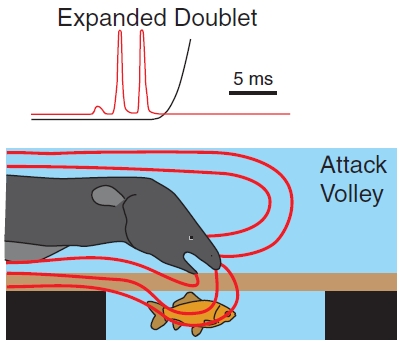
Catania’s experimental setup was surprisingly low-tech: basically, coax an eel into firing her weapons by feeding her worms, while monitoring neuromuscular activity inside pithed fish placed nearby (but still deep in the shock zone). It yielded some very nifty insights, though. For one thing, Electrophorus doesn’t just use her superpower to kill prey; she uses it to detect that prey beforehand. She sends a low-voltage tickle through the water that mimics fish-motor-neuron commands, tricks her victim’s muscles into a twitch response. The prey jerks; that movement generates a pressure wave that the eel can lock onto (think of sharks, drawn to the signature thrashing of wounded prey; think of a submarine, patiently pinging for enemy contacts). Only then, with her target in the crosshairs, does Electrophorus fire the big guns: packs of modified muscle tissue punching 600 volts through the water, turning the target into one big clenching charlie-horse to be scooped up at leisure.

We’re not just talking about muscles frying in an electrical field, or just sticking your tongue into a light socket. This is far more sophisticated. The muscle contractions don’t occur unless the motor neurons controlling them are active. It’s the neurons, not the muscles, that are being targeted. What we have here is a strategy that precisely and remotely hacks the prey’s nervous system, planting an explicit self-destruct command that throws the whole body into tetanus.

From Catania 2004.

If you don’t find this deeply cool, you shouldn’t be reading this blog. And if I can’t find a way to use this, then I shouldn’t be writing it.

Fortunately I can think of two ways. This remote-firing of neurons reminds me of the “ephaptic coupling” some of you may have noticed in Echopraxia‘s endnotes, in which neurons are induced to fire not by direct synaptic stimulation but by diffuse electrical fields generated elsewhere in the brain. I invoked it as a mechanism for the Bicameral hive-mind interface— but this whole eel-zap strategy could serve a similar function if harnessed for good instead of evil (especially if the Hive happens to be hanging out in a hot tub). So maybe Electrophorus will get a walk-on part in Omniscience.

That’s small potatoes, though. Regular visitors will know that my next novel (as things stand now, at least) is going to involve genetically-engineered giant squids attacking Petrocan wellheads in a melting Arctic. They already pack some cool modifications: kidneys that double as batteries, generating current along the ionic gradient in the nephridium. Weird membranous structures, like some kind of diffuse body-spanning eardrum tuned way down to the 5Hz range: an organic acoustic modem, sensitive to low-frequency rumbles that could cross an ocean.

Would it not be awesome to equip them also with remote neuron-hacking battery packs that could take down— or even better, commandeer—other life forms at 200 meters?

Squids with tasers. I’m telling you, Intelligent Design is looking better and better.

14 Dec 20:27

mansplainedmarxist: redplebeian: redplebeian: 5th...


mansplainedmarxist:

redplebeian:

redplebeian:

5th Anniversary

6th Anniversary

I almost forgot but we can never forget

14 Dec 01:00

fuckyeahvikingsandcelts: “From Iceland comes the legend...

by beelzebuttz


fuckyeahvikingsandcelts:

“From Iceland comes the legend of the sinister and gargantuan Yule Cat, who, it seems, is ready to eat lazy humans. Those who did not help with the work of their village to finish all work on the autumn wool by Yule time got a double whammy — they missed out on the Yule reward of a new article of clothing, and they were threatened with becoming sacrifices for the dreaded Yule Cat.”

OH FUCK, YULE CAT

YULE CAT by ~Quizzical-Squidopus

14 Dec 00:48

Photo


13 Dec 19:46

"He who fights with monsters should be careful he doesn’t become a monster himself. Unless that makes..."

“He who fights with monsters should be careful he doesn’t become a monster himself. Unless that makes him more effective at fighting monsters. Like he becomes a badass werewolf who knows how to use a sword and has magic armor. That’d be so rad.”

- Nietzsche (via doc-sarge)
13 Dec 02:52

The Family That Couldn’t Say Hippopotamus - Issue 17: Big Bangs - Nautilus

The Family That Couldn’t Say Hippopotamus - Issue 17: Big Bangs - Nautilus:

enki2:

There is a family living in Britain, known only as the KE family, with a few members that can’t quite say words like “hippopotamus.”…

The Family That Couldn’t Say Hippopotamus

The origins of language are not what inherited disorders seemed to suggest.

BY ELIZABETH SVOBODAILLUSTRATION BY MICHAEL WOLOSCHINOWSEPTEMBER 18, 2014

There is a family living in Britain, known only as the KE family, with a few members that can’t quite say words like “hippopotamus.” They know the words, but can’t get their mouth positions quite right, so their speech comes out garbled. Some family members have a hard time saying words in the right order, and others have trouble reciting words that begin with the same letter. Multiple generations of the family have similar language difficulties, suggesting a genetic basis for their disorder.

In the early 2000s, Oxford University geneticists Anthony Monaco, Simon Fisher, and their colleagues found the culprit: KE family members had a rare mutation in a gene called FOXP2.1 The mutation was subtle—only one nucleotide removed from the typical FOXP2 sequence—but the resulting language impairment was substantial. That meant there was probably something about the normal FOXP2 gene that helped enable fluent speech. In the wake of this finding, FOXP2 was trumpeted in the press as a “grammar gene” and a “language gene.” 

The public’s “language gene” assumption seemed to fit well with certain long-standing theories about the origins of language. In the mid-1960s, linguist Noam Chomsky proposed that the human brain is equipped with a distinct “language organ”—a module that appeared relatively suddenly in the history of human development. “The language organ interacts with early experience and matures into the grammar of the language that the child speaks,” Chomsky toldOmni’s John Gliedman in a 1983 interview.

Without a neatly packaged module to point to, how can we tell when and how language appeared?

Coming out of an era of rapid advances in computer technology, the idea of a discrete, common origin to human language made intuitive sense. It was also consistent with observations that many languages have similar features, suggesting that the brain contains a limited array of linguistic “switches” that constrain the ways language develops. These narrow paths, according to the theory, give rise to universal language structures. In sentences that contain a verb and object, for instance (“Duane played the piano”), a preposition often precedes a noun (“at the party”).

But over the years, it became clear that the truth about language origins was not quite as simple as a “language gene” or well-defined language module. Further study revealed that the FOXP2gene is relevant to multiple mental abilities and is not strictly a language gene at all. In a 2009 paper, for example, Max Planck Institute geneticist Wolfgang Enard exploited the fact that justthree amino acids distinguish the human version of the FOXP2 protein from that of mice. When he engineered the FOXP2 genes of mice to produce proteins with the two human FOXP2 amino acids, it resulted in functional differences in brain areas critical for carrying out fine motor tasks and controlling muscle movements, as well as altered function in regions involved in sending and receiving reward signals.2

“This is the reward system, the system that gets hijacked by drugs,” Enard says. “This system is needed for statistical learning. It makes sense to say if you want to have speech, you need to tune it.” A later study3 also found that mice with human FOXP2 learned faster than regular mice. 

The same gene that regulated language so strongly also regulated other mental faculties, so its very existence appeared to contradict rather than strengthen the idea that language commands its own territory separate from other areas of the brain. As Enard points out, the language-as-island idea is also inconsistent with the way evolution typically works. “What I don’t like about the ‘module’ is the idea that it evolved from scratch somehow. In my view, it’s more that existing neural circuits have been adapted for language and speech.”

People making complex tools showed brain blood flow patterns similar to those they displayed when thinking about words.

In humans, too, evidence is mounting that language relies on a surprisingly broad neural support system. A 2012 paper from the University of Washington4 shows that infants with denser concentrations of white or gray matter in the hippocampus and cerebellum show higher levels of language skill by their first birthdays, despite the fact that these brain areas have not traditionally been linked to language. Earlier this year, University of Washington scientists also found that 7-month-old babies show activation in a number of different brain regions when they hear speech, including in the cerebellum, which is important for coordinating motor movements.5

Some researchers argue that the universality of structures across different languages has also turned out to be weaker than initially thought. In 2011, Uppsala University evolutionary linguist Michael Dunn and his colleagues created computer models of how word order has changed over time in four of the world’s largest language groups: Uto-Aztecan, Indo-European, Bantu, and Austronesian. They found that instead of developing parallel structures, each language was evolving according to its own set of rules.6 One structure that statistical methods suggested was universal (how “verb-object” clauses influence word order in prepositional phrases) actually appeared in just half the major language groups the team studied. “What seems like a strong statistical correlation really only happens in two big [language] families,” Dunn says. “It looks a lot less universal.”

Dunn doesn’t think that a language-specific brain module evolved and gave rise to predictable language structures. Instead, he believes language—in all its messy complexity—emerged once humans reached a certain level of cognitive capacity. “The module thing started with the computer metaphor for the human brain, and I think this was of some use at the time,” he says. “But really, it’s a little bit deceiving. It’s all a much more ramshackle, muddled-up biological system.”

Svoboda_BREAKER

While the existence of a language module continues to be debated, questioning its presence would seem to make understanding the origins of language more difficult. Without a neatly packaged module to point to, how can we tell when and how language appeared?

Some clues are coming from studies of the history of toolmaking. In 2010, Imperial College London neuroscientist Aldo Faisal enlisted his colleague Bruce Bradley, an Exeter archaeologist and skilled craftsman, to take part in a novel experiment. Bradley was tasked with whittling blocks of stone, crafting a series of rough-hewn stone flakes and more detailed, symmetrical hand axes, while wearing a glove studded with sensors that tracked his hand movements. When Faisal analyzed the sensor data, he noticed that the hand motions required to craft a well-turned hand axe were basically identical to those needed to make a stone flake.7

The results suggested that it wasn’t an improvement in manual coordination per se that allowed early humans to make the leap from primitive stone flakes to hand axes—instead, it was a shift in cognitive capacity. This shift, Faisal points out, could also have aided language. An earlier study had reported that when master craftsmen are making complex tools like hand axes (but not simple stone flakes), specific regions of the brain’s right hemisphere light up on functional MRI scans—brain areas that are also involved in making sense of speech.8 Similarly, in 2013 University of Liverpool archaeologist Natalie Uomini found that people making complex tools showed brain blood flow patterns similar to those they displayed when thinking about words.9

Researchers like Faisal think that as toolmaking skills became more common in the population, humans may have acquired the mental horsepower requisite for language. “A lot of people would say that toolmaking came [before language]—that’s the general prevailing view,” Uomini says. “I would just say that they co-evolved.”

The problem with ‘gene for x’ or ‘grammar module y’ is they ignore how something that is the property of an individual is linked to something that is the property of a community.

Even the advancement of general cognitive skill, however, may be too narrow a picture of the evolution of language. University of Edinburgh computational linguist Simon Kirby argues that, while the human brain may be a necessary foundation for language, it is not sufficient to explain it. The beginnings of language, Kirby says, were profoundly shaped by the dynamic interplay of human culture itself.

Kirby took a unique approach to probing the origins of language: He taught human participants novel languages he had made up. He and his colleagues showed human subjects cards with different shapes and pictures on them, taught them the words for these pictures, and tested them. “Whatever they do, whether they get it right or wrong, we teach it to the next person,” Kirby says. “It’s rather like the game Telephone.”

Remarkably, as the language passed from one learner to the next, it began to acquire cogent structure. After 10 generations, the language had changed to make it easier for human speakers to process. Most notably, it began to show “compositionality,” meaning that parts of words corresponded to their meaning—shapes with four sides, for instance, might all have a prefix like “ikeke.” Thanks to these predictable properties, learners developed a mental framework they could easily fit new words into. “Participants not only learn everything we show them,” Kirby says, “but they can correctly guess words we didn’t even train them on.”

Kirby realized that this process of iterated learning—which depended on brain function but extended beyond it—went a long way toward explaining where language structure came from. Having watched in the lab as ordered languages appeared, he’s skeptical when he sees colleagues get entrenched in purely biological explanations for language’s origins. “There’s been this assumption that brain and behavior are related very simply, but languages emerge out of huge populations of socially embedded agents. The problem with ‘gene for x’ or ‘grammar module y’ is they ignore how something that is the property of an individual is linked to something that is the property of a community.”

This linkage reveals the absorbing paradox at the heart of language’s origins. As hardwired as it is, language is a distributed object, both across the human brain and across generations of people. And it is precisely the chaotic hot-potato toss of words and grammar that yields the order and beauty that we see today. In the realm of language, as in other things, modern science is showing us that we are not the pilots of our own sealed ship, but are actors in a play, each able to contribute a verse.

Elizabeth Svoboda is a writer in San Jose, California, and the author of What Makes a Hero?: The Surprising Science of Selflessness.

References

1. Lai, C.S.L., Fisher, S.E., Hurst, J.A., Vargha-Khadem, F., & Monaco, A.P. A forkhead-domain gene is mutated in a severe speech and language disorder. Nature 414, 519-523 (2001).

2. Enard, W., et al. A humanized version of FOXP2 affects cortico-basal ganglia circuits in mice. Cell137, 961-971 (2009).

3. Schreiweis, C., et al. Humanized FOXP2 alters learning in differently balanced cortico-basal ganglia circuits. Neuroscience Meeting Planner, Washington, D.C. Society for Neuroscience (2011).

4. Can, D.D., Richards, T., & Kuhl, P.K. Early gray-matter and white-matter concentration in infancy predict later language skills: A whole brain voxel-based morphometry study. Brain & Language124 34-44 (2013).

5. Kuhl, P.K., Ramirez, R.R., Bosseler, A., Lin, J.F.L., & Imada, T. Infants’ brain responses to speech suggest analysis by synthesis. Proceedings of the National Academy of Sciences of the United States of America 111, 11238-11245 (2014).

6. Dunn, M., Greenhill, S.J., Levinson, S.C., & Gray, R.D. Evolved structure of language shows lineage-specific trends in word-order universals. Nature 473, 79-82 (2011).

7. Faisal, A., Stout, D., & Bradley, B. The manipulative complexity of lower Paleolithic stone toolmaking. PLoS One 5, e13718 (2010).

8. Stout, D., Toth, N., Schick, K., & Chaminade, T. Neural correlates of Early Stone Age toolmaking: technology, language and cognition in human evolution. Philosophical Transactions of the Royal Society B 363, 1939-1949 (2008).

9. Uomini, N.T. & Meyer, G.F. Shared brain lateralization patterns in language and Acheulean stone tool production: a functional transcranial Doppler ultrasound study. PLoS One 8, e72693 (2013).

12 Dec 22:22

theglorifiedloser: i love cowboy bebop


theglorifiedloser:

i love cowboy bebop

12 Dec 06:14

Photo


12 Dec 06:12

witnesstheabsurd: ♡”Giant Cerberus. It is a Knife Collector. It...


witnesstheabsurd:

♡”Giant Cerberus. It is a Knife Collector. It wears a Leather Outfit”♡

11 Dec 18:30

It’s That Time Of Year Again: Christopher Lee Releases Another Heavy Metal Christmas Song - Against the power of Mordor Christmas, there can be no victory.

by Victoria McNally

For the third year in a row, Christopher Lee reminds us why we all love and fear him by singing about the baby Jesus in a haunting, sonorous voice with shredding guitars behind him. Reminder: he is ninety two years old. Satan bless him.

The above video includes samples of his previous holiday hellscapes, but if you’re hankering for more, he also put out an EP in 2012 and in 2013, and works on other non-Christmas tune slayage with Charlemagne Productions. You can buy those, as well as “Darkest Carols, Faithful Sing,” on iTunes. Just… maybe don’t leave a bad review if you end up not liking the whole track. I have a feeling that won’t end well for you.

Are you following The Mary Sue on Twitter, Facebook, Tumblr, Pinterest, &

11 Dec 15:00

america-wakiewakie: No one is reading the CIA torture report,...

11 Dec 02:19

wigmund: the-darkest-of-lights: thingsgotwyrd: cubebreaker: D...


wigmund:

the-darkest-of-lights:

thingsgotwyrd:

cubebreaker:

Designer Anze Miklavec’s goat horn coffee mug is inspired by the animals whose curiosity and appetite led to the discovery of coffee.

I know what I’m gifting my hubby this year! oooooooh

OMGS that’s awesome! I totally want one.

SOMEONE BUY ME THIS FOR CHRISTMAS

10 Dec 21:01

A Brief History of Rectal Feeding

by Dave Schilling
Mattalyst

"President Garfield's physicians believed that one of the bullets that struck their patient had pierced his intestines. As such, they deemed it unwise to feed him solid foods. Instead, they fed him a steady diet of beef bouillon, egg yolks, milk, whiskey, and drops of opium through his rectal cavity. Garfield died anyway, but he wouldn't have lasted nearly as long without all the egg yolks, liquor, and drugs they pumped up his ass.

​No one ever thought the CIA's torture program for terror suspects was a pleasant evening at Medieval Times or a mild tickling from Bradley Cooper. We always knew it was pretty grim. Granted, terms like "waterboarding" and "behavioral control" don't immediately make you cringe or reach for the nearest slop bucket to expel your breakfast. These are psychological terrors more than anything else, tools to break a person's spirit so they'll divulge sensitive details of their dastardly plans to strike at the heart of America. But the  ​horrific details we learned from the ​Senate Select Committee report sound less like interrogation techniques and more like cut scenes from The Human Centipede.


[youtube src='//www.youtube.com/embed/7a_sx3ozoXI?rel=0' width='700' height='394']

One of the CIA techniques we learned about yesterday was rectal feeding. The idea of cramming food and liquid up someone's ass against his will is so crude and idiotic that it comes off as a sort of frat-boy prank gone wrong. I don't think it's much of a stretch to look at America's last adventure in the Middle East as some kind of sado-masochistic sex romp—a Revenge of the Nerds sequel in which Ogre became president of the Greek Council and forced all the students he didn't like to stick pine needles in their pee holes. We thought ​Abu Ghraib was bad, but that was just act one of the snuff film we called a war.

Rectal feeding wasn't always a device for "extracting information." A June 1913 article in the  ​British Medical Journal explained the practical benefits of consuming nutrients through the anus. It claims that rectal feeding was popular in the Middle Ages, and that experiments were done on dogs in 1872—the dogs were given injections of 500 calories of "chopped meat and pancreas." There's even an anecdote about keeping a woman alive for 70 days on rectal feeding alone in the 17th century. As a recent article on our sister site Motherboard ​points out, rectal feeding was very useful in the days before IVs for patients who had, for whatever reason, lost their ability to eat solid foods. The British Medical Journal goes into a bit more detail on what was deemed a successful experiment in rectal feeding:

Seven young women suffering from gastric ulcer were fed entirely on nutrient enemata for six or seven days. They were kept in bed and weighed before and after. All did well clinically. The enemata were given six-hourly, and consisted of two eggs or 200 c.cm. of milk and eggs, dextrose, normal saline, and in one case cod-liver oil. The whole was pancreatized for 20 minutes. Every day the bowel as washed out, and the contents analyzed.

This didn't quite catch on as a miracle diet or a replacement for the tedious process of chewing, but it did help keep President James Garfield alive for 80 days after ​he was shot by Charles J. Guiteau in 1881. According to medical historian ​Dr. Ira Rutkow, President Garfield's physicians believed that one of the bullets that struck their patient had pierced his intestines. As such, they deemed it unwise to feed him solid foods. Instead, they fed him a steady diet of beef bouillon, egg yolks, milk, whiskey, and drops of opium through his rectal cavity. Garfield died anyway, but he wouldn't have lasted nearly as long without all the egg yolks, liquor, and drugs they pumped up his ass.

As intravenous administration of nutrients became widely used by medical professionals, rectal feeding and devices like the Murphy Drip fell out of favor. Besides South Park's ​ongoing ​fascination with putting food up your butthole, the whole practice had been pretty much consigned to the garbage dump of creepy medical treatments, where it could share space with such oddities as bloodletting and drilling holes in your skull. Leave it to Americans to get nostalgic and resurrect something irrelevant for nefarious purposes. In the last couple years, we've brought back fear of Russian aggression, racial tension, ​whooping cough, police brutality, ​voter suppression, and ​Hillary Clinton. What's next, cars without seat belts? Lead-based paint? Polka music? God help us all.

Follow Dave Schilling on ​Twitter.

10 Dec 20:57

X-Race Spex

10 Dec 20:27

Sen. Udall: Obama Needs To 'Purge' CIA, Says Brennan Is Still Lying

by Susie Madrak
Sen. Udall: Obama Needs To 'Purge' CIA, Says Brennan Is Still Lying

It seemed possible that Udall was going to read the torture report into the record before he left office, but he didn't have to. He's still determined to get as much of the truth out there as possible, it seems:

Sen. Mark Udall (D-Colo.) on Thursday called on President Obama to “purge” his administration of the CIA officials who were involved in the "enhanced interrogation" program detailed in a new Senate report.

“It’s bad enough to not prosecute these officials but to reward and promote them is incomprehensible,” Udall said on the Senate floor Wednesday. “The president needs to purge his administration.”

Udall reiterated his call for the resignation of CIA director John Brennan, saying he should no longer lead the agency because officials hacked into the Intelligence Committee’s computers during their investigation and deleted a file.

He also spilled some findings from the so-called Panetta review, which was not included in the Senate panel’s report but is expected to paint a damning picture of the CIA’s public statements about the interrogation program.

“Director Brennan and the CIA today are continuing to willfully provide inaccurate information and misrepresent the efficacy of torture,” Udall said.

“The CIA is lying. This is not an issue of the past, this is going on today.”

read more

10 Dec 19:23

A History of Thugs

by Adam Weinstein on Fortress America, shared by Lacey Donohue to Gawker

A History of Thugs

Civilization is imperiled. Demonic dark-skinned criminals exult in seizing property and security. Only a vanguard of brave uniformed officers can take them off the streets and restore order. It is 1835, and whites are finally confronting what Mark Twain will soon call "the satanic brotherhood of the Thugs."

Read more...


10 Dec 17:00

riseofthecommonwoodpile: Mainstream petplay invades american...


riseofthecommonwoodpile:

Mainstream petplay invades american masculinity

10 Dec 03:30

Even President Bush showed "discomfort" when he saw CIA torture in action

by German Lopez

Former President George W. Bush approved the CIA torture programs outlined in a lengthy report released by the Senate Intelligence Committee on Tuesday, but the Senate report shows even Bush wasn't completely comfortable with the policies when he saw how they were executed.

According to one passage in the report, Bush "expressed discomfort" in April 2006 when presented with an "image of a detainee, chained to the ceiling, clothed in a diaper, and forced to go to the bathroom on himself":

Bush torture report diaper

Read more: The CIA torture report, summed up in four brutal sentences.

10 Dec 03:28

Suspected Gas Attack At "Furry" Convention Puts 19 In Hospital

by Luke Plunkett
Mattalyst

I don't even. This has to be an intra-furry thing, right?

Suspected Gas Attack At "Furry" Convention Puts 19 In Hospital

A suspected "intentional" chlorine gas leak at a hotel in Chicago - the venue for Midwest Fufest, a convention for "furries" - has left 19 guests in hospital.

Read more...


10 Dec 00:29

sirensongfashion: Alice Auaa Fall/Winter 2013 at Tokyo Fashion...


sirensongfashion:

Alice Auaa Fall/Winter 2013 at Tokyo Fashion Week

10 Dec 00:28

isabelledrake: #comics #androids #retro #classic #romance...


isabelledrake:

#comics #androids #retro #classic #romance #scifi

10 Dec 00:10

robinsoncobras: from the infamous virtual reality episode of...


robinsoncobras:

from the infamous virtual reality episode of Murder She Wrote.

09 Dec 18:31

Twitter On The Torture Report

by Susie Madrak
Mattalyst

"and the only person currently threatened by the US Government with jail time for CIA abuses is James Risen, a journalist who covered them."

Twitter On The Torture Report

God this report is horrifying. 2 contract psychologists paid $81m for torture techniques. http://t.co/tMA9ZG0fM1 pic.twitter.com/XyvtAU7CzY

— Lydia DePillis (@lydiadepillis) December 9, 2014

@TPM If he thinks that, then CIA Director John Brennan needs to resign.

— Watchdog Progressive (@Watchdogsniffer) December 9, 2014

This is what Dick Cheney and his fan club described as not torture. pic.twitter.com/a0z5oVMLBM

— Ujamaadam Serwer (@AdamSerwer) December 9, 2014

This report details an ugly chapter in American history during which the intelligence community dishonored our nation’s proud traditions.

read more

09 Dec 18:22

The First Piece of Code Written by an American President

The President participated in an introductory coding workshop as part of Computer Science Education Week
09 Dec 18:18

The CIA Detained the Wrong Man for 'Using a Satellite Phone'

by derek@motherboard.tv (Derek Mead)

Is getting a phone call from an Arabic speaker on a satellite phone proof that you're a terrorist? The CIA thinks so.

The argument for the US government's foreign surveillance infrastructure is simple: The more communication American analysts can access, the easier time they'll have identifying and detaining terrorists

But in actuality, the barrier for detention is much lower. In one case, the CIA accidentally detained the wrong man for up to six monthsnot because of incriminating phone transcripts, but simply because he owned a satellite phone. And when the CIA finally released the man, the agency lied about its mistake.

From page 120 of the executive summary.

Today the US Senate Intelligence Committee released the executive summary its four-year investigation into the US government's use of torture in the War on Terror, which is filled with stories of individuals captured, renditioned to CIA-controlled secret prisons, and detained, interrogated, and tortured for lengthy periods of time.

One of the individuals named in the report is Ali Jan, who the CIA described as "the most trusted bodyguard of Jaluluddin Haqqani (a top [Al Qaeda] target of the [US government])." The only problem is the CIA detained at least two men named Ali Jan, according to the Senate report.

One Ali Jan was "captured in the village of [redacted] on June 2002," and in March 2004, when the CIA transferred 18 detainees to US military custody for eventual release, the agency claimed that this Ali Jan was the one captured in 2002, and described him as indeed Haqqani's bodyguard.

From page 16 of the executive summary.

The Senate investigation found that to be a lie. The Ali Jan that the CIA released in 2004 was actually captured in August 2003 during a US military operation in Zormat Valley, Paktia Province, Afghanistan. So how did a random guy named Ali Jan end up in CIA custody for half a year? His satellite phone rang while being interrogated by the military.

"CIA records indicate that Ali Jan was transferred to CIA custody after his satellite phone rang while he was in military custody, and the translator indicated the caller was speaking in Arabic," reads the report. Subsequent investigations into his call behavior "revealed no derogatory information."

Using a modern piece of technology in your native language? In the War on Terror, that's all it takes to get detained and disappeared to a CIA black site (location redacted). After being transferred back to military custody, Ali Jan was released in July 2004. The report does not make clear what happened to him during that time, or what happened to the other Ali Jan in custody.

09 Dec 18:13

Photo


09 Dec 14:28

the first wonder bra


the first wonder bra

09 Dec 14:24

funnyskullgrin: Aw hello again, cuties. 


funnyskullgrin:

Aw hello again, cuties. 

09 Dec 14:23

maadbitch: stunningpicture: The camera angle they never show...


maadbitch:

stunningpicture:

The camera angle they never show on TV

woahhhhh