09 Sep 13:31
J. Mater. Chem. A, 2016, 4,14983-14987
DOI: 10.1039/C6TA07368A, Communication
Shuixing Li, Wenqing Liu, Chang-Zhi Li, Tsz-Ki Lau, Xinhui Lu, Minmin Shi, Hongzheng Chen
A planar perylene diimide derivative with a high efficiency of 7.33% and high voltage of 0.99 V is presented.
The content of this RSS Feed (c) The Royal Society of Chemistry
09 Sep 13:27
J. Mater. Chem. A, 2016, 4,15771-15787
DOI: 10.1039/C6TA06241E, Review Article
Jia Du, Michael C. Biewer, Mihaela C. Stefan
This review attempts to summarize recent advances with respect to solution-processable molecular semiconductors having 2,1,3-benzothiadiazole or its fluorine substituted derivatives as electron-acceptor units published in the last few years. The relationship between the structure, optoelectronic properties, and photovoltaic performance of these molecular semiconductors is discussed.
The content of this RSS Feed (c) The Royal Society of Chemistry
09 Sep 13:22
J. Mater. Chem. A, 2016, 4,15232-15239
DOI: 10.1039/C6TA07120A, Paper
Ming Wang, Hengbin Wang, Michael Ford, Jianyu Yuan, Cheng-Kang Mai, Stephanie Fronk, Guillermo C. Bazan
Two regioregular narrow bandgap conjugated polymers (PM1 and PM2) are prepared and their devices exhibit low Voc loss and high short circuit current Jsc, but, most significantly, display improved fill factors compared to previously reported PIPCP.
The content of this RSS Feed (c) The Royal Society of Chemistry
09 Sep 13:19
by Yunpeng Qin, Mohammad Afsar Uddin, Yu Chen, Bomee Jang, Kang Zhao, Zhong Zheng, Runnan Yu, Tae Joo Shin, Han Young Woo, Jianhui Hou

A highly efficient fullerene-free polymer solar cell (PSC) based on PDCBT, a polythiophene derivative substituted with alkoxycarbonyl, achieves an impressive power conversion efficiency of 10.16%, which is the best result in PSCs based on polythiophene derivatives to date. In comparison with a poly(3-hexylthiophene):ITIC-based device, the photovoltaic and morphological properties of the PDCBT:ITIC-based device are carefully investigated and interpreted.
09 Sep 13:18
by Sunsun Li, Long Ye, Wenchao Zhao, Shaoqing Zhang, Subhrangsu Mukherjee, Harald Ade, Jianhui Hou

Fine energy-level modulations of small-molecule acceptors (SMAs) are realized via subtle chemical modifications on strong electron-withdrawing end-groups. The two new SMAs (IT-M and IT-DM) end-capped by methyl-modified dicycanovinylindan-1-one exhibit upshifted lowest unoccupied molecular orbital (LUMO) levels, and hence higher open-circuit voltages can be observed in the corresponding devices. Finally, a top power conversion efficiency of 12.05% is achieved.
30 Aug 11:41
by Tim Erdmann, Simone Fabiano, Begoña Milián-Medina, David Hanifi, Zhihua Chen, Magnus Berggren, Johannes Gierschner, Alberto Salleo, Anton Kiriy, Brigitte Voit, Antonio Facchetti

Naphthalenediimide-based random copolymers (PNDI-TVTx) with different π-conjugated dithienylvinylene (TVT) versus π-nonconjugated dithienylethane (TET) unit ratios (x = 100![[RIGHTWARDS ARROW]](http://onlinelibrarystatic.wiley.com/undisplayable_characters/002192.gif) 0%) are investigated. The PNDI-TVTx-transistor electron/hole mobilities are affected differently, a result rationalized by molecular orbital topologies and energies, with hole mobility vanishing but electron mobility decreasing only by ≈2.5 times when going from x = 100% to 40%.
0%) are investigated. The PNDI-TVTx-transistor electron/hole mobilities are affected differently, a result rationalized by molecular orbital topologies and energies, with hole mobility vanishing but electron mobility decreasing only by ≈2.5 times when going from x = 100% to 40%.
18 Aug 12:37
J. Mater. Chem. A, 2016, 4,13251-13258
DOI: 10.1039/C6TA04950H, Paper
Bing Guo, Xia Guo, Wanbin Li, Xiangyi Meng, Wei Ma, Maojie Zhang, Yongfang Li
Polymer solar cells based on a wide-bandgap polymer exhibited PCEs of 7.7% and 10.3% for single and tandem devices, respectively.
The content of this RSS Feed (c) The Royal Society of Chemistry
18 Aug 11:50
J. Mater. Chem. A, 2016, 4,13265-13270
DOI: 10.1039/C6TA05471D, Paper
Yahui Liu, Guangwu Li, Zhe Zhang, Liangliang Wu, Jianya Chen, Xinjun Xu, Xuebo Chen, Wei Ma, Zhishan Bo
A planar DPP-based polymer containing three regular alternating units exhibits a good photovoltaic performance with a high PCE of 9.02% and a large Voc of 0.86 V.
The content of this RSS Feed (c) The Royal Society of Chemistry
18 Aug 11:49
J. Mater. Chem. A, 2016, 4,14234-14240
DOI: 10.1039/C6TA05303C, Paper
Jie Min, Oh Kyu Kwon, Chaohua Cui, Jung-Hwa Park, Yue Wu, Soo Young Park, Yongfang Li, Christoph J. Brabec
We used six solvent additives and a non-volatile DTBT additive to improve the BDTT-S-TR:NIDCS-MO blend morphology for synthesizing high performance all-SMSCs with a promising PCE of 5.33%.
The content of this RSS Feed (c) The Royal Society of Chemistry
18 Aug 11:40
by Yikun Guo, Yunke Li, Omar Awartani, Jingbo Zhao, Han Han, Harald Ade, Dahui Zhao, He Yan

All-polymer solar cells with 7.57% power conversion efficiency are achieved via a new perylenediimide-based polymeric acceptor. Furthermore, the device processed in ambient air without encapsulation can still reach a high power conversion efficiency (PCE) of 7.49%, which is a significant economic advantage from an industrial processing perspective. These results represent the highest PCE achieved from perylenediimide-based polymers.
18 Aug 11:40
by Haoran Lin, Shangshang Chen, Huawei Hu, Lu Zhang, Tingxuan Ma, Joshua Yuk Lin Lai, Zhengke Li, Anjun Qin, Xuhui Huang, Benzhong Tang, He Yan

A small-molecular acceptor, tetraphenylpyrazine-perylenediimide tetramer (TPPz-PDI4), which has a reduced extent of intramolecular twisting compared to two other small-molecular acceptors is designed. Benefiting from the lowest extent of intramolecular twisting, TPPz-PDI4 exhibits the highest aggregation tendency and electron mobility, and therefore achieves a highest power conversion efficiency of 7.1%.
26 Jul 11:20
by Xiaozhou Che, Chin-Lung Chung, Xiao Liu, Shu-Hua Chou, Yi-Hung Liu, Ken-Tsung Wong, Stephen R. Forrest

Donor–acceptor–acceptor′ small-molecule donors are synthesized to investigate regioisomeric effects on organic photovoltaic device performance. Cross-conjugation in 2-((7-(N-(2-ethylhexyl)-benzothieno[3,2-b]thieno[3,2-d]pyrrol-2-yl)benzo[c][1,2,5]thiadiazol-4-yl)methylene)malononitrile leads to an increased open-circuit voltage compared with its isomer 2-((7-(N-(2-ethylhexyl)-benzothieno[3,2-b]thieno[2,3-d]pyrrol-2-yl)benzo[c][1,2,5]thiadiazol-4-yl)methylene)malononitrile. A correlation is then established between molecular conjugation length and orbital energies, and hence open-circuit voltage.
22 Jul 13:28
by Cheng Zhang, Yaping Zang, Fengjiao Zhang, Ying Diao, Christopher R. McNeill, Chong-an Di, Xiaozhang Zhu, Daoben Zhu

“Molecule-framework” and “side-chain” engineering is powerful for the design of high-performance organic semiconductors. Based on 2DQTTs, the relationship between molecular structure, film microstructure, and charge-transport property in organic thin-film transistors (OTFTs) is studied. 2DQTT-o-B exhibits outstanding electron mobilities of 5.2 cm2 V–1 s–1, which is a record for air-stable solution-processable n-channel small-molecule OTFTs to date.
09 Jul 11:57
by Huifeng Yao, Yu Chen, Yunpeng Qin, Runnan Yu, Yong Cui, Bei Yang, Sunsun Li, Kai Zhang, Jianhui Hou

A novel non-fullerene acceptor, possessing a very low bandgap of 1.34 eV and a high-lying lowest unoccupied molecular orbital level of −3.95 eV, is designed and synthesized by introducing electron-donating alkoxy groups to the backbone of a conjugated small molecule. Impressive power conversion efficiencies of 8.4% and 10.7% are obtained for fabricated single and tandem polymer solar cells.
09 Jul 11:56
by Liang Gao, Zhi-Guo Zhang, Haijun Bin, Lingwei Xue, Yankang Yang, Cheng Wang, Feng Liu, Thomas P. Russell, Yongfang Li

A nonfullerene polymer solar cell with a high efficiency of 9.26% is realized by using benzodithiophene–alt–fluorobenzotriazole copolymer J51 as a medium-bandgap polymer donor and the low-bandgap organic semiconductor ITIC with high extinction coefficients as the acceptor.
05 Jul 06:29
J. Mater. Chem. A, 2016, 4,11747-11753
DOI: 10.1039/C6TA03695C, Paper
J. Zhang, X. W. Zhu, C. He, H. J. Bin, L. W. Xue, W. G. Wang, Y. K. Yang, N. Y. Yuan, J. N. Ding, Z. X. Wei, Z.-G. Zhang, Y. F. Li
Two new compounds with alkyl side chains at different positions have a similar structure, but exhibit different photovoltaic properties.
The content of this RSS Feed (c) The Royal Society of Chemistry
24 Jun 00:16
by Michelle S. Vezie
Nature Materials 15, 746 (2016).
doi:10.1038/nmat4645
Authors: Michelle S. Vezie, Sheridan Few, Iain Meager, Galatia Pieridou, Bernhard Dörling, Raja Shahid Ashraf, Alejandro R. Goñi, Hugo Bronstein, Iain McCulloch, Sophia C. Hayes, Mariano Campoy-Quiles & Jenny Nelson

24 Jun 00:13
by John Grey
Nature Materials 15, 705 (2016).
doi:10.1038/nmat4666
Author: John Grey
Greater rigidity of conjugated polymer backbones increases their light-harvesting ability, making them better performers in solar-cell applications.

24 Jun 00:03
J. Mater. Chem. A, 2016, 4,11439-11445
DOI: 10.1039/C6TA04920F, Paper
You-Sun Lee, Ji Young Lee, Su-Mi Bang, Bogyu Lim, Jaechol Lee, Seok-In Na
Conjugated random copolymers with non-covalent intramolecular interaction are synthesized and used as electron-donor materials for highly efficient organic solar cells.
The content of this RSS Feed (c) The Royal Society of Chemistry
24 Jun 00:00
J. Mater. Chem. A, 2016, 4,11729-11737
DOI: 10.1039/C6TA04059D, Paper
Jiuxing Wang, Xichang Bao, Dakang Ding, Meng Qiu, Zurong Du, Junyi Wang, Jie Liu, Mingliang Sun, Renqiang Yang
A fluorine substituent was firstly introduced into a PT-containing polymer, resulting in significantly improved photovoltaic performance.
The content of this RSS Feed (c) The Royal Society of Chemistry
23 Jun 23:52
by Lin-Song Cui, Ya-Li Deng, Daniel Ping-Kuen Tsang, Zuo-Quan Jiang, Qisheng Zhang, Liang-Sheng Liao, Chihaya Adachi

Efficient sky-blue organic light-emitting diodes (OLEDs) employing thermally activated delayed fluorescence (TADF) display a three orders of magnitude increase in lifetime, which is superior to those of controlled phosphorescent OLEDs used in this study. The combination of electro-oxidation and photo-oxidation of the TADF emitters in their triplet excited-states is suppressed through molecule design and device engineering.
20 Jun 12:08
J. Mater. Chem. A, 2016, 4,10135-10141
DOI: 10.1039/C6TA04030F, Communication
Wanbin Li, Bing Guo, Chunmei Chang, Xia Guo, Maojie Zhang, Yongfang Li
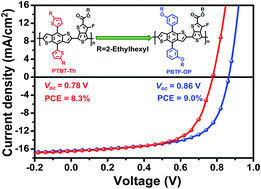
A new conjugated polymer PBTF-OP was synthesized and the PSCs based on PBTF-OP:PC71BM showed a PCE of 9.0%.
The content of this RSS Feed (c) The Royal Society of Chemistry
07 Jun 13:38
by Yu-Qing Zheng, Ting Lei, Jin-Hu Dou, Xin Xia, Jie-Yu Wang, Chen-Jiang Liu, Jian Pei

Planar backbone, locked conformation, and low lowest unoccupied molecular orbital level provide polymer F4BDOPV-2T with ultrahigh electron mobilities of up to 14.9 cm2 V−1 s−1 and good air stability. It is found that the nonlinear transfer curves can be tuned to near-ideal ones by changing fabrication conditions, indicating that film morphology largely contributes to the nonlinear transfer curves in high-mobility conjugated polymers.
07 Jun 12:39
J. Mater. Chem. A, 2016, 4,9967-9976
DOI: 10.1039/C6TA03801H, Paper
Yuxiang Li, Seo-Jin Ko, Song Yi Park, Hyosung Choi, Thanh Luan Nguyen, Mohammad Afsar Uddin, Taehyo Kim, Sungu Hwang, Jin Young Kim, Han Young Woo
Three types of quinoxaline-thiophene based photovoltaic polymers were synthesized by considering the backbone coplanarity via side-chain spacing and intrachain non-covalent coulombic interactions.
The content of this RSS Feed (c) The Royal Society of Chemistry
07 Jun 12:26
by Ting-An Lin, Tanmay Chatterjee, Wei-Lung Tsai, Wei-Kai Lee, Meng-Jung Wu, Min Jiao, Kuan-Chung Pan, Chih-Lung Yi, Chin-Lung Chung, Ken-Tsung Wong, Chung-Chih Wu

Extremely efficient sky-blue organic electroluminescence with external quantum efficiency of ≈37% is achieved in a conventional planar device structure, using a highly efficient thermally activated delayed fluorescence emitter based on the spiroacridine–triazine hybrid and simultaneously possessing nearly unitary (100%) photoluminescence quantum yield, excellent thermal stability, and strongly horizontally oriented emitting dipoles (with a horizontal dipole ratio of 83%).
04 Jun 07:56
J. Mater. Chem. A, 2016, 4,9511-9518
DOI: 10.1039/C6TA03288E, Paper
Kang Zhao, Qi Wang, Bowei Xu, Wenchao Zhao, Xiaoyu Liu, Bei Yang, Mingliang Sun, Jianhui Hou
Efficient fullerene-based and fullerene-free PSCs were fabricated based on two wide band gap polymers PBT-TTz and PBT-S-TTz.
The content of this RSS Feed (c) The Royal Society of Chemistry
04 Jun 07:53
J. Mater. Chem. A, 2016, 4,10212-10222
DOI: 10.1039/C6TA03709G, Paper
Ning Wang, Weichao Chen, Wenfei Shen, Linrui Duan, Meng Qiu, Junyi Wang, Chunming Yang, Zhengkun Du, Renqiang Yang
A PCE of 9.02% for a two-dimensional polymer as donor applied in solar cells was obtained without any additive treatment.
The content of this RSS Feed (c) The Royal Society of Chemistry
04 Jun 07:49
by Qian Zhang, Xiangjian Wan, Feng Liu, Bin Kan, Miaomiao Li, Huanran Feng, Hongtao Zhang, Thomas P. Russell, Yongsheng Chen

Three small molecules as front cell donors for tandem cells are thoroughly evaluated and a high power conversion efficiency of 11.47% is achieved, which demonstrates that the oligomer-like small molecules offer a good choice for high-performance tandem solar cells.
04 Jun 07:49
by Masahiko Saito, Itaru Osaka, Yosuke Suda, Hiroyuki Yoshida, Kazuo Takimiya

A novel electron-deficient building unit, dithienylthienothiophenebisimide, and its polymers (PTBIs) are reported. Organic photovoltaic (OPV) cells based on PTBIs as p-type material exhibit 8.0% efficiencies with open-circuit voltages higher than 1 V. Interestingly, PTBIs also function as n-type material in OPVs depending on the molecular structure. These polymers also exhibit p-channel, n-channel, and ambipolar behaviors in field-effect transistors.
04 Jun 07:47
by Xiao-Dong Zhang, Huasen Wang, Alexander L. Antaris, Lulin Li, Shuo Diao, Rui Ma, Andy Nguyen, Guosong Hong, Zhuoran Ma, Joy Wang, Shoujun Zhu, Joseph M. Castellano, Tony Wyss-Coray, Yongye Liang, Jian Luo, Hongjie Dai

Traumatic brain injury (TBI) is a leading cause of death and disability worldwide. A bright, renal-excreted, and biocompatible near-infrared II fluorophore for in vivo imaging of TBI is designed. A transient hypoperfusion in the injured cerebral region, followed by fluorophore leakage, is observed. NIR-II fluorophores can provide noninvasive assessment of TBI.