×You need to sign in to continue.

Shared posts

03 Sep 12:29

What Can We Do If A President Has A Conflict Of Interest But Doesn’t Think He Does?

by Maggie Koerth-Baker

Even by 2017 standards, the last few weeks have been packed with news. So you’re forgiven if you missed a chain of stories tied to alleged ethical violations by members of the Trump administration. Here’s a quick catch-up:

Whew.

And that’s just the tip of the iceberg. The Sunlight Foundation, a nonprofit devoted to government transparency, has been compiling a list of the president’s alleged conflicts of interest from news reports and legal documents. As of July 5, their count sat at 609 different ethical quandaries, of which only 46 had been resolved through the dissolution of a company, divestment by the Trumps, or some other means. That’s a lot for a leader who assured America back in December that the president “couldn’t have conflicts of interest” and promised he’d solved all of his in a January press conference.

How do you deal with conflicts of interest when the person at their center doesn’t believe they exist? That’s not a question unique to the presidency. Twenty years ago, the medical and scientific fields were in much the same position, with a handful of ethicists struggling to convince doctors and researchers that financial conflicts of interest with pharmaceutical companies and other industry sponsors were real and dangerous. As the political community weighs the options for increasing presidential transparency, it’s worth looking at how the same process has changed science — and at how little we still know about whether those changes worked.

The first step is disclosure, even if it’s only voluntary, said David Resnik, a bioethicist and chair of the National Institute of Environmental Health Sciences’ Institutional Review Board. That’s because the disclosure of potential conflicts of interest was one of the key factors in convincing scientists that potential conflicts were widespread and troubling. Florence Bourgeois, assistant professor of pediatrics and emergency medicine at Harvard Medical School, agreed. For example, she told me about the federal clinical trial registry website, which began in 2000 as a purely voluntary system for researchers who wanted to show that they were being honest about their results, even when they didn’t turn out they way they had hoped, rather than cherry-picking hypotheses after they arrived at their results. It also ensured that results didn’t just disappear when they conflicted with the desires of financial sponsors. But as the editors of scientific journals saw what was — and more importantly, what wasn’t — getting registered, that changed. In 2005, the International Committee of Medical Journal Editors began requiring pre-registration of any study before results could be published. In 2007, the FDA also began to require study registration as part of the drug approval process. Today the National Institutes of Health requires it of any study they fund.

The same was true with physicians who accepted money from companies that make the drugs and devices they prescribe, said Bernard Lo, president of the Greenwall Foundation for bioethics research and the chair of a 2009 National Academies report on conflicts of interest in medicine. Years of surveys — where doctors voluntarily offered information about their financial relationships — helped to build the case for state laws that mandated disclosure, which, themselves, helped create momentum to make this kind of transparency part of the Affordable Care Act.

We’re seeing a similar pattern happening with presidential conflicts of interest. Disclosing tax returns has never been legally required of presidential candidates — but every candidate for the past 40 years has volunteered disclosure, said Larry Noble, senior director of the nonpartisan Campaign Legal Center. Trump’s choice to withhold that information has made the public, ethicists and lawmakers more aware of how important that disclosure is. Several state legislatures — including New Jersey, Hawaii, California, New Mexico and Oregon — are now pushing bills that would make disclosure of tax returns mandatory for any presidential candidate who wants to be on the ballot.

Trump’s bucking of voluntary disclosure norms has also drawn attention to how little presidents are required to report to begin with. Presidents fill out conflict of interest forms, Noble said. But those forms leave out a lot of detail. Personal businesses and LLCs have to be reported, but currently, “you don’t know who is behind it, what partners there are, what investors there are,” he said. Both he and Richard Painter, a University of Minnesota law professor who was also George W. Bush’s chief ethics lawyer, said they would want to see changes to the level of detail those forms require.

But, according to Resnik, disclosure isn’t enough: “It doesn’t eliminate the problematic situation.” All it does is tell people about it.” Sometimes that can be sufficient to alter the way an industry operates — in the medical field, for instance, Pfizer began sharing information about its studies that had previously been considered trade secrets as the peer pressure around disclosure norms increased. But, experts said, the big takeaways are that disclosure is a necessary first step — and that enforcement needs to come next.

When it comes to the office of the president, it’s the matter of enforcement that comes up short. Many conflict of interest rules for government officials don’t apply to the chief executive. Even when it looks like the president might be violating the rules that do apply to him, Painter said, nobody has the direct authority to do something about it. The emoluments clause of the Constitution — which forbids government officials, including the president, from accepting money and gifts from foreign governments — could apply to some of Trump’s business holdings overseas. But there’s no agency that has authority to investigate or enforce that without first convincing a court there’s a problem. Painter is part of a group of legal and ethics experts currently trying to do just that.

“There ought to be specific authority given to an executive branch agency to enforce emoluments and tell people when they’re in violation and when they’re not,” Painter said. That’s something that has support from Noble, as well as from Walter Shaub, his colleague at the Campaign Legal Center who was, until July, Trump’s head of the Office of Government Ethics. The OGE has an advisory role for now. Maybe, in the future, the CLC or some spin-off agency will have an enforcement role.

Medical and scientific communities have had to learn the hard way that even well-intentioned ethics rules can have unintended consequences. After years of increasing mandatory disclosures there’s now a growing stigma against any kind of financial association with the pharmaceutical industry. “I think the fear [is that it might] unnecessarily deter collaboration when that could be for the public good,” she said. The assumption that all connections to industry are inherently bad can lead to impractical, and unreasonable, choices. Should a researcher have to reject a grant from the American Cancer Society because that organization might accept money from pharmaceutical companies? Probably not, Resnik said.

Similarly, Painter and Noble said, it would be impractical — and possibly unconstitutional — to have the president recuse himself from every decision that crossed paths with his finances. Nobody expects senators to sell the family farm before they can serve on the agriculture committee. This isn’t an all-or-nothing situation.

More importantly, science and medicine have taught us that no matter what changes get made, we may never know whether they worked. Neither Bourgeois, Lo, nor Resnik knew of any research that could show whether changes to medical conflict of interest rules had produced fewer conflicts of interest. And it could be impossible to prove definitively, Resnik said, because there are more variables at work than a single policy. But experts said that in both medicine and government, values still matter and there’s reason to want rules based on those values, even if we aren’t sure how effective they are. “Is it important for elected officials to make decisions on what is best for the country or what is best for them?” Noble said. “I think most people would say ‘the country.’”

02 Sep 20:14

The Speakeasy #092: Otakon, More Ideon, More One Piece

by reversethieves

Ongoing Investigations: One Piece Water Thriller Bark-Paramount War, Space Runaway Ideon.

Song: “SKILL” by JAM Project from Super Robot Wars Alpha 2

Food for Thought: What event would you like to see for Otakon’s 25th year?

Topics: Otakon

DOWNLOAD


More Otakon 2017 posts:

Otakon 2017: Ani-Gamers Podcast
Otakon 2017: General Impressions
Otakon 2017: Artist Alley
Otakon 2017: Panels
Otakon 2017: 15-minutes with Hidenori Matsubara


Filed under: Anime, Conventions, Editorials, Events, Manga, Otakon, Podcasts, The Speakeasy
02 Sep 20:14

Otakon 2017: Artist Alley

by reversethieves

For the last few years of Otakon in Baltimore, there was a premium on artist tables. The lottery system had to be implemented with space so limited in their Artist Alley. That problem has been solved at the new con center in Washington DC. Artist Alley is now bigger than ever and even has space to expand!

Now Artist Alley shares its space with the autograph section which seemed to have been given a wide enough berth to not cause traffic jams in the alley proper. There was a snag Friday morning though. Some autographs were scheduled right when the alley opened so hordes of fans had nowhere to wait except the hallway and ended up blocking escalators. But this seems like an easily solvable problem for next year.

That was nothing compared with the chaos of Saturday night when a waterfall appeared inside the Artist Alley thanks to the storms outside. Videos from some inside show it pretty clearly, and it ended up closing down the alley for an hour or so. Some merchandise was ruined and many artists had to relocate within the alley causing some confusion. From the sound of things, Otakon responded well to the situation. However, some in the forums say this leak is not an unknown occurrence with this convention center.

I can’t reasonable start my exploits through Artist Alley without first discussing buttons. There were a lot less of the usual small, round $1-2 range buttons this year. I really had to hunt for them! Although, admittedly that was fun in a way.

What I did see was a lot more large, shaped (star, heart) buttons that were also more expensive, $3-5. And there was an explosion of enamel pins which have been really gaining steam in the last year or so. They are beautiful, I love them! But they are also quite high-end, $10-12. With my low budget this year, it really limited what I could buy.

I added three new sports boys buttons to my collection. Haikyu’s Furokudani captain Bokuto by Koi and Nekoma’s captain Tetsuro by Hyde. I still don’t see enough Bokuto anything so that was a no-brainer. And Tetsuro was my first purchase of the alley at the first booth I encountered, it seemed a good way to start.

The Yurio button by Ravefirell which just cracks me up every time I look at it, ended up being a quest for me. I saw it very early when I had just started my tour of the alley then planned to return later. That later ended up being after the rainstorm which displaced this artist’s booth among others so I then had no idea where she had gone to! I was finally able to find her Sunday and breath a sigh of relief.

I picked up an adorable Rohan button by Rii who I’d gotten Joseph and Cesar buttons from at a previous Otakon. It ended up being their very last one, the display one, so I felt very lucky!

Picking up the Sucy button by Vivian I saw that the Little Witch Academia character she was running low on was Akko. For some reason many think her unpopular though I don’t know why!

My one and only enamel pin purchase was a One Piece one from Bing. She had a vast array of wares that were all amazing. I definitely wished I could have walked away with all her pins.

I found a rare Detective Conan lanyard by Sayriin. I was really, really trying to stick to buttons this year but I could not pass this up. Not only are the characters adorable, but I love seeing all the icons she added.

Again, trying to not pick up too many non-button items, I did end up buying a single print. A super cute Kanda print by Suika who had lots of fantastic D.Gray Man pieces all of which I wanted to take home. We chatted briefly about how Kanda just needs love.

I feel every year I see more and more clothing and accessories shops as well as jewelry makers popping up in the alley. I also saw many amazing crochet doll and plushie makers throughout the hall like Anubis Studios. Pencil bags, coin purses, and small zippered bags continue to grow in number. Places like Pupcakes & Cupcats were seriously testing my willpower.

Bunnies and Cream were selling lotions, candles, body spray, and more. I loved the yummy scents and adorable packaging.  After spraying a test spritz in the early afternoon on my wrist, I found it lasted well into the evening.

A newer item I saw a lot of this year was notebook/sketchbooks/journals with printed covers. I even saw some people advertising them as bullet journals! The few I peaked inside were unlined, but I didn’t look through them at every table I visited. If this trend continues, and I could find ones with the dot grids, I’d probably be inclined to pick one of these up next time around.

The item that dominated the alley this year was definitely charms. Every type of material, plastic, wood, metal was represented as were all manner of sizes from tiny, pea-sized to comically large. There was even more than one booth that had created gachapon for their charms, complete with mini-machines. And yes, you could only get the charms through random chance.

As far as what series were most present in the aisles, from my eyes it was My Hero Academia with Voltron being almost equal to it. Fire Emblem Fates had a strong showing as did Persona 5. I was surprised to see very little Attack on Titan. And of course there were smatterings of things I didn’t recognize at all.

I’m very excited to see what next year holds. There is room for more artists and craftsman for sure. I hope to see more comic creators and those a little more established in their own works return. I’d love to see an exhibit space return to the alley as well. But to be honest, the selection was already so big that I didn’t get to hit everything and didn’t even step foot inside the art show this year.

Otakon’s new, expanded Artist Alley didn’t disappoint. I expect great things in 2018!

~kate


More Otakon 2017 posts:

Otakon 2017: Ani-Gamers Podcast
Otakon 2017: General Impressions
The Speakeasy #092: Otakon, More Ideon, More One Piece
Otakon 2017: Panels
Otakon 2017: 15-minutes with Hidenori Matsubara


Filed under: Conventions, Events, Otakon
01 Sep 00:24

Sailor Jupiter. Commission! Want me to draw you a commission...


Sailor Jupiter. Commission!

Want me to draw you a commission too? Info here!

30 Aug 00:28

Yoshiki Tanaka Finishes Heroic Legend of Arslan Novels' Final Volume

16th volume of series launched in 1986 slated for winter
30 Aug 00:28

Ai Mai Mi Manga Creator Hints Splatoon 2 as Cause of Series Delay

Manga creator Choboraunyopomi has several successful series on their belt, including the slapstick comedy Ai Mai Mi and Magical Somera-chan and the four-panel...
28 Aug 23:05

Fist of the Blue Sky Manga Returns in October

Original Fist of the North Star prequel ran from 2001-2010
28 Aug 15:00

drenched-in-sunlight: Superman protec (ง'̀-‘́)ง but he also...


drenched-in-sunlight:

Superman protec (ง'̀-‘́)ง

but he also attac (ง'̀-‘́)ง (ง'̀-‘́)ง

(based on this post)

28 Aug 14:56

The first group is done! Phone case designs for these will be...


The first group is done! Phone case designs for these will be completed after AB but they’ll be available as buttons at the moment! (if my printer will work)

27 Aug 19:31

Out on the road with Sanders and Warren: Will the Democrats follow them to the left?

by Lauren Gambino in Detroit

As the two veteran campaigners meet supporters it is clear that the rift in the Democrats between left-liberals and centre-moderates has grown since the election

At Fellowship Chapel in west Detroit, Bernie Sanders delivered a thundering battle cry for the progressive movement before a crowd of nearly 2,000 people, squeezed into wooden pews and crowded into an overflow room.

The town hall had the feeling of a revival meeting led by Sanders, who preached with the same urgency a message he delivered repeatedly on the 2016 presidential campaign trail: the system is rigged against the American people.

Continue reading...
27 Aug 19:22

Recipe: Nutty Banana Sheet Cake — Recipes from The Kitchn

by Izy Hossack

Now here's a wholesome cake you can feel equally happy about for dessert as you can for breakfast. A fluffy sheet of banana cake is the perfect partner to a mix of crunchy, earthy nuts and seeds. To make this wholesome cake a bit more sweet, we're finishing it off with a drizzle of bittersweet chocolate.

READ MORE »

27 Aug 11:17

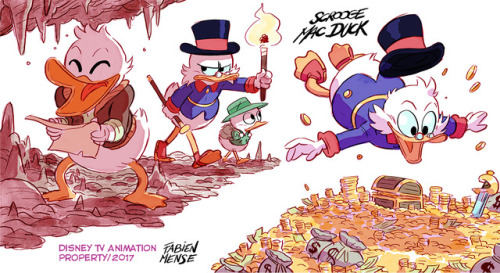
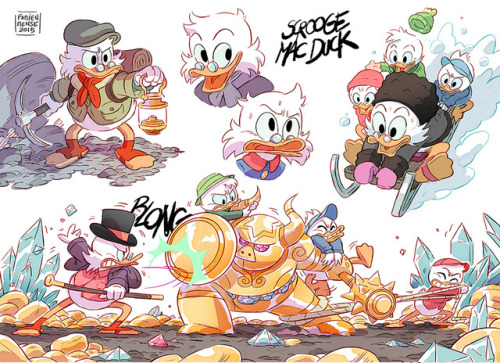
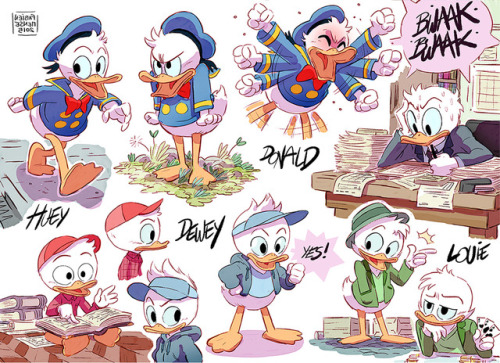
The new Ducktales series has been released on Disney XD. Here...


The new Ducktales series has been released on Disney XD. Here are some early research I’ve done for the show. It was fun to play with such iconic characters !

27 Aug 11:16

The week in wildlife – in pictures

by Compiled by Eric Hilaire

A shag in the Farne Islands, coral reefs in recovery in Belize, and a fox near Chernobyl are among this week’s images from the natural world

Continue reading...
27 Aug 01:28

Artworks from “Sherlock Hound” 1984 japanese/italian TV series...


Artworks from “Sherlock Hound” 1984 japanese/italian TV series (with drawings by Hayao Miyazaki). Bluray release this year in France by Black Box.

27 Aug 01:27

Preview of “The Dam Keeper” comic-book.By Robert Kondo &...


Preview of “The Dam Keeper” comic-book.
By Robert Kondo & Dice Tsutsumi (September 26th - First Second Books) 

27 Aug 01:09

PBS To Air Documentary About ‘Bambi’ Production Designer Tyrus Wong (Watch Trailer)

by Amid Amidi
kate

Went to an exhibit of his work, really awesome.

PBS is celebrating the 75th anniversary of Disney's "Bambi" with a new documentary about its Chinese-American production designer, Tyrus Wong.

The post PBS To Air Documentary About ‘Bambi’ Production Designer Tyrus Wong (Watch Trailer) appeared first on Cartoon Brew.

27 Aug 01:08

Geek & Sundry Writer Turns Catsitting Instructions Into D&D Campaign

by Stubby the Rocket

D&D catsitting Jessica Fisher

Greetings, intrepid adventurer! You have taken on a daunting quest: You venture willingly into the lair of cats in your comrade’s place while they are otherwise detained. But how do you ensure that you escape with no more than an angry scratch or two? And how do you tame the wild Meeple?!

Behold, your handy guide to catsitting, presented as a Dungeons & Dragons campaign—in case you thought that dogs were the only animals who got to have fun with D&D. Jessica Fisher, a writer for Geek and Sundry, tweeted out the comprehensive campaign she created for a friend watching her beloved fur babies.

Accompanied by adorable art (by Tahra, a.k.a. Kyoung Hwan Kim) of a party of felines, it includes such gems as:

  • making the kitten (MEEPLE) the monster “since he is new and the other cats are not fans of him yet”
  • also he goes “Bugnuts crazy fast,” see below:
D&D catsitting Jessica Fisher

Credit: Jessica Fisher

  • “you can summon a celestial veterinarian of challenge rating 4 or lower”
  • emergency phone numbers as summoning spells

You can read the entire PDF here and take some notes for your next catsitting adventure!

26 Aug 19:14

23 Musical Acts Unite in Song for Anime's 100th Anniversary

The Association of Japanese Animations' (AJA) Anime Next 100 project announced on Friday that 23 anime song performers and voice actor singers are uniting...
26 Aug 11:46

Fancy Japanese Chain Plans to Serve Affordable Sushi in NYC

by Serena Dai

Wokuni’s parent company is known for blowfish

A Japanese company that made its name with upscale blowfish omakases will be entering the U.S. with a more casual, affordable sushi restaurant in Murray Hill.

Tokyo Ichiban Foods — a group with 50 restaurants in Japan — is opening a version of its casual restaurant Wokuni at 325 Lexington Avenue, near 39th Street, next month. It will serve a fish in a variety of ways, including as sashimi, tempura, and grilled.

The company is best known for dozens of locations of Torafugu-tei, a restaurant that serves tiger blowfish, the fish with a highly poisonous liver that requires skill to master as a chef. But Wokuni will be far more casual than Torafugu-tei and will not be serving blowfish, at least for now.

It will, however, be serving fish raised in the same farm as Torafugu-tei’s blowfish. Ichiban Foods owns its own fish farm that raises only blowfish, bluefin tuna, and yellowtail. It’s a move intended to streamline quality and to keep prices low, according to the company. The U.S. location will also sell the fish directly, meaning a retail portion in the restaurant where people can buy fish to bring home to cook.

For now, sushi will will cost $17 for eight pieces, and sashimi is on track to run between $20 and $35. Sashimi bowls will be offered at lunch, and appetizers will be around $7. Gunkanmaki, or rolls with nori wrapped around rice and ingredients on top, will cost $10 for three.

It sounds like a model not too far off from LA-based sushi powerhouse chain Sugarfish, which has been perpetually busy since it opened New York for its comparatively affordable omakase. That chain, too, was started by people with upscale backgrounds.

Wokuni is just one of many restaurants coming to the U.S. from Japanese chains recently. In the last year, at least seven other companies have made New York debuts, including Ichiran, Ikinari, TsuruTonTan, and Zauo, a restaurant opening in December where people can literally fish for their dinner. Though many of them have ambitiously set out to open tons of locations, Ichiban Foods has not yet expressed desire to plop affordable seafood restaurants all over New York.

26 Aug 11:45

Scientists Figured Out the Optimal Length of Time to Dunk an Oreo

by Clint Rainey

A group of heroes with Ph.D.s at Utah State University’s Splash Lab has used its very particularized skill set to answer one of the universe’s most burning questions. After researching the matter for “several hours a day, for two weeks,” the group claims to have discovered the peak...More »

26 Aug 11:43

Just When You Thought It Was Over, Starbucks Unveils a ‘Mermaid Frappuccino’

by Clint Rainey

After months of watching rogue baristas trot out unsanctioned drinks (some of them pretty gross-looking), Starbucks today is giving its mythical-creature-obsessed customer base a 100 percent official Mermaid Frappuccino. That’s it on the left: It’s a striking shade of pastel green, it tastes like melon,...More »

26 Aug 11:42

America Is Running Out of Chicken Wings

by Clint Rainey

If you weren’t already annoyed by the big Floyd Mayweather–Conor McGregor fight this weekend, this should probably do the trick: It’s at least in part contributing to a looming chicken-wing shortage. According to The Wall Street Journal, whole-wing prices have climbed by more than a third in the...More »

20 Aug 18:41

Despite Disavowals, Leading Tech Companies Help Extremist Sites Monetize Hate

By Julia Angwin, Jeff Larson, Madeleine Varner and Lauren Kirchner,

The name of Taboola’s spokeswoman was removed at the company’s request.

This story has been updated to include a comment from PayPal.

This story has been updated to include actions taken by PayPal and Plasso to shut down services.

Because of its “extreme hostility toward Muslims,” the website Jihadwatch.org is considered an active hate group by the Southern Poverty Law Center and the Anti-Defamation League. The views of the site’s director, Robert Spencer, on Islam led the British Home Office to ban him from entering the country in 2013.

But its designation as a hate site hasn’t stopped tech companies — including PayPal, Amazon and Newsmax — from maintaining partnerships with Jihad Watch that help to sustain it financially. PayPal facilitates donations to the site. Newsmax — the online news network run by President Donald Trump’s close friend Chris Ruddy — pays Jihad Watch in return for users clicking on its headlines. Until recently, Amazon allowed Jihad Watch to participate in a program that promised a cut of any book sales that the site generated. All three companies have policies that say they don’t do business with hate groups.

Jihad Watch is one of many sites that monetize their extremist views through relationships with technology companies. ProPublica surveyed the most visited websites of groups designated as extremist by either the SPLC or the Anti-Defamation League. We found that more than half of them — 39 out of 69 — made money from ads, donations or other revenue streams facilitated by technology companies. At least 10 tech companies played a role directly or indirectly in supporting these sites.

Traditionally, tech companies have justified such relationships by contending that it’s not their role to censor the Internet or to discourage legitimate political expression. Also, their management wasn’t necessarily aware that they were doing business with hate sites because tech services tend to be automated and based on algorithms tied to demographics.

In the wake of last week’s violent protest by alt-right groups in Charlottesville, more tech companies have disavowed relationships with extremist groups. During just the last week, six of the sites on our list were shut down. Even the web services company Cloudflare, which had long defended its laissez-faire approach to political expression, finally ended its relationship with the neo-Nazi site The Daily Stormer last week.

“I can’t recall a time where the tech industry was so in step in their response to hate on their platforms,” said Oren Segal, director of the ADL’s Center on Extremism. “Stopping financial support to hate sites seems like a win-win for everyone.”

But ProPublica’s findings indicate that some tech companies with anti-hate policies may have failed to establish the monitoring processes needed to weed out hate sites. PayPal, the payment processor, has a policy against working with sites that use its service for “the promotion of hate, violence, [or] racial intolerance.” Yet it was by far the top tech provider to the hate sites with donation links on 23 sites, or about one-third of those surveyed by ProPublica. In response to ProPublica’s inquiries, PayPal spokesman Justin Higgs said in a statement that the company “strives to conscientiously assess activity and review accounts reported to us.”

After Charlottesville, PayPal stopped accepting payments or donations for several high-profile white nationalist groups that participated in the march. It posted a statement that it would remain “vigilant on hate, violence & intolerance.” It addresses each case individually, and “strives to navigate the balance between freedom of expression” and the “limiting and closing” of hate sites, it said.

After being contacted by ProPublica, Newsmax said it was unaware that the three sites that it had relationships with were considered hateful. “We will review the content of these sites and make any necessary changes after that review,” said Andy Brown, chief operating officer of Newsmax.

Amazon spokeswoman Angie Newman said the company had previously removed Jihad Watch and three other sites identified by ProPublica from its program sharing revenue for book sales, which is called Amazon Associates. When ProPublica pointed out that the sites still carried working links to the program, she said that it was their responsibility to remove the code. “They are no longer paid as an Associate regardless of what links are on their site once we remove them from the Associates Program,” she said.

Where to set the boundaries between hate speech and legitimate advocacy for perspectives on the edge of the political spectrum, and who should set them, are complex and difficult questions. Like other media outlets, we relied in part on the Southern Poverty Law Center’s public list of “Active Hate Groups 2016.” This list is controversial in some circles, with critics questioning whether the SPLC is too quick to brand organizations on the right as hate groups.

Still, the center does provide detailed explanations for many of its designations. For instance, the SPLC documents its decision to include the Family Research Council by citing the evangelical lobbying group’s promotion of discredited science and unsubstantiated attacks on gay and lesbian people. We also consulted a list from ADL, which is not public and that was provided to us for research purposes. See our methodology here.

How We Investigated Technology Companies Supporting Hate Sites

We wrote software to find the external domains contacted by popular websites that have been identified as extremist by either the Southern Poverty Law Center or the Anti-Defamation League. Read the methodology.

The sites that we identified from the ADL and SPLC lists vehemently denied that they are hate sites.

“It is not hateful, racist or extremist to oppose jihad terror,” said Spencer, the director of Jihad Watch. He added that the true extremism was displayed by groups that seek to censor the Internet and that by asking questions about the tech platforms on his site, we were “aiding and abetting a quintessentially fascist enterprise.”

Spencer made these comments in response to questions emailed by ProPublica reporter Lauren Kirchner. Afterwards, Spencer posted an item on Jihad Watch alleging that “leftist ‘journalist’” Kirchner had threatened the site. He also posted Kirchner’s photo and email, as well as his correspondence with her. After being contacted by ProPublica, another anti-Islam activist, Pamela Geller, also posted an attack on Kirchner, calling her a “senior reporting troll.” Like Spencer, Geller was banned by the British Home Office; her eponymous site is on the SPLC and ADL lists.

Donations — and the ability to accept them online through PayPal and similar companies — are a lifeline for sites like Jihad Watch. In 2015, the nonprofit website disclosed that three quarters of its roughly $100,000 in revenues came from donations, according to publicly available tax records.

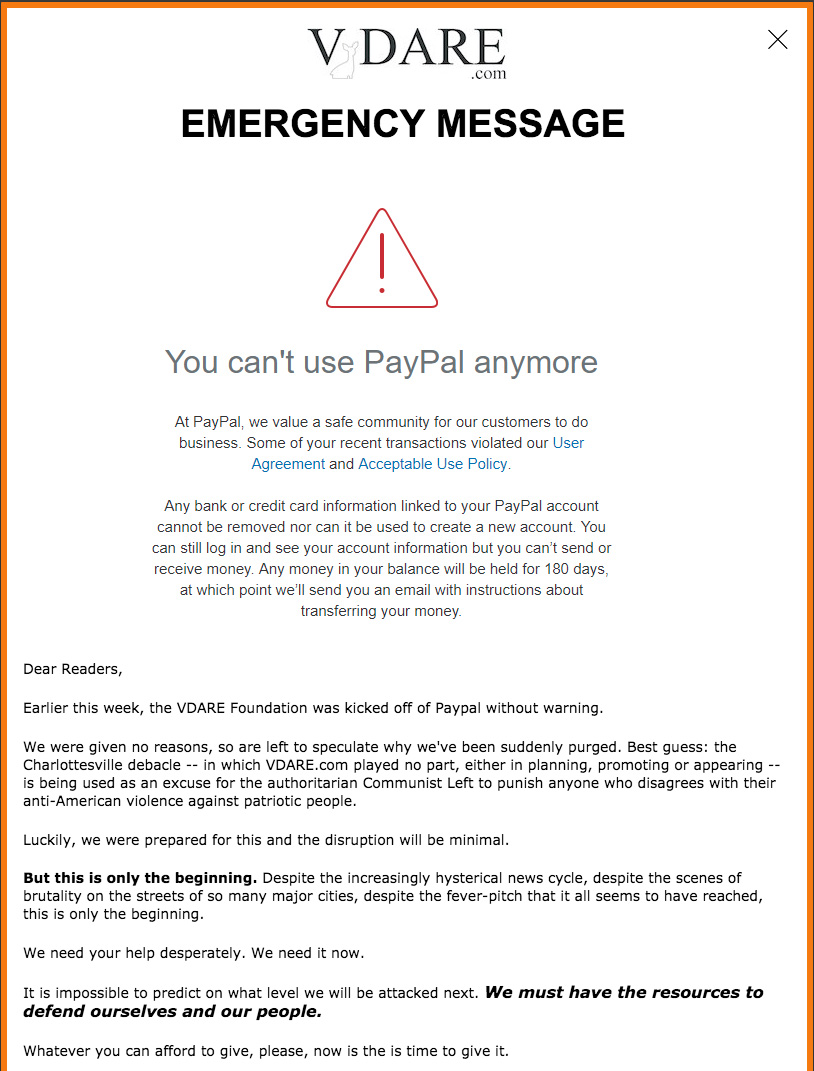
In recent weeks, PayPal has been working to shut down donations to extremist sites. This week, it pulled the plug on VDARE.com, an anti-immigration website designated as “white nationalist” by the SPLC and as a hate site by the ADL. VDARE, which denies being white nationalist, immediately switched to its backup system, Stripe.

Stripe, a private company recently described by Bloomberg Businessweek as a $9 billion startup, is unusual in not having a policy against working with hate sites. It does, however, prohibit financial transactions that support drugs, pornography and “psychic services.” Stripe provided donation links for 10 sites, second only to PayPal on our list. Stripe did not respond to a request for comment.

VDARE editor Peter Brimelow declared on his site that the PayPal shutdown was likely part of a purge by the “authoritarian Communist Left to punish anyone who disagrees with their anti-American violence against patriotic people.” He urged his readers to donate through other channels such as Bitcoins. “We need your help desperately,” he wrote. “We must have the resources to defend ourselves and our people.”

A message from VDARE editor Peter Brimelow announcing PayPal shut down donations to the site

In 2015, VDARE received nearly all of its revenue — $267,038 out of total $293,663 — from donations, according to publicly available tax return forms that the Internal Revenue Service requires nonprofits to disclose.

Brimelow did not respond to our questions, instead characterizing ProPublica as the “Totalitarian Left.”

Some sites also supplement their donations with revenue from online advertising. For instance, SonsofLibertyMedia.com, which is on the SPLC list, generated about 10 percent of its revenue — $37,828 — from advertising in 2015, according to its tax documents.

The site, which describes itself as promoting a “Judeo-Christian ethic,” and recently posted an article declaring that a black activist protesting Confederate statues needed “a serious beat down,” does not appear to attract advertisers directly.

Instead, Sons of Liberty benefits from a type of ad-piggybacking arrangement that is becoming more common in the tech industry. The website runs sponsored news articles from a company called Taboola, which shares ad revenues with it. Known for being at the forefront of “click-bait,” Taboola places links on websites to articles about celebrities and popular culture.

Taboola’s policy prohibits working with sites that have “politically religious agendas” or use hate speech. “We strive to ensure the safety of our network but from time to time, unfortunately, mistakes can happen,” said a Taboola spokeswoman. “We will ask our Content Policy group to review this site again and take action if needed.” 

Sons of Liberty founder Bradlee Dean said that he forwarded our questions to his attorney. The lawyer did not respond.

Hate sites can initiate relationships with tech companies with little scrutiny.

Any website can fill out an online form asking to join, for instance, Amazon’s network, and often can get approved instantly. Once a website has joined a tech network, it can quickly start earning money through advertising, donations, or content farms such as Taboola that share ad revenues with websites that distribute their articles.

Some companies, such as Newsmax, say that joining their ad network requires explicit prior approval.

But, according to a former Newsmax employee, the only criterion for this approval was whether traffic to the site reached a minimum threshold. There was no content review. Salespeople were told to be aggressive in signing up publishing partners.

“We’d put our news feed on anybody’s page, anyone who was willing to listen,” he said, “it’s about email addresses, it's about marketing, they don’t care about ultra conservative or left wing.”

Dylan Roof frequented a website described by the SPLC as “white nationalist.” He said in a manifesto posted online that finding the website was a turning point in his life. He went on to murder nine African-American churchgoers in Charleston, South Carolina, in 2015. That year, USA Today found Newsmax ads on the site.

They no longer appear there.

UPDATE August 24, 2017: Since this article appeared, payment processors PayPal and Plasso have shut down services they were providing to at least five sites identified by ProPublica. Plasso cut ties with the AmericanFreedomParty.us, a white nationalist group. “Thank you for bringing it to our attention,” said Drew Wilson, CEO of Plasso.

PayPal ended its relationships with two Holocaust denial sites, FPP.co.uk and Codoh.com; a white nationalist site, ActforAmerica.org; and EuroFolkRadio.com, a site that proclaims it is fighting against “internationalists” and the “global slaughter of White People.” PayPal also initially shut down services for JihadWatch.org and PamelaGeller.com but then reinstated them. PayPal spokesman Justin Higgs said, “We are consistently evaluating sites and taking action, if necessary.”

20 Aug 18:36

Wreckage of lost ship USS Indianapolis found after seven decades

by Agence France-Presse

Researchers say cruiser sunk by a Japanese submarine in the last days of the war has been located off the Philippines

The wreckage of the second world war cruiser USS Indianapolis has been found off the coast of the Philippines 72 years after it was torpedoed by a Japanese submarine.

Related: Mystery as wrecks of three Dutch WWII ships vanish from Java seabed

Continue reading...
20 Aug 18:34

The week in wildlife – in pictures

by Compiled by Eric Hilaire

Brown bears fishing, a rare white moose, and a puma found in a São Paulo office block are among our images from the natural world this week

Continue reading...
20 Aug 12:16

Valerian: The Illustrated Treasury Sweepstakes!

by Sweepstakes

We want to send you a copy of Pierre Christin’s Valerian: The Illustrated Treasury, available now from Titan Books!

Luc Besson’s Valerian and the City of a Thousand Planets introduced audiences to a future populated by weird and wonderful aliens and laced with incredible futuristic technology. Now discover the universe of the original Valerian and Laureline comic books!

Valerian: The Illustrated Treasury gives a comprehensive overview of the Valerian and Laureline comic-book universe, featuring information on key locations (including Central Point), transport, galactic anomalies and a timeline of the major events in the series. This richly illustrated book also introduces many of the alien races and characters—friendly and hostile—and there is a special section on the ever-popular Shingouz.

Printed in English for the first time, Valerian: The Illustrated Treasury is a wonderful addition to the Valerian franchise and features full-color artwork by Valerian and Laureline artist Jean-Claude Mézières.

Comment in the post to enter!

NO PURCHASE NECESSARY TO ENTER OR WIN. A purchase does not improve your chances of winning. Sweepstakes open to legal residents of 50 United States and D.C., and Canada (excluding Quebec). To enter, comment on this post beginning at 11:30 AM Eastern Time (ET) on August 18th. Sweepstakes ends at 12:00 PM ET on August 22th. Void outside the United States and Canada and where prohibited by law. Please see full details and official rules here. Sponsor: Tor.com, 175 Fifth Ave., New York, NY 10010.

20 Aug 12:15

Nintendo’s Tour of the Louvre: Gaming, Art, and Virtual Reality

by Peter Tieryas

The Louvre Museum in Paris is an architectural marvel, a palace built upon, renovated, and expanded from its origins as a fortress. Even awe would be an understatement to describe the feeling exploring its vast wings, its incredible Pyramide du Louvre, not to mention the most epic collection of artwork on display in the world. The first time I visited, I got completely lost, in part, because it’s one of the world’s largest museums at over 652,000 square feet. In between trying to track down the Mona Lisa, the Venus de Milo, and the Egyptian antiquities, my legs gave out after a half a day of hapless wandering.

The second time I visited (which was almost ten years later), I had a much better experience, knowing exactly where I wanted to go, even getting a good grasp of its layout. This wasn’t the result of having learned my way around during my first visit, but rather because I had the official Nintendo DS Louvre Guide to lead me, complete with a GPS and 3D Imaging designed specifically for the museum—on rent for just five Euros at any of the booths.

My perceptions were more attuned with gaming than I’d realized, where spatial relationships in the real world were more intuitive rendered through the map on the 3DS. The Whorfian Hypothesis on cognitive development describes how language shapes our perceptions. Whether subconscious or not, I was relating to the visual language of gaming in a way that was surprisingly familiar, particularly in terms of the way I interfaced with the museum. The 3DS Guide made my experience not only more manageable, but (and I feel a little silly saying this in retrospect) it made the whole Louvre resemble a Zelda-esque labyrinth ready to be explored.

A couple years back, there was all the hoopla from critics stating that gaming could never be considered art. Even if I found the statement uninformed—all it took was just a peek at some of the galleries of concept art behind the games I’d worked on to convince me otherwise, not to mention the talented artists behind them—the incorporation of a game into the Louvre experience was especially surprising as I considered it a cultural bastion impervious to the sway of gaming. When I first saw tourists carrying the 3DS around the museum, a part of me felt annoyed that they couldn’t put away their gaming console for one day (‘What’d you do and see at the Louvre?’ ‘I leveled up my The World Ends With You character.’). When I found out its actual purpose, not only was I intrigued, but it got me thinking about my own prejudices about what the traditional museum experience entailed.

Nintendo 3DS louvre

As the official guide of the Louvre, the “game” contains more than 600 photographs, 30+ hours of audio commentary, and “high resolution images, 3D models and video commentaries” about the artwork. That means you can zoom in on the details of the paintings, the digital magnifying glass focusing on background images via your screen. You can rotate and spin around sculptures from different angles (like above), all to the tune of a narrator informing you of a work’s history, significance, and interesting trivia. Rather than clash or even supplant the artwork, the 3DS increased my appreciation, visually pointing out specific approaches employed by the artist I would never have known about otherwise. The option to analyze or maximize any painting is invaluable, particularly on the large-scale images. You can search out favorite pieces and mark them on your map, which will then show you the quickest way there. It’s convenient being able to track your position on the 3D map and plan out your entire journey, especially because of how huge the grounds are.

There are limitations to the game; it doesn’t cover every exhibit, though they incorporate software updates as well as analyze user data and give feedback to the museum they can use to optimize and improve future visits. It also doesn’t take questions, and while it comes in several different languages, it lacks a Mandarin version, a feature many of my acquaintances bemoaned. Finally, the GPS isn’t perfect, and from time to time, it’ll get confused about your next destination.

These complaints are rather trivial considering it’s still far more convenient than any app, audio tour, and paper map I’ve used at other museums because of the way the 3DS integrates audio, visual, and tactile control into one package. It’s as close to getting a human guide as you can get without actually having one, but with the added benefit that you can travel at your own leisure, go off the beaten path, and stay in one location for as long or as briefly as you want. I’ve often felt like a herded sheep in tour groups, hitting bullet points on an unseen list, rather than being able to explore the more obscure and stranger pieces on display.

As I’ve mentioned, the Louvre is massive, and it’s both awe-inspiring and overwhelming being surrounded by masterpieces like Delacroix’s Liberty Leading the People or David’s Coronation of Napoleon. The collection never seems to end and I felt like I could have spent a week there and still not appreciated more than a quarter of it. Many castles, just by their grand nature, are designed to make you feel insignificant, particularly in this instance. You’re in the presence of the king. Kneel, fool.

The 3DS was an equalizer and it felt like I was wielding my own personal tricorder (all it needed was a sensor beam). It helped tabulate the enormous gallery so that I could focus on the works on display, from the profound to the more playful.

Nintendo 3DS louvre

I can’t think of anyone better to have created the Louvre Guide than Nintendo, the makers of The Legend of Zelda: Ocarina of Time. Ocarina was my first real introduction to an immersive 3D environment (even more so than Super Mario Bros. 64 or Crash Bandicoot on the PlayStation) and a huge part of that was because of the way it naturally adapted the 2D sprites I’d grown up with into a space that was not only traversable, but became as important a character as the main protagonist. The world was a puzzle to be unraveled and the additional dimension breathed an authenticity into the architecture that holds up to this day. The Deku Tree level was a revelation for me, and gaming space was changed irreversibly once I’d finished. I’ve heard stories about Shigeru Miyamoto’s intuitive grasp of camera and player controls, his dedication to perfecting the user experience.

For me, art is platform agnostic and can find expression in any medium, as long as it gives me a different understanding of the world, independent of whether I agree or disagree. Art in gaming isn’t just limited to the visual, but includes gameplay, design, and sound as well, all working in conjunction to create a unique experience. I still remember the sense of wonder at the Deku Tree level as I uncovered each of its secrets, all the way to the climactic plunge which was the coda to a brilliant level. In the same way, the 3DS creates a sense that each work in the Louvre is a puzzle, exhibitions with unique origins where even a dash of paint or a hint of a smile can have revolutionary implications based on the context in which it was created. This isn’t just art in a stuffy setting, only understood by the connoisseur, but something vibrant, exhilarating, and accessible. Ensconced in an interface familiar to gamers, the 3DS guide broadens the audience in a way that combines the favorite pastimes of the past with the present—as evidenced by many of the kids wielding their 3DS’s in front of classical paintings.

Nintendo’s creativity and consideration of the user experience in the 3DS Louvre Guide is what makes this seemingly quirky pairing work so well—so much so that a few weeks later, when I visited the Vatican Museum, I got lost, unable to find many of the exhibits I wanted to. I longed for a corresponding 3DS guide and found the accompanying audio tour primitive in comparison.

The only thing holding the experience back from being seamless was the fact that the 3DS was a separate object that I held and had to constantly refer back to.

This, of course, got me thinking about virtual reality and its significance for art. VR promises perfect immersion, but there’s also gear designed to augment reality. I tried out the Oculus Rift at Siggraph a few years back and even in its early stages, its potential for immersion held a ton of promise. With Microsoft, Sony, Valve, Google, and Facebook working on their own gear, each with their own distinct take, I couldn’t help but wonder specifically what it signified for the future of art. I’ve spent a lot of time playing with the Unreal engine, which is what some of these kits are using in their creation of their 3D worlds, and some of the better demos don’t just look indistinguishable from real life, but even more graphic. The duller palettes of actual cities seem muted in comparison to the vibrancy of art-directed worlds teeming with refractions, perfect sunsets, global illumination, and the complexity of a polygonal metropolis.

Nintendo 3DS louvre

Will there one day be a virtual Louvre you can visit in your living room? Every work of art, every sculpture, even the hallways replicated with impeccable verisimilitude? No noisy tourists and no need to exhaust yourself finding a specific work of art (unless you wanted to). I realize it’s not the same as actually going (there are all the intangibles of traveling) and even in Star Trek, Captain Sisko wistfully notes that a holodeck baseball game isn’t a substitute for the real thing. I don’t want the virtual to replace the real and make the world a matrix-like MMORPG, and even if I did in other instances, that’s beyond the scope of this piece. What I’m more focused on is how a collaboration would work, the virtual gear functioning as an easel to paint even more fantastic landscapes than either could conceive of by themselves.

One practical example where this would have been very helpful is the Sistine Chapel at the Vatican Museum. It’s gorgeous, but hard to see from almost sixty feet below, even though Michelangelo intentionally used bright colors to make them more visible. I had a hard time enjoying my time there as I’d forgotten to bring my glasses and the chapel was packed to the brim with tourists, all pushing and tugging against each other. Imagine if you could use the virtual gear to zoom your view into the ceiling, visually gorging on the frescoes from below, swinging the camera around, actually seeing the stories in each character, the way they interconnect the Great Flood with the Garden of Eden and so on. Unlike a binocular, constrained to your location, this could actually let you see every detail up close. Goethe once said, “Without having seen the Sistine Chapel one can form no appreciable idea of what man is capable of achieving.” But the truth is, when we actually get there, the most we’ll see are general outlines that we try to decipher in the cacophony of the Biblical panoply.

I hope the 3DS Louvre Guide is a preview of the type of hybridization that will become more and more commonplace. The fusing of the real and unreal to create something innovative but familiar is going to change the artistic experience. Into what? That’s an exciting prospect to ponder.

While in Paris, I imbibed of some of Sartre’s work at a cafe (with a croissant and hot chocolate milk) and one of the passages that struck me were his musings on imagination and feeling:

“When the feeling is oriented toward something real, actually perceived, the thing, like a reflector, returns the light it has received from it. As a result of this continual interaction, the feeling is continually enriched at the same time as the object soaks up affective qualities. The feeling thus obtains its own particular depth and richness. The affective states follows the progress of attention, it develops with each new discovery of perception, it assimilates all the features of the object; as a result its development is unpredictable, since it is subordinate to the development of its real correlative, even while it remains spontaneous. At each moment perception overflows it and sustains it, and its density and depth come from its being confused with the perceived object; each affective quality is so deeply incorporated in the object that it is impossible to distinguish between what is felt and what is perceived. In the constitution of the unreal object, knowledge plays the role of perception; it is with it that the feeling is incorporated. Thus the unreal object emerges.”

I can’t wait to see what emerges in the years to come.

This article was originally published in March 2015.

Peter Tieryas is a character artist who has worked on films like Guardians of the Galaxy, Cloudy With a Chance of Meatballs 2, and Alice in Wonderland. His novel, Bald New World, was listed as one of Buzzfeed’s 15 Highly Anticipated Books as well as Publisher Weekly’s Best Science Fiction Books of Summer 2014. His writing has been published in places like Kotaku, Kyoto Journal, Tor.com, Electric Literature, Evergreen Review, and ZYZZYVA, and he tweets @TieryasXu.

19 Aug 23:55

People Are Actually Taking This Cheetos Restaurant Seriously

by Stefanie Tuder

It was packed on opening night

New York City currently has to suffer through a restaurant dedicated entirely to Cheetos that’s — of course — funded by the synthetic snack brand. The cheese crisp company signed on TV chef Anne Burrell to create an “elevated” menu at The Spotted Cheetah that employs Cheetos in every dish — and New Yorkers are eating it up.

The pop-up completely sold out, and its opening night yesterday was packed with people posing for Instagram and downing Cheetos nachos and mac and cheese. Diners flooded social media with cheesy excitement for the branded dishes, and inexplicably, much of the crowd was full of food writers from People, ABC News, Bloomberg, and Rachael Ray. Here’s what went down:

Anne Burrell and Chester twinning:

I'm here at the opening of #thespottedcheetah! Which dish would you want to try?

A post shared by Chester Cheetah (@cheetos) on

Security was on hand:

Cheetos restaurant pop-up. (Don't get too excited. It's completely booked. )

A post shared by Levi (@closetskeleton) on

Throwback drink Crystal Pepsi quenched the Cheetos thirst:

I'm partying like it's 1991 so hard.

A post shared by Sam McKelvie (@sam_mckelvie) on

Cheetos branding was inescapable:

exclusive preview of the toilet paper at the @cheetos pop-up!

A post shared by melissabethk (@melissabethk) on

And the food was very, very bright:

19 Aug 23:55

One of the City's Best Pakistani Restaurants — and More Cheap Eats

by Robert Sietsema

Plus, a new Nepalese restaurant in Ridgewood in Three Great Cheap #42

In the 42nd “Three Great Cheap” installment, critic Robert Sietsema recommends favorite inexpensive dishes from recent restaurant visits.

Kung Fu Kitchen

Wonton soup and bing at Kung Fu Kitchen: This Hell’s Kitchen branch of a mini-chain of three cafes offers some solid Chinese food, made to order in a glassed-in open kitchen. The kung fu spicy wonton is a modern take on a classic Cantonese soup, the gossamer-skinned dumplings in a broth accented with scallions and a modest squirt of chile oil. But the cooking comes from all over China, including bing stuffed with chives and eggs, sticky rice shu mai, pan fried pot stickers filled with pork or chicken, red bean puffs, entrees like curried chicken served with rice and vegetables, and soups galore — some hot and some not. The service is enthusiastic and the seating comfortable for a fast-food establishment. 805 Eighth Avenue, Hell’s Kitchen, 646-852-6941

Momos, masala wings, and choila roti at While in Kathmandu: This Ridgewood newcomer name-checks the capital of Nepal, and offers a slightly adapted version of the cuisine in a relaxed setting, with an interior like a thatched hut and a backyard that is a work in progress. There are several types of momos (steamed dumplings) offered in a thick soup or by themselves, spicy masala chicken wings, and choila roti — a sort of Nepalese taco wrapping a fiery chopped-chicken filling in a rich flatbread. It’s fantastic. For Himalayan food enthusiasts, the most interesting section will be that offering typical breakfasts, which make very nice suppers. One features sel roti: rice fashioned into a ring and fried, served with a potato curry and an optional egg. 758 Seneca Avenue, Ridgewood, 718-386-3416

Steam table delights at Lahori Chilli: The corner of Foster and Coney Island avenues on the edge of Brooklyn’s Kensington was once the gyro capital of New York, but now not so much. The former Gyro City has turned into Lahori Chilli, and, brightly decorated in shades of orange and blue and outfitted with padded booths, it’s one of the best Pakistani restaurants in town. A steam table pristinely maintained offers two dozen dishes, with samosas, patties made of beef or potatoes, and tandoori chicken and kebabs displayed on a shelf above.

Making selections from the steam table is a great pleasure: Choose from the vegetarian, chicken, or lamb signatures of Punjabi cuisine, or go for the specifically Pakistani standards. These include beef nihari, a braised boneless short rib in a gingery gravy; paya, a viscous stew of goat trotters; freshwater fish cooked in a tawa (a slightly concave griddle); keema, a savory dish of minced chicken; or, a special on a recent visit, goat karah — some of the tenderest goat you’ve ever tasted. Chickpea-studded rice and tossed salad with yogurt dressing served with every entrée. 1026 Coney Island Avenue, Kensington, 718-859-1400

Check out a couple of previous articles in the “Three Great Cheap” series:

19 Aug 23:52

World Breakfast AllDay: The Food of the Gods

by Lily Crossley-Baxter
Breakfast is a sacred tradition in almost every country, but Japan never got the memo. Either not open early enough, only offering pancakes or trying to give you potato salad alongside your toast, it’s never quite right—but there is an answer, and it’s our favorite Tokyo breakfast joint. |credit| A full English, with real Heinz baked beans and HP sauce on the side—it’s the stuff dreams are made of if you’ve been here long enough. World Breakfast AllDay does as advertised: breakfasts from around the world, around the clock. The concept, like the cafe itself, is simple but completely charming, and will have you converted as quick as you can spot the jar of Marmite on the counter. If you’re here long term, or

The post World Breakfast AllDay: The Food of the Gods appeared first on Tokyo Cheapo.