Shared posts

26 Nov 00:38

Using High Heels as a Weapon Is Now Happening in Self-Defense Classes for Women

You can now make those spindly stilettos work for you: Self-defense classes are popping up that utilize high heels as a weapon, inspired by the realization that most women are going to keep wearing their heels, no matter what. Logically, the thinking goes something like this: It boils down to fight or flight, and if these babies can't help with fleeing, they better be helpful for packing a punch.

"Women feel very empowered wearing heels...but most women can barely walk in them, let alone run," Jennifer Cassetta, founder of the L.A.-based Stilettos and Self-Defense class, told The New York Times. "If you can't run away, you better know how to fight off an attacker. You have to be prepared at all times, no matter what you're wearing, no matter how tall you are."

High-heel fighter Avital Zeisler studied Krav Maga, a form of hand-to-hand combat that shares some similarities with intense karate and is officially backed by the Israeli Defense Forces (and described as "the ideal fighting style for dangerous and unexpected situations"). She turned her knowledge into her own approach, the Soteria Method, which is available to study via workshops, online classes, and a book.

Should anyone need a reminder of just how dangerous heels can be, look no further than the sensationally dubbed "Stiletto Murder." A Texas woman was convicted last year of killing her boyfriend with a five-and-a-half-inch pump, a horror that brings up memories of Single White Female proportions.

More from Glamour:
How Embracing Failure Can Be a Stepping Stone to Success
Award-Winning Women Directors Discuss Filming Women of the Year Winners
The Most Inspiring Instagrams From Glamour's Women of the Year Awards
The 5 Most Common Questions Women Ask About Bras (and Answers!)

Photo Credit: MoustacheGirl via Getty Images

22 Nov 00:46

‘Oh Willy…’, Winner of Over 80 International Festival Awards, Is Now Online

by Amid Amidi
When his mother dies, Willy goes back to the naturist community he grew up in. Overwhelmed by the memories this return brings back, he decides to flee into the wild, where he finds the motherly protection of a big hairy creature.
21 Nov 12:15

Goodbye Gravity Falls

shmalexsmirsch:


Hey internet. I’ve got some tough news I have to deliver. Are you sitting down? Do you have a minute? Here, have this picture of a dachshund dressed as a crayon to relax:

image

Everyone good? Okay here goes.

There’s no easy way to say it so I’m just going to say it: Gravity Falls is coming to an end. There are two more episodes left: “Weirdmageddon II: Escape from Reality” and “Weirdmageddon III” which will be our hour long series finale. After that, Gravity Falls as we know it will be over.

I know how tough this will be for many fans, and I feel you guys. But before you start sending me .GIF’s of pitchforks and torches let me explain.

The first thing to know is that the show isn’t being cancelled- it’s being finished. This is 100% my choice, and its something I decided on a very long time ago. I always designed Gravity Falls to be a finite series about one epic summer- a series with a beginning, middle, and end. There are so many shows that go on endlessly until they lose their original spark, or mysteries that are cancelled before they ever get a chance to payoff.

But I wanted Gravity Falls to have a mystery that had a real answer, an adventure that had a real climax, and an ending that had a real conclusion for the characters I care so much about. This is very unusual in television and a pretty big experiment, and Disney for their part has been enormously supportive. I know that hits are rare in this business, and its hard to let one of them go, so I’m so grateful that this company has had the vision to let me start (and end) the show the way I always wanted to.

Why did we wait so long to announce that this was the last season? The truth is, it wasn’t up to me. Before we started Season 2, my writers and I decided that this season would be the last. I wanted to announce this to the world at large then, but I was restricted from doing so, mainly because I think a lot of people were hoping I’d change my mind.

But Gravity Falls was never meant to be a series that goes on and on forever. It’s meant to be an exploration of the experience of summer, and in a larger sense a story about childhood itself. The fact that childhood ends is exactly what makes it so precious- and why you should cherish it while it lasts.  

No words can describe how grateful I am for the millions of fans who have cherished Gravity Falls for the time that it’s been on air. Running a TV show, especially one where you write, direct, supervise, and co-star, can be an incredibly grueling experience. But every hand-written letter, tweet, tattoo, piece of art, costume and creation from the fans made this enormous undertaking worthwhile. To the Gravity Falls fandom- I love you guys. You’re weird and clever and smart and curious and have been a constant inspiration to me and the crew. You’ve picked us up when we felt down and pushed and inspired us to do the best work we possibly could. I hope you enjoy watching our finale as much as we enjoyed dreaming it up.

And if you don’t, keep it to yourself, pal! Yeesh!

Anyway, I know this will still be hard for a lot of fans to digest, so here’s a few FAQ’s for you guys.

FAQ:

Is this a prank? You’re a real prankster, you are!

Nah man, this is real. The first stage of grief is “denial”- that’s why there are people out there who think that Andy Kauffman and Tupac are hiding in the woods waiting to drop 2016′s sickest album. But this is the truth. Besides, just bumming out millions of people for no reason would be a pretty lame prank. My pranks are a lot better than that, give me some credit!

This sucks! I want to be mad at someone! Is there someone I can be mad at?

Being mad is easier than being sad, I get it! But there really are no villains here. My team and I set out to do something and we did it, and the network supported our crazy vision. If you wanna be mad at someone, blame…I don’t know… the goat. With his shifty eyes. This is all his fault. 

Are they going to make a third season without you? Will it be called “Gravity Falls Babies: The New Class: Generations?”

While that is an amazing idea, and you would make an amazing executive, there are no plans to create another full season.

What’s next for you? Are you going to ride the rails with your belongings in a sack, playing the harmonica, going wherever the wind takes you like some kind of tragic folk hero, perhaps named “Johnny Flannel-Britches?”

These questions are getting weirdly specific, guys. The truth is- I don’t know! I’ve spent the last 4 years living & breathing Gravity Falls. I’ve pulled more all-nighters than anyone I’ve ever known who didn’t work at NASA and basically holed myself up in my office to the exclusion of any sort of actual life. I already have some very exciting opportunities lining up on the horizon after I take a good vacation. We’ll see!

How can we continue to stalk follow your exploits?

You can continue to find me on twitter @_AlexHirsch. I’ll be tweeting all sorts of GF goodies leading up to the finale!

Will the last episode be exactly like my head canon?  If not, can I firebomb your house?

The jokes on you, because I don’t have a house! I live in a “shire.” But seriously- my team works insanely hard to make the best series we can.  Of course there’s no way to satisfy every single fan’s personal theories. But our show reflects a genuine sincere effort by some really talented folks to make the coolest thing we can (with the time and budget available.) Will every single conceivable question ever thought of about Gravity Falls be answered in the end? Of course not. But that just leaves some material for any potential Gravity Falls projects in the future…(including the canon Journal #3 that goes on sale in 2016)

Are you SURE you’ll never make more Gravity Falls?

I know that there will be many fans who will be sad to see the Pines family go, but just because I’ve finished the story I wanted to tell doesn’t necessarily mean we will never see Dipper, Mabel, & Stan again. It means that this chapter is closed, and that I, at least for now, am personally done telling their story.

I want to thank Disney, my amazing cast and crew, and most of all our fans for taking this unforgettable road trip with me through the redwoods into a place called Gravity Falls. I look forward to seeing what adventure we go on next.
Your pal,

Alex Hirsch

PS: pqxv tbfoa

PPS: Want to thank the cast and crew for the awesome job they’ve done? Feel free to use the #GravityFinale

08 Nov 19:33

Some stills from Anomalisa stop motion animated feature film...


Some stills from Anomalisa stop motion animated feature film directed by Charlie Kaufman (Being John Malkovich, Eternal Sunshine of the Spotless Mind) & Duke Johnson (Community “Abed’s Uncontrollable Christmas” episode).

08 Nov 19:32

Artworks of french animated TV series project Sambakap by Fais...


Artworks of french animated TV series project Sambakap by Fais Péter La Prod (teaser).

08 Nov 19:30

16 Animated Features Submitted for 2015 Oscars

by Amid Amidi
Here's the complete list of animated features that will compete for the 2015 Academy Award.
08 Nov 19:29

When You’re Just Drawn That Way: Who Framed Roger Rabbit?

by Mari Ness

RogerRabbit01

In 1981, Walt Disney Productions faced a major issue: with the exception of The Rescuers, all of its recent films, including the live action, family friendly films, had been underperforming for years. Walt Disney’s son-in-law, Ron Miller, who had worked as a producer on multiple live action films prior to becoming the president of Walt Disney Productions in 1978, believed he had a solution: Disney needed to start producing films aimed at an adult audience. The eventual result of this was Touchstone Pictures, Ron Miller’s major positive legacy to Disney. (His less positive legacies, less spoken of, included attempted corporate takeovers and his eventual ousting.) Meanwhile, Miller let people know that he was deliberately searching for “different” stuff, which is reportedly one reason why the galley proofs from Who Censored Roger Rabbit? ended up on his desk. Not to mention that the book name drops multiple Disney characters, and a small part of the plot references Disney’s Alice in Wonderland.

Ron Miller liked the concept, thinking it would fit into other Disney films that had combined live action film with animation. He optioned the book over the objections of his then boss Card Walker, and put the film into pre-production. At that point, things started going wrong.

The early test footage, shown to those lucky enough to be among the initial subscribers to the Disney Channel back in 1983, went over well with Miller, but not with the various directors and producers who saw the clips. Once Miller was ousted from Disney, the test footage was pulled from the Disney Channel and sent to the vault. There it languished, until Jeffrey Katzenberg and Eisner “found” it, along with other dropped projects. Katzenberg and Eisner felt dubious, but decided to get Steven Spielberg’s opinion. Spielberg liked it, and brought Robert Zemeckis, then best known for Back to the Future, on board as director. The film would, everyone agreed, after some negotiations, be a rarity: a partnership between Spielberg’s Amblin Entertainment and Disney’s Touchstone pictures.

who-framed-roger-rabbit-disneyscreencaps.com-8649

This partnership had two immediate results. One, it freed up a lot more money for the film. Disney had originally planned to spend maybe $12 million—ok, maybe, possibly, if it turned out to be necessary, $25 million. The final budget ended up being around $70 million, something only possible thanks to Amblin. Two, Amblin’s involvement allowed Spielberg and Zemeckis to lobby for the rights to use various characters from other studios, something that that finally allowed Disney to cut through those tedious negotiations – and get Bugs Bunny on board.

It didn’t end these negotiations. Warner Bros fought over virtually every appearance of Bugs Bunny, which is why in the Bugs Bunny/Mickey Mouse scenes, Bugs Bunny speaks last—Disney finally gave up in exhaustion. Warner Bros also had strong opinions about the closing credits, which ended up being an uneasy compromise between Disney and Warner Bros: Porky Pig does his famous “That’s All, Folks!” and Tinker Bell voicelessly bangs her wand, allowing Warner Bros to have the last word and Disney to have the last image. And the studios were not able to obtain the rights to every character they had hopes for, meaning that Tom and Jerry and Rocky and Bullwinkle could not appear in this film.

RogerRabbit03

In the end, however, they were able to bring in about 45 non Disney characters for various cameos. They also brought in Mel Blanc, who agreed to voice all but one of his Warner Bros characters (Yosemite Sam, a character the aging Blanc had always found physically difficult to voice) and Mae Questel, who had last voiced Betty Boop in 1939. They were also able to set up confrontations that animation fans had wanted for years—between Donald Duck and Daffy Duck, Mickey Mouse and Bugs Bunny, and Droopy Dog and any human coming within that character’s orbit. (And, I suppose, Porky Pig and Tinker Bell, although I’m not sure that counts as a confrontation, let alone a confrontation that fans were clamoring for.)

The rights issues more or less settled, the filmmakers had to tackle the next problems, both technical and story. Who Censored Roger Rabbit? had ended on a note that could kindly be called “depressing.” Although the original film treatment had stuck to a similar tone, Eisner, Spielberg and Zemeckis all wanted a more cheerful ending—especially since the film would eventually be released under a Disney label. The pornography in the original novel also had to go—replaced by what turned out to be a rather good gag involving Jessica Rabbit and a moment of “pattycake.”

RogerRabbit04

Other changes included focusing on characters from animated cartoons instead of newspaper strips, which also allowed the film to drop the conceit used in the book of having Toons speak in word bubbles, instead of normally. The film also gave Eddie Valiant a reason to hate working with Toons—”A Toon killed his brother,” simultaneously giving Eddie a good reason to be an alcoholic (in a nice message for the kiddies, he does stop drinking midway through the film), letting audiences know that yes, Toons can be dangerous, and giving the film another great line.

The real mess involved combining live action with animation. Much of this involved the basics of forcing Bob Hoskins, playing human Eddie Valiant, to act against empty air, but other bits included the tricky effects shots that would involve cartoons interacting with real objects, like bicycles, cars, glasses, plates and heavy machines. In some cases—a shot of Jessica Rabbit in a car, for instance—this proved simple enough. But a three second shot of the pelican from Dumbo delivering mail via bicycle turned out to be mildly nightmarish: effects artists could not keep the bicycle upright, even with different forms of wirework, and eventually just allowed the bicycle to fall over, with the pelican, in the final film.

RogerRabbit10

The process involved shooting live action first, and then producing still photographs from the film, which animators traced over into order to create the final cels. For the first time in Disney production since Sleeping Beauty, all of the cels were once again handpainted and colored, since the xerographic system, still in use, could not be adjusted for this film. That in turn meant that principal photography was completed long before the film was—meaning that nothing could be reshot, forcing animators to get creative with certain scenes where Bob Hoskins or other actors had been looking at the wrong place. In one scene, for instance, the animators had Roger Rabbit stand on his toes; in another sequence, Jessica Rabbit bent both her knees.

The results proved worth the effort—Who Framed Roger Rabbit? does have missed shots here and there, but for the most part, the only shot that looks really bad is the obvious greenscreen shot of Eddie getting tossed from the club, where the lighting and compositing don’t quite work—a problem more with the greenscreen shot than with the animated gorilla behind Eddie, and a problem films and TV still continue to struggle with today.

Otherwise, the film holds up remarkably well even today, with all of the advances in CGI, thanks largely to the performances of Bob Hoskins and Christopher Lloyd—the latter clearly having the time of his life. And also the gags—the Donald Duck and Daffy Duck bit is not just a technical masterpiece, but genuinely hilarious, as are many of the Toontown episodes and bits from the final confrontation sequence—including the moment when Eddie attempts to whip out a cartoon sword, only to hear the sword crooning with a rather unexpected voice.

RogerRabbit05

I do find myself cringing a bit at the Lena Hyena bits—a takeoff on some 1930s and 1940s cartoons featuring ugly cartoon women chasing terrified men, and at the way Baby Herman ends up slapping a number of women’s butts. But to – somewhat – counter that, in another scene, Betty Boop delivers one of my favorite bits of the film: after Eddie expresses incredulity that someone like Jessica Rabbit could possibly be interested in someone like Roger Rabbit, Betty swiftly responds, that yeah, Jessica’s a lucky girl.

It’s hardly the first or the last time that a Disney film emphasized the importance of character over appearance. Indeed, in a few years Disney would build an entire film around that message, however strange it might sound coming from an industry nearly obsessed with appearances. And yes, the line—and the entire relationship between Roger and Jessica Rabbit—is a bit of wish fulfillment fantasy of the geeky, strange guy getting the hot girl. But it’s still a nice bit in a film that is otherwise very much about appearances and judging people (usually negatively) on these appearances, not to mention a film very much aware of the rampant sexism in 1940s Hollywood and Los Angeles, and a film where almost every woman, even those in bit parts and cameos, end up objectified in one way or another—by both live action and cartoon characters.

RogerRabbit02

Interestingly enough, the only two women to comment on/protest this objectification are the two women explicitly drawn to be objectified sex symbols: Betty Boop and Jessica Rabbit. Betty, of course, is having a few issues since she’s a black and white cartoon in an age of Technicolor, making her extremely aware of the issues. Jessica argues that “I’m not bad. I’m just drawn that way.” Her body, of course, has been deliberately drawn to be a sex symbol, something she uses in her job as a cartoon night singer. It’s also something used against her—character after character dismisses her as “bad,” with nearly every character (including two women) immediately assuming that of course a woman who looks like that would be cheating on her husband. The only person not to believe this, or to see Jessica Rabbit as pure sex symbol: that husband. When shown the pattycake pictures, he’s devastated—but then concludes, correctly, that it’s a setup. No one—cops, weasels, Eddie, his boss—believes him.

Because, well, look at Jessica.

And yet, as the movie makes clear, Jessica’s far more than that—indeed, she’s arguably the most complex character in the film. She doesn’t so much grow as a character as reveal different layers: first as a nightclub singer using her blatant sexuality as part of her act; then that same nightclub singer harassed by the club owner into playing patty cake. And it is harassment—Jessica specifically says that she doesn’t want to, only giving in after Marvin Acme continues to insist. Later, Roger Rabbit reveals still more layers: a woman giving into blackmail to keep her husband employed, a woman who, as she tells Eddie, would do anything for her husband; then an investigator; then a woman more than capable with a gun who is also willing to fight to save her husband and Toontown; a woman with a gift for rhyme; and finally, a woman desperately in love with a rabbit. She turns out not to be the hinted at golddigger, interested in manipulating men for money, but a woman who chooses a rabbit because the rabbit makes her laugh. She’s not ashamed of her sexuality, or afraid to use it, but she turns out to be far, far more than what she was drawn to be.

RogerRabbit06

Betty Boop, meanwhile, uses the sexuality she was drawn with to remain employed—and make comments on certain assumptions. The end result is a film surprisingly explicit about the negative effects of these assumptions and of sexual harassment: it’s very clear that had Marvin Acme, who claimed to love Toons so much, backed off the second Jessica Rabbit told him to, that none of the problems the Toons end up facing, which includes, not mildly, their complete destruction, would have happened. And he’d be alive.

Against this, I have to admit that the four human women with speaking parts don’t come out nearly as well—three of them are assistants of one kind or another, and one is stuck in the thankless role of the on and off girlfriend, with little to do. Then again, this is a film focused more on the cartoons than the people.

Which is to say, you can also just ignore all of this and laugh cruelly as Tweety Bird undoes every single one of Eddie’s fingers and lets him drop to the ground while Mickey Mouse and Bugs Bunny casually watch, or think that maybe—just maybe—Eddie would have been better off bringing a real, not cartoon gun, into Toontown. Jessica Rabbit does, after all, and that decision serves her well.

RogerRabbit07

The comedy helped make Who Framed Roger Rabbit an unquestioned box office smash, earning back over four times its budget in domestic receipts alone in its initial release. Reports that the VHS and laserdisc release contained unmistakable proof that Jessica Rabbit was going commando in several shots (not visible at regular speed) helped propel high sales of both. The film also earned four Academy Awards, unprecedented for a combined live-action/film. Disney also used the film as an inspiration for Mickey’s Toontown, added to Disneyland (in 1993) and Tokyo Disneyland (in 1996), and temporarily to the Magic Kingdom (in 1996, now just part of Fantasyland), and naturally, merchandise ranging from T-shirts to plush animals to jewelry and more. Sales eventually declined, so Disney took most of this off the market in the last few years, but you can still find various Roger and Jessica Rabbit Christmas ornaments and art objects in the theme parks if you look.

Arguably, however, the film ended up having an even greater effect on other studios, including Spielberg and Amblin Entertainment. The success of the film helped reignite Spielberg’s never quite dead interest in the old Warner Bros cartoons, which in turn led Spielberg to back the joint Amblin/Warner Bros productions Tiny Toon Adventures, Animaniacs, Freakazoid! and Pinky and the Brain, which formed a critical part of the overall animated renaissance of the 1990s. That in turn spurred Disney to greater effort and helped Pixar persuade skeptical executives that really, yes, there might just be an audience for a computer animated film featuring talking toys.

RogerRabbit08

Meanwhile, the success of Who Framed Roger Rabbit energized the Disney studio, convincing them—and studio executives—that yes, a large audience—even a large adult audience—still existed for animation. It also freed up some last minute funds to do some additional work on a film that animators were feeling increasingly good about—a little cheerful thing about a mermaid.

First, however, the studio had another film to release—about some singing dogs and cats. Oliver Twist and Oliver and Company, coming up next.

Mari Ness lives in central Florida.

01 Nov 19:15

Deadly Disney Princesses Remade as Horror Icons

by Jon Condit

Just in time for Halloween, artist Travis Falligant and Break.com have teamed up to bring us these magnificently macabre makeovers of classic Disney princesses re-imagined as horror icons.

Dig on a few of our favorites below, and then head over to Break.com to check out the rest of the gallery!

Really great stuff here. Check them all out; it’s SO worth it, and look for more treats throughout the weekend because once October passes, we’re then gonna have to wait a year for the rest of the world to catch up with us again!

POCAHONTAS

MERIDA

ELSA-AND-ANNA

disney-princesses-re-imagined-as-horror-movie-villains-11-photos-image-4

disney-princesses-re-imagined-as-horror-movie-villains-11-photos-image-10

The post Deadly Disney Princesses Remade as Horror Icons appeared first on Dread Central.

01 Nov 13:37

Pixar x Studio Trigger = “Battlesaurs” animated...


Pixar x Studio Trigger = “Battlesaurs” animated opening from “Toy Story That Time Forgot” bluray extra features.

01 Nov 12:54

Arby’s Is Opening a New York City Location

by Clint Rainey

Here come the meats.

Arby's, the Midwest-based sandwich-ish chain mercilessly berated by Jon Stewart, thinks it's time New Yorkers decide for themselves how to feel about things like "Meat Mountains." A rep tells the Times that the company's been secretly at work on a midtown store, and it will open "in a few weeks" at 40th Street and Eighth Avenue, very near the behemoth first Chick-fil-A and just a short walk, it turns out, from the Daily Show offices.

Arby's actually once had a location in the city, the Times reminds everyone. It was in the food court at Manhattan Mall, an enormous 13-story mall at 33rd Street and Sixth Avenue, and it went under in 2008. The chain is ready to try again, though, partly because it's had a killer past year. Yesterday, its quarterly earnings statement came out, and it showed sales at established stores are up 10 percent.

People always wondered if the Daily Show's Arby's hathos wasn't some sort of clever marketing stunt, because it sure helped business — as Arby's recently put it, "We are back in the conversation."

[NYT]

Read more posts by Clint Rainey

Filed Under: the chain gang, arby's, new york city, news

01 Nov 12:37

Map of Middle-earth Annotated By Tolkien Found in Rare Book Shop

by Stubby the Rocket

Tolkien Middle-earth annotated map

The Guardian has a lovely report on a recently discovered map of Middle-earth brimming with annotations by J.R.R. Tolkien himself.

The discovery was made at Blackwell’s Rare Books, which recently acquired the personal library of illustrator Pauline Baynes, the artist behind the now-iconic map of Tolkien’s Middle-earth. Existing correspondence between Baynes and Tolkien reveals a prickly working relationship, as Tolkien was very exacting in regards to the locations and environments of the places in Middle-earth, requiring many, many corrections to Baynes’ work. In the end, however, the antagonism simply brought the writer and artist closer together. The Guardian notes that in their correspondence:

The author later apologies for having “been so dilatory”, and a later lunch sees the author “in great form – first names and kissing all round – and pleased with the map”.

Let us just take a moment to imagine J.R.R. Tolkien saying “first names and kissing all around!” in what was most likely a very Bilbo-esque manner. Marvelous.

The annotations reveal certain environmental parallels between Middle-earth and our present day, including that Tolkien considered the latitude of Hobbiton to be the same as Oxford’s, and that the Italian city of Ravenna–the capital of the Western Roman Empire in the 5th century–would be the latitude of Minas Tirith.

Tolkien Middle-earth annotated map

The full map and annotations have yet to be revealed, and may never be revealed unless a particularly sharing soul pays the 60,000 pounds at which Blackwell’s has priced the map. Is there more to Middle-earth than we know? Is there perhaps a spirited thumbing of the nose to C.S. Lewis contained in Tolkien’s annotations? We may never know.

You can find more information in The Guardian‘s article.

01 Nov 12:25

Wes Anderson Will Return To Animation For His Next Film

by Amid Amidi
Anderson will make a stop motion film about dogs.
01 Nov 12:25

Titmouse Announces R-Rated Feature ‘Nerdland’

by Amid Amidi
The voice cast for the film includes Paul Rudd, Patton Oswalt, Mike Judge, Brendon Small, and Jackson Publick.
01 Nov 12:23

Why Everybody Is Using Anime Studio Pro

by Cartoon Brew Connecct
From animation students to Oscar-nominated studios, Anime Studio Pro is the animation software of choice for many artists today.
31 Oct 14:54

ladyloveandjustice: my hero and yours


ladyloveandjustice:

my hero and yours

31 Oct 14:54

Super Groupies official Trigun collaboration sneakers

animenostalgia:

Japanese fashion label Super Groupies is at it again with another older anime collaboration! This time it’s sneakers based on the characters Vash and Wolfwood from 90s anime Trigun. These sneakers will sadly only be released in Japan (and in Japanese sizes), and will cost 9,800 yen (roughly $83 US). Check out more detailed pictures on Super Groupies’ website here.

19 Oct 22:37

Dogs: Prelude's Shirow Miwa to Draw RWBY Manga

Japanese dub of web series to debut in theaters in Japan in November
18 Oct 23:45

Wao World, Yoshiyuki Kaneko Launch Chuya-Den Anime Kickstarter

Campaign seeks US$100,000 to fund pilot, 4 episode OVA with feature film as final goal
18 Oct 23:43

Studio Trigger Reveals New Kiznaiver Original TV Anime

Hiroshi Kobayashi makes directorial debut; Mari Okada writes scripts; Shirow Miwa designs characters
03 Oct 19:33

One vs. Many: Gatchaman Crowds Insight

by sdshamshel

Warning: Some spoilers for Gatchaman Crowds Insight, many spoilers for the original Gatchaman Crowds

Gatchaman Crowds was an incredible work of fiction. Even going beyond the immediate realm of anime, Tatsunoko’s remake of their 1970s classic was incredibly clever, intelligent, and challenging. Presenting a story and world that asked how an age of social media, crowd-sourcing, and gamification might affect the very ideas of heroism and altruism, the mix of sociopolitical commentary and vibrant visual presentation made it unforgettable. Back when they announced the sequel, Gatchaman Crowds Insight, I was excited but also skeptical as to how they could possibly follow up on the original. After all, this isn’t the kind of series where you can just set up a new villain to fight or upgrade the characters’ powers, and the finer details of its philosophical ending was such that further scrutiny might benefit its messages less than just leaving it open ended.

Whether or not Gatchaman Crowds Insight is an improvement on the original is debatable, it turns out to be a worthy successor, taking the ideas of the original series and expanding them into, of all things, an examination of the danger of overvaluing a “harmonious” society, as well as an exploration of the conflict between the concept of direct vs. indirect democracies.

Gatchaman Crowds was a series featuring five unique transforming heroes who use their special powers to defend Japan, but the arrival of a program called GALAX that could enable ordinary citizens to gain superhuman abilities and help out in times of trouble changed things. By the end of the series, GALAX had gone under trial by fire, its strengths and weaknesses forcefully put on display, with a controversial decision based in faith in human decency being the outcome.

By the start of Insight, GALAX creator Ninomiya Rui has joined the Gatchaman team, allowing his perspective to influence the team, but soon after arrive two important individuals: a new Gatchaman member named Misudachi Tsubasa, and an alien named Gel-Sadra. A being that can sense mood, Gel-Sadra believes that, if everyone’s minds are united and in agreement with each other, then conflict would end. Underlining all of this is a new attempt to bridge the modern age with democracy, full-on popular voting via smartphone, which inevitably has both its advantages and problems, including fostering conversation and the threat of mob justice.

Altogether, the series takes that idea of social media and heroism and pushed it further to examine the challenges of political power and reform. What makes this anime especially impressive is that, similar to the first series, the solutions that come out carry a great deal of nuance that encourage you to think. In fact, that is probably the core value of Gatchaman Crowds Insight, to step back and really consider how words such as peace, harmony, and more embody so many meanings that are capable of both empowering and manipulating people, even if there is no conscious intention.

As with the original Gatchaman Crowds, the linchpin of this series is its main heroine, Ichinose Hajime. She is perhaps even more important to this newer series even as she seems less prominent overall. One potential criticism of Insight is that it goes overboard with positioning its characters as representatives or mouthpieces for various beliefs (the series goes as far as to have characters recite lines of philosophy on occasion), but Hajime’s inquisitive nature that amazingly combines both skepticism and optimism presents her intellectualism in a way that is fun and accessible. While intellectualism is usually thought of as being wordy and philosophical, in the case of Hajime it’s the way she employs the Socratic Method through her fairly limited vocabulary that becomes that ray of light in the shadow cast by the tyranny of the majority. The visual emblem associated with Hajime and only one other character in the series, a gray speech bubble derived from Gel-Sadra’s alien powers, and the truth of its meaning, are key to understanding Gatchaman Crowds Insight and its critical nature.

Nowhere is Hajime more representative of the series’ values than in her relationship with the previous series’ terrifying antagonist, Berg Katze. At the end of the first Gatchaman Crowds, it is revealed that Berg Katze is now inside of Hajime’s body. Every other person was consumed by their doubts because of how Berg Katze brought out their very fears, but Hajime is somehow able to keep him in check. In this situation, many works would have had her suffering at his constant and unyielding presence as the most dangerous kind of devil on the shoulder. Alternatively, they might have made it a metaphor for some internal conflict. Instead, Insight uses it to show just how powerful Hajime’s way of thinking is. Rather than ignore Berg Katze, she is willing to engage in dialogue with the alien, somehow gleaning useful information from someone who’s actively antagonistic towards her and shutting down the conversation when she needs to. To a lesser extent, she can be seen doing the same thing all of the other characters, especially Tsubasa, whose “get-it-done” attitude contrasts with Hajime’s nature, and it overall shows how much Gatchaman Crowds Insight values that questioning of not only established norms but the very formation of them as they happen.

Given Japan’s history with internal propaganda from World War II (deliberately mentioned in Insight) and the more recent controversy over the decision to expand Japan’s military applications on a global scale (a vote made by Japan’s parliament in spite of polls showing that over 50% of the Japanese people were against this), Gatchaman Crowds comes out an especially relevant time. It has a lot to chew on, and I would hope that not just anime fans but people of all backgrounds and interests take a look at this series. Its views are complex and perhaps difficult to digest as a result, but its overall theme, encouraging us as people to think and understand conflict and harmony as being both beneficial and harmful depending on the circumstances, is not to be missed.

If you liked this post, consider becoming a sponsor of Ogiue Maniax through Patreon. You can get rewards for higher pledges, including a chance to request topics for the blog.


02 Oct 14:56

Patrick Rothfuss’ The Name of the Wind to Be a Movie and a TV Show

by Stubby the Rocket

Art by Marc Simonetti (c) Bragelonne, France

Lionsgate has won a bidding war to adapt Patrick Rothfuss’ The Kingkiller Chronicle series! And not just into a movie, or a television series—but both, and a video game, to boot! This deal sets up the studio to develop the multiple stories from The Name of the WindThe Wise Man’s Fear, and various novellas (including The Slow Regard of Silent Things) simultaneously and across multiple platforms.

Rothfuss broke the news on his blog, explaining how the option on his series had expired this past July, right around San Diego Comic-Con. However, apparently that deadline lit a fire under several studios, as the bidding war began at the same time. Rothfuss spent most of SDCC in meetings about adapting the series, and shared how he explained just how impossible it was to turn The Name of the Wind into a movie. He elaborated on how a movie adaptation had never been a huge draw for him:

I’ve never been that interested in a straight-up movie deal. Pretty much every fantasy movie created so far has been an action movie, or plot centered, or both. And my books aren’t like that. My books are about the characters. They’re about secrets and mysteries and the hidden turnings of the world. My books are all about antici-

-pation. And a movie, even a long movie, simply doesn’t have enough time to fit all of that stuff in. That’s why my original option was for a TV show. I wanted space for the story to breathe.

Of all the studios, Lionsgate (who Rothfuss described as “agile and innovative,” with their movie and TV departments actually communicating) got what he was saying, and came back to him with this pitch:

Then Lionsgate got in touch. “About that whole TV-show-and-a-movie thing you mentioned,” they said. “If we’re going to do some sort of big narratively intertwined multi-platform development deal based on your books, wouldn’t it make more sense to do a video game along with the TV show and movies? Because seriously, why wouldn’t we want to do a video game too?” (I’m paraphrasing a little here you understand.)

I said, “What?”

As Rothfuss told The Hollywood Reporter, this deal “will give us the screen time to develop the characters and show off the world.” Lionsgate Motion Picture Group co-president Erik Feig added,

Pat Rothfuss’s imaginative storytelling, the spellbinding character Kvothe and the vivid world of Temerant in The Kingkiller Chronicle series have a passionate and savvy fanbase and the potential to reach an even broader audience in adaptation. It is rare that a property comes along with a world so rich and multilayered that it lends itself to exploration across film, television and video game audiences at the same time.

Good thing we’ve already cast it!

26 Sep 21:03

Warner Bros. Is Making An ‘Iron Giant’ Documentary and Needs Help From The Crew

by Amid Amidi
kate

!!!!!!!!!!!

If you worked on the film, now would be a good time to share memories and archival materials.
26 Sep 21:02

Traverse the Literary Seas with This World Map of Genres!

by Stubby the Rocket

World Map of Literature Martin Vargic fantasy

We’re big fans of maps: We study them at the minutest level to investigate sprawling fantasy worlds and eagerly invite mapmakers to explain their detailed processes. So we have to tip our hearts to 17-year-old artist Martin Vargic, who constructed a truly epic Map of Literature: a meta exploration into the many genres of literature, with a nod to the intricate guides included in many of the kinds of books mentioned.

Vargic’s work, which pulls from data and pop culture, is being collected in Vargic’s Miscellany of Curious Maps, out September 24 in the UK from Penguin UK and December 1 in the U.S. from HarperCollins. BuzzFeed got their hands on some wonderfully detailed close-ups of the map, plus a gorgeous image of the entire thing. We were especially interested in the Fantasy and Sci-Fi realms, though there were also plenty of Related Subjects to keep our eyes busy.

He tells BuzzFeed, “The Map of Literature is a graphical visualization of how the world’s literature evolved from the ancient era to the present day.” It’s separated into four distinct “continents”: prose fiction, prose nonfiction, drama, and poetry. If you look at the full map, you’ll see that Ancient Greece, Ancient Rome, the Bible, and other long-ago cultures populate the pole; fittingly, the other genres ripple out from there. Vargic clearly approached this map from multiple dimensions: It’s fascinating to see how authors like Douglas Adams and Aldous Huxley share borders in Sci-Fi—ditto Neil Gaiman and George R.R. Martin in Fantasy—but there are also fun touches like the Cliché and Creativity Seas and the Protagonist Peninsula. These little detours are just as important as the lands they border.

World Map of Literature Martin Vargic sci-fi

Martin Vargic/Penguin

Check out the Map of Literature in all its glory on BuzzFeed! You can also see more of Vargic’s work, including an equally intricate Map of the Internet.

09 Sep 13:51

One-Punch Man Anime's 3rd Video Unveils More of Cast, JAM Project Song, Debut Date

Show to debut on October 4 with Kenjiro Tsuda, Minami Takayama, Tesshô Genda, more
09 Sep 13:50

Neko no Dayan Short Anime Gets 2nd Season in Fall

Neko no Dayan, Nihon e Iku series to take place in Japan
09 Sep 13:40

Duo 'Every Little Thing' Performs New Precure Film's Theme Song

Magical girl film with 1 cel-style & 2 CG parts will open on Halloween
03 Sep 18:37

Scientists Have Invented an ‘Ice Cream’ That Doesn’t Melt

by Clint Rainey

The future of picnics.

Scientists in the U.K. happily report that it won't be long before a protein they're growing in bacteria will be able to prevent ice cream from melting. The research team — a group at the universities of Dundee and Edinburgh — is using a molecule called BslA that somehow binds air bubbles and fat droplets to water, forming basically one impenetrable, puddinglike mass. A promising use, so they say, is for ice cream that stays frozen in the sun and won't form ice crystals, theoretically allowing for a better texture.

They say this ice cream could hit shelves in three years, which still may not be long enough to ease all of the reservations about such a physics-defying dairy product. In fact, researchers might be smart to remember last summer's freak-out when people discovered Walmart's ice-cream sandwiches could last in the mid-July sun for 12 hours. Or, worse yet, just wait until the first person eats a bowlful and then checks into the ER, realizing that, even upon ingestion, this frozen dessert refuses to melt.

[Telegraph]

Read more posts by Clint Rainey

Filed Under: science, england, frozen dessert, unmeltable ice cream

03 Sep 13:46

Tips for better soap living.

by tenillypo

Guys, I am seven days behind and completely lacking in motivation to get caught up. I tried last night! I really did! But I failed out after forcing myself through one episode. I’d like to say it’s because my life is so busy and important, but I think we all know that would be a filthy, filthy lie.

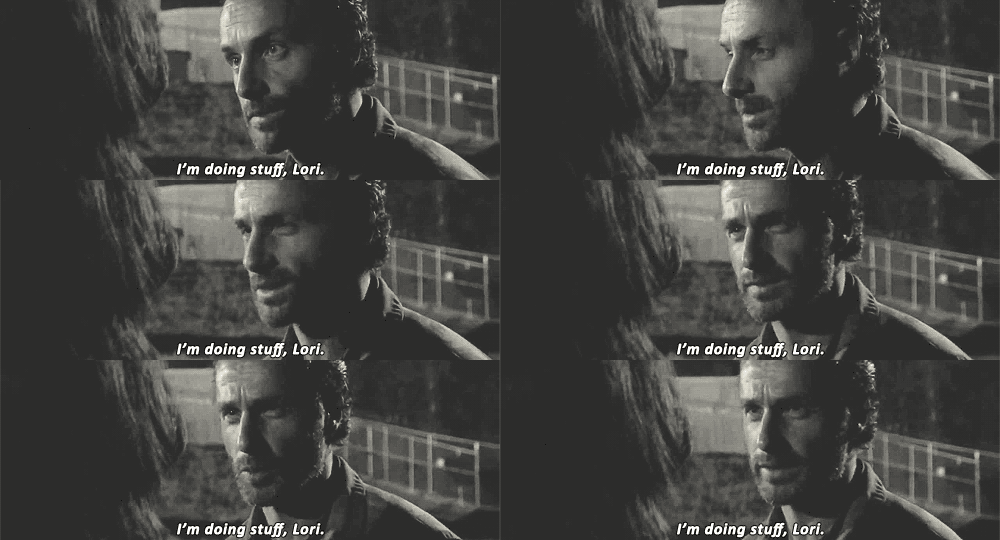
I'm doing stuff Lori

THINGS

Anyway, lest this blog become nothing but dust and tumbleweeds, here’s some filler from my drafts folder. A little while ago I was laughing about Sam waiting around the hospital for hours just to ask Patrick if he’d spoken to Elizabeth yet, and it started me thinking about how truly weird Daytime soaps are as a genre, and how conditioned we all are to just accept the weirdness. I’m not even talking about the stuff like evil twins and back from the dead so much as all the bizarre conventions of every day soap life. Like:

The Real Estate Market. Soap people are perfectly content to live in hotels. Why rent an apartment when you can just live in a five star hotel suite for years at a time?

Ric Nina and Franco

At least one of these people is a functioning adult
who ought to own some furniture.

It’s especially convenient for new arrivals, because anyone who visits a soap town for the day inevitably ends up deciding to move there on the spot and never goes back to wherever their life was previously based to take care of petty details like quitting their job, breaking their lease, moving their things, or saying  goodbye to any of friends and family. “I’ll just live in a hotel for months with no belongings, never speaking to anyone I’ve ever known before!” say new soap transplants. “That’s totally normal, right?”

The Little Big Town. Soap towns are at the same time huge metropolises with universities, airports, high class hotels, and a thriving criminal underbelly, but also small towns where literally every person knows each other. Which sounds exhausting, honestly. I don’t even know the names of the people who share my driveway.

The Cabin in the Woods. When any soap character strays more than 10 feet off the road, they are bound to run into an abandoned yet fully furnished and probably unlocked cabin in which to: have sex, store a kidnap victim, get into a shootout with a rival mobster.

(Who owns these cabins? Why are they never there themselves? What do they think when they come back and find bullets/chains/condom wrappers strewn all over?)

The Careless Whisper. Soap people are either selectively deaf or capable of inhuman hearing, depending on whether it’s sweeps or not. See related:

The Not-So-Interior Monologue. When you have a secret that no one can know, it’s always best to explain it out loud in public, as often as possible. Don’t worry if other people are in the room with you when you feel compelled to talk to yourself about something that will ruin your life if anyone else finds out. They won’t be able to hear you unless it’s a sweeps week, and then it won’t matter if you’re talking on a different continent. If it’s sweeps, SOMEONE WILL HEAR YOU.

The World’s Greatest/Worst Detective. In a similar vein, all soap characters are either inhumanly intuitive and capable of sussing out the fact that something is wrong based on zero evidence… or they are completely oblivious no matter how obviously sketchy another character is acting. There is no in between.

Denise

“Everything about this is totally normal!”

The Delayed Reaction. That 30 seconds after a dramatic revelation when a soap person will just stare blankly without speaking until we hit the commercial break. See above for the reason why no one else finds this a suspicious response to a simple yes or no question.

The Functioning Alcoholic. All soap homes — including the hotel rooms and abandoned cabins — come equipped with a fully stocked liquor cabinet with fancy barware, decanters of hard alcohol, and often, bizarrely, water. Who keeps room temperature water constantly lying around on the off chance someone’s going to stop by unannounced? Of course that’s a constant danger in soap towns, due to…

Sonny's barware

Mmm… lukewarm water and bourbon.

The Bad Phone Etiquette. No one in soap towns uses the phone like a normal person. By which I mean they mostly don’t use it at all. Why call (or email, or text) when you can just trek all over town and show up unannounced at someone’s home or work to have a five second conversation? On the rare occasions when a soap person does make plans over the phone, they will never, ever specify a particular time and place to meet and always hang up without saying goodbye. Soap people are super rude, actually.

The Unemployment Line. Jobs in soap land are a nice to have, but no one other than doctors and cops really needs them. Higher degrees can be obtained in a few months to a year, and then you only need to show up when the plot requires you be at your job. Don’t worry about paying for the expensive hotel suite you live in, either! Either the owner will owe you a favor or the salary from your one hour of work per week will totally cover it.

Maxie and Lulu lead very busy lives

What do we do all day? NO ONE KNOWS

The Nanny. Despite the fact that many of them either have no jobs or never bother going, almost every soap parent has a live in nanny. How else to find the time to run all over town having every single conversation in person?

The Soap Opera Rapid Aging Syndrome. Fortunately, none of these unemployed people need to afford their nannies for long due to the infamous SORAS, in which a toddler will go away to boarding school and come home a teenager the next year. This becomes especially complicated when children in the same age group aren’t SORASed together, leading to awkward situations where a nineteen year old who was born on screen five years ago is suddenly babysitting for a three year old born on screen ten years ago.

Cameron and Molly

One of us is older than the other.
The answer may surprise you!

The Jack of All/No Trades. Every soap lawyer is an expert at every type of law specialty, and every soap doctor can perform every type of surgery. (Want a cardiac surgeon to operate on your brain? No problem! He’ll go in through the neck. It will be fiiiiiine.) The inverse is that when someone is the best at their chosen profession, every other unnamed doctor in the hospital is apparently a garbage monster who would probably accidentally amputate all your limbs with a chainsaw. Don’t even get me started on THOSE BUTCHERS at Mercy.

ETA the following soap space/time mysteries from the comments:

The Monthday. The phenomenon by which Halloween can last an entire month and then two days later, it’s Thanksgiving. Soap people are even worse at letting the holidays breathe than Target.

The Creative Geography. All soap towns — now matter where they are physically located — are only an hour away from: Mexico, Europe, Martha’s Vineyard, all of Canada, the Dominican Republic, Australia, Las Vegas, the coast of landlocked Bolivia. Possible explanations for this include the theory that: all soap people are actually Time Lords, that soap towns are dotted with naturally occurring wormholes, or that soap people live in Truman Show-like environments and are just too stupid to realize that “Mexico” is literally a sound stage where the same bar they always go to has a sombrero stuck on the wall. You decide what seems more plausible.

despair-divider

What’s your favorite weird daytime soap trope? Will the actual show ever be watchable again? Has Rebecca Herbst’s hair finally grown out of its hideous in-between stage?

Weigh in in the comments while I gird my loins for a catch up marathon.


01 Sep 12:53

Crashing the Boy’s Club: Women Speak Out About Gender Inequality in Animation

by Amid Amidi
Women don't receive the same opportunities as men do in animation, and they're finally speaking out about it.
28 Aug 17:25

Cereal Restaurant Mania, Soup Dumplings in Downtown BK, and More Intel

by Greg Morabito

A bracing blast of restaurant news and gossip to start your day.

— New York's first cereal bar is now open inside a sneaker shop in Prospect Heights. The cereal at Kith Treats isn't even fancypants artisan-style stuff, but rather sugary store-bought flakes that are repackaged in "single-serving Mylar bags," according to the Times. One serving of cereal with milk is $6. People are already lining up for the very same foodstuff that they could purchase from literally any grocery store or bodega in the city for a much lower price. This could quite possibly be an elaborate stunt devised by Ashton and the Punk'd crew, but if you happen to stop by Kith Treats, let us know how that goes.

Three Shanghai-born restaurateurs are planning a new soup dumpling parlor at 48 Lawrence St. in Downtown Brooklyn called Yaso Tangbao. The dumpling restaurant — which will also serve noodle soups and entrees like drunken chicken — is slated to open at the end of September.

Bullets Over Broadway actor Chazz Palminteri is opening a Midtown Italian restaurant with the team behind Empire Steakhouse. The actor is currently in Italy eating pasta as research for the new project, which is officially called "Chazz Palminteri’s Ristorante Italiano."

A Florida women is suing hotelier/restaurateur Andre Balazs on discrimination charges. The woman alleges that she applied for a job as controller at Balazs's Sunset Beach hotel, but was told by the hotelier that she wouldn't get the position because she had a disabled son and couldn't give him "100 percent." Balazs's lawyer tells the Post: "We remain firmly of the view that the company’s underlying employment decision here was made on the merits and was not based on any discriminatory considerations."

— The owners of sun-splashed health food cafe Dimes are still planning to open a deli/market at 143 Division, which was the restaurant's original home before it moved across the street. Now Bowery Boogie hears that the team might also be eyeing the space directly next door, which previously housed the Great Wall Bus Company.

— Masao Matsui, the chef/proprietor of pricey Midtown newcomer Tempura Matsui, had to go back to Japan to attend to a personal emergency. His longtime team member Shin Kato is now running the kitchen.

— Michael White's three-year-old East Village pizzeria Nicoletta is applying for a license to sell hard liquor in addition to beer and wine.

— Clinton Street seafood restaurant Black Crescent is still closed because of issues related to a fire that ripped through the basement in January. The team is currently waiting on approval from the DOB and Con-Ed to finish work on the space. Restaurateur Michael Reynolds tells Bowery Boogie: "We had already been inspected and approved by Con Ed to have our gas turned on but then that explosion on 2nd Ave happened and they sent everyone back to DOB."

— And finally, here's how to cut and plate charcuterie like a professional: