


OMOCAT x POKEMON collection only available for less than two months!

close your eyes and you’ll leave this dream
 Comics publishing has hit a bit of a slowdown, as I've noted a few times, and Kickstarter seems to be picking up the slack for a lot of publishers. Comicker's Dave Acampo wrote a piece looking at this is mostly about his own Kickstarter for Comicker, but has some general observations and a pie chart of where the money goes prepared by Comicker publisher Sean Williams:

Holy stuff! Lego’s Ideas program lets amateur builders submit ideas for new sets, and if it gets 10,000 votes from fans, the company will consider making it a reality. And this morning Lego revealed one of the next sets it’s officially putting into production is aBetterMonkey’s Adventure Time creation.
If you were from Fukushima, Japan, would you move back, despite your fears about radiation?
This is the question photojournalist Michael Forster Rothbart asked as he returned to Fukushima last fall to report on what's happened over the past five years, after a tsunami and nuclear disaster hit northern Japan and destroyed the Fukushima Daiichi nuclear power plant. Some 488,000 people were evacuated from the three-part disaster. In 2015, nearly 25 percent remained displaced.
Forster Rothbart arrived one week after the nearby city of Naraha had reopened, in September 2015. He stayed in Naraha, 12 miles south of the Fukushima plant and the first town in the Fukushima Exclusion Zone to reopen after the disaster. So far, only 440 residents have returned home, out of 7,400 who had lived there before. Rothbart interviewed returning residents and asked them to write down their hopes and fears for their hometowns.
"I wanted to help these people tell their own stories," he says. "Five years ago, the news stories were about the disaster itself, but now it's time to tell stories of resilience and recovery."
In Tomioka, the town next to Naraha, no residents have returned. Evacuees are allowed to visit their former homes during daylight hours. Thousands of laborers in Tomioka are cleaning or demolishing every building, as well as removing and incinerating all topsoil in inhabited areas. In a couple of years, the government intends to reopen parts of Tomioka; other neighborhoods are too radioactive and may never reopen.
This is part of a much larger project by Forster Rothbart, called Would You Stay?, that looks at the aftermath of nuclear disasters.


Tamaki Sunaguchi is a decontamination laborer working in Tomioka. He was working in the forest division—clearing all underbrush and topsoil from nearby woodland areas and bagging it for incineration. Now he has been transferred to a road decontamination crew. For now, he's living in the mountains in Kawauchi, in a worker hotel constructed out of stacked shipping containers that have been converted to dorm rooms.
"Sometimes we work in highly contaminated areas," he says. "I worry about health, but I'll be home after a year of this." For now, he's living in the mountains in Kawauchi, in a worker hotel constructed out of stacked shipping containers that have been converted to dorm rooms.
There's a complex maze of contractors, subcontractors, and sub-subcontractors who have divvied up the government contracts for remediation work. Some lower-tier subcontractors have been criticized for underpaying workers and withholding a big chunk of workers' wages for housing and transportation, but there has been little government oversight.


Hidekatsu Ouchi is a farmer from Yamakiya village, in the middle of the Fukushima Exclusion Zone. Although the Fukushima Daiichi nuclear power plant is more than 30 miles away, the worst contamination blew directly toward his village. He knows he'll never be able to farm this land again due to the high radiation levels, but he hasn't given up hope that he'll be allowed to live here. As a temporary solution, he's rented his farmhouse out to a team of radiobiologists for use as a research station—which gives him a reason to come back regularly for visits.
Standing beside his family's shrine, Ouchi writes, "Somehow I want to restore Yamakiya to its previous situation by any means possible, and live there together (with all the original residents), all of us again." However, he worries this is impossible. "Yamakiya, which I love and where I was born and lived until today, I worry how it's going to be here from now on," he adds.


When the tsunami hit, Hisao Yanai was head of the local Yakuza (Japanese mafia) in Naraha. He says the disaster changed him; he decided to leave the mafia and dedicate himself to helping people. He now owns a Japanese pub in Naraha, but he kept many symbols of his former status, including a taxi-yellow Hummer and the stuffed polar bear in the foyer of his sprawling house.
Just after this photo was taken, Yanai, who has one hand, sat beside the bear holding a whiteboard. He wrote about his hope—"solidarity"—and his worry for the future: "How to accomplish the reconstruction of my hometown."


Mayor Yukiei Matsumoto was one of the first people to move back to Naraha more than a year ago—during decontamination and eight months before the town reopened to the public in September 2015. He has been a tireless proponent for his town. He and his staff successfully fought a national government proposal to establish a long-term nuclear waste dump in the town. Instead, they have looked for subsidies and other ways to bring new businesses here. Also, they have plans for a new "compact town" development with commercial space and housing that will replace homes lost in the tsunami. City leaders hope to attract evacuees from towns closer to the nuclear plant who won't ever be able to return to their original homes.
"I hope Naraha will become a town where we can see many children's smiles," the mayor says, careful to frame his worries in a positive light. Still, despite his efforts to persuade residents and his optimistic predictions of growth, the mayor admits he really doesn't know how many will come back.


Yukiko Endo, an evacuee from Naraha, has found a job in her hometown, working as a waitress at the newly reopened Tenjinmisaki hotel. After work, she often stops at her empty house nearby before commuting to her temporary apartment in Iwaki, an hour away. She plans to move back to Naraha in 2016, bringing her parents with her. She writes, "I hope Naraha town has lots of beautiful nature." When asked, she declines to add anything more specific.
However, a few days after the interview, she leaves us a long letter. "After the disaster, I lost the ability to believe people. So many things happened and I was about to have depression. I thought I would be spoiled at this rate, so that I decided to go out and work," she wrote. "I decided to smile all the time in order not to worry others around me. Even though the steps are very small, I now feel like being able to overcome the problem of distrusting others."


Masatoshi Ohata is an engineer working to design robots that will decontaminate the inside of the Fukushima Daiichi plant. He lives in Iwaki but has brought his grandchildren, ages 7 and 11, to go biking at a seaside park in Naraha. His wife, Kumiko Ohata, believes this visit should be safe as long as their stay does not exceed three hours.
Masatoshi writes, "Please do not forget about the people who are suffering from the damages by tsunami." As the family walks to their car, he explains the concerns he alluded to. Evacuees from the nuclear exclusion zone receive a lot of attention from the government and many benefits, including free housing and compensation for their losses and "mental anguish." However, evacuees who lost homes solely from the natural disaster are neglected and receive almost no support.

No word yet on whether the bakery is also offering rainbow doughnut holes.
People lined up for rainbow bagels, and so Moe's Doughs in Greenpoint decided to start making and selling rainbow doughnuts. Food Baby approves of these colorful cake doughnuts. The bakery's Instagram account shows a chocolate-covered version in addition to the original — you might call that one a surprise-inside rainbow doughnut. People have not started lining up for these suckers yet, but that could change at any minute. Moe's sold out of them on the first day. New York hasn't reached its novelty pastry saturation point yet and it's hard to say when — or if — that will happen.
A photo posted by euparkus (@euparkus) on
If this thing starts flying across Instagram, the Moe's team better be prepared to handle the onslaught of novelty pastry chasers, or else they, too, could implode like the Bagel Store. If you spot any other rainbow-colored circular confections out there, or any other novelty foods that people are lining up for, let us know.

New York will never be the same. The Cheesecake Factory, also known as the No. 1 restaurant of professional athletes everywhere, is opening its first New York City location this year, and it will be in a mall, of course. Known for its insanely unhealthy food, dozens of cheesecake flavors, and otherwise very lengthy menu, the ordinary suburban chain is landing in Elmhurst's Queens Center Mall, which is also home to Shake Shack. It should open, reps say, sometime this winter. The local community board estimates there will be seating for 180 indoors, with additional capacity for 50 in the outdoor patio, which could make it a pretty major nightlife destination next summer. Whether New York Knicks rookie and super fan Kristaps Porzingis will attend the opening has not yet been confirmed.
[Queens Courier via Eater]
Read more posts by Chris Crowley
Filed Under: coming soon but eh, cheesecake factory, new york, new york city, the chain gang
From the March 7 edition of TBS' Full Frontal with Samantha Bee:
Previously:
Washington Post Shows How -- And How Not To -- Cover The Politics Of Guns
Even Tucker Carlson Acknowledges Republicans "Could Lose This Debate" On The Gun Issue In 2016
What 2016 Holds In Store For Guns, The NRA, And The Presidential Election

Nisi Shawl, the founder of the Carl Brandon Society, author of the James Tiptree, Jr. Award-winning Filter House and the upcoming Everfair has done us all a great service! She shared “A Crash Course in the History of Black Science Fiction” that provides a decade-by-decade outline of Black science fiction and fantasy novels that could be the basis of the best literature class you’ll ever take… or an essential guide for your TBR stack.
Shawl organized the list by author rather than title (so a few names appear more than once) beginning with Martin R. Delany, who authored Blake: Or; the Huts of America in 1859, and bringing us to 2015 with Walidah Imarisha and adrienne maree brown, the editors of Octavia’s Brood. After outlining her methodology, she gives short blurbs for each author, and discusses why particular titles were chosen. While big names like Samuel Delany and Octavia Butler are well represented, Shawl also digs further into the past to share the work of SFF pioneers like Martin Delany, Charles Chesnutt, and Pauline Hopkins. She highlights the speculative work of W.E.B. DuBois and Lorraine Hansberry, and points toward a future where authors like Balogun Ojetade spins steampunk fantasies from stories of Harriet Tubman, and Kai Ashante Wilson creates modern horror as he delves into the massacres of Rosewood, Tulsa, and Wilmington.
Shawl talks about her initial inspiration for the list:
In 1909 Harvard’s president, Charles W. Eliot, issued a 51-volume anthology he claimed could provide its owners with a complete liberal arts education. In the same vein, I’ve pulled together an annotated list of 42 black science fiction works that are important to your understanding of its history. You’ve got the rest of 2016 to read them. That’s doable, isn’t it?
She also speaks to the way genre itself becomes fraught when your dealing with a history of oppression:
…some of these works could be construed as fantasy rather than science fiction. The distinction between these two imaginative genres is often blurred, and it’s especially hard to make out their boundaries when exploring the writing of African-descended authors. Why? Because access to the scientific knowledge from which SF often derives has been denied to people of the African diaspora for much of history. And the classification of what is and is not scientific knowledge hasn’t been under our control — it’s frequently a matter of dispute. Also, it’s sometimes difficult to understand the history of black science fiction without reference to the history of black fantasy.
One of the most exciting aspects of the list is seeing the way Black SFF begins incorporating African and Caribbean mythic traditions, tapping into a rich vein of lore that offers readers a different perspective than the Eurocentric, vaguely Celtic fantasy that has been the genre’s standard. Head on over to Fantastic Stories of the Imagination for the full reading list! You will thank us.


Artworks of The Summit of the Gods french 2D animated feature film project, based on manga by Jiro Taniguchi. Directed by Eric Valli and Jean-Christophe Roger. Coproduced by Folivari (Didier Brunner) and Julianne Films.


European animated feature film projects presented at Cartoon Movie 2016 festival :
- “Spirit Seeker” by Bo Juhl Nielsen, Sun Creature studio (The Reward) and Norlum.
- “Moustique, Cigale et Cambriole” by Cédric Babouche (Dandelooo).
- “Louise en Hiver” by Jean-François Laguionie.
- “Night of the Trampires” by Mike Mort (Trampires, Blue Dolphin Films, Animatrix).
- “Heart of Darkness” by Rogério Nunes (Les Films d'Ici).
- “Domenica” by Ugo Bienvenu & Kevin Manach (Miyu Productions).
- “Funan” by Denis Do (Les Films d'Ici, Epuar).
- “Old Man Coyote” by Aron Gauder (Cinemon Entertainment).
- “Nayola” by José Miguel Ribeiro & Jorge António (Filmes da Praça, S.O.I.L., Geração 80).
- “Privisa” by Platige Image, Animoon, and Juice.
(more informations)
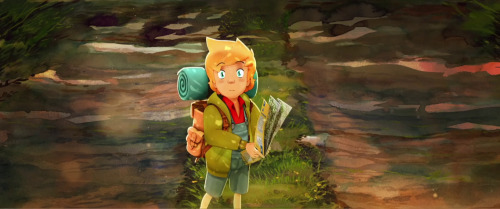
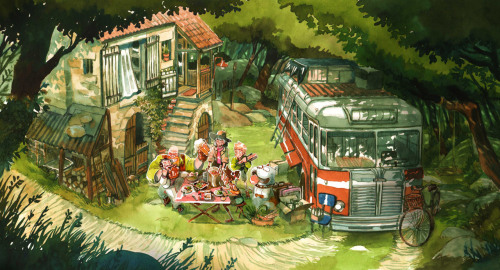

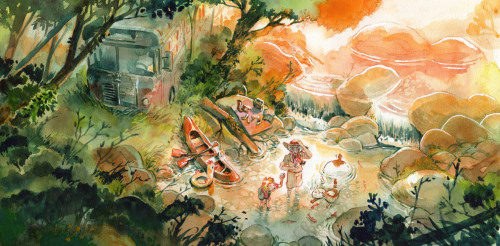

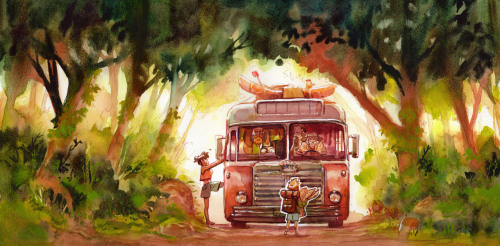


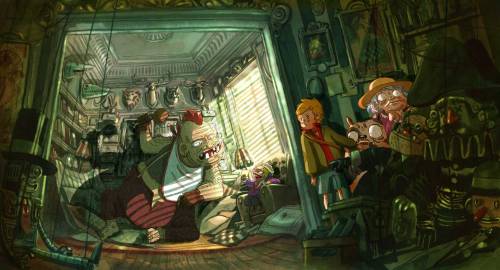
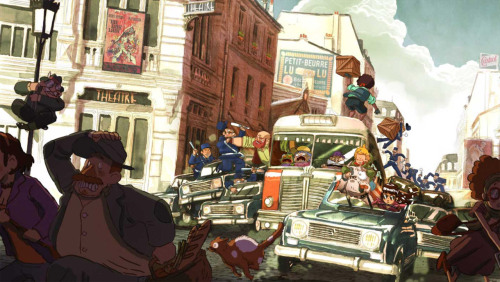
Artworks of “Moustique, cigale et cambriole” (was “Travel to Mama”) french CG animated feature film project by Cedric Babouche & Dandeloo studio.
Animation test : https://www.youtube.com/watch?v=KNl8_VtbNBA
The producers of "Kim Possible" have been placed in charge of Baymax and Hiro.
The post ‘Big Hero 6’ TV Series Arriving in 2017 appeared first on Cartoon Brew.

Marvel Entertainment and Netflix have rounded out The Defenders by casting Iron Fist: Finn Jones (Ser Loras Tyrell on HBO’s Game of Thrones) has signed on to play Danny Rand. A martial arts master able to tap into the mystical force of the Iron Fist, Danny can focus his chi as a superpower. While no release date has been set for Iron Fist’s series, he’ll eventually team up with Jessica Jones, Luke Cage, Daredevil, and the Punisher in the Defenders series.
Scott Buck (Six Feet Under, Dexter) has been tapped as showrunner for the series; he’ll be helped by Scott Reynolds, writer/producer for Jessica Jones. Marvel and Netflix released a synopsis a few months ago:
Returning to New York City after being missing for years, Daniel Rand fights against the criminal element corrupting New York City with his incredible kung-fu mastery and ability to summon the awesome power of the fiery Iron Fist.
Entertainment Weekly broke the news, though neither Marvel nor Netflix has confirmed the casting.
Filmmaker David OReilly reports on his experiences at the one-of-a-kind Georama animation festival in Tokyo.
The post David OReilly on Tokyo’s Georama, A Different Kind of Animation Festival appeared first on Cartoon Brew.

Now that McDonald's has gone all-in on all-day breakfast, the restaurants presumably have all kinds of new ingredients sitting around. That explains why today McDonald's announced that it will combine fried-chicken patties and those little syrup-infused pancake buns it uses for McGriddles to make a heretofore-unseen new breakfast sandwich, called the Chicken McGriddles.
Columbus Business First reports Ohio franchisee Brian Mortellaro, the dish's inventor, just did a bit of MacGyvering, since the chain's breakfast menu is waffles-poor. Still, making his new sandwich work doesn't sound like it was that taxing — the only actual change it requires in the kitchen is serving the McChicken during breakfast hours.
McDonald's trivia buffs will note that the Chicken McGriddles isn't an entirely new concept. It's a known menu hack, accomplished by adding a McChicken patty to a McGriddles of the customer's choosing. Also, a variant has been tried before in California, though the reception wasn't what you'd call warm, probably because execution was pretty third-rate.
The sandwich is going to be tested through March 27 at Mortellaro's stores. If customers respond well, then the rest of central Ohio could get a larger run. Going national is no foregone conclusion, in other words, but the Big Mac and Filet-O-Fish got their starts as franchisee Frankenfoods, and Mortellaro would seem to have the Zeitgeist on his side. He rightly notes a viable fast-food version of chicken and waffles is just "something that isn't out there right now."
Read more posts by Clint Rainey
Filed Under: the chain gang, all-day breakfast, chicken mcgriddles, mcdonald's, ohio

These are the restaurants and bakeries that make the finest doughnuts in New York City.
New York City has a great mix of old and new bakeries that sell excellent doughnuts. The city also has a number of restaurants that serve doughnuts that go the distance. Here's a guide to 14 doughnut destinations worth seeking out.




Aiko TV series project by Evan Viera & Charley Pope (ROYGBIV studio).
Trailer : https://vimeo.com/154551506

This article originally appeared on the Kickstarter page for People of Color Destroy Science Fiction!, a special issue of the Hugo-winning magazine Lightspeed, 100% written—and edited—by POC creators.
The first sci-fi short story I ever wrote—an overwrought love-child of tattered 2000 AD comics, William Gibson, repeat listens of Erasure and Europe (not ashamed) MP3s, and an adolescent confusion of bloodlust and anti-war sentiment—took place in an irradiated, war-torn North America. Its protagonist was a white man, a soldier trying to escape The Man’s telepathic control. The first novel I wrote, also in my late teens, had at its epic fantasy center a strapping white lad with, ahem, braids, unconsciously modeled on the features of Christopher Lambert’s stoic Highlander Connor McLeod. While I was writing these white boys on my Windows 98 PC, I never left Kolkata, India, where I’d spent every year of my life. The fingers dancing on that chunky yellow-gray keyboard were and are brown as (light) toast.
Why the white boys? I’d say living in the aftermath of centuries of invasive European colonialism might’ve had something to do with it. Hence my typing these words in English, instead of my native Bengali. Hence the often white writers and protagonists I grew up reading, watching, emulating, and ultimately recreating, when I decided to insert my obtrusively brown self into the life cycle of pop art.
Sci-fi was always a thing distinctly familiar yet foreign. Mainstream Indian writers or film-makers didn’t do sci-fi, despite the elephant-headed gods and giant monsters and flying monkeys in our legends. But Anglophone Indians were and are a sizable consumer of foreign sci-fi. I’d grown up absorbing it from wrinkled VHS tapes, cathode ray tubes and pre-multiplex “cinema halls,” from Star Wars to Star Trek (why choose one; I loved both), E.T. to Jurassic Park. My brother and I huddled by the static tickle of our TV set late at night when my parents went out, thrilled at the illicit red stamp of the 18+ rating before movies like RoboCop, Predator, and Alien unspooled uncut on cable (before the Indian government realized people were getting away with swear words and boobs on fucking television). And as I saw, I read too—the prose versions of the same. The first sci-fi novels I read were Crichton books and novelizations of movies (often by Alan Dean Foster), or extended franchise universes.
I gravitated to the unabridged make-believe of science fiction (and fantasy) partly because of diversity. Like a manic priest with a rosary I flicked through the necklace of infinite worlds that genre offered, and yearned to add my own to the string. I wanted to write stories for everyone in the world, not just India, and the limitless scope of non-realism seemed the best way to do that. I wanted to help create a mythology of tomorrow, suitable for the entire planet. In the hyper-dense humanity of Chiba City and Mega City One, the variegated bazaars of Mos Eisley, the hundreds of planets of the Federation, populated by thousands of cultures and species and races, I saw the overpopulated chaos of the world as seen from an urban Indian viewpoint. Even at its darkest, science fiction and fantasy were freedom from the smallness of Earth.
Growing up with these imaginative riches curiously absent from Indian contemporary art and media, I didn’t even notice all the white protagonists, writers, directors, and actors in this boundary-less creative multiverse I so admired and wanted to be a part of. Or I didn’t mind this prevailing whiteness, because I was taught not to. That, of course, is the quiet hold of cultural white supremacy.
It wasn’t until I was on a campus in the middle of Pennsylvanian Amish country, surrounded by young white undergrad creative writing students in a workshop class taught by a white professor, that I realized I mostly wrote white protagonists. I’d never felt less white, which made the repeated pallor of my protagonists blaze like a thousand suns.
It’s a ponderous realization familiar to many POC writers—that you, brown-faced and full of pluck, are yourself propagating that post-colonial, global capitalist notion of the white person as the moral, cultural, and physical default human being (and thus consumer) of planet Earth (and the universe, in sci-fi). The rest is “other,” including you, a notion you might even have taught yourself to like (maybe the marketability of pandering, of exoticism, might just give you a bump up in the capitalist meritocracy?).
That mostly white undergrad workshop class, the first I attended, was where I stopped blindly writing white protagonists.
I’m not apologizing for growing up inspired by so much science fiction made by white people primarily for white people. Hell, I think white creators should be proud that their work found fans across the planet, and acquired some shade of the universality that sci-fi is supposed to espouse in its futurist openness. Just as languages spread and mutate on the vector of history (I see no need for gratitude, explanations, or shame for the words I use just because they were introduced to India by colonizers—Indian English is no different than American English or Quebecois French), so too do genres and art, and it’s time to recognize that sci-fi and fantasy are so dominant in pop culture now because fans the world over helped make it so. But if international sci-fi is to change, instead of stagnate into a homogenous product for the algorithm-derived generic consumer, it needs to foreground the profuse collective imagination of the entire world, instead of using it as background color for largely white stories.
We were there. We were geeks too, before geek culture became a high value, red-hot element of “globalization.” Not just South Asians, but readers and viewers all over the world—we were there beyond the West, buying, watching, playing, reading, spreading the word about all the books, movies, comics, video games, and TV that convinced Our Capitalist Overlords to divert science fiction and fantasy into mainstream ubiquity (for better and worse) and, increasingly, respect. We deserve our share in science fiction’s continued creation, not just as the other voices, the special and exotic exceptions, the diversity quota, but as fellow voices of a polyphonic planet.
Top image by artist Joshua Mays.
Indrapramit Das (aka Indra Das) is a writer from Kolkata, India. His debut novel The Devourers (Penguin Books India) was nominated for the Shakti Bhatt First Book Prize in India, and is slated for a summer 2016 release in North America from Ballantine Del Rey. His short fiction has appeared in a variety of publications and anthologies, including Clarkesworld, Asimov’s, and The Year’s Best Science Fiction. He is a 2012 Octavia E. Butler Scholar, and a grateful graduate of the Clarion West Writers Workshop. Follow him on Twitter @IndrapramitDas.
Back in September, while at a pumpkin patch with her kids, Samantha Bee caught a glimpse of the late-night TV boys' club in all its glory.
She saw a tweet with a photo from an October Vanity Fair story lauding the new era of late-night comedy. The spread featured household names—Colbert, Fallon, Conan, Kimmel, Oliver—as well as lesser-known hosts like James Corden and Larry Wilmore. Trevor Noah, who hadn't yet debuted at The Daily Show, was also there. There weren't, however, any women.
"It was like a troll job, for sure," Bee now says. "and they were trolling the public." So she instantly released a troll job of her own: a photoshopped image of her face on a centaur's body shooting lasers out of her eyes. "BETTER," Bee quipped on Twitter.
.@VanityFair BETTER pic.twitter.com/EfPbTQ3qZ8
— Samantha Bee (@iamsambee) September 14, 2015
Now, four months later, Bee is set to break into the fraternity: Her new show, Full Frontal With Samantha Bee, debuts Monday at 8 p.m. EST on TBS. And forget the typical dude-sitting-behind-a-desk late-night aesthetic—Full Frontal will feature a standing Bee riffing in front of a line of TV screens and throwing to on-location segments, covering everything from Syrian refugees in Jordan to the treatment of female US veterans.
We caught up with Bee leading up to the February 8 premiere to discuss satire and feminism, diversity in the workplace, and the rise of Donald Trump.
Mother Jones: You joined a predominantly male team at The Daily Show from a four-woman comedy troupe in Toronto. How did you manage that transition?
Samantha Bee: It wasn't a gender concern for me. It was like, "Oh, I've just gone from having a relatively relaxing life and doing comedy at my own pace to suddenly sitting in a room with people whose work I've admired for years and years." I definitely felt out of my league at first. Building a show once a month is vastly different from making a show happen every day with high-quality comedy. The pace was very fast, so your ideas get a hard "no" very fast. I just had to get used to that. I just had to get used to that pace. I didn't know how to edit myself. You need to learn how to kill your joke babies right away if they don't work, and that was a great lesson. I became a great editor of my own material. You've gotta have a lot of ideas, and it's gotta happen fast.
MJ: You started at The Daily Show in 2003, after the start of the Iraq War. As a Canadian, how prepared did you feel commenting on American politics?
SB: We follow US politics quite closely in Canada. It was definitely something I was interested and motivated to follow. It was a part of my life keeping up with international stuff and keeping up with what was happening in the United States. I didn't feel prepared. I didn't know anything about American history, really. [Laughs.] I mean, not in an immersive way. So in no way did I feel prepared for how it would be. It's that imposter syndrome when you sit around thinking, "Why would they hire me? Oh my God, when are they going to figure out that I shouldn't be here?" I guess that they never figured it out. I got pretty lucky.
MJ: How do you think this current US election cycle would play out in Canada?
SB: Canadians, in general, are pretty awestruck by the kinds of character studies you get to do during a US election cycle. It's been true for any election cycle I've been a part of, for sure. It's such a circus, and it goes on forever. It's a long, long process, whereas in Canada, there's a set period of time within which to campaign and that's all you have. You don't have the kinds of funding. Canadians definitely watch it with their jaws on the floor. It's inconceivable to any Canadian that Donald Trump would even be spoken of in the same breath as the office of the presidency. Inconceivable. As a dual citizen of the two nations, I'm still awestruck by it. [Laughs.]. I think we all are. I'm not able to go there yet. Not quite.
MJ: What do you miss most about your time at The Daily Show?
SB: Well, I miss Jon, for sure. But when I left, I left with having had such a full and complete experience that I don't really miss it. I look back on those years with nothing but fondness. I enjoy making and building a new experience for myself, but anyone who I left there, I could still just call them. When it was finished for me, it was finished.
MJ: What are you happy to be done with?
SB: I will be excited to do a show one night a week. That's perfect for me. Doing a scripted show is hard, hard work. It's hard, physical, but we're going to get there soon. It's almost athletic. It's mentally athletic. It's physically athletic. It really breaks you down. That I will not miss. And also, I'm looking forward to being a host who's just directing things.
MJ: What does it mean to become the only female late-night host on television?
SB: It's really exciting for me. I think I would be doing this even if I wasn't the only female in that space. There's room for lots of voices. There's certainly room for more female voices. It's just the way it works out that my show is hitting the airwaves before anyone else. I think there will be more after me, so it definitely means a lot to me. But it's not the only thing that means a lot to me. Just having the ability to fully express myself and fully drive a show is really the most exciting part of me. And I like all those guys tremendously. It's just hard to imagine. When you think about the women who have come before me in that space, it's such a small number of people. It's really unthinkably small. I just don't know why. I really don't know why.
MJ: What, if anything, have you drawn from other women in the industry?
SB: I don't think about it too much. Maybe that's a bad thing, but for me, I can't focus on what other people did. It's better for me to drive forward. What I'm really trying to do is create a show that I would want to watch. That's all I'm trying to do: Build a show that I think would be entertaining, and make a tiny little package with a bow on it and present it to people and hope that they like it too. I'm not taking on board too many thoughts of other people's shows or traditions or anything like that. I can't. I wrote a book, but I didn't read other people's books when I wrote my own book.
MJ: What was the big takeaway from that man-centric Vanity Fair photo spread?
SB: I think those guys are great, by the way. It's not personal. It's just that when you look at the photo, you really capture the fact that there are like a crazy number of male hosts in suits. [Laughs.] It's not even a ratio. It's an imbalance. The teeter-totter just toppled over. There's nobody on the other side. I think everyone is just so tired of it. It's one thing to know it, but that just created the perfect visual portrait of what it means to only have [male] late-night hosts. People just had an emotional reaction to it, and so did I. We were all in it together.
MJ: In a recent New York magazine story, the writer describes you as an "unapologetic feminist." Is it important to you to bring that perspective to your work?
SB: I don't think about whether it's feminist or not feminist. I think about what the issues are going to be. I always have been a feminist. That's how I grew up. We never really thought about it. It's just the reality. I think my daughters are feminists. We don't have to theorize about it too much. It just is. That's how I feel. Somebody was asking me that question the other day, and I was like, "You know, would you not think that you can watch The Late Show because it's hosted by a man? Would you wonder, would you sit and go, "Ugh, this is going to be all about man issues? Like, is there anything for me to watch in this show hosted by a man?" It's strange to me that people would think that this show would be just strictly isolated to women's issues. Like obviously, there are issues that I feel passionate about and want to be a part of it, but we can all handle it. Men and women can handle it as people.
MJ: Do you think there's a difference between what makes men laugh and what makes women laugh?
SB: I don't. I really don't think there's a difference. I don't think there's a difference at all in the things that we laugh at.
MJ: Why not?
SB: Because there's no difference for me. I don't laugh at jokes for women. My experience is different, I guess. But a good joke is a good joke. I'm picky about my jokes. I'm very critical about my jokes, and the material just has to win the day. You can do a themed piece on anything, but if the jokes don't win the day, what's the point? I have a really tough sense of humor, but I don't have a gendered experience of laughing at things. People bring their own experience to the table, but I don't think of it that way at all.
MJ: Your show—the writers' room, the cast, the segments—is notably diverse. Why was that an emphasis for you?
SB: There's so much lip flap devoted to creating diversity in the workplace, especially in the entertainment industry. I think we can all see that. We can see the direct realization of that. It's just a fact. When you're given the gift of being able to do your own thing, you can create the kind of workplace you want to create. I think we all benefit from hearing everybody's stories. It makes our world better. It includes more voices. It includes more people's stories. It makes life worth living, you know what I mean? I'm not interested in living in a bubble where I'm only entertaining people just like me, or I'm only singing to my own versions of myself. I love myself, but I think you can do better. [Laughs.]
Part of how you do better at diversity is you just hire people who are diverse. You make a point of it. You have to do it. It's not going to change if people don't actually just do it. You can do it, and it takes a little extra time. It takes more thought, and that's what we are trying to do. I don't even think we did a perfect job. I don't think there is a perfect job, but we are absolutely putting our money where our mouths are.
Watch these choice clips from the premiere below, just in time for today's New Hampshire primary:
The US Justice Department has sued the city of Ferguson, Missouri, following months of "painstaking negotiations" with local officials and more than a year of investigating their alleged discriminatory and unconstitutional practices.
The Justice Department launched its investigation into the Ferguson Police Department after 18-year-old Michael Brown was shot and killed by a Ferguson police officer in August 2014, sparking months of protest across the country and public outcry over the use of deadly and excessive force by the police.
On Wednesday, Attorney General Loretta Lynch announced that the Justice Department was filing a lawsuit against Ferguson one day after the city council rejected a proposed settlement that sought to "remedy literally years of systematic deficiencies." The Justice Department spent more than six months negotiating a settlement with local officials after it identified widespread civil rights violations and racial discrimination in the Ferguson Police Department's stops, searches, and arrests. It also alleges that local court proceedings violated the due process of residents. The city council's rejection of the agreement, Lynch said, "leaves us no further choice."
Here is the full text of the lawsuit:
Here's the full text of Lynch's remarks:
Good afternoon and thank you all for being here. I am joined by Vanita Gupta, head of the Civil Rights Division.
Nearly a year ago, the Department of Justice released our findings in an investigation of the Police Department of Ferguson, Missouri. Our investigation uncovered a community in distress, in which residents felt under assault by their own police force. The Ferguson Police Department’s violations were expansive and deliberate. They violated the Fourth Amendment by stopping people without reasonable suspicion, arresting them without cause and using unreasonable force. They made enforcement decisions based on the way individuals expressed themselves and unnecessarily escalated non-threatening situations. These violations were not only egregious – they were routine. They were encouraged by the city in the interest of raising revenue. They were driven, at least in part, by racial bias and occurred disproportionately against African-American residents. And they were profoundly and fundamentally unconstitutional. These findings were based upon information received from Ferguson’s own citizens, from Ferguson’s own records and from Ferguson’s own officials. And they demonstrated a clear pattern or practice of violations of the Constitution and federal law.
After announcing our findings one year ago, we began negotiations with the city of Ferguson on a court-enforceable consent decree that would bring about necessary police and court reform. From the outset, we made clear that our goal was to reach an agreement to avoid litigation. But we also made clear that if there was no agreement, we would be forced to go to court to protect the rights of Ferguson residents. Painstaking negotiations lasted more than 26 weeks as we sought to remedy literally years of systematic deficiencies. A few weeks ago, the Department of Justice and Ferguson’s own negotiators came to an agreement that was both fair and cost-effective – and that would provide all the residents of Ferguson the constitutional and effective policing and court practices guaranteed to all Americans. As agreed, it was presented to the Ferguson City Council for approval or rejection. And last night, the city council rejected the consent decree approved by their own negotiators. Their decision leaves us no further choice.
Today, the Department of Justice is filing a lawsuit in U.S. District Court against the city of Ferguson, Missouri, alleging a pattern or practice of law enforcement conduct that violates the First, Fourth and 14th Amendments of the Constitution and federal civil rights laws. We intend to aggressively prosecute this case and I have no doubt that we will prevail.
The residents of Ferguson have waited nearly a year for their city to adopt an agreement that would protect their rights and keep them safe. They have waited nearly a year for their police department to accept rules that would ensure their constitutional rights and that thousands of other police departments follow every day. They have waited nearly a year for their municipal courts to commit to basic, reasonable rules and standards. But as our report made clear, the residents of Ferguson have suffered the deprivation of their constitutional rights – the rights guaranteed to all Americans – for decades. They have waited decades for justice. They should not be forced to wait any longer.


