Shared posts

06 Apr 13:18

New York Gov. Cuomo Issues Mississippi Travel Ban for Discriminatory Anti-LGBTQ Law

by Elliot Hannon

New York Gov. Andrew Cuomo struck back Tuesday with his pen and his state’s pocketbook against the state of Mississippi by issuing a travel ban on the state after Gov. Phil Bryant signed into law an expansive anti-LGBTQ bill earlier in the day. The executive order, which is effective immediately, “requires all New York State agencies, departments, boards and commissions to … bar any such publicly funded travel that is not essential to the enforcement of state law or public health and safety.”

The order says the new Mississippi legislation “explicitly permits and enshrines discrimination” and the executive action is designed to protect New York “from inadvertently financing discrimination.” The Mississippi legislation itself is a measure designed to allow individuals the ability discriminate against LGBTQ individuals under the auspices of "religious liberty" across a broad cross-section of public life, including housing and employment. Slates Mark Joseph Stern outlined examples of how individuals' rights would be infringed upon by the new law:

It allows religious landlords to evict gay and trans renters; permits religious employers to fire workers for being LGBTQ; allows adoption agencies—private and state-run—to turn away same-sex couples; allows private businesses to refuse services to gay people; allows clerks and judges to refuse to marry same-sex couples; and forbids trans students from using public school bathrooms that align with their gender identity. No state has ever passed a law so blatantly rooted in malevolent animus toward LGBTQ people.

Cuomo has taken an activist approach to regressive legislation in southern states; last week, he issued a similar ban on non-essential state travel to North Carolina after its Republican Gov. Pat McCrory signed into law similar allowances for discrimination in public life against LGBTQ individuals under the guise of religious freedom.

06 Apr 12:42

Publication Bias Is Boring. You Should Care About It Anyway.

by Kevin Drum

You all know about publication bias, don't you? Sure you do. It's the tendency to publish research that has bold, affirmative results and ignore research that concludes there's nothing going on. This can happen two ways. First, it can be the researchers themselves who do it. In some cases that's fine: the data just doesn't amount to anything, so there's nothing to write up. In other cases, it's less fine: the data contradicts previous results, so you decide not to write it up.

The second way it can happen is via journal editors. Generally speaking, they prefer papers with exciting new results. This, of course, makes things even worse for researchers. They're not much interested in writing up negative results in the first place, and they're even less interested if they know there's virtually no chance of getting them published in a good journal.

Why bring this up? Because yesterday Brian Resnick wrote about a truly remarkable case of publication bias. It revolves around research showing that the hormone oxytocin increases trust between humans. At first, multiple lines of research suggested it could. But then Anthony Lane, one of the primary researchers in the field, began getting negative results:

After 2010, fewer and fewer of their lab's experiments yielded data that confirmed the oxytocin could reliably increase levels of trust....The doubts crested in 2014 when Lane and his colleagues couldn't replicate their own envelope study....The lab was able to publish this negative finding, but Lane felt a larger problem was lurking. Labs are judged on the strength of their published work. And Lane's published portfolio on oxytocin just wasn't representative of their work anymore. They still had five papers showing promise for oxytocin, and only one casting doubt.

In a new paper published March in the journal Neuroendocrinology, Lane and his colleagues go through their "file drawer" of studies, and conclude the whole of their work yields an inconclusive result on the power of oxytocin spray to change behavior. They looked at 25 different tests their lab conducted. Only six of the 25 tests yielded significant results. In aggregate, the difference between the oxytocin sniffers in their studies and placebo groups "was not reliably different than zero," the paper found.

When they tried to submit their null findings, they "were rejected time and time again," the paper reports.

So there you go. Not just a boring "no result" study from an unknown researcher. Nor a trivial correction to previous work. This is a well-known researcher evaluating his entire output on a subject and concluding that he's been wrong for years. And yet he couldn't get it published.

Lots of null results don't deserve to be published. But lots of them do: otherwise readers are left with an impression that the evidence is far more positive than it really is. That's the case here: the overall impression Lane and others had left is that oxytocin works. It increases trust levels. Without a corrective, that's what people would go on believing.

Everyone knows about this problem. Everyone agrees—in theory—that it needs to be addressed. And yet nothing ever seems to happen. Science deserves better.

06 Apr 03:43

BABYMETAL To Perform on "The Late Show With Stephen Colbert" Tonight

by news+feed@crunchyroll.com

With a new album titled "Metal Resistance" out now and a US spring tour kicking off next month, mini-metalheads BABYMETAL have alerted fans that their previously listed appearance on Letterman successor Late Night with Stephen Colbert is imminent. Tune in to CBS at 11:35 p.m. EST / 10:35 p.m. CST to catch the trio.


From last night.


They've also posted a second music video from "METAL RESISTANCE"


Previously


------
Scott Green is editor and reporter for anime and manga at geek entertainment site Ain't It Cool News. Follow him on Twitter at @aicnanime. 

05 Apr 23:06

Trump, the Media, and You

by David Corn

One night in March, after yet another pair of primary victories, Donald Trump took to a stage in the ballroom of his Mar-a-Lago resort. After hawking his various products (Trump Steaks!), he took questions from the media. Almost all the queries were about the horse race: Could he win the general election? What was his message to Marco Rubio? Would he be able to bring the party together? This allowed Trump the opportunity to boast that he is a winner, to insist he is "more presidential than anybody other than the great Abe Lincoln," and to proclaim, "I am a unifier."

How illuminating.

There was not much probing going on. The one policy-related question came from Jeremy Diamond of CNN, who asked Trump what he would tell consumers if, as president, he imposed high tariffs on China and Mexico and the cost of goods skyrocketed. Trump tried to cut off the question, saying, "Nobody is listening to you, Jeremy."

This one campaign moment was a snapshot of media failure in a primary season that is unlike anything we've ever seen. Entertaining? You bet. But vetting a candidate for one of the most powerful positions in the world is serious business, and for that we need serious journalism.

That's why I'm asking you to make a tax-deductible donation to Mother Jones during our spring fundraising drive—and I hope that my observations regarding the coverage of the race will make for a compelling pitch. I don't usually ask for donations—I'm a reporter, not a pitchman—but I think what we do is pretty damn important. And since we're a nonprofit, we need to raise $175,000 from readers like you by April 30 to maintain the level of reporting you expect from us (and won't find with most other media).

Donate Now


I could probably leave it there: I could point to the most bizarre election we've ever seen and make the case that our democracy needs the type of reporting you get from Mother Jones. But here at MoJo, we're moving away from the standard fundraising appeals, the dire pitches, and the shopworn gimmicks. Instead, we're applying the values that drive our reporting—substance, facts, and transparency—to our fundraising efforts. It worked last December, and I hope it does now.

At the start of 2015, conventional wisdom said we'd be looking at a snooze-fest of an election, dominated by the unexciting Jeb Bush and the too-well-known Hillary Clinton. They had the experience, the party backing, and the support of the megawealthy donors. But a year later, the Republican contest resembles a professional wrestling match far more than the Lincoln-Douglas debates (no coincidence: Trump used to be a business partner of World Wrestling Entertainment, after all), and Bernie Sanders' improbable rise has taken most insiders by surprise.

Early on, the cable networks discovered that airing Trump's ranting and raving—at rallies or elsewhere—was a boon for ratings. Not many thought Trump would be a viable candidate once people started voting, so he wasn't treated like one. Each time he said something outrageous he received more coverage, and he and the networks won a bigger audience—ad infinitum. Meanwhile, many in the media ignored Sanders early in the campaign; they didn't think there was a big audience for his “political revolution."

CBS president and CEO Les Moonves explained it like this: “[It] may not be good for America, but it's damn good for CBS…It's a terrible thing to say, but bring it on, Donald, go ahead, keep going.”

He's right: What's good for advertisers or networks or publishers isn't always what's good for the public. That's why we do things differently at Mother Jones. We don't rely primarily on advertising dollars. Our support comes from readers. That's how we've been able to turn out independent, spin-busting investigative reporting for 40 years that challenges demagogues and the status quo.

Donate Now


Don't get me wrong. There has been some great, in-depth reporting during this campaign. The New York Times revealed Rubio and his family's cozy relationship with a billionaire auto dealer with a political agenda. The Huffington Post, scrutinizing Bush's emails, probed his record on the death penalty. The New Yorker explored how white nationalists embraced Trump's xenophobic campaign. The Washington Post chronicled the rise of the Clinton Foundation.

And I don't want to come down too hard on the journalists embedded on the Trump campaign. Some political reporters are tasked with chronicling the crazy, nanosecond by nanosecond—sorting out what the candidates, strategists, donors, and even the voters are doing. It is not a big part of their job to dig into the past or policy stances of the candidates.

But when so many of the questions directed at Trump from the reporters who have the most access to him are about politics as sports—so, slugger, how did you do out there today, and are you worried about the playoffs?—the public loses. Of all the massive media attention Trump has drawn, only a small percentage has focused on substance. And even when the media fixates on a serious matter—say, Trump's call for banning Muslims from entering the United States—the subject can be blown away by the next headline-capturing insult du jour.

Please Donate!

By the way, our reporters—including me—have been banned from Trump's campaign events. In more than 30 years of covering elections, national and local, I have never been barred from a campaign event open to the press—until this season. The Trump camp apparently has concluded that independent media coverage is harmful. But being shut out of the scripted Trump events has not stopped us from producing revelatory articles (see below) about the tycoon whose campaign of extremism has thrived within the politics of hate that for years has been encouraged and exploited by the Republican establishment.

This isn't just about Trump. Not many reporters have combed through Ted Cruz's pre-Senate record. Where's the digging into John Kasich's days at Lehman Brothers? Sanders' intriguing history was largely ignored for months. And for a long stretch, though Clinton's ties to Goldman Sachs and other Big Finance firms were part of the political discourse, not many media outlets were exploring the details of those connections.

If you've read this far, I'd venture to say you want smart, probing journalism that avoids the sound bites and explodes the spin with facts. That's the type of journalism Mother Jones can produce, thanks to contributions from readers like you.

Donate Now


In a world of ratings and clicks, financially pressed media outlets frequently zero in on the shining objects of the here and now. Merely covering Trump's outrageous remarks—did you see his latest tweet?!—has become its own beat. Even the best reporting that does happen can become lost in the never-ending flood of blogs, tweets, Facebook posts, and stories that appear in increasingly shorter news cycles.

At Mother Jones, we try each day to sort out what to cover—and where to concentrate our kick-ass reporting in order to make a difference. Yes, we need to follow the daily twists and turns. But we recognize it's important for journalists to get off the spinning hamster wheel and dig where others do not. This is how we got the 47 percent story in 2012. And it's what we're doing these days.

When we dig, we find stories that expand the frame of the campaign and get to the bigger issues: Trump's deal with a controversial oligarch in Azerbaijan and his phony claim that he predicted the rise of Osama bin Laden; Cruz's surprising record as a corporate lawyer and the extreme fundamental beliefs of his chief campaign surrogate, his father; Ben Carson's embrace of a "nutjob" conspiracy theorist and his real estate deal with a convicted felon; Bush's involvement with a company that swindled Nigerians; Rubio's reliance on hawkish neocon advisers; Kasich's war on abortion providers in Ohio; Clinton's promotion of fracking overseas when she was secretary of state; Sanders' complicated and controversial history.

We aim to hold all the powerful accountable. When Trump claimed he relied on a former military official for foreign policy advice, we contacted this retired colonel, and he told us that he had never discussed policy with the mogul. That is, we caught the GOP front-runner in a blatant lie. In Iowa, one of our reporters discovered that the Cruz campaign was spreading false information to potential voters to scare them into voting for Cruz. We published a cover story on Sanders' early political career, explaining his unlikely rise, long before most journalists took his presidential bid seriously. And we explored the spread of Islamophobia in South Carolina and how Trump was exploiting this phenomenon.

Why am I telling you all this? It's simple. I hope that if I explain how the shifting media landscape threatens watchdog journalism, you will be moved to contribute to Mother Jones. At times, our political and social problems can seem big and intractable, but it's important to remember your own power. By helping the journalists who ask the tough questions and dig for the truth, you can hold politicians and the powerful accountable.

Donate Now


And, sorry, we're not going to try to coax you with a coffee mug or tote bag. We're putting every dollar back into our top priority: reporting. But anyone who donates $50 or more before April 30 will get a free one-year subscription to our award-winning magazine. (If you're already a subscriber, thanks! We'll add a year on the house.)

The deal here is straightforward; you've seen what we do and you know what's on the line. If you want more fearless and independent journalism, please make a tax-deductible contribution today. And I promise you this: We'll ask the important questions, and we won't stop pursuing the stories that need to be told.

05 Apr 17:53

From George Wallace To Donald Trump: How We Got Here

by Claire Conner

Who is Donald Trump?

Pundits have been trying to answer this question since the loud-mouthed billionaire burst into the GOP primary. In no time, Trump took up the anti-immigration banner, promising to rid us of those murdering, raping Mexicans who were pouring over our border and wrecking our country. Trump declared that he will build a tall, impenetrable, beautiful wall to seal our border. He’s boasted that he would force Mexico to pay for that wall.

Trump has promised to dish out more than $10 trillion in tax cuts, rebuild the military, and rewrite all of our trade deals. He’s going to wring a lot more money from our allies who not been paying enough for our protection. That’s in the first 100 days.

After that, the great and powerful Trump will utterly defeat ISIS, ban Muslims from entering our country, and patrol Muslim neighborhoods to keep tabs on potential terrorists. Trump will pay off the national debt in 8 years, redo our international treaties, and pull us back from NATO. If that isn’t enough, he’ll make abortion illegal by appointing right-wing judges.

People Love Trump and That’s Enough

In the world of Donald Trump, these actions will “Make America Great Again.”

Trump’s fans could care less about the real impact (even on them) of Trump’s proposals. They don’t read fact checkers or economists who warn that Trump’s ideas would spark a global recession, cost millions of American jobs, and embolden terrorists.

read more

05 Apr 17:48

San Diego Comic-Con #hoteloween 2016: the terror of the random

by Heidi MacDonald
San_diego_comic-Con40o5867.jpgThe San Diego hotel room lottery, known variously as #hoteloween (by a few old timers) and #hotelpocalypse (by the current generation), took place this morning and it was a terrifying new version that found the randomization previously used for badges not applied to hotel rooms. Travelplanners, now renamed On Peak is still handling the process, […]
05 Apr 13:33

Benedict Cumberbatch went to the JHU comics shop dressed as Doctor Strange

by Heidi MacDonald
The Doctor Strange movie starring Benedict Cumberbatch has been filming around NYC, but the ‘Batch decided to kick it up a notch by heading to a comics shop in costume, in this case my local, JHU and 32nd Street. The shop may also have made it to the final movie, as they were shooting on […]
05 Apr 12:56

"Can you make us a series of viral YouTube videos about printers?"

“Can you make us a series of viral YouTube videos about printers?”
05 Apr 12:54

I’m in love with my Arduboy


I’m in love with my Arduboy

05 Apr 12:53

WATCH: ‘Imagining Zootopia’ Is A Fantastic 47-Minute Look At The Making Of Disney’s Latest Film

by Amid Amidi

A behind-the-scenes look at the ultimate challenge: figuring out the story of "Zootopia."

The post WATCH: ‘Imagining Zootopia’ Is A Fantastic 47-Minute Look At The Making Of Disney’s Latest Film appeared first on Cartoon Brew.

05 Apr 12:51

These New "Kirby"-Themed Accessories Are Too Cute To Pass Up

by news+feed@crunchyroll.com

In celebration of the upcoming Kirby 3DS title Kirby Planet Robobot, Japan is getting some pretty sweet Kirby covers, styluses, and screen cleaner straps meant for New 3DS XL.


They're not cover plates, but awesome-looking covers that you'd definitely want to pick up if you're a Kirby fan and needing something a little more fashionable to cover your favorite handheld.


Personally I'm pretty excited about these styluses with special figures, but I can't figure out which one I want the most. Which one strikes your fancy?


[via NintendoTweet]

-------

Fueled by horror, rainbow-sugar-pixel-rushes, and video games, Brittany is a freelancer who thrives on surrealism and ultraviolence. Follow her on Twitter @MolotovCupcake and check out her portfolio for more.

05 Apr 12:48

Ample Hills Will Open a New Shop Next to the High Line

by Chris Crowley

No complaints here.

More good news for New York cream lovers and High Line walking tourists. This May, Ample Hills Creamery, one of New York's most celebrated ice cream makers, will open its second Manhattan outpost, this one in the Meatpacking District.

Located at 73 Gansevoort Street in a space attached to Bubby's Highline, the new shop is near the Whitney and, naturally, the High Line, so you can be sure that as the weather warms, the lines will swell, too. At the 400 square-foot space, which will have its own entrance, the team will have booth seating for eight to 10 people, pie shakes, frozen drinks, pints to go, and a location-specific exclusive flavor, per Ample Hills rules.

The mini-store will be the growing chainlet's sixth location: owner Brian Smith already operates two in Brooklyn as well as stalls in Brooklyn Bridge Park, Gotham West Market, and Jacob Riis Park. It's not unreasonable to expect more and bigger things out of Ample Hills, either, as the company recently raised $4 million in additional funding and will use the money to open a modern, 15,000-square-foot creamery version of the Willy Wonka factory.

Read more posts by Chris Crowley

Filed Under: coming soon, ample hills, desserts, high line, ice cream, meatpacking district, new york city

05 Apr 12:47

North Carolina’s Terrible Anti-LGBT Law Is Even Worse than We Thought

by By Nina Martin, ProPublica

When North Carolina lawmakers passed what is widely viewed as the most sweeping anti-LGBT law in the country, supporters said it was needed to fend off a potential wave of local laws like the transgender-friendly bathroom ordinance adopted by the city of Charlotte. Opponents have called the new law a "hostile takeover of human rights."

But all the attention on who can use toilets and locker rooms has overshadowed what employment rights advocates say is an even more expansive change made by the law—one that could affect all workers in North Carolina, not just those who are lesbian, gay, bisexual or transgender.

As has been widely reported, the North Carolina legislature rushed last month to pass HB 2, the Public Facilities Privacy & Security Act, which requires transgender people (and everyone else) to use public restrooms according to the biological sex on their birth certificate. It also bars local governments from passing ordinances like Charlotte’s.

The legislation doesn’t stop there, however. Tucked inside is language that strips North Carolina workers of the ability to sue under a state anti-discrimination law, a right that has been upheld in court since 1985. "If you were fired because of your race, fired because of your gender, fired because of your religion," said Allan Freyer, head of the Workers’ Rights Project at the North Carolina Justice Center in Raleigh, "you no longer have a basic remedy."

"The LGBT issues were a Trojan horse," added Erika Wilson, a law professor at the University of North Carolina who co-directs a legal clinic for low-income plaintiffs with job and housing discrimination claims. The broader change hasn't received much attention, she said, because "people were so caught up in [the LGBT] part of the law that this snuck under the radar."

Conservative-leaning groups have trying for decades to reduce the number of civil lawsuits in the states. In HB 2, lawmakers accomplished this by adding a single sentence to the state’s employment discrimination law that says: "[No] person may bring any civil action based upon the public policy expressed herein."

The language does not repeal North Carolina’s job-bias law, which continues to ban discrimination on the basis of race, sex, age, religion, or disability. But it forces workers seeking redress for discrimination into the federal system, where access is more difficult, the rules are much more complicated, and businesses often have significant advantages. Time, in particular, is on employers’ side: Under federal law, fired workers have just 180 days to file a claim, versus three years in state court. In the past, workers who missed the federal deadline — not uncommon for someone in emotional and economic crisis — could sue under state law instead, said Raleigh attorney Eric Doggett. Now, he predicted, many will discover they’re "hosed."

The law’s impact could be "extraordinarily far-reaching," said Julie Wilensky, California director of the national Civil Rights Education and Enforcement Center. North Carolina doesn’t keep track of how many discrimination cases are filed under state law. But from 2009 to 2014, workers filed more than 28,100 federal "charges" of workplace discrimination with the U.S. Equal Employment Opportunity Commission, or 4.5 percent of the U.S. total (the state accounts for 3 percent of the U.S. population). Forty percent of the complaints involved race; 29 percent involved gender; and 22 percent involved age.

Business groups are playing down the impact of HB 2. Bruce Clarke, CEO of Raleigh-based Capital Associated Industries, an employers’ association with more than 1,200 members, contended eliminating the right to sue was "a technical correction" that brings “clarity to a confusing area of workplace law” and takes North Carolina’s anti-discrimination statute "back to its original intent." He said most employment discrimination cases lack merit and don’t belong in the "mosh pit" of state court. "They're people that are mad, they've had their feelings hurt, they believe they were treated unfairly in some way … I view them like divorces," he said.

Republican Rep. Dan Bishop, one of the legislation’s sponsors, said in an email to ProPublica that the lawsuit provision was "incidental" to the larger effort to revamp North Carolina’s law on public accommodations and rein in local governments. "The overall function of the law is to restore the status quo before the City of Charlotte exceeded its legal authority," he wrote. The change is not as sweeping as critics claim, he said, because federal law "provides its own robust remedies and plaintiffs usually allege both federal and state law claims in the same complaint." He told WBTV in Charlotte that the "exceedingly minor procedural difference" would have a minimal effect.

But in a post for lawyers on the Employment & Labor Insider blog, Winston-Salem attorney Robin Shea, had a different take: "We expect to see a flurry of summary judgment motions and motions to dismiss wrongful discharge claims based on this amendment." Shea, partner in a firm that represents employers, called the change a "bomb."

From the moment that the Charlotte City Council voted on Feb. 22 to expand protections based on sexual orientation and gender identity, opponents vowed to strike back. A month later, Republicans who control the legislature called a one-day, emergency session to take place the next morning, March 23, and waited until just before the first committee hearings to make the text of the legislation public.

LGBT supporters had feared the bill would be broad, but they were stunned by just how far it went. In addition to requiring that people use bathrooms according to their biological sex, the measure preempted local governments from passing any laws aimed at protecting gay and transgender people, a provision that immediately nullified more than 20 existing local ordinances. Another provision banned local minimum wage laws like the $15-an-hour "living wage" ordinances gaining traction around the country. The state minimum wage is $7.25 an hour.

The passage affecting discrimination lawsuits amends the North Carolina Equal Employment Practices Act (1977), which declares that it is against the state’s "public policy" to discriminate in employment "on account of race, religion, color, national origin, age, sex or handicap." The act—which applied to businesses with 15 or more employees—did not contain explicit language allowing alleged victims of job bias to sue. But since the mid-1980s, North Carolina courts have held that the "public policy" doctrine does give people who are wrongfully fired because of discrimination the right to recover damages under common (non-statutory) law. In the space of the 12-hour emergency session, HB 2 "wiped out this entire body of law that’s been in place for the last 30 years," said Chapel Hill lawyer Laura Noble.

Dan Blue, an African American lawyer from Raleigh who leads the Senate Democrats, views HB 2 as part of a pattern of Republican-sponsored measures that have eroded voting and other rights for low-income people of color in recent years. "It’s a continuation of…a wide assortment of things that appear to be rolling back the clock of North Carolina so that it matches the sordid history of 40 to 50 years ago," he said.

Others pointed to a burgeoning trend in which conservatives are exploiting a backlash against gay marriage and transgender rights to push legislation with sweeping ramifications. In Georgia, the governor vetoed a bill allowing faith-based organizations the ability to refuse to rent property, provide education or charitable services, or do any hiring that violates their religious beliefs. In Mississippi, a bill that passed the legislature last week would permit discrimination against anyone who has nonmarital sex.

HB2 "is more evidence that the forces behind this backlash have a larger agenda than simply attacking marriage rights for same-sex couples," said Katherine Franke, director of Columbia Law School’s Center for Gender and Sexuality Law. "They also seek to unravel protections against race discrimination in public accommodations and other contexts."

Last week, the ACLU and others went to court to contest the parts of HB 2 that target bathrooms and to overturn local LGBT ordinances, arguing that they violate the Civil Rights Act and U.S. Supreme Court precedent. But the complaint doesn’t address the provisions affecting the right to sue under state law.

Clarke said that if workers-rights advocates and Democrats don’t like what HB 2 did, they should go back to the legislature. "Go create an agency," he said. "Go put order to this chaos."

Like this story? Read more of Nina Martin’s coverage of gender issues.

05 Apr 12:43

Police Use This Secret Military Snooping Gadget to Track Cell Phones. But Is It Legal?

by Brandon Ellington Patterson

In March, the Maryland Court of Special Appeals ruled that a lower court was correct to suppress evidence the police had collected without a warrant using the cellphone tracking device known as a Stingray. Now the court has published the full opinion explaining its decision in the case, which has  been closely watched by civil rights advocates.

Lawyers for the state argued that Kerron Andrews, sought as a suspect in the shooting of three people, had "voluntarily" shared location information with "third parties" (his phone company) simply by leaving his cellphone on—and thereby had relinquished any reasonable expectation to privacy about his whereabouts. The appeals court disagreed, saying people "have an objectively reasonable expectation that their cellphones will not be used as real-time tracking devices" and that police should have obtained a warrant before using a cell site simulator—best known by the brand name Stingray—to locate him.

Here's how it went down. In the spring of 2014, the police obtained Andrews' number from a confidential informant. Then they sought a judge's approval for a pen-register order. Such orders, generally used to seek call information and limited location information from a user's phone company, are easier to obtain than a warrant, which requires probable cause. But the cops didn't tell the judge they intended to use a Stingray to pull even more precise location info from Andrews' phone.

Marketed by military and space technology giant Harris Corporation, the Stingray mimics a cellphone tower, forcing all phones within a given radius to connect and transmit to it information about their precise locations and communications. After the service provider helped the police determine the phone's general location (based on which tower it was connecting to), they further scoured that area with a Stingray until they found the right house. They entered the home and arrested Andrews. Only then did they get a a warrant to search the place, where they found a gun among the sofa cushions. 

A Stingray can intercept location data so precise that police can pinpoint a cellphone user's whereabouts. Some models can even record calls and texts.
 

In a pretrial hearing, the lower-court judge ruled the search warrant invalid. Using the Stingray to pinpoint the phone's location, he held, amounted to a search that needed its own warrant. She declared all of the resulting evidence—including the gun and the fact that Andrews was found in the same house as the weapon—"fruit of the poisonous tree," and therefore inadmissible. The higher court agreed. 

"This is the first appellate opinion to fully address the question of whether police must disclose their intent to use a cell-site simulator to a judge and obtain a probable cause warrant," says Nathan Wessler, a staff attorney at the American Civil Liberty Union's Project on Speech, Privacy, and Technology. "The court's opinion is a resounding defense of Fourth Amendment rights in the digital age."


Last April, a Baltimore detective testified in court that the city's police had used Stingrays more than 4,300 times since 2007 and had consistently failed to inform judges they planned to use them. The officers didn't seek a warrant in Andrews' case, the detective said, because of a nondisclosure agreement the department signed with the FBI. That agreement, forged in 2011 and published by the Baltimore Sun last year, prohibits the department from releasing info about Stingrays or their use to the public, defendants, defense attorneys, or judges—or referencing them in discovery materials, court filings, police reports, or case files.

Such secrecy robs the courts of oversight to ensure that law enforcement is operating within constitutional limits, Wessler points out. The appellate judges called the nondisclosures "inimical to the constitutional principles we revere."

Last year, USA Today identified nearly 2,000 Baltimore cases wherein the police used Stingrays to make arrests, usually without a warrant. Natalie Finegar, who works for the Baltimore public defenders' office, says the office is now reviewing Stingray cases, particularly 200 cases in which people may have been imprisoned based on Stingray evidence. "Those are the emergencies," she says.

Last week's opinion is likely to change police tactics in Maryland, says Daniel Kobrin, who represented Andrews on appeal. "Law enforcement is going to need to be a lot more transparent about where and when they use this technology," he wrote in an email. "I suspect, as a collateral consequence, we're going to see a drop in the numbers for how often the device is used."

The state will need to drop charges against Andrews, Kobrin says, unless it appeals to the Maryland Supreme Court. He expects to know for sure within the next two weeks. It's not just Maryland, though. At least 61 police departments in 23 states and the District of Columbia own Stingrays, according to the ACLU. At least 20 departments have signed nondisclosure agreements with the FBI.

But some courts have pushed back. In 2012, a federal judge in Texas rejected an officer's pen-register application after deducing that the officer intended to use a Stingray—the judge told the cop he would need a probable-cause warrant instead. In 2013, a rape conviction was overturned on appeal after police admitted they didn't seek a warrant to search the suspect's girlfriend's apartment because they didn't want to tell a judge they used a Stingray to find it. And challenges to officers' warrantless use of Stingrays are pending in several states. At least 11 states have enacted laws regulating how law enforcement tracks cellphones. The Stingray Privacy Act was introduced in Congress last November, but the committee to which it was referred has taken no action to date.

04 Apr 23:26

Macross Delta Anime's 1st Blu-ray/DVD Listed With English Subtitles

Amazon is curently listing the first Blu-ray Disc and DVD volume of the Macross Delta television anime with an option for English subtitles. The second...
04 Apr 17:54

Introducing the Korean French Dip, a Fusion Sandwich We Can Get Behind

by Chris Crowley

Hey, good lookin'.

This may be the cleverest advancement in fusion cuisine since the Korean taco. Tonight at 6 p.m., pastry innovator Dominique Ansel will debut his latest sandwich collaboration: the Korean French dip, which he dreamed up with Kang Ho Dong Baekjeong chef and Koreatown co-author Deuki Hong.

What exactly constitutes a Korean French dip? As Hong puts it, "We didn't want to make it 'Korean-Korean.'" So the rare roast beef, first seared and then roasted for an hour and a half, is straightforward, sliced thin, and extremely tender. The traditional crusty bread gets subbed out for a softer, squishy potato roll, infused with a heavy dose of black garlic and rubbed with a layer of garlic butter, all of which can stand up to the jus.

Then the fixings. Kong cooks kimchee with bacon and deeply caramelized onions to create a sweet-funky marmalade that tastes both like an upgraded chili jam and a bacon marmalade you'd actually want to eat all the time, and it makes you question why no one has made a business out of this high-end condiment. Hong's jus, meanwhile, takes its inspiration from the short-rib marinade used in Korean barbecue. It comes in two flavors: shiitake mushroom or a serrano chile variation with a pleasant, persistent heat.

Ansel's team generously provided a few to Grub for a midday taste test, and, well, this is a very excellent sandwich, soft and yielding and deeply flavorful. Plus, New York desperately needs more quality French dips, so a little innovation is always welcome. But is there a future for this sandwich beyond this weekend? "We'll see," Ansel says. For now it will be available only at Dominique Ansel Kitchen, sold for $22. (By way of comparison, Minetta Tavern's famed lunch-only French dip runs $26 these days.) Ansel will have 300 sandwiches on hand each day, and if you can't make it tonight, know that the team will start serving them at noon on Saturday and Sunday.

Just two guys, talkin' sandwiches and meat slicers. Photo: Paul Wagtouicz

All the fixings: roast beef, buttered bread, mushroom and chile jus, and kimchee marmalade. Photo: Paul Wagtouicz

What's lunch without an Instagram? Photo: Paul Wagtouicz

Ready the sandwich ... Photo: Paul Wagtouicz

And dunk! Photo: Paul Wagtouicz

What are you waiting for? Photo: Paul Wagtouicz

Read more posts by Chris Crowley

Filed Under: deuki hong, dominique ansel, dominique ansel kitchen, kang hao dong baekjong, korean french dip

03 Apr 16:47

Production I.G Schedules Opening Of Shop

by news+feed@crunchyroll.com

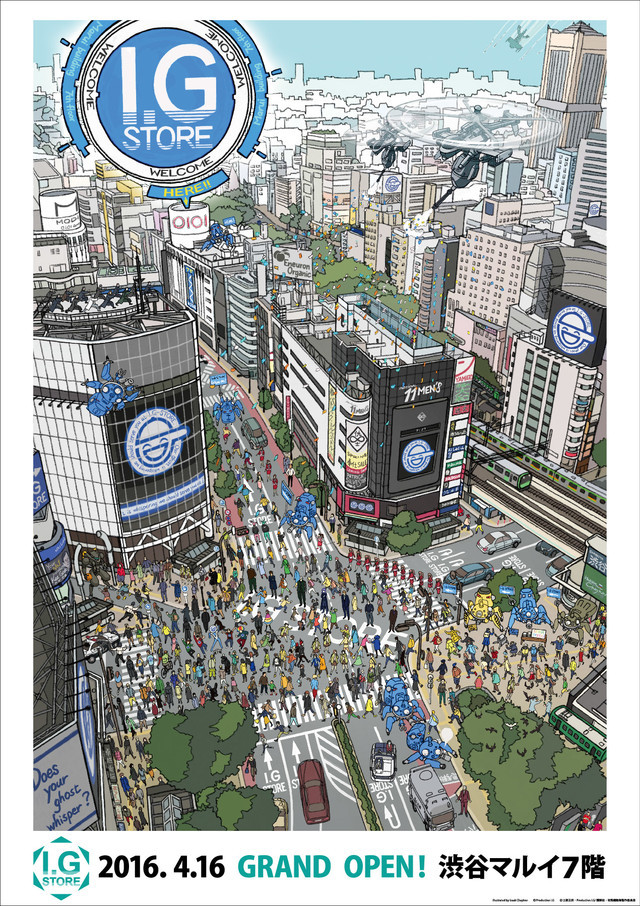
Tachikomas, along with The Laughing Man have taken over Shibuya, Tokyo in a visual, offered on postcards to visitors who spend 2000yen at a new shop that anime studio Production I.G is opening. The I.G Store opens in the Shibuya 0101 building April 16th.


In addition to the merchandise outlet, with limited items, the location has an exhibit space that will launch with a look at original material behind Kuroko's Basketball. Other series to be covered included Psycho-Pass, Haikyu!!, the new Joker Game and, of course Ghost in the Shell.


via Natalie


 ------
Scott Green is editor and reporter for anime and manga at geek entertainment site Ain't It Cool News. Follow him on Twitter at @aicnanime.

02 Apr 11:40

A 9-Year-Old Girl Just Completed a Navy SEAL-Inspired Race for This Reason

Milla Bizzotto is a girl on a mission, and the way she’s doing it is inspiring all of us to be strong.

The 53-pound 9 year old from South Florida just became the youngest person to compete in a U.S. Navy SEAL-inspired race called the Battlefrog race BFX24. The 24-hour race requirements are quite extraordinary, requiring participants to race 36 miles, swim 8 kilometers, and conquer 25 obstacles that include crawling under barbed wire and climbing a 12-foot wall for six laps.

Say what?

As if that's not enough, learning about Bizzotto's journey is even more moving. In an interview she noted that the reason behind her intense training for the race was simple — she was bullied at school.

"People would call me names and say I wasn't a good player," she said. "I didn't want anyone else to go through what I did. I want to set an example and show other kids that they can do or be anything they want."

Milla began training at her father's gym five days a week for three hours a day, all in preparation for the race.

And she was permitted to compete as long as her father was right beside her.

"I'm fearless," she pointed out. "And knowing I'm inspiring people makes me more fearless. It is hard, but that doesn't stop me."

NEXT: Maya Lin: Power Of A Dad's Love »

Related Stories:
Billie Jean King: Sports Scholarships For Girls
Strong, Powerful and Inspiring: Girls Owning Their #GameFaces

Photo Credit: Milla Bizzotto/Instagram 

02 Apr 01:12

Restaurant Workers Will Get a Big Boost As New York Approves $15 Minimum Wage

by Chris Crowley

Cuomo announcing his support for a $15 minimum wage last September.

It's another victory in the fight for $15. New York will become the second state to raise its minimum wage to $15, courtesy of a budget agreement between Governor Andrew Cuomo and state legislators. The increase will be, like in California, phased in over several years, and it'll vary by region: While this will happen by 2018 in New York City, it will take six years before Long Island and Westchester hit the mark.

This is certainly a step forward for Cuomo and his colleagues in the labor wars. Last summer, you may remember, the New York wage board recommended a $15 minimum wage for fast-food workers, and this goes far beyond that to cover all workers — besides the dwindling number of tipped workers, who recently saw their hourly rate increase $2.50.

Raising the minimum wage this much has been a source of contention between Cuomo and industry groups, and some argue labor pressures are the reason why certain restaurateurs switched to a no-tipping model. But this will certainly help underpaid restaurant workers, like the cooks whose wages have declined more significantly than those of any other professionals.

[NYT]

Read more posts by Chris Crowley

Filed Under: minimum wage, fight for 15, labor fights, new york, new york city

01 Apr 00:03

Here’s the New Japanese Water Cake That Will Debut at Smorgasburg

by Chris Crowley

Kind of the exact opposite of a candy-coated milkshake.

The home of the ramen burger will now serve as the American launchpad for Japan's strangest dessert yet. When Smorgasburg's outdoor markets return this weekend, it will mark the New York debut of mizu shingen mochi, a.k.a. the wobbly water "cake." True to its name, the sweet actually looks like a suspended water drop, and, well, it pretty much is exactly that.

First introduced two years ago by Kinseiken Seika Company, the confection is a variation on shingen mochi, a traditional dessert made from a very soft form of mochi known as gyuhi. Like shingen mochi, it comes with kinako, a heavily roasted soybean powder, and kuromitso, or brown sugar syrup, both served on the side. Rather than glutinous rice, this jelly cake is made from water gathered from the southern Japanese alps, the company says, that is then stabilized with some mysterious substance so it will hold its shape. (But only for a fleeting 30 minutes at room temperature, after which it becomes what you might call "puddle cake.") When properly made, it should roll and jiggle, but it's also very fragile and easily broken.

Curious internet sleuths investigated how to re-create the dessert, and the consensus appears to be that agar, which is derived from seaweed, is the ideal stabilizer. That's because, as one report concludes, it creates the right texture while maintaining the water's pristine flavor. So, agar is the solution that Darren Wong, the advertising professional behind the simply named Smorgasburg rookie Raindrop Cake, went with. (Gelatin is the other obvious choice, but apparently it doesn't yield a delicate enough result.)

Like a lot of people, Wong first discovered the dessert went it went viral in 2014, and later wondered why no one was making it here. His recipe for the cake, he says, contains only agar powder and spring water. As Wong sees it, the dessert is very much in the Asian tradition, and he tells Grub, "It's not about flavor or nutrients; it's about the texture."

Though it's a very basic combination — and is so elegantly simple that it kind of flies in the face of over-the-top viral sensations like monster milkshakes and rainbow doughnuts — he says he spent months trying to hit upon the correct ratio of agar to spring water. While some people say it's like Jell-O, Wong protests that the texture is "nothing like that." The biggest challenge, he says, has been figuring out how to transport the delicate dessert, which he individually boxes and, of course, necessarily makes ahead of time. The price is still being determined, but he anticipates maxing out at about 1,000 servings for the weekend, which will be presented in little boats, just like the Kinseiken Seika Company original.

Read more posts by Chris Crowley

Filed Under: viral desserts, brooklyn, japan, news, raindrop cake, smorgasburg, water cake

30 Mar 15:52

The Endless Details In This Custom Lego Batcave Are Completely Overwhelming

by Andrew Liszewski

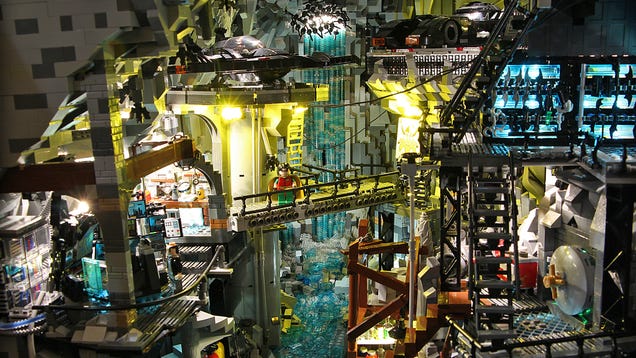
A couple of months ago Lego revealed its sprawling Batcave set based on the ‘60s Batman TV series. And as packed full of details as it was, it can’t hold a candle to Dan Glasure’s custom creation that took two months to build and incorporates elements from almost all of the Batman movies, comics, and TV series.

Read more...

30 Mar 15:05

"I know the text is black, but I want it white. It’ll match with the paper."

“I know the text is black, but I want it white. It’ll match with the paper.”

- A client designing a white poster.
30 Mar 12:46

Warner Bros. Announces ‘The Iron Giant’ Ultimate Collector’s Edition

by Amid Amidi

It only took Warner Bros. 17 years to do this.

The post Warner Bros. Announces ‘The Iron Giant’ Ultimate Collector’s Edition appeared first on Cartoon Brew.

30 Mar 12:45

Kickstarter Spotlight: Help CBLDF Tell the Story of the Women Who Changed Comics!

by Alexander Lu
050ae005ed6aa8e786e538fe4e42a036_originalFrankly, we need this book.
30 Mar 12:40

Fancy Milkshake Specialist Black Tap Expands to Subterranean Space in Soho

by Greg Morabito

This might mean shorter lines for those burgers and shakes.

Black Tap, a relative newcomer to the NYC burger fray, draws crowds daily at both its original Soho location and its spinoff on West 14th Street Many of those people are lining up for the elaborate milkshakes, which became a viral hit on Facebook and Instagram a few months ago. Building on the success of those burgers and shakes, the Black Tap team is gearing up to open a new dining room below the original location of the restaurant to handle the overflow. The new subterranean space, dubbed Black Tap Down, will have a luncheonette-style layout, and a menu of burgers and crazy shakes just like the one upstairs.

Before opening Black Tap, chef Joe Isidori ran the show at two well-received but ill-fated restaurants: Southfork Kitchen and Arthur on Smith. He landed at Chalkpoint Kitchen two years ago, and then he opened the burger bar next door around this time last year.

Black Tap Down is slated to open next month.

30 Mar 12:09

DC’s ‘Hanna-Barbera Beyond’ Will Remix and Reimagine Classic Characters

by Amid Amidi
kate

God this again, after I had put it out of my mind.

Hanna-Barbera characters like you've never seen them before.

The post DC’s ‘Hanna-Barbera Beyond’ Will Remix and Reimagine Classic Characters appeared first on Cartoon Brew.

29 Mar 16:47

Donald Trump's Campaign Manager Charged With Battery

by Russ Choma

Donald Trump's campaign manager, Corey Lewandowski, has been charged with simply battery by the police in Jupiter, Florida, in connection with an alleged altercation earlier this month with Michelle Fields, then a reporter for the conservative website Breitbart. In early March, as Fields approached Trump after a rally, she was roughly yanked back. (She later tweeted a picture of her bruises.) The Washington Post's Ben Terris, who witnessed the episode, identified the person who grabbed her as Lewandowski.

The Trump campaign, however, vehemently denied the accusations. So did Lewandowski, who mocked Fields as an attention-seeker on Twitter. In the days after the run-in, footage emerged that appeared to show Lewandowsi grabbing Fields. But none of the video directly showed the incident. In announcing Lewandowski's arrest, the Jupiter Police Department has released security camera footage that shows the clearest view yet of the altercation. The footage appears to substantiate Fields' version of events.

Even so, the Trump campaign has continued to defend Lewandowski. It released a statement saying Lewandowski had turned himself in to the Jupiter police and that he was innocent of the charge.

29 Mar 13:28

This Fried-Chicken Okonomiyaki Is the Kind of Fast Food America Needs

by Clint Rainey

Theoretically what it looks like.

KFC Hong Kong last landed on Americans' radar for fearlessly introducing pizza-"flavored" wings, which, it turned out, were immediately overshadowed by KFC Philippines' pizza with chicken crust — so Hong Kong has gone for broke with its latest gonzo mash-up: the Okonomiyaki Crispy Chicken.

There is, of course, a twist. Instead of the savory pancake that traditionally forms the bottom of the classic Japanese dish, people who try KFC's version will get pieces of fried chicken with some traditional toppings: mayo, bonito flakes, and a traditional sauce that's kind of like ketchup. Playing around with the form is nothing new, but while most okonomiyaki revisionists keep their versions more or less flat — to give the toppings a place to rest — the Colonel throws the KFC toppings on top of the chicken itself, so it isn't immediately clear how these toppings are supposed to stay attached. It doesn't matter, though: This concoction still sounds a lot more interesting than the mash-ups that America's fast-food-makers currently offer.

[Brand Eating]

Read more posts by Clint Rainey

Filed Under: the chain gang, hong kong, kfc, okonomiyaki, okonomiyaki fried chicken

29 Mar 13:19

"We have hired a new office assistant. Please show her how to make an Internet."

“We have hired a new office assistant. Please show her how to make an Internet.”
29 Mar 13:10

10 Great Graphic Novels About Video Games

kate

Only thing on here I hadn't heard of is Nonplayer which sounds very good, too bad it has a release schedule that is killing it.

While comic books based on video games are easy to find, comics about gaming are few and far between. Here are 10 great examples of comic books about gaming.