Hamburgers with kimchi. We got the kimchi from Seoul Food and unlike grocery store kimchi, it gives you cucumbers that taste fresh even though they’re pickled.
(Photo: Rocklands “Global Warming” tamarind chipotle hot sauce.)


kurtadbthat sounds awesome.
Hamburgers with kimchi. We got the kimchi from Seoul Food and unlike grocery store kimchi, it gives you cucumbers that taste fresh even though they’re pickled.
(Photo: Rocklands “Global Warming” tamarind chipotle hot sauce.)

People will recall that, not so long ago, Senator James Inhofe, Republican of Oklahoma, in order to conclusively demonstrate that claims of man-made climate change were false, made a snowball after a February storm and threw it on the Senate floor. I demonstrate it thus! If I see frozen water, how can the planet be warming? What was so beautiful about this demonstration was that it did not even depend on a snowball made out of season, one packed and tossed, say, in September or April—this was a mid-winter snowball, and it still refuted global warming, for once and all.
Anyone who follows the debate on any public issue discovers that the snowball-in-the-Senate style of argumentation persists, with the same note of smugness—that’ll show them! It most often comes from the same political direction, or party, and with the same disconnection from all familiar standards of evidence and argument. In the debate about the necessity of bringing America into agreement with the rest of the civilized world on the issue of guns and gun killings, there are some persistent snowballs-in-the-Senate that keep getting thrown, which need to be mopped up as they melt.
Snowball No. 1: There is doubt or mystery or uncertainty about whether national gun control can actually limit gun violence. No, there isn’t. The real social science on this, published in professional and, usually, peer-reviewed journals, is robust and reliable, while fake or ersatz social science that proposes to show the opposite has been debunked many, many times. Of course, to say that the social science is settled is exactly not to say that one or two authority figures are in dogmatic possession of the truth—that’s not what makes it science—but that a broad community of people who have taken the trouble to study the evidence and open their data to each other have come to something close to a consensus. More guns mean more homicides. More guns mean more gun massacres. More guns mean more death. Common sense confirms what social science demonstrates: there really have been no gun massacres in Australia since Australia decided to act to stop gun massacres from happening.
Snowball No. 2: Levels of violent crime have been receding in America in recent years, so guns can’t really be a problem. This decline is real—but it is real everywhere in the Western world. The remarkable point is that American gun violence persists at its astonishingly high levels in spite of the general decline in the rich world of violent crime. You have to accept a uniquely narrow view not of human nature but of American character—that Americans are so uniquely violent, so paranoid and hate-filled, so incurably homicidal, that they will keep killing each other no matter what laws exist—to believe that the same simple social restraints that have ended epidemic gun violence elsewhere won’t work here. It would be more American to be more optimistic about Americans.
Snowball No. 3: Gun laws solve nothing because terrorists, whether in Paris or San Bernardino, aren’t the sort of people who care about or obey them. This snowball might properly be restated as follows: if a pickpocket steals your wallet on the bus, repeal the laws against pickpockets. If terrorists and criminals do still get guns, despite existing gun laws, there is no reason to have gun laws at all. But the goal of good social legislation is not to create impermeable dams that will stop every possible bad behavior; it is to put obstacles in their way. The imperfection of a system of restraints is an argument about the imperfection of all human systems. It is not an argument against restraints. What’s more, the special insight of recent criminology is to show that low walls work nearly as well as high ones, and are obviously much easier to build. Making any crime harder usually makes it much harder. If the terrorists in San Bernardino had had to work as hard at building guns as they did at building bombs, perhaps the guns would have worked as badly as the bombs did. (And, surely, it is a good thing that they were not able to go to a bomb store, or a bomb-owing middleman, for pre-made bombs.)
Snowball No. 4: There are already so many guns in circulation in the United States, and their owners are so determined to keep them, that introducing limits would have no practical effect. Determined social movements against what seemed to be fixed features of social life often work—to a first approximation, they always work, which is why the modern history of liberal societies has the generally happy arc it does. Piecemeal social reform tends to be slow, but it tends to be successful. (Many manageable middle-range changes, from ammunition control to “smarter” and more secure guns, have been suggested as passable paths to gun sanity.) One need look only at the history of smoking or of car safety to see that this is so. Cancer caused by cigarettes and deaths caused by traffic fatalities, which were once fixed and ubiquitous features of American life, have been vastly reduced by gradual reform. A full-court press against gun massacres, at local and state and federal levels, has already begun; the more it goes on, the safer we will become.
Snowball No. 5: Even if gun control were a good thing, the Second Amendment renders its achievement impossible. Not so. In 2008, the Supreme Court, by a vote of 5-4, decided the case of District of Columbia v. Heller in favor of the view that the Second Amendment guarantees a right to private ownership of weapons. Justice John Paul Stevens, appointed by a Republican President, in a dissent joined by three other justices, rightly found this view astounding and radical, writing that the Constitution speaks only to gun ownership within the context of a militia. But even the Heller majority agreed that the right it had conjured up was far from unlimited: there could still be conditions and licensing requirements and limits on where one could carry a gun. (Just last week, the Court declined to hear a challenge to a ban on assault weapons and large-capacity magazines in Highland Park, Illinois.)
And so even, according to the new view espoused by Heller, the rational test of actual experience should still trump the Kabbalah of eighteenth-century-word scrutiny, however exciting it may be to pseudo-scholarly minds. Does anyone believe that Madison and Mason, stumbling into the first-grade classroom where modern assault weaponry had blown apart twenty six-year-olds and six of their terrified caretakers, would then say, “Well, too bad—but, yes, that’s exactly what we meant by the right of the people to keep and bear arms”?
Snowball No. 6: Gun rights are a necessary hedge against tyranny. Ted Cruz has been throwing this snowball around quite a bit, strange as it is to hear a senator praise preparations for acts of terrorist sedition. This was, as it happens, exactly the argument of slave owners of 1861, well answered by Lincoln, and then by Grant.
If there is a risk to democracy it might be, instead, in the way the routine of gun violence and terrorist horrors like San Bernardino brutalize us as a people, and the way the paranoia they provoke changes our sense, to use one of the President’s favored phrases, of who we are. Which risks are worth taking, and which demand a response, is a subject for grownup people to debate on a long winter night, with the snow drifting safely outside, where it belongs.
Sign up for the daily newsletter.Sign up for the daily newsletter: the best of The New Yorker every day.
Kevin Drum is asking an interesting question and coming to a conclusion that I think is completely wrong:
But here’s a more interesting question: after driverless cars become widely available, how long will it be until human-driven cars are made illegal? I say ten years. It will vary state to state, of course, and there will likely be exceptions of various kinds (specific types of commercial vehicles, ATVs meant for fun, etc.). Still, without a special license they’ll become broadly illegal on streets in fairly short order. The proximate cause will be a chart something like the one on the right.
I think this is an interesting question, but when I went to visit my in-laws last month, there were still horse and buggies on the road. And those have been technologically obsolete for a century now.
There are a few things that I think Kevin is getting wrong. First, there is a massive distributional issue. Driverless cars will by definition be new cars. The first wave of driverless cars won’t be 100% adapted. Some people will be technophobic, others will like driving sticks, others will be reluctant to put their life into the hands of a piece of software even if that software is statistically a much better driver than the average human (as we are all above average drivers in our own internal estimation it’s just those assholes who are honking at me that can’t drive). And others will decide that they don’t want to spend the money.
Even assuming that there is a fairly rapid shift in the share of proportion of driver controlled and driverless vehicles sold over a couple of years so that in five or ten years from the first good autopilot to 90% of new cars being sold are driverless or driver minimized vehicles, there will be millions of new vehicles that require drivers on the road.
No state government is going to tell tens of thousands of middle class or better voters that they need to junk their $20,000, $30,000 or $40,000 capital investments for safety reasons.
Furthermore, the used car market lags the new car market. My primary used car in high school was made several months before I could walk. Factory fresh, it had sixty six horsepower and by the time I bought it for $50 it could just hit 65 MPH going down hill with a good tail wind. It did not help my social life in high school but retrospectively that car kept me out of a lot of bad decisions simply because the car simply would not allow me to show off and be stupid.
The typical American car has at least a fifteen year lifepan.
There is no way any state government is going to successfully tell most of its working class voters that they need to scrap a $5,000 to $20,000 capital investment for a marginal safety improvement.
What is far more likely once there is good data on operational usage of driverless cars is that they will be treated like anti-lock brakes and skid-control features by the insurance companies. Driverless cars will receive a massive insurance discount because they’ll be far less risky as they remove the most common source of error (human error) from the equation. But driven cars will still be available and still be insurable but at a higher rate.
kurtadb10 years!?!?! conrad would never learn to drive. i just don't think we could even turn over the existing inventory of cars that fast. how do you tell someone with no money and a 10 year old ford fusion that they need to buy a new driverless car?
When will driverless cars become a reality? That is, real driverless cars, where you just tell it where you want to go and then sit back and enjoy the ride?
 My guess is seven or eight years. Maybe you think five. Or ten. Or fifteen.
But here's a more interesting question: after driverless cars become widely available, how long will it be until human-driven cars are made illegal? I say ten years. It will vary state to state, of course, and there will likely be exceptions of various kinds (specific types of commercial vehicles, ATVs meant for fun, etc.). Still, without a special license they'll become broadly illegal on streets in fairly short order. The proximate cause will be a chart something like the one on the right.
kurtadbokay, straight outta compton isn't on the list. but what about carol and creed?
The answer to the question in the headline is easy: because Academy voters are mostly white senior citizens (94 percent white, average age 63) and their taste tends to be pretty conventional for white folks born in 1952. At least that's what all the critics say. This explains, they say, why a great film like Straight Outta Compton didn't get nominated. A bunch of old white guys just aren't going to be moved by a film about an angry group of black gangsta rappers.
But what about the critics themselves? According to Hayley Munguia of FiveThirtyEight, here are the 20 films from 2015 that showed up on the most "Best Of" lists. The movies in red got Oscar nods:

Where's Straight Outta Compton? Not in the top 20.1 Apparently the critics are a bunch of old white guys too.
Next up: maybe Munguia will compile similar lists for the acting categories. Who did the critics love? Did Idris Elba make the top 20? Michael Jordan? Tessa Thompson? O'Shea Jackson Jr? Teyonah Parris? I'm curious about whether the critics ought to be examining themselves as much as they're examining the Academy.
1Only two movies not in the top 20 got Best Picture nominations. Revenant may have gotten released too late to make many lists. And Bridge of Spies didn't deserve to be in the top 20, but probably got nominated because everyone loves Tom Hanks.
(As originally reported here and here – Promoted by Colorado Pols)

Last week, ProgressNow Colorado requested an investigation of Keyser with the Judge Advocate General of the Air Force for violating rules while campaigning behind the scenes during his time in the Air Force Reserve. Keyser claimed in response that he was not actually “in uniform” when he conducted the interview, but admitted he was campaigning behind the scenes while serving. Today, ProgressNow Colorado called on Keyser to apologize for misleading voters with unfounded allegations of fraud in Colorado’s mail ballot elections.
 In 2013 Jon Keyser, then a candidate for the Colorado House, posted a photo on social media of “two ballots” he received, claiming this was evidence of a “failed system” passed by Democrats that year. In truth, Keyser’s “second ballot” was for a single ballot question related to property he owned elsewhere in the state. The photo Keyser posted intentionally concealed the return address of the second ballot to falsely imply he had received two complete ballots for the same election. [1]
“Jon Keyser knew exactly what he was doing,” said ProgressNow Colorado political director Alan Franklin. “Colorado Republicans led by then-Secretary of State Scott Gessler were desperate to convince voters that Democrats had somehow sabotaged the election system. Gessler’s friend Keyser was more than happy to help promote this fiction, then had to make silly excuses for his antics when debunked by fellow Republican county clerks.”
“The fact is, Colorado is a leader in modernizing our election system to increase participation,” said Franklin. “When the new law was passed, opponents immediately claimed it would result in massive election fraud that, as it turns out, never happened. But some Republicans like Jon Keyser were so eager to protect the status quo they invented bogus ‘fraud’ cases out of thin air.”
“Voters deserve an elected official who plays by the rules and is honest with the people of Colorado,” said Franklin. “The more we see from Jon Keyser, the more it becomes clear he is simply not an honest player.”
(It was probably inevitable that #YallQaeda would try to invent their own legal system — promoted by Colorado Pols)

Judge Dredd is not really a judge…or a real person, for that matter.
According to local paper The Oregonian, the bunch of yahoos staking their claim on the Malheur Wildlife Refuge have now found themselves a self-proclaimed “United States Superior Court Judge.” Bruce Doucette has arrived from Littleton, CO, where he supposedly has “retired” as a “judge” to do computer repair work.
Doucette claims the Bundy Bunch have shown him “significant” evidence of crimes committed by the Federal government, and that he will certify the charges after they’ve been formally brought by a “grand jury” consisting of members of a local committee that’s been formed called the “Harney County Committee for Safety”.
All of this, of course, is udder cow-patty nonsense. There is no US official titled ‘Superior Court Judge’, and Doucette has no law degree nor even a lick of common sense. He does, however, have an interesting history as a “judge”. His name turns up on a number of Sovereign Citizen blogs and even news posts – always with the same “Superior Court Judge” title he’s claiming now.
He has appointed himself to defend Sovereign Citizen “Judge” Steve Curry of Montrose, who “filed” a $249 trillion “US gold dollar” lien against the American and International Bar Associations as well as the US Government. Curry was jailed for selling fake meteorites on eBay with claims that they were 80% tax deductible (and also making a supposed $58 million donation of “meteorites” to the local historical society) – not sure how the lien thing fit in with Doucette’s representation of him – the blog post was more interested in the so-called lien…
Doucette also offered to “represent” landowners in Costilla County this year over off-grid residency. He was brought in by another convicted thief (and child abandonment convict), Rodger Marsh, founder of a group called Operation Patriot Rally.
It’s not much of a surprise that the clueless yahoos currently involved in the armed takeover of Federal property in Oregon are aligned with the Sovereign Citizen movement. Even before this development they were “somewhere along the sliding scale” that leads toward the bamboozling Sovereign Citizens. Doucette’s arrival and acceptance by the group does little more than cement just how far down the scale they are…
kurtadbwow
In an apparent effort to prove that you can do data journalism on literally any topic, Leah Libresco examines the merchandising bonanza of the latest Star Wars movie:
The most-recent “Star Wars” Monopoly set did what the villain of “Star Wars: The Force Awakens” couldn’t, sidelining Rey, the film’s female protagonist.... Fans signed petitions, wrote letters, and tweeted their outrage using
the “#WheresRey” hashtag.... The controversy reached its climax when Hasbro, the maker of the game, said Rey will be represented in new editions.
To see whether Rey’s absence was local to Monopoly or more widespread across all “Force Awakens” toys, I did what any sensible data journalist would do: I went to a toy store. Well, a digital one. Toys R Us lists 256 toys in their online “Force Awakens” store, but only 70 of them include any of the major characters introduced in the new movie. Rey holds her own among this group.
"Rey holds her own"? I guess so. She and Finn are the main heroes of the movie, and they're pretty close in the toy competition. The real news here is a clear anti-human bias: the biggest toy winners are Kylo and Captain Phasma, who spend most or all of the movie in masks, and BB-8, a droid so calculatingly adorable as to bring back involuntary memories of Ewoks.
Anyway, as long as we're on the subject, you've probably all been waiting on the edges of your seats wondering what I thought of the movie. Well, the first week it was too crowded, so I didn't go. I'm too old for standing in line. The next week, the kids were still out of school, and a friend was visiting who had no interest in the movie. The next week, my mother's car broke, so I loaned her mine and had no way to get to the theater. By the time I got my car back, I had come down with a cold and didn't feel like going. So it wasn't until yesterday that I finally I saw it.
And I was stunned. I was prepared for anything from bad to pretty good, but it turned out to be stultifyingly boring. There's nothing "wrong" with SWTFA. The acting is OK. The dialog is OK. The effects are OK. The pacing is OK. The direction is OK. The editing is OK. The characters are OK. As a piece of craft, it's fine. But when you put it all together it's two hours of nothing. And yet, the residents of Earth have spent a billion dollars on tickets! What the hell is wrong with you people?
The movie's big mystery, of course, is "Who is Rey?" The answer is, "Who cares?" Here's my guess: she's a clone constructed from a preserved pubic hair of Obi-Wan Kenobi. We'll find out in the exciting sequel!
Anyway, JJ Abrams has now ruined Lost. He's ruined Star Trek. And he's ruined Star Wars. He's a one-man wrecking crew. But there's a silver lining: at least I can now say with confidence that I'll never waste money seeing a JJ Abrams production again.
And now for the worst part. I never thought it was possible I'd say this, but I have marginally more respect for George Lucas's prequels now. They may have sucked, but at least he tried.
kurtadbwe do ours with garlic and broth and then finish with parm. really flavorful.
Brussels sprouts in garlic-flavored oil. In restaurants brussels sprouts are usually cooked with bacon or at least a lot of butter, and I didn’t know how I could possibly match the excitement. I didn’t have bacon and I used olive oil, and they ended up tasting more like cabbage, their cousin, rather than a substitute for appetizers like French fries or calamari. So I added more salt.
(Photo: Faux cupcakes, Denver.)


Photo by Angelo Merendino/Getty Images.
A Cleveland grand jury has declined to bring criminal charges against Timothy Loehmann and Frank Garmback, the police officers who killed 12-year-old Tamir Rice after mistaking his gun replica for a real weapon.
 Jamelle Bouie
In a statement after the November 2014 shooting, police said, “The suspect did not comply with officers’ orders and reached to his waistband for the gun.” Video puts doubt on that claim. In the infamous surveillance video of the shooting, Garmback arrives on the scene driving a police cruiser. As the car arrives, Loehmann exits the vehicle and shoots, fatally wounding Rice. The whole event took seconds, and, with no audio, there’s no indication the officers warned Rice or gave him a chance to respond.
In explaining the grand jury’s decision on Tuesday, Cuyahoga County prosecutor Timothy McGinty said it was “indisputable” that Rice was drawing the gun from his waistband when Loehmann shot him, citing a second, allegedly clearer video of the encounter. “It would be irresponsible and unreasonable to require a police officer to wait and see if the gun was real,” he said, also noting that Rice was “big” for his age, and the officers mistook him for someone much older. (The unstated premise in both statements: If Rice were an adult or even a teenager, his shooting would have been more than justified.)
“The actions of officers Garmback and Loehmann were not criminal,” McGinty said. “The evidence did not indicate criminal conduct by police.”
For the past two years, I’ve written about police shootings of black Americans, from Jonathan Ferrell in North Carolina and John Crawford in Ohio to Michael Brown in Missouri, Walter Scott in South Carolina.* Each time, I try to pinpoint something in the encounter that illustrates a broad trend. With Tamir Rice, there’s almost too much to account for. From faulty, racialized perceptions of age and maturity (according to one study, police overestimate the age of black children by more than four years and perceive them as less “innocent”) to the rapid, lethal use of force, the Rice shooting is almost textbook in how it conforms to research on race and perception.
Which is to say that, on those issues, I don’t have anything new to add. But there are other questions, raised by the prosecutor’s statement, that are worth tackling. What’s pressing about the Rice case isn’t what it says about racial prejudice and implicit bias—lessons we’ve already learned from too many other killings—but what it says about the police themselves.
Strip away the rhetoric, and McGinty has made a clear statement about police conduct: If police perceive a threat to their lives then they’ve de facto justified their actions regardless of context, even if it ends with taking the life of a child. That includes situations like the Rice shooting, where police chose to create a confrontation, rather than manage an encounter.
More broadly, police are empowered to take control of all situations by any means necessary, even those that aren’t criminal. They have no obligation to survey a situation to seek the least violent resolution. Taken together, these prerogatives—established time and again, by departments across the country—encourage police to use lethal force as the first resort.
It’s tempting to see this with sympathy. Police, after all, are just ordinary people. They want to go home to their friends, partners, and children. Blue lives matter, goes the mantra, police have a right to go home safely. This is true, but only to an extent. Part of policing is risk. Not just the inevitable risk of the unknown, but voluntary risk. We ask police to “serve and protect” the broad public, which—at times—means accepting risk when necessary to defuse dangerous situations and protect lives, innocent or otherwise. It’s why we give them weapons and the authority to use them; why we compensate them with decent salaries and generous pensions; why we hold them in high esteem and why we give them wide berth in procedure and practice.
What we see with Tamir Rice—and what we’ve seen in shootings across the country—is what happens when the officer’s safety supercedes the obligation to accept risk. If “going home” is what matters—and risk is unacceptable—then the instant use of lethal force makes sense. It’s the only thing that guarantees complete safety from harm.
It’s also antithetical to the call to “serve and protect.” But it’s the new norm. And worse for any accountability, it sits flush with our broad sympathy with police in the courts of law and public opinion. So that, when police kill someone in this relentless drive to reduce risk, it’s almost impossible to hold officers accountable, barring incredible circumstances. The public just accepts that this is what police had to do. (It doesn’t help that prosecutors rely on police officers to build cases, a strong incentive toward leniency.)
Given this status quo, Tamir Rice—his shooting and the officers’ acquittal—is inevitable. Indeed, it’s almost certain to happen again, since the system isn’t equipped to push back on these new norms of policing and the extraordinary benefit of the doubt that police receive. Just this weekend, Chicago police—called to deal with a domestic disturbance stemming from mental health problems—killed a 19-year-old student and a 55-year-old mother of five within minutes of arriving on scene.
Unaccountable lethal force defines contemporary law enforcement, at least for black Americans and other minorities, and barring a sea change in attitudes among the majority of Americans, there's little reason to think that will change.
One last point: Changing this is in the best interest of police officers. Yes, abandoning “safety at all costs” means accepting additional risk. But it also means an emphasis on de-escalation in policing, which—in communities that need good policing—engenders more trust for police departments. With more trust comes more community cooperation and more resources for solving crime. The same is true for more and greater accountability. In the long run, both create safer environments for citizens and police. Which, I hope, is what we all want.
*Correction, Dec. 28, 2015: This piece originally misspelled Jonathan Ferrell’s last name. (Return.)
*Correction, Dec. 29, 2015: This article originally misstated that Renisha McBride was killed by police. She was killed by Theodore Wafer, a homeowner on whose door she was knocking. (Return.)
kurtadbsome good history on the general conflict of ranchers v. the feds.
My life became a cultural wasteland after my daughter was born. No more books, no more movies — only television provided a last, desperate bastion of artistic connection, consumed in small doses through a semi-conscious daze. I felt bad about not reading; as a librarian with two English literature degrees, books had been fixtures in my life.
And then, suddenly, I was a reader again. For almost 18 months, I had been stuck rereading the first chapter of Canada by Richard Ford, until one day, I moved on to chapter two. And then chapter three. Before I knew it, the book was over, and I started a new one. And then another one. Reading was a connection to my job and to the world, and a conscious rebuilding of my scrambled inner life. In 2014, I read 49 books and felt great about it. In 2015, I'd read 50 for sure.
But once I started, I couldn't stop. I passed 50 books in early May; in August, I reached 100. As of this writing, I've read 164 books, and I have a stack more to get through before the ball drops. (Here's my spreadsheet if you want to take a look at what I read.)
I'd spent a year prostrated before an altar of literature, and in doing so I learned a few things.
Ignore the Atlantic. Finishing every book you start is not just annoying — it's counter-productive. There will never ever be enough time to read every worthwhile book. Even spending almost every spare second reading, there were titles I returned to the library, spines woefully uncracked. Other times, I cursed myself for wasting energy on an unworthy title, hate-reading the last 200 pages of The Rosie Effect because I'd liked The Rosie Project and wanted to make sure that everything turned out okay.
I suspect that people who argue for finishing every book assume that otherwise readers will bail out in droves from difficult literature, finding refuge in the more fast-paced, accessible novels. But that wasn't true for me: As much as it challenged my emotional limits, I never once thought of abandoning A Little Life, for example. Out of my 164-book total, I left only five unfinished. The few books I quit weren't necessarily bad books, nor were they especially difficult. They just weren't for me. I adore Marilynne Robinson's novels, but the essays in The Givenness of Things were far too specialized and outside my area of interest. I tried working through them slowly, while lustily eying flashier covers on my unread pile. Eventually, I gave in, became engrossed in something else, and recognized that I wouldn't be going back.
Reading is amazing; it shouldn't be a chore, and when it became one, I stopped doing it. The few times this year that I felt my reading stall came after spending too long with a book that failed to move me. It's important to recognize that not every book will be a page-turner from the start, but my benefit of the doubt rarely lasts more than 100 pages.
I started documenting my reading in late 2014, after reading Amanda Nelson's article about her reading spreadsheet on Book Riot. In addition to recording the title, author, and page length of each book, I also track the authors' gender, nationality, and whether or not they identify as a person of color. I believe that increasing the diversity of the authors I read requires a conscious effort; it won't just happen on its own. All groups deserve equal representation in literature, and if readers demand books from writers of color, editors will have no choice but to supply them. There's also a more personal reason to read a wide range of books: Deliberately seeking out new literary voices expands my perspective and pushes me out of my comfort zone. Ultimately, I hear more stories, and my life is richer for it.
The sad truth is that while I managed to read authors representing more than 25 countries this year, only about a quarter of the books were by writers of color (and that's including four big question marks by Elena Ferrante, author of the Neapolitan series, whose true identity remains unknown).
Reading is amazing; it shouldn't be a chore, and when it became one, I stopped doing it
Race isn't the only current imbalance in English-language publishing; gender is also an issue. As a librarian, I've noticed that women generally accept book recommendations regardless of the author's gender, but many men are reluctant to read female authors. I am not exempt from institutional sexism in my book choices. While I naturally gravitate to female authors (two-thirds of the books I read this year were by women), an inventory of the books I own showed a majority of male authors on my shelves. Though my spreadsheet skews female, my purchasing dollars tell a different story.
Other biases remained in my blind spot until very recently. A month ago, a friend asked me to recommend a novel featuring trans characters, and I drew a blank. I hadn't yet read N.K. Jemisin's The Fifth Season, which features a trans woman as a minor but mysterious character who I suspect will become more important as the Broken Earth series develops.
Recent studies have shown what any reader could have been easily guessed: Reading fiction — especially literary fiction — makes people more empathetic. According to a 2014 Carnegie Mellon study, reading fiction activates the same regions of the brain as real-life experience. A 2013 study found that people scored higher on tests of empathy and social intelligence after reading literary fiction. I've found this to be true in my own experience — reading really does help me to see where other people are coming from. But it's not the only benefit of reading — my reading marathon this year helped me see that I also learn cultural and sociological lessons from reading novels.
Before this year, I had no knowledge of Nigerian history or politics, but both Chimamanda Ngozi Adichie's Half of a Yellow Sun and Chinelo Okparanta's excellent debut, Under the Udala Trees, chronicled the Igbo experience during the Biafran War. Okparanta's novel was unflinching in its depiction of her home country's persecution of LGBT citizens.

Chimamanda Ngozi Adichie. (Pius Utomi Ekpei/AFP/Getty Images)
Adichie's Americanah, which was possibly my favorite read of 2015, focused on the contrast between Nigerian and American lifestyles, but what really fascinated me was the intense description of black American hair rituals.
I marveled at the amazing amount of World War II fighter plane research that made up Kate Atkinson's A God in Ruins. Soon afterward, Ferrante's My Brilliant Friend reminded me that the postwar years on the losing side were quite different from what I had been used to reading in British, American, and Canadian novels.
In theory, I could have read any of these things in a history book. But in reality, I wouldn't have. I find straight history dry (though Stacy Schiff's The Witches: Salem, 1692 is proving an excellent exception to that rule). Furthermore, I submit that some things are better learned through characters and stories than presented as facts.
Last year, the BBC reported that translations comprise just 2 to 3 percent of English publishing, compared with 27 percent in France and up to 70 percent in Slovenia.
In my readings this year, I noticed the flip side of the 2 to 3 percent statistic, which is this: Books translated into English are almost guaranteed to be excellent.
With only one exception, I adored the books I read in translation this year, including three different series from Italy, Norway, and China. (The book I hated: Coelho's The Alchemist, which, if you haven't read it, odds are you've been implored to read it by several of your friends and loved ones. Many count it among their favorite books; I found it to be an extended string of platitudes.)
I've already mentioned Ferrante's Neapolitan series, which reached its conclusion this year with The Story of the Lost Child. The passion of Ferrante's prose is barely constrained by a lolling, poetic elegance, and the central duo were two of the most complex characters I read this year, if not ever.
From Norway, I was immediately drawn into Hans Olav Lahlum's K2 and Patricia mystery series. Lahlum, a historian, structures his books as homages to great mystery writers set in post-WWII Norway. The first book in the series, The Human Flies, is both a clever locked-room murder and a near-flawless Agatha Christie impression.
Finally, Cixin Liu's controversial Hugo winner The Three-Body Problem, and its sequel, The Dark Forest, raised the bar for my conception of imaginative sci-fi. Reading The Three-Body Problem, I needed frequent breaks to research topics ranging from the Chinese Cultural Revolution to Lawson planetary motion. Both books were well worth the effort; my most anticipated read of the coming year is the series-concluding Death's End.
A big part of why I wanted to read so many books this year was to keep up with the conversation around books. I wanted to recognize the books on the Best of 2015 lists. I wanted my opinion to have weight. I started evangelizing for my favorite books, writing reviews for the library blog, actively contributing to Twitter debates. I became a librarian because talking about books is one of the only things I like as much as reading them. I had forgotten that, but this year reminded me.
Keeping up with literary conversation only requires reading a few books and, preferably, feeling something about them. While many books will end up on the Best of 2015 lists, there were, in my opinion five that dominated the conversation this year: A Little Life, Between the World and Me, Ferrante's Neapolitan series, Harper Lee's Go Set A Watchman, and Jonathan Franzen's Purity. The talk surrounding both Go Set a Watchman and Purity was less about the books than about issues surrounding their respective authors.

Go Set a Watchman. (Joe Raedle/Getty Images)
Go Set a Watchman was an infuriating, mediocre book, its main interest lying in its relation to To Kill a Mockingbird and the ethical question of whether it should have been published at all (it shouldn't). I didn't read Purity, mostly because Franzen's embarrassingly clueless interviews about adopting war orphans are far more entertaining than his novels. I read The Corrections years ago, and part of Freedom. They weren't bad, but Franzen's is an authorial voice I feel like I've heard too many times. I brought Purity home from the library, but with multiple due dates looming, I chose Zen Cho's refreshing debut Sorcerer to the Crown instead, with no regrets.
If there is the makings of a classic in 2015, I believe it lies with one or all of the other three: Yanagihara, Coates, and Ferrante. Yanagihara's A Little Life wrecked everyone who read it. I agree that it was the best book of the year, but I suspect it may be too bleak to have staying power. Between the World and Me has a better chance. In addition to being beautifully written, its historical value to the current state of race relations and connection to the Black Lives Matter movement both bolsters its significance and imbues enough controversy to give it lasting interest.
If there is one 2015 author whose work I hope endures, you may have already guessed that I'm casting my lot with Ferrante. While Story of the Lost Child, as the capper to a series, cannot fully stand own, the quiet ascendency of My Brilliant Friend to the Book Your Friends Are Reading signals an endurance march rather than a sprint. I'll spend 2016 reading the rest of Ferrante's oeuvre.
Now that the year is almost over, I recognize a lot more of the books dominating critics' lists. It does feel good to see other people gushing over the books I love. It's also occasionally confusing, wondering what so many others saw in Lauren Groff's Fates and Furies that left them raving but kept me lukewarm. Mostly I'm still drawn to the books I missed, still excited to add to my to-read list.
I've talked a lot about the various benefits of reading: learning about other cultures, promoting diversity, staying connected to broader conversations about literature. But when I focused too much on numerical goals, I started to resent my books and lose sight of the main reason I read — because it makes me happy.
At the end of every book I loved, I felt transformed. I wanted to tell everyone about it, if not read it again right away. The other books, the ones I didn't care about, I read because I thought they would make me better in some way — more well-read, perhaps, or even more interesting. But reading books I wasn't invested in just made me bored and disengaged; I would have been better off doing something else.
I became a librarian because talking about books is one of the only things I like as much as reading them
With the end of the year in sight and my list surpassing 150 books, my obsession began to wane. I picked up Claire Vaye Watkins's Gold Fame Citrus, a well-reviewed novel with an intriguing premise. I read two pages and didn't feel a spark. A few months earlier, I would have pressed on and possibly really enjoyed it, but for now, I put it down. I let it go.
I won't read 160 books in 2016. If I have a goal, it's to read under 100 — to make sure that every book matters not to the world but to me.
Amy McLay Paterson is a librarian and a writer from Halifax, Canada. She tweets about books, libraries, feminism, and pop culture @shalihavmydwarf.
First Person is Vox's home for compelling, provocative narrative essays. Do you have a story to share? Read our submission guidelines, and pitch us at firstperson@vox.com.

Sen. Jerry Sonnenberg.
FRIDAY UPDATE #2: Liberal group ProgressNow Colorado slams Sonnenberg in a statement:
“The right wing’s all-consuming hatred for President Obama is well known, but Sen. Jerry Sonnenberg has taken disrespect for the President too far this time,” said ProgressNow Colorado executive director Amy Runyon-Harms. “During President Obama’s term in office, our nation has been rocked by horrific mass shootings including the Aurora theater massacre. President Obama has personally met the survivors and victim’s families of Aurora, Newtown, Roseburg, San Bernardino, and other senseless acts of gun violence. I too have met with some of them. The stories of their pain and suffering will bring any decent person to tears.”
“President Obama’s tears for the victims of gun violence in America, including right here in Colorado, are very real, and I’m proud to support a president unafraid of compassion,” said Runyon-Harms. “Thanks to Sen. Jerry Sonnenberg, the right wing’s boundless contempt for the President is now an insult to the victims he wept for.”
“Sen. Sonnenberg is a disgrace to the Colorado Senate, and to the victims and survivors of mass shootings that have occurred in our state,” said Runyon-Harms. “We want President Obama and all victims of gun violence to know that Jerry Sonnenberg does not speak for Colorado.”
—–
FRIDAY UPDATE: Daily Kos, responding to our comments below:
It would be encouraging if “any and all decent” constituents of this pathetic excuse for a senator looked him in the eye the next time he shows up on their turf and asked him if he really meant to make a fucking joke out of lubricating an assault rifle with tears induced by pondering the slaughter of 6- and 7-year-olds.
As for those who believe the president manufactured tears to manipulate his audience, perhaps a few of them could be rehabilitated if they read what Joshua Dubois wrote in The President’s Devotional two years ago about Obama’s visit to Sandy Hook just two days after the slayings there left that community raw.
—–
A Tweet earlier this evening from Sen. Jerry Sonnenberg, a Republican representing a broad area of the Eastern Plains of Colorado, mocks President Barack Obama’s press conference this week in which he announced executive actions to modestly tighten background checks on gun sales:

That President Obama had an emotional moment over the victims of gun violence in America during his presser has made a great deal of news. But a sitting Republican lawmaker responding so crassly to the President’s sympathy for gun violence victims, which we are inclined to believe is genuinely expressed, quite possibly sounds a new bottom in an already acrimonious debate.
We apologize on behalf of any and all decent people he represents.
kurtadbstraight out of star trek (but cooler). very cool.
It took more than a year, but German company Bragi is finally shipping those buzzy wireless earbuds to its Kickstarter backers. Better yet, the company has a handful of those final production versions here at CES, and I finally got to try them.
During my elevator ride up to Bragi's suite on the 29th floor of the Venetian, the question in my mind was: can a hot product live up to a year's worth of expectation, especially considering the delays and mounting doubts? One hour later, on the ride back down, I was measuring just how much the Dash exceeded those expectations.

Let's rewind real quick. Bragi first got attention in 2014 with a flashy idea on Kickstarter: truly wireless earbuds with a portable charging case, health tracking, a slick design, and a personal assistant with hints of Her's Samantha. Before anyone even questioned if it was too good to be true, some 16,000 backers pledged $3.4 million in support of the Dash.
Bragi delayed the Dash a number of times
Bragi brought a working prototype to CES last year with plans to ship in April. I tried and liked it, but I wasn't bowled over — I was only allowed to use one earbud, and the touch controls were finicky or didn't work. I came away from CES optimistic about the possibilities of wireless earbuds, but it wasn't a surprise when that April ship date got pushed back.
April became November, which became "the holiday season." In the meantime, our own James Vincent got a second look at the Dash at IFA in September of last year, but the earbuds were still in beta. Most of the features were in place, but performance was still buggy.
Some of Bragi's Kickstarter backers were upset about enduring that wait, and they had a right to be. But what became apparent in my demo of the Dash is that the company didn't waste that extra time. There are lots of smart, little touches. For instance, every time you swipe up on the right earbud to increase the volume, a very soft tone rings in real time, at increasingly higher pitches. That's the kind of feedback you need when you're using a touch interface you literally can't see. (Another touch: a help section in the app dedicated to letting you chat with one of 25 support staffers, something made possible because Bragi now has over 100 employees.)
Back in the suite, Bragi CEO Nikolaj Hviid hands me a box; it's the final production version of the Bragi dash. He tells me 4,500 have already been shipped to backers, and that the rest will be on their way in the next month.
The box that those 4,500 backers have received is the same that will wind up on retail shelves (no official partners yet, but deals are in place) and in Amazon.com shopping carts, and is one of the best product packages I've ever seen. You actually learn more and more about the Dash and how to operate the earbuds as you thumb through the book-like box.
On the left, last year's prototype. On the right, the final production model.
Eventually you get to the important stuff: the Dash earbuds. At a glance, they look just like the ones from the Kickstarter. But a second look shows that they're much more refined. They're even much more polished than the ones we saw in September. They're thinner, lighter, the seams are harder to find, and they fit better in my ears.
The Dash got better in the last year
The Bragi Dash earbuds are Bluetooth headphones, but that only describes the connection from the phone to the earbuds themselves. Bluetooth was originally how the earbuds talked to each other (and passed the music from the left one to the right one), but Bragi ditched Bluetooth for a newer technology called Near Field Magnetic Induction. It's something that's used in the hearing aid industry, and it's able to penetrate your head (and all the water inside it) much more reliably than Bluetooth can. This was a big problem when I reviewed the Earin earbuds; they sync together over Bluetooth, but that connection often cut out, which made them really frustrating to use.
Switching from Bluetooth to NFMI was one of the reasons that Bragi had to be delayed. "I made a call at that point saying that, even though the performance was really good with Bluetooth, it's never going to be good enough," Hviid tells me. But it seems that it was worth the wait. I experienced none of those interruptions, and the sound quality was excellent.


Of course, Bragi wants the Dash to be much more than just a tool you use for listening to music. There's also fitness tracking, motion commands, and a few other software features. I didn't get to test out the fitness tracking, and I'm still skeptical of the value there — there are a lot of good reasons why we might be misplacing our faith in devices like these when it comes to tracking our health.
What I did test was some of the gestures. For example, if you receive a call while you're wearing the Dash, all you have to do is nod your head to accept or reject the call (up and down for accept, left and right to reject). It sounds goofy, and I definitely doubted its usefulness last year — especially because this particular demo didn't work well at CES 2015 — but Bragi has tuned the gesture recognition in a really careful way. I tried to reject a phone call with a nod that I thought was too subtle for the Dash to pick up, but it worked. If anything, I came away afraid I'd be wearing the Dash and quickly hang up on someone because of the involuntary reaction to the idea of speaking to them. (Oh, Terry's calling? Nope. Wait!)
But the best feature by far is that the Dash can allow outside noise to pass through into the earbuds. Since the earbuds create a very good seal, and have noise cancelation as well, they present you with a heightened version of the same problem that plagues dumb headphones: when someone tries to talk to you, or you need to hear the world around you, you have to fumble to take them out of your ears. (This problem becomes an especially clumsy one when your earbuds are wireless.)
I thought I wanted simple wireless earbuds. I think I was wrong
With the Dash, you just swipe on the left earbud and the ambient noise around you suddenly appears in your earbuds. Better yet, Bragi has done some especially tricky software work to make that ambient noise sound like it's coming from the corresponding direction. If someone is speaking to the right of you, it sounds like their voice is coming from that direction. You can do this while music is playing or not, and it's the kind of feature that you wind up wanting on any pair of headphones even after using it just one time.
Bragi still has a lot left to prove, but my first impression with the final version of the Dash was a strong one. And even though I thought I wanted a simpler wireless earbud, I left the demo desperate to put the earbuds, the charging case, and all of the Dash's other features through their paces. My colleague James Vincent was right when he saw the last Dash beta version at IFA. The Bragi really is the wireless earbud of my dreams. But not for long.
One of the more depressing features of Capital in the 21st Century is the air of inevitability attached to the much-discussed r > g inequality. This is exacerbated, on the whole, by the fact that Piketty’s proposed policy response, a progressive global tax on wealth, seems obviously utopian.
What about a much simpler alternative: increasing the rate of income tax applied to the very rich, and removing preferential treatment of capital income? Piketty’s own work with Saez yields the conclusion that the socially optimal top marginal rate of taxation, after taking account of incentive effects, would be 70 per cent or more. Such rates prevailed, at least nominally, in the mid-20th century, without obvious ill effects. Again, Piketty provides the relevant evidence.
So, is there something about a globalised world economy that renders a return to high marginal rates of taxation impossible?
One crucial objection has been tested and refuted. Over the course of the 20th century, numerous small countries and some larger ones (notably Switzerland) established themselves as tax havens, willing to accept bank deposits and other capital flows from citizens of other countries and shield them from the efforts of the governments of those countries to collect taxes, or penalise tax evasion. Given the benefits of being a tax haven, it seemed likely that some jurisdictions would simply reject any attempt at an international effort to combat tax evasion.
The OECD put this proposition to the test when, in 2000, it listed a number of jurisdictions, such as Andorra and Liechtenstein as un-cooperative tax havens, because they declined to implement proposed standards of transparency and exchange of information. All of these jurisdictions ultimately capitulated and were “whitelisted”. The label “tax haven”, once sought-after, is now repudiated by all governments, however keen they may be to attract and retain hot money.
Even more symbolically important has been the end of Switzerland’s famous (or notorious) system of bank secrecy, as a result of agreements signed with the EU and other national governments over the past year. Under these agreements, the parties will automatically exchange information on the financial accounts of each other’s residents.
A bigger problem, central to Piketty’s larger concerns, is the deeply ingrained criminality of the financial sector, including participation in tax evasion. Despite repeated exposure, the big banks have got away with financial penalties that have barely dented their earnings and with occasional criminal charges against underlings. As long as major international banks retain their immunity from any kind of effective punishment, they will continue to facilitate both aggressive tax avoidance and criminal tax evasion. The ‘too big to jail’ list over the last year or so includes HSBC, Deutsche Bank and Credit Suisse, but others, like UBS, are even worse.
But with something like $200 billion in penalties levied over the past five years alone, the excuses are wearing thin, as is the theatre of ritual wrist-slapping. “Too big to jail” has become a public scandal so notorious that sooner or later, someone will be forced to act, and actually put one of these recidivists into receivership. That implies, breaking up their operations, sacking the entire management and wiping out the shareholders. With a few examples, “pour encourager les autres”, we might see some actual changes in behavior.
Corporate taxation presents some more difficult problems. National governments, such as those of Singapore and Ireland, have proved much more protective of corporate tax dodgers than of individuals. Resistance to measures to combat tax avoidance has been correspondingly stronger. Still, the OECD is slowly grinding its way through measures to combat BEPS (Base Erosion and Profit Shifting), its unlovely acronym for an array of corporate devices including transfer pricing and abuse of tax treaties. At some point, perhaps, the secrecy achieved through webs of shell companies may become as obsolete as numbered Swiss bank accounts.
A more serious objection is that, rather than notionally shifting their money, wealthy individuals and corporations might physically shift themselves and their productive activities to low-tax jurisdictions. On the whole, this problem does not look to be too severe. For example, despite a very attractive tax regime, and easy proximity to European capitals, the Channel Islands have not attracted English tax-dodgers in the numbers that might be expected. As regards corporations, the capacity to move is limited by economic realities. Whatever their organizational structure, companies like Apple and Google must generate their revenue, and their economic profit, in markets with large numbers of consumers. If the conduits they have used to shift that profit to tax havens are shut down, they have little choice but to pay up.
Finally, there’s the question of political practicality. For those whose views were formed by the tax revolts of the 1970s and 1980s, and by the capitalist triumphalism of the 1990s, substantial increases in tax rates, even for the very wealthy, are simply unthinkable. This is the intellectual background for the great majority of the political class, including the notional left, in most developed countries. But those days are fading into the past. The surprising success of Capital in the Twenty-First Century is one among many indications of an appetite for change.
kurtadbwhat on earth? rain barrels are illegal in colorado?
The Colorado State Capitol.
Rep. Jessie Danielson, D-Wheat Ridge, says the new bill will look similar to the one that failed last session, but she's also working with opponents in hopes of better success in 2016.
She spoke with Colorado Matters host Ryan Warner.

Boulder County DA Stan Garnett.
One of the principal arguments made by opponents of gun safety legislation like the universal background checks law passed by the Democratic-controlled Colorado General Assembly in 2013 is that additional laws to regulate access to guns are unnecessary–and that if the government would simply focus on the enforcement of “existing laws,” we could reduce gun violence without placing onerous burdens on “law-abiding citizens.”
Well, as the Boulder Daily Camera’s Mitchell Byars reports, Boulder County DA Stan Garnett is doing just that–but surprisingly (or not), the gun lobby doesn’t seem to be very happy about it.
Boulder County District Attorney Stan Garnett is hoping to cut down on gun violence by putting more emphasis on prosecuting laws that prohibit people from applying for guns when they know they aren’t supposed to have them.
The Colorado Legislature passed a series of gun laws in 2013, including one that now requires universal backgound checks for potential gun buyers. But another part of that law makes it a crime to even apply for a background check for people who know they are not qualified to own a gun, and Garnett said that part of the law needs to be a point of emphasis…
Violating that statute is a Class 1 misdemeanor, which is punishable by up to 18 months in jail and a $5,000 fine.
Garnett said he has already about six cases of people unlawfully trying to buy firearms in Boulder County, but he said its a law that many other districts — especially those who were against the gun restrictions in 2013 — are not very strict about enforcing. [Pols emphasis]
It’s been the case ever since background checks for most gun purchases became nationwide law that many thousands of people fail the checks and are denied gun purchases every year. Unfortunately, enforcement of that provision beyond denial of the gun purchase itself is far from consistent. Gun rights supporters routinely complain that no one is prosecuting the significant numbers of prohibited persons who attempt to buy guns, so part of the 2013 background check law prescribed specific penalties for those who attempt to buy a gun when knowingly ineligible.
In short, DA Garnett is doing exactly what the gun lobby says we should be doing–enforcing existing law. It’s been illegal for many years to attempt to buy a gun with prohibiting factors on your record, to include any kind of active arrest warrant. Obviously, a police officer in the position of having to arrest a wanted suspect doesn’t want said suspect to be able to buy a gun, even if the warrant is for a speeding ticket.
You’d think this would make the gun lobby happy! But you’d be wrong:
Boulder DA Stan Garnett says he will crack down on Colorado’s gun laws already on the books and send people to jail who have unpaid traffic tickets and try to buy a gun…
So, it looks like if you run a red light, get a speeding ticket, or double-park in Boulder, then you’re going to jail for trying to buy a gun.
Yes, that’s exactly right. If you have an arrest warrant and you try to buy a gun in Boulder County, Boulder County DA Stan Garnett says he’s going to prosecute you. Because that’s what the law says he needs to do. And that’s what the NRA says he needs to do–“enforce the laws already on the books.” Clearly, not every case will result in a conviction, but the simple act of enforcement of this law has no downside. Everybody ought to be happy to see it.
And that makes the complaints from gun rights usual suspects look very strange indeed.
kurtadboh, please.
(Promoted by Colorado Pols)
On December 23, 2015, Cargill Meat Solutions Plant in Fort Morgan fired 150 mostly Somali Muslim employees after forbidding Islamic prayers at work, saying, “If you want to pray, go home”. The employees are not eligible to be rehired for six months.

Cargill employees fired for praying at work. Attribution: Denver Channel, 12/30/15
The meat processors, some of whom had worked at the plant for 10 years, had been allowed, under long-standing policy, to take five minutes to pray during their own unpaid lunch and break times, in a “reflection room” provided by the plant. This policy, in place since 2009, allowed its employees the freedom to pray at work, and allowed the company to produce meat products profitably and on time. Six hundred of the 2100 workers at Cargill’s Fort Morgan plant are Somali Muslims.
Then, suddenly, according to CAIR’s Hussein, Cargill cracked down and stopped allowing Muslim prayer at work. Members of other faiths, presumably, are still allowed to use the company “reflection room” to pray during break time.
A simple miscommunication may have caused the problem, aggravated by Somali/English language barriers; only two at a time from any one meat processing “table” were allowed to go to prayer at a time, so as not to slow down the line. According to CAIR’s Mr. Hussein, interviewed on KSTP, a new shift supervisor told workers that they could no longer leave the line to pray, so they missed prayer that day. When they went to management to complain, they were told, “If you want to pray, go home.” Eleven workers walked out, and others walked out in support the next day. Around 200 stayed home that week, and about 150 of those who left have been fired. (Reports vary – from 150-190 workers have actually been terminated.) Lance Hernandez, reporting on the Denver Channel, said that Cargill is having trouble filling shifts since the walkout and subsequent worker firings. The workers reportedly are eager to come back to work, and CAIR is negotiating with the plant to make that happen.
Now, Fort Morgan’s meat plant prayer dispute has become the right wing’s newest meme to pump up anti-Islamic fears about “Sharia Law” in action. Across the nation and the world, people with political agendas are focusing on Fort Morgan.
Background
Like many observant Muslims, the Cargill workers pray several times a day. Meat plants in the Greeley and Fort Morgan area rely on Somali refugee workers to keep production lines rolling -a common hiring practice in towns where refugees settle.
Regardless of the worker’s religious affiliations, Federal law protects workers from religious discrimination. Union agreements typically do not allow employers to specify what employees may or may not do on their own unpaid time. The meat processors are represented by the Teamsters Union, which negotiated on behalf of the employees, but was unable to resolve the dispute. Unions in America have not been consistent about going to bat for the religious rights of Muslim members. Jaylani Hussein of the Council on American-Islamic Relations (CAIR) has stepped in to negotiate for the fired workers.
Meanwhile, Muslim-hating right-wing sites, such as Breitbart, are losing their minds about this, calling it “The Islamification of America”, and “Sharia Law in the workplace.” They claim that the workers are asking for special privileges, instead of the normal right any employee would have to spend his /her down time in any way that doesn’t harm the company’s mission.
The timing of the policy change forbidding Muslim prayer at work is suspicious, coming as it does in the midst of a wave of hate crimes, political candidates and leaders proposing extremist anti-Muslim policies, or terrifying tweets about nonexistent threats from ISIL.
This is not the first time the issue of religious accomodation in the workplace has come up in northern Colorado. In Greeley during 2008-2009, the JB Swift meatpacking plant also faced lawsuits over its religious discrimination practices. The EEOC lawsuit on behalf of Somali JB Swift workers was still being litigated in 2015.
In the absence of strong union support, CAIR is negotiating for the Cargill workers. Hopefully, they will be reinstated soon. If Greeley’s experience is any guide, Cargill can avoid a long and expensive religious discrimination lawsuit by the simple expedient of reinstating the pray-on-your-own-time policy which had been so successful for the last seven years.
UPDATE 1/2/16: Cargill said in a twitter conversation today that they had gone to a mosque to ask all workers to return, but that “some abandoned their jobs”. The remaining 200 who walked out are still not able to be rehired for 6 months, although that time frame is being negotiated. Cargill is exaggerating the number of Muslim workers who remain at the Fort Morgan plant, and representing the conflict as one in which only the employees are at fault. The Teamsters offices in both Fort Morgan and Denver have declined to meet with the CAIR represenatives for the meat workers, according to Mr. Hussein.
Sources:
CAIR Newsletter press release: Jaylani Hussein, Jennifer Wicks, 12/31/15
Fort Morgan Times, Stephanie Alderton, 12/22/15
Denver Post, Jesse Paul, 12/31/15
Breitbart, Pamela Geller, 12/31/15
Photo credit: ABC 7 News video still, reposted in Daily Mail article , Regina Graham, 1/2/16
Denver Channel, Lance Hernandez, 1/1/2016
Mother Jones, Edwin Rios, Anti-Muslim Hate Crimes on the Rise
Jaylani Hussein, interviewed on KSTP, youtube video 1/1/16
Twitter exchange with Cargill 1/2/15
Telephone conversation with Jaylani Hussein 1/2/15
kurtadba little sociology with your basketball!
It is nearly certain that this ends up as the year with the most 3-pointers shot, and it is very likely that 3-point percentage will finish at the highest mark since the 3-point line was moved back to 20’9” for the 2009 season. This despite the fact that 2-point shooting and free throw rates are high enough that the breakeven point for three-point shooting is higher than it’s been in a long time.
But there are more 3’s and for good reason. People are drilling them more frequently than ever. Or at least in the modern 3-point shooting era. Some might say this is the Steph Effect trickling down to the college game. I’m not sure that’s playing a huge role, but at the edges, maybe coaches are more open to an offense built around the three-pointer and maybe occasionally a shooter feels slightly more justified to take a three early in the shot clock.
Where the revolution is happening is on the playground. Curry is doing things that kids from 10 or 20 years didn’t think was possible. Kids just figuring out who they are as basketballers are going to think they can be Curry. Probably none of them will be, but quite a few of them will come close, and in 5-10 years they’ll be getting scholarships.
However, whatever the cause, the use of the 3-point line has accelerated over the past two seasons.. Teams have taken 35.2% of shots from beyond the arc, a healthy increase from the 34.2% last season. But freshmen players are taking a whopping 38.3% of their shots from long-range, the highest number for any class ever.* It marks the third consecutive season with a large increase among freshman as the following chart illustrates.
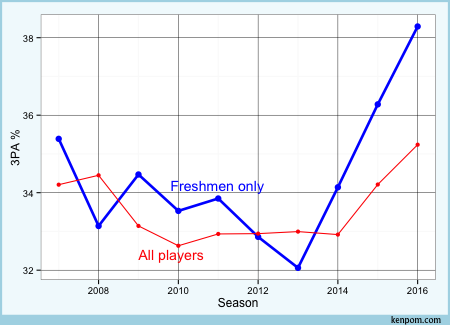
What that means for the future is not quite as easy as the graph makes it look. The freshman class does have some predictive power for the following season’s 3-point rate but that’s based on just a few years. However, history, limited as it is, would suggest this year’s class will cause next year’s 3-point rate to reach another all-time high. And it’s hard to imagine what the impact of all of the junior Steph’s will be, but it’s not inconceivable we’ll be pushing a 3-point rate of 40% in a decade with accuracy holding steady.
Of course, that assumes the 3-point line stays where it is, which would be a bad idea. The surge of shooters will give college basketball an opportunity to build on the gains made this season and become an even better product. You often hear people covering the game talk about how much parity there is in college basketball. To borrow a Bill James line, this is childish pablum. It makes everyone feel good about the sport that they cover/follow, but it’s not entirely true.
Because there are two kinds of parity worth discussing. One is at the game level: the kind where Radford beats Georgetown or Northeastern beats Miami, or more famously where last season’s Kentucky team can be the best team we’ve seen in a many years and yet only given a 50/50 shot to win a national championship on the eve of the NCAA tournament. No doubt that’s a fun part of the game that will always exist to some extent. Though having too much of that is not necessarily a good thing. I’d like the better team to win most of the time.
The other kind of parity is long-term. What are the chances that a program with limited resources and tradition can compete for a national title, or even just its conference title? This kind of parity is lacking in the game. Look at almost any conference history page and you’ll find a select number of teams grabbing the honor of “best team” in recent seasons. For most conferences with reasonably stable membership, no more than two teams account for half of the best team honors since 2002.
It’s personal taste whether one finds that acceptable. And since we’re all fans around here, I guess we all find it “acceptable”. Obviously, if you’re loyal to Duke or Kentucky or North Carolina or Kansas, it’s a great thing. But for me, fan of general college basketball, it’s one of the worst features of the sport. You see people in the media actively cheering when a mid-major gets an at-large bid (whether they truly deserve it or not) because it’s so hard for a mid-major to be good enough to just get considered for an at-large bid.
However, the influx of shooters could change things in that regard. I’m no scout, but I have to assume it’s easier to scout what most basketball people seem to call “talent”, but what I’d call some combination of basketball athleticism and playmaking ability than it is to scout shooting ability. Steph Curry himself couldn’t sniff a high-major scholarship. Buddy Hield and Denzel Valentine are among the frontrunners for player of the year this season, and both take an awful lot of 3’s (and make a high percentage) but neither was a celebrated recruit. Valentine takes more 3’s than 2’s now, but he made just 28 percent as a freshman. Hield made 23 percent!
There will always be a few near-Steph’s that fall through the cracks of big-time basketball factories in the recruiting game. But it’s less likely that the “talent” guys do. Which means that with more shooters on the scene there’s the potential for more true parity, where a program with fewer resources and less tradition can actually field a better team than the program that’s winning the battles for the highest-ranked freshmen.
But I think this is much more likely to happen if the 3-point line is moved back, at least to the FIBA distance of 22 feet and preferably farther. This will make the skilled shooters more valuable and it will force defenses to cover more space against the teams with shooters. Sure, the bad teams will still be bad and in the margins, maybe - and I mean maybe because I’m not sure it’s true - we won’t see as many cases where Western Illinois beats Wisconsin, but I think the trade of short-term parity for long-term parity is worth it.
* I only have data by class for the last ten seasons, so it takes a bit of faith to make this statement. But given 3-point trends prior to 2007, there’s good reason to think this is true.
kurtadbhis first wife was 10 years younger than him. now his 2nd is 26 years younger. seems like kind of a weird dude.
Pringle, 37, is vice president of corporate development for Liberty Media in Englewood. The pair have been dating for more than a year. She was introduced as his girlfriend at a holiday party at the Governor's Mansion in 2014.
"Yes, I have been dating a young woman named Robin Pringle," he said at the time. "We met more than a year ago, but only started dating some months ago, almost, as sometimes happens, by accident."
Hickenlooper, 63, was married for 10 years to author Helen Thorpe, separating in July 2012. They have son, Teddy, who is 13, and have remained friends. She attended the inauguration for his second term last year.
kurtadbThis is just so different from my experience, I sometimes forget how common it is. (And most of my high school and college friends, obviously.)
According to Google Maps, I live 13.64 miles from my mother. This is less than the median of 18 miles for American adults:
The biggest determinants of how far people venture from home are education and income. Those with college and professional degrees are much more likely to live far from their parents than those with a high school
education, in part because they have more job opportunities elsewhere, including in big cities.
....Families live closest in the Northeast and the South, and farthest apart on the West Coast and in the Mountain States. Part of the reason is probably cultural — Western families have historically been the least rooted — but a large part is geographical. In denser areas, people live closer together than in rural areas.
Married couples live farther from their parents than unmarried people, and women are slightly more likely to leave their hometowns than men. Blacks are more likely to live near their parents than whites, while Latinos are no more likely to live near their parents, but more likely to live with them, according to data from Mr. Pollak and Janice Compton, an economist at the University of Manitoba.
How far do you live from your mother?
kurtadbwant
Save to Wish List
15 OZ Coffee Mug / White(80455-mug15oz-whi-one_size)
Ruth Bader Ginsberg is a real badass, because real BADASSES push forward women's and minority rights! Show your love for everyone's favorite supreme court justice, Notorious R.B.G.!
Our 15-ounce Mug features large handles for easy gripping and a wrap-around print. These heavy-duty Mugs are both dishwasher and microwave safe. Printed in the USA.
Taken by the Washington Post at campaign rally in New Hampshire last week:

It’s one of those moments when the camera’s ability to pluck a brief slice of reality out of the blur and make it…well, horrifying, reaches out and grabs you. Everything we’ve read about the scene suggests that Jeb! Bush had just hugged this nice woman, and was not in any way preparing to beat the snot out of her.
But seriously, without that context, what the hell are you supposed to think?
(via io9)
Because I enjoyed it, is why. Although Garry Wills, IIRC, explained many years ago that the Western ‘estranged hero who leads his people to a paradise he can’t enter’ trope goes back at least as far as Moses in the Old Testament…
Just in time for the holidays, Kim Kardashian, queen of the selfie, is releasing her own line of emoji. They are called Kimoji. The emoji include a butt, a doughnut, Kim's censored boobs, Kim ugly crying, a word cloud featuring Kim calling someone "basic," a solo cup, Kim taking a selfie, and a hairdryer.

kurtadbi know, classic BJ, but this is good.
Against my better judgment, I checked CNN’s homepage, and I found this:

Yes. Donald Trump has insulted every race, creed, and religion, called for the execution of people’s families, called for a ban on Muslims, and basically every repulsive thing you can imagine, but it’s Hillary who might have gone too far.
Your liberal media.