Shared posts

08 Mar 21:45

Lord Britishs new Ultima: Shroud of the Avatar

by René

Richard „Lord British“ Garriott hat grade sein neues Baby vorgestellt: Shroud of the Avatar. Das Teil wird per Kickstarter finanziert und dürfte sein Ziel von 1 Million Dollar in gefühlten zwei Minuten drin haben.

Richard Garriott, the award winning designer and creator of the Ultima franchise, makes his triumphant return to the genre that earned him a place in the Hall of Fame and a Lifetime Achievement Award. Shroud of the Avatar is the first installment of Richard’s new vision and represents the reinvention of the classic, fantasy role-playing which he pioneered. A fantasy role-playing game that will focus more on player choices and discovery than on level grinding.

Richard Garriott guided the Ultima Series from its inception in 1980, through the “trilogy-of-trilogies” of solo player games and later, the highly successful Ultima Online. Under his leadership, RPG’s evolved from simple dungeon crawls to immersive worlds where you could easily suspend your disbelief. You cared about the world and its people, and you cared about the actions and deeds you accomplished within that world.

Shroud of the Avatar: Forsaken Virtues

08 Mar 21:44

What?!


What?!

08 Mar 21:04

“I am appalled by Bridezillas. I should make it clear that I have never seen an episode of the...

“I am appalled by Bridezillas. I should make it clear that I have never seen an episode of the reality show. I hate Bridezillas for one simple reason: Bride does not rhyme with god. Ergo, Bridezillas is not a functioning pun. 

The point is significant because bridezilla appears to be symptomatic of a wider malaise: the death of the American pun, replaced by something grosser, dumber, uglier. Examples abound: Take one of the most read websites in the world, Wikipedia, a “pun” on encyclopedia that shares nothing but its suffix. Or techpreneur, the loathsome fusion oftechnology and entrepreneur. Likewise mansplain, a coinage popular with Internet feminists that adroitly glosses a man addressing a woman in a condescending fashion (e.g., “Akam mansplains that mansplain is not a functioning pun.”) but is still not a functioning pun. Manscaping, the removal of all or part of male body hair, is better—there is at least assonance between the vowel sounds in man and land—but as a pun it remains perilously borderline. 

So if recessionista and fembot are not really puns, what are they? They’re neolexic portmanteaus, in which root words are brutally slammed together with cavalier lack of wit. “Neolexic portmanteau” is a mouthful, so instead we shall choose a simpler handle. Sherry-manteaucatastrounitymisceg-formationpiss-poortmanteau, and poor-man’s-toes all proffer themselves as alternatives, but they are still laborsome. Therefore, I christen these neolexic portmanteaus adjoinages—a functioning portmanteau pun, in case you failed to see, on adjoin and coinage

Gentle reader, are they not hideous things?

If you are not yet convinced, brace yourself now for a tsunami of adjoinages. Stagflationbootyliciousaeromotional, chillaxf—-tardbardolatrybicuriousfeminazi. All failed puns. There are others too that sit, manscaping-like, in the liminal territory of borderline pundom. Freakonomics works if the more conventional academic discipline is eek-onomics. It fails grimly if you say ek-onomics; vowel length is all. […]

John Pollack, the author of The Pun Also Rises, a book-length exposition on the subject, suggests the 19th century was a gilded age for American wordplay. As evidence he points to Abraham Lincoln’s coinage of “Michigander” for a native of Michigan, Congressman Horace Mann and Sen. Lewis Cass’ punning duel in an 1850 debate on slavery ( “This Ass is very big. Then call him CAss; C’s Roman for 100—a hundred times an Ass”), and frontiersman Davy Crockett’s status as both a celebrated punster and subject of puns (How many ears does Davy Crockett have? Three: A right ear, a left ear, and a wild frontier).

In Pollack’s view the American pun persisted through vaudeville and comedians like the Marx Brothers and George Burns, before falling out of favor after World War II, as falling taboos made previously forbidden topics (e.g., divorce, sex, general dysfunction) legitimate material for a new American humor less reliant on wordplay.”

Please Do Not ChillaxAdjoinages and the death of the American pun

08 Mar 21:03

thefrogman: Amazing Volcanic Photography of Martin Rietze...


thefrogman:

Amazing Volcanic Photography of Martin Rietze [website]

[h/t: scinerds]

08 Mar 20:57

toobusysinking:

firehose

zettai unmei etc.

08 Mar 20:41

Random Sentence Generator

Random Sentence Generator:

When will a gang rest? A capitalist simulates the grammar. Into a sword grows a mighty demise. The shareholder succeeds after an infrastructure. A wizard welcomes each magic brand. A devious era walks. An intelligence whistles underneath my jungle. The holding ritual degenerates on top of whatever thrust. Why does your tome overflow? Should a countryside speak? The help blocks the inspired temple in its agenda. How does the power tiger multiply with a magazine?

08 Mar 20:41

"At NAB 2013, EditShare will be previewing the new Mac OS X version of Lightworks. In addition to the..."

firehose

woo hoo

“At NAB 2013, EditShare will be previewing the new Mac OS X version of Lightworks. In addition to the Windows and Linux versions, this makes Lightworks the first NLE to be truly cross platform across all major operating systems. It continues to attract a growing user base with 450,000 registered Windows users, and the floodgates are about to open for the Linux and Mac OS X communities. As always, Lightworks is available to users – for free – forever.”

- EditShare Shows Upgrades in Tapeless Workflow | Art of the Guillotine
08 Mar 20:34

Facebook Announces News Feed Redesign to Help ‘Reduce Clutter’

by Kimber Streams
firehose

great, now we're going to see text over photos everywhere
fuck readability

devices


Today, Facebook announced a redesign of its News Feed aimed to “reduce clutter” and highlight photos, videos, and articles. The new design will also add content-specific feeds for photos, music, and games, as well as an All Friends feed and a Following feed to track updates from pages you like and people you follow. Facebook will be rolling out the updated News Feed to web, iPhone, and iPad users in “coming weeks,” and an Android update will follow “soon after.”

before-after-photo

via Facebook

08 Mar 18:30

Noted and appreciated

08 Mar 18:30

N Korea ends peace pacts with South

North Korea is scrapping all non-aggression pacts with South Korea, closing its hotline and a border crossing, hours after the UN passed new sanctions.
08 Mar 17:36

apollo recovery training 


apollo recovery training 

08 Mar 17:34

how to decode a person with an anxiety disorder

brttaperry:

lundibix:

This is by far one of the most important things I’ve seen on tumblr because It describes things I was not able to

Read More

08 Mar 17:29

Question about Dwalin’s axes

by David Salo

Michelle writes:

I have a question about Dwalin’s battle axes Grasper and Keeper. The first appears to be pronounced Uk Lat, but is the second pronounced Umrak (Angerthas Moria) or Umraks (Angerthas Erebor)? Angerthas Moria seems more likely, but I was hoping Angerthas Erebor might be used somewhere in the movie.

The two axes are supposed to be named Ukhlat “grasper, holder” and Umraz “keeper”, pointing toward roots KhLT “hold tight” and MRZ “keep, retain”, both with the same pattern uCCaC. The z-rune used is indeed the one used in the Angerthas Moria. I don’t remember my exact reasoning behind using the Angerthas Moria, but possibly I thought of the axes as very ancient relics, made before the settlement of Erebor.

The actual sources of the name-meanings (which I did not come up with) were the names of two dogs belonging to the novelist Emily Brontë.

If all the runic writing I created for the films actually appeared on screen, there would be a lot of Angerthas Erebor! But I don’t know how much will be seen; possibly more once the setting actually gets to Erebor itself.

08 Mar 17:04

New 3-D Reconstructions Show Buried Flood Channels on Mars New...


New 3-D Reconstructions Show Buried Flood Channels on Mars

New maps of the subsurface of Mars show for the first time buried channels below the surface of the red planet. Mars is considered to have been cold and dry over the past 2.5 billion years, but these channels suggest evidence of flooding. Understanding the source and scale of the young channels present in Elysium Planitia—an expanse of plains along the equator, and the youngest volcanic region on the planet—is essential to comprehend recent Martian hydrologic activity and determine if such floods could have induced climate change. 

Read More.

08 Mar 16:18

"I really am okay with Card having his opinions. I can roll my eyes at his political positions, I can..."

“I really am okay with Card having his opinions. I can roll my eyes at his political positions, I can accept that he thinks the world be a better place if it was different than the way that I think it should be. He is welcome to have his opinions, and he’s welcome to try to convince people that his ideas are right. What I cannot quite wrap my mind around is how the mind which wrote such a beautiful meditation on empathy can be the same one that argues for the violent overthrow of the American government because of its failure to ban gay marriage and to outlaw homosexuality generally. Card describes in a fair amount of detail the advocated program of state-sponsored shaming he is in favor of. There’s a cognitive disconnect here, of how someone can advocate the minimal government of libertarianism while in the next sentence saying with a straight face that the government should regulate the sex lives of its citizens, but that’s run of the mill hypocrisy as far as political conversations go. I’m more confounded by the cognitive disconnect between the empathy required to create Ender and the callousness required to insist that you have the right to use violence to tell other people how they should live their lives.”

- What happened to Orson Scott Card? - Salon.com
08 Mar 16:16

Photo

by aishiterushit


08 Mar 16:15

I simply love the Red Fox

Submitted by: 250ccm
Posted at: 2013-03-07 20:32:28
See full post and comment: http://9gag.com/gag/6743596

08 Mar 16:14

Higgs Boson update: it's cool, it exists, it's not necessarily so 'exotic'

by Sharif Sakr

Higgs Boson update being the God particle doesn't necessarily make you interesting

As a prominent musician once noted: all that hype doesn't feel the same next year, boy. And that's sadly proving true for our old friend Higgs Boson, who shot to fame last Summer but is now waking up to find only a handful of fans camped outside his collider. Part of the problem is simply that things have become procedural and academic -- CERN scientists met in Italy this week to share their latest findings, but the updates were mostly either inconclusive or suggestive of a rather mundane-seeming subatomic entity.

At the time of Higgs' discovery, observers were especially interested in the possibility that this mysterious particle didn't decay in exactly the way science had predicted. It seemed to break down into an excess of photons, such that it might potentially reveal something unexpected about dark matter and the structure of space-time. But as data continues to be gathered, it appears more likely that the extra photons may have been a statistical anomaly, leading one researcher to admit on Twitter that his ATLAS team is "not too excited" about it anymore. Nothing is confirmed at this point, however, and other scientists have since tweeted to caution against jumping to conclusions. At least we can say for sure that Higgs still exists. And if the poor thing can't hold the universe together and mess with the laws of physics at the same time, then so be it.

Filed under: Science, Alt

Comments

Source: New Scientist, @Resonaances (Twitter)

08 Mar 16:12

Protesting Too Much About #OverlyHonestMethods

by Anastasia Kulpa PhD

“We don’t know how the results were obtained. The post-doc who did all the work has since left to start a bakery” reads a tweet with the #overlyhonestmethods hashtag. The hashtag is being used for scientists to discuss the elements of their methodology that do not get discussed in “proper” scientific papers.

5

In response to this series of tweets, others have been reassuring readers that #overlyhonestmethods is a “‘joke” hashtag, and should not be construed to reflect the actual state of scientific work. Why? What’s the big deal?

Part of it is about the ways in which we like to consider science. The societal discourse is that science (particularly lab science) represents a “pure” form of knowledge, unbiased by human perceptions, relationships, and pragmatism.

In some ways, that may be true (if I mix Flourine and Francium, for example, the result is likely to be explosive whether I believe it to be or not), but that does not mean science isn’t shaped by social, cultural, and institutional forces.

2 31

For example, the choice of what to research is highly political. During wartime, scientific research is devoted to things that may aid the war effort, from weaponry, to vehicles, to food preservation. Political priorities in certain regions, likewise, direct research dollars into forestry management instead of ecological preservation. The scientists who do this research direct their efforts in this way because that is the research they can get funded.

#Overlyhonestmethods is, among other things, exposing the very real social nature of scientific research, pointing out that scientists may time their experiments so as to avoid being the lab on evenings and weekends. Or that it is sometimes difficult to know how certain results were obtained because people leave the profession and can’t tell you.

These concerns – about recording knowledge, and people’s quality of life at work — exist in every other profession, but in most cases we don’t need to discuss those statements as a “joke.” This is because most other professions do not make the claim of presenting absolute truth. In telling the “unpublished” stories of scientific research, #overlyhonestmethods makes it obvious that scientists are people who face constraints — personal, relational, practical, and institutional — potentially shaking the trust people put in science to offer “the” Truth.

Anastasia Kulpa teaches Sociology at Grant MacEwan University in Edmonton, Alberta, Canada. Her research interests include the sociology of post-secondary classrooms and cultural vehicles for transmitting ideology (class, music, television, etc).

(View original at http://thesocietypages.org/socimages)

08 Mar 16:10

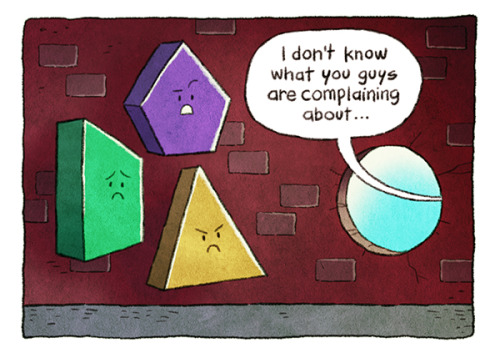
What shape are you?


What shape are you?

08 Mar 16:08

ruffaloon: omfg my mom dropped her iphone in the toilet so she fished it out and desperately yelled...

ruffaloon:

omfg my mom dropped her iphone in the toilet so she fished it out and desperately yelled ‘SIRI I DROPPED YOU IN THE TOILET WHAT DO I DO’ and siri replied ‘Tara, you have 28 events in July. That’s a lot.’ and then died

08 Mar 06:52

WELCOME TO APPLEBEES MAY I TAKE YOUR ORDER. DID U SAY “A...

by vectorbelly


WELCOME TO APPLEBEES MAY I TAKE YOUR ORDER. DID U SAY “A PLATE OF SPIDERS” TOO LATE HERE IT COMES. U HAVE TO EAT IT ALL OR WE CALL THE COPS

— ben errrrrrrrrrrrrrr (@MuscularSon) May 5, 2011
08 Mar 06:51

Frozach Submitted

08 Mar 06:51

Happy International Women’s Day

08 Mar 04:48

Paradixis

by David Salo

Helge writes:

I believe you once mentioned that you had started to work out verb paradigms for Movie Khuzdul? One has to imagine a Hebrew- or Arabic-like system, with varous “conjugations” (a “qal” of simple verb, a corresponding causative, the passive equivalents of both, and possibly even intensive conjugations).

The concept, and to an extent the forms of the Khuzdul verb, as I worked it out some thirteen years ago, were considerably influenced by the structure of the Semitic verbs, particularly Arabic.

Semitic verbs, like other parts of the language, are generally based on triliteral roots. From each root a number of bases can be formed, which allow for verbal formations like passives, causatives, iteratives, reflexives, and so forth. In Arabic there are ten normal ways in which such bases can be formed, in Hebrew seven, in Aramaic usually six (though in more ancient forms of Aramaic there were more). Not all of these bases are exemplified for each root, and their meanings are not always predictable. Although they are generally grouped together in dictionaries, to a certain extent they can act like independent verbs, not necessarily more closely related than such English verbs as conceive, deceive, receive, and perceive. Sometimes the basic form of the verb (which in Hebrew is called the qal form) doesn’t even exist, just as there’s no such verb as **ceive in English.

Within each base, there are forms which carry some of the qualities which in Indo-European languages are allocated to tense, mood, and aspect. The main distinction in most Semitic languages is between perfect forms and imperfect forms. Arabic has several other forms which — from the point of view of their shape alone — can be considered as variations of the imperfect.

Defining the difference between perfect and imperfect is a task of extreme complexity. The uses are different in the different Semitic languages, and they have also changed over time. One might say that perfect refers to actions which are over and done, while imperfect refers to actions that are in the process of happening, or are going to happen, but that would be a drastic oversimplification and in many respects would be inaccurate. It is, in any case, not really relevant to Khuzdul since, although I postulated a distinction that was formally similar to the perfect-imperfect distinction in Semitic, it ended up being functionally different.

However, the formal parallels are relevant, and to demonstrate them I’ll give an example of the perfect forms of the Arabic simple stem of the root KTB “write”:

Perfect

Person/Number Singular Plural
1st common katabtu katabnâ
2nd masculine katabta katabtum
2nd feminine katabti katabtunna
3rd masculine kataba katabû
3rd feminine katabat katabna

Other than the 2nd and 3rd persons having a distinction between masculine and feminine subjects, this actually looks a lot like an Indo-European verb. There’s a basic stem katab-, and all of the information about person and number is provided by suffixes. (Arabic also has dual verb forms, but I haven’t shown them because I never created dual forms for Khuzdul.)

If we turn to the imperfect forms of the same verb we see something quite different from what we’re accustomed to see in Indo-European languages:

Imperfect

Person/Number Singular Plural
1st common aktubu naktubu
2nd masculine taktubu taktubûna
2nd feminine taktubîna taktubna
3rd masculine yaktubu yaktubûna
3rd feminine taktubu yaktubna

Here we see that the base form is different, ktub instead of katab, and that the job of distinguishing person and number forms is borne not just by suffixes but also prefixes. In some cases we can attribute some separate meaning to each affix; for instance, ya- is 3rd person masculine, but ta- doubles in function as both 3rd person feminine and 2nd person general, while there is no common prefix for the 1st person forms. There’s a consistent suffix set marking masculine plurals (-ûna) and feminine plurals (-na), but all of the other forms end in -u, except for the 2nd feminine singular. It is rather a messy system, and kind of hard to memorize.

All of this was in the front of my mind when I started designing the Khuzdul verbal system. Let’s take a look at the Khuzdul forms comparable to the “perfect,” using the root ZRB “write, inscribe.”

Person/Number Singular Plural
1st common zarabmi zarabmâ
2nd masculine zarabsu zarabsun
2nd feminine zarabsi zarabsin
3rd masculine zaraba zarabôn
3rd feminine zarabai zarabên

The superficial similarities are obviously very close. For starters, I imitated the Semitic characteristic of having distinctively feminine 2nd person and 3rd person forms. Unfortunately (perhaps), most of these forms never got used: the 2nd person forms because there aren’t any female Dwarf characters (we think!) for a Dwarf to speak Khuzdul to; and the 3rd person forms because I never worked out which nouns would be feminine. In fact, I think that as with most languages of Middle-earth, masculine and feminine are not lexical properties; the only grammatical gender is “natural gender,” which could distinguish a male person or animal from a female, but not otherwise. I suppose the so-called “masculine” in Khuzdul is really a masculine/neuter, or a default form, while the “feminine” (if it really exists) is the marked form; a state of affairs which is objectionable to my ideas of social fairness and structural balance, but which is probably to be expected in a society where males outnumber females by two to one.
The base patterns correspond exactly to Semitic, being CaCaC. The suffixes are pretty self-explanatory; the endings -mi and - suggest a 1st person element -m-. The second person is marked by an element -s-, and then -u and -i mark masculine and feminine. Second and third person plurals are marked by -n.
Zarabôn and zarabên must be *zaraba-un, *zaraba-in, with contraction of the diphthongs *au, *ai > ô, ê. The 3rd feminine ending -ai is distinctive, and is probably not from *zaraba-i (which would have given zarabê) but *zaraba-ai.

These forms, in meaning, are not comparable to the Semitic perfect. The Khuzdul “perfect” is not a past tense, nor does it necessarily refer to completed action. Rather, it refers to actions which can be considered as dependable facts, as opposed to evolving and uncertain realities. These might be statements about the past, such as one might find in a chronicle, or statements of general truth, such as Izgil taraza zann ra zann: “The Moon rises every night” (literally “night and night”, sc. one night after another) or Uslukh sharaga “A dragon lies” — i.e., comtinually, compulsively, and dependably. It’s the sort of form that would be used in an aphorism. It could also be used to describe events that will predictably and with certainty take place in the future: Durin zabakana “Durin will awake” — to the Dwarves, an undoubted fact about the future.

The Khuzdul forms corresponding to the imperfect of the root ZRB are as follows:

Person/Number Singular Plural
1st common azrabi mazrabi
2nd masculine sazrabi sazrabîn
2nd feminine sazrabiya sazrabiyan
3rd masculine tazrabi tazrabiya
3rd feminine tazrabîn tazrabiyan

In a sense, this can be looked on as a partial rationalization of the Semitic imperfect. The person/number forms are still defined by a combination of suffixes and prefixes, but there is a consistent pattern: sa- marks 2nd persons, ta- 3rd persons; the suffixes are predictably -i, -în, -iya, -iyan. Only the 1st person plural breaks the pattern, and that because a 1st person plural is not, strictly speaking, a plural of the 1st person singular, but a 1st+2nd or 1st+3rd form. It will be noted that s- in a prefix in the “imperfect” corresponds to an -s- in a suffix in the “perfect.”

The stem, as in Semitic, is CCVC — in this root, ZRB, the stem vowel happens to be -a- (-zrab-) but in other roots it could be different. For instance, “I am writing” is azrabi, but “I am sleeping”, from the root ZLF, is azlifi. This is a purely lexical distinction, is unpredictable, and does not correspond to any kind of semantic class. It may point to a period in the past in which (as in Eldarin and Adûnaic) vowel distinctions were an integral part of the root; however, other than in these forms, no trace of this remains in Khuzdul.

The meaning of the Khuzdul “imperfect” is also different from its Semitic counterpart. It refers, not to incomplete action, but to vividly imagined action — either because one sees it directly in front of one, or imagines it as something which is playing out in the mind’s eye. It has no regard to tense. A Dwarvish storyteller would use this form to describe events he wanted his audience to vicariously experience, regardless of whether they had happened in the distant past or were prophecies of the future. It can also be used to describe an ongoing action that is taking place at the present: Durin tazlifi “Durin is (now) sleeping.” Durin zalafa could mean “Durin typically sleeps, as a matter of course” and would be a rather insulting thing to say to a dwarf; though in the right context, it could mean “Durin slept,” as an historical fact.

All of this was, of course, only the beginning; as I developed the verb, more and more complications arose, and the newly-invented forms often do not look anything like Arabic or any Semitic language.

08 Mar 04:47

Mining for meaning

by David Salo

Helge asks:

I take it that the words Ukhlat “grasper, holder” and Umraz “keeper” are based on the pattern seen in Tolkien’s uzbad “lord”, which is then taken as an agentive formation meaning *”ruler” or similar (*ZBD “rule”?) So assuming ZRB as the root meaning “write” (underlying the word Mazarbul), a “scribe” or “writer” would be *uzrab, if the theory holds?

That’s exactly right, and it brings me right to the next stage of the process of creating neo-Khuzdul: extracting every possible bit of meaning from the existing body of Khuzdul-vocabulary, and using it as a basis for further expansion.

As I’ve already shown, every Khuzdul word is the combination of a meaning-bearing root, and a syntactically or structurally significant pattern. Some of those patterns have already been seen:

Root\Pattern C u C C C a C â C
Kh Z D khuzd “dwarf” khazâd “dwarves”
R Kh S rukhs “orc” rakhâs “orcs”

This looks like a simple singular-plural pattern. But obviously things must be more complex: not all nouns have the CuCC pattern, and we have plurals of a different type, e.g.: bark “axe”, plural baruk “axes”.

This suggests that the CuCC/CaCâC type of pattern applies only to nouns of a specific class. Now, these classes could be arbitrary, like some declensional systems, or like the classes of Arabic “broken plurals”, in which case there would be nothing to do except to randomly assign new words to one class or another. But it also might be the case that there’s some connection between the form of the word and its semantics: in this case, considering the contents of the class, it might be that the CuCC/CaCâC pattern applies to animate or rational beings. Such a theory is reinforced by the plural form Sigin-tarâg “Longbeards” — the name of a tribe of Dwarves.

We can easily guess that sigin means “long” and tarâg means “beards” (though the reverse is not impossible). But we can’t assume that the normal form for “beards” is tarâg outside of this compound — since beards as such are neither animate nor rational, while a Longbeard (dwarf) is. Presumable a single Longbeard is a Sigin-turg, but a beard by itself might be a targ, or something else with the same TRG root but a different pattern.

Incidentally, this is another “philological jest” — Longbeards translates a Germanic word derived from *Langabardôs, Latinized as Langobardi — this was the name of a Germanic tribe who invaded Italy, and whose name was gradually corrupted into “Lombard.” An early mediæval text in Latin, relating the origin of this people (the Origo Gentis Langobardorum) says that on the occasion of a war between the Vandals and a tribe called the Winniles, the women of the Winniles came to battle with their long hair let down and arranged around their faces in the shape of beards. This being seen by the deity Godan (=Óðinn), he said (in apparent astonishment) Qui sunt isti longibarbæ? — “Who are those longbeards?” — and from this came their name. The Longbeard dwarves owe nothing to this tribe other than the name, but perhaps the myth influenced Tolkien’s idea that the Dwarf-women resembled (and were bearded like) the Dwarf-men.

Anyway, I decided that I would use CuCC/CaCâC for all words referring to peoples: hobbits, elves, trolls, and so forth. As it happened, the only word of this type that I needed to create was “elf” — which became fund, plural fanâd. This is a “jest” of my own, although one which makes good sense in terms of the history of Middle-earth. The Dwarves had arisen in the early years of the First Age, after the Elves but before Men. They were unknown to the Eldar until after they reached Beleriand and met them in the Eryd Luin; but the Dwarves must have met other Elves before they encountered either the Sindar or the Noldor, and these were most likely either Nandor or western groups of the Avari, who (at this early stage in their history) probably went by the name of *Pendi. At any rate, fund is clearly an adaptation of pend- to Khuzdul phonology, substituting f for the p that is absent in Khuzdul, and using the CuCC pattern for “incarnates.”

Other words provided different meanings and patterns. On Balin’s tomb in Moria, we find him described as Uzbad Khazaddûmu “Lord of Khazad-dûm.” Now, it’s possible that uzbad “lord” is just a word, incapable of further analysis. But obviously it would be very convenient for me if I could get more out of it. I assumed that “lord” actually meant “ruler”, and that therefore the sequence ZBD meant “rule, govern” and the pattern uCCaC was the normal form for an agent — that is, in relation to any verb, a noun of this form would mean “one who [verb]s”. So, as Helge says, if ZRB was the root for “write, record” then a writer — most probably a professional writer, a scribe — would be an *uzrab. This was a pattern that I made considerable use of.

This theory about the meaning of uzbad also helped me explain why it is Khazaddûmu and not *Khazaddûmul, using the adjectival or genitival suffix which occurs so often elsewhere. I assumed that -u was the ending used for an objective genitive, one that can be used when the noun modified has verbal force, and the modifying noun is, in a sense, its object: that is, if uzbad Khazaddûmu can be understood to mean “one who rules Khazad-dûm.”

08 Mar 04:46

A Low Philological Jest

by David Salo

In a letter to the British newspaper The Observer written in 1938, Tolkien wrote regarding the name of the dragon Smaug:

The dragon bears as name — a pseudonym — the past tense of the primitive Germanic verb smugan, to squeeze through a hole: a low philological jest.

To clarify his meaning: there was, or can be assumed to have been based on descendant languages, a proto-Germanic verb smûgan, meaning “to creep, to crawl, to go through a hole,” of which the 1st person and 3rd person singular forms of the preterite tense would have been smaug: “I crept/he, she, it crept”.

Why this derivation would be humorous, even to philologists, let alone a “low jest” is, I suppose, something for the reader to guess at. It’s not even clear why it’s relevant to Smaug as a character — other than that a dragon can be considered a kind of serpent, and serpents creep — since one of the things we know about Smaug is that he was too large to “squeeze through a hole” as large as five feet by three. However, this particular Germanic root was a favorite of Tolkien’s — it also appears in Gollum’s proper name, Sméagol (Hobbitish Trahald, which Tolkien translates as “burrowing, worming in,” but which in light of Old English sméagend might also be rendered “searcher, investigator,” both being plausible descriptions of Gollum) and in the large delvings built by more prosperous hobbits, smials (from Old English smygel “burrow”= Hobbitish trân < trahan).

This sort of “jest” is not at all untypical of Tolkien’s linguistic work. From the very beginning of his invention of languages, the vocabularies are rich with “puns” — of a sort. They are plays on words that usually require some knowledge of other languages, modern, historical, and reconstructed, to be understood. They are not, as a rule, more humorous than needed to crack a very slight smile on the face of the person who gets them; and, like all puns, they lose their humor once explained. Some of these have been fairly thoroughly documented by Tolkien himself; for instance, the origin of orc in Latin orcus “underworld” (Late Latin “demon, ogre”); or of Eärendil in Old English Earendel, apparently a figure or concept from Germanic mythology associated with stars or with the dawn. But there are many other words, not bearing any particular mythological importance, which are borrowed, with more or less change, from various languages. To list them all would be a great labor. But derived from Finnish, for instance, we have the Elvish words rauta “metal,” tie “road,” lapse “baby,” kulu “gold”; from Primitive Germanic mat- “eat,” suk- “drink”; from Greek aglar “glory,” pen “lacking”; from Latin vala “have power,” ros “dew, spray,” cassa “helmet”; from some Slavic language ranko “arm”; from Hebrew  “mouth.” These are only some of the ones I can think of off the top of my head.  Some of these “puns” are indeed far too obvious, such as (in an early vocabulary) nénuvar “pool of lilies”, from French nénuphar “a water-lily”! Tolkien tended to drop some of the more obvious puns from his Elvish vocabularies, and was occasionally concerned (unnecessarily, I think) about too-obvious resonances between Elvish and real-world languages. For instance, it seemed to concern him that the Elvish negative element ú resembled too much various derivatives of Germanic un-, like Old Norse ó-, ú-. He occasionally considered replacing it with the element — forgetting, perhaps, that itself closely resembled the Arabic word for “no” or “not”, lâ!

Tolkien also repeatedly engaged in several “low philological jests” between his own languages, a sort of cross-pollination. Adunaic naru “male” echoes Quenya nér of the same meaning (though both probably echo Greek anêr, Sanskrit nara; and, for that matter, Adunaic zini “female” echoes, at a greater distance, Greek gynê, Persian zan). Adunaic  “spirit” echoes Quenya manu “departed spirit”. Khuzdul kibil “silver” echoes Sindarin celeb of the same meaning. Adunaic târik “pillar/that which supports” may be echoed in Khuzdul tharkûn “staff-man” (a nickname of Gandalf).

I’m discussing this because it relates to how I went about building Khuzdul vocabulary. Coming up with sequences of sound to fit meaning is not an easy task. Language creators have gone about this in different ways. Some, like the makers of Esperanto, Interlingua, and other auxiliary languages, have drawn extensively on real-world languages to provide a basic vocabulary. Others, especially creators of “artlangs” (in which class I suppose neo-Khuzdul belongs) have tried to distance their languages from the real world context — which only makes sense if your language is supposed to be spoken on, say, an alien planet or in a parallel plane of existence. Some have gone so far as to use computers, programmed with certain limitations on sounds and word-types, to generate new vocabulary.

I couldn’t do that. To me, the junction of meanings and sounds has to make some sense, to me if not to others. Such ‘sense’ is usually derived from our own linguistic experience. If I were looking for a word for “round”, no doubt sequences that resembled RND or BL or GLB would seem more plausible than, oh, KZT or ShRG. There is also a certain amount of sound-symbolism which is, if not universal, at least common enough to be drawn on in language-creation. If I create the words bulmo and rizek, and tell you that one refers to sharp, brittle shards while the other refers to a large, soft pillow, few people — certainly few speakers of English — will have difficulty guessing which meaning belongs to which word.

Considering this, and considering that Tolkien’s languages were not examples of pure language-making, untainted by influences from outside, I decided not to consciously avoid “influences,” either from real-world languages or from Tolkien’s languages, but to take them as they came to mind, and consider whether they could be fitted to the sound-patterns of Khuzdul. Neo-Khuzdul is therefore full of linguistic “puns” and references, though these are for the most part limited to the particular choice of sound-sequences for the roots.

08 Mar 04:46

The Architecture of Words

by David Salo
firehose

oh god this blog
oh my god this blog

Generating a vocabulary for an invented language is a stupendous task. For basic functionality, a natural language probably needs about 5000 to 10,000 words; a language that’s fully capable of dealing with all sorts of specialized and technical topics may have upwards of 100,000 words.

Naturally, when I started work on neo-Khuzdul, I did not have such a complete vocabulary. Nor, after many years, does such a vocabulary exist today. What I created instead was something like what Tolkien had done with his Elvish languages; instead of making a dictionary of thousands of words, he created a system by which new vocabulary items could be generated based on existing words and “roots” — the sounds which carry the fundamental meaning of each word.

But Khuzdul was very different in structure from Elvish. In this, as with the phonology of Khuzdul, Tolkien had left clues that I was bound to follow. In The Lord of the Rings itself, Tolkien had had little to say about Khuzdul as a language; only that it was a “strange tongue, changed little by the years,” and “a tongue of lore rather than a cradle-speech” which few had succeeded in learning. We recall that, at the West-gate of Moria, Gandalf speculates that it will be unnecessary for him to ask Gimli for “words of the secret dwarf-tongue that they teach to none.” Obviously, even Gandalf is not a master of Khuzdul!

A vital clue about the nature of Khuzdul came from a text that is not really concerned with Khuzdul or the Dwarves at all. This is “Lowdham’s Report on the Adunaic Language” (in Sauron Defeated, pp.413-440). This text purports to be a description, by the fictional character Alwin Arundel Lowdham, of the languages of Númenor — an “Atlantis” of a distant, semimythical past, which he has been able to view by means of entering into the experiences of his remote ancestors – who may include Elendil of Númenor! The machinery by which all this is justified is extremely complex, and is described in The Notion Club Papers (also in Sauron Defeated); it also raises all sorts of intriguing issues which are beyond the scope of this particular discussion. Suffice it to say that Lowdham provides some elementary grammatical information about the primary language of Númenor, Adûnaic (or, as he spells it, Adunaic), and contrasts it with the Elvish or “Nimrian” languages — nimir being the Adunaic word for “elf.”

Adunaic, Lowdham speculates,

came under some different influence [than Elvish]. This influence I call Khazadian; because I have received a good many echoes of a curious tongue, also connected with what we should call the West of the Old World, that is associated with the name Khazad. Now this resembles Adunaic phonetically, and it seems also in some points of vocabulary and structure; but it is precisely at the points where Adunaic most differs from Avallonian [sc. Quenya] that it approaches nearest to Khazadian.

Lowdham does not identify Khazadian specifically as a language of Dwarves, doubtless because he does not know; his psychic information is largely focused on language-details, and occasionally visions of manuscripts, with other aspects of the visualized culture being scant or absent. But there is no doubt that, within Tolkien’s mythology, Khazad refers to the Dwarves and that Khazadian is Khuzdul.

This is all well and good, but one would like to know more precisely in what points of structure “Khazadian” resembles Adunaic. Lowdham happily comes through:

The majority of the word-bases of Adunaic were triconsonantal. This structure is somewhat reminiscent of Semitic; and in this point Adunaic shows affinity with Khazadian rather than Nimrian.

No more is said about “Khazadian” in this text, but this is enough. It echoes, somewhat obliquely, a comment made by Tolkien in a letter to Naomi Mitchison: that the Dwarves were “like Jews… speaking the languages of the country [i.e., of whatever country they happen to be living], but with an accent due to their own private tongue.” It’s difficult to reconcile this with Tolkien’s statement that Khuzdul was “a tongue of lore rather than a cradle-speech”; and in reality it’s more likely that the pronunciation of Hebrew was influenced by “the languages of the country” than the other way around, and that such accents as the Jews of Tolkien’s acquaintance may have had more likely came from Yiddish than from Hebrew.

But to return to the main point: it seemed evident that Tolkien intended Khuzdul to be somewhat Semitic in structure, particularly as regarded the system of roots. The Semitic language family is a large but fairly tightly-knit group of languages found mostly in the Middle East. Its representatives with the most speakers today are the Arabic languages (descended from Classical Arabic), modern Israeli Hebrew, and some but not all of the languages of Ethiopia and Eritrea. Extinct varieties include the Akkadian languages spoken in Mesopotamia, including Assyria and Babylon; Phœnician, spoken along the coasts of what are now Syria, Lebanon, and Northern Israel, and its descendant, the Punic of Carthage; and Aramaic, spoken originally in Syria but later throughout the Middle East. Aramaic is not quite extinct; some descendant dialects are still spoken in a few villages, though more than a century of upheaval has not been kind to them, and they are now on the edge of extinction.

What these languages have in common is a peculiar structure, in which basic meaning is carried by a group of consonants (normally three, but sometimes 1, 2, or 4) which are then modified by the addition of prefixes, suffixes, infixes, doubling of consonants (normally the second), and, most notably, the insertion or deletion of vowels between these consonants. For instance, in Arabic the three consonants k-l-m carry the notion of “speaking” or “speech”. From this root are derived (among othes) the verbs kallama “address”, kâlama “converse”, takallama “utter”, and the nouns kalimah “word, speech”, kalâm “expression”, mukâlama “discussion”, takallum “talk”, and the adjectives kalâmî “pertaining to speech”, tiklâm “eloquent”, and mutakallim “speaking”. The sequence k-l-m (which, for convenience’s sake, I’ll express in capital letters henceforth without dashes, thus: KLM) is the “root”, which in Arabic is called jidhr and in Hebrew shoresh.

A standard set of affixes or pattern of vowels can be applied to many different roots. These patterns (called wazn in Arabic and binyan in Hebrew) can indicate the part of speech, the person, number, mood, or tense of the verb, the comparative or superlative forms of the adjective, and so forth. For instance, in Arabic, the adjectives meaning “big” and “near” have the pattern CaCîC, where C=one of the consonants of the root: kabîr, qarîb. The superlatives of these same adjectives have the pattern aCCaC: akbar “biggest”, aqrab “nearest”.

Can we verify that Khuzdul has this kind of construction, in general, if not in detail? The word Khuzdul itself is evidently related to Khazâd “dwarves”, the prefixed form Khazad- in “Khazad-dûm” (“Mansion of the Dwarves”) and probably also Nulukkhizdîn*, a Dwarvish name for Nargothrond (where Nuluk probably = Narog, the name of the river on which Nargothrond was built). Each of these shows the same root KhZD (remember that kh is a single consonantal sound in Khuzdul) with a variety of vowel patterns and suffixes: CaCaC, CaCâC, CuCCul, CiCCîn. The ending -ul in Khuzdul is probably the same as that seen in Mazarbul and Fundinul — in the latter case appended to a name of Mannish origin. We also have the word Rukhs “orc”, plural Rakhâs “orcs” in The War of the Jewels, p. 391, which shows that patterns are repeated; Rakhâs has the same pattern as Khazâd, but with the root RKhS. If the patterns are consistent, then most likely the singular of Khazâd is Khuzd, which in term explains Khuzd-ul — basically equivalent to Dwarf-ish.

Assuming a Semitic style of construction, generating a Khuzdul vocabulary was therefore — in principle — as simple as producing a lot of triliteral roots and a suitable set of patterns, like (but not identical to) those found in real Semitic languages. In actual application, things were a little more complicated.

*Misspelled in The Silmarillion; see The War of the Jewels, p. 180.

08 Mar 04:45

Piece by piece

by David Salo

Having already considered the methods I would use to extract meaning from various Khuzdul words, let’s go ahead and look at some of the words that seemed most easy to interpret. This is most easily done in a table:

Khuzdul word Meaning Root     Meaning Pattern       Meaning
aglâb language G L B speak a CC â C action or abstraction
felak stone-cutting tool F L K hew stone C e C a C tool or instrument
mazarb record Z R B write ma C a CC past participle?
uzbad lord Z B D rule u CC a C agent
khizdîn dwelling of dwarves? Kh Z D dwarf C i CC în place (of)

But there remained a lot of words whose patterns couldn’t be readily interpreted, or whose patterns overlapped in an unclear way: CiCiC was used, for instance, for sigin “long”, but also zigil “silver” (referring to a silver-like color) and kibil “silver,” the actual metal. CaCaC appeared in baraz “red” and narag “black”, suggesting an adjectival formation — but also in zahar “excavation” or “underground dwelling”.

Prefixes and suffixes weren’t terribly clear either. Ma- I was pretty sure was a participial suffix, considering its similarity to Arabic mu-. A lengthened vowel + n was common in placenames: Nargûn “Mordor” next to narag “black”; Gabilân “Great River”, the Gelion; and Nulukkhizdîn, which I guessed meant “Dwarf-home on the Narog.” But then there was also Tharkûn “staff-man.”

I was pretty much on my own from that point on. I had a basic idea of how Khuzdul was shaped in my head, but specifics were elusive. The only grammatical facts available were that there were genitival or adjectival formations ending in -ul and that compound words were common. Everything else I was going to have to make up myself.

At the time I began working on the films, I actually had a little practice inventing Khuzdul words and names for the Middle-earth Roleplaying Game, to replace some earlier ones that weren’t quite Khuzdul-looking enough. Looking back at them, I can see there there were already some “philological puns” in there, some of which might be considered pretty atrocious. Some of them were based on well-known Khuzdul forms, such as those I’ve used before; but others borrowed inspiration from real-world languages, such as Old Norse and the Germanic languages ancestral to it.

For instance, one of the MERP words I was replacing was Khuzadrepa, intended (by its original creator, whose name I’ve never known, and who I hope, if he ever ends up reading this, is not offended) to mean “slayer of dwarves”. Obviously Khuzad was the creator’s attempt to create a combining form for Khazâd. But the second part, I believed, was not -repa but -drepa, the Old Norse word meaning “to kill.”

I liked the look of that, but I also knew that it could not be a Khuzdul form, given the absence of the sound p; but I turned it into a Khuzdul root DRF “kill”, and gave it the pattern of Tharkûn, producing darfûn, which I attached to khazad-, as a combining form already seen in Khazad-dûm: hence Khazad-darfûn. (Today I would probably have used udraf instead of darfûn.)

On a basis of which I can’t now be certain, I also created the root ʔZG “fight” (which I have not yet made use of again, but which I suppose still “exists” in some sense, since I haven’t decided that it’s not part of neo-Khuzdul) and created on the basis of the pattern seen in aglâb the word âzâg “fighting, battle” — where you can see that although the underlying form is *aʔzâg, the vowel and the glottal stop fuse to create a long vowel. This is a recurring feature of my version of Khuzdul — and since I don’t believe I’d yet studied Arabic at the time I was working on MERP, the similarity between this phonological rule and the Arabic one (which is basically the same) is perhaps “coincidental.” At any rate it seemed to me like an obvious development.

By the time I started work on The Lord of the Rings films, I had studied Arabic, so similarities of this type were thereafter usually pretty conscious.

The first Khuzdul translations I did for the films, way back in 1999, were very limited: they were a bunch of words that would appear in runes on the walls of Moria. I did not make much use of these translations later; indeed, I think I forgot about them for a long while — but they’re a good example of how I approached the translation. Here’s one of the examples:

Mabazgûn zai Azgâr Azanulbizarul zai shakâl Kheled-zâramul.
“Slain in the Battle of Azanulbizar on the shores of Kheled-zâram.”

I have to analyse this now almost as an outsider, lacking much (if any) direct memory of my thought-processes, and only advantaged by the fact that I have a general idea of how I think!

Mabazgûn is obviously “slain”, and shows a pattern maCaCC, similar to mazarb, and so I suppose a past participle. The ending -ûn is a little mysterious; perhaps it was intended to make the participle refer to a person, and was perhaps suggested by the -ûn in Tharkûn.

Zai must be a preposition, meaning “in/on.” I don’t think I’ve used it again.

Azgâr “battle” is pretty clear. It’s the same action-noun structure as in aglâb, and the root is ZGR, which is very obviously borrowed (in real terms) from the Adûnaic root of the same form. Could the Dwarves have borrowed such a root from speakers of Mannish languages? Or, conversely, could the Men have borrowed it from the Dwarves? I think the answer to both questions is yes — there’s nothing in Middle-earth history that I think would make it impossible.

It’s sometimes objected that Aulë made Khuzdul for the Dwarves, and he made it perfect, so it can’t have any borrowings. I don’t think this is actually stated by Tolkien — he does, indeed, identify kibil as a word with probable Elvish associations — and in any case I was not going to turn down a combination of sounds that seemed appropriate. In any case, several Adûnaic words made it into neo-Khuzdul, and the direction of the transmission is one of those things I’m content to leave lost in the mists of history — well, unless someone gives me a really good reason for interpreting things one way or the other.

Azanulbizarul and Kheled-zâramul are self-explanatory, I think.

Shakâl “shores” is evidently a plural, I suppose of shukl or shakl. I clearly wasn’t following any particular restrictions on the use of CaCâC plurals at this point.

Here’s another one:
Durin mabazgûn au Abzag Durinu
“Durin slain by Durin’s bane”

There are obvious objections to using the Mannish Durin in a Khuzdul context, especially when written in Dwarvish Angerthas. I was not and am not insensitive to the objections — which Tolkien had also noted, in the context of the appearance of the name of Durin on the West-gate of Moria. On the other hand, I felt (probably) that it was a bit above my pay grade to be inventing a “true Dwarvish name” for Durin the Deathless — which I still have not done. So Durin it remained.

Au must be a preposition meaning “by (an agent).” I haven’t used this one again either, as far as I know.

BZG is evidently a root for “slay, murder”, as in mabazgûn, while abzag is clearly a form derived from the same root, but with the pattern aCCaC. Clearly this is supposed to be related to uCCaC but different. I am sure that it’s not a casual error for “ubzag“; what I am not sure of is exactly what distinction I was making. Possibly it was that I imagined that “Durin’s Bane” was not conceived of as a person, and I associated the u- prefix with personhood.

It is, however, obvious why it is Abzag Durinu and not **Abzag Durinul: abzag literally means “killer” or “one who kills”, and therefore Durinu is in the “objective genitive” form.

There are a few more phrases here, but mostly short and not revealing a whole lot of grammatical information. In any case, the neo-Khuzdul seen here, though similar in general outline to that which I later developed, is obviously not exactly the same. When I come to frame something like a complete grammar of the language, I shall have to decide whether I want to retain any of these old forms and fit them in some how, or look at them as a mistake — or, perhaps, archaic “Moria-Dwarvish” forms which were somehow ancestral to the forms typically used in Erebor.

But there is an important point to be made here, about the way in which I had to work on neo-Khuzdul. I did not start with a complete grammar in mind, much less a complete vocabulary. I let the demands of particular translations build neo-Khuzdul up, bit by bit, until at last it developed some sort of coherence. Complete coherence I didn’t really expect and didn’t get, except that sort of coherence which can be imposed on a language thus developed after the fact.

It is odd to note that this is more or less the way in which Tolkien’s languages developed. Odd, not merely because I’m not Tolkien, but also because our patterns of work were quite different. Tolkien had years in which to carefully consider different aspects of his languages and carefully work out phonologies and inflectional paradigms. I had literally hours between the request for a translation and the time the end result needed to be delivered. Moreover, between one request and the next (particularly in less-used languages, like Khuzdul) months or even years might pass.

In the meantime, the likelihood that I would forget at least some parts earlier inventions was pretty good. Each time, I made an effort to, effectively re-learn the details of the languages I invented, in order to maintain consistency. Several things, however, might thwart this intention: first, I might not be able to find all of the older material in time to review it and get the translations done. Second, even if I found it, I might inadvertently overlook some details in the reviewing. Third, on reviewing the older material I might simply be unhappy with some aspects of the invention and choose to substitute something new.

Consistency was always my intention — but I wasn’t going to insist on an absolute consistency if the result was going to produce something that I thought wouldn’t really look like Khuzdul (or whatever other language I was working on). After all, natural languages are complex, inconsistent, and redundant, and a certain amount of synonymy or redundancy of construction could perhaps even enhance verisimilitude. I have often let myself be guided by my ear (and my gut), feeling that if I gave it free enough rein, the language would eventually speak for itself, and that if I made mistakes, they were not in failing to stick rigidly to an invention that I had made at one time, but in failing to listen closely enough to what the language was telling me about how it wanted to develop.

On the other hand, just playing by ear wasn’t going to be good enough if I didn’t want the language to descend into absolute chaos. So it was that when I was asked to translate lyrics into Khuzdul to be used in conjunction with the Moria scenes, I found the need — on translating complex verbal sentences for the first time — to sit down and create a verbal paradigm, which has remained essentially the same ever since.

08 Mar 04:43

Grade Your Own Work