“I’m living in a nightmare, and I am the cream.”
- Randy Savage (via euclideansea)
firehose
Shared posts


26 Oct 14:32


Why healthcare.gov went wrong—a lack of “Agile”
by Tim Fernholz
firehoseugh
'most public employees who write the contracts for tech projects are career civil servants without an in-depth understanding of modern software development. If the requirements are too generic, companies that don’t use modern development methods or open-source coding standards—like those responsible for healthcare.gov—end up with the contracts. “There is NO way one can actually write good requirements, IMHO, if they still don’t write code,” one government tech manager said in an e-mail.'
lurn 3 code multitask
In 2010, less than year into his presidency, Barack Obama told a group of CEOs that the government’s “best efforts are thwarted because the technological revolution that has transformed our society over the past two decades has yet to reach many parts of our government.” He outlined priorities to make the government a better user and buyer of information technology. Now, his administration’s signature initiative is embroiled in a massive IT project gone wrong. Here are the main reasons.
The federal government isn’t good at buying IT services. Most large public IT projects are over-budget or over-time. While it’s still a mystery exactly why people trying to sign up for insurance on healthcare.gov faced site crashes and data transfer problems, there’s general agreement that procurement and workflow procedures—how the government buys stuff—is at the heart of the problem.
Government employees in charge of contracts are trained to buy either large, discrete objects like battleships or simple services, like painting a room. Neither one is a good analogy to hiring a company to design and maintain a website for the public to use. In particular, the government relies on a top-down project-management style known as a “waterfall” approach—in which a project’s goals and specifications are all decided in advance—rather than the “Agile” methods favored by tech companies, which incorporate multiple prototypes and feedback, and often use open-source standards and code posted on transparent databases like github.
The Obama administration didn’t do much to adopt a more Agile approach. The Obama team had a big agenda for IT reform when it came into office—making more data available to the public, consolidating data centers, adopting cloud computing principles. It also wanted to reform procurement, part of which meant making it easier for government agencies to use Agile project management. But most of their time was spent on the first set of ideas, which offered more attractive up-front cost savings, while procurement reform has faced hold-ups.
Some of the problems are internal—for instance, the White House’s much-lauded IT project dashboard, a central portal for keeping track of how IT projects are progressing, relies on waterfall-style project management. Others are external: The White House Office of Management and Budget, which is responsible for these initiatives, hasn’t been able to get Congress to tackle contract reform in between debt-ceiling crises.
Then there’s the culture clash. Still, some government agencies have adopted Agile methods, with good results. But government tech workers Quartz spoke to stress that most public employees who write the contracts for tech projects are career civil servants without an in-depth understanding of modern software development. If the requirements are too generic, companies that don’t use modern development methods or open-source coding standards—like those responsible for healthcare.gov—end up with the contracts. “There is NO way one can actually write good requirements, IMHO, if they still don’t write code,” one government tech manager said in an e-mail.
At the current pace of technological innovation, it will take a while before most US civil servants understand enough about software to integrate it effectively into the public sphere. But judging by yesterday morning’s congressional hearing on healthcare.gov’s problems—where the website was compared to a house, a car’s engine, and scrambled eggs—a tech culture upgrade is needed throughout the capital.
26 Oct 05:23

samhumphries: spaceexp: Every Single Man Made Satellite...
Every Single Man Made Satellite Orbiting the Earth
everything’s fine
Traffic.
firehose likes this
26 Oct 05:19
niknak79: Very original Halloween costume…
firehosevia Rosalind

Tertiarymatt, firehose and -1 others like this
26 Oct 04:43
'Spider Outbreak' Shuts Down School
firehoseNONONONONOOONNNNNONONONOPE NOPE NOPOPOPOOOOOOOOPE
A school has been forced to close because of an outbreak of Britain's most venomous spider.

26 Oct 04:29
This GoPro video of a mountain bike run will blow your mind
by Bill Hanstock
firehosebreaking sharecation because omfg
Kelly McGarry did this on a bicycle. Nothing is impossible.
Kentaro Mori, firehose and -2 others like this

26 Oct 04:23
Things We Saw Today: Princess Vader

firehose and -1 others like this


26 Oct 03:30

Historical Map: Japanese Match Box Cover, date unknown...
Historical Map: Japanese Match Box Cover, date unknown (1920s?)
Beautiful vintage match box cover with a little map showing the location of the “Fuji Restaurant” relative to the nearby streetcar line.
(Source: maraid/Flickr)
firehose likes this
26 Oct 03:29


Why Hollywood Needs to Change its Conception of “The...
Why Hollywood Needs to Change its Conception of “The Architect” | Via
In her chapter, “Tall Buildings, Tall Tales: On Architects in the Movies” in Mark Lamster’s anthology, Architecture and Film (NY: Princeton Architectural Press, 2000), Nancy Levinson examines how Hollywood has assigned certain stereotypic character traits to architects. The following graphic builds upon and updates her work, showing a snapshot view of how architects are portrayed in 20th and 21st century film.
So, according to Hollywood, an architect is a hero, lover, hopelessly out of touch, financially in trouble, a workaholic, or some combination of these.
But what does Hollywood say an architect looks like? Our updated list of actors and actresses who have played architects on the big screen allowed us to examine not just the manner in which the architect was portrayed, but also his/her physical features – such as gender, race, hair color, eye color, and facial hair – as well. In fact, Hollywood film directors have created a distinct image of what an architect should be. In over three-quarters (79%) of the 45 films we reviewed, the architect is represented as being clean-shaven. Over half (56%) of Hollywood’s architects have brown eyes (25% have blue, 19% green); over half (58%) have dark hair compared to light (42%). Taken holistically then, Hollywood has created the stereotypic image of an architect: a white, clean-shaven male with dark hair and brown eyes.
firehose likes this
26 Oct 03:24
oceansunset: derpunicornmermaid: British Comedy at it’s...
firehosevia Osiasjota

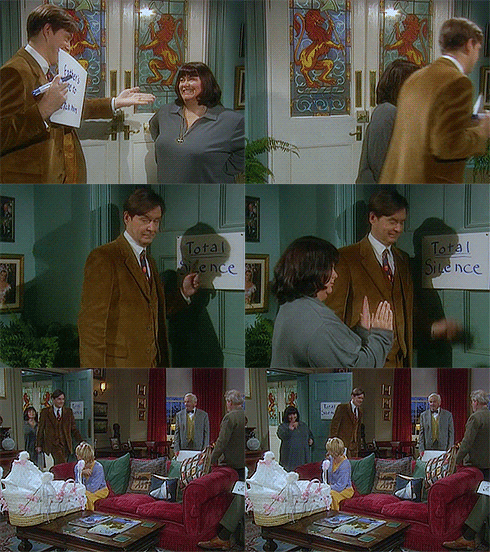



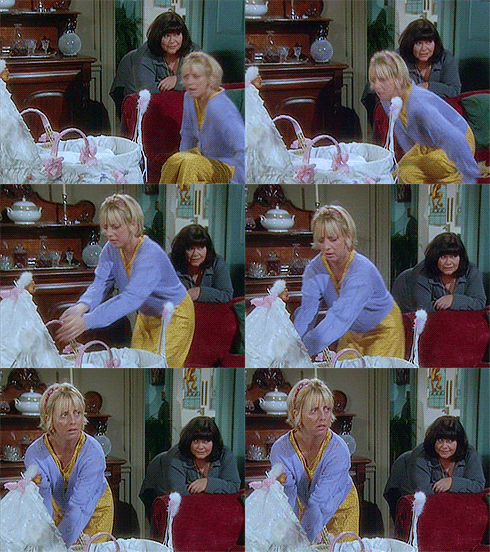


firehose, Albener Pessoa and 4 others like this
26 Oct 03:22


MWD Halloween Edition: McFly
firehosevia Snorkmaiden
nobody calls me corgi
MWD Halloween Edition: McFly
26 Oct 02:11


Thanks to the “mancession”, metrosexuals have become “manfluencers™”
by Christopher Mims
firehose"Seventy-seven percent of manfluencers make a grocery list"
They called it the “Great Mancession.” As the post-2008 economic decline put more men out of work than women in the US, marketers began to notice a trend: Men in opposite-sex couples were taking over what had traditionally been women’s roles. In focus group after focus group, Julie Murphy, an account planner at Midan Marketing, heard from under- and unemployed men who were buying and preparing most of the food in their households. Robbed of their economic potency, men were transforming themselves from chest-waxing metrosexuals into helpmates.
Smelling a trend, Midan conducted a survey that revealed that 47% of men in the US are buying most of of the groceries and doing most of the cooking in their homes. Murphy decided to call this group “Manfluencers™” in order to highlight their newfound power over purchasing decisions. (Yes, the term is trademarked.) Contrary to decades of dogma in the consumer packaged-goods industry, they, rather than the archetypal “mom,” were deciding what their families would consume.
The breathtaking scope of Manfluence™

Manfluence doesn’t end the moment a manfluencer leaves the grocery store, says Murphy. Nearly half—46%—of manfluencers say they are responsible for all of the food preparation in their households. Fifty-eight percent of them do all of the grocery shopping. And 74% claim to clip coupons. In other words, if Midan’s survey of 900 men is truly representative, the data suggest that 73 million American men are manfluencers, and 27 million of them are clipping coupons. “We just couldn’t believe how high these numbers were for men,” says Murphy.
Marketers take notice

Already, marketers are rolling out packaged goods designed to appeal to the newly-empowered manfluencer. These include everything from frozen yogurt for men, which comes in black packaging and was immediately christened “brogurt”, to cold-brew coffee (also black). As is the case with a great deal of marketing, many of those who are being persuaded don’t realize what’s happening.
“I’m not grocery shopping to bolster my manhood—I’m grocery shopping because I want to eat something,” says Adam Carstens, director of research at Hult International Business School. Carstens, a busy professional, is typical of the men to whom prepared foods are marketed. When pressed, Carsten admits that when buying meal bars, he prefers Nature Valley Protein Bars. Carsten didn’t realize that marketers use the keyword “protein” when attempting to appeal to men. “So then I am susceptible to [that kind of marketing],” admits Carsten.
But are marketers exaggerating differences that aren’t really there?

Without historical data, it’s impossible to know the degree to which the mancession accelerated what was already a decades-long trend of men taking over more household work. It’s also hard to know to what degree men respond to marketing.
“Is there a gendered way to cook?” asks Pascal-Emmanuel Gobry, founder of Paris-based market research firm Noosphere, and a manfluencer by Midan’s definition. Gobry is dubious that an equivalent of America’s dawning obsession with man-centric foodstuffs has crossed the Atlantic just yet. “But maybe it’s just that I’m too dumb to see it and I only buy the dude tomatoes,” he adds.
Some couples, of course, have for decades negotiated grocery shopping without reference to gender stereotypes. Steve Silberman, an author who lives in San Francisco, says that “what’s interesting thing about being in a same sex couple is there’s no template for the assigned gender roles, so we work out for ourselves which tasks we find the least onerous.”
Murphy says that one of the most interesting things about the shift towards men buying groceries is that it doesn’t always mean a change in shopping habits. “Men are from Mars and women are from Venus, right? We thought [the differences in shopping habits] were going to be earth-shattering, and there would be so many differences between genders. But we found they’re very alike.”
Seventy-seven percent of manfluencers make a grocery list, 72% compare prices between stores, and 59% are surfing websites for deals and clipping coupons, “all things you wouldn’t think a man would do,” says Murphy.
Midan re-ran its survey numbers for Quartz, looking just at the percentage of women surveyed who did the majority of grocery shopping and cooking in their households, and found that the proportion was the same as it was for men. That’s exactly what you’d expect, given that about half of men claim to be doing these activities.
This lack of difference between genders may be one reason that it took marketers of consumer packaged goods so long to realize that half their audience is no longer “moms.” Carstens notes that while he prefers the “protein” granola bars, he found the all-black packaging of Danon’s new Pro Yo frozen yogurt for men off-putting. “I saw the black box, and I was like, ‘Whoa that’s too strong.’ The Nature Valley protein bars box is very friendly—it’s no big deal, and it’s not in your face.”
Murphy is resolute that manfluentials are a thing, and Midan is determined to make manfluence happen. “The biggest thing we’re driving home is, you need to know who your target is, and don’t just assume it’s a she,” says Murphy.
26 Oct 01:25

fuckyeahbrutalism: Boston City Hall Competition, Second Prize...
Boston City Hall Competition, Second Prize Entry, 1963
(Romaldo Giurgola, Ehrman B. Mitchell, Thomas R. Vreeland, Jr.)
Say what you will about the current City Hall, at least it wasn’t this.
Russian Sledges, firehose likes this

26 Oct 01:05
The Next Wonder Woman Animated Film Won’t Use Her Name In The Title, We’d Like To Know Why
firehose"we’ll probably do a Wonder Woman-centered Justice League movie. We’ll use the Justice League as an umbrella to focus on characters who might not be able to support DVDs of their own. That’s not my judgment, that’s based on sales"
ZOINK


26 Oct 01:03
livia-carica: keepingtrackoflosttime: #no buddy she probably...

Russian Sledges, firehose likes this

26 Oct 01:02

Figuring Out What's Stymieing Bike Share. The Hard Way.
by Dirk VanderHart
firehose"It's not super heartening that wealthy Seattle, which is hoping for 500 bikes at 50 docking stations, only needs to corral about $1.75 million to get things off the ground and still can't find it. We need far more than that."
I've been trying to figure out just what the hell's going on with Portland's much-discussed bike share system. As we reported this week, no one on the front lines of finding $5.5 million in sponsorships for a 750-bike system is saying anything about that work, but it seems pretty clear we're looking at another delay.
Since Portland Bureau of Transportation Director Leah Treat refused to discuss this with me, and Alta Bicycle Share Director Mia Birk says she can't share anything, I've been turning outward to try to get a sense of why we're having trouble corralling cash.
In this week's story, I included the comments of Susan Shaheen, a researcher at University of California, Berkeley, who's studied bike share systems throughout the world. She floated the possibility that title sponsors—the companies that kick in big-time money to name bike share systems, pick the color scheme and slap their names all over the tank-like bikes (think Citibank to New York's Citi Bike system)—aren't as excited about bike share as they used to be.
"Maybe part of this issue is: When these first title sponsors sign on, it's exciting and it's new," Shaheen told me. "For the fourth and fifth installment, it's not as exciting. Maybe the first couple cracks at this was considered a better bang for your buck."
I heard a similar suggestion from Parry Burnap, who got Denver's B-Cycle program up and running in 2008—partly by finding willing sponsors, partly by tapping a bunch of money left over from the 2008 Democratic National Convention.
"For Denver, things lined up in a way," Burnap said. "Bikes were pretty new. There was no feeling that, yeah, we've been there, done that."
Fair enough. I figured maybe Portland's having trouble because we sort of missed the boat on bike share. Even huge metropolises with systems up and running—Chicago, DC, San Francisco—are operating on public money. They've not been able to attract a big sponsor like Citibank or a Barclays (which sponsored London's system).
Then I talked to Holly Houser, executive director of Puget Sound Bike Share, which is having its own troubles scrounging up corporate money.
She'd read our story, and Shaheen's theory.
"I really strongly disagree," Houser said. "I think it's quite the opposite."
She said, if anything, Citibank's sponsorship had made big companies more excited about bike share. And she sent along a couple articles (here and here, both from back in July) suggesting Citi has seen big-time payoffs in perception for its $41 million investment.
"Citibank kind of took the first step and I think rally took center stage," Houser said. "We have seen a lot more interest come up and, especially on the West Coast, a better understanding of bike share."
Also: Slapping your logo on a bike share station is pretty much the only way to get advertising in the right-of-way up in Seattle, she said. It would be a huge potential boon.
Fine. So why is Seattle struggling?
"I think part of it is the kind of money" available in Seattle, Houser told me. Many of the big sponsors for bike share systems, both in the US and internationally, have been banks or health care companies—organizations that might have dubious reputations, and aren't very successful with media campaigns geared toward millennials. Contrast that with Seattle's big fish. Amazon, Microsoft, and Starbucks probably don't need the help.
It's easy to see the same being true here. Nike? Intel? They don't have to shell out $5.5 million to win Portland's allegiances with some bulky bikes. Maybe Kaiser Permanente—who Alta's been courting—will ultimately give in to our advances. Maybe not.
It's not super heartening that wealthy Seattle, which is hoping for 500 bikes at 50 docking stations, only needs to corral about $1.75 million to get things off the ground and still can't find it. We need far more than that.
Of course, we could always pay for the thing ourselves and wait for the money to trickle in, something PBOT officials have mulled in internal documents [pdf]. Or, we could take what money we can get and roll out a smaller system, something Houser's also contemplated.
Not that she thinks it will come to that.
"I'm really confident that we're going to find the money that we need. I don't doubt that it's going to happen."
26 Oct 01:02

KXL: Keeping It Classy In Chinatown
by Dirk VanderHart
firehosewelcome to Portland
Perceptive reader Alexander sends along this picture of news station KXL-FM's current message to the good people of Portland's historic Chinatown. It's around NW 3rd and Couch.
Alexander says:
"UHHH, is this entirely racist? YES! A mistake from one ignorant person happens, but this advert was green-lit by numerous decision makers no doubt, and now presides in a neighborhood already wrought with the stigma of Portland's historic racist behavior.THOUGHTS?"
I think it's about the most-pointless billboard I've ever seen regardless of where it hangs, but especially stupid in this context.
What do you got, Blogtown?
26 Oct 00:55
Magnitude 7.3 earthquake hits off Japan's Fukushima | Al Jazeera America
by gguillotte
firehosegoodbye, earth
A magnitude 7.3 earthquake struck near Japan’s Fukushima region on Friday, the U.S. Geological Survey said.
The Japan Meteorological Agency has issued a tsunami advisory for Fukushima prefecture, the site of the country’s 2011 nuclear disaster, which resulted from an earthquake-triggered tsunami.
The earthquake occurred about 231 miles of east Japan’s Honshu Island and was about 6.2 miles deep, the USGS said.
26 Oct 00:48
Dupé Store Offers Bottled Air to Shoppers as Part of Australian Campaign to Promote Tap Water
by EDW Lynch
As part of Choose Tap, a campaign to promote tap water over bottled water, Melbourne water corporation Yarra Valley Water created Dupé, a fake company that claims to sell bottled air, sunshine, and other absurdities. The ruse includes a slick website and a pop-up store which offered bottles of organic air to baffled customers.

firehose likes this