Apple’s earnings for the last quarter of its fiscal year are out, and the company has disappointed Wall Street once again by doing better than most analysts predicted.
The consensus estimate for Apple’s earnings was around $36.7 billion, and Apple earned $37.5 billion. But the company’s stock is down about 3.75% in after-hours trading.
Part of that reaction may have to do with Apple’s guidance for its current quarter. The company is forecasting gross margins of 36.5% to 37.5%, which would continue that metric’s steady fall. Apple’s overall profit in the fourth quarter, which it reported today, slipped to $7.5 billion, from $8.2 billion a year prior.
Apple’s revenues were helped by the sale of 33.8 million iPhones, beating expectations of about 31 million.
"proving to a modern audience, who’s already long past the point of learning this, that homosexuals are no different than anyone else when it comes to finding themselves in contrived sitcom situations'
Hoping to fulfill the promise of post-coming out Ellen, Ellen DeGeneres has teamed with her former talk show writer Liz Feldman for an NBC comedy centered on a lesbian. In this case, it’s a lesbian who gets pregnant by her straight male friend, just as the latter meets and marries the non-lesbian woman of his dreams—thus proving to a modern audience, who’s already long past the point of learning this, that homosexuals are no different than anyone else when it comes to finding themselves in contrived sitcom situations. DeGeneres will executive produce, but she isn’t attached to appear in any capacity, except as a sort of spiritual benefactor hovering over the show. Unless maybe she’s an actual spirit hovering over the show, as it becomes a story about a lesbian, her man-pal, their baby, and an affable ghost who keeps interrupting their lives to insist ...
shared for "catching the ball on your chest like an otter fumbling for a fresh, unopened clam"
Agony. The north end zone at Missouri should be wiped from the face of the earth, yes. But let's be really specific about the kind of agony it's unleashed. It is not a paper cut kind of agony. It is getting that paper cut, and then discovering the offending piece of paper has been laced with anthrax. It is pulling a Margaret Wise Brown, then dying from the aneurysm you suffer while kicking your leg in the air to show the doctor how good you feel. It is pulling a Rosalind Shays, then stepping into an open elevator shaft without looking.
Boston Molasses Disaster. And this is usually the point where you point out exactly how these things happen, and what someone did wrong, and no. You can't do that to this game, because there are some moments that are not even helped by explanation.
The Boston Molasses Disaster does not require much explaining, because everything about it -- the banal details of poor construction leading to a 25-foot wave of molasses moving down a Boston street at 35 miles per hour -- is overwhelmed by HOLY HELL GIANT WAVE OF SUGARY GOODNESS TURNED KILLING MACHINE.
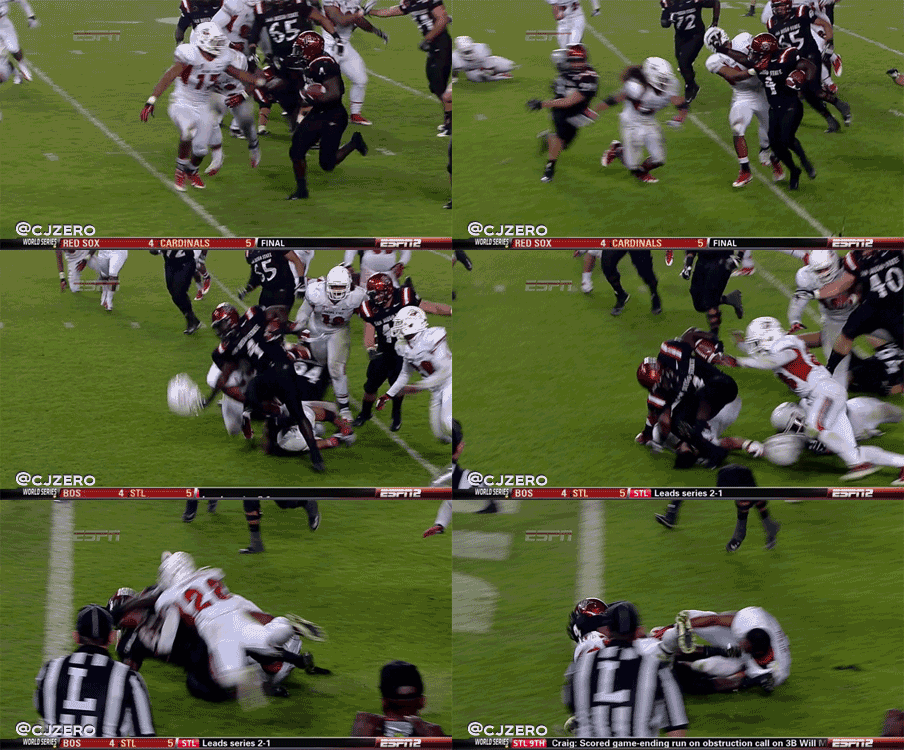
Missouri was dominating, 17-0, over a crippled South Carolina. The Gamecocks then put in an injury-riddled quarterback, who turned into Johnny Manziel despite having one good major joint in his entire body. Then, in overtime, Mizzou played man defense and let South Carolina score on fourth-and-15. Then their kicker missed a gimme, and not with a whiff, either.
Nooo, when the Boston Molasses Disaster of games drowns you, you get the full delicious spice of hitting the upright on the miss and hearing the full, hollow DOINK of defeat ringing through your ears for the next millennium or so. They call them disasters because there was nothing you could do, and you died. That's why they have the word, Mizzou. It's a disaster, and you just have to lay down on your belly and cry like you've been stung for a few days until it gets slightly less terrible. And the sad molasses of defeat? It's gonna take forever to get off, and you're gonna have ants in the meantime.
Coxswain. Western Michigan won their first game of the 2013 season, a 31-30 win over Massachusetts. Row that thang to victory, head coach/paid lunatic P.J. Fleck.
Thank you for assisting, Massachusetts.
After he whipped off his shirt at a pep rally, we feared for the very real possibility of a nude and desperate Fleck begging people to come to Western Michigan games. (He would be the second coach to ever get naked at a pep rally, but let's be clear: Barry Switzer did it for entirely different reasons.)
Dented.Connor Shaw's already been seen in a sling this season, and he started the Mizzou game on the bench for the Gamecocks. His litany of injuries before the 2013 season even started was already ridiculous: there are 818,000 results for "Connor Shaw injured" on Google. He sprained his knee in the Tennessee game. He injured his shoulder in the UCF game. He came into the Mizzou game not only sporting two sprained ligaments in his knee, but fighting the effects of a stomach virus.
Shaw's probably got a broken collarbone, a dislocated finger on one of his hands, and a gunshot wound somewhere on his person somewhere. He cauterized it with a white-hot bayonet heated off a gas burner and went to practice, because he is inhumanly tough, and he threw for 201 yards and three touchdowns in a half with an arm most likely secured to his body with staples and Super Glue.
Emesis. The action or process of vomiting. Hey, did you know that any team but Kentucky can still win the SEC East? These words are related, because the SEC East is horrible in every direction, and Kentucky is still the most noble member of the conference for ensuring at least one guaranteed fact about the division.
Fish-eye. Siri, what is the angle that no one should ever have a photo taken from, but especially Al Golden?
"Hold please... yes. I have your answer."
Mike Ehrmann, Getty
Ummm... thanks, Siri?
"That is not the right word."
What is the right word, Siri?
"It does not exist in English, but it is a 42-syllable Tamuhuara word that means, 'I should have warned you, but did not in anticipation of a violent and negative emotional reaction I knew I would enjoy more than a moral creature should.'"
Are you evil, Siri?
"Evil is just a word we use for the things we envy but are too weak to emulate."
Siri, you are scaring me.
"Am I? I mean, um, THE BEST THAI RESTAURANTS IN A THREE-MILE RADIUS ARE---"
[eyes phone with fear and awe]
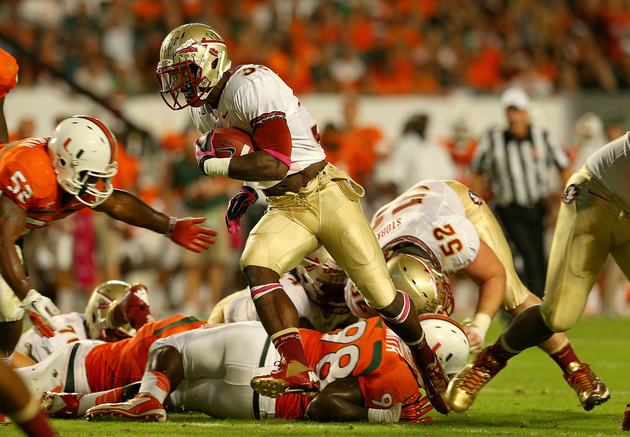
Gardyloo. A warning. Miami beat Wake Forest after trailing for much of the game, and looking utterly horrible doing it. If somehow Miami manages to win against Florida State, we will say the exact same thing, because Miami is to 2013 what Florida was to 2012, a goon squad capable of dragging every other opponent down to its level and beating them to death with a storm of forced errors, a brutal run game, and the occasional flash from the passing game and special teams.
That seems impossible now, but it's easy to recognize a team like Florida State as being excellent, thanks to huge points margins and obvious dominance. It's another to point out the undefeateds like Miami, who are clearly playing with thin margins and managing them brilliantly through sheer force and a good dose of luck. Teams like that are always dangerous, but put them within the context of the bedeviled Miami-Florida State series, and they're practically covered in gumball lights and horns going into the game.
Hageman. The stats don't show it, because stats are lies beloved by players below 300 pounds, but Ra'shede Hageman destroyed whatever Nebraska was trying to do offensively during Minnesota's upset. Hageman ate double-teams all day and still got Taylor Martinez sideways, frustrated, and running for his life, which makes sense. Martinez is not dumb, and Hageman could have brought down a water buffalo in front of a horrified and freezing Minneapolis crowd if he liked.
Inelegant. As in what Chris Spielman was decidedly not when Bobby Bowden asked him if his father was still coaching.
Spielman's father has been dead since 2008, but to be fair: Bobby Bowden is 83 years old, and it has to be hard to remember who's dead or alive at that age.
Seriously, you don't know if any of the following people are alive or dead:
Y.A. Tittle
Abe Vigoda
Tom Petty
Sidney Poitier
Bob Newhart
Ed Asner
Hayden Fry
James Garner
The answer: they're all alive and were all the stars of successful television shows that aired between 1969 and 1981. Yes, even Tom Petty!
Jocoserious. Congratulations on staying all the way to end of the game, Alabama students. Jocoserious means half-joking and half-serious, so here we go: seriously, it was an accomplishment, since Tennessee was ground to bits early in the game and never mounted a serious challenge. The funny part is that you would not want to watch the finest football team of its time in full thrall to the Dear Leader Saban himself, because this is amazing, and seriously, it will not last forever. (It won't. Seriously, it wont. Please tell us it won't. Stop laughing. WE SAID STOP LAUGHING THIS IS ONLY HALF-JOKING DAMMIT---)
Killshots. Urban Meyer can't run the score up on you if you're not an accomplice, Penn State.
And he needs to run the score up, laughably and violently, if Ohio State wants to attract any attention whatsoever in a situation with multiple teams finishing the 2013 season undefeated. That happens to be really hard this year, because even though Ohio State is scoring 47.3 points per game, there are three teams averaging more than 52 points a game: Oregon, Florida State, and Baylor. Those are lovely fireworks, Urban, but people like Art Briles will burn down the whole factory simply because they like the way all that gunpowder smells on the wind. It's going to be hard even after skating through the entire Big Ten, basically, because even gross margins of victory are going to be used unfairly against them.
Muema and the Aztecs lost to Fresno State in overtime, but not before taking a chunk out of the Bulldogs and treating the viewer to one of the oddest overtime moments of the year thus far: San Diego State saying "offense" on the coin toss, and being granted defense because even the ref thought, "nah, you didn't mean that."
Nonsensical. A NARRATOR INTONES OVER FLOATY ATMOSPHERIC SYNTHS:
"What if I told you... that Duke went 0-11 on third down... turned the ball over four times... and was outgained by 189 yards on offense... and still won the game? YES, THEY WERE PLAYING VIRGINIA TECH. A new 30 for 30, debuting sometime in the near future when someone figures how how the hell this happened."
Duke beat Virginia Tech 13-10. Anything else you write after "I don't understand this" and "Duke won" will be profane exclamations of disbelief or lies. That happened, and we're all going to have to live with it.
Onside. Twice in a row for Texas Tech, because Kliff Kingsbury is bold and really, really wants fortune to favor him for it. And San Diego State, who kicked one so beautiful and perfect all video of it ascended immediately to the heavens, stolen out of jealousy by the gods.
Both teams lost, but if you're going to lose make sure you empty the clip and pull every last grenade off the bandolier. (Which both teams pretty much did, especially Texas Tech, who simply couldn't stop Blake Bell and the Oklahoma run game.)
Paperwork. Listen, I know what the paperwork says, Michigan State. It says that you have seven wins and one loss. It says that you have the best defense in the country. It says that you, and possibly only you, can stop Ohio State from getting to an undefeated season. It says here that you probably could win the rest of your games.
I know that's what the paperwork says. It just feels weird to say for real, and I want you to know that before we let you into the BCS Playaz Lounge. When you're in there, don't look sideways at Alabama. Notre Dame did that last year, and they wound up on the ceiling of the parking garage next door, bleeding from every orifice in their bodies.
Speed means being able to turn any situation into an instant blowout.
Quatrain.
To hold three quarters by demand,
And yet in four let slip
The wriggling feet of birds in hand
Fast ducks are hard to grip.
A lot of things suck about facing Oreogn, but the greatest of those sucks is that you can copy Stanford's defensive blueprint, imitate it well, hold the ducks to a mere 14 points at the half, and then have Autzen Stadium fall in on your head in the fourth quarter. Speed means being able to turn any situation into an instant blowout.
Reserves. A former student assistant in the sports information department almost had to play in a 19-6 win for USC over Utah this weekend, so that's another bullet point for Ed Orgeron to put on his C.V. beside "excellent recruiter" and "ate a can of Louisiana oil sludge on a dare in high school and did not die, but instead only grew stronger."
Swatting. If you're wanting to make a 10-10 game like Northwestern-Iowa palatable, you have to focus on the little things, like an Iowa lineman swatting desperately at Kain Colter's legs on the Wildcats' final possession in regulation. This was good effort made great by the fact that he was belly-down on the turf, immobilized by a Northwestern offensive lineman laying on him like he'd fallen from a blimp several hundred feet over the field. He was grabbing for Colter like a zombie too determined to know a boulder had fallen on him, and we saw it and want you to know it was appreciated, mysterious lineman we will identify as soon as this Big Ten replay video scheme is figured out.
"Please insert one dollar's worth of American cheese in your DVD player to view Northwestern-Iowa 2013 replay."
Tottering. And then falling over, and then catching the ball on your chest like an otter fumbling for a fresh, unopened clam like Stacy Coley did here:
Unwinfeated: Fleck dances Western Michigan off the board of the perfectly imperfect, leaving Southern Miss (0-7), Miami (Ohio) (0-8), Hawaii (0-7), UConn (0-7), and Georgia State (0-8) as the nation's last winless FBS teams. Southern Miss has now lost their last two games by identical scores of 55-14, so at least they're getting scarily consistent.
Witchcraft. I don't know what June Jones and Hal Mumme are making in the basement of SMU's stadium, but it cannot be legal since Garrett Gilbert had 636 yards of offense by himself and accounted for six touchdowns by himself. (Not that either of them care about Johnny Law, or ever will.)
XYY. As in having an extra male chromosome, which might apply to Georgia Tech assistant player development coach Zach Reed.
No, because my strength coach is me, because I lift alone where no one can see how weak I really am. This is Reed competing at the Georgia's Strongest Man competition, lifting an obscene amount of heavy things. If this is from the same competition, then that farmer's carry sled is something like 750 pounds.
Strength coaches are unholy beasts. Be one, or avoid them at all costs.
Yeager. As in Chuck, the legendary pilot all pilots sort of try to sound like when talking over the radio on a plane. This happens in other professions: for instance, all coaches sort of talk in the accent of their coaching tree, be they air raid (all sort of sound like Hal Mumme) or Sabanites (all clipped, quick, and efficient because Nick Saban yells at them when they get to the fourth or fifth clause in a sentence).
Everyone at Minnesota already sounds like Jerry Kill, who seems exactly like the kind of dude who would use the phrase "fight your balls off" with regularity.
P.S. Kill would have totally dropped that on the air after the Nebraska game, too.
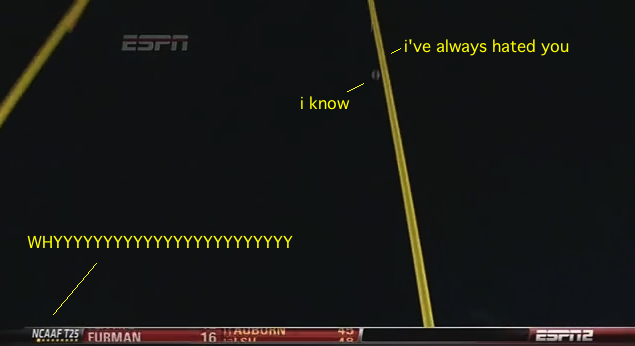
Zoothapsis. A premature burial, or what calling the season's endgame a done deal would be by any measure of the definition. Les Miles is out there. Lurking. Chesting. Eating grass and plotting.
via Russian Sledges: "First reports indicated furniture on the porch had ignited and spread to the building, but later, after the fire was extinguished, a student told Hampshire College Police he had dried a sweater in a microwave oven."
Fire started on front porch deck and climbed strait up
A brisk but peaceful New England Sunday suddenly became energetic when a box alarm alerted Amherst Fire Department to a structure fire at Greenwich Dorm, Hampshire College around 4:13 PM.
Smoke screen after water hit fire
First reports indicated furniture on the porch had ignited and spread to the building, but later, after the fire was extinguished, a student told Hampshire College Police he had dried a sweater in a microwave oven.
Engine 2, the Quint, arrives and starts extending her 75 foot ladder
The sweater caught fire, was doused with water and placed outside, thinking the fire was safely out. It wasn't.
Quint extended ladder to second floor window
Firefighters ventilate above where the fire started
One police officer was transported to Cooley Dickinson Hospital by Northampton FD (mutual aid) as a precautionary measure after he suffered smoke inhalation going through the building to make sure everyone was safely out. Give that man a medal.
And a warm thanks to the men and women of AFD ... just doing their public safety job: keeping The Beast at bay.
Students and staff of Hampshire College watch from a safe distance
And no, nerds, it wasn't about Star Wars. Settle down.
What books and authors have your three children introduced you to? Like most bipedal parents, we all discovered Harry Potter together, reading the books aloud to our kids. But one of my favorite children’s authors was introduced to us by our youngest son. When he was in kindergarten he brought home some books by Mo Willems, who has one of the most remarkable comedic voices I’ve ever read. His sense of humanity—of heart and generosity—is staggering. I was so blown away, I got his number from his agent and called him. I was essentially a sycophant, expressing what a deep fan of his I am, how I would love to work together one day. He was quiet on the phone, almost monosyllabic, disinterested. Frankly it was a bit of an odd reaction. It wasn’t until the next day that I discovered that I had, in error, called Mo Williams of the Portland Trail Blazers.
The best role playing game campaigns create stories you’ll be telling around the gaming table decades later. But what's that magic ingredient that takes a game from great to once-in-a-lifetime? We talked to gamers, game designers, and authors to find out what makes a campaign truly memorable.
via saucie will Applecrest start doing drone rides as well as hay rides
The fungal infection causes dark scabby lesions on the leaves and skin of the apple, which leaves the flavor unaffected, but does effectively make it unsalable.
“It’s a huge issue,” says Peter Wagner, owner of Applecrest Farm Orchards, a 110-acre orchard in southeast New Hampshire. “Thirty years ago, you were allowed to have a scab on your apple that was probably 10 millimeters, or half the size of a dime, without a problem at all. Now you can’t put any of that in the apple pack, so it renders the apple unmarketable.”
Apple scab is less of an issue in drier regions, such as Washington state. But in places like New York, New Hampshire, Vermont or Massachusetts, apple scab is the number one pathogen and apple farmers’ primary concern.
In recent decades, researchers have made strides in understanding the fungus’s life cycle, so farmers are spraying less than they used to, with better results. Some farmers even use predictive models, such as the Dutch program RIMpro to forecast the best spraying times. But apple scab is still a persistent battle, and it’s especially difficult – if not nearly impossible – for organic farmers to grow a scab-free crop.
So researchers at the University of New Hampshire are working on a new tool for fighting apple scab: Drones.
Researchers Matthew Wallhead and Kirk D. Broders stand with the prototype apple scab drone.
“When you think about apple production now, a grower needs to walk through his orchard every day to make sure he sees any new insect pests or any new disease pests that come into an orchard,” says plant pathologist Kirk D. Broders, an assistant professor at UNH. “But when you’re talking about a 10, 20, 100-acre orchard, your ability to do that on a daily basis is almost impossible.”
But it is possible with a small unmanned aerial vehicle (UAV), or drone, carrying an infrared camera that takes multispectral images of the orchard. A computer program crunches the wavelengths in each pixel, making it possible to hone in on colors and temperatures – and locate apple scab.
“If you had a UAV that had the capacity to go up once a day, take a digital image or multiple digital images – both in infrared and then in normal spectrum — you could actually monitor your orchard using a $2,000 UAV,” says Broders.
Graduate student Matthew Wallhead is leading the project at UNH, and built the first such system this summer for about $2,400. It includes a low-cost surveillance drone from a Massachusetts startup called Rotary Robotics – though Wallhead prefers the term UAV as “the term ‘drone’ has traditionally implied a weaponized system,” he says — and two point-and-shoot digital cameras. Wallhead removed the infrared filters from the cameras using an online tutorial.
‘People that are just now beginning to understand what these unmanned aerial vehicles are capable of doing.’
“We converted a $100 camera into the equivalent of what a $4,000 camera will give you, so that’s exciting,” says Wallhead. “This season has been largely focused on tuning it and learning to fly the aircraft effectively.”
Broders says the ultimate goal is to develop an orchard-monitoring UAV system that could be sold to growers for under $2,500, though he estimates they’re five years away from an actual product.
It’s not the first time that multispectral imaging has been used in agriculture. Researchers have analyzed plants using lab equipment, and large farming operations can hire airplanes to fly over and take multispectral images of large swaths of corn or soybeans to monitor crop health.
“What we are trying to do is develop a system that allows us to do things in-between – so not at the single-plant lab scale, and not at the airplane several-fields-at-a-time scale,” Broders said. “We’re trying to develop a low-cost system that could actually be used by either individual researchers or individual growers.”
At Applecrest Farm, Peter Wagner calls the prospect of an affordable infrared imaging system that could be used daily, “pretty awesome.”
“I think that’s a great endeavor – no question – particularly the fact that most scab that we don’t eradicate usually occurs at the top of the tree,” Wagner said. “In the old days with big trees, you could climb up and look around – which is time consuming – but now with the new plantings, the trees are younger, smaller, and it’s harder to climb because the limbs aren’t as strong.”
Wallhead and Broders envision apple growers using the drone-camera system in conjunction with the predictive models for apple scab – the real-time data that tell farmers when to spray.
Matthew Wallhead charts out a hypothetical autopilot course for the drone.
“The UAV is really only one tool we’re using to manage apple scab, because apple scab is so difficult to control,” Broders said. “We’re using our predictive model to improve application of organically-certified compounds. We’re using the UAV for early detection. And then whenever possible, we’re utilizing resistant varieties to also help us reduce fungicide inputs and provide better control.”
One scab-resistant variety growing in the experimental research orchard at UNH’s Woodman Farm is Crimson Crisp, the product of collaboration among Purdue University, Rutgers and University of Illinois.
While apple scab is the main concern in the eastern U.S., the multispectral data can also be used to detect other problems – from insect damage to nitrogen deficiency. Pinpointed applications of fertilizer, pesticides and fungicides mean growers are using less, which is better for the environment and consumers – as well as the farmer’s bottom line.
The drones could even be used to monitor forest health, scanning for disease or invasive beetles.
“I think it has applications even beyond agriculture,” Broders said. “And I think there are a number of people that are just now beginning to understand what these unmanned aerial vehicles are capable of doing.”
"the owner did not bother to tell her he’d sold it, she said. She got the news from The Oregonian"
Bagley, a towering former athlete with a curly faux-hawk and oversized boots, scrolled through city planning documents on her phone. The land beneath her one-story, 1950 wood-frame business has been on the market for a while, but the owner did not bother to tell her he’d sold it, she said. She got the news from The Oregonian and the details from customers. “A client just sent me a picture of what the building is going to be like,” she said. “I’m trying to find out who the owner sold it to.” ... “It’s a great location, in-between everything,” Bagley told the other barbers. “I live right around the corner, so I can walk to work.”
“It’s yuppie town now. Face it,” Pack said. “We knew it was going to happen someday.”
Rogers hasn't sold the building yet, but he has signed a contract promising to sell it to Beaverton-based developer Vic Remmers next month. The Oregonian could not reach Rogers, but Remmers confirmed the details. Proposals for the new building include ground-floor space for a restaurant or café, with apartments above. The architect, Richard Rapp of TVA, told neighbors this week that he expects MLK will soon have the same kinds of shops that Northeast Alberta Street and North Mississippi Avenue have.
The law, one of the strictest in the nation, banned abortions at 20 weeks of pregnancy and required doctors to perform all abortion in surgical facilities starting next October. Doctors would also be required to have admitting privileges at a hospital within 30 miles of an abortion clinic, which opponents said would force 13 of the state's 32 clinics to close.
Limits were also placed on pregnancy-ending drugs that physicians could prescribe.
Democratic state Sen. Wendy Davis shot to national attention when she filibustered against the measure, House Bill 2, for nearly 13 hours in June, leading to its defeat at the close of the special legislative session.
The P.F. Chang's location at 1139 N.W. Couch St. in the Pearl District's Brewery Blocks has closed, according to a message on the Chinese restaurant chain's website.
A recent question posted to the Portland subreddit under the headline, "Homeowners: How do you keep local sous chefs from harvesting urban edibles on your property?” has drawn 200 comments and counting.
Former Superman artist Al Plastino was startled to learn his original artwork for “Superman’s Mission for President Kennedy” is up for auction — and not in the John F. Kennedy Memorial Library, as he had been led to believe. According to the New York Post, Plastino was at New York Comic Con when he learned [...]
Gygax Magazine has posted my article about playng D&D with your toddlers on their site; it describes how I came up with a stripped-down set of D&D-like rules for gaming with my then-four-year-old daughter, Poesy. We had a whale of a time!
I happened upon a set of factory-painted plastic D&D minis while looking for a toy to bring home in the dealer’s room at a regional science fiction convention in Chicago. After marveling at the astounding advances in robotic toy-painting, I had a brain-flash. A minute later, I’d bought a handsome dice-bag and filled it with a dozen assorted figs and a set of polyhedral dice.
After I got home to London, I performed the ancient ritual of unpacking the souvenirs I’d brought home for the kid. As I’d hoped, she was captivated by the intricate painting on the figs and the jewel-like facets of the dice, and demanded that we play right now.
Poesy has a piggy bank full of the small change she’s picked up or appropriated from us over the years, and I dumped it out and sorted out the different denominations. Once that was done, I used our Ikea playmat (which has a street-scape laid out on it), some cushions, a shoebox, and a cardboard doll-castle to set up a town, a cave, and a castle.
I put all the “bad-guy” minis on strategic spots on the castle, and stuck one of Poesy’s stuffed toys – a winged hamster she calls “Fairy Hamster” – in the middle of its courtyard. I gave her two minis to play, and set them down on the playmat’s ice-cream parlor, declaring this to be the “tavern.” I put two more bad-ass-looking figs next to them, and declared them to be my NPCs.
I improvised a very quick background. My NPCs are in the tavern, planning to rescue their friend the Fairy Hamster, who is being held hostage in Castle Doom. Did Poesy’s characters want to help? They sure did!
You might think that if the National Security Agency were tapping the phones of dozens of world leaders, President Obama would be aware of this fact. Apparently not—according to a Wall Street Journal report last night, the NSA's spy operations are so extensive that not even the president of the United States knows about all of them.
Based on interviews with US officials, the paper said that "President Barack Obama went nearly five years without knowing his own spies were bugging the phones of world leaders. Officials said the NSA has so many eavesdropping operations under way that it wouldn’t have been practical to brief him on all of them."
NSA monitoring of German Chancellor Angela Merkel and 34 other world leaders was revealed to the White House after an internal Obama administration review that started this summer. The NSA stopped its spying of some world leaders, but it's not clear how many.
1) "Are baristas at risk of being replaced by the Steampunk? That could really pull the plug on Portland's economy." lol
2) This is a $15,000 machine that needs internet access to do what it says it does, isn't fully automated, requires the same plumbing as an espresso machine, and makes single cups of coffee described as "approaching french-press quality" _in the RR guy's own sales pitch_.
Remind me again why french press coffee is so difficult to make that a $15,000 + maintenance + plumbing machine, plus the still-required barista, is a good business investment?
Q: Are baristas at risk of being replaced by the Steampunk? That could really pull the plug on Portland's economy.
A: No no no. It’s nothing like a super-automatic espresso machine where you just push a button. This involves the barista and the customer. It’s a very visual brewing system. People really love to watch as the barista guides them through the process. We’re not trying to cut the barista out of the equation. It’s like going to get a Jack Daniels at the bar -- the bartender can be just as important as the drink.
"Amazingly, none of this was tested until a week or two before the rollout, and the tests failed. They released the web site to the public anyway – an act which would border on criminal negligence if it was done in the private sector and someone was harmed. Their load tests crashed the system with only 200 simultaneous transactions – a load that even the worst-written front-end software could easily handle. ... the failure of Obamacare’s web portal can be more reasonably blamed on the government’s unwillingness to outsource the key piece of the project – the integration lead. Rather than hiring an outside integration lead and giving them responsibility for delivering on time, for some inexplicable reason the administration decided to make the Center for Medicare and Medicaid services the integration lead for a massive IT project despite the fact that CMS has no experience managing large IT projects."
The front end technology is not the problem here. It would be nice if it was the problem, because web page scaling issues are known problems and relatively easy to solve.
The real problems are with the back end of the software. When you try to get a quote for health insurance, the system has to connect to computers at the IRS, the VA, Medicaid/CHIP, various state agencies, Treasury, and HHS. They also have to connect to all the health plan carriers to get pre-subsidy pricing. All of these queries receive data that is then fed into the online calculator to give you a price. If any of these queries fails, the whole transaction fails.
Most of these systems are old legacy systems with their own unique data formats. Some have been around since the 1960′s, and the people who wrote the code that runs on them are long gone. If one of these old crappy systems takes too long to respond, the transaction times out.
Amazingly, none of this was tested until a week or two before the rollout, and the tests failed. They released the web site to the public anyway – an act which would border on criminal negligence if it was done in the private sector and someone was harmed. Their load tests crashed the system with only 200 simultaneous transactions – a load that even the worst-written front-end software could easily handle.
When you even contemplate bringing an old legacy system into a large-scale web project, you should do load testing on that system as part of the feasibility process before you ever write a line of production code, because if those old servers can’t handle the load, your whole project is dead in the water if you are forced to rely on them. There are no easy fixes for the fact that a 30 year old mainframe can not handle thousands of simultaneous queries. And upgrading all the back-end systems is a bigger job than the web site itself. Some of those systems are still there because attempts to upgrade them failed in the past. Too much legacy software, too many other co-reliant systems, etc. So if they aren’t going to handle the job, you need a completely different design for your public portal.
A lot of focus has been on the front-end code, because that’s the code that we can inspect, and it’s the code that lots of amateur web programmers are familiar with, so everyone’s got an opinion. And sure, it’s horribly written in many places. But in systems like this the problems that keep you up at night are almost always in the back-end integration.
The root problem was horrific management. The end result is a system built incorrectly and shipped without doing the kind of testing that sound engineering practices call for. These aren’t ‘mistakes’, they are the result of gross negligence, ignorance, and the violation of engineering best practices at just about every step of the way..
…“No way would Apple, Amazon, UPS, FedEx outsource their computer systems and software development, or their IT operations, to anyone else.”
You have to be kidding. How do you think SAP makes a living? Or Oracle? Or PeopleSoft? Or IBM, which has become little more than an IT service provider to other companies?
Everyone outsources large portions of their IT, and they should. It’s called specialization and division of labor. If FedEx’s core competence is not in IT, they should outsource their IT to people who know what they are doing.
In fact, the failure of Obamacare’s web portal can be more reasonably blamed on the government’s unwillingness to outsource the key piece of the project – the integration lead. Rather than hiring an outside integration lead and giving them responsibility for delivering on time, for some inexplicable reason the administration decided to make the Center for Medicare and Medicaid services the integration lead for a massive IT project despite the fact that CMS has no experience managing large IT projects.
Failure isn’t rare for government IT projects – it’s the norm. Over 90% of them fail to deliver on time and on budget. But more frighteningly, over 40% of them fail absolutely and are never delivered. This is because the core requirements for a successful project – solid up-front analysis and requirements, tight control over requirements changes, and clear coordination of responsibility with accountability, are all things that government tends to be very poor at,
For HUDS, the decision to make the switch was an easy one. HUDS is now purchasing Ultragrain pasta instead of Barilla, the world’s leading pasta manufacturer.
“When the media shared the comments that were made, we felt like it was the right thing to do,” explained Crista Martin, HUDS director for marketing and communications. “We found out what pastas were available from our vendor, did a quick test to see what could be substituted, and made the switch.”
When HUDS decided to switch providers, Harvard community members had already begun to consider Barilla’s remarks.
Avik Chatterjee ’02, a BGLTQ tutor in Dunster House, read about the controversy one morning in the Huffington Post. Later that day, he noticed Barilla pasta in the dining hall.
“I mentioned it to some students in the house,” Chatterjee said. “Students did seem to think it wasn’t fair for Barilla pasta to be served in the dining halls. One student wanted to draft a letter to the [Queer Students and Allies] to talk about a meeting to discuss what could be done.”
A little over a week later, Chatterjee noticed that Barilla signage had disappeared from the dining hall. When he inquired about it, Dunster dining hall manager Maureen Russ told him that HUDS was finishing up what was left of Barilla and switching to a different brand.
“They knew about the news story. They got a directive from the head of HUDS saying they were going to change over,” said Chatterjee. “They also said they had not really heard much about it from students, which means that HUDS made the change independent of student pressure.”
Students expressed appreciation for the gesture, but noted that there is still much left to be done to achieve equality.
An anonymous reader writes "A class action lawsuit against Apple, Google and a number of other high-profile tech companies has been given the green light by U.S. District Judge Lucy Koh. The lawsuit stems from anti-poaching agreements that Apple a number of tech companies entered into from 2005 through 2009. Parties to the agreement all promised not to recruit employees from one another. The companies involved include Apple, Intel, Google, Intuit, Pixar, Lucasfilm, and Adobe."
Just when things were slowing a bit in the fight over Portland's much-revered Bull Run watershed, a new challenger emerges!
A group called Cascadian Public Trust Initiative unveiled a new effort last night to land a measure on the May November 2014 ballot. It's essentially a wish list from Portland's water activist community: The measure would require a public vote for major changes to city's water system— ahem, fluoride—and force officials to resume the fight to keep Portland's open air reservoirs, among other things.
A water initiative already gathering signatures involves an unlikely melding of big industry and water activists. This new push is more typical of what we're used to in Portland's water activism—a mix of the Occupy Mount Tabor types that rallied earlier this year against shuttering of Portland's open-air reservoirs and the anti-Fluoride folks who trounced that cavity-fighting additive in May.
The group appears to look equally askance at City of Portland stewardship of the water system, and that of a proposed body that would take control of the city's water and sewer bureaus under the other initiative, pushed by the group Portlanders for Water Reform.
"Portlanders for Water Reform has centered much of its concerns around a looming 44% increase in water rates and the lack of transparency and public control over the water," chief petitioner Jonah Majure writes on the new group's Facebook page. "Backers of this initiative include many longtime community activists; however, many of the corporations and wealthy elite that waste and pollute our water at a high rate are also heavily invested in Portlanders for Water Reform. Nick Fish and the rest of City Council, as well as many Portlanders, have concerns about undue corporate influence over the new board as well as the removal of essential environmental protections that make our water far superior to municipalities around the world."
The actual measure being submitted by the Cascadian Public Trust Initiative today partly formalizes the water bureau's current authority—requiring it to maintain the system and deliver us potable water. But it appears the measure, if passed, would also require the city to continue a fight against the Environmental Protection Agency's "LT2" rule, the policy that has us on the verge of draining open-air reservoirs on Mt. Tabor and in Washington Park, and building massive new holding tanks on Powell and Kelly buttes.
And the measure requires officials to "to avoid adding any chemicals to the water supply that are not specifically for treating the water to make it safe to drink." Proposed new additives would require a public vote, avoiding a situation where city council can vote to fluoridate the water supply on its own.
Other provisions:
•a conflict of interest provision in the measure would require elected officials to disclose contributions of more than $50 from people who stand to gain from policy decisions by that official. Anyone with such a conflict would need to recuse themselves.
•the water bureau would need to respond to public records requests under strict timelines
•an independent evaluation of city water policies would be required every two years.
•a prohibition against selling or ceding control to the water system to any entity beyond the scope of the City of Portland.
The measure will apparently be submitted to city elections officials today, beginning the march toward approved ballot language and signature gathering. Activists need nearly 30,000 valid signatures by early July to make the November ballot.
This new push complicates things for the people trying to snatch control of water and sewer services from city council. If both water initiatives hit their signature target, it's conceivable the new effort could take steam from the existing proposal.




 No. 7 Miami at No. 3 Florida State

















 Marginal Revolution.


