
firehose
Shared posts
29 Oct 16:27

The tale of the World Series paper airplane(s)
by Rodger Sherman
I'm not an expert paper airplane constructor. No matter which form of paper airplane I constructed -- a regular old triangle-shaped thing or a more advanced doohickey -- or how much effort I put in, it invariably took a nosedive instants after I threw it.
Which is why I want to highlight the effort of one -- or perhaps many -- St. Louis Cardinals fans, who broke the bounds of what I believed capable in the field of paper aeronautics.
In the bottom of the seventh inning, they tossed a paper airplane so far that it nearly reached the mound, which is I'd guess 100-ish feet from the closest part of the Busch Stadium stands. That's a long flight for a paper airplane.

Jon Lester had to step off and retrieve it:

Photo via Eileen Blass-USA TODAY Sports
He gave it to a batboy named Greg.

Photo via Dilip Vishwanat, Getty Images
First of all, that thing is enormous. It's roughly as long as four of Lester's hands or one of Greg's arms. Greg has a really short arm. Was this made with construction paper, or perhaps some sort of malleable posterboard?
And there's clearly an advanced folding technique at work here. I think it most resembles "The Dart" in that comprehensive listing of paper airplane styles, but it appears to have an addition lower segment not included in standard airplane constructions.
Greg the diligent batboy went off with the enormous flying paper, and the game was underway. But we weren't done with the paper drone assault:

Incredible engineering, St. Louis fans. And now the series heads to Boston, where they could top this by having M.I.A. will sing the National Anthem before a fan throws a plane from the top of the Green Monster to the backstop.
firehose likes this
29 Oct 16:23

WORLD SERIES PAPER AIRPLANE
by bubbaprog
ANIMATED: It’s that damn paper airplane again
firehose likes this

29 Oct 16:21








rootbeerflotsam: clothed-cats: turtletotem: My blog needs...
My blog needs some cats in sweaters.
every blog needs some cats in sweaters
firehose likes this

29 Oct 16:18
Obamacare gets grace period, but privacy still a concern - Washington Times
Washington Post |
Obamacare gets grace period, but privacy still a concern Washington Times The federal Obamacare website has been blasted for technical problems, but Republicans say an even bigger problem may be lurking inside the computer system — weak protections of private information. Late Monday, the Obama administration, in an ... GOP hopes 'Obamacare' woes have staying powerPost-Bulletin Here's a tax increase Republican lawmakers supportU-T San Diego all 192 news articles » |
29 Oct 16:18

'It's not clear if we'll have enough' iPad minis with Retina displays for Christmas, says Tim Cook
by Nathan Ingraham
'It's not clear if we'll have enough' iPad minis with Retina displays for Christmas, says Tim Cook | The Verge


By Nathan Ingraham on October 28, 2013 06:02 pm

If you were hoping to get your hands on the iPad mini with Retina display at launch, Apple CEO Tim Cook has some bad news — it's going to be hard to find. Confirming recent speculation on today's earnings call, Cook said that "it's not clear if we'll have enough" stock of the Retina iPad mini when it launches. He also said that while he expects Apple's opening weekend for the full-sized iPad Air to be strong, "it's not clear that everyone who wants one will be able to find one." Despite some potential supply concerns, Cook says that "it's going to be an iPad Christmas" and called the Air "the best iPad we've ever done." Reading between the lines, it looks like Apple expects its currently-flat iPad sales to be a thing of the past next quarter.
]]>
[% var len = Math.min(data.comments.length, data.settings.autoUpdateAlertMaxShown) %] [% for (var i = 0; i
[% if (comment.parent) { %]
replied to [%= comment.parent.user.display_name %][% } else { %]
posted a new comment[% } %] [% } %]
[% if (data.comments.length > data.settings.autoUpdateAlertMaxShown) { %]
[% } %]
]]>
[% } %]
[%= data.comment.body %]
[% if (data.comment.id) { %] Posted on [%= data.comment.created_on %] [% if (data.comment.is_editable) { %] Edit [% } %] [% if (!data.context.comments_closed) { %] Reply [% } %] [% if (data.context.able_to_comment) { %] [% var rec_class = [] %] [% if (data.comment.is_recommended) { rec_class.push('recommended') } %] [% if (data.comment.is_recommended_by_user) { rec_class.push('user_recommended') } %] [% rec_class = rec_class.join(' ') %] [% if (!data.comment.is_flagged_by_user && data.comment.user_id != data.context.user_id) { %] Recommend [% if (data.comment.recommended_flags_count > 0) { %] ([%= data.comment.recommended_flags_count %]) [% } %] [% } else if (data.comment.recommended_flags_count > 0) { %] Recommend ([%= data.comment.recommended_flags_count %]) [% } %] [% if (!data.comment.is_recommended_by_user) { %] [% } %] [% if (data.context.able_to_moderate) { %] [% if (data.comment.bad_flags_count > 0) { %] ([%= data.comment.bad_flags_count %]) [% }%] Delete [%= data.comment.hidden ? 'Unhide' : 'Hide' %] [% } %] [% } %] [% } %]
[% if (data.comment.is_editable) { %] [% } %] ]]>
Headlines
-

Senator Dianne Feinstein condemns US spying on Chancellor Merkel, orders investigation
-

Tim Cook sees significant opportunities in new product categories next year
-

Apple Q4 results: revenues rise but profits fall
-

WikiLeaks launches site for Edward Snowden's legal defense
-

US says it will use secret surveillance evidence in court, opening door for ACLU challenge
Latest Media
-
Fitbit designer Gadi Amit on the future of wearable technology
about 6 hours ago
-
The deadly legacy of open air burn pits
about 7 hours ago 2 comments
-
Nvidia Shield update 60 slidedeck
about 9 hours ago
-
LG G Flex press images
about 21 hours ago 2 comments
-
Historical Software Collection
1 day ago
Discussions
-
Music Creation Software for Windows 8
6 minutes ago by wootbetogod
-
Surface Pro 2 - Flimsy USB port?
about 1 hour ago by Immanuel 3 comments
-
Let's See Those Windows 8.1 Startscreens
about 1 hour ago by Acbuono5 12 comments
-
2013, The Year Rumors "Jumped the Shark"
about 2 hours ago by runningsloth 2 comments
-
First Photos Taken With The Nexus 5 Show Up On Google+
about 2 hours ago by sportsguy10293 22 comments
-
Moto X and Nexus 5 Size Comparison Question?
about 2 hours ago by zaerru 4 comments
-
Chromebooks are the future..We Just don't know it Yet
about 3 hours ago by hecareth 29 comments
-
Google event set up for October 29th
about 3 hours ago by dr_turkleberry 16 comments
-
iCloud Backup and Flickr
about 3 hours ago by dwightk
-
Rumors of XB1 performance issues
about 3 hours ago by getnate 2 comments
The Basics
The Elsewhere
Vox Media
© 2013 Vox Media, Inc. All rights reserved.
Designed in collaboration with Code and Theory.
Forgot password?
We'll email you a reset link.
If you signed up using a 3rd party account like Facebook or Twitter, please login with it instead.

Authenticating
Great!
Choose an available username to complete sign up.
In order to provide our users with a better overall experience, we ask for more information from Facebook when using it to login so that we can learn more about our audience and provide you with the best possible experience. We do not store specific user data and the sharing of it is not required to login with Facebook.


29 Oct 16:17


Review: Leacock Co-Op Trilogy
by Grant Rodiek

Review by: Grant Rodiek
You can read my review policy here.
Quick Notes: I’m reviewing three cooperative games, all designed by Matt Leacock, so stick with me and follow along.
Forbidden Island is a game for 2-4 players (though you could solo two characters) for which you should set aside 30 minutes to play. I’ve played it with every player variable a combined total of 8 times.
Pandemic is a game for 2-4 players (though you could solo two characters) for which you should set aside an hour to play, though honestly, you might fail far more quickly. In that case, get ready to play again to make the most of that hour! I’ve played it with every player variable a combined total of 10 times.
Forbidden Desert is a game for 2-5 players (though you could solo two characters) for which you should set aside 30 minutes to play. I’ve played it with every player variable a combined total of 6 times.
Something you might not know is that the designer, Matt Leacock, is an interface designer for his day job. He is a master of how people interact with devices, software, and each other, so it should come as no surprise that his rules are masterfully written. The game’s are beautifully easy to learn, but tough to master. Pandemic’s rules are especially inspirational to me as a designer. His diagrams leave nothing unclear. I’d really love to know how much of that was his influence and how much the publisher’s.
Clean, easy to read rules.
All three games scale incredibly well, though as a general rule, with only 2 players they are a smidge easy, and with 4 or 5 players a smidge difficult. The sweet spot is in that 3-4 player zone. What I love is that all come with pre-defined difficulty levels and even then, the games are beautifully tuned such that you will always barely win or lose quite dramatically. It adds a great deal of tension. Think of Leacock’s experiences as Indiana Jones just barely sliding under the door to grab his hat. It’s a close call every time.
The Review (in 3 parts)
Note: I left my copy of Forbidden Island at my house in Napa, so I’m borrowing pictures for it. Sorry!

Forbidden Island: One must learn to walk before they run, and run you shall do, because the island is sinking, the world is coated in a layer of schmegle and disease, and the desert twisters are a twistin’.
Forbidden Island is the simplest of the three games and the cheapest at a mere $15, so it makes sense that this is our first port of call. But oh, what a lousy port! At the start, our heroes find themselves on an island that is sinking. That’s bad. But, there’s treasure! That’s good.
On their turns, players will optimize their actions to do things like move through the island, trade cards with nearby teammates, shore up the island to offset its perpetual sinking nature, and if you have the right cards, pick up the treasure. There are four different ones you must obtain and they are lovely. Gamewright does NOT mess around.
Then, you draw treasure cards. These are used to trade and pick up the treasures, though you must hold them within a strict hand limit. Gah! Do I discard the red to focus on yellow? Choices, choices. You might also get some sandbags, which let you shore up an island tile for free or a helicopter, which can whisk you around the island quickly.
The game in progress.
You might also draw a card that forces the water to rise. We’ll get to that in a second.
Unfortunately, after every delightful jaunt through the island, you must take your medicine. Your medicine in this case is the salty froth of the ocean. Based on the current water level, you draw a number of cards that dictate which island tiles flip to their flooded sign, or if already flooded, be removed from the board entirely.
This is not good. This is also part of the genius of the game. Remember the water rising card? These force you to draw more cards every turn, which means more of the island floods every turn. You must also reshuffle the already played cards to the top of the deck, which means the most flooded part of the island will get more flooded. Flooderer? The floodest.
When it rains on the island, it pours. Well, it seems rather sunny to be honest, but the waves are dreadful. Luckily, every player has a special character card which grants them a single game-breaking ability. Using these with your friends is key to winning the game. If you manage to capture all four treasures and get to the helicopter pad without dying, you win.
Goodbye island! So long! Enjoy your treasures, lads and lasses! Our adventurers will return in Forbidden Desert’s review.
 Pandemic: I’d caution you to not beat up on Forbidden Island too much. One, because bullying is bad, but two, he has a much bigger brother who spends a lot of time at the gym. It seems this exposure to unclean metal and sweaty seats has made the brother sick. Bring hand sanitizer!
In Pandemic, you are a team of emergency specialists trying to save the world from killer diseases. You are the heroes of the CDC, Doctors without Borders, and other organizations that heal.
If you like Forbidden Island, you’ll love Pandemic. The two games are very similar in that you are leveraging your characters’ abilities, carefully choosing which actions, like traveling around the world, curing illness (instead of preventing sinking), and trading cards to ultimately cure the diseases.

Again, like Forbidden Island, you will draw cards that dictate where new diseases are added and when things get much worse. Over time there will be more cubes, you’ll pull more cards, and best of all, there’s a really clever chain reaction mechanic. Let’s say Paris is full of disease, and why wouldn’t it be? If a new disease cube must be added, every city connected to Paris takes on a “bonus” disease cube. And if those new cities are also full? Another chain reaction. Every time a chain reaction occurs, you move one step closer to failure and global obliteration.
Paris is about to chain react…
I have the first edition of the game, which in my opinion has an absolutely beautiful aesthetic and feel. Wooden cubes and a variety of soft colors really give it a classic aesthetic that I love. The newest printing BLUE is fine, BLUE, but I feel it’s a bit BLUE monochromatic. But, if you want to go deeper down the trail of disease, you’ll need this new version to play expansions, as the 1st edition and new expansions aren’t compatible without a compatibility kit. Lame! Also, BLUE.
So blue.
You can find Pandemic in Target, Toys ‘R Us, Barnes and Noble, or online for a very fair price.
Blue? Blue.
 Forbidden Desert: When we last saw them, our adventurers were flying in a helicopter towards, I presume, a museum, with their four priceless treasures aboard. Unfortunately, they didn’t learn the lessons of the Carter administration and flew over a desert with a helicopter (Killer Carter Administration slam!). It seems our fair crew has crashed and must now escape the desert with their lives.

The site of the crash.
Where Forbidden Island and Pandemic come from the same parents, Forbidden Desert is the roguish cousin that arrives at the reunion 2 hours late, with a big tattoo, on a *gasp* motorcycle. He’s from that side of the family.
The game at setup.
I imagine Forbidden Island sold like the hottest of cakes, because Forbidden Desert is more unique, more difficult, a little more complex, and the production values are turned to a very sandy 11. You can tell its intended for an army of fans who have graduated and want more. I just hope I create a game one day with the production values seen here.
Completed airship.
Your goal is to find all 4 parts to an ancient airship, construct it, and fly it out of the desert to safety (or to crash in the next Gamewright title?). You must do this before the storm becomes too great, the sand dunes overwhelm you, or one of you dies of thirst.

Water?

Not water.
Whereas the island disappears, in the desert, sand piles up, which prevents you from accessing the delightful parts beneath the surface until you clean enough sand. You can now excavate and flip over tiles to reveal powerful gadgets, like the jetpack, sun shield, or dustblower, tunnels, that protect you from the sun and help you travel quickly, water to refill your canteens, or the tiles that tell you where to find the airship parts.
Steampunk gadgetry.
You see, it’s not a matter of simply flipping over a tile that says “here’s the propeller!” No, you need to find the tiles that tell you the vertical and horizontal coordinates of the propeller. Then, you need to clear the space of sand and excavate the part. And one more thing — the desert is alive. The island sinks out from under you, but the desert tiles are constantly moving. That’s right! They move, shift, change the surface, all the while adding more sand.

Notice how the red piece (bottom right) was located by the vertical and horizontal arrow tiles.
This. Is. Awesome. It’s brilliant, so easy to understand, and adds more life to the game than its predecessors. Forbidden Desert is Matt Leacock’s best cooperative work. The fact that it plays up to 5 really packs an additional challenge into the experience.
We draw a card that tells us to move 2 tiles downwards…
…so we shifted 2 tiles downwards towards the center and added sand.
Forbidden Desert also stands out for tossing aside the set collection mechanic and putting a greater emphasis on the tools you find. When do you use it? Now? Or later. These elements really freshen the experience and help it stand out.
Considering the awesome bits that come inside the box, it’s a steal at the price.
Conclusion: I love all three of these games and have no reason to push them out of my collection ever. All three are fantastic gateway games to share with non-gamers or family members. All three provide a ridiculous value for the price and have simply outstanding components.
In all three, you, the players, get to go toe-to-toe against the unthinking, unfeeling cardboard robot Mr. Leacock has ingeniously devised. They present a puzzle-like quandary that is surprising, tense, and thrilling, and quite frankly, evil.
If I had to pick one as a starting point, I first need to ask what you want from the experience. If you’re new to games or just want to dip your toes into the cooperative pools, I heartily recommend Forbidden Island. It’s $15! You can set it up, teach it, and play a game in well under 40 minutes.
Character cards. Notice the canteen level on the left.
However, if you are a little more experienced (not much more, really), I have to recommend Forbidden Desert. The game is so reasonably priced for its gorgeous components and just so unique and special. I feel the mechanics allow for greater replayability than the other titles, and the addition of a fifth player means more can enjoy this sometimes brutal game. Hey, if you’re gonna die, die together, right?
Really, you can’t go wrong here. All three get a resounding thumbs up from me.
What do you think? Share your thoughts in the comments below.

29 Oct 16:13


Assassin’s Creed IV review: Enormous, but ultimately empty
by Sam Machkovech
For the past six years, the Assassin's Creed video game series has hosted murderous sprees across the history of Western civilization, all with a weird meta-connection to modern-day times. Beyond its consistent “run-anywhere, kill anything” core gameplay—as if Spider-Man were scaling giant buildings while hiding swords in his sleeves—the series' soup of ancient evils and corporate villainy has always proven an awkward juggle.
Still, at least settings like ancient Italy and the American Revolution maintained a tenuous connection between past and present by way of, say, the Illuminati or conspiracy theories. Wackadoodle, but doable. The series' sixth major installment, conversely, seems to say “aw, whatever” to such strides. "People love pirates, right? Let's do pirates."Assassin's Creed IV: Black Flag doesn't necessarily play as half-assed as that might sound. Once the game sets sail, its swashbuckling hero combines the extremes of a superpowered assassin and ruthless ship captain on a quest that seems to go on forever, traversing nearly the entire real-life enormity of the West Indies.
Yet this stupidly huge game—yes, even bigger than the giant Assassin's Creed III—somehow feels claustrophobic. Even if you haven't burnt through every AC entry thus far, and even if you're charmed by the variety of set pieces throughout the latest campaign, ACIV sees the series both run out of creative gas and miss out on opportunities to refine its most basic gameplay elements. Interested pirates can expect a mighty long journey in ACIV, but they should beware dehydration and scurvy along the way.
Read 27 remaining paragraphs | Comments
    
|
firehose likes this


29 Oct 04:14
The Mandate Has (Literal) Space Opera
by Jim Rossignol
firehosespace tsars beat
By Jim Rossignol on October 28th, 2013 at 4:00 pm.

There’s Space Opera, and then there’s dudes singing opera over space opera. The Mandate is both of these in its new trailer, which shows off some in-game footage from the Kickstarting starship management game set against a backdrop of Imperial Russian space expansion (Tsars Vs The Stars, I call it.) The devs explain: “The gameplay trailer begins with neutral starship Zukov issuing a distress signal after it is assaulted by pirates. This signal is intercepted by a player who is commanding battle squadron Azimov which is loyal to the Empress of The Mandate. The player engages the pirates giving them the chance to surrender and withdraw, but battle ensues.”
Battle! Oh and also character customisation. Our two darkest loves.
Here’s the space biff with great big soundtrack:
And here are some hats:
Still a long way from finished, of course, but there’s also only a bit of the way into their Kickstarter, which has raised $174k of a cool $500k required to make this happen. I have to say that it does so much so differently from the other big space games that I am keen to see it happen.
It’s rather beautiful.
__________________
« Exo-suits You, Sir: Reset Returns With New Beautiful Trailer |
29 Oct 04:13
Level With Me, Liz Ryerson
by Robert Yang
By Robert Yang on October 28th, 2013 at 9:00 pm.

Level With Me is a series of interviews with game developers about their games, work process, and design philosophy. At the end of each interview, they design part of a small first person game. You can play this game at the very end of the series.
Liz Ryerson is a game developer and composer based in Oakland, California. She did music for Dys4ia, Crypt Worlds, and MirrorMoon EP. Most recently, she made Problem Attic, a 2D platformer about real and imaginary prisons. Oh, and she also blogs about level design in Wolfenstein 3D and Doom, among other things.
[some talk about Indiecade and festivals that honestly wasn't too interesting; but then we started talking about an "indie scene"...]
Robert Yang: Yeah, sometimes I feel pretty distant from game culture. That’s normal, right?
Liz Ryerson: Yes. I’ve always felt like an outsider. I’ve always had this notion that I have to “make it.” It’s been hard for me to realize that it’s more about just doing what I like. I still have this idea that there’ll be this “big explosion” where everything will fall into place for me, but maybe it won’t happen.
RY: I was at one event where my friends heard someone gasp, “oh my god, that’s Robert Yang.” Am I a D-list games celebrity now? Explosions are bittersweet, it’s weird to realize when your dynamic in a community is changing, especially when you used to feel alienated from that culture, or maybe when you didn’t but now you do.
LR: Well, I’ve been trying to write things that are critical of game culture. To an extent, I want some people to look at me with, like, disdain –
RY: [laughs]
LR: … but at the same time I also want people to say, “oh hey Liz!” Deep down, I think I’m usually willing to talk to anyone. But sometimes people aren’t even comfortable talking about these things. There are things that you can’t say, there are these rivalries…

I was fairly active on a site called Overclocked Remix for a period of time, and back then I knew DannyB, who did the music for Super Meat Boy, etc. Most of the reason I got involved with indie stuff was because DannyB was saying, “you should totally do music for games, it’s great.”
We all still see each other and talk, but when we do, it feels awkward. The more I speak out against this culture, the more I’m alienated from them. Not just DannyB but also Disasterpeace, and Ben Prunty (who did the music for FTL) used to be a big fan of my music. I don’t dislike them, but it feels like there are things you can’t say around them… because they’re successful? I don’t know exactly how to put that.
RY: I get that. But is it unfair to expect that it wouldn’t be like that? Isn’t it like that anywhere, with anything?
LR: Kind of. There are people who care less about money, like Michael [Brough], or us… I mean, I care about money on some level; I’d like to not have to sleep on the floor of my friend’s house. But as far as doing what I want — I feel pretty good about that.
RY: I’m probably not going to quit my day job anytime soon. Making and selling games isn’t going to “sustain” me in the way that it does for others.
LR: That’s part of why I tried to start writing about games. And then I got depressed. I decided that if I really want to do this, then I need to make it work, and my idea of success is being able to pay rent somewhere in the Bay Area if possible, which is really expensive.
Maybe I should focus more on my music and performing? I could DJ and perform and get money from doing that. Also, I’m doing music for a few games, and I might get a small percentage from those. I feel like my own games aren’t going to go anywhere. It’s overwhelming and depressing, and I’m just trying to get out of that mode. Like when I write something very critical, do I have the strength to keep going and not doubt myself? It’s hard.
RY: You’ll be fine. You can do it.
LR: I hope so. I’ve made lots of plans. I’m going to go to a bunch of games events. I’m going to be around, I’m going to be visible. The end result of that can’t be bad anyway? Just showing up is important.
RY: I like that. “Just showing up is important.”
LR: But a lot of people can’t afford to do that. Either they don’t know the right people to help them out, or they don’t have the money (which I don’t either)… You also have to be in the right place in the world. Like, if you’re in Europe — there are games events in Europe — but you’re more likely to miss other events like Indiecade or GDC if you don’t have the budget to fly over [to California.]
RY: But the indie culture there in Europe is nice too. When I went to GDC Europe last year, it felt different somehow, like we were all talking to each other more.
LR: Less of a competition?
RY: Yeah, maybe?
LR: I like Bay Area indies, and obviously I like Anna [Anthropy's] games, but I feel my approach to design is more similar to UK indies like Increpare or Terry [Cavanagh].
RY: I like a lot of the UK indie work, and how they handle abstraction and complexity, but at the same time, I feel like I could never make games like that. Like your Problem Attic? It asks so much of the player. I could never make a game like that.
LR: My perspective’s changed a lot, even in the past few years, in terms of what games stimulate me? Initially Braid was that game for me, but also Yume Nikki. Have you played that?
RY: No.

LR: It’s an RPGMaker game. (My theory is that the author might be trans, but they never specify a gender and that’s only a theory.) Anyway, you play as this little girl in her apartment, and the only thing you can do is to go to sleep. Every time you sleep, there are all these different doors to different parts of your subconscious. The first few stages are these very abstract maps that loop on themselves and you just wander and collect items. Gradually, things get less abstract, and more suggestive of what the girl is going through.
My games are influenced by that: Responsibilities is about wandering in a hellscape of your own making, and Problem Attic has some basic platforming but after a while you gain the ability to walk through walls sometimes –
RY: Why sometimes?
LR: Well, it’s hard to explain. [SPOILERS FOR PROBLEM ATTIC:] There’s a part where the title screen repeats again, except it’s in a different color and it glitches out. Some people thought that was the end of the game when it was actually only a third of the way through. And then it sends you into the walls, back into the overworld, and the first stage — in it, there’s some text that says, “Go fuck yourself,” which felt like the right thing to say — and then you realize the screen wraps too. There’s some sort of build-up that goes on. You end up going through all the previous stages, but with different solutions. I don’t think these are that random; some people have completed the game, I know these puzzles are solvable.
I want to suggest something that you know on an intuitive level, but not on a conscious level. Maybe like David Lynch’s work — upsetting but in a way that you don’t exactly don’t know why. Now I feel like I’ve spent a lot of time on making this game and most people aren’t going to get past the first half hour.
RY: I was one of those people. Sorry.
LR: No, it’s fine, a lot of my friends were those people. My goal was to submit Problem Attic to Indiecade and a lot of festivals, but I realized it’s probably not going to be understood. The presentation is kind of weird and maybe “amateur-ish”, which puts some people off. Again, Michael Brough makes Corrypt and all these amazing games and has these people say it’s brilliant but the graphics seem so amateurish, even though his style is so completely realized in a lot of ways… And if they don’t get that, they’re not going to get my work either. They don’t see it. It upsets me that this thing that I made is just going to disappear. I want to make more stuff, but then I get so emotionally invested in it.

RY: If people aren’t getting it, is that a sign to maybe… compromise, a little?
LR: [appalled] No! That just seems so wrong.
RY: [backpedaling] Like, don’t compromise a lot, but maybe compromise a little?
LR: I think people have to go into my game while also wanting to go into my game. You need a certain state of mind, you need to want to play a puzzle platformer where all you do is jump.
RY: But your game isn’t just a puzzle platformer. It’s a “hellscape” characterized by uncertainty that “makes you upset and you don’t know why.” People have an idea of what David Lynch offers them, but here, is anyone going to say, “boy howdy I feel like getting upset for some unknowable reason, so I’m going to go play…”
LR: When Lynch released Eraserhead, it was this big midnight movie, a spectacle. I feel like the things we react to in games, are very much on the surface, and there’s no space for Increpare-style freakouts? Like if there’s just a few things that are “off”, then players dismiss it and don’t look any further. I’ve written blog posts about this but there’s only so much you can do.
RY: I’ve written those posts, and I’m sure Jonathan Blow has written posts like that too. “Don’t you get what I’m saying with my work? Why aren’t more people playing this?” Then I think, if everyone in the world is saying my game is not that good, then there’s a strong possibility that it wasn’t really that good? Isn’t that the most direct explanation?
LR: I don’t agree. Maybe it just means you’re not around the people with the right mindset and you should find those people. There’s also oversaturation, where some people get really cynical about things. I wish I wasn’t so cynical. We need to get work outside of a bubble of game designers who filter work from a technical perspective, we need more emotional response.

RY: This is something I struggle with, and something a lot of indies (and, uh, all humans) struggle with — in the absence of spectacular success, how do you know if you’re making good work?
LR: Your work is good if you’re satisfied with it and if you’re not a sociopath. If you made something that expresses what you wanted it to, and people don’t appreciate it, then maybe it’s because they don’t have the right lens to appreciate it. You should offer them a lens. When people make fun of Jonathan Blow for doing that, I think I actually empathize more with him, that feeling that no one else is really getting where you’re coming from.
RY: That seems true to me. I usually want to be understood… but do you think, like, Michael Brough cares whether people understand him?
LR: I don’t think he does. There’s plenty of stuff that the current culture isn’t going to recognize right now.
RY: I wish I could be more stoic like him and ignore my desperate need for validation.
LR: Me too. I’m in the same boat.
RY: We should meditate more.
LR: That’s what David Lynch does! He says it “increases his capacity to understand.”
RY: Adam Cadre talked about how he went to this 10 day sleep-away meditation camp. You get up at 4 AM, sleep at 6 PM, and all you do is meditate all day. He had trouble staying awake. The advice he got was to “contemplate the inevitability of death.” Maybe anxiety is our form of meditation?

RY: I’d like to talk about your Wolfenstein 3D criticism, which I found really powerful because I remember it as a game about running into rooms and shooting, but it’s actually a tactical stealth puzzle game?
LR: I exaggerate those qualities a little. The variation and depth comes more from the sheer amount of levels in this game — 60 levels total. That’s a lot of levels.
RY: But it was only 3 chapters of 10 levels each, at first?
LR: Well, all of it was made roughly at the same time. They just split it into two parts more as a marketing thing. Each level was also made very quickly.
RY: They made one level a day, right? That’s soooo fast.
LR: But if you ever made a Wolf3D level before, you’d know that’s possible. Tom Hall and John Romero also designed the Commander Keen levels, and those were made really quickly too. I think that philosophy goes into what Wolf3D is and how it works. They just did it.
RY: Now, the popular legacy of Wolfenstein 3D is…
LR: It’s mostly based on the first episode of the game, the shareware episode that everyone played. The first episode is very different, design-wise, from the rest of the game. It was all originally going to be a stealth game, and the original Wolfenstein was a stealth game too. You could drag bodies around. And I can see in the first episode that a lot of the levels were built to support that; they’re big, with a lot of areas that kind of look like a castle that could exist, maybe? These massive prison labyrinths that have a solution path that ignores 75% of the level.
Then, I think with the other episodes, they decided that it was more of an action game. And that sort of freed them in a way, to let them do crazier designs than in the first episode. So naturally the people who played only the first episode, they focused more on the fact that you could walk around and shoot people from a first person perspective.
RY: I also didn’t know you could strafe in Wolf3D. To me, that changed the dynamic of it a lot. Suddenly you’re not limited by the slow turning speed. Your relationship with line of sight is different, you can “slice the pie” around a corner.
LR: Well, a lot of the strategy just involves opening a door, shooting in the air, and then waiting for the guards to come to you. But in the editor, you can make the guards deaf so they can’t be baited, so that you have to walk in and clear the room piece-by-piece. There’s a really good example of this in E5M1 by John Romero.

There, the last room is a hallway where you can see the exit door right in front of you, but there are also all these alcoves with deaf guards. There’s a temptation to run forward, but you can’t here, because you actually need to edge forward slowly and clear out the guards. “Can I go further yet or can I not?” I think Romero had more of that kind of thinking about level design than Tom Hall. It’s more about putting the player in these tactical moments.
RY: But doesn’t that seem random and inconsistent, or artificial? If I shot into the room and saw no soldiers come out, then I would assume there are no soldiers there, and feel like the game lied to me randomly? You can’t do that today.
LR: They put enough deaf guards in earlier missions that you know they could still be there. Presumably, the backstory is that these guards just don’t want to abandon their post. In the end, none of this backstory really matters, but I like that there’s this historical premise with a wacky design philosophy that, oddly, seems appropriate at the same time.
RY: Yes, I like how surreal it feels, sometimes.
LR: There’s a great example of surreal level design in E4M3.
RY: There’s that room that is *just* doors.

LR: Yeah, and it’s disorienting because there’s no frame of reference to know where you came from. I could tell some parts of the map involved Tom Hall thinking, “oh, that’s a cool idea,” and putting that in.
He plays a lot with expectations. This level also has a lot of stuff on the side that seems significant… like there’s a silver key. In one of the main menu recorded demos, you can see the demo player pick up the silver key. So when you play, you pick up the key, and then go through a couple doors, only to realize that key doesn’t work there. Maybe it opens something else? But it actually doesn’t open ANYTHING on the map.
RY: It’s totally useless.
LR: In any other level, it would’ve been important for some secret, but not here. I like the idea of looking for a secret that isn’t really there. A lot of people would say that’s bad design, but here it was just so intentionally done. I doubt he just forgot to add a silver door for the silver key. Regardless of the intent anyway, this was the end result. There’s also a huge grid of lights. What the hell is that? Even the decoration of the room makes you question what is going on.
RY: You feel really vulnerable.

LR: Yeah, and when you step forward, some officers come out and shoot you, and you can’t even see them before. That’s the philosophy of design in, like, every Doom level.
RY: To me, the grid of lights was maybe the designer saying, “I know this is making you nervous, and something bad is going to happen.”
LR: In Doom there were so many moments like that, where you pick up a key and then a trap door or trap wall opens with monsters. It happens so much. Some Doom mods do a good job of deconstructing your expectations that way.
RY: It’s a conceptual framework for surprise.
LR: It’s still a very game-y framework though. You still know every level involves you picking up a key to get to the exit to get to the next level, and nothing is going to happen in-between that to put that in jeopardy.
RY: Except in your analysis of E4M5?

LR: Right. The fact that this very important key was behind a secret door — that was pretty strange. But even then, you know there’s an exit that goes to the next level. The episode won’t suddenly end or put you two levels ahead. The set of verbs remains pretty constant. I think that’s why a lot of gamers are comfortable with variation but not disruption. In Mario games, you know you just basically have to collect powerups and then run and jump to the exit.
What really surprised me was in Deus Ex 1, when you get captured in a prison, then escape, only to come out of a door that you never really noticed in the other side of the UNATCO building. It was a weirdly significant moment for me. The narratives and the rules were all being called into question.
RY: Yeah, it’s interesting when these kind of rules and patterns get broken? I thought I was going to just keep going back to UNATCO HQ to report, to brief and debrief, in that pattern, etc.
LR: I tried to like Deus Ex 3, but I gave up on it.
RY: It was okay. It always had a stealth path, a conversation path, etc. and everything was well-lit and clearly marked and knowable. Maybe the problem was that Deus Ex 3 rarely broke its own rules.

RY: Okay, so let’s talk about what you’d like to add or change in this game…
LR: Hmm. Well, the world you start on is very blue, and then you go to the red planet — and what if the red planet turns everything red? You could just grab onto the planet and then it sends you –
RY: Wait, like, grab the planet through the periscope?
LR: Yeah, that seems like the most intuitive thing to do here.
RY: I’ll put an invisible lever on the front of the periscope, so it’ll seem like you’re grabbing the planet.
LR: And then you’re in this red version of the room you were in before.
RY: How will the player know they can do all this? It doesn’t look like the other things they’ve been grabbing.
LR: It could play a sound when the planet is centered. And also your cursor will change. I think that’ll be enough? And then it could make a woosh sound! And send you into a red sandy desert-y version of your old world, the room with the periscope. And in the other direction, there’s this bright light, and that’s as far as you can go. There will be all these windy sounds or sand sounds. You can also see another periscope that looks like the one you just used, but you can’t get to it. You can see it through a window?

RY: And when you see it through this window, you’ll try to walk to it, but you end up walking into the light?
LR: And maybe the light “takes you” sooner than you can get there. If you’re close enough, and you look into it, then it automatically just goes woosh –
RY: — and “takes me.”
LR: Yeah. And make it so you can’t see the light until after you’ve seen the other periscope? I don’t know. It doesn’t matter.
RY: What does matter?
LR: [pauses] The fact that I’m hungry.
RY: Thanks for your time.
This transcript was edited for clarity and length.
firehose likes this
29 Oct 04:12


Senator changes tune, now is “totally opposed” to foreign leader surveillance
by Cyrus Farivar
firehoserofl Feinstein rofl
Sen. Dianne Feinstein (center), previously served as mayor of San Francisco for 10 years.
Just four days ago, National Security Agency (NSA) leaker Edward Snowden issued a rare statement, forcefully arguing against the American government’s line that what it does is not surveillance.
In particular, it appeared that Snowden was directly challenging Sen. Dianne Feinstein (D-CA). Feinstein has been one of the intelligence community’s strongest allies, and she notably heads the Senate Select Committee on Intelligence. Specifically, Feinstein wrote on October 20 in USA Today that the NSA's "call-records program is not surveillance."
But on Monday, Feinstein herself issued a new statement, calling for a “total review of all intelligence programs” in light of the new revelations of American surveillance conducted on American allies including France, Spain, Mexico, and Germany.
Read 3 remaining paragraphs | Comments
|
|
29 Oct 04:11
Germans want to interrogate Snowden - The Local.de
firehoserofl
The Local.de |
Germans want to interrogate Snowden The Local.de German politicians said on Monday they wanted to call whistleblower Edward Snowden as a witness in a parliamentary investigation into US spying - and possibly grant him asylum at the same time. White House 'ended NSA Merkel phone tapping' - National ... and more » |
firehose likes this

29 Oct 04:10
 If you've been waiting for a good opportunity to pick up Shadowrun Returns, this is your moment: Until October 30 at 10AM, the PC and Mac incarnations of Shadowrun Returns are available from Steam at a 33 percent discount.
For $13.39, Shadowrun Returns offers players a grimy, dystopian futurescape that works nicely as a singleplayer experience, but really comes into its own when you examine the Steam Workshop community that's built up around the game. After completing the 10- to 12-hour campaign that ships with Shadowrun Returns, you'll find dozens of new adventures there available for free download. This was only attractive potential when our review was published, but the community has blossomed since, and it's now trivial to find numerous player-created adventures that humble the campaign built by developer Harebrained Schemes.
In addition to cutting its base price, this Daily Deal also reduces the cost of the Shadowrun Returns Digital Deluxe edition. That version includes a downloadable soundtrack as well as a .pdf containing short stories set in the Shadowrun universe, alongside the game. Buying the Digital Deluxe edition will now set you back $23.44, though if you already own Shadowrun Returns, you can upgrade to Digital Deluxe for $10.05.
Shadowrun Returns summons temporary 33% price cut
by Earnest Cavalli
If you've been waiting for a good opportunity to pick up Shadowrun Returns, this is your moment: Until October 30 at 10AM, the PC and Mac incarnations of Shadowrun Returns are available from Steam at a 33 percent discount.For $13.39, Shadowrun Returns offers players a grimy, dystopian futurescape that works nicely as a singleplayer experience, but really comes into its own when you examine the Steam Workshop community that's built up around the game. After completing the 10- to 12-hour campaign that ships with Shadowrun Returns, you'll find dozens of new adventures there available for free download. This was only attractive potential when our review was published, but the community has blossomed since, and it's now trivial to find numerous player-created adventures that humble the campaign built by developer Harebrained Schemes.
In addition to cutting its base price, this Daily Deal also reduces the cost of the Shadowrun Returns Digital Deluxe edition. That version includes a downloadable soundtrack as well as a .pdf containing short stories set in the Shadowrun universe, alongside the game. Buying the Digital Deluxe edition will now set you back $23.44, though if you already own Shadowrun Returns, you can upgrade to Digital Deluxe for $10.05.
 Shadowrun Returns summons temporary 33% price cut originally appeared on Joystiq on Mon, 28 Oct 2013 21:30:00 EST. Please see our terms for use of feeds.
firehose likes this
29 Oct 04:08
Linking and intrusive R - Wikipedia, the free encyclopedia
by hodad
 hodad
hodad@Lanna_Cauley_Jones
Some speakers pronounce an R at the end of a word even when there is no vowel following. An example is president George W. Bush (who is from Texas) speaking to FEMA director Michael Brown in 2005 – "The FEMA-R directors's working 24/7".
firehose likes this

29 Oct 04:07

Golden Tate literally waves goodbye to the defense
by Rodger Sherman
firehoselol this fucking guy
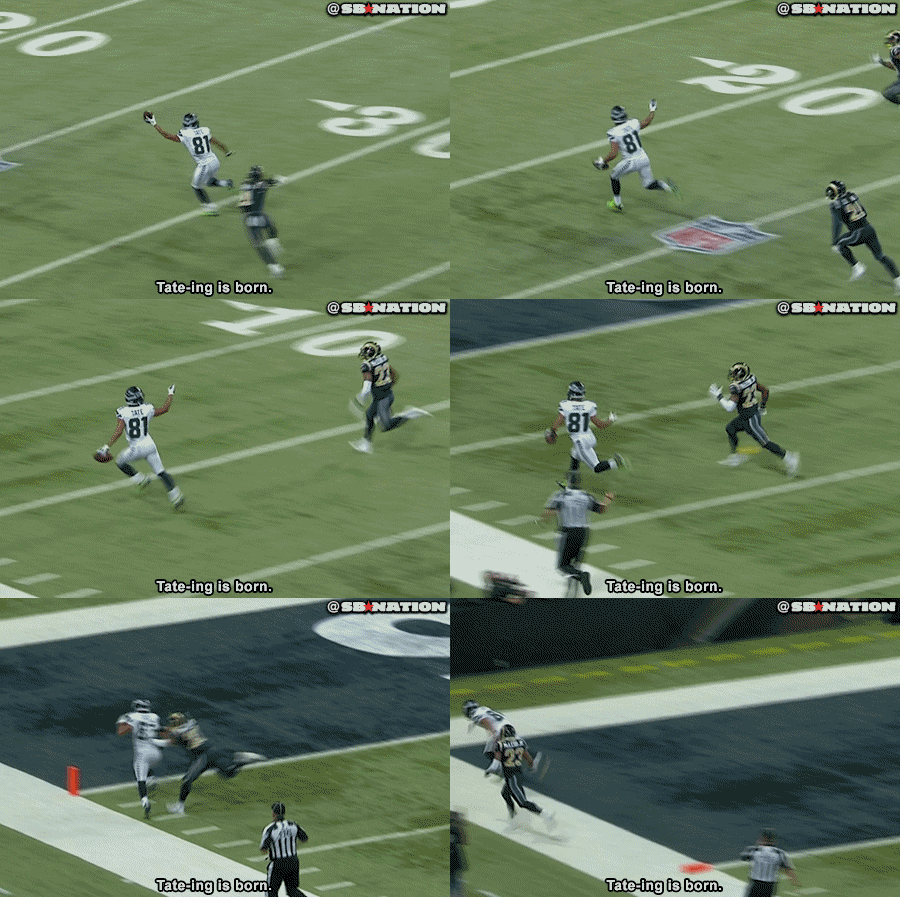
Monday Night Football was a dreary 7-6 affair -- until Golden Tate got under a Russell Wilson bomb past a falling Janoris Jenkins. But what made the touchdown special on Tate's part wasn't the touchdown -- he beat Jenkins, but there was some incredibly bad coverage, and after his man fell he could just run into the end zone -- it was the way he taunted Rodney McLeod, the defender chasing after him.
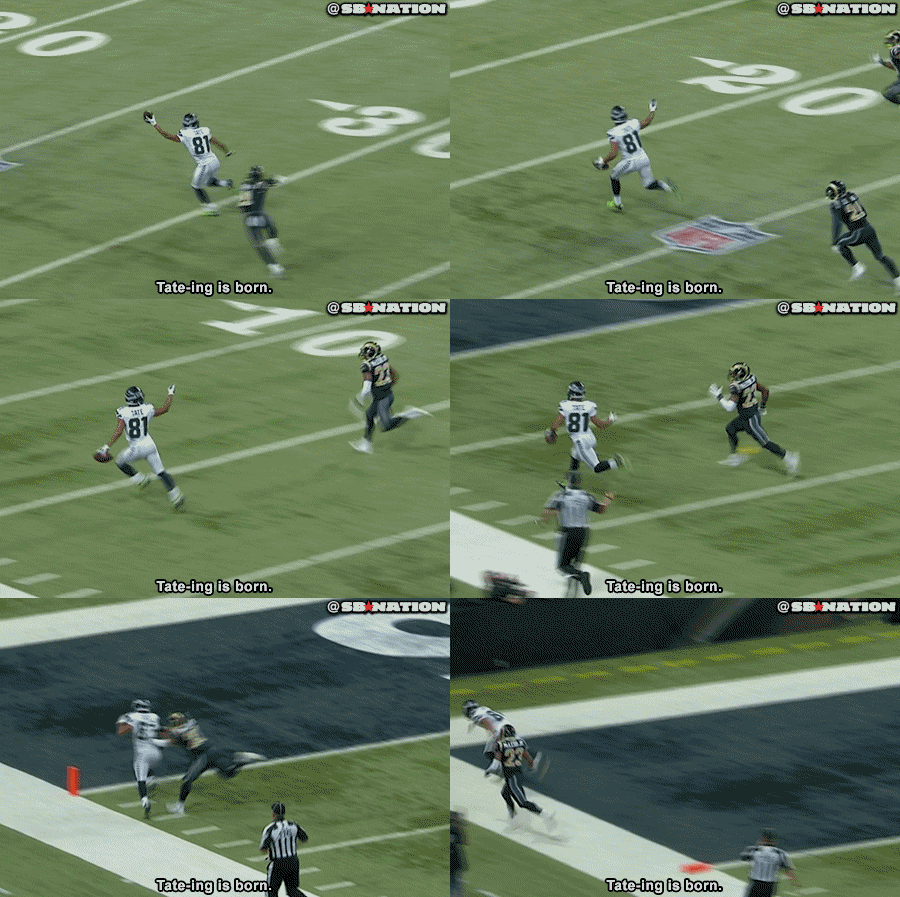
Bye-bye!
In college football, that gets called back. In the pros, it's just a penalty enforced on the kickoff.
firehose likes this
29 Oct 04:06
Quincy, Mass. police confirm person of interest in dog abuse case - NECN
firehosequinzee beat
Quincy, Mass. police confirm person of interest in dog abuse case NECN (NECN) - Police in Quincy, Mass. confirm that they have a person of interest in the animal abuse case regarding a pit bull that had to be put to sleep. Quincy Police have not released the person's name, but confirm he is being held in New Britain, Conn. under ... and more » |
firehose likes this

29 Oct 04:04

Seahawks vs. Rams 2013 final score: Seattle survives 14-9
by Mark Sandritter
firehoselol this game
It came down to the final play of the game, but the Seattle Seahawks survived to hold on for a 14-9 win against the St. Louis Rams.
Trailing 14-9, St. Louis took over at its own 3-yard line and rode their running attack all the way down the field. Seattle stopped St. Louis on a 3rd-and-goal from the 1-yard line setting up the final play of the game. Despite having success on the ground, the Rams chose to pass on fourth down and Kellen Clemens' game-winning attempt fell incomplete.
The game proved to be a defensive battle with neither offense able to get going. Russell Wilson was pressured all night as the Seahawks struggled mightily to clear room through the Rams defense. Robert Quinn and Chris Long were dominant for the St. Louis, both racking up three sacks.
While the Seahawks struggled to move the ball, they took advantage of what opportunities they had. A Richard Sherman interception set up the Seahawks deep in St. Louis territory in the first half. Wilson and the offense capitalized, giving Seattle a 7-3 lead at halftime that they would extend lead late in the third quarter, thanks to an acrobatic catch and run from Golden Tate.
The defenses dominated the rest of the game as the teams combined for 13 punts, including nine by Seattle. The Seahawks finished with just seven first downs, while the Rams found more offensive success, but struggled to finish drives. Rookie Zac Stacy ran well, finishing with 134 yards. Two turnovers and a missed field goal cost the Rams.
With the win the Seahawks are now 7-1 while the Rams dropped to 3-5
Fantasy studs and duds
Tate was the only Seahawk to do much offensively. He finished with five catches for 93 yards and two touchdowns. Stacy had the best game for St. Louis, finishing with 134 rushing yards.
Marshawn Lynch carried just eight times, finishing with 23 yards.
Injury report
Sidney Rice left the game for Seattle during the first half and did not return. He suffered a knee injury was taken back to the locker room.
Did they cover?
The Seahawks opened as an 11.5-point favorite and failed to cover the spread despite picking up the win.
What's next?
Seattle returns home for a game against Tampa Bay next week. St. Louis will host the Tennessee Titans.
More from SB Nation NFL
• NFL Debrief: Waiting for the man
• NFL Takeaways: Contenders emerge at season's midpoint
• Stafford fakes spike, scores game-winning TD | Megatron's 329 yards
firehose likes this
29 Oct 04:01
nex218: "Jeff Davis Reaping the Harvest"From Harper’s Weekly,...
firehosevia Toaster Strudel
my people, my people

29 Oct 00:38

The Japanese DB. Toshirô Mifune, 1948.
firehosevia multitasksuicide
The Japanese DB.
Toshirô Mifune, 1948.
29 Oct 00:10
Kanye West Suing YouTube Co-Founder
Uploading a smartphone video recording of the Kanyedashian proposal seemed like a good idea. YouTube creator Chad Hurley has been struggling to find a second success, and putting hot celeb videos on MixBit—his newest project—drummed up instant interest. Unfortunately, Kanye West is furious.
firehose likes this