Read more of this story at Slashdot.

Read more of this story at Slashdot.

One does not simply walk into Mordor — one takes the J.R.R. line. Alas, Post-Isengard replanting of the Fangorn forest has caused some delays on the subway. Check out these adorable signs that were posted all over the NYC's subway system.

    
|

When you're a Triceratops, you have to teach your babies how to take a bath — especially on a hot day. Maybe your feathers will get a little dirty, but it's a small price to pay when you need to cool down on a hot, late Cretaceous afternoon.

|
|

if this is the end i just wanna say it was a pleasure and an honor to blog with you

okay so everyone uses this gif for halloween:
BUT THERE ARE OTHERS AND THEY ARE SO MUCH BETTER:

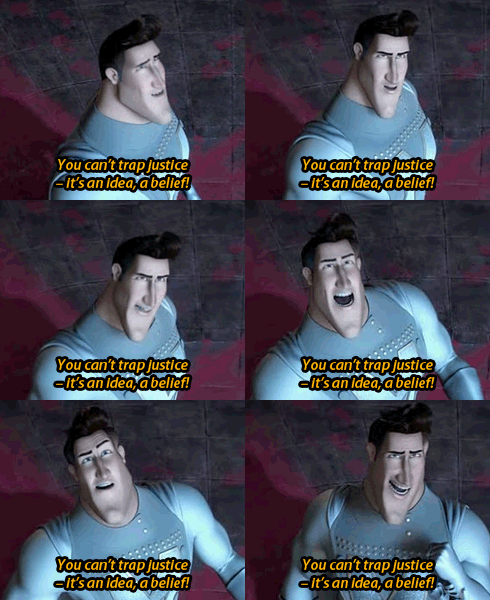


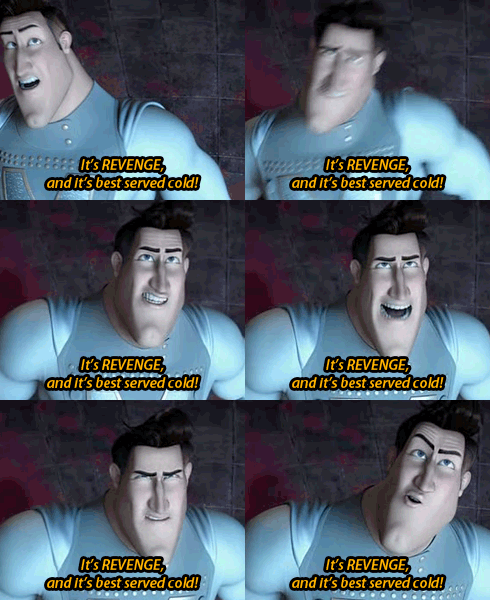

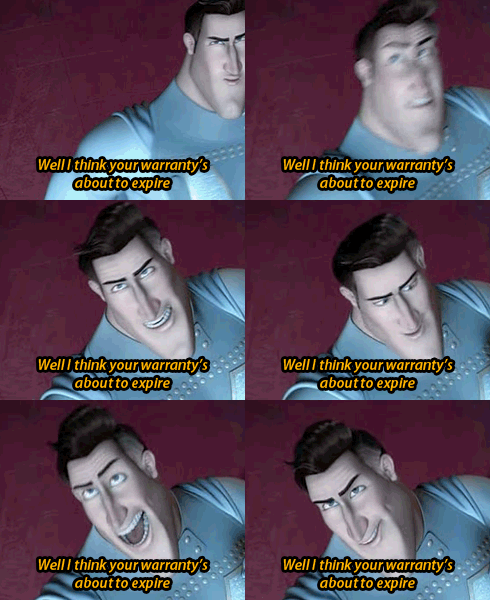
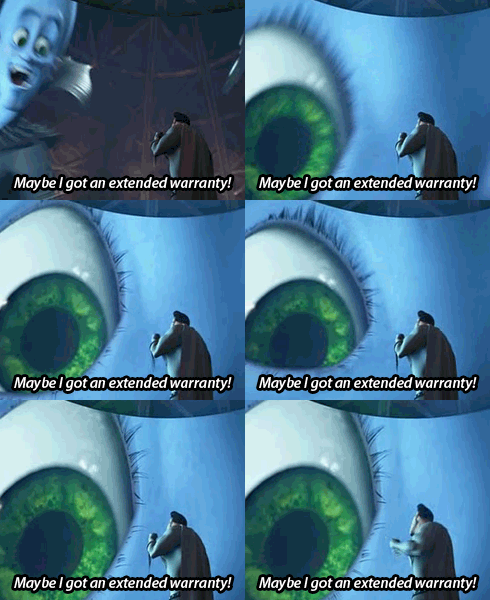

Witty banter
I HAVE BEEN WAITING FOR THIS GIF SET FOR THE LONGEST TIME!
OH GOD THIS MOVIE THIS IS THE BEST MOVIE
One day I will cosplay as Megamind. One day…… (and my fiance will do Metroman or Minion)
 |
submitted by i_amnotacanadian [link] [27 comments] |
When, if ever, will Facebook contain more profiles of dead people than of living ones?
Emily Dunham
Either the 2060s or the 2130s.

There are not a lot of dead people on Facebook. The main reasons for this is that Facebook—and its users—are young. The average Facebook user has gotten older over the last few years, but the site is still used at a much higher rate by the young than by the old.[1]There are a zillion surveys confirming this, such as this one from eMarketer.
The Past:
Based on the site's growth rate, and the age breakdown of their users over time,[2]You can get user counts for each age group from Facebook's create-an-ad tool, although you may want to try to account for the fact that Facebook's age limits cause some people to lie about their ages. there are probably 10 to 20 million people who created Facebook profiles who have since died.
These people are, at the moment, spread out pretty evenly across the age spectrum. Young people have a much lower death rate than people in their sixties or seventies, but they make up a substantial share of the dead on Facebook simply because there have been so many of them using it.
The Future:
About 290,000 US Facebook users will die (or have died) in 2013. The worldwide total for 2013 is likely several million.[3]Note: In some of these projections, I used US age/usage data extrapolated to the Facebook userbase as a whole, because it's easier to find US census and actuarial numbers than to assemble the country-by-country for the whole Facebook-using world. The US isn't a perfect model of the world, but the basic dynamics—young people's Facebook adoption determines the site's success or failure while population growth continues for a while and then levels off—will probably hold approximately true. If we assume a rapid Facebook saturation in the developing world, which currently has a faster-growing and younger population, it shifts many of the landmarks by a handful of years, but doesn't change the overall picture as much as you might expect. In just seven years, this death rate will double, and in seven more years it will double again.
Even if Facebook closes registration tomorrow, the number of deaths per year will continue to grow for many decades, as the generation who was in college between 2000 and 2020 grows old.

The deciding factor in when the dead will outnumber the living is whether Facebook adds new living users—ideally, young ones—fast enough to outrun this tide of death for a while.
Facebook 2100:
This brings us to the question of Facebook's future.
We don't have enough experience with social networks to say with any kind of certainty how long Facebook will last. Most websites have flared up and then gradually declined in popularity, so it's reasonable to assume Facebook will follow that pattern.[4]I'm assuming, in these cases, that no data is ever deleted. So far, that's been a reasonable assumption; if you've made a Facebook profile, that data probably still exists, and most people who stop using a service don't bother to delete their profile. If that behavior changes, or if Facebook performs a mass purging of their archives, the balance could change rapidly and unpredictably.
In that scenario, where Facebook starts losing market share later this decade and never recovers, Facebook's crossover date—the date when the dead outnumber the living—will come sometime around 2065.

But maybe it won't. Maybe it will take on a role like the TCP protocol, where it becomes a piece of infrastructure on which other things are built, and has the inertia of consensus.
If Facebook is with us for generations, then the crossover date could be as late as the mid-2100s.

That seems unlikely. Nothing lasts forever, and rapid change has been the norm for anything built on computer technology. The ground is littered with the bones of websites and technologies that seemed like permanent institutions ten years ago.
It's possible the reality could be somewhere in between.[5]Of course, if there's a sudden rapid increase in the death rate of Facebook users—possibly one that includes humans in general—the crossover could happen tomorrow. We'll just have to wait and find out.
The fate of our accounts:
Facebook can afford to keep all our pages and data indefinitely. Living users will always generate more data than dead ones, and the accounts for active users are the ones that will need to be easily accessible. Even if accounts for dead (or inactive) people make up a majority of their users, it will probably never add up to a large part of their overall infrastructure budget.
More important will be our decisions. What do we want for those pages? Unless we demand that Facebook deletes them, they will presumably, by default, keep copies of everything forever. Even if they don't, other data-vacuuming organizations will.
Right now, next-of-kin can convert a dead person's Facebook profile into a memorial page. But there are a lot of questions surrounding passwords and access to private data that we haven't yet developed social norms for. Should accounts remain accessible? What should be made private? Should next-of-kin have the right to access email? Should memorial pages have comments? How do we handle trolling and vandalism? Should people be allowed to interact with dead user accounts? What lists of friends should they show up on?
These are issues that we're currently in the process of sorting out by trial and error. Death has always been a big, difficult, and emotionally charged subject, and every society finds different ways to handle it.
The basic pieces that make up a human life don't change. We've always eaten, learned, grown, fallen in love, fought, and died. In every place, culture, and technological landscape, we develop a different set of behaviors around these same activites.
Like every group that came before us, we're learning how to play those same games on our particular playing field. We're developing, through sometimes messy trial and error, a new set of social norms for dating, arguing, learning, and growing on the internet. Sooner or later, we'll figure out how to mourn.

Happy Halloween!
The senator has put a hold on the confirmation of the new FCC chief until he’s promised the agency won’t follow the law and disclose the real funders of dark money group political ads.
Sock puppet son of a bitch.
If you open your network settings in the System Preferences after upgrading to OS X 10.9 "Mavericks", you'll be informed that a new "Thunderbolt Bridge" network interface was added to the system. So it's now possible to network two Macs over Thunderbolt. Let's take our new network for a spin.

Obviously you need a Thunderbolt cable to connect two Thunderbolt-equipped Macs. I got the 0.5 meter one from Apple, which is quite short, and connected my mid-2011 MacBook Air to a brand new MacBook Pro ("with Retina Display", but that almost goes without saying now). The MacBook Pro has 20 Gbps Thunderbolt 2 while the Air has to make do with the regular 10 Gbps Thunderbolt—but on both the Network Utility reports a link speed of 10 Gbps.

On the Air, the network interface now came up, but not on the Pro. The reason for that is that the Thunderbolt Bridge interface is actually a virtual bridge interface that allows network packets to be passed from one physical network interface to another. This also means that packets toward those interfaces should now go through the bridge interface. The Air's lone Thunderbolt port was part of the Thunderbolt Bridge out of the box, but on the Pro only one of the ports was part of the bridge—and of course I had connected my cable to the other port. This was easily fixed.
Read 14 remaining paragraphs | Comments

|
|
firehosequality GIF
non-meme Gene Wilder beat

There’s no knowing where we’re rowing, or which way the river’s flowing.
Is it raining? Is it snowing? Is a hurricane a-blowing?
firehosevia GN: "The Passion of the Ultraman? WTF?"

By Graham Smith on October 29th, 2013 at 9:00 pm.

Hey yo youse.
I’m going to hold off on Krosmaster for yet another week, so that I can get my photo game tight. In the meantime, I’d like to tell you about a fantastic little game that will be staying in my collection for keeps. It’s an abstract strategy game with the potential to keep a gamer entertained for life. I’m hugely impressed by it. It’s called The Duke, and it’s made of wood. Come along, kid. Come along, come along.
THE DUKE
The Duke, from Catalyst Games, is like chess. No, it’s nothing like chess. It’s played on a board with a 6×6 grid. Each player has an army, and each type of unit in that army has its own movement rules. You move your units around the board in an attempt to corner, and ultimately capture, the enemy’s Duke.
It’s a bit like chess, in the sense that you think “Oh, it’s a bit like chess”. But it’s actually not like chess at all.
Each player starts the game with a Duke and two Footmen. These are placed at your edge of the board, and then the game begins. In a turn, a player can move a piece, or draw a new piece from a drawstring bag. Any new piece you draw must be placed onto the board beside The Duke – and remember, this is a blind draw, so you’re never exactly sure which unit will be coming out of the bag.
The movement rules are what this game is all about. Take a look at these pieces from the game -

Let me explain what you’re seeing here. Every tile shows the grid on its face. And in the centre of the grid is a little pawn. That represents the tile itself. Look at the Footman – here we can see that the Footman can move to the square in front, or behind, or to the left or the right. Those black dots clearly illustrate that. On the Duke tile, we see symbols that represent “slide” moves. So the Duke can slide as far to the left or the right as the player wishes. Cool, right? No “how does this piece move again?” confusion. It’s all clearly displayed on the tile.
But wait until you hear what happens every time you move a piece. This is the COOL BIT.
Every single time you move a piece, you have to flip it. And when you flip it? Well – take a look at the same tiles, flipped.

As you can see, the reverse of each tile has a different movement. The Duke now slides forward and back, and the Footman can advance two spaces forward or move out to the diagonals. Grasping the flow of each tile’s movement is key to success in this game. If you’re planning to capture another piece, and trying to think four or five turns ahead, you need to be considering all of the movement variations introduced by the flipping of tiles.
Each player has a wide assortment of units in their drawstring bags, so the shape of the game will shift with each new unit that gets introduced. It’s a game where the player has to plan ahead and think on their feet when a new problem gets flung into the mix.
Take a look at this Wizard.

The reverse of the Wizard tile is nightmarish. Those hollow circles are “jump” symbols. This means that the Wizard can pretty much teleport all over the fucking place. If you’re closing in on the enemy’s Duke, and a Wizard gets flung into your path, the whole nature of your approach changes. The game can be highly aggressive at one moment, and patient and defensive at the next.
It’s a simple game – capture the enemy’s leader. Get that Duke into “guard”, send him into a panic, corner the fucker and then eat him. But the game is shifting under your fingers the whole time. It might seem to you, reading this, that the whole “pull a new piece from the bag to see if it saves me” thing brings too much luck into the equation, but while luck is always a factor, the game is all about how you react to these little swings in battle. Also – any new units need to be placed beside the Duke. If you lock that Duke down in a defensive position, it can be hard for your opponent to get any reinforcements into play.
Here’s another cool thing – if your play starts to go a bit… well, let’s say you’re having a bad game. Your Duke is fleeing across the board, and you’ve relinquished much of your starting area. You’re starting to wing it, and your plans have fallen to shit. You decide to pull out a new unit – with it having to come into play beside your Duke, it’s possible to bring in a unit in a stunted position, or even in a position where it cannot move at all. Imagine your enemy’s attacks have sent your Duke fleeing to the opposite end of the board – you are in DEEP TROUBLE. Your reinforcements, with no room to advance, will likely be left having to crawl backwards or be screaming “SIRE, THE PLACES I CAN GO TO DO NOT EXIST!”
Position is hugely important. When you’re needing a bit of luck, those draws from the bag can only go so far. You need to make your luck in this game.
Oh, there’s a lot in the box. The basic game is enough, but when playing with special units, such as the Oracle or the Duchess, there are special powers that can be activated in the player’s turn too. That’s even more stuff to think about – OH GREAT THANKS. There are also variant games to play. Capture the Flag games? Yes. How cool is that? There’s an impassable Mountain tile you can place on the board to tighten up the game area even further. Oh, and there’s a Dragon.

Yes, a Dragon. Those star symbols? That’s where the Dragon can breathe his fire.
Amazing.
So, that’s the Duke. A game that is easy to learn. A game with the rules pretty much written on the game pieces themselves. And yet, a game that offers so much. I really, really want to get good at this game. I want to commit all the tile movement possibilities to memory, create some strategies of my own, and then maybe go off the fucking rails like Bobby Fischer did. I will wrap my head in tin foil and damn The Duke to hell for ruining my life.
So that’s a recommendation then. To the HIGHEST.

firehosevia Danniel.schulz
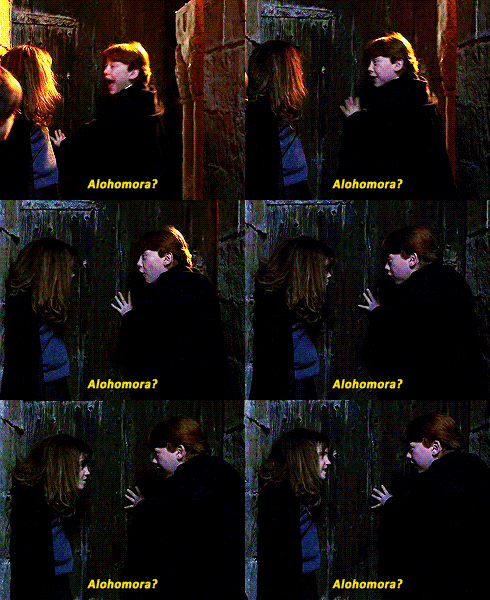
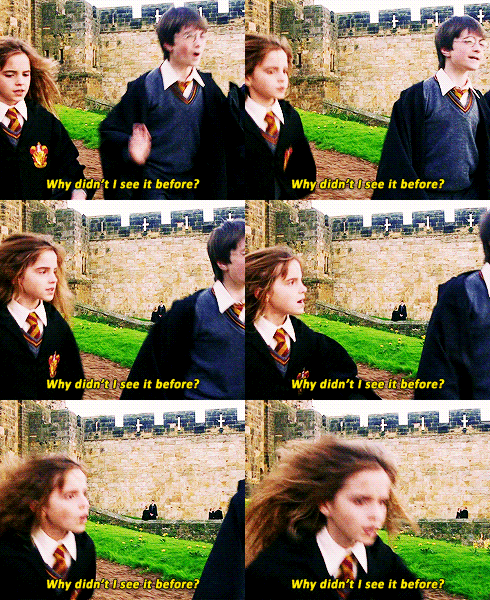
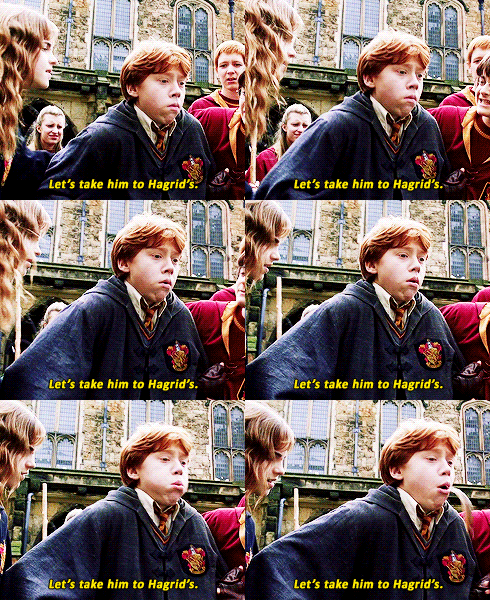
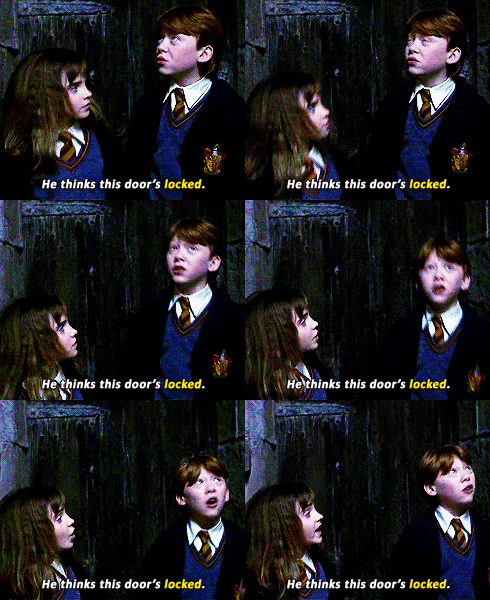
In the first Harry Potter films, if you watch carefully, in some scenes you can see me mouthing Harry and Ron’s lines, as well as my own! Because that’s just what I was like, I was… I was crazy. - Emma Watson
I didn’t know this! This is adorable!
Cloud-based database service MongoHQ said it's changing log-in credentials for employees and customers alike after suffering a security breach that allowed attackers to access sensitive customer files and obtain users' e-mail addresses and cryptographically scrambled password data.
The intrusion occurred Monday, when hackers gained access to an internal support application that included a trouble-shooting feature that allows MongoHQ employees to view an account as if they are a specific customer. The support application allowed the intruders to view account information, including lists of databases, e-mail addresses, and passwords that were protected with the bcrypt hashing algorithm, Jason McCay, co-founder of the service, wrote in an advisory published Tuesday afternoon. The attackers also had the ability to view the MongoHQ account database, which includes connection information for customers' MongoDB instances.
"We've conducted an audit of direct access to customer databases and determined that several databases may have been accessed using information stored in our account database," McCay wrote. "We are contacting affected customers directly. If you have not heard from us individually, there is no evidence that your DB was accessed by an unauthorized user."
Read 5 remaining paragraphs | Comments

|
|
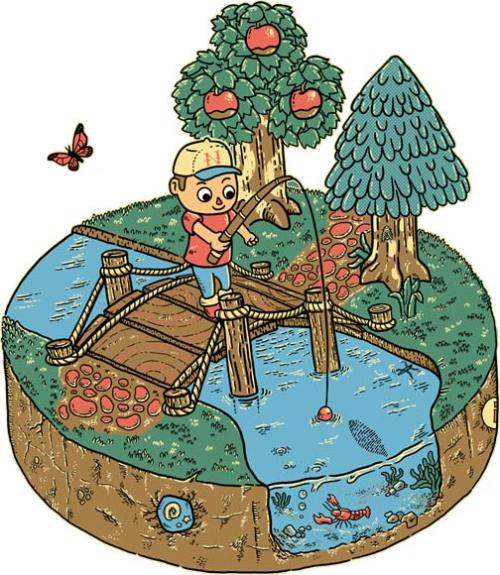
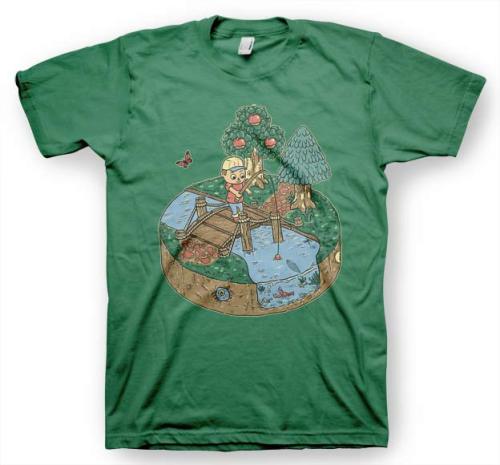
What a lovely cross-section of an Animal Crossing life, by Adam Works. Reminds me of Camille Young’s amazing sculpture for Fangamer X Attract Mode.
BUY Animal Crossing: New Leaf, AC:NL guide, upcoming games
firehosegreat

The numbers: LinkedIn swung to a third quarter net loss of $3.4 million, from a profit of $2.3 million last year, as the corporate social network ramped up investment in its platforms. But revenue for the third quarter surged 56% to $393 million. Together with an upbeat forecast for the next quarter, this was enough to drive shares up by 1.7% in after hours trading.
The takeaway: Those pesky emails from LinkedIn asking you to upgrade from free to paid service may drive you mad, but they appear to be working. Revenue from premium subscriptions jumped 61% to $79.8 million. The talent solutions division, which is mainly specialist products for recruiters, still accounts for the bulk of the business, with revenue growing by 62% to $224.7 million. Marketing solutions—mainly advertising—was up 38% to $88.5 million.
What’s interesting: During the quarter, LinkedIn membership climbed through the 259 million mark, an increase of 38% on last year. The gap with Twitter, which has 218 million monthly active users, has widened. But the corporate social network is still way behind Google Plus, with 540 million active monthly users, and Facebook, with a whopping 1.2 billion.

firehosehi
it's me

|
|

|
|
firehosereddit is still trying to figure out if this is a joke they started, or if their joke started a real thing
 |
submitted by pdxborn1960 [link] [38 comments] |