 The Philips Hue smart lightbulb lineup already includes some outdoor lighting, but rumor has it that Philips will introduce more outdoor options, likely at CES. According to a leaked product catalog, found by Hueblog.de, Philips Hue is planning a pre...
Emahlstadt
Shared posts
22 Dec 01:33
The Philips Hue smart lightbulb lineup already includes some outdoor lighting, but rumor has it that Philips will introduce more outdoor options, likely at CES. According to a leaked product catalog, found by Hueblog.de, Philips Hue is planning a pre...
Philips seems to be working on more Hue outdoor lights
by Christine Fisher
Emahlstadtlolwut. am i the only one who sees the jason voorhess in this header image?
The Philips Hue smart lightbulb lineup already includes some outdoor lighting, but rumor has it that Philips will introduce more outdoor options, likely at CES. According to a leaked product catalog, found by Hueblog.de, Philips Hue is planning a pre...
20 Dec 03:17
The Way Beer Styles Evolve
by Jeff Alworth
Emahlstadtcliff's notes:
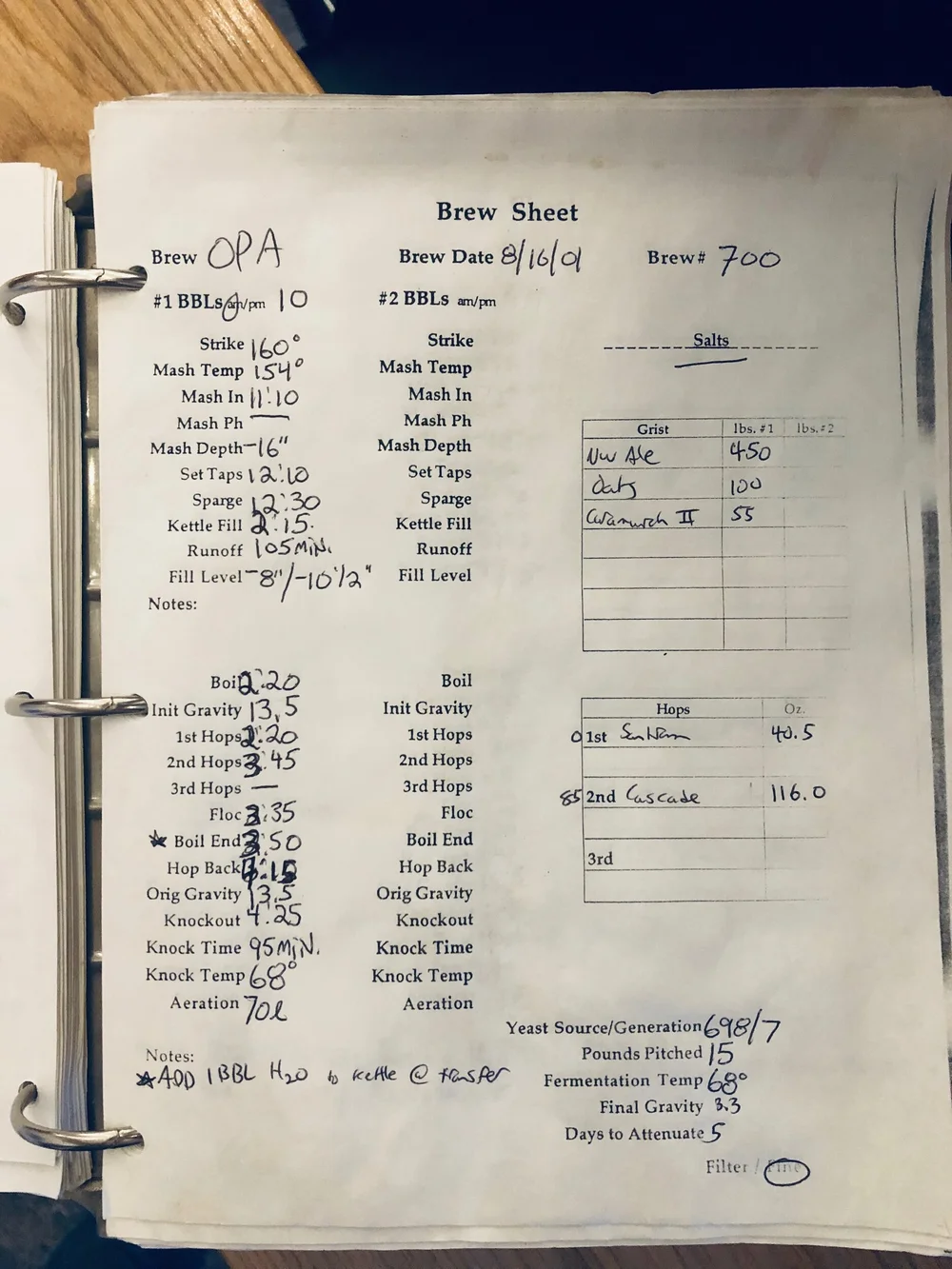
"By this phase in Rock Bottom’s evolution, hop schedules were already shifting radically... Van was already trying to push his pales and IPAs away from bitterness and toward flavor and aroma... three-quarters of the hops used were added at the end of boil."
17 years ago... the birth of the hazy ipa happening on a brew log.
The Portland link in the Rock Bottom chain announced its closure on the morning of October 28th. That afternoon, Van Havig was there to grab the 25 years of collected brewing logs—entirely complete from 1994 through 2019, save for the first ten brews, which were lost to antiquity. Van was the head brewer there from 2000-2011 before quitting to start Gigantic with Ben Love. [Van corrects what shouldn’t need correcting in comments: he was fired. I regret the error.]
They are absolutely fascinating reading. Van plans to ship them down to OSU’s brewing archives, but I’m going to take a deeper look at some point before he does. The reason: even in a brewery that was owned by a cautious corporation and attracted behind-the-curve drinkers (even in its heyday, Rock Bottom was never the Great Notion of Portland), we can trace the evolution of an industry. There is so much to describe, but here’s one small example that illustrates how early brewers were working with techniques that would come to define American craft brewing. Let’s have a look at brew 700, Oatmeal Pale Ale.
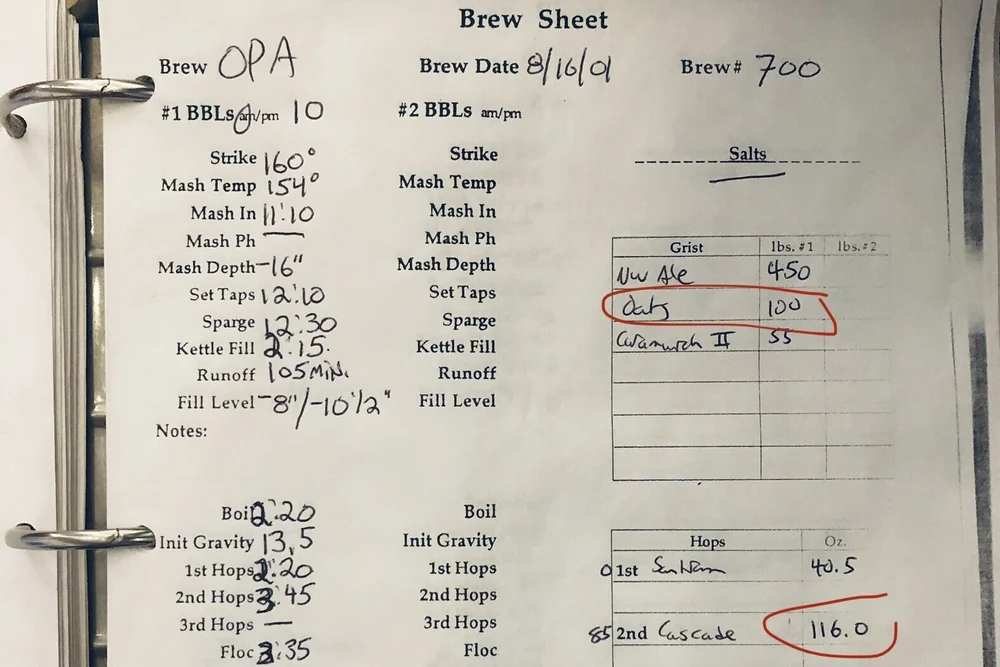
There is no such thing as a standard brew log; every brewery has their own version, so it can take awhile to figure out what you’re looking at. Let me direct your attention to the interesting bits by zooming in and highlighting two things:
This is by no means a modern hoppy ale. It was brewed during a time when Cascades were the signature hop of the West Coast—ages before Citra, Mosaic, Galaxy, El Dorado, and the rest would redefine the flavor ranges of hoppy ales. And yet, look at the hop schedule.
By this phase in Rock Bottom’s evolution, hop schedules were already shifting radically. In the first batches from the 90s, the process was fixed for all beers—an addition at the start of boil, another a half hour in, and an aroma addition five minutes before flameout. Bitter charges were robust. But by 2001–eighteen years ago—Van was already trying to push his pales and IPAs away from bitterness and toward flavor and aroma. He used a modest bitter charge of Santiam, presumably because it was supposed to have “noble” character and a smooth bitterness. But three-quarters of the hops used were added at the end of boil. As I flipped through later batches, I saw that he moved this charge from five minutes to the end of boil to flameout.
The grist is also interesting. I’d sort of forgotten about the use of oats in pale ales, but it was a minor trend in the Northwest. I think the first to pioneer this was Mike Hale of Hale’s Ale, who wanted to replicate the creaminess of Boddington’s—and he put his on nitro. That idea, of a fuller, sweeter base on which to float a floral, zingy dose of hops, goes back decades. That’s why oats are a key ingredient in many hazy IPAs, of course—to help create a velvety texture in the mouth. Van would later rename this beer Velvet Pale Ale.
Brewers are smart and if one has thought of a technique in their brewery, there’s a very good chance another has already tried it. IPAs only became a national phenomenon in the late aughts, but development of the techniques that made them popular were happening brewery by brewery all over the place. (Brewers talk to each other, too, especially in national chains, and that spreads discoveries.)
I’ll dig through these a bit more and see what other discoveries surface. I expect to find a lot of fascinating stuff.

19 Dec 00:52
A look at the streamers that hack Ring cameras live
by noreply@blogger.com (John)
Emahlstadtjesus
Motherboard:

The NulledCast is a podcast livestreamed to Discord. It's a show in which hackers take over people's Ring and Nest smarthome cameras and use their speakers to talk to and harass their unsuspecting owners. In the example above, Chance blared noises and shouted racist comments at the Florida family.
"Sit back and relax to over 45 minutes of entertainment," an advertisement for the podcast posted to a hacking forum called Nulled reads. "Join us as we go on completely random tangents such as; Ring & Nest Trolling, telling shelter owners we killed a kitten, Nulled drama, and more ridiculous topics. Be sure to join our Discord to watch the shows live."
18 Dec 22:58




$20 at Amazon, but ships after Christmas.

The Buttheads Fart Launcher 3000 Interactive Farting Toy is apparently the toy of the holiday season
by noreply@blogger.com (John)




$20 at Amazon, but ships after Christmas.
This Fart Launcher is powered by the deadliest farts!There's also an entire line of figurines (ninja, mummy, etc) that have butts for faces.
Insert included stink cartridge and push into fart chamber. Pull lever until it locks in position. Pull trigger to send a fart forward towards it's victim! 100+ Blasts!
Send farts to your target up to 10 feet away!
Smell dissipates in minutes!
1 stink cartridge included with purchase
18 Dec 17:09
 Photo by Joe Robbins/Getty Images
Tom Herman apologizes for Early Signing Day double bird aired on Longhorn Network
by Xander Peters
Emahlstadtlolwut
Photo by Joe Robbins/Getty Images
The head coach claimed he didn’t know the camera was live and was making a joke about his first experience at the Cotton Bowl.
The Texas Longhorns coaching staff, it seems, are enjoying early signing day.
As the staff sat huddled together in one of the program’s offices, presumably strategizing or talking up a successful Early Signing Day so far, the Longhorn Network’s camera cut to a shot of the staff. The only problem — It doesn’t seem as though the coaching staff were aware they were on live TV, because head coach Tom Herman promptly flipped the double-bird to the camera.
See for yourself:
@kbohls Just saw this on LHN. Why is Coach flipping the double bird to the LHN camera here? Did he not realize the camera was on? LOL but seems like a great signing day pic.twitter.com/uKI41ltr3k
— Scott Scharfenberg (@dolphlong) December 18, 2019
All in good fun or another sign of Herman’s lack of maturity?
Update [4:54 p.m. Central]: When Herman opened his Early Signing Day press conference, he started it with an explanation of what happened.
“Obviously before we start, I do want to apologize for something that ended up on live television this morning,” Herman said. “We were joking, quite frankly, about my first experience riding into the Cotton Bowl Stadium on the bus and the warm welcome you receive in the Red River game. I think I told you guys as well. When it occurred, I honestly had no idea — I wasn’t aware that the camera in the room was on live television. It certainly had nothing to do with Longhorn Network, Signing Day or anything. Again, regardless, it was poor judgement on my part and I do apologize for that.”
Herman was referencing a story that he told this fall.
“I think I’ve told the story, looking out the window and literally seeing this elderly lady that had to have been 80 years old, going double bird (indicating) to the Texas bus,” Herman said in October. “Then literally next to her was a couldn’t have more been than eight-year-old boy going double bird (indicating) to the Texas bus. It speaks to the intensity of the rivalry, that it crosses a lot of different generations.”
18 Dec 05:38
 Photo by Scott W. Grau/Icon Sportswire via Getty Images
Texas announces Chris Ash as DC
by Wescott Eberts
Emahlstadtsweet defensive stats from five years ago bruh. now, please make me eat my words.
Photo by Scott W. Grau/Icon Sportswire via Getty Images
Tom Herman officially reunites with his former Ohio State colleague.
Two days after news broke that the Texas Longhorns were set to hire former Rutgers Scarlet Knights head coach Chris Ash as the replacement for fired defensive coordinator Todd Orlando, the school made the hire official on Tuesday.
“After taking a hard look at a lot of options at defensive coordinator, Chris was the one that continued to stand out,” Herman said. “We couldn’t be more excited what he’ll add to our staff. I’ve witnessed firsthand Chris’ skills as a game planner, his attention to detail and ability to develop players. He gets the best out of every one of them and has a history of building physical, fundamentally sound, winning defenses. He has done it at the highest level, is a tremendous all-around coach and an awesome person. I know he’ll do great things, and our players, coaches and staff will really enjoy working with him. We look forward to his arrival in Austin, getting to work, and him and his family joining our Longhorn family.”
Ash’s first day with the Longhorns is on Wednesday, but he will not coach in the Alamo Bowl against the Utes — Craig Naivar, the co-defensive coordinator and safeties coach, will remain in charge of the defense.
“Number one, I’m humbled and extremely honored to be able to coach football at The University of Texas,” Ash said. “I want to thank Tom Herman and Chris Del Conte for this opportunity and for their professionalism throughout the process. My family and I are very excited to move to Austin and become part of Longhorn Nation, and I’m ready to lead and serve our student-athletes.
“I have a great deal of respect for Coach Herman as a coach and a person. If I didn’t believe in him, I wouldn’t be making this move. I have complete confidence and faith and trust in his ability to lead and to coach, and I’m excited to be a part of this program.”
In addition to a year together in Columbus leading Ohio State to the national championship in 2014, Herman and Ash also spent the 2009 season on the Iowa State staff.
Those stops were part of a 19-year career as an assistant that led to Ash taking the head coaching job at Rutgers in 2016. He went 8-32 with the Scarlet Knights before he was fired this season.
Now he’ll return to his roots as a defensive coordinator, where he has a significant track record of success that includes four Big Ten championships during his five seasons in the conference. Ash also spent a year as the Arkansas defensive coordinator under Bret Bielema.
Four of those five defenses ranked in the top 25 nationally, including a top-10 unit in 2015 at Ohio State. At Wisconsin in 2011 and 2012, Ash’s defenses ranked in the top 20 in scoring defense and No. 15 overall in total defense.
“Texas is a place with a lot of history and tradition,” Ash said. “It’s synonymous with success. There are great players that have been in this program, there are great players in this program, and I’m really excited about what we can do in the future. I’ve recruited in the state of Texas. When I was at Ohio State, I had been in the state to recruit, and as a young coach at Iowa State in the Big 12, I always thought Texas was the gold standard and would be a place you would want to be at and work at, and I’m thrilled about this opportunity.”
Herman’s reasoning for firing Orlando helps illuminate what he wants from Ash’s defense — Herman wants to simplify things, get better in technique and fundamentals, and better feature the defensive ends.
Basing out of a 4-3 Under front with quarters coverage behind it, Ash will almost certainly have to morph into a nickel defense to face Big 12 opponents, but is known for accomplishing the goals that Herman highlighted last week.
Ash also turned around the Ohio State defense quickly, something that he’ll have to do next season at Texas in order for the program to reach the goals that it fell short of accomplishing this season.
Before Ash arrived in early 2014, the Buckeyes were coming off a season in which the defense ranked 110th nationally in pass defense and 46th in total defense. The results were quick and apparent — Ohio State’s defense ranked No. 19 in total defense (342.4 ypg), No. 26 in scoring defense (22.0 ppg), No. 13 in pass efficiency defense (108.2) and No. 28 in pass defense (201.1 ypg).
The Buckeyes also ranked No. 4 nationally in interceptions (24), No. 5 in turnovers gained (33), No. 16 in third-down defense (34.4 percent), No. 13 in sacks (3.00 pg) and No. 14 in tackles for loss (7.3 pg) on the way to Big Ten and national championships.
17 Dec 02:39
Trojans keep OC Harrell with multiyear deal
Emahlstadtbooooo!
Offensive coordinator Graham Harrell and USC have agreed to a three-year deal worth $3.6 million, a source told ESPN's Adam Rittenberg.
16 Dec 20:38

I came across an old MCP 100 Wolvie page I did about 20 years ago. I was late so I sorta skimped on his beard stubble, and some of the brush work is a little too sloppy.
----

Interesting to compare that to this panel from a Wolvie 10 page story I drew just a few years back. Truth is, how I draw Wolvie now is hit and miss, nowhere near as strong or detailed as my early 'Blood Hungry' issues were.
Because, (forgetter or worse) I'm different now too.
So, given my deteriorating skills (which all artists eventually face), I'm surprised some (not all) of my later panels aren't too shabby.
Not amazing,
but not bad for an old fart.
: )
Wolverine - Then & Now
by -

I came across an old MCP 100 Wolvie page I did about 20 years ago. I was late so I sorta skimped on his beard stubble, and some of the brush work is a little too sloppy.
----

Interesting to compare that to this panel from a Wolvie 10 page story I drew just a few years back. Truth is, how I draw Wolvie now is hit and miss, nowhere near as strong or detailed as my early 'Blood Hungry' issues were.
Because, (forgetter or worse) I'm different now too.
So, given my deteriorating skills (which all artists eventually face), I'm surprised some (not all) of my later panels aren't too shabby.
Not amazing,
but not bad for an old fart.
: )

15 Dec 08:44
 Stephen Spillman-USA TODAY Sports
Big second-half performance pushes Texas past Central Michigan, 87-76
by Wescott Eberts
Emahlstadtby far, my least favorite part of college bball is the awkward 4th string white guys making guitar-solo-like gestures from the bench whenever the actually-talented team members make baller-ass plays, like in the latter clip from this write-up.
this is where the term "cringe-worthy" gets it's name.
Stephen Spillman-USA TODAY Sports
Jase Febres and Courtney Ramey helped key a 51-point second half for the Longhorns.
Facing an experienced, high-scoring team that gained confidence early with a strong first half, the Texas Longhorns did something they’ve struggled to accomplish under head coach Shaka Smart — respond and close out down the stretch to pull out a 87-76 win against the Central Michigan Chippewas on Saturday at the Erwin Center.
After trailing by six points at halftime, Texas out-scored the visitors 51-34 in the second half thanks to big-time efforts from junior guard Jase Febres and sophomore guard Courtney Ramey, aided by eight points from junior forward Jericho Sims. Febres hit three three-pointers in 100 seconds during the decisive stretch and scored 23 points overall on 7-of-10 shooting from deep, while Ramey finished off the Chippewas with two big threes of his own and 18 of his 20 points in the second half.
Ramey added six assists to tie for the team high with junior guard Matt Coleman as Texas shot 50.9 percent from the field for the game and 56 percent from beyond the arc. Meanwhile, the defense locked down in the second half to hold Central Michigan to 38.7 percent shooting in the final 20 minutes after the Chippewas hit 53.6 percent in the first half.
In a promising development, Texas was aggressive getting into the paint and earned 31 foul shots as a result, the highest number so far this season. The volume of free-throw attempts was particularly impressive because Central Michigan entered the game as one of the top defenses in the country at avoiding sending opponents to the line.
With a five-out offense that emphasizes taking a high volume of three-point shots, Central Michigan made its first three attempts, including a four-point play on a foul by Sims. Fortunately for Texas, Febres started off hot by hitting his first two from beyond the arc just before Sims picked up his second foul. Coleman then followed with a three of his own to keep pace with the visiting Chippewas.
The biggest issue for Texas offensively leading into the under-16 timeout was valuing the basketball — a handful of careless passes resulted in three steals by Central Michigan and four turnovers overall for Smart’s team. Out of the timeout, pressure on freshman forward Kai Jones after a rebound resulted in another turnover.
Against a team that plays with one of the fastest tempos in the country and entered the game tied for first in Division I averaging 90 points per game, the Longhorns got sped up early and the turnovers were the result. The aggressiveness of the Chippewas also resulted in a second quick foul for sophomore guard Andrew Jones, sending him to the bench with Sims. The two combined to play only five minutes before picking up those fouls.
The result of those fouls and the aggressiveness contributed to seven foul attempts by Central Michigan in the first six minutes of the game before Texas got to free-throw line.
After the last start offensively, the Horns then missed their next six shots, going four minutes without making a field goal, a stretch that also included four turnovers and resulted in a seven-point Central Michigan lead. Ramey finally broke the drought with a driving layup in transition.
In a sign of how things went for the Longhorns defensively in the first half, a deflection from Febres ended up as a perfect pass to a cutting David DiLeo for a layup.
The struggles continued, with Kai Jones and sophomore forward Gerald Liddell picking up offensive fouls, freshman guard Donovan Williams with a bad turnover, and DiLeo continuing his strong performance, hitting a deep three and another jump shot to push his scoring to 12 points in 12 minutes. DiLeo only scored three more points for the rest of the game.
With Texas sitting at 10 turnovers at the under-four timeout, Central Michigan had an eight-point lead thanks to shooting nearly 60 percent from the field and better than that from the three-point line.
The Longhorns had another drought from the field and Liddell had another turnover that led to a transition dunk for the Chippewas, but a fourth three from Febres on a pump fake cut the lead to five with 1:25 remaining in the half. A put-back dunk by junior forward Royce Hamm, Jr. that looked like it was off the rim on replay took points away from Texas as the Horns continued to struggle with getting too sped up — Liddell shot an airball in transition when he got out of control and picked the ball up too early.
At halftime, Central Michigan led by six, 42-36, after holding the advantage for the entire first half.
Texas missed some opportunities to start the second half at the free-throw line and Liddell had his fifth turnover when he passed up an open look and then dribbled the ball off his foot, but Hamm. ignited the crowd with a put-back dunk that counted this time, Febres picked up a charge, Ramey hit a three, and Hamm blocked a shot to send Texas to the under-16 timeout with the game tied.
Too strong #AllForTexas | @R0v_ce pic.twitter.com/Z7BUdkO3SR
— Texas Basketball (@TexasMBB) December 14, 2019
Hamm provided a boost for the Longhorns with Sims in foul trouble, setting his career high with 12 rebounds — also a Texas season high — but also provided a boost for the Chippewas at times with six turnovers.
Two offensive fouls, one by Hamm and one by Coleman, helped stall the momentum for Texas with the game tied. However, a dunk by Sims after he tipped an offensive rebound to Febres gave the Longhorns their first lead of the game with 14 minutes remaining.
As Texas gained confidence despite some foul trouble, Kai Jones hit the first three of his career. The game then started to open up in favor of the Longhorns as the Chippewas struggled to protect the basketball and to find Febres in transition as Texas mounted a 12-2 run over 2:16 by hitting 6-of-7 shots, including three threes from Febres in 100 seconds. As a result, the Horns held a six-point lead when Davis called a timeout with 7:51 remaining, the largest of the game for Texas.
Jace Febres = Tres Febres
— Jake García (@Jake_M_Garcia) December 14, 2019
On the heels of his best game of the season, he's topping that this afternoon.
7/10 from deep, 23 points, helping Texas take the lead in the second half against Central Michigan. pic.twitter.com/m35YARtTKE
A quick surge by Central Michigan cut an eight-point lead to three, but Ramey responded with his second made three of the game. Another made three by Ramey on a rainbow shot clearly deflated the Chippewas as the lead went up to nine and then 11 when Hamm converted two free throws.
Whether it was increased shot credibility by Ramey or just increased confidence on a day when he was battling the flu, those two big threes led to two drives to the basket, one with a finish and a second that drew a shooting foul.
With the Chippewas finally robbed of the confidence generated in the first half, the Longhorns were able to cruise to the victory.
Texas is still looking to put 40 minutes of strong basketball together, but getting Febres on track and Ramey some more confidence after an up-and-down start to this season are both positive signs for the Longhorns.
There have also been too many games during the Smart era in which Texas has failed to respond to opponents gaining confidence early and are now 9-1, the best start since Smart arrived in Austin.
Next Saturday, Texas travels to Rhode Island to face Providence in the second true road game for the Longhorns this season. It will be an opportunity for Texas to pick up a solid non-conference win against a Friars squad off to a slow 5-5 start.
14 Dec 22:06
What's keeping the Pac-12 from a spot in the College Football Playoff
Emahlstadtgood teams
Utah came close this season with a No. 5 ranking, before losing in the conference title game to Oregon. But there's little room for error (or nonconference losses).
14 Dec 06:24

'Ultimate Rivals: The Rink' is an old-school hockey game with a twist
by Devindra Hardawar
Emahlstadtok. interest is piqued here. i loved both the original nes "ice hockey" title, as well as nhl '94, which i mostly played on mike's genesis.
too bad its currently an apple arcade exclusive.
gross.
Do you ever miss the days of classic 16-bit sports games like NBA Jam and NHL 94? So does the indie developer Bit Fry. So much so, that it's spent the past six years in stealth mode developing a bold new franchise, Ultimate Rivals, which debuts tonight exclusively on Apple Arcade for iOS, Apple TV and Mac users. It combines the frenetic arcade-like gameplay '90s kids grew up with, along with an insane new twist: You can use players across different sports leagues. Think of it as a playable version of the classic cartoon ProStars.
14 Dec 06:23

Watch 'Senua's Saga: Hellblade II' running on the new Xbox Series X
by Jessica Conditt
Emahlstadtthe first hellblade was a solid b+, but the narrative didn't really leave any room for expansion, at least not with the senua character. i'd happily play more hellblade, i just hope it doesn't feel like a shoe-horned money-grab.
Microsoft revealed its next-generation console, the Xbox Series X, in a surprise announcement at The Game Awards -- and no debut would be complete without a fancy, detailed, in-engine demo. To that end, players got another world premiere in the form of Senua's Saga: Hellblade II from Ninja Theory.
13 Dec 21:44

The Next-Gen Xbox Is Called Xbox Series X
by Luke Plunkett on Kotaku, shared by William Hughes to The A.V. Club
Emahlstadtok
The next Xbox console is called the Xbox Series X. It has a weird new shape, a practically identical controller, loads of backwards compatibility, and it’s out in the 2020 holiday season.
12 Dec 02:29

Abominable's cast and director on why we all love Yetis
by Marah Eakin on Film, shared by Marah Eakin to The A.V. Club
Emahlstadtjust gonna leave this right here
Abominable is not the first animated movie about a yeti ever made. It’s not even the first one this year: Laika’s Missing Link, in which yetis play a villain role to a more demure sasquatch dropped in April. Plus, Smallfoot, of “Zendaya is Meechee” fame hit in 2018. Abominable’s charming, though, and its yeti,…
11 Dec 14:23
[Watch] Poppy Walks with Death in Music Video for “Fill the Crown”
by Brad Miska
Emahlstadtapparently, poppy does this batshit crazy horror/metal crossover shit now?
video in this writeup is busted, but you can see some bonkers shit here: https://www.youtube.com/watch?v=wbQsxWKfTSU
Poppy is back and she’s bringing more of that metal energy that crossed into the horror world with her insanely bloody music video for her single “X” off the album Am I a Girl?
Following the release of “I Disagree”, “Concrete”, and “BLOODMONEY”, Poppy shares a video for “Fill the Crown”, the fourth single ahead of her expectation-subverting upcoming album I Disagree (out January 10 via Sumerian). The video takes inspiration from the 1957 film The Seventh Seal in which Poppy walks alongside Death.
According to the press release, “Poppy carefully constructed the sonic framework for this reinvention throughout 2019. Under the influence of everything from Madonna, Air, and Gary Numan to Nine Inch Nails and Marilyn Manson, she took the reins and built the album in an unfiltered and unfettered creative ecosystem of her own design, expanding the sonic palette with an arsenal of analog synths and sonic flourishes.”
The US leg of Poppy’s forthcoming tour begins January 22, 2020, in San Francisco, CA, and precedes the already-announced tour in the UK and Europe. See a full list of tour dates and ticket information here.
Poppy is also working on a horror film, which she spoke exclusively to Bloody Disgusting about on our Boo Crew Podcast. Listen below (episode #84).

10 Dec 04:38
E-Scooter Company 'Unicorn' Goes Bust After Spending Big On Facebook Ads
by BeauHD
Emahlstadtlolololol
Electric scooter start-up Unicorn is shutting down after spending too much money on Facebook ads. The BBC reports: Customers received an email from founder Nick Evans, saying he was "very sorry" and was trying to sell Unicorn's assets to offer partial refunds. The Texas-based company sold just 350 of its $699 commuter scooters, according to The Verge. They have a top speed of 15mph and a range of 15 miles. And start-up tracker Crunchbase said Unicorn had raised just $150,000.
"It saddens me to write this letter but we have run out of funding and are shutting down operations immediately," the email says. "We unfortunately do not have the resources to deliver your Unicorns nor are we able to provide refunds, as we are completely out of funding." The cost of "Facebook and Google ads, payments for loans, and other expenses" ate through the company's funding quicker than Mr Evans anticipated. "A large proportion of the revenue went toward paying for Facebook ads to bring traffic to the site," the email says. "Unfortunately the cost of the ads were just too expensive to build a sustainable business."


Read more of this story at Slashdot.
08 Dec 06:24
From the Steam page:
First, some good questions:
Second, some suggestions:
Finally, a different game:

How to improve upcoming game "I Am Jesus Christ," which promises an open world and a realistic fight with Satan
by noreply@blogger.com (John)
Emahlstadtyou had me a "realistic fight with satan." what a great sequence of four words in just the right order. what a time to be alive.
From the Steam page:
"I am Jesus Christ" is a realistic simulator game inspired by stories from the New Testament of the Bible. Get into old times and follow the same path
of Jesus Christ 2,000 years ago. Game is covering the period from Baptizing of Jesus Christ and to Resurrection. Have you ever wondered to be like Him - one of the most privileged and powerful people in the world?
...
Key features:
- Open World
- Special skills
- Realistic fight with Satan
- Over 30 miracles like healing people, walking on water, calming storm, feeding people
- Baptising and getting super power of Holy Spirit
- Praying and increasing of Holy Spirit
- Crucifixion and Resurection
First, some good questions:
so many questions— D🌑CFUTURE (@topherflorence) December 7, 2019
is this on rails like a bible virtua cop?
are the sparkly magic sounds diagetic or is it just for the player benefit?
how does christ replenish his miracle meter?
does the game have a loss state? are there some things you aren't supposed to do miracles on? pic.twitter.com/hxmG5Vfvdk
Second, some suggestions:
This looks bad but I’m up as long as there’s a Renegade option https://t.co/5OqZA13eLY— James Palmer (@BeijingPalmer) December 7, 2019
Canonically the Old Testament playthrough was Sith.— James Palmer (@BeijingPalmer) December 7, 2019
If you actually wanted to make a good game from a mainstream Christian perspective based on the New Testament, you’d play Paul.— James Palmer (@BeijingPalmer) December 7, 2019
Gameplay revolves largely around negotiating the hazards of travel and persecution in Roman world, while managing contentious congregations in person and by letter.— James Palmer (@BeijingPalmer) December 7, 2019
Finally, a different game:
I Am Jesus Christ is a real game based on the New Testament. Watch the announcement trailer here: pic.twitter.com/M8rLVFSN0G— Liv (@LivPosting) December 7, 2019
08 Dec 06:22


25 Days of Christmas with INPRNT: Kelsey Smith.25 Days of...
Emahlstadtthese are all so fucking cozy
25 Days of Christmas with INPRNT: Kelsey Smith.
25 Days of Christmas with INPRNT continues on with our sixth selection, Kelsey Smith. Kelsey’s brilliant illustrations are all available as fine art prints in her INPRNT Shop.
-
08 Dec 06:20

Ryan Reynolds helps the Peloton Lady off the bike and onto the sauce
by William Hughes on News, shared by William Hughes to The A.V. Club
Emahlstadti can't tell if this chick is hot or not
The actress who starred in Peloton’s recent “The Gift That Gives Back” commercial—identified by People as performer Monica Ruiz—probably wasn’t expecting to become a meme this week. And yet memed she was, as the internet sank its fangs into the meaty flank of all the truly bizarre things about the ad, which begins…
06 Dec 07:17
The Rise Of Restaurants With No Diners As Apps Take Orders
by msmash
Emahlstadtweird
Shannon Bond, writing for NPR: Inside a bright red building in Redwood City, just south of San Francisco, cooks plunge baskets of french fries into hot oil, make chicken sandwiches and wrap falafel in pita bread. If you've been in a restaurant kitchen, it's a familiar scene. But what's missing here are waiters and customers. Every dish is placed in a to-go box or bag. Delivery drivers line up in a waiting area ready for the name on their order to be called. Behind the counter, racks of metal shelves hold bags of food. Each bag sports a round, red sticker with the logo of DoorDash, America's biggest food delivery app. DoorDash manages this building, the drivers, the counter staff -- everything but the food, which is made by five restaurants that are renting kitchens here.
Rather than having to build a physical brick-and-mortar store, we do that on their behalf. And then they move into our DoorDash kitchen and then overnight they're live on the DoorDash platform," said Fuad Hannon, DoorDash's head of new business verticals. He oversees the new kitchen venture. Not long ago, food delivery in many places was limited to pizza and Chinese takeout. But now, thanks to apps like DoorDash, Grubhub and Postmates, customers can summon their favorite dish with a tap on a smartphone screen, whether they live in a city or the far-flung suburbs. "Your customer is just like, at their living room, watching Netflix," said Min Park, an investor in DoorDash tenant Rooster & Rice, a chicken chain with six locations in the Bay Area.

Read more of this story at Slashdot.
Scott Weigand likes this
06 Dec 05:51
[Butcher Block] Cyberpunk and Body Horror Collide in ‘Tetsuo: The Iron Man’
by Meagan Navarro
Emahlstadtthe part where he rapes the lady with the drill penis is pretty gnarly.
Butcher Block is a weekly series celebrating horror’s most extreme films and the minds behind them. Dedicated to graphic gore and splatter, each week will explore the dark, the disturbed, and the depraved in horror, and the blood and guts involved. For the films that use special effects of gore as an art form, and the fans that revel in the carnage, this series is for you.
Often described as the surreal intersection of David Cronenberg’s body horror meets David Lynch’s Eraserhead, Shinya Tsukamoto’s Tetsuo: The Iron Man is wholly unique. An influential piece of filmmaking in native Japan and a cult hit overseas, Tsukamoto’s take on body horror plays like a cyberpunk fable that disturbs at every possible turn. With a runtime clocking in at just over an hour, that’s saying a lot.
The plot premise sounds simple on paper: a metal fetishist gets hit by a car and killed in a hit and run. The metal fetishist gets revenge from beyond by slowly turning his killer, a businessman, into a grotesque hybrid of tech and metal that threatens to consume him entirely. It’s the way that Tsukamoto relays his cautionary tale of losing one’s humanity amidst a concrete jungle that makes this narrative complex. The black and white expressionism, the industrial setting, the aural assault by way of metal percussions and screeching metal synth, and the music video-style visuals make this body horror entry stand out.
The short run time means no time is wasted getting straight into the gruesome bits. The metal fetishist, played by Tsukamoto, opens the film with grisly imagery; he’s so obsessed with tech and metal that he cuts open his leg and inserts a metal rod. It’s rusted, though, and the crude surgical job means that the wound gets infected. It’s the startling sight of maggots writhing in the wound that drives him into the road, where the businessman’s car runs him down. The businessman’s transformation into a mutated bio-tech thing begins almost instantly.

Tsukamoto was a self-professed student of Cronenberg’s films, which might explain the prominent themes of sexuality in addition to the body horror. Like the sadomasochism of Videodrome or the voyeuristic arousal of Crash, Tetsuo uses sexuality to heighten the body horror. The businessman dreams of his girlfriend, who happened to be in the car with him during the hit and run, sodomizing him with phallic tech pieces. That’s before his phallus transforms into a massive drill. Yes, it’s as insane as it sounds. And all of it has a purpose in Tsukamoto’s message.
Tetsuo is an arduous display of DIY filmmaking. The first of Tsukamoto’s films to be shot in 16mm, Tetsuo was filmed primarily in his apartment over 18 months on a shoestring budget. Nearly all of the cast and crew lived with him on set for much of production, which meant tensions rose as time wore on and the budget depleted. Many crew members dropped out throughout filming, and by the end, Tomorowo Taguchi, who played the businessman, was picking up extra duties like running the lighting. Aside from writing, directing, and playing the Metal Fetishist, Tsukamoto also edited, produced, handled art direction, and shared cinematography duties with Kei Fujiwara, who played the businessman’s girlfriend on screen.
Fujiwara went on to stake a claim on shocking and gory Japanese horror with Organ and Id after this film’s creation.
In the end, Tetsuo remains a kinetic entry in body horror cinema, unlike anything else. Though the influences from Cronenberg and Lynch are overt, they’re mere stepping stones in the creation of something singular and far stranger. A cyberpunk metamorphosis into a living heap of scrap metal fueled by an industrial assault on the senses, it’s easy to see why Tsukamoto’s film remains a cult favorite all these years later.

06 Dec 05:00



Will Ballast Point Survive?
by Jeff Alworth
Emahlstadt“Kings and Convicts will be lucky to pare it down to 70,000 and keep it healthy,” he said. “That’s a best-case scenario.”
for context, ABW does ~20K barrels a year -- less than 1/3 of that 70K "best case scenario" for bp's new ownership.
Now that we’ve had 48 hours to digest the news that Kings and Convicts, a tiny, two-year-old brewery, has indeed purchased Ballast Point, new questions have emerged. Initially everyone was trying to learn who Kings and Convicts (K&C) were. Was the deal legit? And, because Ballast Point was purchased for a billion dollars just four years ago, the question everyone wanted answered—what was the (fire?) sale price? Thanks to some great reporting by Josh Noel and Kate Bernot, some of these questions have come into focus. On Tuesday night I was able to speak with Brendan Watters, one of the two co-owners of K&C, and later began chatting with folks outside the deal. Now that we know something about this madness, perhaps it’s time to ask a different question: is this a new beginning for the newly-independent San Diego brewery, or the beginning of the end?
Who Are Kings and Convicts?
Noel described K&C as a “suburban Chicago” brewery, but that doesn’t quite describe how far out Highwood, Illinois is—it’s actually closer to the Wisconsin state line than Soldier Field. Indeed, before the Ballast Point deal happened, K&C had already begun a new, much bigger brewery project in Wisconsin. I wanted to get a sense of how Watters would describe the brewery, so I asked him about the “golf simulators” mentioned on the Google search results yesterday when the website was down. It gives some sense of how suburban K&C must be:
“We’ve got a tiny little taproom you can fit about twenty people in and then you've got the brewery out the back. You get your beer, you come out there, you book an hour and you play Augusta or Pebble Beach and you play on the simulator. It's a real simulator like Jordan Spieth or Tiger has in the basement. It's Chicago; you have a golf season of six months. I like golf and a lot of people who come into the brewery like golf, so when it starts snowing you come in and bring your clubs and grab a beer and swing away.”
Well, that’s unusual. But they seem to take their beer seriously. Watters is a charming, chatty guy—the kind of guy you’d love to find sitting next to you at a bar. (He’s the Aussie, or “convict” of the brewery’s name. The “king” is Englishman Chris Bradley.) When I asked what beers the brewery’s known for, he joked, “It's not like, ‘Oh my god, you've hit 600 barrels; you're known for this awesome beer!’” They don’t do hazies, he said, but about half the two dozen or so beers they’ve made have been IPAs. But their real love is lagers. “Pils is one of our biggest selling [beers], and that's one of our issues, because we lager properly for six weeks.”
The brand tries to draw in Australia, Britain, and Chicago’s underworld history in puckish celebration of charlatans and rogues. It’s got a kitchen-sink quality that may or may not gel—but in any case, it’s very far from the sun-washed Southern California cool of Ballast Point.
Buying Ballast Point
By this time, you know that K&C are not about to divulge the price they paid for Ballast Point. I actually saved that question for last. As I headed into the wind-up, Watters saw it coming from a mile away. “The question I have to ask,” I started, but he interrupted me. “How much?” He trotted through the now widely-reported details of the arrangement, which involves a group of investors. “I brought in private individuals and a private group that have either invested with me before in my other ventures, or people that have known me for a long time.” Another factor K&C hasn’t disclosed is how much of debt the brewery took on.
Perhaps the price is less important than the plan. Now that this group of very green brewery owners has swallowed Ballast Point whole, what do they plan to do with it? On this point, Watters offered very broad, pretty obvious strokes to start. They plan to “bring back the craft nature and some of the innovation and R&D” by letting local brewers follow their bliss. “We are definitely going to come up with new beers, new beer names, maybe funk up the label a bit and have some fun with it.”
He then turned to what sounds like the more central goal: paring back. “There’s 49 states and there’s 12 that really make up 90% of the sales,” he began. The beer is nominally national, but sales reveal its real locus to be the West Coast.
“One in five beers we brew are sold in San Diego; over half are sold in California. When more than half the beer is sold in California—let's just start the focus on California for game one. Game two is the West Coast. Then we start to look at the major markets of Chicago, New York, Boston, Philly, Wisconsin, Colorado, Texas, and Nevada.
“There are no Ballast Point-specific sales people. There’s no one on the ground looking after this. This company still does more today that it did when it was bought. I know everyone thinks it's terrible, but when I step back, tell me what other brands that are out there that you consider terrible at 200k barrels? The liquid’s good, it needs a change in perception, and we’re going to execute that plan to market it.”
Why Constellation Sold Ballast Point
These approaches seem fairly straightforward. But Ballast Point is a damaged brand. Constellation had to slash prices and this year started shuttering existing pubs and scuppering plans for new ones. After using its national might to drive sales up to 430,000 barrels, the brand has been in freefall and will only make 200,000 this year. I wondered what it looked like from Constellation’s side and contacted an industry insider for some insight on what may be happening. He gave me some great background and explained why Constellation was desperate to dump what was still one of the largest brands in the country.
Craft beer isn’t really what the company does. “Constellation has a big wine business and a big Mexican beer business. The idea that they could have a craft beer business was misguided,” he told me. They assumed it would be easy to scale up Ballast Point and plug it into their distributor network the way they do Corona or Modelo. But craft beer requires a different way of thinking, and it wasn’t in their wheelhouse.
“Businesses ultimately have bandwidth. They have to make decisions and choices. If you take that bandwidth up with things that are declining, you’re sacrificing your ability to pursue things that could grow your business.”
In economics, there’s the concept of the “opportunity cost.” If a company decides to do X, it can’t do Y or Z. In putting resources into Ballast Point, Constellation was missing other opportunities—seltzer, for example, a trend the company completely failed to anticipate. Flavored malt beverages are a far better fit than craft beer for Constellation, and in dumping Ballast Point—even at a massive loss—it frees the company up to focus on its core competencies.
Can Kings and Convicts Turn Ballast Around?
Kings and Convicts apparently found the capital to buy a large craft brewery, but do they have the skills and experience to do it? My industry source was very skeptical. “They don’t have the playbook,” he said. When a larger brewery buys a smaller one, it understands the industry. People know what to do and in which order to do it. Kings and Convicts probably doesn’t, he believes.
If a larger brewery bought Ballast, he described what would happen next. “We know how we reassure the staff; we know how to talk to the distributors. The new guys have none of that. Boston Beer could. ABI could. They could meet 300 distributors in a week. These guys can’t. That’s why the chances that they’ll hold onto current volume is miniscule.”
He added that one of the very serious challenges now will be keeping talent at Ballast Point, as key employees, nervous at the prospects the brewery will flourish, look around for new jobs. This, ultimately, could be the element that makes or breaks the new Ballast Point. The recipes, the brand, the equipment—they weren’t getting it done for Constellation. If anything, these elements are liabilities—I saw someone jokingly call the brand a “toxic asset.” Ballast’s success will hinge on how well those people retool the brand and its relationships and Bring new vitality to the operations and products.
The first order will be to soothe anxious distributors. Growth was out of the question, my source felt, because Constellation had so much more leverage with distributors than the new guys will have. With high-volume brands like Corona and Modelo, Constellation has the power to “encourage” their distributors to support Ballast Point. Kings and Convicts will find themselves in a very different situation. My source offered a stark appraisal of the deal. “Kings and Convicts will be lucky to pare it down to 70,000 and keep it healthy,” he said. “That’s a best-case scenario.”
We’ll see. Watters seems like a sharp guy, and his plan to focus on the West Coast is in alignment with the paring down my industry source thought was critical. And he understood the importance of soothing distributor worries. As our conversation wound down, he added, “I plan on spending a lot of time engaging back with our distributors and making sure they know where we’re headed with this.” It’s a high-stakes gamble, and one the industry will be following and discussing closely.
ALL PHOTOS BALLAST POINT/KINGS AND CONVICTS

05 Dec 22:20
Tiny Chicago Brewery Purchases Brand Formerly Valued at $1 Billion
by Jeff Alworth
Emahlstadtwhat a weird fall from grace for ballast point. too bad. sculpin was still a great beer last i had it.
Post has been updated below.
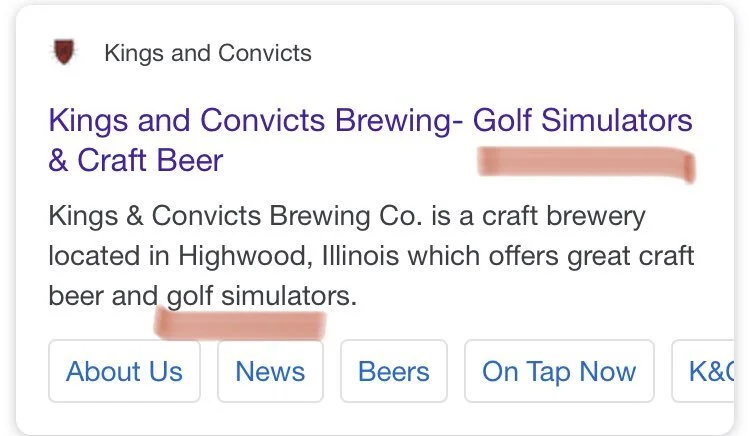
A two-year-old Chicago concern that touts “great craft beer and golf simulators,” today announced it had purchased Ballast Point. Named Kings and Convicts in honor of its Australian and English founders, the company has 334 Instagram followers. Upon hearing the news, every living being on the planet responded: “Who?”
The website immediately crashed, so little is known about the company. The press release offers these tidbits:
Kings & Convicts is a privately held company headquartered in Highwood, IL, in the North Shore of Chicago. Conceived by an Englishman and an Aussie, Kings & Convicts started brewing for the public in 2017 and was built on the freedom of anti-authority and the spirit of fellowship. They brew ales and lagers inspired by the tales of convicts, royalty and the undercurrent of American gangsters. Every beer tells a story. Kings & Convicts’ beer is available on draft and in cans at its taproom and in bars and restaurants across Chicagoland and southern Wisconsin.
Back in 2015, Ballast Point was the hottest brewery in the US, selling six-packs of Grapefruit Sculpin for $15 and leading a trend that would last well into 2016. Constellation Brands, then principally an importer, swooped in and purchased the California juggernaut for a cool $1 billion. It seemed a tad high at the time, but those were heady days.
Things have changed. The zeitgeist in beer shifted from clarion, bitter (and citrus-flavored) San Diego IPAs to murky, sweet New England hazies. Constellation recognized its error and started buying smaller breweries instead (“At the time we acquired Ballast Point, we thought there would be more national brands that broke out.”) Earlier this year, Constellation had to close locations and spiked further expansion—and was apparently looking for suitors in the meantime. Or CEO Bill Newlands drunkenly lost Ballast in a poker game. Or something.
I have an interview request in with the brewery, and I’ll let you know if I find out more—because clearly there is way more to this story than is currently being reported.
Update. This San Diego Union-Tribune piece has some additional details:
Kings and Convicts makes 600 barrels a year. That’s a six with two zeros, not four or five.
Kings and Convicts employs nine people.
The new company will be headquartered in San Diego.
Ballast has lost over half its volume, from a high of 431,000 bbls to something like 200k this year.
Brendan Watters, co-owner, was meeting with Constellation executives in July. Actual conversation: “Is it for sale?” he asked, half-joking. The response: “Would you like to buy it?”

05 Dec 22:19
 Not long after Spotify announced its upcoming music awards show, Apple has done the same. The Apple Music Awards is a "celebration of the best and boldest musicians of 2019 and the enormous impact they have had on global culture this year." The event...
Apple's first Music Awards will be headlined by Billie Eilish
by Rachel England
Emahlstadti don't know who this chick is and i haven't heard any of her songs, but i already wish she would go away.
Not long after Spotify announced its upcoming music awards show, Apple has done the same. The Apple Music Awards is a "celebration of the best and boldest musicians of 2019 and the enormous impact they have had on global culture this year." The event...
05 Dec 19:15
 Raj Mehta-USA TODAY Sports
Chris Ash is the right person for the Texas Longhorns defensive coordinator job
by Coachlamons
Emahlstadtthe video is just insufferable. also, i'm not buying this at all. dude's best resume stat is that he was a co-dc on a championship team once. he failed elsewhere as a defensive coach and failed miserably as a head coach.
and the "hire the buddy you worked with" concept is garbage. have a defensive vision, bring in a dc to implement. look at saban, it's a revolving door of coaches, most of which have never worked with him before.
herman needs to do some actual researching and interviewing. it's fucked up that i can so easily doubt this process is actually happening.
Raj Mehta-USA TODAY Sports
The defensive coordinator hire is arguably the most important decision Tom Herman will make in his career, and he already has the right man on his radar.
Coach Lamons explains why the defensive coordinator hire is the most important decision Texas Longhorns head coach Tom Herman has to make, and why he is already on the right track with former Rutgers head coach Chris Ash.
04 Dec 22:47

Microsoft may be building a disc-less next-gen Xbox after all
by Igor Bonifacic
Emahlstadti have owned an xbox one (and xbox one x) since it launched in... whatever year that was, and have never put a disc in it once.
who are these people out there buying discs?
Just when it seemed Microsoft's plans for Project Scarlett, its next-generation Xbox console, were getting simpler, there's a new wrinkle to the narrative. According to Kotaku's Jason Schreier, Microsoft is working on a more affordable, disc-less version of the device codenamed "Lockhart."
Source: Kotaku
04 Dec 03:52
Ring Reportedly Outed Camera Owners To Police With a Heat Map
by BeauHD
Emahlstadtjust gave it to 'em just because? yeah, no thanks, ring.
Amazon-owned home surveillance company Ring gave law enforcement a heat map that let police see all devices installed in an area, allowing them to view users down to the street level. CNET first reported the news. From a report: While the feature was removed in July, law enforcement could reportedly use the function to search for the concentration of cameras in a neighborhood, and even see circles drawn around individual user locations. The documents that revealed the feature were obtained by a privacy researcher and shared with the publication. The feature was so specific, according to CNET, that police could essentially obtain the specific location of Ring customers. While police can request videos from users through Ring, the company has denied that it provides information to law enforcement on who, specifically, owns their products. Ring said in a statement to CNET that zooming in on the map "would not provide actual device locations."

Read more of this story at Slashdot.
Mike Butash, Scott Weigand and one other like this
03 Dec 21:50
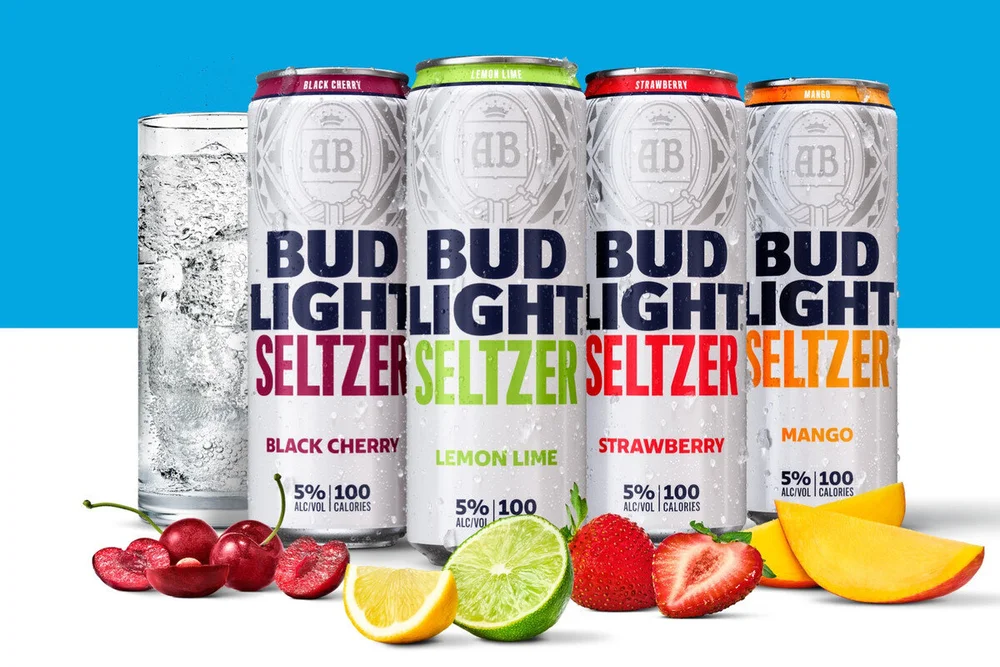
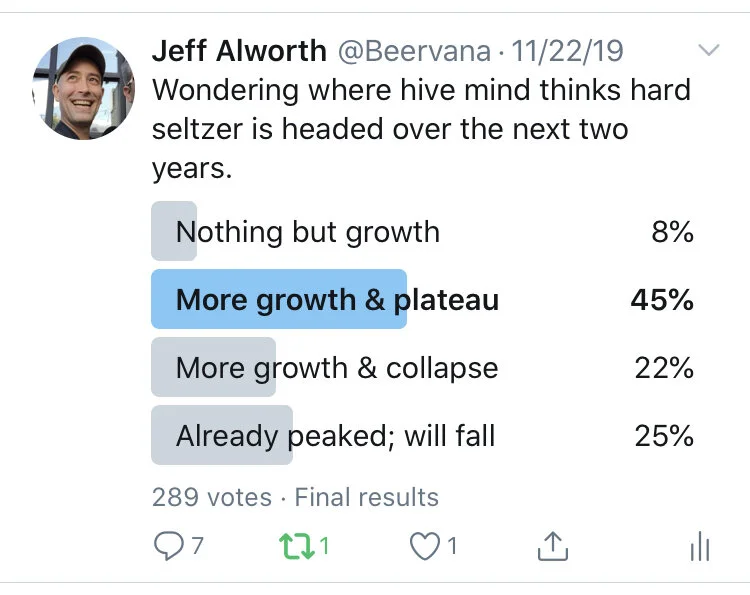
Beer is Still Fun and Seltzer Won’t Last
by Jeff Alworth
Emahlstadtrings true even if its mostly speculative.
It’s the week after Thanksgiving and the first winter chill has settled in—which means it’s time for a couple of very hot takes to keep us warm. Let’s just start with some bald assertion and get to the reasoning later: contrary to the current narrative, beer is still a lot of fun and replete with passionate support, and hard seltzer is a fad that will—eventually—run its course.
The Bizarre “Fun” Argument
As hard seltzer has enjoyed its rocketship popularity, people have started to make a strange argument. Hard seltzer isn’t popular because it’s a lightly-sweet low-impact way to get alcohol into one’s bloodstream—it’s popular because it’s fun, while beer is terribly abstruse and oppressive. That is, seltzer is popular because beer has gotten too serious. A couple recent examples. In The Atlantic, Amanda Mull argues seltzer is defined by “what it’s not: difficult or aspirational.” Seltzer is “about as basic as lining up at your local Starbucks on the first day of pumpkin-spice-latte season. That’s also why it’s fun,” she explains. Writing for Good Beer Hunting, Dave Holmes makes a similar case by comparing seltzer to punk rock (your mileage may vary on the effectiveness of that metaphor). His assesment? “In 2019, White Claw woke us up to what was really important when it comes to drinks: they’re supposed to be fun.”
The idea that the popularity of seltzer has to be a referendum on beer is odd. Odder still is the specificity of the complaint—that beer’s complexity is off-putting and exhausting. Craft beer may have it’s problems, but whatever fall is taking place in beer is happening not at the complex but the simple end: among domestic lagers. The hazy IPAs, barrel-aged wild ales, and pastry stouts—those exhausting beers the writers target—are the industry’s bright spot.
A much better explanation is that seltzer is merely hastening the decline of domestic lagers, but that wouldn’t allow writers to make a cultural critique and shame beer. The craft segment, which has been mainstream for a decade, offers a juicy target for anyone who wants to critique a culture of bearded white dudes or hypocrisy among sell-outs or even those overly complex and excessive liquid confections. All valid and important arguments. But there’s very little evidence that has anything to do with seltzer’s success.
(And really, as long as beer has alcohol in it, it’s going to be plenty fun.)
Our Future is Not Seltzer
The alcohol business is tough. In the past few decades, beer, wine, and spirits have fragmented tremendously. Consumer tastes have shifted. Boomers once conveniently sorted themselves into categories and stuck with brands for decades. No one consumes anything that way anymore. No one is a “Rainier man” anymore. In fact, there aren’t many “beer drinkers” left, either. If a person develops a taste for alcohol, they’re much more likely to drink all the alcohols, shifting from hazy IPA to Pinot to mezcal cocktails. And worse, we continue, decade by decade, to drink less. These are macro trends that have been developing for a very long time.
Enter seltzers, which within this fragmented, diffuse market of brands and categories, has shown a rare capacity to attract customers. It has been a marvel to behold. I can’t recall seeing any trend that has sparked a more immediate frenzy among copycats—not cider, citrus IPAs, golden ales, or even hazy IPAs. With the incredible sales for White Claw, seltzer represents an irresistible sector for growth, particularly among larger breweries where sales are dropping. Based on the press releases and news stories I’ve seen over the past year, the number of breweries launching new seltzer lines has to be in the triple digits by now. It is a real phenomenon and the immediate future is very bright.
It won’t last.
The very fragmentation and variety that defines alcohol right now makes it very hard for any trend to last. Within beer, hazies are an outlier—they are the end stage of a development happening for two decades in the US, and they’re here to stay. But other trends are built to die—it’s the nature of the promiscuity and quest for novelty that defines the alcohol market. Seltzer is a product of this trend, and will almost certainly be a victim of it, as the shandies and -Ritas and Four Lokos attest.
Beyond market trends, there’s another reason to suspect seltzers can’t last: they’re not very good, and certainly not very interesting. Supporters usually cite this as seltzer’s key advantage. Holmes gleefully put it this way:
“What if instead of a complicated mix of flavors, you had a craving for, like, lime-ish? White Claw gives you this and nothing more; I had planned to include tasting notes in this essay, but after one sip, I scribbled ‘bubbles!’ and then didn’t write anything else down.”
“Lime-ish and nothing more” is not the strongest foundation on which to build an enduring segment. Seltzers are on track to hit something close to three million barrels this year, which is a great little niche—but it’s still very much a niche in a 200 million-barrel industry. It is, rather, an example of a very successful flavored malt beverage. For thirty years, companies have appealed to drinkers by putting neutral grain spirits inside a sugary solution—wine coolers, spritzers, tea, lemonade, soda, and now coffee. The successful brands even manage to establish themselves as permanent fixtures. Mike’s Hard Lemonade has been profitably tricking along for two decades. But they’re fundamentally uninteresting, and when the novelty wears thin, so does the trend as a national force. Once they do, the market moves to the next disposable trend. What innate appeal do seltzers contain that will make them uniquely durable? White Claw may well he around in a decade or two, but one suspects seltzers will seem as cool as Zima does today.
In summary: seltzer is a fine little beverage to sip on a summer day, but is as forgettable as a can of La Croix. Beer has challenges and troubles, but consumers aren’t, en masse, sending it a secret, coded critique of hazy IPAs by buying a sixer of Claws.
Please feel free to add your view in comments.
