Journal of the American Chemical Society
DOI: 10.1021/jacs.6b10651
Luminescent materials with thermally activated delayed fluorescence (TADF) can harvest singlet and triplet excitons to afford high electroluminescence (EL) efficiencies for organic light-emitting diodes (OLEDs). However, TADF emitters generally have to be dispersed into host matrices to suppress emission quenching and/or exciton annihilation, and most doped OLEDs of TADF emitters encounter a thorny problem of swift efficiency roll-off as luminance increases. To address this issue, in this study, a new tailor-made luminogen (dibenzothiophene-benzoyl-9,9-dimethyl-9,10-dihydroacridine, DBT-BZ-DMAC) with an unsymmetrical structure is synthesized and investigated by crystallography, theoretical calculation, spectroscopies, etc. It shows aggregation-induced emission, prominent TADF, and interesting mechanoluminescence property. Doped OLEDs of DBT-BZ-DMAC show high peak current and external quantum efficiencies of up to 51.7 cd A−1 and 17.9%, respectively, but the efficiency roll-off is large at high luminance. High-performance nondoped OLED is also achieved with neat film of DBT-BZ-DMAC, providing excellent maxima EL efficiencies of 43.3 cd A−1 and 14.2%, negligible current efficiency roll-off of 0.46%, and external quantum efficiency roll-off approaching null from peak values to those at 1000 cd m−2. To the best of the authors' knowledge, this is one of the most efficient nondoped TADF OLEDs with small efficiency roll-off reported so far.

A highly efficient nondoped organic light-emitting diode affording excellent maxima electroluminescence efficiencies of 43.3 cd A−1 and 14.2%, negligible current efficiency roll-off of 0.46%, and external quantum efficiency roll-off approaching null from peak values to those at 1000 cd m−2, is attained based on a robust luminogen featuring aggregation-induced emission and thermally activated delayed fluorescence.
The development of nanotheranostic agents that integrate diagnosis and therapy for effective personalized precision medicine has obtained tremendous attention in the past few decades. In this report, biocompatible electron donor–acceptor conjugated semiconducting polymer nanoparticles (PPor-PEG NPs) with light-harvesting unit is prepared and developed for highly effective photoacoustic imaging guided photothermal therapy. To the best of our knowledge, it is the first time that the concept of light-harvesting unit is exploited for enhancing the photoacoustic signal and photothermal energy conversion in polymer-based theranostic agent. Combined with additional merits including donor–acceptor pair to favor electron transfer and fluorescence quenching effect after NP formation, the photothermal conversion efficiency of the PPor-PEG NPs is determined to be 62.3%, which is the highest value among reported polymer NPs. Moreover, the as-prepared PPor-PEG NP not only exhibits a remarkable cell-killing ability but also achieves 100% tumor elimination, demonstrating its excellent photothermal therapeutic efficacy. Finally, the as-prepared water-dispersible PPor-PEG NPs show good biocompatibility and biosafety, making them a promising candidate for future clinical applications in cancer theranostics.

A water-dispersible and biocompatible D–A semiconducting polymer nanoparticle (PPor-PEG NP) with light-harvesting unit is successfully developed for highly effective photoacoustic imaging guided photothermal therapy. The photothermal conversion efficiency of the PPor-PEG NPs is determined to be as high as 62.3% for achieving 100% tumor elimination.
It is commonly believed that large dielectric constants are required for efficient charge separation in polymer photovoltaic devices. However, many polymers used in high-performance solar cells do not possess high dielectric constants. In this work, the effect of polymer–fullerene interactions on the dielectric environment of the active layer blend and the device performance for several donor–acceptor conjugated polymer systems is investigated. It is found that, while none of the high-performing polymers studied has a dielectric constant value larger than 3, all polymer–fullerene blends have a significantly larger dielectric constant compared to their pristine constituents. Additionally, it is found that the blend dielectric constant reaches a maximum value in fully optimized devices. Using PTB7:PC71BM blends as an example, it is showed that, in addition to a small increase in the dielectric constant, devices fabricated using the optimum processing additive concentration exhibit almost 3X larger excited state polarizability. This large increase in excited state polarizability results in a substantial difference in short-circuit current and ultimately device performance. The results show that the excited state polarizability critically depends on polymer–fullerene interactions, and can be a leading indicator of device performance for a given material system.

The relationship between the dielectric constant and the device performance is investigated in polymer solar cells. The increase in the dielectric constant observed upon polymer–fullerene blending correlates well with device performance, in contrast to the pristine polymer dielectric constant. More importantly, the increase in excited state polarizability upon blending is a key indicator of device performance and is responsible for efficient charge transfer.
To improve the efficiency of existing perovskite solar cells (PSCs), a detailed understanding of the underlying device physics during their operation is essential. Here, a device model has been developed and validated that describes the operation of PSCs and quantitatively explains the role of contacts, the electron and hole transport layers, charge generation, drift and diffusion of charge carriers and recombination. The simulation to the experimental data of vacuum-deposited CH3NH3PbI3 solar cells over multiple thicknesses has been fit and the device behavior under different operating conditions has been studied to delineate the influence of the external bias, charge-carrier mobilities, energetic barriers for charge injection/extraction and, different recombination channels on the solar cell performance. By doing so, a unique set of material parameters and physical processes that describe these solar cells is identified. Trap-assisted recombination at material interfaces is the dominant recombination channel limiting device performance and passivation of traps increases the power conversion efficiency (PCE) of these devices by 40%. Finally, guidelines to increase their performance have been issued and it is shown that a PCE beyond 25% is within reach.

A numerical model is developed and validated that describes the operation of perovskite solar cells and quantitatively explains the role of contacts, the charge transport layers, charge generation, drift and diffusion of carriers and recombination. By doing so, a unique set of material parameters and physical processes is identified that describes these solar cells. To increase their performance, some guidelines are issued.
Hole transport matertial (HTM) as charge selective layer in perovskite solar cells (PSCs) plays an important role in achieving high power conversion efficiency (PCE). It is known that the dopants and additives are necessary in the HTM in order to improve the hole conductivity of the HTM as well as to obtain high efficiency in PSCs, but the additives can potentially induce device instability and poor device reproducibility. In this work a new strategy to design dopant-free HTMs has been presented by modifying the HTM to include charged moieties which are accompanied with counter ions. The device based on this ionic HTM X44 dos not need any additional doping and the device shows an impressive PCE of 16.2%. Detailed characterization suggests that the incorporated counter ions in X44 can significantly affect the hole conductivity and the homogeneity of the formed HTM thin film. The superior photovoltaic performance for X44 is attributed to both efficient hole transport and effective interfacial hole transfer in the solar cell device. This work provides important insights as regards the future design of new and efficient dopant free HTMs for photovotaics or other optoelectronic applications.

A new strategy to design dopant-free hole transport materials (HTMs) by modifying the organic molecule to include charged moieties that are accompanied by counter ions is investigated. The introduced counter ions are highly beneficial for improving the conductivity of the HTM and the perovskite solar cell devices based on the designed ionic HTM show impressive power conversion efficiency of more than 16%.
Organometal trihalide perovskites have been attracting intense attention due to their enthralling optoelectric characteristics. Thus far, most applications focus on polycrystalline perovskite, which however, is overshadowed by single crystal perovskite with superior properties such as low trap density, high mobility, and long carrier diffusion length. In spite of the inherent advantages and significant optoelectronic applications in solar cells and photodetectors, the fabrication of large-area laminar perovskite single crystals is challenging. In this report, an ingenious space-limited inverse temperature crystallization method is first demonstrated to the in situ synthesis of 120 cm2 large-area CH3NH3PbBr3 crystal film on fluorine-doped tin oxide (FTO) glass. Such CH3NH3PbBr3 perovskite crystal film is successfully applied to narrowband photodetectors, which enables a broad linear response range of 10−4–102 mW cm−2, 3 dB cutoff frequency (f 3 dB) of ≈110 kHz, and high narrow response under low bias −1 V.

120 cm2 laminar CH3NH3PbBr3 perovskite crystal film is in situ grown on fluorine-doped tin oxide (FTO) glass via an ingenious space-limited inverse temperature crystallization method. Such a crystal film presents excellent electron mobility (μe), trap density (ntrap), and electron diffusion length (L) of 40.7 cm2 s−1 V−1, 8.80 × 1010 cm−3, and 6.4 µm, respectively, which shows efficient performance in narrowband photodetectors.
Organolead trihalide perovskites have drawn substantial interest for photovoltaic and optoelectronic applications due to their remarkable physical properties and low processing cost. However, perovskite thin films suffer from low carrier mobility as a result of their structural imperfections such as grain boundaries and pinholes, limiting their device performance and application potential. Here we demonstrate a simple and straightforward synthetic strategy based on coupling perovskite films with embedded single-walled carbon nanotubes. We are able to significantly enhance the hole and electron mobilities of the perovskite film to record-high values of 595.3 and 108.7 cm2 V−1 s−1, respectively. Such a synergistic effect can be harnessed to construct ambipolar phototransistors with an ultrahigh detectivity of 3.7 × 10¹⁴ Jones and a responsivity of 1 × 10⁴ A W−1, on a par with the best devices available to date. The perovskite/carbon nanotube hybrids should provide a platform that is highly desirable for fields as diverse as optoelectronics, solar energy conversion, and molecular sensing.

A strategy to enhance the carrier mobility of photoresponsive hybrid perovskite films is realized via coupling with single-walled carbon nanotubes. Hole and electron mobilities of the devices reach ultrahigh values of 595.1 and 108.7 cm2 V-1 s-1, and such ambipolar phototransistors with composite channels provide a versatile platform for diverse fields of optoelectronics, solar energy conversion, and molecular sensing.
The efficiencies of the hybrid organic–inorganic perovskite solar cells have been rapidly approaching the benchmarks held by the leading thin-film photovoltaic technologies. Arguably, one of the most important factors leading to this rapid advancement is the ability to manipulate the microstructure of the perovskite layer and the adjacent functional layers within the device. Here, an analysis of the nucleation and growth models relevant to the formation of perovskite films is provided, along with the effect of the perovskite microstructure (grain sizes and voids) on device performance. In addition, the effect of a compact or mesoporous electron-transport-layer (ETL) microstructure on the perovskite film formation and the optical/photoelectric properties at the ETL/perovskite interface are overviewed. Insight into the formation of the functional layers within a perovskite solar cell is provided, and potential avenues for further development of the perovskite microstructure are identified.

The performance of perovskite solar cells is greatly affected by the microstructure of the functional layers, especially that of the perovskite film. By controlling the nucleation and crystal growth process, desirable microstructures (grains and voids size) of the perovskite films, such as dense films with large grains, can be achieved for high-efficiency solar cells.
Mixed ion perovskite solar cells (PSC) are manufactured with a metal-free hole contact based on press-transferred single-walled carbon nanotube (SWCNT) film infiltrated with 2,2,7,-7-tetrakis(N,N-di-p-methoxyphenylamine)-9,90-spirobifluorene (Spiro-OMeTAD). By means of maximum power point tracking, their stabilities are compared with those of standard PSCs employing spin-coated Spiro-OMeTAD and a thermally evaporated Au back contact, under full 1 sun illumination, at 60 °C, and in a N2 atmosphere. During the 140 h experiment, the solar cells with the Au electrode experience a dramatic, irreversible efficiency loss, rendering them effectively nonoperational, whereas the SWCNT-contacted devices show only a small linear efficiency loss with an extrapolated lifetime of 580 h.

A perovskite solar cell with carbon nanotube-based hole contact and drop cast 2,2,7,7-tetrakis(N,N-di-p-methoxyphenylamine)-9,90-spirobifluorene (Spiro-OMeTAD) exhibits superior stability over the standard device with spin-coated Spiro-OMeTAD and evaporated gold contact. The solar cells are subjected to a 140 h maximum power point tracking stability experiment in 1 sun illumination and 60 °C, and the carbon-based cell outperforms the gold cell clearly.
Nonfullerene polymer solar cells (PSCs) are fabricated with a perylene monoimide-based n-type wide-bandgap organic semiconductor PMI-F-PMI as an acceptor and a bithienyl-benzodithiophene-based wide-bandgap copolymer PTZ1 as a donor. The PSCs based on PTZ1:PMI-F-PMI (2:1, w/w) with the treatment of a mixed solvent additive of 0.5% N-methyl pyrrolidone and 0.5% diphenyl ether demonstrate a very high open-circuit voltage (Voc) of 1.3 V with a higher power conversion efficiency (PCE) of 6%. The high Voc of the PSCs is a result of the high-lying lowest unoccupied molecular orbital (LUMO) of −3.42 eV of the PMI-F-PMI acceptor and the low-lying highest occupied molecular orbital (HOMO) of −5.31 eV of the polymer donor. Very interestingly, the exciton dissociation efficiency in the active layer is quite high, even though the LUMO and HOMO energy differences between the donor and acceptor materials are as small as ≈0.08 and 0.19 eV, respectively. The PCE of 6% is the highest for the PSCs with a Voc as high as 1.3 V. The results indicate that the active layer based on PTZ1/PMI-F-PMI can be used as the front layer in tandem PSCs for achieving high Voc over 2 V.

Nonfullerene polymer solar cells with PTZ1 as a donor and PMI-F-PMI as an acceptor demonstrate a very high open-circuit voltage (Voc) of 1.3 V with a higher power conversion efficiency of 6%. The high Voc is a result of the high-lying lowest unoccupied molecular orbital (LUMO) of −3.42 eV of the PMI-F-PMI acceptor and the low-lying highest occupied molecular orbital (HOMO) of −5.31 eV of the polymer donor.
Recently, organic–inorganic hybrid perovskite materials have drawn great attention for their outstanding performance in high-efficiency solar cells. Successful synthesis has been realized either in solution-based chemical deposition or vapor deposition. However, conflicts have never ceased among quality control, growth rate, process complexity, and instrument requirement, which have limited their development toward real applications. In this work, the first electrochemical fabrication of perovskite toward high-efficiency and scalable perovskite solar cells (PSCs) is established. The morphology and crystallization of the CH3NH3PbI3 film can be effectively controlled by simply modulating a few physical parameters. A detailed study on its optoelectronic properties reveals significantly improved film quality and interfacial conditions. Aided by this, the total process does not require standard annealing, which greatly reduces the total growth time from hours to minutes. Up to now, an efficiency of 15.65% has been achieved in planar PSCs under 1 sun AM 1.5 condition, with small hysteresis and efficiency loss under longtime exposure to air. Moreover, high efficiency (10.45%) can be easily attained for large cells (2 cm2). This result will hopefully facilitate research for applicable high-efficiency PSCs and other multicomponent materials as well.

The first complete electrochemical fabrication of perovskite has been achieved for perovskite solar cells, with a total time two orders of magnitude less than other presented solution-based methods. High efficiency is realized with large area with efficiency loss of 0.7% from a total of over three weeks' exposure in air, aided by modulation of just a few physical parameters without additional treatments.
The booming development of organometal halide perovskites has prompted the exploration of morphology-engineering strategies to improve their performance in optoelectronic applications. However, the preparation of optoelectronic devices of perovskites with complex architectures and desirable properties is still highly challenging. Herein, novel CH3NH3PbI3 nanonets and nanobowl arrays are fabricated facilely by using monolayer colloidal crystal (MCC) templates on different substrates. Specifically, highly ordered CH3NH3PbI3 nanonets with high crystallinity are fabricated on a variety of flat substrates, whereas regular CH3NH3PbI3 nanobowl arrays are produced on a coarse substrate. The photodetection performance of the CH3NH3PbI3 nanonet-based photodetectors is significantly enhanced compared to the photodetectors based on conventional CH3NH3PbI3 compact films. Particularly, the nanonet photodetectors exhibit a high responsivity (10.33 A W−1 under 700 nm monochromatic light), which is six times higher than that for the compact CH3NH3PbI3 film devices, fast response speed, and good stability. Owing to the two-dimensional arrayed structure, the CH3NH3PbI3 nanonets exhibit an enhanced light harvesting ability and offer direct carrier transport pathways. Meanwhile, the MCC template brings about larger grain sizes with enhanced crystallinity. Furthermore, the perovskite nanonets can be formed on a flexible polyethylene terephthalate substrate for the fabrication of promising flexible nanonet photodetectors.

Highly ordered CH3NH3PbI3 nanonets with high crystallinity are fabricated on a variety of flat substrates through a facile nanosphere lithography approach. When used as a photodetector, the perovskite nanonet exhibits significantly enhanced photoresponsive performance owing to the unique net-like architecture that is beneficial to light harvesting and charge collection.
Organic field-effect transistors (OFETs) have attracted much attention for the next-generation electronics. Despite of the rapid developments of OFETs, operational stability is a big challenge for their commercial applications. Moreover, the actual mechanism behind the degradation of electron transport is still poorly understood. Here, the electrical characteristics of poly{[N,N-9-bis(2-octyldodecyl)-naphthalene-1,4,5,8-bis(dicarboximide)-2,6-diyl]-alt-5,59-(2,29-bithiophene)} (P(NDI2OD-T2)) thin-film transistors (TFTs) as a function of semiconductor/dielectric interfacial property and environment are systematically investigated, in particular, how the copresence of water, oxygen, and active hydrogen on the surface of dielectric leads to a sharp drop-off in threshold voltage. Evidence is found that an acid–base neutralization reaction occurring at the interface, as a combined effect of the chemical instability of dielectrics and the electrochemical instability of organic semiconductors, contributes to the significant electron trapping on the interface of P(NDI2OD-T2) TFTs. Two strategies, increasing the intrinsic electrochemical stability of semiconductor and decreasing the chemical reactivity of gate dielectric, are demonstrated to effectively suppress the reaction and thus improve the operational stability of n-type OFETs. The results provide an alternative degradation pathway to better understand the charge transport instability in n-type OFETs, which is advantageous to construct high-performance OFETs with long-term stability.

An acid–base neutralization reaction occurring at the semiconductor/dielectric interface is found to be critical for electron trapping in n-type organic field-effect transistors (OFETs). Two strategies are verified to suppress the reaction and thus improve the operational stability: increasing the electrochemical stability of semiconductors and decreasing the chemical reactivity of dielectrics. These results are advantageous to construct highly stable OFETs.


The controlled synthesis of high-quality multilayer (ML) MoS2 flakes with gradually shrinking basal planes by chemical vapor deposition (CVD) is demonstrated. These CVD-grown ML MoS2 flakes exhibit much higher mobility and current density than mechanically exfoliated ML flakes due to the reduced contact resistance which mainly resulted from direct contact between the lower MoS2 layers and electrodes.
The patterning of functional materials represents a crucial step for the implementation of organic semiconducting materials into functional devices. Classical patterning techniques such as photolithography or shadow masking exhibit certain limitations in terms of choice of materials, processing techniques and feasibility for large area fabrication. The use of self-assembled monolayers (SAMs) as a patterning tool offers a wide variety of opportunities, from the region-selective deposition of active components to guiding the crystallization direction. Here, we discuss general techniques and mechanisms for SAM-based patterning and show that all necessary components for organic electronic devices, i.e., conducting materials, dielectrics, organic semiconductors, and further functional layers can be patterned with the use of self-assembled monolayers. The advantages and limitations, and potential further applications of patterning approaches based on self-assembled monolayers are critically discussed.

The SAM-guided patterning of functional materials represents a powerful tool for the structuring of active layers in organic electronic devices. This approach is critically reviewed in view of the large-area processing of the different components of organic thin film transistors.
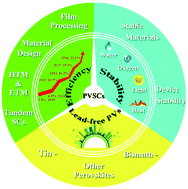
Organic–inorganic hybrid halide perovskites (e.g., MAPbI3) have recently emerged as novel active materials for photovoltaic applications with power conversion efficiency over 22%. Conventional perovskite solar cells (PSCs); however, suffer the issue that lead is toxic to the environment and organisms for a long time and is hard to excrete from the body. Therefore, it is imperative to find environmentally-friendly metal ions to replace lead for the further development of PSCs. Previous work has demonstrated that Sn, Ge, Cu, Bi, and Sb ions could be used as alternative ions in perovskite configurations to form a new environmentally-friendly lead-free perovskite structure. Here, we review recent progress on lead-free PSCs in terms of the theoretical insight and experimental explorations of the crystal structure of lead-free perovskite, thin film deposition, and device performance. We also discuss the importance of obtaining further understanding of the fundamental properties of lead-free hybrid perovskites, especially those related to photophysics.

Recent progress on lead-free perovskite solar cells (PSCs) in terms of the theoretical insight and experimental explorations of the crystal structure of lead-free perovskites, thin-film deposition, and device performance is reviewed. The importance of understanding the fundamental properties of lead-free hybrid perovskites is discussed. Greater effort is needed to explore high-performance lead-free PSCs.
Despite the breakthrough of over 22% power conversion efficiency demonstrated in organic–inorganic hybrid perovskite solar cells (PVSCs), critical concerns pertaining to the instability and toxicity still remain that may potentially hinder their commercialization. In this study, a new chemical approach using environmentally friendly strontium chloride (SrCl2) as a precursor for perovskite preparation is demonstrated to result in enhanced device performance and stability of the derived hole-conductor-free printable mesoscopic PVSCs. The CH3NH3PbI3 perovskite is chemically modified by introducing SrCl2 in the precursor solution. The results from structural, elemental, and morphological analyses show that the incorporation of SrCl2 affords the formation of CH3NH3PbI3(SrCl2)x perovskites endowed with lower defect concentration and better pore filling in the derived mesoscopic PVSCs. The optimized compositional CH3NH3PbI3(SrCl2)0.1 perovskite can substantially enhance the photovoltaic performance of the derived hole-conductor-free device to 15.9%, outperforming the value (13.0%) of the pristine CH3NH3PbI3 device. More importantly, the stability of the device in ambient air under illumination is also improved.

A new compositional perovskite, CH3NH3PbI3(SrCl2)0.1 with more compact morphology and lower defect concentration is presented. Consequently, a power conversion efficiency of 15.9% with enhanced stability is achieved by employing the structure of hole-conductor-free fully printable mesoscopic perovskite solar cell.