25 Jul 06:48
J. Mater. Chem. A, 2016, 4,11307-11316
DOI: 10.1039/C6TA03164A, Paper
Minwoo Park, Joon-Suh Park, Il Ki Han, Jin Young Oh
By incorporating long P3HT nanofibrils as a hole transporting layer, high-performance, air-stable and flexible perovskite solar cells with a large active area (1 cm2) have been realized with an excellent power conversion efficiency of 13.12%.
The content of this RSS Feed (c) The Royal Society of Chemistry
25 Jul 06:48
J. Mater. Chem. A, 2016, 4,11729-11737
DOI: 10.1039/C6TA04059D, Paper
Jiuxing Wang, Xichang Bao, Dakang Ding, Meng Qiu, Zurong Du, Junyi Wang, Jie Liu, Mingliang Sun, Renqiang Yang
A fluorine substituent was firstly introduced into a PT-containing polymer, resulting in significantly improved photovoltaic performance.
The content of this RSS Feed (c) The Royal Society of Chemistry
25 Jul 06:47
J. Mater. Chem. A, 2016, 4,10650-10658
DOI: 10.1039/C6TA04321F, Paper
Pierayeh Vahdani, Xianzhen Li, Chi Zhang, Steven Holdcroft, Barbara J. Frisken
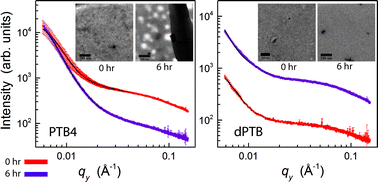
Optical microscopy, TEM and SAXS reveal stable morphology at micro and nanoscopic length scales.
The content of this RSS Feed (c) The Royal Society of Chemistry
25 Jul 06:47
J. Mater. Chem. A, 2016, 4,11747-11753
DOI: 10.1039/C6TA03695C, Paper
J. Zhang, X. W. Zhu, C. He, H. J. Bin, L. W. Xue, W. G. Wang, Y. K. Yang, N. Y. Yuan, J. N. Ding, Z. X. Wei, Z.-G. Zhang, Y. F. Li
Two new compounds with alkyl side chains at different positions have a similar structure, but exhibit different photovoltaic properties.
The content of this RSS Feed (c) The Royal Society of Chemistry
25 Jul 06:46
J. Mater. Chem. A, 2016, 4,11738-11746
DOI: 10.1039/C6TA03585J, Paper
Yue Zhao, Qingsen Zeng, Xu Liu, Shihui Jiao, Guangsheng Pang, Xiaohang Du, Kai Zhang, Bai Yang
A PCE of 5.53% is obtained for the aqueous-processed polymer/nanocrystal hybrid solar cells based on the aqueous-processed TiO2 electron extraction layer.
The content of this RSS Feed (c) The Royal Society of Chemistry
22 Jul 06:36
by Dehui Li, Hao Wu, Hung-Chieh Cheng, Gongming Wang, Yu Huang and Xiangfeng Duan

ACS Nano
DOI: 10.1021/acsnano.6b02795

16 Jul 01:42
by Sachin Badgujar, Gang-Young Lee, Taiho Park, Chang Eun Song, Sangheon Park, Sora Oh, Won Suk Shin, Sang-Jin Moon, Jong-Cheol Lee, Sang Kyu Lee

In article number 1600228, Taiho Park, Sang Kyu Lee and co-workers achieve a high efficiency of 7.45% in a 77.8 cm2 rigid module of organic photovoltaics. The delicate control of intermolecular interaction has an important role in achieving a well-interconnected morphology. The number of 2D-BDT (benzodithiophene) units is essential in creating a well-defined intermolecular interaction, and the desired interconnected bulk heterojunction structure.
30 Jun 05:12
by Hongkyu Kang, Geunjin Kim, Junghwan Kim, Sooncheol Kwon, Heejoo Kim, Kwanghee Lee
The past two decades of vigorous interdisciplinary approaches has seen tremendous breakthroughs in both scientific and technological developments of bulk-heterojunction organic solar cells (OSCs) based on nanocomposites of π-conjugated organic semiconductors. Because of their unique functionalities, the OSC field is expected to enable innovative photovoltaic applications that can be difficult to achieve using traditional inorganic solar cells: OSCs are printable, portable, wearable, disposable, biocompatible, and attachable to curved surfaces. The ultimate objective of this field is to develop cost-effective, stable, and high-performance photovoltaic modules fabricated on large-area flexible plastic substrates via high-volume/throughput roll-to-roll printing processing and thus achieve the practical implementation of OSCs. Recently, intensive research efforts into the development of organic materials, processing techniques, interface engineering, and device architectures have led to a remarkable improvement in power conversion efficiencies, exceeding 11%, which has finally brought OSCs close to commercialization. Current research interests are expanding from academic to industrial viewpoints to improve device stability and compatibility with large-scale printing processes, which must be addressed to realize viable applications. Here, both academic and industrial issues are reviewed by highlighting historically monumental research results and recent state-of-the-art progress in OSCs. Moreover, perspectives on five core technologies that affect the realization of the practical use of OSCs are presented, including device efficiency, device stability, flexible and transparent electrodes, module designs, and printing techniques.

Bulk-heterojunction organic solar cells based on solution-processable organic semiconductors enable completely new functionalities of being printable, portable, wearable, biocompatible, and attachable to any curved surfaces. The recent major advances in device efficiency and stability, flexible transparent electrodes, module design, and printing technologies for their commercialization are reviewed. The existing challenges and perspectives for these five core technologies are discussed.
27 Jun 06:10
J. Mater. Chem. A, 2016, 4,11844-11858
DOI: 10.1039/C6TA03594A, Paper
Ermioni Polydorou, Angelos Zeniou, Dimitris Tsikritzis, Anastasia Soultati, Ilias Sakellis, Spyros Gardelis, Theodoros A. Papadopoulos, Joe Briscoe, Leonidas C. Palilis, Stella Kennou, Evangelos Gogolides, Panagiotis Argitis, Dimitris Davazoglou, Maria Vasilopoulou
The surface passivation effect of SF6 plasma on ZnO films for application in polymer solar cells is demonstrated.
The content of this RSS Feed (c) The Royal Society of Chemistry
27 Jun 06:08
by Gongxun Bai, Shuoguo Yuan, Yuda Zhao, Zhibin Yang, Sin Yuk Choi, Yang Chai, Siu Fung Yu, Shu Ping Lau, Jianhua Hao

A 2D system of Er-doped MoS2 layered nanosheets is developed. Structural studies indicate that the Er atoms can be substitutionally introduced into MoS2 to form stable doping. Density functional theory calculation implies that the system remains stable. Both NIR-to-NIR up-conversion and down-conversion light-emissions are observed in 2D transition metal dichalcogenides, ascribed to the energy transition from Er3+ dopants.
27 Jun 06:07
by Jinwoo Byun, Himchan Cho, Christoph Wolf, Mi Jang, Aditya Sadhanala, Richard H. Friend, Hoichang Yang, Tae-Woo Lee

Efficient quasi-2D-structure perovskite light-emitting diodes (4.90 cd A−1) are demonstrated by mixing a 3D-structured perovskite material (methyl ammonium lead bromide) and a 2D-structured perovskite material (phenylethyl ammonium lead bromide), which can be ascribed to better film uniformity, enhanced exciton confinement, and reduced trap density.
27 Jun 06:07
by Lin-Song Cui, Ya-Li Deng, Daniel Ping-Kuen Tsang, Zuo-Quan Jiang, Qisheng Zhang, Liang-Sheng Liao, Chihaya Adachi

Efficient sky-blue organic light-emitting diodes (OLEDs) employing thermally activated delayed fluorescence (TADF) display a three orders of magnitude increase in lifetime, which is superior to those of controlled phosphorescent OLEDs used in this study. The combination of electro-oxidation and photo-oxidation of the TADF emitters in their triplet excited-states is suppressed through molecule design and device engineering.
27 Jun 06:06
by Pei Cheng, Cenqi Yan, Yang Wu, Jiayu Wang, Meng Qin, Qiaoshi An, Jiamin Cao, Lijun Huo, Fujun Zhang, Liming Ding, Yanming Sun, Wei Ma, Xiaowei Zhan

The alloy acceptor (indene-C60 bis-adduct (ICBA)/[6,6]-phenyl-C71-butyric acid-methyl-ester (PC71BM)) is employed to replace the widely used fullerene acceptor (PC71BM) in organic solar cells based on five different polymer donors, which exhibit a higher efficiency and much better device stability than the PC71BM counterpart.
24 Jun 07:32
by Hobeom Kim, Jinwoo Byun, Sang-Hoon Bae, Towfiq Ahmed, Jian-Xin Zhu, Sung-Joo Kwon, Yeongjun Lee, Sung-Yong Min, Christoph Wolf, Hong-Kyu Seo, Jong-Hyun Ahn, Tae-Woo Lee

On-fabrication solid-state N-doping of graphene using a fluorosurfactant (Zonyl)-added ZnO layer on a graphene surface is developed by Tae-Woo Lee and co-workers, in article number 1600172. The N-doping facilitates efficient electron transfer from the ZnO layer to the graphene cathode. Based on this, inverted organic solar cells with a power conversion efficiency of 7.5% are fabricated, which is 100% power conversion efficiency with respect to the ITO cathode.
23 Jun 01:28

Sheets ahead: Solution-based methods offer an effective route for the preparation of MoS2 nanosheets. With the an emphasis on applications, the synthetic strategies and methods for functionalization and hybridization are discussed.
[Review]
Xiao Zhang, Zhuangchai Lai, Chaoliang Tan, Hua Zhang
Angew. Chem. Int. Ed., June 22, 2016, DOI: 10.1002/anie.201509933. Read article
23 Jun 01:14
J. Mater. Chem. A, 2016, 4,12158-12169
DOI: 10.1039/C6TA04726B, Paper
Sawanta S. Mali, Chang Su Shim, Hyungjin Kim, Chang Kook Hong
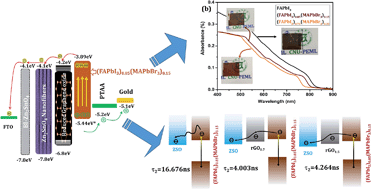
Electron transporting materials based on ternary metal oxides (TMOs) with graphene incorporation are the best electron transport layers (ETLs) for perovskite solar cells (PSCs).
The content of this RSS Feed (c) The Royal Society of Chemistry
23 Jun 01:13
J. Mater. Chem. A, 2016, 4,11439-11445
DOI: 10.1039/C6TA04920F, Paper
You-Sun Lee, Ji Young Lee, Su-Mi Bang, Bogyu Lim, Jaechol Lee, Seok-In Na
Conjugated random copolymers with non-covalent intramolecular interaction are synthesized and used as electron-donor materials for highly efficient organic solar cells.
The content of this RSS Feed (c) The Royal Society of Chemistry
23 Jun 01:12
J. Mater. Chem. A, 2016, 4,11372-11380
DOI: 10.1039/C6TA04600B, Paper
Faming Li, Chunxiong Bao, Weidong Zhu, Bihu Lv, Wenguang Tu, Tao Yu, Jie Yang, Xiaoxin Zhou, Yangrunqian Wang, Xiaoyong Wang, Yong Zhou, Zhigang Zou
A spray assisted solution process in CH3NH3PbI3 film deposition can achieve the efficient mesoporous structured perovskite solar cells with an optimal PCE of 14.2%.
The content of this RSS Feed (c) The Royal Society of Chemistry
23 Jun 01:10
by Rundong Fan, Yuan Huang, Ligang Wang, Liang Li, Guanhaojie Zheng, Huanping Zhou
Organic–inorganic halide perovskite has received extensive attention as a light harvester for next-generation low-cost and high-performance photovoltaics. Its superior optoelectronic properties are attractive among most thin film absorber materials, such as an extremely high absorption coefficient, optimal band gap, ambipolar carrier transport property, and high defects tolerance. However, it requires suitable electrodes and carrier transport materials to fulfill efficient photovoltaic process within an entire device. Thus, the interfaces along the device play a crucial role in determining device photovoltaic performance. Here, the progress of understanding interfaces in perovskite photovoltaics is reviewed from the perspective of processing chemistry and photophysics of carriers, which are the key parameters for the corresponding device photovoltaic behavior. This study is mainly focused on the relevant working mechanism, interface design fundamentals, and the resulting carrier dynamic control over the entire architecture. The study of the interfaces with appropriate materials design provides a fundamental understanding of the photocarrier behavior, including separation, transportation, and collection. The accumulative efforts will contribute to the construction of high-efficiency perovskite-based single junction and multijunction photovoltaic devices. It also affects other properties of perovskite solar cells, including J–V hysteresis phenomenon, and long-term stability. Suggestions with respect to required improvements and future research directions are provided based on the current field of available literature.

The progress of interfaces design in perovskite photovoltaics is reviewed, from the perspective of various aspects, including the relevant working mechanism, interface design fundamentals, devices long-term stability, as well as hysteresis phenomenon, etc., which are the key parameters for the corresponding materials understanding and device photovoltaic behavior.
23 Jun 01:10
by Shi Chen, Yi Hou, Haiwei Chen, Moses Richter, Fei Guo, Simon Kahmann, Xiaofeng Tang, Tobias Stubhan, Hong Zhang, Ning Li, Nicola Gasparini, Cesar Omar Ramirez Quiroz, Laraib S. Khanzada, Gebhard J. Matt, Andres Osvet, Christoph J. Brabec
Perovskite solar cells based on CH3NH3PbBr3 with a band gap of 2.3 eV are attracting intense research interests due to their high open-circuit voltage (Voc) potential, which is specifically relevant for the use in tandem configuration or spectral splitting. Many efforts have been performed to optimize the Voc of CH3NH3PbBr3 solar cells; however, the limiting Voc (namely, radiative Voc:Voc,rad) and the corresponding ΔVoc (the difference between Voc,rad and Voc) mechanism are still unknown. Here, the average Voc of 1.50 V with the maximum value of 1.53 V at room temperature is achieved for a CH3NH3PbBr3 solar cell. External quantum efficiency measurements with electroluminescence spectroscopy determine the Voc,rad of CH3NH3PbBr3 cells with 1.95 V and a ΔVoc of 0.45 V at 295 K. When the temperature declines from 295 to 200 K, the obtained Voc remains comparably stable in the vicinity of 1.5 V while the corresponding ΔVoc values show a more significant increase. Our findings suggest that the Voc of CH3NH3PbBr3 cells is primarily limited by the interface losses induced by the charge extraction layer rather than by bulk dominated recombination losses. These findings are important for developing strategies how to further enhance the Voc of CH3NH3PbBr3-based solar cells.

CH3NH3PbBr3 solar cells with the average open circuit voltage of 1.50 V are achieved. External quantum efficiency measurements and electroluminescence spectroscopy are employed to predict the limiting open circuit voltage and the corresponding voltage loss mechanism are clarified via temperature dependent measurements, beneficial for further open circuit voltage improvements of CH3NH3PbBr3 solar cells.
22 Jun 11:16
by Jun Xing, Fei Yan, Yawen Zhao, Shi Chen, Huakang Yu, Qing Zhang, Rongguang Zeng, Hilmi Volkan Demir, Xiaowei Sun, Alfred Huan and Qihua Xiong

ACS Nano
DOI: 10.1021/acsnano.6b01540

ziyang and -1 others like this
21 Jun 01:19
by Marcos H. D. Guimarães, Hui Gao, Yimo Han, Kibum Kang, Saien Xie, Cheol-Joo Kim, David A. Muller, Daniel C. Ralph and Jiwoong Park

ACS Nano
DOI: 10.1021/acsnano.6b02879

20 Jun 13:02
by Fan Gong, Wenjin Luo, Jianlu Wang, Peng Wang, Hehai Fang, Dingshan Zheng, Nan Guo, Jingli Wang, Man Luo, Johnny C. Ho, Xiaoshuang Chen, Wei Lu, Lei Liao, Weida Hu
In recent years, 2D layered materials have been considered as promising photon absorption channel media for next-generation phototransistors due to their atomic thickness, easily tailored single-crystal van der Waals heterostructures, ultrafast optoelectronic characteristics, and broadband photon absorption. However, the photosensitivity obtained from such devices, even under a large bias voltage, is still unsatisfactory until now. In this paper, high-sensitivity phototransistors based on WS2 and MoS2 are proposed, designed, and fabricated with gold nanoparticles (AuNPs) embedded in the gate dielectric. These AuNPs, located between the tunneling and blocking dielectric, are found to enable efficient electron trapping in order to strongly suppress dark current. Ultralow dark current (10−11 A), high photoresponsivity (1090 A W−1), and high detectivity (3.5 × 10¹¹ Jones) are obtained for the WS2 devices under a low source/drain and a zero gate voltage at a wavelength of 520 nm. These results demonstrate that the floating-gate memory structure is an effective configuration to achieve high-performance 2D electronic/optoelectronic devices.

This study reports a novel float-gated memory structure phototransistor based on multilayer WS2 with gold nanoparticles embedded in the gate dielectric. The device represents excellent photodetection capabilities demonstrating that the float-gated memory is an effective configuration to achieve high-performance 2D optoelectronic devices.
20 Jun 13:01
by Tonghui Wang, Mahesh Kumar Ravva, Jean-Luc Brédas
Polymer-fullerene packing in mixed regions of a bulk heterojunction solar cell is expected to play a major role in exciton-dissociation, charge-separation, and charge-recombination processes. Here, molecular dynamics simulations are combined with density functional theory calculations to examine the impact of nature and location of polymer side-chains on the polymer-fullerene packing in mixed regions. The focus is on poly-benzo[1,2-b:4,5-b′]dithiophene-thieno[3,4-c]pyrrole-4,6-dione (PBDTTPD) as electron-donating material and [6,6]-phenyl-C61-butyric acid methyl ester (PC61BM) as electron-accepting material. Three polymer side-chain patterns are considered: i) linear side-chains on both benzodithiophene (BDT) and thienopyrroledione (TPD) moieties; ii) two linear side-chains on BDT and a branched side-chain on TPD; and iii) two branched side-chains on BDT and a linear side-chain on TPD. Increasing the number of branched side-chains is found to decrease the polymer packing density and thereby to enhance PBDTTPD–PC61 BM mixing. The nature and location of side-chains are found to play a determining role in the probability of finding PC61BM molecules close to either BDT or TPD. The electronic couplings relevant for the exciton-dissociation and charge-recombination processes are also evaluated. Overall, the findings are consistent with the experimental evolution of the PBDTTPD–PC61BM solar-cell performance as a function of side-chain patterns.

Polymer side-chains are expected to play a significant role in determining the polymer-fullerene packing in the mixed regions of bulk-heterojunction solar cells. The computational work, based on a combination of molecular dynamics simulations and density functional theory calculations, provides a detailed description of the impact that the nature and locations of the polymer side-chains have on the nanoscale polymer-fullerene packing.
20 Jun 13:01
by Qin Liu, Min-Chao Qin, Wei-Jun Ke, Xiao-Lu Zheng, Zhao Chen, Ping-Li Qin, Liang-Bin Xiong, Hong-Wei Lei, Jia-Wei Wan, Jian Wen, Guang Yang, Jun-Jie Ma, Zhen-Yu Zhang, Guo-Jia Fang
Perovskite solar cells (PSCs) may offer huge potential in photovoltaic conversion, yet their practical applications face one major obstacle: their low stability, or quick degradation of their initial efficiencies. Here, a new design scheme is presented to enhance the PSC stability by using low-temperature hydrothermally grown hierarchical nano-SnO2 electron transport layers (ETLs). The ETL contains a thin compact SnO2 layer underneath a mesoporous layer of SnO2 nanosheets. The mesoporous layer plays multiple roles of enhancing photon collection, preventing moisture penetration and improving the long-term stability. Through such simple approaches, PSCs with power conversion efficiencies of ≈13% can be readily obtained, with the highest efficiency to be 16.17%. A prototypical PSC preserves 90% of its initial efficiency even after storage in air at room temperature for 130 d without encapsulation. This study demonstrates that hierarchical SnO2 is a potential ETL for fabricating low-cost and efficient PSCs with long-term stability.

Low-temperature hydrothermally grown hierarchical SnO2
, a mesoporous layer of nanosheet arrays on a compact nanoparticle layer, is used as the electron transporting layer to enhance the long-term stability of perovskite solar cells. A mesoporous device preserves 90% of its initial efficiency, even after storage in air for 130 d without encapsulation.
18 Jun 01:15
by Xiaohui Liu, Xiaodong Li, Yaru Li, Changjian Song, Liping Zhu, Wenjun Zhang, Hai-Qiao Wang, Junfeng Fang

High-performance polymer solar cells incorporating a low-temperature-processed aluminum-doped zinc oxide (AZO) cathode interlayer are constructed with power conversion efficiency (PCE) of 10.42% based on PTB7-Th:PC71BM blends (insensitive to the AZO thickness). Moreover, flexible devices on poly(ethylene terephthalate)/indium tin oxide substrates with PCE of 8.93% are also obtained, and welldistributed efficiency and good device stability are demonstrated as well.
18 Jun 01:14
by Di Liu, Jun Wang, Xiaojuan Bai, Ruilong Zong, Yongfa Zhu

A self-assembled perylene-3,4,9,10-tetracarboxylic diimide(PDINH) supramolecular system consisting of all-organic PDINH molecule building blocks through non-covalent interactions works as a visible light photocatalyst with high activity.
18 Jun 01:05
by Yingying Fu, Bei Wang, Jianfei Qu, Yang Wu, Wei Ma, Yanhou Geng, Yanchun Han, Zhiyuan Xie
This study has proposed to use a well-defined oligomer F4TBT4 to replace its analogue polymer as electron acceptor toward tuning the phase separation behavior and enhancing the photovoltaic performance of all-polymer solar cells. It has been disclosed that the oligomer acceptor favors to construct pure and large-scale phase separation in the polymer:oligomer blend film in contrast to the polymer:polymer blend film. This gets benefit from the well-defined structure and short rigid conformation of the oligomer that endows it aggregation capability and avoids possible entanglement with the polymer donor chains. The charge recombination is to some extent suppressed and charge extraction is also improved. Finally, the P3HT:F4TBT4 solar cells not only output a high VOC above 1.2 V, but also achieve a power conversion efficiency of 4.12%, which is two times higher than the P3HT:PFTBT solar cells and is comparable to the P3HT:PCBM solar cells. The strategy of constructing optimum phase separation with oligomer to replace polymer opens up new prospect for the further improvement of the all-polymer solar cells.

A well-defined oligomer F4TBT4 is proposed to replace its polymer PFTBT as electron acceptor to fabricate fullerene-free polymer solar cells. The oligomer acceptor favors to construct pure and large-scale phase separation in polymer blend film due to decreased chain entanglement. The resulted P3HT:F4TBT4 solar cells not only output a high VOC above 1.2 V, but also achieve a PCE of 4.12%.
18 Jun 01:03
by Achilleas Savva, Ignasi Burgués-Ceballos, Stelios A. Choulis
Perovskite photovoltaics (PVs) have attracted attention because of their excellent power conversion efficiency (PCE). Critical issues related to large-area PV performance, reliability, and lifetime need to be addressed. Here, it is shown that doped metal oxides can provide ideal electron selectivity, improved reliability, and stability for perovskite PVs. This study reports p-i-n perovskite PVs with device areas ranging from 0.09 cm2 to 0.5 cm2 incorporating a thick aluminum-doped zinc oxide (AZO) electron selective contact with hysteresis-free PCE of over 13% and high fill factor values in the range of 80%. AZO provides suitable energy levels for carrier selectivity, neutralizes the presence of pinholes, and provides intimate interfaces. Devices using AZO exhibit an average PCE increase of over 20% compared with the devices without AZO and maintain the high PCE for the larger area devices reported. Furthermore, the device stability of p-i-n perovskite solar cells under the ISOS-D-1 is enhanced when AZO is used, and maintains 100% of the initial PCE for over 1000 h of exposure when AZO/Au is used as the top electrode. The results indicate the importance of doped metal oxides as carrier selective contacts to achieve reliable and high-performance long-lived large-area perovskite solar cells.

Doped metal oxides provide ideal electron selectivity, improved lifetime, and reliability for large-area perovskite-based photovoltaics. The proposed aluminum-doped zinc oxide electron selective contact provides suitable energy levels for carrier selectivity and stability, neutralizes the presence of pinholes, provides intimate interfaces, and maintains high power conversion efficiency for large-area solar cell devices.
17 Jun 01:41

A great advantage of conjugated polymers is the solution processability with low cost. As conjugated polymers typically have flexible alkyl side chains for solubility in organic solvents, J. Liu, L. Wang, and co-workers report in their Communication (DOI: 10.1002/anie.201602775) soluble conjugated polymers bearing novel side chains, branched oligo(ethylene glycol). These polymers can be used in solution-processed polymer solar cells with high efficiency and near-IR response.
[Cover Picture]
Xingxing Chen, Zijian Zhang, Zicheng Ding, Jun Liu, Lixiang Wang
Angew. Chem. Int. Ed., June 15, 2016, DOI: 10.1002/anie.201605537. Read article