21 Sep 01:02
J. Mater. Chem. A, 2016, 4,15294-15301
DOI: 10.1039/C6TA05745D, Communication
Xiao Liu, Chu-Chen Chueh, Zonglong Zhu, Sae Byeok Jo, Ye Sun, Alex K.-Y. Jen
Highly crystalline Zn2SnO4 NPs were applied as an efficient electron-transporting layer that can enable both efficient inverted p-i-n PVSC with enhanced ambient stability and efficient conventional n-i-p PVSC on a flexible substrate.
The content of this RSS Feed (c) The Royal Society of Chemistry
12 Sep 01:21
J. Mater. Chem. A, 2016, 4,15662-15669
DOI: 10.1039/C6TA06232F, Paper
Bai-Xue Chen, Hua-Shang Rao, Hong-Yan Chen, Wen-Guang Li, Dai-Bin Kuang, Cheng-Yong Su
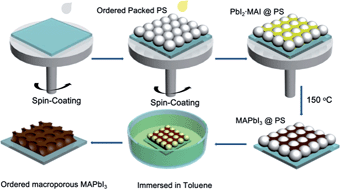
Perovskite solar cell based on ordered macroporous CH3NH3PbI3 films achieves a PCE of 11.7% under the AL AVT of 36.5%.
The content of this RSS Feed (c) The Royal Society of Chemistry
12 Sep 01:19
J. Mater. Chem. A, 2016, 4,15788-15822
DOI: 10.1039/C6TA06987H, Review Article
Chin Hoong Teh, Rusli Daik, Eng Liang Lim, Chi Chin Yap, Mohd Adib Ibrahim, Norasikin Ahmad Ludin, Kamaruzzaman Sopian, Mohd Asri Mat Teridi
HTMs with a planar core structure, extended-[small pi] system and electron-rich groups exhibited better intrinsic conductivity, which enhanced the photovoltaic performance.
The content of this RSS Feed (c) The Royal Society of Chemistry
08 Sep 01:08
by Xian-Kai Chen, Mahesh Kumar Ravva, Hong Li, Sean M. Ryno, Jean-Luc Brédas

In organic solar cells, a major source of energy loss is attributed to nonradiative recombination from the interfacial charge transfer states to the ground state. By taking pentacene–C60 complexes as model donor–acceptor systems, a comprehensive theoretical understanding of how molecular packing and charge delocalization impact these nonradiative recombination rates at donor–acceptor interfaces is provided.
08 Sep 01:06
by Lin Song, Amr Abdelsamie, Christoph J. Schaffer, Volker Körstgens, Weijia Wang, Tianyi Wang, Efi Dwi Indari, Thomas Fröschl, Nicola Hüsing, Tobias Haeberle, Paolo Lugli, Sigrid Bernstorff, Peter Müller-Buschbaum
The requirement of high-temperature calcination for titanium dioxide in (solid-state) dye-sensitized solar cells (DSSCs) implies challenges with respect to reduced energy consumption and the potential for flexible photovoltaic devices. Moreover, the use of dye molecules increases production costs and leads to problems related with dye bleaching. Therefore, fabrication of dye-free hybrid solar cells at low temperature is a promising alternative for current DSSC technology. In this work the authors fabricate hierarchically structured titania thin films by combining a polystyrene-block-polyethylene oxide template assisted sol–gel synthesis with nano-imprint lithography at low temperatures. The achieved films are filled with poly(3-hexylthiophene) to form the active layer of hybrid solar cells. The surface morphology is probed via scanning electron microscopy and atomic force microscopy, and the bulk film morphology is examined with grazing incidence X-ray scattering. Good light absorption by the active layer is proven by UV–vis spectroscopy. An enhancement in light absorption is observed and ascribed to light scattering in mesoporous titania films with imprinted superstructures. Accordingly a better photovoltaic performance is found for nano-imprinted solar cells at various angles of light incidence.

Nano-imprinted hybrid solar cells are fabricated at low temperature. Scanning electron microscopy, atomic force microscopy, and grazing incidence small-angle X-ray scattering offer morphological evidence that low temperature processed titania film could be imprinted by nano-imprint lithography retaining its nanostructures. UV–vis measurements verify the higher light absorption in nano-imprinted active layers. Consequently, nano-imprinted hybrid solar cells outperform unstructured devices.
05 Sep 00:45
J. Mater. Chem. A, 2016, 4,15670-15675
DOI: 10.1039/C6TA04989C, Paper
Wanzhu Cai, Chiara Musumeci, Fatima N. Ajjan, Qinye Bao, Zaifei Ma, Zheng Tang, Olle Inganas
A water-soluble conjugated polyelectrolyte, PEDOT-S, is demonstrated to be an excellent hole transport material in several polymer solar cells with different donor HOMOs.
The content of this RSS Feed (c) The Royal Society of Chemistry
05 Sep 00:44
J. Mater. Chem. A, 2016, 4,14983-14987
DOI: 10.1039/C6TA07368A, Communication
Shuixing Li, Wenqing Liu, Chang-Zhi Li, Tsz-Ki Lau, Xinhui Lu, Minmin Shi, Hongzheng Chen
A planar perylene diimide derivative with a high efficiency of 7.33% and high voltage of 0.99 V is presented.
The content of this RSS Feed (c) The Royal Society of Chemistry
05 Sep 00:44
J. Mater. Chem. A, 2016, 4,15088-15094
DOI: 10.1039/C6TA06152D, Paper
Meng Li, Yi-Hsiang Chao, Tin Kang, Zhao-Kui Wang, Ying-Guo Yang, Shang-Lei Feng, Yun Hu, Xing-Yu Gao, Liang-Sheng Liao, Chain-Shu Hsu
A maximum power conversion efficiency of 17.21% was achieved in CH3NH3PbIxCl3-x:-C-PCBSD based solar cells with improved perovskite crystallization.
The content of this RSS Feed (c) The Royal Society of Chemistry
05 Sep 00:44
J. Mater. Chem. A, 2016, 4,15771-15787
DOI: 10.1039/C6TA06241E, Review Article
Jia Du, Michael C. Biewer, Mihaela C. Stefan
This review attempts to summarize recent advances with respect to solution-processable molecular semiconductors having 2,1,3-benzothiadiazole or its fluorine substituted derivatives as electron-acceptor units published in the last few years. The relationship between the structure, optoelectronic properties, and photovoltaic performance of these molecular semiconductors is discussed.
The content of this RSS Feed (c) The Royal Society of Chemistry
05 Sep 00:42
Nanoscale, 2016, 8,18021-18026
DOI: 10.1039/C6NR05330K, Communication
Zhanhua Wei, Ajay Perumal, Rui Su, Shendre Sushant, Jun Xing, Qing Zhang, Swee Tiam Tan, Hilmi Volkan Demir, Qihua Xiong
CsPbBr3 light-emitting diodes reveal a high luminance of 7276 cd m-2 and an outstanding ambient stability (>15 h).
The content of this RSS Feed (c) The Royal Society of Chemistry

03 Sep 01:14
J. Mater. Chem. A, 2016, 4,15478-15485
DOI: 10.1039/C6TA05008E, Paper
Shoyebmohamad F. Shaikh, Hyeok-Chan Kwon, Wooseok Yang, Hyewon Hwang, Hongseuk Lee, Eunsong Lee, Sunihl Ma, Jooho Moon
The effects of La2O3 interface modification of mesoporous TiO2 on the photovoltaic performance of perovskite solar cells are investigated.
The content of this RSS Feed (c) The Royal Society of Chemistry
03 Sep 01:14
J. Mater. Chem. A, 2016, 4,16036-16046
DOI: 10.1039/C6TA06258J, Paper
K. Zhao, H. Hu, E. Spada, L. K. Jagadamma, B. Yan, M. Abdelsamie, Y. Yang, L. Yu, R. Munir, R. Li, G. O. Ngongang Ndjawa, A. Amassian
Scalable solution-manufacturing is at the heart of the promise of low-cost and high throughput manufactured polymer photovoltaics. We propose a rational process transfer from spin-coating which achieves performance parity in blade-coated solar cells with efficiency up to 9.7%.
The content of this RSS Feed (c) The Royal Society of Chemistry
03 Sep 01:13
by Ning Wang, Yuanyuan Zhou, Ming-Gang Ju, Hector F. Garces, Tao Ding, Shuping Pang, Xiao Cheng Zeng, Nitin P. Padture, Xiao Wei Sun
Perovskite solar cells (PSCs) have been emerging as a breakthrough photovoltaic technology, holding unprecedented promise for low-cost, high-efficiency renewable electricity generation. However, potential toxicity associated with the state-of-the-art lead-containing PSCs has become a major concern. The past research in the development of lead-free PSCs has met with mixed success. Herein, the promise of coarse-grained B-γ-CsSnI3 perovskite thin films as light absorber for efficient lead-free PSCs is demonstrated. Thermally-driven solid-state coarsening of B-γ-CsSnI3 perovskite grains employed here is accompanied by an increase of tin-vacancy concentration in their crystal structure, as supported by first-principles calculations. The optimal device architecture for the efficient photovoltaic operation of these B-γ-CsSnI3 thin films is identified through exploration of several device architectures. Via modulation of the B-γ-CsSnI3 grain coarsening, together with the use of the optimal PSC architecture, planar heterojunction-depleted B-γ-CsSnI3 PSCs with power conversion efficiency up to 3.31% are achieved without the use of any additives. The demonstrated strategies provide guidelines and prospects for developing future high-performance lead-free PVs.

The promise of coarse-grained B-γ-CsSnI3 perovskite thin films as light absorber for efficient lead-free perovskite solar cells (PSCs) is demonstrated. Benefitting from thermally-driven solid-state coarsening of B-γ-CsSnI3 perovskite grains and optimized device architecture, planar heterojunction-depleted B-γ-CsSnI3 PSCs with power conversion efficiency up to 3.31% are achieved without the use of any additives.
01 Sep 01:29
by K. Narayanaswamy, A. Venkateswararao, P. Nagarjuna, Swati Bishnoi, Vinay Gupta, Suresh Chand, Surya Prakash Singh
Abstract
A new low-band gap dyad DPP-Ful, which consists of covalently linked dithiafulvalene-functionalized diketopyrrolopyrrole as donor and fullerene (C60) as the acceptor, has been designed and synthesized. Organic solar cells were successfully constructed using the DPP-Ful dyad as an active layer. This system has a record power-conversion efficiency (PCE) of 2.2 %, which is the highest value when compared to reported single-component organic solar cells.

Climbing alone: The combination of dithiafulvalene-functionalized diketopyrrolopyrrole (DPP) as donor with fullerene (Ful) as acceptor has been successfully explored. Its utilization in single-component organic solar cells (SC-OSCs) was investigated, and it was shown to have a record power-conversion efficiency. ITO=indium tin oxide.
31 Aug 01:01
by Yunlong Li, Weihai Sun, Weibo Yan, Senyun Ye, Haixia Rao, Haitao Peng, Ziran Zhao, Zuqiang Bian, Zhiwei Liu, Huanping Zhou, Chunhui Huang
In the present work, a Pb-assisted two step method is successfully proposed to fabricate high-quality CH3NH3Sn0.5Pb0.5I3 (MASn0.5Pb0.5I3) perovskite film on the indium tin oxide (ITO) glass/poly(3,4-ethylenedioxythiophene):poly(styrene sulfonate) (PEDOT:PSS) substrate. The film shows regular crystalline grains with a flat and compact morphology as well as full coverage on the planar PEDOT:PSS substrate. Remarkably, corresponding devices ITO/PEDOT:PSS/MASn0.5Pb0.5I3/C60/2,9-dimethyl-4,7-diphenyl-1,10-phenanthroline/Ag are fabricated with high reproducibility, achieving a high power conversion efficiency of 13.6%, which is, to the best of knowledge, the most efficient solar cell based on Sn-based perovskite.

A high efficiency inverted planar Sn-based perovskite solar cell is fabricated by utilizing a two-step solution processing technique. Through use of PbI2 in combination with SnI2, the Sn-based perovskite film quality is improved obviously. The lead contents are successfully reduced to 50% in the perovskite layer, and the power conversion efficiency of the best corresponding device reaches up to 13.6%.
31 Aug 01:00
by Zhenwei Wang, Xin He, Xi-Xiang Zhang, Husam N. Alshareef

A p-type oxide/2D hybrid van der Waals p–n heterojunction is demonstrated for the first time between SnO (tin monoxide) (the p-type oxide) and 2D MoS2 (molybdenum disulfide), showing an ideality factor of 2 and rectification ratio up to 104. The reported heterojunction is gate-tunable with typical anti-ambipolar transfer characteristics. Surface potential mapping is performed and a current model for such a heterojunction is proposed.
31 Aug 00:59
by Zhaoyi Li, You Zhou, Hao Qi, Qiwei Pan, Zhen Zhang, Norman Nan Shi, Ming Lu, Aaron Stein, Christopher Y. Li, Shriram Ramanathan, Nanfang Yu

The electron-doping-induced phase transition of a prototypical perovskite SmNiO3 induces a large and non-volatile optical refractive-index change and has great potential for active-photonic-device applications. Strong optical modulation from the visible to the mid-infrared is demonstrated using thin-film SmNiO3. Modulation of a narrow band of light is demonstrated using plasmonic metasurfaces integrated with SmNiO3.
31 Aug 00:47
by Shuai Yuan, Zhiwen Qiu, Chaomin Gao, Hailiang Zhang, Yanan Jiang, Cuncheng Li, Jinghua Yu and Bingqiang Cao

ACS Applied Materials & Interfaces
DOI: 10.1021/acsami.6b06847

30 Aug 01:37
by Yucheng Liu, Yunxia Zhang, Zhou Yang, Dong Yang, Xiaodong Ren, Liuqing Pang, Shengzhong (Frank) Liu

Thinness-controlled perovskite wafers are directly prepared using a geometry-regulated dynamic-flow reaction system. It is found that the wafers are a superior material for photodetectors with a photocurrent response ≈350 times higher than that made of microcrystalline thin films. Moreover, the wafers are compatible with mass production of integrated circuits.
30 Aug 01:36
by Weiqiang Liao, Dewei Zhao, Yue Yu, Corey R. Grice, Changlei Wang, Alexander J. Cimaroli, Philip Schulz, Weiwei Meng, Kai Zhu, Ren-Gen Xiong, Yanfa Yan

Efficient lead (Pb)-free inverted planar formamidinium tin triiodide (FASnI3) perovskite solar cells (PVSCs) are demonstrated. Our FASnI3 PVSCs achieved average power conversion efficiencies (PCEs) of 5.41% ± 0.46% and a maximum PCE of 6.22% under forward voltage scan. The PVSCs exhibit small photocurrent–voltage hysteresis and high reproducibility. The champion cell shows a steady-state efficiency of ≈6.00% for over 100 s.
30 Aug 01:36
by Qingchao Zhou, Zelong Bai, Wen-gao Lu, Yongtian Wang, Bingsuo Zou, Haizheng Zhong

A simple and versatile in situ fabrication of MAPbX3 nanocrystal-embedded polymer composite films is developed by controlling the crystallization process from precursor solutions. The composite films exhibit enhanced photoluminescence properties, improved stability, and excellent piezoelectric and mechanical properties. Applications of these composite films as color converters in liquid-crystal-display backlights are demonstrated, showing bright potential in display technology.
26 Aug 01:23
J. Mater. Chem. A, 2016, 4,13830-13836
DOI: 10.1039/C6TA04973G, Paper
Mike Hambsch, Qianqian Lin, Ardalan Armin, Paul L. Burn, Paul Meredith
A generic and simple approach to realize solution processed, monolithic large area perovskite solar cells.
The content of this RSS Feed (c) The Royal Society of Chemistry
26 Aug 01:22
J. Mater. Chem. A, 2016, 4,14752-14760
DOI: 10.1039/C6TA05932E, Paper
Wenyan Su, Qunping Fan, Xia Guo, Bing Guo, Wanbin Li, Youdi Zhang, Maojie Zhang, Yongfang Li
Efficient ternary all polymer solar cells (all-PSCs) based on PTB7-Th:PBDD-ff4T:N2200 were reported, where PTB7-Th and PBDD-ff4T were two polymer donors and N2200 was a polymer acceptor. The all-PSCs showed an optimized PCE of up to 7.2% which is superior to those of the binary all-PSCs based on PTB7-Th:N2200 and PBDD-ff4T:N2200.
The content of this RSS Feed (c) The Royal Society of Chemistry
26 Aug 01:22
J. Mater. Chem. A, 2016, 4,15997-16002
DOI: 10.1039/C6TA04949D, Paper
Simone Meloni, Giulia Palermo, Negar Ashari-Astani, Michael Gratzel, Ursula Rothlisberger
We performed density functional calculations aimed at identifying the atomistic and electronic structure origin of the valence and conduction band, and band gap tunability of halide perovskites ABX3 upon variations of the monovalent and bivalent cations A and B and the halide anion X.
The content of this RSS Feed (c) The Royal Society of Chemistry
25 Aug 00:52
by Andrea Capasso, Fabio Matteocci, Leyla Najafi, Mirko Prato, Joka Buha, Lucio Cinà, Vittorio Pellegrini, Aldo Di Carlo, Francesco Bonaccorso

In article 1600920, Aldo Di Carlo, Francesco Bonaccorso, and co-workers propose the use of solution-processed molybdenum disulfide (MoS2) flakes in lead-halide perovskite solar cells. In this configuration, the MoS2 flakes enhance the hole collection at the anode while protecting the perovskite from degradation. This has a remarkable effect on the lifetime stability of the cell, yielding power conversion efficiency, after 550 hours of endurance test, which is 33% higher compared to otherwise identical cells that do not exploit the MoS2. An efficiency of 11.5% is also recorded in large area (>1 cm2) cells. This design might boost the commercialization of perovskite-based photovoltaics.
24 Aug 00:48
J. Mater. Chem. A, 2016, 4,14720-14728
DOI: 10.1039/C6TA04442E, Paper
Yuanyuan Kan, Chang Liu, Lianjie Zhang, Ke Gao, Feng Liu, Junwu Chen, Yong Cao
Inserting ethynylene bridges in conjugated molecules can enhance high open-circuit voltage and fill factors to improve photovoltaic performances in organic solar cells.
The content of this RSS Feed (c) The Royal Society of Chemistry
24 Aug 00:48
J. Mater. Chem. A, 2016, 4,14804-14813
DOI: 10.1039/C6TA06502C, Paper

Open Access
Jorge W. Mok, Dylan Kipp, Luis R. Hasbun, Andrei Dolocan, Joseph Strzalka, Venkat Ganesan, Rafael Verduzco
All-conjugated block copolymer additives enhance open circuit voltage through formation of parallel-type bulk heterojunction photovoltaics.
The content of this RSS Feed (c) The Royal Society of Chemistry
24 Aug 00:47
by Zhengrong Shang, Thomas Heumueller, Rohit Prasanna, George F. Burkhard, Benjamin D. Naab, Zhenan Bao, Michael D. McGehee, Alberto Salleo
Doping of organic bulk heterojunction solar cells has the potential to improve their power conversion efficiency (PCE). Deconvoluting the effect of doping on charge transport, recombination, and energetic disorder remains challenging. It is demonstrated that molecular doping has two competing effects: on one hand, dopant ions create additional traps while on the other hand free dopant-induced charges fill deep states possibly leading to V
OC and mobility increases. It is shown that molar dopant concentrations as low as a few parts per million can improve the PCE of organic bulk heterojunctions. Higher concentrations degrade the performance of the cells. In doped cells where PCE is observed to increase, such improvement cannot be attributed to better charge transport. Instead, the V
OC increase in unannealed P3HT:PCBM cells upon doping is indeed due to trap filling, while for annealed P3HT:PCBM cells the change in V
OC is related to morphology changes and dopant segregation. In PCDTBT:PC70BM cells, the enhanced PCE upon doping is explained by changes in the thickness of the active layer. This study highlights the complexity of bulk doping in organic solar cells due to the generally low doping efficiency and the constraint on doping concentrations to avoid carrier recombination and adverse morphology changes.

Ultralow level doping (≈ppm) can increase the power conversion efficiency of organic solar cells. Trap states filling by free charges and trap creation by dopant ions have competing effects on carrier mobility and open circuit voltage thereby imposing constraints on the effectiveness of doping. Measurements are performed to study what electronic process dominates in different materials or fabrication conditions.
24 Aug 00:47
by Ardalan Armin, Jegadesan Subbiah, Martin Stolterfoht, Safa Shoaee, Zeyun Xiao, Shirong Lu, David J. Jones, Paul Meredith
Bimolecular recombination in bulk heterojunction organic solar cells is the process by which nongeminate photogenerated free carriers encounter each other, and combine to form a charge transfer (CT) state which subsequently relaxes to the ground state. It is governed by the diffusion of the slower and faster carriers toward the electron donor–acceptor interface. In an increasing number of systems, the recombination rate constant is measured to be lower than that predicted by Langevin's model for relative Brownian motion and the capture of opposite charges. This study investigates the dynamics of charge generation, transport, and recombination in a nematic liquid crystalline donor:fullerene acceptor system that gives solar cells with initial power conversion efficiencies of >9.5%. Unusually, and advantageously from a manufacturing perspective, these efficiencies are maintained in junctions thicker than 300 nm. Despite finding imbalanced and moderate carrier mobilities in this blend, strongly suppressed bimolecular recombination is observed, which is ≈150 times less than predicted by Langevin theory, or indeed, more recent and advanced models that take into account the domain size and the spatial separation of electrons and holes. The suppressed bimolecular recombination arises from the fact that ground-state decay of the CT state is significantly slower than dissociation.

A detailed study of bimolecular recombination in a high efficiency organic solar cell, comprised of a liquid crystalline donor and PC71BM, is presented. Using multiple techniques, it is shown that the bimolecular recombination is nearly 150 times suppressed with respect to that predicted by Langevin theory. This reduction is attributed to an equilibrium between charge transfer states and free charges.
23 Aug 01:38
by Zhaojun Li, Xiaofeng Xu, Wei Zhang, Xiangyi Meng, Wei Ma, Arkady Yartsev, Olle Inganäs, Mats. R. Andersson, René A. J. Janssen and Ergang Wang

Journal of the American Chemical Society
DOI: 10.1021/jacs.6b04822