04 Jan 12:25
by Long Ye, Wenchao Zhao, Sunsun Li, Subhrangsu Mukherjee, Joshua H. Carpenter, Omar Awartani, Xuechen Jiao, Jianhui Hou, Harald Ade
Organic solar cells (OSCs) made of donor/acceptor bulk-heterojunction active layers have been of widespread interest in converting sunlight to electricity. Characterizing of the complex morphology at multiple length scales of polymer:nonfullerene small molecular acceptor (SMA) systems remains largely unexplored. Through detailed characterizations (hard/soft X-ray scattering) of the record-efficiency polymer:SMA system with a close analog, quantitative morphological parameters are related to the device performance parameters and fundamental morphology–performance relationships that explain why additive use and thermal annealing are needed for optimized performance are established. A linear correlation between the average purity variations at small length scale (≈10 nm) and photovoltaic device characteristics across all processing protocols is observed in ≈12%-efficiency polymer:SMA systems. In addition, molecular interactions as reflected by the estimated Flory–Huggins interaction parameters are used to provide context of the room temperature morphology results. Comparison with results from annealed devices suggests that the two SMA systems compared show upper and lower critical solution temperature behavior, respectively. The in-depth understanding of the complex multilength scale nonfullerene OSC morphology may guide the device optimization and new materials development and indicates that thermodynamic properties of materials systems should be studied in more detail to aid in designing optimized protocols efficiently.

Quantitative morphological parameters correlate well with the photovoltaic performance of six high-efficiency nonfullerene small molecular acceptors systems. Synergistic higher π–π coherence lengths and average domain purity result in over 12% efficiency fullerene-free organic solar cell (OSC) with a sequential treatment of solvent additive and thermal annealing. The work highlights the need for more detailed studies into the thermodynamics of OSCs.
04 Jan 12:19
by Bo Xiao, Ailing Tang, Jianqi Zhang, Asif Mahmood, Zhixiang Wei, Erjun Zhou

Poly(3-hexyl thiophene) (P3HT) can be easily synthesized, demonstrating the large potential to decrease the cost in large-scale synthesis. Thus, the development of novel non-fullerene acceptor to match well with P3HT is urgent and necessary. The first benzotriazole-containing non-fullerene acceptor is designed and synthesized, and high open-circuit voltage (V
oc) of 1.02 V, fill factor (FF) of 0.70, and power conversion efficiency (PCE) of 5.24% are realized, which are remarkably higher than that of P3HT: [6,6]-phenyl-C61-butyric acid methyl ester (PC61BM) system (V
oc = 0.59 V, FF = 0.57, and PCE = 3.34%).
04 Jan 12:19
by George Kakavelakis, Temur Maksudov, Dimitrios Konios, Ioannis Paradisanos, George Kioseoglou, Emmanuel Stratakis, Emmanuel Kymakis
Reduced graphene oxide (rGO) is added in the [6,6]-Phenyl-C61-butyric acid methyl ester (PCBM) electron transport layer (ETL) of planar inverted perovskite solar cells (PSCs), resulting in a power conversion efficiency (PCE) improvement of ≈12%, with a hysteresis-free PCE of 14.5%, compared to 12.9% for the pristine PCBM based device. The universality of the method is demonstrated in PSCs based on CH3NH3PbI3−xClx and CH3NH3PbI3 perovskites, deposited through one step and two step spin coating process, respectively. After a comprehensive spectroscopic characterization of both devices, it is clear that the introduction of rGO in PCBM ETL results in an important increase of the ETL conductivity, together with reduced series resistance and surface roughness. As a result, a significant photoluminescence quenching of such perovskite/ETL is observed, confirming the increased measured short circuit current density. Transient absorption measurements reveal that in the rGO-based device, the relaxation process of the excited electrons is significantly faster compared to the reference, which implies that the charge injection rate is significantly faster for the first. Furthermore, the light soaking effect is significantly reduced. Finally, aging measurements reveal that the rGO stabilizes the ELT/perovskite interface, which results in the stabilization of perovskite crystal structure after prolonged illumination.

Planar inverted perovskite solar cells with high efficiency and ambient stability are fabricated based on a reduced graphene oxide (rGO) doped [6,6]-Phenyl-C61-butyric acid methyl ester (PCBM) electron transporting layer (ETL). The performance improvement is attributed to enhanced electron extraction, while the enhancement in the lifetime is due to the stabilization of the perovskite/ETL interface of the rGO doped device compared to the pristine.
04 Jan 12:18
by Dávid Forgács, Lidón Gil-Escrig, Daniel Pérez-Del-Rey, Cristina Momblona, Jérémie Werner, Bjoern Niesen, Christophe Ballif, Michele Sessolo, Henk J. Bolink

Efficient monolithic perovskite/perovskite tandem solar cells are fabricated using two perovskite absorbers with complementary bandgaps. By employing doped organic semiconductors, an efficient and selective extraction of the charge carriers is ensured. This study demonstrates perovskite/perovskite tandem cells delivering a maximum efficiency of 18%, highlighting the potential of vacuum-deposited multilayer structures in overcoming the efficiency of single-junction perovskite devices.
17 Dec 01:46
by Manuel Salado, Jesus Idigoras, Laura Calio, Samrana Kazim, Mohammad Khaja Nazeeruddin, Juan A. Anta and Shahzada Ahmad

ACS Applied Materials & Interfaces
DOI: 10.1021/acsami.6b12236

17 Dec 01:45
by Chen Ge, Kui-juan Jin, Qing-hua Zhang, Jian-yu Du, Lin Gu, Hai-zhong Guo, Jing-ting Yang, Jun-xing Gu, Meng He, Jie Xing, Can Wang, Hui-bin Lu and Guo-zhen Yang

ACS Applied Materials & Interfaces
DOI: 10.1021/acsami.6b13203

17 Dec 01:41
by Xiaoqin Zhang, Jiang Wu, Jiantai Wang, Qingqing Yang, Baohua Zhang and Zhiyuan Xie

ACS Applied Materials & Interfaces
DOI: 10.1021/acsami.6b11978

17 Dec 01:34
by Yawei Liang, Daniel Strohecker, Vincent Lynch, Bradley J. Holliday and Richard A. Jones

ACS Applied Materials & Interfaces
DOI: 10.1021/acsami.6b11657

15 Dec 01:30
by Yen-Ta Tseng, Hsin-Yu Lu, Jie-Ren Li, Wan-Ju Tung, Wen-Hao Chen and Lai-Kwan Chau

ACS Applied Materials & Interfaces
DOI: 10.1021/acsami.6b13926

15 Dec 01:26
J. Mater. Chem. A, 2016, Accepted Manuscript
DOI: 10.1039/C6TA07541J, Paper
Xin Wang, Lin-Long Deng, Lu-Yao Wang, Si-Min Dai, Zhou Xing, Xin-Xing Zhan, Xu-Zhai Lu, Su-Yuan Xie, Rong-Bin Huang, Lansun Zheng
In high performance perovskite solar cells (PSCs), the electron transport layer (ETL) has overwhelmingly been dominated by compact titanium oxide (TiO2) that typically requires sintering around 500 oC. Such a...
The content of this RSS Feed (c) The Royal Society of Chemistry
15 Dec 01:18
J. Mater. Chem. A, 2016, Accepted Manuscript
DOI: 10.1039/C6TA07876A, Paper
Weiran Zhou, Jieming Zhen, Qing Liu, Zhimin Fang, Dan Li, Pengcheng Zhou, Tao Chen, Shangfeng Yang
Interfacial engineering is critical for highly efficient charge carrier transport in perovskite solar cells (PSCs). Herein, we develop a new method so-called successive surface engineering affording efficiency enhancement of PSCs...
The content of this RSS Feed (c) The Royal Society of Chemistry
15 Dec 01:18
J. Mater. Chem. A, 2016, Accepted Manuscript
DOI: 10.1039/C6TA09709J, Communication
Peng Gao, Yi Zhang, Zhaofei Zhang, Wei Yan, Bao Zhang, Yaqing Feng, A. R. Malik, Nazeeruddin, Mohammad K.
The efficiency of perovskite solar cells based on mesoscopic TiO2 has been soaring over the past three years and is expected to reach over 25% by engineering composition of perovskite...
The content of this RSS Feed (c) The Royal Society of Chemistry
15 Dec 01:17
J. Mater. Chem. A, 2017, 5,1005-1013
DOI: 10.1039/C6TA08175D, Paper
Sadok Ben Dkhil, Martin Pfannmoller, Ibrahim Ata, David Duche, Meriem Gaceur, Tomoyuki Koganezawa, Noriyuki Yoshimoto, Jean-Jacques Simon, Ludovic Escoubas, Christine Videlot-Ackermann, Olivier Margeat, Sara Bals, Peter Bauerle, Jorg Ackermann
Solvent vapor annealing transforms the morphology of blends by a three-stage mechanism.
The content of this RSS Feed (c) The Royal Society of Chemistry
15 Dec 01:14
J. Mater. Chem. A, 2017, 5,11693-11700
DOI: 10.1039/C6TA09379E, Paper
Zhaojun Li, Xiaofeng Xu, Wei Zhang, Zewdneh Genene, Wendimagegn Mammo, Arkady Yartsev, Mats R. Andersson, Rene A. J. Janssen, Ergang Wang
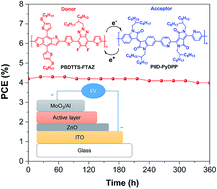
High-photovoltage all-PSCs with good stability were realized by using a new polymer acceptor based on diketopyrrolopyrrole-isoindigo.
The content of this RSS Feed (c) The Royal Society of Chemistry
15 Dec 01:13
by Mingxing Li, Ling Li, Rupam Mukherjee, Kai Wang, Qing Liu, Qiang Zou, Hengxing Xu, Jeremy Tisdale, Zheng Gai, Ilia N. Ivanov, David Mandrus, Bin Hu

The spin on a ferromagnetic Co surface can interact with the asymmetric orbital on an organometal halide perovskite surface, leading to an anisotropic magnetodielectric effect. This study presents an opportunity to integrate ferromagnetic and semiconducting properties through the Rasbha effect for achieving spin-dependent electronic functionalities based on thin-film design.
15 Dec 01:10
by Yuwei Duan, Xiaopeng Xu, He Yan, Wenlin Wu, Zuojia Li, Qiang Peng

A novel-small molecular acceptor with electron-deficient 1,3,5-triazine as the core and perylene diimides as the arms is developed as the acceptor material for efficient bulk heterojunction organic solar cells with an efficiency of 9.15%.
15 Dec 01:10
by Yuze Lin, Liang Shen, Jun Dai, Yehao Deng, Yang Wu, Yang Bai, Xiaopeng Zheng, Jiayu Wang, Yanjun Fang, Haotong Wei, Wei Ma, Xiao Cheng Zeng, Xiaowei Zhan, Jinsong Huang

A π-conjugated Lewis base is introduced into perovskite solar cells, namely, indacenodithiophene end-capped with 1.1-dicyanomethylene-3-indanone (IDIC), as a multifunctional interlayer, which combines efficient trap-passivation and electron-extraction. Perovskite solar cells with IDIC layers yield higher photovoltages and photocurrents, and 45% enhanced efficiency compared with control devices without IDIC.
15 Dec 01:05
by Shangshang Chen, Guangye Zhang, Jing Liu, Huatong Yao, Jianquan Zhang, Tingxuan Ma, Zhengke Li, He Yan

The first homo-tandem non-fullerene organic solar cell enabled by a novel recombination layer which only requires a very mild thermal annealing treatment is reported. The best efficiency achieved is 10.8% with a Voc over 2.1 V, which is the highest Voc for double-junction organic solar cells reported to date.
15 Dec 01:05
by Young Bum Lee, Jin Kyu Han, Suttinart Noothongkaew, Seong Ku Kim, Wooseok Song, Sung Myung, Sun Sook Lee, Jongsun Lim, Sang Don Bu, Ki-Seok An

New fiber-type piezoelectric nanogenerator devices consisting of radially aligned perovskite PbTiO3 nanotubes are designed for energy harvesting from arbitrary mechanical motion. The free-standing fiber-type nanogenerators generate constant amount of electric power by bending or wind motion regardless of direction, thus, extending the possibility of their practical applications.
15 Dec 01:04
by Soyeon Kim, Bernardi Sanyoto, Won-Tae Park, Seyul Kim, Saumen Mandal, Jong-Choo Lim, Yong-Young Noh, Jung-Hyun Kim

On page 10149, a simple and mass-scalable method, ultrafiltration, is proposed for achieving high-conductivity poly(3,4-ethylenedioxythiophene) (PEDOT): poly(4-styrenesulfonate) (PEDOT:PSS) by Y.-Y. Noh, J.-H. Kim, and co-workers. By effectively removing excess PSS and various reaction impurities using repeated 100 nm-poremembrane filtration, the purified PEDOT:PSS shows impressive conductivity and sheet resistance as high as 2000 S cm−1 and 37.8 ± 4.5 Ω□−1, respectively.
15 Dec 01:03
by Junhui Wang, Mengyu Yan, Kangning Zhao, Xiaobin Liao, Peiyao Wang, Xuelei Pan, Wei Yang, Liqiang Mai

Hydrogen evolution reaction performance of MoS2 can be enhanced through electric-field-facilitated electron transport. The best catalytic performance of a MoS2 nanosheet can achieve an overpotential of 38 mV (100 mA cm−2) at gate voltage of 5 V, the strategy of utilizing the electric field can be used in other semiconductor materials to improve their electrochemical catalysis for future relevant research.
15 Dec 01:01
Nanoscale, 2016, Accepted Manuscript
DOI: 10.1039/C6NR08347A, Paper
Holly Zarick, Abdelaziz Boulesbaa, Alex Puretzky, Eric M Talbert, Zachary Robert DeBra, Naiya Soetan, David Geohegan, Rizia Bardhan
In this work, we examine the impact of hybrid bimetallic Au/Ag core/shell nanostructures on the carrier dynamics of methylammonium lead tribromide (MAPbBr3) mesoporous perovskite solar cells (PSCs). Plasmon-enhanced PSCs incorporated...
The content of this RSS Feed (c) The Royal Society of Chemistry

05 Dec 01:14
by Paul Gratia, Giulia Grancini, Jean-Nicolas Audinot, Xavier Jeanbourquin, Edoardo Mosconi, Iwan Zimmermann, David Dowsett, Yonghui Lee, Michael Grätzel, Filippo De Angelis, Kevin Sivula, Tom Wirtz and Mohammad Khaja Nazeeruddin

Journal of the American Chemical Society
DOI: 10.1021/jacs.6b10049

05 Dec 01:09
J. Mater. Chem. A, 2016, Accepted Manuscript
DOI: 10.1039/C6TA09408B, Paper
Virginia Virginia Cuesta, Maida Vartanian, Pilar de la Cruz, Rahui Singhai, Ganesh D Sharma, Fernando Langa
The synthesis of two symmetrical molecules with A-D-A (1) and D-A-D (2) structures is reported. The compounds have Zn-porphyrin as the donor component and 3,6-di(thiophen-2-yl)pyrrolo[3,4-c]pyrrole-1,4-dione (DT-DPP) as the acceptor unit...
The content of this RSS Feed (c) The Royal Society of Chemistry
05 Dec 00:57
J. Mater. Chem. A, 2016, Accepted Manuscript
DOI: 10.1039/C6TA09173C, Communication
Jie Li, Fuwen Zhao, Taishan Wang, Nieming zhe, Jiang-Jun Li, Zhixiang Wei, Jiang Li, Chun-Ru Wang
Ethylenediamine (EDA) functionalized fullerene nanoparticles as independent electron transport layers (ETLs) for inverted polymer solar cells, exibited high electronic conductivity and low work function. Compared with ZnO, the power conversion...
The content of this RSS Feed (c) The Royal Society of Chemistry
05 Dec 00:56
J. Mater. Chem. A, 2016, Accepted Manuscript
DOI: 10.1039/C6TA08812K, Communication
Chongwu Wang, Shuang Yang, Chen Xiao, Tianyu Wen, Huagui Yang
Organometal halide perovskite has attracted intensive research interest for its inestimable potential in solar energy conversion. In this work, rationally designed perovskite film with surface functionaliztion and ultrathin Ni proactive...
The content of this RSS Feed (c) The Royal Society of Chemistry
05 Dec 00:53
J. Mater. Chem. A, 2017, 5,384-396
DOI: 10.1039/C6TA07685H, Paper
P. Karthik, R. Vinoth, P. Selvam, E. Balaraman, M. Navaneethan, Y. Hayakawa, B. Neppolian
Designing new materials for sustainable energy and environmental applications is one of the prime focuses in chemical science.
The content of this RSS Feed (c) The Royal Society of Chemistry
02 Dec 01:39
J. Mater. Chem. A, 2017, 5,79-86
DOI: 10.1039/C6TA08565B, Communication
Eun Joo Yeom, Seong Sik Shin, Woon Seok Yang, Seon Joo Lee, Wenping Yin, Dasom Kim, Jun Hong Noh, Tae Kyu Ahn, Sang Il Seok
We synthesized single-crystalline Sn-based oxides for use as electron-transporting layers (ETLs) in perovskite solar cells (PSCs).
The content of this RSS Feed (c) The Royal Society of Chemistry
02 Dec 01:38
J. Mater. Chem. A, 2017, 5,3812-3818
DOI: 10.1039/C6TA09020F, Paper
Seulki Song, Maximilian T. Horantner, Kyoungwon Choi, Henry J. Snaith, Taiho Park
We introduce a pin-hole free CH3NH3PbI3-xClx perovskite layer by using heated airflow during the nucleation stage. We control the nucleation stage which gives a pin-hole free planar perovskite with large grains, resulting in a maximum power point (MPP) efficiency of 14.3% and a high efficiency of 19.0% with reproducibility.
The content of this RSS Feed (c) The Royal Society of Chemistry
02 Dec 01:33
J. Mater. Chem. A, 2016, Accepted Manuscript
DOI: 10.1039/C6TA09687E, Paper
Teng Zhang, Xiangyue Meng, Yang Bai, Shuang xiao, Chen Hu, Ying-Long Yang, Haining Chen, Shihe Yang
The operational stability is one of the main obstacles that may hold back the commercialization of perovskite solar cells (PVSCs). In this paper, we provide a detailed account for the...
The content of this RSS Feed (c) The Royal Society of Chemistry