09 Feb 08:54
by Xiaodong Ren, Dong Yang, Zhou Yang, Jiangshan Feng, Xuejie Zhu, Jinzhi Niu, Yucheng Liu, Wangen Zhao and Shengzhong Frank Liu

ACS Applied Materials & Interfaces
DOI: 10.1021/acsami.6b13362

09 Feb 08:49
by Jing Chen, Jia Xu, Li Xiao, Bing Zhang, Songyuan Dai and Jianxi Yao

ACS Applied Materials & Interfaces
DOI: 10.1021/acsami.6b13410

09 Feb 08:48
by Yu-Hsien Chiang, Ming-Hsien Li, Hsin-Min Cheng, Po-Shen Shen and Peter Chen

ACS Applied Materials & Interfaces
DOI: 10.1021/acsami.6b13206

09 Feb 08:46
by Tao Ye, Miloš Petrović, Shengjie Peng, Jeremy Lee Kong Yoong, Chellappan Vijila and Seeram Ramakrishna

ACS Applied Materials & Interfaces
DOI: 10.1021/acsami.6b12845

09 Feb 08:44
by Mario Alejandro Mejía Escobar, Sandeep Pathak, Jiewei Liu, Henry J. Snaith and Franklin Jaramillo

ACS Applied Materials & Interfaces
DOI: 10.1021/acsami.6b12509

09 Feb 08:44
by Eric Singh, Ki Seok Kim, Geun Young Yeom and Hari Singh Nalwa

ACS Applied Materials & Interfaces
DOI: 10.1021/acsami.6b13582

09 Feb 08:42
by Yan Busby, Emil J. W. List-Kratochvil and Jean-Jacques Pireaux

ACS Applied Materials & Interfaces
DOI: 10.1021/acsami.6b14758

09 Feb 08:38
by Shuai Guo, Weijia Wang, Eva M. Herzig, Anna Naumann, Gregory Tainter, Jan Perlich and Peter Müller-Buschbaum

ACS Applied Materials & Interfaces
DOI: 10.1021/acsami.6b14926

09 Feb 08:08
by Gan Jin, Haotong Wei, Zhongkai Cheng, Henan Sun, Haizhu Sun and Bai Yang

The Journal of Physical Chemistry C
DOI: 10.1021/acs.jpcc.6b07171

09 Feb 08:07
by Hang Yin, Yun Geng, Guang-Yan Sun and Zhong-Min Su

The Journal of Physical Chemistry C
DOI: 10.1021/acs.jpcc.6b12174

09 Feb 08:06
by Mary Allison Kelly, Steffen Roland, Qianqian Zhang, Youngmin Lee, Bernd Kabius, Qing Wang, Enrique D. Gomez, Dieter Neher and Wei You

The Journal of Physical Chemistry C
DOI: 10.1021/acs.jpcc.6b10993

09 Feb 08:02
by Sujin Ham, Yung Ji Choi, Jin-Wook Lee, Nam-Gyu Park and Dongho Kim

The Journal of Physical Chemistry C
DOI: 10.1021/acs.jpcc.6b11984

09 Feb 07:05
J. Mater. Chem. A, 2017, 5,2774-2783
DOI: 10.1039/C6TA10319G, Paper
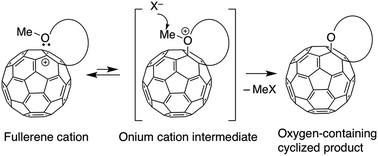
Yutaka Matsuo, Keisuke Ogumi, Ying Zhang, Hiroshi Okada, Takafumi Nakagawa, Hiroshi Ueno, Akiko Gocho, Eiichi Nakamura
Fullerene cations undergo demethylative cyclization through onium intermediates to give cyclo[60]fullerene derivatives for organic solar cell application.
The content of this RSS Feed (c) The Royal Society of Chemistry
09 Feb 07:04
J. Mater. Chem. A, 2017, 5,3186-3192
DOI: 10.1039/C6TA10106B, Communication
Lin Mao, Jinhui Tong, Sixing Xiong, Fangyuan Jiang, Fei Qin, Wei Meng, Bangwu Luo, Yun Liu, Zaifang Li, Youyu Jiang, Canek Fuentes-Hernandez, Bernard Kippelen, Yinhua Zhou
Tandem structures have higher defect tolerance than single-junction. 10.5 cm2 flexible tandem solar cells yielding a PCE of 6.5%.
The content of this RSS Feed (c) The Royal Society of Chemistry
09 Feb 07:03
J. Mater. Chem. A, 2017, 5,3193-3202
DOI: 10.1039/C6TA09554B, Communication
Yingdong Xia, Chenxin Ran, Yonghua Chen, Qi Li, Naisheng Jiang, Changzhi Li, Yufeng Pan, Taotao Li, JianPu Wang, Wei Huang
The management of perovskite intermediates to construct perovskite films with uniform perovskite crystals and controlled surface morphology was introduced.
The content of this RSS Feed (c) The Royal Society of Chemistry
Lucy and -1 others like this
09 Feb 06:59
J. Mater. Chem. A, 2017, 5,2920-2928
DOI: 10.1039/C6TA08426E, Paper
Jie Ge, Corey R. Grice, Yanfa Yan
p-Type wide-bandgap Cu2BaSnS4 holds promise for use as hole transport material in inverted perovskite CH3NH3PbI3 thin-film solar cells.
The content of this RSS Feed (c) The Royal Society of Chemistry
Lucy and -1 others like this
09 Feb 06:56
J. Mater. Chem. A, 2017, 5,1374-1379
DOI: 10.1039/C6TA08117G, Communication
Yue Sun, Yihui Wu, Xiang Fang, Linjun Xu, Zhijie Ma, Yongting Lu, Wen-Hua Zhang, Qiang Yu, Ningyi Yuan, Jiangning Ding
Perovskite solar cells with superior tolerance to humidity (85-95% RH) and long-term stability have been achieved via adding a certain amount of a cost-effective and available water soluble additive, polyvinyl alcohol (PVA).
The content of this RSS Feed (c) The Royal Society of Chemistry
09 Feb 03:20
J. Mater. Chem. A, 2017, 5,3203-3207
DOI: 10.1039/C6TA10727C, Communication
David Forgacs, Daniel Perez-del-Rey, Jorge Avila, Cristina Momblona, Lidon Gil-Escrig, Benedikt Danekamp, Michele Sessolo, Henk J. Bolink
We study the properties of the series of compounds Cs0.15FA0.85Pb(BrxI1-x)3, aiming to develop an efficient complementary absorber for MAPbI3 in all-perovskite tandems. A bromide content of 0.7 leads to a band gap of 2 eV and a maximum PCE of 11.5% in solar cells, among the highest reported for band gaps wider than 1.8 eV.
The content of this RSS Feed (c) The Royal Society of Chemistry
09 Feb 03:19
J. Mater. Chem. A, 2017, 5,3214-3220
DOI: 10.1039/C7TA00562H, Communication
Alexander R. Uhl, Zhibin Yang, Alex K.-Y. Jen, Hugh W. Hillhouse
Low-bandgap chalcopyrite absorbers exhibit excellent low-light performance and current matching to best performing semi-transparent perovskite cells enabling new record efficiencies for solution-processed tandem devices.
The content of this RSS Feed (c) The Royal Society of Chemistry
08 Feb 03:22
Nanoscale, 2017, 9,2875-2882
DOI: 10.1039/C6NR09769C, Paper
Qingchen Dong, Feifei Tai, Hong Lian, Bo Zhao, Zheng Zhong, Zheng Chen, Jianxin Tang, Furong Zhu
Light extraction in OLEDs is significantly enhanced using composite hole transport layers with surface carbon-coated magnetic NPs. Light-scattering, localized surface plasmon resonance and increased electron trap density induced by magnetic alloy NPs contribute to the efficiency enhancement.
The content of this RSS Feed (c) The Royal Society of Chemistry

08 Feb 03:18
Nanoscale, 2017, 9,3095-3104
DOI: 10.1039/C6NR09032J, Paper
Sawanta S. Mali, Chang Kook Hong, A. I. Inamdar, Hyunsik Im, Sang Eun Shim
A room-temperature sputtered highly uniform and compact TiO2 layer was deposited on flexible conducting substrates and used as electron transporting layer (ETL) in flexible perovskite solar cells.
The content of this RSS Feed (c) The Royal Society of Chemistry

08 Feb 03:09
Energy Environ. Sci., 2017, 10,546-551
DOI: 10.1039/C6EE03489F, Communication
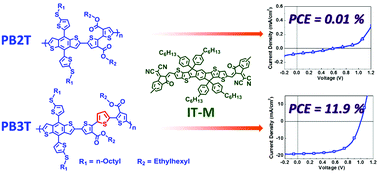
Delong Liu, Bei Yang, Bomee Jang, Bowei Xu, Shaoqing Zhang, Chang He, Han Young Woo, Jianhui Hou
Two wide band gap polymer donors were developed for fullerene-free polymer solar cells. The photovoltaic performance of the PB3T:IT-M device processed by anisole achieved a high PCE of 11.9%.
The content of this RSS Feed (c) The Royal Society of Chemistry

08 Feb 03:07
by Dirk Raiser, Stephanie Mildner, Benedikt Ifland, Mohsen Sotoudeh, Peter Blöchl, Simone Techert, Christian Jooss
Understanding and controlling the relaxation process of optically excited charge carriers in solids with strong correlations is of great interest in the quest for new strategies to exploit solar energy. Usually, optically excited electrons in a solid thermalize rapidly on a femtosecond to picosecond timescale due to interactions with other electrons and phonons. New mechanisms to slow down thermalization will thus be of great significance for efficient light energy conversion, e.g., in photovoltaic devices. Ultrafast optical pump–probe experiments in the manganite Pr0.65Ca0.35MnO3, a photovoltaic, thermoelectric, and electrocatalytic material with strong polaronic correlations, reveal an ultraslow recombination dynamics on a nanosecond-time scale. The nature of long living excitations is further elucidated by photovoltaic measurements, showing the presence of photodiffusion of excited electron–hole polaron pairs. Theoretical considerations suggest that the excited charge carriers are trapped in a hot polaron state. Escape from this state is possible via a slow dipole-forbidden recombination process or via rare thermal fluctuations toward a conical intersection followed by a radiation-less decay. The strong correlation between the excited polaron and the octahedral dynamics of its environment appears to be substantial for stabilizing the hot polaron.

Ultrafast optical pump–probe experiments in the manganite Pr0.65Ca0.35MnO3 reveal a hot polaron state with ultraslow recombination dynamics on a nanosecond time scale in the charge-ordered phase. This long living excitation gives rise to a pronounced photovoltaic effect in heterojunctions. The strong correlation between excited polarons and cooperative octahedral dynamics appears to be substantial for stabilizing the hot polaron.
08 Feb 02:59
by Jian Mao, Wei E. I. Sha, Hong Zhang, Xingang Ren, Jiaqing Zhuang, Vellaisamy A. L. Roy, Kam Sing Wong, Wallace C. H. Choy
While indirectly patterned organic–inorganic hybrid perovskite nanostructures have been extensively studied for use in perovskite optoelectronic devices, it is still challenging to directly pattern perovskite thin films because perovskite is very sensitive to polar solvents and high-temperature environments. Here, a simple and low-cost approach is proposed to directly pattern perovskite solid-state films into periodic nanostructures. The approach is basically perovskite recrystallization through phase transformation with the presence of a periodic mold on an as-prepared solid-state perovskite film. Interestingly, this study simultaneously achieves not only periodically patterned perovskite nanostructures but also better crystallized perovskites and improved optical properties, as compared to its thin film counterpart. The improved optical properties can be attributed to the light extraction and increased spontaneous emission rate of perovskite gratings. By fabricating light-emitting diodes using the periodic perovskite nanostructure as the emission layers, approximately twofold higher radiance and lower threshold than the reference planar devices are achieved. This work opens up a new and simple way to fabricate highly crystalline and large-area perovskite periodic nanostructures for low-cost production of high-performance optoelectronic devices.

A new and simple direct nanopatterning approach for fabricating highly crystalline and large-area periodic perovskite nanostructures is proposed. This approach is suitable for preparing perovskite nanostructures with different configurations. More importantly, the prepared periodic perovskite nanostructures can be fabricated into different optoelectronic devices, such as solar cells, light-emitting diodes, laser diodes, and photodetectors.
08 Feb 02:53
by Taisuke Matsui, Ji-Youn Seo, Michael Saliba, Shaik M. Zakeeruddin, Michael Grätzel

A room-temperature perovskite material yielding a power conversion efficiency of 18.1% (stabilized at 17.7%) is demonstrated by judicious selection of cations. Both cesium and methylammonium are necessary for room-temperature formamidinium-based perovskite to obtain the photoactive crystalline perovskite phase and high-quality crystals. This room-temperature-made perovskite material shows great potential for low-cost, large-scale manufacturing such as roll-to-roll processing.
08 Feb 02:53
by Chien-Yu Chen, Hung-Yu Lin, Kai-Ming Chiang, Wei-Lun Tsai, Yu-Ching Huang, Cheng-Si Tsao, Hao-Wu Lin

Vacuum-sublimed inorganic cesium lead halide perovskite thin films are prepared and integrated in all-vacuum-deposited solar cells. Special care is taken to determine the stoichiometric balance of the sublimation precursors, which has great influence on the device performance. The mixed halide devices exhibit exceptional stabilized power conversion efficiency (11.8%) and promising thermal and long-term stabilities.
08 Feb 02:51
by Saidur R. Bakaul, Claudy R. Serrao, Oukjae Lee, Zhongyuan Lu, Ajay Yadav, Carlo Carraro, Roya Maboudian, Ramamoorthy Ramesh, Sayeef Salahuddin

Single-crystal perovskite ferroelectric material is integrated at room temperature on a flexible substrate by the layer transfer technique. Two terminal memory devices fabricated with these materials exhibit faster switching speed, lower operating voltage, and superior endurance than other existing flexible counterparts. The research provides an avenue toward combining the rich functionality of charge and spin states, offered by the general class of complex oxides, onto a flexible platform.
08 Feb 02:49
by Chen Tao, Jeroen Van Der Velden, Lydia Cabau, Nuria F. Montcada, Stefanie Neutzner, Ajay Ram Srimath Kandada, Sergio Marras, Luigi Brambilla, Matteo Tommasini, Weidong Xu, Roberto Sorrentino, Andrea Perinot, Mario Caironi, Chiara Bertarelli, Emilio Palomares, Annamaria Petrozza

Fully solution-processed direct perovskite solar cells with a planar junction are realized by incorporating a cross-linked [6,6]-phenyl-C61-butyric styryl dendron ester layer as an electron extracting layer. Power conversion efficiencies close to 19% and an open-circuit voltage exceeding 1.1 V with negligible hysteresis are delivered. A perovskite film with superb optoelectronic qualities is grown, which reduces carrier recombination losses and hence increases V
oc.
08 Feb 02:49
by Xianxiong He, Peng Liu, Haihua Zhang, Qing Liao, Jiannian Yao, Hongbing Fu

A polydimethylsiloxane cylindrical-hole-template-confined solution-growth method is developed to fabricate densely packed CsPbCl3−
x
Br
x
microdisk laser arrays. Furthermore, a strategy to integrate multicolored microdisk laser (MDL) arrays is demonstrated that simultaneously lase in the deep blue, blue, cyan, and green by means of gas-phase replacement of Cl by Br from initial CsPbCl3 MDLs in HBr vapor.
08 Feb 02:47
by Hong-Kyu Seo, Hobeom Kim, Jaeho Lee, Min-Ho Park, Su-Hun Jeong, Young-Hoon Kim, Sung-Joo Kwon, Tae-Hee Han, Seunghyup Yoo, Tae-Woo Lee

Highly efficient organic/inorganic hybrid perovskite light-emitting diodes (PeLEDs) based on graphene anode are developed for the first time. Chemically inert graphene avoids quenching of excitons by diffused metal atom species from indium tin oxide. The flexible PeLEDs with graphene anode on plastic substrate show good bending stability; they provide an alternative and reliable flexible electrode for highly efficient flexible PeLEDs.