15 Feb 06:55
by Jae Keun Nam, Sung Uk Chai, Wonhee Cha, Yung Ji Choi, Wanjung Kim, Myung Sun Jung, Jeong Kwon, Dongho Kim and Jong Hyeok Park

Nano Letters
DOI: 10.1021/acs.nanolett.7b00050

15 Feb 06:55
by Smritakshi P. Sarmah, Victor M. Burlakov, Emre Yengel, Banavoth Murali, Erkki Alarousu, Ahmed M. El-Zohry, Chen Yang, Mohd S. Alias, Ayan A. Zhumekenov, Makhsud I. Saidaminov, Namchul Cho, Nimer Wehbe, Somak Mitra, Idris Ajia, Sukumar Dey, Ahmed E. Mansour, Maged Abdelsamie, Aram Amassian, Iman S. Roqan, Boon S. Ooi, Alain Goriely, Osman M. Bakr and Omar F. Mohammed

Nano Letters
DOI: 10.1021/acs.nanolett.7b00031

15 Feb 01:19
Nanoscale, 2017, 9,3222-3230
DOI: 10.1039/C7NR00355B, Paper
K. Galkowski, A. A. Mitioglu, A. Surrente, Z. Yang, D. K. Maude, P. Kossacki, G. E. Eperon, J. T.-W. Wang, H. J. Snaith, P. Plochocka, R. J. Nicholas
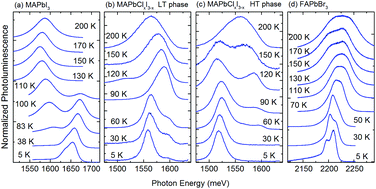
Local photoluminescence measurements of organic-inorganic tri-halide perovskites show a temperature dependent crystal domain structure closely related to device performance.
The content of this RSS Feed (c) The Royal Society of Chemistry

15 Feb 01:18
by Wei Chen, Leiming Xu, Xiyuan Feng, Jiansheng Jie, Zhubing He

A series of metal acetylacetonates produced by a full low-temperature (below 100 °C) process are successfully employed to obtain both “multistable” and high-performance planar-inverted perovskite solar cells. All the three kinds of champion cells in small area exhibit over 18% in conversion-efficiency with negligible hysteresis, along with a conversion efficiency above 16% for planar PSCs in an aperture area of over 1 cm2.
14 Feb 03:19
by Tomoyuki Hata, Giacomo Giorgi, Koichi Yamashita, Claudia Caddeo and Alessandro Mattoni

The Journal of Physical Chemistry C
DOI: 10.1021/acs.jpcc.6b11298

14 Feb 02:08
Nanoscale, 2017, 9,3747-3751
DOI: 10.1039/C6NR06740A, Communication
Suh-Ciuan Lim, Hsuan-Peng Lin, Wei-Lun Tsai, Hao-Wu Lin, Yao-Tsung Hsu, Hsing-Yu Tuan
A variety of crystalline colloid binary halide, ternary perovskite-like and ternary perovskite-derivative nanostructures with well-defined morphologies were synthesized.
The content of this RSS Feed (c) The Royal Society of Chemistry

14 Feb 02:06
J. Mater. Chem. A, 2017, 5,6840-6848
DOI: 10.1039/C7TA00027H, Paper
Bin Ding, Yan Li, Shi-Yu Huang, Qian-Qian Chu, Cheng-Xin Li, Chang-Jiu Li, Guan-Jun Yang
Decreasing the crystal growth time and increasing the number of nuclei produced high quality perovskite films toward large-area high-efficiency perovskite solar cells.
The content of this RSS Feed (c) The Royal Society of Chemistry
14 Feb 02:05
J. Mater. Chem. A, 2017, 5,5449-5459
DOI: 10.1039/C6TA10978K, Paper
Han-Hee Cho, Taesu Kim, Kimyung Kim, Changyeon Lee, Felix Sunjoo Kim, Bumjoon J. Kim
We designed and synthesized a series of n-type conjugated polymers by introducing phenylnaphthalenediimide (PNDI) as a novel n-type building block, and investigated the effect of side-chain engineering in the polymer acceptor on the performance of all-polymer solar cells (all-PSCs).
The content of this RSS Feed (c) The Royal Society of Chemistry
14 Feb 02:04
by Saeed Shahbazi, Cheng-Min Tsai, Sudhakar Narra, Chi-Yung Wang, Hau-Shiang Shiu, Shahrara Afshar, Nima Taghavinia and Eric Wei-Guang Diau

The Journal of Physical Chemistry C
DOI: 10.1021/acs.jpcc.6b09722

14 Feb 02:00
by Run Long, Wei-Hai Fang and Oleg V. Prezhdo

The Journal of Physical Chemistry C
DOI: 10.1021/acs.jpcc.6b12921

13 Feb 06:11
Publication date: May 2017
Source:Solar Energy Materials and Solar Cells, Volume 164
Author(s): Jung-Yao Chen, Chu-Chen Chueh, Zonglong Zhu, Wen-Chang Chen, Alex K.-Y. Jen
Tin oxide (SnO2) has recently attracted significant research interest for its role functioning as an efficient electron-transporting layer (ETL) due to its higher charge mobility than the commonly used titanium oxide (TiO2) for realizing high-performance perovskite solar cells (PVSCs). However, it is still challenging to develop a facile, low-temperature solution-based (<100
oC) processing method to synthesize crystalline SnO2 with desirable charge mobility, which can facilitate its widespread applications in flexible optoelectronic devices. In this work, we utilize an electrochemical deposition technique to prepare SnO2 films at a reduced temperature below 100
oC. The electrodeposition endows the SnO2 film with high crystallinity and conductivity in addition to high transparency across the visible spectrum. Efficient photoluminescence (PL) quenching is observed in the bi-layered SnO2/CH3NH3PbI3 film, manifesting its efficient electron extraction capability from perovskite. Consequently, a conventional n-i-p PVSC using this electrodeposited SnO2 ETL shows a high PCE of 13.88% with negligible hysteresis. This work demonstrates a low-temperature solution-based preparation route for making crystalline SnO2 and its potential for application in large-scale PVSC production.
Graphical abstract

11 Feb 01:29
by Xin-Gang Zhao, Ji-Hui Yang, Yuhao Fu, Dongwen Yang, Qiaoling Xu, Liping Yu, Su-Huai Wei and Lijun Zhang

Journal of the American Chemical Society
DOI: 10.1021/jacs.6b09645

11 Feb 01:24
by Wenfei Shen, Jianguo Tang, Yao Wang, Jixian Liu, Linjun Huang, Weichao Chen, Lanlan Yang, Wei Wang, Yanxin Wang, Renqiang Yang, Jungheum Yun and Laurence A. Belfiore

ACS Applied Materials & Interfaces
DOI: 10.1021/acsami.6b13671

11 Feb 01:22
by Kai Wang, Zhan Zhang, Chang Liu, Qiang Fu, Wenzhan Xu, Chongwen Huang, R. A. Weiss and Xiong Gong

ACS Applied Materials & Interfaces
DOI: 10.1021/acsami.6b13642

11 Feb 01:13
by Youzhen Li, Xuemei Xu, Congcong Wang, Ben Ecker, Junliang Yang, Jinsong Huang and Yongli Gao

The Journal of Physical Chemistry C
DOI: 10.1021/acs.jpcc.6b11853

11 Feb 01:12
Energy Environ. Sci., 2017, 10,710-727
DOI: 10.1039/C6EE03397K, Review Article
Juan-Pablo Correa-Baena, Antonio Abate, Michael Saliba, Wolfgang Tress, T. Jesper Jacobsson, Michael Gratzel, Anders Hagfeldt
The latest developments in the efficiency and long-term stability of perovskite solar cells are summarized.
The content of this RSS Feed (c) The Royal Society of Chemistry

11 Feb 01:11
J. Mater. Chem. A, 2017, 5,5709-5718
DOI: 10.1039/C6TA09922J, Paper
Mikas Remeika, Sonia Ruiz Raga, Shijin Zhang, Yabing Qi
Viability of ultrasonic spray coating as a pathway to scaling-up of perovskite solar cell production is improved by quantitative characterization of process conditions.
The content of this RSS Feed (c) The Royal Society of Chemistry
11 Feb 01:09
J. Mater. Chem. A, 2017, 5,4756-4773
DOI: 10.1039/C6TA10305G, Review Article
Ziran Zhao, Weihai Sun, Yunlong Li, Senyun Ye, Haixia Rao, Feidan Gu, Zhiwei Liu, Zuqiang Bian, Chunhui Huang
Organo-metal halide perovskite solar cells have shown great potential for application in photovoltaics with their high power conversion efficiency.
The content of this RSS Feed (c) The Royal Society of Chemistry
11 Feb 01:06
by Shuang Xiao, Yang Bai, Xiangyue Meng, Teng Zhang, Haining Chen, Xiaoli Zheng, Chen Hu, Yongquan Qu, Shihe Yang
Hybrid organic/inorganic perovskite solar cells (PSCs) have shown great potential in meeting the future challenges in energy and environment. Solvent-vapor-assisted posttreatment strategies are developed to improve the perovskite film quality for achieving higher efficiency. However, the intrinsic working mechanisms of these strategies have not been well understood yet. This study identifies an MA2Pb3I8(DMSO)2 intermediate phase formed during the annealing process of methylammonium lead triiodide in dimethyl sulfoxide (DMSO) atmosphere and located the reaction sites at perovskite grain boundaries by observing and rationalizing the growth of nanorods of the intermediate. This enables us to propose and validate an intermediate-assisted grain-coarsening model, which highlights the activation energy reduction for grain boundary migration. Leveraging this mechanism, this study uses MABr/DMSO mixed vapor to further enhance grain boundary migration kinetics and successfully obtain even larger grains, leading to an impressive improvement in power conversion efficiency (17.64%) relative to the pristine PSCs (15.13%). The revelation of grain boundary migration-assisted grain growth provides a guide for the future development of polycrystalline perovskite thin-film solar cells.

MA2Pb3I8(DMSO)2 intermediate is identified and tracked during the methylammonium lead triiodide thin-film anneal process under dimethyl sulfoxide (DMSO) solvent vapor, which helps to reduce the activation energy of perovskite grain boundary migration. Leveraging this mechanism, an MABr/DMSO mix vapor anneal method is developed to further facillitate grain goundary migration to achieve 17.64% efficiency in NiO-based inverted perovskite solar cell.
09 Feb 08:51
by Guohua Dong, Debin Xia, Yulin Yang, Li Sheng, Tengling Ye and Ruiqing Fan

ACS Applied Materials & Interfaces
DOI: 10.1021/acsami.6b12938

09 Feb 07:28
by Sibel Leblebici, Jiye Lee, Alexander Weber-Bargioni and Biwu Ma

The Journal of Physical Chemistry C
DOI: 10.1021/acs.jpcc.6b12463

09 Feb 01:35
J. Mater. Chem. A, 2017, 5,4404-4412
DOI: 10.1039/C6TA10521A, Paper
E. Mitraka, M. J. Jafari, M. Vagin, X. Liu, M. Fahlman, T. Ederth, M. Berggren, M. P. Jonsson, X. Crispin
Doping of the reduced (undoped) PEDOT by oxygen during oxygen reduction reaction (ORR).
The content of this RSS Feed (c) The Royal Society of Chemistry
09 Feb 01:31
J. Mater. Chem. A, 2017, 5,6817-6824
DOI: 10.1039/C7TA00772H, Communication
Hongkang Wang, Jinkai Wang, Daxian Cao, Hangyu Gu, Beibei Li, Xuan Lu, Xiaogang Han, Andrey L. Rogach, Chunming Niu
Confining smaller and fewer SnO2 nanoparticles within honeycomb-like carbon nanoflakes demonstrated superior cycle stability and rate capability for lithium storage.
The content of this RSS Feed (c) The Royal Society of Chemistry
09 Feb 01:30
J. Mater. Chem. A, 2017, 5,5195-5203
DOI: 10.1039/C6TA11139D, Paper

Open Access
Ngoc Duy Pham, Vincent Tiing Tiong, Peng Chen, Lianzhou Wang, Gregory J. Wilson, John Bell, Hongxia Wang
19% perovskite solar cells with enhanced electronic properties of MAPbI3 film through employing 2.5% PbCl2 additive in the precursor.
The content of this RSS Feed (c) The Royal Society of Chemistry
09 Feb 01:28
by Andrew K. Saydjari, Philipp Weis, Si Wu

Implementation of azobenzene-based solar thermal fuels remains challenging because UV light, a small fraction of the solar spectrum, is required for charging. In article number 1601622, Si Wu and co-workers report a four-layer solar thermal cell that stores both UV and visible light from the sun. This cell achieves a record solar efficiency (0.4%) amongst azobenzene-based solar thermal fuels.
08 Feb 02:56
by Wenhui Wang, Yurong Ma, Limin Qi
The booming development of organometal halide perovskites has prompted the exploration of morphology-engineering strategies to improve their performance in optoelectronic applications. However, the preparation of optoelectronic devices of perovskites with complex architectures and desirable properties is still highly challenging. Herein, novel CH3NH3PbI3 nanonets and nanobowl arrays are fabricated facilely by using monolayer colloidal crystal (MCC) templates on different substrates. Specifically, highly ordered CH3NH3PbI3 nanonets with high crystallinity are fabricated on a variety of flat substrates, whereas regular CH3NH3PbI3 nanobowl arrays are produced on a coarse substrate. The photodetection performance of the CH3NH3PbI3 nanonet-based photodetectors is significantly enhanced compared to the photodetectors based on conventional CH3NH3PbI3 compact films. Particularly, the nanonet photodetectors exhibit a high responsivity (10.33 A W−1 under 700 nm monochromatic light), which is six times higher than that for the compact CH3NH3PbI3 film devices, fast response speed, and good stability. Owing to the two-dimensional arrayed structure, the CH3NH3PbI3 nanonets exhibit an enhanced light harvesting ability and offer direct carrier transport pathways. Meanwhile, the MCC template brings about larger grain sizes with enhanced crystallinity. Furthermore, the perovskite nanonets can be formed on a flexible polyethylene terephthalate substrate for the fabrication of promising flexible nanonet photodetectors.

Highly ordered CH3NH3PbI3 nanonets with high crystallinity are fabricated on a variety of flat substrates through a facile nanosphere lithography approach. When used as a photodetector, the perovskite nanonet exhibits significantly enhanced photoresponsive performance owing to the unique net-like architecture that is beneficial to light harvesting and charge collection.
08 Feb 02:42
by Jing Liu, Heng Zhao, Min Wu, Benoit Van der Schueren, Yu Li, Olivier Deparis, Jinhua Ye, Geoffrey A. Ozin, Tawfique Hasan, Bao-Lian Su
Solar light is widely recognized as one of the most valuable renewable energy sources for the future. However, the development of solar-energy technologies is severely hindered by poor energy-conversion efficiencies due to low optical-absorption coefficients and low quantum-conversion yield of current-generation materials. Huge efforts have been devoted to investigating new strategies to improve the utilization of solar energy. Different chemical and physical strategies have been used to extend the spectral range or increase the conversion efficiency of materials, leading to very promising results. However, these methods have now begun to reach their limits. What is therefore the next big concept that could efficiently be used to enhance light harvesting? Despite its discovery many years ago, with the potential for becoming a powerful tool for enhanced light harvesting, the slow-photon effect, a manifestation of light-propagation control due to photonic structures, has largely been overlooked. This review presents theoretical as well as experimental progress on this effect, revealing that the photoreactivity of materials can be dramatically enhanced by exploiting slow photons. It is predicted that successful implementation of this strategy may open a very promising avenue for a broad spectrum of light-energy-conversion technologies.

Slow photons can dramatically enhance the photoreactivity of semiconducting materials. It is believed that “slow photons” will break new ground to improve light harvesting of various materials for all solar-related applications in the future.
08 Feb 02:41
by Hua Zhang, Huan Wang, Spencer T. Williams, Dehua Xiong, Wenjun Zhang, Chu-Chen Chueh, Wei Chen, Alex K.-Y. Jen
Despite the breakthrough of over 22% power conversion efficiency demonstrated in organic–inorganic hybrid perovskite solar cells (PVSCs), critical concerns pertaining to the instability and toxicity still remain that may potentially hinder their commercialization. In this study, a new chemical approach using environmentally friendly strontium chloride (SrCl2) as a precursor for perovskite preparation is demonstrated to result in enhanced device performance and stability of the derived hole-conductor-free printable mesoscopic PVSCs. The CH3NH3PbI3 perovskite is chemically modified by introducing SrCl2 in the precursor solution. The results from structural, elemental, and morphological analyses show that the incorporation of SrCl2 affords the formation of CH3NH3PbI3(SrCl2)x perovskites endowed with lower defect concentration and better pore filling in the derived mesoscopic PVSCs. The optimized compositional CH3NH3PbI3(SrCl2)0.1 perovskite can substantially enhance the photovoltaic performance of the derived hole-conductor-free device to 15.9%, outperforming the value (13.0%) of the pristine CH3NH3PbI3 device. More importantly, the stability of the device in ambient air under illumination is also improved.

A new compositional perovskite, CH3NH3PbI3(SrCl2)0.1 with more compact morphology and lower defect concentration is presented. Consequently, a power conversion efficiency of 15.9% with enhanced stability is achieved by employing the structure of hole-conductor-free fully printable mesoscopic perovskite solar cell.
08 Feb 01:15
by Jianyu Yuan, Michael J. Ford, Yannan Zhang, Huilong Dong, Zhi Li, Youyong Li, Thuc-Quyen Nguyen, Guillermo C. Bazan and Wanli Ma

Chemistry of Materials
DOI: 10.1021/acs.chemmater.6b05365

08 Feb 01:12
by Tanghong Yi, Wei Chen, Lei Cheng, Ryan D. Bayliss, Feng Lin, Michael R. Plews, Dennis Nordlund, Marca M. Doeff, Kristin A. Persson and Jordi Cabana

Chemistry of Materials
DOI: 10.1021/acs.chemmater.6b04181


   This article is licensed under a Creative Commons Attribution 3.0 Unported Licence.