Shared posts
Michelisz ötödik lett az időmérőn Makaóban

Xeon Phi to Re-launch as Socket 'CPU', Loses GDDR5
Exclusive: Key Industry Insider Jon Carvill Leaves Intel for Qualcomm
Az Oxide Games végre számokban beszélt a Mantle API-ról
Intel to open retail pop-up stores
Mullins may need a mulligan: Here’s a look at Intel’s Cherry Trail-T

Intel’s 14 nm Cherry Trail-T promises higher burst frequency, faster memory interface and support for more RAM. Will it be a Mullins and Beema killer? Just before AMD announced the specs on its upcoming mobile APUs for 2014 — Beema and Mullins — VR-Zone obtained a leaked slide outlining some improvements in Intel’s mobile SoC [...]
The post Mullins may need a mulligan: Here’s a look at Intel’s Cherry Trail-T appeared first on VR-Zone.
Túlmelegszik a Chromebook 11 töltője
Szdani88jo reklám xd
Magyarországra is megérkezett az LG hajlított OLED tévéje
Szdani88kene kettő neked is rendeljek?
NVIDIA Announces CUDA 6: Unified Memory for CUDA
Kicking off next week will be the annual International Conference for High Performance Computing, Networking, Storage, and Analysis, better known as SC. For NVIDIA, next to their annual GPU Technology Conference, SC is their second biggest GPU compute conference, and is typically the venue for NVIDIA’s summer/fall announcements. To that end NVIDIA has a number of announcements lined up for this year, so many in fact that they’re pushing out some of them ahead of the conference just to keep them from being overwhelming. The most important of those announcements in turn will be the announcement of the next version of CUDA, CUDA 6.
Unlike some prior CUDA releases, NVIDIA isn’t touting a large number of new features for this version of CUDA. But what few elements NVIDIA is working on are going to be very significant.
The big news here – and the headlining feature for CUDA 6 – is that NVIDIA has implemented complete unified memory support within CUDA. The toolkit has possessed unified virtual addressing support since CUDA 4, allowing the disparate x86 and GPU memory pools to be addressed together in a single space. But unified virtual addressing only simplified memory management; it did not get rid of the required explicit memory copying and pinning operations necessary to bring over data to the GPU first before the GPU could work on it.
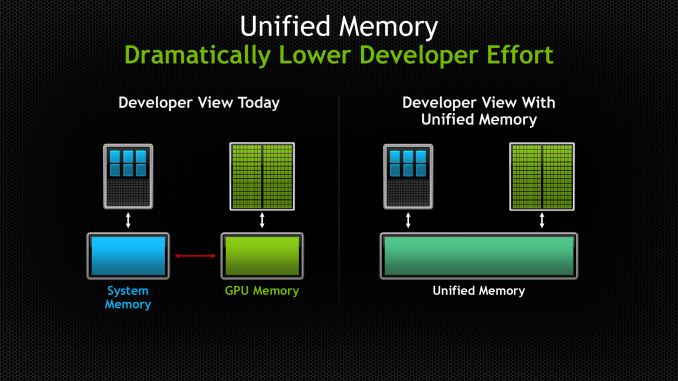
With CUDA 6 NVIDIA has finally taken the next step towards removing those memory copies entirely, by making it possible to abstract the memory management away from the programmer. This is achieved through the CUDA 6 unified memory implementation, which implements a unified memory system on top of the existing memory pool structure. With unified memory, programmers can access any resource or address within the legal address space, regardless of which pool the address actually resides in, and operate on its contents without first explicitly copying the memory over.
Now to be clear here, CUDA 6’s unified memory system doesn’t resolve the technical limitations that require memory copies – specifically, the limited bandwidth and latency of PCIe – rather it’s a change in who’s doing the memory management. Data still needs to be copied to the GPU to be operated upon, but whereas CUDA 5 required explicit memory operations (higher level toolkits built on top of CUDA withstanding) CUDA 6 offers the ability to have CUDA do it instead, freeing the programmer from the task.
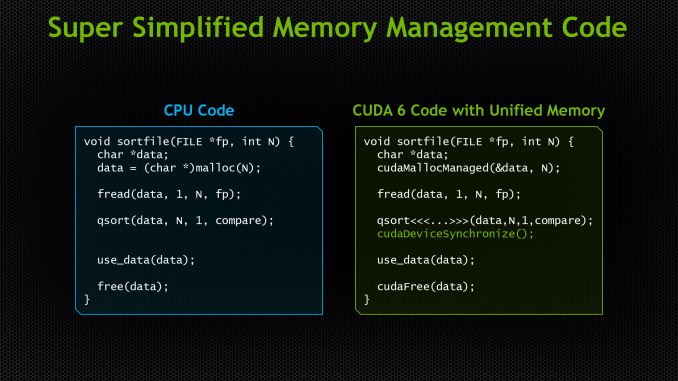
The end result as such isn’t necessarily a shift in what CUDA devices can do or their performance while doing it since the memory copies didn’t go away, but rather it further simplifies CUDA programming by removing the need for programmers to do it themselves. This in turn is intended to make CUDA programming more accessible to wider audiences that may not have been interested in doing their own memory management, or even just freeing up existing CUDA developers from having to do it in the future, speeding up code development.
With that said NVIDIA isn’t talking about the performance impact at this time. Memory abstractions such as these typically have some kind of performance penalty over manual memory management – after all, who knows more about the memory needs of an application than an application itself – but of course manual memory management isn’t going anywhere, as there will still be scenarios where the higher complexity is worth the tradeoff.
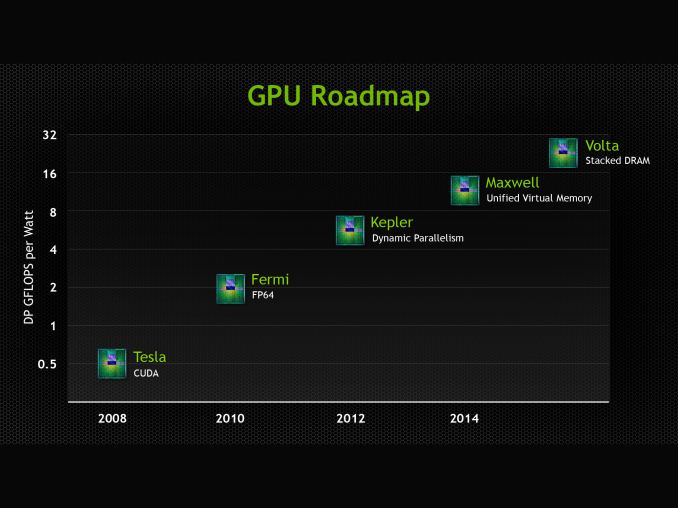
Meanwhile it’s interesting to note that this comes ahead of NVIDIA’s upcoming Maxwell GPU architecture, whose headline feature is also unified memory. From what NVIDIA is telling us they developed the means to offer a unified memory implementation today entirely in software, so they went ahead and developed that ahead of Maxwell’s release. Maxwell will have some kind of hardware functionality for implementing unified memory (and presumably better performance for it), though it’s not something NVIDIA is talking about until Maxwell is ready for its full unveiling. In the interim NVIDIA has laid the groundwork for what Maxwell will bring by getting unified memory into the toolkit before Maxwell even ships.
Moving on, there are a pair of further, smaller additions that will be coming to CUDA with CUDA 6. The first of these is that CUDA 6 will come with new BLAS and FFT libraries that are further tuned for multi-GPU scaling, with these new libraries supporting scaling of up to 8 GPUs in a node. Meanwhile NVIDIA will also be releasing drop-in compatible libraries for BLAS and FFTW, allowing applications that use those libraries to use the GPU accelerated version of their respective routines just by replacing the library.
Wrapping things up, NVIDIA will be showing off CUDA 6 and the rest of their announcement at SC13 next week. Meanwhile we’ll be back on Monday with coverage of the rest of NVIDIA’s SC13 announcements.

    
|
AMD spendiert FirePro S10000 12 GB Speicher
Szdani88aranyos xd
Darabokra szakadhat az internet
NFS Rivals is 1080p on both platforms
Már nem elérhetetlenek a filmekben látott futurisztikus eszközök
Motorola killed mid-range phones with the Moto G
Szdani88kicsit erős cim xd itt pl nem is igen lesz hivatalosan

Mid-range smartphones have always been an odd segment of the mobile landscape. The hardware they offer is never top-notch, their designs can look like bloated mutations of sleeker flagship models, and despite more affordable prices than those higher tier handsets, mid-rangers just haven’t been a great value for your dollar. And then today we get this new Motorola – the Moto G. It doesn’t completely hit the ball out of the park with its hardware, but there are a few stand-out components. The ...
The post Motorola killed mid-range phones with the Moto G appeared first on .
Proper CyanogenMod phone rumored to come with 2.5 GHz quad-core Qualcomm CPU, Nexus-like pricing
Szdani882,5 szép xd
The Oppo N1 may have been touted as the first CyanogenMod phone, but in reality it’s probably more like the first CyanogenMod-friendly device out there. You can easily discard Oppo’s own Color OS based on Android and install CM. And there’s even a CM special edition of the handset, that will get a limited release and will come with the aftermarket software preinstalled.
That’s not bad for a first partnership between a hardware maker (Oppo) and a newly created software company (CM). But things could be better… and if this rumor turns out to have been correct, they will be.
Apparently there’s a ‘proper’ CM phone in development, and it will pair some killer hardware to the ROM a lot of people already know and love. This handset is going to be designed by the CM team (possibly with some help), and it will be built with CM in mind from the beginning.

Furthermore, it will sport a yet-unannounced chipset from Qualcomm, the MSM8974AC Snapdragon 800. Currently the highest-end iteration of that chip is the MSM8974AB, which is going to be seen in the Snapdragon version of the Xiaomi MI3 very soon. This beast will be clocked at 2.5 GHz inside the CM phone.
The upcoming CM phone is said to be the device that Steve Kondik (a.k.a. Cyanogen) always wanted to build, whatever that may mean. Obviously, someone has to actually make the hardware. And Oppo is a good candidate, given the two companies’ good relationship at the moment.
The CM phone will match the LG-made Google Nexus 5 in pricing, and it will sport some new CM features. It’s unclear for now whether these will be exclusive to this device or they’ll make it to other handsets via the CM ROM.
There are no details about when this mythical beast might appear on the market, but given that we’re just first hearing about it today it may still take a while. So don’t expect to grab it for Black Friday or anything like that.
All of the above reportedly comes from reliable sources, or at least people who’ve been reliable in the past. Which means there’s a good chance most of what you read is real. But on the off chance that it isn’t, we hope you’ve been reading this with a grain of salt somewhere in your vicinity.
LG Nexus 5 battery life test
Plusz 3 év kiterjesztett garancia a ZOTAC felhasználók számára

A ZOTAC új bejelentése az európai felhasználóknak, így nekünk, magyaroknak is kifejezetten kedvez. A gyártó a termékeire eddig 24 hónap, azaz két év garanciát vállalt, amely kiterjesztésre került további három év extra garanciával.
A kiterjesztett garancia regisztrációjára 28 nap áll rendelkezésre a felhasználók számára. a ZOTAC Extended Warranty Program segítségével Európában 5 évre nő a teljes jótállási idő, míg Afrikában és Indiában 4 év a vállalt időtartam.
A gyártó videokártyái, alaplapjai és mini számítógépei egyaránt a garancia kiterjesztés hatálya alá esnek, azonban a kiterjesztett garancia nem érvényes ezek kiegészítőire (tápkábel, töltő, távirányító, adapterek), a RAM modulokra, merevlemezekre, SSD-kre és CMOS akkumulátorokra, így tényleg csak magára a ZOTAC hardverre lehet felhasználni a plusz 3 év kiterjesztett garanciát.
Megszabadít a zajos oldalaktól a Chrome
Legyőzhetetlen gépet épít a Lockheed
Chinese clone makers are starting to clone Chinese smartphones. Meet the No.1 M3, a Xiaomi MI3 clone
You know you’ve made it in the mobile world and are a successful company when an obscure Chinese smartphone maker or two start cloning your wares. This has been happening to the likes of Apple, Samsung, and HTC for years, and you may have already gotten used to reading about the latest clones out of China.
This time, however, things are a bit different. See, who would have expected a Chinese clone maker to clone a Chinese smartphone? Yet that’s exactly what has happened to the Xiaomi MI3, that company’s latest flagship offering. Xiaomi has become pretty much a phenomenon in China in its short history, and the phone maker that calls itself No.1 has taken notice.
Hence, the No.1 M3. This is a Xiaomi MI3 clone, and it’s due to be available soon. It’s priced at $199.99, which is around $127 less than the original. Obviously though, aside from the uncanny similarities in terms of looks, you’re getting a different device altogether.

The No.1 M3 comes with a 5-inch 720p HD touchscreen, a 13 MP rear camera, a 5 MP front camera, a 1.5 GHz quad-core MediaTek MT6589T processor, 2 GB of RAM, 32 GB of internal storage space, a microSD card slot, Wi-Fi, 3G, Bluetooth, FM radio, HSPA, dual-SIM support, and a 2,500 mAh battery. It runs Android 4.2 Jelly Bean. Its dimensions are 135x69x8 mm, and it supposedly weighs just 91 grams (though that’s probably a typo). It will be offered in black or yellow.
The specs here aren’t half bad, especially for a clone and for that price. But make no mistake – this is no Xiaomi MI3.
Via GizChina
Hülkenberg visszautasította a Lotus ajánlatát
Szdani88elég hülye

Surface RT 32GB to cost $199 on Black Friday
Szdani88így már nem rossz
Opera 19 Developer is here!
Szdani88Known issues
Mouse gestures do not work properly
Hello from Oslo,
We are ready with the first Opera 19 developer build. Why don’t you give it a go and see if you like it? Your feedback is always appreciated.
There is a new option ‘Advanced settings’ under opera:settings-> Browser. It controls ‘Use hardware acceleration when available (requires Opera restart)’ under System and ‘Disable tab bar’s top spacing when browser window is maximized’ under User Interface.
More options for power-users will be introduced over time.
Have a nice day! 
Highlights
- OS X Mavericks fixes
- Stop Adobe Flash from blocking accented and Cyrillic characters input when executable is called opera.exe
- Ported chrome.proxy API
- Other bugfixes
Known issues
- Mouse gestures do not work properly
- Renderer crash on a polish site (http://www.wykop.pl)
- Facebook is scrolled all the way to the top when click on any picture/video post
- Speed Dial extensions not displaying content
Downloads
Old blog comments
Megtalálták a legrégebbi nagymacskát
Another Xbox One launch title to miss launch
Szdani88hatalmas cim
AMD gibt erste Details zur Mantle-API bekannt
Kipróbáltuk: Leap Motion mozgásérzékelő
Büntet a Sharknado 2 plakátja
Xbox One launch titles download sizes unveiled
Szdani88vannak méretek szépen

Most Xbox One games will take up a large chunk of the system’s hard drive. Were you expecting something else? Remember the days when you can have a full shelf of PSX CDs and not have to worry about running out of hard drive space? Those days are long gone, and (in most cases) these [...]
The post Xbox One launch titles download sizes unveiled appeared first on VR-Zone.