Shared posts

15 Aug 12:16

Hyperloop: Elon Musk publikálta a teleport dokumentációját

by vizzitor

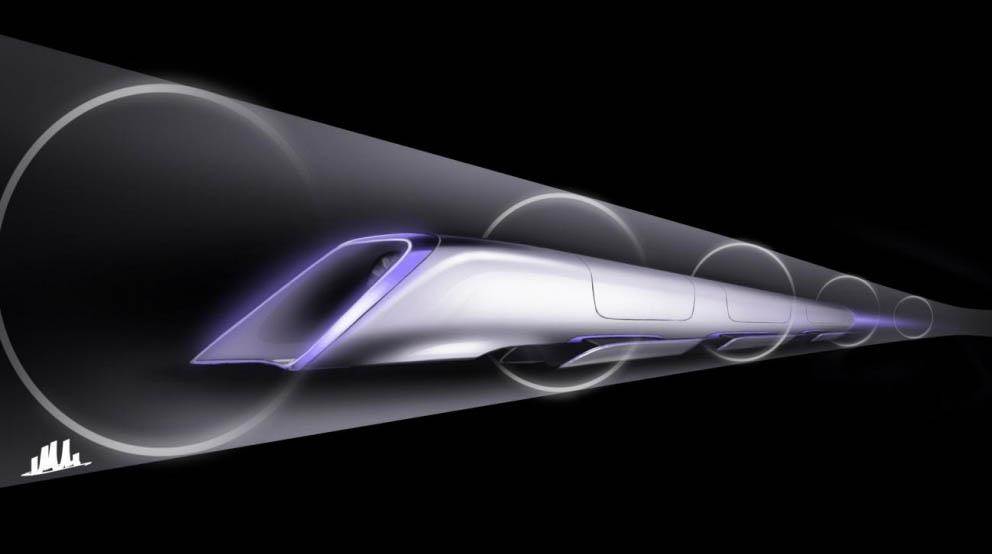
Elon Musk ígéretéhez híven tengerentúli idő szerint hétfő este publikálta a Hyperloopról alkotott eddigi elképzeléseit. A Hyperloop, a középtávolságú közlekedést hivatott forradalmasítani. A koncepció szerint egy csőben, vákuumalagútban száguldó kapszulák 1200 km/h végsebességgel, 30 perc alatt szállítanának utasokat a San Francisco – Los Angeles közötti 600 km-es távon.
elon_musk_hyperloop_01b

A hétfőn publikált dokumentáció ábrákkal, számításokkal, költségvetéssel 57 oldalon foglalja össze Elon Musk eddigi elképzeléseit. Az első 5 oldalon megpróbálja konyhanyelven összefoglalni a koncepció lényegét, majd egy egyébként nem sokkal bonyolultabb, lényegesen részletesebb, technikai jellegű leírás következik, számokkal, az elképzeléseket számításokkal is alátámasztva.

A bevezetőből többek között kiderül az egész projekt indíttatása. Pár éve kiírták a pályázatot a San Francisco – Los Angeles gyorsvasút megtervezésére. A nemrég elfogadott és megvalósítására kiírt terv azonban széleskörű csalódást keltett, ugyanis a Kalifornia gyorsvasút néven emlegetett vonal a megvalósítás km költségét tekintve a világ legdrágább gyorsvasútja lenne, miközben sebességben jóval elmaradna a jelenleg már mindennapi üzemben működő megoldásoktól. Mindössze 264 km/h átlagsebességet és 2ó 38p menetidőt ígér $105-os jegyáron (egy irányba). Repülővel jelenleg $158 egy retúrjegy, míg autóval $115-os benzinköltséggel lehet megfordulni. Elon Musk ezt elfogadhatatlannak tartja. Az általa javasolt Hyperloop 1200 km/h végsebességgel, 30p menetidővel és $20-os (!!!) menetjeggyel számol.
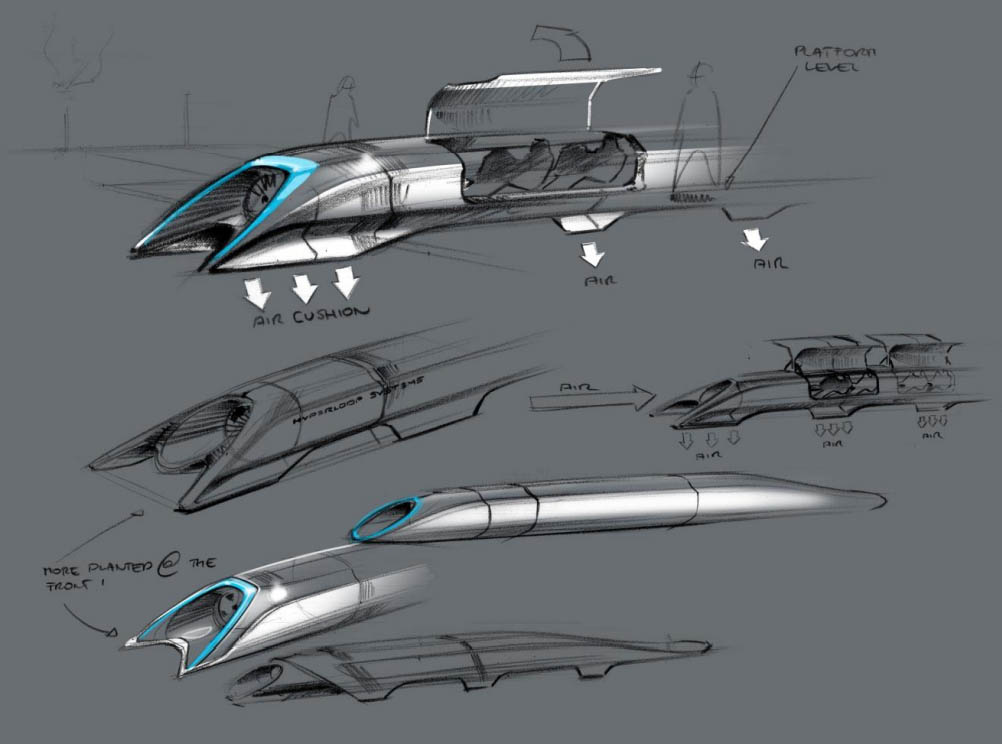
elon_musk_hyperloop_02

A korábbi találgatásokkal szemben pár változás, illetve új infó, megoldandó problémák, ami az 57 oldalas PDF-ből kiderül:

  • max. 1500 km-re lévő nagyvárosok összekötésére lenne ideális (nagyobb távokon a szuperszonikus repülés nyerne)
  • Nem fúrnának 600 km-es alagutat, hanem függővasúthoz hasonlóan 6-30 méter magas oszlopokon haladna végig, mindössze 24,5km fúrt alagútra lenne szükség
  • Teljesen légmentes vákuum alagút kihúzva, pneumatikus alagút kihúzva, egy alacsony légnyomású, légsűrűségű cső ami elképzelhető
  • A Kantrowitz korlát is felvet pár problémát, ha a kapszula szinte kitölti a csövet, akkor tolja maga előtt a levegőt nem lehetséges az elvárt sebességű száguldás, nagy átmérőjű cső építése pedig nem igazán gazdaságos. Elon javaslata kompresszor, ami a kapszula elején beszívja a végén kifújja a levegőt. Ezzel egy másik problémát is megoldana egy csapásra. Ilyen sebességnél kerekeknek nincs értelme, a mágneses lebegtetésű pálya drága, egy speciális légpárna lehet a megoldás.
  • Következő kérdés a meghajtás. A kapszula nem tudna akkora aksit magán cipelni, ami ekkora távon kitartana, javaslat a külső motor, hasonló, amit a Tesla S modellben is használnak, csak kiterítve. Ez adna egy lökést a kapszulának 100 km-ként, azaz mindössze 5-6 db-ra lenne szükség a teljes 600 km-es pályán.
  • 30-120 másodpercenként indulna egy-egy 28 utast szállít kapszula, óránként 840, évente 7,4 millió embert tudna szállítani, becsült megvalósítási költség 6 milliárd dollár, 20 dolláros menetjeggyel 20 éves megtérülés
  • A kapszulák követési távolsága 37 km lenne, csúcsidőben 40 kapszula száguldozna folyamatosan
  • Két típusú kapszula készülhet: egy személyszállító (28 fő) és egy személyek (28 fő) mellett 3 db személyautó szállítására is alkalmas modell
  • A Hyperloop csőben 100 Pa lenne a légnyomás, így a légellenállás az ezrede lenne a tengerszinthez képest, kb. mintha 30.000 méteren repülnénk, a kapszula így közel hangsebességre gyorsulhatna
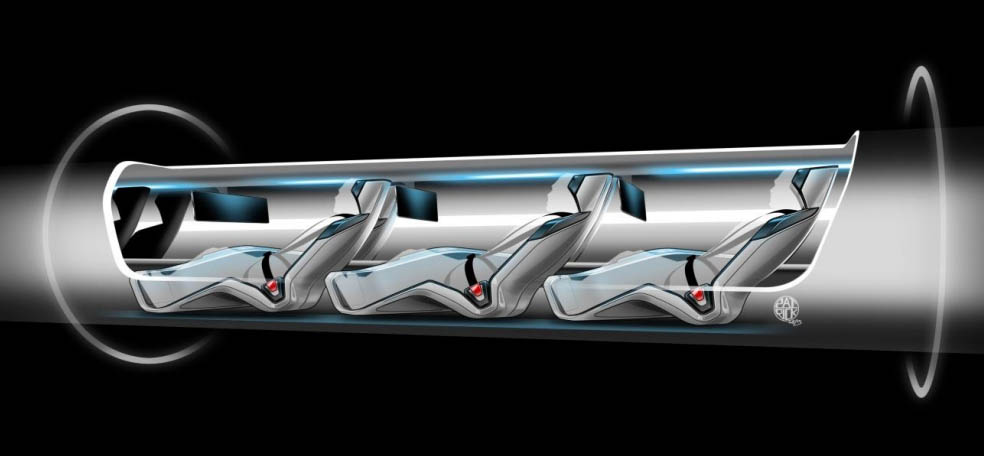
elon_musk_hyperloop_01

  • A kapszulákban az utastér elég szűkös lenne, a kapszula tervezett szélessége mindössze 135 cm, magassága 110 cm. Azaz oldalról kellene beszállni és félig fekvő pózban, hátradöntött üléstámlával bemászni. Ilyen sebességnél toalett és WC mászkálás sincs. 30 perc, mondjuk nem hosszú idő, de kínos lehet félúton egy baleset.
  • A kapszula önsúlya 3100 kg, de a 28 utassal megpakolva is elég lenne 135 lóerő teljesítmény a légellenállás leküzdésére.
  • A kompresszorok javasolt teljesítménye: 436 lóerő.
  • Egy kapszula becsült gyártási költsége: $1.350.000 (305 millió Ft)
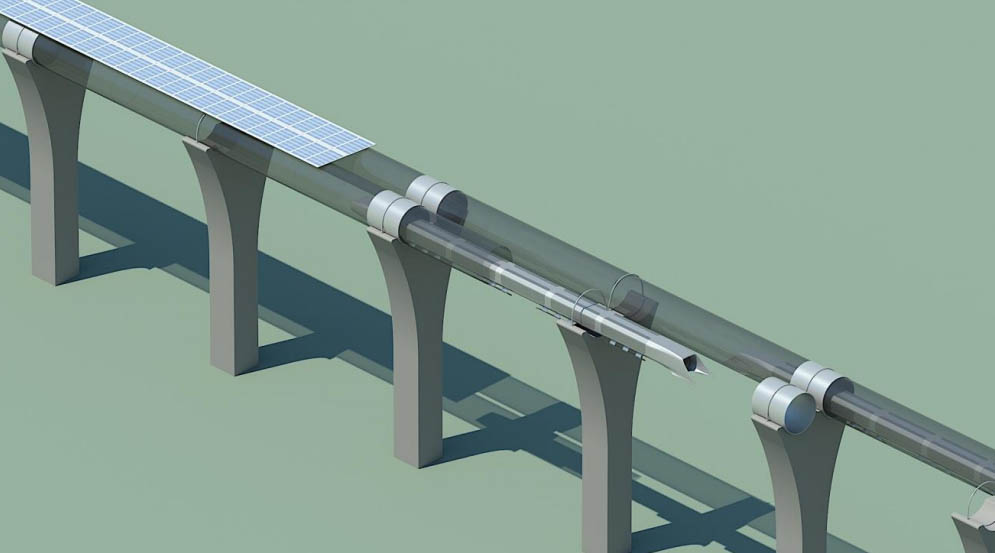
elon_musk_hyperloop_05

  • A pálya, a cső tervezett átmérője: 223 cm. Kapszula / cső keresztmetszet terület aránya: 36%, átmérő arány 60%
  • Nem a föld alatt, hanem 6-30 méter magas pilléreken futna a pálya. 30 méterenként egy, összesen 25.000 oszlop.
  • A számítások szerint a 25.000 cölöpre szerelt napkollektor 2,5-3x annyi energiát tudna előállítani, mint a Hyperloop szükséglete.
  • A Szilícium-völgyben és Los Angeles környékén lenne pár „kanyargósabb” szakasz (kanyarsugár 1,6km alatt), lakott terület, ahol csak 480 km/h sebességig gyorsulna a Hyperloop. Egyik tervezési korlát, hogy a pálya egyetlen szakaszán sem hathat 0,5g oldalirányú gyorsulásnál nagyobb erőhatás az utasokra. Mondjuk ez sem kevés.
  • Az egyenes szakaszra érve (min. kanyarsugár 4,8km felett) a Hyperloop max. 1g mellett 1200 km/h sebességig gyorsítaná a kapszulákat.
  • Míg a kapszulák összköltsége, mindössze 54 millió dollár (12 Mrd Ft), addig a pálya megépítésének becsült költsége ennek százszorosa 5,4 milliárd dollár (1200 Mrd Ft). Ha a 7,2 km hosszú 4-es metró 452 milliárdjához hasonlítjuk, akkor eléggé utópisztikus tervnek tűnik.

A tévedés, félreértelmezés jogát fenntartjuk, az építő hozzászólásokat, szakértő korrekciókat szívesen fogadjuk kommentben!

elon_musk_hyperloop_04


15 Aug 06:23

Kickstarter Weekly 5 - August 14th

Our fourth installment of the Kickstarter Weekly 5, with a few new and interesting Kickstarter projects that may or may not turn out to be life-changing products.
15 Aug 06:08

PureView vs PureView: Nokia Lumia 1020 vs Nokia 808

by Michael Fisher

Shortly after meeting him in person for the first time at IFA 2012, I sat in a Berlin bar with Managing Editor Anton D. Nagy and we talked about our hopes for the future of smartphones. He’d just given me a gander at his prize Nokia 808 PureView, and despite its bulk and its dated software platform, I wanted it. More precisely: I wanted a Windows Phone version of it. Fast forward to MWC 2013. Anton and I were ...

Continue reading »

The post PureView vs PureView: Nokia Lumia 1020 vs Nokia 808 appeared first on .

15 Aug 05:58

HTC One mini vs Samsung Galaxy S4 mini: Young guns

Yes, you can call it Round 2 but we don't think it'll be up to the minis to sort out any unfinished business between the flagships. What we do know though is that taking the dispute to the junior league doesn't mean there'll be less pain in losing and less honor...

14 Aug 20:00

Atomos tabletet kínál az Intel a nebulóknak

Szdani88

mintha egy kicsit megkésett volna ez a hír

Az Android operációs rendszert futtató termékek az Intel Education szoftvercsomagot is megkapják.
14 Aug 19:58

AMD und Intel bauen Marktanteil bei PC-Grafikchips aus

Szdani88

buko most az nvnek de az intel a leggyalázatosabb 2/3 os többség lassan xd

Aktuelle Zahlen zum Markt mit Grafikchips für PC-Systeme besagen, dass Nvidia im zweiten Quartal des Jahres Marktanteile verlor, da sowohl AMD als auch Intel von der zunehmenden Verbreitung von integrierten Grafiklösungen profitierten. Insgesamt konnte der Absatz mit Grafikchips trotz sinkender PC-Verkäufe gesteigert werden.
14 Aug 19:51

Google Project Loon: 10 Mbps for users, 50 Gbps ultra-bright LED links between backbone super-nodes 100 miles apart

by Staska

So far Google has been describing their Project Loon balloon internet initiative in very general terms.

Yes, we know that the idea is to provide internet access via a network of balloons floating in stratosphere 20 kilometers high, and use rather stable atmospheric winds at different altitudes up there to keep balloons on station by moving them up or down. But that’s about all that Google told us about Project Loon.

How exactly those balloons keep their station and move up or down? How big the Loon network can be? How do they communicate with each other, with ground stations and internet access points on the ground? What kind of speeds can we expect from it? We had no idea.

Until now.

Recently several patent applications related to Project Loon became public in USPTO database, with a lot of details about Google’s balloon Internet. Including an expected 10 Mbps speeds for users on the ground, and 50 Gbps backbone network of Super Balloons 100 miles apart, covering huge areas via ultra-bright LED free-air optical links.

The balloon network with 50 Gbps super-node backbone and 10 Mbps downlinks

In the patent apps Google talks about various kinds of possible network configurations. But the most interesting and ambitious one is this:

Google Project Loon network

The high-altitude balloon network consists of two types of balloons:

  • The backbone of super-nodes that use ultra-bright LEDs to talk to each other via free air optical links, over the distances of up to 100 miles. According to Google,  such network of super-nodes can achieve data transmission rates of 10 to 50 Gigabits per second
  • A number of sub-node balloons that connect to super-nodes and to the access points on the ground, providing ordinary users with 10 Mbps wireless Internet connections

Super-nodes may also talk to each other using lasers, but that may be problematic due to various regulations regarding laser comms.

Super and sub-node balloons form balloon clusters (BC) over certain defined geographic area. Sub-nodes can move between nearby clusters and their density may be adjusted according to the data throughput requirements. E.g. a cluster with a lot of sub-nodes may be needed above the city, while  rural areas may make do with one super-node a few sub-nodes. The network is also able to temporarily create and move balloon clusters as needed, for example for an event like rock festival, or disaster relief effort.

There is also one more type of balloon – that stays more or less above the project  ground stations and connects the network to them via optical or high throughput radio link.

The balloons

Balloons move around and keep station above certain area by using relatively constant different direction winds in stratosphere. They are configured for altitude control via variable buoyancy system that moves balloon up and down by inflating or deflating it.

Google Project Loon balloon

The part that keeps balloon in the air is the envelope, filled with lighter than air gasses like hydrogen or helium. Balloons are inflated or deflated at need with the help of the  “Bladder”. It’s an elastic chamber configured to hold gas and/or liquid. The buoyancy of the balloon is adjusted by changing the density and/or volume of the gas in a bladder. It can be done via a heating/cooling process, or by adding/removing gas via specially designed pumps and valves.

In one version of balloons,  the envelope is filled with helium, and the bladder is treated as a ballast tank that can be made lighter or heavier by sucking in or pumping out the air from it.

Alternatively, Google considers more passive  buoyancy system, were the gas is heated and cooled by the sun. They do that by painting different sides of balloon envelope in different colors, e.g. black and white. The black side absorbs more solar energy than the white one. When Google needs to take balloon higher, they turn it towards the sun, the gas heats up and balloon goes up. To go down, they turn the white side towards the sun and the gas inside cools. By adding the third intermediate color, e.g. grey, to the envelope, they can calibrate buoyancy and movement even more precisely.

Balloons  may also have an airfoil, such as a kite, wing, or sail, that can be adjusted to control its direction of motion. Just like a modern sailboat, airfoil  equipped balloon would be able to move not only along with the wind, but at some angle to it, greatly increasing maneuverability and overall network flexibility. Alternatively, the airfoil may be of a type that can convert the vertical motion generated by changing buoyancy of the balloon, into horizontal motion. Such airfoil can be used to achieve the desired movement without relying on ambient winds. This approach may be thought of as using the airfoil to convert lift into thrust, which is essentially the opposite of how a conventional airplane works (the wings of a an airplane convert thrust into lift).

Attached to the envelope of the balloon is the payload with all the electronics and power generation system. Those include the processor, memory, various sensors for navigation  and buoyancy/movement control,  radio and optical data transmission equipment.

By tuning up the hardware and software control algorithms, Goolge says they expect to be able keep the balloon in the air and on station for up to 100 days.

Between the envelope and payload, there’s a “Cut-Down” system, to cut the payload so all electronics can be recovered on the ground, when balloon has to be brought down.

In the patent apps Google also describes in some detail how they can effectively navigate and keep all the balloons on station. But the math and science involved there is way over my head. If you are interested you can check out the USPTO yourself:

Google Project Loon  patent applications: 1, 2, 3,4

Similar Posts:
14 Aug 19:46

Kilopták a 2014-es X-Men mozifilm első előzetesét - itt a videó

Bryan Singer az X-Men-trilógia első két epizódja után ismét mutánsos képregény-filmet rendez. Az X-Men - Az eljövendő múlt napjait jövőre fogják bemutatni, és már nézhető az előzetese.
14 Aug 19:39

K-Lite Mega Codec Pack 10.0.0

K-Lite Codec Pack is a collection of components needed for audio and video playback in DirectShow players such as Windows Media Player, Media Center, and Media Player Classic. ... [License: Freeware | Requires: Win 8 / Win 7 / Vista/ XP | Size: 29.5 MB ]
14 Aug 13:26

AMD Announces Never Settle Forever Bundle, Introduces Selectable Rewards

by Ryan Smith
Szdani88

8 free game a nagyhoz nem rossz

With AMD’s existing Never Settle Reloaded bundle set to wind-down this summer, AMD is announcing this morning that they are once again refreshing their popular Never Settle bundle program. The latest iteration of the program, being dubbed Never Settle Forever, is going live today and will immediately be replacing Level Up with Never Settle Reloaded across most products. And like previous iterations of the Never Settle program, Never Settle Forever will be coming with its own set of changes for the program.

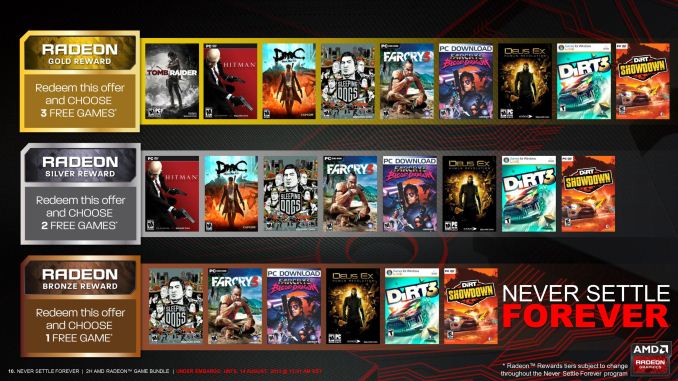
The most significant news here, beyond the fact that AMD is renewing Never Settle, is how the redemption program works. With Never Settle Reloaded and previous editions of the bundle, AMD has been bundling offers for specific games with specific products. The most recent edition, for example, would offer Bioshock Infinite, Tomb Raider, and Far Cry 3: Blood Dragon with a Radeon HD 7790, while a Radeon HD 7770 would come with Blood Dragon, but drop the other two titles for Far Cry 3. However with Never Settle Forever, AMD is moving away from a fixed game model to a pick-your-game model that lets buyers redeem games off of a revolving list of several games.

Alongside the pick-your-game model, with Never Settle Forever AMD is moving redemption into 3 “Radeon Rewards” tiers: Bronze, Silver, and Gold, with the tiers tied to video cards of increasing value. Each tier in turn has its own list of games – these lists currently being supersets of each other as you go up in tiers – with buyers getting 1, 2, or 3 games off of each list respectively. Meanwhile this tier system will also serve to slightly simplify AMD’s redemption system, as this will see AMD contracting the number of card/game configurations from 5 to 3 (7990 excluded).

AMD Never Settle Forever: Radeon Rewards Tiers
Card Tier Number of Free Games Cur. Number of Games on Tier
7990 N/A 8 8
7900 Series Gold 3 9
7800 Series Silver 2 8
7790/7770 Bronze 1 7

Next to the pick-your-game model and the use of tiers, the final change in the program is that AMD is now going to allow buyers to “bank” their redemption credit, in anticipation of future titles. As previously mentioned AMD will be using a revolving list of games, so games will be periodically added or dropped as AMD signs up new games, loses old games, or exhausts their key allocations. Buyers in turn may choose to use their redemption coupon now or in the future, with those choosing to bank their coupon betting on being able to redeem those coupons for newer/better games in the future.

However there will be a trio of catches to banking redemption credit that need to be pointed out. First and foremost, AMD will not be announcing new games ahead of time. So whatever games they add in the future – and they have made it clear they will be adding games – are anyone’s guess, as will what tiers get those games (only gold tier is a given). The second catch is that silver and gold tier coupons, good for 2 and 3 games respectively, must have all of their games redeemed all at once; the credits can’t be split. So for example on a gold tier coupon it’s not possible to get Tomb Raider now, and then save just 2 of the credits for future use. It’s all or nothing, as it were. AMD didn’t go into great detail on why they’re handling the program in this manner, but judging from their current game lists it’s a reasonable assumption that they don’t want coupon holders “sniping” the most valuable (read: expensive to AMD) games. Finally, redemption coupons/credits are only valid until the end of 2013, so while buyers can bank their credits they can't bank them for too long, as they'll need to spend them by the end of the year.

With all of that in mind, given AMD’s current game list the banking system is a reasonable compromise considering what games are currently available on each tier. Compared to Never Settle Reloaded, Never Settle Forever is at least initially a weaker bundle; AMD has lost two of their most recent titles, Crysis 3 and Bioshock Infinite. The only 2013 AAA games that remain are Tomb Raider and DMC, the rest of the games being from 2012 or earlier, or in the case of Blood Dragon a budget game from the start. So despite the additional flexibility the pick-your-game model offers, buyers at the highest tier in particular (7900 series/gold) are getting a less valuable bundle at this moment. We can’t guess what titles will be introduced in the future, but banking may not be a bad idea for those looking to get the most bang for their buck.

Finally, Never Settle Forever will for the time being only cover AMD’s single GPU parts, as noted in the product chart above. The Radeon HD 7990 retains its existing 8 game (i.e. everything) bundle, in part a consequence of the fact that the coupons for those cards are bundled in the product box itself rather than added by the retailer, and as such cannot be changed by AMD. This also means that the 7990 will continue to have by far the most lucrative bundle, even after the recent AMD price cuts that saw the 7990 drop to as low as $649 after rebate.

Ultimately from a marketing perspective the fact that AMD is renewing the Never Settle program comes as no great surprise, as the game bundle program has been undeniably popular among Radeon buyers. It has been obvious that AMD was going to continue the program in some form considering all the good will and good press it has earned them, so we're glad to see it renewed. At the same time while the pick-your-game model is not groundbreaking (we’ve seen MSI do it before) this is the first time we’ve seen such a program done at the highest levels, and in AMD’s case it’s a simple yet effective change that will reduce buyer concern over duplicate games. Finally with the Forever iteration of the program running until the end of the year, it will be interesting to see what games AMD adds to the program. There are a number of AAA games from AMD’s typical partners due over the next couple of months, so hopefully in light of the loss of Bioshock and Crysis AMD can land some new anchor titles to further augment the program.

14 Aug 10:04

Acer’s got a nice Kabini box

by document.write(['peter','fudzilla.com'].join('@')) (Peter Scott)
Available in Britain for 267 squid
14 Aug 09:57

Samsung Hennessy clamshell Android smartphone now official

Samsung China has just officially announced the Hennessy - a flip-phone with dual screens running the Android operating system. More specifically, the Hennessy is boasting a pair of 3.3" touch displays of 320x480 resolution each. It's powered by a 1.2GHz quad-core CPU and 1GB of RAM that helps it run Android 4.1 Jelly Bean. The Samsung Hennessy is quite thick and heavy, measuring 110.85...

14 Aug 07:48

Meglepetés: nőtt a magyar PC-piac

by Bodnár Ádám
A régióban továbbra is zuhannak a PC-eladások, Magyarországon viszont emelkedtek a második negyedévben. A tabletek forgalma felülmúlta a notebookokét.

13 Aug 14:45

Meglepő élettartam növekedés a holokauszt túlélőinél

Szdani88

és panaszkodnak...

Egy új kutatás eredményei szerint a holokauszt férfi túlélői esetében az átélt borzalmak megnyújtották várható élettartamukat.
13 Aug 07:33

New Nexus 7 suffers from multi-touch display issues

by Prasad
Szdani88

xd lassan nem lesz alkatrész ami jo

After recently having being diagnosed with GPS connectivity issues, owners of the new Nexus 7 tablet are now complaining about the erratic performance of multi-touch functionality on the display.
13 Aug 07:32

Samsung Galaxy Note III specs get detailed ahead of launch

The specs of the hotly anticipated Samsung Galaxy Note III have allegedly been revealed. The second flagship handset by Samsung this year will launch in at least two different versions, dubbed SM-N900 and SM-N9005. The Samsung Galaxy Note III SM-N900 will reportedly pack a 1.8GHz Octa-core Exynos 5420 SoC and ARM Mali-T628 MP6 GPU. There is no info on the CPU and GPU of the SM-9005...

13 Aug 07:30

North Korea now has its own Android smartphone

by Dusan Belic
Szdani88

kép :D

North Korea now has its own Android smartphone

North Koreans are about to join the smartphone revolution of sorts. The country unveiled its very first smartphone called “AS1201 Arirang” which got its name after a Korean folk song. It’s still unclear whether this is really North Korea’s own “indigenous technology,” or — more likely — a China-made Android device that was simply placed into boxes in the country.

Nevertheless, the state-run media praised the effort, showing the great leader Kim Jong-un visiting the factory:

He learned in detail about the performance, quality and packing of “Arirang” hand phone being made at this factory.

He highly appreciated the creative ingenuity and patriotic enthusiasm with which the officials and employees of the factory laid a solid foundation for mass-producing hand phones by building a new modern hand phone production process.

Specs of the AS1201 Arirang are unknown though we doubt it’s a power-house under the hood. On the other hand, we’re glad that at least select North Koreans will be able to access the Internet while on the go. At least some part of the Internet since the government is censoring things left and right…

[Via: AndroidCentral]

The post North Korea now has its own Android smartphone appeared first on IntoMobile.

North Korea now has its own Android smartphone originally appeared on IntoMobile.com on 2013-08-13T07:02:18Z. FV1gMYsz9b5j

13 Aug 07:22

PNY Prevail 5k SSD meghajtó

Szdani88

fontos is hogy strapabíró legyen egy SSD xD ha leesik a gép nincs gond, strapabíró volt az SSD

A PNY strapabíró, magas igényeket is kielégítő SSD-t jelentett be.
12 Aug 19:17

Dev Channel Update for Chrome OS

by Josafat
Szdani88

Htm5 YouTube video freezes when USB headphone is plugged in

érdekes bug

The Dev channel has been updated to 30.0.1589.4 (platform version: 4512.2.0) for all Chrome OS devices. This release contains several improvements and bug fixes.

Known Issues:
  • Video glitches on on certain Flash sites. Workaround: Move cursor away from playing window reduces the glitches (263154).
  • Htm5 YouTube video freezes when USB headphone is plugged in (270210).
If you find new issues, please let us know by visiting our help site or filing a bug. Interested in switching channels? Find out how. You can submit feedback using ‘Report an issue...’ in the Chrome menu (3 horizontal bars in the upper right corner of the browser).

Josafat Garcia
Google Chrome
12 Aug 18:21

Elindultak a gólyák Afrikába

GPS-szel követhető a madara vándorlása, az első csapat már Törökországban jár.
12 Aug 08:38

Angeblich nur Hawaii-Karten mit neuer Architektur

Nachdem es über Monate keine neuen Informationen über AMDs Next-Gen-GPUs, die unter der Volcanic-Islands-Serie laufen werden, gegeben hat, quillt die Gerüchteküche in den letzten Tagen plötzlich über. Grund für die plötzliche Zunahme: AMD soll für Ende September eine Veranstaltung zu den neuen Grafikkarten angesetzt haben.
12 Aug 08:37

Bay Trail desktop parts coming soon

by document.write(['staff','fudzilla.com'].join('@')) (Fudzilla staff)
Three SKUs unearthed
12 Aug 06:52

Furcsa és érthetetlen áremelések a T-Mobile-nál

Szdani88

szép magasabb havidijért ugyan annyi a telo xd

Felfelé változtak az árak, de még ennél is furább az, hogy milyen logikával.
12 Aug 05:47

UNOFFICIAL Windows98 SE Service Pack 3.25

Szdani88

xdd

Microsoft has never released a service pack for Windows98 SE. But the author made a Service Pack for Windows98 SE users. It contains all Windows98 SE updates from Windows Update site and more. ... [License: Freeware | Requires: Win 9x | Size: 65.1 MB ]
10 Aug 11:57

Nvidia Tegra Tab pictured. Nvidia Tegra 5 tablet coming in 2014. Surface RT 2 will sport Tegra CPU

by Vlad Bobleanta
Szdani88

szép fail ha az uj Surfaceben megint tegra lesz és nem snapdragon nagyon nyomattak h dobjak az nvt

Since January we’ve known that Nvidia is planning on designing and developing its own tablets and smartphones. This has probably happened because the company is having real issues in finding OEM and ODM customers for its mobile chipsets this year.

A few days ago we even got word that Nvidia may in fact be preparing to sell an Android tablet itself, under its own brand – the TegraNote Premium.

That still may happen, but today another alleged Nvidia tablet has leaked. It’s called the Tegra Tab, and this time we have a couple of pictures too. This device is said to be made by Shenzhen Homecare for Nvidia.

Nvidia Tegra Tab 1 Nvidia Tegra Tab 2

The Tegra Tab will reportedly sport Nvidia’s Tegra 4 CPU, a 7-inch screen, a 5 MP rear camera, a full HDMI port, and a stylus. The tablet may even come in a 3G-capable version, since in one of the images something resembling a SIM card bay can be seen.

Other specs and details about the Nvidia Tegra Tab aren’t available right now, but we’ll bring them to you as soon as they get leaked.

Now this could be Nvidia’s first own-brand tablet, or it could be the first tablet to come out of its effort of making tablets itself, but for partners that will then market and sell them (perhaps Nvidia will let these companies use the Tegra Tab brand). That’s what we heard would happen when we first got wind about the chip maker’s new plans. This Tegra Tab may be what the previously leaked TegraNote ends up being called commercially, in which case it should feature a 1,280×800 touchscreen and run Android 4.2.2 (at least).

Interestingly though, another report claims that Nvidia will release its own high-end tablet in the first quarter of next year (so before the end of March). That will apparently come with the Nvidia Tegra 5 mobile chipset, currently codenamed Logan. The Tegra 5 will come with Kepler-branded graphics, and as such should smoke the competition – at least in terms of raw GPU power.

This tablet will be released in North America as you’d expect, but also in Europe it seems. This is obviously going to be a different device from the 7-inch TegraNote / Tegra Tab, and we expect its touchscreen to measure around 10 inches diagonally.

So it looks like Nvidia has two tablets in the works for the near future: the Tegra 4-based 7-inch TegraNote or Tegra Tab, and another 10″ Tegra 5-based monster coming in 2014.

Finally in Nvidia news, the company’s CEO has confirmed that its chipset will power the next Microsoft Surface RT tablet. This first of all serves as yet another confirmation that Microsoft is indeed working on a new generation of the Surface RT, and second it puts to rest all speculation that Microsoft may have switched CPU suppliers and gone with Qualcomm.

Whether the next Surface RT will manage to be a success unlike its predecessor is still up for debate, of course.

Via MyDrivers, Fudzilla, CNET

Similar Posts:
09 Aug 19:12

Éhen halt egy jegesmedve a klímaváltozás miatt

Szdani88

felháborító, hogy nincs MacDonalds a sarkokon

Tengeri jég nélkül nem tudott fókára vadászni.
09 Aug 17:39

A Sony megint a Microsoftot szívatja

A cég arra építi fel a Playstation 4 egész marketingjét, hogy nála ingyen lesz, amiért az Xbox One-on fizetni kell.
09 Aug 14:00

New Nexus 7 arriving in UK on August 28

by Prasad
Szdani88

nem lesz europaban xd

ASUS has announced that the European version of the second generation Nexus 7 tablet will go on sale in the UK on August 28. Although the tablet was announced couple of weeks ago and went on sale in the US last week, the European launch dates weren’t revealed until now.
09 Aug 11:36

Live images of Tegra 4-powered Nvidia Tegra Tab surface

by Vince
Rumors of Nvidia wanting to build its own tablet have been doing the rounds for a couple of months now, but they will probably gain even more traction now that we got leaked photos of an Tegra-4 powered Tegra Tab slate. If you don’t fancy the looks of the Tegra Tab, but like the sound [...]
09 Aug 08:41

LG G2 produces impressive scores in initial benchmark tests

by Prasad
LG’s latest flagship smartphone – the G2 – wowed us with its unique design and more importantly, the fantastic set of specifications. Naturally, then, it was bound to be put through its paces sooner or later and so it has.