Silent Film
Scott Lord
Shared posts
09 Jul 03:47
Scott Lord on Silent Film Hollywood, Lost Silent Film, Swedish Silent Film, Danish Silent Film: May 2023
Film
Tags: Film
Scott Lord, Scott Lord and 2 others like this
09 Jul 03:47
Scott Lord Mystery: Boris Karloff as Mr. Wong, Detective - YouTube
Scott Lord, Scott Lord and 2 others like this
 Blacklight Castle- Mystery Film.
09 Jul 03:46
Sherlock Holmes, The Dying Detective (Elvey, 1921)
Scott Lord, Scott Lord and 2 others like this
09 Jul 03:46
Scott Lord on Film: Mae Murray in Peacock Alley (Marcel de Sano, 1930)
Scott Lord, Scott Lord and 2 others like this
09 Jul 03:46
Scott Lord Silent Film: Biblical Drama; The Miracles of Jesus (Mogul Film Company, 1910s) - YouTube
Scott Lord, Scott Lord and 2 others like this
09 Jul 03:46
Scott Lord on Silent Film Hollywood, Lost Silent Film, Swedish Silent Film, Danish Silent Film: Scott Lord Silent Film: Ben Hur, A Tale of Christ (Fred Niblo, 1925)
Silent Film
Tags: Silent silent film
Scott Lord, Scott Lord and 2 others like this
09 Jul 03:46
Scott Lord Silent Film: The Invaders (Ince, 1912)
Silent Film
 Having directed "The Indian Massacre" and Across the Plains" the year before, Thomas Ince during 1012 directed the films "The Invaders" (three reels) starring its co-director Francis Ford and Ethel Grandin and "Custer's Last Fight" (three reels) for the New York Motion Picture Company and "Shadows of the Past" for the Vitagraph Company of America.
It is often acknowledged that Thomas Ince was the first director to use a shooting script. These were detailed shooting scripts, known to be meticulous in their planning, where plotline would emerge as having precedence over action and spectacle.
Author Kenneth MacGowan notes that Thomas Ince "strove for theatric effect", but only with scripts that were "direct and tight" and used intertitles to advance character action dramatically relating to events as a technique of exposition.
Silent Film D. W. Griffith
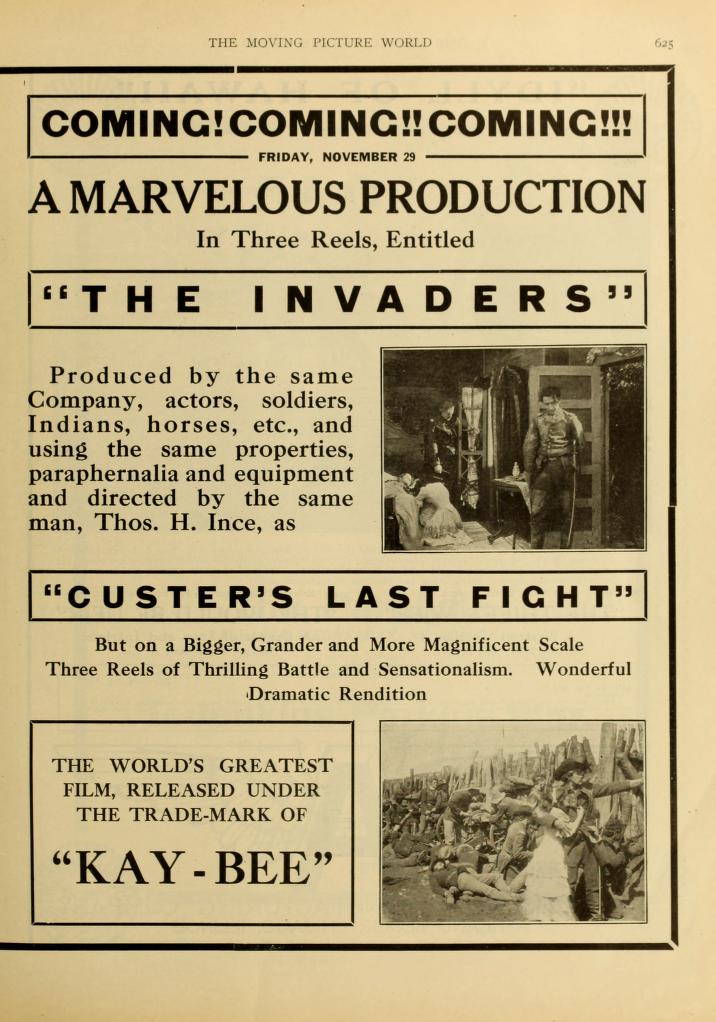 Having directed "The Indian Massacre" and Across the Plains" the year before, Thomas Ince during 1012 directed the films "The Invaders" (three reels) starring its co-director Francis Ford and Ethel Grandin and "Custer's Last Fight" (three reels) for the New York Motion Picture Company and "Shadows of the Past" for the Vitagraph Company of America.
It is often acknowledged that Thomas Ince was the first director to use a shooting script. These were detailed shooting scripts, known to be meticulous in their planning, where plotline would emerge as having precedence over action and spectacle.
Author Kenneth MacGowan notes that Thomas Ince "strove for theatric effect", but only with scripts that were "direct and tight" and used intertitles to advance character action dramatically relating to events as a technique of exposition.
Silent Film D. W. Griffith
Scott Lord, Scott Lord and 2 others like this
09 Jul 03:46
Greta Garbo
The Film Daily ran an announcement during 1929 titled "Feyder Directing Garbo" It related, "Greta Garbo has begun work on a new picture under the direction of Jacques Feyder, French director recently signed by M.G.M. Anders Randolph will play the husband in the film, an original by Feyder, not yet titled."
New Movie Magazine quoted the director, " 'Dialougue- that is what will make the love sparkle in American films.' Monsieur Feyder has a great vision of Greta Garbo's future. He directed her in her last silent film The Kiss. Says Mr. Feyder, "What possibilities are opened to her with her voice? She will branchout, her characterizations will broaden. She will enter into her cinema inheritance- and what a glorious inheritance it will be." The Film Daily inadvertantly reviewed the film as an "All-Talker", but the studio in its advertisements that ran in the magazine that year included the film in "a deluge of dialogue delights" that it would be offering. The subtitle to the review read, "Sophisticated drama of continental life puts Greta Garbo in a new kind of role but tragic story misses." The review explained, "Greta Garbo as always is very alluring and excersizes her erotic charm throughout the erotic portrayal. But the subject matter is too tragic and the ending not the type that her average fan looks for...Shapes up as a pretty sophisticated farce that lacks the American slant and is problematical whether Garbo fans will feel enthusiastic about seeing their favorite in this type of production...Feyder worked the camera technique in many novel ways and achives some effective shots." Richard Corliss aptly writes, "It's also true that Garbo looks beautiful but distracted. She walks through the role as if her mind were on other things." Picture Play summarily reported, "Commonplace story made glamorous by Greta Garbo, beautifully produced and directed. Film critic Paul Rotha, in his volume The Fill to Now, a survey of world cinema recognized the assingment of Greta Garbo to Jacques Feyder, "Quite recently Jacques Feyder, the Belgian, who in Europe is associated with the brilliant realization of Zola's Therese Raquin and the political satire Les Nouveaux Messiers, made his first picture for Metro Goldwyn Mayer, The Kiss, in which he skillfully combined intelligent direction with the necessary proportion of picture sense. his treatment of Greta Garbo was more subtle that that usually accorded to this actress by American directors...But there was a freshness about The Kiss that raised it above the level of the ordinary movie and a use of camera angle which was reminiscent of Feyder's earlier work." Earlier in the book Rotha had directed his attention to the film of Greta Garbo in an attempt to characterize the then contemporary film of the United States, "There is found then at the close of the pre-dialouge period of the American film, a mixed selection of production made according to formula...The ingredients of a successful film, conceived from a picture-sense point of view may be said to to: a strong, powerful theme (preferably sexual); a high-polished, quick moveing technique employing all the most recent discoveries (usually German); a story interest that will carry the sex at the same time allowing for spectacle and at least two highspots: and a cast of international players. Of such a type were Flesh and the Devil, The Last Command, The Patriot, Wild Orchids and The Kiss."
John Bainbridge reviews the film but more intriguing is his met intoning the social bond between Garbo and Feyder, I that she was less in contact with John Gilbert and both her sister and Mauritz stillerhas passed away. "however threadbare the plot, "The Kiss" has always been of interest to serious filmgoers for two reasons; it was Garbo's last silent film, and it was directed with consummate artistry...she also took pleasure from that Mrs Feyder was on the set nearly every day. After work the three often went to Feyders' house for dinner, and even once in a while to Garbo's." This was reiterated in Silver Screen magazine by Harriet Parson, who in 1930, penned, "24 Hours with Garbo"
It chronicled an evening where the journalist followed Greta Garbo "I caught my breath in excitement. It was Garbo! I sat breathless while she and her escort selected a table. It was the one next to mine, not four feet away. Garbo was dressed as no other girl in Hollywood would have dressed- a grey suit, severely tailored, a man's grey shirt, a navy blue tie with white dots, a navy blue topcoat and a dark blue beret with no hair showing from beneath it... Suddenly I recognized him- Jacques Feyder, the French director who made "The Kiss", Garbo's last silent picture. They began to eat...Afterward she drank black coffee and smoked a denicotinized cigarette. A flower woman came to the table with her little trey of blossoms. Feyder had purchased a gardenia and with a gallant guest urge handed it to Garbo" After dinner, Garbo and her former director went to a puppet show held in a theater next door where Greta Garbo was being portrayed bu a puppet dressed as Anna Christie. Feyder escorted her home that night as the 24 hour reporter followed, "A fortress as impenetrable as she is herself. She disappears-Feyder departs alone-midnight arrives."
The then twenty year old Lew Ayres was described by Screenland Magazine as a rare sensation that had unexpectedly catapulted on to the screen almost as if he had in fact been hurriedly signed as a newcomer in anticipation of the new technology of sound. When interviewed by Myrene Wentworth, Lew Ayers described his meeting Greta Gabo, " 'Gee, she is wonderful,' he said. 'I was scared to death when I walked on to the set but she made me feel right at home and helped me tremendously.'...It was a scene where he had to rush in and embrace her madly. 'And I hadn't even been introduced to her.', he said with an imagine-my-embarrassment gesture... Miss Garbo saw his discomforture and took his arm, turning to Jacques Feyder, the director. 'Would you mind making me acquainted with this young man?'."
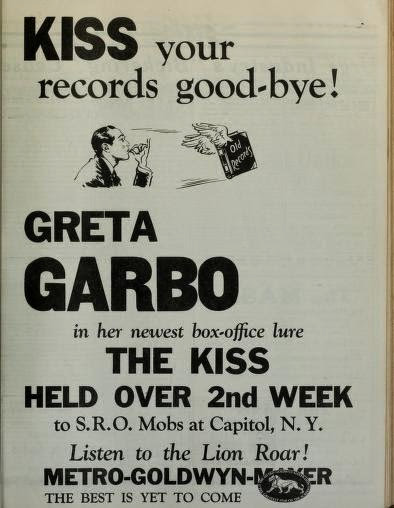
Greta Garbo in The Kiss (Feyder/Daniels, 1929)
scottlordpoet
shared this story
from  scottlordpoet's blurblog. scottlordpoet's blurblog.
|
scottlordpoet
shared this story
from  Scott Lord on Silent Film Hollywood, Lost Silent Film, Swedish Silent Film, Danish Silent Film. Scott Lord on Silent Film Hollywood, Lost Silent Film, Swedish Silent Film, Danish Silent Film.
|
Greta Garbo
The Film Daily ran an announcement during 1929 titled "Feyder Directing Garbo" It related, "Greta Garbo has begun work on a new picture under the direction of Jacques Feyder, French director recently signed by M.G.M. Anders Randolph will play the husband in the film, an original by Feyder, not yet titled."
New Movie Magazine quoted the director, " 'Dialougue- that is what will make the love sparkle in American films.' Monsieur Feyder has a great vision of Greta Garbo's future. He directed her in her last silent film The Kiss. Says Mr. Feyder, "What possibilities are opened to her with her voice? She will branchout, her characterizations will broaden. She will enter into her cinema inheritance- and what a glorious inheritance it will be." The Film Daily inadvertantly reviewed the film as an "All-Talker", but the studio in its advertisements that ran in the magazine that year included the film in "a deluge of dialogue delights" that it would be offering. The subtitle to the review read, "Sophisticated drama of continental life puts Greta Garbo in a new kind of role but tragic story misses." The review explained, "Greta Garbo as always is very alluring and excersizes her erotic charm throughout the erotic portrayal. But the subject matter is too tragic and the ending not the type that her average fan looks for...Shapes up as a pretty sophisticated farce that lacks the American slant and is problematical whether Garbo fans will feel enthusiastic about seeing their favorite in this type of production...Feyder worked the camera technique in many novel ways and achives some effective shots." Richard Corliss aptly writes, "It's also true that Garbo looks beautiful but distracted. She walks through the role as if her mind were on other things." Picture Play summarily reported, "Commonplace story made glamorous by Greta Garbo, beautifully produced and directed. Film critic Paul Rotha, in his volume The Fill to Now, a survey of world cinema recognized the assingment of Greta Garbo to Jacques Feyder, "Quite recently Jacques Feyder, the Belgian, who in Europe is associated with the brilliant realization of Zola's Therese Raquin and the political satire Les Nouveaux Messiers, made his first picture for Metro Goldwyn Mayer, The Kiss, in which he skillfully combined intelligent direction with the necessary proportion of picture sense. his treatment of Greta Garbo was more subtle that that usually accorded to this actress by American directors...But there was a freshness about The Kiss that raised it above the level of the ordinary movie and a use of camera angle which was reminiscent of Feyder's earlier work." Earlier in the book Rotha had directed his attention to the film of Greta Garbo in an attempt to characterize the then contemporary film of the United States, "There is found then at the close of the pre-dialouge period of the American film, a mixed selection of production made according to formula...The ingredients of a successful film, conceived from a picture-sense point of view may be said to to: a strong, powerful theme (preferably sexual); a high-polished, quick moveing technique employing all the most recent discoveries (usually German); a story interest that will carry the sex at the same time allowing for spectacle and at least two highspots: and a cast of international players. Of such a type were Flesh and the Devil, The Last Command, The Patriot, Wild Orchids and The Kiss."
John Bainbridge reviews the film but more intriguing is his met intoning the social bond between Garbo and Feyder, I that she was less in contact with John Gilbert and both her sister and Mauritz stillerhas passed away. "however threadbare the plot, "The Kiss" has always been of interest to serious filmgoers for two reasons; it was Garbo's last silent film, and it was directed with consummate artistry...she also took pleasure from that Mrs Feyder was on the set nearly every day. After work the three often went to Feyders' house for dinner, and even once in a while to Garbo's." This was reiterated in Silver Screen magazine by Harriet Parson, who in 1930, penned, "24 Hours with Garbo"
It chronicled an evening where the journalist followed Greta Garbo "I caught my breath in excitement. It was Garbo! I sat breathless while she and her escort selected a table. It was the one next to mine, not four feet away. Garbo was dressed as no other girl in Hollywood would have dressed- a grey suit, severely tailored, a man's grey shirt, a navy blue tie with white dots, a navy blue topcoat and a dark blue beret with no hair showing from beneath it... Suddenly I recognized him- Jacques Feyder, the French director who made "The Kiss", Garbo's last silent picture. They began to eat...Afterward she drank black coffee and smoked a denicotinized cigarette. A flower woman came to the table with her little trey of blossoms. Feyder had purchased a gardenia and with a gallant guest urge handed it to Garbo" After dinner, Garbo and her former director went to a puppet show held in a theater next door where Greta Garbo was being portrayed bu a puppet dressed as Anna Christie. Feyder escorted her home that night as the 24 hour reporter followed, "A fortress as impenetrable as she is herself. She disappears-Feyder departs alone-midnight arrives."
The then twenty year old Lew Ayres was described by Screenland Magazine as a rare sensation that had unexpectedly catapulted on to the screen almost as if he had in fact been hurriedly signed as a newcomer in anticipation of the new technology of sound. When interviewed by Myrene Wentworth, Lew Ayers described his meeting Greta Gabo, " 'Gee, she is wonderful,' he said. 'I was scared to death when I walked on to the set but she made me feel right at home and helped me tremendously.'...It was a scene where he had to rush in and embrace her madly. 'And I hadn't even been introduced to her.', he said with an imagine-my-embarrassment gesture... Miss Garbo saw his discomforture and took his arm, turning to Jacques Feyder, the director. 'Would you mind making me acquainted with this young man?'."

Photoplay magazine during 1931 used two full pages to exhibit one photo of Jacques on the set to follow the director into the sound era in American film. It was a scene from his film "Daybreak", starring Ramon Novarro. The caption explains that the camera was "mounted on a rubber-tired 'dolly' for the making of traveling shots Jacques Feyder, director of Garbo's 'The Kiss' is the boss. He's at the extreme left, seated from the bottom." Film periodicals had counted on there being interest in the offscreen lives of film stars and in how they might put together a sound film, the extra-textual discourse embroidering distant super luminaries into the conversations that were held after the audiences left the public sphere of the theater and entered the fantasy objectifications of spectatorship that to some of the public may have seemed to be merely an ordinary walk home from the theater; and for theater goer Greta Garbo they may have been.
A publicity still published in Picture Play magazine during 1929 kept the caption, "Miss Garbo, at top of page, unhappy in the midst of luxury, reflects on how little life holds." Interestingly, although Greta Garbo in a low cut dress directing the view of the spectator to where she might not be wearing a bra is in front of a dressing room mirror it is not strictly a mirror shot in that she is also photographed in quarter profile as though nearing over the shoulder to effect a double image. P




Greta Garbo
Greta Garbo
Greta Garbo
Greta Garbo
Greta Garbo
Greta Garbo
Scott Lord, Scott Lord and 2 others like this
09 Jul 03:46
Sjostrom
scottlordpoet
shared this story
from  Scottlord's Favorite Links from Diigo. Scottlord's Favorite Links from Diigo.
|
Scott Lord, Scott Lord and 2 others like this
09 Jul 03:46
The Politicians Love Story is a brialliant, early example of reverse screen direction, using diagnol framing to depict perspective.
Linda Arvidson, wife of director D.W. Griffith chronicled having known Mack Sennett in her autobiography "When Movies Were Young", " 'The Curtain Pole' and 'The Politicians Love Story' started the grumbling young Mack Sennett on the road to fame and fortune. Like the grouchy poker player who kicks himself into financial recuperation,Mack Sennett grouched himself into success." Silent Film D.W. GriffithD Biograph Film Company
Scott Lord Silent Film: The Politician's Love Story (D.W. Griffith, 1909)
The Politicians Love Story is a brialliant, early example of reverse screen direction, using diagnol framing to depict perspective.
Linda Arvidson, wife of director D.W. Griffith chronicled having known Mack Sennett in her autobiography "When Movies Were Young", " 'The Curtain Pole' and 'The Politicians Love Story' started the grumbling young Mack Sennett on the road to fame and fortune. Like the grouchy poker player who kicks himself into financial recuperation,Mack Sennett grouched himself into success." Silent Film D.W. GriffithD Biograph Film Company
Scott Lord, Scott Lord and 2 others like this
09 Jul 03:45
Scott Lord Mystery: Boris Karloff in The Raven (Roger Corman, 1963)
Scott Lord, Scott Lord and 2 others like this
09 Jul 03:45

 Donna and I walked down Tremont Street, Boston, passed the church where she is a librarian, it bells ringing, and went to lunch at one of our usual places for my Sixty Second brithday.(She bought me a pocket hair comb for a dollar and said it was for my birthday, I took her to lunch this time, ps. I had a Western Omlette.)
scott lord
Donna and I walked down Tremont Street, Boston, passed the church where she is a librarian, it bells ringing, and went to lunch at one of our usual places for my Sixty Second brithday.(She bought me a pocket hair comb for a dollar and said it was for my birthday, I took her to lunch this time, ps. I had a Western Omlette.)
scott lord
With Donna on my Sixty Second Birthday, Downtown Boston
by Scott Lord on Silent Film, Scott Lord on Mystery Film


Scott Lord, Scott Lord and 2 others like this
03 Jul 03:15
Basil Rathbone in Sherlock Holmes and the Secret Wea...
Scott Lord, Scott Lord and 2 others like this
03 Jul 03:15
Scott Lord: Sherlock Holmes- Sign of the Four
Scott Lord, Scott Lord and 2 others like this
03 Jul 03:14
scottlordpoet's blurblog
Silent Film
Tags: Silent silent film
Scott Lord, Scott Lord and 2 others like this
03 Jul 03:14
scottlordpoet2's blurblog
Silent Film
Tags: Silent Silent-Film
Scott Lord, Scott Lord and 2 others like this
03 Jul 03:14
Scott Lord Horror Comedy: The Haunted House (Buster Keaton, Edward Cline...
Scott Lord, Scott Lord and 3 others like this
03 Jul 03:14
The Black Cat Magazine- Boston 1899;contemporary to The Strand Magazine


Scott Lord, Scott Lord and 3 others like this
03 Jul 03:14
Scott Lord Silent Film: Silent Film Studio Tours, Life In Hollywood (Del...
The short subject weekly newsreel "Life in Hollywood" featured as extratextual discourse on the set introductions of actors and actresses that included silent film stars Aileen Pringle, Elinor Glyn, Madge Bellamy and Priscilla Dean.
Silent Film
Silent FIlm
Silent Film
Silent FIlm
Scott Lord, Scott Lord and 3 others like this
03 Jul 03:14
The short subject weekly newsreel "Life in Hollywood" featured on the set extratextural introductions of actors and actresses that inckuded Ruth Roland, Vivien Martin, Kathleen Clifford, and Jack and Lottie Pickford.
Silent Film
Life in Hollywood
Scott Lord Silent Film: Silent Film Studio Tour, Life In Hollywood (Dell...
|
scottlordpoet
shared this story
from Scott Lord on Silent Film Hollywood, Lost Silent Film, Swedish Silent Film, Danish Silent Film.
|
The short subject weekly newsreel "Life in Hollywood" featured on the set extratextural introductions of actors and actresses that inckuded Ruth Roland, Vivien Martin, Kathleen Clifford, and Jack and Lottie Pickford.
Silent Film
Life in Hollywood
Scott Lord, Scott Lord and 3 others like this