Shared posts

05 Mar 13:17

Finally, a machine that makes cheap 3D printer filament.

by Brian Benchoff
Claus.dahl

Clearly, this just needs to be mounted on top of the printer, as a combined contraption.

extruder

If there’s one problem with the RepRap, it’s the cost of filament. Sure, there’s also the computationally difficult problem of slicing 3D models, but a 5 to 10 times markup on turning plastic pellets into filament is the biggest problem. It’s even a bigger problem than the problems of compatibility and interchangeable parts that comes with everyone forking a ‘standard’ printer design dozens of times. The cost of filament, though, is the biggest problem, right up there with RepRap developers focusing nearly entirely on different printer designs instead of the software, firmware, and electronics that are also vitally important to the RepRap project.

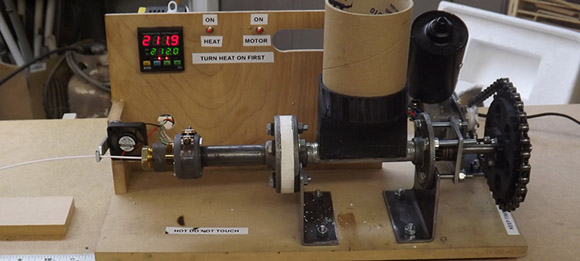
Nearly a year ago, we caught wind of a competition to create a home-based filament manufacturing station that takes cheap plastic pellets available for about $5/kg and turns them in to 3D printer filament that usually sells for $50/kg. A winner for this competion has finally been announced. The winner, [Hugh Lyman] just won $40,000 for his home filament creation station, the Lyman Filament Extruder

The goal of the Desktop Factory Competition was to create a machine that produces filament suitable for 3D printers with a total build cost of under $250 USD. [Lyman] met the goal by using a few motors, 3D printed parts, a PID controller, and off the shelf auger drill bit (that’s the actual model and supplier he used, by the way) that is able to reliably churn out plastic filament.

If you want to build your own Lyman Extruder, all the plans are up on Thingiverse, but LulzBot, the awesome people who gave us a 3D printer, hope to sell a pre-assembled version of this extruder sometime in the future, hopefully with a chain guard around that sprocket.


Filed under: 3d Printer hacks
02 Mar 12:20

“On a street in Brooklyn that takes you towards the river,...


“On a street in Brooklyn that takes you towards the river, where the cobblestones begin paving the road, there is a townhouse that deserves a second look. Despite its impeccable brickwork, number 58 Joralemon Street is not like the other houses. Behind its blacked out windows, no one is at home; no one has been at home for more than 100 years. In fact, number 58 is not a home at all, but a secret subway exit and ventilation point disguised as a Greek Revival brownstone.”

(via The Fake Townhouses hiding Mystery Underground Portals | Messy Nessy Chic Messy Nessy Chic)

27 Feb 11:48

The Next Four Years at CloudMade

by nick
Claus.dahl

Map data is a useful benchmark for many notions around 'cloud' and 'big data', and the trends that guide cloudmade are a useful guide for trends that drive any success in these fields

Four years ago in February 2009 we launched CloudMade’s developer program. Fast forward to February 2013 and we’re launching the platform that kickstarts the next four years for CloudMade and our customers. What’s happened in the last four years and what do the next four have in store for CloudMade and the thousands of developers, OEMs and enterprises that build on our platform?

The First Four Years

Four years ago we set out to build a platform that would let developers of all types all around the world build exciting location aware apps, websites and experiences.  We focused on three areas to make a difference in:

1. Create Something Different

We created the Style Editor – the first tool of its kind to let developers create beautiful custom map styles. We innovated ontop of, and improved, open source tools like Mapnik to create a unique tool chain. For the first time, developers and designers could come to a website and use a point and click interface to create a custom map style. When they were done, the style they had created was instantly available through an HTTP API that could be accessed from any platform. Since we launched the Style Editor over 15,000 map styles have been created and we’ve served up billions of custom map tiles. Developers like Red Robot Labs have created experiences in which the map seamlessly blends with the game design. Transport Agencies like Transport for London have created finessed styles that help their users navigate with ease. Map visualization pioneers like Movity (since acquired by Trulia) created styles that let their data take prominence. Whatever the use case, the Style Editor provided a way for thousands of developers to express themselves through their websites and apps.

2. Build for Developers

Most of you reading this are developers. You’re one of the most sought after players in the mobile ecosystem today. Google, Apple, Facebook court you and spend millions of dollars to get you to build apps on their platforms.  Over the years we’ve invested in CloudMade’s developer program and now over 25,000 developers on web and mobile build projects and businesses on our platform.  That investment is set to continue.

3. The Best Maps

In 2009 OpenStreetMap was the source of map data for CloudMade. OSM and the incredible community of volunteers around the world who spend their free time building a free map of the world has become the inevitable de-facto choice for mapping. Apple, Twitter, Foursquare and countless other business rely on OSM to deliver the best maps in the world.

Over the last four years there’s been an explosion of accessible, exciting geo-data and a large focus of the new CloudMade platform we’re launching today is accessing, organizing and making sense of the huge amount of map data out there today.

This post talks about how we’re building out the original CloudMade APIs for Map Tiles, Routing, Geocoding – making them faster, keeping them rock solid stable, making them cheaper and passing on the savings to you.

Starting The Next Four Years

As we listened to our customers and looked at the market over the years after we launched CloudMade, we noticed some key trends that shaped the platform we’re launching today:

1. An explosion of geo content and the tools to create it

The kind of crowd sourcing that OpenStreetMap pioneered combined with the explosion of smartphones and cheap data plans has lead to an explosion of geo content. From Yelp to Foursquare to Facebook Places to Food Spotting to real time traffic to weather to movie times and restaurant reservations. Where 4 years ago there was only OpenStreetMap and a smattering of other pioneers, now we’re flooded with content. Now the problems aren’t “where do I find a map” they’re “how do I make sense of it all?”, “how do know this place is the same across all of these different sources?”, “how do I manage this much data?”, “how do I analyze this much data?”, “how do I route across this much data?”, “how do I manage to access so many different APIs?”, “how do I give my user the results they’re looking for”. We are certain that there is going to be more and more geodata being created over the next few years. We have little idea what kind of new geo content is going to emerge over the next 4 years.  The platform we’re building on is designed for this.

2. Pervasive location. Intermittent internet.

To add to the complication, our customers from large OEMs to independent developers told us that whilst geo-location (the raw latitude and longitude of the device) was pervasive, available through all major mobile OSs, increasingly available to web apps and available to OEMs through low cost GPS or WiFi positioning, access to the internet was far from pervasive. App developers told us about the inevitable network lags whilst accessing services over mobile networks. OEMs told us about new categories of devices they planned that would be intermittently connected to the internet through WiFi or Bluetooth. Tablets, on-dash GPS navigators, in-dash automotive systems, watches and other wearables all share this dilemma – pervasive location but intermittent internet.

3. Apps, Apps, Apps

The app phenomena has deeply impacted us and our customers. For developers it created a market place and a business model that let their businesses grow and thrive. For OEMs, apps have not only driven the smartphone explosion, they’ve elevated consumers’ expectations when it comes to the quality and content of the user experience. GPS navigators that used to be about getting from A-B find it hard to compete with Google Maps. Your TV is not just a screen for the cable companies, its an interface through which you interact with the world. Consumers are demanding the kind of slick experiences that iOS and Android developers craft across all of their devices and screens – from their car to their home and their office.

4. More Devices. Not Less.

Convergence is all very well. Sure, I don’t have a camera in my pocket any more. Now I have a Nike Fuel Band on my wrist, a Kindle Fire in my jacket, an iPad Mini in my bag. There are more connected devices distributed more evenly throughout the the world than ever before. This poses a problem for developers and experience creators who must now master the art of creating apps that span multiple devices with many different use cases, use modes, screen sizes and platforms. Cisco estimates that there will be more connected devices than people in the world by 2017. How is your app, your business going to capitalize on this reality?

Three New Products from CloudMade

To address these major trends in our industry, today we’re launching a new range of products: the “Mapsafe” family and the “Hybrid Data” family and a new range of CloudMade SDKs, starting with Android. Each of these new products has been built from the ground up over the last 18 months to address the trends we and our customers have seen. Each of them use a cloud-device architecture that distributes computation between the cloud and the device, making the most of the abilities of both. Let’s take a brief look at what they can do.

Hybrid: Always Up To Data Geo Content

“Hybrid” made it possible for GPS OEM Magellan to create “SmartGPS” – the world’s first WiFi enabled personal navigation device (PND). CloudMade’s Hybrid technology does a number of things for SmartGPS:

- Enables the uniquely colorful, information rich user interface that is SmartGPS’ design signature
- Facilitates lightening fast search through a vast database of location content from a single interface
- Provides a single server-side database and API for content from a vast number of data providers including Yelp, Foursquare, OPIS (gas prices), PhantomALERT (speed cams), weather, Factual, OpenStreetMap, TomTom and more.
- Keeps an up-to-date copy of this data available on the SmartGPS device at all times, trickle syncing the local database via WiFi, a Bluetooth tether or a USB connection whenever available.
- Minimizes the use of local disk space on the device by profiling the user and selectively syncing only the content that the user requires
- Provides a singe on-device search API that delivers a single entity across multiple data providers. So when you search for a your favorite coffee shop on SmartGPS, you get a result that can include data from Yelp, Foursquare, Factual, OpenStreetMap and other sources
-Facilities on-device commerce, letting users upgrade to premium versions of datasets like PhantomALERT’s road safety dataset.

The Hybrid technology opens up a vast world of geo content that exists today, making it available to OEMs and developers building cross device experiences. But most importantly Hybrid is future proof. We cannot even imagine the type of geo data that’s going to be created over the next four years – no-one knows what will follow Foursquare, Yelp, Food Spotting. Whatever does follow, Hybrid will access, store, curate and make it available to your apps, devices and services.

Mapsafe: A Personal Location Cloud

Mapsafe” is to your places what Evernote is to your notes. Use the Mapsafe API to save a favorite place, route, appointment, geo-tagged photo or any other location content on one device and it is automatically synced across all of the user’s devices. Using an intermittently connected device? No problem! Mapsafe’s intelligent synchronization let’s your users create, read, update and delete in offline mode and have the changes made next time the device is online. Want to share a location with friends? Mapsafe makes it easy. Want to capture user feedback and edits? We have that base covered too. Mapsafe uses the Hybrid layer to keep all of the changes in sync across a multitude of devices, screens and apps.

SmartGPS sports a number of very cool features that are enabled by Mapsafe:

SmartGPS is part of an ecosystem of apps, websites and devices that all interact with each other. A Magellan user planning a trip can research the best hotels on their tablet from the comfort of their sofa and quickly save the places they find to their Wishlist on the Magellan “Via” web portal. Powered by Mapsafe, their Wishlist is automatically synced with their SmartGPS. Throw away the pen and paper!

The Magellan Active group have taken their product even further with the help of Mapsafe. The Magellan Active website and developer API, let users store their runs, walks, cycles and associated GPS trace, heart rate, cadence and other fitness data in a Mapsafe powered cloud from where they can grant access to third party apps and services to access the data. For example, you could let a snowboarding website access your snowboarding data, let a marathon coaching services access your runs and let your personal trainer have access to the whole lot.

Cross Platform SDKs: A Developer’s Best Friend

The third new product we’re announcing today is a completely reworked cross platform SDK that provides a comprehensive set of tools for developers building location aware applications. To scratch the surface, here are a few of the features:
- Bitmap map tile handling
- Vector map rendering
- Hybrid and Mapsafe integration
- Sophisticated map matching
- Fast on device search
- Fast on device routing
- Turn by Turn Navigation with spoken route guidance

We built all of this in a portable C/C++ core and have native APIs for iOS (Objective-C), Android (Java and NDK) and Windows (C++) devices. Where you need to access data directly from a web service, we have HTTP APIs that are all accessible from the popular Leaflet HTML5 maps API.

From Here On

Whether you are a large OEM or new startup building On-Dash or In-Dash navigation, Fitness and Outdoors devices, a website planning your new maps portal, a logistics company planning your new truck and fleet solution, or an app developer building the next Foursquare, the kind of innovation you’ve seen from us over the last 4 years is only a taste of things to come. We’re can’t wait to build the future with you. If you share our excitement, get in touch. Leave a comment, drop us an email. We’d love to talk and we’d love even more to do business with you.
27 Feb 10:29

This week in London: city boys in skirts and explosive vase

by Regine
Claus.dahl

Awesome

78k KK Outlet is now showing Franck Allais' comical Subverting The City, a series of street photos featuring city boys dressed in their usual grey suit attire from the waist up but in skirts and heels from the waist down. And i was going to leave you with this when i realized i might as well add a quick sequences of of images illustrating exhibitions i've seen around town recently continue
27 Feb 10:24

Four short links: 26 Feb 2013

by Nat Torkington
  1. School of Data — free online courses around data science and visualization.
  2. libshorttext — classify and analyse short-text of things like titles, questions, sentences, and short messages. MIT-style open source license, Python and C++ source.
  3. Letterboxd — a site for movie lovers from Kiwi Foo alums. I love people who build experiences to help people express their love of things.
  4. RadioBlocks and SimpleMesh — mesh networking for Arduino.
26 Feb 13:47

This made me howl ...

by Simon Wardley
Claus.dahl

math joke....

Q6. Expand 3(a+b+c)2

A. 3(a+b+c)2
    = 3 ( a + b + c ) 2
    = 3  (  a  +  b  +  c  )  2
    = 3    (    a     +     b     +     c    )    2

I just couldn't stop laughing when I saw this.
24 Feb 19:49

futuristgerd: “To meet these needs, we believe U.S. companies will need 5,000 certified...

Claus.dahl

Wow, GigaOm + O'Reilly peddling complete bullshit at $2K a pop......

futuristgerd:

“To meet these needs, we believe U.S. companies will need 5,000 certified gamification designers over the next three years to infuse every aspect of their operations with the science of engagement.”

Beyond the hype: 5 ways that big companies are using gamification — Tech News and Analysis

To pique these interests, we’ll have the post “Beyond the Hype” written by Gabe Zicherman, who creates the hype.

But these 5000 “certified gamification designers” — who “we” believe we’ll need — how will they get certified? [shrugging emoticon]

As it turns out, one need look no further than the links in the post, which allow you to pay $2,095 to the guy that wrote the post. Really, Om? Does it come to this?

I admire and respect O’Reilly, Gigaom, and the Huffington Post, but they continue to endorse and enable this Barnum-esque hall of mirrors with a gift shop at the terminus. It makes me sad every time their names are associated with it.

image

24 Feb 12:20

"People ridiculed George W. Bush when he called them “the internets” but he had it right...."

Claus.dahl

Actually it's also technically many networks, that's where the 'inter-' comes from.

“People ridiculed George W. Bush when he called them “the internets” but he had it right. Technically, the internet is one huge interconnected network. Linguistically and socially, it is many networks, and they are very distinct.”

- Making culture for the internets—all of them — Robin Sloan at The Sea of Fog  n Medium
23 Feb 19:11

Neither snow nor rain nor crippling debt...

by Jason Kottke
Claus.dahl

Hurra for posten. Og så er den ikke lige så dårligt drevet som DSB

This Esquire article asks: Do We Really Want to Live Without the Post Office?

The postal service is not a federal agency. It does not cost taxpayers a dollar. It loses money only because Congress mandates that it do so. What it is is a miracle of high technology and human touch. It's what binds us together as a country.

Go on, read the whole thing. Near the top of The List of What Makes America Great and No One Realizes Until It Disappears and Even Then Probably Not is The United States Postal Service. A poster child for Mundane Technology if there ever was one.

Tags: USPS
23 Feb 17:42

Tickle-Me-Elmo… Frozen In Carbonite

by Jeremy Cook

elmo-in-carboniteWe at [HAD] love any hack that combines children’s toys with science-fiction technology, so seeing a Tickle-Me-Elmo “frozen” in [Carbonite] is a definite win in our book. It’s also a great argument for joining your local Hackerspace, or just getting together with some like-minded friends. This idea came out of an impromptu brain-storming, or “talking about crazy ideas session” at the [Baltimore Node] hackerspace.

Fortunately [Todd] had access to all the tools necessary to make this “crazy idea” a reality. A [Shopbot] was used to cut out the box, and the side panels were 3D printed with help from these files on Thingiverse. For processing, an [ATtiny85] programmed using an Arduino was used to power this project.

There’s no mention of whether [Todd] would be willing to part with his creation, however, we would guess that there would be no bargaining with him. He’s not going to give up his favorite decoration easily.


Filed under: toy hacks
22 Feb 12:25

Arduino-controlled MIDI sequencer

by Mike Szczys
Claus.dahl

Digger totalt den old skool enclosure på den her

am808vx3-arduino-synth

[Christian] wrote in to tell us about his third-generation Arduino MIDI sequencer (translated) called the AM808 VX3. He had already laid a strong base for the project in his previous versions. But the user interface was still frustrating at times and that’s where this version comes in. it features a nice clean dashboard like interface, but also includes a configurable virtual interface.

The obvious components seen above include the slider and potentiometer band, as well as the repository of buttons mounted below that. But in the center of the board is a touchpad which [Christian] pulled out of an old Laptop. It interfaces as a PS2 device which makes it pretty simple to use in conjunction with the Arduino. But that’s not the only touch-enabled input device. The rectangle to the right of the touch pad is an LCD screen with a touch overlay. As you can see (and hear) in the clip after the break, the touch screen made it possible for him to rework the controls until they became simple and intuitive.


Filed under: arduino hacks, musical hacks
21 Feb 21:13

De humanistiske uddannelser har et skræmmende lavt niveau - Politiken.dk

by clausd
Claus.dahl

En anden måde at se det på er: Humaniorauddannelserne tilbyder en frihed uni kun havde i gamle dage på de andre fakulteter, og vores referent er dumpet som voksent ansvarligt menneske ved at køre det på lavblus

Der var kun tale om et fuldtidsstudie 1-2 uger i hvert semester. Arbejdsbyrden var så lav, at jeg i et semester havde et fuldtidsjob ved siden af mit såkaldte fuldtidsstudie. Det var intet problem at have et fuldtidsjob ved siden af mit studie, da stort set alle mine eksamener fungerede på den måde, at jeg selv valgte, hvad jeg ville gå til eksamen i. Jeg valgte et emne at gå op i, og så forberedte jeg mig kun på det og så bort fra resten. Hvis jeg manglede bøger på min pensumliste til en opgave, så skrev jeg bare nogle tilfældige bøger på.
21 Feb 10:59

topherchris: Drones are really everywhere. getting in on this...

Claus.dahl

The hills are alive..


topherchris:

Drones are really everywhere.

getting in on this at note #39, before it hits 1,000,000 in about 10 minutes.

21 Feb 10:28

Heroku: The worst place you could possibly host

by Claus
Claus.dahl

Heroku har fucket hele sit product promise op uden selv at indse at det er det, de har gjort.

I'm completely stunned with how pathetically inept Heroku's response to RapGenius' widely read dismemberment of the Heroku platform has been. At this point the following is clear:


  • Heroku has done a really bad job of routing requests for two years

  • For the better part of those two years, the company has been misleading all customers about this

  • In respons to getting caught out, the response has been "We'll stop deceiving you now"

  • No response about the years of degraded service at no discount

  • Normally you'd expect Heroku to be able to offer better and better terms as they grow - in reality it just get's worse

  • The point of Heroku used to be "we'll scale it for you", but now it turns out, not only that, "yeah, we're not really going to scale it for you", but in fact that Heroku customers are paying for Heroku's growth by being more and more disadvantaged by shitty routing, due to no fault of their own, and with no fix in sight. Heroku not only is much worse per dollar than customers were led to believe, the entire product promise has gone out the window.

  • In fact, the solution Heroku has taken is completely inept. Instead of the expectation previously documented, where an 8x performance increase meant a 8x price increase - seems reasonable - it turns out, the advantage of adding servers decreases exponentially. Whenever you think you can just add a server, you actually have to double cluster size, to get the expected througput gain. What's worse, while this shitty behaviour makes sense for Heroku, it's really, really easy for most of Heroku's customers to do better, if only they could.

  • Heroku blends explanations of concurrency into this, but that has got nothing at all to do with this. Concurrency makes the individual dyno more useful, potentially, but the queuing characteristics of the server aren't changed.

  • I expect this to burn Heroku to the ground, unless they do something drastically different


You can start at the end, here.
20 Feb 13:53

Four short links: 19 February 2013

by Nat Torkington
  1. Using Silk Road — exploring the transactions, probability of being busted, and more. Had me at the heading Silk Road as Cyphernomicon’s black markets. Estimates of risk of participating in the underground economy.
  2. Travis CIa hosted continuous integration service for the open source community. It is integrated with GitHub.
  3. Chinese Cyber-Espionage Unit (PDF) — exposé of one of China’s Cyber Espionage Units. (via Reddit /r/netsec)
  4. $250 Arduino-Powered Hand Made by a Teenthe third version of his robotic hand. The hand is primarily made with 3D printing, with the exception of motors, gears, and other hardware. The control system is activated by flexing a pre-chosen muscle, such as curling your toes, then the movement is chosen and controlled by a series of eyeblinks and an EEG headset to measure brainwaves. The most remarkable part is that the hand costs a mere $250.
20 Feb 13:52

Four short links: 18 February 2013

by Nat Torkington
Claus.dahl

vim search! Aggregators!

  1. crowy — open source social media aggregator.
  2. Raytheon makes Social Media Tracking Software (Guardian) — the technology was shared with US government and industry as part of a joint research and development effort, in 2010, to help build a national security system capable of analysing “trillions of entities” from cyberspace.
  3. Big Data Leads to Jobs for ClevelandSpun out of the Cleveland Clinic three years ago, Explorys already employs 85 people and the prospects are as bright as its hip new offices in University Circle. Suddenly, economic development specialists are eyeing Big Data, and its potential for Cleveland, with new intensity. From rust belt to Hadoop uber alles.
  4. YouCompleteMea fuzzy search engine for Vim.
20 Feb 13:52

Forget the 3D printer, 3D pens are way awesomer

by Mark Jensen
Claus.dahl

Det er opstanderne der får en til at tro.

Of course you can say awesomer. Just look at this:

3D pen

3D pen reptile

3D pen

More to be found on Colossal.

20 Feb 13:51

OAuth and Changing Your Twitter Password

by John Gruber
Claus.dahl

Enig med Steffen

Brent Simmons:

When Twitter was recently hacked, I was among those who got an email saying I was affected. So I changed my password.

But here’s what I’ve noticed: changing my password does not cause any of the Twitter clients on my iPhone to ask me again for authentication. They just keep working normally. […]

I understand that OAuth is a security win in some ways. But implementors should, I think, be mindful of what normal people expect — which is that changing your password locks out every app until you re-authenticate.

 ★ 
20 Feb 09:14

imglib: Icebergs

Claus.dahl

Pretty good stuff.


imglib:

Icebergs

19 Feb 21:54

Fælleshjernens neuroanatomi II

Claus.dahl

Nerd blogging om hvordan vi forædler info på nettet

For fem år siden skrev jeg denne blogpost, og forsøgte at mappe hive-mindens kognitive facilititer til vores fælles sociale internetplatform. I kort referat, så har hjernen både en scannende og mønstergenkendende bred opsamlende funktion og en kondenserende, strukturerende glemmende, og dermed lærende, funktion*.
Det var bemærkelsesværdigt på det tidspunkt at praktisk taget ingen konkurrerede med Google om discovery - om den lærende, aggregerende funktion på nettet. De der forsøgte var teknologisk håbløst bagefter; f.eks. ting som Technoratis blogsøgning - det virkede bare ikke på samme måde. I 2008 burde jeg muligvis allerede have haft siloerne med som det specifikke sted for den konstante scanning istedet for at fokusere på browserne, som jeg gør i billedet ovenfor, men det var fordi man ikke kunne se at de havde tænkt sig at byde på hele figuren dengang. Det kan man nu. Og det virker. Vi søger simpelthen mindre. Og ikke fordi der ikke er snedige algoritmer nede i Twitter og FB, men det primære er at nok øjne finder alt.

Skulle man tegne grafikken om idag så ville 2008s general purpose-scannere være afløst af de specialiserede scannere, Twitter, Pinterest, Facebook, og søgningen ligeså; passende omforstået, for søgningen er i stigende grad push og ikke pull. Maskinen kondenserer for os. I 2008 var der simpelthen ikke nogen, der endnu havde lavet de personlige mikromedier Twitter og Facebook bader os i idag, der var kun Googles globale aggregeringer, resten var self assembly.


Formodentlig skyldes forandringen i lige høj grad at ingen gider self assembly, eller rettere, den nye meget større digitale befolkning gider ikke, det var kun os edge cases, der gad for 10 år siden, der stadig gider, og så den nye device eksplosion - med den mindre form faktor på smartphones og tablets er general purpose interfaces som browseren mindre attraktive.


* Det kunne man skrive en lang post om en anden gang.

19 Feb 21:44

AWS Launches OpsWorks, A Potential PaaS Disruptor, To Automate App Deployment To The Cloud

by Alex Williams
amazon-web-services-copie

Amazon Web Services (AWS) has launched a new service called OpsWorks, which manages apps at any scale. But more interesting is the disruptive influence the move will have on the fledgling platform as a service market (PaaS) and the battles between Chef and Puppet, the two competing services that help DevOps pros manage their increasingly complex infrastructures.

According to the announcement, the service is designed to manage the “complete application life cycle, including resource provisioning, configuration management, application deployment, software updates, monitoring and access control.” In a blog post, Amazon CTO Werner Vogels writes that AWS OpsWorks is built on technology developed by Berlin company Peritor, the creators of Scalarium, which was acquired by AWS in 2012.

OpsWorks gives developers the capability to use what it calls “layers,” which act as blueprints for the instances that a developer deploys. These layers can be used to configure a set of instances and the different related resources such as AWS “Elastic IP addresses,” which allows developers to use the dynamic aspects of the AWS cloud environment. The new service includes layers for technologies that include Ruby, PHP, HAProxy, Memcached and MySQL. A developer can extend the layer or create a custom one. Chef, used for automating infrastructure, can be triggered to push out “recipes” that correlate to specific events in the application life-cycle management.

OpsWorks is also used to assign instances to the different layers in the configuration of the developer’s choosing.

The powers of automation come into play in all aspects of OpsWorks. For example, the service defines and deploys apps. The developer tells OpsWorks where the code is located and from there, the system takes care of deployment tasks such as database configuration.

OpsWorks could be quite disruptive. Commenters on Hacker News point to its capabilities and how it can be used to replace Heroku. It integrates Chef, which raises questions about how Puppet might be used in this environment.

Overall, a meaty piece of news that points to the faster pace of app development, the need to automate and the impact it all has on the PaaS and DevOps markets.


19 Feb 21:39

After bashing Ballmer, former Microsoft exec outlines turnaround plan for the company

by Barb Darrow
Claus.dahl

Guy sounds pretty smart, I'd agree on all points

Joachim Kempin has some ideas about how Microsoft, his former employer, can achieve greatness again and they go beyond his already widely publicized call for the company to deep-six CEO Steve Ballmer.

Kempin, who left Microsoft in 2002, was the exec who ran the company’s cash cow OEM business. He was the guy who cut the deals with hardware makers who bundled Microsoft Windows and Office on their machines. Those negotiations were by most accounts joachim kempinbrutal, leaving hardware partners like Dell and HP reeling. They also led some to call Kempin Microsoft’s Dark AngelAnd now he’s peddling a book on Microsoft and is penning a series of blogs for ReadWrite.

Here are the some of his suggestions for Microsoft from his first post:

1: Microsoft needs a tech guru. 

Kempin writes:

“The company needs a bold and charismatic executive with bona fide technical credentials to head all of its product divisions. This dynamic leader must not only serve as the main spokesperson for all products, but he or she must also inspire and command the respect of developers. (Unfortunate Ray Ozzie did not survive in this role, and the one who came after him, Craig Mundie, was from the beginning the wrong person.)”

No kidding. This is true, and it was also true when Bill Gates started stepping back from day-to-day duties at Microsoft. Even when he dubbed Ozzie his successor as chief software architect in 2006, many wondered why he didn’t go for a younger, new-age thinker; a response to the Google guys. No one doubted Ozzie’s tech vision, but by that time Microsoft had already “missed” the internet and had to make up for lost time. Ozzie was of the same generation as Gates and Ballmer. The feeling was Microsoft really needed an infusion of new blood. Ozzie was new to Microsoft but he was rooted in the same client-server world they came from. For what it’s worth, Microsoft is bleeding many of its long-time execs with Robbie Bach, J Allard and Steven Sinofsky all exiting over the past two years.

2: Go easy on the enterprise schtick

Kempin said Microsoft’s focus on enterprise customers was lucrative but hurt the company with consumers.

“… its reputation as an innovative tech leader deteriorated in the public eye. Once cool, today Microsoft is a well-oiled money machine, but the contagious excitement around the time when Windows 95 launched is long gone …. That torch has passed to the Apples, Googles, Twitters, and Facebooks of this world.”

My take: I’m not sure anyone ever thought of Microsoft as “cool.” The big flash-bang Windows 95 event was fun; but cool? Hardly. Jay Leno hosted and even in 1995 Leno was your father’s talk show host. Even many language and compiler geeks found Borland a much more amenable culture than Microsoft.

It’s true that Microsoft has gotten too enterprise-oriented. In fact, it appears hell-bent to replicate Oracle and IBM at a time when many question the relevance of those companies in a consumer IT focused world.  Even Microsoft Surface is painted with an “Office” paintbrush. Exceptions to this rule: Xbox and Kinect — which probably doesn’t carry the Microsoft brand on purpose. The reason companies update Windows and Office is to stay legal, not because of any compelling new features. Sad but true.

3: Microsoft needs to go back to school.

Kempin writes:

“The US school system is antiquated and needs to be brought into the 21st century. This presents an opportunity for Microsoft to engage and help teachers, parents, and children to excel.”

Assuming here that excel is not a pun, he has a point. Most students use Google Docs (and most of the students I know personally are using it on MacBooks.) And when is the last time you heard a student (or anyone) request a Dell (or HP or Acer) laptop running Windows?

Kempin thinks Microsoft (with help from its big cool philanthropic friend The Gates Foundation) should just underwrite a complete re-do of technology in the nation’s schools. It would be a bold move. But Microsoft still needs to make products that people want to buy, not products that they accept because they have to.


Related research and analysis from GigaOM Pro:
Subscriber content. Sign up for a free trial.

19 Feb 21:35

Guitar Innovation, Then And Now: Paul Vo Reinvents Fretless, Acoustic Guitars [Videos]

by Peter Kirn
Claus.dahl

This is outstanding! F**k augmented reality, this is _altered_ reality, digitally enhanced actual physical sounds, not some sad painted on simulated bullshit

Imagine any acoustic instrument able to act as a synth, and you begin to appreciate the potential instrumental pioneer Paul Vo may be about to unlock.

As we reported last month, music-technological innovation can absolutely involve guitars, not just synths with keyboards. So, it’s fitting that we tun now to a lover of keyboards and guitars alike, Chris Stack, for a look in video at the work of Paul Vo.

Vo may not be a household name in sound tech, but he should be, as the inventor of the impressive Moog Guitar. Here, we get look back at what came before — and what’s next.

Below, Chris gets his hands on a one-of-a-kind prototype that came before the Moog Guitar, in the form of a fretless model. You can see the fruits of the labors on Moog Guitar in the video at bottom, which demonstrates what a versatile electronic instrument this can be – as much a “synth with strings” as anything, beyond only what you might think of in guitar tone.

But having done fretless, electric, bass, and lap steel, Paul Vo’s tech now reaches a truly new frontier: the acoustic guitar and other stringed instruments. And that could be very big news. Watch, at top. It’s still early to fully grasp what this instrument may be like, but already there’s something really special going on:

The Vo-96 Acoustic Synth is the newest innovation from Paul Vo, the inventor of The Moog Guitar. It opens a new method of musical expression called Acoustic Synthesis. Will Rayan and Vincent Crow of The Electric Jazz Project try it out for the first time.

Code-named LEV-96, the concept instrument here uses harmonic content from strings as its source material. The inventor explains:

The numeral 96 refers to the number of individual harmonic control channels. Each channel is capable of controlling the behavior of one harmonic partial of a string’s timbre. 16 such channels are instantiated per string. 6 x 16=96

And if your mind isn’t blown yet, here’s more from Paul on how he’s thinking:

Add-on hardware, says Vo, will unlock the harmonic content of acoustic instruments in a way you haven't ever heard before. Photo courtesy Vo Inventions.

Add-on hardware, says Vo, will unlock the harmonic content of acoustic instruments in a way you haven’t ever heard before. Photo courtesy Vo Inventions.

With Acoustic Synthesis™ any acoustic musical instrument – any object that makes a sound – can be enhanced to bring out its hidden acoustic voice. Think also of potential new instruments – playable objects of acoustic art.
So far I’ve worked mostly with vibrating strings. The musical instrument string is arguably the most ubiquitous means of making music. It’s also the most difficult to vibrate coherently using electronic control. One idea I had back in 1979 turned out to be a great solution. I was amazed to find it was still unknown and patentable 20 years later.
Over the past 50 years or so we have accepted and become familiar with using synthesizers to create an endless variety of sounds electronically. I’m saying we are now beginning to extend this idea into the physical realm. We can make the virtual become real. We can artistically create new sounds by bringing out modes of vibration that have up to now remained hidden within the material objects we call musical instruments. Through Acoustic Synthesis™ the same sonic exploration is possible for other acoustic instruments and even creative objects of acoustic art that no one has imagined – not just yet anyway.
Analog Synthesis. Digital Synthesis. Acoustic Synthesis™: it isn’t empty hype, this really is a distinctly different and new method of voicing instruments, designing new sounds, and making music.

He covers this on his site:

Vo Inventions

Finally, a look back at the best-known Vo project, the Moog Guitar:

Chris’ site has been recently improved, so it’s well worth exploring all that he’s doing with creative instrument adventures and exploring sound design.

http://experimentalsynth.com/

18 Feb 10:12

“Killing It” Isn’t Worth It

by Alexia Tsotsis
Claus.dahl

Probably not a 'pattern' yet, but Swartz, Ilya from Diaspora and this story is some kind of reminder that the world can be a lonely place if you're super focused and not much else than that.

Screen Shot 2013-02-17 at 8.32.39 PM

It’s unfair to take a particular moment in time, slice it, and pass judgement on that particular slice. Yet that’s our precise function, as chroniclers of news, and our role in the startup community.

Like many others, I read the news this week that Vegas-based ecommerce site Ecomom will be shutting down. As I read the story, I remembered interviewing the hopeful CEO Jody Sherman for his original funding post on TechCrunch. “I hope to one day be as big as Zappos,” he said at the time.

Confirmation that he died of a self-inflicted gunshot wound came on the same day as his birthday, and on the same day I received the saddest Skype notification ever (above) – that Jody was “offline” on that day.

If this week’s reports are correct, and we’ve heard they are, Ecomom will be shutting down soon due to mismanagement of funds and some sort of purchasing decision the site somehow couldn’t recover from. More than anything, this shutdown makes me realize that the cult of startup success, exacerbated by the spin from this and other publications, may not entirely be the positive driving force we posit it to be.

As popular culture continues to glamorize startups, the harsh reality that 90 percent of them fail is consistently ignored. “We the investors, the ones who write off the losers quickly and amp the winners, we share a lot of the blame for creating the fiction around startups,” Ecomom investor Paige Craig told me in an email.

Hell, I’m terrified to start a startup and I’m relatively well-positioned toward success. While nothing will make you appreciate businesses of all kinds more than having actually operated one, I’m pretty sure I’d at least get a TechCrunch post for whatever it was I was launching.

Ecomom investor Dave McClure agreed that our community, with its apotheosis of successes and the blind eye toward failure, was partially at fault. “Jody was obviously going through a lot of stress and probably needed a better support network to help him out. Unfortunately we are all likely somewhat to blame — I saw Jody less than 10 days before the accident down in LA and I had no idea he was considering anything so drastic. Mental health isn’t part of something we as investors are typically qualified to assess, but maybe it needs to become part of our process.”

So did Craig. ”I never asked Jody for an honest answer, not really – we did the startup lineup and we all knew what pattern to run. I’d ask ‘How’s it going dick bag?’ and he’d say ‘Killing it.’ We’d rush straight in with some talk about good things, jink with a little not so great stuff and circle back to the center with ‘It’s all good!’ And then ‘Awesome man, lets get more drinks.’ Of course we’d get a little deeper than that, but truthfully we’d never get to the painfully ‘truthful’ part. When you’re not a board member, you don’t want to hurt founders and dig too hard and they don’t want to bare their vulnerabilities.”

Sure, there are few startups with the self-awareness to see through this cycle, but most get caught up in the hype.

One of the more self-aware founders, LaunchBit’s Elizabeth Yin, recently gave some much-needed perspective on startup spin versus reality:

When entrepreneurs say they are “crushing it”, statistically speaking, they must be lying or complacent, neither of which are great traits. You have to be absolutely clueless to truly believe that someone is crushing it when they say they are. If I told my employees we were crushing it, they would see right through me. I do want them to be hopeful. And the way to do that is to praise them when they do an excellent job. And to show them numbers and traction, not fake semblances of hoopla.

“The most likely animals to be left alive after a nuclear war are cockroaches, because they’re so hard to kill,” Paul Graham wrote in 2007. “Instead of a beautiful but fragile flower that needs to have its stem in a plastic tube to support itself, [startups better] be small, ugly, and indestructible.”

While there’s plenty of speculation, there’s still no conclusive proof that Jody’s death and Ecomom’s failure are correlated. After all, we live in a time where acquihires and talent fire sales result in Twitter high fives, a couple of years at Google or Yahoo or eBay and then the world moves on.

The industry has a tendency to make pariahs out of startups that aren’t doing so well, so “never show weakness” becomes a koan, to the point of self-delusion. TechCrunch gets pitched hundreds of “Top Ten Ways To Be A Successful Entrepreneur” guest posts from entrepreneurs who quite honestly aren’t that successful themselves.

This super-human stoicism is at best superficial and myopic to the human component of so much of our business. The emotional travails of deciding what to build, how to build it, who to build it with, when, where, why, with whose money, etc. are harrowing. And it’s even worse when the investors are your friends and family versus nameless pension funds. Losing the savings of people you admire cuts deep.

Yet aspiring to someone else’s idea of success should never be the ultimate goal or something you use to beat yourself down when your startup or career isn’t hockey-sticking or crushing it.

“No matter how dark it gets, you should never, ever take your own life. Professional investors understand failure,” Ecomom investor Cyan Banister keenly observed. “Your friends and family may not but they should. Your employees will move on and find better things to do with their lives. It is all temporary. You may never heal [entirely] from it, but everyone around you will.” And hell everyone else might just be wrong.

Graham himself also wrote in the same post: “What investors still don’t get is how clueless and tentative great founders can seem at the very beginning. And anyone who has been denied funding because of lack of social proof knows the impact of this.” This too shall pass.

On a more macro level, I don’t know what the solution is, except the immediate one of outlets like TechCrunch covering more failures in addition to all the successes. Let’s start with this post.


17 Feb 12:31

The F-35: A Weapon That Costs More Than Australia - Dominic Tierney - The Atlantic

by clausd
Claus.dahl

Such a lovely turn of phrase.....

The program has fallen years behind schedule, causing billions of dollars of additional expense, and won't be ready until 2016. An internal Pentagon report concluded that: "affordability is no longer embraced as a core pillar." www.theatlantic.com - clausd 4 months ago
17 Feb 11:57

The beginning of BotWorld

by Bruce Sterling
Claus.dahl

Amen to that. We don't need no stinkin Tamagotchi

*This BotWorld is the London tech-house atelier version of the big crunchy all-consuming Cisco Internet of Everything. I give rather more credence to this scenario, because BERG’s version of Artificial Intelligence is as dumb as an infant dog. However, I don’t believe in Artificial Intelligence even as a nice domestic puppy that needs haircuts and possibly bathing.

*Basically, I believe in algorithms. I mean, that’s what’s going on in stark actuality, once you stop pretending that code is the ghost of Alan Turing all the way down. If ubiquity was all about Siri and cute bots, Ask Jeeves and Microsoft Clippy would rule the Earth already.

http://magicalnihilism.com/2013/02/15/the-beginning-of-botworld/

17 Feb 09:49

“The Mexican military has recently broken up several...


“The Mexican military has recently broken up several secret telecommunications networks that were built and controlled by drug cartels so they could coordinate drug shipments, monitor their rivals and orchestrate attacks on the security forces. A network that was dismantled just last week provided cartel members with cellphone and radio communications across four northeastern states. The network had coverage along almost 500 miles of the Texas border and extended nearly another 500 miles into Mexico’s interior. Soldiers seized 167 antennas, more than 150 repeaters and thousands of cellphones and radios that operated on the system. Some of the remote antennas and relay stations were powered with solar panels.”

Mexico Busts Drug Cartels’ Private Phone Networks : NPR

16 Feb 18:18

Tick tock: why timing your Mac hardware upgrades makes good sense

by Geoffrey Goetz
Claus.dahl

In short, Mu current - early 2009 - Macbook will have to last another 6 months....

One of the questions I get asked every time Apple has a modest update to one of their Macs, is whether or not “now” is a good time to buy a new Mac. Most just want to know how long they would have to wait for the next release, and if it is not too far off, they will wait.  Some Mac refreshes have significant performance improvements while others are just minor updates.  But knowing whether or not the upcoming release will offer a major overall performance boost can help you decide.

There is also a more practical reason for trying to time your Mac purchase just right.  That is the fact that the hardware from Apple will most certainly outlast the version of the operating system it ships with.  A good goal when deciding on a purchase is to maximize the time your new Mac purchase will be able to run on a supported version of Apple’s OS X software.

The following looks at release cycles, processor performance and the history of Apple and Intel release dates to help you determine if waiting for a new release worth it before you go shopping.

Intel providing the performance

Looking at performance, the most important factor to consider is the Intel chip inside the Mac you are purchasing. Intel releases its chips on a tick-tock release cycle. Each “tick” is a major step forward in manufacturing and each “tock” is an improvement on micro-architecture. At this year’s CES, Intel showed off its new Haswell micro-architecture, part of their fourth-generation Intel Core processor family, that will be made available later this year.  Haswell is a “tock” as it enhances the micro-architecture of the chip.

Tick Tock Geekbench

Using the Mac Geekbench scores from Primate Labs for the 15-inch MacBook dating back to the first release of an Apple MacBook with an Intel processor, you can see that (other than the time Apple skipped a “tock” release from Intel) the first release in a tock cycle has had the more significant performance gains than chips that were released during a “tick.”  So provided Apple includes a Haswell chip in its upcoming Mac releases, we can expect significant performance improvements once again since this will be the first release of a new Mac during Intel’s tock cycle of chip enhancements.

Intel Releases

The big question is, will Apple have a Haswell chip inside of the next revision of Macs?  It’s always tough trying to predict what Apple will do, but as the above chart indicated, Apple has done a good job historically of releasing a MacBook Pro update within a month of Intel releasing the chipset that is used inside the MacBook Pro. So not only are you getting the latest hardware from Apple, you are also most likely getting the latest chips that Intel has to offer. And if Intel can deliver on its promisethis particular chipset will be just what a manufacturer looking to move away from dedicated GPU chips in their products in favor of sleeker and thinner designs is looking for.

Apple providing the support

Keeping up-to-date with all of the current versions of Mac OS X, including all of the security updates and bug fixes is important too. Being able to continue to run your favorite software on the latest version of OS X also helps.  With each OS X release comes the potential that your favorite software will no longer be supported on older versions of OS X.  It is therefore a good idea to see just how long you can expect Apple to continue supporting the hardware you are thinking about purchasing.

OS X Releases

When it comes to the lifespan of a given OS version, Apple has typically been keeping up OS X versions around for about 580 days, or a little over a year and a half. This is the average time from the initial release of a new version of OS X until the date of the last update Apple puts out for that version of OS X. In contrast, we’ve seen, at least historically, a hardware update about every 260 days. That ends up being about two MacBook Pro hardware updates for every one OS X software update.

Macbook Pro Releases

The current version of OS X, Mountain Lion, supports MacBook Pros back to the June 5, 2007 release of the MacBookPro 3,1, the previous version of OS X, Lion, continues to support MacBook Pros back to the Oct. 24, 2006 release of the MacBookPro 2,1, and finally OS X Snow Leopard, whose last update was released on July 25, 2011, supported all Intel-based Macs, the first of which was the MacBookPro 1,1 released on Jan. 10, 2006. This trend continues all the way back to the original release of OS X 10.0.

Macbook Pro Lifespan on Supported OS X

If historical data is any indication of future expectations, then it is reasonable to anticipate that the next version of OS X will support MacBook Pros back to the Feb. 26, 2008 release of the MacBookPro 4,1 which was when Apple also transitioned from Intel’s Merom to Intel’s Penryn based Core 2 Duo chips. This trend creates a countdown timer for each hardware release. Set at roughly 2,400 days, or 6.5 years, this countdown starts on the first day each new MacBook Pro is released, not the day you happen to purchase your MacBook Pro.

Timing purchases just right

What it boils down to is timing.  Planning out your MacBook upgrade to coincide with Intel’s “tock” releases should ensure that you are getting the largest performance gains with each purchase.  When you purchase your new hardware as close to the release date as possible, you will maximize the number of days your Mac will be running on the last supported version of OS X.  With evidence of testing for the next version of OS X beginning to show online, it wont be much longer until the mid-2012 MacBook Pros are no longer running on the version of OS X they shipped with.  And if you’re like me, purchasing the extended coverage provided with Apple’s own AppleCare program will certainly help guarantee that your Mac will keep running for at least three of the six years that your Mac will be able to run the latest version of OS X.


Related research and analysis from GigaOM Pro:
Subscriber content. Sign up for a free trial.

16 Feb 16:37

Nothing about this isn’t perfect. “We’re going...

Claus.dahl

Hold nu op, det er godt det her!


Nothing about this isn’t perfect. “We’re going on a psychotically calibrated … journey through sonic grooviness.”

(via Do you know anything about Techno? Watch. - Boing Boing)

16 Feb 16:31

ZIPScribble is pretty awesome. It connects all the zipcodes in...

Claus.dahl

Postnummerversionen er et must! Nu mangler vi bare neogeografen....


ZIPScribble is pretty awesome. It connects all the zipcodes in the US in ascending order. It’s a pretty crazy way to look at the US.

(via The Interactive ZIPScribble Map | eagereyes)