Shared posts

12 Oct 14:05

Is fundamental analysis difficult? really?

by subra

Writing one post on ‘why fundamental analysis is difficult?’ is a brave attempt! Very good chance that a few thousand people will call up and REFUTE (which is all right) and many many more may call in to say, there is much more to it.

Both are absolutely true.

When we got a balance sheet for Fundamental Analysis, we would start at the Board of directors (page one of most annual report). Here we would find husband, wife, sons, fixers, friends.

Very very rarely would you find an independent director. If you were looking for an eminent independent director it was almost impossible. People like S M DATTA (ex Chairman Hindustan Lever) it was impossible. Some so called ‘eminent independent directors’ are a complete joke. They come completely unprepared, and like a friend said …’he opens his mouth just to eat the sandwiches’ and has an opinion only on whether sales incentive trips should be to Greece or West Indies’.

So if you are looking for an independent board, you will have to search real far and wide. Very few directors can stand up to the current management and really have an independent view. If you think mutual funds owning shares in companies is a good thing because they will have an independent view, again you are sadly mistaken. Other than Templeton – and going ahead perhaps Fidelity, very few fund houses have an independent view. If they do have an independent view, there is no clue as to how it is being exercised.

The next item that attracts your attention is the name of the STATUTORY AUDITOR. Once upon a time when people like H K Bilpodiwala or even Y H Malegam were at their peak, their names added some confidence in the analyst’s mind. Clearly remember S B Billimoria (Y H Malegam was a partner then too I guess) giving up the audit of Raymonds. It is not clear why they left (personal reasons?) but as soon as they left the company declared a bonus. (Those days the statutory auditor had to certify the free reserves). However a few small auditors too have stood up in the past, but not at too much of liberty to write about friends. In some cases the owners are friends, in most cases the CA is the friend!

will write more…


ps: when the media says ‘you should do fundamental analysis and then invest’ I am so amused…:-)

Post Footer automatically generated by Add Post Footer Plugin for wordpress.

12 Oct 14:03

A powerful message for all leaders of India from Swami Om Poorna Swatantra

by Sanjeev Sabhlok

Swami Om Poorna Swatantra is one of the finest individuals I've met: to the point, clear about what he stands for and what he wants for India. 

I visited his ashram on the outskirts of Pilani in August, and he prompted me to take the plunge (to help reform India's governance through grassroots work) and not worry about the family and such matters. In his view, such things always get taken care of. I have been mulling over his advice.

In the meanwhile he sent this powerful message which I'm publishing with his kind consent. I believe this message must be read by all Indians who wish to see a New India – a Nav Bharat, a Swarna Bharat.

Please read and widely share.

I invite readers (you are all leaders of a New India) to rise to the challenge.

But first, a photo that I'd taken of Swamiji at his ashram (click for larger image). He is seated in the front, along with key leaders from surrounding villages.  

The Way to New India 

[Download Word version here]

The Way to New India

A Leader is the corner stone of national edifice, he bears the burden of entire structure, he is not only its foundation but also the architect of its destiny. In the history of the nation what we are faced with today as central problem is the crisis of leadership.

Before 1947 when we were poor, mostly illiterate and under the subjugation of a foreign power, we produced a galaxy of great leaders — in all walks of life, spirituality, literature, politics, science etc. — , several of them were of world class stature of whom we feel proud even today. These leaders galvanized the decrepit nation and built a force of indomitable courage and will which empty handed threw the super power of the world to the other shore of the ocean. This was a unique action and achievement in world history. It not only won freedom for India but also set an example of successfully fighting a battle against a material and military power with moral Force and that too in a so called age of materialism. Following this approach so many countries in the third world achieved freedom in the second half of 20th century. That is the measure of the quality and caliber of our pre-independence leadership.

After Independence our focus shifted from human to economic development and although some development took place but it was uneven, it divided the country into two categories: few became extremely rich and many became extremely poor. Secondly, as money became the supreme value and man was ignored, the quality of life suffered a great loss, man became sub-servient and a means to the end of money-earning. This negative equation led to degeneration and all round corruption in society. This is a very dangerous development and if not checked where we as a nation would land only God knows. This is the question of our survival, so this national cancer will have to be controlled at all cost by reversing the trend of life from downward to upward.

In a historically most revolutionary action man will have to be freed from his slavery to money and matter by focusing his attention on himself as the object of ultimate Value. And finally he will be made to realize that he is the master of all the world created by God: human and sub-human as he is the Son of God. The whole exercise of upward movement will begin with the heart and soul of the nation whom we term as the Leader.

Who is a Leader? What are his characteristics and qualifications? A true leader is one who stands at the head of the past, epitomizes the past achievements; represents the present, is the embodiment of the truth of the present time-spirit and constitutes the foundation of the future, that is, is the source of future creation, out of him springs the vision and action which shapes the future of a nation or a world. In simple terms our leader must be capable of acting as a driver as well as an engine of the train of India. He must have the driver’s vision to look into and see the future of nation and the strength of the engine to carry the load of the entire nation to the destined goal on his single shoulders.

By infusing the fire of his spirit into his co-travellers and passengers through his words and actions he must be capable of enlivening his nation and set it on march. This leader is not an isolated individual, he is identified with the whole nation, he is the India himself, India individualized. India is his family and home, he lives its life. This is his public as well as personal life, he does not have any personal life apart from it.

This is our new leader who acts as the central column of new India, his emergence marks the beginning of the work: Building a New India.

Now two things are required: a comprehensive and integral vision of the India to be built, a blue-print of New India and a work Force to translate this vision into action, a physical reality. The new leader will play these twin roles: formulate the vision and generate the force.

The Blue-Print of New India : The blue-print will consist of the seven aspects viz. spiritual, moral, culture, educational, social, political and economic.

  1. Spiritual : The traditional spirituality has been world-withdrawing, not only it did not take interest in the life of the world on earth but positively rejected it as something negative and worthless. Therefore, for the spirituality to serve as the bedrock foundation for the India to be built a revolutionary change will have to be brought about in the spirituality itself first. Instead of moving backwards and away from world life, it will have to change its direction and move towards life, earth and nature and bring about a corresponding change in their constitution along the way. This world transforming spirituality emerges from its base and source in the Divine. In fact, when the Divine descends as a universal Conscious Force, this kind of spirituality is the natural outcome and manifestation of the Truth. It is in the cradle of this spirituality that a new India would take birth.
  2. Moral : The releasing Consciousness of spirituality brings man out of the prison of ego and removes its vitiating and distorting effect from the nature of man and makes him naturally good. This natural goodness reflects in all human endeavour and behaviour. This is true, natural and genuine morality, it is not imposed from outside by any authority based on social custom, religious traditions or convention. It is the manifestation of pure intrinsic human nature. It is like the fragrance of a fully flowered spiritual bud. It beautifies the life of the individual himself as well as spreads sweetness all around.
  3. Culture : The culture is the process of refining, reforming and purifying human nature through various methods, disciplines and practices. Like any natural product man is born as a rough and raw product of Nature which requires constant processing to take him to the final shape of Truth, Goodness and Beauty. In Vedic tradition this process of purification has been termed as Sanskars. But due to criminal neglect of human being instead of moving upwards towards betterment of his quality he has gone downwards and degenerated into a beast and a most dangerous creature. His natural Prakriti in place of refining itself into Sanskriti has defiled itself into Vikriti. In modern context this negative development has made man a threat not only to himself but to the survival of all life on the planet earth. It is therefore not a matter of choice but compulsion of the day that this falling trend must be checked and order of life reversed. The would be new India must centrally focus on this aspect of life as she is the hub of the world. A cultured man is equal to god and cultured India would be the abode of gods because man is potentially divine and culturing is the process of revealing his divinity.
  4. Education : Education is the ‘organic factory’ for man-making and nation building through human cultivation and reprocessing. It is not merely polishing brain and storing information and turning man into an efficient machine through computerization of his system. The new India will develop a scientific system of education which will be universally applicable with local adaptations and variations. It will have three phases:

i)It will scientifically analyze the human organism and discover the ‘formula’ of his constitution with all the components and integral parts of his being.

ii)Then on the basis of this formula provision will be made for the integral development of his life: as an individual, as a member of society and a productive citizen in modern age of computer.

iii)Finally it will undertake to do continuous research in the Science and Technology of Life and thus to rising to ever new heights of consciousness.

From here the work of building a new India practically starts.

  1. Social Structure : The society built on the integral vision of life would be  radically different from the present one. It would not be constructed like a house from outside, it would instead organically grow like a tree from inside. It would be self-generative, it would generate energy from within itself for its sustenance and growth and it would be continuously growing stronger and stronger. But its strength would not be used for the exploitation of others and the destruction of the weak, it would, rather, protect, serve and strengthen them. As this society would be based on self-fulfillment, its natural motive for action would be to give everything to all, not to take anything from anybody.

As integrality of life would be the basic nature of this society, so the competition between the individuals would be replaced by co-operation and the two principles of ‘freedom of individual’ and ‘harmony in society’ which have kept the world divided into two rival blocs of Capitalism and Communism for almost a century due to having adopted contradictory postures would be realized to be complementary. The free individuals will serve the society and bring about greatest cohesion and establish natural harmony in it, whereas the society, on the other hand, will provide for the greatest freedom to its members so that they put force the creativity of highest order and enrich the society in return.

This way the New India society will grow into a national family and materialize the truth-vision of Vasudhaiva Kutumbakam of the ancient Rishis.

  1. Political Order : Democracy or the ‘government of the people, by the people and for the people’ which is based on the equality and maturity of the individuals, so that they all not only take part in the constitution of the political authority but also contribute towards shaping its policies in their governance, is the highest political ideal up to which modern society has evolved. That is a different matter that in practice we are no where near the ideal because of our human immaturity.

But our political order in New India would be based on the Unity of Life, not merely the equality of men. Here the law of life, the love is the governing principle which serves, not rules and duty, to give and contribute according to one’s capacity, is the only right, — the return is automatic. The more the capacity — mental and physical — you have, the greater becomes your duty to give and serve and, on the other hand, in proportion to the intensity of your need your right to receive is increased: the strongest is the first servant who constitutes the foundation of the social structure and undertakes the responsibility of nourishing and nurturing the entire human family as a mother or father, and the weakest and the lowliest is the supreme ‘master’ to claim, demand and deserve top priority in service. The power and authority to control and govern comes from your capacity to love, serve and give which again is determined by the degree of your identification with the nation, world or earth, that is, the degree of your realization of the unity of life.

  1. Economic Production : It is rightly said that India is a rich country inhabited by poor people. Nature has given us everything: vast area of land, abundance of natural resources, huge man-power capital to invest and a developing technology. But after 2/3 of a century’s struggle we are still one of the poorest nations in the world. Why? There is something basically wrong with us. Though we have two powerful centers of production, farm and factory, where the Kisan and Mazdoor are constantly at work, yet we have not been able to translate the potential into actual. It concludes that our approach has been wrong.

The wrong in approach was that we started building the national edifice from the top whereas naturally it must have been started from the bottom, started from outside instead of starting from inside for the development to be organic, steady and sustainable.

India is a rural country and agriculture is the back-bone of its economy and the main source of its employment generation. So we should have made agriculture as the launching ground for our economic revolution and liberation and the Kisan as its vanguard. Then Kisan’s younger brother Mazdoor could have carried the movement of economic development upward through small scale and cottage industries in rural sector and medium and heavy industries in co-operative and public sector. This is also the pattern which economic development has followed in world history.

This order of development which has been followed since Independence will have to be reversed for the removal of disorder and establishment of Order. This process of integralization through awakening to the Truth of life will make Rishi and Mazdoor one, God and Nature one, You and I one, — and it would be the nucleus of new India. Besides this, you will have to take care of the balance between production and consumption keeping a check on population.

After the blue-print of new India, a comprehensive outline of the India to be made, the what to be done, has been drawn, the question comes about the how and the who will do it.

Our Leader, as described earlier, who would be fully equipped and thoroughly versed with the above vision of new India will act as the architect and undertake to build the India envisioned.

How will he act? History is replete with the re-occurrence of the fact that the period of renaissance precedes the great epochal action, the Revolution: John, the Baptist prepared the ground for the advent of Jesus, the Christ; Hegel’s generation sowed the seed for the birth of Bismarck; Nietzsche  was the smithy on which Hitler was forged; and without Karl Marx there would have been no Lenin and the Russian Revolution. The age of humanism and enlightenment went before the French Revolution; the great Awakening laid the foundation of the American Revolution. The modern Indian Renaissance created the field for the installation of Indian Independence. Therefore, the great, radical and transformatory action of the birth of new India will be preceded by a mass movement of national Awakening along the aforesaid lines.

The Movement would work on five fronts simultaneously:

1.Spiritual Front: The central function of this front would be to conduct research in the Science and Technology of Life which will lead to the discovery of ever higher principles of consciousness and to the development of appropriate technologies for their application to the physical life of India and the world.

2.Scientists’ and Thinkers’ Front : This would constitute the movement’s communication link between the laboratory research and the field work. The thinkers’ job is to formulate the vision in a language which is understood by modern man: in scientific terms for the elite and in simple terms for the common man. They will be the leaders of the awakening movement. They will not be merely guides and philosophers but architects and engineers to fashion a golden body and divine soul of New India.

3.Youth Front : The youth are the building material for future India. The quality of their life will determine the nature of India to be built. Therefore, the vast ocean of raw youth energy will have to be thoroughly processed, illumined and awakened and infused with the vision of the truth of life. They will be led to the realization that they are not the children of the old but the ‘fathers’ of the New India.

4.Masses Front : The masses are the monolithic base of our life. If this remains asleep and inert, if its dormant genius is not stirred up, nothing positive can happen to this country. We must realize that the masses are not only the lowest strata of our society but they are also the masters of our destiny and it is with them that rests the future of this nation, they can make or mar it depending upon their condition. So if we want to rise as a nation, we shall have to raise them up and make them makers as they constitute the bulk of India.

5.Women Front : The women are not only half of the world but as mothers they are the creatrix of all the world. And as the kind and quality of the creation is determined by the kind and quality of its creator, so the condition of the women is responsible for the state of the Indian nation. So if we want to raise the nation to the glory of heavens, we will have to uplift its mother, the women to the status of a goddess as she is supposed to have been in some golden days of its ancient history.

When the Awakening reaches the point of ‘critical mass’, the New India shall take Birth, — it is as natural and inevitable as the birth of a child at the ripe time.

Swami Om Poorna Swatantra

12 Oct 03:34

Numerator vs Denominator

by David Merkel
Photo Credit: Jimmie

Photo Credit: Jimmie

Every now and then, a piece of good news gets announced, and then something puzzling happens.  Example: the GDP report comes out stronger than expected, and the stock market falls.  People scratch their heads and say, “Huh?”

A friend of mine who I haven’t heard from in a while, Howard Simons, astutely would comment something to the effect of: “The stock market is not a futures contract on GDP.”  This much is true, but why is it true?  How can the market go down on good economic news?

Some of us as investors use a concept called a discounted cash flow model.  The price of a given asset is equal to the expected cash flows it will generate in the future, with each future cash flow discounted to reflect to reflect the time value of money and the riskiness of that cash flow.

Think of it this way: if the GDP report comes out strong, we can likely expect corporate profits to be better, so the expected cash flows from equities in the future should be better.  But if the stock market prices fall, it means the discount rates have risen more than the expected cash flows have risen.

Here’s a conceptual problem, then: We have estimates of the expected cash flows, at least going a few years out but no one anywhere publishes the discount rates for the cash flows — how can this be a useful concept?

Refer back to a piece I wrote earlier this week.  Discount rates reflecting the cost of capital reflect the alternative sources and uses for free cash.  When the GDP report came out, not only did come get optimistic about corporate profits, but perhaps realized:

  • More firms are going to want to raise capital to invest for growth, or
  • The Fed is going to have to tighten policy sooner than we thought.  Look at bond prices falling and yields rising.

Even if things are looking better for profits for existing firms, opportunities away from existing firms may improve even more, and attract capital away from existing firms.  Remember how stock prices slumped for bricks-and-mortar companies during the tech bubble?  Don’t worry, most people don’t.  But as those prices slumped, value was building in those companies.  No one saw it then, because they were dazzled by the short-term performance of the tech and dot-com stocks.

The cost of capital was exceptionally low for the dot-com stocks 1998-early 2000, and relatively high for the fuddy-duddy companies.  The economy was doing well.  Why no lift for all stocks?  Because incremental dollars available for finance were flowing to the dot-com companies until it became obvious that little to no cash would ever flow back from them to investors.

Afterward, even as the market fell hard, many fuddy-duddy stocks didn’t do so badly.  2000-2002 was a good period for value investing as people recognized how well the companies generated profits and cash flow.  The cost of capital normalized, and many dot-coms could no longer get financing at any price.

Another Example

Sometimes people get puzzled or annoyed when in the midst of a recession, the stock market rises.  They might think: “Why should the stock market rise?  Doesn’t everyone know that business conditions are lousy?”

Well, yes, conditions may be lousy, but what’s the alternative for investors for stocks?  Bond yields may be falling, and inflation nonexistent, making money market fund yields microscopic… the relative advantage from a financing standpoint has swung to stocks, and the prices rise.

I can give more examples, and maybe this should be a series:

  • The Fed tightens policy and bonds rally. (Rare, but sometimes…)
  • The Fed loosens policy, and bonds fall. (also…)
  • The rating agencies downgrade the bonds, and they rally.
  • The earnings report comes out lower than last year, and the stock rallies.
  • Etc.

But perhaps the first important practical takeaway is this: there will always be seemingly anomalous behavior in the markets.  Why?  Markets are composed of people, that’s why.  We’re not always predictable, and we don’t predict better when you examine us as groups.

That doesn’t mean there is no reason for anomalies, but sometimes we have to take a step back and say something as simple as “good economic news means lower stock prices at present.”  Behind that is the implied increase in the cost of capital, but since there is nothing to signal that, you’re not going to hear it on the news that evening:

“In today’s financial news, stock prices fell when the GDP report came out stronger than expected, leading investors to pursue investments in newly-issued bonds, stocks, and private equity.”

So be aware of the tone of the market.  Today, bad news still seems to be good, because it means the Fed leaves interest rates low for high-quality short-term debt for a longer period than previously expected.  Good news may imply that there are other places to attract money away from stocks.

Ideas for this topic are welcome.  Please leave them in the comments.

11 Oct 04:44

Scientific management for election campaigns in India

by Ajay Shah

by Viral Shah.

From 2010, I worked in the Aadhaar project for three years. This helped me learn how Government works and how it does not. The one big takeaway from my experience of working with the Executive arm of the Government was that to bring about true and lasting change, to restructure our defunct institutions and build new ones, one needs to engage with the Legislative arm, with politicians.

Politics in India is a cottage industry. Everybody loves to talk about it; most are cynical; very little is known about how things actually work. The professional ways of working -- which are found in business, science and slowly in government -- are least visible in politics. In particular, the crucible of politics -- the election campaign -- is just black art. In the last 20 years, we have seen family businesses get shaken up, professionalise, and embrace technology and process engineering. We have seen some parts of government do the same. We have seen a transformation of some parts of academiaa. The one place which has seen the least change is politics in general and election campaigns in particular.

This suggests opportunities for achieving important change. Shankar Maruwada, Naman Pugalia and I started a company -- FourthLion Technologies -- to provide professional services to political campaigns. Over a couple of campaigns, we have slowly learned how elections in India work. We have looked at an array of data from various public and private sources, and developed tools and technologies to aid election campaigns in multiple phases.

Elsewhere in the world, election campaigns are run through scientific management. In the US, both the Democratic and Republican parties have voter databases, where one can search for any voter by name. Through a variety of analytical methods, campaigns know fairly well which voters are likely to vote for them, and which ones are marginal, and on which groups of voters, no resources should be expended. Starting with such databases, every voter contact is recorded (a volunteer knock, a telephone call, a letter sent, an email, or a tweet) in the same way companies manage customer services through a CRM system. It took a decade of work for the machinery of election campaigns in the US to get to this stage, to transplant ideas which were well developed in the world of business.

When thinking about election campaigns in India in a professional way, there are many challenges. There are multiple parties, many races are multi-cornered, and with first-past-the-post elections, a candidate can win with as few as 20-30% of the votes. The voter lists are very poor in quality, with every possible error of inclusion and exclusion. They do not capture the large scale of urban migration and are often tampered with. Although the Election Commission of India has made great strides in conducting free and fair elections over the last several decades, much more remains to be done, and the quality of the voter list is perhaps the weakest link in Indian democracy today.

Every election has three natural phases: Registration, Persuasion, and Turnout. A campaign should start 6-12 months before voting date, by registering voters. Three months before the election, voters need to know the candidate and be persuaded, and finally the last week is focussed on "Get The Vote Out", or Turnout. At each stage of the campaign, one has to focus on the message and mobilisation. The message is all about what the candidate says and does, and mobilisation is about execution on the ground, in the digital sphere and in the media. Each stage as a distinct methodology for scientific management, and the problems faced can be quite surprising. As an example, it is not uncommon for 2 to 3% of the population of a constituency to be working for all the candidates, put together, in the last 2-3 weeks. This calls for the processes of large-scale management.

We provide tools and technologies for different parts of the campaign, starting with coalition dynamics, seat selection, analysis of past elections, formulation and testing of messages, calculating the reach of every channel (hoardings, TV, radio, print, etc.), managing call centres, and a control room for the turnout operation and voting day. We use data, analytics, and technology at every stage of a campaign to aid decision making and efficient deployment of resources. Traditional politics often deploys resources in a "Spray and Pray" manner, while we try to combine all available information and intuition so as to use resources more effectively.

In our experience, an incumbent who has a good chance of getting the ticket has a head start as he is able to do preparatory work for the campaign well ahead of time. As emphasised above, the campaign should really start 6-12 months before the voting. All too often, in India, candidate selection is left to the last minute. This makes it impossible to mount a serious campaign, and generally plays in favour of the incumbent. Once we start thinking of an election campaign as a systematic project, this induces the discipline of a minimum time period that is required to execute all the steps, just as is the case with all well planned projects.

On one hand, our thinking about process improvement for election campaigns consciously draws from successful techniques of scientific business management which have been perfected in the worlds of business, science and government in India. Along the way, we have seen that the speed, agility, and scale required in political campaigns in India is something unique when compared with the worlds of business, science and government in India. To some extent, we are seeing innovations in the field of election campaigns that can usefully inform, and sometimes get directly transplanted, into the other three worlds.

We are learning how our democracy works. The accountability is jarring, as any politician will tell you: voters make every possible demand, and speak their mind to the candidate, in as direct a way as can be. Millions of micro-deals are struck with candidates by individuals and groups of people. These are genuine deals about actions of the State and not bribery or corruption. These micro-deals bubble up into the processes of government and ultimately shape policy. It is a rough and tumble world which clashes against our dreams of representative democracy, but it is also astonishing how much this is about representative democracy.

11 Oct 04:30

When Will the FOMC Tighten the Fed Funds Rate?

by David Merkel
Photo Credit: Moon Lee || When is this train going to arrive?

Photo Credit: Moon Lee || When is this train going to arrive?

There are several ways to gauge the Federal Open Market Committee wrong. I am often guilty of a few of those, though I hope I am getting better.  Don’t assume the FOMC:

  • Shares your view of how economies work.
  • Cares about the politics of the situation.
  • Knows what it really wants, aside from magic.
  • Won’t change its view by the time an event arrives that was previously deemed important for monetary policy.
  • Cares about the reasoning of dissenters on the committee.
  • Understands what is actually happening in the economy, much less what its policy tools will really do.

But you can assume the FOMC:

  • Cares about the health of the banks, at least under extreme conditions
  • Wants to do something good, even if their minds are poisoned by neoclassical economics
  • Will err on the side of saying too much, rather than too little, when it feels that its policies are not having the impact desired on the markets and economy.
  • Will act in the manner that most protects its continued existence and privileges.

So if we want to guess when the FOMC will tighten, we can do three things:

  1. Look at market opinion
  2. Look at the FOMC’s own opinions, or
  3. Something else ;)

Let’s start with market opinion.  At present, Fed funds futures have the Fed funds rate rising to 0.25% in the third quarter of 2015, and 0.50% in the fourth quarter.  Now, market opinion has tended to be ahead of the actual actions of the FOMC on tightening policy, so maybe that will be true in the future as well.  So far, those betting for tightening in the Fed funds futures market have been losing over the last few years along with those shorting the long Treasury bond, because rates have to go up.

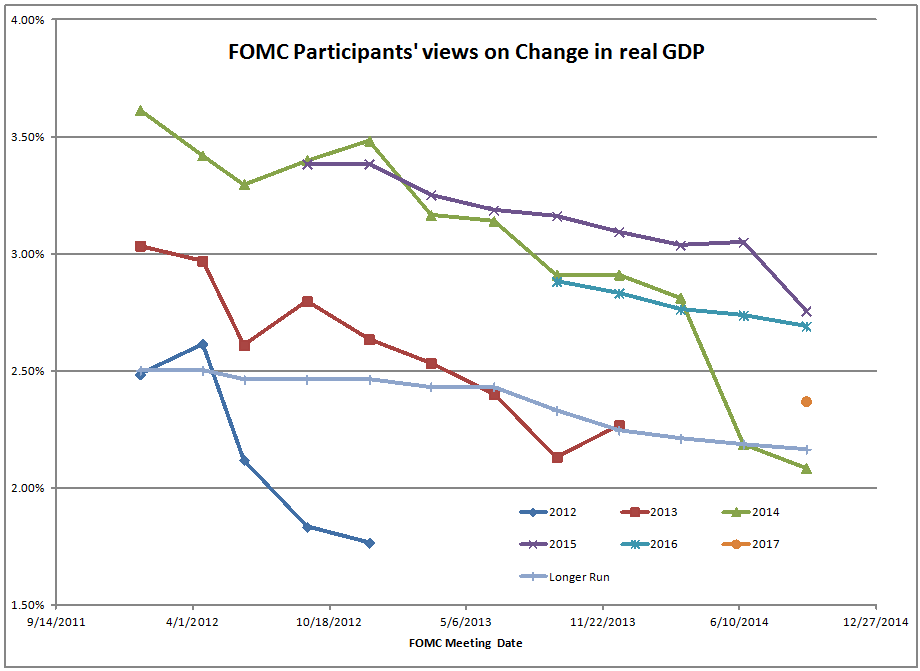
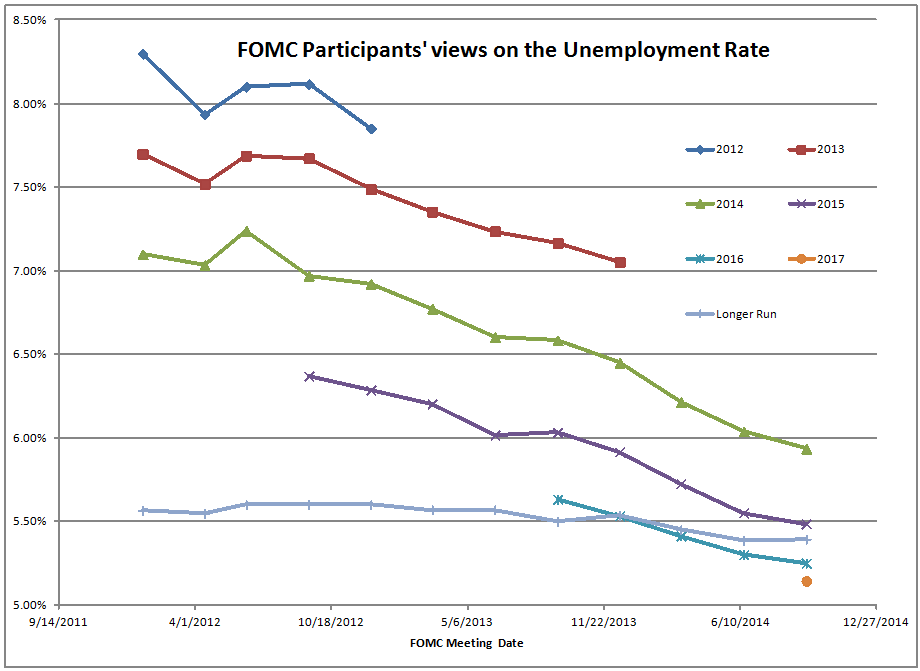
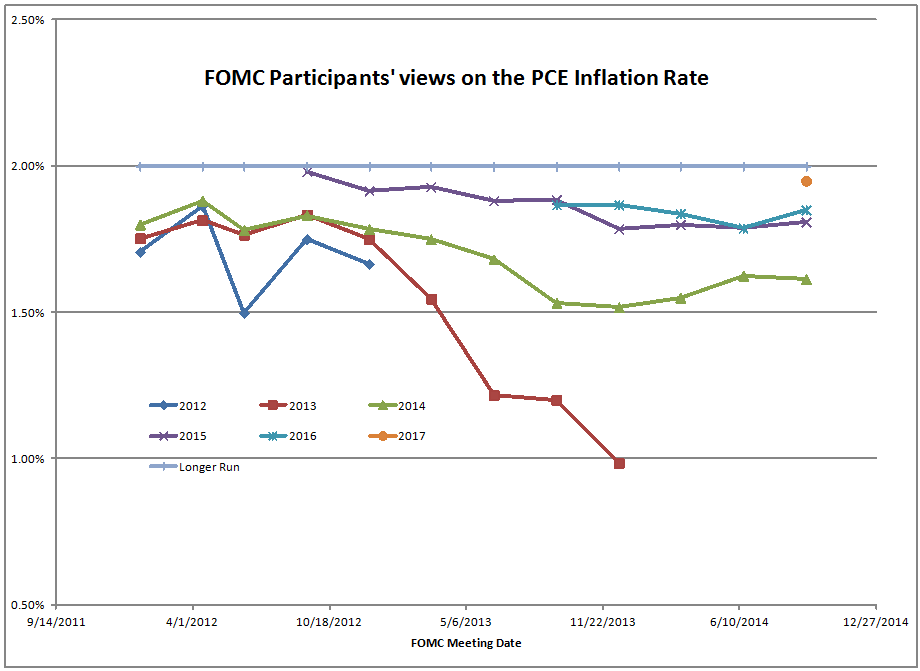
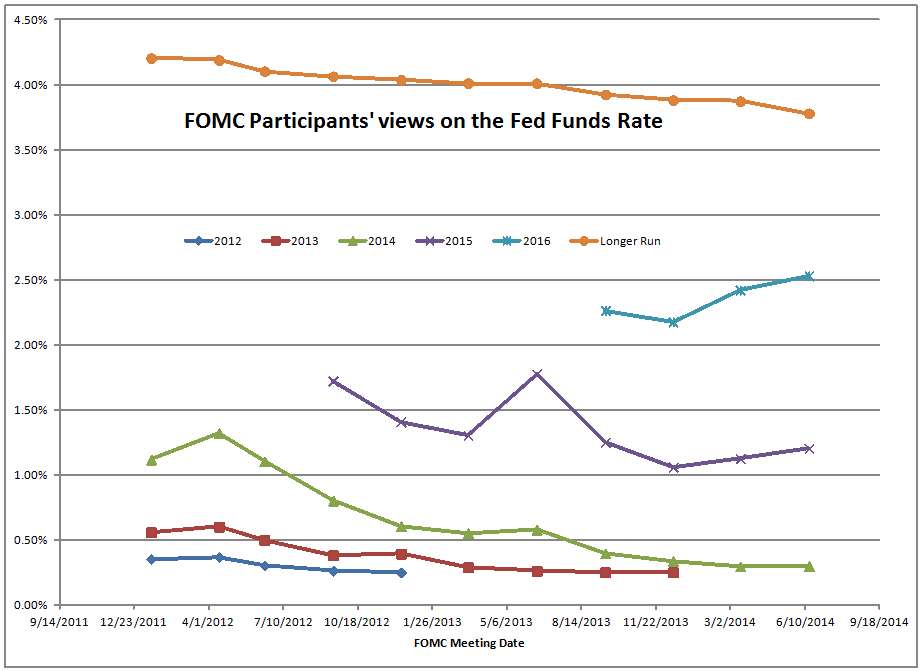
Okay, so what does the FOMC think?  Starting back in January of 2012, they started providing forecasts to us, and here is a quick summary of their efforts:

central tendency_10374_image001 GDP

In general, they have been overly optimistic about growth in the US economy.  They probably still are too optimistic.


Unemp

They have been better at forecasting the unemployment rate, even as it has become less useful as an indicator of how strong labor conditions are because of discouraged workers and more lower wage jobs.

PCE


In general, they have expected inflation to perk up in response to their policies a lot faster than it has happened.

FF


And as a result, like the market, they have expected to tighten in the past a lot sooner than they are presently projecting, which is not all that much different than the view of the market.  Also like the market, you can’t simply take an average of their views as representative of where Fed Fund will be.  Since the FOMC relies on voting, the median view would be more representative than the average Fed funds rate forecast, and that has remained at a relatively consistent “tightening will happen sometime in 2015″ since September 2012.  The median estimate of where Fed funds would be at the end of 2015 has also been 0.75-1.00% over that same period, which is higher than the current market estimate of 0.60%, but lower than the FOMC’s own estimate of 1.1%.

So, where does this leave us, but with a view that the FOMC will tighten policy next year.  But what if the monetary doves on the FOMC remain dominant?  After all, those that are permanent voting members are more dovish than the average participant tossing out an estimate.  That leaves me with this, which reflects the influence of the doves better:

Tighten


This graph is based on the average forecast, which includes a decent number of outlier views from some of the doves, which at present suggests tightening in January of 2016, but if you take into account the time drift of views since September 2012, it augurs for tightening in August of 2016.

The drift has happened because the economy has not strengthened the way the FOMC expected it would.  If we muddle along at the average rate of growth over the last two years, the FOMC may very well sit on its hands and not tighten as quickly as presently expected.  After all, labor conditions are soft, and inflation as they measure it is not roaring ahead.  (Please ignore the asset price inflation that aids the non-existent wealth effect.)

As it is, statements from the FOMC have been noncommittal, only saying that they are ending QE.  They are still waiting for their grand sign to act on Fed funds, and it has not come yet.

Summary

Current expectations from the market and the FOMC suggest that the Fed funds rate will rise in 2015.  Prior expectations of FOMC action have signaled much earlier action than what has actually happened.  From my vantage point, it is more likely that the FOMC moves later than the third quarter of 2015 versus earlier than then.  The FOMC has been slow to remove policy accommodation; it is more likely that they will remain slow given present economic conditions.


11 Oct 04:28

Why do people do a business?

by subra

Does every business have to be profitable?

Do all businessmen do a business to earn money? For themselves and their stake holder?

To the common man, yes!

Not true, not true, not true at all!

Many people do businesses to:

– keep themselves busy

– to show to the world that they are doing a big business

– hoping to make money 10 years, 20 years or 30 years later!

-for their own ego – and the price is paid for by the shareholders.

Let us take the case of ‘keeping themselves busy‘. In this category are a bunch of retail grocery stores. Most of them will earn much, much more by selling their shops and investing the monies well. However just because they have no hobbies, and have no clue about how to manage their time (but for the shop), they continue to go to the shop. What I mean is – If you are the owner of a shop with a market value of say Rs. 1 crore, and are aged say 55 – you should earn at least Rs. 15 lakhs a year – right? Well I know of shop keepers with a Rs. 2 crore shop and earning Rs. 5-6 lakhs…but WILL KILL ME, if I suggest a sale of the shop….’What will I do all day’ is a good rebuff. Not arguing against it, just enumerating as the first …

The second is worse. They are actually wasting good money after bad. They have a big set up, an office, daily visits to the office, AND ARE ACTUALLY LOSING money. One such category I know are some wholesale traders – they ‘invest’ say Rs. 5 crores in stocks…and at the end of the year they earn about Rs. 50-60 lakhs. Again not having a hobby (which means they need to go to an office till they CANNOT go) is a must. I know of a 70 year old who goes regularly…and frankly is destroying wealth. What do you tell him? Nothing.

There are some businesses which justify to their stakeholders business models based on hope. Or optimism. Hoping to make money after 7, 10 or 20 years. This is really funny simply because they way people buy things or services is changing fast. Very few people are capable of or willing to make long term commitment. So to think that businesses must build brands, build a ‘loyal’ customer base…sometimes need to be checked again and again.

The worst are those businesses that are run for the ego of the owner. There is no way on earth that a ‘gas’ or ‘petrol’ agency from a PSU (Fortune 500 Companies!) will ever make money. It is also very difficult to make money from an auto agency of a small car company. However it gives a lot of ‘social’ standing. So people with a lot of money (and own old real estate) need to be roped in.

Of course the absolute worst are subsidiaries of big large companies which may not earn money. The distance between the shareholder of the parent company and the company making losses is so huge that NOBODy really pays attention to what is happening. Shareholder activism, mutual funds becoming active in such companies, or threats of asset stripping are all necessary to help the shareholder. Not seen it in corporate India for a very long time.

Sad, is it not?

Corporate Egoism and Egotism are far more difficult to spot compared to Alcoholism.

Post Footer automatically generated by Add Post Footer Plugin for wordpress.

10 Oct 03:28

How to strengthen the National Pension System

by Ajay Shah
by Renuka Sane and Susan Thomas.

When the Old Age Social and Income Security (OASIS) committee was created in 1998, it was asked to design a pension system that: (a) increased pension coverage on the large area, population and diversity of India; (b) was low cost; (c) was accessible to unsophisticated participants; (d) provided choice of investment; (e) was backed by sound regulation; and (f) had long-run sustainability. The report of the OASIS committee recommended the creation of the National Pension System (NPS), a pension system that was innovative even by the standards of pension systems in developed economies. The design included the following features:
  • Individual accounts with defined contributions.
  • Central record keeping agency which will provide a single account balance statement for each individual, and will move net funds to the fund managers.
  • Investments managed by multiple pension fund managers, each offering standardised asset products. Auction based selection of fund managers where the selection is based on the sum of fees and expenses.
  • Collection of contributions done through a network of banks, post offices and other "points of presence" across the country.
  • Withdrawals permitted only after age 60, with a minimum mandatory annuitisation of 40 percent of the terminal pension funds.
  • EET tax treatment, where benefits and withdrawals are taxed as ordinary income.

The NPS became operational in 2004 for new recruits to the central government. A central recordkeeping agency (CRA) and selection of fund managers through auctions have led to some of the lowest cost structures in the world. The NPS has grown to having 7.1 million accounts, and Rs. 0.6 trillion in assets under management. While it is mandatory for new recruits to the central government, it can be accessed by all. A co-contribution scheme called NPS-Swavalamban encourages participation by poor households in the informal sector.

After a decade of existence, there is need to examine the existing NPS and compare the performance of this system to the goals with which it was created. In a recent paper, we analyse the NPS from this perspective.

Problems with the implementation of the NPS


While several of the key features of the existing system are consistent with the original design features, there are certain critical areas in which the NPS has deviated. There continues to be an attempt to reduce transactions costs in the system, with a central record keeping agency and a limited number of pension fund managers. However, the NPS has several flaws at the ease of accessibility as well as the choice of investments to the pension contributor:

Low transparency: One of the progressive features of the original NPS design was high transparency about cumulations for the NPS member contributors. However, this has not been implemented. Members do not always get communications regarding their pension wealth. There is as yet, no clarity on how long the process of contribution deduction to actual investment takes, and the costs incurred in the form of lost interest owing to delays in the process (if any) on the customer. The PFRDA does not make available aggregate details about assets under management, number of accounts, or cumulated returns. This lack of transparency leads to a lack of awareness and trust in the system, and reduces the quality of policy analysis.

Lack of investment choice: Government employees are not allowed a choice of investment strategy, or pension fund manager. The default investment option of government employees is badly structured - it does not cater to the best interests of participants. International diversification is not permitted.

Inconsistency in tax treatment: Schemes such as the GPF and the CPF continue to be taxed on a EEE basis, while the NPS is taxed on a EET basis. Employee contributions to the NPS above Rs.100,000 are taxed. These tax inconsistencies need to be rationalised.

Confusion: A key element of the original NPS was that it was one single pension system serving the entire country. For a variety of tactical reasons, before the PFRDA Act was passed by Parliament, a series of variants of NPS were created. These create complexity, hamper portability, and increase cost. It is time to go back to one single NPS.

Broader policy problems


Beyond the scope of the original NPS design, there are other policy issues that need to be addressed in order to achieve the end objective with which the NPS was commissioned: the goal of providing old age income security with coverage across the breadth and length of India.

One such issue deals with the question of the annuity the NPS contributor member can expect to access as a pensioner. The price of an annuity will influence the monthly pension available to a pensioner. If annuity prices are very high, it will have a detrimental impact on the pension payout. As of yet, there has been no active effort on the part of the PFRDA to enable the pensioner to obtain the lowest cost annuity product. Similarly, there has been no effort to design a common draw-down policy that works in the interest of both government employees and lower-income, informal sector workers, both of whom contribute to the NPS.

Another area of broad policy concern has centered around the sales of NPS so far. This has been perceived as very low, and has led to suggestions to incentivise sales intermediaries to push the sales of NPS, by improving their commissions. However, experience from the mutual fund and insurance industries in India shows that a combination of high-powered sales incentives without any liability for mis-selling does not lead to an increase in retail participation. Instead, it can lead to defrauding of customers. This suggests that it would be imprudent for the PFRDA to incentivise the sale of the NPS in an environment that is characterised by a lack of strong consumer protection. The PFRDA needs to first re-orient its strategy towards an explicit goal of consumer protection, with a clear enumeration of the rights of consumers and obligations of sellers. A relevant benchmark that provides explicitly for protections against misleading conduct by sales agents is the Indian Financial Code.

The light at the end of the tunnel


One of the key bottlenecks for the NPS since it was implemented in 2003, was the lack of a sound regulatory framework that was implemented by an empowered and independent regulator. While the PFRDA has been in place at the same time that the NPS was implemented, it has awaited the passage of the PFRDA Bill for a regulatory mandate and empowerment. This Bill has since been passed in 2013, enabling the formal institutionalisation of the PFRDA as the regulator of the NPS.

The PFRDA can now take on the task of both the relatively short term agenda of closing the gap between the current implementation and what was visualised in the original design. This includes building trust in the system by improving the transparency and visibility of fund accumulations for contributor members and the overall system; enabling a richer choice of investments available to individual members; and resolving inconsistencies in tax treatment.

Another area which the PFRDA can take forward is to initiate the policy thinking and research analysis for the medium and long-term objectives of sound policy and regulation for annuities, and to design the regulatory framework to improve the NPS customer rights.

With these actions, India can get back on the track to achieve a pension system with universal coverage that was visualised in the OASIS reforms of 1998.
10 Oct 03:28

Completely Contrarian View

by subra

I know many IFAs read my blog and so do many investors. I know a couple of fund managers too read it, especially when I write about their fund – but more if I write about a competitor fund.

So here is a Completely Contrarian View.

1. Every site tells you that the ONLY thing you can control is costs: True. So you should buy a fund with the lowest costs. Correct. However my take is, well, a little different. If you are reasonably sure about the fund manager, and his capabilities, it is worth taking a risk with that fund manager. Once upon a time I owned a Unit Linked Endowment Plan and a unit linked Pension plan too.

I had done the theoretically the right things. I had picked up the ULEP with the CHEAPEST fund management costs.

Excellent, so my fund should be doing well, right? Wrong. Saurabh Nanavati quit the fund house, and with it my advantage of paying only 0.80% as fund management charges. Even now Hdfc ULEP is a well managed fund, with a low amc, but my returns on other funds is superior DESPITE the higher fund management.

2. The name of the fund manager is not important, only the process and the fund management skill of the team is important: Guilty. I interacted and found that I would be happy dealing with Siva and then also had some interaction with a couple of CIOs of Hdfc. Once PJ came on the comfort level surely went up. I had started investing with Hdfc Growth fund, and had no complaints. Then the Pioneer funds came into the Hdfc fold and along with it PJ. I felt here was a good fund house (sanitation was in place), and a good fund manager had joined. Remember I had NOTHING against Sanjoy B – but he was a little carried away at times….but I still do hold Hdfc Growth fund..and have no major complaints. But yes the amount of money at stake was still small.

3. My trust on the ‘brand name’ Icici Prudential started ONLY on the day Nilesh Shah joined from Templeton and attracted brilliant fund managers like Naren Sankaran. Here I had the luck of knowing NS from an earlier relationship. Nilesh of course from FT – but he was not what we call the ‘star’ equity fund manager. However he meant ‘cleanliness’ and we saw the results quickly. NS took charge of a couple of funds like Discovery and Dynamic – so that became our favorites too. Since many of us did not make the mistake of investing in Infra, etc. our portfolios did well.

4. The fund house is not important: For me at least, the fund house was very important – which meant I was restricted to about 5-6 fund houses, and on a concentrated basis just 2-3 fund houses to do business. This is tough if your business model is ad dependant…I am not.

I am largely an equity man and still find it easy to do a portfolio construct / deconstruct…


Post Footer automatically generated by Add Post Footer Plugin for wordpress.

10 Oct 03:24

The Future Will Be Like The Past, Only More So

by David Merkel
Photo Credit -- Javier || Buffett believes in America

Photo Credit — Javier || Buffett believes in America

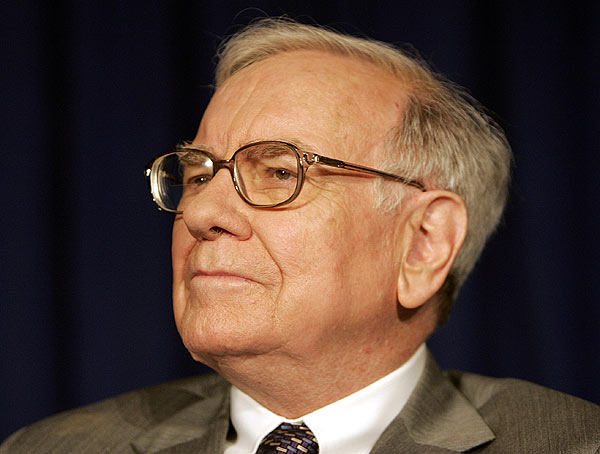
Yesterday there was an article where Buffett was quoted on getting mortgages to buy houses. Let me quote the most relevant portion:

“You would think that people would be lining up now to get mortgages to buy a home,” Buffett said today at a conference hosted by Fortune magazine in Laguna Niguel,California. “It’s a good way to go short the dollar, short interest rates. It is a no-brainer. But so far home construction pickup has been slower than I had anticipated.”

Now, when I read the comment stream on the article, I was not surprised at the level of disagreement, but the vitriolic nature of the the disagreement.  Buffett is certainly not made of Teflon anymore, and fame has led to its share of detractors.

Now, I don’t think that Buffett is giving the right advice to everyone here, but I also don’t think that he is talking his book because has has investments in firms that sell:

  • Real estate
  • Manufactured housing
  • Building materials
  • Mortgages
  • Etc.

Indeed, Buffett has enough investments that almost anything he says could be talking his book.  I think his character is such that he does not talk his book — his firm is one that is built on “low hype” attitudes, at least, low hype for a company of its size and complexity.

Should everyone run out and get a mortgage because it is a cheap time to be borrowing money?  That is an individual question, hinging on how secure and high your income is versus the likely payment on the mortgage, and other housing-related expenses.

The interest rate may indeed be low relative to history, but how well will the economy do in the future?  Maybe residential housing is too expensive in some areas to get a lot of people excited about buying.

Buffett also said:

“Household formation falls off dramatically in a recession, at least initially,” he said. “But that doesn’t last long. Hormones kick in and in-laws get tiresome, too.”

Unless something changes in US culture, there have been changes to the demand for homes, driven by the following factors:

  • People are marrying later and less frequently
  • They are having fewer kids
  • Urban areas are more attractive for many people to live in, reducing commute time and costs.  Even car-buying is affected.
  • There are fewer move-up buyers because of the financial crisis.
  • The ability of lower middle class people to afford homes has been reduced, particularly in high cost of living areas.
  • The financial crisis has ruined the illusion that residential real estate is an investment that can’t lose money.

There may be more reasons, but even though the 30-year mortgage is the cheapest long-term financing that an average person can get, there are more people than before who are not interested in buying a home.  Renting suits their goals fine.

As such, I think Buffett is wrong here, and that borrowing to buy residential housing will not be as prominent as it was in the past.  But I don’t think he has any bad intentions in what he said — he believes in America, and thinks that we will return to the consumption patterns of the past, which relied on too much debt in my opinion.

Final note: I’m getting tired of reading comment streams.  The people there are often too cynical, and too loose with the truth.  Their expectations for what they deserve in this life are also inflated beyond what is reasonable.  Some turn to conspiracy theories to keep themselves from blaming their bad fortune on their own actions.

Buffett is generally a good guy, and a good example as far as businessmen go — he does not deserve the abuse.  I don’t agree with Buffett’s politics, but I don’t think that he is not sincere.

Full disclosure: long BRK/B and WFC

10 Oct 03:20

Subra will you answer some simple questions please?

by subra

Of course I will…in fact when somebody asked me some questions, I had already answered it…so here I am sending you the link!!

Here are some questions: i have already answered them in earlier posts, hence just connecting..sadly wordpress is not working well…and I am not able to link it..please cut and paste the links on the browser and it should work…

1. Subra I agree that short term predicting of markets is difficult, but some of these mutual fund schemes have given 20% return over 25 years…will they not give 20-30% returns over the next 25 years?

http://www.subramoney.com/2012/03/will-equity-give-the-best-returns/

2. I do not want too much returns, but over the next 25 years, by picking direct equities in good companies like L&T can I not get 6-7% p.a. MORE than the index?

http://www.subramoney.com/2011/06/equity-returns-depend-on-timing/

3. I have about Rs. 20,000 pm to invest. I cannot afford a financial planner, do I really need one?Can I use websites like yours and…(name deleted) instead of using a financial planner? Is a planner charging say Rs. 8k per annum as good as a planner charging 20k?

http://www.subramoney.com/2008/01/financial-planner-do-you-need-one-at-all/

4. I am doing a course in Forex trading – I paid US $ 3000 for it. They say they will GIVE me money to play in the Forex markets so that I learn properly, is it a good course?

http://www.subramoney.com/2010/06/doctors-losing-money-in-equity-markets-a-story/


Post Footer automatically generated by Add Post Footer Plugin for wordpress.

10 Oct 03:19

Should a government subsidise the purchase of energy-efficient equipment?

by Ajay Shah
Today the Financial Express has a story, where LED bulbs costing Rs.400 will be sold at Rs.10 with the government paying for the difference. Does this make sense? I think it does not, and that this situation calls for a lot more sophistication in thinking about public policy.

What's the market failure?


The first and obvious place where this spending program fails to make the grade is on the question of public goods. I get a gift of Rs.390 to have a LED bulb, I benefit. The bulb is a private good. A gift to people who buy LED bulbs is as wrong as government spending on other private goods. Just as we criticise a government which runs health clinics for perambulatory care, we should criticise the government when it gifts money to people for the folks who buy LED bulbs. This is just the faddish thinking of one bunch of hausfraus running policy versus another.

The guiding question, in all design of government, should be: What's the market failure? I am not able to see a market failure in the working of the market for LED bulbs.

Get the prices right


Some people in the field of energy have an almost moralistic perspective on energy efficiency. Higher energy efficiency is seen as a good thing, regardless of cost. This is the wrong way to think about it. Energy efficiency is just one part of economic efficiency. An LED lamp is a big up front payment and then a stream of gains in the future. Whether the LED lamp is worth putting in depends on (a) The magnitude of each gain (i.e. how much you use that lamp) and (b) The discount rate. If the interest rate is high, it will make sense to buy a Tungsten bulb instead.

To obtain efficiency in the field of energy we should think about three things:

  1. The first is the question of pricing of energy. When energy is cheap, it will be squandered by consumers, and vice versa. Externalities should be priced in. The biggest externality that is not being priced in is carbon emissions. When we fix these mistakes, the price of energy will go up, which will encourage people to buy energy efficient equipment.
  2. When a household chooses to get capital goods of more or less energy efficient equipment, the flip side of these decisions are the capital goods that will be invested upstream, in the large factories of the energy industry such as generation utilities or natural gas infrastructure. Optimality requires that society should solve that overall problem correctly, and the overall problem is the combination of energy production, energy transportation and the end-devices which use energy. It is not obvious that the greatest bang for the buck is always obtained at the device end.
  3. For that overall problem to be solved correctly, consumers and energy companies should be hanging off a sensible financial system which shows interest rates to both which are internally consistent. The failures of the Bond-Currency-Derivatives Nexus in India hamper that. The interest rates seen by households (which determine their purchase of LED bulbs) are strange, and the interest rates seen by the energy industry are quite different and also strange.

The engineer in me marvels at LED lamps. I was thrilled when the 2014 Nobel Prize went to the geniuses who made blue LEDs; this is simply one of the great sagas of the 20th century. I have watched Shuji Nakamura ever since he moved to UCSB in 1999. But this `gee whiz' should not blind us on questions of public policy; we should be hard headed in how we thinking about what government does. Most of what government in India does is not the job of government; most of what government ought to do in India is not being done. The rocket science that we require in India is the great organising principle of the market economy -- the Bond-Currency-Derivatives Nexus.
08 Oct 11:37

Online Shopping, Investing, and Why We Get Fooled

by Vishal Khandelwal

A three-bedroom apartment. Two cars. Enough flying miles to send an airline into losses (well almost!). Job with a foreign consulting company. Annual salary of Rs 30 lac…or around 45-times India’s average per capita income. Yet my friend Rohan is not happy.

Whenever I meet him, he is, as I put it, caught on the “work-spend treadmill.”

So, just two days back, when he was showing off his latest purchase, a fourth mobile, and one costing in excess of Rs 45,000, I asked him, “You really need one more?”

“It was selling cheap on Flipkart, and so I bought,” he replied.

I knew that handset was Rs 5,000 cheaper on some other website as my other friend had bought it very recently. But then, how do you explain that to someone who bought stuff not because he wanted it, but because “it was selling so cheap and everyone else was buying like crazy!”

I have countless other stories like Rohan’s, where people bought stuff from Flipkart on its Big Billion Day – not because they needed stuff, but because things were selling cheap (at least that was what Flipkart communicated well) and they wanted to buy because others were buying, and before others could buy what they wanted.

What else justifies that Flipkart did a business worth around Rs 600 crore within a matter of few hours? By the way, its competitor Snapdeal has also managed to sell goods worth Rs 600 crore on its own big sale day.

Now, we know for sure that Flipkart and sellers on its platform would have had to bear huge losses for that day’s sale, but that’s not the point here. What’s more important is how companies – especially in the ecommerce space – use a lethal behavioral bias that is bound to fool a large majority of consumers in buying stuff they need. Things worth Rs 1,200 crore in a few hours!

Well, that bias is known as…

Social Proof
Have you ever been in a situation when you looked at the sky, or at something, just because someone else was staring there? Like in this image below…


I remember playing a few of such pranks during school days, when a group of us friends started looking at the sky and then giggling at passers-by following us in doing so.

It’s another matter that I did not realize then that I was getting the passers-by to indulge in what psychologists call as ‘social proof’.

As per Wikipedia, social proof is…

…a psychological phenomenon where people assume the actions of others in an attempt to reflect correct behavior for a given situation. This effect is prominent in ambiguous social situations where people are unable to determine the appropriate mode of behavior, and is driven by the assumption that surrounding people possess more knowledge about the situation.

In simple words, social proof is all about ‘what-you-think-I-think…what-you-do-I-do”.
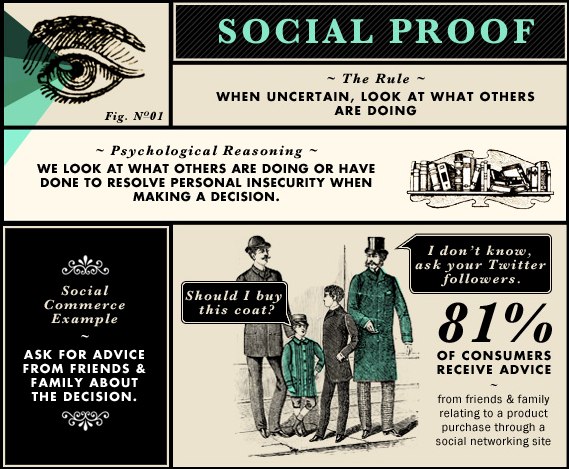

Social proof is what is at work in canned laughter – what you hear in comedy shows. The reason such laughter exists is it causes the audience to laugh longer and more often when humorous material is presented and to rate the material as funnier.


In fact, you will hear the laughter even when there’s nothing to laugh about. I propose they add such laughter to business channels as well, so that people stressed hearing the experts can get a few laughs. :-)


Social proof applies especially to the way we decide what constitutes correct behavior. We view a behavior as more correct in a given situation to the degree that we see others performing it.

Whether the question is what to do with an empty popcorn box in a movie theatre, how fast to drive on a certain stretch of highway, or what to put on the plate at a dinner party, the actions of those around us will be important in defining the answer.

Social proof works to both our advantage and disadvantage. When someone shouts “Bomb!” at a packed theatre, it pays to run with others for safety without being analytical.

Social proof also helps us find books we’ll like (Amazon reviews), restaurants to eat at (Zomato), and places to travel (TripAdvisor).


We don’t make our decisions in a choice vacuum. Our social circles influence our actions and our purchases, and that’s normal.

How Managers Make Decisions
Social proof also works at a bigger level…inside companies. That is what drives most CEOs to act like their peers. So they will acquire companies just because a competitor is doing so. And they will conduct accounting frauds just because many others are doing so!

Here is what Warren Buffett wrote to his managers in September 2006, when his peers in corporate America were all under the spell of social proof to justify their misdoings…

The five most dangerous words in business may be “Everybody else is doing it.” A lot of banks and insurance companies have suffered earnings disasters after relying on that rationale.

Even worse have been the consequences from using that phrase to justify the morality of proposed actions. More than 100 companies so far have been drawn into the stock option backdating scandal and the number is sure to go higher. My guess is that a great many of the people involved would not have behaved in the manner they did except for the fact that they felt others were doing so as well. The same goes for all of the accounting gimmicks to manipulate earnings – and deceive investors – that has taken place in recent years.

You would have been happy to have as an executor of your will or your son-in-law most of the people who engaged in these ill-conceived activities. But somewhere along the line they picked up the notion – perhaps suggested to them by their auditor or consultant – that a number of well-respected managers were engaging in such practices and therefore it must be OK to do so. It’s a seductive argument.

But it couldn’t be more wrong. In fact, every time you hear the phrase “Everybody else is doing it” it should raise a huge red flag. Why would somebody offer such a rationale for an act if there were a good reason available? Clearly the advocate harbors at least a small doubt about the act if he utilizes this verbal crutch.

Social Proof and Stock Market
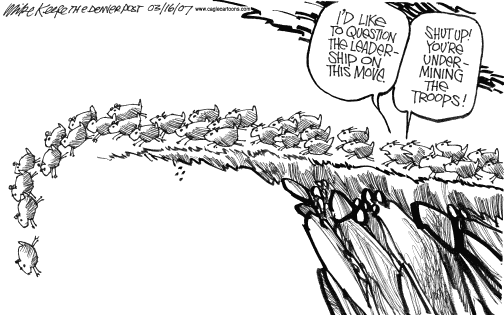
Social proof also works in stock market investing.

Why do you think most of us are always on the lookout for others’ opinions on online forums on the stocks we own or want to own?


Social proof is the reason you will find most fund managers owing similar stocks in their portfolios. The thinking is – “If I outperform, I will be a star…but if I underperform, I will be like others!”

But then, Somerset Maugham said, “If 40 million people say a foolish thing, it does not become a wise one.”

You will scold your child who misbehaves and then says, “But everybody else is doing it.” Have you ever scolded yourself for investing like everyone else is doing?

Seeing the way things are going on in the stock market, I am sure that day is not far when we would see this…


3 Kinds of Social Proof in Investing
There are three types of social proof that impact investors’ decisions – and that you should be very careful of:

1. Television “Experts”: 24×7 television business channels like CNBC have turned investing into a game of sound bites.

Switch on the channel any time during the day (or night) and you will find talking heads and experts spew out their strategies to making money. Every strategy will be different and each one will promise to make you a lot of money if followed.

I’ve seen a lot of people – even a few otherwise sensible investors – fall prey to such strategies and lose their money and good night’s sleep. They speculated in stocks just because someone on TV, posing as an expert, was speculating on that stock.

It’s a trap, dear friend, to invest in a stock just because an “expert” is doing so. You may know from your personal experience.

2. Peer Investors: I’ve seen a lot of investors get their investment advice at the gym or at work when a friend shares what he or she has been buying.

Interestingly, when people talk about their investments, they usually talk only about their large gains. But, even if those claims are true (and they’re hard to verify), it’s difficult for others to profit on those recommendations because the stocks or mutual funds in question have already gone up.

If you’ve ever read the comments on investing blogs or stock forums, you’ve probably seen similarly smart-seeming peer advice – “I bought this and it doubled!”

Funny, but you never hear about the picks they got wrong, do you?

It’s thus important to avoid reading stock forums and especially picking your stocks from there.

3. Wisdom of the Crowds: When McDonald’s claims “Over 1 Million Served,” the message people take away is that, somehow, such a large number of people couldn’t have made a wrong eating choice. So they must be right.

Stocks and mutual funds are similar. Certain stocks and mutual funds have almost cult-like followings.

The massive hype creates a very positive aura around these investments, but a lot of hype doesn’t mean these are necessarily the best funds to buy at all times.

How Newton Got Fooled
South Sea Company was formed in the United Kingdom in 1711. The company had a monopoly in trade with Spain’s colonies in South America and the West Indies as part of a treaty made after the War of the Spanish Succession.

When investors recognized the potential profits to be made from trade with the gold and silver-rich South American colonies, they bid the South Sea Company’s shares and the shares of similar trading companies to incredible heights in a typical speculative bubble fashion.

The stock of the company rose to 128 pounds in Jan 1720, then 330 pounds in March 1720, 550 pounds in May 1720, 890 pounds in June 1720, and around 1,000 pounds later in the summer.

Though the South Sea Company’s shares were skyrocketing, the company’s profitability was mediocre at best, despite abundant promises of future growth by company directors. Its shares leaped to 1,000 pounds per share by August 1720 and finally peaked at this level before plunging and triggering an avalanche of selling.

By September it was down to 175 pounds, and by December to 124 pounds.

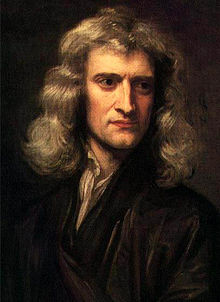
Anyways, Sir Isaac Newton had invested in the South Sea stock before its sharp rise and then came out with a 100% profit in a few months.

However, led by social proof – his friends were making even bigger returns on the stock – he caved in and bought the stock again near its peak, and then all hell broke loose! See this great chart below of Newton’s misdemeanours in the South Sea bubble…
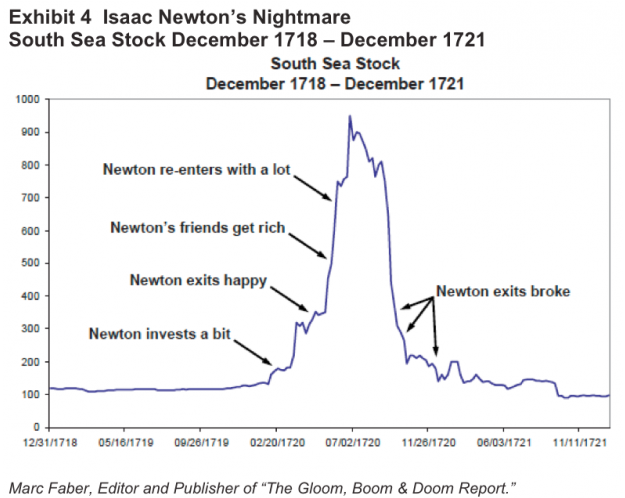

Interestingly, while selling his stock for a 100% profit earlier, Newton said this – “I can calculate the movement of stars, but not the madness of men.”

But he himself gave in to the madness caused by social proof (“Everyone is getting rich!”). So the man whom gravity found, could not understand the gravity in the stock market!

From South Sea to Reliance Power
I remember attending the pre-IPO meet of Reliance Power in early 2008, as the company was coming out with India’s largest IPO ever.

At the dais, alongside Mr. Ambani was a “respected” investment banker who had worked on this public issue. What I heard this investment banker promising to investors and brokers who were attending the meet was shocking.

“The IPO will more than double your money on the listing day!” he announced as if he had seen the future. A large number of people stood up and applauded this statement, and similar other promises made during that meet.

I know of how people sold off their other stocks and assets to apply to the Reliance Power IPO (some were my distant family members!). Everyone wanted to get a pie of the IPO not just because the “stock was expected to double on listing day” but also because “everyone else was also applying”!

When I advised people to avoid the IPO at all costs, I heard statements like…

  • “You have lost your head! This is a sure-shot winner.”
  • “Everyone would me making money on this IPO, so I don’t want to miss out.”
  • “So many people have made money on previous IPOs that I had avoided. Not this one!”

Anyways, what followed is in front of us…
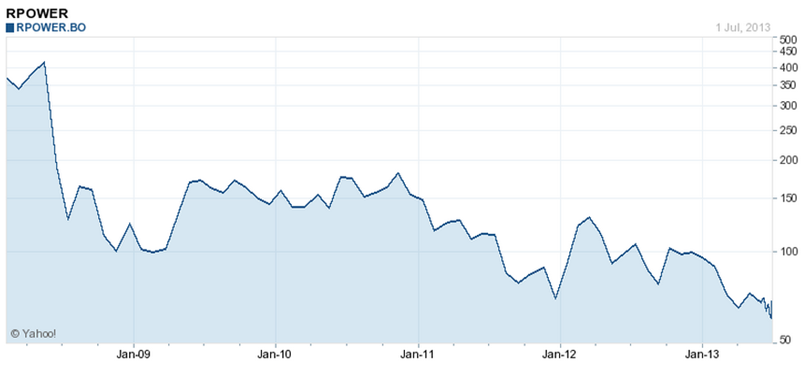

All stock market bubbles – like the one you saw in the Harshad Mehta days, or Ketan Parikh days, the dotcom boom, and the real estate boom – are caused by social proof as everyone wants to act and invest like everyone else.

You must have seen several such instances in your investing life as well, when people around you were buying or selling stocks just because “everyone else was doing so”.

You must have yourself fallen into this trap, haven’t you?

Well, that’s how social proof works in investing. It explains why most of us buy high and sell low (because “most” of us are doing so!).

How Fund Managers Behave
Do you think your mutual fund manager knows a lot and uses only his intelligence to pick up stocks? Well, fund managers are also human beings and are affected by social proof.

Warren Buffett writes…

Most managers have very little incentive to make the intelligent-but-with-some-chance-of- looking-like-an-idiot decision. Their personal gain/loss ratio is all too obvious: if an unconventional decision works out well, they get a pat on the back and, if it works out poorly, they get a pink slip. (Failing conventionally is the route to go; as a group, lemmings may have a rotten image, but no individual lemming has ever received bad press.)

Here is how a fund manager thinks – “It really doesn’t matter a lot to me what happens to this blue-chip stock as long as everyone has it and we all go down together. But on the other hand, I cannot afford to try for large gains on unfamiliar stocks, which would leave me open to criticism if the idea fails.

This explains why for a very long period, only a handful of mutual funds beat the broader markets. Everyone is trying to do exactly like others are doing and thus most come out with less than average results.

Keep in Mind
How to get over the social proof tendency?

Here is some advice from Peter Bevelin’s amazing book, Seeking Wisdom

  • The 19th Century American poet Ralph Waldo Emerson said: “It is easy in the world to live after the world’s opinion; it is easy in solitude to live after our own; but the great man is he who in the midst of the crowd keeps with perfect sweetness the independence of solitude.”
  • What is popular is not always right. If you don’t like what other people are doing, don’t do it. Warren Buffett says: “We derive no comfort because important people, vocal people, or great numbers of people agree with us. Nor do we derive comfort if they don’t.”
  • Disregard what others are doing and think for yourself. Ask: Does this make sense? Remember the advice from Benjamin Graham, the dean of financial analysis – “Have the courage of your knowledge and experience. If you have formed a conclusion from the facts and if you know your judgment is sound, act on it – even though others may hesitate or differ. You are neither right nor wrong because the crowd disagrees with you. You are right because your data and reasoning are right.”

Basically, if you want to be successful in investing, you got to form your own independent opinions. Learn from vicarious experiences, for that will save you a lot of money.

As far as saving money otherwise is concerned, like not buying things your don’t need, here is a flowchart that can help you.

This has helped me a lot in saving a lot of money by leading me to NOT spend a lot of money on things I now consider frivolous.

Click here or on the image below to download the flowchart. It may not be a perfect one that solves your spending problems, but it has helped me immensely, and thus I am sharing it here.

In the chart, start reading from “Should I spend big money?”


(Want to save the full image? Click on the image above, then right-click, then click “Save image as…”)

I am sure this chart will help you save a lot of money as you begin drawing your Diwali shopping list. :-)

Finally, remember what Benjamin Franklin said – “Buy what thou hast no need of, and before long thou shalt sell thy necessaries” – which simply means – If you buy things you don’t need, soon you will have to sell things you need.

I have nothing to add.

References and Further Reading

Disclosure: I participate in the Amazon Associates Program, which simply means that if you purchase a book on Amazon from a link on this page, I receive a small commission. The book does not cost you any extra. I give away 100% of the commission for the betterment of the under-privileged.


No related posts.

08 Oct 11:33

Amusing Real Estate Experiences….

by subra

All these experiences are anecdotal and may not be useful at all for you. However it could be illustrative of what happens in the RE market..and could become some kind of a learning. However it may or may not work for you, so that is the caveat.

I have been looking to buy a house in Nerul, a suburb of Navi Mumbai. This would be about 40 km from the central business district called Nariman Point. For most people in So Bo (South Bombay – many of them still have not reconciled to Mumbai). So it could be an unwanted, eastern suburb of Mumbai, but if you saw the RE prices you would think you are in Manhattan.

1. Brokers are the only ones chasing you. Literally unemployed from dawn to dusk they chase you with houses which could be much beyond your budget, or much smaller in size, or at a location which you have specifically said NO to.

2. We wanted to buy in one colony called Army Colony, Nerul. That experience should be a separate post! We met people asking for Rs. 1.55 crores to people asking for Rs. 2.1 crores for SIMILAR house, with same level of interior work done. Amazing, but no deals have happened there in the past 6 months, so pricing is just a number in the sky.

3. We saw a 2500 sft house priced at Rs. 7 crores, and a 2000 s ft house about 700 mts away NOT SELLING for Rs. 1.8 crores. I believe he has now UPPED THE offer to Rs. 2.1 (my broker was laughing). But hey if he wants to sell, he wants to. If he does not want to sell, he does not want to!!

4. One lady is trying to sell a 3 bhk for Rs. 1.56 crores and buy a 1 bhk. Her best offer is Rs. 1.46 for the flat she wants to sell and she cannot get a 1bhk for anything less than Rs. 77 lakhs! amusing. Demand and Supply I guess.

5. There are people in the market who come regularly to feel ratified that their house is quoting at a particular rate. No intentions of selling, aise hi, time pass kar liya..

6. If you think selling a house is difficult, it is so damn true. Hey buying WITH a budget in a particular LOCATION of a particular SIZE is a good damn pain in the wrong places.

7. All the RE websites are infested with brokers offers.

8. Brokers lie. One broker said the deal is closed, but the SELLER had not even heard of this broker.

…can go on…instead I want YOU to add YOUR home buying / selling  nightmare…

Post Footer automatically generated by Add Post Footer Plugin for wordpress.

08 Oct 03:37

When management gurus dissect politics....

by T T Ram Mohan
How can we tell whether a political leader such as Narendra Modi will succeed? Three management experts, including Ram Charan, attempt an answer in a business journal. I can't say I was bowled over by their analysis.

The authors say we should look for five signals, on all of which Modi scores. Let me take up two in detail

i. How deep is the politician's insight into public interest? Modi's interest is very deep, the authors say, because of his own background of poverty. Well, Manmohan Singh too came from a poor family in a very backward village. He could, perhaps, claim that he understood the poor as well as the elite and was thus well placed to negotiate his way through the elite on behalf of the poor.In India (unlike in the US), we have hordes of politicians who have come up from the grassroots. Lalu Yadav and Mayawati, for instance. But they have not proved to be transformative leaders in the sense of bringing about an improvement in the lives of the class of people they once belonged to.

ii. Can the leader get things done? Modi has a record as a doer in Gujarat, the authors point out. But Gujarat was one of the best performing states even before Modi became Chief Minister (although, to his credit, Modi was able to maintain that record). India's growth rate has improved since the nineties and through the noughties under a succession of governments and leaders. Not all were headed by doers. However, starting with Narasimha Rao, we managed to put in place policies that paid off. So, yes, it helps to be good at execution but the role of policy must not be understated.

The authors mention other factors that favour Modi: his business mind-set, his ability to engage senior government officials, the broad support he enjoys. It's hard to disagree on these. But none of these by themselves or even put together ensure results.  Both Indira Gandhi and Rajiv Gandhi had broad support but both saw how quickly this could dissipate. A "businesss mind-set" can be a negative if it means being pro-business at the expense of welfarist considerations.

Modi's strengths are his ability to connect with the masses, formidable administrative experience, a a capacity to think out of the box. deep study and reflection, boundless energy and a genuine passion to make a difference at the national level. This combination bodes well for any leader. We don't need management experts to tell us that.


08 Oct 03:35

Exclusive : Yahoo Is Laying Off Everybody In India. Everybody.

by Ashish Sinha

Yahoo SDC (Software Development Center) is laying off everybody in India . The last day is November 7th and out of 2250+* people in Yahoo SDC Bangalore, only 250 remain (some of them have been given an option to go to Sunnyvale office).

*Update : There are several reports that claims that Yahoo is laying off ~600 employees (mostly engineering). 

The ones who have survived the layoff are mostly from engineering operations team (Yahoo India teams, which looks at Yahoo.in web properties are untouched).yahoo

From what we know, this is not a cost cutting exercise, but the company is planning to consolidate its development centers.

Yahoo is giving a severance package of 5 months (in extreme cases, 10 months) and the d-day for employees is November 7th (We hope Yahoo engineers use this as seed funding and startup!).

This comes as a surprise though, given that Yahoo recently acquired Indian startup, Bookpad and in some ways, sent a strong signal of focusing on Indian market for talent.

“As we ensure that Yahoo is on a path of sustainable growth, we’re looking at ways to achieve greater efficiency, collaboration and innovation across our business. To this effect, we’re making some changes to the way we operate in Bangalore leading to consolidation of certain teams into fewer offices. Yahoo will continue to have a presence in India and Bangalore remains an important office.” [Official statement from Yahoo India]


» Tip : For startups looking to hire talent, go ahead and add your job opening details here and attract some of the best engineering talent that Yahoo has.

The post Exclusive : Yahoo Is Laying Off Everybody In India. Everybody. appeared first on NextBigWhat.com

08 Oct 03:35

Cera Sanitaryware Announces Q2 Results; Net Profit Soars 48.31%, Shares At A 52-Week High

by Gautam Jagannathan

Cera Sanitaryware (BSE: 532443; NSE: CERA) today hit a 52-week high of Rs. 1848 (at 13:56 p.m.). That is a jump of 16.72% from the previous close price of Rs. 1583.25.

CS_01

Not only did the share price see a surge, there were massive volumes being traded today. A total of 47,009 shares were traded today; the highest since 5th May, 2014 when 79,870 shares exchanged hands.

Why did the share price jump so much?

Earlier today, Cera released their stand-alone financial results for Q2 2015 (period ending Sept 30, 2014). The numbers look very impressive:

CS_02

Looking at the year-on-year numbers, we see that:

  • Total Income from Operations has increased 25.72%, from Rs. 158.76 cr. to Rs. 199.60 cr;
  • Finance Costs have increased ever so slightly; a 5.59% increase year-on-year;
  • Net Income has jumped by 48.31%!

That is quite staggering. Cera saw a massive jump in Net Profit for Q2 2015; up from Rs.(Read On...)

07 Oct 04:47

Looking after one’s portfolio

by subra

When I see people talking about their portfolios almost all the time, it sets me worrying. This is like body building – doing more workouts results in injury – and some injury could be dangerous. One needs to have a portfolio and a career – the career means some time when you are not fine tuning your portfolio – asset allocation, evaluating performance, asking people ‘what do you think of Colgate? is it over priced? or some shit like that.

Increasingly I find people on websites thinking that by tampering with the portfolio on an hourly basis, their yield will go up. For such people this story is likely to be useful.
The following story is either a part of Panchatantra tales, Buddhist tales or Jataka tales – frankly it does not matter. See how relevant it is in your own life.

When you invest money, you should stay a little away from it for a long time. When you are busy with your life elsewhere, your portfolio grows.

Long long ago…there was a Garden which was beautifully created by a very nice gardener. It was time for Diwali and he too wanted to go to see his wife and children who were staying far away. The owner of the garden told him – find somebody who will take care of the garden in your absence – and after that you are free to go.

He was very sad, but still wanted to go. When he was wondering what to do, he saw a bunch of monkeys who were living in the garden. The gardener wanted to celebrate the holiday, just like everybody else. So he decided to hand over his duties to the monkeys.

He went to the monkey king and said, “Oh king of monkeys, my honourable friend, would you do a little favour for me? I must be away for 2 weeks. Here in this lovely garden, there are plenty of fruits and berries and nuts to eat. You and your subjects may be my guests, and eat as much as you wish. In return, please water the young trees and plants while I’m gone.”

The monkey king replied, “Don’t worry about a thing, my friend! We will do a terrific job! Have a good time!”

The gardener showed the monkeys where the watering buckets were kept. Feeling confident, he left to celebrate the holiday.

The next day, the monkeys filled up the buckets, and began watering the young trees and plants. Then the king of the monkeys addressed them:

“My subjects, it is not good to waste water. Therefore, pull up each young tree or plant before watering. Inspect it to see how long the roots are. Then give more water to the ones with long roots, and less water to the ones with short roots. That way we will not waste water, and the gardener will be pleased!”

Without giving it any further thought, the obedient subjects followed their king’s orders.

When a wise man asked them what they were doing they replied as follows “We are watering the trees and plants, without wasting water! We were commanded to do so by our lord king.”

The man said, “If this is the wisdom of the wisest among you – the king – what are the rest of you like?

Intending to do a worthwhile deed, your foolishness turns it into disaster!”

Post Footer automatically generated by Add Post Footer Plugin for wordpress.

06 Oct 04:40

When to sell a share?

by subra


For most of us, deciding when to sell is a lot harder than deciding when to buy. It’s not a subject that gets much attention, largely because it can depend on individual circumstances–when you bought the stock, how big a part of your portfolio it is, etc. Also the sell calls are not really high – after all nobody (read management) will really want to pay for such a report, right?

Still, there are some solid rules for when selling is a good idea, and for when it’s not.

Did You Make a Mistake?

In other words, did you miss something when you first evaluated the company? Perhaps you thought management would be able to pull off a turnaround, but the task turned out to be bigger than you thought. Or maybe you underestimated the strength of a company’s competition, or overestimated its ability to find new growth opportunities. No matter what the reasons, it’s rarely worth holding on to a stock that you bought for a reason that’s no longer valid. If your initial analysis was wrong, cut your losses and move on.
I did this several years ago with a shipyard company (heard of Chokani International?). My growth expectations turned out to be way too high, because the India for ship building and maintenance boom that I expected did not happen! I was down quite a bit on the investment by the time I figured this out, but I sold anyway. Good thing, too, because the shares subsequently plunged to penny-stock territory. I recently (about 3 years ago) bought shares of GMR Infrastructure for Rs. 71 – thinking of the Infra demand in the country, the Delhi and Hyderabad airports…etc. (breaking my own rule of NOTHING from Hyderabad). However when I quickly reduced my exposure – and lost just a couple of bucks. Then of course it plunged to 20 or even lower.

Have the circumstances changed?

I bought a piece of shit – Crest Animation – it was supposed to be the Infosys in the Animation space. Then the prices went down a little, added more, because a brilliant merchant banker joined the board. I had no business holding the share once he left the board! (price had gone further south by then)..then reluctantly (reluctance to acknowledge OWN mistake)…I did sell, but had bled a lot by then. Mistake? trusting the shitty management.
Have the Fundamentals Deteriorated?

After many  years of success, that raging growth company you bought has started to slow down. Cash is piling up as the company has a tougher time finding profitable, new investment opportunities, and competition is eating away at the company’s margins. Sounds like it’s time to reassess the company’s future prospects. If they’re substantially more grim than they used to be, it’s time to sell, no matter what the stock price has done since you bought it. Companies which are in my portfolio and I keep worrying about this problem are Colgate, Ashok Leyland, Hdfc, – but I realized that in all these industries the equations do not change easily. Even ITC with all the new laws in cigarette sales, the margins do not fall off really quick. But one needs to be hawk eyed.
Has the Stock Surpassed Its Intrinsic Value?

Let’s face it: Mr. Market is a capricious individual, and sometimes he wakes up in an awfully generous mood and offers to pay you a price far in excess of what your investment is really worth. There’s no reason not to take advantage of his good mood. What you need to ask yourself is how likely it is that your estimate of what the company is worth could go up over time. If your estimate of intrinsic value is likely to rise, than it’s worth waiting out periods of mild overvaluation.

It is not always easy to ACCEPT that it has reached its peak. Take a look at Cholamandalam Investment and Finance. Not long ago I bought it at Rs. 60, thinking I would happily sell it at Rs. 300 in 5 years. Half way to the 5 year mark it is already at Rs.500 and I am holding almost the whole quantity – sold just 1500 shares enroute.

Generally, it does not take much in the way of a valuation premium to convince me to sell stocks with minimal economic moats. However, I am not so keen to sell stocks with wide moats. FMCG and Pharma in Indian markets quote at such a premium that one does not know what is the intrinsic value – so Pfizer, GSK, Colgate, Gillette, PnG, …etc. continue to be in my portfolio. NO clue when I will sell all these shares which have been with us for 3-4 decades.

Is the share now more than 12%* of your Portfolio? 

Any time one stock grows to become more than 10% of your portfolio, you should start thinking very carefully about how much risk you’re taking on–even if you still think a company has great prospects, it’s simply not prudent to allow it to take up too large a percentage of your portfolio. I learned this lesson the hard way a few years ago. I’d bought a few hundred shares of a small company called Mukand Engineering back in 1999, and five years later it comprised more than 20% of my portfolio. I sold some shares to lessen my exposure, but not nearly enough. As a result of my greed, I suffered more than my fair share of the tech downdraft. Sometimes we need to learn the hard way. (Ah yes this engineering company was masquerading as a technology company for a few years of its existence)

* create your own limits, I am happy with about 12-14% but sometimes break it and allow it to go to 16% in case of commodity stocks…

Of course, spreading your risks around applies to larger categories–such as sectors, groups, market caps, and styles–in addition to individual stocks. Any time you find that too much of your portfolio is in one area of the market, then you’ve probably got yourself some good sell candidates.


Post Footer automatically generated by Add Post Footer Plugin for wordpress.

06 Oct 04:38

What Should the Cost of Equity Be to Value Investors?

by David Merkel
5766453552_621667909d_z

Photo Credit: Sepehr Ehsani — Which project is better, project A or project B?

I can’t remember where I ran into it, but I found this article on a blog that I had not run into before on Calculating [the] Cost of Equity for Value Investors.  I think it gets close to the right answer, and I would like to sharpen it here.

My answer to a lot of economic questions is: what’s the alternative?  Many people look at the shiny formulas in investing but don’t ask what they really mean.  (More people just don’t look at the formulas… which has its pluses and minuses.  The math reveals, but it also conceals hidden assumptions.)

After wisely dismissing how to calculate the cost of equity from Modern Portfolio Theory [beta] and the Gordon model, he considers cost of equity based off of return on equity, and begins to get tied up in problems.  Let me try.

The cost of equity is important for a number of reasons:

  • It helps answer the question, “When should a company issue or buy back stock?”
  • It provides a measure for the alternative use of equity capital on competing unlevered projects/investments of equivalent riskiness.

Note the each of the reasons is structured as a series of comparisons.  I’ll use a discounted cash flow [DCF] analysis as an example.  Imagine a simple project requiring an investment of equity capital.  There is a certain cost, and the risk is enough that you can’t borrow money for financing — it must be funded by equity.  There are expected after-tax cash flows from the project that you think are a best estimate of returns.  When would you invest in the project?

I would compare investments versus other similar investments, and look at as many similar projects from a riskiness perspective, and see which investment yielded the best return.  The second place project as returns go is the alternative project for investment by which the winning project is judged, and surprise, the winning project has a positive net present value evaluated at the rate of the alternative project.

(An aside: it just hit me that I am recreating part of the learning process that I went through back when I was a TA at UC-Davis 31 years ago, helping teach Corporate Financial Management [CFM], while taking quadratic programming [QP] course at the same time — I ended up doing my QP paper on using QP to choose investments to maximize returns without explicitly calculating internal rates of return, thus quietly solving a problem that the undergrad CFM textbook said could not be done.  FWIW, which isn’t much.)

Now, I’m waving my hands at what I mean by risk, but to me it is the best estimate of the probability distribution of outcomes, thus giving you estimates of what the likelihood and severity of adverse outcomes could be.  The thing is, in real life we know these figures poorly at best, but the framework is still useful because the investor making the decision needs to choose the project of a class of projects with roughly the same risk profile.  Though my initial example included only equity-financed projects, this could be expanded to consider all projects, where the amount of debt on projects affects their risk, and the tax-affected debt cash flows are a deduction from returns.

The process would remain the same: look at as many similar projects from a riskiness perspective, and see which investment yielded the best return on the equity.  The second place project as returns on the equity go is the alternative project for investment by which the winning project is judged.

Back to Stocks

Where does that leave us as stock investors?  I subscribe to the “pecking order” theory of the cost of capital, which says that firms use the cheapest form(s) of capital to fund their incremental financing needs, which means they should rarely issue equity. The exception would be if they are undertaking a project so large that it would make the company significantly more risky if they were to issue only debt for financing.

We do see companies engaging in buyback activity when they can’t find better uses for slack capital.  In many cases, there are few large projects begging for the attention of management.  Buying back stock earns the earnings yield for the firm.  Managements buying back stock make the statement that there are no more incremental projects of equivalent risk that would have an unlevered return on equity greater than the earnings yield for the firm.

Now maybe shareholders may have a bigger set of investment choices than the firm does, so perhaps dividends could be a better choice for shareholders, but it will have to be a lot better, because dividends are taxable.

In general, we want to see management teams be careful users of equity capital, taking note of its cost for the benefit of shareholders.  Every good management team should have their schedule of possible projects for investment, but always recognize there is the alternative of buying back stock as a last resort.  In that limited sense, the earnings yield is the cost of equity for the firm, unless big profitable projects beckon.

There’s more to say here, but maybe this is a good start.  Thoughts?

05 Oct 03:53

Kalpesh Sharma’s message to Modi: Why are you giving MASSIVE public funding to RSS? (You are an RSS pracharak, basically)

by Sanjeev Sabhlok

Received in my inbox. Although a tad poorly drafted and excessively long, I'm posting it here (yellow highlights mine) for it DOES raise a very pertinent question. I thoroughly CONDEMN Modi's government for promoting RSS through official media. This is a purely Hitlerian strategy. Let him know that in India such a thing will severely backfire. India doesn't trust extremists of any sort.

==KALPESH'S MESSAGE==

Subject 1: Door Darshan of Mr. Bhagwat: A Clear Misuse of National Resources by Mr. Modi's Government.

Subject 2: What is a Ruler's Identity: Mr. Narendra Modi OF RSS OR Prime Minister OF INDIAN CITIZENS?

Hello National Citizens,
 
This time I am writing a long article for all the people in my mailing list labelled "Important Mails for Important People". This topic was very important awareness message for citizens of nation and thus I am using easy to understand language for everyone to understand the matter with clarity. It's long but will though NOT take more then 5 minutes and request you to read till end, because this is a direct, strong and strict message to The Honorable Prime Minister of India as well as to the individual named Mr. Narendra Modi.
 
Before I begin, I want to request to translate in local languages and keep forwarding this email to all your friends, relatives, nearest NGO's, social workers, etc. and also ask them to re-forward this to as many as possible. This is something about our hard earned money. This is something related to national economy and this is something related to future of citizens of the nation. This is something related to national interest. We have to together WITH UNITY help ourselves, no GOD is going to come and help you, until you don't take actions at your own. Make it viral to every place you can, so that every Citizen of India can awake and fights for the nation, and so that the citizens do NOT get fooled or feel cheated, BY ANY POLITICIAN OF NATION. They should be aware that someone in the country gave alert and warned them to take care of the things, regardless of whether they took that ALERT, SERIOUSLY OR NOT.
 
My Research & Analysis: As an expert what I feel and understand, genuinely and honestly: Mr. Bhagwat is using the national resources for their personal benefit to grow their organization in various parts of nation. It's being done with an intention TO GROW THE MEMBER BASE OF THOSE ORGANIZATIONS, BEFORE NEXT LS POLLS, WHO DIRECTLY OR INDIRECTLY ARE CONNECTED TO BJP. And very clearly in easy to understand language without playing game of words, I would say Mr. Modi is indirectly on the name of NATIONAL INTEREST trying to help these organizations by endorsing the speech of Mr. Bhagwat. This is something like expansion of his BRAND NAME for preparation of NEXT LS POLLS right from now, so that by that time this userbase will become large, help them to achieve win again. Niether the Government of India, NOR the RULER(i.e. Mr. Modi and BJP) of Government of India have been given the powers by 125 crore citizens of nation, to misuse the national resources for their dear one's  and near one's.
 
Now let me tell something about the person who is an employee of Door Darshan, who is responsible to allow this misuse. Firstly, who asked him to allow this? Secondly, who gave him powers or rights under his position, to allow a private organization's promotion, expansion and so on? Thirdly, I want to ask this question to Door Darshan Officials from bottom to top that being an ordinary citizen of this nation, suppose if I am NOT happy from the work of the Government or from the Ruler of the Government(i.e. Mr. Modi and BJP) and if I request you to allow an ORDINARY CITIZEN OF NATION TO SPEAK TO 125 Crore Citizens of Nation, so that I can explain the problems that I have with the government or the way Mr. Modi and his supporters are operating or directly speaking I have complaints about Mr. Modi or if I want to deliver about any kind of wrong goings in the nation; in such cases will these Door Darshan Officials allow me to convey my message to the 125 crore citizens of the nation? I have many complaints and negative/positive messages about the way the Prime Minister of India is working. Being the citizen of nation, it's my duty as well as duty of these Door Darshan Employees to spread the message and make the other 125 crore citizens aware and awake them, for something wrong going on in the nation. If your answer is YES, then give me appointment, date and time to proceed ahead. If your answer is NO, then how dare you misuse and abuse the powers by telecasting something which is NOT related to PUBLIC IN GENERAL and how dare you misuse our resources i.e. public resources. Because if a citizen says something against his ruler is also national interest, and if a citizen says something in favour of his ruler is also national interestIn short, if Door Darshan Employees allowed Mr. Bhagwat under certain reasons, then why can't the Door Darshan Employees allow an ordinary citizen of nation as well?
 
Kind Attn: Mr. Modi (NOT TO MISUNDERSTAND This message is for Mr. Narendra Modi and NOT for The Prime Minister of India).
 
Mr. Modi, you said on Radio yesterday, that if something that touches your soul, you would respect that message and spread that message to the nation and am sure you mean you will implement on it. Right? Did the content of this message which is honestly and genuinely prepared by me touch your soul? Because I am NOT a politician, rather a common ordinary citizen of India, who dare to challenge his Nation's Prime Minister DIRECTLY. Do you agree that a citizen of india has the rights to inform, and alert his country's prime minister, if he/she feels that his nation's prime minister's action is somewhere wrong OR if his beauracrats are taking wrong actions? Let this citizen of nation(i.e. me) clarify, that by repeating our names 10 times through out the day, does NOT mean that you are the OWNER OF INDIA. The Prime Minister or President or Chief Minister may be a RULER OF NATION OR STATE, NOT THE OWNER OF NATION OR STATE. By becoming elected by the citizens of nation, any citizen who gets the Honour to hold the position as a Prime Minister of Nation, does NOT get the rights/powers to use funds and/or national resources, whose owner are the 125 crore citizens. Alternatively, if you use your powers which our constitution has given to the Prime Minister of India, for some specific purpose, then also you cannot use it for selected people only, you need to use it for the entire nation in general. Did you NOT learn this from your experience in last 15 years as a Chief Minister of Gujarat? You repeatedly address the nation, "Desh Ko Badalna Hai". But when would you replace your thoughts and way of thinking. When you were RSS member, at that time what thoughts and way of thinking you carried in your brain, may be right at that time because you were holding a position in that organization and it was your responsibility to obey the rules of the organization, being a member it was your duty. I understand that. But now the position that you are holding, you will first have to replace your thought process and way of thinking, then address the nation and ask the citizens of nations to replace the country. Right? In short, I am giving these examples to you to explain you the difference, don't take it on mind or heart. I know it may be paining you, because today what I am writing is very bitter. But at the same time it's also truth. If I was the Prime Minister instead of you, and if you had written me this letter; I would have rewarded you for saying the truth, for courage to write these things to the highest authority. And those who do my chamchagiri, I would have fired them from the jobs. In desi language, this is called "I am an Oolti Khopdi Ka Insaan". Because I like to do unique and exclusive tasks. Otherwise what's the difference if same things continue in your period also, which used to happen during the period when other party used to rule?
 
When Door Darshan Officials use their powers connected to their respective positions, does NOT give them rights to telecast the messages of their nearest or dearest one's. If Mr. Bhagwat is so keen to spread RSS through out nation as he said in his speech, there is nothing wrong; BUT THEN ask him to do it with his own money or by selling all his property, NOT with our money i.e. PUBLIC FUNDS. I know this is very BITTER for you, Right? And I also know that as soon as this message reaches the inbox of several BJP, RSS, VHP and other organizations which are supporting you; they will reply with aggresiveness. I know that, but though I would NOT stop writing: "WHAT IS TRUTH". The private media agencies may or may NOT dare because of fear or for several other their personal reasons, but I do dare with courage to say what I think is CORRECT. I have no fear from you or your so called aggresive supporters, who create environment and circumstances for your PRE-PLANNED promotional shows, by shouting modi-modi. Right? Though you are holding the position of the PRIME MINISTER OF INDIA, you have no rights or powers to use the national resources for any such reasons. NOT EVEN IF I SAY, INCASE I WAS YOUR SON.
 
You must be thinking why I am writing all this. Right? Answer: So that an ordinary citizen of nation CAN TRAIN the prime minister of his nation about, "What is Right and What is Wrong". Do you understand that? If you TRUELY UNDERSTAND, then kindly please teach this to your beauracrats as well. Just don't be depended on whatever they say, as your final decision. We 125 crore people of Republic of India are responsible for you to hold the title of Prime Minister of India and NOT just because of your beauracrats and nearers and dearers. So, stop being LOYAL JUST TO SELECTED PEOPLE OF NATION. This is a STRICT AND STRONG MESSAGE OF AN ORDINARY CITIZEN OF THE NATION WHICH YOU RULE.
 
Conclusion of this mail for the 125 crore citizens of nation: Does the Prime Minister of India know the duty, functions and resposibilities that falls under the position titled: PRIME MINISTER OF INDIA. If YES, then why this is happening what I explained above and about which lot of debate is going on almost all news channels, public, political community. If NO, then have we 125 crore citizens did a mistake by unnecessarily getting attracted towards the sweet words of Mr. Narendra Modi and gave opportunity to a wrong person to head this position? The most important thing here is Why ONLY shall we target Mr. Narendra Modi, even other politicians do the same when they head such senior positions. The point is NOT to target alone Mr. Modi, the conclusion of this mail is to rather create a change in our lives, our thought process, our decision making process during elections, our identification process during elections, etc. Why should we 125 crore citizens KEPT QUITE from 1947 till date when this happened 1000s and 1000s of times right in front of our eyes and still happening, though we had trusted and tried by giving an opportunity, to someone new this time, during LS Polls i.e. Mr. Modi. This message is very important for the citizens of nation to know and I hope every media personnel and citizen who receives this mail will try at their level the best to spread this awareness amongst the citizens across nation, without any sort of partiality or competition factor. Forget the competition factor for a while, forget the partiality factor for a while and just do what your soul says is correct. Simply without fear, follow the directions of Bhagwad Geeta with unity in minds: Jo Huva, Achcha Huva; Jo Ho Raha Hai, Achcha Ho Raha Hai; Jo Hoga, Woh Bhi Achcha Hi Hoga.
 
Copy of the below mail communication being forwarded for actions to all of the below:


Honorable Prime Minister of India.
 

Entire National Print and Electronic Media.

All Political Elements of All Political Parties of India.
All NGO's across the nation.
All Government Officials in my Network including Police Department Officials and all three wings of Indian Military Forces.
125 Crore Indian Citizens of Nation through Viral Mass Mailing Techniques & Methods…
 
Regards
 
 
Kalpesh Sharma
05 Oct 03:52

Repeal 100 laws

by Ajay Shah
An earlier version of this appeared on qz.com two days ago.

Fixing the laws is fixing the Republic


Badly drafted laws are at the heart of the failures of government in India. All too often, in India, laws feature sloppy drafting (inducing legal risk), have vague objectives (hampering accountability), and give sweeping powers (inviting abuse). Of particular importance is the role of sloppy drafting coupled with absence of accountability in generating arbitrary power in the hands of the executive. You have to `respect' the executive because it has arbitrary power.

Today there is a thicket of nearly 2,000 central laws, alongside hundreds of state laws, processes, rules and regulations, The Gazette of India fares badly on publishing central legislations, making it impossible for citizens to know all the laws through which government has powers over them. Everyday life has become a minefield: a person never quite knows what laws he is violating.

Remedying this situation requires large scale rewriting and cleaning of the statute books. The first step is outright repeal of obsolete and anachronistic laws. The second is creating a new wave of well-drafted laws which clean up one sector at a time. A well-drafted law is precise, principles-based and will make sense for a long horizon. One example of this is the Indian Financial Code, which aims to replace all existing financial law. Drafting high quality law is a complex and time-consuming process.

Both strategies -- outright repeal and new drafting -- are required to clear the thicket, reduce complexity, uncertainty, mis-governance and opportunities for rent seeking, and ultimately to put the Republic on a sound foundation.

Three groups of laws that require fixing


Three groups of laws are of prime importance in cleaning up the undergrowth:

  1. There are laws from the colonial era which are irrelevant or misplaced today, as the world has changed. Some of these were specifically enacted to curb the independence movement.
  2. In particular, during the Second World War, many laws were passed which reflected the exigencies of the war. In numerous areas, freedoms of Indians were taken away to make it convenient for the British war effort.
  3. The laws from the socialist period, roughly 1950 to 1980, where the government sought to achieve a dominant role in the economy. Many times, the dirigisme which was initiated as a wartime measure ossified into a system of control under socialism. The years around the Emergency in particular had laws which gave a tremendous increase of State power, the after effects of which are still plaguing the country.

The zone of careful rewrite


While all the laws under these three categories merit review, in many cases, outright repeal is neither feasible nor desirable. Three examples are instructive:
  1. The Forward Contracts Regulation Act of 1952 has as its objective the prohibition of options trading. This is not an objective that we wish to pursue today. However, the solution does not lie in a simple repeal of this Act; what is required is a complex drafting of a new law (i.e. the Indian Financial Code).
  2. The RBI Act, 1934, was proposed by the British as a `temporary measure'. It is a badly drafted legislation, and has given us an under-performing central bank, but the solution is not a simple repeal but the complex drafting of a new law (the Indian Financial Code).
  3. There are huge problems with the Indian Penal Code in areas such as freedom of speech. In a sense, the IPC of 1860 (written three years after the mutiny) is incompatible with the Constitution of India when it proposes to imprison a man for committing the crime of speaking. But this is not a simple repeal. What is required is a deeper rewrite of criminal law - e.g. by setting up a Criminal Justice Legislative Reforms Commission a la FSLRC.

The zone of outright repeal


In 2014, a collaborative project was initiated between three organisations -- Centre for Civil SocietyVidhi Centre for Legal Policy and the Macro/Finance Group at the National Institute of Public Finance and Policy -- that aimed to identify 100 laws that can be simply repealed. This initiative came at the back of the new government's undertaking to clean the statute books. The initiative identified laws that are completely out of touch with today's India, where almost everyone would agree that they do not belong, and where there are no complexities other than a simple repeal.

The report of this project has a compact presentation of each of these laws, based on thorough research. This document is a hall of shame of the 100 laws that have no reason to exist. Once there is consensus about this work, a simple `Repeal of 100 Laws Act' can be drafted which eliminates these 100 laws.

In the past few weeks, the government has built momentum towards fulfilling its promise of repealing dated enactments -- however, these have focussed largely on low-impact house keeping repeals. This is no doubt crucial. The 100 Laws Project however, goes a step beyond -- it has assembled a package of both low impact repeal recommendations (40 of which have been included by the 20th Law Commission as part of its Legal Enactments Simplification and Streamlining project/248th Report), as well as gathered evidence to recommend repeal of high-impact laws that materially affect business climate and government effectiveness.

Achieving a modern and capable State in India undoubtedly requires more work. There are surely more than 100 laws which merit simple repeal. There are thousands of laws, which can be removed through more complex drafting projects. Most important of all is the constructive agenda, of drafting high-quality laws which create an accountable government with clarity of objectives. However, in that larger journey, this project is a useful and immediate building block.

A team of experts sifted through the landscape and chose 100 laws that are ripe for repeal. Let's look at the distribution of the date of these laws:

Distribution of the date of the 100 laws

We see a bimodal distribution with one hump at old British laws and another reflecting the period of India's socialism. The vertical lines focus us on the socialist period, 1955-1980, and the red line is the year of the Emergency, 1976. This gives us insights into the time periods which produced laws that obviously merit repeal, and may help increase the productivity of future projects which sift through laws.

World War 2 does not show up as a bump in this graph. Perhaps what is going on here is that the restrictions which were introduced here, such as capital controls, ossified into complex systems of socialist control, and resist simple repeals.

Reinvigorating the legislative process


In the past, the drafting of laws was dominated by the executive. As an example, the Ministry of Rural Development drafted the National Rural Employment Guarantee Act, 2005. The founding team of SEBI drafted the SEBI Act, and RBI staff have repeatedly had a role in drafting amendments to the RBI Act. This method of drafting generates a bias in favour of sweeping powers and low accountability.

For the health of the Republic, it is important to have independent voices involved in drafting and critiquing laws, and to create public debate on the substance and impact of new and old laws. In recent years, we are starting to see the evolution of think tanks away from traditional economic policy analysis towards a greater understanding of, and an involvement in, the legislative process. Examples of these organisations include Centre for Policy Research, Parliamentary Research Service, Centre for Civil Society, Vidhi Centre for Legal Research, Indira Gandhi Institute for Development Research and NIPFP. An array of independent writing now dissects laws and regulations, and creates resistance against badly drafted laws. This is an important and welcome new phase in the policy process in India -- in the maturation of the Republic -- one we think should be received with enthusiasm by the new government.
05 Oct 03:51

Preparing for retirement: Start EARLY here too….

by subra

At what age should one start preparing for retirement? It is customary to say – the day you get your first job. Let us be fair, this will NEVER happen. No 23 year old kid is going to think about retirement (that too his own!) when his parent is still working.

At your age of say 40 years you will find people who played (in your childhood) with you are retiring. Suddenly it hits you that you have to retire too. You may have bought some investments with the word Pension – but honestly you did not pay too much attention to what you bought.

Suddenly one day your wife said “you do nothing around the house..your money is in a mess and you have no clue what you will do for Retirement”

Your company’s head of HR is a close friend of yours and was 3 batches your junior when you did your MBA. One day at lunch he throws a bomb – the company is considering a “Voluntary” retirement for people over the age of 50, and even those who are over 45 will be considered favorably.

You now hit panic situation. You have a house, and the home loan has been paid off, but nothing much more than that. You do a quick analysis – your bank had asked you to pay Rs. 3 lakhs premium in a insurance plan (so over 4 years it should have Rs. 12 Lakhs is what you think), your provident fund is untouched so it should have about Rs. 26 lakhs, you have some shares which at last count was worth Rs. 23 lakhs, but you have not valued them for the past 4-5 years and actually you have no clue.

You have 2 daughters – and the big educational expenses have still not hit both are in high school – so you have the college expenses, and wedding expenses to reckon with. Your mother in law stays with you – she is just 64 and could live another 30 years (at worst!). Your own parents are currently living on their own in Mumbai. They are financially and physically independent – but as the only son you need to anticipate that they could come and live with you!

Bang, bang.

You wake up sweating. You ask your relationship manager and he says that it a ULIP that you have bought and your life insurance plan is worth Rs. 8 lakhs after all expenses and if you surrender it now you will get Rs. 7 lakhs – after a surrender charge. Your equity shares are worth Rs. 35 lakhs (pleasant surprise!!)…and your PF is about 25 lakhs. That gives you a net worth of Rs. 68 Lakhs. That joker Subra of Subrarmoney.com had told you that for retirement you need about Rs. 3.4 crores. What a joke.

Here are my thoughts on preparing for retirement. Many planners who are dealing with people past their earning prime, will benefit to know some of this.

In my experience I have found that people who are doing their own business are more alert – to business opportunities and to their own physical and mental requirements. They are also less concerned about retirement than their service counterparts! However they too need to retire – somewhere they have to accept that the younger gen may NOT WANT their older parents continuing to interfere in the business. The younger gen may want to make changes which you may not be allowing…so hey get out of  the way!

Start planning for your RETIREMENT from the age of 40 or 45 years…..a good age to start. Worrying about what to do at the age of 60 cannot start at the age of 60!

I think doing the following things are useful / important to be in good shape – mentally and physically:

1. develop a serious hobby – play a guitar, ride a cycle, run the marathon, – hardly matters, but it should be something which you always wanted to do passionately.

2. join groups, clubs, - groups and friends have a great impact on your life. Groups with common interests will help you talk, walk, eat, ….the passionate hobby of yours!

3. learn something new - and try to do something physical like reading, writing, knitting, cooking…using both hands improves dexterity.


Post Footer automatically generated by Add Post Footer Plugin for wordpress.

04 Oct 04:25

Media Crooks….

by subra

First of all we all need to understand that the main stream media (msm) only carries advertisements. Some of it you recognise as ads, some which you do not.

This Saraswati Pooja let us learn and just not fall to their sales gimmicks. Yesterday / Today / Tomorrow you will receive Real Estate specials – full of ads by builders, sanitary ware makers, tiles, etc. etc. and they will also contain ‘articles’ .

What are these articles going to say?

– real estate has not done well in the past 5 months, so it will do well in the next few decades

– give you indicative prices in various locations – I recently saw a deal in Ghatkopar for exactly 50% MORE than the rate mentioned in India’s leading English daily. Hmm 50% cannot be just laughed away I guess.

– you are better off buying property with a loan, and the loan can be easily repaid over the next 20-30 years. All the best.

– you are better off buying RE instead of buying some depreciating item like a/c or washing machine (after all they are the cost, right??)

The bankers in India have lent 5.73 trillion – 573,000,000, 000, 000 Rupees. If you have finished counting the number of zeroes apply your mind. If the bankers had not lent so much money, could the builders have jacked up prices so much?

How did the bankers have so much money? Hey you gave it to them = see the amount of money lying in your savings account, current accound and of course cheap fixed deposits…

Who are the EXPERTS who write in this page? Real estate consultants (aka brokers), builders, landlords, RE fund managers, PMS managers who have lent money to such builders…..lol

What should you do? Research a lot. Once you decide on say Ulwe, visit the place. Then go on to FB and create a buying team – and bargain with the builder for 5 flats. I would be surprised if you DO NOT get a 30% discount without much fighting. Talk to housing finance companies and find out who are stressed is a nice starting point.

This Vijaya Dashmi day go and get educated BEFORE you go and ‘invest’ your money to get fabulous returns.

Go to Pattu’s website and use the RE calculator and see what kinda returns you are getting. Then curse him and me.

Happy Vijaya Dashami.

Post Footer automatically generated by Add Post Footer Plugin for wordpress.

04 Oct 04:21

You ask: So HOW should Modi clean India? Well, here’s how I’d do it. I don’t think Modi can ever understand.

by Sanjeev Sabhlok

Instead of just singing the praise of Modi, as most people seem to doing these days (I get a sense of deja vu. I first saw this mindless euphoria about Indira Gandhi, then Rajiv Gandhi, Rahul Gandhi, Anna Hazare, Arvind Kejriwal, and now Modi) – someone on FB actually asked a question:

"what do you suggest.. to change people's mindset about cleanliness".

Another asked a similar one on Twitter: 

@sabhlok Pl suggest your idea to keep clean RATHER THAN REMARKING AND OFFERING 1 LAKH RUPEE.

— manoj kamra (@manojkamra) October 3, 2014

Well, it is good that SOME people are not just defending my criticism of Modi's JHARU PROGRAM to solve fundamental governance problems with India, and are willing to ask questions. I do not vigorously criticise AAP, Congress and BJP for nothing. There is a reason why I criticise these socialists.

Now, if you had read BFN and SKC agenda, you'd not ask about this, but let me not assume too much and summarise the key plan of action.

HOW TO MAKE INDIA CLEAN

I had already alluded to the solution in this post. Let me elaborate.

Step 1: Implement basic system reforms outlined in SKC agenda.

It is impossible to clean India without fixing the underlying system. Key reforms in this area include (but are not limited to):

-    Electoral system reform to ensure we get clean politicians. If not, they’ll ALWAYS interfere in every decision and try to make money from EVERY project at EVERY level.

-    Bureaucratic system reform to ensure we get a COMPETENT and accountable bureaucracy. Today no one is accountable for anything, and most bureaucrats are trying to make money from the system. We need to ensure that everyone at ALL levels will need to be accountable. Bureaucrats at all levels will have absence of tenure, and contracts that insist on performance.

-    Local government reform. This will include total empowerment of local governments with elected members, allowing them to hire and fire their own CEO, with capacity to raise rates and local property taxes to fund their work. 

This is merely a sketch. Details are outlined in BFN/ SKC agenda. Without putting in place these basic reforms Modi CAN NEVER DELIVER a clean India. No matter how many jharus he uses. Modi has shown NO INTEREST in reforms. So he can never get to the second step.

Step 2: Ensure that cleanliness is a Key Performance Indicator (KPI) in the contracts of the CEOs of various municipalities

Now that there are accountable bureaucracies, we insert cleanliness (and absence of corruption, etc.) into the contracts of CEOs. They will need to work out ways to deploy resources to deliver these KPIs, or be sacked.

Step 3: Let local governments establish a CONSTRUCTIVE COMPLIANCE STRATEGY

This will involve things like:

- ensuring waste bins are installed at numerous strategic places across the cities, and are regularly cleared

- ensuring there are well-equipped (e.g. with cameras) compliance officials who impose on the spot fines on those littering the city (such fines exist in the statute books of most municipalities but are not enforced). Raj Samadhiya village in Gujarat is perhaps India’s cleanest village. Nobody throws any paper on road or dirties common lands or water. That is because incentives work. It follows a draconian (almost Singaporean) law that if those who litter are fined Rs.1000. 

- ensuring professional cleaning services for streets etc. tendered through open competition, and successful bidders held to account for delivery through stiff penalties for non-compliance.

- establishing incentives (if needed PPPs) for recycling plants that will sort out the rubbish and recycle before it goes to landfill

- ensuring international standards are met re: the kind of material that enters landfill (to avoid polluting underground water).

This, again, is merely an OUTLINE. But these three steps are ENTIRELY BEYOND MODI'S FEEBLE UNDERSTANDING. 

Hence my wagers to him, and hence my ASSERTION without any hesitation that he will TOTALLY fail to clean India.

I believe that cleaning India and making it beautiful can become one of the largest job generating programs in India's history. But India is not prepared to deliver. Its house is not in order.

04 Oct 04:19

Rich attitude means what

by subra

I have said this many times in my blog and many people may be wondering what it means. Let me explain what is a Rich attitude with some characteristics of a person with Rich attitude:

1. They are ‘Santhust’ or ‘Satiated’ with what they have.

2. Being satisfied with what they have does not mean they stop working or stop earning. It is just that their standard of living has nothing to do with their net worth.

3. They buy things that they need, not things that they can afford. So a person who needs to travel 20km on a straight road and travel alone may buy a Nano, but if he has to travel 500km a week to visit his factory on a difficult road, he may buy a Honda CRV and hire a driver.

4. He could own a Merc and the humility to go by an auto if the need arises.

5. He lives for himself, unmindful of what the world thinks about his choices.

6. His money making, wealth accumulation and his regular expenses are not always related. Beyond a particular level of wealth, he is just adding money for his grandson / great grandson. However that does not stop him from slogging his butt to make money.

7. Takes good care of his health, has a good attitude towards spiritual health, mental health and wealth.

8. His children have a lot of his qualities – and if they do not, it does not bother him too much. His ability to live within himself is just awesome.

there could be many…but hey here is a start…

Post Footer automatically generated by Add Post Footer Plugin for wordpress.

03 Oct 15:33

Even a 75 year old sweeper understands the stupidity of Modi’s jharu campaign. Modi should start reading about BASICS of governance.

by Sanjeev Sabhlok

A report from Promod Chawla on why Modi's idea of having everyone sweep India's streets [Source]:

Kailash 75, who has cleaned & polished Shoes of High & Mighty for 45 yrs, stated Watching TV, 
8.35 am Oct 2:

- Prices are rising, Life is Miserable for Poor – New Govt, now in for about 200 days, is a failure as 
Persons Ruling are not interested in addressing any issue to logical end, they instead hob nob with 
crony capitalists.

- Interactions led to answering & clearing doubts on How Inflation Occurs ( Bania’s Hoard ) Most from
the Capitalistic Class have No empathy for needs of the Poor.

- All five fingers are Not the same in a Hand, so likewise, Non of us are equal in talent & ability.

- If PM starts cleaning & uses the broom, what will the ones who do this Job, do? Where will they
find Jobs?

- Symbolic gesture done yesterday & today are seen as Theatrics. We have made both Ganges & 
Yamuna Worse & taken Children to lift Garbage on the banks, close to 7000 Crores have been spent 
& we are starting afresh ASSUMING bygones be bygones & People will continue to forget – believe us,
in sincerity of Effort!!

submissions, Promod C

Even an untrained sweeper understands the concept of comparative advantage. But he doesn't know – and that's what WE need to explain to such people – is that it is SYSTEM REFORM that will change things. Let's help the people of India understand good governance. 

And as I just wrote to Bhagwad Jal, who was enthused by this "campaign":

Bhagwad. You are too young. Many such things have been tried, done before. NEVER makes a difference. This is NOT the way to fix things. Only systems can deliver, not nautanki. 

p>

I've started a Twitter hashtag for Modi's GREAT achievements in cleaning Gujarat ‪#‎ModisDirtyGujarat‬. If you are in Gujarat, please upload photos from Modi's DIRTY Gujarat. Let's pin down the fakester for his constant lies.

I'm starting a new hashtag for Modi's GREAT achievements in cleaning Gujarat #ModisDirtyGujarat

— Sanjeev Sabhlok (@sabhlok) October 3, 2014

ADDENDUM

Now for the solution: 

You ask: So HOW should Modi clean India? Well, here’s how I’d do it. I don’t think Modi can ever understand.


03 Oct 15:31

Yet another wager for Modi. Clean India by 2019 and I’ll give you 1 lakh rupees.

by Sanjeev Sabhlok

There is – as usual with India – a sense of misplaced euphoria about some random symbolic things. Earlier it was about "I am Anna" caps and such delusions. Now there is this euphoria about cleaning India with jharus in an ad hoc basis (on 2 October each year?). The people of India DESERVE what they get. They just don't have the ability to think, being readily taken for a ride by every demagogue or actor that comes their way.

Two comments from FB illustrate this delusion:

1) In India, people keep them homes clean…but they do not care about cleanliness outside their homes and in public places…they throw things where ever they want…assuming that someone will pickt up after them and cart it away…unless this mentality changes…nothing will. But a good intention and a good start… Modi

2) If there is zero to minimum scams/corruption, cleanliness in India (the one that they have started now) and economy is up, his five years will be worth.

And so on. You get the point. People keen to DELUDE THEMSELVES.

Well, I've made MANY wagers to Modi over the past months. Here's one more.

Clean India by 2019 and I'll give you 1 lakh rupees.

I GUARANTEE he can't since he has no clue about how to do it. System reform is completely unknown to him. 

Time permitting, I should compile my wagers into a booklet and publish on my blog. The man, Modi, is a joke (apart from being a criminal). And India is so gullible and easily fooled. There is simply no culture of critical thought in India. 

ADDENDUM

I found I had already made this wager on 11 June 2014: I wager Rs.1 lakh that India will remain a GARBAGE DUMP after five years of Modi

I've started a Twitter hashtag for Modi's GREAT achievements in cleaning Gujarat ‪#‎ModisDirtyGujarat‬. If you are in Gujarat, please upload photos from Modi's DIRTY Gujarat. Let's pin down the fakester for his constant lies.

I'm starting a new hashtag for Modi's GREAT achievements in cleaning Gujarat #ModisDirtyGujarat

— Sanjeev Sabhlok (@sabhlok) October 3, 2014


ADDENDUM

Now for the solution: 

You ask: So HOW should Modi clean India? Well, here’s how I’d do it. I don’t think Modi can ever understand.


03 Oct 04:15

Repeal 100 laws

by Ajay Shah

This appeared on qz.com a short while ago.

Fixing the laws is fixing the Republic

Badly drafted laws are at the heart of the failures of government in India. Indian laws all too often have vague objectives (hampering accountability), and give sweeping powers (inviting abuse). Today there is a thicket of nearly 2,000 central laws, alongside hundreds of state laws, processes, rules and regulations, The Gazette of India fares badly on publishing central legislations, making it impossible for citizens to know all the laws through which government has powers over them. Everyday life has become a minefield: a person never quite knows what laws he is violating.

Remedying this situation requires large scale rewriting and cleaning of the statute books. The first step is outright repeal of obsolete and anachronistic laws. The second is creating a new wave of well-drafted laws which clean up one sector at a time. A well-drafted law is precise, principles-based and will make sense for a long horizon. One example of this is the Indian Financial Code, which aims to replace all existing financial law. Drafting high quality law is a complex and time-consuming process. Both strategies -- outright repeal and new drafting -- are required to clear the thicket, reduce complexity, uncertainty, mis-governance and opportunities for rent seeking, and ultimately to put the Republic on a sound foundation.

Focus on three groups of laws

Three groups of laws are of prime importance in cleaning up the undergrowth:

  1. There are laws from the colonial era which are irrelevant or misplaced today, as the world has changed. Some of these were specifically enacted to curb the independence movement.
  2. In particular, during the Second World War, many laws were passed which reflected the exigencies of the war. In numerous areas, freedoms of Indians were taken away to make it convenient for the British war effort.
  3. The laws from the socialist period, roughly 1950 to 1980, where the government sought to achieve a dominant role in the economy. Many times, the dirigisme which was initiated as a wartime measure ossified into a system of control under socialism. The years around the Emergency in particular had laws which gave a tremendous increase of State power, the after effects of which are still plaguing the country.

The zone of careful rewrite

While all the laws under these three categories merit review, in many cases, outright repeal is neither feasible nor desirable. Three examples are instructive:

  1. The Forward Contracts Regulation Act of 1952 has as its objective the prohibition of options trading. This is not an objective that we wish to pursue today. However, the solution does not lie in a simple repeal of this Act; what is required is a complex drafting of a new law (i.e. the Indian Financial Code).
  2. The RBI Act, 1934, was proposed by the British as a `temporary measure'. It is a badly drafted legislation, and has given us an underperforming central bank, but the solution is not a simple repeal but the complex drafting of a new law (the Indian Financial Code).
  3. There are huge problems with the Indian Penal Code in areas such as freedom of speech. In a sense, the IPC of 1860 (written three years after the mutiny) is incompatible with the Constitution of India when it proposes to imprison a man for committing the crime of speaking. This, once again, is not a simple repeal. What is required is a full rewrite of criminal law.

The zone of outright repeal

In 2014, a collaborative project was initiated between three organisations -- Centre for Civil Society, Vidhi Centre for Legal Policy and the Macro/Finance Group at the National Institute of Public Finance and Policy -- that aimed to identify 100 laws that can be simply repealed. This initiative came at the back of the new government's undertaking to clean the statute books. The initiative identified laws that are completely out of touch with today's India, where almost everyone would agree that they do not belong, and where there are no complexities other than a simple repeal.

The report of this project has a compact presentation of each of these laws, based on thorough research. This document is a hall of shame of the 100 laws that have no reason to exist. Once there is consensus about this work, a simple `Repeal of 100 laws Act' can be drafted which eliminates these 100 laws.

In the past few weeks, the government has built momentum towards fulfilling its promise of repealing dated enactments -- however, these have focussed largely on low-impact house keeping repeals. This is no doubt crucial. The 100 Laws Project however, goes a step beyond -- it has assembled a package of both low impact repeal recommendations (40 of which have been included by the 20th Law Commission as part of its Legal Enactments Simplification and Streamlining project/248th Report), as well as gathered evidence to recommend repeal of high-impact laws that materially affect business climate and government effectiveness.

Achieving a modern and capable State in India undoubtedly requires more work. There are surely more than 100 laws which merit simple repeal. There are thousands of laws, which can be removed through more complex drafting projects. Most important of all is the constructive agenda, of drafting high-quality laws which create an accountable government with clarity of objectives. However, in that larger journey, this project is a useful and immediate building block.

Reinvigorating the legislative process

In the past, the drafting of laws was dominated by the executive. As an example, the ministry of rural development drafted the National Rural Employment Guarantee Act, 2005. The founding team of SEBI drafted the SEBI Act, and RBI staff have repeatedly had a role in drafting amendments to the RBI Act. This method of drafting generates a bias in favour of sweeping powers and low accountability.

For the health of the Republic, it is important to have independent voices involved in drafting and critiquing laws, and to create public debate on the substance and impact of new and old laws. In recent years, we are starting to see the evolution of thinktanks away from traditional economic policy analysis towards a greater understanding of, and an involvement in, the legislative process. Examples of these organisations include Centre for Policy Research, Parliamentary Research Service, Centre for Civil Society, Vidhi Centre for Legal Research, Indira Gandhi Institute for Development Research and NIPFP. An array of high quality independent writing now dissects laws and regulations, and creates resistance against badly drafted laws. This is an important and welcome new phase in the policy process in India -- in the maturation of the Republic -- one we think should be received with enthusiasm by the new government.

03 Oct 04:04

ARM and Partners to Support mbed Free OS for Cortex-M Designs

by noreply@blogger.com (Aaron Clarke)
ARM has just announced the ARM mbed IoT DEvice Platform to 'simplify and speed up the creation and deployment of Internet of Things (IoT) products,' (see Oct. 1 press release).  The platform includes the mbed OS, mbed Device Server and the mbed.org website.  The open-source OS is currently available but under development to create a modern full-stack OS for ARM Cortex-M based MCUs.  The existing v2.0 is the starting point for the full platform release, v3.0, scheduled for ARM TechCon 2015.  For more details see the ARM mbed Blog post Announcing our plans for mbed v3.0 on the ARM mbed Developer Site. Many development boards are available to support mbed software development, most using processors fro NXP, STMicroelectronics and Freescale.  See the platforms page at the developer site for a complete list.  The images below show the $12.95 FRDM-KL25Z board, one of five Freescale Development Platforms with ARM mbed Enablement.


A partial list of ARM partners supporting mbed include Atmelelement14FreescaleMarvellNXPNordic semiconductorRenesasSTMicroelectronics,  SemtechSilicon Labsu-blox and wot.io.
03 Oct 04:04

Mahatma Gandhi’s 3 great statements..

by subra

There are 3 statements of Mahatma Gandhi – which are so unique and really awesome. Sadly not enough has been written about these 3 statements.

1. Choosing your problems  – a brilliant concept and I had written about it earlier – here it is

http://www.subramoney.com/2011/02/choosing-your-problems/

2. I am Rich by the things that I can live without! – so true – and here is  a link to that-

http://www.subramoney.com/2010/10/i-am-rich-by-the-things-i-can-live-without/

3. You should be ASHAMED to say that you are not well:

This is another amazing statement. My doctor also tells me the same thing. If you are not well see ‘what have you done to your body for you not to be well’. Generally being unwell is caused by food – too much food, too hot food, too much gap between meals, wrong food (maida, sugar, cola, coffee, – far in excess of what the body can process).

So if you do not abuse your body, you should be fit and fine. As long as you eat simple foods, rest well and sleep well  and exercise regularly – your body is likely to be fine….

So on his birthday….let us remember these three Master statements from him…


Post Footer automatically generated by Add Post Footer Plugin for wordpress.