Shared posts

04 Jan 04:36

NITI — New Initiatives for Transforming India

by Atanu Dey

book-mirrorSo the new game in town is called “NITI Ayog” — National Institution for Transforming India — and the news is that Prof Arvind Panagariya will be appointed as the vice-chairman of the institution, as the Hindustan Times reports. That “Niti” bit may sound familiar to some who have been following this blog. If you recall, my book of 2011 is titled “Transforming India” and in 2012, my colleague and I decided that “New Initiatives for Transforming India” or NITI would be a good word to use for all our initiatives related to . . . wait for it . . . transforming India. Why? Because in Sanskrit (and so in Hindi and Bengali), Niti (or नीति in Devanagri) means variously “morality, policy, ethics, the right path” etc. Our goal was to figure out how to bring about — and help in — the transformation of India. We wanted India’s transformation and continue to do so. “NITI Central” was one of those initiatives.

So I am quite tickled to note that Prime Minister Narendra Modi has relabeled the old Planning Commission as the “National Institution for Transforming India”. It is the old planning commission with a new name. Of course, you all know how I feel about central planning and how wonderful it is for human welfare. Anyway, here’s wishing NITI Ayog the best and hoping that it lives up to its meaning.

Correction: I had mistakenly believed that NITI Ayog was “New Institution for Transforming India” but I was corrected (hat tip Anup) that it was actually “National Institution for Transforming India.” I regret the error (as they say in the MSM.)

04 Jan 04:36

Pi Of Life : Being Professional [A Note On Hindu Resignation Letter]

by Ashish Sinha

So Hindu newspaper’s Opinion & Special Stories Editor,  Rahul Pandita quit the organization. That too with an open letter that got viral in no minutes.

The letter takes a dig at the editor,  Malini Parthasarthy and her work style.

I think I made my point quite clear in my email to the editor-in-chief. In the current situation what the Op-ed page really needs is a bunch of interns who can seek instructions from you on an hourly basis and then get in touch with the authors on your behalf.

An Op-ed editor, the way I see it, has to be given some broad guidelines in the beginning and then left free to run the page.

But there is absolutely no freedom for the current editors to do so. Every article that comes to us or has to be commissioned has to go through your approval. And it really depends on what you think at that point.To tell you the truth, it is just a waste of talent, as far as I am concerned.I came to The Hindu to steer some top-notch reportage and to strengthen the edit pages – by making it more accessible and more nuanced. But I am bogged down with this hourly need to consult you, and with the practice of selecting articles on the basis of whether you’ve been addressed as “Malini” or “Ma’am” in the covering letters.I am also sick of this constant play of yours: to pitch one person against another for one week, and then reverse it in the next. One is also tired of your changing goalposts.

The Sunday Anchor has to be reportage-driven, and then suddenly it becomes policy-driven, and then suddenly, depending on what you hear or get impressed with, it has to be made reportage-driven again.I am a hardcore journalist and I came to journalism with a certain anger, with a certain cockiness. I have seen people dying in front of my eyes, their entrails in their hands. I have had guns pointed to my temple. Getting my blood pressure high in a conflict zone is a part of my life. But I do not like to get my blood pressure high while sitting in a cabin, waiting for a phone call from yours, of which I’ll not understand a word.I have resigned with immediate effect. And that is what I have conveyed to the editor-in-chief.

Warmly,
r [via]


All Good. Funny as well !

The letter has gone viral on social media and every other competition of Hindu is having a good time taking a dig at the company.

But.

But the bigger issue here isn’t being raised and that bothers me (given the intellect of people who are sharing this on Facebook/Twitter).

In my opinion, this is an extreme case of unprofessionalism. Of course, there could be truth to all these accusations, but making your resignation letter public is not just unprofessional, but a breach of trust as well.

Stop Stupidity!

Stop Stupidity!

Being Professional : It’s A Soft Currency

Being professional is a soft currency. No employer or colleague can ever evaluate somebody on their professionalism ethics and values.

To be clear, being on-time is not professionalism is all about. It’s much more than what meets the eyes. It’s something which stays with people, irrespective of circumstances.

Your boss and colleagues will not tell you ‘Hey! Thanks for not bitching about us. You are a true professional’.

Being Professional In The Time Of Cholera*

When things are going wrong, Being professional is a lot about maturely segregating the issue with the person you have a problem with.

It’s a known fact that people join company and quit their managers. But if everybody starts bitching (and everyone else promotes this – via social media), the company (and the industry) will then be forced to come up with (hiring/exit) clauses which will even deter the ‘normal’ human beings to join the company.

In the case of Hindu letter, the hero (as of now) is Rahul Pandita – but to me, he is the biggest loser. And the ones supporting/sharing without even understanding the context of the company are promoting this unprofessional culture, at the cost of a few laughs (and tweets/likes).

I once had a boss with whom I couldn’t gel well. For each and every product feature / roadmap , our debates/disagreement went to an extent that it was difficult for us to work together.

And then, the super boss called us up and all he said was this:

‘Let’s agree to disagree, but fucking keep the main thing the main thing”.

And that’s what we did. One needs to learn to segregate the issue and the person. We agreed to disagree, but as professionals, we ensured that the wheel is moving forward.

In most of the cases, you will have a problem with the issue-at-hand, and you end up putting a label on the person.

“If you were a real professional, you’d build a bridge and get over it.”
[Jacqueline E. Smith, Between Worlds]

Being unprofessional is much easier – it wins you a lot of accoloades in the short run. But in the long run, you are no more than a loser trying to justify your past actions.

Being professional is a soft currency which may not bring you money, but you will win hearts for a very very long time.

* : a reference to Gabriel García Márquez’s Love In The Time Of Cholera.

Image credit : shutterstock

The post Pi Of Life : Being Professional [A Note On Hindu Resignation Letter] appeared first on NextBigWhat.

04 Jan 04:33

Na Mo and the banks…

by subra

We still do not know what happened at the banking conclave…or the ‘Gyaan Sangam. Hopefully some manthan must have happened and some amrut may have flown…

What he spoke at the Icici function was

1. use cashless transactions – that will reduce black money.

Fantastic. Since Na Mo cannot bring back that small amount lying there…he says if we buy petrol and groceries using our debit card, black money will go down.

2. Instead of gold, people should keep money in banks.

Banks will lend it to Adag, JPA, Bhushan steel, Mallaya or invest it through Harshad Mehta or Ketan Parikh.

Obviously to the consumer it does not matter, because he is being given a guarantee by the President of India….but the money is lost. The NPA level is not encouraging…nor is the ULIP sale (through banking channels) a good investment for the investor….so what does he do?

Is NaMo serious about banking reforms?

Create 5 banks which will lend only to the top 200 companies. If they have to invest in equities it has to be in the top 200 companies -or make it the top 100.

Reduce the number of banks. Get good auditors by creating an auditor appointing panel – too much of incest is happening there.

Be careful…it is not easy Na Mo. These sharks have been around far longer than you have been….these guys are dangerous.

Post Footer automatically generated by Add Post Footer Plugin for wordpress.

04 Jan 04:31

Heterogeneous investors and multi factor models

I read two papers last week that introduced heterogeneous investors into multi factor asset pricing models. The papers help produce a better understanding of momentum and value but they seem to raise as many questions as they answer. The easier paper is A Tug of War: Overnight Versus Intraday Expected Returns by Dong Lou, Christopher Polk, and Spyros Skouras. They show that:

100% of the abnormal returns on momentum strategies occur overnight; in stark contrast, the average intraday component of momentum profits is economically and statistically insignificant. ... In stark contrast, the profits on size and value ... occur entirely intraday; on average, the overnight components of the profits on these two strategies are economically and statistically insignificant.

The paper also presents some evidence that “is consistent with the notion that institutions tend to trade intraday while individuals are more likely to trade overnight.” In my view, their evidence is suggestive but by no means compelling. The authors also claim that individuals trade with momentum while institutions trade against it. If momentum is not a risk factor but a free lunch, then this would imply that individuals are smart investors.

The NBER working paper (Capital Share Risk and Shareholder Heterogeneity in U.S. Stock Pricing) by Martin Lettau, Sydney C. Ludvigson and Sai Ma presents a more complex story. They claim that rich investors (those in the highest deciles of the wealth distribution) invest disproportionately in value stocks, while those in lower wealth deciles invest more in momentum stocks. They then examine what happens to the two classes of investors when there is a shift in the share of income in the economy going to capital as opposed to labour. Richer investors derive most of their income from capital and an increase in the capital share benefits them. On the other hand, investors from lower deciles of wealth derive most of their income from labour and an increase in the capital share hurts them.

Finally, the authors show very strong empirical evidence that the value factor is positively correlated with the capital share while momentum is negatively correlated. This would produce a risk based explanation of both factors. Value stocks lose money when the capital share is moving against the rich investors who invest in value and therefore these stocks must earn a risk premium. Similarly, momentum stocks lose money when the capital share is moving against the poor investors who invest in momentum and therefore these stocks must also earn a risk premium.

The different portfolio choices of the rich and the poor is plausible but not backed by any firm data. The direction of causality may well be in the opposite direction: Warren Buffet became rich by buying value stocks; he did not invest in value because he was rich.

But the more serious problem with their story is that it implies that both rich and poor investors are irrational in opposite ways. If their story is correct, then the rich must invest in momentum stocks to hedge capital share risk. For the same reason, the poor should invest in value stocks. In an efficient market, investors should not earn a risk premium for stupid portfolio choices. (Even in a world of homogeneous investors, it is well known that a combination of value and momentum has a better risk-return profile than either by itself: see for example, Asness, C. S., Moskowitz, T. J. and Pedersen, L. H. (2013), Value and Momentum Everywhere. The Journal of Finance, 68: 929-985)

04 Jan 04:31

Stock Update - Sintex Industries

by Abhishek Basumallick
Sintex has been part of my portfolio before and suffered a lot due to untimely acquisitions and foreign borrowings. They are still paying the price for that through  equity dilutions because of conversion of bonds to equity. The reason I started taking a re-look at the company is that it is uniquely placed to gain from the Narendra Modi government's thrust on Swacch Bharat and Clean Ganga projects. Additionally, the new mandate for CSR activities and the resultant push from corporates in making toilets and classrooms in rural areas will create a demand for the companies products.

Swacch Bharat, Clean Ganga & CSR thrust:
Sintex is a market leader in pre-fabricated toilets (90%-95% marketshare) where they manufacture and install toilets with water tank, soak-pit or bio-gas chamber. The total cost outlay by GoI for Swacch Bharat has been put around Rs 62,000 cr of which Rs 14,600 will be provided by the Central Government. Clean Ganga  proposes to spend Rs 51,000 cr to completely stop  discharge  of  untreated  sewer  and  waste  water  from small and medium industries and urban habitations into the Ganges. Under the mission, all villages along the river is to be made free from open defecation. This represents a huge opportunity for toilet blocks, waste management and package treatment  plants. Sintex is a market leader in this space.


Custom Moulding & Textiles to add to growth:
With a revival in the industrial activity, the custom moulding division has started picking up and is expected to improve its performance in the future. This quarter the growth was 24%. 

Textile is starting to get benefits of the capacity expansion that the compnay had undertaken. 100,000 spindles will start every quarter next year 2015-16. Incremental 200-250 cr of revenue will come in at 50-60% capacity utilization. At full capacity, the new capacity is likely to add 1700-2400 cr to the topline.

Negatives:
  • The company has outstanding FCCBs which will result in equity dilution to the tune of 25-33% which will be a dampener for EPS growth.
  • The company has been investing a lot on capex and is currently running a negative cashflow, though it has positive cash flow.
  • Govt projects typically mean delayed payments and high working capital requirements.

My expectations of growth

FY15 - expecting EPS range of 11-12. At a PE of 12, price can be 132 - 144.

FY16 - Expecting growth of 30%. EPS 15-16. PE of 15-20. Price can be 225 - 320.

Disclosure: I am not an investment analyst. Stocks discussed in the blog should not be construed as buy / sell recommendations. This blog is a chronicle of my actions and thoughts in the markets. Please consult an accredited financial advisor before investing yourself.
04 Jan 04:18

The Inflexion Point for the IT Service Industry (Long)

by Deepak Shenoy

This is a long post. It’s meant as weekend reading, and I would love to hear your thoughts: deepakshenoy at capitalmind.in or comment on this page. I’ve written too much, but I’m sure I’ve not written enough. 

Indian traditional IT sector jobs are going through a massive inflexion point. I’ve said this many times, even on a TV interview with ET Now, that IT service companies are in a soup: they are darlings of inefficiencies rather than efficiencies.

Whoa. Explain.

The IT business has traditionally consisted of billing for headcount. That means you put X people on the project and you get revenues that are a multiple of X. That multiple can be $25 per hour, $100 per hour or even as low as $7 per hour, depending on the kind of work needed. Typically, the idea is to get work done by “freshers” or people with low levels of experience, with oversight by someone who’s experienced (a “project lead”).… (Read On...)

04 Jan 04:18

Case Study - Surprising Results of combining HDFC Top 200 & Recurring Deposit (Market Crash Fund)

by Dev Ashish
We always think that it is best to invest when markets are down. But how often are we able to do it? Not regularly. Why? There are 2 reasons. First - The markets don't go down regularly. Second - When they do go down, we don't have the guts to go out there and invest. And that is because, either we don't have the money to invest AND / OR we don't know where to invest. And
03 Jan 04:22

From Make in India to Marry in India..

by Amol Agrawal
Jug Suraiya has a practical and more easily doable advice for Indian government. He says that instead of Make in India which looks to make India factory of the world, the govt could look at Marry in India, making it an international hub for matrimony: India could emerge as the nuptial nation of the world, […]
03 Jan 04:22

Will India Recover?

by Atanu Dey

A few days ago, the following tweet was retweeted approvingly by many Indians, no doubt out of a sense pride and patriotism. “Look, look,” they seemed to say, “Look, how great India was. In 1870, India’s GDP was higher than UK, US, Russia, Germany, France and Italy. In fact, India’s GDP was over four times that of Italy.”

Countries by GDP, 1870 CE ($ billion) China: 189 India: 134 UK: 100 US: 98 Russia: 83 Germany: 72 France: 72 Italy: 41

— The Int. Spectator (@INTLSpectator) December 26, 2014


I can’t fathom what motivates such mindless jingoism. Only those incapable of basic arithmetic are prone to such idiocy. As the late great John McCarthy used to say, “He who refuses to do arithmetic is doomed to talk nonsense.” Nothing significant can be gleamed from raw numbers alone. At the very least, aggregate numbers are meaningless unless one contextualizes them. The simplest contextualization requires that you normalize them. I wrote about it here in Aug 2004:

. . . any raw number is essentially meaningless. We need to normalize the raw numbers before they can be meaningful. For instance, India is the largest producer of milk and produces 38,945,021 gallons of milk a year as compared to Denmark with only produces 1,045,983 gallons a year. India therefore produces 30 times more milk than Denmark. But that is meaningless unless one also knows that India’s population is 300 times that of Denmark. The proper normalization in this case is per capita milk production and consumption. That is, you take the raw milk production numbers and divide it by the respective population numbers to get the meaningful statistic that Indians only produce 10 gallons per year per capita while Denmark produces 100 gallons per year per capita.

It is simple arithmetic and those who refuse to do arithmetic are doomed to speak nonsense.

(Disclaimer: All the numbers above are straight out of a hat. They are definitely not accurate. They are for illustrative purposes only. The exact numbers are left as an exercise for the interested reader. For all others who are basically lazy like me, the fake numbers should suffice. You gets what you pays for.) [Source: High Population Considered Necessary but not Sufficient for Poverty.]

So let’s do the basic arithmetic and then see how India stacks up against those other countries in 1870. To save time, let me illustrate what I mean by deriving the normalized GDP figures for India and US only for 1870. India’s population was around 306 million (this site puts it at 306 million) and that of the US was around 38 million (this site puts it as 38,558,371 with astonishing accuracy). Per capita GDP in 1870 thus works out to be $438 for India and $2,579 for the US. Thus the US per capita GDP appears to be almost six times that of India.

Here I am merely illustrating a point that I keep making that raw numbers are meaningless. I don’t know where @INTLSpectator got those GDP numbers but to me they do sound suspect because the implied India’s per capita GDP of $438 in 1870 does not appear realistic.

I believe that in the past — perhaps a thousand years ago — India was not significantly poorer than the rest of the world, and perhaps it was richer. But it was impoverished by forces internal and external. Then a series of unfortunate things happened: the British Raj and after they left, the Congress raj of Mr Nehru and his progeny. Nehruvian socialism basically buried India. Will India recover? I don’t know. But I suspect that it will take the kind of policies that we are unlikely to see.

03 Jan 04:22

Are Indian banks systematically mispricing risk?

by Ajay Shah
by Harsh Vardhan.

The primary objective of a financial system is to efficiently allocate capital. The key step in allocating capital efficiently is to assess and price risk correctly. Correct pricing of risk ensures that it is properly distributed - capital providers get to hold assets that reflect their risk appetite and present them with an efficient risk-reward trade off.

Banks are an important vehicle for linking up the savings and investment of India. It is critical that banks price risk correctly. There are concerns about how Indian banks are pricing risk. The chart below shows the average risk premium charged by the banking system on commercial loans in comparison with the risk spreads on various ratings of bonds.

 
This shows that private sector banks priced their loan book as if it was rated between AA and A whereas public sector banks priced loans as if they were rated between AAA and A. The risk spreads spiked in FY 2009, the year of global financial crisis. The financial years 2006 to 2008 appear to be `carefree' lending years: there was the biggest ever boom in bank credit, and risk premia were the lowest.

This analysis may be challenged on several points:

  1. Indian corporate bond markets are not deep enough to provide reliable risk spreads
  2. Loan risk spreads cannot be compared with bond risk spreads as loan covenants are generally tighter than bond covenants
  3. Bank loan books carry a significant retail lending portfolio, which is generally of much lower risk, and hence the risk of the whole lending book comes down


The first criticism is valid - the bond market is indeed very shallow, and that hampers our ability to read information from it. However, there are two key data points that will throw some more light on this issue. Firstly, in the chart below we show the rating distribution of the top 3 rating agencies in India for the financial year 2009 and 2013. These three agencies account for over 95% of all bonds rated in India. The data shows that the median and mean rating of the bonds was BBB in both the years. The overall rating profile deteriorated over these 4 years. Also, the companies that issue rated bonds are typically larger in size and more established. The firms that banks lend to are, to a greater extent, Small and Medium Enterprises (SME) which are riskier than the large companies that access the bond market. Thus, it is fair to expect that the average rating of the portfolio of banks should be worse than the average bond rating.


Is this an issue of underestimating the risk, or bad pricing? Unfortunately the analysis does not throw much light on the cause of mispricing. But here is another piece of data that may be insightful. In FY 2012, the Indian banking system had ~ 76 Mn commercial loan accounts (i.e. loan accounts for commercial loans excluding Individual loans). Of these about 72,000 were loan accounts of value above 5 crore, and this subset accounted for 80% of the loans of banks. Currently, around 40% of these accounts are rated by rating agencies. (Under Basel II, banks are allowed to use external rating for their loans). This means that about a 3rd of the loan book by value of the banking system is rated by the same rating agencies that rate bonds. It's unlikely that the ratings agencies use radically different (and lower) standards for rating bank loans. This implies that the cause of underpricing may not be misunderstanding risk but mispricing it.

The second criticism, of loan covenants assigning better rights to the lender (i.e. banks) than bond covenants is plausible. It is hard to test empirically unless we get the data on recovery rates of loans vs. bonds. I feel that while this is a factor at work, it cannot explain the significant difference between the loan spreads and bond spreads.

Finally, the criticism about retail loans in the portfolio. It is true that the retail secured lending (eg housing, car loans) has demonstrated a much better risk profile over the last decade or so. However, it is important to note that retail lending constituted about 22% of the overall loan book of Indian banks, and hence the lower risk on retail is unlikely to significantly lower the overall risk.

I hope to have persuaded you that there is evidence in favour of systematic mispricing. This takes us to the next question: Why would there be such systematic mispricing? There are two possible reasons. First, excessive competition, especially in the larger and relatively better rated lending, that drives pricing down.

The other reason is more nuanced. Historically, a significant part of the banks' deposits base (~ 33%) was under interest rate regulation - these are the "CASA" (Current Accounts, Savings Account) resources that all banks chase. The chart below presents some interesting analysis. Consider this: if the banking system as whole did nothing but took CASA deposits and invested in the risk free 10 year government security (we call this Risk Free Margin on CASA) then the margin it would make is more or less the same as the pre-tax profits of the banking system! Over the last decade, the risk free margin on CASA was more than the pretax profits of the system except in a few years when the yields on government securities had fallen precipitously - FY 03, FY04 and FY09. This "lazy profit" has been created by regulations. It is this profit pool that allows banks to underprice loans, effectively creating a system wide wealth transfer from (CASA) depositors to commercial borrowers. Most banks use a cost plus approach to loan pricing where the loans are priced at a margin over the cost of funds, which are kept low by interest rate regulation. Despite lifting the SA interest regulation a couple of years ago, only 3 relatively small banks have changed their SA pricing.


Using sources of funds whose cost has been kept low, because of regulations, to underprice risk in lending, effectively engineers a large scale wealth transfer from depositors to borrowers. This wealth transfer can be interpreted as being an integral part of the system of financial repression which is in operation in India.

Systematically mispriced risk will result in misallocated capital. Is this one of the reasons that the system regularly runs into NPA crises? Is this systematic transfer of wealth the reason why households avoid bank deposits and prefer to hold other kinds of assets?

As the Indian economy grows, our financial system should not just grow in size, but also evolve to become more sophisticated and allocate capital more efficiently. With a monolithic system dominated by public sector banks, we have not seen such evolution. Banks today look and behave the same way they did 10 years ago, they are only a lot bigger. Fundamental change in the framework for financial economic policy will give a banking system that allocates resources better, and is safer.
03 Jan 04:12

The Good and Bad Advice for Bootstrapped Startups

by Guest Author

[Editorial Notes : Every founder receives a few good advice and well, a lot of bad recommendations. Anshuman Sharma, founder of Chulbul Store shares some of the advice / gyaan received while building the startup.]

When you start an e-commerce business, you get a lot of “gyan” from people and it translates into thousands of ideas that can work for your business. It’s called hard work when you work 20 hours a day to implement all these ideas but it’s called smart work when you spend a week to jot down all the ideas, filter them as good or bad and then prioritize them for implementation.chulbulstore

The latter way has a much better pay back. Here are a few things that we learnt during our first year and we feel that these things should be on the top of list of any aspiring ecom-startup.

1. COD

Bad advice: Don’t start COD too early. It is very risky.

Good advice: Start COD as soon as possible.

We charge Rs 50 extra for COD orders but that does not seem to deter customers from making a purchase. It has in fact doubled our sales. Remember that not all of your target audience has debit/credit cards or access to internet banking. Also, Indian consumers believe in cash transactions even if it means paying a little bit extra, especially when purchasing from a new website. If we have a doubt on a COD order, we check email validity or call the customer before processing the order.

2. Selling through online marketplaces

Bad advice 1: Sell through all marketplaces. It will increase your reach and orders.

Bad advice 2: Don’t sell though any other website. They charge too much commission and you will not make any profit.

Good advice: Figure out which marketplace suits your product best and start selling on them ASAP.

We started selling on Snapdeal very early in our business. Gradually, we started selling through Flipkart, Amazon, Fashionara and Paytm. We’ve made sure through our pricing that we don’t make loss by selling on these websites.

Flipkart not only gets us a good percentage of orders but has also helped us gain trust of our customers. Several of our customers bought our product from Flipkart first before starting to buy directly from us.

Snapdeal has not been very good for us. The customers there are those who are more interested in discounts and offers rather than product quality. We get very less orders and a higher return rate from Snapdeal. Our product and pricing is not suited for Snapdeal. So it’s important to figure out where you will find your target audience and then spend energy and effort to get your products online there.

Babas to Founders : You Know Nothing!

Babas to Founders : You Know Nothing! [Courtesy:Chulbul Store]

3. Social Media Marketing

Bad advice: Facebook is the boss of social media marketing. Put most of your efforts there.

Good advice: Pay equal attention to Facebook, Twitter, Instagram and Youtube and see which works out better for you.

Facebook is not as good as it was before. The organic reach has gone down considerably. Unless you spend money, there is hardly any good response. Then, there is the controversy of fake “likes” that can be bought on facebook.

Twitter is better as you directly talk to real people.

Instagram is cool as people like to watch good images.

Youtube is rising steadily. Marketing through videos looks like the new “in-thing” although making cool videos is neither easy nor cheap. If you can crack this, your reach can improve considerably.

4. Spending on Marketing v/s Branding

Bad advice: Don’t spend on branding. Spend on marketing to reach more people.

Good advice: Allocate funds for branding. Spend it wisely to show the world that a big brand is coming up.

We spent money on marketing with the aim of reaching more people. We did marketing with freecharge by giving discount coupons. Freecharge has a million visitors daily and it looked like a promising marketing idea. It did not work. The probability of someone ignoring discount coupons of McDonalds, CCDs, PVRs and 100 others and picking up Chulbul’s coupon was extremely less. The probability of conversion was still lesser. We were just not in the right stage to do that kind of marketing.

We stopped spending money like that and started spending it on brand building. We have our own packaging bags now. We have an awesome logo. We have a colour theme that shows on our website, bags, visiting cards and just about everything that can be coloured.

We even make our stalls in Comic Con match our colour theme. The idea is not to go to a lot of people and not be remembered but to reach a few people but leave an impression. People have started recognizing us as a brand now.

5. Customer service

Bad advice: Set up a toll free number to give impression of a big company.

Good advice: Let people know that you are a startup and you provide good customer service.

Setting up a toll free number makes it mandatory to have a customer care representative otherwise the number is of no use. A bootstrapped startup cannot afford this. So it’s better not to have a toll free number in the beginning.

We give our mobile numbers on the website for customer care. Since we are unable to take all calls all the time, we specifically mention that we can be contacted through whatsapp.

People love it. No one complains that we sometimes miss calls since we reply on whatsapp whenever we get time. We let people know that we run this company and we’ll do our best possible to keep them happy. We give free stickers and posters to unsatisfied customers.

We make the customers feel good and cared for. This is much better than dialing a toll free number to a big company and waiting for 15 minutes to talk to a real human being.

All of this tells one more thing: It’s important to have a good mentor who has the experience and knowledge to help you with critical decisions. We were fortunate enough to meet Lalit Mangal (co founder at Commonfloor) halfway through our first year’s journey who agreed to mentor us. Having a good mentor is the biggest blessing a startup can have.

Don’t shy away from spending time and effort to find a good mentor. It can be the turning point for your startup.

The post The Good and Bad Advice for Bootstrapped Startups appeared first on NextBigWhat.

03 Jan 04:08

Learning from the Past, Part 2

by David Merkel
Photo Credit: PSParrot

Photo Credit: PSParrot

Happy New Year to all of my readers. May 2015 be an enriching year for you in all ways, not just money.

This is a series on learning about investing, using my past mistakes as grist for the mill.  I have had my share of mistakes, as you will see.  The real question is whether you learn from your mistakes, and I can say that I mostly learn from them, but never perfectly.

In the early 90s, I fell in with some newsletter writers that were fairly pessimistic.  As such, I did not do the one thing that from my past experience that I found I was good at: picking stocks.  Long before I had money to invest, I thought it was a lot of fun to curl up with Value Line and look for promising companies.  Usually, I did it well.

But I didn’t do that in that era.  Instead, I populated my portfolio with international stock and bond funds, commodity trading funds, etc., and almost nothing that was based in the USA.  I played around with closed-end funds trying to see if I could eke alpha out of the discounts to NAV.  (Answer: No.)  I also tried shorting badly run companies to make a profit.  (I succeeded minimally, but that was the era, not skill.)

I’ve been using my tax returns from that era to prompt my memory of what I did, and the kindest thing I can say is that I didn’t have a consistent strategy, and so my results were poor-to-moderate.  I made money, just not much money.  I even manged to buy the Japanese equity market on the day that it peaked, and after many months got out with a less-than-deserved 3% loss in dollar terms because of offsetting currency movements.

One thing I did benefit from was learning about a wide number of investing techniques and instruments, which benefited me professionally, because it taught me about the broader context of investing.  That said, it cost time, and some of what I learned was marginal.

But not having a good overall strategy largely means you are wasting your time in investing.  You may succeed for a while with what some call luck, but luck by its nature is not consistent.

Thus, I would encourage all of my readers to adopt an approach that fits their:

  • Knowledge
  • Personality
  • Available time

You have to do something that you truly understand, even if it is hiring an advisor, wealth manager, etc.  You must be able to understand the outer edges of what they do, or how will you evaluate whether they are serving you well or not?  Honesty, integrity, and reputation can go a long way here, but it really helps to know the basics.

Picking fund managers is challenging enough.  How much of their good performance was due to:

  • their style being in favor
  • new cash flows in pushing up the prices of the assets that they like to buy
  • a few good ideas that won’t be repeated
  • a clever aide that is about to leave to set up his/her own shop
  • temporary alignment with the macroeconomic environment
  • or skill?

Personality is another matter — some people don’t learn patience, which cuts off a number of strategies that require time to work out.  Few things also work right off the bat, so even a good strategy might get discarded by someone expecting immediate results.

Time is another factor which I will take up at a later point in this series.  The best investment methods out there are no good for you unless you can make them fit into the rest of your life which often contains the far more important things of family, recreation, faith, learning, etc.  It’s no good to be a wealthy old miser who never learned to appreciate life or the goodness of God’s providence in life.

And so to that end, I say choose wisely.  My eventual choice was value investing, which isn’t that hard to learn, but requires patience, but can scale to the time that you have.  For those that work in a business, it has the side-benefit that it is the most businesslike of all investment methods, and can make you more valuable to the firm that you work for, because you can learn to marry business sense with your technical expertise, potentially leading to greater profit.

For me, I can say that it broadened my abilities to think qualitatively, complementing my skills as a mathematician.  The firms I worked for definitely benefited.  Maybe it can do the same for you.

Till next time, where I tell you how value investing is *not* supposed to be done. ;)

PS — one more note: it is *very* difficult to make money off of macro insights in equities.  Maybe there are some guys that can do that well, but I am not one of them.  Limiting the effect of my insights there has been an aid to doing better in investing, because it forces me to be modest in an area where I know my likely success is less probable.

03 Jan 04:05

10 distinctions between Traders & Investors

by Gaurav Parikh
 10 distinctions between Traders & Investors Traders look at Price,Investors look at Value Traders watch Stock Channels,Investors read Books Traders study Charts minutely,Investors chill out at Beaches Traders make Brokers rich,Investors make themselves rich Traders book Profits,Investors book Losses Traders average on downside,Investors average on upside Traders look at 10% profit,Investors look at 10x profit [...]
03 Jan 04:05

Crude Price Falls, But Govt Keeps Raising Excise Duty To Match

by Deepak Shenoy

The government has, for the third time in two months, raised excise duty of petrol and diesel by Rs. 2 each. This means there’s no change in the retail prices of petrol or diesel. (Effectively, Oil Marketing Companies have cut the prices of petrol and diesel, and the increased excise duty makes up for it)

The government has to do this on it’s deficit problem, which we explain as reaching gargantuan proportions as of November.

The analysis:

  • The input prices of crude oil have reached $53 per barrel. This is about half the $110 we used to pay earlier!
  • Petrol prices are supposed to be market linked but they obviously are not – from Rs. 80 the price has only fallen to Rs. 68.
  • There’s a 1000 cr. liters of petrol+diesel India consumes per month.
  • The government will earn Rs. 5.75 more for petrol (increase in excise) and Rs. 4.50 on diesel.
(Read On...)
03 Jan 04:05

Annual Report: 2014

by subra

Here is the annual report for 2014…read on…if you are not bored…

Total number of posts in 2014: 489 new posts…taking the total archives to 3403. It will take you 1 year to read them all if you read 10 posts a day.

Best day still is a day in 2011 when I posted the story…”One word that will make you rich: NO”….I still love that post…it got 100,000 hits from Yahoo finance….

The top 5 posts were:

When there is death    http://www.subramoney.com/2014/08/when-there-is-a-death/

Marriage! Be careful boys and girls http://www.subramoney.com/2014/03/marriage-be-careful-boys-and-girls/

Step up your investing. Now…http://www.subramoney.com/2014/11/step-up-your-investing-now/

Will we reach this stage …http://www.subramoney.com/2014/12/will-we-reach-this-stage/

Only step to attain wealth      http://www.subramoney.com/2014/11/only-step-to-attain-wealth/

Surprising that 2 are from Nov and 1 is from December. Statistically speaking it is the Jan post that got the best odds. These are THE MOST VISITED PAGES …for pages created in 2014.

Most of the readers came from India, but US is a distant second.

Total number of countries from where readers came? 153. I am sure I cannot name them. Thanks Indians !! u have reached all over. I cannot imagine a non Indian reading my India centric blog. USA, UK, Australia, Canada, …were not far from each other…

Abhijit, Mira D, Karthikraja, Bharat Shah, and VK are the top 5 commentators….the numbers are really close to each other. The top is at 60 comments. THANKS GUYS…you add the tadka to the blog…love you !!

Facebook, Twitter, Alphaideas.in, Rediff, nblo.gs – in that order sent people to the blog…

in.yahoo.finance and Jagoinvestor were not there in the top 5 this year.

I had 527 posts in 2013….


Post Footer automatically generated by Add Post Footer Plugin for wordpress.

02 Jan 05:49

IFCI Limited 9.50% NCDs – January 2015 Issue

by Shiv Kukreja

This post is written by Shiv Kukreja, who is a Certified Financial Planner and runs a financial planning firm, Ojas Capital in Delhi/NCR. He can be reached at skukreja@investitude.co.in

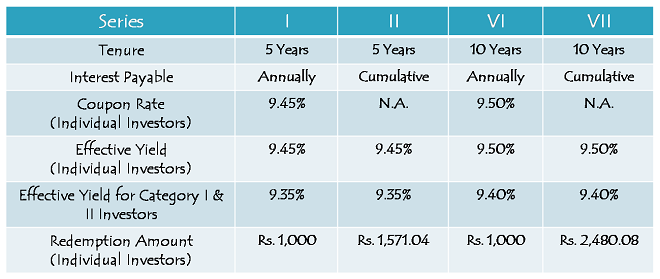
IFCI yesterday launched its second public issue of non-convertible debentures (NCDs). The issue carries annual interest rate of 9.50% for 10 years and 9.45% for 5 years, which is 50 basis points lower than its last public issue of October 2014. IFCI plans to raise Rs. 250 crore in this issue with an option to retain oversubscription up to the residual shelf limit of Rs. 790.81 crore.

IFCI has decided to issue these NCDs for a period of 5 years and 10 years only. Last time it had the option of 7 years as well. The company has also decided not to offer the monthly interest payment option this time around. Last time IFCI offered monthly interest payment option with its 5 year maturity period. The issue is scheduled to remain open for over a month to close on February 4th.
Picture1

Categories of Investors & Allocation Ratio - The investors would be classified in the following four categories and each category will have the following percentage fixed during the allotment process:

Category I – Institutional Investors – 25% of the issue size is reserved

Category II – Domestic Corporates – 25% of the issue size is reserved

Category III – High Networth Individuals including HUFs – 25% of the issue size is reserved

Category IV – Retail Individual Investors including HUFs – 25% of the issue size is reserved

Allotment will be made on a first-come first-served (FCFS) basis.

Coupon Rates for Category I & II Investors - Like last time, IFCI has kept the differential between the coupon rates offered to the individual investors and non-individual investors as 0.10% only. I think this move would again make these NCDs more attractive to the non-individual investors as compared to the retail investors.

NRI Investment Not Allowed - Foreign investors, including foreign nationals and non-resident Indians (NRIs), are not allowed to invest in this issue.

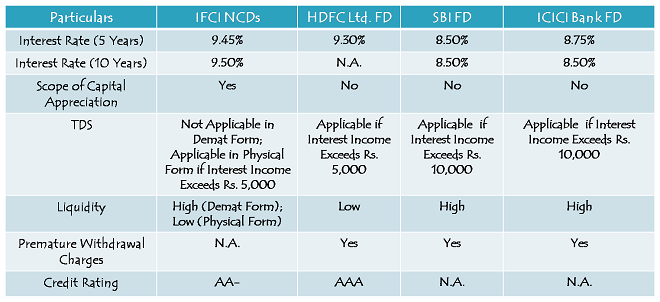
Credit Rating & Nature of NCDs - While Brickwork Ratings has assigned a credit rating of ‘AA-’ to the issue with a ‘Stable’ outlook, ICRA has given it a credit rating of ‘A’ again with a ‘Stable’ outlook. Moreover, these NCDs are ‘Secured’ in nature and in case of any default in payment, the investors will have the right to claim their money against certain receivables of IFCI.

Minimum Investment - These NCDs carry a face value of Rs. 1,000 and one needs to apply for a minimum of 10 NCDs, thus making Rs. 10,000 as the minimum investment to be made.

Maximum Investment - Like the last time, IFCI has kept Rs. 2 lakhs as the maximum amount one can invest in the retail investors category. Individual investors investing more than Rs. 2 lakhs will be categorised as high networth individuals and there is no such cap on the investment amount for such investors.

Allotment in Demat/Physical Form - Investors will have the option to get these NCDs allotted either in demat form or physical form as per their choice.

Listing - These NCDs will get listed on both the stock exchanges, Bombay Stock Exchange (BSE) and National Stock Exchange (NSE), within 12 working days from the closing date of the issue.

Taxation & TDS - Interest earned on these NCDs will be taxable as per the tax slab of the investor and tax will be deducted at source if NCDs are taken in physical form and the interest amount exceeds Rs. 5,000 in any of the financial years. However, there will be no TDS on NCDs taken in a demat form.

Moreover, if these NCDs are sold after holding for more than 12 months, the investor is liable to pay long term capital gain (LTCG) tax at a flat rate of 10%. However, if sold prior to the completion of 12 months, short term capital gain (STCG) tax is applicable at the slab rate of the investor.

Interest Payment Date - Again, IFCI has not fixed any date in advance for the purpose of its annual interest payment and that is why its first due interest will be paid exactly one year after the deemed date of allotment.

Interest on Application Money & Refund - IFCI will pay interest to the successful allottees on their application money, from the date of realization of application money up to one day prior to the deemed date of allotment, at the applicable coupon rates. However, unsuccessful allottees will be paid interest @ 4% per annum on their money liable to be refunded.

Premature redemption & Call Option - IFCI will not entertain any request for redemption before the maturity period gets over. Investors will have to sell these NCDs on the stock exchanges to liquidate their investments. IFCI too will not carry any option to call these NCDs for redemption before their maturity.

IFCI NCDs vs. Bank Fixed Deposits vs. Company Fixed Deposit
Picture2

Should you subscribe to IFCI NCDs?

These were my views when its last issue came in October – “With CPI as well as WPI inflation falling sharply, Brent crude prices declining from $114 per barrel to $84-85 per barrel, commodity prices also correcting substantially and 10-year Indian G-Sec yield falling from 9%+ to 8.39%, I think the interest rates should still head lower going forward. In the present macroeconomic scenario, it makes sense to subscribe to these NCDs. Long term investors in the 30% tax bracket will do well to invest either in debt mutual funds or explore tax-free bonds from the secondary markets.”

Inflation has fallen further, both CPI as well as WPI. Crude prices have also fallen further with Brent crude trading at $57.33 per barrel as I write. Though the 10-year Indian G-Sec yield has also come down sharply to 7.88% from 8.39% earlier, I think the pace of fall should get slowed down now.

Though I think there is still some more room left for the deposit rates to fall, especially the bank deposit rates, I think the rates offered by IFCI this time are less attractive to me as compared to the last time, which is natural as well. If you are able to buy its previous issue’s NCDs from the secondary markets at a relatively reasonable cost, then you should avoid this issue. If you face difficulty in doing so, then you should still subscribe to these NCDs for your medium to long term investment. Long term investors in the 30% tax bracket would still do well to invest either in debt mutual funds or tax free bonds.

Application Form of IFCI NCDs

Note: As per SEBI guidelines, ‘Bidding’ is mandatory before banking the application form, else the application is liable to get rejected. For bidding of your application, any further info or to invest in IFCI NCDs, you can contact me at +919811797407

02 Jan 05:48

Me at the ASSA Meeting

by Greg Mankiw
I have a busy few days at the upcoming ASSA meeting in Boston.  For those interested, I will be involved in the following public events:

Jan 03, 2015 8:00 am, Sheraton Boston, Independence Ballroom
American Economic Association
A Discussion of Thomas Piketty's "Capital in the 21st Century" (D3)
 
Presiding: N. Gregory Mankiw (Harvard University)
 
Capital and Wealth in the 21st Century
David N. Weil (Brown University)
TBD
 
Capital Taxation in the 21st Century
Alan J. Auerbach (University of California-Berkeley)
Kevin Hassett (American Enterprise Institute)
TBD
 
Yes, r>g. So what?
N. Gregory Mankiw (Harvard University)
Piketty argues that r>g is the “the central contradiction of capitalism” and that it will lead to an “endless inegalitarian spiral.” As a result, he argues for a new global tax on capital. In this brief essay, I explain why I am not persuaded by either his prediction or his prescription.
 
About Capital in the 21st century
Thomas Piketty (Paris School of Economics)
TBD


Jan 03, 2015 2:30 pm, Sheraton Boston, Independence Ballroom
American Economic Association
The Economics of Secular Stagnation (A1)
 
Presiding: Robert E. Hall (Stanford University)
 
Secular Stagnation: A Supply Side View
Robert Gordon (Northwestern University)
TBD
 
Secular Stagnation: A Demand Side View
Lawrence H. Summers (Harvard University)
TBD
 
Does History Lend Any Support to the Secular Stagnation Hypothesis?
Barry Eichengreen (University of California-Berkeley)
TBD
 
Discussants:
Robert E. Hall (Stanford University)
William Nordhaus (Yale University)
N. Gregory Mankiw (Harvard University)
02 Jan 05:47

Retirement Pain

by subra

Sadly there is not enough social research in this country…and for people like me that is bad news. I have no clue what retirees do in their leisure time. Seriously no clue. So I have to observe 5 people and assume that the rest of the population does exactly that. Right or wrong – nobody else has a clue either!

Here are a few of my own observations:

1. Recent retirees and older retirees try to sleep more: successfully or unsuccessfully is a different answer, but most of them try to sleep more!

2. Television, and newspaper take up the bulk of their time and they are a little hesitant to call younger people – lest they think that the older person is wasting their time.

3. Most of the recent retirees are screen addicts – TV, computer, ipad, kindle, ….this reduces their requirement of meeting people.

4. Most, almost none of the retirees have any kind of a retirement plan. If somebody approached me, I would have no clue how to make one, but it has to be made.

5. There is just not enough professional help available for the retiree. The situation does not seem to be improving either.

6. Most of the hobbies sought are NOT income draining – and that is surely good news from a financial point of view.

What can be done:

1. Try increasing social activities: your nearby temple, Lions club, Municipal school, …all are looking for volunteers. A great age to start all this is say 50. However, if you have not done that, start today.

2. Learn something new: Never too late to start learning something, eh? It keeps you engaged – make sure that the new activity takes about 10-15 hours a week. That is enough.

3. Join a physical activity group: walking, running (long distance running is an old people’s sport), cycling, swimming, ….you tend to meet new people, and the age group is huge. Thanks to running, cycling, and training I still attend weddings of ‘friends’ apart from attending weddings of friend’s daughters and daughter’s friends!

4. Seek professional help in managing money, making a will, etc. – believe me it is far more complicated than you think. It is also much simpler to understand than you dread!!


Post Footer automatically generated by Add Post Footer Plugin for wordpress.

02 Jan 05:46

Our Sales Principles

by Muthu

Any profession or business needs selling. We’ve been selling for the last 8 years and these are the principles which guide us. We are intelligent enough from the beginning to make these principles cornerstone of our selling and never digressed from the same. By doing this, we are able to really create win-win relationships. The results are there to see.

Thanks to each one of you as you are the buyers of our services.

We are grateful to Warren Buffett and Charlie Munger for providing these guiding principles:

1) ”I don’t want to be on the other side of the table from the customer. I never was selling anything I didn’t believe in myself or own myself.”- Warren Buffett

2) ”Decide early in life to make your money by selling things that you really believe are good for the customers.”- Warren Buffett

3) “Don’t sell anything you wouldn’t buy yourself.”- Charlie Munger

4) “We will only do with your money what we would do with our own.”- Warren Buffett

5) ”Having integrity is the safest way to do business.”- Warren Buffett

6) “We don’t get paid for activity, just for being right.”- Warren Buffett

7) “You want to deliver to the world what you would buy if you are on the other end.”- Charlie Munger

8) “We will not equate activity with progress.”- Warren Buffett

9) “We will not trade reputation for money.”- Warren Buffett


01 Jan 04:27

9th year

by Muthu

Wishing you and your family a wonderful 2015.

We’ve completed eight years in this profession and entering the 9th year today.

Just to refresh; I got relieved from my employment on December 12th 2006 and formally started our organisation on January 1’st 2007.

I would like to take this opportunity to convey my gratitude for helping us grow by placing your trust on us.

Thanks a lot.

In Chennai, among the IFA (Independent Financial Advisors) category, we’ve the largest SIP book. We are maintaining this position for the last 4 years. We also understand from industry sources that even for entire Tamilnadu, among the IFA category, our SIP book size is the largest. We are proud of this as we believe that every SIP makes a meaningful change in someone’s life. Many of you who have been investing for last few years or in some cases for even last 7 or 8 years through SIPs have already started experiencing its benefits.

On this occasion, as always, we request you to stay the course with your SIPs and investments. SIP is a very good habit for wealth building. Focus on strengthening this habit in 2015. Keep increasing your SIP contribution at least once in 2 years and continue maintaining the long term orientation.

We became active on social media (Twitter) last year and now have 1041 followers. We get around 40,000+ views every month.

I’ve been writing regularly to our clients, friends and some fellow professionals for many years. As of now, the mail goes to around 400 people. I’m thankful to some of you who asked me to start posting these mails as blog posts. This has ensured that our mails are being shared with many outside this group of clients and friends. Many visitors have mentioned that they find our posts useful and inspire them to have long term orientation, develop patience and to stay the course. The blog has also helped us to get professional visibility and has even brought new clients. Starting the blog to post the emails was your idea and I’m thankful to you for the same.

This would be the 405th post in our blog. We now get around 10,000 to 12,000 views every month. At the time of writing this piece, we have a total of 2,39,417 views. The page which has got maximum number of views is ‘SIP Crorepathi’; with 18,519 views and counting. It’s no coincidence that we passionately focus and promote SIPs.

Sensex as on December 31’st 2013- 21170

Sensex as on December 31’st 2014- 27499

Sensex has provided a return of 29.89% for the calendar year 2014. Last year has been very good. As we repeatedly mention, we are in a secular growth story and would continue to make many new highs in the years and decades to come.

We believe that the ‘personal’ component in ‘personal finance’ is very important; basically working on one’s behaviour and approach towards money, savings, spending, investing, risk etc. I focus more on this in our professional relationship.

The more we help you shape your behaviour the better would be your success rate.

We want our clients to be amongst the minority who create huge wealth from equity by having strong long term orientation, high conviction, enormous patience and staying the course ignoring ups and downs.

You’ve done extremely well so far and we would continue to reinforce and assist you in shaping your attitude and behaviour towards investing and over all personal finance.

Thanks again.

Wishing you the very best for 2015.


31 Dec 07:33

Links: Great and Meaningless Phrases, Not North Korea for Sony, New Rules for Uber and more…

by Deepak Shenoy
31 Dec 07:33

Subra please speak to my son…

by subra

Once you are a consultant, and have clients in relationships, you are asked for the vaguest of help. Pro Bono. No, not because they do not want to pay, but I have no clue how to, and whether to charge for such things.

Let us see one such “assignment”.

Subra will you please speak to my son? Ask him about his life plans…me and my husband are worried. This was my friend’s uncle telling me this.

Off I went.

Here is this ‘boy’ who is staying in a rented house, is in his second job, has no girlfriend (no boyfriend either, he confirmed!!), earns well, stays with his sister (8 years younger, cousin). Both brother and sister find this convenient – they have a cook, a maid, …one younger brother was to join them soon in this ‘family rented’ home…

What was his father’s problem? The boy was 35 years of age…..

well my queries (for which I needed answers)….were:

– when will he ‘settle down’? Indian euphemism for getting married.

– when will start saving/ investing (how can he earn Rs. 21 lakhs and have no savings?)

– when will he be committed to a nice job (he has a good job in a big Indian group with Mnc like compensation benefits)

– why does he not buy a house, car, pension plan, life insurance – Manly products to show that he has arrived.

– at this age his father had 2 kids, had bought a house, and had even put one kid through 2 years of school.

This 62 year old man was aghast that this generation was not willing to accept responsibility, did not want to commit to a pension plan, did not want to get married, no home loan – so no EMI.

I actually have no solution, in fact I did not even have the questions!

Post Footer automatically generated by Add Post Footer Plugin for wordpress.

31 Dec 07:22

A Look At Hot Job Skills Of 2014 [LinkedIn India Data] : PR and Comm Above App Development

by NextBigWhat

LinkedIn analysed the skills and experience data of its 332+ million members worldwide, including over 28+ million members in India to identify the skill categories that belonged to those members that had either changed employer or appeared in a recruiter’s search during 2014.linkedin-logo

Here goes the top 25 list:

1.    Statistical Analysis and Data Mining
2.      Storage Systems and Management
3.      Cloud and Distributed Computing
4.      PR and Communications
5.      Network and Information Security
6.      Social Media Marketing
7.      Algorithm Design
8.      Perl/Python/Ruby
9.      Web Architecture and Development Framework
10.  Mac, Linux and Unix Systems
11.  User Interface Design
12.  Data Presentation
13.  Economics
14.  Mobile Development
15.  Virtualization
16.  Public Policy and International Relations
17.  Digital and Online Marketing
18.  Business Intelligence
19.  Data Engineering and Data Warehousing
20.  Game Development
21.  Middleware and Integration Software
22.  Market Research and Insights
23.  Shell Scripting Languages
24.  SEO/SEM Marketing
25.  Electronic and Electrical Engineering

Note that the results of this analysis represent the world seen through the lens of LinkedIn data.
As such, it is influenced by how members choose to use the site, which can vary based on professional, social, and regional culture, as well as overall site availability and accessibility. These variances were not accounted for in the analysis.

The post A Look At Hot Job Skills Of 2014 [LinkedIn India Data] : PR and Comm Above App Development appeared first on NextBigWhat.

31 Dec 06:36

Investments resolutions for 2015

by subra

Financial resolution for 2015 should be very simple:

“To complete the resolutions that I made in 2008, 2009, 2010, 2011, …….because there is no point in making new resolutions if you have not lived up to the previous resolutions, right?”

Still for those who have not made any resolutions…..here…

Here is a list of very useful financial resolutions to make:

1. I will write down my financial goals. I will make sure that they are SMART….

2. I will convert a big portion of my savings into investments. Especially in this young country if you are 45 years of lower, you need to have about 70% of your money in equities. 

3. I will live a simple, frugal life by choice – but choose my dream career. You need guts to do it. If you do not, get vicarious pleasure by watching 3 idiots again and again.

4. I will start saving/investing for my retirement. Saving for retirement is an old game. Now you need to invest for old age.

5. I will have regular conversations about money, saving and investing with my spouse, kids and parents – all people for whom I feel financially responsible.

6. I will not deal in direct equity with my current level of knowledge of equities. I will keep learning and buy one or 2 shares a year after doing proper research.

7. I will increase my financial knowledge – inter-alia by visiting www.subramoney.com, www.moneycontrol.com, www.investopedia.com and such other sites.

8. I will maintain my income and expenditure details diligently and keep reviewing them. I at least know where I am headed.

9. I will maintain proper records of my assets and liabilities, understand the risk of each asset class, and do proper asset allocation.

10. I will protect all those people dependent on me. Will review my term insurance, medical insurance and retirement and make sure it is up to date and adequate, and the nominees are current.

Most important:  Properly stick to all the resolutions!

Post Footer automatically generated by Add Post Footer Plugin for wordpress.

31 Dec 06:34

7 reasons why you never get a feeling of being rich?

by subra

There are many roadblocks to being rich. Being in debt and not having the guts to invest are surely some of the top reasons…let me enumerate the top reasons as per my perception. This is the result of reading and many interactions…so here it goes…

1. You are inundated with debt: You feel like you are drowning or almost drowned in debt. Of course this is a mistake from the past – over spending or not having adequate, appropriate medical insurance, but every month you buy more on that card..and you do not remember any month that your balance came down. Painful yes, but a reality.

2. You and your partner have no control over your spending. Whether it is a trip for your parents (they have done so much for me, they deserve a vacation do they not), or your kids (how can I not put her in tennis classes?), or just plain simple binge at the local mall. If you treat going to the mall as a ‘treat’ chances are you will have very expensive treats – and sadly they show up on the bill. Oops!

3. Your kid is in class 8 and you have no money – you hope to God that she does not do medicine – no way how you can whip up Rs. 60 lakhs required to pay the fees. You are hoping that she takes Commerce and does her Bcom. Anything else is panic situation.

4. Retirement? You got to be joking. I am just 46 and my wife is 47…we are not in a hurry to start saving for retirement – in fact we do not have a surplus!

5. Your boss recently hinted that your chances of being moved to Gurgaon / Haridwar office are high – it would be a transfer. You are paranoid because you cannot afford to pay the Mumbai EMI and the Gurgaon rent. Your parents cannot take the cold of Delhi…so there is a possibility of 2 establishments. Also, your wife will not get a transfer…so you may have to stay alone..and you have no clue about what to do in the kitchen.

6. You fell back on your credit card, and your score is getting lower – there is a good chance that your car loan / housing loan get repriced.

7. Your aged parents have very little capital and not very adequate medical cover…this scares you everyday…


Post Footer automatically generated by Add Post Footer Plugin for wordpress.

29 Dec 04:12

Should I pay the ULIP premium?

by subra

First obvious advice is “Do not buy ULIPs”. This obviously falls on deaf years. “Subra I knew you would say NO, so I did not ask you” is a classmate’s confession – in a different context of course!

So you should not buy a ulip. However if you have bought it, how long should you pay the premia? 30 years? 10 years?

Well…read on..

Many of the life insurance policies sold in the past few years may not see the “logical end” of the policy as perhaps intended. In the United States of America the endowment plans are called “permanent” policies. A high percentage of existing “permanent” insurance policies will not make it to the finish line. Many Indian Ulips are so poorly structured, that the client will not collect the claim amount – it would have just lapsed! 

They will fall apart before the deaths of those they insure if the insured lives a long time. Most of the premiums, will be wasted. Policy beneficiaries will receive nothing. Many policy holders will not pay the 2nd / 3rd premium and will let the policy lapse. In some cases the choice of asset class, the charges, and the withdrawals will combine to defeat the purpose of the policy.

 This is a relatively new problem for the life insurance industry. Until a few years ago in the Indian scenario there was only one type of life insurance – endowment plans with a full paying term. That is to say if you bought a 20 year endowment plan, your friendly neighborhood agent made sure that you paid the premium for 20 years.

 Consumers knew what they were buying. Agents knew what they were selling. Clearly it was a tax saving product. Nothing more. Nothing less. It was NOT an investment product, it was a savings product – so it had to be compared to a savings bank account kind of a return, not even bank fixed deposit.

 The “endowment” insurance choices in recent times have been more numerous, complex,

And by definition risky! In one form or another, most often involve combinations of endowment and term insurance. The perceived advantage is of course, a shorter pay period! The death benefit not guaranteed, its eventual payment is highly dependent on an assumed policy performance that is highly unlikely to occur. When that performance falls short and the insured lives a long time, the policy will collapse. Monitoring this risk and avoiding or minimizing it requires a greater understanding of its origins.

So if you have a ULIP plan pay for 5 years and then give it up. HOWEVER, if you need life insurance at that stage TAKE A TERM PLAN…or take a term plan now itself…and ensure that after 5 years you collect the matured amount from the life insurance company.


Post Footer automatically generated by Add Post Footer Plugin for wordpress.

29 Dec 04:11

What people look for in a job?

by subra

Let me start with a caveat. I am not a HR expert, but I have interacted with many people and asked them…’what really are you looking for a in a job’. I have got interesting answers…So let me enumerate..from my limited experience.

1. When a kid starts out on a job the expect a lot of encouragement: they have no clue what the corporate is expecting them to do. They are just told ‘do this’ or ‘do that’. Some of them can live with this..but many of them like to be told about the big picture, and their role in that.

2. A boss who is participating and encouraging: If I am the Sales Head of a company, I should have the guts and ability to go on a sales call to sell a product which I am confident of selling. I see sales heads who are not capable of closing a single deal – they have no conviction in a product. If I were made the sales head of a ‘ULIP’ team, I would cut a sorry figure. Once I do not have the conviction in a product, I have no moral right to lead a team. My team would hate me. Totally.

3. Some routine yes, but some challenge too: A job which is just routine quickly bores a person. However, there is a huge population which likes routine jobs – like operations, accounting, audit, etc. However a vast majority of the population wants some complexity, challenge, interpretation…in the job that they do. If there is no challenge, they can get bored easily.

4. A boss who will be a task master and a friendly guide: A boss should be capable of helping – or at least directing the team to the right resources for help. A boss who just pokes, makes fun but cannot teach or guide is soon seen as a pain. Kids are not worried about hard work, but lack of guidance scares them. They like to be guided and hand held – at the starting part of their career at least.

5. Some of the kids who think like businessmen maybe an exception, but most of the employees want to be compensated better than market. Some of the potential entrepreneurs like to substitute some learning, but they too need to be compensated as per market at least.

6. Clear lines of growth, clear Key Result Areas. Some kids will look at the larger picture, some kids will happily do what the boss says – if their compensation depends on what the boss says, so be it.

7. At the bottom and at the very top most people are worried about their actions being ethical and morally right. If it makes money for the company at the cost of the client, it disturbs a few…but generally they do not mind selling a Re. 1 product at Rs. 100. Some of them call it brand building. It surely has value.


Post Footer automatically generated by Add Post Footer Plugin for wordpress.

28 Dec 03:49

My 7 Resolutions for 2015 – No I Don't Only Want to Save & Invest. I Want to Spend & Read too!

by Dev Ashish
In few days, we will enter a new year. And I am sure that most of you would be making resolutions for 2015 right now. A study says that 93% of new-year resolutions die by 23rd February. And if these are financial resolutions, then 96% die by 3rd February. No. Don't worry. There is no such study. I just made that up. :-) I know I am really bad at keeping my new year resolutions. So I won’t
28 Dec 03:49

2014 Thus Far: The Fall of Oil and Its Effects on Indian Fuel Prices

by Gautam Jagannathan

In continuation of Capital Mind’s year-end specials (read more at: 2014 Ends With the Death of Deposit Growth, Lowest in 20 years!), we decide to look at yet another one of 2014’s enigmas. Oil. This post aims to decipher the somewhat odd relationship that crude oil prices and Indian petrol and diesel prices have had over the years.

2014 was truly a humdinger for crude oil. Brent Crude Oil is currently at $60.24 to the barrel, while WTI crude oil is at $ 55.84 to the barrel. Looking at the crude oil price of the Indian Basket in 2014 thus far:


Crude Oil


The data used above was obtained from Petroleum Planning and Analysis Cell (PPAC) website. The organisation publishes data for current as well as historical prices of crude oil. Since we are not through December yet, at the time of writing this post Indian Basket prices were available only till November 2014, through an official press release, we obtained the data for Indian Basket price as of 24th December 2014.(Read On...)

27 Dec 07:43

Choose Wisely

by Muthu

Morgan Housel mentions the below 2 points in this wonderful piece:

“1) Remember what Wharton professor Jeremy Siegel says: “You have never lost money in stocks over any 20-year period, but you have wiped out half your portfolio in bonds [after inflation]. So which is the riskier asset?”

2) In finance textbooks, “risk” is defined as short-term volatility. In the real world, risk is earning low returns, which is often caused by trying to avoid short-term volatility. “

As you are aware, for last few years, every April, we publish a comparative chart of performance of various asset classes from 1979-80 to till date.

Between 1979-80 to 2013-14; for the last 35 years; fixed deposits have produced an annualised return of 8.41% and Sensex 16.72% (18.72%, assuming a dividend yield of 2%).

Let us assume, 35 years ago, you invested Rs.1 lakh each in FD & Sensex. As on March 31’st 2014, FD is worth Rs.16.94 lakhs and Sensex is worth Rs.2.23 crores.

Before we feel happy about the above returns, we’ve to understand that the average inflation rate for the above period is 7.57%.

Real rate of return = Nominal returns – Inflation

So the real rate of return for FD is meagre 0.84% and for Sensex is 9.15% (around 11% including dividend yield).

So your investment of Rs.1 lakh in both FD and Sensex, 35 years ago, after adjusting for inflation, is ‘really’ worth as follows: FD- Rs.1.07 lakhs and Sensex- Rs.14.20 lakhs.

Since FDs are taxed every year on accruals, you would not have even got the real return of 0.84% and would be sitting on a negative return. Your Rs.1 lakh investment would be even lesser than the capital value. Whereas Sensex, even after inflation, has multiplied your wealth by 14 times. There is no tax on long term capital gain.

Though it looks FD has multiplied your wealth by 17 times, in terms of purchasing power, it has actually eroded your capital.

Even Sensex, though it appears to have multiplied your wealth by 223 times, has actually done so ‘only’ by 14 times, if you take purchasing power into account.

Many people, especially with real estate and gold, have no clue about annualised return, inflation adjusted return, impact of transactional cost and taxes etc. What we think as what we are earning and what we are actually earning are not one and the same.

The real risk is not the short term volatility you see the in stock markets. The real risk is capital erosion, due to returns eaten away by inflation and taxes. So for all long term requirements, you need to invest in instruments which beat the inflation handsomely and are also tax efficient.

In the above example, equities have beaten inflation by around 9% and also given that return absolutely tax free. What more one can ask for?

So please understand that risk is not short term volatility but long term erosion of capital.

Fixed deposits are not volatile but they erode capital and reduce your purchasing power. Equities are volatile but they multiply capital and increase your purchasing power.

Choose wisely for long run.