By Dave Michels In 2023 there were several significant mergers and acquisitions in the enterprise communications space. They may not have been for eye-popping sums, but they all represent strategic shifts.
Batman and Catwoman want you both to know that eating mistletoe is a poison risk. | Warner Bros. Pictures/Sunset Boulevard/Corbis via Getty Images
Tim Burton’s superhero classic is Christmas rom-com you don’t realize is a Christmas movie or a rom-com.
While the winner of Best Christmas Movie is up for debate, the undisputed best Christmas movie genre isn’t: It’s Christmas romantic comedies. And in this exceptional genre — which includes the likes of The Holiday, Little Women, Love Actually, and Moonstruck — there is no better Christmas rom-com than Batman Returns.
You might not think “Christmas” or “rom-com” when you hear Batman Returns, but that’s what makes itso fun. It tops this list of fantastic movies because it feels as though it’s getting away with something — you’re getting a holiday romance smuggled into a Batman movie.
Stylistically, Tim Burton’s 1992 movie is unmatched. The set pieces — giant evergreens, rollicking fires, cartoonish amounts of ice and snow — and costumes evoke a surreal, maximalist take on the holiday’s mash of inviting warmth and bitter cold. Also, somehow, mistletoe is a central figure in the film. Chekov’s mistletoe!
Batman Returns goes out of its way to establish rom-com lore, like the idea that no one should be alone at Christmas, especially Batman. Think Christmas time can be hard for single people? Think about poor, rich Bruce Wayne! He’s an orphan! He’s so alone!
It also plays with the idea that there’s no better time to tell the truth than at Christmas. Movies always tell us that Christmas is the time we let our masks fall and our guards down. In Batman’s case, this means it’s the perfect time to admit that you love, or, at the very least, are a little horny for, one of your enemies — who also might be your soulmate (yes, this applies to many Batman villains).
In Gotham City, the Christmas spirit might be the only thing more powerful than Batman himself.
Batman Returns is a Christmas movie, the best Christmas movie
The thing about Batman movies is that they’re Batman movies. Things like setting and supporting characters tend to melt away or bleed into one another because Batman, in all his mythos and popularity, can’t help but eclipse them. Gotham is always dark and rainy. Batman is always brooding, with that hefty origin story about his parents’ murders never far from mind. Without Googling, I couldn’t tell you in what time of year the most recent iteration, Matt Reeves’s The Batman, takes place. But I could tell you that Robert Pattinson is very good, and his Batman is extremely sad.
That’s not the case with Returns.
Warner Bros. Pictures/Sunset Boulevard/Corbis via Getty Images
Penguin’s antics, including actual penguins, wouldn’t fly in summertime.
Burton loves a loopy, unconventional Christmas, as he shows in Edward Scissorhands and Nightmare Before Christmas. And the director plunges Gotham into that outré Christmastime spirit. The city is freezing, but smoke billows up from the street and snow’s almost always falling. There’s an enormous fire in the Cobblepot mansion, one of the first shots of the movie. Blazing logs crackle in their massive fireplace. The only thing bigger than the yawning inferno is the Cobblepots’ gorgeous Christmas tree. It’s lit in warm gold, draped in monochromatic, uniform ornaments — the kind of tree that extremely rich people who loathe multi-colored lights and tacky handmade things have.
Burton’s focus on the Cobblepots’ luxury is deliberate because, despite this enormous wealth, they aren’t the best people. Mrs. Cobblepot has given birth to a baby boy, what should be a joyous occasion. But there’s an unseen horror about the newborn that causes his doctor and nurses to scream in terror. Whether it’s for their own safety or because they don’t want to look at him, they keep the child in a boxed cage, although that doesn’t stop him from eating the family cat. Fed up one night, Mr. and Mrs. Cobblepot abandon their son, dumping him over one of Gotham’s bridges, an act that’s somehow more sinister in winter, when this city, famous for its inhospitality, is crueler and chillier than usual.
It’s a yuletide miracle that baby Cobblepot a.k.a the Penguin (Danny DeVito), survives the frigid dumping and emerges at Christmastime 33 years later (the number 33 can’t be a coincidence). It makes symmetrical sense that the Penguin would wreak his havoc during winter. His goons pop out of giant presents! Some of his henchmen are literal, very cute penguins! His antics wouldn’t work during summertime. Does Gotham even have a summer?
Penguin’s dastardly deeds center on Gotham’s holiday events like its annual tree lighting, the crowning of the city’s Ice Princess, and Gotham’s masquerade ball. Gotham becomes a different place during Christmas, and like so many cultures, it has its own Christmas traditions.
Returns’s holiday setting also drives home some of Batman’s most pronounced personality points. Batman a.k.a. Bruce Wayne (Michael Keaton) is already a solitary figure. Loneliness and brooding is his entire deal. He’s isolated by his family dying, but also because he needs to operate in secrecy to protect his city. Christmas, when everyone is together (even the Cobblepots abandon their cat-eating baby as a family), makes his cold remove from anyone who isn’t his loyal butler Alfred even clearer.
More than any other Batman movie, Returns gives you the feeling it’d be nice if, for once, Batman/Bruce Wayne weren’t so alone. Especially on Christmas.
Batman Returns is a rom-com, anchored by Michelle Pfeiffer
There is no Batman Returns without the performance of Michelle Pfeiffer as Catwoman a.k.a. Selina Kyle. Sexy, campy, lethal, and vulnerable, Pfeiffer’s Catwoman is the one all modern Catwomen are judged against. What makes Pfeiffer’s performance so effective is that she’s as good at playing bad as she is playing the character as a charming, sweet, rom-com lead.
At the beginning of the movie, Selina is Max Shreck’s (Christopher Walken) overlooked secretary. She’s pouring coffee for some corporate jerks, awkward and smarter than she appears. Selina knows this too, beating herself up and calling herself a “corn dog” for trying to speak up during one of Shreck’s meetings.
Later, she’s caught up in one of Penguin’s attacks on the city and meets Batman for the first time. He saves her life, which, because it’s her life, she takes to be very important. But it’s no big deal for the Caped Crusader, just one of the many people he’ll help that night. Pfeiffer plays it like a meet cute, frazzled and tingly. She carries the entire scene, trying to charm the hero by asking him if he prefers to be called “Batman” or “The Batman.”
He doesn’t reply because Batman is Batman. She bumbles because she’s Selina Kyle. He runs off, nonplussed. She’s charmed. “Well, that was brief. Just like all the men in my life,” Selina tells herself, exasperated, and picks up a taser. “What men?”
Warner Bros. Pictures/Sunset Boulevard/Corbis via Getty Images
KISS! YOU LOVE EACH OTHER!
Like any good rom-com heroine, Pfeiffer’s Selina gets a makeover. Unlike good rom-com heroines, this one requires her death. Shreck pushes her out of a skyscraper and leaves her for dead, a snow angel made of snapped bones. He doesn’t stick around to see a herd of cats gather and bestow some kind of feline magic upon her corpse. Selina’s brought back to life, but not quite the same. She destroys all remnants of the woman she was. She trashes her apartment, cramming stuffed animals into the garbage disposal and taking a cast iron pan and black spray paint to the walls and frames of her cozy apartment.
As Catwoman, Selina gains an electric, crackling confidence. At the brink of death, she jolts to life. She whips some loser cops while yelling at them that they’re overpaid. She enters scenes via back handspring. She slithers, licks Batman’s face, and blows up a Shreck department store. No longer is this woman a corn dog, if she ever really was. Even if she was a corn dog, the woman she is now would never call herself one.
Like Batman and Bruce Wayne, the line between Catwoman and Selina thins as the movie goes on. That’s a bad thing, Batman tells us and her, because Catwoman is so bent on payback. She’s so charged up with vengeance that she doesn’t see how it consumes her. Yet, Batman, Bruce, and the audience watching at home can’t help but be attracted to both Catwoman and Selina. Returns’s gimmick is that we know who these people are underneath their masks but they don’t, and so they play this game of wait and see, hide and seek, of refusing to show the other who they really are even though they just want to tell the truth.
How much of Batman being attracted to Catwoman is because she’s a mystery that he, the city’s greatest detective, can’t figure out? Is Catwoman attracted to Batman or to the lure of finding out his identity? Are they really the same person, split down the middle?
Selina and Bruce find out about their secret identities because they both take turns saying a corny line: “Mistletoe can be deadly if you eat it, but a kiss can be deadlier if you mean it.” It’s a testament to Keaton and Pfeiffer that this poison control fact comes out so sexy. They say it once during a fight between Catwoman and Batman, and again, to each other, as Selina and Bruce, masks off, during the masquerade ball. If not for pesky mistletoe, their secrets would still be safe.
The devil works hard, but apparently, Christmas magic works harder.
While all these holiday hijinks lead to the inevitable will they or won’t they, the yuletide spirit isn’t strong enough to give us a traditional merry ending. Had this been any other Christmas rom-com, we’d get our happily ever after. Returns give us the closest thing to happy Batman can get: justice. Christmas, while romantic, is sometimes also a little bit about making sure bad people know they’ve been bad.
Selina rejects Bruce’s offer of companionship and a normal life in that big Wayne mansion. They won’t be kissing under a mistletoe, opening presents, or cuddling next to one of Tim Burton’s gigantic fires because Selina’s too obsessed with killing Shreck. Shreck, an asshole of exponential proportion, does deserve it, and someone needs to take him out because Bruce has gone soft. Selina gets her Christmas wish, and Bruce goes home alone. They’re both lonely again but maybe next year, next holiday season, things could be a little better.
The government might be in a smidge of a pickle with deficits and debt. | PM Images via Getty Images
America rarely has its financial ducks in a row. Does it finally matter?
As though there were not enoughthings in the world to worryabout at the moment, a perennial issue has once again been percolating: Is the United States’ financial house in order? Talk about the federal government’s deficit — meaning the difference between what it spends and what it collects in taxes — has started to pick back up. The same goes for chatter about the country’s debt. Deficits are a gamble — a wager that the government paying out more than it’s taking in, especially as time goes on, is worth the risk. Not everyone thinks it’s such a good bet.
Some prominenteconomists who were once pretty laid back on the matter have started to change their tune. Not everyone is setting their hair on fire, but it has been a bit of a “Wait, what?” moment in terms of deciphering just how much to worry, or whether to worry at all.
The federal deficit officially clocked in at $1.7 trillion in fiscal year 2023 (the government’s fiscal year runs from October 1 to September 30), up from almost $1.4 trillion in 2022. Thanks to some wonkiness around the Supreme Court-thwarted attempt to cancel student loan debt, it was actually likely closer to $2 trillion for 2023 and $1 trillion for 2022. In other words, the gap between what the government spends and what it makes is a big one — and about doubled from one year to the next.
There are some 2023-specific reasons that the deficit was particularly high; namely, the government saw a big dip in tax revenue. However, there are plenty of trends that aren’t limited to this specific year.
What’s further spooked onlookers are higher interest rates, which have made the country’s debt more expensive because of higher interest costs. Interest rates on US Treasury bonds started to climb over the summer and into the fall, and while they have come down from some of the highs they were at in October, they remain elevated overall, making people a little more nervous.
“You know the meme that’s like mess around and find out? That’s a little what happened here,” said Marc Goldwein, senior vice president and senior policy director for the Committee for a Responsible Federal Budget, a think tank focused on fiscal responsibility. Years of low interest rates, low inflation, and strong global savings, among other factors, made deficits palatable and easy to ignore in practice on both the right and the left (except when politically convenient). Now, the landscape has shifted.
Lawmakers have made the bet that deficits are worth the trade-off and the debt is manageable, and these soaring rates and their attendant anxiety show just how high the stakes of that gamble are. That risk also calls attention to how difficult the issue is, politically. While many experts say there’s next to no chance of balancing the budget, getting revenue and spending back in line would require compromises few people on Capitol Hill are willing to make. Republicans don’t want to raise taxes and keep cutting them instead, seemingly worrying about deficits largely only when they’re not in office. Democrats don’t want to curb spending, and raising taxes isn’t easy. It’s not clear what, if anything, would make anyone budge.
“I don’t think you’re going to get a solution to this [deficit] until it really is something quite salient to the public, to politicians, and the thing that I’ve been saying for years is … that will happen when markets start to care, when interest rates start to rise,” said Louise Sheiner, a senior fellow at the Brookings Institution and policy director of the Hutchins Center on Fiscal and Monetary Policy. Despite high interest rates, she’s still not sure if this will prove to matter now. “This may be just this little head-fake where interest rates went up and then they came back down and it was no big deal, or we may turn around and may look back at this moment in 10 years and say, ‘That was the moment when people did start to worry about the deficit again and we started doing stuff.’ I don’t know which one it will be.”
2023 is unique, and it isn’t
The 2023 deficit wasn’t necessarily outlandishly high. The deficit also topped $1 trillion in the years following the Great Recession. It was over $3 trillion in 2020 and more than $2 trillion in 2021 because of the pandemic and related spending under Presidents Donald Trump and Joe Biden. “You had Donald Trump go on a huge tax cut and spending spree, and then Joe Biden went on a spending spree,” said Brian Riedl, senior fellow at the Manhattan Institute.
But the deficit being so high in a relatively normal period in 2023 — no recession, no war the US is fighting — is a bit different. What exactly were we spending money on, and why didn’t we have the funds to cover it?
The main culprit this year is taxes (spending was only slightly higher than where it was in 2022). As Jim Tankersley at the New York Times explains, the government brought in an especially low amount of revenue. The IRS extended tax-filing deadlines for people because of natural disasters, including for most people in California, the country’s most populous state. A lot of firms took advantage of a pandemic-era tax credit for retaining workers — some of those claims may be fraud. Capital gains taxes, which come when an asset, like a stock, is sold, also fell from 2022, when they were abnormally high. The decline in capital gains taxes is an effect of high interest rates from the Federal Reserve, which contributed to stock market declines and a downturn in companies going public. (This is a big issue in California’s budget.)
“The trajectory of debt has not fundamentally shifted in the last few years”
“The 2023 deficit was certainly anomalous, and I think people are using a ‘that’s weird’ as a point of proof, but I don’t think it actually has much to do with genuine concern over fiscal risk,” said Michael Linden, senior policy fellow at the Washington Center for Equitable Growth. “The trajectory of debt has not fundamentally shifted in the last few years.”
Still, the trajectory is one that some people find to be uncomfortable.
Tax revenue as a percentage of GDP was abnormally high in 2022 and in 2023, it reverted closer to what it was pre-pandemic. Tax cuts, including those put in place by George W. Bush (and made permanent under Barack Obama) and Donald Trump, are taking a bite out of revenue and will continue to do so. The Trump tax cuts are set to expire in 2025, and it’s not clear whether they might be extended.
At the same time, government spending is on track to continue growing. As baby boomers age, programs like Social Security and Medicare are getting costlier. Defense is always an expensive line item, and there’s demand for more in order to help Israel and Ukraine. And there’s the question of interest costs, too.
“People have changed their views because the aging population is starting to hit — the pre-programmed rise in Social Security and Medicare is happening, and people are looking at it in 10-year projections where it wasn’t before, because baby boomers are retiring. The second issue is interest costs,” said Danny Yagan, an economics professor at the University of California, Berkeley. “The truth is that the interest costs are a much smaller deal now than people think they are, because economic growth has edged out interest rates for years and is generally projected to for some time.”
How big of a deal this is isn’t really clear
America’s debt and the potential implications of high deficits were pretty easy to ignore in the lower interest rate environment the country has been in for the last several years. As borrowing costs rise, paying interest on America’s debt load becomes pricier, especially if those higher costs persist.
“The debt used to appear costless, because the interest rates were, in many cases, below inflation and almost always, for the last 15 years, below economic growth,” Goldwein said. The debt issued when borrowing that was more or less free is now being rolled over, meaning renewed, at higher interest rates, he said. The Center for a Responsible Federal Budget notes that more than half of the country’s debt matures over the next three years.
There are a number of factors potentially playing into interest rate increases on Treasury bonds in the financial markets, but there’s no one single factor to pinpoint. The Federal Reserve has hiked interest rates to fight inflation and is expected to perhaps keep them there for a while. The New York Times points out strong growth, fewer buyers of American debt from abroad, and overall worries about debt sustainability as contributing factors. Sheiner, from the Brookings Institution, said brinkmanship over the debt ceiling, threats of a government shutdown, the overall political environment, and a downgrade on US credit could be part of it as well. “Markets aren’t always 100 percent rational, and you can’t predict every day why it’s doing stuff,” Sheiner said.
“Why did we see a spike of interest rates on federal debt over the last six months, and why is it coming down now? I don’t think it’s obvious what the right answer is,” Linden said.
If the economy grows faster than interest rates, the general line is that running a deficit is more or less okay, because the debt-to-GDP ratio, an indicator of the country’s ability to pay back its debts, doesn’t increase. The problem would come if interest rates outpace economic growth.
Many economists and experts say it’s not time to panic — interest rates have come back down. “Growth is definitely still higher than interest rates, but it’s closer than it was in the past,” Linden said. “If the 10-year Treasuries were sustained at 5, 6, 7 percent for more than six months or something like that, I would start to be like, ‘Okay, is there something really going on here?’ Especially if that happened at the same time as a Fed cut.”
“All else being equal, lower debt is better, but all else is never equal”
Bobby Kogan, senior director of federal budget policy at the Center for American Progress, a progressive think tank, emphasized that it’s also important to take a look at what a high deficit is paying for. Kogan — who is in the camp that believes the Bush and Trump tax cuts are largely responsible for the issues of today — pointed out that the spending side of the equation is one that is popular. Most people don’t want cuts to Social Security and Medicare. “All else being equal, lower debt is better, but all else is never equal,” he said. “All else being equal, we probably would want lower debt, but if you gave me an option between the current path and eviscerating the social safety net, that’s a different question.”
When it comes down to it, the political will to fix this is roughly zero
The country isn’t necessarily careening toward financial ruin because of its deficits and debt. To quote Kogan, “our current level of debt is manageable because we’re managing it.” But it’s something that probably has to be addressed eventually.
The worst-case scenario here would be something like a debt spiral, where higher interest rates and a growing debt mean the costs of servicing the debt get higher and higher, eventually spinning out of control and pushing deficits up more and more. But the worst-case scenario isn’t the only undesirable one. There could be other consequences around slowing economic growth or “crowding out” investment, meaning the government’s needs on borrowing and spending impact borrowing and investing in the private sector. “You don’t need a crisis for debt to be bad,” Goldwein said.
“Neither party is remotely serious about either spending cuts or tax increases”
Given the landscape, one might find themselves asking why the government doesn’t take a look at the deficit before it gets out of hand. That’s where there’s an awkward standoff. The GOP generally wants to cut taxes, and certainly not raise them, and would rather cut spending instead. Democrats do not want to cut spending, especially on vital programs such as Social Security and Medicare. Many Democrats would be into raising taxes, especially on corporations and the wealthy. They haven’t had the numbers to do so in a big enough way, though the Biden administration has implemented some tax changes on corporate minimum tax and stock buyback tax, and is pushing for more funding for the IRS to collect more of what’s owed.
“Neither party is remotely serious about either spending cuts or tax increases,” Reidl said. “The momentum has shifted that people are at least talking about the deficit and they’re not proposing a big expansion, but they’re nowhere close to actually solving the deficit.”
“Not only do you not have to balance the budget, but it’s not clear that you could,” Goldwein said. Even if there were a “staunch Paul Ryan-type figure,” referring to the former budget hawk Speaker of the House, who was looking to go after spending, it’s unlikely the issue could be addressed without looking at revenue, he added. “The bottom line is either the middle class is going to have to contribute … on the tax side or on the spending side,” he said. “There really is no path if they’re not part of it and realistically even that, I think, would be very hard.”
The runway isn’t endless. The Social Security trust fund is expected to run out of money in about a decade, which means taxes or benefits would need to be cut or the government would have to find money somewhere else.
Republicans often claim that they’re serious about addressing the deficit. This year, some hardline members of the House GOP have been fighting for spending cuts, proclaiming concerns for the budget. But when in power, the GOP has slashed taxes. Efforts even now seem insincere — many Republicans are also pushing to take funding away from the IRS, which would lower revenue, not increase it.
Democrats have taken a more complex approach to deficits. There’s an argument to be made that during the Obama years, Democrats were too worried about them. That resulted in a reluctance to spend and ultimately dampened the recovery from the Great Recession.
Part of what’s disturbing about the situation is that nobody really knows the answer to what level of deficit is truly sustainable, what level of debt would be completely destabilizing, and if or when that day will arrive. Nobody can really predict the future here.
“We will have to do something eventually. What does that mean? Nobody really knows what [that] eventually means, the longer you wait, the more you are shifting costs onto the future generation,” Sheiner said. “It’s always about intergenerational equity.”
Spurred on by the rising cost of living and the end of pandemic aid, U.S. homelessness this year reached a level not seen since the 2008 financial crisis, according to one influential annual metric released by the The Department of Housing and Urban Development (HUD) on Friday.
HUD’s annual homelessness count, which is called the “Point In Time,” or P.I.T., count, is not a count of all cases of homelessness throughout the year, but a snapshot of who was homeless on a single day in the last ten days of January.
This year, HUD said 653,100 people were experiencing homelessness, the highest number since HUD began issuing the report in 2007 and a 12 percent increase from 2022. Nearly one-third, or 143,105 people, of those experiencing homelessness reported that they were chronically homeless, also the highest number ever counted.
In a press release, HUD said that the increase in homelessness was a result of the expiration of pandemic-era expansions in the social safety net, like eviction moratoria and rental assistance.
“The rise in homelessness at the beginning of 2023 continued a pre-pandemic trend from 2016 to 2020, when homelessness also increased,” HUD said. The agency said the American Rescue Plan had prevented a rise in homelessness between 2020 and 2022, but many of its resources have now expired.
Of those experiencing homelessness, 60 percent were sheltered and 40 percent were unsheltered, sleeping outdoors or “places not meant for human habitation,” according to the report. Homelessness among families rose 16 percent; for individuals, it was up 11 percent.
The report showed a particular dire situation for people of color. Black people accounted for 37 percent of the homeless population despite making up only 13 percent of the country’s population. Asian Americans saw the largest percentage increase, experiencing a 40 percent rise in homelessness from 2022, and the largest numerical increase was among Hispanic or Latino Americans, up by more than 39,000 people, or 28 percent from the prior year.
There also were 39,700 people over the age of 64 experiencing homelessness, and 34,700 people under the age of 25 experiencing individual homelessness, meaning they were not with their families.
In New York, the homeless population increased by 39 percent year over year, likely a result of an ongoing influx of migrants to the state. But the highest percentage increases were in New Hampshire (52 percent) and New Mexico (50 percent.)
California’s homeless population, on the other hand, only grew 5.8 percent year over year, though its overall unhoused population remains the highest.
In an analysis of the newly released numbers, the Urban Institute blamed the increase on a lack of affordable housing, which has led more people to become newly homeless.
“These numbers are a jarring snapshot of the increasing housing affordability challenges Americans face and the lack of a long-term federal investment to meet the urgent need for affordable housing,” the Urban Institute said. It pointed to one estimate that there is a shortage of 7.3 million homes for people who are extremely low income.
The U.S. has been on a home-building boom in the past few years, particularly for multi-family rental housing, but the amount of units affordable to the lowest income Americans have nevertheless dwindled, partly due to deterioration but also the loss of affordable housing subsidies. The rental units that do get built are rarely in the suburbs, putting added pressure on cities to absorb population increases.
“Unfortunately, the PIT confirms what we have been saying for years: that the rent is too high for a growing number of Americans and that far too many people are just one missed paycheck or health crisis away from becoming homeless,” the National Homeless Law Center said in a statement sent to Motherboard.
The group also pointed out that homelessness was trending downward until about 2017 and pressed the administration to focus on proven solutions like permanent housing, currently under attack from think tanks like the Cicero Institute. “Led by billionaires who profit from the criminalization of homelessness,states across the country are passing laws to gut housing first and make it easier to arrest or ticket people for living outside,”the group said.
HUD’s report is viewed as a likely undercount by some advocates. Many unsheltered people are huddled in subways, hospital waiting rooms or doubled-up on couches in the freezing period of time that the count occurs. The annual count is also conducted at the local level by government agencies and contracted nonprofits, so methodologies can vary. But for now, it’s the most comprehensive snapshot we have and this year, it most assuredly does not look good.
To hear the hype from vendors, you would think that enterprise buyers are all in when it comes to generative AI. But like any newer technology, large companies tend to move cautiously. Throughout this year, as vendors feverishly announced new generative AI-fueled products, CIOs took note. Some companies have actually been looking to cut back […]
We’ve noted how most modern media executives see “AI” (language learning models) not as a way to improve productivity, boost product quality, or satisfy readership — but as a way to lazily cut corners and attack labor (organized or otherwise). As a result, they’re implementing these potentially useful technologies in the most half-assed, nontransparent, and problematic way possible.
Both Gannett and Sports Illustrated’s parent company, The Arena Group, responded to the scandals in the exact same way: by playing dumb and blaming everything on a the same third-party vendor: AdVon Commerce. But in SI’s case there does at least appear to be something vaguely resembling accountability, given several of the Arena Group executives involved in the fracas have been fired.
The company that first claimed it the articles weren’t generated by AI (they were), and had no idea how this all happened is now claiming the firings have nothing to do with the recent scandal:
“Speaking to Futurism, [majority owner Manoj] Bhargava’s rep claimed the dismissals were unrelated to recent revelations about Arena Group’s use of AI or the resulting damage to the reputation of Sports Illustrated and Arena Group writ large — and that the cuts were made as part of Bhargava’s overall reorganization plan.”
This will be far from the last of these sort of scandals. The fail-upward, trust fund brunchlords in charge of most major media companies are dead set on replacing human-focused and generated journalism with an (badly) automated, ad-engagement ouroboros that effectively shits money — without any pesky annoyances like having to pay writers and editors a living wage.
But while early LLMs may be undercooked and prone to fabulism and plagiarism, the problem here generally isn’t the tech itself. The problem is human beings who don’t really understand the industry they’re in charge of (and don’t care to), don’t understand the tech they’re adopting, and don’t respect their existing writers and editors enough to include them in the decision-making process.
This is all set to a backdrop of a record-number of journalist layoffs in 2023, as hard reporting and journalism increasingly get replaced by a badly automated quest for clicks by some of the least competent and ethical people imaginable.
On Friday, two days after Threads finally started publicly testing ActivityPub integration, Instagram head Adam Mosseri shared a thread on Threads detailing the company’s plans for its continued integration with the fediverse. Right now, it’s possible to follow a few Threads accounts (including Mosseri’s) from other platforms, but Meta has much bigger plans for Threads interoperability that Mosseri says will take “the better part of a year” to realize.
Here’s what’s in the works, according to Mosseri.
Mosseri says that the Threads team wants to make it so the option to follow a Threads account on other platforms is available to “all public accounts on Threads, not just a handful of testers.”
Here’s some news you probably didn’t expect to hear today: Scientists examining a unique society of mixed-species dolphins in Greece recently discovered a unique specimen… with thumbs.
Dolphins are intelligent. But a major advantage we humans have, besides being able to walk on land, is our opposable thumbs. This particular dolphin’s thumbs are apparently not moveable (thankfully, for our species), and resemble a pair of bottle openers embedded in its flippers.
The discovery was made by researchers from the Pelagos Cetacean Research Institute working in the Gulf of Corinth in Greece. The team shared their findings in a YouTube video uploaded in October.
“The Gulf of Corinth is the only place in the world, where striped dolphins live in a semi-enclosed gulf, isolated from larger seas or oceans!” the researchers wrote in the video’s caption. “Together with common dolphins and Risso's dolphins, they form a permanent mixed-species dolphin society.”
Among some other pretty notable observations, such as a common dolphin that adopted a “kidnapped” striped dolphin, the researchers wrote that they “recorded a unique striped dolphin with thumbs on both its pectoral [flippers].”
Needless to say, the discovery of a thumbed dolphin is spectacular. Live Science spoke to Alexandros Frantzis, president of the Pelagos Cetacean Research Institute, who told the outlet, “It was the very first time we saw this surprising flipper morphology in 30 years of surveys in the open sea and also in studies while monitoring all the stranded dolphins along the coasts of Greece for 30 years.”
So, what’s happening here? Have dolphins finally begun to evolve into a world-dominating species to rival homo sapiens? Live Science also spoke to Lisa Noelle Cooper, a professor who specializes in mammalian anatomy and neurobiology at Northeast Ohio Medical University, who said that it’s likely a genetic defect. Dolphins’ front limbs have a similar bone structure to our hands, the textbook example of the evolutionary concept of homologous structures, but instead cells form around them to form flippers.
"It looks to me like the cells that normally would have formed the equivalent of our index and middle fingers died off in a strange event when the flipper was forming while the calf was still in the womb," Cooper told the outlet.
School Connection is now generally available in all regions except Europe, the Middle East, and Africa, although it will be made available in these geographies in due course.
Microsoft said in its article announcing the app:
“School Connection is a secure solution that is easy to deploy and provides guardians with information they need to initiate meaningful conversations with their students about their learning.
“School Connection also saves educators’ time and deepens the partnership between educators and guardians.”
The launch of School Connection comes soon after Google’s updates to Google Classroom, ostensibly vying for shares in the education sector.
Microsoft outlines the key features of the app, which include parents being able to see upcoming, recently completed, and past assignments.
Insights into student’s progress can be viewed across the past month, along with assignment turn-ins, and reading progress.
Parents will also be able to contact various educators involved in their child’s learning via email.
School Connection Requirements
Before committing to using the application, schools will need to use Teams for Education and the Assignments feature “to get the most out of School Connection”, according to Microsoft.
If schools use these, then there will not be any extra work involved to integrate School Connection.
Guardians will need to share their personal email addresses to take part in the app, using most of the major email providers, such as Gmail, Outlook, Hotmail, and others. Work emails are not supported, however.
Microsoft Graph or School Data Sync will need to be used in order to fill in guardian contact information.
Microsoft has created a dedicated support address for schools to contact them with their queries.
Setup Guide
After setting up School Data Sync, School Connection can be implemented through a two-step process.
Step one is to enable School Connection in the Teams admin centre. This can be achieved by signing into the admin centre with a global administrator account, then navigating to parent and guardian settings. Next, locate the School Connection toggle, switch it on and, finally, click save.
Step two is to invite guardians to join School Connection by requesting them to download the Microsoft Teams mobile app on their iOS or Android device, and sign in with their personal email that the school has on file for them.
Guardians can then enable the app by selecting it in ‘Settings’, which will pin it in their Teams for easy access.
Finally, students will be able to add their profiles by entering their school email address.
Guardians can add all their children to the same profile, whether they attend the same school or not.
A mockup of the upcoming Rivian electric van for AT&T. | Image: AT&T
Rivian finally has a second customer for its commercial electric vehicles. Today, AT&T announced it’s spinning up a pilot program to switch its commercial fleets to EVs, including Rivian’s commercial van and R1 platform trucks.
AT&T’s first Rivian EVs are expected to join the fleet in early 2024. However, there are no details on how many vehicles are in the initial pilot or whether there are more orders...
Because Autopilot is a standard feature on new Tesla models, almost every X, S, 3, and Y (pictured) model sold within the US is impacted. | Image: Tesla
Tesla is pushing software updates to over 2 million vehicles in the US — or almost every Model S, Y, X, and 3 ever sold in the country — to address a defect in the company’s Autopilot system. On Monday, the National Highway Traffic Safety Administration (NHTSA) issued a recall notice for the vehicles following a two-year investigation into a series of collisions that occurred involving Tesla vehicles using Autopilot, which comes as standard on every new Tesla.
“In certain circumstances when Autosteer is engaged, the prominence and scope of the feature’s controls may not be sufficient to prevent driver misuse,” the agency said in the recall statement, noting that this could lead to an “increased risk of a collision.”
Amazon is rolling out a new feature that puts every book you’ve ever purchased on the site — whether it’s digital, physical, or an audiobook — into a single searchable hub. The new feature, called Your Books, lets you sort through all your titles while also providing recommendations based on your previous purchases.
The main “Library” tab lays out your entire catalog of books, which you can search through based on various filters, such as author, genre, and series as well as some tailored to the titles you currently own, like “Literature & Fiction.” There’s also a tab for saved books that includes every book you’ve ever wishlisted on Amazon.
Screenshot by Emma Roth / The Verge
You can sort through your library...
Users of Tapo and Kasa smart home devices can now control them both in one app. | Image: TP-Link
Wi-Fi router manufacturer TP-Link is finally uniting its two smart home brands under one app, Tapo. The company has made smart gadgets since 2015, but confoundingly under two separate brands: Tapo and Kasa.
Both brands offer very good smart plugs, switches, lights, connected cameras, and other gadgets for relatively low prices. But confusingly, many of them look and work almost identically while requiring two separate apps to control them. This state of affairs has long frustrated users of these inexpensive devices.
After a recent update (Tapo 3.0), TP-Link is now letting users port their Kasa devices into the Tapo app. This allows you to control all your devices from one app and integrate them into any routines or automations you have...
Representative Dean Phillips was the sole Democratic presidential candidate to address the Crypto Presidential Forum after Republicans Vivek Ramaswamy and Asa Hutchinson.
The estate of Dr. Seuss is obviously no stranger to playing the intellectual property maximalist, having appeared on our pages many times in the past. But more specifically for this post, the estate has also, ironically enough, been more than happy to stomp on the Christmas joy of others in favor of jealously guarding its IP when it comes to The Grinch Who Stole Christmas. I have to say, I have no concept of just how much cognitive dissonance one would need to have attained to take a story that is all about sharing and celebrating the Christmas holiday with others and use control over it to do the exact opposite, but it’s impressive nonetheless.
And it’s had a chilling effect, at least in the state of Louisiana where messages are going out proactively to photographers ahead of the holiday season, merely to warn them not to specifically promote or charge for pictures including the Grinch character, lest the estate come calling.
A viral reminder is circulating among photographers, warning that using the Grinch theme could attract legal action from Dr. Seuss Enterprises. Although there’s no specific data on the likelihood of being sued, the risk is significant enough for many photographers to err on the side of caution.
So, would a photographer charging for a picture that included a Grinch character constitute copyright infringement in every instance? I could argue plenty of scenarios in which I don’t think it would, especially if that character was not working directly with the photographer. Notably, copyright isn’t like trademark where you have to police it all as brutally as possible or risk losing it. The estate could simply let all of this go and it would suffer no negative consequences whatsoever. In fact, I would argue that pictures like that only server to promote Grinch-type products and projects, serving as free advertising for the estate.
As for advertising using pictures that include the Grinch, that’s a little more on the nose when it comes to trademark infringement. Still, I refuse to believe that the estate would lose its mark over some independent photographers’ advertisements.
And the larger point is that the original book by Dr. Seuss was published nearly 70 years ago. Unless any depictions of the Grinch treaded on more recent adaptations of the character, exactly what would the estate be losing by letting some people, especially children, engage in a little Christmas joy? The law aside, what is the moral calculation that allows family members of a deceased author wield this kind of power?
None, of course. Instead, photographers are expected to instead find “creative” ways to skirt around the legalities of all of this instead.
Photographers are advised to avoid using any copyrighted or trademarked materials in their work. Instead, they can create “inspired” sessions that evoke a general theme without infringing on specific protected elements. It’s also recommended to seek permissions where available, although acquiring permission from Dr. Seuss Enterprises has been difficult due to existing licensing agreements.
Well, Merry Christmas, I guess. I suppose we should all just be glad that Dr. Seuss didn’t live long enough to watch his own descendants turn into the very character he created.
Intermedia has launched its generative AI assistant for its Unite communications and collaboration platform to enhance business productivity.
This tool is embedded within the chat interface of the Unite mobile and desktop apps, illustrating Intermedia’s intention to leverage AI for improved collaboration, efficiency, and customer care within organisations. This removes the need to switch to external AI platforms and ensures both privacy and convenience, meaning users can utilise the assistant in the same platform as the one where they make calls, have video meetings, share files, and use chat.
Mark Sher, SVP of Product Marketing at Intermedia, said:
With the introduction of Intermedia Unite AI Assistant, we’re taking a significant step forward in making AI accessible, secure, and an indispensable part of the workplace. Whether it’s helping to draft emails, memos, or other content, summarizing data, or assisting with research, Unite AI Assistant is yet another example of Intermedia designing and delivering technology that helps businesses of all sizes gain greater efficiency and productivity.”
The Unite AI Assistant is designed to address the escalating demand among customers for secure and user-friendly AI solutions. Users can achieve faster results with high-quality outputs by facilitating tasks such as content creation, information summarisation, calculations, and coding.
The Unite AI Assistant also adheres to a privacy-first principle. The tool is built on third-party generative AI technology but is configured to keep data within the business, maintaining confidentiality. This approach aligns with Intermedia’s commitment to responsible AI usage and is a critical factor in the era of data security concerns.
Part of the Intermedia SPARK AI Technology suite, the Unite AI Assistant is a component of the business’s broader initiative to complement intelligent and responsible AI across its communications, collaboration, and contact centre platform.
The tool is also accessible for Intermedia customer account administrators, who can activate it with one click, simplifying the implementation process and saving valuable time and resources.
According to the cloud communications company, this expansion offered increased cost savings and more flexibility to businesses with commercial relationships around the globe. It also stated that companies would benefit from enhanced productivity and engagement, as well as easier connections.
Depending on which version of the license they have, Intermedia’s North American users can make outbound calls to up to 33 countries. By introducing the changes based on user licenses, users can enjoy easy access to international communications options with zero extra charges.
“At a time when it seems everything is getting more expensive and businesses are spending more, Intermedia is committed to providing more value for our customers,” said Mark Sher, Senior Vice President of Product Marketing at Intermedia. “This enhancement reinforces our focus on delivering cost-effective and efficient communication solutions that align with the changing landscape of the modern workplace.”
“Affordable, flexible, and feature-rich, Intermedia Unite promises a powerful solution to business leaders looking to synchronise and empower their teams,” the review wrote. “With all-in-one support for collaboration, communication, file management, and contact centre tools, Intermedia Unite is a truly powerful platform. What’s more, it can easily scale to suit the needs of any business and even integrate with the leading tools and software businesses already use.”
Apple has spent the past few years pushing the marketing message that it, alone among the big tech companies, is dedicated to your privacy. This has always been something of an exaggeration, but certainly less of Apple’s business is based around making use of your data, and the company has built in some useful encryption elements to its services (both for data at rest, and data in transit). But, its actions over the past few days call all of that into question, and suggest that Apple’s commitment to privacy is much more a commitment to walled gardens and Apple’s bottom line, rather than the privacy of Apple’s users.
First, some background:
Back in September, we noted that the EU had designated which services were going to be “gatekeepers” under the Digital Markets Act (DMA), which would put on them various obligations, including regarding some level of interoperability. Apple had been fighting the EU over whether or not iMessage would qualify, and just a few days ago there were reports that the EU would not designate iMessage as a gatekeeper. But that’s not final yet. This also came a few weeks after Apple revealed that, after years of pushing back on the idea, it might finally support RCS for messaging (though an older version that doesn’t support end-to-end encryption).
Separately, for years, there has been some debate over Apple’s setup in which messaging from Android phones shows up in “green bubbles” vs. iMessage’s “blue bubbles.” The whole green vs. blue argument is kind of silly, but some people reasonably pointed out that by not allowing Android users to actually use iMessage itself, it was making communications less secure. That’s because messages within the iMessage ecosystem can be end-to-end encrypted. But messages between iMessage and an Android phone are not. If Apple actually opened up iMessage to other devices, messaging for iPhone users and the people they spoke to would be much more protected.
But, instead of doing that, Apple has generally made snarky “just buy an iPhone” comments when asked about its unwillingness to interoperate securely.
That’s why Apple’s actions over the last week have been so stupidly frustrating.
For the past few years, some entrepreneurs (including some of the folks who built the first great smartwatch, the Pebble), have been building Beeper, a universal messaging app that is amazing. I’ve been using it since May and have sworn by it and gotten many others to use it as well. It creates a very nice, very usable single interface for a long list of messaging apps, reminiscent of earlier such services like Trillian or Pidgin… but better. It’s built on top of Matrix, the open-source decentralized messaging platform.
Over the last few months I’ve been talking up Beeper to lots of folks as the kind of app the world needs more of. It fits with my larger vision of a world in which protocols dominate over siloed platforms. It’s also an example of the kind of adversarial interoperability that used to be standard, and which Cory Doctorow rightfully argues is a necessary component of stopping the enshittification curve of walled garden services.
Of course, as we’ve noted, the big walled gardens are generally not huge fans of things that break down their walls, and have fought back over the years, including with terrible CFAA lawsuits against similar aggregators (the key one being Facebook’s lawsuit against Power.com). And ever since I started using Beeper, I wondered if anyone (and especially Apple) might take the same approach and sue.
There have been some reasonable concerns, about how Beeper handled end-to-end encrypted messaging services like Signal, WhatsApp, and iMessage. It originally did this by basically setting up a bunch of servers that it controls, which has access to your messages. In some ways, Beeper is an “approved” man-in-the-middle attack on your messages, with some safeguards, but built in such a way that those messages are no longer truly end-to-end encrypted. Beeper has taken steps to do this as securely as possible, and many users will think those tradeoffs are acceptable for the benefit. But, still, those messages have not been truly end-to-end encrypted. (For what it’s worth, Beeper open sourced this part of its code so if you were truly concerned, you could also host the bridge yourself and basically man in the middle yourself to make Beeper work, but I’m guessing very few people did that).
That said, from early on Beeper has made it clear that it would like to move away from this setup to true end-to-end encryption, but that requires interoperable end-to-end encrypted APIs, which (arguably) the DMA may mandate.
Or… maybe it just takes a smart hacking teen.
Over the summer, a 16-year-old named James Gill reached out to Beeper’s Eric Migicovsky and said he’d reimplemented iMessage in a project he’d released called Pypush. Basically, he reverse engineered iMessage and created a system by which you could message securely in a truly end-to-end encrypted manner with iMessage users.
If you want to understand the gory details, and why this setup is actually secure (and not just secure-like), Snazzy Labs has a great video:
Over the last few months, Beeper had upgraded the bridge setup it used for iMessage within its offering to make use of Pypush. Beeper also released a separate new app for Android, called Beeper Mini, which is just for making iMessage available for Android users in an end-to-end encrypted manner. It also allows users (unlike the original Beeper, now known as Beeper Cloud) to communicate with iMessage users just via their phone number, and not via an AppleID (Beeper Cloud requires the Apple ID). Beeper Mini costs $2/month (after a short free trial), and apparently there was demand for it.
I spoke to Migicovsky on Sunday and he told me they had over 100k downloads in the first two days it was available, and that it’s the most successful launch of a paid Android app ever. It was a clear cut example of why interoperability without permission (adversarial interoperability) is so important, and folks like Cory Doctorow rightfully cheered this on.
But all that attention also seems to have finally woken up Apple. On Friday, users of both Beeper Cloud and Beeper Mini found that they could no longer message people via iMessage. If you watch that YouTube video above by Snazzy Labs, he explains why it’s not that easy for Apple to block the way Beeper Mini works, but, Apple still has more resources at its disposal than just about anyone else and devoted some of them to doing exactly what Snazzy Labs (and Beeper) thought it was unlikely to do: blocking Beeper Mini from working.
So… with that all as background, the key thing to understand here is that Beeper Mini was making everyone’s messaging more secure. It certainly better protected Android users in making sure their messages to iPhone users were encrypted. And it similarly better protected Apple users, in making sure their messages to Android users were also encrypted. Which means that Apple’s response to this whole mess underscores the lie that Apple cares about users’ privacy.
Apple’s PR strategy is often to just stay silent, but it actually did respond to David Pierce at the Verge and put out a PR statement that is simply utter nonsense, claiming it did this to “protect” Apple users.
At Apple, we build our products and services with industry-leading privacy and security technologies designed to give users control of their data and keep personal information safe. We took steps to protect our users by blocking techniques that exploit fake credentials in order to gain access to iMessage. These techniques posed significant risks to user security and privacy, including the potential for metadata exposure and enabling unwanted messages, spam, and phishing attacks. We will continue to make updates in the future to protect our users.
Almost everything here is wrong. Literally, Beeper Mini’s interoperable setup better protected the privacy of Apple’s customers than Apple itself did. Beeper Mini’s setup absolutely did not “pose significant risks to user security and privacy.” It effectively piggybacked onto Apple’s end-to-end encryption system to make sure that it was extended to messages between iOS users and Android users, better protecting both of them.
When I spoke to Eric on Sunday he pledged that if Apple truly believed that Beeper Mini somehow put Apple users at risk, he was happy to agree to have the software fully audited by an independent third party security auditor that the two organizations agreed upon to see if it created any security vulnerabilities.
For many years people like myself and Cory Doctorow have been talking up the importance of interoperability, open protocols, and an end to locked-down silos. Big companies, including Apple, have often made claims about “security” and “privacy” to argue against such openness. But this seems like a pretty clear case in which that’s obviously bullshit. The security claims here are weak, given that from the way Beeper Mini is constructed, it seems significantly more secure than Apple’s own implementation, which puts less security on iOS-Android interactions.
And for Apple to do this just as policymakers are looking for more and more ways to ensure openness and interoperability seems like a very stupid self-own. We’ll see if the EU decides to exempt iMessage from the DMA’s “gateekeeper” classification and its interop requirements, but policymakers elsewhere are certainly noticing.
While I often think that Elizabeth Warren’s tech policy plans are bonkers, she’s correctly calling out this effort by Apple.
She’s correct. Chatting between different platforms should be easy and secure, and Apple choosing to weaken the protections of its users while claiming it’s doing the opposite is absolute nonsense, and should be called out as such.
As hinted by their team over the weekend, Beeper is going to play the cat-and-mouse game with Apple. From cofounders Eric Migicovsky and Brad Murray on the Beeper blog:
Phone number registration is not working yet. All users must now
sign in with an Apple ID. Messages will be sent and received via
your email address rather than phone number. We’re currently
working on a fix for this.
In other word, what’s broken is the implicit creation of an iMessage account based on the cellular phone number of your device. I described this process in broad terms in a footnote on my column yesterday. It’s a “magic” process that’s been part of iMessage since it first debuted as an iOS-only feature in iOS 5. (It’s worth rewatching Scott Forstall’s introduction at WWDC 2011. I know Apple is not going back, but man, I do miss live on-stage demos.)
The “magic” is that you don’t have to sign up for a new account, or create a new username or account identifier. You just send a message from your phone number to another phone number, and if both numbers are registered for iMessage, the message goes over iMessage instead of SMS, even if you don’t have an Apple ID. Beeper had that working last week. Now, Beeper users need to have an Apple ID, and sign into that Apple ID within Beeper. (Beeper should actively encourage users to create and use an app-specific Apple ID password for Beeper.)
I can confirm that today’s update to Beeper Mini in the Play Store restores the ability to use iMessage, if you’re signed into an Apple ID.
We’ve made Beeper free to use. Things have been a bit chaotic, and
we’re not comfortable subjecting paying users to this. As soon as
things stabilize (we hope they will), we’ll look at turning on
subscriptions again. If you want to keep supporting us, feel free
to leave the subscription on 🙂.
Good on them. Like I wrote, it was irresponsible to charge a subscription fee for a service they can’t guarantee access to.
Beeper Mini launched on Tuesday and rocketed to top 20 of Play
Store charts. It was an instant hit. From what we can tell, Beeper
Mini was the fastest growing paid Android application launch in
history. In the first 48 hours, it was downloaded by more than
100,000 people.
Making it free (instead of a $2/month subscription with 7-day free trial) should only help its popularity, but I think it’s an open question how much demand there is for this. iMessage users might wish their Android-owning friends installed it, but are typical Android users interested?
Note: Beeper Cloud’s new Oct 2023 iMessage bridge never used Mac
relay servers and still does not today. It uses a similar
method to Beeper Mini, but runs on a cloud server.
That’s news to me. Beeper Cloud was relying on Mac relay servers prior to October. And I think regardless of whether the relay servers are Macs or Linux boxes, it doesn’t change the fact that it’s a sketchy idea to entrust a relay server with your Apple ID credentials. But I think this recent change to Beeper Cloud means that you can use an app-specific password with that, too, just like with Beeper Mini — you never need to share your actual Apple ID password.
Sometimes there’s the world you wish existed, and there’s the world as it is.
Over the last week, Apple and the messaging app Beeper have been locked in a battle for users’ souls and security. The bones of the story are this: Beeper released a new app, Beeper Mini, that cleverly made use of Apple’s iMessage protocols to allow you to send blue-bubble, encrypted messages from an Android phone. Apple swiftly shut it down. Beeper spent a few days getting a somewhat less impressive version of Beeper Mini running again. It probably won’t last.
What’s odd about this story is that you have two sides completely at odds, both saying entirely correct things. Beeper CEO Eric Migicovsky has been telling anyone who will listen that SMS is insecure,...
HOLMDEL, NJ – December 6, 2023 – Vonage, a global leader in cloud communications helping businesses accelerate their digital transformation and a part of Ericsson (NASDAQ: ERIC), today announced that Joy Corso, Chief Marketing Officer & Head of Integration, has won the 2023 Aragon Research Women in Technology Award for Marketing.
This award reflects the achievements of women who have demonstrated outstanding personal and professional growth and significantly contributed to the technology industry. Corso is an accomplished, results-oriented leader with more than 25 years of leadership experience in marketing and communications and deep expertise in building high performing teams, leading corporate transformations, and driving brand engagement across key audiences. Since joining Vonage, Corso has transformed the Vonage Marketing organization and reinvigorated her team in the spirit of innovation, accountability and data-driven execution.
“I am honored to be named a 2023 Women in Technology award winner by Aragon Research,” said Corso. “I believe this is a reflection of the dedication of my Marketing team and their tireless work to increase our recognition and relevance in the market to create demand for our cloud communications engagement solutions that help businesses create better connections, conversations and engagement.”
As CMO, Corso leads all areas of Vonage’s global marketing function including Brand and Creative, Content and Web, Corporate Communications and Events, Demand Generation, Field Marketing, Marketing Operations, Product Marketing and Global Customer Experience. In her role as Head of Integration, she also leads the company’s Value Creation and Growth Office, bringing operational and strategic rigor to the company’s integration with Ericsson, as well as joint go to market and growth initiatives. Corso also serves a leadership role in philanthropy within Vonage through her work as President of the Vonage Foundation where under her leadership, the Vonage Foundation supports global initiatives dedicated to bringing technology access to children through partnerships, charitable contributions and donations of services for nonprofits.
“Joy is a deserving winner of the 2023 Aragon Research Women in Technology Award for outstanding leadership and success not only in the marketing sphere but in the world of technology as well,” said Jim Lundy, CEO and Founder of Aragon Research. “Joy is an impactful leader thanks in part to her passion and vision that has led the transformation of Vonage’s perception via innovative strategy and positioning.”
Women in Technology Award Winners were selected by the Women in Technology committee—composed of past winners and the Aragon Research marketing team—based on their overall success in their current and previous roles, their leadership, and their ability to drive change. The awards were virtually presented at Aragon Transform, the annual Aragon Research awards ceremony.
Vonage was also recently included in the list of “Hot Vendors” in Hot Vendors in Communication Automation Platforms, 2023* by Aragon Research, Inc. As the number of channels that customers use has increased and can easily change based on situational context, so has their expectation for AI-powered, personalized, high quality communication. With these expectations, the Hot Vendors in Communication Automation Platforms report has “identified the communications automation platform market to describe emerging solutions that go beyond addressing basic customer communications needs,” and identified Vonage as one of the four companies making an impact within this market. Download the full Aragon report here.
About Vonage Vonage, a global cloud communications leader, helps businesses accelerate their digital transformation. Vonage’s Communications Platform is fully programmable and allows for the integration of Video, Voice, Chat, Messaging, AI and Verification into existing products, workflows and systems. The Vonage conversational commerce application enables businesses to create AI-powered omnichannel experiences that boost sales and increase customer satisfaction. Vonage’s fully programmable unified communications, contact center and conversational commerce applications are built from the Vonage platform and enable companies to transform how they communicate and operate from the office or remotely – providing the flexibility required to create meaningful engagements.
Vonage is headquartered in New Jersey, with offices throughout the United States, Europe, Israel and Asia and is a wholly-owned subsidiary of Ericsson (NASDAQ: ERIC), and a business area within the Ericsson Group called Business Area Global Communications Platform. To follow Vonage on Twitter, please visitwww.twitter.com/vonage. To become a fan on Facebook, go tofacebook.com/vonage. To subscribe on YouTube, visityoutube.com/vonage.
A few months ago, I downgraded my internet, going from a 900Mbps plan to a 200Mbps one. Now, I find that websites can sometimes take a painfully long time to load, that HD YouTube videos have to stop and buffer when I jump around in them, and that video calls can be annoyingly choppy.
In other words, pretty much nothing has changed. I had those exact same problems even when I had near-gigabit download service, and I’m probably not alone. I’m sure many of you have also had the experience of cursing a slow-loading website and growing even more confused when a “speed test” says that your internet should be able to play dozens of 4K Netflix streams at once. So what gives?
Like any issue, there are many factors at play. But a major one is...
NotebookLM, Google’s experimental AI-powered note-taking app, is now widely available in the US. It’s also getting several new features and is “starting” to use Google’s Gemini Pro AI model “to help with document understanding and reasoning,” according to the company.
NotebookLM can already do things like summarize the documents you import into the app, come up with key points, and even answer questions about your note-taking sources. But now, Google is adding a way to transform your notes into other types of documents, too. Once you select all the notes you want to include, NotebookLM will automatically suggest formats, such as an outline or study guide. However, Google notes that you can also tell NotebookLM to transform your notes...
Do you trust this man to know a good joke? | Illustration by Laura Normand / The Verge
Fine. Let’s talk about xAI, which is getting funded to the tune of $1 billion or whatever.
xAI is, according to some commentators, Elon Musk’s bid to “save X,” the platform better known as Twitter. Musk may have spectacularly struck out with advertisers and failed to make up the shortfall with subscriptions, the thinking goes, but he can fundraise off the hype of a new AI product currently available only to a subset of blue checks. That product is Grok: a ChatGPT-style answer bot allegedly possessing a sense of humor. This raises several questions, particularly since AI chatbots remain a money pit with an unsure path to profit. But one sticks out to me: why is Grok so unfunny?
xAI’s website makes it clear Grok is launching from a weird...
Electric vehicles with batteries that contain minerals and materials sourced from China won’t be eligible for the $7,500 federal EV tax credit starting on January 1, 2024, according to guidelines recently released by the Internal Revenue Service.
That means a lot of EVs are about to lose their eligibility — chief among them, the Ford Mustang Mach-E. Ford sent out a notice to dealers recently stating that it is “unlikely that any Mustang Mach-Es will qualify for the Federal Tax Credit beginning on 1/1/24,” according to a report in Cars Direct.
Ford spokesperson Martin Gunsberg confirmed the notice. “The rules proposed by Treasury and Energy about Foreign Entities of Concern within the Inflation Reduction Act are detailed and extensive,”...
Each year, Twilio hosts its Twilio Signal event. I’ve attended a couple of them in person and used to cover them here on a yearly basis.
That stopped with Twilio Signal 2021, which was the last time I covered that event here. The reason for that was the pivot Twilio made from CPaaS to CEP (Customer Engagement Platform).
Ever since, I’ve searched for things to talk about and share about Twilio Signal, but found nothing of real value or interest to my readers.
Remember – I cover WebRTC and CPaaS. CPaaS mainly from the point of view of WebRTC and modern communications and less from the SMS and legacy telephony sides of it.
The shift towards CEP meant a lot less investment and focus by Twilio on exactly these areas – WebRTC and CPaaS that are non-SMS/legacy telephony related.
What did Twilio have to show for its investment in video and WebRTC in 2022 and 2023? Nothing. Crickets. Oh… yes… they did integrate with Krisp for noise cancellation. Presumably only in their Video SDK and not the Voice SDK. So that’s down the drain as well.
The decision might be the right one for Twilio, if you look at where their investments and attention are going:
Twilio Flex, for a programmable contact center
Segment, as a leading CDP vendor
Fuzing Segment with programmable communications
Video is likely 1% or less of their revenue. So why bother? Especially when it requires management attention to get it anywhere meaningful with so much else that is bigger and more important to deal with.
CPaaS vendors: Best of breed vs best of suite
I learned about the concepts of best of breed and best of suite when working at Amdocs.
A best of breed vendor would specialize vertically, offering its customers a solution that is great in a narrow domain. Think of it as “the leading SMS vendor”. You do SMS and only SMS and you do it really well
Best of suite is all about the breadth of your offering. You provide a solution that has a mixture of multiple services and features your customers will need. You might not be doing any of them the best in the market, but if someone needs multiple services and wants a single vendor to work with – you’re the best for them. Think of it as offering SMS, voice, email, video, … – Twilio
Twilio started with SMS and voice. It later decided to expand and become “best of suite” by attaching to it email, video, IOT, social messaging, chat , …
What happened though is that in parallel, it worked hard on being best of breed in voice and SMS. Doing that by going upstream and introducing Flex. Flex reduced the effort of contact centers built on top of Twilio.
And then they pivoted. With the acquisition of Segment and the need to tightly integrate it with their CPaaS and Flex offering. Transitioning from taking care of communications to taking care of understanding the customer.
Today?
There are two types of CPaaS vendors:
The best of suite ones, who offer the breadth of communication services
Or the best of breed ones, who focus on a specific domain. And the domain I care about is WebRTC and video. These usually won’t have legacy telephony. At most, they will enable connecting to legacy telephony of third parties
Interestingly, both are circling like vultures around Twilio to see which customers are going to come out of there looking for alternatives. Some of these CPaaS vultures offer pure WebRTC video solutions. Others offer the whole suite. And there are those who don’t even offer video – but see this as an opportunity to poach customers from Twilio.
The cases of Twilio IOT and Twilio Live
I remember that in one of the first Twilio Signal events, Jeff Lawson stood on stage and proudly announced that they never deprecated an official API. The way this was later handled is by having beta and GA phases for products.
This cannot be said anymore… by the end of 2022, Twilio started sunsetting and shutting down services.
The decision was to take the internal email and publicly put that on their blog, instead of getting it indirectly on TechCrunch
A few interesting to note in this email:
Twilio has 4 focus areas: reliability+trust, profitability of messaging, Segment adoption, Flex customer base
3 main products in focus: messaging, Segment (Customer Data Platform), Flex (Programmable Contact Center)
Programmable Video isn’t prioritized at all. Programmable Voice might be said to be buried somewhere in there under Flex
Twilio’s future success and growth lies Segment and Flex – not in Communication APIs
The charts below show the number of employees and growth rate of Twilio in recent years
Why is Twilio doing this? A few options here
Growth is slowing, and all the hiring they did is just too much to maintain
Management has too many directions it is now looking at, so it was time to shoot down all the smaller initiatives and products since they won’t bring the necessary growth at Twilio’s size
Twilio might have used the current market state to clean the stables and remove all the useless fat from the company
All of the above, to some extent
How will this affect other CPaaS vendors? This is hard to say. Here are a few thoughts
If Twilio is in poor shape, then the rest are in worst one
With Twilio management shifting focus elsewhere, the API space, and especially in voice and video, it is down on these areas to build some differentiation
Time to use FUD in the market against using Twilio for video APIs – Jeff just said it isn’t a focus area. Just make sure it doesn’t backfire…
Maybe CPaaS isn’t as great as it was believed to be as a business…
From my past life I know that selling to developers is super hard
And the target market for it is rather limited
There are better opportunities out there, which is why many CPaaS vendors are following in Twilio’s steps when it comes to Flex
Also, if you are looking for developers, it might be worthwhile to try and poach a few of those who still work at Twilio, or more easily those who are looking for a new job
After the reduction in workforce, came the reduction in product offerings. The first two to go through the chopping block were Twilio IOT and Twilio Live.
Twilio Live was announced dead in November 2022. Low traction of the service and little fit the the direction of Twilio meant this had to die. The way this was done? Let customers know. Officially suggest they go use Mux instead. Somehow, the fact that Mux at the time had a service competing directly with Twilio Programmable Video wasn’t something that worried Twilio.
Twilio IOT was simply sold off to KORE Wireless in March 2023.
Remember that suggestion we gave about FUD in the market against using Twilio for video APIs? (I marked it in yellow above so you won’t miss it)
The demise of Twilio Programmable Video
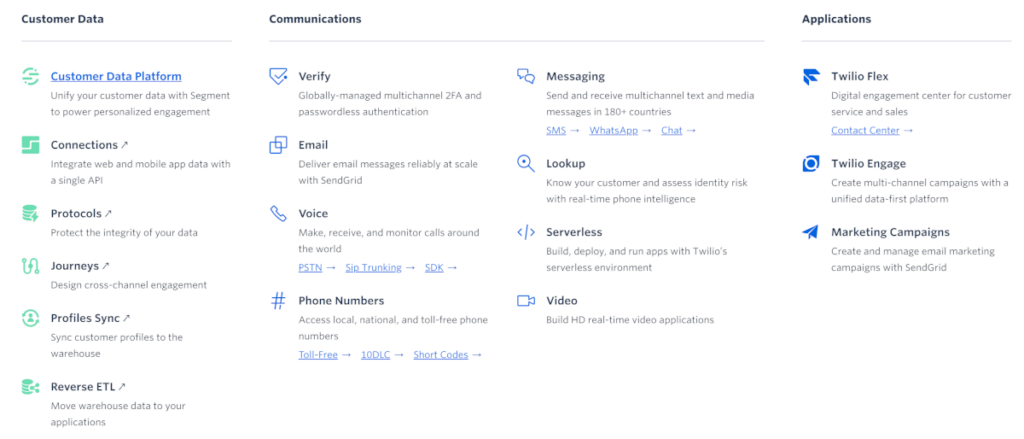
Here’s what the Twilio product menu looks like on their homepage:
This is likely going to change soon or by the time this gets published.
Customer Data = Segment offering
Communications = CPaaS
Applications = Enterprise stuff
Each and every piece in the Communications part can be snuggly fit into the products on the left and on the right (Customer Data and Applications).
Video is a bit of a stretch. At least if you look closely at traffic sizes and revenue numbers.
The two other oddballs – IOT and video streaming – were thrown out without too many objections and without hurting Twilio’ bottom line.
What was left was to get rid of the video piece. It likely took too many resources but made no real dent in Twilio’s numbers.
To be frank – the problems likely started with the acquisition of Kurento. Kurento wasn’t fit for what they had in mind for it, and it was riddled with architectural and technical issues. This wasn’t a good starting point for multiparty calling in Twilio Programmable Video.
If I had to guess, a lot of technical debt went into the product to improve and repurpose the media server pieces of Kurento.
Twilio was slow to innovate on video, leaving the room for other vendors – big and small. It missed the lowcode and embeddable experiences that are now common in video APIs. They didn’t invest in AI integrations too much. It didn’t optimize media quality enough to work well for its customers.
I am guessing growth and revenue from Twilio Programmable Video wasn’t in line of expectations (unsurprisingly). The current market climate, the end of the pandemic, the headaches in Segment and Flex. All of it got them to the conclusion that it would be simpler to just sunset Twilio Programmable Video and move on.
A brave decision. Twilio Programmable Video couldn’t have been sunset in the worst time (unless you consider a few months prior to the pandemic and the quarantines).
Amazon is investing in adding video to its contact center solution, and Twilio, who has Twilio Flex competing against Amazon Connect, is sunsetting video support for its video API.
What does it mean for video calling support in Twilio Flex?
Would Twilio still support or add video calling to Twilio Flex without offering Programmable Video APIs?
How should contact center customers view this? If they have video requirements in their roadmap, would they use Amazon Connect or Twilio Flex?
Innovations in Video APIs and WebRTC managed services
Why was Twilio Programmable Video appealing to potential customers? I can think of two main reasons:
Single throat to choke. Sourcing your voice, SMS and video from the same vendor, on a single bill is an advantage
A reputable vendor. It is Twilio. They are big. What can ever go wrong? …
The reasons why not to? Quite a few:
Quality wasn’t on par with what can be achieved elsewhere with CPaaS vendors
All that Twilio had for itself is its brand name. And that in a market that was moving on.
Things other vendors have been doing in that period of time?
Doubling down on large scale sessions, with 10,000 or more users
Live streaming solutions (the one Twilio sunset in 2022 – Twilio Live)
Investing in AI integrations and pipelines, both on client side and on server side
3D audio, VP9 video codec support
Nocode/lowcode solutions
Twilio wasn’t able to keep up. Or even pick a direction it wanted to invest in.
The rise of the Zoom Video SDK
Twilio issued an email to its customers on December 5, stating the sunset will take a full year. From this email:
[…] we have decided to End of Life (EOL) our Programmable Video product on December 5, 2024, and we are recommending our customers migrate to the Zoom Video SDK for your video needs.
The official recommendation from Twilio is for their customers to migrate to the Zoom Video SDK.
The announcement can’t be found (yet) on any marketing material from Twilio. It can be found on social media accounts from Zoom.
Why Zoom?
Zoom isn’t a competitor of Twilio in anything, and are unlikely to be any time soon
It is a large and respectable vendor with a brand name
They couldn’t suggest vendors that have SMS or voice services.
The rest are mostly smaller vendors – not something Twilio wanted to be identified with is my guess.
There’s only one problem with picking Zoom Video SDK here. Their web experience isn’t on par with the rest of the pack. They rely on WebTransport+WebCodecs+WebAssembly, which isn’t as stable or performant as just using WebRTC. For native, their SDKs should be fine, but for web browsers, I’d be reluctant to use them yet. Add to that the fact that this is a technology shift, requiring some relearning of terms and a reliance on proprietary technology, and you get some increased risk for the vendors switching.
I wonder if Twilio and Zoom came to an agreement here (with Zoom maybe even paying for this suggestion to go out) or if Twilio simply decided to offer some kind of a recommendation and be done with it. Philipp’s bet: Eric Yuan had dinner with Jeff Lawson and paid for it.
Anyhow, customers have a full year to figure out a solution. Or less – depending on how much browsers WebRTC implementations drift away from the current implementation of Twilio. What doesn’t get maintained in WebRTC rots rather quickly.
The future of managed Video APIs (without Twilio)
I am not sure how much Twilio Programmable Video would be missed.
Developers certainly used it. Big and small. Its revenue was probably higher than some of the smaller video API vendors out there. These developers will figure out a way to migrate to other vendors to use. It won’t be the first time a CPaaS vendor has existed in the video API market (we had AddLive, vLine, ooVoo, SightCall, Respoke, Tropo, Forge, CafeX, Circuit, Bit6 all exit this market in the past).
3-4 years ago, we had 3 top dogs in this market: Vonage, Twilio, Agora
A year ago, I’d say I heard a lot more about Vonage, Amazon Chime SDK and Twilio. Less so Agora
Now, we have Vonage and Amazon Chime SDK
Who will take the 3rd spot in the 3 runners when it comes to developers’ mindshare in this industry?
We have Agora, Daily, Dolby, LiveKit and others who are all vying for that spot. Each has its own angle and differentiation.
Would Vonage keep its spot there?
Will Amazon continue investing in its Chime SDK enough?
I don’t have the answers to these questions, but I do have my own opinions.
Where should Twilio Video customers go from here?
That is the big question.
If you are using Twilio Programmable Video – who should you go to instead?
And if you are on the lookout for a CPaaS vendor now – who should you pick?
My WebRTC Developer Landscape infographic was last updated in 2022, but can still offer some guidance as to the alternatives available. Some of them I’ve listed throughout this article. Others are just as valid.
Here are a few questions you need to answer for yourself:
What are your requirements and focus? Different CPaaS vendors offer a different type of a solution, so pick one that offers what it is you’re after
Make sure you ask around. Check references. Talk with other developers who use that CPaaS vendor
Try them out in a small POC before fully committing yourself
Check their commitment and level of investment in what it is you focus on as your requirements and roadmap. Don’t only listen to what they say – also check out what features they introduced to the market in the last 12-24 months. See if they had layoffs in that same period of time as well, and make an educated guess if they will be around a year from now. Maybe wait six months until making the decision
Don’t invest in abstraction layers to be able to replace CPaaS vendors. It sounds like a great initiative and project, so just don’t do it. Unless you want to use more than a single vendor at a time (unlikely for most of us)
While you shouldn’t invest in an abstraction layer, you should definitely try to limit calls to the CPaaS vendor’s APIs to specific modules in your code. If you can limit it to a single source file or class – even better
Thank you for joining us for your latest lesson in how you don’t actually own the things you buy when you buy them digitally. Over a year ago, we discussed a story out of Germany and Austria where a deal expired between Sony and movie distributor StudioCanal, which resulted in 100s of movies being delisted and deleted, both from the PlayStation Store and from the PlayStations of those who bought them. Yup! People bought a thing, got a thing, and then had that thing clawed back from them once the licensing agreement wasn’t renewed. You can guess for yourself whether members of the public who “bought” these movies had any idea that them disappearing long after purchase was even a possibility, but don’t overthink it, you know the answer.
But maybe you thought, “Sucks for Germany, but that wouldn’t happen here in America.” Well, turns out it sucks for some of us, too, as the exact same thing happened here, only with shows and content produced by Discovery and purchased through the PlayStation Store.
The latest pothole in the road to an all-digital future was discovered via a warning Sony recently sent out to PlayStation users who purchased TV shows made by Discovery, the reality TV network that recently merged with Warner Bros. in one of the most brutal and idioticcorporate maneuvers of our time. “Due to our content licensing arrangements with content providers, you will no longer be able to watch any of your previously purchased Discovery content and the content will be removed from your video library,” read a copy of the email that was shared with Kotaku.
It linked to a page on the PlayStation website listing all of the shows impacted. As you might imagine, given Discovery’s penchant for pumping out seasons of relatively cheap to produce but popular reality TV and documentary-based shows, there are a lot of them. They include, but are not limited to, hits such as: Say Yes to the Dress, Shark Week, Cake Boss, Long Island Medium, Deadly Women, and many, many more.
And MythBusters, too, which feels like that show missed an opportunity to bust the myth that you own what you bought when you purchase something digitally. The reality is that there is no good way to actually retain these shows in cases like this. Some that “bought” Discovery content are freaking out, understandably.
“Is there a way I can save this content?” asked one panicked PlayStation user on Reddit. “I use PS4…But I have bought many seasons of shows such as Dual Survival that I do not wish to lose. I was actually under the impression since I owned it, I wouldn’t ever lose it…”
Whatever else is true, it’s obvious that platforms aren’t doing nearly enough to actually inform customers of what they’re buying, leasing, renting, whatever. It would be one thing if this content was ripped away and everyone on all sides realized that was a possibility. That just isn’t the case.
And just as in the Germany instance, there’s no chance that any of this comes with any refunds or givebacks. Well-meaning customers who paid money for this content simply don’t have it anymore. And it just isn’t like having a Netflix account or something like that, where the product catalogue is constantly in flux. It’s people who are buying a show, or the season of a show. But they’re really not. They’re renting it until some combination of Sony and the licensee decides they’re not.
Microsoft is detailing a number of new features coming to its Copilot service soon, including OpenAI’s latest models. Copilot will get support for GPT-4 Turbo soon, alongside an updated DALL-E 3 model, a new code interpreter feature, and deep search functionality inside Bing.
Copilot will soon be able to respond using OpenAI’s latest GPT-4 Turbo model, which essentially means it will “see” more data thanks to a 128K context window. This larger context window will allow Copilot to better understand queries and offer better responses. “This model is currently being tested with select users and will be widely integrated into Copilot in the coming weeks,” explains Yusuf Medhi, EVP and consumer chief marketing officer at Microsoft.

/cdn.vox-cdn.com/uploads/chorus_asset/file/25165444/607408438.jpg) Warner Bros. Pictures/Sunset Boulevard/Corbis via Getty Images
Warner Bros. Pictures/Sunset Boulevard/Corbis via Getty Images
/cdn.vox-cdn.com/uploads/chorus_asset/file/25165446/607408362.jpg) Warner Bros. Pictures/Sunset Boulevard/Corbis via Getty Images
Warner Bros. Pictures/Sunset Boulevard/Corbis via Getty Images