Shared posts

26 Oct 04:47

Voice: So much more than Phone Calls

by Dean Bubley

 [Originally published on LinkedIn. Please subscribe to my new LinkedIn Newsletter here]

Trivia Question: When was the first example of network-based music streaming launched?

I'll bet many of you guessed that it was Spotify in 2006, or Pandora in 2000. Maybe some of you guessed RealAudio, back in 1995.

But the actual answer is over a century earlier. It was the Théâtrophone, first demonstrated in 1881 in Paris, with commercial services around Europe from 1890. It allowed people to listen to concerts or operas with a telephone handset, from another location across town. It even supported stereo audio, using a headset. It finally went out of business in the 1930s, killed by radio. Although by then, another form of remote audio streaming - Muzak, delivering cabled background music for shops and elevators - was also popular.


Why is this important? Because these services used "remote sound" (from the Greek tele+phonos) over networks. They were voice/audio communications services.

Yet they were not "phone calls".

Over the last century, we've started to use the words "voice communications", "telephony" and "phone calls" interchangeably, especially in the telecoms industry. But they're actually different. We often talk about "voice" services being a core component of today's fixed and mobile operators' service portfolios.

But actually, most telcos just do phone calls, not voice in general. One specific service, out of a voice universe of hundreds or thousands of possibilities. And a clunky, awkward service at that - one designed 100+ years ago for fixed networks, or 30+ years ago for mobile networks.

*Phone rings, interrupting me*

"Hello?"

"Oh, is that Dean Bubley?"

"Yes, that's me"

"Hi, I'm from Company X. How are you today?"

"I'm fine, thanks. How can I help you?"

... and so on.

It's unnatural, interruptive and often unwanted. A few years ago a 20-something told me some words of wisdom "The only people who phone me are my parents, or people I don't want to talk to". He's pretty much right. Lots of people hate unsolicited calls, especially from withheld numbers. They'll leave their phones on silent. (They also hate voicemails even more).

I used to go into meetings at operators and ask them "Why do people make phone calls? Give me the top 10 reasons". I'd usually get "to speak to someone" as an answer. Or maybe a split between B2B and B2C. But never a list of actual reasons - "calling a doctor", "chatting to a relative", "politely speaking to an acquaintance but wishing they'd get to the point".

Now don't get me wrong - ad-hoc, unscheduled phone calls can still be very useful. Person A calling Person B for X minutes is not entirely obsolete. It's been good to speak to friends and relative during lockdown, or a doctor, or a bank or prospective client. There's a lot of interactions where we don't have an app to coordinate timings, or an email address to schedule a Zoom call.

But overall, the phone call is declining in utility and popularity. It's an undifferentiated, lowest-common denominator form of communications, with some serious downsides. Yet it's viewed as ubiquitous and somehow "official". Why do web forms always insist on a number, when you never want to receive a call from that organisation?

Partly this relates to history and regulation - governments impose universal service obligations, release numbering, collect stats & make regulations about minutes (volume or price), determine interconnect and wholesale rates and so on. In turn, that has driven revenues for quite a lot of the telecom industry - and defined pricing plans.

But it's a poor product. There are no fine-grained controls - perhaps turning up the background noise-cancellation for a call from a busy street, and turning it down on a beach so a friend can hear the waves crashing on the shore. There's no easy one-click "report as spam" button. I can't give cold-callers a score for relevance, or see their "interruption reputation" stats. I can't thread phone calls into a conversation. Yes, there's some wizardry that can be done with cPaaS (comms platforms-as-a-service) but that takes us beyond telephony and the realm of the operators.

Beyond that, there's a whole wider universe of non-call voice (and audio) applications that operators don't even consider, or perhaps only a few. For instance:

  • Easy audioconferencing
  • Push-to-talk
  • Voice-to-text transcription (for consumers)
  • Voice analytics (e.g. for behavioural cues)
  • Voice collaboration
  • Voice assistants (like Alexa)
  • Audio streaming
  • Podcasts
  • Karaoke
  • One-way voice / one-way video (eg for a doorbell)
  • Telecare and remote intercom functions for elderly people
  • Telemedicine with sensor integration (eg ultrasound)
  • IoT integrations (from elevator alarms to smartwatches)
  • "Whisper mode" or "Barge-in" for 3-person calls
  • Stereo
  • De-accenting
  • Voice biometric security
  • Data-over-sound
  • In-game voice with 3D-positioning
  • Veterinary applications - who says voices need to be human?

There are dozens, maybe hundreds of possibilities. Some could be blended with a "call" model, while others have completely different user-interaction models. Certain of these functions are implemented in contact-centre and enterprise UCaaS systems, but others don't really fit well with the call/session metaphor of voice.

I've talked about contextual communications in the past, especially with WebRTC as an enabling technology, which allows voice/video elements to be integrated into apps and browser pages. I've also written before about the IoT integration opportunities - something which is only now starting to pick up (Disclosure: I'm currently working with specialist platform provider iotcomms.io to describe "people to process" and event-triggered communications).

But what irritates me is that the mainstream telecoms industry has just totally abdicated its role as a provider and innovator of voice services and applications. You only have to look at the mobile industry currently talking about Vo5G ("5G Voice") as a supposed evolution from the VoLTE system used with 4G. It's basically the same thing - phone calls - that we've had for over 100 years on fixed networks, and 30 years on mobile. It's still focused on IMS as a platform, dedicated QoS metrics, roaming, interconnection and so on. But it's still exactly the same boring, clunky, obsolescent model of "calls".

There was a golden opportunity to rethink everything for 5G and say "Hey, what *is* this voice thing in the 2020s? What do people actually want to use voice communications *for*? What interaction models and use-cases? What would make it broader & more general-purpose?" In fact, I said exactly the same thing around 10 years ago, when VoLTE was being dreamed up.

Nothing's changed, except better codecs (although HD voice was around on 3G) and lame attempts to integrate it with the even-worse ViLTE video and perennially-useless RCS messaging functions. The focus is on interoperability, not utility. Interop & interconnection is a nice-to-have for communications. Users need to actually like the thing first.

Some of the vendors pay lip-service to device integration and IoT. But unless you can tune the underlying user interface, codecs, acoustic parameters, audio processing, numbering/identity and 100 other variables in some sort of cPaaS, it's useless.

I don't want a phone call on a smartwatch - I want an ad-hoc voice-chat with a friend to ask what beer he wants when I'm at the bar. I want tap-to-record-and-upload of conversations, from my sunglasses, when someone's trying to sell me something & I suspect they're scamming me. I want realtime audio-effects like an audio Instagram filter that make me sound like I'm a cartoon character, or 007. (I don't want karaoke, but I imagine millions do)

So remember: the telecoms industry doesn't do "voice". It just does one or two voice applications. VoLTE is actually ToLTE. It's not too late - but telcos and their suppliers need to take a much broader view of voice than just interoperable PSTN-type phone calls. Maybe start with Théâtrophone 2.0?

This post was first published via my LinkedIn Newsletter - see here + also the comment stream on LI

#voice #telecoms #volte #phone #telephony #IMS #VoLTE #telcos #cPaaS #conferencing

If you're interested in revisiting your voice strategy, get in touch via email or LinkedIn, to discuss projects, workshops and speaking engagements. We can even discuss it by phone, if you insist.

25 Aug 06:58

Alcatel-Lucent Enterprise and the New Side of the Rainbow

by Dave Michels
Alcatel-Lucent Enterprise and the New Side of the Rainbow

Watch and subscribe on YouTube.

In this session, Dave talks to Alcatel-Lucent Enterprise about its latest partnership with RingCentral and the launch of Rainbow Office.

For more information, visit Alcatel-Lucent Enterprise.

Thanks for watching, if you’d like more like this, don’t forget to SUBSCRIBE to our YouTube channel.

You can also join in the conversation on our TwitterLinkedIn and Facebook pages.


24 Aug 15:36

Please remain calm while the robot swabs your nose

by James Vincent

If you’ve been tested for COVID-19 then you’ve probably experienced the unpleasantness of a nasal swab. Someone takes a long-handled cotton swab and sticks it up your nose — way up your nose — until it reaches the back of the mucus-cave that is your nasal cavity. Upon arrival they give the swab a good twirl to collect your secretions and beat a merciful retreat. I can say from personal experience that it’s a uniquely unpleasant sensation. It’s something that just feels wrong, like the opposite of scratching an itch.

That’s perhaps why I was so unsettled by the sight of this autonomous nasal swab robot developed by Taiwanese medtech startup Brain Navi. Of all the entities I don’t want sticking cotton swabs up my nose, an industrial robot...

Continue reading…

24 Aug 03:28

Here are all the Google products with over 1 billion users – and the ones that experts believe could be next (GOOGL)

by Hugh Langley

Google CEO Sundar Pichai speaks during the Google I/O 2016 developers conference in Mountain View, California

  • Google now has nine products with over one billion monthly active users.
  • They range from the obvious big hitters like Search, to newer members such as Photos.
  • Who could be next? We have a few hunches. (Hint: Google Assistant is a rising star)
  • Visit Business Insider's homepage for more stories.

Just over a year ago, Google Photos became the company's ninth product to reach 1 billion monthly active users. 

Can you name the other eight?

Some of them – search, YouTube, Maps – won't surprise you, but a few of them might. Some were built by Google and some were acquired.

Here are all of Google's products that have made it over the billion-user line, based on data from Google and analysts.

Plus, read on for a few ideas of which products may be next to join the club.

Google Photos

Officially joined the billion-user club: July, 2019

Photos was originally part of the much less successful Google+, but in 2015 Google spun it out into its own product – and another huge hit was born.

Photos was immediately praised as a serious competitor to big rivals like Apple iCloud and Amazon Drive. Four years after its release, it reached the big billion. The company has since launched Photos Go, a lightweight alternative to help it chase the next billion.

Monetized? Google doesn't directly make money from photos, but the data you share helps feed the big Google brain, particularly for refining its machine learning computer vision processes.


Google Drive

Officially joined the billion-user club: July/August, 2018

We knew Google Drive was close to hitting 1 billion users at Google I/O 2017 when the company announced it was hovering at around the 800 million mark. A year later, it joined the big leagues.

You can thank Google's new head of search, Prabhakar Raghavan, for a lot of the hard work making Drive into what it is today.

Monetized? Google charges for its G Suite service, which includes Drive, but the basic consumer version is free of charge. Of course, Google hopes you'll eventually pay for more storage.


Gmail

Officially joined the billion-user club: February, 2016

Gmail was the seventh Google product to hit 1 billion monthly users, and today that number stands at over 1.5 billion total. It seems strange to think Gmail began as one of Google's 20% project, with some executives even dismissing the idea of Google building its own email service.

Today, it's the most popular email provider in the world.

Monetized? Google used to actually scan emails to better target Gmail adverts, a practice it ended in 2017. But it still uses information about you scraped from Chrome, YouTube, etc to target the ads you get on Gmail. Google also said it still allows third-party apps to scan Gmail data as long as they get user consent.


Play Store

Officially joined the billion-user club: September, 2015.

Unlike the Apple iPhone, there are other ways to download apps on Google's Android platform without using its official store – but for most people the Play Store is the simplest way to do it. The Play Store had around 1.1 billion active monthly users as of the last check, according to Bernstein data published in January this year. 

But the number of overall downloads is a better check of the Play Store's health, and Google's not hurting there. According to Sensor Tower data, there were 84.3 billion downloads from the Play Store in 2019.

Monetized? You bet. In fact, the Play Store is one of the key ways Google makes money through Android. The company takes a 30% cut from all app sales, and the same amount from in-app purchases – a practice that has recently come under heavy fire.

Don't forget all of the Play Store services Google offers too, such as books and movies, which also nets it a healthy pay day.


Google Maps

Officially joined the billion-user club: First mentioned in 2015.

Google Maps is a mammoth product for Google, and continues to be the default map product for billions of people. That's partly thanks to Google's continued work to update Maps – and a surprisingly poor start for Apple's rival product. Until recently, Maps was led by Jen Fitzpatrick but is now run by Dane Glasgow and Liz Reid.

Monetized? Google makes money from Maps in several ways. It charges developers to use its Maps infrastructure for their own products; it places ads in Maps search results; and it lets advertisers drop promoted pins. 


Chrome

Officially joined the billion-user club: May, 2015

You probably know about Google's popular web browser, but did you know that Chrome was developed by Google's now-CEO Sundar Pichai? At Google's I/O conference in 2015, just a few months before he was given the most powerful job at Google, Pichai got to announce Chrome had hit 1 billion monthly active users.

Monetized? Not directly, but Chrome functions as a portal to Google's search product – and of course, its ads. It also became the basis of Google Chrome OS, Chromebooks and has become a hugely important part of the Google experience.


Android

Officially joined the billion-user club: June, 2014

It should be no surprise to see Android on this list. Google announced its smartphone platform hit 1 billion monthly active users at its I/O developer's conference in 2014. At last year's Google I/O, the company said there were 2.5 billion active Android devices.

Monetized? In several ways. The Play Store is a big one, but Google benefits by having Android owners use its array of apps. Plus, having Android also puts Google in a better bargaining position for staying as the default search engine on Apple's iPhone and iPad. Remember, a lot of Google's mobile search revenue comes from iPhones.


YouTube

Year it joined the billion-user club: March, 2013

"If YouTube were a country, we'd be the third largest in the world after China and India," said YouTube in a blog post in March 2013, announcing the video streaming service had hit the billions club. Last year, Google said that number had doubled. And to think Google once thought YouTube was only worth $50 million.

Monetized? Naturally. The lion's share of YouTube's revenues come from advertising, but it also makes money from its subscription offerings. Google has started breaking out its YouTube revenues in earnings, revealing that it raked in $3.81 billion in Q2 this year.


Search

Year it joined the billion-user club: May, 2011, according to Comscore.

Search and ads are the meat and potatoes of Google's business, and according to data from Bernstein research, there are more than 2.5 trillion Google searches made every year. 

Monetized? You bet. Search is Google's chief moneymaker, bringing in just under $100 billion in revenue for the company last year.


What's next?

Google doesn't break out a lot of its user numbers (except when it has reason to celebrate) and with no Google I/O this year we've missed our best opportunity to get insight into the products that are really taking off.

But we can speculate, and there are certainly a few clues as to what could be next. Mark Schmulik, an analyst at Bernstein, suggested looking at some of the other products inside Google's G Suite.

"A lot of the applications within G Suite may get there or are already there," he told Business Insider. If you take G Suite as a whole (which is sort of cheating), it's already an established member of the club, surpassing 2 billion users last year.

"We know a lot of that is Gmail," said Schmulik, but he suggested looking to products within, such as Google Docs and Calendar, as possible contenders.

In January, Google announced that its AI Google Assistant had hit more than 500 million monthly users, with that number made up of users across smart speakers, phones, smart displays, cars, and more. 

YouTube Music may also be worth keeping an eye on, said Schmulik. YouTube is already comfortably one of Google's most popular products, while Music and Premium have more than 20 million subscribers combined.

And Google is also in the process of shuttering its Play Music service and trying to shift users over to YouTube Music instead – which could give the service a healthy boost in users.

Google Meet is probably still a ways off joining the club, but a huge tailwind from the pandemic is pushing it along nicely. In April, Google said it was adding 3 million new Meet users a day and was seeing over 100 million daily Meet participants.


23 Aug 22:52

USPS Delays 'Far Worse Than We Were Told,' Internal Docs Show

by Jason Koebler

You’re not just imagining it: The mail really is experiencing widespread delays, according to new internal United States Postal Service documents.

The documents were published by Rep. Carolyn Maloney ahead of a Monday hearing with Postmaster General Louis DeJoy before the House Committee on Oversight and Reform. Motherboard previously reported that a mix of the coronavirus pandemic, more restrictive overtime policies, and a restriction on the amount of time that mail can be sorted and loaded onto mail trucks before they go out has led to delays in mail delivery. Maloney said that "these new documents show that the delays are far worse than we were told” by DeJoy.

Subscribe to our newsletter about the USPS:

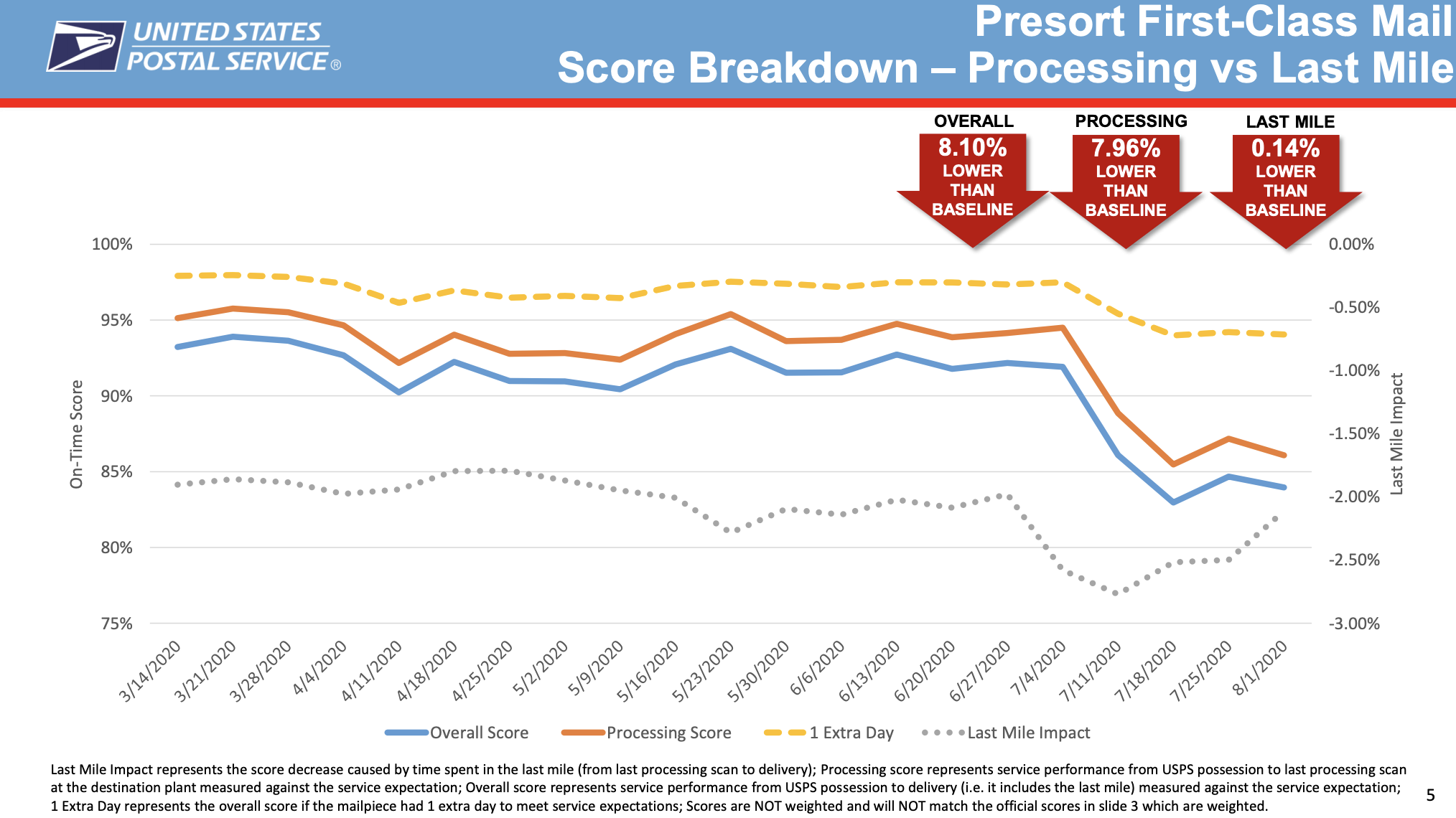
The new documents, a Postmaster General “Service Performance Measurement” briefing prepared for DeJoy on August 12, seemingly show the actual impact of those policies. Across the board, “on-time” scores have fallen sharply since early July. Presorted first-class mail is getting delivered late 8.1 percent more often than baseline, marketing mail (8.42 percent), periodicals (9.57 percent), and even Priority Mail (7.97 percent) have seen similar drops. 

“A marked decline in service performance observed for Priority Mail starting week 7/11/2020,” the document reads. 

USPS has faced an incredible amount of scrutiny in recent weeks as president Donald Trump has tried to sow discord and discourage people from voting by mail in the upcoming election. The Post Office has also decommissioned and dismantled a series of mail sorting machines across the country. 

Screen Shot 2020-08-22 at 4.50.46 PM.png

“After being confronted on Friday with first-hand reports of delays across the country, the Postmaster General finally acknowledged a ‘dip’ in service, but he has never publicly disclosed the full extent of the alarming nationwide delays caused by his actions and described in these new documents,” Maloney said in a statement. “To those who still claim there are ‘no delays’ and that these reports are just ‘conspiracy theories,’ I hope this new data causes them to re-think their position and support our urgent legislation today. We have all seen the headlines from every corner of our country, we have read the stories and seen pictures, we have heard directly from our constituents, and these new documents show that the delays are far worse than we were told.”

21 Aug 00:24

RingCentral Partners with Poly on Meeting Rooms

by Rebekah Carter
Poly-Ringcentral-Video-Bars

Leading communication, contact centre, and collaboration company, RingCentral, announced an exciting new partnership this week. The new RingCentral Rooms for Poly experience will bring the simplicity and performance of RingCentral Video to any workspace.

Created to support the hybrid and flexible workforce, this intuitive RingCentral Rooms service builds on top of the Poly Studio X video bars for all-in-one functionality. RingCentral Rooms for Poly consolidates workspace needs into a minimal number of devices, while allowing for a new wave of analytics, rooms intelligence and manageability.

The solution specifically simplifies large-scale deployments with frictionless installations, procurement, and management.

Delivering Sensational Meeting Rooms

The RingCentral Rooms experience for Poly is now fully integrated with Poly Studio X30 and X50 solutions. This integration delivers more simplicity and convenience to physical workspaces.

The partnership responds to a recent Gartner survey, revealing that while 30% of employees worked remotely part-time before the pandemic, around 41% of people will be working remotely post-pandemic. This hybrid workforce requires new ways to meet and connect.

RingCentral Rooms will allow on-site and remote employees to enjoy seamless collaboration. Leading-edge video and UC technology ensures RingCentral Rooms will enhance meetings for the future workplace, with on-site and remote employees collaborating on equal footing.

According to Chief Product Officer at RingCentral, Will Moxley, the ability to work anywhere is changing how businesses operate. Modern teams require flexibility that allows for collaboration and rapidly changing environments. RingCentral Rooms offers this flexibility in the work-from-home landscape.

RingCentral Rooms extends cloud communication functionality to meeting spaces of any size, with Poly technology to enhance audio, video, and content sharing. Benefits include:

  • Collaboration with anyone joining from any device with a single tap
  • Modern workspaces to suit rooms of all sizes: Teams can utilise everything from wireless file and screen-sharing, to digital whiteboards
  • Easy to deploy, manage, and monitor performance: IT teams can establish telepresence cloud rooms with off-the-shelf equipment, reducing initial investment requirements

A State of the Art Collaborative Experience

The Poly Studio X50 and X30 products enhance RingCentral Rooms with exceptional noise suppression, video, and audio. According to VP and GM of the Room Collaboration Business Unit for Poly, Tim Root, Poly and RingCentral have always worked well together. They both believe in the importance of efficient and intuitive meeting spaces.


Already, CIO & VP of Technology at the Computer History Museum in Silicon Valley, Dave Evans, says that deploying RingCentral Rooms has helped his company to modernize the communications infrastructure. Partners and employees can immediately start meetings as soon as they walk into a conference room.

Poly X Series

RingCentral Rooms with Poly technology provide a simple and consistent experience. Collaborative moments are intuitive and interactive, with seamless functionality across all RingCentral team messaging and video.

Partner for Wainhouse Research, Bill Haskins, said that having evaluated both the Poly Studio technology, and RingCentral, they’re optimistic about the RingCentral Rooms launch. The best successful meeting platforms delight users in the meeting room and at the desktop. RingCentral Rooms is in the perfect position to offer highly desirable outcomes everywhere.


21 Aug 00:24

Tata Communications to Offer Webex Calling in Global Rollout

by Gabriel Avner
Tata-Comms-Webex-Calling-Cisco

Moving your organization’s unified communications to the cloud probably was not the top line priority for you this year. Especially if you are a multinational based outside of North America, migrating to the cloud was likely on the list, but much closer to the bottom than the top.

But then came 2020 and everyone’s best laid plans changed — quickly and drastically.

“We’re seeing what was a three year plan for large multinationals turn into a ‘in three months I want to be 100% cloud, so how do we make that happen?’ situation,” says Chad Elford, the Global AVP for UCaaS Cisco Powered Solutions at Tata Communications.

Chad Elford

Chad Elford

As more organizations are hunting for ways to quickly become far more flexible in the face of uncertainty and optimize their Cisco Flex licenses, Elford tells UC Today that his clients know that they have to make the transition to the cloud.

“Their top request is to help them determine what their end state should be and to help them strategize what that migration looks like,” he says, adding that the price incentives are helping to significantly encourage the move.

Organizations are now going through a process of questioning everything, including where they put their IT resources. Tata Communications’ customers want to know how moving to the cloud will impact their ability to scale, save costs, and of course address how to provide employees working from home with a secure and reliable connection that works as expected.

One key area where Tata Communications is receiving significant interest is in the roll out of Cisco’s Webex Calling cloud service.

The promise of bringing Cisco’s voice, video, and conferencing services on a single platform to their global customers has been years in the making. However, even for organizations that decide on adopting the platform, they lack the knowledge of how exactly to navigate their transition.

Every organization’s cloud migration and end state are going to look a little different. For some, the best path leads them from being on-prem to a hybrid cloud model, while another may be ripe for a full-on cloud-only arrangement. By auditing factors like the organization’s licenses and working hand-in-hand with them to understand their goals, Tata Communications’ team is able to help provide expert guidance and recommendations.

“Cisco talks about ‘the bridge to possible’, but you need a partner to walk you across it,” explains Elford. “That’s why service providers like us can come in with a trusted advisor approach and make recommendations based on where they are and how to reach that end state as quickly as possible.”

Simplifying Global Roll Out and Accountability

As a global leader in voice services, Elford tells UC Today that Tata Communications team believes that they have the infrastructure to fully support the roll out of Webex Calling for multinationals.

“Our strength is our global enablement capabilities and our focus on multinationals, specifically in APAC and India. Tata Communications is ready and able to provide full support for Cisco’s Webex Calling for global customers”

Outside of North America, the Webex Calling offering has been slow to reach customers. This is due in no small part to the complexity that multinational companies face in working through multiple PSTN providers for each location that lack the necessary infrastructure to offer a high standard of service.

This challenge can impact the consistency on pricing and accountability when it comes to support. However, Tata Communications’ singular point of contact for billing and support simplifies these processes, putting them all under one roof of responsibility.

“As a service provider, I’m responsible for the service from ear to ear,” Elford says, “A dial tone is a natural right. It doesn’t matter if you pick up the phone on your soft phone on your PC or the handset on your desk. You just expect it to work. So you have to work with a service provider that can deliver on that type of promise.”


21 Aug 00:23

Gmail, Docs, Drive, and more Google services hit by widespread disruption

by Jon Porter
Illustration by Alex Castro / The Verge

A number of Google services including Gmail, Drive, Docs, Meet, Groups, Chat, Keep and Voice experienced service disruptions on Thursday morning, according to the company’s G Suite Status Dashboard. As of 7:10AM ET Google says that the Gmail issues have been resolved, and its dashboard has been updated to show that none of its services are experiencing problems.

While the disruptions were ongoing, we verified that file uploads were failing across Google’s services, including uploading attachments in Gmail to both personal and G Suite Gmail accounts. In some cases trying to simply compose a new email or a reply failed.

Google first said it was investigating issues with Gmail at 1:29AM ET. It later provided official confirmation of a...

Continue reading…

21 Aug 00:21

You'll soon be able to buy the Porsche Taycan EV in rose gold

by Alanis King

rose gold porsche taycan EV frozenberry metallic

  • The Taycan, Porsche's first EV, will have an available rose gold paint color starting in 2021.
  • That's along with several new features for 2021, like automatic payments for public charging, a new battery-preservation system, and lots of new interior and exterior choices. 
  • Porsche has revealed 2021 pricing yet, but the 2020 Taycan starts at around $104,000. 
  • Orders for 2021 models will open in the fourth quarter of the year, and deliveries are expected in Q1 of 2021. 
  • Visit Business Insider's homepage for more stories.

There's a lot to like about the Porsche Taycan EV, as there is with most material objects over $100,000. But for its first year on the market, there was one glaring hole in the options list for the all-electric sport sedan: a rose gold paint job. 

Come 2021, that hole will be no more. 

Porsche Taycan EV Frozenberry Metallic

Porsche announced a slew of new features for the 2021 Taycan on Wednesday, among them being: a function that allows models with adaptive air suspension to automatically raise themselves in recurring high spots, like speed bumps or driveways; a color heads-up display; over-the-air updates that allow owners to purchase new features without visiting the dealership to install the software; the ability to automatically pay for public charging at "many" Electrify America locations; a new battery-preservation feature; and appearance options that weren't available for 2020.

That last category includes five new interior choices and seven new exterior colors, including metallic brown, metallic cherry, metallic beige, and "Frozenberry Metallic" — the official Porsche term for "rose gold." It's both less cool than the standard nomenclature and liable to make you crave a fruit smoothie that looks healthy but most certainly is not. 

The colors currently available on the Taycan are red, green, silver, gray, two shades each of blue, white, and black.

porsche taycan snow

Porsche said 2021 models, new colors and all, will be available to order in the fourth quarter, and dealer arrivals will happen in the first quarter of 2021. Porsche didn't include pricing for 2021, but the current car starts at $103,800.

Talk of a pink Porsche EV first came earlier this year, when a Taycan forum shared a photo of all 17 colors the car would apparently come in one day. The forum rendered a few Taycans in rose gold at the time, and Porsche later brought one in the flesh to a virtual press conference in Shanghai. 

Porsche Taycan EV Frozenberry Metallic

Actual images of the rose-gold Taycan are so rare, in fact, that when asked for a few, a Porsche North America spokesperson said it was "too soon," before remembering the virtual press event in China.

Perhaps once 2021 deliveries start, photos of rose-gold Taycans will no longer be rare. But if buyers decide not to go pink, we'll at least be able to look at the car in the online configurator — where most of us will be looking at it anyway.

Join the conversation about this story »

NOW WATCH: Swayze Valentine is the only female treating fighters' cuts and bruises inside the UFC octagon

20 Aug 19:16

Google’s Pixel Buds get new transcribe mode, attention alerts, and sharing detection

by Tom Warren
Photo by Becca Farsace / The Verge

Google is adding a number of new features to its Pixel Buds today. A new transcribe mode is designed to translate long speeches directly into your ears, which is ideal for if you’re listening to a lecture or speech where a single person is speaking in a language you don’t understand. The Pixel Buds have always supported a translation feature, but this transcribe mode is designed for one-way translation instead of conversations back and forth, and it’s a more discrete way to translate using the Buds. It will be available initially for French, German, Italian, and Spanish translation into English.

Alongside the new transcribe mode, Google is also adding some more audio options. A new bass boost mode enhances the bass you hear from the...

Continue reading…

18 Aug 20:38

The Senate Intelligence Committee’s new Russia report, explained

by Andrew Prokop
Trump with Paul Manafort (center right) during the 2016 Republican convention. | Mark Reinstein/Corbis via Getty Images

It’s strong, bipartisan pushback against the common claim that there was “nothing there.”

The Senate Select Committee on Intelligence released the final installment of its years-long investigation into Russian interference with the 2016 election on Tuesday, and its report is a strong, bipartisan pushback against the common claim that there was “nothing there.”

The 966-page report (technically volume five of a larger series) contains some new details, and sections redacted for containing classified information imply there’s still more to this story we don’t know. But its real value is reminding Americans that the Russian interference scandal is very real.

“The Russian government engaged in an aggressive, multi-faceted effort to influence, or attempt to influence, the outcome of the 2016 presidential election,” the report, which was co-signed by both Democrats and Republicans on the Senate committee, says. “Russian President Vladimir Putin ordered the Russian effort to hack computer networks and accounts affiliated with the Democratic Party and leak information damaging to Hillary Clinton and her campaign for president” to WikiLeaks.

Paul Manafort, the former Trump campaign chair, comes under heavy criticism in the report for his “willingness to share information with individuals closely affiliated with the Russian intelligence services” — this “represented a grave counterintelligence threat.”

However, the report goes further than Mueller did — it claims some information suggests Manafort and a longtime associate of his, Konstantin Kilimnik, were “connected” to the Russian government’s effort to hack and leak Democrats’ emails. These details here are redacted, though.

The report also retells the story of how Roger Stone tried to get inside information on WikiLeaks’ plans at the behest of the Trump campaign. “Stone obtained information indicating that John Podesta would be a target of an upcoming release,” the report says. It also describes Jerome Corsi’s claims that Stone tried to get WikiLeaks to time the release of Podesta’s emails to distract from the Access Hollywood tape.

There are many other topics addressed in the report, including some criticism for how the FBI handled the “Steele dossier” allegations about Trump. There are also matters that remain murky — most notably, the purpose and extent of Manafort’s communications with Kilimnik, and the exact nature of the information Stone got regarding WikiLeaks.

The Republican senators on the committee insist, in an “additional views” section at the end of the report, that there is still “no evidence that then-candidate Donald Trump or his campaign colluded with the Russian government in its efforts to meddle in the election.” But overall, the bipartisan body of the report does not reflect well on Trump or his team.

The main question has always been about the email hacking and leaking

Last year, special counsel Robert Mueller wrapped up his investigation without criminally charging any Trump campaign officials with conspiring with the Russian government into interference with the 2016 election. Since then, Trump’s defenders have argued that he was right all along that there was “no collusion,” and Mueller’s critics on both the right and left have questioned what the whole thing was about, anyway.

Indeed, it’s true that the most lurid and speculative theories about Trump’s connection to Russia — say, that he’s been a Kremlin asset since 1987 or that he’s being blackmailed with a pee tape — have not been validated and have in some cases been outright debunked to the extent that’s possible.

But it’s important not to forget that a crime really did unfold in plain sight in 2016 — Democratic officials’ private and personal correspondence was hacked and posted publicly, leading to a slew of negative news stories about them (which Trump frequently referred to on the campaign trail).

The hacking, Mueller conclusively documented, was carried out by officers of the GRU, Russia’s military intelligence agency. The leaked documents were mainly posted by WikiLeaks — the group posted emails from the DNC in July 2016, and emails from Clinton campaign chair John Podesta in October 2016.

Trump’s team disclaimed any involvement in all this. But arguably the central question hanging over the Mueller investigation was whether they were, in fact, involved in the hacks or leaks in some way — and if so, whether that involvement amounted to a crime.

Mueller did not end up charging any Trump officials with crimes related to the hack and leak. He also found that the hacks themselves appear to have been carried out entirely by Russian intelligence officers. The full story of what happened with the leaks is more complicated — and the new Senate report adds new complications.

The curious case of Paul Manafort

 Brendan Smialowski/AFP via Getty Images
Paul Manafort walks outside the William B. Bryant US Courthouse Annex on October 30, 2017 in Washington, DC.

Trump’s campaign chair Paul Manafort, a globetrotting political consultant who made millions working for Ukraine’s pro-Russian political faction, was always a major focus of collusion questions, and of Mueller’s investigation. Mueller eventually charged Manafort with various financial and other crimes connected to his Ukraine work. After being convicted at trial on one set of charges in 2018, Manafort pleaded guilty to other charges.

But none of these crimes were directly about conspiring with the Russian government to affect the election. And while Mueller’s report did disclose that Manafort shared internal Trump campaign polling data to his longtime associate, Russian national Konstantin Kilimnik, he did not make any allegations of Manafort being centrally involved in a conspiracy with the Russian government.

Now, the new Senate report has an extremely long and harsh section on Manafort, both claiming that his presence on the campaign posed “a grave counterintelligence threat” and even reopening questions about whether Manafort was involved in the Russian interference campaign itself.

“Manafort’s presence on the Campaign and proximity to Trump created opportunities for the Russian intelligence services to exert influence over, and acquire confidential information on, the Trump Campaign,” the report claims.

Most prominently, the report focuses on Kilimnik, who the authors flatly describe as a “Russian intelligence officer.” Kilimnik had worked with Manafort for over a decade and they stayed in touch during 2016, often communicating in code. “The Committee assesses that Kilimnik likely served as a channel to Manafort for Russian intelligence services, and that those services likely sought to exploit Manafort’s access to gain insight info the Campaign,” the authors write.

Yet the report goes further than Mueller ever did by claiming that “some information” suggests Kilimnik himself “may have been connected to the GRU’s hack and leak operation.” The details, though, are unfortunately redacted.

The report then goes on to claim that “two pieces of information” raise “the possibility” that Manafort, too, was connected “to the hack-and-leak operations”:

Again, the details here are redacted, but the few sentences that we can read make reference to Manafort’s former son-in-law, Jeffrey Yohai, who pleaded guilty to fraud charges.

With so many redactions here, we have no idea what the evidence for this actually is, or how strong it may be. Still, this is a bipartisan report that both Republicans and Democrats signed on to — senators from both parties agreed this stuff, whatever it is, was worth including.

In a statement by Sen. Ron Wyden (D-OR) appended to the end of the report, Wyden complains about “excessive redactions” and says that he is particularly troubled by “indications that Kilimnik, and Manafort himself, were connected to Russia’s hack-and-leak operations.” He adds: “Significant aspects of this story remain hidden from the American public.”

Revisiting Roger Stone

 Alex Wong/Getty Images
Roger Stone speaks to reporters at the Rayburn House Office Building on December 11, 2018, in Washington, DC.

The other long-hanging question about the Trump campaign and the email leaks is about what, exactly, Roger Stone did.

Stone was indicted by Mueller for making false statements and obstructing a congressional investigation, and was convicted at trial last year (though Trump commuted his sentence last month).

Evidence and testimony presented at Stone’s trial made clear that Stone tried to get information from WikiLeaks about their forthcoming releases, and that Stone told the Trump campaign that he had a relationship with WikiLeaks and tried to take credit for their actions. Emails also show that Stone was hearing about Podesta-related leaks nearly two months before news of Podesta’s hack was public.

So Stone may have gotten inside information. There’s also been a claim that he went even further — that he urged WikiLeaks to release the Podesta material at a specific time, to distract from the release of the Access Hollywood tape (in which Trump bragged about grabbing women by their genitals).

Yet establishing what actually happened here has been difficult, because so much of it involves conservative writer and conspiracy theorist Jerome Corsi.

Corsi appears to have been Stone’s source of information about WikiLeaks. And, in an initial interview with Mueller’s team, Corsi “explained” that while he was traveling in Italy in August 2016, “someone told him Assange had the Podesta emails” (per the report). Yet he said he couldn’t recall who told him, saying only that “it feels like a man.” Then, in a later interview with Mueller’s team, Corsi changed his story, saying he had simply deduced this information himself.

Corsi also gave a detailed account of how Stone learned in advance that the Washington Post had the Access Hollywood tape story coming out. Corsi said that Stone wanted to get word to WikiLeaks to “drop the Podesta emails immediately” to distract from this coming news.

Much of this information was actually in the Mueller report, but it was initially redacted to avoid prejudicing Stone’s trial. A version containing many fewer redactions was released earlier this summer. It reveals that Mueller’s team investigated these claims by Corsi but, per their own report, “found little corroboration for his allegations about the day.” Mueller concluded: “The investigation was unable to resolve whether Stone played a role in WikiLeaks’s release of the stolen Podesta emails on October 7, 2016.”

Still, there is a great deal of evidence that Stone very much wanted to hide his communications with Jerome Corsi regarding WikiLeaks. (He concocted a cover story claiming the only person who gave him information was radio host Randy Credico, and emails show that’s flatly false.)

But the Senate report comes to a similar conclusion as Mueller did: “The Committee could not reliably determine the extent of authentic, non-public knowledge about WikiLeaks that Stone obtained and shared with the Campaign.” That is: whatever happened with Stone and WikiLeaks still remains a mystery.


Will you become our 20,000th supporter? When the economy took a downturn in the spring and we started asking readers for financial contributions, we weren’t sure how it would go. Today, we’re humbled to say that nearly 20,000 people have chipped in. The reason is both lovely and surprising: Readers told us that they contribute both because they value explanation and because they value that other people can access it, too. We have always believed that explanatory journalism is vital for a functioning democracy. That’s never been more important than today, during a public health crisis, racial justice protests, a recession, and a presidential election. But our distinctive explanatory journalism is expensive, and advertising alone won’t let us keep creating it at the quality and volume this moment requires. Your financial contribution will not constitute a donation, but it will help keep Vox free for all. Contribute today from as little as $3.

18 Aug 19:51

Herman Cain and the Problems With Tweeting After Death

by Tamara Kneese
18 Aug 16:38

No one has made more money during the pandemic than Elon Musk

by Taylor Nicole Rogers

elon musk happy.JPG

  • Elon Musk has made more money than anyone since the beginning of the coronavirus pandemic — his net worth has more than tripled since March 18.
  • Musk added nearly $8 billion to his fortune on Monday alone.
  • Musk is far from the only billionaire to see their fortune skyrocket in 2020, according to a new report from the Institute for Policy Studies: Jeff Bezos' net worth was up 68% and Mark Zuckerberg's was up 75% as of August 13.
  • The pandemic has upended the finances of millions of ordinary Americans during the same time span, prompting renewed calls for a wealth tax.
  • Visit Business Insider's homepage for more stories.

Lots of billionaires have gotten richer during the coronavirus pandemic, but no one has made more money than Elon Musk.

The Tesla and SpaceX CEO's net worth rose 197% between March 18 and August 13, according to a new analysis by left-leaning think tank the Institute for Policy Studies (IPS) released Monday.

Musk's net worth has grown even more over the last week. He added nearly $8 billion to his fortune on Monday alone, making him the fourth richest person on the planet and bringing his net worth percentage increase since March 18 up to a whopping 246%, according to Bloomberg's estimates. (His latest estimated net worth, per the Bloomberg Billionaires Index, is $84.8 billion.)

The surge in Musk's fortune has paralleled the surge in Tesla's share price. The stock is up 732% in 2020 alone.

A representative for Musk at Tesla did not respond to Business Insider's request for comment on the billionaire's net worth.

"Musk's leadership, a compelling brand, and improved execution are driving an ever-increasing stock price," Bank of America analysts wrote Friday, Business Insider's Carmen Reinicke previously reported.

Billionaires' skyrocketing earnings seem even starker when compared to the pandemic's economic impact on the rest of the country

An unprecedented 56 million Americans have filed for unemployment benefits over the past 21 weeks, far surpassing the 37 million claims filed during the 18-month long Great Recession that ended in 2009. At the same time, experts predict that more than 28 million Americans could lose their homes after falling behind on their rent since the federal eviction moratorium expired.

Though Musk's gains far outstrip those of any other billionaire, the South African native is far from the only member of the three comma club to get richer over the past five months.

As of August 13, Amazon's Jeff Bezos had seen his net worth grow 68% since mid-March, while Mark Zuckerberg's fortune grew 75% to a new all-time high, IPS reports. Thanks to their recent net worth boost, the 12 richest Americans are now worth more than $1 trillion combined, according to IPS's calculations.

Calls for a specialized tax on billionaire's fortunes have strengthened as a result, especially as governments face ballooning budgets and falling tax revenues because of the pandemic. Sen. Bernie Sanders introduced one such bill to tax what he called "the obscene wealth gains" of billionaires during the pandemic in early August.

SEE ALSO: The pandemic has minted 5 new rubber gloves billionaires in Malaysia alone

DON'T MISS: Meet the billionaires bankrolling Joe Biden's 2020 campaign

Join the conversation about this story »

NOW WATCH: What makes 'Parasite' so shocking is the twist that happens in a 10-minute sequence

18 Aug 15:56

Desk phones flirted with extinction, but evolving interfaces keep them relevant

by Samantha Ann Schwartz

With the pandemic, vendors are exploring how they can change a phone's interface for their customers. The question has become, what kind of devices "deserve a spot" on someone's desk at home. 

18 Aug 15:55

Amazon is investing $1.4 billion to expand into 6 cities outside of Seattle, and it may be a sign that tech companies are reconsidering the future of the office (AMZN)

by Avery Hartmans

Amazon office

  • Amazon announced that it's expanding its physical offices in six "tech hubs" around the country and adding 3,500 jobs.
  • The expanded offices will be based in Dallas, Detroit, Denver, New York, Phoenix, and San Diego. Amazon is investing $1.4 billion in building out those offices, it said. 
  • Amazon's office hubs follow a larger trend of tech companies reconsidering how and when employees return to the office. Facebook and Google aren't requiring workers to return until next summer, while Twitter has said employees may work from home forever.
  • Hiring more workers outside of Seattle, where the company is based, allows Amazon to expand its talent pool and potentially adjust salaries down in more affordable cities.
  • Visit Business Insider's homepage for more stories.

For Amazon, the future of office work, post-coronavirus, means thousands of new jobs and office hubs in six cities across the US. 

The ecommerce giant announced Tuesday that it's planning to add 3,500 workers and will expand its offices in six US "tech hubs" — Dallas, Detroit, Denver, New York, Phoenix, and San Diego.

Teams at those offices will work in various sectors of Amazon's business, including AWS, Alexa, Amazon Fashion, and Amazon Fresh, the company said. Amazon plans to fill a range of roles at those locations, including software engineers, data scientists, and product managers. 

Amazon said it's investing $1.4 billion in building out those offices. In New York, the company is building a new 630,000-square-foot office in the Lord & Taylor building on Fifth Avenue, which Amazon acquired from WeWork in March for a reported $1 billion. The building was previously planned to be the site of WeWork's global headquarters.

Amazon said it will add 2,000 new jobs in Manhattan.  

Amazon's investment in physical office space comes at a time when many major tech companies are evaluating how and when employees will return to the office. Amazon previously announced that employees could work from home until January 8, 2021, while companies like Facebook and Google have said that employees may work remotely until summer 2021.

Twitter has said its workforce may work from home forever with no expectation to return to the company's physical office in San Francisco. 

But Amazon's decision to expand its office space outside of Seattle, where its main headquarters is located, falls in line with a trend among tech workers to abandon major coastal tech hubs, particularly the San Francisco Bay Area. A recent survey from job-search database Hired found that 40% of tech workers based in the Bay Area would move to a less expensive city if they were asked to permanently work from home. 

The shift to a "decentralized" office has been percolating in the tech industry for years, and has likely been spurred on by the coronavirus. Twitter CEO Jack Dorsey recently said that Twitter has been working "for a year, if not two years" around decentralizing the way employees work, and that having a distributed workforce was "the whole promise of the internet" to begin with. The internet should have made a central office location "irrelevant," Dorsey said. 

And while new tech offices in less expensive cities could be a benefit for tech workers looking to leave Seattle or the Bay Area, it also allows Amazon to expand its talent pool and potentially adjust salaries down in more affordable cities. In the case of Facebook, CEO Mark Zuckerberg recently told employees that beginning in January, employees who leave the Bay Area will have their salaries adjusted based on where they live.

SEE ALSO: Silicon Valley's open offices are probably over, thanks to the coronavirus — but they were always bad for employees anyway

Join the conversation about this story »

NOW WATCH: How 'white savior' films like 'The Help' and 'Green Book' hurt Hollywood

18 Aug 05:16

Facebook 'actively promotes' Holocaust denial content to certain users, a new study finds (FB)

by Ben Gilbert

facebook ceo mark zuckerberg

  • Facebook users who have interacted with Holocaust denial content are being led to similar content via Facebook's automated algorithms, according to a new report.
  • "Using a 'snowball' discovery method," a new report published by the Institute for Strategic Dialogue said, "we found that when a user follows public pages containing Holocaust denial content, Facebook actively promotes further Holocaust denial content to that user."
  • Facebook has struggled with policing hate speech and divisive content for years, and a Wall Street Journal report from earlier this year revealed that Facebook executives have allowed the issues to get worse in the interest of growth.
  • Visit Business Insider's homepage for more stories.

Facebook has a major issue with its suggestion algorithms. According to a new report, if a Facebook user has previously interacted with Holocaust denial content, Facebook "actively promotes further Holocaust denial content to that user." 

That's according to an August 10 report from the Institute for Strategic Dialogue, a British think tank. The report, "Hosting the Holohoax: A Snapshot of Holocaust Denial Across Social Media," shows that Facebook not only hosts anti-Semitic content denying that the Holocaust happened, but that it continues to present that content to users.   

Using the "snowball" method on Facebook, where a user clicks suggested content based on prior activity, the report found that "when a user follows public pages containing Holocaust denial content," Facebook actively promoted related content.

In the case of Holocaust denial content, "Facebook actively promotes further Holocaust denial content to that user." 

The report found similar Holocaust denial content available through Reddit, Twitter, and YouTube — but Facebook was the only service that actively surfaced additional related content. 

The same suggestion algorithms that pushed additional Holocaust denial content are foundational to how the world's largest social network operates. Facebook collects extremely detailed information about how how users interact with everything on the social network, and tailors itself to each user based on that information.

With well over 2 billion users, Facebook is by far the largest social network in existence. But as the service continues to grow, the company that runs it has struggled or outright refused to moderate content — a Wall Street Journal report from May revealed that executives, including CEO Mark Zuckerberg, declined to moderate the service even when faced with evidence that its algorithms "exploit the human brain's attraction to divisiveness."  

Zuckerberg, who is Jewish, has previously spoken to his own struggle with moderating a subject like Holocaust denial on Facebook.

"I'm Jewish, and there's a set of people who deny that the Holocaust happened. I find that deeply offensive," he told Recode in July 2018. "But at the end of the day, I don't believe that our platform should take that down because I think there are things that different people get wrong."

Facebook has long been criticized for policies that allow Holocaust denial. A 2009 article by TechCrunch's Michael Arrington called the company "stubbornly proud" of its stance after Brian Cuban, brother of billionaire investor Mark Cuban, lambasted the company for "promoting and encouraging hatred."

"The mere statement of denying the Holocaust is not a violation of our terms," a Facebook spokesperson told ABC News at the time.

Jonathan Greenblatt, CEO of the Anti-Defamation League, said in a statement after Zuckerberg's 2018 comments that Holocaust denial is a "willful, deliberate, and longstanding deception tactic by anti-Semites that is incontrovertibly hateful, hurtful, and threatening to Jews." 

A Facebook representative shared the following statement with Business Insider:

"We take down any post that celebrates, defends, or attempts to justify the Holocaust. The same goes for any content that mocks Holocaust victims, accuses victims of lying, spews hate, or advocates for violence against Jewish people in any way. We also remove Groups and Pages that discuss Holocaust denial from recommendations and references to it in search predictions. While we do not take down content simply for being untruthful, many posts that deny the Holocaust often violate our policies against hate speech and are removed. In countries where it is illegal, such as Germany, France and Poland, this content is not allowed in accordance with the law. Striking the right balance between keeping people safe and allowing free speech is difficult and we know many people strongly disagree with our position. We are constantly developing and reviewing our policies and consulting with organizations around the world to ensure we're getting it right."

Got a tip? Contact Business Insider senior correspondent Ben Gilbert via email (bgilbert@businessinsider.com), or Twitter DM (@realbengilbert). We can keep sources anonymous. Use a non-work device to reach out. PR pitches by email only, please.

SEE ALSO: The Trump administration is asking a court to dismiss the tech industry's legal challenge his executive order taking aim at social media companies

Join the conversation about this story »

NOW WATCH: Swayze Valentine is the only female treating fighters' cuts and bruises inside the UFC octagon

18 Aug 05:14

A market research firm says Google Cloud is now the leading cloud in the retail industry, partially because retailers don't want to work with Amazon Web Services (GOOG, GOOGL)

by Rosalie Chan

GettyImages 1142103398

  • The market research firm Canalys named Google Cloud the leading cloud in the retail industry. 
  • That's notable, given that rivals Amazon Web Services and Microsoft Azure are seen to dominate the overall cloud computing industry.
  • Under CEO Thomas Kurian, Google Cloud has placed its focus on appealing directly to six specific industries, including retail — a strategy that includes hiring sales and marketing staff dedicated to that purpose. 
  • Canalys says that in Google Cloud's ability to offer advertising and search services to retailers alongside its core cloud offering makes it stand out from Microsoft, and those same customers like that it doesn't compete in e-commerce the way that Amazon does.
  • Visit Business Insider's homepage for more stories.

One of Google Cloud CEO Thomas Kurian's key strategies to take on the dominant Amazon Web Services and Microsoft has been to focus on selling directly to certain, specific industries. Now, a new report from market research Canalys shows this initiative has borne fruit, as Google Cloud is named the leading cloud in the retail sector.

Analysts say that this is thanks to Google Cloud's abilities to offer advertising and search services alongside its core cloud platform, its industry-specific focus, and that it's not seen as a competitor in e-commerce, the way that leading cloud platform Amazon Web Services is. 

Google Cloud already has some major retail customer wins under its belt. Earlier this month, Google Cloud announced an expanded multi-year partnership with Best Buy to provide infrastructure and analytics services to help with retail strategy and customize shopping experiences. Google Cloud also counts retailers Costco and Target as customers. 

Still, Google Cloud is far behind AWS and Microsoft when it comes to cloud market share in the United States, with Alibaba also a strong contender on the global stage.

Retail is one of the six industries targeted by Kurian's strategy, with the others being financial services, health care, manufacturing, media and entertainment, and the public sector. As part of this master plan,  Google Cloud has hired salespeople aggressively, as well as forged partnerships to win over customers in each sector.

As part of the initiative, Google Cloud now has a sales team entirely focused on retail customers, while also building specific products like Google Cloud for Retail, designed to help retailers with hosting, inventory management, search, and product recommendation. It also offers AI-powered search engine optimization services, a boon to sellers.

The coronavirus pandemic has likely only accelerated Google's appeal to retailers, many of whom were forced to double down on e-commerce as physical retail stores closed or reduced their capacity in the name of public health. That means using a platform like Google Cloud to modernize and go online.

Read more: Here's how Amazon, Microsoft, and Google are making their big pushes to win over customers in niche markets like retail and finance

"Especially during this pandemic, people need to move their online experience along," Canalys research analyst Blake Murray told Business Insider. "Google is in a great place to do that, They are leaders using artificial intelligence and machine learning. I think it gives them an edge in that way."

Competing against AWS, Microsoft, and Alibaba

Google Cloud isn't the only cloud company going after the retail sector: Amazon Web Services has made its own play for the space.

AWS was originally designed for Amazon's internal use, meaning it has a notable e-commerce pedigree, as well as a partner program focused on retail. Nike and Disney are both big AWS customers. However, on the other hand, many of the retailers that AWS is going after are also competitors on some level, which could turn them away. 

"Due to this competitive aspect, many major retailers have opted to work with other cloud service providers," Murray said. 

Microsoft, meanwhile, has a huge, decades-old partner-network with over 2,000 retail-specific applications, Murray notes. 

However, Murray says, Google's strong position in search and advertising makes it appealing to retailers, as well as its charm offensive in the sector. Google Cloud gives customers more customizable contracts and service "in a way that's arguably better off than Microsoft is," Murray says.

Murray says that ultimately, Google Cloud's momentum with retailers is a sign that the company has a real shot at catching up with its rivals, but that it's far from a sure thing.

"They can work with huge retailers," Murray said. "They have customized solutions and support teams ready to go. It's a big question over time. Can Google catch up to Microsoft and AWS? I think the answer is 'yes,' but it really depends on how they utilize their strategy and how well it works out in the long term, not just in retail but all the other verticals."

Do you work at Google Cloud? Got a tip? Contact this reporter via email at rmchan@businessinsider.com, Signal at 646.376.6106, Telegram at @rosaliechan, or Twitter DM at @rosaliechan17. (PR pitches by email only, please.) Other types of secure messaging available upon request. 

SEE ALSO: Google Cloud partners explain all the ways that the search giant is getting more flexible, from letting customers reallocate their cloud resources to helping developers pay for their own sales and marketing pushes

Join the conversation about this story »

NOW WATCH: 7 secrets about Washington, DC landmarks you probably didn't know

18 Aug 05:11

Microsoft’s ‘can’t uninstall Microsoft Edge’ support page is hilariously telling

by Sean Hollister
Photo by Tom Warren / The Verge

Look, I’m sure that the new Microsoft Edge is a fantastic web browser. I’m looking forward to trying it someday.

But Microsoft, I have a piece of advice for you: if so very many Windows users are googling “Can’t uninstall Microsoft Edge” that you feel the need to utterly own that search result by making it the title of your FAQ... maybe just don’t force it on Windows users to begin with?

Here’s a screenshot of the new support page, for posterity:

To be clear, I’m not saying Microsoft shouldn’t have updated users to the new version of Edge, particularly after today’s announcement that Internet Explorer and legacy Edge will be fully phased out exactly one year from now. Continued security updates are important!

But instead...

Continue reading…

17 Aug 17:05

Get Zoom Phone Service in 40+ Countries & Territories for One Flat Monthly Price

by Cari Dick

Organizations large and small have turned to Zoom Phone, a simple, secure, cloud phone system, to untangle their global telephony spending and replace their existing PBX solution with one that fits seamlessly into their overall communications framework.

Today, we’re excited to announce that Zoom Phone is growing — offering expanded international coverage and simplicity to our customers with global business operations.

Streamlined global calling in 40-plus countries & territories

Zoom Phone is now in more than 40 countries and territories across Europe, North America, Latin America, and the Asia-Pacific region. We’re also introducing a new, simplified plan for providing local telephony service with unlimited domestic calling for multinational organizations.

Gone are the days when you had to manage a fleet of telecom carriers and contracts around the world. Our new Global Select plan enables companies located in any of the 40-plus countries and territories we serve to pay one flat price per user, with a streamlined process for managing domestic calling plans.

The benefits of a new global plan model

Providing local service in 40-plus countries and territories along with bring-your-own-carrier (BYOC) plans, Zoom Phone has you covered. We dramatically simplify your global phone service by offering a predictable, easy-to-manage plan. Some of our favorite benefits include:

  • Flat rates across 40-plus countries and territories: Pay just $20 USD per user/per month for a simplified unlimited domestic calling plan wherever Zoom Phone provides local PSTN service.
  • Unlimited calling: Unlike many calling plans that come with a “pool” of metered minutes, our unlimited plan gives users unlimited calling for one flat monthly rate for both mobile devices and landlines. 
  • Mix and match calling plans: Our new plans enable you to add domestic, regional, or metered calling plans across 40-plus countries and territories to fit your organization’s needs. 
  • Add unlimited international calling: For users who require higher-volume international calling, an add-on with unlimited calling in 18 countries and territories is available.

Our focus: simplifying your communications 

Since we launched Zoom Phone in January 2019, we’ve steadily pushed to expand availability in the UK, Australia, Ireland, and other European markets, providing PSTN coverage to ensure an easy path to cloud phone service for any organization. Today’s announcement furthers our commitment to creating a frictionless and simplified communications experience for all our global customers.

“Zoom continues to push the envelope in the UCaaS market,” said Elka Popova, VP of Connected Work Research at Frost & Sullivan. “Now, with an innovative plan model and availability of its successful Zoom Phone product in over 40 countries, Zoom should be on the shortlist for many multinational companies.”

Want to learn more about the benefits of Zoom Phone for your business? Sign up for the webinar “Support Your Global Workforce with Zoom Phone on Aug. 26, or contact a Zoom Phone expert for a personalized demo today!

17 Aug 17:05

Will the pandemic spell the end of the printer?

by Roberto Torres

Printer sale projections fell as employees stayed home, leveraging digital processes to get work done. But in some industries, the office printer continues to be in demand.

17 Aug 16:56

Secret Service bought access to cellphone location data

by Adi Robertson
Photo by Becca Farsace / The Verge

The US Secret Service (USSS) signed a contract to access Locate X, a service that lets law enforcement track phone users’ locations. Motherboard published apparent confirmation of the deal this morning, following a Protocol report in March. The contract indicates that the USSS paid Virginia company Babel Street around $36,000 to add Locate X to a $2 million social media monitoring package.

Protocol’s report describes Locate X as a powerful tracking tool that aggregates data from popular phone apps, then lets buyers track the location history of devices that were active at a specific time and place. It reported that the Secret Service, US Customs and Border Patrol, and Immigration and Customs Enforcement have all used the product. The...

Continue reading…

17 Aug 02:56

Apple stumbled into a war with the gaming industry, and the future of iOS is at stake

by Nick Statt
Image by Epic Games

Apple’s cloud ban and Fortnite feud have made it gaming’s latest villain

Continue reading…

14 Aug 22:21

The 14 best beach movies you can stream right now

by Audrey Lee
 

Portrait of a Lady

  • Though many beaches have opened for the season, those with COVID-related concerns are looking for summer entertainment from the safety of their homes, including films available for streaming.
  • We compiled a list of award-winning and cult-favorite movies from a diverse range of directors and actors to replicate the experience of visiting the beach and inspire new bucket list travel destinations.
  • Picks include coming-of-age dramas, queer love stories, and family-friendly animated films set on beaches and coasts around the world, all available for streaming across Amazon, Disney Plus, Hulu, and more.
  • For more streaming recommendations, check out our guide to the best streaming services you can sign up for online.

With strict travel guidelines and the continued need for social distancing, planning a relaxing vacation is a daunting task. Now, more than ever, there are considerable risks to enjoying normal summer activities, like dining out, traveling, and even going to the beach. If your summer getaway has been cancelled and you've been longing to feel the cool ocean breeze again, consider simulating the experience through film.

Our picks for the best international beach movies will allow you to marvel at some of the most alluring shorelines in the world from the comfort and safety of your home. Buckle up for a road trip to a secluded Mexican beach with a young Diego Luna and Gael García Bernal in "Y Tu Mamá También," or sing along to an ABBA tune in Greece with the cast of "Mamma Mia!" These beloved and award-winning features are sure to impress with coastal sites you'll soon add to your own travel bucket list.

Aesthetics aside, some of the beaches and coastal settings in our top picks also help represent central themes, reflect emotional states, and even personify their own characters. With a mix of comedy and drama, including important work from queer and BIPOC storytellers, these lively narratives deliver strong performances while transporting us to different corners of the globe. Whatever your preference, we recommend you make a refreshing drink to enjoy as you watch and let your mind drift to one of these on-screen oases.

Note: Mild spoilers ahead.

For more armchair travel, check out these additional articles:

Here are the best international beach movies to stream right now:

"Call Me by Your Name"

A staple in queer cinema, "Call Me by Your Name" follows the secretive but passionate affair between 17-year-old Elio Perlman (Timothée Chalamet) and an American grad student named Oliver (Armie Hammer) who is studying and living with Elio's parents during the summer of 1983. Their ethereal romance plays out in Crema, a small Northern Italian city where the Perlmans reside, stimulated by picturesque foliage and historic architecture. The beautiful Italian landscapes showcased throughout the film include the crystal blue waters in Sirmione, Italy on Jamaica Beach, where an intimate dialogue between Chalamet and Hammer takes place.

A quintessential summer romance film, this coming-of-age story explores sexuality, love, and discovery with the surrounding Italian scenery serving as the perfect backdrop to capture the intense emotional currents Elio experiences both alone and when he is with Oliver. "Call Me by Your Name" received several international nominations and awards, including winning the 2017 Academy Award for best adapted screenplay, and the movie earned Chalamet his first-ever nomination for best actor.

Stream "Call Me by Your Name" or sign up for Amazon Prime here


"The Talented Mr. Ripley"

Working-class pianist Tom Ripley (played by Matt Damon) becomes embroiled in sex, lies, and murder as he travels to Italy in order to retrieve the playboy son (played by Jude Law) of a New York magnate. A majority of the film was shot in Italy, with the fictional Southern Italian town "Mongibello," where Damon first meets Law and Gwyneth Paltrow's character, actually identifiable as Ischia and Procida, sunny islands that are part of the Bay of Naples.

Along with filming on Bagno Antonio beach, the coastal roads, open piazzas, and narrow cobblestone paths showcase Southern Italy's allure as Damon's character becomes captivated by the extravagantly lavish lifestyle he now finds himself living. As Damon jet-sets through the Italian islands throughout this psychological thriller, the audience is spoiled by displays of Italy's charm and glamour, demonstrating why its coast remains such a popular vacation destination to this day.

Stream "The Talented Mr. Ripley" or sign up for Hulu here


"Moana"

"Moana" is an easy choice for a family-friendly movie that both children and adults can enjoy. In order to restore balance within her community, the titular heroine embarks on a life changing journey in search of a slighted demigod voiced by Dwayne "The Rock" Johnson.

Though Moana hails from the fictional Polynesian island Montunui, the animated tropical landscapes from the film were inspired by actual islands, like Tahiti, Samoa, Hawaii, and Fiji. These influences are apparent throughout the film's visuals including the tropical foliage, distinct rock formations, and crystal clear waters. Auli'i Cravalho, the Hawaiian native who voices Moana, has also noted that the creators of "Moana" spent five years researching in order to make the film as authentic as possible and aptly convey a deep cultural respect for the land and ocean on-screen.

Stream "Moana" or sign up for Disney Plus here


"The Beach"

In this drama, Leonardo DiCaprio plays an American backpacker drifting from place-to-place in search of paradise. After the backpacker befriends a French couple during his travels, the vagabond trio embark on a journey to Southern Asia in search of a hidden oasis that promises to fulfill all their desires. The beautiful Maya Bay on Southern Thailand's Koh Phi Phi Leh Island is the actual location of the movie's fabled utopia, where tropical foliage, clear ocean waters, and imposing rock formations make for an idyllic hideaway.

While "The Beach" received unfavorable reviews from critics, the film serves as a powerful and important warning about the dangerous side effects of ecotourism. Maya Bay was closed by government officials in 2018 after the two decades of ecological havoc that ensued from both the movie's filming as well as tourists flocking to the destination to follow in young Leo's footsteps. As a result, Maya Bay's once pristine waters have now been closed to the public for more than two years in order for the ecosystem to peacefully restore itself. Until it reopens, "The Beach" serves as a proxy to enjoy the bay's beauty.

Stream "The Beach" or sign up for Amazon Prime here


"Mama Mia!"

Laughter, love and the music of ABBA make "Mama Mia!" a great summer pick for movie night with friends. The film, set in fictitious Kalokairi, was actually shot in Skopelos, a Greek Island with lively beaches and cliff sides lined with charming homes.

Glisteri Beach was close to where Hotel Villa Donna was located, and its sweeping bay and surrounding areas served as the ideal spot to shoot key scenes, like when Sophie is reading Donna's diary singing "Honey, Honey," and when Bill, Harry, Sam, and Sophie reminisce crooning "Our Last Summer" together. Kastani Beach on the southwest coast also provided ideal acoustics to film musical numbers like Sophie and Sky's duet of "Lay All Your Love On Me," and Tanya's rendition of "Does Your Mother Know."

If you're in the mood for a double feature, follow up with the movie's sequel, "Mamma Mia! Here We Go Again," which focuses on Donna's life as a young woman. The sequel was filmed predominantly on the equally impressive Croatian island of Vis.

Stream "Mama Mia!" or sign up for Hulu here


"Whale Rider"

Shot on the East Coast of New Zealand's North Island, "Whale Rider" explores a young Maori girl's desire to become the leader of her tribe while struggling with her community's long held patriarchal conventions. Both the film and the book are set in Whangarei, a small community historically populated by Maori, with the choice to film on-location culturally significant in maintaining the narrative's authenticity.

The ocean and aquatic wildlife play important roles in the story and several key scenes showcase the Whangarei coast's distinct geographical features such as its whale-shaped island and crescent bay. At the time of release, "Whale Rider" won multiple international awards and the film's star, Keisha Castle-Hughes, even became the youngest best actress nominee in Oscar history at the 2003 Academy Awards.

Stream "Whale Rider" or sign up for Amazon Prime here


"On Chesil Beach"

This love story with commentary on sexual freedom and the tradition of marriage follows a newlywed couple played by Saorise Ronan and Billy Howle as they realize the deep seated implications their different socioeconomic backgrounds have on their union. Told in flashbacks of the pair's initial meeting as well as in the present where the young couple are spending their honeymoon, "On Chesil Beach" demonstrates that not all love stories are happy.

As its title suggest, this film's beach scenes were filmed on Chesil Beach's pebbled coast in Dorset, England. While the beginning sequences show still shots of the area's vibrantly colored landscapes and windy atmosphere, Chesil Beach truly shines as the couple have their climactic argument in which they decide to part ways. While the pair dispute on the seemingly desolate beach, the camera also captures beautiful shots of the tides running up and down the rocky shore as well as a visible sunset peaking from behind the cloudy sky.

Stream "On Chesil Beach" or sign up for Amazon Prime here


"Portrait of a Lady on Fire"

"Portrait of a Lady on Fire" is a historical French drama that follows the secret romance between Marianne, a French artist, and Héloïse, the young aristocrat whose portrait she is commissioned to paint. Hired by Héloïse's mother and assuming the guise of a walking companion, Marianne accompanies Héloïse on intimate beachside strolls that were filmed in Saint-Pierre Quiberon, Morbihan, a North Western French commune in Brittany.

"Portrait of a Lady on Fire" prominently features the region's rocky cliffs, crashing waves, and Pointe Du Percho's distinct natural archway, providing a serene setting for the budding love that ensues. Throughout the film, the beach serves as the young couple's escape from eighteenth century society's constraints, and director Céline Sciamma uses the ocean's sometimes calm, sometimes violent tides to reflect the characters' inner turmoil.

Stream "Portrait of a Lady on Fire" or sign up for Hulu here


"To Catch a Thief"

Cary Grant and Grace Kelly make a memorable duo in this 1950s thriller about a cat burglar (Grant) looking to clear his name of a crime he didn't commit. "To Catch a Thief" was filmed in Cannes, Nice, and the surrounding countryside along the French Riviera, with scenes featuring several historic landmarks in France's southern coast, such as the Hotel Carlton in Cannes and Boulevard Jean Jaurès in Nice.

One of the film's most iconic scenes shows Grant and Kelly driving a powder blue convertible in Beausoleil on the Cote d'Azur. As Kelly' character zips through the winding roads, the camera captures a wide shot overlooking Monaco's coast and the Mediterranean ocean. La Croix des Gardes, where the couple stop to have a picnic, still has public trails where visitors can hike today, but watch the film to experience what the area looked like in the 1950s, or if you're in the mood to add some old-school glamour to your life.

Stream "To Catch a Thief" or sign up for Amazon Prime here


"Breath"

Set in Western Australia during the 1970's, "Breath" follows two childhood best friends who pick up an interest in surfing when they meet and form a connection with an older, retired professional surfer. As this mysterious local begins to encourage the boys to take risks, like surfing in shark-infested waters, the teenagers begin experiencing new emotions and ultimately find themselves at a loss of innocence in this coming-of-age tale.

The film was shot in Denmark, a popular area for surfing along the coast of Western Australia, and the movie's opening sequence and several surf scenes throughout prominently feature Crusoe beach. The visibly gentle waters, open skies, and scenic mountain peaks captured on-screen help demonstrate precisely why Denmark would be any surfer's paradise.

Stream "Breath" on Amazon Prime or Netflix


"Lilo and Stitch"

If your Hawaiian getaway was cancelled, this Disney classic might serve as an upbeat substitute for the real thing. When precocious Lilo accidentally adopts an alien fugitive disguised as a dog, the two misfits develop a heartwarming friendship neither knew they were searching for.

The movie's charming depictions of beachside living, which include surfing, shaved ice, and an Elvis-heavy soundtrack, make the film quintessentially Hawaiian. This animated children's film also celebrates Hawaiian culture by incorporating historic Island traditions into the narrative, like hula as well as the deep-rooted importance of family. While not a popular tourist destination, the relaxed town of Hanapepe on Kauai is said to be the inspiration for "Lilo and Stitch," though the community's only nod to the movie seems to be a mural on the side of a local cinema, the Aloha Theatre.

Stream "Lilo and Stitch" or sign up for Disney Plus here


"Y Tu Mamá También"

Alfonso Cuarón's "Y Tu Mama Tambien" follows Tenoch (Diego Luna) and Julio (Gael García Bernal), a pair of best friends who embark on a summer road trip with Luisa, the sick wife of Tenoch's cousin whom they meet at a wedding. After boasting to Luisa about knowledge of a beautiful unknown beach, the duo are shocked when she takes up the boys' invitation to accompany them to the fictional paradise, "Heaven's Mouth."

Though the group does make it to the shore, the movie's stunning beach scene where the trio frolic in the ocean was filmed at Playa Cacaluta in Huatulco, Oaxaca. Though Cacaluta is noted as not the easiest beach to access, many say the secluded bay's white sands and clear waters are well-worth the trek. "Y Tu Mamá También" was praised for its powerful depictions of love and intimacy as well as interesting narrative structure, plus the film actually had a hand in changing Mexican censorship laws when it was released in 2001. 

Stream "Y Tu Mama Tambien" on Amazon Prime or Netflix


"Fast Five"

In the fifth installment of the "Fast & Furious" franchise, Dominic Toretto (Vin Diesel) returns with his team of highly skilled auto thieves to pull off a job that will financially set all of them for life. Set in Rio de Janeiro, though filmed in both Brazil and Puerto Rico, the movie is able to incorporate stunning aerial footage of the city that includes iconic sites, like Sugarloaf Mountain, the Copacabana Fortress, Ipanema Beach, and the Christ the Redeemer statue.

In addition to capturing some of Rio's impressive landmarks, one of the film's key scenes finds Gal Gadot and Sung Kang's characters staking out a luxurious Brazilian beach club while swaying palms and sparkling waters are visible in the distance. Along with its visually impressive components, the film's action-packed race sequences and fast-paced fight scenes make "Fast Five" the perfect escape from a drab day indoors.

Stream "Fast Five" or sign up for Hulu here


"Crazy Rich Asians"

Based on the bestselling novel, "Crazy Rich Asians" follows the protagonist, Rachel Chu, as she travels to Asia to meet her boyfriend Nick's family for the first time who, unbeknownst to her, is extremely wealthy. While the history-making movie captures Singapore's impressive grandeur and advanced modern architecture, the scenes where Colin and Araminta's bachelor and bachelorette parties take place also showcase Malaysia's stunning beaches.

Though the couple's parties supposedly take place on different beaches in the film, Langkawi, which is made up of over 100 islands on Malaysia's west coast, serves as the location for both pre-wedding celebrations. Araminta's festivities were filmed at the Four Seasons Langkawi along the Andaman Sea, while the remote spot where Nick tells Colin he plans to propose was actually built and shot on a separate part of Langkawi. According to director Jon M. Chu, the cast and crew felt spoiled while filming with the island's coastal mangrove trees, boat rides, and sunsets.

Stream "Crazy Rich Asians" or sign up for Amazon Prime here


14 Aug 19:39

The dystopian tech that companies are selling to help schools reopen sooner

by Rebecca Heilweil
An empty schoolroom with a US flag. Companies are adapting their artificial intelligence products with the hope they can help schools reopen amid the pandemic. | George Frey/Getty Images

This fall, AI could be watching students social distance and checking their masks.

Open Sourced logo

Thousands of schools nationwide will not be reopening this fall. But in Las Vegas, the private K-12 Meadows School plans to use an artificial intelligence-powered thermal screening system to keep students safe as they return to classes.

The system will scan for signs that students have elevated temperatures — an indication they might have Covid-19 — as they enter buildings for their classes. If they’re flagged, the students will be asked to wait separately for about 10 minutes, and then get their temperature taken again. If the result is within a normal range, they’re cleared to start their day. If not, they’ll be sent home.

“Things are strange enough. Kids are going to be coming to school with masks. They’re going to be meeting friends with masks,” Jeremy Gregersen, the head of school at Meadows, told Recode. “They’re going to be meeting their teachers for the first time in person in strange new ways, and what we want is for kids to feel welcome and to normalize their arrival at school as early as possible.”

Supplying the technology is an artificial intelligence company called Remark Holdings. The company, which also sells facial recognition systems, has been providing a thermal scanning system — which also takes attendance — to more than 100 schools in China for over a year and is now repurposing its tech to assist semi-public places reopening amid the pandemic.

Remark Holdings is not the only company doing so. A slew of firms, many of which already sold surveillance products, are adjusting their technology to the pandemic. The suite of products includes everything from computer programs that can identify whether or not a student is wearing a mask to artificial intelligence that measures how well people are social distancing. Sometimes, these capabilities are sold together as a package.

Ultimately, these companies and their clients hope that the return to class can be made a little safer. Although many schools have delayed their plans to restart in-person classes, some experts discourage putting too much faith in these tools when students do go back to school.

“It’s important that, even perhaps before talking about the privacy concerns around some of these technologies, it’s useful and saves time to take a step back and just ask whether it works,” Amelia Vance, the director of education privacy at the Future of Privacy Forum, told Recode.

Using thermal imaging to screen for temperatures is a good example. While companies like Remark defend their tech, not everyone who has Covid-19 gets a fever, and not every high temperature is caused by an illness. Vance also says the science behind the technology itself is somewhat “rocky.”

Overall, while there might be some value in collecting different types of data amid the pandemic, these new technologies can also cause new problems and endanger children’s privacy. Here’s what we know so far about how schools are trying to strike a balance.

Computer vision and wearables can measure social distancing

One new surveillance tool being retrofitted for the pandemic is artificial intelligence that can measure social distancing by using software to recognize human beings in images, and then measure how close together they are. The goal is to identify “hot spots” full of traffic, which can help school leaders adjust how they set up the flow of people.

Some of that AI is being offered by companies that already have close relationships with schools. Among them is Avigilon, a company owned by Motorola Solutions that sells a wide variety of artificial intelligence-surveillance tools. The company already has relationships with thousands of schools, as the Wall Street Journal recently reported, and has now adjusted its video analytics to measure social distancing.

Actuate is also getting into pandemic-era school surveillance. The company normally sells artificial intelligence that mines through school security video feeds for signs of a brandished weapon — an anti-gun violence measure — but is now offering AI that measures how well people are social distancing. Ben Ziomek, Actuate’s co-founder and CTO, told Recode that 900 schools are interested in the tech for when they reopen, and another 100 are interested in the tech it built specifically for Covid-19.

“It’s pretty easy to have AI identify when a person is in video, and then, when we look at video footage, we extract the relative positions of the people,” he told Recode. “We use those relative positions of people to calculate: ‘Are they within 6 feet of each other?’ ‘How long were they there?’ ‘How many people are there?’ We can also count people; we can show how people move through space.”

Airports and other public spaces have started using similar tech.

Meanwhile, some companies are integrating wearables that are meant to stop infractions of social distancing rules. One school in Ohio is planning to pilot an electronic beacon that could measure how well people are social distancing, as well as aid with contact tracing efforts. A potential privacy benefit to this approach is that the surveillance systems don’t always directly involve cameras.

There are other wearables, however, that are already causing privacy debates. For instance, at Oakland University in Michigan, students are being offered a health monitoring device called a “BioButton” that would stick to their chest during in-person classes and track vital signs. It’s meant to alert university staff if someone seems like they might have Covid-19. Originally, the device was mandatory, but following pushback from students, the school made wearing the BioButton optional.

AI hall monitors detect when people are wearing masks

A slightly different implementation of AI-powered software can quickly determine whether people are wearing personal protective equipment. This technology is being offered by a variety of companies, including Avigilon and Remark Holdings; it’s even being used in the Paris metro system. Now, some companies want to bring the mask-spotting tech to schools.

PreciTaste, which usually sells artificial intelligence tools to the food industry, has designed a kiosk called “AI Welcome Center.” The sensor-laden display offers a voice-activated health quiz and performs temperature checks. The device also uses AI to tell if the person at the kiosk is wearing a face covering.

“We trained it with images of our staff wearing different assorted masks, and the algorithm can just reliably detect whether or not a masked face is present or not,” Charlie Pynnonen, an engineer at PreciTaste, told Recode. “It takes no personally identifying information.”

While the system is being tested with some restaurant clients in New York and Munich, the company is hoping to install the kiosks in schools. The idea is that the system could be deployed at the entrance to dorms or other buildings. PreciTaste says it’s had interest from some schools in the United States, including a school district in Kentucky.

 PreciTaste
PreciTaste, which sells artificial intelligence-based tools to the food industry, is now offering its mask detection systems to schools.

Actuate, the company using AI to measure social distancing, is also working on similar mask-spotting tech. The idea is to detect automatically whether people are wearing masks, and track mask compliance in a given location over time without the need for a human to constantly monitor several video feeds. This mask-detecting software is distinct from new facial recognition technology that’s designed to identify people while they’re wearing masks, which is an increasingly important pandemic-era feature for some security systems.

Covid-19 apps are cheap and easy to deploy

Amid advanced hardware like AI-powered cameras and wearables, one of the most common tools we should expect to see in the weeks to come are apps — and lots of them.

Some companies are launching contract tracing apps specifically built for schools, as universities, including Columbia and Duke, are encouraging some students to download apps that allow students to report symptoms. In New York, schools are being encouraged to take periodical surveys about Covid-19 testing and recent travel history, a task that can be completed with an app.

Experts warn that these new apps come with privacy concerns, and that schools and app providers often aren’t as upfront about the way data is collected by the apps as they should be.

“We don’t know how that information is being protected by the company. We don’t know how it’s being used by the school,” said Vance, from the Future of Privacy Forum. “There hasn’t been a lot of transparency.”

Whether all this technology works as intended is still unclear. Many schools are being encouraged to delay their reopening while others have already committed to remote learning for the foreseeable future. So while companies selling this somewhat dystopian technology stand ready and waiting, reopening many schools seems to be infeasible at the moment, and it’s hard to know just how many schools that are reopening are actually installing such devices.

But that doesn’t mean some of this tech isn’t already at work. Even in empty schools, Acutate’s Ben Ziomek says his company’s artificial intelligence is measuring whether people are entering closed campuses and buildings. Usually, it’s just kids vandalizing school property. After all, they’re very, very bored, he says. They haven’t been to school in months.

Open Sourced is made possible by Omidyar Network. All Open Sourced content is editorially independent and produced by our journalists.


Will you become our 20,000th supporter? When the economy took a downturn in the spring and we started asking readers for financial contributions, we weren’t sure how it would go. Today, we’re humbled to say that nearly 20,000 people have chipped in. The reason is both lovely and surprising: Readers told us that they contribute both because they value explanation and because they value that other people can access it, too. We have always believed that explanatory journalism is vital for a functioning democracy. That’s never been more important than today, during a public health crisis, racial justice protests, a recession, and a presidential election. But our distinctive explanatory journalism is expensive, and advertising alone won’t let us keep creating it at the quality and volume this moment requires. Your financial contribution will not constitute a donation, but it will help keep Vox free for all. Contribute today from as little as $3.

14 Aug 19:24

Jack Dorsey explains why wanting to work 20 hours a day to be like Elon Musk is 'bulls---' (SQ, TWTR)

by Avery Hartmans

Jack Dorsey Twitter Square

  • Jack Dorsey is warning startup founders that they need to be concerned about burning themselves out. 
  • Dorsey discussed burnout on a recent episode of "The Boardroom: Out of Office," a podcast hosted by Rich Kleiman, NBA superstar Kevin Durant's manager. 
  • Dorsey warned that founders shouldn't try to emulate famous leaders they read about, using Tesla and SpaceX CEO Elon Musk as an example. 
  • "Like, 'Success means I work 20 hours a day and I sleep four because that's what I read that Elon Musk does.' Which is bulls---," Dorsey said.
  • Musk famously once worked 120 hour-weeks, though he has since scaled it back to more "manageable" 80- or 90-hour workweeks.
  • Visit Business Insider's homepage for more stories.

Jack Dorsey may run two publicly traded companies, but he doesn't believe in working all hours of the day to keep up. 

The Twitter and Square CEO was a guest on "The Boardroom: Out of Office" this week, a podcast hosted by Rich Kleiman, cofounder of Thirty Five Ventures and manager of NBA superstar Kevin Durant. Dorsey discussed everything from his daily schedule to what motivates him to keep going to how to avoid burnout while running two major corporations. 

Kleiman asked whether young startup founders need to be worried about burning themselves out, to which Dorsey replied: "100%."

Dorsey said that the key to avoiding that feeling is to figure out what works for you instead of reading up on what's worked for other famous founders. 

"I think being too rigid about having to work all hours, versus 'what is the work trying to teach me about what I need to do personally to maintain this level or to extend or go beyond this level' ... the latter is the mindset I want to have and what I would recommend," Dorsey said.

He admitted that it's hard not to feel pressured by what other successful leaders are doing, but the key is to have self-awareness and to check in with how you're feeling. Working nonstop, he said, can "take options off the table" — you're so determined to work hard that you don't notice opportunities coming your way. 

Dorsey used Elon Musk as an example of famous founders who others may try to emulate. 

"Like, 'Success means I work 20 hours a day and I sleep four because that's what I read that Elon Musk does.' Which is bulls---," Dorsey said. "If you're only observing the outside world instead of like, your reaction to it, we're missing an opportunity to raise a bar in ourselves, which I think is the best way to grow — the only way to grow." 

Musk famously told The New York Times in 2018 that he had begun working 120 hours per week — though he later scaled it back to a more "manageable" 80- to 90-hour workweek.

And while overworking is detrimental to mental health, experts have warned that it can be dangerous for your physical health as well: the Centers for Disease Control and Prevention have found that working long hours can lead to cardiovascular disease, cancer, and suicide. 

You can listen to Dorsey's full conversation with Kleiman on "The Boardroom" podcast

SEE ALSO: A history of the 30-year feud between Bill Gates and Steve Jobs, whose love-hate relationship spurred the success of Microsoft and Apple

Join the conversation about this story »

NOW WATCH: Why Pikes Peak is the most dangerous racetrack in America

14 Aug 19:23

Microsoft salaries revealed: The highest-paying job titles at the $1.58 trillion tech titan, paying as much as $336,290 (MSFT)

by Ashley Stewart and Alex Nicoll

Microsoft, Brad Smith, Amy Hood. Satya Nadella

  • Business Insider analyzed salary data Microsoft discloses when it applies for visas on behalf of foreign workers to find the highest-paid roles within the company.
  • Granted, it's not a comprehensive look because it only includes salaries for foreign workers, but it gives rare insight into the otherwise-private pay practices at the $1.58 trillion tech titan. 
  • We analyzed the federal data for Microsoft titles with the highest salaries, and provided a salary range for each role. Notably, the data doesn't include total compensation, such as potential bonuses or stock awards.
  • We focused on roles that pay $175,000 or more at the high end of the range, and categorized them based on information we found in job postings.
  • Do you work at Microsoft? Contact this reporter via encrypted messaging app Signal (+1-425-344-8242) or email (astewart@businessinsider.com).
  • Visit Business Insider's homepage for more stories.

Federal data provides a window into the highest-paid roles within Microsoft.

American companies have to disclose salaries when they apply for visas on behalf of current or prospective foreign workers. The Office of Foreign Labor Certification publishes the salaries every year. Business Insider analyzed the data to find the highest-paying roles within Microsoft, the $1.58 trillion tech titan. 

Granted, it's not a comprehensive look because it only includes salaries for foreign workers. Still, it's the best look at salary data we have, because Microsoft — like almost every other company on the planet — generally doesn't disclose or discuss employee compensation, with the notable exception of its regulatory requirement to disclose the pay packages for top executives like CEO Satya Nadella. Microsoft declined to comment for this report.

We analyzed Microsoft's more than 4,000 active foreign worker visas in 2020 to find the titles with the highest salaries, and provided a salary range for each role (the data doesn't include total compensation, such as potential bonuses or stock awards). We focused this list on roles that pay $175,000 or more at the high end of the range, and categorized them based on information we found in job postings. The highest we found pays $336,290.

Let us know if you think any titles are in the wrong place.

More than three-quarters of Microsoft's active visas are located in Washington state, where Microsoft is headquartered. The company has offices small and large all over America, including sizable outposts in California, North Carolina, and Texas. Note that offices in different cities may pay local employees at different rates, based on factors including the cost of living.

Internal Microsoft poll results obtained by Business Insider in May suggest a declining number of employees think their pay is competitive. Sources said that 55% of employees surveyed said their combined salary, bonuses, and equity is competitive with similar jobs at other companies — down from 57% in 2019, 61% in 2018, and 65% in 2017.

SEE ALSO: Microsoft asks staff each year if they think their compensation is competitive. Leaked poll results show a declining share say yes.

Marketing: Up to $188,802

Microsoft hires for marketing roles across the business, and a few command some of the highest salaries within the company, including some related to Microsoft's channel partner network of resellers, systems integrators, and consultants.

  • Partner/channel marketing manager: $113,000 to $188,802
  • Group product marketing manager: $185,955.00
  • Channel executive: $183,095
  • Product marketing manager: $89,500 to $182,175


Architecture and service engineering: Up to $191,400

Many high-paying roles within Microsoft appear to relate to the company's Azure cloud computing business, including infrastructure service engineers and cloud solutions architects, but it's likely the company has service engineers and architects across the business.

Architecture and service engineering roles make up more than 13% of our list:

  • Partner technical architect: $138,430 to $191,400
  • Delivery management manager: $191,300
  • Senior service engineer: $145,397 to $190,305
  • Architect manager: $189,200
  • Principal solutions architect: $184,500
  • Cloud solutions architect: $93,750 to $183,116
  • Principal service engineering manager: $182,034
  • Architect: $113,800 to $180,100
  • Supply chain manager: $115,000 to $177,529


Sales and other customer-facing roles: Up to $191,920

Many of the high-paying jobs on the list had titles including the term "specialist," which Microsoft job postings indicate means a role within the company's sales organization. A "technical specialist" within Azure, for example, might help customers determine what cloud services they need for specific projects, and how to implement them.

  • Principal solution specialist: $191,920
  • Account technology strategist: $132,000 to $185,000
  • Technical specialist: $97,350 to $178,403
  • Specialist: $95,000 to $175,500

There were also a couple of additional customer-facing roles with a salary range above $175,000 — a learning development manager, which appears to help train Microsoft employees and clients, and an engineering role within Microsoft's customer support organization.

    • Learning and development manager: $186,056
    • Premier field engineer: $119,158.00 to $177,062


Finance: Up to $210,500

A few finance roles fetch high salaries within Microsoft, the highest-level of which is for a "controller manager," which appears to be basically a role in charge of financial management for a particular business, and is considered a member of the executive team for that business, according to a recent Microsoft job posting.

  • Controller manager: $118,000 to $210,500
  • Director RM [risk management] manager: $185,500
  • Financial analysis and controls manager: $118,000 to $180,462


Hardware, electrical, and mechanical engineering: Up to $212,500

Hardware, electrical, and mechanical engineering roles made up more than 13% of the highest-paying jobs on our list.

While these roles are likely spread across the company, some land within Microsoft's "experiences and devices" team, which Microsoft recently reorganized in order to bolster the group with internal cloud talent.

  • Senior hardware engineering program manager: $160,000 to $212,500
  • Senior mechanical engineer: $160,223 to $213,012
  • Senior electrical engineer: $153,000 to $217,153
  • Principal hardware engineer: $200,000
  • Principal electrical engineer: $196,953
  • Senior hardware engineer: $94,000 to $195,000
  • Electrical engineer: $94,000 to $190,000
  • Senior NPI [new product introduction] quality engineer: $185,000
  • Principal development manager: $191,126


Business development: Up to $240,000

Microsoft recently lost its top dealmaker, former head of business development Peggy Johnson, who took over as CEO of troubled startup Magic Leap.

Losing Johnson hasn't mellowed Microsoft's M&A ambitions. The company is trying to acquire a chunk of viral video app TikTok's operations. A few business development roles are among the highest-paid titles within Microsoft:

  • Business development manager: $164,300 to $240,000
  • Business planner management: $188,800.00
  • Business development senior manager: $175,000.00
  • Business program manager: $91,500.00 to $175,000.00


Design, and design verification and validation: Up to $242,761

Design, and design verification and validation roles made up about 10 percent of Business Insider's analysis of highest-paid roles.

Microsoft employs design professionals across the business, from its Microsoft 365 suite of business applications, to its cloud and artificial intelligence businesses:

  • Director, hardware DVE: $242,761
  • Principal design verification engineer: $219,057
  • Senior design validation engineer: $205,000
  • Senior design verification engineer: $140,000 to $203,991
  • Designer: $108,000 to $195,020
  • Design verification engineer: $94,000 to $181,872
  • Senior designer: $145,000 to $180,000


Program management: Up to $255,368

A project manager's role within Microsoft depends a lot on the team, but as former Microsoft Program Manager Amanda Song once explained, "they develop and advocate for the product vision, build the roadmap, interact with customers to collect feedback, and work cross-functionally with engineering, design, marketing, customer support, etc., over the product or feature life-cycle, from ideation through launch and beyond."

  • Principal PM manager: $109,000 to $255,368
  • Principal program manager: $110,000 to $222,944
  • Senior program manager: $109,000 to $221,000
  • Senior PM manager: $168,880 to $179,927
  • Business operations and program management leader: $179,200


Software engineering: Up to $263,400

Nearly one-fifth of the highest-paid job titles on our list are software-engineering related, the largest share of any category:

  • Software engineering manager: $123,000 to $263,400
  • Software engineer: $85,842 to $235,787
  • Software engineering lead: $143,000 to $228,303
  • Principal software engineer: $155,000 to $212,000
  • Partner software development engineer: $205,000
  • Senior software development engineer: $135,000 to $205,000
  • Principal software development engineer: $190,224 to $204,874
  • Principal software engineering manager: $202,000
  • Senior software engineer: $118,000 to $200,000
  • Software engineer manager: $192,400.
  • Principal research software development engineer: $186,046
  • Senior software engineer lead: $182,575


Research, data, and science: Up to $336,290

Microsoft Research is the company's long-established think tank, responsible for technologies powering everything from quantum computing to underwater data centers to the HoloLens goggle.

While not all Microsoft researchers and scientists necessarily work for the company's research arm, it's clear they are highly paid across the company.

Research, data, and science roles make up nearly 15% of our list:

  • Distinguished scientist: $336,290
  • Principal researcher: $185,644 to $215,370
  • Researcher: $110,000 to $200,000
  • Senior researcher: $175,000
  • Data and applied scientist manager: $159,825 to $255,823
  • BAI [business analytics and insights] manager: $205,300
  • Data and applied scientist: $109,000 to  $202,940
  • Senior applied scientist: $162,000 to $183,650
  • Senior product analyst: $180,000
  • Senior data engineer: $175,500


14 Aug 18:45

ICE just signed a contract with facial recognition company Clearview AI

by Kim Lyons
Illustration by Alex Castro / The Verge

Immigration and Customs Enforcement (ICE) signed a contract with facial recognition company Clearview AI this week for “mission support,” government contracting records show (as first spotted by the tech accountability nonprofit Tech Inquiry). The purchase order for $224,000 describes “clearview licenses” and lists “ICE mission support dallas” as the contracting office.

ICE is known to use facial recognition technology; last month, The Washington Post reported the agency, along with the FBI, had accessed state drivers’ license databases — a veritable facial recognition gold mine, as the Post termed it — but without the knowledge or consent of drivers. The agency has been criticized for its practices at the US southern border, which has...

Continue reading…

14 Aug 04:15

Facebook tells Elizabeth Warren it has two different standards for climate fact-checking

by Justine Calma
In this photo illustration, a Facebook logo is displayed on... Photo Illustration by Omar Marques/SOPA Images/LightRocket via Getty Images

Facebook says its third-party fact-checking partners “do review and rate climate misinformation, and there has never been a prohibition against them doing so,” in a response to criticism from Democratic senators. Facebook will continue its policy of exempting “clear opinion content” from fact-checking, the letter says. The senators are unsatisfied.

In the response, which was shared exclusively with The Verge, the tech behemoth says it does not consider all climate change content “opinion.” But opinion articles about climate change don’t receive fact-checking, a policy Facebook says it began in 2016.

“There should be no company too big, too powerful, and too opaque to be held accountable for its role in the climate crisis.”

“We asked...

Continue reading…

13 Aug 23:04

The USPS is shutting down mail-sorting machines crucial for processing absentee ballots as the 2020 election looms

by Aaron Holmes

usps coronavirus

  • The United States Postal Service is deactivating mail-sorting machines at processing centers across the US.
  • At least 19 sorting machines, which can process 35,000 pieces of mail per hour, have been dismantled and removed in recent weeks, postal workers told Motherboard.
  • The president of the Iowa Postal Workers Union and Democratic lawmakers have voiced concerns about sorting machines being dismantled and about sweeping changes to the USPS made by Postmaster General Louis DeJoy, a top Trump donor who took office earlier this summer.
  • Mail-in voting during the COVID-19 pandemic is expected to cause a surge in mail volume ahead of the 2020 election. President Donald Trump has said he would withhold funding from the USPS to sabotage mail-in voting.
  • Visit Business Insider's homepage for more stories.

United States Postal Service workers say mail-sorting machines are being taken apart and removed from distribution facilities across the US, raising concerns about their ability to handle a surge in mail-in ballots for the general election in November.

At least 19 mail-sorting machines, which can process up to 35,000 pieces of mail per hour, have been removed without any explanation, postal workers told Motherboard. And an internal letter published by the USPS in June outlines a plan to remove hundreds of mail-sorting machines from operation this year.

It's the latest in a series of sweeping changes that Postmaster General Louis DeJoy, a major donor to President Donald Trump, has made to the agency since taking office earlier this summer. Postal workers and elected officials have said the changes dismantle the US Postal Service and could have devastating effects on the election, when many people are expected to vote by mail because of the coronavirus pandemic.

Kimberly Karol, the president of the Iowa Postal Workers Union, confirmed that machines were being removed and told NPR in an interview this week that DeJoy's policies were "now affecting the way that we do business and not allowing us to deliver every piece every day."

In a letter to DeJoy last week, the Democratic congressional leaders Nancy Pelosi and Chuck Schumer said that the removal of mail-sorting machines and other cost-cutting measures "threaten the timely delivery of mail," including absentee ballots.

In a statement to Business Insider, a USPS representative, Dave Partenheimer, said the notion that mail-sorting machines were being deactivated to sabotage mail-in voting was "erroneous."

"The Postal Service routinely moves equipment around its network as necessary to match changing mail and package volumes," Partenheimer said. "Package volume is up, but mail volume continues to decline. Adapting our processing infrastructure to the current volumes will ensure more efficient, cost effective operations and better service for our customers."

Trump has repeatedly attacked the USPS and its role in the 2020 election, claiming that voting by mail is inherently fraudulent despite evidence that the rate of fraud is extremely low and that mail-in voting doesn't help or hurt one political party over the other. On Thursday, Trump told Fox Business that he would withhold funding from the USPS to harm mail-in voting.

"They want $25 billion — billion — for the post office. Now they need that money in order to have the post office work so it can take all of these millions and millions of ballots," Trump said, adding, "But if they don't get those two items, that means you can't have universal mail-in voting."

DeJoy, a major Trump donor, has overseen sweeping changes at the USPS, slashing its budget amid the COVID-19 pandemic and freezing hiring since he took control of the agency in May.

Postal workers told Motherboard that while it wasn't unusual for mail-sorting machines to be deactivated or moved among facilities, the timing coincided with Trump's push to destabilize the USPS before the election.

"When you take out one of the machines, it takes away our ability to respond to unforeseen things that may happen," Karol told Motherboard.

But experts have said that Trump's assertion that the USPS won't be able to process mail-in voting without a larger budget is faulty. Amber McReynolds, the former director of the Denver Elections Division and the CEO of the National Vote At Home Institute, told Business Insider in April that election-related mail likely wouldn't strain the service.

"The Postal Services estimates they process about 140 billion pieces of mail a year. And when we talk about 250 million mail ballots for, say, every American, that's only about 0.2% of their normal volume," she said.

Join the conversation about this story »

NOW WATCH: Leslie Odom, Jr.'s $500,000 gamble that led to a starring role in 'Hamilton'

13 Aug 23:04

Avaya CEO Jim Chirico On Cloud Growth And How Partners Are Doing ‘Quite Well’ With Subscriptions

by Gina Narcisi
While admittedly late to the game with subscriptions, Avaya is making up for lost time, due in part to the global pandemic shifting IT decisions all over the globe, the vendor‘s longtime CEO Jim Chirico told CRN.