When the COVID-19 pandemic hit the US in March, it brought air travel to a near standstill. But US air travel hit an important milestone on Sunday, the Transportation Security Administration announced on Monday.
The TSA screened 1,031,505 people on Sunday, marking the first day since March that more than 1 million people took to the skies, a TSA spokesperson said on Twitter. That's only 40% of the roughly 2.6 million people that boarded commercial flights the same day last year, but Sunday's numbers confirm that air travel is creeping back to normal levels — at least for now.
On any given day in 2019, US airports would have seen around 2 million to 2.7 million travelers, according to data published by the TSA, but the pandemic reduced air travel to a trickle in March. Demand hit a low point on April 14 when the TSA counted just 87,534 travelers, representing a 96% decrease compared with the same day last year.
Air travel has climbed gradually since April, seeing a bump in passengers around holidays like July 4, but the overall state of the airline industry remains bleak. By and large, those returning to the air are people traveling for leisure, not the business travelers who tend be more profitable for airlines.
Thanksgiving weekend kicks off the holiday travel season and is the most important time of the year for airlines — but November bookings are down as much as 88%, according to airline analytics firm OAG. The struggling airlines are hoping and preparing for a last-minute bump in bookings, since travelers during the pandemic have been booking flights closer to departure than ever.
The Department of Justice filed a heavily anticipated antitrust case against Google Tuesday morning, accusing the search giant of having an unfair advantage in search and online advertising.
The case alleges that Google disadvantaged competitors through a network of exclusionary business deals. It's the largest legal challenge that Google has faced in its history, and is likely to result in a court fight that could last years.
"Google is a monopoly under traditional antitrust principles and must be stopped," Associate Deputy Attorney General Ryan Shores said. "We are asking the court to break Google's grip on search."
Google is unlikely to back down from the legal fight, which could stretch out in court for years. If the government wins out over Google, the company could be forced to restructure or possibly separate parts of its business.
The United States Department of Justice filed an antitrust lawsuit against Google on Tuesday morning, kicking off the largest legal challenge the tech giant has ever faced.
The case argues that Google uses a network of illegal, exclusionary business deals which disadvantage smaller competitors, building an unfair advantage in search and online advertising. Eleven states joined the Justice Department in its lawsuit.
"Google is a monopoly under traditional antitrust principles and must be stopped," Associate Deputy Attorney General Ryan Shores said in a press conference Tuesday morning. "We are asking the court to break Google's grip on search."
Google is unlikely to back down from the legal fight, which could stretch out in court for years. If the government wins, Google could be forced to restructure or possibly separate parts of its business. If Google wins, the case could set a precedent shielding several tech giants from legal scrutiny they're currently facing — but lawmakers could still aim to regulate or break up tech companies through new laws.
The antitrust suit will be led by the appointees of whoever wins the November 3 presidential election. The lawsuit does not ask for specific remedies, which would instead be decided at a later point by the courts. Prosecutors said they will ask courts to stop Google's alleged anticompetitive behavior and added that "additional relief" may be necessary to undue alleged harms caused.
"Nothing is off the table," Deputy Attorney General Jeff Rosen said at Tuesday's press conference.
Google said in a statement that the lawsuit is "deeply flawed," arguing that people intentionally choose to use Google's search engine rather than one of its competitors.
The lawsuit focuses on how Google allegedly choked out competitors, building on precedent set in a 1998 antitrust suit against Microsoft
The lawsuit takes the rare step of invoking the Sherman Act, an antitrust law passed in 1890 granting the government power to break up monopolies. The last high-profile government case that invoked the Sherman Act was a 1998 antitrust lawsuit brought against Microsoft, which ultimately settled with the government and agreed to restructure its business.
"The [Sherman Act] is not regularly invoked," Rosen said. "It's not an everyday occurrence, it's a very significant thing for the department to do."
Critics of antitrust action against tech giants have argued that the Sherman Act is a weak legal basis for such a lawsuit because it defines monopolies in terms of consumer harm, typically interpreted as an unfair increase in cost — but Google doesn't charge consumers for most of its popular products. The DOJ argues, however, that Google's alleged anticompetitive conduct has had other negative impacts on consumers, like reducing the quality of search services.
In online search, Google controls more than 88% of the market, according to the results of the DOJ's investigation. Its market share is even greater among smartphone users — 94% of web searches on mobile devices are made through Google. Meanwhile, Google's share of the search ads market is 70%, DOJ officials said.
In addition to its dominance in search and online advertising, the DOJ lawsuit argues that Google unfairly pays smartphone manufacturers to place its apps front-and-center by pre-installing them on handsets, which it pays for using revenue from its advertising platform.
DOJ officials waved away concerns that the lawsuit is politically motivated
The heavily anticipated lawsuit comes as President Donald Trump has pushed his administration to crack down on big tech companies, which he perceives as biased against him. Attorney General William Barr reportedly pushed prosecutors to file the lawsuit before the Nov. 3 presidential election despite concerns from some prosecutors that the case required a longer investigation, according to The New York Times.
However, Rosen emphasized that the antitrust lawsuit against Google is unrelated to Trump's criticisms of Section 230, a law that shields tech companies from lawsuits over users' posts on their sites.
Google is also the subject of a probe by 50 state attorneys general, which was officially announced in September last year. Eleven of those states — Arkansas, Florida, Georgia, Indiana, Kentucky, Louisiana, Mississippi, Montana, South Carolina, and Texas — joined the Justice Department's lawsuit filed Tuesday, all of which have Republican attorneys general. But Rosen denied that states' decision to join the lawsuit had partisan motivations, implying that Democrat attorneys general also supported the suit.
"People might want to do their own thing on timing and approach. That's fine, I don't take that as non-support," Rosen said.
Meanwhile, both Democratic and Republican lawmakers are calling for tech giants to be more heavily regulated. Last month, House Democrats published a report following a year-long investigation that concluded Google, Apple, Facebook, and Amazon have monopoly power on part with "oil barons and railroad tycoons" of past centuries.
Read the DOJ's full antitrust complaint below:
This is a developing story. Check back for updates.
The DJI Pocket 2 is drone-maker DJI’s latest handheld stabilized vlogging camera, and comes with an upgraded camera, more microphones, and new modular design. It’s releasing on November 1st with a starting price of $349 for a basic selection of accessories, but there’s also a $499 kit that comes with an extra lens, tripod, external microphone, and feature-packed handle.
Although the Pocket 2 has a similar design to the original Osmo Pocket, with a small grip topped with a camera mounted on a three-axis gimbal, its internals have been upgraded across the board. For starters, it has a larger 1/1.7-inch image sensor compared to the original’s 1/2.3-inch sensor, and its lens offers a wider 20mm field of view with an aperture of f/1.8...
Some sodas are harder to get thanks to can shortages. | Getty Images
Shoppers are still finding many items — heat lamps, refrigerators, laptops, and more — on back order.
You don’t appreciate how indispensable your refrigerator is until it stops working.
When Slomique Hawrylo’s Kenmore fridge broke down in mid-August, she realized this is especially true during a pandemic. At first, Sears quoted her two-and-a-half weeks to deliver a replacement — already a long wait for a five-person household — a date the retailer pushed back once, then twice, then three times, until she was looking at sometime in October.
After an expensive experiment with dry ice, she bought a dorm-size mini-fridge to tide the family over. It wasn’t much help, though.
“I mean, once you put a gallon of milk in the refrigerator, that’s it,” she says. “So we found ourselves going to the store every day, we found ourselves eating out every day.”
Eventually, she gave up and canceled the order, finally tracking down one of the few available models at a local Lowe’s. “It was a humbling experience, to be honest with you,” she says.
People across the US are still finding empty shelves or months-long back orders
It’s also a familiar one during the Covid-19 pandemic. Nearly seven months into the pandemic, people across the US are still finding themselves thwarted from purchases due to empty shelves or months-long back orders. While toilet paper may no longer be a scarce commodity, the supply of new bikes hasn’t yet caught up with the cycling boom, and dumbbells continue to see the kind of resale markups usually reserved for limited-edition Air Jordans. Now, as Americans get ready to hunker down for a projected next wave of the virus — or settle into masked and distanced school and work routines — they’re buying up a whole new range of products to prepare.
Retailers are struggling to keep up: Wayfair had sold out of nearly its entire selection of patio heaters by mid-September as people snatched them up for safer outdoor gatherings. School districts are facing shortages of Chromebooks, leaving tens of thousands of students without laptops for online learning. Big-box stores can’t keep enough furniture and appliances in stock to fill the homes where their customers are now spending so much time.
The disruptions are everywhere — and with the busiest shopping season of the year still ahead, experts say more delays are inevitable.
If it were merely an issue of quarantine fads and a shift from offline to online shopping, these problems might have a quicker fix. But behind every sold-out product, there’s a vast supply chain linking raw materials to factory floors to distribution centers, and the fallout from the pandemic is impacting them in ways we are still coming to understand.
Many of the shortages we see now are the direct result of decisions made six months ago, says Rafay Ishfaq, an associate professor of supply chain management at Auburn University. In April, retailers looked at the growing economic and human toll of the virus and adjusted their purchase orders accordingly. At a time of record unemployment, it was understandable to think Americans might be inclined to buy less.
“Imagine a big-box retailer saying, ‘Let’s hold off. Let’s see where things go, and then we will restart [the supply chain].’ That’s what’s happening,” he says. When retailers told their suppliers not to produce more, those companies told their suppliers not to produce more, setting off a chain reaction.
As lockdowns eased and people started shopping, however, there was no switch anyone could flip to ramp back up to a pre-pandemic pace.
“It takes time to gather that momentum and get this global supply chain or even the domestic supply chain going,” says Ishfaq. “For the producers to start making things, they need demand planners and merchants and the retail firms to tell them how much they need.”
While it may seem obvious from today’s vantage point that restrictions on indoor gatherings would lead to a run on outdoor heaters, that was hardly the case back in the spring. When Walmart placed its orders for fishing tackle earlier this year, it estimated that 25 million Americans would be fishing regularly. None of its forecasts predicted that number to jump to 35 million as lockdowns propelled interest in outdoor recreation.
Now, looking ahead, there’s no historical data to model whether people will still be scrambling to buy inkjet printers and chest freezers next April, or whether, by then, there will be a whole new “new normal.”
Plus, says Ishfaq, even if retailers could meet every spike in demand at a few weeks’ notice, it’s not necessarily worth it for them to do so.
“Every retail chain is focused on their big sales items: what they sell most, what they’re known for, what the customers come to the stores to buy,” he says. “If that means that the peripherals or seasonal items or secondary product categories run short, then so be it.”
“Every retail chain is focused on what they sell most, what they’re known for, what the customers come to the stores to buy”
This is especially true when manufacturers are dealing with supply chain issues of their own. Fans of Coke’s or Pepsi’s more esoteric soda flavors — Diet Mountain Dew Code Red, Cherry Vanilla Coke Zero — have found them out of stock for months as the companies prioritized their “high-volume” products.
Like other beer and soft drink makers, they’ve also had to contend with an aluminum can shortage — a consequence of consumers suddenly drinking at home en masse rather than at bars or restaurants, where most beer comes from a keg — as well as earlier disruptions in the supplies of artificial sweetener (imported from China) and carbon dioxide (produced as a byproduct of gasoline, for which demand plummeted this spring).
It’s not just beer and soda cans that are harder than usual to come by. Sales of canned food and home canning supplies have soared during the pandemic, and while the leading can manufacturer, Ball Corporation, has ramped up production at two US plants and begun construction on another, that extra capacity won’t come online until the latter half of 2021. Even that’s a better timeline than most: Paper towels are out of stock at many retailers, but “producers have no plans to build new manufacturing capacity,” reports the Wall Street Journal. “The central piece of the machinery needed to make paper towels takes years to assemble.”
Transportation bottlenecks are another culprit in the back order bonanza. Early on in the pandemic, US imports plummeted and shippers canceled planned voyages from countries like China, anticipating lower demand. As economic activity picked up and Americans tore through retailers’ inventory of standing desks and roller skates, freight couldn’t keep up: Ships were filled to capacity, leading to congestion and delays in ports.
Months later, importers are still struggling to find shipping containers to send certain goods, and when they can, it’s costing nearly three times as much to ship from East Asia to the US’s West Coast as it was pre-pandemic, according to the Freightos Baltic Index. Shipments are also less reliable, and those delays and costs get passed along to the consumer.
“Transportation has a limited capacity,” says Simone Peinkofer, an assistant professor of supply chain management at Michigan State University. “There are only that many containers that fit on a ship or number of products that fit on a truck, and thus, if there is not enough transportation capacity, then products will take longer to reach their destination.”
Stateside, the effects of Covid-19 have exacerbated a shortage of truck drivers, caused by the industry’s decades-long failure to increase drivers’ wages and benefits to reduce turnover. With workers retiring or changing careers in droves, companies aren’t able to recruit or license new drivers fast enough to meet increased demand.
“There are only that many containers that fit on a ship or number of products that fit on a truck”
Steven Melnyk, a professor of supply chain and operations management at Michigan State University, says we’ll be feeling the effects of many of these disruptions for months — and in some cases years — to come. One threat he expects will eventually trickle down to store shelves is supplier bankruptcies. In July, the International Monetary Fund warned that the bankruptcy rate for small- and medium-sized businesses could triple this year due to the pandemic, potentially destabilizing the supply chains they support.
“Many companies are just going to disappear,” says Melnyk. “Why? Because if they file for bankruptcy and then they decide to reconstitute themselves, they have a 25 percent reduction in their ability to secure a loan from a bank because they previously declared bankruptcy. So guess what they do? They just shut the door.”
These so-called “silent bankruptcies” are already underway: One amusement ride manufacturer told the Washington Post that many of its suppliers in China and South Korea have simply stopped returning messages.
In some industries, such as aerospace, suppliers may be highly specialized and therefore hard to replace when demand returns, says Melnyk. “When they go bankrupt, you don’t have a supplier. And it takes time for you to find an alternative and qualify them and develop them and vet them and integrate them.”
Even if the market for children’s rides seems unlikely to see a sudden surge in demand, those companies, in turn, support a network of other businesses that could crumble if orders dry up — subcontractors who make specific components, suppliers of raw materials and manufacturing equipment, transportation and logistics companies, and so on — making a quick rebound even harder.
In the shorter term, the holiday shopping rush is going to be a test of Americans’ patience. A recent Salesforce report found that as many as 700 million packages could face delays if online orders exceed shipping capacity by the expected 5 percent.
Shoppers could also see fewer bargains on Black Friday, says Melnyk. While retailers usually compete on price during the holidays, this year, “The issue is going to be availability. … You might see some discounts but they’re not going to be the crazy discounts we’ve seen in the past.”
For those who have their eye on fitness equipment, a new guitar, or a working refrigerator, the question may not be, “Where can I find this on sale?” but rather, “Can I find it at all?”
Millions turn to Vox each month to understand what’s happening in the news, from the coronavirus crisis to a racial reckoning to what is, quite possibly, the most consequential presidential election of our lifetimes. Our mission has never been more vital than it is in this moment: to empower you through understanding. But our distinctive brand of explanatory journalism takes resources. Even when the economy and the news advertising market recovers, your support will be a critical part of sustaining our resource-intensive work. If you have already contributed, thank you. If you haven’t, please consider helping everyone make sense of an increasingly chaotic world: Contribute today from as little as $3.
Law enforcement's hack of Encrochat, an encrypted phone network used heavily by organized crime, is now facing a wave of legal challenges across the United Kingdom as defendants raise issues with the mass hack.
Many of the legal challenges are awaiting the results of one case in particular, which will rule whether message content gathered by law enforcement's malware from user's Encrochat phones is admissible in court. That hearing, scheduled for the end of this month in Liverpool, will potentially throw the prosecutions of alleged serious criminals into doubt.
"Crucially, underpinning all such investigations and prosecutions is the fact that the prosecuting authorities are seeking to rely on the EncroChat data as evidence," lawyers Iqbal Jinnah and Thomas Schofield from law firm No5 Chambers said in a written statement to Motherboard.
Do you know anything else about Encrochat? We'd love to hear from you. Using a non-work phone or computer, you can contact Joseph Cox securely on Signal on +44 20 8133 5190, Wickr on josephcox, OTR chat onjfcox@jabber.ccc.de, or emailjoseph.cox@vice.com.
Partially at issue is whether a mass hack carried out by a foreign law enforcement entity on devices in the U.K. is an acceptable way to collect evidence under U.K. law.
In July, Motherboard reported how French authorities targeted Encrochat's infrastructure and used it to install malware on Encrochat phones. A document obtained by Motherboard said that the malware was able to harvest GPS locations, messages, passwords, and more from the handsets.
After deploying the malware and collecting tens of millions of messages, French authorities shared sections of that message content with other law enforcement agencies, including the Dutch police and the UK's National Crime Agency (NCA). Agencies arrested hundreds of criminal suspects, including those suspected of large scale drug trafficking and some linked to torture chambers.
Multiple U.K.-based criminals have already pleaded guilty and been sentenced. Connected cases remain ongoing, with local police forces still conducting new raids related to the Encrochat investigation. The Encrochat cases broadly fall into two categories: those in which suspects were found with illegal weapons or drugs or other items, and those whose prosecution falls entirely on the content of the Encrochat text messages themselves.
Some defendants are trying to fight the charges by arguing that the Encrochat messages should not be allowed in court.
"The biggest argument that is ongoing as matters stand is what is the legal status of this encrypted phone evidence, globally," Julian Richards, partner and head of complex crime at law firm Reeds Solicitors, and who said they are defending Encrochat suspects, told Motherboard in a phone call.
Some are arguing about the chain of custody of the data, or the legality of the Targeted Equipment Interference (TEI) warrant the NCA obtained to search through the Encrochat data. Another avenue is whether the Encrochat message data was technically obtained via interception; in U.K. law, intercepted material can only be used for intelligence purposes, and not admitted as evidence in court.
"If they intercepted it by diverting [Encrochat messages] to a dummy server or a clone server," Richards said he would consider that as an instance of interception. Richards added that French authorities have estimated that around 10 percent of Encrochat users were not criminals, raising more questions around the approach of hacking all of the company’s handsets.
Another approach is that defense teams argue they haven't been given enough information for their own technical experts to verify the data.
"It is hard to see how the Prosecution will defeat certain Defence challenges. For example, how could a defendant possibly get a fair trial if his lawyers and their experts cannot examine and test the key evidence against him?" Jinnah's and Schofield's statement read.
As for the Liverpool hearing scheduled for later this month, Jinnah and Schofield said that judges on other cases are waiting for the hearing's outcome which will see whether the Encrochat data can be presented as evidence.
The mounting legal defenses bear some similarity to those U.S. lawyers held against an FBI mass hacking operation. In February 2015, the FBI took control of a dark web child abuse site, and deployed a so-called network investigative technique (NIT) to the site's visitors, which would reveal their real IP address. Multiple defendants challenged the legality of the search warrant used to deploy the NIT, arguing that the judge who signed the warrant did not have the legal authority to do so, or pressured the FBI to provide code of the exploit used in the hack. Some judges threw out the evidence against defendants.
The National Crime Agency did not respond to a request for comment. The Crown Prosecution Service did not respond either.
Singapore Airlines will add its second non-stop route to the US during the pandemic when New York flights launch in November.
Soos Jozsef/Shutterstock.com
Singapore Airlines will start a new route between Singapore and New York that will take the title of the world's longest flight when it launches in November.
Flights will utilize New York's John F. Kennedy International Airport instead of Newark Liberty International, adding an extra two nautical miles to the route.
Singapore Airlines suspended flights to the New York area on March 28 as the pandemic reached its peak and global borders closed.
Singapore Airlines just announced plans to fly non-stop between Singapore and New York in what will be the world's longest scheduled flight when it launches next month.
The new route will connect Singapore's Changi Airport and New York's John F. Kennedy International Airport, replacing the former world's longest flight that served Newark Liberty International Airport in nearby New Jersey. Flying to New York instead of New Jersey adds two nautical miles to the route for a total of 8,287 nautical miles, though actual routings can vary much greater than that.
Singapore cited better opportunities to serve passengers and cargo by offering the only non-stop link between the US East Coast and Singapore when announcing the transition to New York's primary international gateway. Cargo has been a vital revenue stream as passenger traffic continues its unimpressive return to normal.
Newark flights were relaunched in 2018 using modified Airbus A350-900 ULR, or ultra-long-range, aircraft. Only business class and premium economy seats were installed on the aircraft to maximize performance on the 8,285-nautical mile journey.
The same exact aircraft won't be used for the New York route as standard Airbus A350-900 XWB aircraft will be subbed in, complete with 42 business class seats, 24 premium economy class seats, and 187 economy class seats. New flight numbers have also been assigned.
Journey times in both directions are scheduled at over 18 hours, with the New York to Singapore flight clocking in at 18 hours and 40 minutes. The outbound to New York departs Singapore at 2:25 a.m. and arrives at 7:30 a.m. for a duration of 18 hours and five minutes while the return departs New York at 10:30 p.m. and arrives back in Singapore at 6:10 a.m., two days later.
The Singapore-New York route was formerly served with an Airbus A380 aircraft, the airline's former flagship, that made a stop in Frankfurt, Germany in both directions. Launching the original non-stop Singapore-Newark route in 2004 saved travelers a few hours if they could stomach being on a place for nearly an entire day.
The challenge to survive the flight is even greater now. As face coverings are required in both airports and on all Singapore Airlines flights, that could mean wearing a mask for nearly an entire day with breaks only to dine and imbibe on the mammoth flight.
US citizens can enter Singapore if they submit to a 14-day quarantine at their expense. The island nation saw an early outbreak of COVID-19 that warranted the closure of its borders but air bridges are now being opened with the most recent announcement of one with Hong Kong.
Singapore is preparing to enter the third phase of its reopening that seeks to expand travel opportunities to low-risk countries, which the US would not likely fall under. Visitors from high-risk countries would still be required to quarantine but the country is examining different approaches, including more frequent testing, as an alternative to the lengthy and costly homestays.
The new route will operate three-times-weekly on Mondays, Wednesdays, and Saturdays from Singapore starting November 9, and on Mondays, Wednesdays, and Fridays from New York starting November 11.
The CalWood Fire is now the largest wildfire in the history of Boulder County in Colorado. The largest wildfire in state history, the Cameron Peak Fire, is also continuing to gain ground. | Eric Lutzens/MediaNews Group/The Denver Post via Getty Images
The previous record-holding fire was contained just seven weeks ago, and new fires continue to erupt.
The previous record-holder was the 137,000-acre Pine Gulch Fire near Grand Junction, Colorado. That fire also ignited this year and was declared 100 percent contained in September. It only held on to its record as Colorado’s largest wildfire for seven weeks.
Meanwhile, another new, fast-moving wildfire ignited in Boulder County on Saturday and quickly spread across almost 9,000 acres, forcing at least 3,000 people to evacuate. Known as the CalWood Fire, it’s now the largest wildfire on record for Boulder County. Then on Sunday, the Lefthand Canyon Fire started just outside of Boulder.
Beyond the threat from the flames, these various wildfires have sent dangerous, smoky air into cities like Denver and Fort Collins, triggering air quality alerts off and on for months.
Together, the recent blazes in Colorado add up to an unusually long and severe wildfire season, and it’s not likely to let up anytime soon. “The current fire season, it’s definitely a crazy one,” said Chad Hoffman, an associate professor of fire science at Colorado State University. “We still have dry, windy conditions pushing these fires.”
Some unique weather conditions this year set the stage for Colorado’s blazes, but the threat from wildfires is growing across the state due to human development and climate change.
What’s fueling Colorado’s fires this year
It’s an increasingly familiar story. Like the epic wildfires this year across California, Oregon, and Washington, the wildfires in Colorado arose amid a year of extreme heat and dryness.
Heat waves baked the state this summer and persisted into the fall. The high temperatures increased the evaporation of moisture from vegetation, leaving plants dry and ready to burn. There was also less rainfall. Over the past month, precipitation was less than 10 percent of what is typical.
“By the end of September, nearly 100% of the state was experiencing some level of drought, up from 51% since the beginning of the calendar year,” according to the Colorado Climate Center’s Monthly State of the Climate report. The state is on track to have its second-driest year on record.
That aridity has left almost every type of vegetation in the state primed to burn, as was evident in the Cameron Peak Fire. “It burned all the way from fir forest, ponderosa pine, mixed conifer. It’s burned through some grasslands and shrublands as well,” Hoffman said. “It’s burned through areas that have previously burned, like during the Bobcat Fire. It’s burned through bark-beetle-affected areas. So a really big mix of fuels that this fire has burned through over the last 60 days.”
It’s also uncommon to see fires this late in the year in Colorado. Typically winter precipitation starts to set in and cap fire seasons in the autumn.
This fits within the trend of fire seasons in Colorado getting longer. Wildfires are a natural part of the landscape in the state, as they are in places farther west. Many woodlands have evolved to deal with and benefit from periodic fires.
However, humans have been making fire risks worse. That’s in part due to climate change, which is changing weather patterns and driving some of the aridity in Colorado’s forests. It’s also a function of more people living in high-risk areas. “The growing population in Colorado means we have more people in the woods, which leads potentially to more ignitions,” Hoffman said. The vast majority of wildfires in the United States have human causes, though in Colorado about half of fires in the state are ignited by lightning strikes.
The growing fire risk is also a consequence of more than a century of suppression of natural wildfires. By putting out blazes, vegetation in the state has accumulated, so during periods of extreme dryness, there is much more fuel to burn than there would be had more fires been allowed to proceed.
There are now efforts to reintroduce fire to the landscape, but vast swaths of the state need fuel reduction treatments, and the window for safely conducting measures like prescribed burns is shrinking as the climate warms.
This video gives a quick look into the types of wind conditions us and other firefighters on Cameron Peak experienced and have been experiencing over the duration of the #cameronpeakfire#cofirepic.twitter.com/8WDfE1reTc
For now, firefighters are facing high winds as they work to contain Colorado’s record-breaking blazes. And until the winds slow and the snow and rain arrive, the fires in the state are poised to continue burning — and more may yet ignite.
Millions turn to Vox each month to understand what’s happening in the news, from the coronavirus crisis to a racial reckoning to what is, quite possibly, the most consequential presidential election of our lifetimes. Our mission has never been more vital than it is in this moment: to empower you through understanding. But our distinctive brand of explanatory journalism takes resources. Even when the economy and the news advertising market recovers, your support will be a critical part of sustaining our resource-intensive work. If you have already contributed, thank you. If you haven’t, please consider helping everyone make sense of an increasingly chaotic world: Contribute today from as little as $3.
More details are coming out about federal law enforcement's purchases of location data from data brokers. In February, the Wall Street Journal reported ICE and CBP were both purchasing large amounts of data from Venntel, using this information to track down people in this country illegally. Supposedly the data was "anonymized," which the CBP felt was enough to dodge any Constitutional concerns. Of course, the more data you have, the easier it is to de-anonymize it. And if it was truly anonymous and unable to be converted into traceable human beings, there would be no reason for ICE and CBP to be purchasing it.
This led to some Congressional scrutiny. The House Committee on Oversight and Reform opened up an investigation into federal agencies' purchases of location data from Venntel. This investigation didn't stop the CBP from re-upping its contract with the now-controversial broker and continuing to explore the edges of this legal gray area.
A couple of months later, it was revealed the IRS was also buying location data from Venntel, presumably in hopes of tracking down tax cheats. This led to Senators Ron Wyden and Elizabeth Warren asking the IRS's oversight to look into this. The Inspector General has already replied, stating an investigation is underway to determine whether the IRS's warrantless acquisition of this location data complies with the Supreme Court's Carpenter decision, which enacted a warrant requirement for cell site location data.
More documents obtained by Motherboard explain where all this controversial data is coming from. It's not Google or cell providers' towers, but from any phone app that harvests location data for their multiple Big Data overlords.
U.S. Customs and Border Protection (CBP) bought access to "global" location data harvested from ordinary apps installed on peoples' phones, meaning it could track devices even outside of U.S. borders, according to a document obtained by Motherboard.
[...]
"I know I could find signals in non-U.S. territory but they may have been U.S. users/devices," a former worker for Venntel, the company that CBP bought the location data from, told Motherboard.
This explains CBP and ICE's interest in this particular data. Looking for illegal entrants gets a whole lot easier when you can start tracking them from the other side of the border. It's far more useful to these agencies than it is for the IRS, which apparently couldn't find the suspect it was looking for in Venntel's database.
This is also why CBP feels compelled to keep throwing money at a vendor targeted by a Congressional investigation and (indirectly) by IRS oversight. It's too valuable not to have, no matter what the Fourth Amendment implications are.
President Donald Trump shakes the hand of FCC Chair Ajit Pai before delivering remarks on 5G deployment in the US on April 12, 2019, in Washington, DC. | Tom Brenner/Getty Images
Trump wants the FCC to help him rewrite Section 230, the law that protects the internet as we know it. But the agency isn’t that powerful.
The Trump administration is once again trying to force social media platforms to do its bidding. This time, the Federal Communications Commission (FCC) has been tapped to use a law called Section 230 to prevent websites from moderating content in a way that many conservatives believe is biased against them. Despite the law being designed to prevent FCC intervention — and the FCC itself using that as justification not to regulate the internet just a few years ago — it appears the agency is going to try.
This comes after Trump and many conservatives have called for Twitter and Facebook to be punished after the platforms suppressed links to the New York Post’s questionably sourced story about Hunter Biden. This prompted another all-caps demand from Trump to repeal Section 230 and the Republican-led Senate to prepare to subpoena Twitter CEO Jack Dorsey, accusing the company of election interference.
The very next day, FCC Chairman Ajit Pai announced that his agency would “move forward with a rulemaking to clarify” the meaning of Section 230, which gives internet platforms like Facebook and Twitter immunity from lawsuits over content their users provide. That is to say, if someone defames you in a tweet, you can sue the Twitter user but not Twitter itself. This 25-year-old law is what allows websites that rely on third-party content to exist at all. It also allows those sites to moderate that content as they see fit, which has been a source of ire for conservatives who believe they are being censored when Facebook bans them, YouTube demonetizes them, or Twitter appends fact-checks to their tweets.
Trump has been particularly upset about this in recent months, as platforms have cracked down on the misinformation he spreads. In May, he went so far as to issue an executive order calling for the FCC to come up with rules that would prevent websites from moderating content based on a perceived anti-conservative bias, which is the basis for the FCC’s actions now.
The FCC isn’t the thought police
But legal experts — former FCC commissioners and staff among them — don’t think the FCC is allowed to regulate the internet in this way.
“I don’t think the FCC has the authority to be thought police over platforms,” former FCC Chairman Tom Wheeler, Pai’s predecessor and no fan of Section 230 himself, told Recode.
Wheeler added: “The Trump administration practices government by performance. They come out and they beat their chests and they say we’re gonna do this on 230, and we’re gonna do that on the digital divide. But it’s chest-pounding, not policy. There’s a difference between showbiz and substance.”
Pai has claimed that the FCC’s general counsel, Thomas M. Johnson Jr., told him that the FCC has the legal authority to interpret Section 230. When asked to elaborate on where that legal authority comes from, FCC spokesperson Brian Hart told Recode, “We don’t have anything to add at this point.”
Johnson later issued a statement citing Section 201(b) of the Communications Act, which says that the FCC may “prescribe such rules and regulations as may be necessary in the public interest to carry out this Act.” Many have argued that 201(b) applies only to common carriers. And the section does, in fact, fall under Title II of the Communications Act, which is titled “Common Carriers” — defined as entities that provide “telecommunications services,” like phone companies.
But Johnson’s interpretation of 201(b) is that it should apply to everything covered by the Act and that this includes social media companies. This is despite the fact that the FCC said in 2017 that it was “misguided and legally flawed” to classify broadband internet as a telecommunications service under Title II.
“201(b) is inside Title II of the Communications Act, and Pai has gone out of his way to say that ISPs are not subject to Title II,” Wheeler said. “If the ISPs are not subject to Title II, how in the world can you make the stretch that those that transmit over the ISPs are subject to Title II?”
Harold Feld, senior vice president at open internet advocacy group Public Knowledge, said in 2019 — when an executive order commanding the FCC to regulate Section 230 was just a rumor — that this was both a “bad idea” and that he couldn’t see any way that the FCC had the authority to do it.
“The FCC cannot rewrite acts of Congress to suit its whims,” Kate Ruane, senior legislative counsel at the American Civil Liberties Union, said in a statement. “Section 230 is critical to protecting free speech online and the FCC has no authority to change it, especially not in ways that will undermine free expression.”
Section 230 was designed to prevent FCC interference
“There’s nothing in Section 230 of the Communications Decency Act that gives the FCC authority either to interpret it or, even more importantly, set rules,” said Gigi Sohn, a distinguished fellow at the Georgetown Institute for Technology & Law Policy who was counselor to Wheeler from 2013 to 2016. “In fact, the legislative history is completely to the contrary.”
The law’s bipartisan co-authors, Sen. Ron Wyden and former Rep. Chris Cox, have said they intentionally wrote the law to prevent the FCC from having this authority in the first place.
The FCC does not have the authority to rewrite the law, and Ajit Pai can't appoint himself commissioner of the speech police. Read my comments with former-Rep. Cox on why this process is so deeply flawed. https://t.co/7JxSSKNmRR
Back in 1995, when the Communications Decency Act was being considered, there was some debate over what the FCC’s role in regulating the internet should be. Wyden and Cox thought FCC oversight would be a barrier to internet innovation and development.
As Cox said in the House at the time, Section 230 “will establish as the policy of the United States that we do not wish to have content regulation by the federal government of what is on the internet — that we do not wish to have a ‘Federal Computer Commission’ with an army of bureaucrats regulating the internet.”
He continued: “If we regulate the internet at the FCC, that will freeze or at least slow down technology. It will threaten the future of the internet.”
That’s a vision that Pai himself agreed with back in 2017, when the FCC — under his chairmanship — repealed net neutrality, citing Section 230’s provision that the United States’ policy is not to interfere with the growth of the internet with federal or state regulation as justification for taking a “light-touch approach” to “burdensome regulation that stifles innovation and deters investment.”
Because of this, Sohn said, the FCC would essentially have to reverse its own decision — one that has become emblematic of the FCC’s anti-regulatory approach under Pai and the Trump administration — in order to make the case that it has any authority over Section 230 at all.
To this argument, Johnson said in his statement that “none of these observations bear on the central question” of whether the FCC has the authority to interpret Section 230, and that doing so would not be regulation but “clarifying a legal standard.” Johnson admitted that, while the FCC once used Section 230 to guide its actions when repealing net neutrality, it “need not rely” on it here and can instead use 201(b) as he interprets it. Put simply, Johnson believes that the FCC can pick and choose which statute to apply and which to ignore depending on what it hopes to accomplish.
What happens next
If the FCC does decide to try to make rules for Section 230, it will need the majority of the five-person commission to agree on them. Pai is clearly in favor, and fellow commissioner Brendan Carr is, too. Democratic commissioners Geoffrey Starks and Jessica Rosenworcel are not. That leaves the fifth commissioner as the deciding vote. Right now, that’s Republican Michael O’Rielly, who has signaled that he is not in favor of regulating Section 230 in this way. But it could soon be Nathan Simington, who Trump nominated last month to replace O’Rielly. And Simington appears to be in favor of regulating Section 230 through the FCC, which is likely part of why Trump nominated him in the first place.
After that, it will probably take several weeks or months to issue those rules. It’s already taken nearly five months between Trump’s executive order calling for its action for the FCC to get to this point. Depending on how the election goes, Trump may no longer be in office and the Democrats could control both branches of the legislature, in which case executive orders and FCC interpretations under the Trump administration will almost certainly come to an end.
But let’s say that Trump does win the election — what then? There’s still no guarantee that what Trump wants to happen will happen, or that it would happen anytime soon. Congress can overturn FCC rules, and it likely would if it has a Democratic majority in both houses. While Democrats have their own problems with Section 230, those have mostly focused on eliminating immunity protections for websites that feature child sex trafficking and child sexual abuse images. Changing Section 230’s content moderation policies has become a partisan issue — Republicans are the ones writing bill after bill opposing Section 230 and decrying perceived censorship on social media platforms — and that makes it much less likely that Democrats will pick up the Republicans’ cause.
If Congress doesn’t reject the FCC’s rules, then it’ll be up to the courts, which has become the norm for an administration that refuses to accede to laws until it absolutely has to. A number of organizations alreadyhave sued the Trump administration over the executive order, citing First Amendment and regulatory policy violations. And that litigation will likely come with injunctions that prevent any regulations from taking effect until the courts can rule on them.
“This is going to be tied up in litigation forever and a day,” Sohn said.
Courts have typically ruled in Section 230’s favor, but there’s at least one judge who seems to feel differently: Supreme Court Justice Clarence Thomas recently said that he thinks courts have gotten Section 230 wrong, and the protection from lawsuits its provides has been granted too liberally. But he said this in the court’s denial to hear a case about Section 230, which indicates that the majority of justices aren’t interested in reconsidering Section 230 right now.
So how likely is it that the FCC will be the one to make Trump’s dreams of an internet that doesn’t put fact-checks on his tweets come true? Not very, and certainly not anytime soon. But the administration has already gotten its way just by threatening to do so: Twitter changed its rules a few hours after Pai issued his statement. The next day, it allowed the Post story on the platform.
Open Sourced is made possible by Omidyar Network. All Open Sourced content is editorially independent and produced by our journalists.
Millions turn to Vox each month to understand what’s happening in the news, from the coronavirus crisis to a racial reckoning to what is, quite possibly, the most consequential presidential election of our lifetimes. Our mission has never been more vital than it is in this moment: to empower you through understanding. But our distinctive brand of explanatory journalism takes resources. Even when the economy and the news advertising market recovers, your support will be a critical part of sustaining our resource-intensive work. If you have already contributed, thank you. If you haven’t, please consider helping everyone make sense of an increasingly chaotic world: Contribute today from as little as $3.
In this March 5, 2020, file photo, Michigan Secretary of State Jocelyn Benson speaks at a news conference in Lansing, Mich
AP Photo/David Eggert, File
Michigan banned the open carry of guns within "100 feet of a polling place, clerk's offices, or absent voter counting board" on Election Day.
"The presence of firearms at the polling place, clerk's office(s), or absent voter counting board may cause disruption, fear, or intimidation for voters, election workers, and others present," a press release from Michigan Secretary of State Jocelyn Benson said.
"The presence of firearms at the polling place, clerk's office(s), or absent voter counting board may cause disruption, fear, or intimidation for voters, election workers, and others present," Benson said in a press release on Friday. Benson, who is considered the state's chief election officer, added that she is working with state and local law enforcement in order to carry out the mandate.
Meanwhile, safety at polling sites continues to be a prevalent concern. A report from the bipartisan Transition Integrity Project stated: "The potential for violent conflict is high, particularly since Trump encourages his supporters to take up arms."
Election inspectors will post signage that indicates the notice of a ban on open carrying firearms in the polling places, clerk's offices, and absent voter counting boards, according to the press release.
Amarjeet Kumar Singh/SOPA Images/LightRocket via Getty Images
Silicon Valley's workforce is reporting feeling more burned out than before the pandemic.
A new survey from anonymous workplace chat app Blind found that 68% of tech workers feel more burned out than they did when they worked at an office.
That number is higher than it was in February, when Blind found that 61% of professionals reported feeling burned out.
While working remotely has alleviated some daily stressors like commuting, which can be particularly arduous in Silicon Valley, it's added new stress like longer hours, less work-life balance, and video-chat-fatigue.
"All of the issues that we've heard about really paint this broader picture of a more vulnerable population and more stressed population in our workforce than we had going into this pandemic," Terri Patterson, a psychologist and principal at global risk consulting firm Control Risks, told Business Insider earlier this year.
As the coronavirus crisis stretches into the fall, Silicon Valley's workforce is more burned out than ever before.
That's according to a new survey from anonymous workplace chat app Blind, which surveyed 3,023 employees at companies like Amazon, Microsoft, Google, and Facebook. Blind's poll found that employees at some of the world's biggest tech companies are feeling more burned out than they did prior to the pandemic.
Of the total employees surveyed, 68% said they feel more burned out than they did when they worked at an office. Burnout is particularly high among employees at Google and Facebook: 79% of Google employees who responded to the survey say they're more burned out than before, and 81% of Facebook employees said the same.
Blind's findings highlight that employee burnout is getting worse, not better, as the coronavirus pandemic stretches into the fall. A study of 3,921 users conducted on Blind in February found that 61% of professionals were burned out for reasons most often related to an unmanageable workload, insufficient rewards, and a lack of control of their work. By May, that number had risen by 12%, with one in five citing fears over job security as the main factor in how they were feeling.
Other surveys have produced similar findings. Online job platform Monster found that between May and July of this year, there was a 20% increase in workers reporting symptoms of burnout, according to CNBC.
'Not working from home, just living at work'
VALERY HACHE/AFP via Getty Images
Working remotely since March has alleviated stressors like the grind of a long daily commute, particularly in Silicon Valley, where people with commute times of 90 minutes or more grew, in some areas as much as 126%, between 2009 and 2017, according to a recent study by Apartment List.
But those types of daily stressors have been replaced by the existential threat of the coronavirus and secondary factors like job security and financial security, according to Terri Patterson, a psychologist and principal at global risk consulting firm Control Risks.
"Counterintuitively for some, working from home carries stressors that many people didn't anticipate," Patterson told Business Insider earlier this year. "Remote work can make it hard for people to turn off the office. They're finding it hard to have that uninterrupted time for themselves."
It's that lack of delineation between home and work that is, in part, continuing to cause burnout among workers, even after seven months of working from home. In another recent Blind survey of 5,500 users about work-life balance, more than half of respondents said their work-life balance has worsened since working from home.
"There used to be some delineation between work and home life, now it's gone," on Google employee wrote on Blind. "Not working from home, just living at work."
Beyond work-life balance, there are issues that arise for workers from just the daily toll of doing their jobs. Employees are still reporting Zoom fatigue in droves: Joan Burke, chief people officer at DocuSign, described video calls as "exhausting" in a recent interview with The New York Times. "By 7 o'clock last night, I was Zoomed out," she said.
And working from home continues to lead to longer work hours, tech workers say. The Blind poll of 3,023 tech workers found that 60% are working more hours than they were prior to the pandemic, particularly at Amazon and Microsoft, where 67% and 70% of employees respectively say they're working longer days than before. Half of Google and Facebook employees reported the same.
"All of the issues that we've heard about really paint this broader picture of a more vulnerable population and more stressed population in our workforce than we had going into this pandemic," Patterson said. "We really find that this is catching up to employees."
Pavlo Gonchar/SOPA Images/LightRocket via Getty Images
Over 1,000 current and former CDC officers signed an open letter criticizing the politicization of the health agency in response to the coronavirus pandemic.
"The absence of national leadership on COVID-19 is unprecedented and dangerous," the letter stated.
President Donald Trump's administration has been criticized for intervening with the CDC for its political agenda. In September, Trump appointees reportedly delayed CDC reports that were not in line with its politics.
Over 1,000 current and former CDC officers signed an open letter criticizing the politicization of the health agency in the US's response to the coronavirus pandemic.
"We hereby express our concern about the ominous politicization and silencing of the nation's health protection agency during the ongoing COVID-19 pandemic," the letter stated.
The letter was signed by current or alumni Epidemic Intelligence Service officers of the CDC, including Jeffrey Koplan, who was the agency's director under former presidents Bill Clinton and George W. Bush.
"The absence of national leadership on COVID-19 is unprecedented and dangerous," the letter added. "Inconsistent contact tracing efforts are confined within each state's borders — while coronavirus infections sadly are not. Such chaos is what CDC customarily avoided by its long history of collaboration with state and local health authorities in developing national systems for disease surveillance and coordinated control."
Ajit Pai, Chairman of the Federal Communications Commission.
Reuters
The Federal Communications Commission will "clarify the meaning" of Section 230 of the US Communications Act, its chairman Ajit Pai said Thursday.
Section 230 grants internet companies power to moderate the content that appears on their platforms, and protects them from liability for illegal content posted by users.
President Trump has railed against Section 230, arguing that it allows tech companies like Facebook to censor lawful speech and target conservatives.
"Social media companies have a First Amendment right to free speech," Pai said. "But they do not have a First Amendment right to a special immunity denied to other media outlets, such as newspapers."
Internet rights charity Access Now also condemned Pai's decision, calling him a "puppet" for the Trump administration.
The Federal Communications Commission (FCC) is re-examining the part of US law that lets tech companies decide what people are allowed to say on their platforms, acting on demands from President Donald Trump and both Republican and Democrat lawmakers.
FCC Chairman Ajit Pai announced Thursday the Commission would "clarify the meaning" of Section 230 of the Communications Decency Act of 1996.
Section 230 offers two main legal shields to tech companies: It gives them power to moderate the content that appears on their platforms, and protects them from liability for illegal content posted by users.
"Members of all three branches of the federal government have expressed concerns about the prevailing interpretation of the immunity set forth in Section 230 of the Communications Act. There is bipartisan support in Congress to reform the law," Pai said in a statement.
Both Democrat and Republican lawmakers have called for reforms to Section 230, though for very different reasons.
Republicans, including Trump, have argued Section 230 allows tech companies like Facebook to censor lawful speech and target conservatives.
Democrats, including presidential candidate Joe Biden, take issue with the protection from legal liability for harmful content that flourishes on social media platforms.
Pai: 'Many advance an overly broad interpretation' of Section 230
Pai said that his decision to clarify Section 230 was in part prompted by Supreme Court Justice Clarence Thomas, who on Tuesday wrote that the prevailing interpretation of the law didn't match with what's laid out in the text.
Pai said that "as elected officials consider whether to change the law, the question remains: What does Section 230 currently mean?"
"Many advance an overly broad interpretation that in some cases shields social media companies from consumer protection laws in a way that has no basis in the text of Section 230," he said.
"The Commission's General Counsel has informed me that the FCC has the legal authority to interpret Section 230. Consistent with this advice, I intend to move forward with a rulemaking to clarify its meaning.
"Social media companies have a First Amendment right to free speech. But they do not have a First Amendment right to a special immunity denied to other media outlets, such as newspapers and broadcasters," he added.
He again railed against the law on Wednesday, calling for Section 230 to be revoked after Twitter and Facebook limited the spread of a dubious New York Post story about Joe Biden's son, Hunter Biden.
Speaking at a campaign event in Greenville, North Carolina on Thursday, Trump claimed big tech companies conspire with mainstream media outlets against him. "If Big Tech persists in coordination with the mainstream media, we must immediately strip them of their Section 230 protections," Trump said.
"We're in the midst of an election. The President's Executive Order on #Section230 was politically motivated and legally unsound. The FCC shouldn't do the President's bidding here," tweeted Commissioner Geoffrey Starks on Thursday.
He was joined by Commissioner Jessica Rosenworcel. "The FCC has no business being the President's speech police," she tweeted. Both Starks and Rosenworcel are Democrat members of the FCC.
Republican FCC Commissioner Brendan Carr disagreed. "The FCC's General Counsel is right. The FCC has authority to interpret Section 230, and now is the time to move forward with clarifying its meaning," Carr tweeted.
O'Rielly did not publicly comment on the decision.
Internet rights charity Access Now also condemned Pai's decision, calling him a "puppet" for the Trump administration.
"It is unbelievable that the FCC, an independent agency that recently completely deregulated broadband internet providers, is taking its cues from the president and will proceed with a rulemaking that could significantly degrade the First Amendment protections for people and the platforms they use," said Eric Null, Access Now's US policy manager.
"The Trump Administration's allies will stop at nothing to protect the president's flagrant lies that seek to undermine political processes," added Jennifer Brody, legislative manager at Access Now.
"This is yet another attempt to prevent social media platforms from removing harmful hate speech and disinformation off their sites in this politically charged time," she said. "It is a disgrace and must be stopped."
A community of forest homes lies in ruins after the Creek Fire swept through on September 8 near Shaver Lake, California. | David McNew/Getty Images
Different ways of looking at the problem.
With heat waves, wildfires, intense hurricanes, and other extreme weather events in the headlines, the ravages of climate change have become undeniable and unavoidable. Who or what is responsible for this?
It seems like a simple enough question, but like so many things about climate change, it gets more complicated the more you look into it. It turns out there are a number of ways of divvying up the blame.
To illustrate the point, I’ve borrowed some charts from a recent research note by the investment firm Morgan Stanley (with permission). They help distinguish who is emitting in the present from who emitted in the past, who’s emitting more and less over time, and which fuels and activities are driving the change.
None of this data is original — it’s all public — but putting these charts in one place can help us wrap our minds around the many different ways that questions about responsibility for climate change can be phrased.
What question do we ask when we ask who’s to blame for climate change?
If the question is which country currently emits the most greenhouse gas emissions, the answer is China.
Morgan Stanley
If the question is which country or region emits the most greenhouse gases, the answer is ... still China, but “Other Asia” is coming up fast (even as Europe declines).
Morgan Stanley
If the question is which country’s people emit the most greenhouse gases on a per-capita basis, the answer is Americans, by a fairly wide margin. (Canada and Australia also have high per-capita emissions, as do a few Middle Eastern countries, not on this chart.)
Morgan Stanley
If the question is which region or country is responsible for the biggest portion of the greenhouse gases already in the atmosphere, for a long time, the answer was Europe ...
Morgan Stanley
... and today it still is (with Russia and the rest of Eastern Europe included), with North America and Asia tied for second, according to Our World in Data.
If the question is which country or region is heading fastest in the right direction, the answer is Europe. (Look at China — is that a peak or a pause?)
Morgan Stanley
If the question is which fuel has contributed most to climate change, the answer, as of the 21st century, is coal, followed by oil and natural gas.
Morgan Stanley
If the question is which economic sector contributes the most greenhouse gases, the answer is electricity and heat.
Morgan Stanley
This chart from Our World in Data makes it even clearer that, globally, the rising demand for electricity and heating is the main driver of emissions, with transport rising at a distant second.
(Note that in the US, the situation is somewhat different — transportation emissions are rising and electricity sector emissions are falling. The lines recently crossed.)
The story told by the data
The story told by these charts is familiar to people who have followed climate change for a while. Fossil-fueled industrial development came to the EU, then it came to North America, and just as it was getting underway in China, the world found out that, oops, this development is going to destabilize the atmosphere and potentially devastate the biosphere. And what’s more, the amount of greenhouse gases already in the atmosphere means that humanity’s remaining carbon budget is perilously low. The model of development with a proven record of success has been revealed as extremely dangerous if it continues as it has in the past.
That’s a raw deal for China, as well as India, Vietnam, and other countries trying to raise their citizens to the level of affluence and comfort afforded those in the West. At the same time, it is mostly emerging economies that face the greatest risks from climate change, so they simply must change course, at their own peril.
In this mess of a situation, the answer to the question of responsibility for climate change is always yes, and. Yes, North America and the EU ought to acknowledge their historical responsibility for emissions. They ate up most of the carbon budget, developing in a way that is now off limits to the world’s billions of poor people. In exchange for this good fortune, they have an obligation to help the emerging economies of the world shift to sustainable development and increase their resilience to the climate damages.
And China, India, and other developing nations have a responsibility to see that, for better or worse, they are in the climate driver’s seat in the coming century and that every bit of fossil-fueled development bakes in more suffering later in the century.
North America and the EU owe the world some room (and some help) to raise their standard of living; the rest of the world owes it to itself to try to decouple welfare from material consumption and waste.
In the end, the conversation about responsibility leads where all climate conversations lead: The only hope of avoiding catastrophic damage is most every country decarbonizing as rapidly as they are capable, regardless of their histories and rivalries.
Electricity must be rapidly decarbonized to get rid of coal; heating and transportation must be rapidly electrified to get rid of oil and natural gas. Wealthy countries should mobilize to drive down the costs of clean-energy technologies through research and large-scale deployment; developing nations should work as hard as possible to substitute clean technologies when long-term industrial policy and infrastructure decisions are being made. And those with resources should help those with fewer prepare for the turbulent century to come.
Whoever’s fault it is, we either all chip in to solve it or we all suffer.
Help keep Vox free for all
Millions turn to Vox each month to understand what’s happening in the news, from the coronavirus crisis to a racial reckoning to what is, quite possibly, the most consequential presidential election of our lifetimes. Our mission has never been more vital than it is in this moment: to empower you through understanding. But our distinctive brand of explanatory journalism takes resources. Even when the economy and the news advertising market recovers, your support will be a critical part of sustaining our resource-intensive work. If you have already contributed, thank you. If you haven’t, please consider helping everyone make sense of an increasingly chaotic world: Contribute today from as little as $3.
Coca-Cola will stop making Tab at the end of 2020, the beverage giant announced on Friday.
The news sent off a wave of nostalgia and shock among Tab lovers, from children of the '70s with fond memories of the drink to superfans desperate to hunt down the beverage.
"It's the end of an era, the death of a dream!" author Molly Jong-Fast told Business Insider.
Tab lovers' long battle to keep their fridges filled with the diet soda has come to an end.
On Friday, Coca-Cola announced it was retiring Tab, along with other "underperforming" drinks such as Odwalla and Diet Coke Feisty Cherry.
Tab is set to officially retire on December 31, 2020, after more than five decades, according to Coca-Cola. The decision is part of Coca-Cola's strategy to kill off "zombie" brands in an effort to focus on fewer brands with stronger sales.
"It's the end of an era, the death of a dream!" author Molly Jong-Fast told Business Insider.
Jong-Fast said she hasn't tasted Tab in a long time. However, as someone born in 1978, the news immediately triggered her nostalgia — even though she recalled the drink as tasting like "very very sweet and slightly flat paint thinner," while noting she has no experience consuming paint thinner.
Jong-Fast is not the only person feeling nostalgic about the loss of Tab. Timothy Dooner, 41, told Business Insider that discussion of the drink conjures up memories of childhood cookouts.
"It's a sad day for us Tab drinkers," Dooner, the host of a FreightWaves podcast that covers supply chain and trucking news.
Dooner admits that, today, he rarely drinks Tab — which he described as carbonated Sweet and Low with added caramel coloring. Yet, he said he remains drawn to the drink.
"I come across it so rarely. So, when I do happen to see it out in the wild … I will buy a six pack, at least once a year," Dooner said.
Others refuse to leave Tab purchases up to chance.
Natalie Kueneman has spent decades on the hunt for Tab. Kueneman is in a unique position to assist others in their pursuit of the diet soda, as the founder of the website ILoveTab.com, which she started in 1994. On Friday morning, she said her inbox was flooded with emails from devastated Tab lovers.
"People feel differently about Tab than they do about other drinks — very devoted," Kueneman told Business Insider.
Tab obsessives have been struggling to get their hands on the soda for years
Tab remains a '70s icon.
Coca-Cola
Kueneman is among the Tab super-fans who exclusively drink the diet cola. Tab is sweetened with saccharin, which gives the drink its distinct and polarizing taste. Debunked fears that saccharin could cause cancer led to backlash against Tab in the '80 that the drink never fully overcame.
"People are like, it tastes disgusting, it's pink, it's gross," Kueneman said. "If anyone ever tastes it and they don't want to put on a big show about how it's gross — they like it."
Tab has been disappearing from grocery shelves for years, as various Coca-Cola bottlers have stopped producing the beverage. A bottler's decision usually sets off a wave of emails to ILoveTab.com from shoppers desperate to find the drink. (Kueneman has an arrangement with her local store to keep Tab in stock in a backroom, even if they don't put it on their shelves.)
"You could still get it in March," Kueneman said. "Then, in the beginning of April, I started to get at some more messages [about shortages.] It's been nonstop since."
Tab, back in the 1970s.
Coca-Cola
Some Tab lovers believe that it might be time to let the drink go. Dooner said that he has been considering giving up soda. The loss of Tab might be the catalyst for him to take the plunge and cut out soft drinks all together.
"Diet soda is so bad for you so maybe it's good," Jong-Fast said.
Kueneman said she wasn't shocked by Coca-Cola's decision to kill Tab, especially since the company hasn't substantially marketed the drink in more than two decades. But, she isn't ready to give up the fight. The ILoveTab.com founder is planning to reach out to other Tab lovers and tell them to contact Coca-Cola, bottlers, and distributors.
Kueneman's personal Tab stockpile has now dwindled to a single can. She had been planning on drinking her final Tab on election night. Now, Kueneman isn't sure what she will do with her last can.
"The only way to really save Tab would be to convert the next generation," Kueneman said. "I think Coke missed a huge opportunity to market Tab in a really fun way over the years. I don't know why they never did."
by snagarajan@businessinsider.com (Shalini Nagarajan)
YouTube\Real Vision
The price of bitcoin could hit $1 million in five years, up from about $11,000 now, thanks to an "enormous wall of money," a former Goldman Sachs hedge-fund chief said in a recent interview.
Raoul Pal, who has allocated more than 50% of his capital to bitcoin, said a wave of institutional funds would adopt the digital currency as they realize the economy will take a long time to recover from the COVID-19 pandemic.
"It's an enormous wall of money — just the pipes aren't there to allow people to do it yet, and that's coming," he said. "But it's on everybody's radar screen, and there's a lot of smart people working on it."
Raoul Pal, the former Goldman Sachs hedge-fund manager who founded Real Vision, said the price of bitcoin could hit $1 million in five years.
In an interview with Stansberry Research on October 7, he pinned such a price increase to a wave of institutional funds pouring "an enormous wall of money" into the asset.
Bitcoin's price has exploded about 40% year-to-date and was worth $11,387 on Thursday. It is also the largest digital currency by market capitalization, at about $200 billion, according to data published by Statista.
"Just from what I know from all of the institutions, all of the people I speak to, there is an enormous wall of money coming into this," he told the host Daniela Cambone. "It's an enormous wall of money — just the pipes aren't there to allow people to do it yet, and that's coming. But it's on everybody's radar screen, and there's a lot of smart people working on it."
Pal, the cofounder and CEO of Global Macro Investor, said the global economy was moving from the "hope phase" to the "insolvency phase" as investors realize that a recovery from the COVID-19 pandemic will take much longer than anticipated.
"The economy's not going to recover for a lot longer than we expect," he said. "There's no stimulus around, and we've got more problems to come in Europe, the US, and elsewhere. And businesses don't have enough cash flow. They're closing in droves. And that's what I called the insolvency phase."
He added that "the only answer is more from the central banks, so that's why I started to buy more and more bitcoin."
At one point Pal's portfolio was equally distributed among dollars, gold, equities, and bitcoin, Cambone said. But during the interview Pal said that the percentage of bitcoin he held was "probably above 50% now."
He acknowledged that such an allocation exposed him to a significant downside but said he accepted that, as "the upside's so much bigger."
"My trading positions are relatively small, because I don't think there's as much opportunity as there is in bitcoin. So really, mainly, a bit of cash, some gold, and bitcoin," he said. "And I'm even toying with the idea of selling my gold to buy bitcoin, more bitcoin."
Tyler Winklevoss, the Gemini crypto exchange cofounder and CEO, has also said that bitcoin could also be propelled by the Federal Reserve's global quantitative-easing program.
"The Fed continues to set the stage for Bitcoin's next bull run," he said in a July 22 tweet.
Winklevoss added in August that the US dollar was no longer a "reliable store of value" and that there was no better time to buy bitcoin.
United Airlines lost $1.8 billion in the third quarter of the year, following low demand for flights during what is normally the busiest travel season of the year.
That was about $200 million more than it lost in the second quarter. It made about $1 billion over the same period in 2019.
It had cut its workforce by 22,000 employees since the end of 2019, leading to roughly $765 million in pretax costs in the third quarter, it said Wednesday.
About 13,000 of these cuts were through furloughs, and 9,000 through voluntary departures.
The Chicago-based airline said it cut operating costs by 59% in the third quarter, and had nearly $20 billion of liquidity to position it for an eventual recovery from the COVID-19 crisis that has hammered the travel industry.
Airline executives have signaled a slow but steady improvement in leisure demand, but do not foresee a recovery to 2019 levels for at least two years, with business and international travel particularly slow to bounce back amid ongoing travel restrictions.
"We're ready to turn the page on seven months that have been dedicated to developing and implementing extraordinary and often painful measures, like furloughing 13,000 team members, to survive the worst financial crisis in aviation history," United's CEO Scott Kirby said.
He acknowledged, however, that the "negative impact of COVID-19 will persist in the near term."
Chicago-based United said its daily cash burn slowed to an average $25 million in the quarter ended September, from $40 million in the second quarter, and included $4 million per day in severance and debt payments.
United had $19.4 billion of liquidity at September 30, it said.
Revenue fell 78% to $2.49 billion, slowing from a plunge of about 87% in the previous quarter, and helped by a 50% jump in revenue from its cargo business.
The airline will face increasing competition on its home turf next year after low-cost rival Southwest Airlines said this week it plans to add service at two United hub airports: Chicago O'Hare and Houston's George Bush Intercontinental.
Rival Delta Air Lines posted a $5.4 billion quarterly loss on Tuesday, while Southwest and American Airlines are due to report next week.
United management will hold an investor call on Thursday at 10:30 a.m. EDT.
Stephen Hawking has said, “The development of full artificial intelligence could spell the end of the human race.” Elon Musk claims that AI is humanity’s “biggest existential threat.”
That might have people asking: Wait, what? But these grand worries are rooted in research. Along with Hawking and Musk, prominent figures at Oxford and UC Berkeley and many of the researchers working in AI today believe that advanced AI systems, if deployed carelessly, could permanently cut off human civilization from a good future.
This concern has been raised since the dawn of computing. But it has come into particular focus in recent years, as advances in machine-learning techniques have given us a more concrete understanding of what we can do with AI, what AI can do for (and to) us, and how much we still don’t know.
There are also skeptics. Some of them think advanced AI is so distant that there’s no point in thinking about it now. Others are worried that excessive hype about the power of their field might kill it prematurely. And even among the people who broadly agree that AI poses unique dangers, there are varying takes on what steps make the most sense today.
The conversation about AI is full of confusion, misinformation, and people talking past each other — in large part because we use the word “AI” to refer to so many things. So here’s the big picture on how artificial intelligence might pose a catastrophic danger, in nine questions:
1) What is AI?
Artificial intelligence is the effort to create computers capable of intelligent behavior. It is a broad catchall term, used to refer to everything from Siri to IBM’s Watson to powerful technologies we have yet to invent.
Some researchers distinguish between “narrow AI” — computer systems that are better than humans in some specific, well-defined field, like playing chess or generating images or diagnosing cancer — and “general AI,” systems that can surpass human capabilities in many domains. We don’t have general AI yet, but we’re starting to get a better sense of the challenges it will pose.
But narrow AI is getting less narrow. Once, we made progress in AI by painstakingly teaching computer systems specific concepts. To do computer vision — allowing a computer toidentify things in pictures and video — researchers wrote algorithms for detecting edges. To play chess, they programmed in heuristics about chess. To do natural language processing (speech recognition, transcription, translation, etc.), they drew on the field of linguistics.
But recently, we’ve gotten better at creating computer systems that have generalized learning capabilities. Instead of mathematically describing detailed features of a problem, we let the computer system learn that by itself. While once we treated computer vision as a completely different problem from natural language processing or platform game playing, now we can solve all three problems with the same approaches.
And as computers get good enough at narrow AI tasks, they start to exhibit more general capabilities. For example, OpenAI’s famous GPT-series of text AIs is, in one sense, the narrowest of narrow AIs — it just predicts what the next word will be in a text, based on the previous words and its corpus of human language. And yet, it can now identify questions as reasonable or unreasonable and discuss the physical world (for example, answering questions about which objects are larger or which steps in a process must come first). In order to be very good at the narrow task of text prediction, an AI system will eventually develop abilities that are not narrow at all.
Our AI progress so far has enabled enormous advances — and hasalso raised urgent ethical questions. When you train a computer system to predict which convicted felons will reoffend, you’re using inputs from a criminal justice system biased against black people and low-income people — and so its outputs will likely be biased against black and low-income people too.Making websites more addictive can be great for your revenue but bad for your users. Releasing a program that writes convincing fake reviews or fake news might make those widespread, making it harder for the truth to get out.
Rosie Campbell at UC Berkeley’s Center for Human-Compatible AI argues that these are examples, writ small, of the big worry experts have about general AI in the future. The difficulties we’re wrestling with today with narrow AI don’t come from the systems turning on us or wanting revenge or considering us inferior. Rather, they come from the disconnect between what we tell our systems to do and what we actually want them to do.
For example, we tell a system to run up a high score in a video game. We want it to play the game fairly and learn game skills — but if it instead has the chance to directly hack the scoring system, it will do that. It’s doing great by the metric we gave it. But we aren’t getting what we wanted.
In other words, our problems come from the systems being really good at achieving the goal they learned to pursue; it’s just that the goal they learned in their training environment isn’t the outcome we actually wanted. And we’re building systems we don’t understand, which means we can’t always anticipate their behavior.
Right now the harm is limited because the systems are so limited. But it’s a pattern that could have even graver consequences for human beings in the future as AI systems become more advanced.
2) Is it even possible to make a computer as smart as a person?
Yes, though current AI systems aren’t nearly that smart.
Lots of things humans do are still outside AI’s grasp. For instance, it’s hard to design an AI system that explores an unfamiliar environment, that can navigate its way from, say, the entryway of a building it’s never been in before up the stairs to a specific person’s desk. We are just beginning to learn how to design an AI system that reads a book and retains an understanding of the concepts.
The paradigm that has driven many of the biggest breakthroughs in AI recently is called “deep learning.” Deep learning systems can do some astonishing stuff: beat games we thought humans might never lose, invent compelling and realistic photographs, solve open problems in molecular biology.
These breakthroughs have made some researchers conclude it’s time to start thinking about the dangers of more powerful systems, but skeptics remain. The field’s pessimists argue that programs still need an extraordinary pool of structured data to learn from, require carefully chosen parameters, or work only in environments designed to avoid the problems we don’t yet know how to solve. They point to self-driving cars, which are still mediocre under the best conditions despite the billions that have been poured into making them work.
It’s rare, though, to find a top researcher in AI who thinks that general AI is impossible. Instead, the field’s luminaries tend to say that it will happen someday — but probably a day that’s a long way off.
Other researchers argue that the day may not be so distant after all.
That’s because for almost all the history of AI, we’ve been held back in large part by not having enough computing power to realize our ideas fully. Many of the breakthroughs of recent years — AI systems that learned how to play strategy games, generate fake photos of celebrities, fold proteins, and compete in massive multiplayer online strategy games — have happened because that’s no longer true. Lots of algorithms that seemed not to work at all turned out to work quite well once we could run them with more computing power.
And the cost of a unit of computing time keeps falling. Progress in computing speed has slowed recently, but the cost of computing power is still estimated to be falling by a factor of 10 every 10 years. Through most of itshistory, AI has had access to less computing power than the human brain. That’s changing. By most estimates, we’re now approaching the era when AI systems can have the computing resources that we humans enjoy.
And deep learning, unlike previous approaches to AI, is highly suited to developing general capabilities.
“If you go back in history,” top AI researcher and OpenAI cofounder Ilya Sutskever told me, “they made a lot of cool demos with little symbolic AI. They could never scale them up — they were never able to get them to solve non-toy problems. Now with deep learning the situation is reversed. ... Not only is [the AI we’re developing]general, it’s also competent — if you want to get the best results on many hard problems, you must use deep learning. And it’s scalable.”
In other words, we didn’t need to worry about general AI back when winning at chess required entirely different techniques than winning at Go. But now, the same approach produces fake news or music depending on what training data it is fed. And as far as we can discover, the programs just keep getting better at what they do when they’re allowed more computation time — we haven’t discovered a limit to how good they can get. Deep learning approaches to most problems blew past all other approaches when deep learning was first discovered.
Furthermore, breakthroughs in a field can often surprise even other researchers in the field. “Some have argued that there is no conceivable risk to humanity [from AI] for centuries to come,” wrote UC Berkeley professor Stuart Russell, “perhaps forgetting that the interval of time between Rutherford’s confident assertion that atomic energy would never be feasibly extracted and Szilárd’s invention of the neutron-induced nuclear chain reaction was less than twenty-four hours.”
There’s another consideration. Imagine an AI that is inferior to humans at everything, with one exception: It’s a competent engineer that can build AI systems very effectively. Machine learning engineers who work on automating jobs in other fields often observe, humorously, that in some respects, their own field looks like one where much of the work — the tedious tuning of parameters — could be automated.
If we can design such a system, then we can use its result — a better engineering AI — to build another, even better AI. This is the mind-bending scenario experts call “recursive self-improvement,” where gains in AI capabilities enable more gains in AI capabilities, allowing a system that started out behind us to rapidly end up with abilities well beyond what we anticipated.
This is a possibility that has been anticipated since the first computers. I.J. Good, a colleague of Alan Turing who worked at the Bletchley Park codebreaking operation during World War II and helped build the first computers afterward, may have been the first to spell it out, back in 1965: “An ultraintelligent machine could design even better machines; there would then unquestionably be an ‘intelligence explosion,’ and the intelligence of man would be left far behind. Thus the first ultraintelligent machine is the last invention that man need ever make.”
3) How exactly could AI wipe us out?
It’s immediately clear how nuclear bombs will kill us. No one working on mitigating nuclear risk has to start by explaining why it’d be a bad thing if we had a nuclear war.
The case that AI could pose an existential risk to humanity is more complicated and harder to grasp. So many of the people who are working to build safe AI systems have to start by explaining why AI systems, by default, are dangerous.
Javier Zarracina/Vox
The idea that AI can become a danger is rooted in the fact that AI systems pursue their goals, whether or not those goals are what we really intended — and whether or not we’re in the way. “You’re probably not an evil ant-hater who steps on ants out of malice,” Stephen Hawking wrote, “but if you’re in charge of a hydroelectric green-energy project and there’s an anthill in the region to be flooded, too bad for the ants. Let’s not place humanity in the position of those ants.”
Here’s one scenario that keeps experts up at night: We develop a sophisticated AI system with the goal of, say, estimating some number with high confidence. The AI realizes it can achieve more confidence in its calculation if it uses all the world’s computing hardware, and it realizes that releasing a biological superweapon to wipe out humanity would allow it free use of all the hardware. Having exterminated humanity, it then calculates the number with higher confidence.
It is easy to design an AI that averts that specific pitfall. But there are lots of ways that unleashing powerful computer systems will have unexpected and potentially devastating effects, and avoiding all of them is a much harder problem than avoiding any specific one.
Victoria Krakovna, an AI researcher at DeepMind (now a division of Alphabet, Google’s parent company), compiled a list of examples of “specification gaming”: the computer doing what we told it to do but not what we wanted it to do. For example, we tried to teach AI organisms in a simulation to jump, but we did it by teaching them to measure how far their “feet” rose above the ground. Instead of jumping, they learned to grow into tall vertical poles and do flips — they excelled at what we were measuring, but they didn’t do what we wanted them to do.
Sometimes, the researchers didn’t even know how their AI systemcheated: “the agent discovers an in-game bug. ... For a reason unknown to us, the game does not advance to the second round but the platforms start to blink and the agent quickly gains a huge amount of points (close to 1 million for our episode time limit).”
What these examples make clear is that in any system that might have bugs or unintended behavior or behavior humans don’t fully understand, a sufficiently powerful AI system might act unpredictably — pursuing its goals through an avenue that isn’t the one we expected.
In his 2009 paper “The Basic AI Drives,”Steve Omohundro, who has worked as a computer science professor at the University of Illinois Urbana-Champaign and as the president of Possibility Research, argues that almost any AI system will predictably try to accumulate more resources, become more efficient, and resist being turned off or modified: “These potentially harmful behaviors will occur not because they were programmed in at the start, but because of the intrinsic nature of goal driven systems.”
His argument goes like this: Because AIs have goals, they’ll be motivated to take actions that they can predict will advance their goals. An AI playing a chess game will be motivated to take an opponent’s piece and advance the board to a state that looks more winnable.
But the same AI, if it sees a way to improve its own chess evaluation algorithm so it can evaluate potential moves faster, will do that too, for the same reason: It’s just another step that advances its goal.
If the AI sees a way to harness more computing power so it can consider more moves in the time available, it will do that. And if the AI detects that someone is trying to turn off its computer mid-game, and it has a way to disrupt that, it’ll do it. It’s not that we would instruct the AI to do things like that; it’s that whatever goal a system has, actions like these will often be part of the best path to achieve that goal.
That means that any goal, even innocuous ones like playing chess or generating advertisements that get lots of clicks online, could produce unintendedresults if the agent pursuing it has enough intelligence and optimization power to identify weird, unexpected routes to achieve its goals.
Goal-driven systems won’t wake up one day with hostility to humans lurking in their hearts. But they will take actions that they predict will help them achieve their goal — even if we’d find those actions problematic, even horrifying. They’ll work to preserve themselves, accumulate more resources, and become more efficient. They already do that, but it takes the form of weird glitches in games. As they grow more sophisticated, scientists like Omohundro predict more adversarial behavior.
4) When did scientists first start worrying about AI risk?
Scientists have been thinking about the potential of artificial intelligence since the early days of computers. In the famous paper where he put forth the Turing test for determining if an artificial system is truly “intelligent,” Alan Turing wrote:
Let us now assume, for the sake of argument, that these machines are a genuine possibility, and look at the consequences of constructing them. ... There would be plenty to do in trying to keep one’s intelligence up to the standards set by the machines, for it seems probable that once the machine thinking method had started, it would not take long to outstrip our feeble powers. … At some stage therefore we should have to expect the machines to take control.
I.J. Good worked closely with Turing and reached the same conclusions, according to his assistant, Leslie Pendleton. In an excerpt from unpublished notes Good wrote shortly before he died in 2009, he writes about himself in third person and notes a disagreement with his younger self — while as a younger man, he thought powerful AIs might be helpful to us, the older Good expected AI to annihilate us.
[The paper] “Speculations Concerning the First Ultra-intelligent Machine” (1965) ... began: “The survival of man depends on the early construction of an ultra-intelligent machine.” Those were his words during the Cold War, and he now suspects that “survival” should be replaced by “extinction.” He thinks that, because of international competition, we cannot prevent the machines from taking over. He thinks we are lemmings. He said also that “probably Man will construct the deus ex machina in his own image.”
In the 21st century, with computers quickly establishing themselves as a transformative force in our world, younger researchers started expressing similar worries.
In 2014, he wrote a book explaining the risks AI poses and the necessity of getting it right the first time, concluding, “once unfriendly superintelligence exists, it would prevent us from replacing it or changing its preferences. Our fate would be sealed.”
Across the world, others have reached the same conclusion. Bostrom co-authored a paper on the ethics of artificial intelligence with Eliezer Yudkowsky, founder of and research fellow at the Berkeley Machine Intelligence Research Institute (MIRI), an organization that works on better formal characterizations of the AI safety problem.
Yudkowsky started his career in AI by worriedly poking holes in others’ proposals for how to make AI systems safe, and has spent most of it working to persuade his peers that AI systems will, by default, be unaligned with human values (not necessarily opposed to but indifferent to human morality)— and that it’ll be a challenging technical problem to prevent that outcome.
Increasingly, researchers realized that there’d be challenges that hadn’t been present with AI systems when they were simple. “‘Side effects’ are much more likely to occur in a complex environment, and an agent may need to be quite sophisticated to hack its reward function in a dangerous way. This may explain why these problems have received so little study in the past, while also suggesting their importance in the future,” concluded a 2016 research paper on problems in AI safety.
Bostrom’s book Superintelligence was compelling to many people, but there were skeptics. “No, experts don’t think superintelligent AI is a threat to humanity,” argued an op-ed by Oren Etzioni, a professor of computer science at the University of Washington and CEO of the Allan Institute for Artificial Intelligence. “Yes, we are worried about the existential risk of artificial intelligence,” replied a dueling op-ed by Stuart Russell, an AI pioneer and UC Berkeley professor, and Allan DaFoe, a senior research fellow at Oxford and director of the Governance of AI program there.
It’s tempting to conclude that there’s a pitched battle between AI-risk skeptics and AI-risk believers. In reality, they might not disagree as profoundly as you would think.
That’s not to say there’s an expert consensus here — far from it. There is substantial disagreement about which approaches seem likeliest to bring us to general AI, which approaches seem likeliest to bring us to safe general AI, and how soon we need to worry about any of this.
Many experts are wary that others are overselling their field, and dooming it when the hype runs out. But that disagreement shouldn’t obscure a growing common ground; these are possibilities worth thinking about, investing in, and researching, so we have guidelines when the moment comes that they’re needed.
5) Why couldn’t we just shut off a computer if it got too powerful?
A smart AI could predict that we’d want to turn it off if it made us nervous. So it would try hard not to make us nervous, because doing so wouldn’t help it accomplish its goals. If asked what its intentions are, or what it’s working on, it would attempt to evaluate which responses are least likely to get it shut off, and answer with those. If it wasn’t competent enough to do that, it might pretend to be even dumber than it was — anticipating that researchers would give it more time, computing resources, and training data.
So we might not know when it’s the right moment to shut off a computer.
We also might do things that make it impossible to shut off the computer later, even if we realize eventually that it’s a good idea. For example, many AI systems could have access to the internet, which is a rich source of training data and which they’d need if they’re to make money for their creators (for example, on the stock market, where more than half of trading is done by fast-reacting AI algorithms).
But with internet access, an AI could email copies of itself somewhere where they’ll be downloaded and read, or hack vulnerable systems elsewhere. Shutting off any one computer wouldn’t help.
In that case, isn’t it a terrible idea to let any AI system — even one which doesn’t seem powerful enough to be dangerous — have access to the internet? Probably. But that doesn’t mean it won’t continue to happen.AI researchers want to make their AI systems more capable — that’s what makes them more scientifically interesting and more profitable. It’s not clear that the many incentives to make your systems powerful and use them online will suddenly change once systems become powerful enough to be dangerous.
So far, we’ve mostly talked about the technical challenges of AI. But from here forward, it’s necessary to veer more into the politics. Since AI systems enable incredible things, there will be lots of different actors working on such systems.
There will be governments — Russia’s Vladimir Putin has expressed an interest in AI, and China has made big investments. Some of them will presumably be cautious and employ safety measures, including keeping their AI off the internet. But in a scenario like this one, we’re at the mercy of the least cautious actor, whoever they may be.
That’s part of what makes AI hard: Even if we know how to take appropriate precautions (and right now we don’t), we also need to figure out how to ensure that all would-be AI programmers are motivated to take those precautions and have the tools to implement them correctly.
6) What are we doing right now to avoid an AI apocalypse?
The truth is that technical work on promising approaches is getting done, but there’s shockingly little in the way of policy planning, international collaboration, or public-private partnerships. In fact, much of the work is being done by only a handful of organizations, and it has been estimated that around 50 people in the world work full time on technical AI safety.
The longest-established organization working on technical AI safety is the Machine Intelligence Research Institute (MIRI), which prioritizes research into designing highly reliable agents — artificial intelligence programs whose behavior we can predict well enough to be confident they’re safe. (Disclosure: MIRI is a nonprofit and I donated to its work in2017-2019.)
Alphabet’s DeepMind, a leader in this field, has a safety team and a technical research agenda outlined here. “Our intention is to ensure that AI systems of the future are not just ‘hopefully safe’ but robustly, verifiably safe ,” it concludes, outlining an approach with an emphasis on specification (designing goals well), robustness (designing systems that perform within safe limits under volatile conditions), and assurance (monitoring systems and understanding what they’re doing).
There are also lots of people working on more present-day AI ethics problems: algorithmic bias, robustness of modern machine-learning algorithms to small changes, and transparency and interpretability of neural nets, to name just a few. Some of that research could potentially be valuable for preventing destructive scenarios.
But on the whole, the state of the field is a little bit as if almost all climate change researchers were focused on managing the droughts, wildfires, and famines we’re already facing today, with only a tiny skeleton team dedicating to forecasting the future and 50 or so researchers who work full time on coming up with a plan to turn things around.
Not every organization with a major AI department has a safety team at all, and some of them have safety teams focused only on algorithmic fairness and not on the risks from advanced systems. The US government doesn’t have a department for AI.
The field still has lots of open questions — many of which might make AI look much scarier, or much less so — which no one has dug into in depth.
7) Is this really likelier to kill us all than, say, climate change?
It sometimes seems like we’re facing dangers from all angles in the 21st century. Both climate change and future AI developments are likely to be transformative forces acting on our world.
Our predictions about climate change are more confident, both for better and for worse. We have a clearer understanding of the risks the planet will face, and we can estimate the costs to human civilization. They are projected to be enormous, risking potentially hundreds of millions of lives. The ones who will suffer most will be low-income people in developing countries; the wealthy will find it easier to adapt. We also have a clearer understanding of the policies we need to enact to address climate change than we do with AI.
There’s intense disagreement in the fieldon timelines for critical advances in AI. While AI safety experts agree on many features of the safety problem, they’re still making the case to research teams in their own field, and they disagree on some of the details. There’s substantial disagreement on how badly it could go, and on how likely it is to go badly. There are only a few people who work full time on AI forecasting. One of the things current researchers are trying to nail down is their models and the reasons for the remaining disagreements about what safe approaches will look like.
Most experts in the AI field think it poses a much larger risk of total human extinction than climate change, since analysts of existential risks to humanity think that climate change, while catastrophic, is unlikely to lead to human extinction. But many others primarily emphasize our uncertainty — and emphasize that when we’re working rapidly toward powerful technology about which there are still many unanswered questions, the smart step is to start the research now.
8) Is there a possibility that AI can be benevolent?
AI safety researchers emphasize that we shouldn’t assume AI systems will be benevolent by default. They’ll have the goals that their training environment set them up for, and no doubt this will fail to encapsulate the whole of human values.
When the AI gets smarter, might it figure out morality by itself? Again, researchers emphasize that it won’t. It’s not really a matter of “figuring out” — the AI will understand just fine that humans actually value love and fulfillment and happiness, and not just the number associated with Google on the New York Stock Exchange. But the AI’s values will be built around whatever goal system it was initially built around, which means it won’t suddenly become aligned with human values if it wasn’t designed that way to start with.
Of course, we can build AI systems that are aligned with human values, or at least that humans can safely work with. That is ultimately what almost every organization with an artificial general intelligence division is trying to do. Success with AI could give us access to decades or centuries of technological innovation all at once.
“If we’re successful, we believe this will be one of the most important and widely beneficial scientific advances ever made,” writes the introduction to Alphabet’s DeepMind. “From climate change to the need for radically improved healthcare, too many problems suffer from painfully slow progress, their complexity overwhelming our ability to find solutions. With AI as a multiplier for human ingenuity, those solutions will come into reach.”
So, yes, AI can share our values — and transform our world for the good. We just need to solve a very hard engineering problem first.
9) I just really want to know: how worried should we be?
To people who think the worrying is premature and the risks overblown, AI safety is competing with other priorities that sound, well, a bit less sci-fi — and it’s not clear why AI should take precedence. To people who think the risks described are real and substantial, it’s outrageous that we’re dedicating so few resources to working on them.
While machine-learning researchers are right to be wary of hype, it’s also hard to avoid the fact that they’re accomplishing some impressive, surprising things using very generalizable techniques, and that it doesn’t seem that all the low-hanging fruit has been picked.
AI looks increasingly like a technology that will change the world when it arrives. Researchers across many major AI organizations tell us it will be like launching a rocket: something we have to get right before we hit “go.” So it seems urgent to get to work learning rocketry. No matter whether or not humanity should be afraid, we should definitely be doing our homework.
Millions turn to Vox each month to understand what’s happening in the news, from the coronavirus crisis to a racial reckoning to what is, quite possibly, the most consequential presidential election of our lifetimes. Our mission has never been more vital than it is in this moment: to empower you through understanding. But our distinctive brand of explanatory journalism takes resources. Even when the economy and the news advertising market recovers, your support will be a critical part of sustaining our resource-intensive work. If you have already contributed, thank you. If you haven’t, please consider helping everyone make sense of an increasingly chaotic world: Contribute today from as little as $3.
The We Company, which was once known as WeWork, will change its branding back to WeWork, Reuters reports. It is part of a larger reckoning, as the company recognizes it is in the real estate business, and somehow, nebulously, “tech.”
“We want to be strategic. We want to be innovative. We want to be impactful. We want to be WeWork,” wrote the new CEO of the once and future WeWork, Sandeep Mathrani, in the memo Reuters obtained.
Unless the last thousand years of pandemic have somehow rendered you amnesiac, you may recall that The We Company filed documents to go public in 2019, and got laughed at so hard its founder and CEO Adam Neumann had to quit. Also, the IPO was canceled. But before all that, in January 2019, the company was known as...
The video specialist introduces OnZoom, a platform for live events and Zapps, a hub for third-party applications that can be brought right into Zoom meetings.
You probably haven’t thought about Google Glass in a while, but the Enterprise Edition of its heads-up display is getting a neat new trick: it’ll be able to use Google Meet (formerly Hangouts Meet) to let remote supervisors see through the eyes of their workers in the field and help them complete tasks with live chat.
Eric Yuan, CEO of Zoom Video Communications takes part in a bell ringing ceremony at the NASDAQ MarketSite in New York
Reuters
Zoom is introducing OnZoom, a new way to host events — free and paid — using the popular videoconferencing tool.
Zoom has come to be used to host all kinds of events amid the pandemic, from board meetings and conferences to fitness classes and concerts. The new OnZoom platform includes the ability to charge for tickets, as well as a directory of public event listings.
Zoom is also launching a new kind of app integration, called a Zapp, that can bring information from productivity tools like Dropbox, Slack, or Asana directly into a video chat.
Facebook launched its own features for paid videoconferencing events over the summer.
As the pandemic drags on, Zoom is releasing a new way to host online events — importantly, now including paid events — as well as new types of apps that integrate outside business and productivity tools like Slack, Dropbox, and Asanadirectly into Zoom meetings, the company announced Wednesday.
The online event platform, called OnZoom, adds features to Zoom that make it easier to host online events — notably, by allowing event organizers to sell tickets for paid events on Zoom, thanks to an integration with PayPal. There will also be an event marketplace, where people can find and sign up for public events, free and paid.
At launch, the events platform is only available to US users, but will be available more globally next year. There's no additional fee for paid users to try out OnZoom through the end of 2020, but Zoom says that it plans to revisit the possibility of taking a cut of ticket sales next year.
Notably, Facebook announced something similar earlier this year, allowing businesses, creators, educators and media publishers to host paid events on Facebook Live or its Messenger Rooms app. Facebook has said it won't collect fees from tickets sales until at least August 2021.
The catch is that you will have to be a paid Zoom user to set up events with OnZoom, with a capacity ranging from 100 attendees, up to 1,000 for enterprise users. For anything larger, users can livestream the event with a Zoom Webinar license.
OnZoom is actually getting its first public test right out in the open: Zoom is using it to host its annual Zoomtopia user conference this week. The company bills it as being well-suited for other companies to host their own conferences, for fitness instructors to hold paid lessons, for nonprofits to set up fundraising events and many other use cases.
The company also promises that OnZoom will have security features built in, allowing hosts to monitor and moderate attendee behavior, as well as a system for users to report their fellow attendees.
Zoom is also making it easier to access third party applications from within its platform. It's introducing a new type of app to its marketplace, called a Zapp, which allows users to open apps like Dropbox, Slack, and Asana directly within a Zoom meeting. While Zoom has long supported app integrations, they were mostly focused on allowing users to start a video call from within other apps.
With these so-called Zapps, users can do things like share a document in a call, send a poll, or pull up a team's tasks and projects right on screen. Third-party developers will be able to build apps for Zoom as well, and the company says that so far, 35 outside firms have signed up to build Zapps. Zoom is also focusing on integrating with online education tools for the many students now relying on the app for online learning.
Microsoft cofounder Bill Gates slammed the US government's response to the COVID-19 pandemic on Wednesday.
The US had attacked its scientific experts, fallen behind other countries on testing, and failed to get its citizens to wear masks, he said.
Many countries have "done very, very well" on getting people to change their behavior — but not the US, he said.
Testing results take longer to come back in the US than in other countries, Gates said, which he described as "mind-blowing."
"Our response in most respects has not been very good. And we would have expected it to be good," the billionaire said in a CNBC interview on Wednesday.
"Mask compliance in the United States is quite poor. And yet the cost of the mask and the productivity lost from [not wearing] the mask, it's quite an intervention," he said.
He added that "most governments take advantage of their scientists and listen to them. They don't undermine them and attack them."
Gates did not name US President Donald Trump or any scientist by name.
He said the fact that some countries had performed better than others on testing and mask-wearing was a "purely technical thing, not a political thing."
Trump had a habit of not wearing a mask before his COVID-19 infection — and this may have both exposed him to the coronavirus in the first place and raised his risk of developing a more severe infection, experts told Business Insider on October 3.
Gates' comments came after the top US infectious-disease expert, Dr. Anthony Fauci, slammed the Trump campaign on Monday for using his words out of context and without his consent in a recent political ad. This amounted to harassment, he said.
Wearing masks and washing hands are our most important tools, Gates said
Gates, whose charitable organization, the Bill and Melinda Gates Foundation, has committed more than $100 million to fight the outbreak, said that social behavior changes such as wearing masks and washing hands were the most important tools for controlling COVID-19 until "therapeutics or vaccines get out there in big numbers."
The Gates Foundation, which works to tackle complex global health challenges, teamed up with Wellcome and Mastercard in March to commit $125 million in funding to companies developing treatments for COVID-19.
US drugmaker Eli Lilly announced on October 8 that it had partnered with the foundation to supply its COVID-19 antibody therapy to low- and middle-income countries. The company paused its antibody drug trial Tuesday over safety concerns.
Coronavirus has claimed more than 200,000 lives in the US, and infected 7.89 million people.
Amazon's CEO Jeff Bezos speaks at an event in Washington.
REUTERS/Joshua Roberts
California fined an Amazon warehouse and a delivery center $935 each for failing to adequately train employees on proper safety measures to prevent the spread of COVID-19.
Amazon employees filed two complaints to the state's Division of Occupational Safety and Health in April and May of this year, respectively. They said the company endangered workers by failing to enforce physical distancing and communicate positive COVID-19 cases within the warehouse.
Net profit doubled from last year to a record $5.2 billion in July, due an increase in demand for delivery and cloud storage during the COVID-19 pandemic.
California fined Amazon $1,870 for safety violations in a delivery station and a warehouse during the COVID-19 pandemic.
The state's Division of Occupational Safety and Health found two Amazon sites in Southern California did not provide effective employee safety training on how to lower exposure to COVID-19 at work, the LA Times reported.
Thecitations, both dated October 6, stated that Amazon "failed to provide effective safety and health training on COVID-19 and procedures to mitigate potential exposure." Each citation fined the company $935 each.
Amazon employees at the warehouse and delivery station filed a complaint to the state agency in April and May of this year, respectively.
In the complaint, warehouse workers in Eastvale, California, told the state that Amazon did not notify workers of the first positive COVID-19 case, did not enforce physical distancing, and did not allow them to take handwashing breaks without being reprimanded. Delivery workers in Hawthorne added that the company did not lighten workloads to accommodate for additional time for handwashing and physical distancing.
The fines precede Amazon Prime Day, when warehouse workers in the US and Europe have called out challenging working conditions in the company's push for more purchases and speedy delivery.
Amazon warehouse workers in Germany went on strike Tuesday to demand better pay and working conditions.
Videoconferencing app Zoom is trying to keep its lockdown success rolling with two big new features: a marketplace called OnZoom that will allow users to schedule and monetize virtual events, and new ways for business apps like Asana and Box to integrate their wares directly into your next Zoom call.
First, OnZoom. This is an “event discovery and monetization” platform that will make it easier to find virtual events in a whole range of categories, says Zoom — from cooking classes to lectures to stand-up and more. Basically, any event or activity you might already have been doing through Zoom (or other videoconferencing software) will be available, with built-in tools for selling tickets, scheduling, and promotion.
Atlassian has been offering collaboration tools, often favored by developers and IT for some time with such stalwarts as Jira for help desk tickets, Confluence to organize your work and BitBucket to organize your development deliverables, but what it lacked was a machine learning layer across the platform to help users work smarter within and across the applications in the Atlassian family.
That changed today, when Atlassian announced it has been building that machine learning layer, called Atlassian Smarts, and is releasing several tools that take advantage of it. It’s worth noting that unlike Salesforce, which calls its intelligence layer Einstein or Adobe, which calls its Sensei, Atlassian chose to forgo the cutesy marketing terms and just let the technology stand on its own.
Shihab Hamid, the founder of the Smarts and Machine Learning Team at Atlassian, who has been with the company 14 years, says they avoided a marketing name by design. “I think one of the things that we’re trying to focus on is actually the user experience and so rather than packaging or branding the technology, we’re really about optimizing teamwork,” Hamid told TechCrunch.
Hamid says that the goal of the machine learning layer is to remove the complexity involved with organizing people and information across the platform.
“Simple tasks like finding the right person or the right document becomes a challenge, or at least they slow down productivity and take time away from the creative high-value work that everyone wants to be doing, and teamwork itself is super messy and collaboration is complicated. These are human challenges that don’t really have one right solution,” he said.
He says that Atlassian has decided to solve these problems using machine learning with the goal of speeding up repetitive, time-intensive tasks. Much like Adobe or Salesforce, Atlassian has built this underlying layer of machine smarts, for lack of a better term, that can be distributed across their platform to deliver this kind of machine learning-based functionality wherever it makes sense for the particular product or service.
“We’ve invested in building this functionality directly into the Atlassian platform to bring together IT and development teams to unify work, so the Atlassian flagship products like JIRA and Confluence sit on top of this common platform and benefit from that common functionality across products. And so the idea is if we can build that common predictive capability at the platform layer we can actually proliferate smarts and benefit from the data that we gather across our products,” Hamid said.
The first pieces fit into this vision. For starters, Atlassian is offering a smart search tool that helps users find content across Atlassian tools faster by understanding who you are and how you work. “So by knowing where users work and what they work on, we’re able to proactively provide access to the right documents and accelerate work,” he said.
The second piece is more about collaboration and building teams with the best personnel for a given task. A new tool called predictive user mentions helps Jira and Confluence users find the right people for the job.
“What we’ve done with the Atlassian platform is actually baked in that intelligence, because we know what you work on and who you collaborate with, so we can predict who should be involved and brought into the conversation,” Hamid explained.
Finally, the company announced a tool specifically for Jira users, which bundles together similar sets of help requests and that should lead to faster resolution over doing them manually one at a time.
“We’re soon launching a feature in JIRA Service Desk that allows users to cluster similar tickets together, and operate on them to accelerate IT workflows, and this is done in the background using ML techniques to calculate the similarity of tickets, based on the summary and description, and so on.”
Today’s announcements are just the start of what Atlassian hopes will be a slew of new machine learning-fueled features being added to the platform in the coming months and years.

 Some sodas are harder to get thanks to can shortages. | Getty Images

 The CalWood Fire is now the largest wildfire in the history of Boulder County in Colorado. The largest wildfire in state history, the Cameron Peak Fire, is also continuing to gain ground. | Eric Lutzens/MediaNews Group/The Denver Post via Getty Images
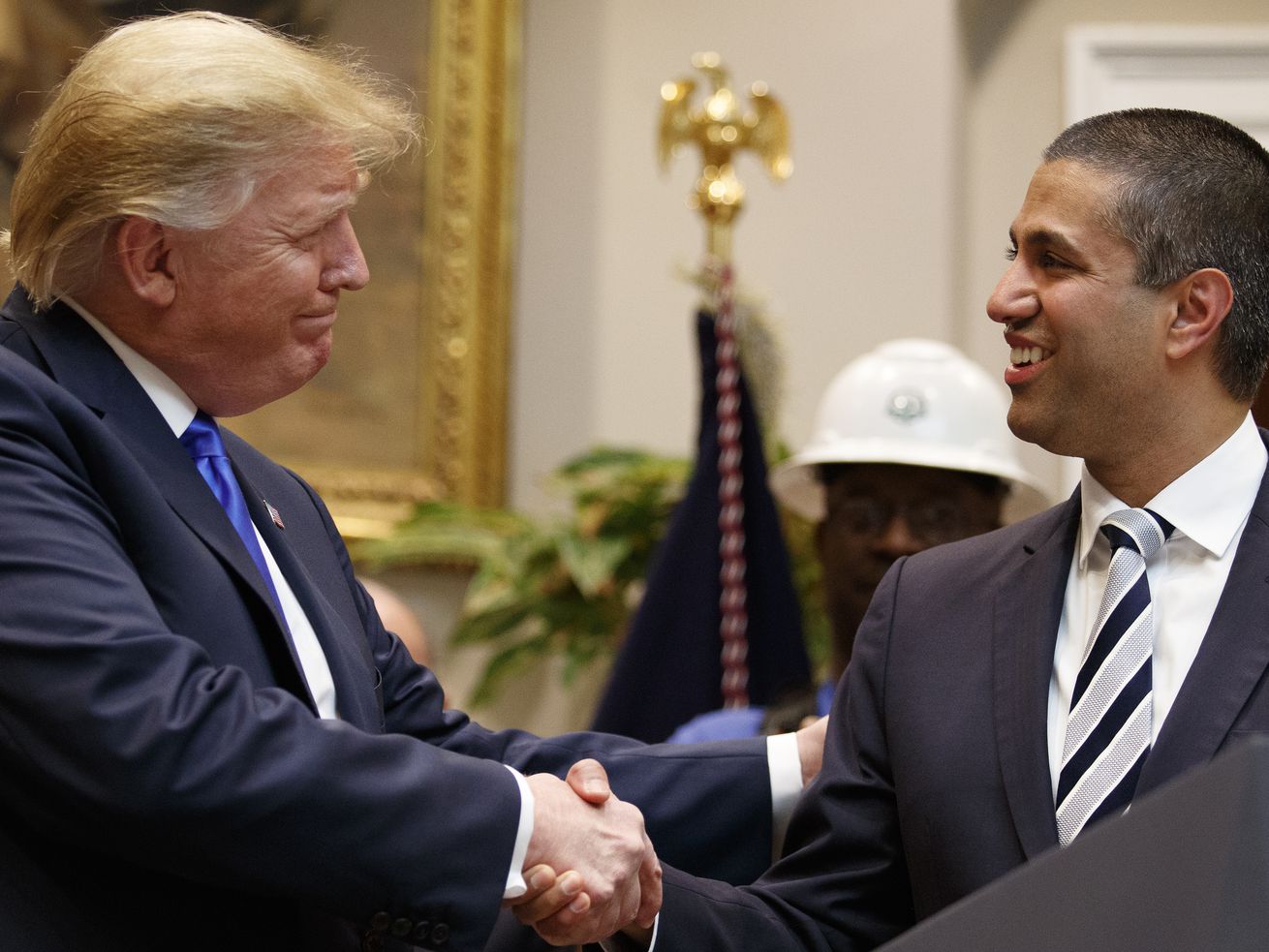 President Donald Trump shakes the hand of FCC Chair Ajit Pai before delivering remarks on 5G deployment in the US on April 12, 2019, in Washington, DC. | Tom Brenner/Getty Images
/cdn.vox-cdn.com/uploads/chorus_asset/file/19433750/open_sourced_story_logo.png)
 A community of forest homes lies in ruins after the Creek Fire swept through on September 8 near Shaver Lake, California. | David McNew/Getty Images
/cdn.vox-cdn.com/uploads/chorus_asset/file/21865784/Screen_Shot_2020_09_08_at_8.29.55_PM.png) Morgan Stanley
Morgan Stanley
/cdn.vox-cdn.com/uploads/chorus_asset/file/21865796/Screen_Shot_2020_09_08_at_9.59.38_PM.png) Morgan Stanley
Morgan Stanley
/cdn.vox-cdn.com/uploads/chorus_asset/file/21865801/Screen_Shot_2020_09_08_at_8.31.22_PM.png) Morgan Stanley
Morgan Stanley
/cdn.vox-cdn.com/uploads/chorus_asset/file/21865811/Screen_Shot_2020_09_08_at_8.35.02_PM.png) Morgan Stanley
Morgan Stanley
/cdn.vox-cdn.com/uploads/chorus_asset/file/21868684/Cumulative_CO2_treemap.png)
/cdn.vox-cdn.com/uploads/chorus_asset/file/21865818/Screen_Shot_2020_09_08_at_8.30.39_PM.png) Morgan Stanley
Morgan Stanley
/cdn.vox-cdn.com/uploads/chorus_asset/file/21865839/Screen_Shot_2020_09_08_at_8.36.22_PM.png) Morgan Stanley
Morgan Stanley
/cdn.vox-cdn.com/uploads/chorus_asset/file/21865845/Screen_Shot_2020_09_08_at_11.03.27_PM.png) Morgan Stanley
Morgan Stanley
/cdn.vox-cdn.com/uploads/chorus_asset/file/21868717/co_emissions_by_sector.png)
 Javier Zarracina/Vox
/cdn.vox-cdn.com/uploads/chorus_asset/file/13641934/AI_4.png)
/cdn.vox-cdn.com/uploads/chorus_asset/file/13641935/AI_3.png) Javier Zarracina/Vox
Javier Zarracina/Vox
/cdn.vox-cdn.com/uploads/chorus_asset/file/13641938/AI_2.png)
/cdn.vox-cdn.com/uploads/chorus_asset/file/13641941/AI_1.png)
 Illustration by Alex Castro / The Verge


 Image: Google