Shared posts

08 Jun 19:07

Polestar’s first electric SUV will officially debut in October 2022

by Andrew J. Hawkins

The Polestar 3, the aptly named third vehicle from the electric performance marque, will have its official reveal in October 2022, the company announced. It will be Polestar’s first sport utility vehicle and its first made in the US.

The Polestar 3 marks Polestar’s attempt to break into the highly competitive and highly lucrative SUV market in the US. When it comes out, it will slot into the premium category, putting it in competition with EVs like the Tesla Model X, Audi E-tron, Mercedes-Benz EQE, Rivian R1S, and Fisker Ocean. Notably, the Polestar will be assembled at Volvo’s factory in Charleston, South Carolina, giving it the distinction of being the company’s first EV made on US soil.

At launch, the Polestar 3 will sport a...

Continue reading…

08 Jun 19:04

Education Chromebooks are getting Figma, a very cool set of design tools

by Monica Chin
Figma Chief Executive Officer Dylan Field Interview
Figma CEO Dylan Field. | Image: Getty

Google for Education has announced a new partnership with Figma. The companies will bring Figma’s design and prototyping platform as well as its collaborative whiteboarding app FigJam to education Chromebooks. Schools can apply now to the beta program, which will begin over the summer.

Verge reporter Dami Lee described Figma as “Google Docs for design.” Like Google’s software, Figma is primarily web-based and is a lighter load for a computer to run than many industry-standard creative programs. Figma also allows team members to collaborate in a way that is similar to how they might in Google Docs — but on prototypes and design projects rather than text. Users can add annotations and notes to projects, mark things with stickers, and even...

Continue reading…

08 Jun 18:35

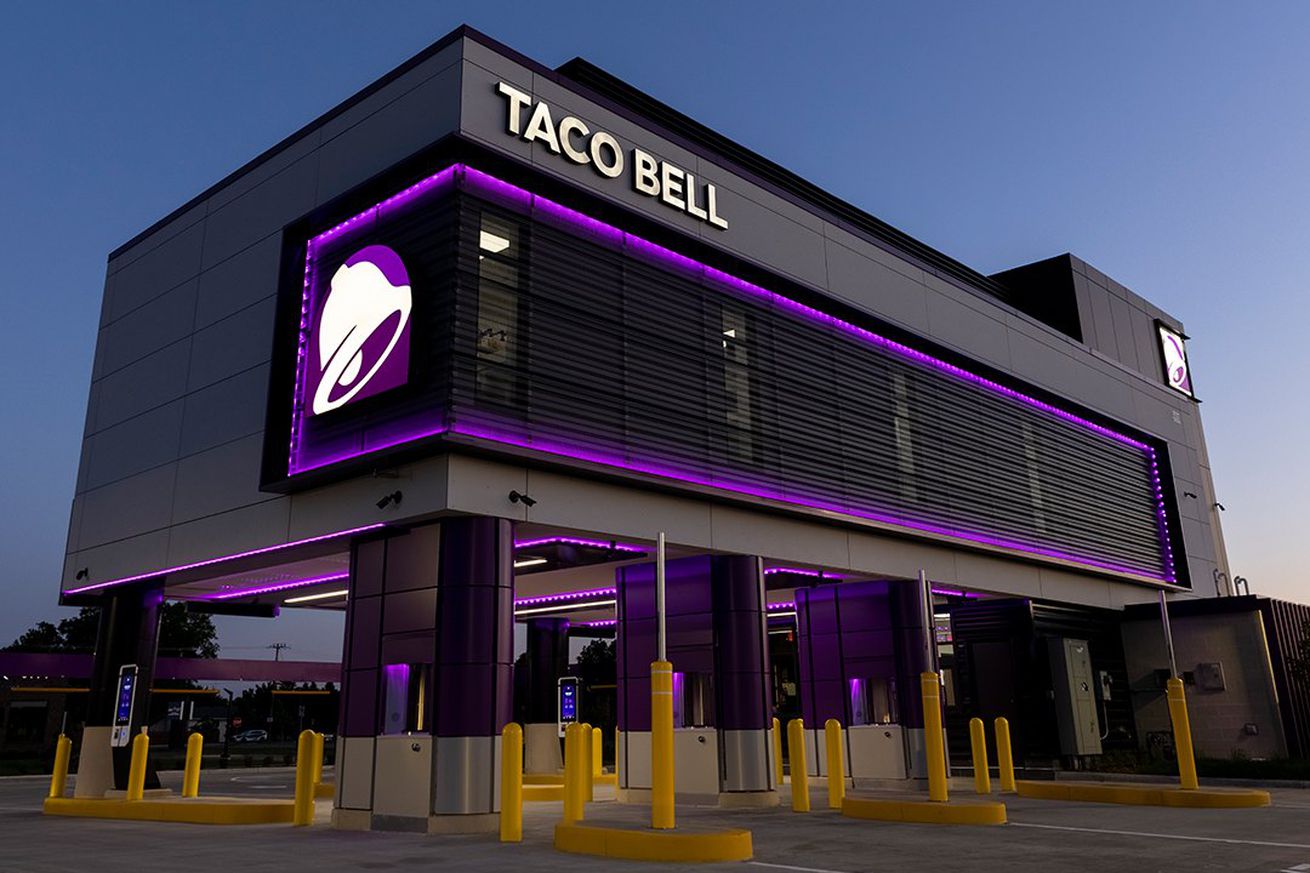
Taco Bell opens its first ‘Defy’ restaurant that prioritizes ordering via app

by Jasmine Hicks
Taco Bell Defy in Brooklyn Park, Minnesota
Taco Bell Defy in Brooklyn Park, Minnesota | Image: Taco Bell / Border Foods

Today, Taco Bell opened the doors to its new digital-driven, two-story restaurant concept, Taco Bell Defy, in Brooklyn Park, Minnesota. Taco Bell first told us about Taco Bell Defy back in August 2021. The location uses technology to speed up service, with a “bold goal of creating a 2 minute or less drive-thru experience for customers of this concept,” according to Taco Bell President Mike Grams.

Most of all, the design of the new restaurant is meant to be more mobile order and third-party delivery friendly. It delivers orders from the elevated kitchen area via a vertical lift / “food tube” seen in the video below that brings meals down to ground level — think a drive-thru bank but you get a Chalupa and Baja Blast instead of cash....

Continue reading…

08 Jun 17:41

You’ll soon be able to use an iPhone as a Mac webcam

by Tom Warren
Image: Apple

Apple is planning to allow macOS users to use their iPhone camera as a webcam. The new Continuity Camera feature comes as part of macOS Ventura, an upcoming update to macOS. Apple envisions MacBook users clipping an iPhone to the top of their laptops and using the camera to improve video calls in FaceTime, Microsoft Teams, WebEx, and more.

Continuity Camera simply takes the rear camera feed from your existing iPhone and converts it into a webcam that can be used in macOS apps. Continuity Camera even includes Center Stage and Portrait Mode support, so there are plenty of video modes for a variety of calls.

...

Continue reading…

08 Jun 17:33

Apple WWDC 2022: the 16 biggest announcements

by Emma Roth

Apple revealed a ton of exciting news at WWDC 2022, giving us a glimpse at the highly-anticipated macOS Ventura, iOS 16, the M2 chip, a new MacBook Air, and much more.

If you weren’t able to catch the conference live, here’s a list of Apple’s biggest announcements.

Apple introduces iOS 16 with customizable lock screen, updated notifications, and more

Apple has announced iOS 16, and the update brings a totally revamped and customizable lock screen interface. This lets you add custom wallpapers, change the date and time’s font and color, as well as add new widgets for weather, activity rings, calendar events, and more. Apple is also pushing updates to notifications and its Focus feature.

iOS 16’s Live Activities let you...

Continue reading…

06 Jun 23:34

Elon Musk threatens to scrap Twitter deal over ‘breach’ of agreement

by Jacob Kastrenakes
Illustration by Kristen Radtke / The Verge; Getty Images

Elon Musk says that Twitter is in “clear material breach” of their $44 billion acquisition deal and that he could “terminate” the agreement in response. In a letter sent to Twitter this morning, Musk’s legal team claims that Twitter has failed to provide him with information on the service’s spam bot problem and that he’s entitled to receive that information under the deal agreement.

“Mr. Musk believes the company is actively resisting and thwarting his information rights (and the company’s corresponding obligations) under the merger agreement,” the lawyers write. The letter says Musk could choose “not to consummate the transaction” because of the alleged breach of contract.

Musk has been complaining about bots since shortly after he...

Continue reading…

05 Jun 03:01

Bandwidth Announces Karl Perkins As Chief Innovation Officer

by Amy Ralls

Cloud communications expert has advanced the technology vision for global leaders including Cisco, Avaya and Tata Communications

RALEIGH, NC – June 2, 2022 – Bandwidth Inc. (NASDAQ: BAND), a leading global enterprise cloud communications company, today announced Karl Perkins has joined the company as Chief Innovation Officer, a newly created position.

A cloud communications expert, Perkins has advanced the strategic technology vision for leading global service providers, including Cisco, Avaya and Tata Communications. His mission at Bandwidth is to drive transformational research and disruptive technologies into a more differentiated product roadmap that delivers a higher level of customer value and growth.

“Karl is well known to our largest customers and well regarded by the vast network of technologists in our space,” said Anthony Bartolo, Bandwidth’s Chief Operating Officer. “His deep domain expertise, motivational leadership and entrepreneurial mindset will complement our strategy to accelerate innovation and customer co-creation across our offerings.”

“I’m excited to join a talented innovation team to make Bandwidth’s global network and APIs the most relevant and versatile platform for powering the enterprise communications migration to the cloud,” said Perkins. “We have tremendous potential to build on our culture of innovation to expand our portfolio, grow our ecosystem and build stronger customer partnerships to unlock mutual value.”

Perkins has a broad mix of consulting and technical innovation leadership at top global service providers and communications technology companies. Most recently, he was Chief Technology Officer at Avaya, where he helped define the company’s transition to a SaaS-based business model. Earlier experience includes Vice President and Chief Technology Officer of Business Collaboration, Mobility and IoT Solutions at Tata Communications; Group Technical Director at video collaboration software provider UCi2i; product and solution roles in the office of the CTO at Cisco Systems; and technical and strategy positions at a number of other communications technology companies.

A native of the United Kingdom, Perkins holds degrees in computer science from Loughborough University in the U.K., where his research focused on all areas of distributed computing, from network design to communication protocols and applications.

About Bandwidth Inc.
Bandwidth (NASDAQ: BAND) is a global communications software company that helps enterprises connect people around the world with cloud-ready voice, messaging and emergency services. Backed by a network reaching 60+ countries covering 90 percent of global GDP, companies like Cisco, Google, Microsoft, RingCentral, Uber and Zoom use Bandwidth’s APIs to easily embed communications into software and applications. Bandwidth has more than 20 years in the technology space and was the first Communications Platform-as-a-Service (CPaaS) provider offering a robust selection of APIs built on our own global network. Our award-winning support teams help businesses around the world solve complex communications challenges every day. More information is available at www.bandwidth.com.

The post Bandwidth Announces Karl Perkins As Chief Innovation Officer appeared first on Cloud Communications Alliance.

05 Jun 02:59

Google is bringing Gboard’s custom text stickers to more Android users

by Emma Roth
Image: Google

Google is expanding its custom text stickers to Android users who use the US-English version of its Gboard keyboard. Previously, only Google Pixel users had access to the feature, which lets you create and send personalized stickers by typing in your own text and choosing a premade design.

In addition to expanding custom stickers, Google is also introducing over 1,600 new Pride Month and summer-themed mashups to Gboard’s Emoji Kitchen. You can use the feature by simply typing in an emoji (or two) into a message, and then seeing what kind of mashups you can translate into stickers. The result is fun, and sometimes unconventional emoji combinations, like a soccer ball made out of watermelon.

Image: Google
You can...

Continue reading…

05 Jun 02:59

Glasses or no glasses, this year’s WWDC is all about AR

by David Pierce
Apple has been demoing AR for years but has never really shown us how it’s supposed to work. | Image: Apple

Apple’s software is very good, generally speaking. Even as the company has spread its focus among more platforms than ever — macOS and iOS and iPadOS and tvOS and watchOS and whatever software Apple’s building for its maybe-possibly-coming-someday car and its almost-certainly-coming-soon AR / VR headset — those platforms have continued to be excellent. It’s been a while since we got an Apple Maps-style fiasco; the biggest mistakes Apple makes now are much more on the level of putting the Safari URL bar on the wrong part of the screen.

What all that success and maturity breeds, though, is a sense that Apple’s software is… finished — or at least very close. Over the last couple of years, the company’s software announcements at WWDC have...

Continue reading…

05 Jun 02:58

Amazon Launches TransferContact API for Amazon Connect

by ProgrammableWeb Staff

Amazon has announced the release of its new TransferContact API in support of Amazon Connect, the company’s omnichannel contact center. This new API will allow developers to integrate task and contact transfers between queues. 

Amazon’s product announcement outlined the value that this new API provides to its partners:

04 Jun 06:52

BMW i4 review: better than expected

by Roberto Baldwin

On the road, the 2022 BMW i4 eDrive40 looks like any other 4 Series. There’s a reason the four-door sedan with its gigantic kidney grilles and sleek roofline commands is one of the automaker’s best-selling vehicles. It looks the part of a German sedan, and the EV version of the vehicle is the fruit of the automaker’s desire to build a platform that can accept any powertrain. Except, this is the best 4 Series.

While the push for electric SUVs continues, not every driver wants to sit above cars and haul all that extra weight around. There are real competitors for the BMW sedan — namely, the Tesla Model 3, Mercedes EQE, and Polestar 2. All of these vehicles are courting the midlevel luxury buyer who’s likely looking for either something a...

Continue reading…

04 Jun 06:28

New York Passes Nation's First Electronics Right-to-Repair Law

by Jason Koebler

After a multi-year battle, New York has become the first state in the country to pass an electronics right-to-repair law, a historic win for consumers and independent repair shops across the U.S., not just in New York. The move has the potential to seismically shift the power balance between consumers and electronics manufacturers.

The bill overwhelmingly passed the state senate on Wednesday by a vote of 59 to 4. It passed the Assembly Friday afternoon by a vote of 145-1. It will now go to Gov. Kathy Hochul for final passage. The bill is the most expansive consumer rights legislation to pass in the United States in recent memory and is the result of countless hours of grassroots campaigning from consumers and consumer rights groups. 

The legislation, called the Digital Fair Repair Act, covers all consumer electronics and will require companies to sell repair parts and tools and to provide repair documentation to consumers under “fair and reasonable terms.” Companies like Apple and Samsung, as well as medical device providers, video game companies, and electronics trade organizations have spent years and thousands of dollars lobbying against this sort of legislation in New York and all over the country. 

In recent months, Apple, Microsoft, Samsung, and Valve have begun to semi-voluntarily sell certain repair parts and offer repair guides to consumers after President Joe Biden suggested that the vast majority of companies’ existing policies were illegal or were monopolistic. Right-to-repair advocates like US PIRG, iFixit, and Repair.org have said those voluntary policies were a step in the right direction, but do not have the force of law that the Digital Fair Repair Act will have.

The New York legislation  was modeled on a similar law that applies to cars passed in Massachusetts in 2012. After that legislation was enacted, auto manufacturers signed a “memorandum of understanding” that essentially made the legislation a national policy, because car manufacturers didn’t want to have to deal with slightly different versions of the same law in different states. Right to repair advocates are hopeful that the same thing will happen with electronics; if repair parts and guides are available in New York, it’s impossible to keep those parts and guides from making their way to other states.

02 Jun 19:30

Canadian government slams Tim Hortons for using its app to spy on customers

by Adi Robertson
Business sign of a Tim Horton’s cafeteria.
Photo by Roberto Machado Noa/LightRocket via Getty Images

Tim Hortons used its mobile app to collect “vast amounts of location data” from users, including tracking when they visited competing coffee shops, says Canada’s privacy watchdog. Yesterday, the Office of the Privacy Commissioner of Canada released the results of a 2020 investigation into the coffee and donut chain, demanding it delete any remaining location data and limit future collection. Tim Hortons, the commission says, has agreed to implement the regulations.

The full report outlines a sweeping, invasive attempt to deduce Tim Hortons customers’ behavior in order to target advertising at them — although the company apparently never actually used the data for that purpose. It notes that in May 2019, Tim Hortons updated its mobile app...

Continue reading…

02 Jun 19:18

When Will Payphones Finally Die Off? Hold Please.

by Jessa Lingel
02 Jun 19:16

Disgraced OpenSea engineer arrested for insider trading

by Russell Brandom
Illustration by Alex Castro / The Verge

Former OpenSea product manager Nathaniel Chastain has been charged with wire fraud and money laundering in connection with an insider trading scheme. Chastain was arrested Wednesday morning in New York City and is expected to be presented in court later today.

Chastain was publicly accused of insider trading in September and fired from his position at OpenSea — but today’s indictment marks the first criminal charges associated with the scheme.

45 token purchases on 11 different occasions

While employed at OpenSea, Chastain was responsible for deciding which NFT collections would be featured on OpenSea’s front page, a distinction that typically made the collections skyrocket in value. The indictment describes a pattern of 45 token...

Continue reading…

02 Jun 16:04

Crestron Adds Dedicated Microsoft Teams Device for Hotdesking

By Lisa Schmeiser
Crestron's latest device is aimed at hotdesking employees who work on Microsoft Teams; meanwhile, Teams allows third-party apps to work within the Teams environment.
02 Jun 15:55

Why it isn’t easy to throw cloud spending on the cutting block

by Ron Miller

There’s been an onslaught of negative economic news of late, with gloom and doom aplenty out there. However the economy plays out in the coming months, people perceive that there is turbulence ahead and are behaving accordingly.

One thing businesses may try to do is rein in cloud infrastructure spending to reduce the substantial bills they have from AWS, Azure, Google Cloud, and others. But simply wanting to cut costs and actually being able to do it are two entirely different matters.

What you can’t do is limit your ability to operate your business in the name of trying to cut expenses.

It is clear that cloud bills are becoming a big part of the operating budget of many companies. The cloud has allowed company bookkeepers to shift computer spending from capital expenditures to operating expenditures — theoretically paying only for what you use — but in reality, there can be a lot of waste, and you don’t want to pay for resources you aren’t using regardless of the economy.

A shift toward profitability over growth

While public cloud infrastructure is consumed by most (if not all) industries to varying degrees, it is in the technology sector that we expect to find the greatest cloud spend as a percentage of operating costs; tech companies built atop public clouds from birth see their infrastructure spending expand with time, making them lucrative customers of AWS, Azure and others — and potentially those with the most incentive to hunt for savings.

But there is more than just relative spend to consider. According to data from a recent software valuations report from venture shop Battery, investors have shifted their operating preferences.

The data that the venture group collated and shared with TechCrunch dealt with companies at varying points of balance between growth and profit. There is a natural tension between the two, with startups often absorbing heavy losses in the name of growth. The Battery dataset, however, makes clear that there has been a shift in market perception recently. Before 2022, tech companies that lost more money but grew more quickly were awarded richer valuation multiples than the peers who were more profitable but growing more slowly. In 2022, the situation inverted.

Tech companies are now rewarded for indexing more heavily toward profitability than growth, though, naturally, companies that sport both quick growth and strong profitability remain the most valuable. As investors put more weight on profitability, reducing spending in non-human expense categories becomes critical. Layoffs are far harder to execute than cuts to public cloud spending in terms of internal message, external branding and morale, for example.

Major cloud players will not relish their tech customers looking to reduce their public cloud line item, but for the technology companies in question, following investor wishes is a way to preserve corporate value. In a falling stock market, that’s a critical task.

The incentives have changed, making cloud spend reductions more attractive than ever. But how much can tech companies really hope to cut?

02 Jun 15:54

On WhatsApp, You Can’t Escape Work—or Life

by Isabel Migoya-Iriso and Mia Armstrong
In countries like Mexico, WhatsApp is used for both personal and professional communication. Nonexistent work-life boundaries are the result.
01 Jun 15:31

Dell’s 32-inch 4K videoconferencing monitor costs just as much as a Studio Display

by Emma Roth
Dell’s 32-inch display comes with a focus on video calls. | Image: Dell

Dell has finally revealed the $1,599.99 price attached to the UltraSharp 32-inch 4K video conferencing monitor it previewed at CES (via 9to5Mac). If that price sounds familiar, it’s because Apple’s 27-inch Studio Display costs almost the exact same amount — only Dell justifies the price with the monitor’s size and its camera sensor, while Apple’s sales pitch leans on that still-rare 5K resolution.

The Dell monitor (U3223QZ) comes with a focus on videoconferencing, made clear by Dell’s built-in UltraSharp webcam with a 4K HDR Sony Starvis sensor that uses artificial intelligence (AI) to help keep you in the frame during a call. This is a bit like Apple’s Center Stage feature used in the Studio Display and other Apple devices, a similar...

Continue reading…

01 Jun 15:10

Buick is rebranding as an electric-only automaker

by Andrew J. Hawkins
Photo: Buick

Buick, the iconic American automaker owned by General Motors, announced a raft of major changes meant to underscore its shift to electric vehicles.

The company says it will release its first EV for the North American market in 2024 and will only sell electric vehicles by the end of the decade. Its future EVs will bear the name “Electra” in a nod to the company’s past. It’s unveiling a new concept car, the Wildcat, that’s meant to tease its all-electric future. And it’s even updating its tri-shield logo, doing away with the circular design for a body-mounted horizontal display, to emphasize its “brand transformation.”

Buick is the last of the four vehicle brands owned by GM to unveil its electrification plans

Buick is the last of the...

Continue reading…

31 May 18:42

Massive podcast outage caused by Spotify’s failure to renew security certificate

by Ariel Shapiro
A photo illustration of Spotify’s green circle logo
Illustration by Alex Castro / The Verge

Podcast listeners could not access many of their favorite shows for more than eight hours on Monday night and early Tuesday morning due to an outage on Megaphone, a podcast hosting platform owned by Spotify. The outage stemmed from the company’s failure to renew Megaphone’s security certificate.

“Megaphone experienced a platform outage due to an issue related to our SSL certificate,” Spotify spokesperson Erin Styles said in a statement. “During the outage, clients were unable to access the Megaphone CMS and podcast listeners were unable to download podcast episodes from Megaphone-hosted publishers. Megaphone service has since been restored.”

It’s a simple mistake with big ramifications. Megaphone, which inserts dynamic ads into episodes,...

Continue reading…

31 May 18:41

Tell your boss: Working from home is making you more productive

by Rani Molla
A woman sits at a computer in her home while a dog sits by the door.
Around 40 percent of American workdays are currently done from home, and a growing number of them report that they’re being more productive. | Carlos Avila Gonzalez/San Francisco Chronicle via Getty Images

Employers are missing out by calling workers back to the office.

For the minority of Americans who’ve been fortunate enough to work from home over the past couple of years, the ride might seem like it’s coming to an end. Employers big and small are asking their employees to return to the office — just as those employees have gotten really good at working from home.

People who work remotely are reporting being more productive than they were early on in the pandemic, according to data from Stanford University professor Nicholas Bloom. Bloom, who’s been studying remote work since before it was cool, has teamed up with other academics from the University of Chicago, ITAM, and MIT since May 2020, to conduct a huge ongoing survey about employees’ work arrangements and attitudes toward remote work. In April, people who worked remotely at least some of the time reported being about 9 percent more efficient working from home than they were working from the office. That’s up from 5 percent in the summer of 2020.

Why? Bloom says we’ve gotten better at it.

“When we flipped to working from home back in March 2020, we were completely unprepared,” Bloom told Recode. “We didn’t have management systems, performance review systems, meeting structures, workflows, equipment.”

Now we’re much better set up, and productivity should continue to improve as technology makes it easier, according to Bloom.

Additionally, and perhaps more importantly, as the worst parts of the pandemic fade, our support systems outside of work — day care, friends and family, the ability to do literally anything besides staying home — have largely returned, too.

“Whatever you were doing during the pandemic and its stilted aftermath, it was not working from home,” Anne Helen Petersen and Charlie Warzel note at the start of their book Out of Office: The Big Problem and the Bigger Promise of Working from Home. “You were laboring in confinement and under duress.”

Of course, this data on productivity is self-reported, and most people report wanting to keep working from home, so take it with a grain of salt. There is, however, objective data — like more calls per minute for call center workers, engineers submitting more changes to code, and Bureau of Labor Statistics data on growing output per hours worked — that has generally shown that people are, in fact, more productive working from home. But even the idea that people feel more productive is important.

Around 40 percent of American workdays are currently done from home, according to Bloom’s data. This figure tracks with data from the office keycard company Kastle, which is seeing office buildings at 43 percent occupancy. Bloom expects it to remain at around 25 to 30 percent after the pandemic, meaning that working from home will by no means go away. So while traffic has mostly returned to pre-pandemic levels at hotels, movie theaters, and restaurants, the offices remain a holdout.

Many employers have conceded that productivity is fine at home, but they’re still worried about other immeasurables, like workers’ ability to collaborate and to be creative from home. A December report from Northeastern University found that over half of C-suite executives across industries were concerned about their workforce’s ability to be creative and innovative while working remotely. They also worry about how continued remote work will affect their company culture and loyalty. Interestingly, Slack’s Future Forum found that executives are more likely to say they want to work from the office than non-executives, but are less likely to be doing so full time. The study also found that since a third of office workers have returned to the office five days a week — the highest since the survey began in June 2020 — these workers are also reporting their worst employee experience.

But in this current tight labor market, many workers are getting their way with remote work, and bosses aren’t exactly in a position to push back. Interest in remote jobs is consistently higher than that of onsite work. About 20 percent of paid job listings on LinkedIn were remote in March, but they saw the majority of applications (52 percent), according to the company. And some 60 percent of knowledge workers said they would quit their job for a fully remote one.

Indeed, employers seem to be conceding to employees’ desire to work from home. According to the Bloom surveys, office workers say their employers are planning to let them do so on average 2.3 days per week after the pandemic. That’s up from 1.6 days in the summer of 2020.

Apple had said it would make workers come into the office three days per week, but has since postponed and modified that plan after worker pushback and after a prominent machine learning engineer resigned over the company’s lack of flexibility. Even the office stalwarts like big banks are changing their tune and increasingly offering remote work. JPMorgan Chase CEO Jamie Dimon, who has been vocal about his disdain for remote work, said in his latest shareholder letter that only half of the company’s workers would be in the office full time.

Anecdotally, we’re hearing from people who are required to go into the office a few days per week that it’s not actually happening. Tech companies, law offices, and insurance firms are telling employees to come in two or three days per week, and they’re showing up one or two. Companies could, of course, fire workers for failing to comply with office mandates, but that doesn’t seem to be happening.

It’s less clear what happens when the economy turns sour and when people don’t have as much leverage as they do now. In that case, employers might be better able to force workers back into the office — or perhaps they’ll go the other way and get rid of more office space.

As it stands, 52 percent of the 185 office companies recently surveyed by the real estate services company CBRE said they intend to decrease their office real estate in the next three years, compared with 39 percent who say they’re expanding (9 percent say they’re maintaining their existing footprint). The survey found that most companies, 73 percent, plan to follow a hybrid work plan wherein people work from home and the office, while 19 percent are office only and 8 percent are fully remote. Amid the uncertainty, coworking spaces, which can be unloaded much more quickly than traditional office space, are thriving.

For now, many office workers are doing a pretty good job of working from home.

This story was first published in the Recode newsletter. Sign up here so you don’t miss the next one!

31 May 18:40

DeLorean offers a first look at its gull-winged Alpha 5 EV revival

by Emma Roth
Image: DeLorean

DeLorean Motor Company has revealed the first images of the Alpha 5 electric vehicle (EV), the brand’s attempt at resurrecting the DeLorean name in an all-electric form. Staying true to the classic ‘80s-era DeLorean known for its appearance in Back to the Future, the Alpha 5 comes with those iconic gull-wing doors and can reach 60mph in about 2.99 seconds (or 88mph in 4.35 seconds, if you’re curious).

Before we dive into the details, it’s worth noting the company behind the Alpha 5 isn’t actually the same one behind the original DeLorean vehicles — that company went defunct in 1982. An unrelated Texas-based company, which supplies replacement parts to the owners of vintage DeLorean vehicles, snapped up the rights to the DeLorean brand...

Continue reading…

31 May 18:38

Discord Is the World’s Most Important Financial Messenger, and a Hotbed for Scammers

by Lorenzo Franceschi-Bicchierai

Earlier this month, Josh Fraser, the founder of the Ethereum-based platform Origin, was poking around Discord, the chat app for gamers that’s become the go-to platform for crypto projects all over the world. What he found startled him. 

Fraser wanted to see if he could set up an automatic script that would alert him every time users posted certain keywords in his server. He saw several private channels that he couldn’t access, but he was still able to see a lot of information about them. Despite the channels being supposedly private, he was able to see their names, their description, and the channel’s full list of members.

Because Discord is used by lots of high-profile (and obscure) crypto projects, this information could be used to figure out that a certain project is about to launch a new token, or is about to be listed on Coinbase (imagine a private channel called "Coinbase"), which can have significant impact on the price of a coin. The names and user lists of private channels can even expose people who are responsible for executing financial transactions through multi-signature wallets, according to Fraser. 

“That could very easily dox someone who didn't intend to be doxed,” Fraser told Motherboard in a call. 

“Those [Discord] bots are a huge liability when it comes to security.”

Fraser's research exposes a broader truth about cryptocurrency and the new Wild West of finance. While traditional financial communications take place over protocols like the highly secure (and expensive) Bloomberg Terminal or SWIFT, which catapulted into the public consciousness when Russia was banned from it, the most important messaging service in the world of crypto is Discord, which is a powerful chat app but was not designed from the ground up with security in mind. 

Discord chats are not encrypted, public chat histories can be available to anyone who joins a channel, impersonation scams are common, and the security issue Fraser found remains a problem. Attempts by Discord to design specific features for crypto projects have been met with wide backlash from its main user base of gamers, many of whom find crypto reprehensible.  

In the financial world, several firms use Instant Bloomberg, an application integrated in built to work with the Bloomberg terminal that runs on Bloomberg infrastructure and whose members’ identities are verified by the company. And the terminal requires a user’s fingerprint for login. But the app is costly (reportedly around $24,000 a year for a single terminal subscription), and it’s really designed for people in finance, who have different needs and constraints compared to DeFi and crypto. In practice that means the app is fully surveilled so that it’s compliant with financial regulations.
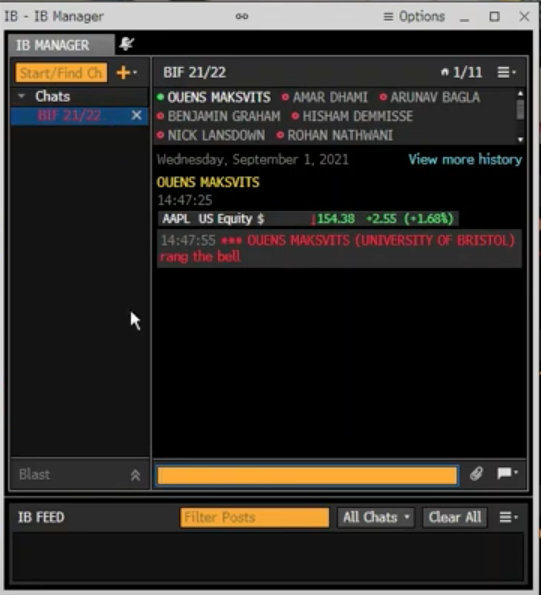
bloomberg-instant.png
A screenshot of the Instant Bloomberg messaging platform. (Image: Instant Bloomberg)

There’s also Symphony, an Instant Bloomberg competitor. But it’s also specifically built for financial firms, especially with compliance with existing regulations in mind, which don’t apply to crypto. 
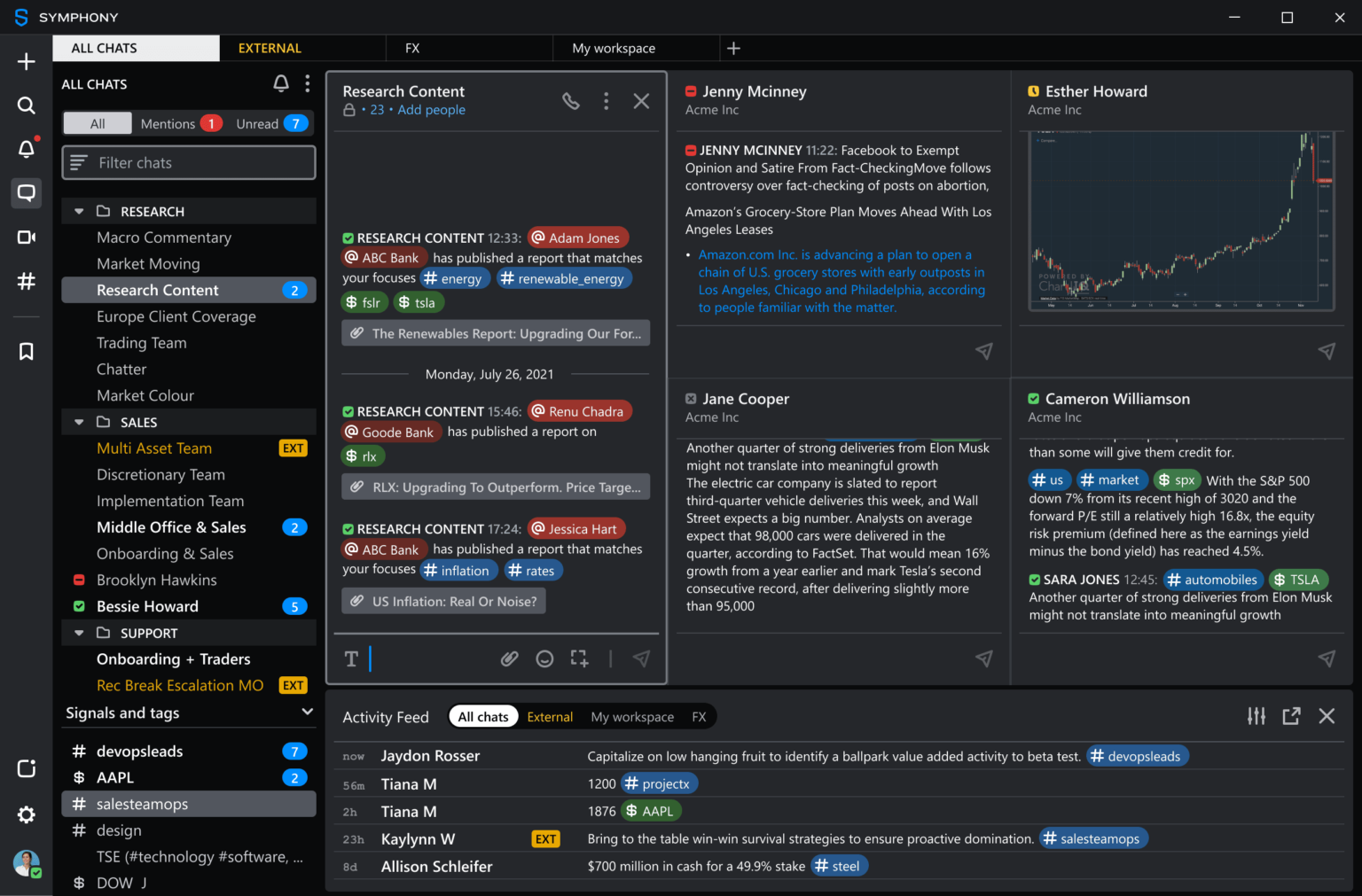
symphony.png
A screenshot of the Symphony messenger. (Image: Symphony)

After discovering that private channels leaked potentially sensitive information, Fraser alerted Discord, but the company told him this is a known issue that cannot be fixed for now. So he wrote a thread on Twitter explaining what he had discovered in an attempt to warn the community. His thread quickly went viral, suggesting many people in crypto had no idea private channels leaked such sensitive information.  

Discord was launched in 2015 and was created by Jason Citron (CEO) and Stanislav Vishnevskiy (CTO), two developers who had launched social apps for gaming before trying their hand at game development under the banner of Hammer & Chisel Inc. That resulted in a free-to-play game for tablets called Fates Forever that failed to become commercially successful and shut down shortly after. From there, Hammer & Chisel pivoted to developing Discord as a hub for gamers to talk and coordinate in-game tactics with a focus on user-friendliness, eventually becoming Discord Inc. 

Eventually, the app—perhaps because of its UI and community features, ease of creating pseudonymous identities, and some cross-pollination between online communities—cemented itself as a hub for most crypto projects. Most NFT collections including Bored Ape Yacht Club call it their home and have thousands or tens of thousands of members in their servers, and DAOs (Decentralized Autonomous Organizations) have also proliferated.

It's also become a hotbed for scammers targeting an industry that the app was never designed to support. 

Crypto hacks can be executed devastatingly quickly (one wrong link is all it takes to irreversibly swipe someone's holdings), and so hijacking a Discord server is an efficient way to target a large number of people at once. In the last few months alone, hackers have taken control of the official Discord servers of the uber-popular NFT collection Bored Ape Yacht Club, the NFT trading platform OpenSea, and several others.  

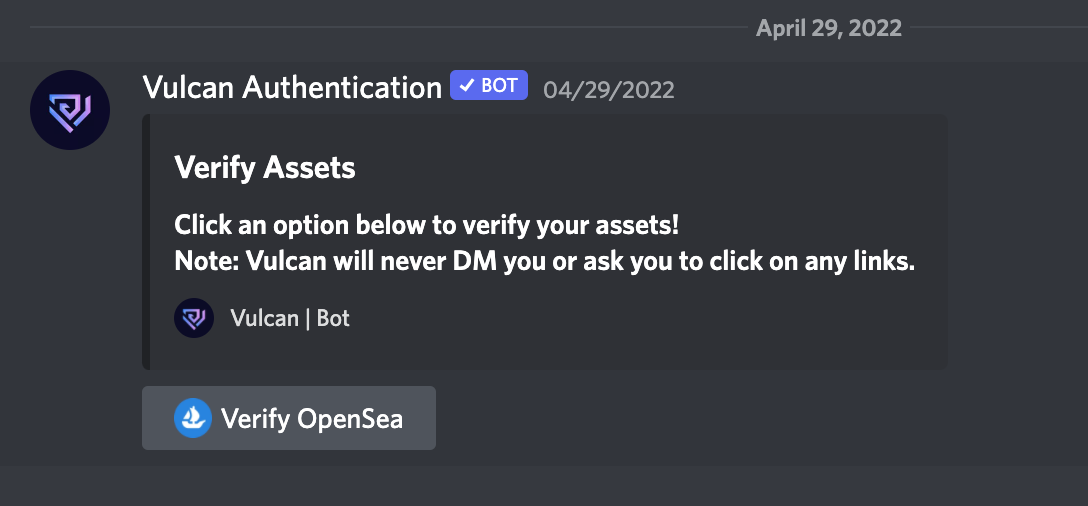
In these cases, once a hacker had control over the servers, the scammers took control of the admin’s bots, which  are trusted by the community. They then began posting fake announcements from these bots, tricking victims into giving up their cryptocurrency or NFTs. 

“If that bot ever got compromised, the back end that controls the bot ever got compromised, that'd be fucking nasty,” Stephen Tong, the co-founder of blockchain security firm Zellic, told Motherboard in a call. “Those bots are a huge liability when it comes to security.”

Do you have information about hacking groups targeting Discord servers? Or do you know of other web3 and crypto hacks? We’d love to hear from you. You can contact Lorenzo Franceschi-Bicchierai securely on Signal at +1 917 257 1382, Wickr/Telegram/Wire @lorenzofb, or email lorenzofb@vice.com

Virtually every crypto project's Discord server is filled with fake accounts sending private messages with phishing links to everyone in the server. If you don't set your Discord account to only accept private messages from your contacts, there is no warning that pops up to tell you the message comes from someone you don’t know and it may be dangerous, a disclaimer that would make a huge difference and would be an easy solution, according to Tong. Motherboard has joined a handful of crypto servers over the years and is regularly subjected to dozens of private messages from sketchy servers or containing phishing links. 

Discord scams typically involve social engineering in addition to exploiting the app's features. In the case of the hack that targeted the Bored Ape Yacht Club Discord server, the scammers took over admin accounts and posted a link to a fake NFT drop from YouTube, which tricked eager investors hoping to get in early on a new collection to give up control of their wallets. 

The hackers who target Discord channels and users within them are becoming very well organized, which is something Discord isn’t ready for, according to Mitchell Amador, the CEO of blockchain security firm Immunefi.

“[Discord] is not built with the idea of enshrining secure communications, it is not built with the idea of thorough privacy in mind. It is not built with the idea of very focused almost [Advanced Persistent Threat] level attackers. Some of these scam groups must have dozens or hundreds of employees in them,” Amador told Motherboard in a call. “They're effectively corporations that are professional and dedicated to achieving these outcomes. And they are just ripping through Discord. It was never built to protect against such a dedicated attacker who is targeting such a vast swathe of accounts.” 

Jessy Irwin, a cybersecurity practitioner who works for a blockchain company, recently saw a novel kind of attack. If a hacker pays for Discord Nitro, a higher tier of Discord's service, they are able to use different nicknames for different servers. Irwin told Motherboard that abusing that feature, someone impersonated her company’s CEO, using his name and account number. 

“When our security team reached out to Discord support, they asked why we hadn’t reported it—and we learned that you have to have a DM from the attacker in order to report it to their global trust and safety team,” Irwin told Motherboard in an online chat. “So for a nominal fee, anyone can pull off an impersonation attack by renaming their account in a way that is nearly indistinguishable from a legit account.” 

Ultimately, the problem is that Discord wasn’t designed as a communication platform for crypto or DeFi projects, Tong said.

“Discord is built around gamers, that's the original target audience. And that whole community has a lot of trauma from back in the old Skype days. When everyone was using Skype, it was very easy to extract someone's IP address from their Skype,” he said. “And because of that, Discord is very careful to make it as difficult as possible to extract someone's IP address from just talking over Discord. […] If you're a whale with a million dollars, you don't want to be broadcasting to the world: ‘Hey, I'm a person with a million dollars in my crypto wallet.’ That’s kinda dangerous.”

“[Discord] was never built to protect against such a dedicated attacker who is targeting such a vast swathe of accounts.” 

Discord’s design for gamers, a large community of typically pseudonymous people who aren’t necessarily close friends or colleagues, makes it popular in the world of crypto and DeFi, which also value pseudonymity and trustlessness. However, those same factors make it easy for scammers to blend in. . 

“[Discord] was designed for gamers, so large groups of people who don't know each other and don't trust each other. And that's actually a much better model for crypto communities, which are large groups of people who don't know each other and don't really have any good reason to trust each other,” Fraser said. 

Still, there are a lot of improvements Discord could make to appease the crypto world, where much more is at risk than tactics for online gaming. “The security concerns for gamers are very different from the high stakes world of crypto. And while Discord hasn't done anything to stop crypto communities from coming in and using their product, they haven't exactly welcomed us and been very accommodating for crypto either,” Fraser said. 

When Discord has attempted to address this large section of its user base in the past, it hasn't gone well. In November of last year, Discord’s CEO Jason Citron teased an upcoming feature where users could connect their crypto wallets in a tweet. The reaction from Discord users was so negative that Citron had to backpedal and said there are no plans to integrate Ethereum wallets on the platform. 

A Discord spokesperson said that the company “takes the safety of all users and communities very seriously, including social engineering attacks like the ones you’ve shared. While there are clear controls in place, we are always working to make it harder for attacks to happen and continue to invest in education and tools to help protect our users.”

The spokesperson pointed to the platform’s terms of service, which prohibit fraudulent, illegal, and harmful activities, and said the trust and safety team often takes action by banning spammers and removing spam messages. When that happens, users get a warning when they receive a message from the spammer. 

Moreover, Discord is testing a system that monitors servers for inauthentic behavior and can put them into “safe mode” which requires captchas to participate in the server. The company also has a system to remove malicious links and alert users if they open those kind of links, according to the spokesperson. 

discord-warning.png
The warning that Discord displays when users click on a link that’s been flagged as malicious. (Image: Discord)

The company has also published two blog posts with advice on how users and servers administrators can protect themselves from scams and what kind of scams users should be aware of

Discord channels getting inundated with phishing links by hackers is not the only danger on the platform. According Irwin, Discord has even become “a hotbed for malware distribution.”

Several cybersecurity companies have published reports detailing malware campaigns conducted on Discord, though they don’t always target crypto users. Irwin said that it’s difficult to really understand how big of a problem malware is on Discord because “so much of the malicious behavior doesn't happen in the open on each server, actors can jump from server to server, it's more difficult to get visibility into campaigns unless you've set up several honeypot user accounts on your server and you monitor them carefully.”

For now, there aren’t really any alternatives to Discord. Some crypto projects use Telegram, but the app doesn’t offer all the community features that Discord does. Crypto projects and companies have to make it work with Discord. And there are some crypto-focused tools that can help make servers more secure, which have popped up in the wake of the seemingly endless series of hacks.  

There is a free tool called Good Knight, which promises to be “a first-of-its kind Discord security bot that uses innovative password protection technology to prevent malicious actions performed by hackers.” In practice, if Discord server admins use this bot, they can block anyone—including hackers—from posting links to the server that are not included in what effectively is an allow-list. When admins set up Good Knight, they have the option to give it more permissions than the admins, which prevents a hacked admin account from disabling the Good Knight bot. The bot also can force admins to use a password when they want to use commands for the server, according to Kyle Higdon, the developer of the tool.

The developer, who goes by Captain_Plantain on Twitter, told Motherboard that he suggests admins set up a “cold” admin account and a “hot” admin account. The difference between the two is that the “cold” one is used to manage the server, such as to add or remove bots and channels, and it shouldn’t be online often, reducing the risk of compromise. The “hot” one should not have administrator permissions so that even if it gets compromised, the hacker can’t kick out the Good Knight bot. 

Another tool is called Collab.land, and it allows the administrators of Discord servers to only allow users who can prove they own the crypto asset that the Discord server (or Telegram channel) is about. In practice it’s a bot that can automatically approve users if they prove they own a specific crypto asset, and boot them out once they sell it. The company calls it “a concierge,” which requires the crypto project to have a crypto wallet installed, such as Metamask. 

Some crypto projects have also built bots that serve a similar purpose. If you can’t prove you own the project’s token, you can’t access its Discord server.

image1.png

Discord is king for now. But that might change in the future. 

Amador said that is “very sure crypto will move on from Discord eventually.”

It wouldn’t be the first time the community has migrated to a new communications platform. At first, there was Bitcoin Talk, then Slack, then Telegram, and now Discord, Mitchell said. And despite the voice chat app Clubhouse briefly becoming a destination for crypto investors, the community has largely moved to Twitter Spaces for that purpose. 

“The history of chat applications and crypto is kind of a long and winding path, deeply unpleasant,” Amador said. “Because it's constantly about escaping scams and finding a safe place to build something together.”

Subscribe to our podcast, CYBER. Subscribe to our new Twitch channel.

31 May 18:20

Thin Platforms

by Ben Thompson

The Department of Justice’s 1998 complaint against Microsoft accused the company of, amongst other things, tying the Internet Explorer browser to the Windows operating system:

Internet browsers are separate products competing in a separate product market from PC operating systems, and it is efficient to supply the two products separately. Indeed, Microsoft itself has consistently offered, promoted, and distributed its Internet browser as a stand-alone product separate from, and not as a component of, Windows, and intends to continue to do so after the release of Windows 98…

Microsoft’s tying of its Internet browser to its monopoly operating system reduces the ability of customers to choose among competing browser products because it forces OEMs and other purchasers to license or acquire the tied combination whether they want Microsoft’s Internet browser or not. Microsoft’s tying — which it can accomplish because of its monopoly power in Windows — impairs the ability of its browser rivals to compete to have their browsers preinstalled by OEMs on new PCs and thus substantially forecloses those rivals from an important channel of browser distribution.

In retrospect, the complaint feels quaint for three reasons:

First, Microsoft won the browser wars, and it didn’t matter; after peaking at 95% market share in 2004, Internet Explorer was first challenged by Firefox, which peaked at 32% market share in 2010, and then surpassed by Chrome in 2012:

The reasons ended up being both a condemnation and an endorsement of the libertarian defense of Microsoft’s actions, depending on your timeframe: sure, the company leveraged its operating system dominance to gain browser market share, but the company also made a great browser (I personally switched with the release of version 4). And then, with Version 6 and its position seemingly secured, the company just stopped development; that is what opened the door to first Firefox and then Chrome, both of which were downloaded and installed by end users looking for something better. The market worked, eventually.

Of course, the reason the market could work is that Windows was an open platform: sure, Microsoft controlled (and allegedly abused) what could be preinstalled on a new computer, but once said computer was in a user’s hands they could install whatever they wanted to, including alternative browsers. That gets to the second reason why the complaint feels quaint: today having a browser pre-installed is de rigueur for operating systems, and Apple’s iOS goes much further than simply pre-installing Safari: all alternative browsers must use Apple’s built-in rendering engine, which means they can only compete on user interface features, not fundamental functionality.1

The third reason has to do with Microsoft itself.

Thick and Thin

As I noted last week in an Update, one of the overarching themes of CEO Satya Nadella’s Build developer conference keynote was the seemingly eternal tech debate about thin versus thick clients (to dramatically simplify — and run the risk of starting a flame war — thin clients are terminals for a centralized computer, while thick clients are computers in their own right, that sync):

The biggest takeaway from this keynote is that for developers, at least the ones that Microsoft is courting, the thin client model has won — although the truth, as is so often the case with tech holy wars, has ended up somewhere in the middle. Here is the key distinction: there is and will continue to be a lot of work that happens locally; all of the assumptions around that work, though, will be as if the work is being done on the server. For example:

  • GitHub Codespaces is an explicitly online environment that you can temporarily use locally.
  • Azure Arc provides the the Azure control plane for an on-premises development environment.
  • The Azure Container Apps service and Azure Kubernetes Service enable developers to write locally in the same environment they deploy to the cloud.

Moreover, several other of the announcements were about patching up limitations in cloud development relative to local: Microsoft Dev Box, for example, enables the deployment of cloud-based VMs that mimic a local development environment for things like app development; Microsoft Cloud PC (which was previously announced) does the same thing for client applications.

What makes this shift so striking is that it is being articulated by Microsoft; after all, Windows (along with Intel) was the dominant winner of the thick client era. Yes, Windows Server was an integral part of Microsoft’s enterprise dominance, but the foundation of the company’s strategy — as evidenced by the tactics used in the fight against Netscape — was the fact that Windows was the operating system on the devices people used. That, by extension, was precisely why mobile was so disruptive to the company: suddenly Windows was only on some of the devices people used; iOS and Android were on a whole bunch of them as well.

I’ve spent many articles writing about how Satya Nadella weaned Microsoft off of its Windows-centric strategy; the pertinent point in terms of this Article comes from Teams OS and the Slack Social Network:

The end of Windows as the center of Microsoft’s approach, and the shift to the cloud, though, did not mean the end of Microsoft’s focus on integration, or its attempt to be an operating system; the company simply changed its definition of what an operating system was; Satya Nadella said at a press briefing in 2019:

The other effort for us is what we describe as Microsoft 365. What we are trying to do is bring home that notion that it’s about the user, the user is going to have relationships with other users and other people, they’re going to have a bunch of artifacts, their schedules, their projects, their documents, many other things, their to-do’s, and they are going to use a variety of different devices. That’s what Microsoft 365 is all about.

Sometimes I think the new OS is not going to start from the hardware, because the classic OS definition, that Tanenbaum, one of the guys who wrote the book on Operating Systems that I read when I went to school was: “It does two things, it abstracts hardware, and it creates an app model”. Right now the abstraction of hardware has to start by abstracting all of the hardware in your life, so the notion that this is one device is interesting and important, it doesn’t mean the kernel that boots your device just goes away, it still exists, but the point of real relevance I think in our lives is “hey, what’s that abstraction of all the hardware in my life that I use?” – some of it is shared, some of it is personal. And then, what’s the app model for it? How do I write an experience that transcends all of that hardware? And that’s really what our pursuit of Microsoft 365 is all about.

This is where Teams thrives: if you fully commit to the Microsoft ecosystem, one app combines your contacts, conversations, phone calls, access to files, 3rd-party applications, in a way that “just works”…This is what Slack — and Silicon Valley, generally — failed to understand about Microsoft’s competitive advantage: the company doesn’t win just because it bundles, or because it has a superior ground game. By virtue of doing everything, even if mediocrely, the company is providing a whole that is greater than the sum of its parts, particularly for the non-tech workers that are in fact most of the market. Slack may have infused its chat client with love, but chatting is a means to an end, and Microsoft often seems like the only enterprise company that understands that.

Note that line about “3rd-party applications”: if Teams is the Windows of Microsoft’s new services strategy, then it follows that the platform opportunity for developers in Microsoft’s ecosystem is itself centered on Teams; that’s exactly what Nadella described in the Build keynote:

Let’s talk about the future of work and how we’re making apps more contextual and people-centric, so you can build a new class of collaborative applications. It starts with Microsoft Graph, which underlies Microsoft 365 and makes available to you information about people, their relationships, and all of their artifacts. Today we are seeing developers around the world enriching their apps with Microsoft Graph. In fact, more than half of the Microsoft 365 tenant are using custom-built and 3rd-party apps powered by the Graph. With Graph connectors ISVs can extend their applications and have them be discovered as part of the user’s everyday tasks, whether they are writing an email, meeting on Teams, or doing a search. For example, data from an app can appear directly in an organization’s search results, as you can see in the experience Figma is building here. You can compose a mail and @-mention files from these apps in-line, and you can access them in Teams chat too. Another way that you can create interactive experiences is by building live actionable loop component using adaptive cards like partner Zoho does. Your users can make decisions and take action like updating the status of a ticket right in the flow of work, and updates are always live, like this one across Outlook, Teams, and Zoho.

When you combine the Microsoft Graph with Microsoft Teams, you combine the data that describes how people work together with the place they work together. It’s incredibly powerful, and developers are extending their apps into Teams and embedding Teams in their apps. In fact, monthly usage of 3rd-party apps and custom-built solutions on Teams has grown 10x over the last two years, and more and more ISVs are generating millions of [dollars in] revenue from customers using apps built on Teams.

“Graph connectors” are the new APIs.

Windows versus Teams

If the Windows platform looked like this…

The Windows "thick" platform

…then the new Teams platform looks like this:

The Teams "thin" platform

There are a few important observations to make about these differences.

First, in the PC era the monopoly that mattered was being the only operating system on a single device. This, to be clear, is a technical necessity — while a PC could dual-boot into different operating systems, only one could run at a time2 — but it was the foundation of Windows’ market monopoly. After all, whichever operating system was running on the most devices most of the time was the operating system that developers would target; the more developers on a particular operating system, the more popular that operating system would be amongst end users, resulting in a virtuous cycle, aka a two-sided network, aka lock-in, aka a monopoly.

Once mobile came along, though, not only did the number of devices proliferate, but so did the need for new user interfaces, power requirements, hardware re-imagining, etc.; this made it inevitable that Microsoft would miss mobile, because the company was approaching the problem from the completely wrong perspective.3 At the same time, this proliferation of devices meant that the point of integration — which enterprises still craved — moved up the stack. I wrote in 2015’s Redmond and Reality:4

That is because there is in fact a need for an integrated solution on mobile. Look at Box, for example: the company obviously has a cloud component, but they also have multiple apps for every relevant — and non-relevant! — platform resulting in much better functionality than what Microsoft previously had to offer. Multiply that advantage across a whole host of services and it starts to make sense for the CIO to modularize her backend services in order to achieve integration when it comes to how those services are accessed:

A drawing of Pre-Cloud and post-Cloud Services

This is exactly what Microsoft would go on to build with Teams: the beautiful thing about chat is that like any social product it is only as useful as the number of people who are using it, which is to say it only works if it is a monopoly — everyone in the company needs to be on board, and they need to not be using anything else. That, by extension, sets up Teams to play the Windows role, but instead of monopolizing an individual PC, it monopolizes an entire company.

Second, developers had much more power and flexibility in the old model, because they had direct access to the underlying PC. This had both advantages — anyone could make an app that could do anything, and users could install it directly — and disadvantages — anyone could make an app that could do anything, and users could install it directly. In other words, the same openness of the PC that presented an opportunity for Firefox and Chrome to dethrone Internet Explorer — and for Netscape to exist in the first place — also presented an opportunity for viruses, malware, and ransomeware.

This latter point is the justification that Apple returns to repeatedly for its App Store model, even though a significant portion of the increased security of mobile devices is due to fundamentally different architectural choices made in designing the underlying operating system. Then again, these arguments go hand-in-hand: it’s those architectural choices in iOS (and Android) design that make App Store control possible; the broader point is that mobile set the expectation that developer freedom — and by extension, opportunity — would be limited by the operating system owner.

A thin platform like Teams takes this even further, because now developers don’t even have access to the devices, at least in a way that matters to an enterprise (i.e. how useful is an app on your phone that doesn’t connect to the company’s directory, file storage, network, etc.). That means the question isn’t about what system APIs are ruled to be off-limits, but what “connectors” (to use Microsoft’s term) the platform owner deigns to build. In other words, not only did Microsoft build their new operating system as a thin platform, they ended up with far more control than they ever could have achieved with their old thick platform.

Stripe OS

Build wasn’t the only developer conference last week: Stripe also held Stripe Sessions, and one of the tentpole sections of the keynote was called “Finance OS”. Here’s Stripe co-founder and President John Collison:

We’ve talked about payments, and how they’re highly strategic, and rapidly fragmenting, and we’ve talked about the business model innovations of adaptive enterprises and fintech everywhere. These trends are great news for the Internet economy, but a challenge for finance and business operations teams. The rate limiter for so many new opportunities isn’t the idea for a great product; it’s the mundane foundations. “Can we build for this? Can we get international operations off of the ground? Can we expand when we’re still not closing our books on time?” It’s never just about having the idea for a great product, it’s about being able to operate it, and that’s why we’re building a modern operating system for finance, and like any good OS, we’re focused on nailing the basics.

Those basics included features like invoicing, billing, taxes, revenue recognition, and data pipelines, all of which sit on top of the various ways to gather, store, and distribute money that Stripe has abstracted away:

The Stripe OS

This image, given its similarity to the one above, makes clear what was coming next:

So we just heard about core revenue management capabilities, like invoicing, subscription billing, and handling tax. Even if you’re not using Stripe, these are the things you should want running like clockwork.

But what about everything else? It’s like any operating system: core functionality needs to work perfectly out of the box, but the breadth of functionality of the platform is also really important, having an app to solve every use case. For things like customer messaging, you might want to use something like Intercom; for contracts, DocuSign; or, you might just to build your own tool. But often these workflows are highly integrated, so for years our users have been asking us for the tools of their choice to interoperate with Stripe…

We’re thrilled to launch today Stripe Apps and the Stripe App Marketplace, where you can find or build best-of-breed tools that work naturally with Stripe.

There are the missing pieces!

The Stripe thin platform

“Working naturally with Stripe” doesn’t simply mean access to Stripe’s APIs; it means fitting in to the Stripe dashboard — Stripe is even including pre-made UI components so that 3rd-party apps look like they were designed by the fintech company:

Stripe offers pre-made UI components for integrating into the Stripe dashboard

This is another thin platform: developers don’t have access to the core financial data of a company, nor does IT want them to; instead the opportunity is to sit on top of an abstraction layer that covers all of a company’s money-moving pieces, and to fit in as best as you can.


Of course I am covering the Build and Stripe Sessions keynotes together because both happened the same week; at the same time, it was a fortuitous coincidence, because Stripe’s announcement brings important context to Microsoft’s approach. After all, I used the magic word “monopoly”; the truth, though, is that not only was an operating system monopoly inevitable, it also made perfect sense from a user perspective that important functionality — like browsing — became integrated with the core OS.

Collison made the case as to why similar considerations should be front-and-center for thin platforms — there are things “you should want running like clockwork.” Microsoft would make a similar argument about Teams and its incorporation of things like file storage and communications, and, I would argue, Teams’ success in the market relative to Slack is evidence that the argument is a compelling one to customers. That Microsoft has so often seemed like the only enterprise company actually building for an enterprise’s ends, instead of solipsistically obsessing over being best-of-breed for one specific means, seems worth celebrating and emulating, not condemning and complaining.

At the same time, it is also worth mourning the slow eclipse of the thick client model. Yes, things like malware were a pain and a drain on productivity, and the SaaS model has led to a plethora of new products that are accessible to companies without needing an IT department, but the big downside of the thick model in terms of what could go wrong and the necessity of IT created the conditions for massive upside, in this case the opportunity to make new apps — and by extension, new companies — without needing any permission, “connectors” or pre-made UI components. Alas, the tech industry is past the end of the beginning; welcome to middle age, where the only thickness is your waistline.

I wrote a follow-up to this Article in this Daily Update.


  1. Apple argues, not without merit, that this is for security reasons; critics argue, with considerable | merit, that this restricts innovation on iOS and meaningful competition with the App Store. 

  2. Absent virtualization, although that wasn’t really feasible on user-level PCs at the time Windows was establishing its dominance 

  3. This interview with Tony Fadell includes an excellent discussion on this point in the context of Intel, which applies just as much to Microsoft. 

  4. With, I am ashamed to admit, probably the worst drawing in the history of Stratechery; as I recall I was late to a Chinese New Years’ Eve dinner! 

31 May 18:19

Ultra-Fast Delivery Services Shutting Down, Closing Warehouses, Laying Off Workers

by Aaron Gordon

Three big names in the nascent ultra-fast grocery delivery industry, which promises an array of items available at your doorstep in around 15 minutes or less, announced mass layoffs last week, putting the skids on an industry that just last year was being hyped as the next big thing in urban tech startups. 

Berlin-based Gorillas announced it laid off 300 office employees—about half the workforce—and shut down in four European countries. Days later, rival Getir confirmed media reports it is cutting 14 percent of its staff, amounting to more than 4.000 workers. Most recently, Insider reported Gopuff is going to either “pause” or shutter 20 warehouses. 

Gorillas, Getir, and Gopuff are the survivors of a field already littered with failed ultrafast enterprises. 1520 shut down last year while Buyk and Fridge No More called it quits in March.

Were you impacted by any layoffs in the fast delivery industry? Know anything we should know? Contact Aaron Gordon at aaron.gordon@vice.com.  

Ultra-fast delivery companies became a source of investor fascination during the pandemic when delivery services were in hot demand, governments pumped money into the economy, and banks kept interest rates low to prevent a prolonged recession, meaning companies seeking a billion dollars give or take in venture capital funding to launch a 15-minute grocery delivery service could get it. 

But this year, the story has turned sour. Interest rates are rising, venture capital firms are scrutinizing startups more closely, giving out less money, and demanding profits sooner, a bad combination for businesses who were hoping to ride out a saturated market, merge with other firms, or otherwise figure out how to make money sometime down the road after the founders became even more fabulously wealthy. 

Time appears to have run out. Overall, it’s a bloodbath for an industry that is just getting started and which doesn’t quite have a clear reason to exist anyway. One of the great conveniences of city living is popping to the local corner store and back in just a few minutes. It’s hardly surprising companies looking to replace that fundamental urban experience with a complex, expensive micro-warehouse and delivery network are struggling to survive.

31 May 18:19

15,000 Pounds of Delicious Hot Dog Filler Spill in Highway Crash

by Samantha Cole

Seven and a half tons of pink slime—the stuff that goes inside hot dogs—oozed onto a Pennsylvania highway earlier this month, when a speeding semi-truck driver lost control and ran off the road.

According to a report from the Pennsylvania state police, on May 20, a truck driver was traveling “at a high rate of speed” on interstate 170 near Rostraver, Pennsylvania when he started to lose control and veer onto the shoulder. The truck only stopped when it hit trees, causing the massive sacks of meat byproduct to lurch in the trailer and break loose onto the roadway.

“Due to the violent stopping motion” of the truck, the report states, “the load contained inside… became dislodged causing approximately 15,000 pounds of hot dog filler to catapult onto the roadway.” Photos from the Rostraver Central Fire Department’s Facebook page show the stuff pouring onto the road from the back of the trailer like a pink meaty lava flow.

Rostraver Central Fire Department’s Facebook page

“Pink slime” is the word for what the meat industry calls “finely textured beef” or “boneless lean beef trimmings.” In a 2012 report, ABC News uncovered the use of pink slime as an additive to ground meat, created in a process where fat is spun out of, and separated from, meat, and  the resulting product is sprayed with ammonia to kill bacteria. The investigation and resulting panic caused a major decline in sales, but it made a comeback in 2014.

The hot load stopped traffic for four hours. The temperatures on that evening in Rostraver reached the mid-80’s. 

The driver and a passenger had minor injuries; the driver will have numerous citations filed against him, likely including ones for faulty brakes. “Multiple brakes on the vehicle were completely inoperable,” the report said, “resulting in a total loss of stopping power.” 

31 May 18:13

Depressed? This algorithm can tell from the tone of your voice

by Ron Miller

Mental health issues have come into a clearer focus amid the pandemic. Depression became endemic, but it still too often goes undetected. Even when it does, healthcare providers struggle to meet demand. Two women engineers — both of whom experienced depression and had trouble finding therapy — thought the answer might be helping medical pros detect depression.

Kintsugi is a startup that wants to put technology to work on the problem. Co-founder and CEO Grace Chang saw this as an access issue: Both founders experienced bouts of depression and found it difficult to get clinicians to help, leading them to think about it from their perspective as engineers.

They figured that if it was possible to identify the people who need therapy the most, it would be easier to achieve the goal of directing those people to suitable treatment. So Chang and co-founder Rima Seiilova-Olson built an API to detect signs of depression through voice.

“We saw this as an infrastructure problem where you have so many people trying to jam through that front door, but not a lot of visibility as to who is severely depressed and who is in this low to moderate phase. And if we can provide this information to those practitioners, we can really deeply affect the specific problem,” she said.

Why voice?

People who are feeling blue tend to have a flat voice, something that clinicians have observed for decades. This is true regardless of language or culture and appears to be a universal human reaction to depression, according to Seiilova-Olson.

“Psychomotor retardation is the process of slowing down of thought and muscle movements. And it’s universal no matter where you’re born or what language you speak,” she said.

Psychiatrists who observe severely depressed patients notice this symptom, Seiilova-Olson noted. Kintsugi is attempting to use technology to build a machine learning model with many more samples than any individual clinician could see in a lifetime. The solution measures the likelihood of depression on two scales, the PHQ-9 (0-27 with a higher numbers indicating higher severity) and GAD-7 (0-21, same). After a patient grants permission, the clinician can get immediate feedback based on the score. The score, which becomes part of the patient notes, is protected under doctor-patient privilege, according to the company.

“Our neural network model has been trained on tens of thousands of depressed voices. So it can be like a set of psychiatrists, but it’s much more sensitive. It can pick it up even when the depression is at mild or moderate levels,” she said.

Even before the pandemic, depression was rampant. The World Health Organization reports that 5% of adults worldwide suffer from clinical depression. That adds up to 280 million people. It is the leading cause of disability in the world, and it doesn’t have to be that way.

The WHO reports that all forms of depression — whether mild, moderate or severe — are treatable if detected. But too often those with depression suffer in silence and don’t seek help for their condition. A 2017 article published in the SSM Population Health Journal cites a 1999 study that found two-thirds of depression cases in the U.S. go undiagnosed.

This is even more tragic when you consider that 700,000 people take their own lives each year as a result of depression, according to the WHO. Among the problems with getting people into treatment is a lack of trained professionals to help diagnose it, and the fact that medical professionals tend to tackle this problem only when patients report symptoms, which can be unreliable.

Finding a data source

Before Chang and Seiilova-Olson could build a model to detect depression signals through voice, they needed data. The first step involved interviewing around 200 psychologists, psychiatrists and clinicians. They learned through their research that journaling was a good way for people to sort out their feelings.

So the first thing they did was build a voice journaling app ($19.99), also called Kintsugi. With that, they were able to access thousands of voice samples that they used to train the model on what a depressed voice sounds like.

If you’re worried about privacy here, the terms of service indicated that the data could be used for research purposes. In terms of security, entries are encrypted in transit and at rest, but they are also shareable publicly if people are inclined to do that. Further, Chang said they deliberately made the choice upfront not to use natural language processing, which keeps the content of the journals out of the equation. Their goal was simply to understand how people were speaking, rather than what they were saying, which was really not relevant to the issue they were trying to solve.

Chang said this solved three problems. For starters, they didn’t have to worry about protecting the privacy of their individual users because the content was not the target of their research. It also simplified the underlying technology and enabled them to focus on building a scoring system based on the pattern in the voice. Finally, using pattern recognition allowed them to be language-agnostic — it didn’t matter what people were saying or what language they were speaking.

Building the solution

The founders thought long and hard about how to incorporate this solution into a clinical setting, and they decided to build an API that connects into the clinical notes section of the patient’s electronic health record.

Patients are sometimes asked to assess their own mental health state as part of the patient intake process, but they often don’t accurately assess their condition. That’s where the Kintsugi solution comes into play.

“We have an API, which is just a software layer that is integrated into clinical call centers and telehealth applications … and it is for nurses and care managers when they do their outbound calls to patients to understand in that short window of time if that patient is struggling with a behavioral health issue, and if the patient is struggling to provide information to that patient with what different types of care are available to him or her,” Chang explained.

The company points out that while it is working with the U.S. Food and Drug Administration for what is called De Novo approval, the solution is identified as a Clinical Decision Support tool under the 21st Century Cures Act. Such support tools do not require explicit FDA approval, the founders told me.

Kintsugi also conducted a clinical study and is in the process of publishing a paper in a peer-reviewed journal with the University of Arkansas for Medical Sciences (UAMS), but it didn’t want to share details until the official announcement.

The two founders met at a hackathon in 2019 and were excited just to encounter another woman at such an event, which tend to be attended mostly by men. They bonded over a mutual love of coding and their similar immigrant experiences: Chang grew up in Taiwan, while Seiilova-Olson grew up in Kazakhstan.

As they got to know each other, they realized that each had struggled to find mental health care when they needed it and began exploring the idea of building a solution to help. They raised an initial $8 million seed round to build the product last year and another $20 million Series A earlier this year.

Fundraising as two immigrant women founders presented its own unique challenges, Chang said. “The barrier for women is that you can’t paint a story of all these things that you’re going to do. You already must have these things done for people to invest in you, and so I think that is quite a challenge, probably not just for women, but for minorities more broadly I would imagine,” she said.

They are not alone in this space. Ellipsis Health, Sonde Health, Vocalis Health and Winterlight Labs are working on similar voice-based solutions for identifying mental health conditions. Some of these companies have identified problems providing consistent results across different dialects and demographics, but Kintsugi’s founders believe their approach overcomes these issues.

Kintsugi already has contracts with a couple of large healthcare companies and is working to build on that.

27 May 20:19

Mass shootings typically lead to looser gun laws, not stronger ones

by Zack Beauchamp
Dick Heller, a Second Amendment activist, speaks at the March For Our Rights rally outside the Capitol on July 7, 2018, in Washington, DC. Rallies were held across the country as a reaction to the student-led gun control movement started after the Parkland school shooting. | Toya Sarno Jordan/Getty Images

Scholars of gun politics have found a striking — and disturbing — pattern.

Immediately after the mass shooting at Robb Elementary in Uvalde, Texas, the state’s Republican attorney general, Ken Paxton, argued that the best way to prevent such a horror from happening again would have been to arm the school’s staff.

“We can’t stop bad people from doing bad things. We can potentially arm and prepare and train teachers and other administrators to respond quickly,” he said on Fox News.

The fact that Robb had an armed school security officer did not seem to deter Paxton (police have given contradictory answers on whether this officer exchanged fire with the shooter). Nor did the fact that what he’s describing is already permitted under Texas law: a 2013 bill, passed as a direct response to the 2012 mass shooting at Sandy Hook Elementary in Connecticut, permitted trained staff members at Texas schools to secretly carry weapons. The state expanded this policy in 2018 in response to a mass shooting at a high school in Santa Fe, Texas.

Recent research finds that this seemingly perverse response — the use of a mass shooting as a justification for loosening gun laws and calling for more guns — is actually the norm in the United States. One study, published in the Journal of Public Economics in 2020, examined state legislatures’ policy responses in the wake of mass shootings — and found that they were heavily tilted toward lax regulation.

“In states with Republican-controlled legislatures, a mass shooting roughly doubles the number of laws enacted that loosen gun restrictions in the year following the incident,” the authors write. “We find no significant effect of mass shootings on laws enacted when there is a Democrat-controlled legislature. We also find no significant effect of mass shootings on the number of enacted laws that tighten gun restrictions.”

Research by Kristin Goss, a political scientist at Duke University, helps explain why this happens. In two recent publications, Goss compares the political activities of pro-gun rights citizens and activists to those who favor gun regulations. She finds strong evidence that pro-gun rights citizens are consistently more engaged in the political process, both after mass shootings and otherwise (though the gap has been narrowing).

“Different levels of mobilization reflect the different capacity of groups on each side to do the mobilizing,’” Goss writes. “By these measures, the gun rights side has a strong advantage.”

Put together, the political science on gun policy after mass shootings paints a grim picture of America’s future after Uvalde.

Though polling shows strong public support for enhanced gun control policies like background checks, the most likely outcome is not any kind of breakthrough on these issues. Instead, the strongly held beliefs and superior organization of pro-gun citizens — together with a political system structurally biased in the GOP’s favor — make the opposite more likely: a future where the intense efforts of a radically pro-gun minority continue to expand the availability of firearms and their presence in everyday American life.

Recent mass shootings have made America’s gun laws looser, not stricter

In the Journal of Public Economics paper, Harvard’s Michael Luca and Deepak Malhotra, with UCLA’s Christopher Poliquin, examine every piece of gun legislation passed between 1989 and 2014, comparing what happens in the year following mass shootings to more “normal” legislative sessions.

Their first finding is that mass shootings do indeed galvanize legislative efforts to change gun laws — and that the worse the mass shooting is, the more likely it is spur legislation.

“[A] mass shooting leads to a 15% increase in firearm bills introduced. For the average state, this amounts to an additional 2.4 firearm bills introduced in the year following a mass shooting,” they write. “On average, each additional death in a mass shooting leads to a 2.3% increase in the number of gun bills introduced.”

 Anna Moneymaker/Getty Images
Texas Rep. Chip Roy speaks alongside members of the Second Amendment Caucus at a press conference outside the US Capitol on March 8 to talk about their support for the “No REGISTRY Rights Act,” which if passed would make it illegal to track gun ownership.

When you split up these numbers by party, the results are striking. Republican legislators introduce roughly 50 percent more bills in years when there’s a mass shooting within that state than in other years. Democratic legislators seem to introduce 11 percent more bills, but the authors note that finding was not significantly significant.

The difference is even more striking when you look at bills that actually become law.

“[A] mass shooting in the previous year increases the number of enacted laws that loosen gun restrictions by about 120% in states with Republican-controlled legislatures,” they write. “When there is a Democrat-controlled legislature, mass shootings lead to a statistically insignificant reduction in laws that loosen gun control.”

The authors suggest that the overall increase in legislative activity is the result of increased media coverage of guns after mass shootings. However, this by itself cannot explain the partisan asymmetry in legislative activity — which they propose, but do not attempt to prove, is the result of gun rights advocates being more involved in the political process.

“Supporters of gun rights are more likely to advocate for their positions by writing letters or donating money) and are better-organized than citizens favoring gun control,” the authors theorize.

But is this what actually happens in the wake of tragedy?

Pro-gun rights citizens really are more engaged than their opponents

Goss, the Duke political scientist, examines this phenomenon in a pair of recent papers.

In a 2017 article, she studies a series of topics related to gender and political views on guns. Generally speaking, she finds that both partisanship and gender matter: Democrats are consistently more pro-gun regulation than Republicans, but women in both parties are more likely to support gun control than their male co-partisans.

To see how these divides play out in practice, Goss examines political activism in the wake of the 2012 Sandy Hook shooting, looking specifically at three surveys conducted in a six-month period surrounding the attack. The survey assessed whether respondents had ”contacted a public official to express their opinion about gun policy; contributed money to an organization that takes a position on gun policy; expressed their opinion on gun policy using Facebook, Twitter, or another social network; or signed a petition about gun policy.”

What she found was striking: Pro-gun rights men were by far the most likely to engage in political activism in the months following Sandy Hook.

 Jessica Hill/AP
Gun rights supporters rally at the Connecticut State Capitol in Hartford in 2013. The rally, dubbed “Guns Across America,” was held at state capitol buildings across the country to raise concerns about possible new gun legislation that could affect gun owners’ rights in the wake of the 2012 Sandy Hook school shooting in Newtown, Connecticut.

These men were more engaged on every measure except expressing an opinion on social media, where pro-gun rights women were (slightly) more active. Gun control supporters consistently lagged behind, sometimes by huge margins: pro-gun rights men were, for example, nearly five times as likely to donate to a gun rights group than gun control advocates of either sex were to donate to a gun-control group. The only exception was one element of the post-shooting debate on background checks, in which pro-regulation women reached out to legislators more than pro-gun rights men.

The overall discrepancy is not necessarily because gun rights activists care more about the issue than their anti-gun peers, according to Goss. Rather, the key difference is that the pro-gun organizational capacity is stronger: advocacy groups like the NRA are considerably better at getting their supporters mobilized than their anti-gun opponents.

“[Pro-regulation] women remain generally undermobilized relative to pro-gun men when it comes to other forms of engagement around gun policy,” Goss writes. “Even though pro-gun men are fewer in number than pro-regulation women, the men generally produce more political activity.”

In a 2019 paper, Goss examines whether anything in the years since Sandy Hook has changed this general pattern.

She finds that the shooting did profoundly alter the pro-regulation activist landscape, leading to an influx of money from pro-regulation billionaire Mike Bloomberg and the formation of new advocacy groups like Everytown for Gun Safety. These changes created a more active and disciplined gun control movement, one more effectively engaged in the political process and better equipped to score legislative wins.

But still, she writes, “these groups are David to the gun lobby’s Goliath” — a political behemoth whose revenues were (per 2017 data) “five times those of national gun violence prevention groups.” The result was a series of victories, even after Sandy Hook and the next 10 years of mass shootings, that outstripped the new pro-regulation movement’s more modest wins.

“In the early 1990s, the majority of states either barred people from carrying concealed firearms in public or strictly regulated the licenses to do so,” she writes. “By 2018, the situation was reversed. All states allowed concealed carry, and fewer than one in five states strictly regulated licensing.”

It’s possible this trend may change. In the past few years, the NRA has faced massive legal problems while gun control advocates have continued to organize.

But in an intensely polarized society where legislation faces many political veto points — like the Senate filibuster and an extremely pro-gun Supreme Court majority — it’s hard to make significant changes at the federal level or in Republican-controlled states. Gun control advocates aren’t just at an organizational disadvantage; they’re at a structural one. They’d have to outcompete the NRA and its allies not just a little, but dramatically, to really transform the way America responds to mass shootings.

As a result, the most likely outcome, at least in the short and medium term, is that after Uvalde, things will continue the way they’ve gone. Republican-controlled state legislatures will expand gun rights or at the very least preserve the status quo, entrenching the hegemony of the gun over American civic life.

Political realities can and do change, of course. But the challenge for the gun reform side remains daunting.

27 May 19:32

NEC Corporation of America Strengthens Leadership with Newly Appointed Executive Roles

by Amy Ralls

NEC leaders comprise more than 35 years of cumulative company experience

  • Marc Hebner – Senior Vice President of Enterprise Business, Americas
  • Al Kelley – Vice President, Channel Sales

Irving, TX – May 23, 2022 – NEC Corporation of America (NEC), a leading provider and integrator of advanced IT, communications, networking, and biometric solutions today announced that Marc Hebner is promoted to Senior Vice President, Head of Enterprise Business in the Americas, and Al Kelley will serve as Vice President, Channel Sales.

Marc Hebner is a 15-year veteran at NEC, excelling in several roles during his tenure. Before his promotion to Senior Vice President, Hebner led the Channel Sales organization and demonstrated extraordinary success in transforming the division into a software-as-a-solution (SaaS) sales channel while navigating full profit and loss responsibility for a traditional premises-based business into the cloud. As the leader of NEC’s Enterprise business in the Americas, Hebner will be responsible for achieving NEC’s revenue and operating profit targets for Channel, Direct, Cloud, IT, and Smart Workspace lines of business for the U.S., Canada, and Latin America operations.

Hebner’s former responsibilities will be assumed by Al Kelley, who has been promoted to Vice President, Channel Sales. During Kelley’s 21-year tenure with NEC, he has successfully led U.S. Channel business supporting partners in the SMB, Enterprise and Distribution channels. Kelley’s expanded responsibilities will now include channel sales throughout the U.S., Canada and Latin America.

“It’s a pleasure to see these leaders assume new roles at such high levels,” said Keith Terreri, Executive Vice President for Enterprise Services at NEC. “These moves reflect on the quality people we have at NEC. I have full confidence in their ability to lead their teams, serve customers and deliver results.”

About NEC Corporation of America
NEC Corporation of America (NEC) is a leading technology integrator providing solutions that improve the way people work and communicate. NEC delivers integrated Solutions for Society that are aligned with our customers’ priorities to create new value for people, businesses, and society, with a special focus on safety, security and efficiency. We deliver one of the industry’s strongest and most innovative portfolios of communications, analytics, security, biometrics and technology solutions that unleash customer’ productivity potential. Through these solutions, NEC combines its best-in-class solutions and technology and leverages a robust partner ecosystem to solve today’s most complex business problems. NEC Corporation of America is a wholly-owned subsidiary of NEC Corporation, a global technology leader with a presence in 140 countries and $27 billion in revenues.

The post NEC Corporation of America Strengthens Leadership with Newly Appointed Executive Roles appeared first on Cloud Communications Alliance.