The Facecam Pro includes a monitor mount that attaches with a quarter-inch thread (not shown above) and a USB-C to USB-C cable. | Image: Elgato
Elgato has released the $299.99 Facecam Pro, its second creator-focused webcam that adds impressive features that aren’t in its original Facecam. Its standout feature is the ability to record 4K resolution footage at a smooth 60 frames per second, while many other competing 4K options are limited to 30 frames per second. You won’t necessarily see those benefits in Zoom calls since the internet compresses video quality, but if you’re a streamer, this could be worth checking out.
$299.99 for the Pro is indisputably high — the smaller Facecam is now selling for $149.99 — but it might deliver the updates you were hoping for. 4K resolution recording aside, it also lets you choose between auto or manual focus mode. Being able to choose between...
Next step in Cisco partner program evolution to support partner competitiveness and recognize deep expertise
Six new solution specializations focus on the biggest market opportunities for partners, including hybrid cloud, hybrid work, secure access service edge (SASE) and full-stack observability
By tying solution specializations to customer buying criteria, Cisco makes it easier for customers to identify which partners to work with
Cisco Partner Summit, Las Vegas, NV – November 1, 2022 – Cisco today expanded its portfolio of specializations available through the company’s world-class partner program. Cisco’s partner program continues to evolve to increase partner sales opportunities, add flexibility to partner certification requirements, and emphasize the importance of multi-architectural expertise. The six new specializations are tied to Cisco customer priorities and represent fast-growing market opportunities for Cisco and its partners in areas where Cisco has been investing and innovating.
Cisco solution specializations are designed to showcase partner value to customers and represent the type of solutions partners are selling today. They reflect how partners are using cross-architectural solutions to solve some of their customers’ biggest challenges in today’s hybrid work world—challenges such as balancing an organization’s security needs with the flexibility employees want, providing the best digital experience or consistently delivering a secure user experience from anywhere. Aligned to massive market opportunities, specializations are designed to protect and optimize partner investments with Cisco, offer more opportunities for differentiation, and recognize the co-innovation that is happening between Cisco and its partners.
“Specialization is ranked number one as the initial critical partner selection criterion for 74 percent of customers,[1]” said Anurag Agrawal, Chief Global Analyst, Techaisle. “By tying solution specializations to customer buying criteria, Cisco makes it easier for customers to identify which partners to work with.”
Partners that achieve solution specializations are recognized and rewarded based on the value delivered to customers. The requirements for each specialization are tied to knowledge and experience, allowing partners to capitalize on their existing investments with Cisco. The six new solution specializations added to Cisco’s partner program include:
Full-stack Observability (FSO)
Showcases expertise in centralizing and correlating application performance analytics across the full IT stack, including integrations across AppDynamics, ThousandEyes, Intersight, and Secure Application.
Demonstrates expertise in prioritizing actions to deliver superior customer experiences, drive revenue streams, and accelerate digital transformation.
Hybrid Work from Office
Recognizes Cisco partners for their skills and experience helping customers evolve traditional on-site and off-site work models, with solutions that power hybrid work, enabling people to work safely and securely from home, the office, and anywhere in between on any given day or time.
Secure Access Service Edge (SASE)
Highlights partners’ ability to help customers to securely enable the growing universe of roaming users, devices, and software-as-a-service (SaaS) apps without adding complexity or reducing end-user performance.
Hybrid Cloud Computing
Showcases partners that provide customers with simple, secure hybrid cloud computing experiences at home, in the office, or anywhere.
Hybrid Cloud Networking
Recognizes partners that securely and efficiently connect and manage customers’ data, workloads, and applications across data centers, edge, and multiple clouds.
Hybrid Cloud Software
Demonstrates expertise in managing operational complexity by helping customers streamline and unify IT operations with secure, hybrid cloud management software.
The new solution specializations are one of the four categories of partner specializations available to qualified Cisco partners to demonstrate their expertise to customers, including:
Architecture specializations: demonstrate deep product expertise in specific technology areas.
Solution specializations: demonstrate that a partner excels at delivering value with Cisco solutions, including cross-architectural offers prioritized by customers.
Cisco Powered Service specializations: convey partner proficiency in delivering managed services and as-a-service offers.
Business specializations: focused on horizontal business practices that are essential to supporting customers’ business goals.
“These new specializations are aligned with the types of solutions and expertise customers are demanding. They demonstrate to customers that they are working with the best partners in the industry,” said Marc Surplus, Vice President, Partner Strategy and Programs in Cisco’s Global Partner and Routes to Market Sales organization. “We’ve designed the solution specializations to complement partners’ prior investments in Cisco and to build on their current expertise so that partners can further differentiate themselves in the market.”
Cisco (NASDAQ: CSCO) is the worldwide leader in technology that powers the Internet. Cisco inspires new possibilities by reimagining your applications, securing your data, transforming your infrastructure, and empowering your teams for a global and inclusive future. Discover more on The Newsroom.
[1] Techaisle Commercial and Enterprise Partner Selection and Communication study, June 2022
Double-tapping the side of the Quest 2 triggers passthrough mode, letting you see what’s happening around you. | GIF by Owen Grove / The Verge
Virtual reality is for checking out. The wider the field of vision and the less light peeking in, the better. But as VR becomes more mainstream, there needs to be a way to quickly check back in with reality. A safe word, so to speak, to pull you out of VR, whether you’re feeling overwhelmed by a game or if you want to feel more present.
That’s exactly what the passthrough button offers on Meta’s Quest and Quest 2. It’s both a safety tool, as well as a practical one to let you see what’s going on outside of the headset without having to struggle to take it off. After firmly double-tapping either side of the headset where the straps attach to it, a view of your room — albeit a pixelated, monochromatic feed as seen through a handful of...
Usually being a board chair is a job that involves running some meetings and pushing through routine company business, but when Bret Taylor became Twitter board chair last year, he was getting a lot more than he bargained for.
Taylor was promoted to the job in November 2021, the same day Jack Dorsey resigned as CEO. That in itself was an inauspicious start, and it would only get rockier.
As though that weren’t enough for one person to take on, Bret was also promoted to co-CEO at Salesforce in the same week. It seemed like a good thing at the time, helping run two of the most influential tech companies out there, but the situation with Twitter quickly devolved.
By April, Elon Musk bought a 9.2% stake and demanded a board seat before backing off that and making a $43 billion offer to buy the company outright. It’s been a roller-coaster ride ever since, with the board accepting the offer, then Musk trying to back out, the board initiating a court case to force him to go through with it, and finally Musk taking over this week and promptly dissolving the board under the terms of the merger agreement.
That’s quite a ride by any measure, and after all that, who would blame Taylor for being anything but relieved that the gig was over.
Truth be told, the board chair gig probably took up a bit more of his attention than he had anticipated when he agreed to take the job. But now Taylor can devote himself, fully unencumbered, to his day job being co-CEO at Salesforce, leading the CRM giant with co-founder, chairman and co-CEO Marc Benioff.
Meanwhile, Salesforce has been having some issues of its own, with its stock price down 34% this year. To be fair, many SaaS stocks are down double digits this year, but it has left it vulnerable to activist investors.
And earlier this month, Starboard Value took an undetermined stake in the company with plans to work with Salesforce to increase its value. That’s enough of a headache to deal with without another job gnawing at your consciousness, especially one that involved the mercurial Musk.
The company also announced big plans to reach $50 billion in revenue by FY2026, which pleases investors, even Starboard, but they want to see the company increase growth and profitability.
In its most recent earnings report at the end of August, the company reported revenue over $7.7 billion, putting it on a run rate over $30 billion, but that’s a fair distance from the stated goal of $50 billion in about two and a half years.
It wasn’t that long ago that $20 billion was the goal, so I wouldn’t put it past them, but it’s going to take focus to get there, and being involved in the Twitter saga could have been an unnecessary irritant pulling Taylor away from this central task.
The bottom line is Taylor has a lot going on. He is co-leading a company with over 70,000 employees with activist investors breathing down the company’s neck. Getting let go by Elon Musk frees him to devote his full attention to Salesforce. And that might not be a bad thing.
The campground for business reopened for the first time since the pandemic in September welcoming business leaders, MVPs, Trailblazers, developers and yes, even us analysts back to the familiar embrace of the forest. Truth be told I was expecting more of a “first day of camp” excitement vibe running through the crowd. Instead, what I felt was an intense desire to get back to the work of running a business on Salesforce.
That’s not to say the feeling wasn’t celebratory…it’s simply to say that the Salesforce community was ready to get back to it. As the theme of Dreamforce 2022 stated: it was a family reunion. And this family WORKS. The pared down footprint allowed the community to rally and gather, but also allowed for a more focused experience where live attendees could really dive into areas of interest, get knee deep into demos and have more time with subject matter experts in core solutions across the Salesforce portfolio. Thanks to the ongoing content being streamed on Salesforce+, virtual attendees were pulled into the campground with special features and behind the scenes views exclusive to the audience at home. (If you missed it, of course, you can still check out Dreamforce 2022 on Salesforce+.)
One thing that was exactly as expected was the opening keynote from the familiar Hawaiian blessing to the star-studded special guests (let’s just get this out of the way…Nobody but NOBODY will ever say no to a Lenny Kravitz moment to start the day.) What stood out was the dynamic between the co-CEOs, Marc Benioff with his larger-than-life exuberance and Bret Taylor with his pragmatic, steadying presence.
In 2020, I tweeted that I was exceedingly concerned that Marc Benioff needed a hug. He was there, standing alone in Salesforce Park looking glum and repeatedly saying “this isn’t the Dreamforce we wanted” with no audience and only Bret to keep him company. If he needed a hug, he got it in 2022, walking around the stage celebrating the growth of Salesforce while even taking a moment to deliver kudos to SAP on reaching their 50th anniversary.
The keynote exemplified the balance that the co-CEOs seem to bring to the overarching leadership of Salesforce itself: dreams of massive, unfettered innovation and the steady pragmatic knowledge that takes those dreams and turns them into reality. The ultimate display of this partnership was when Benioff playfully slapped bunny ears on himself to joyously herald the entry of Genie to the Salesforce fold. Without missing a beat, laughing and rolling with the fun, Taylor proceeded to interview the digital leader of Ford Motors about their capacity to transform their driver and customer experience with Salesforce. Nothing to see here folks…just another day at the office. Moments later, Taylor had his own bunny ears, willing to join the fun to the thrill of the MVPs sitting one section away. Yes, there is a playfulness. But through the entire keynote, you didn’t just see the co-respect of these co-CEOs, you could feel it.
Now to the meat of Dreamforce: the announcements. Genie was the big magical reveal. Salesforce more directly calls this data service a hyperscale real-time data platform. Genie extends the power of traditionally siloed Marketing CDP to the entirety of the customer experience (CX) front line. Intended as a shared service across all clouds, Genie, as one would expect from a CDP, unifies and harmonizes a broad and complex array of customer data into a persistent record of a customer, available to power personalization and focused, relevant engagement regardless of function.
This is, as I have often argued, the true value of a CDP. There is a reason the CDP is NOT called a Marketing Data Platform…its value will never be fully realized if relegated to being a marketing toy for marketing things.
Genie focuses on what can be learned about the customer and shares that with any user. Think of this as bi-directional context: based on the context of the Salesforce user (eg: Marketing Cloud, Sales Cloud or Service Cloud user) Genie unearths and uplevels insights, automated actions and engagement optimization recommendations specific to the context of a customer or customer segment. It takes the context of the customer and binds that to the context of the business user to make…well…magic.
What elicited cheers from the Dreamforce audience was Genie’s capacity to help normalize and harmonize data…cleaning up the pathways that turn random stacks of data into individual, more comprehensive and complete customer records. The reality of customer records is that for every one customer, there are 900+ systems that collect data from or about that customer. So instead of Liz…you have Lizx900. Personalization occurs by accident in this scenario. Thanks to Genie’s capacity to reconcile data and identifiers, the haze and exhaust surrounding a persona turns crystal clear and becomes a person that can be engaged with regardless of where that person has engaged.
This is just the beginning of the Genie journey. Yes, Genie is battle-tested…both by Salesforce using Genie to run Dreamforce and as the CDP unleashed in the Marketing cloud use case since October 2020. Genie is generally available today, applied within the specific clouds (as in Service Genie, Sales Genie and Marketing Genie) but expect to see those use case applications start to evolve into cross cloud opportunities.
While Genie was Dreamforce’s big clap of thunder, I couldn’t help but lean in and take note of some of the “smaller” yet equally important announcements including the updates and upgrades coming to Slack. It would be hard to argue that the demand for collaboration tools has quieted in the last year. In fact, leaders are daring their teams and their tech to enable and empower collaboration in new and more visual ways. This is what makes Slack’s new features in Slack huddles a welcome addition. While huddles have always simulated that group meeting concept of popping into a conference room for a quick meeting at the office into the digital HQ by including groups to spontaneously huddle, react, send an Astley or 10, white board, take notes and share screens, now you can include video into that mix while staying in one familiar place where ever that physical place might be. Once that meeting is over, the newly launched canvas becomes the digital surface that captures all of the output and resulting actions and notes that came out of that huddle.
If canvas feels familiar…it should for Salesforce’s Quip faithful. Quip has been fully integrated with Slack giving you an interactive content repository and space for background, key information, content and notes.
It wouldn’t be a Dreamforce wrap up without making mention of Einstein. While the little fellow didn’t make too many virtual pop ins, you could sense that unlike previous years where Einstein was talked about almost like an application that turned on or off….2022 was the year that Einstein started being spoken about as a unifying shared service…a service that was now being unleashed into a massive new pool of data being harmonized thanks to Genie. This eclectic pair are poised to truly reshape how intelligence is gathered and served across the Salesforce ecosystem. Also watch for a LOT more with the combination of Genie, Einstein and flow. This won't just be a matter of more AI or even about AI having access to more data. This is about automating a broad array of possible actions (and reactions) based on the insights and understanding of that data.
Yes. It was nice to head back to camp. But it was even better to see just how energized and ready to work all the campers were. Dare I say it…everyone was ready for a little magic…and with products in GA and teams ready to run…Dreamforce delivered.
As I write this, there are a lot of social network users who are wondering if they should look for a new home. Over at X, Elon Musk has essentially become part of the incoming Trump administration, while various changes have made the formerly popular social network a dark and forbidding forest for many of its former inhabitants.
Meanwhile, Meta’s announcement that it was abandoning third-party fact-checkers and moving its trust and safety teams from California to Texas is making some Facebook and Instagram members nervous. So nervous, in fact, that while we previously included Meta’s Threads social network in this article as a possible alternative to X, we’ve pulled it — at least for now.
So, if you’re no longer feeling safe at your current social network, where do you go?
We’ve been looking into the various possibilities and have put together what is admittedly an incomplete list of some of the current alternatives to X, Facebook, and Instagram that you may want to check out if you’re thinking about leaving your current hangout.
Probably nothing will become the combined news / gossip / conversation / spam source that Twitter once was, and it may be difficult to leave the kind...
It’s Halloween: the special day of the year reserved for scary stories, hidden identities, and candy binges. While most of these eerie festivities take place here on Earth, extraterrestrial trick-or-treaters have occasionally swung by our planet to partake in the holiday fun.
Take, for instance, the amazing skull-shaped asteroid that just happened to zoom by Earth on Halloween in 2015. Known officially as 2015 TB145, the asteroid has since earned the nicknames “the Great Pumpkin” and “the Halloween Asteroid” because of its eerie resemblance to a human skull, which is, of course, an enduring symbol of Halloween.
The asteroid was discovered by Panoramic Survey Telescope and Rapid Response System (Pan-STARRS) just a few weeks before Halloween that year, but its skeletal appearance was first revealed in radar observations captured on October 30 by the Arecibo Observatory, a premiere radio telescope that has sadly since collapsed.
The rock is less than a half-mile wide and passed about 300,000 miles from Earth, which is just a little beyond the orbit of the Moon. It does not pose any threat to our planet in terms of a potential impact, though its ghoulish shape may have given some skywatchers the creeps.
The asteroid is just one of many outer space phenomena that have stoked the Halloween spirit over the years. This year, NASA shared an image of the Sun that makes our star look like a giant Jack O’Lantern that runs on nuclear fusion, and there is no lack of zombie stars, ghostly nebulas, and cannibal galaxies out there in space for anyone interested in an off-Earth dimension to the scary season.
This tiny new feature has already improved my daily work. | Illustration by Alex Castro / The Verge
Slack is now rolling out typing indicators in threads, and they’ve already dramatically improved my Slack experience.
At The Verge, we use threads a lot. We’re constantly sharing interesting and potentially newsworthy stuff we find around the web, and we use threads to help corral conversations about links or topics into one zone. At any given time, there might be a lot of people talking in one thread, especially with everything going on right now. But because typing indicators used to appear in the main channel even if someone was typing in a thread, it could be hard to tell who might be workshopping a witty one-liner for the thread or drafting something new for the channel.
These new in-thread typing indicators handily fix that. The...
For years, the definition of success for many tech employees has been getting a job at a FAANG company (Facebook, Amazon, Apple, Netflix, Google). Amazon, Apple, Microsoft, Facebook, and Google, meanwhile, are often the five major companies people think of when they think of "big tech."
But there is evidence that Facebook—once a dominant monopoly rightly blamed for all sorts of societal ills—is on the precipice of dropping out of this group through years of sheer mismanagement, a failure to innovate, setting money on fire in pursuit of a metaverse that seemingly no one wants, a vulnerable business model that Apple is squarely taking aim at, and upstart competitors like TikTok that the company seemingly has no answer for. What seemed impossible just a year or two ago—that Facebook will become just another tech company, more or less—now seems like a very real possibility.
In a little over one year, the company has shed nearly $800 billion of its market capitalization, with the lion's share of that coming these past eight months. To be clear, the company is one of the biggest tech firms in existence, with billions of people regularly using its products and a still growing user base, and yet, by the definition of one proposed antitrust bill, has sat below the market capitalization of what counts as “Big Tech” for months.
The company’s pivot to the metaverse, complete with a name change (Meta Platforms Inc.) and a soulless PR campaign featuring chief executive Mark Zuckerberg’s sickly digital avatar, has resulted in it hemorrhaging money, while its core products—Facebook, Instagram, and WhatsApp—all seem to have very real vulnerabilities. Reality Labs, Facebook's metaverse fantasy team, burned through $4.5 billion in 2019, $6.62 billion in 2020, and $10.19 billion in 2021 (that’s over $21 billion).
In a February 2022 earnings call, chief financial officer David Wehner said those operating losses would "increase meaningfully" this year. And they have. Another $9.4 billion in losses have been realized in just the last three quarters, bringing Reality Labs’ operating losses to north of $31 billion. On this week's third quarter earnings call, Wehner warned that they "anticipate that Reality Labs operating losses will grow significantly year-over year." Meta's stock has fallen about 70 percent this year.
By all indicators, the metaverse is a wasteland devoid of any souls save those who are too zealous or too well compensated to realize admit how stupid it is. For now. While Zuckerberg’s main contribution has been to add legs to his company’s avatars and ship out nausea-inducing headsets needed to access this realm, he promises that this new world he’s building should be ready in 10 to 15 years.
Zuckerberg's obsession with the metaverse is one major problem, but there are fundamental issues plaguing the company's core business that suggest Meta isn't going to just be able to effortlessly maintain the massive money printing factories that are Facebook and Instagram, and there is even reason to worry about WhatsApp's future as the world's most popular messenger.
Schooled By a Real Monopoly: Apple
Facebook’s core advertising business is flashing some warning signs thanks to another, more competent monopoly that has long been a thorn in its side: Apple.
In a Q1 earnings call, Facebook warned that Apple’s 2021 privacy changes to its iOS operating system—which makes it harder for third parties like Facebook to harvest data to target users—would be "a pretty significant headwind for our business" to the tune of $10 billion in advertiser revenue this year. In a Q2 earnings call, Zuckerberg warned of "an economic downturn that will have a broad impact on the digital advertising business." Sure enough, over the past four quarters, Facebook's ad revenue has faltered: $33.67 billion (Q4 ‘21), $26.998 billion (Q1 ‘22), $28.152 billion (Q2 ‘22), and $27.2 billion (Q3 ‘22), with first-ever year-over-year declines reported these last two quarters.
For investors looking to generate excess profits on trades and investments, all of this is part of a dark and dreary picture. Facebook's revenue has declined for two consecutive quarters, costs and expenses are surging, operating margin is spiraling downwards, net income has been cut substantially, and so investors have abandoned ship and brought the share price down nearly 70 percent this year.
Earlier this week, Apple announced yet another change that would also hit Facebook. Apple said it would consider buying ads within the Facebook app to be a "digital purchase" subject to the App Store's 30 percent commission. It's too early to say how much this will affect Facebook, but it's not good. This is especially important for a few reasons: Facebook makes more money per user in North America than it does from any other region, and Apple's iPhone is now used by more Americans than Android is. It's also gaining market share around the world. iPhone owners are also, on average, more wealthy and thus it can be more expensive to target them with ads.
The rise of the iPhone in the U.S. and, more importantly, around the world may also, eventually, be problematic for Facebook if WhatsApp users begin to migrate toward iMessage and other messaging apps.
An Advertising Platform
Beyond an excuse to indulge in schadenfreude, should you or anyone else you know care about Zuckerberg losing $100 billion of his net worth?
As Malcolm Harris points out in a terrific NYMag piece, there are some people thinking about all of this through the lense of "technofeudalism," which argues that capitalist firms have leveraged monopolies into extensive data extractivist and rentier schemes. In this telling, Facebook is all-powerful and its march towards omnipotence inevitable—but on closer examination, we might realize this sounds remarkably like Silicon Valley’s self-mythology that doesn't track with how things have actually ended up.
"Facebook is much less than what the technofeudalists make it out to be,” Harris writes. “It's an advertising platform that wrings pennies out of users' scrap time—attention that would otherwise go to waste, at least from the capitalist perspective."
For a long time the heart of Meta was Facebook, its advertising platform masquerading as a social network. Its major moves to reach for digital monopoly status beyond this came in the form of acquisitions or clones of competitors' products. Instagram was acquired for $1 billion in 2012, Oculus VR in 2014 for $2 billion, and WhatsApp for $19 billion in 2014.
Its dozens of acquisitions have not only worked to support its core offerings, but eliminate competition or buyout talent—and when that fails, cloning a competitor service has been an option. Most notably, Facebook has offered clones in the form of Portal—an Amazon Echo clone that was recently killed off for consumers—and Reels, a TikTok clone that users and advertisers have struggled with. Reels has proven to be a disaster, with Instagram users spending less than 10 percent of the time watching Reels as TikTok users spend on their platform. None of Facebook's clones have been very successful since Instagram Stories, which was introduced all the way back in 2016. Quite simply, by many metrics, Facebook is getting its ass kicked by TikTok.
Monopolize the metaverse or fade to irrelevance
With Facebook core still incredibly popular worldwide but increasingly feeling like a bloated piece of garbage whose power users in the United States are aging (and, is, specifically, notbeing used by American teens) Instagram is regularly held up as being a lesser disaster of a platform, albeit one whose most popular and famous users are actively revolting against it. With all this going on, Facebook is now leaning on the last of its monopoly-seeking acquisitions that it thinks might still have legs: virtual reality, which is turning into a gigantic money pit.
This is a stunning change of circumstances for a company that once threw its weight around with confidence and attempted to colonize as much of life outside of the Facebook app as possible. In pursuit of capitalist monopolies in various sectors, there exists a long list of projects Facebook has poured its endless resources into. Facebook has sought to radically change aspects of our lives with decisions about how specific platforms will operate, precisely because it has leveraged economic power into other forms.
At one point, Facebook even tried to monopolize the global monetary system with Libra, a global cryptocurrency backed by a basket of currencies and assets (e.g. a stablecoin), and Calibra, a digital wallet for said stablecoin. Immediately, regulators worldwide expressed concerns Libra would compete with sovereign currencies and undermine their authority on designing and implementing monetary policy. Part of Facebook's pitch was that it was too big to fail—or be broken up—in the context of a geopolitical struggle against China and its technology firms. Facebook promised Libra would extend the power of the U.S. dollar, and even downgraded its plans to a U.S.-backed stablecoin (Diem) coupled with a smaller wallet (Novi). Stil, the plan was laid into by Congress, quietly killed by financial authorities, sold for scraps to a bank, and the project’s head slunk out the back.
What was the right way to understand Libra? A technofeudalist might have read it as another milestone on its inevitable march towards omnipotence. The project was announced with a coalition of dozens of corporations and non-profit organizations, it was being pushed by a chief executive with inordinate influence in Washington and Wall Street, and by a company with billions of users. And yet it was smothered in the crib.
Evgeny Morozov—founder of The Syllabus and one of the main critics of the technofeudal model—offered a much simpler rationale that speaks to how the company has flailed for unassailable monopolies as its core product lagged: Facebook wanted to create another core business. It was interested in finance because Chinese tech giants showed payments and communications systems complement one another well; to compete in foreign markets with established Chinese firms it would need to offer its own payment-communication system; by aggressively moving against Chinese firms it could skirt regulatory roadblocks by framing itself as a strategic asset in a tech Cold War with China. Morozov wrote that Libra would have also helped the social network turn a greater profit.
“Yes, Facebook would need to pay something to its users—but, in turn, it would also be able to charge them for its services," he wrote. "As long as all such transactions are conducted in a currency under its implicit control—and if Facebook succeeds in convincing its users that their data, on its own, has far less value than the services it supplies—it would not necessarily be such a bad outcome for the company.”
So, Facebook was first and foremost pursuing a strategy to diversify its business while insulating it from antitrust scrutiny. It was denied that opportunity, but this doesn’t diminish the very real need for that pivot—especially as antitrust scrutiny has increased in the years since Libra was first proposed. Facebook doubling down on the metaverse, despite the infeasibility of the project and despite declines in advertising revenue, suggest lethargy as much as ambition. We’re seeing the reformulation of a necessary but desperate gambit by the company to do something which will allow it to preserve a key role in the digital economy, with or without advertisers. Finance was the first attempt, a depressing digital simulacrum of the real world is the second one.
Facebook Hasn't Fallen Yet
Every time Zuckerberg was trotted out in front of Congress, he was adamant that Facebook is not a monopoly, and that it faces plenty of competition on the internet. It was hard to imagine, at the time, that Zuckerberg would shift from being a weirdo obsessed with dominating social media to become a weirdo obsessed with lighting cash on fire in pursuit of becoming the premiere place to play virtual ping pong with a heavy computer strapped to your face. It was also hard to predict that this obsession would utterly tank his company.
But just because Facebook appears to be in actual, real trouble for the first time in its history does not mean this slow decline to become just another advertising giant is inevitable, nor does it mean that we can forgive and forget its monopolistic behaviors and endeavors. Facebook is still a gigantic force that has spread an endless amount of disinformation and misinformation worldwide, a hugely important platform, and a monopolistic company; this cannot be waved away simply because the company is grossly incompetent.
Perhaps Facebook's most monopolistic endeavor was Free Basics, a program to provide "free" internet access to people in developing countries—free, as long as the "internet" they were accessing was Facebook. The legacy of Free Basics and the simple fact that huge parts of the global population still interact with Facebook or Facebook-owned platforms as their only access to "the internet" is deeply concerning and remains dangerous.
Within this understanding of Facebook, though, there’s reason to pause and celebrate. For one, while this is still a juggernaut that can and will throw its weight around at great cost to us and great profit to itself, it’s also a fragile and withering one that has to contend with investors who don’t care about Zuckerberg’s next three Five-Year Plans for competing with China and building a core non-advertising business line. There is a possible near future, if we're not already there, where Meta is just another company rather than a world-shaping monolith, having been outfoxed and outclassed by more competent monopolies and wrecked by the hubris of its chief executive.
Secondly, regulators seem to be wise to this plan, or at least elements of it: the FTC has already sought to block Facebook acquisitions of companies that might help it build the metaverse it so desperately needs to work at this point. Finally, Meta's failure is another chance to spur people to think about and advocate for alternatives to the technological offerings we have today, and to prevent Facebook from recementing its stranglehold on our culture or upstarts from recreating it. What sort of communication, payments, and social media platforms do we actually want—especially if we don’t design them with advertiser revenue as the core concern? What sort of technologies should be allowed to flourish and what sorts should be prohibited?
Facebook’s miscalculation about its ability to pursue finance as a new line of business, compounded by its miscalculation about investors’ patience for the metaverse as a new line of business, compounded by Apple’s ability to leverage its monopoly to damage Facebook's core business have left Facebook weaker in the markets and in our culture than at any point in recent memory. Whether regulators or competitors (or we) will be able to take advantage of this moment of weakness, however, is another question altogether.
Poly has revealed that its line of Studio X video bars will be among the first Android-based video appliances for Google Meet.
It means that the Studio X product line will join Poly’s growing list of devices that are currently certified for Google Meet, Voice, and Chrome OS.
Poly has confirmed that the Studio X30, Studio X50, Studio X700, and the TC8 controller will offer a native Google Meet experience and deliver a “streamlined, purpose-built experience” for any meeting room.
Chris Moss, Head of Product and Portfolio Management, Poly, said: “Poly and Google Workspace are celebrating this milestone of providing an intuitive and powerful enterprise-grade video conferencing solution for Google Meet customers.
“We share a common vision of providing an immersive and equitable meeting experience for all participants by reimagining the future of meetings and the hybrid collaboration experience.”
Poly has designed the Studio X product line to include a broadcast-quality level of video for meeting rooms of all sizes.
The products also feature smart features such as Poly DirectorAI, which uses artificial intelligence and machine learning to deliver real-time automatic transitions, tracking, and framing that gives an up-close view of each meeting participant.
Poly’s NoiseBlockAI and Acoustic Fence technologies also work to block out unwanted background noise during meets to ensure that the audio quality is the best it can be.
The Studio X30 is designed for small meeting rooms, the Studio X50 for medium-sized rooms, and the Studio X70 for large meeting rooms.
Both the X50 and the X70 feature a dual display to allow meeting participants to see each other and the content full screen.
David Citron, Director of Product, Google Meet and Voice, commented: “Poly’s innovative video solutions offer customers a fantastic meeting experience, which is why we are so pleased to bring Google Meet to Poly’s Studio X30, X50, and X70.
“Alongside partners like Poly, we are committed to equipping today’s hybrid workforce with technology that makes video collaboration effective for all participants, no matter where they work.”
All Poly devices certified for Google Meet and Voice are supported by the Poly Lens App on PC and Mac.
It allows IT managers to troubleshoot, push software updates, and remotely manage devices.
Poly has confirmed that the application’s support features will be available for ChromeOS devices in Q2 of 2023.
Zoom Phone certified the Poly Edge E Series desk phones, while Teams certified the Poly G7500 video conferencing system.
There was also a Teams certification for the Studio X70 and re-certification for the X30 and the X50.
Poly also released several Teams-integrated solution updates, including Poly Studio Kits, the Poly CCX 350, Poly Rove DECT IP phones, and a new promotional programme.
The holiday season should be Amazon’s best. This year may be different. | Sean Rayford/Getty Images
The tech giant warned that businesses are cutting spending and customers are tightening their belts.
Amazon’s stock price fell as much as 20 percent on Thursday afternoon after the tech giant provided a weak forecast for the holiday quarter. The company’s chief financial officer said Amazon is attempting to cut costs as it sees signs that both business and consumer customers are watching their spending.
“We are taking actions to tighten our belt,” Brian Olsavsky, Amazon’s chief financial officer, said in a call with reporters on Thursday.
Amazon said in its earnings release that it expected to generate $140 billion to $148 billion in revenue during the final quarter of 2022, disappointing Wall Street stock analysts who had expected revenue projections of around $155 billion. Sales growth of Amazon’s highly profitable Amazon Web Services cloud computing unit slowed in the third quarter as business customers looked to cut spending — “I think every company is trying to save money,” Olsavsky said — and Amazon’s core retail business softened as consumers began spending less, most notably in Europe.
“Europe has been weaker than North America, although we see the impact of consumers tightening their belts a bit globally,” Olsavsky said. He referenced entering a period of “uncharted waters,” with tightening budgets, inflation still high, and high energy costs.
Words of caution from a top executive at one of the world’s most valuable companies and largest US employers, coupled with the weaker-than-expected holiday forecast, could be a sign that the worst days of the current economic slowdown are still ahead of us. And that should be worrying to anyone, whether they’re a fan of Amazon or a critic who doesn’t want the company to succeed.
And it’s not just Amazon. Other tech companies provided similarly ominous signals recently. Google and Microsoft both told investors this week that they would slow hiring, and Amazon said earlier this month that it would freeze hiring in its core retail business, which is its maturest business unit but also its slowest-growing and least profitable.
Similar to Amazon, Microsoft reported to Wall Street this week that business customers of its Azure cloud computing business were looking to cut spending, signaling broader belt-tightening in the corporate world. And if mid-sized and large companies with large workforces are preparing for the economic climate to worsen, that could be a sign that more people are in jeopardy of losing their jobs and that smaller businesses on less stable footing could have a rocky road ahead.
Silicon Valley is also facing trouble in the advertising business, which is a massive source of revenue at the top technology companies. Amazon, Google, and Facebook — the three largest advertising sales companies in the US — also revealed slowdowns in their ad businesses. Some of that is due to changes in privacy controls Apple started offering iPhone users last year, which can make it harder for marketers using advertising tools from the tech giants to target these users with ads.
But that’s not the whole story. Amazon’s ad business is largely insulated from Apple’s privacy changes, but the company’s CFO said the division is still seeing softening demand from consumer brands and merchants looking to market their goods to Amazon customers, with these advertisers spending less per digital ad impression. Amazon’s ad revenue still grew 30 percent in the third quarter, but that’s down from 52 percent in the same period in 2021.
“We are preparing for what could be a slower growth period, like most companies,” Olsavsky said.
And if tech giants like Amazon, that once seemed invincible amid record sales and profits spurred by the early days of the pandemic, are preparing for the economy to get worse, the rest of us probably should too.
European Union lawmakers have reached a political agreement on legislation that will effectively ban the production of new combustion engine cars and vans from 2035.
As one of the world’s largest trading blocs and home to some of the world’s biggest car manufacturers, the EU’s decision will have a huge impact on global transport, pushing the industry even more firmly towards a fully electric future. The legislation will now have to be formally approved by the EU Council and the Parliament, though it’s expected only minor changes will be made.
The key requirements are that, by 2030, new cars reduce their C02 emissions by 55 percent and new vans by 50 percent (in both cases these emissions are compared to 2021 levels). Then, by 2035,...
Twitter’s combatting an increase in hateful tweets after Elon Musk officially acquired the company on Friday. Yoel Roth, the platform’s head of safety and integrity, said on Twitter that the company’s taking action against an “organized effort” to spread hate speech on the platform.
According to Roth, a “small number” of accounts posted a rash of tweets containing “slurs and other derogatory terms” over the past two days, with the goal of making users think Twitter’s policies surrounding content moderation have changed. Roth says that just 300 accounts sent out over 50,000 tweets using a “particular slur,” and that almost all of the accounts in question are inauthentic.
Over the last 48 hours, we’ve seen a small number of accounts...
Elon Musk speaks at the Tesla Giga Texas manufacturing “Cyber Rodeo” grand opening party in Austin on April 7, where throngs of electric car lovers attended a huge party inaugurating the “gigafactory.” | Suzanne Cordeiro/AFP via Getty Images
Elon Musk’s former fans have lost faith in the idea of the billionaire genius.
Elon Musk isn’t like other tech billionaires, even if he now owns a major social media company. First, he’s much richer. Second, he has a fervent, extremely online fan base — a kind usually reserved for boy bands — and this fandom has helped propel the incredible success of his companies on Wall Street.
Salina Gomez, a 43-year-old illustrator in Colorado, has been a devoted Musk fan for the past five years. She says the billionaire tech entrepreneur’s ambition to colonize Mars helped her find her calling: to help humanity expand into space. But in the past year, as Musk became more vocal about his support of right-wing politics, she’s lost some faith in a man she once idolized.
“It gets harder to see him as somebody that I can look up to,” she told Recode in June. Though Gomez doesn’t have a political party affiliation, she was especially troubled when Musk announced his plans to vote Republican, even as Republicans are dismantling abortion rights in several US states. “He knows damn well what he’s doing when he says that on Twitter. He’s encouraging people to move in that direction,” Gomez said.
“It gets harder to see him as somebody that I can look up to”
Gomez is one of a dozen Elon Musk fans who told Recode this summer that they’ve become disillusioned with the polarizing CEO of Tesla and SpaceX. They gave a variety of reasons, but one throughline is that the reality of Musk has failed to live up to the larger-than-life image he has long presented — the same myth that drew them into Musk’s orbit in the first place.
Professor Iwan Morus, a science historian who has written about the valorization of “tech disruptors” like Musk, says there’s a powerful appeal to “the notion of the inventor, the person who makes the future, as somebody who’s an iconoclast — who’s different, who’s disruptive.” Musk and his quest to disrupt the auto industry to save the planet have helped establish him as this kind of figure in the public imagination.
But lately, Musk’s political takes, as well as his messy bid to acquire Twitter that finally closed after months of him trying to back out of it, have drawn even more public scrutiny to him than usual. According to a poll from the survey research firm Morning Consult, unfavorable impressions of Musk rose among both Democratic and Republican voters between April and June, going up by 22 percentage points in this period for Democrats and 8 percentage points for Republicans. While Musk still has legions of fans — and has even seemed to attract new supporters who admire his embrace of certain conservative talking points — the reasons some of his admirers have soured on him showcase how Musk’s popular online presence, which has helped him become the richest person on Earth, has become detrimental to his image.
This shift of opinion might seem sudden, but for many of the former fans Recode spoke to, the journey of disappointment was years in the making. They pointed to several issues, many of which have played out on Twitter — such as Musk opposing Covid-19 restrictions, allegations of racism and worker mistreatment at Tesla and SpaceX, and the often incendiary manner in which Musk responds to detractors, to name just a few. To some, it seems that Musk has changed from the person they once admired. To others, the shift was proof that it was a mistake to worship a billionaire CEO as a hero in the first place.
From hero to zero
Patrick Levy, a 41-year-old carpenter in California, became a Musk fan in Tesla’s early days. “The idea of not burning gas was a pretty cool one,” he said. He was impressed by how the company was making electric vehicles sexy, and grew intrigued by other concepts Musk proposed, like the futuristic Hyperloop, “given that he made good on the cars, or at least the first few cars.”
“The idea of this kind of romantic futurism started seeming viable” because of Musk, Levy said.
Now, he says, he wants nothing to do with the billionaire or his companies. He used to hold Tesla stock, but he sold all of it in 2020.
“The idea of getting all the carbon-burning cars off the road is a really important mission — and he’s not acting like it is”
For Levy, the sheen of Musk’s image wore off the more he commented publicly — and often crassly — on matters beyond his businesses. “The pedo thing, I think, was the first big red flag,” he said, referring to a now-famous incident from 2018 connected to the rescue of a youth soccer team trapped in a cave in Thailand. A cave diver in the rescue effort criticized Musk’s attempt to assist, and Musk tweeted to his millions of followers that the diver was a “pedo.”
Levy became increasingly bothered by Musk’s behavior. It didn’t seem worthy of someone in his position. “The idea of getting all the carbon-burning cars off the road is a really important mission — and he’s not acting like it is,” he said.
He grew more cynical about Musk’s ideas and promises as well. Tesla seemed more interested in making “spec-busting vehicles” than something practical and, crucially, more affordable. “He wants to make all these ridiculous toys for rich people,” Levy said. “He’s just not making cars for me.”
Still, he acknowledged the appeal of the narrative Musk wove. “If somebody is telling you that they have solutions to these really big, existential problems, I think a lot of people are inclined to listen to that,” he said. “I just don’t think that he’s delivering on it.”
The belief that Musk hasn’t delivered on his vision is another catalyst for his former admirers to lose their admiration. Filip Piekniewski, a 41-year-old scientist and engineer in California, began to see Musk differently the more he dug into the billionaire’s often grandiose claims and promises.
In a 2018 blog post discussing the viability of some of Musk’s ideas — like flying from Shanghai to New York in just 39 minutes — Piekniewski wrote that he once thought the tech CEO might be the next Steve Jobs, “only actually better.” But that was before Musk began talking about AI, which he claims is a great existential threat to humanity. Piekniewski, who has a PhD in computer science and who worked on a DARPA-funded AI research project, doesn’t agree, saying that Musk and Silicon Valley have “overexaggerated the so-called deep learning revolution.”
Musk can sound like an expert when he’s discussing a topic you don’t know much about — but the moment he enters your area of expertise, said Piekniewski, “then you realize that he doesn’t necessarily know what he’s talking about.”
But, like Levy, Piekniewski acknowledges the draw of Musk’s big ideas, and his talent for PR. “I think Elon understands very well the biggest application of rocketry is not actually space exploration — it is propaganda,” he told Recode. “A rocket launch is such a show, right?”
Saul Martinez/Getty Images
Elon Musk takes a bow as President Donald Trump and others applaud after the successful launch of the SpaceX Falcon 9 rocket with the manned Crew Dragon spacecraft at the Kennedy Space Center in Cape Canaveral, Florida, on May 30, 2020.
Skepticism about whether Musk has actually fulfilled his bold promises is sacrilege among loyalists, who are known for harassing his critics. Take last year, when they targeted Missy Cummings, an engineering professor and a critic of Tesla’s driver assistance technology, after she was appointed to the National Highway Traffic Safety Administration as a safety adviser. Musk’s fans sent her a barrage of online harassment — including death threats — and Cummings deactivated her Twitter account.
Several of the former fans interviewed by Recode spoke on condition of anonymity, citing worries about backlash from his admirers. This concern is indicative of the strain of tribalism running through Musk’s fandom. To a degree, that may be a feature of any insular community — but it’s remarkable that a fandom exists at all for a tech CEO. There is no comparable adoration for Jeff Bezos, who also believes humanity should go to Mars, or even for the late Steve Jobs. Former fans said that Musk’s aggressive followers contributed to their growing distaste for the billionaire.
Among these former fans, there’s an overarching sense that they would respect Musk more if he said less. Most give credit to Musk for his contributions to the EV and space industries — the problem they see is his tendency to stride into other conversations as if he’s an informed authority, whether it’s opining on how many Covid cases there would be by April 2020 or how to run a social media platform.
“His overall arrogance has kind of skyrocketed in the last few years,” said Van Cummerford, a 27-year-old former fan in Arizona.
Though Cummerford still sees Musk as someone trying to do good in the world, he’s grown more and more disturbed by the inequality billionaires represent. “In the last few years, he’s gotten so much richer, especially with the pandemic,” he said. The number of billionaires increased by 30 percent from 2020 to 2021, and Musk’s own wealth has seen a meteoric rise during the pandemic. In January 2020, he was worth around $28 billion — in November 2021, his net worth reached a peak of $338 billion.
Cummerford points to the allegations of employee mistreatment at Tesla and SpaceX in recent years as one reason he doesn’t look up to Musk the way he used to. Musk “doesn’t treat his workers fairly, just like other billionaires don’t,” he said. Another reason is the billionaire’s habit of tweeting about specific stocks, which Cummerford sees as a case of price manipulation.
“Now we know things about him that I would have preferred not to know”
As a finance expert running her own financial literacy company, 36-year-old Bridget Casey also took issue with Musk’s tweets on Tesla and Dogecoin stocks. “His audience on Twitter is so large,” she told Recode. “He really does have the power to manipulate stock prices with a single tweet.” Once upon a time, she had thought of him as a great innovator.
“But as time wore on, his antics started to get really ridiculous, particularly on Twitter,” she said. “Now we know things about him that I would have preferred not to know.”
Another former fan, a 19-year-old in India, said that Musk represented the best and worst parts of capitalism. “I so badly wanted to believe he was the guy who would change the course of humanity and would take us, as a civilization, to new heights,” he told Recode over email. As time went on, he saw that Musk didn’t always deliver — such as his promise in March 2020 that Tesla would start making ventilators for hospitals in case of a shortage — and that his ideas weren’t always brilliant. “He’s just an expert at media and knows how people’s psychology works,” he said.
The danger of hero worship
Image matters for all public figures, but perhaps no other billionaire has been as adept at using the internet to shape their public image, and then leveraging that to improve the financial performance of their businesses. In some ways, image has been Musk’s greatest asset. His stature as a high-minded iconoclast who will stop at nothing to help humanity thrive in the far-flung future is one of the keys to the success of his businesses.
Christian Marquardt/Getty Images
Elon Musk takes a moment during the official opening of the new Tesla electric car manufacturing plant near Gruenheide, Germany, on March 22.
“Humanity is life’s steward, as no other species can transport life to Mars,” he tweeted in June 2022. “We can’t let them down.”
This is Musk’s typical style of not just selling products, or even piecemeal ideas, but a philosophy of life. He uses rousing, hyperbolic language that speaks of humanity in broad sweeps. It’s little surprise then that so many consider him a visionary — or did once upon a time. “Particularly for me there was a hole that was never filled after Carl Sagan’s death,” said one former fan from Reddit, where there’s a sizable community of Musk devotees.
Salina Gomez, the artist passionate about getting humanity to Mars, is now getting a master’s degree in religious studies at the University of Denver, focusing her research on the intersection of religion and space colonization. It’s always been clear to her that space expansion is a “religious impulse,” connected to the search for meaning. And she believes Musk understands that impulse, too.
Studying religion has been instructive in deconstructing her own relationship with the billionaire. “I feel like I have a little bit more of a buffer between his spiritual leadership. It really was that for me for a long time,” she said. “Now I’m looking at it more critically.”
Some of Musk’s disillusioned fans also say they began to scrutinize more closely how the billionaire woos cultural relevance in a way that few other businesspeople do. Twitter, where Musk has over 110 million followers at time of writing, is his primary marketing channel. And last year — the same year he overtook Bezos as the richest man in the world — Musk even hosted Saturday Night Live, despite the disapproval of some cast members and viewers.
Part of Musk’s allure is also that he appears not to care much about his image, even if he in fact cares a lot about his image. He’s often described as a shitposter, and straddles a sense of casual insincerity. People seem endlessly fascinated that a billionaire posts memes and can kick it with the rest of the unserious internet — and this ostensible “authenticity,” compared to other CEOs who communicate only in canned PR speak, has cemented his popularity.
Musk has doubled down on the narrative that attacks against him are engineered by those who jealously want to see his noble mission fail
And yet, as former fans expressed to Recode, Musk’s stream of tweets has begun increasingly turning people off. If his control over his image slips — if it becomes more of a liability than an asset — he stands to lose money and power. A decade ago, media attentionon Musk tendedto be more fawning. But as more and more reporting scrutinizes him and his companies, and as a larger public discourse questions billionaires and the role they play in wealth inequality, Musk has doubled down on the narrative that attacks against him are politically motivated and engineered in bad faith by those who jealously want to see his noble mission fail.
In the end, Musk is just one example of how powerful people, particularly billionaires, have learned to craft a public image that expands their influence. Particularly in an age when so much information — and misinformation — is readily available, billionaires like Musk aren’t only using the values of their business ventures and their political and philanthropic donations to impart influence. They’re also using their personal brand and social media savvy to become arbiters of a certain truth, purporting to separate the signal from all the noise.
And that’s what’s worth paying attention to — that Musk isn’t alone in leveraging his massive influence, which extends beyond his actual wealth, to shape the present and the future. The tech industry has transformed our way of life, and tech leaders assure us that they are singularly equipped to deliver even more magical innovation.
“People are looking to individuals — whether the individuals are on the left or the right — as their saviors,” said Morus. Much of the past several decades have been characterized by the adoption of neoliberal policies favoring reduced government budgets and public spending, a worldview most championed by conservative politicians like Ronald Reagan and Margaret Thatcher. And it has contributed to a loss of faith in institutions, says Morus, while at the same time prompting an “increased focus on charismatic individuals.”
Chuck Collins, a senior scholar at the Institute for Policy Studies and a vocal critic of wealth inequality, notes that there’s a great cultural cachet to “virtuous or innovative capital” and “the idea that you’ve invented something that everybody will benefit from.”
“It plays into our great man theory of history,” he said. “We don’t recognize the value of public investments, or workers, or other people within an enterprise — we just focus on the person at the head of the enterprise.”
Whether Musk’s current public image turbulence is a blip or not is hard to say. Some former fans said they believed more of his supporters will eventually realize he isn’t deserving of their fandom. Others were pessimistic that such a powerful person could ever truly be dethroned.
Whatever happens next, Musk’s former fans are reckoning with the downsides of putting too much stock in billionaires who use the public’s admiration to influence which problems we ought to prioritize and how our resources should be allocated.
In the past, Musk has described his political alignment as “utopian anarchist,” describing a society where “you’re not under anyone’s thumb.” And on this, he’s completely right. No one person can be humanity’s great hope. To believe that not only leads to disappointment — it gives too much power to a single individual’s imperfect vision of what our future should look like.
Correction, October 28, 2 pm ET: An earlier version of this story incorrectly stated Patrick Levy’s age. He is 43.
Honda’s power station battery slots are angled for easier access. | Image: Honda
Honda delivered a new battery swapping station in Tokyo that’s looking mighty similar to the one Gogoro makes. The automaker’s new power pack exchanger lets electric motorcycle riders easily flip their depleting batteries for fresh ones instead of needing to wait around for a charge.
The Honda power station itself looks very similar to Gogoro’s: like a vending machine with a grid of battery packs that slide in and out of slots.
Image: Honda
Honda’s “Power Pack Exchanger e:” station can be expanded to accommodate a whole lot of batteries in busy parts of cities.
You can access fully charged batteries by interacting with the touchscreen, pulling one out, and popping in your discharged ones to charge up for use by...
The airline is the first and only in the industry to be approved by the FAA to digitize maintenance release documents through biometric technology, according to Linda Jojo, EVP chief customer officer at United Airlines.
Extreme heat and drought fueled wildfires this summer in China. | VCG via Getty Images
Greenhouse gas emissions need to halve by 2030. They’re on track to rise.
In 2018, United Nations climate scientists warned that if the world wants to keep global average temperatures from rising by more than 1.5 degrees Celsius (2.7 degrees Fahrenheit) — one of the targets of the Paris climate agreement — humanity would have to cut its emissions roughly in half by 2030.
A report from the UN on Wednesday found that the world is on track to increase emissions by 10.6 percent compared to 2010 levels, and that’s if countries actually meet their current commitments. That could lead global average temperatures to rise as high as 2.9 degrees Celsius, or 5.22 degrees Fahrenheit.
It’s a grim prediction as world leaders prepare to gather at COP27 in Sharm el-Sheikh, Egypt next month to hash out their plans to deal with climate change, and it’s a reminder that there’s a cavernous chasm between what countries say and what they do.
The effects of those actions, or lack thereof, are already apparent and will continue to get worse. UNICEF warned this week that 559 million children are already facing frequent heat waves. By 2050, just about every child on Earth will experience more extreme heat, even under more optimistic greenhouse gas emissions scenarios.
“These disasters are not inevitable or ‘natural’ — they are of our making,” wrote climate activist Vanessa Nakate in the report.
The Lancet also published its assessment of health and climate change this week, noting that rising average temperatures is increasing the spread of certain diseases, impairing food security, exacerbating existing inequalities, and threatening the health system as a whole.
“Urgent action is therefore needed to strengthen health-system resilience and to prevent a rapidly escalating loss of lives and to prevent suffering in a changing climate,” according to the report.
Climate conferences like COP27 are the main vehicle for coordinating between countries to address these problems. But the process has been agonizingly slow, and despite the pressure for more aggressive cuts to emissions, other economic concerns may once again halt progress.
Countries are promising to do more than ever, but it’s still nowhere near enough
The 2015 Paris Agreement set up a process where countries would come up with their own plans to meet the targets of the agreement, limiting warming this century to less than 2 degrees Celsius above pre-Industrial levels, with a more ambitious target of staying below 1.5 Celsius.
It was clear from the outset that what countries promised to do wouldn’t be enough, but the idea was that as economies grew and technologies improved, countries would step up their commitments, outlined in plans known as Nationally Determined Contributions (NDCs). And so far, countries have been increasing their ambitions.
UN Climate ChangeThe current batch of commitments to curb greenhouse gas emissions is an improvement, but not enough to meet climate change targets.
However, not everyone is moving at the same pace. A year ago, at the last major climate meeting in Glasgow, more than 130 countries, including China, the United States, and India, the world’s three largest carbon dioxide emitters, pledged to eventually zero out their contributions to climate change. But since then, only 24 of the 193 parties to the Paris Agreement increased their NDCs.
And NDCs are only pledges — countries then have to act on them, and so far, they haven’t moved the needle. Global greenhouse gas emissions have continued to rise. Though the Covid-19 pandemic led to a drop, emissions have more than rebounded this year.
Our World in DataGlobal emissions have continued to rise in the years since the Paris Agreement.
Yet as leaders gather in Sharm el-Sheikh, climate change may not be at the front of their minds. Inflation is rising around the world, and many governments are bracing for a recession. Russia’s invasion of Ukraine has triggered a spike in fuel prices and grain prices. Some countries are now increasing their use of coal and other fossil fuels, reversing years of decline. Renewable energy is cheaper than ever, but the bulk of the world’s economy still runs on coal, oil, and natural gas.
But for other countries, climate change is impossible to ignore. Floods in Pakistan this summer killed more than 1,100 people, worsened by melting glaciers. Extreme heat, drought, and wildfires afflicted more than 900 million people in China. A gargantuan heat wave baked much of India. As a result, some delegates to the meeting are not just calling for greater urgency to address climate change, but for reparations, since the countries that contributed least to global greenhouse gas emissions are often the ones that suffer the most under warming. UN Secretary General Antonio Guterres explicitly called for such compensation last month.
“It is high time to put fossil fuel producers, investors, and enablers on notice,” he said at the UN General Assembly. “Polluters must pay.”
It’s a tough sell, however, and wealthy countries like the US are loathe to acknowledge any liability. Without reparations though, some countries will be more reluctant to take aggressive steps to curb their own emissions. This tension has derailed past climate conferences, and might not be resolved at this one. So even as global average temperatures rise and their effects grow larger, momentum is slow to build, and global greenhouse gas emissions will continue to grow in the meantime.
Toward the end of Meta’s earnings call on Wednesday discussing the company’s results for Q3 2022, CEO Mark Zuckerberg took a moment to address his metaverse doubters.
“Look, I get that a lot of people might disagree with this investment, but from what I can tell, I think this is going to be a very important thing,” he said. “People will look back a decade from now and talk about the importance of the work being done here.”
“People will look back a decade from now and talk about the importance of the work being done here”
The problem is that a decade is a long time from now. And as Zuckerberg experienced on today’s earnings call, he is losing faithful supporters quickly. “I think kind of summing up how investors are feeling right now is...
A woman shops for chicken at a supermarket in Santa Monica, California, on September 13. | Apu Gomes/AFP via Getty Images
Higher prices are painful. A recession could be worse.
The last year of inflation has disproportionately hurt low-incomeand nonwhite families — those with the least flexibility in their monthly budgets to absorb higher prices.
Now those same groups could be hurt by economic policymakers’ plan to tackle inflation through interest rate hikes, and in potentially longer-lasting ways.
Last month, leaders at the Federal Reserve predicted that, given their plans to continue raising rates, unemployment would rise from 3.7 percent (or 6 million people) to 4.4 percent by the end of 2023. In plain terms, this means an additional 1.2 million people would lose their jobs over the 15-month period. “I wish there was a painless way to do that,” Federal Reserve Chair Jay Powell had said. “There isn’t.”
Other financial analysts projected even higher unemployment to result. Bank of America predicted unemployment would reach 5.6 percent by the end of 2023, translating to 3.2 million more people out of their jobs. Researchers at the International Monetary Fund (IMF) said in September that unemployment may need to reach as high as 7.5 percent to curb inflation, which would mean roughly 6 million people losing work.
The Federal Reserve raises interest rates to slow down consumption across the economy: As the cost of borrowing rises, the hope is that people buy fewer things, and prices stop spiraling higher.The latest data shows inflation still up roughly 8 percent compared to a year ago, and recent reporting in the New York Times suggests Fed leaders may even raise rates more aggressively into 2023 than they had previously envisioned. The question is whether the Federal Reserve will be able to hit the brakes when they decide they’ve done enough — or whether it will be too late, and the economy will be hurtling downhill toward a recession that the Fed created but can’t control.
“One thing that’s a very open debate and a very important subtext to all the fights is the question of whether the Fed can actually increase unemployment just a little,” said Mike Konczal, the director of Macroeconomic Analysis at the Roosevelt Institute, a left-leaning think tank. “And with every million who lose their jobs, it’s that much harder to reintegrate them [into the labor force] later on.”
Stabilizing the economy, Konczal said, is like mending a garment. “You can pull at the threads, but if it tears you can’t just push it all back,” he said. “That’s certainly what keeps me very nervous, that the Fed is so worried it underreacted last year [to inflation] that now it might overreact.”
Some economic experts and journalists are asking if the current pain of inflationoutweighs the suffering of a potential recession, and if there areless blunt tools the federal government could be leveraging instead.
“To have a smaller paycheck due to inflation, is that really worse than having no paycheck at all?” Today, Explained host Noel King asked Minneapolis Fed President Neel Kashkari last week. “There’s not an easy answer,” Kashkari acknowledged, ultimatelyarguing that unemployment affects fewer people than inflation, and it’seasier for the government to target assistance to those who might be hurt.
But higher unemployment and recessions don’t just affect those who lose their jobs, and the assumption that the government would be willing or even able to provide targeted assistance to those pushed out of the labor market beyond the maximum six months of traditional (and relatively meager) unemployment benefitsseems highly uncertain, given how Democrats’ more generouspandemic stimulus policies have been blamed for contributing to inflation in the first place. Experts say the country still lacks the infrastructure to deliver more targeted aid, and with Democrats barely even mounting a defense of their pandemic assistance, whether there’s political oxygen — let alone technological capacity — to help those in a recession remains unclear.
On top of all this, if rate hikes do push millions more people out of work, those who would likely bear the biggest brunt of that job loss and take the longest to recover are the same groups suffering most now from inflation: low-income workers, workers with less education, and people of color.
Missing a “soft landing” means millions more people could lose their jobs
The workers who aremost vulnerable to near-term layoffs work inconstruction and mortgage lending, andsell products like TVs and cars.These are so-called “interest-sensitive” industries, particularly responsive to changes in interest rates and borrowing costs.The next hit would bethose working in firms that are particularly exposed to financial speculation — like traders and tech companies built around equity valuation.
The Federal Reserve’s goal is to achieve a so-called “soft landing” — meaning they want to lower inflation without throwing the economy into a recession.
Earlier this year Powell, the Fed chair, explained their goal was to make it harder for people to switch jobs, since job-switching and the fierce competition to hire workers were driving up wages. In this scenario, maybe a business eyeing higher interest rates would post fewer new jobs or decide not to fill vacant roles. Maybe an employee would see the hiring landscape as less friendly and decide to stay put. “The idea is there’s a whole lot of activity happening that we don’t see by just looking at the unemployment rate,” said Konczal, of the Roosevelt Institute. “So in this scenario, where it becomes harder to switch to new jobs, the economy still cools without unemployment going up.”
Konczal says there’s some evidence that Powell’s “soft landing” argument has been bearing out over the past two months — the number of new job openings has slowed, as have the number of workers voluntarily switching to take another job. Wage data expected at the end of October should provide a clearer picture of where things stand.
But many experts are pessimistic that inflation can really come down without driving up unemployment, and say that if the Federal Reserve wants to see a genuine drop in prices it will have to force layoffs in less “interest-sensitive” industries, even if that increases the risk of a recession. Fewer people simply work in interest-sensitive fields like manufacturing than they did decades ago.
“That’s where face-to-face services like hospitality start to take the hit,” said Josh Bivens, the research director at the left-leaning Economic Policy Institute. “Recessions can have big multiplier effects. Layoffs typically start in construction and then radiate onward, and things can get pretty bad if you have a big spiral.”
It’s harder for less educated, low-income, and nonwhite people to find work after layoffs
While some policymakers are trying to figure out if they could reduce inflation while keeping unemployment around 4 or 5 percent, other economists are sounding the alarm on what even this optimistic aggregate figure obscures — the unemployment rate for Black people is generally double that of white people, and for Hispanic people it’s typically 1.5 times the rate.
In one recent study, researchers found that lowering interest rates disproportionately helped the employment prospects for Black workers, women, and those without a high school diploma. It makes sense — if employers are facing increased competition for labor, they may be less likely to discriminate in the hiring process. Relatedly, over the past year, workers with criminal recordsand workers with disabilities were more in demand than they have been, as employers struggled to fill vacancies.
“It’s just a truism that when bad things happen in an economy, it’s the marginalized people, the people with less power, who are hurt fastest and most,” said Wendy Edelberg, the director of the Hamilton Project, an economics division within the Brookings Institution. “That should be fiscal policymakers’ laser focus, at all times but particularly in a downturn.”
The government is less likely to offer aid to workers who lose their jobs
The investments kept millions out of poverty and evictions below historic averages, and are credited generally with helping the economy rebound much faster than following past downturns, and more quickly than other nations that had less robust stimulus policies.
But now Republicans have latched onto that federal aid as one of the top reasons inflation is at its highest point in four decades. They blame the Biden administration for putting too much money in people’s pockets, allowing them to spend too much and drive up prices. Some argue the American Rescue Plan was simply too big, or not targeted enough to those who really needed help. Economists disagree over how much the pandemic policies are to blame but Democrats, notably, are not touting their investments on the campaign trail, as voters cite inflation as a top election concern.
Republicans are expected to win control of the House, and Republican Leader Kevin McCarthy has for months attacked Democrats’ Covid policies for driving inflation. This raises the question: If the economy does spiral and workers lose their jobs or their workable hours, what kind of assistance might they expect to receive in that scenario?
“It’s one of the reasons I’m so worried about the Fed potentially overshooting, that we just won’t do that much to help people since we’re told that helping people too generously is what got us into this mess,” said Bivens of the Economic Policy Institute. “I think that’s wrong, but I’m still totally worried about this dynamic.” Bivens also warned that if Republicans control Congress, it might be in their interest to prolong economic hardship ahead of the next presidential election.
“If the Fed slips the economy into recession, what kinds of tools and political capital will be available? That’s a real concern that we aren’t talking about and aren’t being honest with ourselves,” said Mark Paul, an economist at Rutgers who has argued raising rates is the wrong response to the inflation crisis. “In the pandemic, policymakers reacted in a far better way than they have in our lifetime, where, rather than the economy taking 10 years to get to pre-Covid levels, it essentially took 1.5 years. The narrative now is that the government overshot, but the question is what were the other options and what would those have led to?”
Edelberg of the Hamilton Project said if there is a downturn, she hopes we can get “targeted relief” to those most in crisis, so that it only has modest effects on inflation. “We should do that with eyes wide open — knowing it will boost aggregate demand a little bit and that will be okay because a policy should have more than one objective,” she said.
Edelberg acknowledged the country isn’t exactly positioned to distribute targeted relief — the nation’s unemployment insurance system remains in need of serious upgrades. “We should be improving the system so we can find the people who need to get the money, so we don’t need to do things like send checks to everyone,” she said. “We do not have that infrastructure now because we haven’t really valued it.”
Slow wage growth affects even those who keep their jobs
It took 10 years after the Great Recession for wages to finally start rising, long after unemployment had gone back down. Part of this was fueled by stateand local minimum wage increases, but part of it, experts believe, was due to a finally tightening economy.
Workers have enjoyed increased power over the past two years amid the even tighter post-pandemic labor market. Wages have gone up, especially for workers at the lower end of the income spectrum, and especially among those who switched their jobs. In 2021, wages grew by 4.5 percent on average, the fastest rate in almost four decades.
Now that we’re finally seeing broad-based gains in the economy, progressive economists warn that aggressive Fed policy could make those raises disappear. One major risk of a recession is slowed wage growth, which can impact everyone, not just those who lose their jobs. Even modest economic downturns can significantly reduce the chance of employers handing out raises. The Federal Reserve has been explicit that its goal is to reach 2 percent inflation — meaning prices would continue to rise in that scenario, just hopefully more slowly and predictably. But if wages are not also rising, then families will still feel worse off and struggle to afford basic necessities.
“This wage growth angle is, by far, the most important reason why just looking at the rise of unemployment in a recession is a radical understatement of how many workers are adversely affected by recessions,” Bivens wrote in July.
One big fear for inflation watchers is the risk of a so-called “wage spiral” — a scenario where wage increases cause price increases, which in turn cause more wage increases. The concern isn’t baseless; wage spirals have happened before, most notably in the US in the 1970s, but it’s certainly not an inevitability. The labor movement was also much stronger four decades ago — over a third were unionized compared to 6 percent of private sector workers today — giving workers the kind of bargaining power they simply lack now.
Fears of a wage spiral have been dissipating somewhat. Wage growth is still higher than pre-Covid levels but has been slowing down this year. Earlier this month, researchers with the IMF concluded that wage spiral risks “appear contained” for now.
What else could be done?
Some economists and writers have warned that raising interest rates further is unlikely to curb some of the root causes of inflation — such as the war in Ukraine and factory shutdowns — and that inflation would come down next year regardless as supply chains get back on track.
Others say more attention should be on things like investigating corporations for raising their prices far beyond the cost increases for raw materials. The House Subcommittee on Economic and Consumer Policy held a hearing on these concerns in late September, and three Democratic lawmakers introduced a bill in May that would seek to ban price gouging during market disruptions. Dean Baker, an economist at the Center for Economic and Policy Research, pointed to what he called “an extraordinary increase in profit shares in a relatively short period” — rising from 23.9 percent in 2019 to 26 percent in the second quarter of this year.
Some centrist and conservative analysts have framed higher unemployment and a possible recession as simply a necessary if regrettable stage in the life cycle of an economy, almost like a biological reset. “The Fed’s rate hikes will hurt,” said the right-leaning Washington Post editorial board. “That’s unavoidable.”
But “the idea that severe recessions are necessary is absolutely not true,” said Konczal. “That’s the whole point of having a Federal Reserve and macroeconomics. And the idea that recessions are somehow regenerative and healing to the economy is also wrong.”
Whether one needs higher-than-expected unemployment or lower-than-existing GDP to bring down inflation is not really clear. “People are not sure if that’s true,” said Konczal. “It’s a small sample size, and we have only so many economies that you can test.”
Others have argued that fiscal policy — as opposed to the Federal Reserve’s monetary policy — demands more attention to combat inflation. (Fiscal policy refers to a government’s decision to tax and spend, whereas monetary policy is about a central bank’s control over the flow of money and credit.) Fiscal policy can be more targeted, but it can also be difficult to pass through the legislative process, and take far longer to have an economic effect.
For example,Rep. Ro Khanna (D-CA) has called for a “production agenda” that would involve new investments in child care, housing, and community college to bring down prices and train Americans to work. These strategies, if successful, would take years however to trickle out.Sen. Elizabeth Warren (D-MA) similarly argued this past summer that Congress investing in child care would help bring more parents into the workforce, which could counteract inflation, though pouring more money into child care amid a worker shortage, conversely, could also worsen it. In August, Rep. Jamaal Bowman (D-NY) introduced a bill that would place price controls on utilities, food, and housing, bolster the scope of the White House supply chain disruption task force, and authorize better data collection on corporate profiteering. (Price controls are controversial, and led to soaring prices after they were lifted in the 1970s.)
Paul, the Rutgers economist, helped advise Bowman on his bill and told Vox that he believes the Federal Reserve is not taking seriously its dual congressional mandate for both price stability and maximum employment. “Right now the Fed seems to be focused on price stability at all costs,” Paul said. “Full employment be damned.”
Cisco kicks off WebexOne 2022 with innovations in the Webex Suite to reimagine workspaces and enable flexible workstyles.
Cisco partners with Microsoft to give customers the option to run Microsoft Teams on world-class Cisco collaboration devices.
New advancements address hybrid work challenges in security and manageability. This includes integration between Webex Control Hub and Cisco Spaces to improve the return-to-office experience, and audio watermarking to protect confidential meeting content.
San Jose, CA – October 25, 2022 – Today, at WebexOne 2022, Cisco (NASDAQ: CSCO) made several key announcements, including major updates to the Webex Suite, a new collaboration device and new partnerships to expand its collaboration footprint. To help customers large and small solve the myriad of challenges they’re grappling with as offices reopen, Cisco’s innovations enhance workspaces and empower people with the flexibility to “work their way” – all while being easy to use and manage.
“Hybrid work is both different and harder than how we worked before. Regardless of job function – frontline worker, knowledge worker, IT admin or contact center agent – people expect and deserve an amazing experience no matter where or how they work,” said Jeetu Patel, EVP and GM, Cisco Security and Collaboration. “This requires a holistic solution that only Cisco can deliver with its integrated platform across collaboration software, devices, networking and security.”
Reimagined workspaces in the office, at home and everywhere in between
98% of meetings will have remote video attendees. Yet only 11% of meeting rooms are video enabled (Frost & Sullivan “State of the Global Video Conferencing Devices Market, October 2022”). Both home offices and office spaces require video devices to help people collaborate and feel their best. And with a 2022 survey of customers finding that 85% use more than one meeting platform, it’s critical those video devices provide seamless interoperability with the platforms colleagues and customers use. New partnerships and capabilities:
Cisco Partners with Microsoft: Cisco is partnering with Microsoft, enabling the Microsoft Teams Rooms experience on Cisco’s industry-leading collaboration devices wherever people choose to work. Customers and IT benefit from the best quality, highly inclusive and manageable set of devices with Cisco, along with the flexibility to choose their collaboration experience.
New Collaboration Device: The new Cisco Room Kit EQ is one of the industry’s most advanced collaboration device solutions for large workspaces. Powered by the Cisco Codec EQ, an AI-based computing appliance, the Room Kit EQ enables true-to-life meeting experiences, bringing seamless integration to video-enable and transform large spaces for inclusive hybrid work.
Hybrid Workspace Blueprint: For the first time Cisco is offering a repeatable Hybrid Workspace Design Guide, based on its NYC office deployment, to help customers design next-generation hybrid workspaces. It encompasses Cisco’s Smart Building Solutions, collaboration, networking, security technology and more. Cisco’s approach connects the intersection of people, space and technology. It supports triple-screens, offers embedded camera and audio intelligence, including automatic noise cancelation, and the option to switch to bring your own device (BYOD) collaboration, so customers can unlock the true potential of hybrid work.
Flexible workstyles put people at the center
Because there’s no single way of working and an entire spectrum of interaction types, organizations must support all types and styles of work and events. Notable new Webex innovations supporting these interaction types:
New Whiteboard App: One of the most critical issues of hybrid work is enabling workers in and out of the office to brainstorm or sketch on a whiteboard in meetings or spontaneously. With the new Webex Whiteboard app in the Webex Suite, users benefit from a simple, easy-to-use whiteboarding experience regardless of where they’re working. Anyone can start or join a whiteboard and work together from a browser, the Webex App, or a Cisco device. Whiteboards can be combined with Slido polls, saved and shared in a Webex space for asynchronous ideation.
Asynchronous Video: To give people time back and free them from endless meetings, Cisco introduced its asynchronous video offering Vidcast, part of the Webex Suite, last year. Vidcast, now generally available, has since saved 47 million meeting minutes and over 40 new innovations make the experience even more powerful. Among the new features will be a new AI-powered editing capability that drastically reduces the time it takes to create polished content, and Slido integration to incorporate polling and audience engagement into shared video content.
Partnership with Apple: iPhone and iPad users can now share content from the rear-facing or front-facing camera via the Webex Meetings app and annotate over what they’re seeing with Mobile Camera Share. For the first time customers benefit from effective collaboration by leveraging the high-quality video capture capabilities of Apple devices. For example, an architect or frontline worker can share job site progress with clients in real-time instead of sending static images or screenshots.
Calling Innovations: Significant innovation in Webex Calling includes new integration with Microsoft Teams, enabling users to easily make enterprise-grade Webex Calls seamlessly in the Teams interface for a more flexible workflow. Additionally, Group Call Management is now available for Webex Calling. This capability makes it easy for businesses to activate informal call center services to elevate their customer calling experience, measure performance, improve staff training, and deliver results without needing a separate or specialized contact center application.
Hybrid Events: Webex Events and Webinars provide the most comprehensive portfolio of hybrid event solutions, all from a single platform. Now users will have access to a new lobby experience for virtual events that will support a variety of customizations, such as agendas, speaker bios, sponsors, and more. New content widgets make it easy to embed any of those elements into external event websites. With new production tools in Webex Webinars, hosts can easily add custom branding and personalization to every event with the new Stage Manager. Integration into Network Device Interface (NDI) gives event production teams a new tool for professional broadcasts.
Hybrid work requires comprehensive security and manageability to ensure the supporting IT operations are deployed, optimized, and monitored effectively and securely. New updates put the power into the hands of IT to:
Audio Watermarking: Audio watermarking uniquely tags audio streams to every participant in a confidential meeting with a marker that cannot be heard by the human ear. This allows organizations to better protect intellectual property in today’s hybrid world with more highly dispersed and remote teams. For example, if an employee were recording a meeting where confidential information is discussed, the company could trace that recording back to the individual regardless of how the audio was shared.
Webex Control Hub integration with Cisco Spaces: Webex Control Hub is now integrated with Cisco Spaces. This integration offers employees critical information, such as real-time occupancy and air quality updates, that improves their experience when they come into the office. Facilities and real estate teams benefit from real-time data to simplify the complexity of reconfiguring and redesigning workspaces while supporting sustainability goals.
IT Digital Coach: Control Hub as a Coach offers Webex customers an in-product digital coach that takes the complexity out of improving hybrid work experiences. Control Hub guides IT admins to achieve best practice set up, adoption quality, and create greater efficiency for managing and supporting workers.
The Webex Suite is the industry’s first suite for hybrid work that provides Cloud/On-Premise Calling, Messaging, Meetings, Polling, Whiteboarding, Asynchronous Video, Webinars and Events in a unified, highly secure offering.
About Cisco
Cisco (NASDAQ: CSCO) is the worldwide leader in technology that powers the Internet. Cisco inspires new possibilities by reimagining your applications, securing your data, transforming your infrastructure, and empowering your teams for a global and inclusive future. Discover more on The Newsroom.
About Webex by Cisco
Webex is a leading provider of cloud-based collaboration solutions which includes video meetings, calling, messaging, events, polling, asynchronous video and customer experience solutions like contact center and purpose-built collaboration devices. Webex’s focus on delivering inclusive collaboration experiences fuels our innovation, which leverages AI and Machine Learning, to remove the barriers of geography, language, personality and familiarity with technology. Its solutions are underpinned with security and privacy by design. Webex works with the world’s leading business and productivity apps – delivered through a single application and interface. Learn more at webex.com.
In an open letter, Altimeter Capital’s CEO and founder recommended the tech giant cut its metaverse investments from $10-15 billion a year to $5 billion.
WhatsApp went down in a major outage affecting the communications app for two hours today. The service started experiencing issues at around 3AM ET, with users greeted with a “connecting” message. WhatsApp web also showed a “make sure your computer has an active internet connection” error. The issues affected users globally, and were resolved around 5AM ET.
“We’re aware that some people are currently having trouble sending messages and we’re working to restore WhatsApp for everyone as quickly as possible,” said Meta spokesperson Joshua Breckman in an initial statement to The Verge.
This was the first major WhatsApp outage since the service went down as part of a massive outage that also took down Instagram, Messenger, Oculus, and...
Early Saturday morning, a Florida man and his teenage son were arrested after allegedly shooting at and nearly killing a woman sitting in her car after receiving a Ring doorbell camera alert.
After a neighbor stopped by Gino (73) and Rocky (15) Colonacosta's front door to drop off prescription medication accidentally delivered to the wrong address, the Ring surveillance camera began bombarding their phones with alerts.
The pair grabbed .45-caliber handguns, went outside looking for a burglar, and found a woman sitting in her car on her phone. Gino pointed the gun at her and ordered her out of her car, but she escaped in her car believing she was being carjacked. The pair allegedly shot at her seven times according to police; in a press conference on Monday, Poly County Sheriff Grady Judd claimed one round passed through an empty child seat in the vehicle.
“They go out searching for a burglar that wasn’t there and shot up an innocent lady’s car while she was in it,” Judd said. “That’s crazy!”
Thankfully, no one was killed, but if she had been shot it wouldn’t have been the first time a Ring surveillance camera played a role in someone’s death. In October 2021, a man in England learned four people were breaking into his home through his Ring surveillance camera alerts, then went home and stabbed one of the burglars to death. The man was later found guilty of manslaughter and jailed for 19 years.
Still, some may claim that the Ring surveillance camera had nothing to do with this incident. When I shared this story on Twitter, a small but vocal contingent insisted Ring surveillance cameras are not implicated because the humans, not the tech, shot the handguns. Some replied that this was a mental health issue, although no details were released to suggest this. Given the popularity of Ring cameras, it’s not unreasonable to assume a lot of people view Ring surveillance cameras this way.
So let’s try to be clear about this. We understand what’s going on when people make similar arguments about guns; when someone says that guns don’t shoot people, people shoot people, we understand the rhetoric intent there is meant to pre-empt any discussion of gun control. Similarly, a Ring camera doesn't force someone to go and shoot at an innocent person, but both Ring cameras and handguns exist to amplify some tendencies and enable different actions, which in this case resulted in violence. Arguing that a piece of surveillance technology is okay so long as you or other people like you use it for good reasons is not only muddle-headed, but preempts any discussion around corporate surveillance and its outcomes. Technologies are not neutral tools: they’re intentionally designed, often to be used even at great cost to the user by obscuring the harms or packaging them up with “good reasons” that seem undeniable.
We should think critically about whether even the “good reasons” are actually, you know, good.
As a report from Data & Society recently found, a Ring owner may be bombarded with alerts that allow them to track packages, surveil overworked delivery workers, and even punish them by way of public humiliation. Amazon has "managed to transform what was once a labor cost (i.e., supervising work and asset protection) into a revenue stream” by selling surveillance tech (e.g. Ring) and subscription services (e.g. Prime) that lets you perform that labor, the report states.
More relevant to the Florida case is Ring's well-documented pattern of cultivating paranoia to sell cameras. Amazon’s Ring is powered by the Neighbors app—a virtual neighborhood watch that encourages people to racially profile, spy on, and snitch on their “suspicious” neighbors—which shares Ring surveillance footage with police departments.
Cultivating that paranoia is a key thread of the company’s revenue stream here, but it goes even further. This doesn’t simply translate into a vague sense of hostility in your neighborhood, but the gamification of harassment, policing, and criminalization of Black and brown people. At the same time, Amazon is continuing to build an even wider surveillance dragnet that will sweep up private and public spaces—Alexa, Astro, Echo, Sidewalk, the list of new Amazon surveillance tech grows every quarter.
In July of last year, 48 civil rights and advocacy groups sent a letter to the Federal Trade Commission asking it to ban corporate surveillance of public spaces, specifically because Amazon uses it as part of a strategy to shore up its economic empire. Pervasive surveillance was key to its monopolies, but at great costs to our politics, social relations, and economy. Is the cost worth minor conveniences?
“Rulemaking is needed to stop widespread systematic surveillance, discrimination, lax security, tracking of individuals, and the sharing of data,” the letter reads. “While Amazon’s smart home ecosystem, facial surveillance technology, and e-learning devices provide a good case study, these rules must extend beyond this one technology corporation to include any entity collecting, using, selling, and/or sharing personal data.”
The coalition calls for these forms of corporate surveillance to be banned outright and similar forms to be closely regulated, limited, and banned whenever possible. The argument is that using the population at large to cultivate harmful social and political patterns while testing new products or services that might be lucrative should be illegal, especially when surveillance comes into the picture.
But you don't have to wait around for the government to act here. You can always throw your surveillance camera away, or talk to your friends and loved ones and neighbors about getting rid of theirs. There’s no reason why any of us should be foot soldiers in Amazon’s campaign to spin corporate surveillance into the highest form of consumer convenience.
A new report from Greenpeace USA paints a dire picture for recycling efforts in the United States: They’ve fundamentally failed.
"The plastics and products industries have been promoting plastic recycling as the solution to plastic waste since the early 1990s. Some 30 years later, the vast majority of U.S. plastic waste is still not recyclable,” the report reads. “The U.S. plastic recycling rate was estimated to have declined to about 5-6% in 2021, down from a high of 9.5% in 2014 and 8.7% in 2018, when the U.S. exported millions of tons of plastic waste to China and counted it as recycled even though much of it was burned or dumped."
In 2020, Greenpeace USA published a survey of plastic recycling in America that looked at about 370 material recovery facilities (MRFs) as part of a larger survey of America's capacity for domestic plastic waste reprocessing. One key result was that only some types of plastic containers could actually be recycled—specifically PET#1 and HDPE#2—but that MRFs regularly accepted other types of plastics, then disposed of them because there was no "end-market buyer." But it gets worse: PET#1 and HDPE#2 are hardly recyclable themselves, falling well below a 30 percent threshold established by the Ellen MacArthur Foundation's New Plastics Economy initiative.
Recycling plastic waste fails for a variety of reasons that Greenpeace boils down to: the impossibility of collection and sorting, the environmental toxicity, synthetic compositions and contamination, and a lack of economic feasibility.
There are thousands of different types of plastics with different compositions that cannot be recycled together, let alone sorted. Plastic recycling facilities are likely to catch on fire because plastic is flammable, and living near one poses a huge health risk—take Turkey, which became a new plastic waste export destination after China banned imports and saw an influx of EU waste expose workers and communities to new health risks. Plastics can also absorb toxic chemicals, further complicating recycling efforts and increasing their toxicity. On top of all this, recycled plastic costs more than new plastic because of the aforementioned factors encouraging companies to simply make more instead of pursuing alternatives.
Greenpeace points to a 2022 interview with Craig Cookson, senior director of plastics sustainability at the American Chemistry Council, where Cookson insists it "is a little bit more in its infancy compared to paper and aluminum and steel.” That’s an interesting way to talk about an industry that has existed for about three decades. But this sort of rhetoric, which Greenpeace dismisses as a delaying tactic, tracks with what recent investigations have found.
In 2020, NPR and PBS Frontline spent months looking into the recycling industry and found that "the industry sold the public on an idea it knew wouldn't work—that the majority of plastic could be, and would be, recycled—all while making billions of dollars selling the world new plastic." In 2022, The Atlantic ran an essay titled “Plastic Recycling Doesn’t Work and Will Never Work” which argued the industry was lying to the public about fundamental roadblocks to plastic waste recycling in part because of how profitable keeping up the facade was.
Scientists are rapidly making new breakthroughs on how to more easily recycle certain types of plastic or even mixed plastics that normally get sent to the landfill today, using a mixture of chemical and biological processes. Still, there is an even better path forward: abandoning the idea that single-use plastics can and should continue to be used.
"Will we allow companies to continue to promote the failed, toxic plastic recycling myth or will we demand a pivotal change that dramatically reduces the production of single-use plastics? Instead of continuing on this false path, companies in the U.S. and around the world must urgently phase out single-use plastics by replacing their packaging with reuse and refill systems and offering packaging-free products."



 One thing that was exactly as expected was the opening keynote from the familiar Hawaiian blessing to the star-studded special guests (let’s just get this out of the way…Nobody but NOBODY will ever say no to a Lenny Kravitz moment to start the day.) What stood out was the dynamic between the co-CEOs, Marc Benioff with his larger-than-life exuberance and Bret Taylor with his pragmatic, steadying presence.
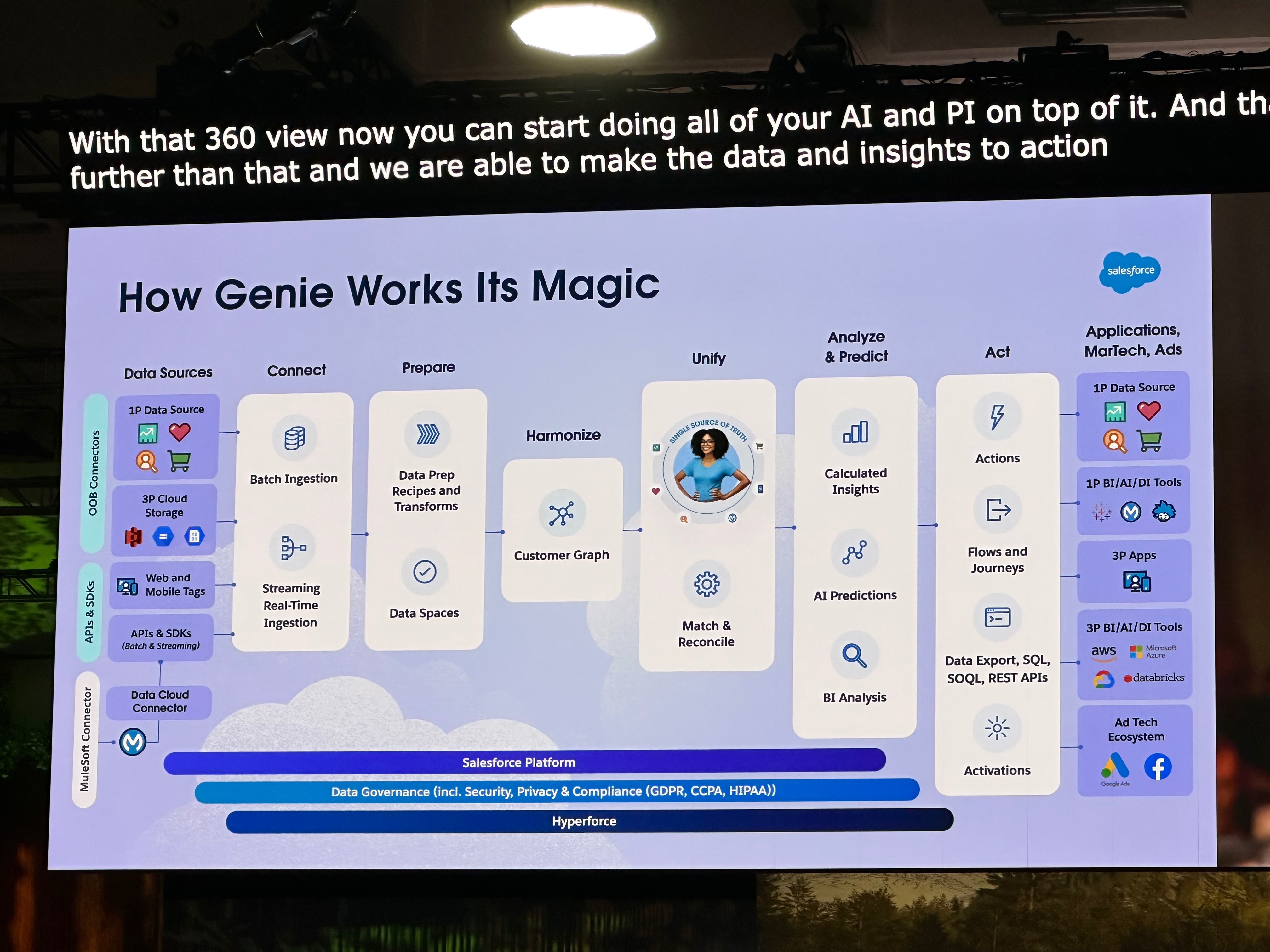 What elicited cheers from the Dreamforce audience was Genie’s capacity to help normalize and harmonize data…cleaning up the pathways that turn random stacks of data into individual, more comprehensive and complete customer records. The reality of customer records is that for every one customer, there are 900+ systems that collect data from or about that customer. So instead of Liz…you have Lizx900. Personalization occurs by accident in this scenario. Thanks to Genie’s capacity to reconcile data and identifiers, the haze and exhaust surrounding a persona turns crystal clear and becomes a person that can be engaged with regardless of where that person has engaged.






/cdn.vox-cdn.com/uploads/chorus_asset/file/24146907/GettyImages_1216300269.jpg) Saul Martinez/Getty Images
Saul Martinez/Getty Images
/cdn.vox-cdn.com/uploads/chorus_asset/file/24147039/GettyImages_1387431806.jpg) Christian Marquardt/Getty Images
Christian Marquardt/Getty Images


/cdn.vox-cdn.com/uploads/chorus_asset/file/24143408/Projected_GHG_Emission_levels_Figure_1.png)
/cdn.vox-cdn.com/uploads/chorus_asset/file/24143451/annual_co_emissions_by_region.png)