Illustration by Kristen Radtke / The Verge; Getty Images
After an unusually eventful few days, let’s check in on the current state of affairs at Twitter. A high-profile capitulation to the Turkish government and new CEO sparked a ton of chatter over the weekend. Meanwhile, a troubled introduction of encrypted messaging on the site has raised questions over when, if ever, the product can be said to be truly secure.
I.
Start with encrypted messaging, where owner Elon Musk’s ready-fire-aim approach to product development has once again led to a chaotic feature rollout.
Last week, Twitter launched encrypted direct messages, a project the company has been exploring since at least 2018 and that Musk has been talking about since November. Encryption, which comes free on apps including WhatsApp,...
The bill, titled the AM for Every Vehicle Act, would direct the National Highway Traffic Safety Administration (NHTSA) to issue a rule that “requires automakers to maintain AM broadcast radio in their vehicles without a separate or additional payment, fee, or surcharge.” Prior to the new rule from NHTSA, automakers selling vehicles without AM radio would be required to disclose that fact to potential customers. And the Government Accountability Office would be tasked with...
WhatsApp is getting a new “Chat Lock” feature intended to make it easier to keep conversations more private. The new locked chats will live in a password- or biometrics-protected folder, and notifications from those conversations won’t display the sender or the actual message content. If you’re familiar with Apple’s hidden photos feature for iCloud, Chat Lock sounds like it will work similarly.
You can get an idea of how it will all look in this video from WhatsApp.
WhatsApp is already well-known for its end-to-end encrypted messages, but that won’t block somebody who already has your unlocked phone that’s opened to WhatsApp from potentially seeing a message with their eyes. Chat Lock adds an extra layer of protection that could be...
RingCentral has revealed RingCentral for Teams 2.0.
Described in RingCentral’s announcement as a “next-gen” UC app for calling, faxing and SMS, the solution integrates RingCentral’s cloud PBX capabilities into Teams via a fully native experience without requiring another app. Among the innovative new features to boost productivity are voicemail transcription, call recording, bi-directional presence sync, and unified contact search. The offering can also be coupled with RingCentral’s CCaaS solution, RingCentral Contact Centre.
Mo Katibeh, President and COO of RingCentral, said:
Many businesses have standardized on Teams for internal collaboration, but when it comes to advanced communications, customers often seek out third-party solutions. When customer communications are critical, businesses look to RingCentral, given our reputation for 99.999% reliability and our robust and advanced telephony capabilities.”
Because most Teams customers have Microsoft 365 licenses which don’t include telephony capabilities — according to Irwin Lazar, President and Principal Analyst at Metrigy — RingCentral for Teams is a popular UCaaS solution for enterprise. It provides “flexible, and highly reliable, deployment options and the ability to integrate enterprise-grade telephony and SMS, fax, analytics, CRM integrations, and other capabilities,” Lazar added.
New Generation Means New Features
RingCentral for Teams 2.0 introduces faster load times and a streamlined user interface. This produces an improved user experience with more refined capabilities and flexibility.
There are also significant specific innovations too, such as bi-directional presence sync. This means that presence status is automatically detected and synced between Microsoft Teams and RingCentral, including hardphones, to help users avoid interruptions.
Other new features include a new unified contact searching from RingCentral and Microsoft directories in RingCentral for Teams 2.0, so callers can find the right contact without app switching.
Full integration is critical to RingCentral for Teams 2.0, with deep integration with the Teams mobile app allowing users to make and receive calls through the service. There is also a new and extensive set of telephony app integrations for customers to connect CRMs and business apps, allowing them to automate critical workflows.
Customers can also leverage their integrated business telephony with an AI-powered contact centre within Teams.
“We’re excited to deliver this next generation of RingCentral for Microsoft Teams and empower customers with faster performance, deeper integration, a new mobile experience, and simpler admin tools,” Katibeh said.
RingCentral for Teams 2.0 will be available in open beta at the end of May and generally available this summer.
A Busy Time for RingCentral
It’s been a busy period for RingCentral, with new solutions and partnerships launched in recent months.
RingCentral and Vodafone upgraded their shared collaboration and calling platform, Vodafone Business Unified Communications (VBUC), to enhance the experience of mobile users.
RingCentral also launched a generative AI platform RingSense to enable businesses to turn conversation data into powerful insights. The first offering in the portfolio is RingSense for Sales, which assesses interactions between salespeople and potential customers to produce insights and performance metrics.
Earlier this year, RingCentral created an AI guidance offering in the form of producing a real-time guidance AI-powered agent solution for contact centre agents and managers in its App Gallery.
Steve Rafferty, VP of International at RingCentral, also told UC Today earlier this year that organizations need to transform hybrid working into a joy, not a chore, by leveraging tailored collaboration tools to the practice. The interview followed up RingCentral research, which found UK workers prefer hybrid working, with more than half of UK workers (51 percent) feeling more productive when they work from home.
Gmail will start displaying a familiar-looking blue checkmark next to a sender’s name to verify their identity. In a blog post, Google says the feature is supposed to help users figure out whether the email they’ve received is from a legitimate source or a scammer.
The verified checkmark builds upon Gmail’s existing Brand Indicators for Message Identification (BIMI) feature. This requires companies to authenticate that the brand logo they’re using as their email avatar is supposed to let users know that the logo actually belongs to them. Companies that have already adopted BIMI will automatically receive the checkmark.
Image: Google
As shown in the image provided by Google, hovering over the checkmark says that “the...
U.S. telecom monopolies like AT&T and Comcast spent millions of dollars and several decades quite literally buying shitty, protectionist laws in around twenty states that either banned or heavily hamstrung towns and cities from building their own broadband networks. Even in instances and areas where AT&T and Comcast have repeatedly failed to upgrade or expand their broadband networks.
This dance of dysfunction was particularly interesting in Colorado. While lobbyists for Comcast and CenturyLink managed to convince state leaders to pass such a law (SB 152) in 2005, the legislation contained a provision that let individual Colorado towns and cities ignore the measure with a simple referendum. So they’ve been doing exactly that, en masse, for years.
“Today, the state took a big step in establishing a competitive economy for generations to come. SB23-183 removes the biggest obstacle to achieving the Governor’s goal to connect 99% of Colorado households by the end of 2027,” said Colorado Broadband Office Executive Director Brandy Reitter. “Each local government is in a unique position or different phase of connecting residents to high-speed internet, and this bill allows them to establish broadband plans that meet the needs of their communities.”
That leaves sixteen states with laws banning community broadband, after both Arkansas and Washington state eliminated their restrictions in 2021. Such laws are almost always ghost written by heavily taxpayer subsidized telecom monopolies, which have routinely tried to portray grass roots annoyance at monopolization and market failure as some form of vile socialist boondoggle.
It’s a scenario where giant telecoms get to have their cake and eat it too; often refusing to upgrade their networks in under-served or minority areas (particularly true among telcos offering DSL), while simultaneously ghost writing shitty laws preventing these underserved towns from doing anything about it — even if local voters, long struggling to gain access to broadband, vote in favor of it.
These communities wouldn’t be building broadband networks if they weren’t annoyed by decades of market failure. Or decades of federal regulators too captured to embrace policies that competitively challenge the nation’s biggest telecom monopolies.
Telecom monopolies could have responded to this by providing better, cheaper service, but given the nature of widespread U.S. corruption, it was simply easier to buy terrible state laws.
The home schooling and telecommuting boom of peak COVID put the counterproductive stupidity of these bills in very stark relief. As has the $42 billion in looming broadband funds made possible by the recent passing of the infrastructure bill. If that money is to be spent effectively, eliminating pointless, monopoly-backed restrictions on creative broadband alternatives is a good first step.
CallTower delivers a unified, simplified, high-quality Zoom Bring-Your-Own-Carrier experience
SALT LAKE CITY, UT, ROCHESTER, NY – May 1, 2023 –CallTower, an international leader in delivering cloud-based enterprise-class unified communications, contact center and collaboration solutions, expands its global reach by adding Zoom Phone Provider Exchange to its UCaaS solution availability in Austria, Croatia, Cyprus, Czech Republic, Denmark, Germany, Greece, Hungary, Ireland, Israel, Italy, Latvia, Netherlands, Norway, Poland, Romania, South Africa, Turkey, and the United Kingdom.
Built from Zoom’s intuitive platform, CallTower’s recently announced Zoom Phone Provider Exchange offering is a fully featured cloud phone system. This flexible BYOC system enables users to retain current PSTN service providers by redirecting existing voice circuits to the Zoom Phone cloud or by implementing a hybrid solution with Zoom Calling Plans. This powerful capability allows customers to enjoy the benefits of Zoom Phone while keeping their existing phone numbers, service provider contracts, and calling rates with the carrier of their choice.
As a current provider of Zoom Phone and cloud-based services in North America, CallTower enhances global workplace productivity by expanding Zoom Phone Provider Exchange into Europe, the Middle East and Africa.
“We are thrilled to be expanding our EMEA footprint,” said William Rubio, Chief Revenue Officer. “CallTower’s expanded presence positions us to better focus on global customer needs and support our growing network of partners and customers in this new market.”
“We are excited to team up with CallTower to provide more customers with the solutions they need to effectively communicate and collaborate across their organizations,” said Dion Smith, Head of Channels, EMEA at Zoom.
Since its inception in 2002, CallTower has evolved into a global cloud-based, enterprise-class Unified Communications, Contact Center and Collaboration solutions provider for growing organizations worldwide. CallTower provides, integrates and supports industry-leading solutions, including Operator Connect for Microsoft® Teams, Teams Direct Routing, GCC High Teams Direct Routing, Office 365, Cisco® Webex Calling / UCM, Cisco® CCPP, Zoom (BYOC), Zoom Phone, CT Cloud UCaaS and four contact center options, including Five9 for business customers.
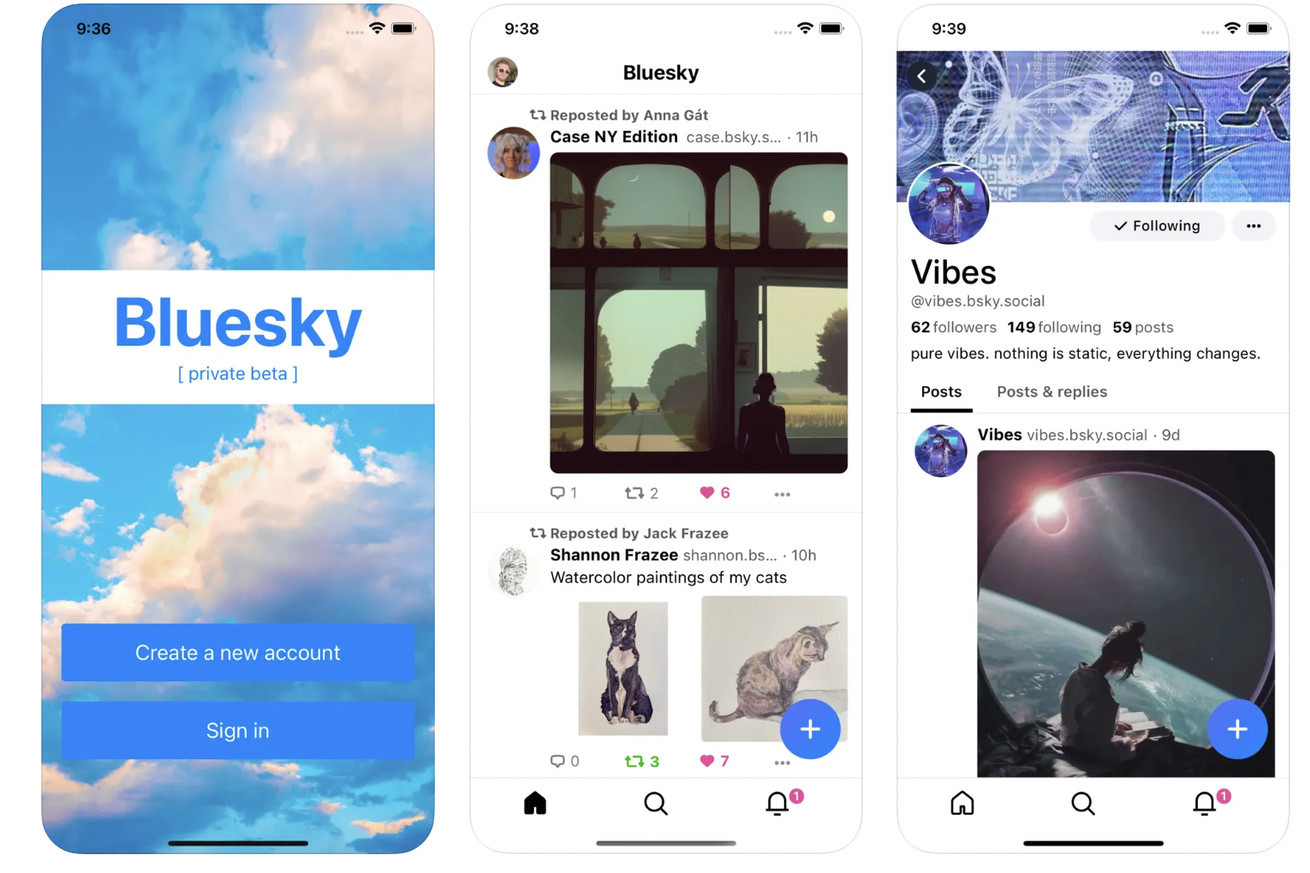
Last week, we talked about how BeReal missed its moment. This week, let’s discuss how Bluesky might avoid the same fate.
Bluesky, of course, is the decentralized social network that surged in popularity over the weekend as the app opened up invitations to more beta testers and quickly sped past its first 50,000 users. Suffice to say it has been a long time coming: I first wrote about the company here in 2019, when Jack Dorsey woke up one day and decided he would try to rebuild Twitter on an open protocol and funded a team to do just that.
Elon Musk’s reign of error over the past six months has led to a flood of talent and money into social networking companies. Among the apps attempting to capitalize on Twitter’s decline are Post, T2,...
We’ve seen a number of enterprise software companies making announcements related to generative AI in the last six weeks, from established companies like Salesforce and Adobe to startups like Ada and Forethought. Box is the latest to be announcing its own flavor of the technology under the moniker Box AI, and it will be teaming up with OpenAI to deliver the first tools on the platform.
Like many of the other companies making these announcements, they don’t have a product quite ready yet, but they are working with early customers to refine the functionality they have built in recent months. The company chose to call this Box AI because the two features being announced today are part of a much broader product road map of AI being added to the platform in the coming months.
Box CEO and co-founder Aaron Levie says that on one hand, the new AI features will help generate more content, but the real strength is helping people understand that content. “These large language models are uniquely good at reasoning through content. And so a lot of the use cases that we’re excited about are actually ones where you can use the large language model, not as the database of knowledge, but as a reasoning engine to work through your data,” Levie told TechCrunch.
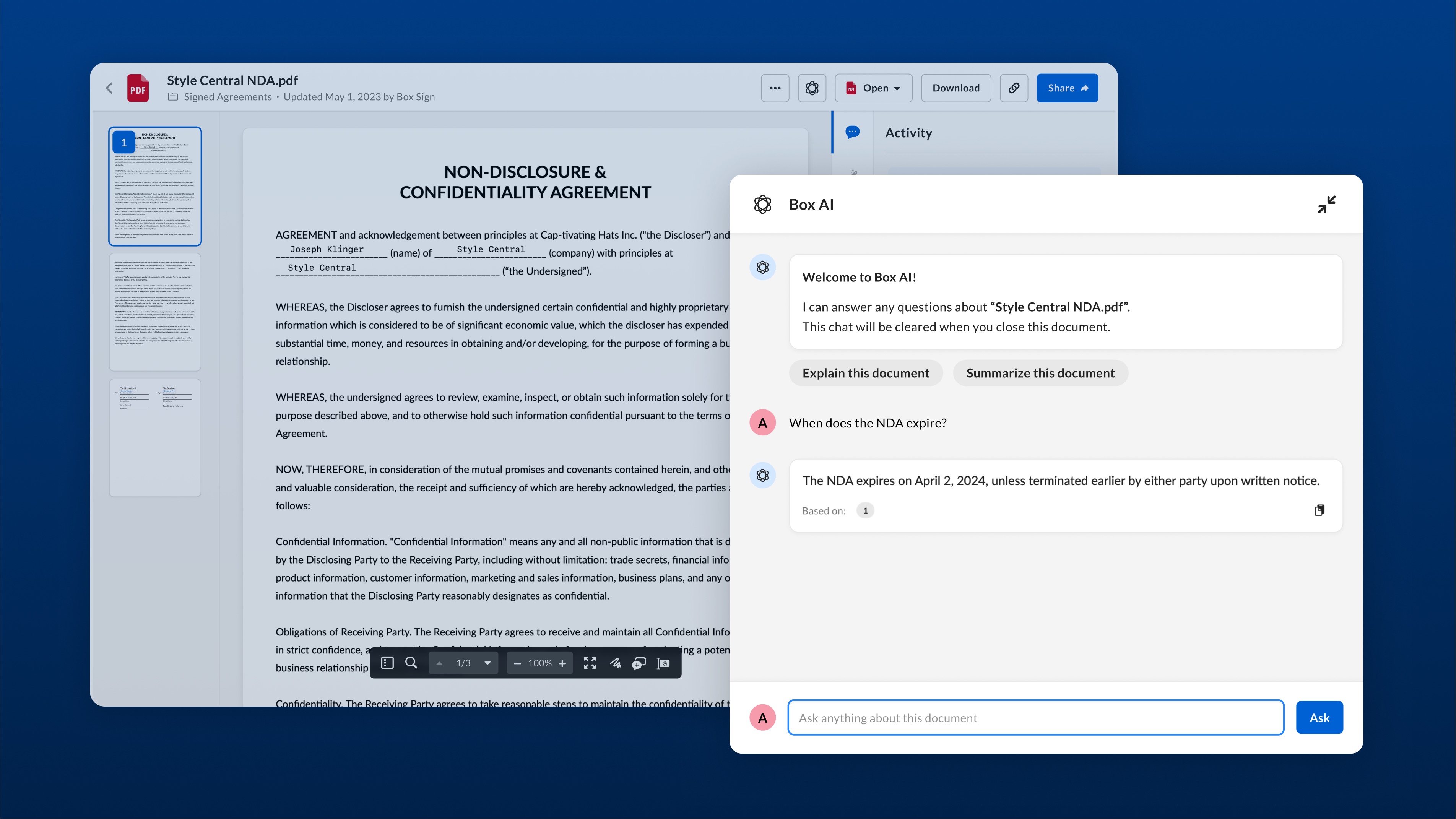
For now the company is focusing on a couple of use cases in its initial announcement. For starters, you can click the Box AI button and ask questions of a document like, “Summarize this document for me,” or “What are five key points about this document?” And Box’s generative AI will provide an answer. This could come in handy for long reports or complex contracts.
In this example, you can ask Box AI about the details of this agreement. Image Credits: Box
Being able to iterate over a document and ask increasingly specific questions means that you can produce content like a quiz or summary and the AI should be able to improve as you ask more questions.
The other thing you can do is create new content in Box Notes. Say, you create 10 bullet points from a meeting about a new product. You could ask Box AI to make a blog post out of that list and it can do it pretty much instantly, working in a similar way to ChatGPT, OpenAI’s generalized generative AI tool.
The company is working closely with customers to refine these tools and Levie says that in time, you will be able to analyze multiple documents with refinements like the maximum age a document can be. Over time, you will also be able to build automated workflows, but these elements are on the product roadmap and are not part of this announcement.
Although, the company is working with OpenAI API for starters, the idea is to be flexible enough to accommodate any large language model, or even alternative model types that could develop over time.
Levie says he’s announcing these products now, even prior to beta, because he’s been getting a constant stream of questions from customers about the company’s plans for generative AI and he wants them to know what’s coming.
Microsoft Edge is a good browser but for some reason Microsoft keeps trying to shove it down everyone’s throat and make it more difficult to use rivals like Chrome or Firefox. Microsoft has now started notifying IT admins that it will force Outlook and Teams to ignore the default web browser on Windows and open links in Microsoft Edge instead.
Reddit users have posted messages from the Microsoft 365 admin center that reveal how Microsoft is going to roll out this change. “Web links from Azure Active Directory (AAD) accounts and Microsoft (MSA) accounts in the Outlook for Windows app will open in Microsoft Edge in a single view showing the opened link side-by-side with the email it came from,” reads a message to IT admins from Microsoft.
The Chevy Bolt’s demise underscores a trend toward larger, heavier, more expensive EVs. But the Bolt was always more practical than dramatic. And that’s why it will be missed.
Google Meet finally supports 1080p video calls — but only for paying subscribers. In an update on Wednesday, Google says it’s bringing the upgrade to select Workspace and Google One users.
Additionally, you can only access 1080p video calls on the web-based version of Google Meet, and it all depends on whether your computer’s webcam actually supports the resolution. Google also notes that you’ll need additional bandwidth to send 1080p video and says that it will automatically adjust your resolution if bandwidth is “constrained.”
Image: Google
The feature isn’t enabled by default, but you can toggle it on by selecting the three dots in the top right corner of your video feed and then hitting Turn on HD video. Since...
At Meta and across tech, software engineer jobs aren’t looking as safe any more. | Getty Images
Software engineers made up the biggest portion of tech layoffs in 2023.
If you were unlucky enough to have lost your job in the last 15 years, someone might have suggested — often unhelpfully — that you “learn to code.” It was shorthand for “do something actually useful that would have kept you from being laid off in the first place.”
That advice is starting to feel even less welcome.
The latest round of layoffs at Facebook parent company Meta is impacting workers in core technical roles like data scientists and software engineers — positions once thought to be beyond reproach. This represents a stark about-face for a company that, until recently, had been offering outrageous salaries and basically hoarding people in these highly sought-after technical positions. And now, as part of the company’s “year of efficiency,” it’s letting some of them go. As Meta founder and CEO Mark Zuckerberg put it, “We’re in a different world.”
The beleaguered social media company is also not alone.
Software engineers were the most overrepresented position in layoffs in 2023, relative to their employment, according to data requested by Vox from workforce data company Revelio Labs. Last year, when major tech layoffs first began, recruiters and customer success specialists experienced the most outsize impact. So far this year, nearly 20 percent of the 170,000 tech company layoffs were software engineers, even though they made up roughly 14 percent of employees at these companies.
“Early layoffs were dominated by recruiters, which is forgoing future hiring,” Revelio senior economist Reyhan Ayas told Vox. “Whereas in 2023 we see a shift toward more core engineering and software engineering, which signals a change in focus of current business priorities.”
In other words, tech companies aren’t just trimming the fat by firing people who fill out their extensive ecosystem, which ranges from marketers to massage therapists. They’re also, many for the first time, making cuts to the people who build the very products they’re known for, and who enjoyed a sort of revered status since they, like the founders of the companies, were coders. Software engineers are still important, but they don’t have the power they used to
“Before it was just, ‘the more or better, whatever it takes to recruit the best talent,’” said Daniel Keum, an associate professor of management at Columbia University’s business school, said of tech companies. “Now they’re cost-conscious, they want to be optimized and economized.”
He added, “That’s an entirely different mindset. We haven’t seen this before.”
Tech companies grew rapidly during the pandemic, when people were home and their services were needed more than ever, but much of that demand has died down. In the meantime, the tech companies that hugely expanded their head counts in that time failed to come up with the next big thing, meaning they don’t have new sources of massive revenue to pull from and have been forced to switch from growth mode to maintenance. Meanwhile, the economy is not as strong as it was, and Wall Street is telling tech companies that less is more. The rise of AI at work is also a contributing factor, since it allows coders to be more productive, or potentially allows employers to do the same work as before but with fewer workers.
Additionally, Keum said that Elon Musk, who fired 80 percent of his staff but still has a (sort of) functioning product, has become a sort of inspiration for other tech CEOs, who see his extreme cuts as a way of making their more modest ones seem “morally and culturally acceptable.”
Their stance? “‘Thank you, Elon Musk, for showing us that it can be done. And thank you Elon Musk for taking the blame,’” Keum said.
Of course, this might be short-term thinking. While they might save companies some money, ultimately layoffs can be bad for business, lessening morale and productivity and making it harder for companies to grow in the future, when the economy improves. That fact doesn’t seem to be stopping tech companies from joining the layoff bandwagon, whether it’s strictly necessary or not.
For software engineers and other tech workers, however, this doesn’t spell the end of the world. They’re still hugely in demand, but their bargaining power and ability to ask for over-the-top perks and salaries has been muted.
The latest monthly jobs report by tech industry association CompTIA found that even though employment at tech companies (which includes all roles at those companies) declined slightly in March, employment in technical occupations across industry sectors increased by nearly 200,000 positions. So even if tech companies are laying off tech workers, other industries are snatching them up. Unfortunately for software engineers and the like, that means they might also have to follow those industries’ pay schemes. The average software engineer base pay in the US is $90,000, according to PayScale, but can be substantially higher at tech firms like Facebook, where such workers also get bonuses and stock options.
“If you’re a tech person, before, you’d only consider Silicon Valley and top-five firms,” Keum said. “Now, our graduates are thinking about okay, maybe an industrial company. They’re diversifying away from traditional ‘tech tech’ type jobs”
Over 17 million workers lost their jobs in 2022, according to the Bureau of Labor Statistics. | Getty Images/mathisworks
A brief history of engineered job insecurity in America.
Mass layoffs at some of the world’s biggest, most successful tech companies have been sweeping headlines in the past year, with the industry slashing more than 170,000 jobs, according to the tech layoff tracker Layoffs.fyi. Meta (which includes Facebook and Instagram) laid off 11,000 workers in November 2022, and another 10,000 beginning this week; Amazon eliminated 18,000 roles in 2022 and announced 9,000 more cuts were ahead in 2023. Twitter, which was acquired and taken private by Elon Musk last year, has shed more than half of its workforce in the past year.
These represent just a sliver of a far more devastating picture for American workers: More than 17 million workers were laid off or discharged — that’s the official term for “fired” — in 2022, according to the Bureau of Labor Statistics. The numbers throughout the 1990s and 2000s show a consistent pattern: We live in an age of mass layoffs.
Mass layoffs haven’t always been so commonplace, says Louis Hyman, a historian of work and business at Cornell University and the author of Temp: How American Work, American Business, and the American Dream Became Temporary. Vox spoke with Hyman about the history of mass layoffs and how decades of regular upheaval in corporate America have changed how Americans think about work and job security.
The interview below has been edited for length and clarity.
Are mass layoffs … normal?
Mass layoffs have been normal for a very long time — the idea that you would have job security is sort of a 20th-century invention. Normally, layoffs are tied to two things: a sudden reversal in a particular business, like some rival has a new kind of product that puts them out of business or there’s some sort of business challenge, or the business cycle.
I think what’s sort of weird about this moment right now is that it’s really been determined by this Covid shock to the system. Are we in a recession? Are we in a moment of prosperity? What is this? Where does Covid meet the business cycle? And I think nobody really knows what’s going on.
Some companies have taken inflation as an opportunity to push prices higher than they absolutely have to. When corporations want to downsize, do economic downturns also provide a nice opportunity to do so?
Absolutely. Sometimes they need to do it, sometimes they want to do it — who knows what vice president just got promoted and wants to unwind the empire of his or her rival and fire that whole team? It’s an opportunity to reimagine strategy and get coverage by the media.
You said job security was a 20th-century invention. When exactly did it become a thing?
After World War II — it was in the context of just phenomenal economic growth. The basis for any kind of job security is that you’re needed, right? Somebody needs you. Demand was just going through the roof after World War II. You had industrial unions really coming into their own after WWII; they negotiated, in 1950, something called the Treaty of Detroit, between General Motors and United Auto Workers. It’s not really a political treaty, it’s a contract, but that’s how important people thought of it as. It was the basis for a new economic order where you’d only negotiate [the bargaining contract] every five years, you wouldn’t have strikes, and in return, you wouldn’t have layoffs.
And then once the economy becomes more volatile in the 1970s, you see a return to layoffs, a decline in that kind of stability; first in the 1970s for industrial workers, and then basically the recession of 1990 for office workers — that’s when we first see the term “downsizing” and all kinds of corporate restructuring.
In the tech sector, Hewlett-Packard, which was sort of a quintessential Silicon Valley firm, tried to shelter their workers as much as possible from layoffs, and then they turned that policy around in the 1980s. They substituted, as much as possible, regular workers with temp workers so that in a time of recession, they can just fire all the temps. That’s why temporary worker numbers are such an important leading indicator for the coming of layoffs.
Before the post-war era — let’s say in the 19th century — what did a “layoff” look like?
They would not care. Very famously, Jay Gould, who was this big railroad magnate, said, “I can hire one-half of the working class to kill the other half.” That was their idea of labor relations. Whenever they wanted to, they would just fire people or they would just lower their wages. You start to see these big worker movements in the late 19th century that began to organize around things like railroads. The first big national strike was in 1877. They used the telegraph to organize themselves, sort of like we would use Twitter today to organize a protest. They shut down all the railroads and then cut the wires.
So there was no expectation of job security; you only have this idea of layoffs being a thing in the 20th century. You have an idea, especially after the 1930s, that the business cycle can be managed by Keynesian interventions, by the Federal Reserve and such. There’s a belief that the government can abate this.
When American jobs became more stable in the post-war era, why was that? Was it just the economic boom? Was there also a different philosophy toward work and jobs?
All those things were happening. There was just a tremendous demand for US workers — part of that was that immigration was gone. America basically closed the doors in 1921; there wasn’t really immigration again to the US, in large numbers, until 1965. There’s a restriction on the supply of workers. There’s an incredible technological boom in the post-war [era], much more so than today. You have things like aerospace being invented as an industry, electronics being invented as an industry, the entire Southwest is being built, and all suburbia is being built.
And then on top of that, you have a new kind of belief system about capitalism in the context of the Cold War. We want to say, look, the free enterprise system is better than the communists. We have labor peace, we have the Treaty of Detroit. General Motors doesn’t care — it’s making money hand over fist. Why not just let them keep going on strike as long as they’re doing their jobs?
Your book Temp focuses on the rise of the “gig economy” and why work feels so precarious today. Does that term just apply to new tech companies like Uber, or is it something older?
It’s something much older. In some ways it’s the normal way humans work, not just in the US, but around the world. Informal labor markets define most of the work in the Global South, and certainly look a lot like what work looked like before the rise of the corporation in the 20th century in the US.
The gig economy, as it came into being in the ’70s, ’80s, and ’90s, is in the context of a society where there was an expectation of labor rights. The way in which we created labor rights post-war was for a very particular kind of worker — a full-time worker who had steady employment at a particular job. He was a man, he was white, a citizen, native-born, and married. As many of those assumptions begin to break down about who an American is, we also see the meaning of that job begins to go away. Marriage begins to collapse, women start to work, millions of new Americans come. The obligations [corporations] feel to their workforce is quite different. It’s not incidental to the shifting nature of the American population — that racism and sexism guide expectations of who matters and who doesn’t from a corporate and policy point of view.
Jack Welch, the former CEO of General Electric, had a famous strategy of firing the worst-performing 10 percent of employees every year. That’s essentially stack ranking, something that tech companies like Google use today, right?
He’s the guy, Neutron Jack. He kills everybody but leaves the equipment. “We’ve got to make sure that we cut loose the fat. We’ve got to get lean and mean.” This is the kind of language that would never have been possible, not talked about, in the 1950s or ’60s. In the 1960s, there was a sense of, actually, you want your workers to feel safe. Because if they’re safe, they’re not afraid, and they’ll actually be more inventive. They’ll do better work, they’ll be loyal to you, they will not always be looking out the door for something else.
But this sort of downsizing strategy wasn’t invented by Welch, and it didn’t become popular overnight. How did books like In Search of Excellence — written by former McKinsey people — or other influences move the needle on how corporations should be managed?
Books like In Search of Excellence popularized these kinds of ideas — you don’t really need all these workers, you should be able to buy what you need from the market, you don’t need to have these big corporations, you can get by without job security. One of the partners at McKinsey who writes In Search of Excellence is the guy who’s behind the shifting culture at Hewlett-Packard. He supports a new shifting of the guard from [HP co-founders Bill] Hewlett and [David] Packard to a guy who has just an MBA; he’s not really an engineering guy. They begin to implement all the buzzy words like “kaizen” and “lean manufacturing” that were all the rage in the 1980s and begin to systematically break down Hewlett-Packard, and destroy its culture and its promise to its workers.
Future Shock is basically the most important book written in the last 30 years of the 20th century, if you want to understand the world we live in. [The author] Alvin Toffler basically invents the idea of project management and talks about a future where there’s no stability and no security. It’s a blueprint for work under neoliberalism, and it’s everywhere — it’s a bestseller. There’s lots of these popularizers that bring ideas about workplace insecurity into a kind of connection with rethinking what the corporation is after the 1970s.
Don’t companies rate morale, and having a sense of job security, as important for their employees? Don’t they think that’s essential for quality and productivity?
Certainly in Silicon Valley culture, that kind of morale is very important. Try to keep people happy, keep it fun. But in general, no. In general, I think that we’ve gotten away from this idea that people deserve not to be afraid, full stop. I think that’s not just a question of work, it’s a question of politics and democracy.
What’s the way forward from this environment where people feel that their work is so disposable? How do we get back to that golden post-war era of job security — but even better than before?
Exactly, because you want security, but it shouldn’t come at the cost of doing the work that machines should do. You don’t want to have people turning a wrench or working a cash register. If that’s the only way to have financial security, clearly we’re thinking about the problem incorrectly. I think the first step is really to have an extended national conversation on what our shared goals are: to not be afraid, to have workplace security and financial security.
The vendor investigated “errors within caching infrastructure” and “high CPU utilization on the components which process back-end navigation feature APIs” to resolve the issue.
Illustration: Kristen Radtke / The Verge; Image: Getty Images
Elon Musk is threatening to take legal action against Microsoft over claims that the company “trained illegally using Twitter data.” The billionaire’s statement came in response to a tweet noting that Microsoft’s advertising platform announced it would stop supporting Twitter, reportedly due to Twitter’s changes requiring payment to access its API.
Musk’s threat is vague but appears to be over OpenAI using Twitter data to train the large language model behind products like ChatGPT. OpenAI, obviously, is not Microsoft, but it did recently receive a significant investment from the company, which is building AI into tools like Bing, Edge, and Microsoft 365.
It’s unclear whether Musk will actually sue Microsoft at this point, as he has...
The new Withings Body Smart scale features a new “eyes closed” mode. | Image: Withings
Even if your goal is to lose weight, the number on the scale isn’t always the best measure of progress. In that vein, Withings’ new Body Smart scale is adding an “eyes closed” mode. Instead of displaying your weight, the scale will instead show encouraging messages or metrics like step count, air quality, and the weather.
It might seem odd to exclude weight on a scale, but it’s a helpful feature for folks who want to track their health but may have a history of disordered eating, are easily discouraged, or want to focus on other measures of progress like muscle gain. Or you could merely want to keep your weight private and viewable only within the app. This isn’t the first time we’ve seen this kind of feature. The QardioBase 2, for...
As Elon Musk continues wielding Twitter like a blunt weapon against competitors like Substack, the downsides of centralized social media platforms are becoming more apparent every day. For those like me who have built a valuable audience on Twitter over the years, it’s unnerving to consider that those relationships could be broken or taken away completely in the blink of an eye.
That underlying unease animates much of the consternation toward Musk these days. Zooming out, it’s also why I’m closely watching the rise of...
Elon Musk keeps talking about how he’s saving Twitter, but it’s difficult to see how. He’s made the site much more unstable, has been messing up basically every part of “trust & safety 101,” is now facing a growing number of lawsuits (including many over unpaid bills), has no idea how the site actually works, and has regulators breathing down his neck. And, on the business side, well, it’s not going great. His grand solution to saving Twitter — charging for Twitter Blue — has been a flop, and each new “update” makes him more of a laughingstock. Rather than increasing the value of using Twitter, he’s made it worse by shutting down, or charging ridiculous fees for, API access.
Twitter’s revenue was almost entirely from advertising, which brought in nearly $5 billion. Now, there’s a reasonable argument to make that it would be good for Twitter to diversify revenue streams, and figure out ways to find alternatives that don’t rely on ads. To date, however, Musk’s big idea has flopped, and rather than just cutting a few costs on the margins, and using the constant stream of ad revenue to finance his experiments into other business models, Musk took the Leeroy Jenkins approach of rushing in with no idea and no plan.
It’s not going great.
We already know that advertisers quickly fled as they worried about the direction of the site. The company desperately tried to cling to fleeing advertisers by offering them hundreds of thousands of dollars of free advertising. But advertisers said that it just wasn’t worth it. Musk himself admitted that he drove away nearly half of all advertisers, and possibly way more. If my own (increasingly infrequent) visits to the site are any indication, Musk has now turned up the advertising dial so that my feed is now full of ads every few tweets, which (again!) makes the site less useful and less interesting. And the ads in my feed are so, so bad. The company is clearly scraping the bottom of the barrel.
Advertisers are now speaking about it and they have a simple message: The problem is Elon Musk. Twitter was basically just fine as an ad platform. Not great, could be better, but it was okay. But the real issue now is just that anyone with any sense at all is freaked out about how Elon Musk himself is going to destroy their brand value.
One of the biggest barriers to spending more, advertisers say, is Musk’s own behavior on Twitter. In the past month alone, Musk defended the cartoonist who created “Dilbert” after he went on a racist tirade and made a sexist joke about women being “dangerous and violent.” This week, he responded to — and thereby amplified — a tweet that promoted an anti-trans narrative around the school shooting in Nashville, Tennessee.
Advertisers have expressed concern about Musk’s erratic decision making and how his personal brand blurs with Twitter’s corporate image. For instance, the same weekend as the Super Bowl — traditionally a major advertising event for Twitter — Musk was asking engineers to adjust the algorithm to boost his own tweets into users’ feeds.
“It’s this intangible wild card,” the media buyer said about Musk, asking for anonymity to preserve relationships at Twitter. “We need to work with clients to understand from a values perspective: Is this a partner you want to be in business with?” The short answer for many advertisers right now is no.
Elon Musk is literally a liability for his own site.
Hilariously, Twitter introduced a tool to try to deal with some of this, letting advertisers make sure their ads don’t appear next to certain accounts… and advertisers are using it to make sure their brand is nowhere near Musk.
Author Exclusions, as Twitter calls them, let advertisers choose as many as 1,000 handles that they want their ads kept away from, in addition to keywords and topics. “Brands need to consider the source and what a person stands for,” said Jason Lee, brand safety officer at Horizon Media, a leading US media agency.
“The irony, of course,” said another media buyer from a large agency, is “the No. 1 or No. 2 account that we’re going to look to avoid is the owner of the company.”
Then in a separate article over at Semafor, we find out that advertisers are having private discussions of “how do you deal with Elon Musk” and the whole thing is just bizarre.
But a private email thread among the organization’s board members, obtained by Semafor, suggests he will face a skeptical audience. Top advertisers, including McDonald’s and Colgate-Palmolive, are concerned that Musk’s comments about race and the platform’s openness to racist speech have rendered Twitter toxic.
“For many communities, his willingness to leverage success and personal financial resources to further an agenda under the guise of freedom of speech is perpetuating racism resulting [in] direct threats to their communities and a potential for brand safety compromise we should all be concerned about,” wrote McDonald’s chief marketing and customer experience officer, Tariq Hassan. “Further, all of us who lead our brand’s investments across platforms were required to navigate a situation post-acquisition that objectively can only be characterized as ranging from chaos to moments of irresponsibility.”
Again, Twitter had problems. You could easily see a variety of paths by which the site and its sustainability could have been improved. There was bloat that could easily have been trimmed. There were products and offerings that could have been more compelling and there were business model ideas that could stand to be improved. But, to do all that, it would help to continue (and continue to grow) what had been a $5 billion / year fire hose, and instead, Musk has literally driven much of that away almost entirely because he’s erratic and prone to nonsense.
It’s really an incredible, somewhat historic, self-own.
HOLMDEL, NJ – April 12, 2023 –Vonage, a global leader in cloud communications helping businesses accelerate their digital transformation, has announced that it has appointed Vikram Khandpur as Senior Vice President, CPaaS Products and Developer Experience. Khandpur will report to Savinay Berry, Vonage Executive Vice President of Product & Engineering.
In this role, Khandpur will be responsible for driving the strategic direction for Vonage’s vast portfolio of communications APIs (voice, video, SMS, chat, messaging, verification and more), including product development and go-to-market processes. He will also have oversight of the Company’s network of more than one million registered developers, as well as its globally distributed, diverse and highly talented Product Management team.
“I am delighted to welcome Vikram to Vonage. When it comes to our unique portfolio of product offerings, our vision is to turn notifications into conversations in the physical, digital and virtual worlds, enabled by the most comprehensive, intelligent customer engagement platform,” said Savinay Berry, Executive Vice President, Product & Engineering for Vonage. “With Vikram’s breadth of knowledge and experience in the API and developer space, he is the perfect fit to help us execute on this vision. His expertise in these areas ensures he understands today’s evolving business and developer challenges so that we can deliver the kinds of customizable products and services that help our customers create innovative solutions that drive more personalized and meaningful engagement across any channel.”
Khandpur has more than 20 years of experience in the tech space. Prior to joining Vonage, he served as SVP and Chief Product Officer at Sinch. In this role, he led product innovation, platform integrations and product partnerships across a diverse portfolio of mobile-first and cloud-first communications products.
Khandpur has also held several leadership roles at Microsoft, including Senior Director of Product, Skype and Microsoft Teams; GPM, Internet of Things; and Principal Group Program Manager for the HoloLens wearable device.
“I couldn’t be more excited to be joining Vonage at such a pivotal moment,” said Khandpur. “Vonage is a pioneer in the tech space and, with so many new products and opportunities ahead, combined with the power of Ericsson’s R&D and its network of partners in the industry, I am thrilled to be a part of this team. I look forward to working together to build on Vonage’s legacy of innovation to create more customer engagement opportunities and even better developer experiences.”
About Vonage Vonage, a global cloud communications leader, helps businesses accelerate their digital transformation. Vonage’s Communications Platform is fully programmable and allows for the integration of Video, Voice, Chat, Messaging, AI and Verification into existing products, workflows and systems. The Vonage conversational commerce application enables businesses to create AI-powered omnichannel experiences that boost sales and increase customer satisfaction. Vonage’s fully programmable unified communications, contact center and conversational commerce applications are built from the Vonage platform and enable companies to transform how they communicate and operate from the office or remotely – providing the flexibility required to create meaningful engagements. Vonage is headquartered in New Jersey, with offices throughout the United States, Europe, Israel and Asia and is a wholly-owned subsidiary of Ericsson.
MARKHAM, ON – April 11, 2023 – Sangoma Technologies Corporation (TSX: STC; Nasdaq: SANG) (“Sangoma” or the “Company”), a trusted leader in delivering cloud-based Communications-as-a-Service solutions for companies of all sizes, today announced the appointment of Joanne Moretti as the Company’s first go-to-market expert and female director to sit on the board, effective immediately.
The addition of Ms. Moretti adds a seasoned go-to-market veteran to the board and marks a major milestone in the Company’s commitment to diversity, equity, and inclusion. It is the first step in diversifying the board of directors (the “Board”), a key priority for Sangoma. The addition of Ms. Moretti comes well ahead of the Company’s publicly disclosed goal to add a female director to its Board by August 2023.
“We are thrilled to welcome Joanne to our Board,” said the Company’s Interim Executive Chairman, Norm Worthington. “Her extensive experience in the industry and her expertise in product management, sales, and marketing will be invaluable as we continue to pursue growth opportunities and strive to create value for our shareholders.”
Ms. Moretti is the current Chief Revenue Officer at Fictiv, the operating system for custom manufacturing. In addition to her current role at Fictiv, Ms. Moretti has 35 years of experience in the high-tech and manufacturing industries and has held board seats with Fictiv, DecisionLink, and Alteryx. Joanne also served as SVP & CMO at Jabil Inc., a Fortune 200 manufacturing company, and in sales and marketing roles at HP Inc., Dell Technologies Inc., and CA. “I am honored to join the board of Sangoma,” said Ms. Moretti. “I look forward to working with my fellow directors and the management team to drive Sangoma’s growth and success.”
The Board recognizes the importance of skills and gender diversity in achieving the Company’s strategic objectives, enhancing corporate governance, and promoting innovation and creativity. Ms. Moretti’s appointment signifies the beginning of important strides Sangoma is taking to meet its objectives.
Similar to Mastodon, Bluesky is a federated social network, which, at its most basic level, means that users can participate through different providers instead of a huge central one. The easiest comparison is email: if you have Gmail, you can send an email to somebody on Apple’s iCloud, and they can reply back to you.
Bluesky lets you pick from different hosting providers. When I joined the app on Tuesday, I...
HOLMDEL, NJ – April 13, 2023 –Vonage, a global leader in cloud communications helping businesses accelerate their digital transformation, will highlight its commitment to the Channel and innovations in its support of channel partners at the upcoming Channel Partners Conference & Expo. The Company will also lend thought leadership across three sessions, including two Keynotes.
The annual Channel Partners Conference & Expo is the premier event for the channel space and will take place May 1-4, 2023, at The Venetian in Las Vegas, NV.
“Channel Partners is such a key event for us each year to demonstrate our ongoing commitment and service to our network of channel partners and their customers,” said Reggie Scales, SVP, Global Sales for Vonage. “With the opportunity to meet with the channel community face to face – to showcase demos of new products and our continued investments in our Channel model, tools, and infrastructure – this show is the perfect opportunity to reinforce our dedication to our partners’ success.”
In a Keynote on Tuesday, May 2, at 10:20 am PT – Building Resilience and Revenue Through Innovation– Vonage Chief Operating Officer Jay Bellissimo will provide an overview of the Vonage Communications Platform, and an outlook for the future as the Company continues its legacy of opening new revenue streams for partners and helping them build resilience for their businesses.
An additional Keynote panel on Wednesday, May 3, at 8:45 am PT – The Future of the Channel: The Ultimate Vendor Power Panel – will feature Vonage SVP Global Sales Reggie Scales. The panel will discuss how today’s tech leaders are meeting customers’ business challenges head on while working to drive success for their partner communities.
A third Vonage speaking engagement at Channel Partners is an MVP Panel – UC and CC – Consolidation without Compromise on Tuesday, May 2 at 2:15 pm PT, hosted by Vonage Channel Chief, Jim Regan. This panel of channel and product experts will uncover why a truly integrated suite of solutions helps businesses create differentiated experiences for their customers – and how this drives increased productivity within their organizations.
Vonage will host a booth (#1419) on the expo show floor, where attendees will have the opportunity to connect with members of the Company’s executive and channel teams and experience interactive product demos showcasing Vonage’s latest technology.
About Vonage
Vonage, a global cloud communications leader, helps businesses accelerate their digital transformation. Vonage’s Communications Platform is fully programmable and allows for the integration of Video, Voice, Chat, Messaging, AI and Verification into existing products, workflows and systems. The Vonage conversational commerce application enables businesses to create AI-powered omnichannel experiences that boost sales and increase customer satisfaction. Vonage’s fully programmable unified communications, contact center and conversational commerce applications are built from the Vonage platform and enable companies to transform how they communicate and operate from the office or remotely – providing the flexibility required to create meaningful engagements. Vonage is headquartered in New Jersey, with offices throughout the United States, Europe, Israel and Asia and is a wholly-owned subsidiary of Ericsson.
Feature-rich voice solution for Microsoft Teams radically simplifies Direct Routing, showcasing the revenue opportunity for CSPs to modernize core voice infrastructure with the cloud
Pleasant Grove, UT - April 12, 2023 -Alianza, Inc. today introduced Alianza for Microsoft Teams, a new and powerful solution that gives service providers a robust cloud PBX voice solution for Microsoft Teams.
Many communication service providers (CSPs) struggle with the complexities and hidden costs of setting up telephony for Microsoft Teams via Direct Routing or Operator Connect. In many cases, they are forced to employ a third-party Microsoft partner to manage a Teams integration on their behalf. Alianza for Microsoft Teams ensures successful implementation by automating the voice configuration between the customer’s Microsoft 365 tenant and the Alianza platform — without specialized expertise or expensive network elements like session border controllers (SBCs).
With Alianza for Microsoft Teams, both CSPs and Teams administrators bypass the heavy lift and complex configuration of the voice calling and user policies in the Microsoft Teams admin center.
Highlights of Alianza for Microsoft Teams include:
Unprecedented Automation: A two-step deployment to add licenses and sync, it’s that simple. Alianza has simplified Direct Routing for PSTN and PBX provisioning, which eliminates the heavy technical lift for CSPs.
Robust PBX Feature Set: Comprehensive calling features support knowledge workers who live and breathe Teams, while continuing to support non-Teams users within the organization who are primarily reliant on traditional telephony functionality and devices.
Superior PSTN Coverage: Wide rate renter coverage ensures CSPs can provide telephone numbers wherever their Teams users are located.
Extensive CPE Interoperability: Alianza for Microsoft Teams supports a broad variety of SIP endpoints ranging from IP phones to high density analog gateways, including devices from Cisco, Yealink, and Poly, empowering CSPs with the ability to deploy the right devices for their customers.
Faster Time to Market: Alianza for Microsoft Teams can be enabled and set up in minutes so CSPs can take advantage of the Teams opportunity immediately as opposed to the typical 12-month deployment timeframe.
Administrative Ease: With Alianza for Microsoft Teams automation, CSPs don’t need to define the SBC and PBX templates every time they sign up or move an end user to the Teams integration. In addition, PowerShell scripting is not required to build, test, and deploy, meaning zero extra work for the Teams Admin.
Security: End-to-end encryption of both signaling and media is enforced between the integration and Microsoft 365. Additionally, administrative access is controlled by Azure/Microsoft 365 single sign-on; no user credentials are stored by the portal.
With 280 million Teams monthly active users globally, only 30% of which are active Teams Phone users and a much smaller percentage with PSTN, there is a massive market opportunity for CSPs to build their “with Teams” strategy and capitalize on the large and growing Microsoft’s Team ecosystems.
Although Microsoft offers documentation to enable Direct Routing, it’s an intense, do-it-yourself approach that requires high levels of specialized expertise. Alianza’s turnkey, voice-enabled Teams integration goes beyond Direct Routing to radically simplify the heavy technical and administrative complexities of implementing Direct Routing. With Alianza for Microsoft Teams, CSPs are better positioned to deliver an enterprise-grade, feature-rich, and administratively easy solution to their end–users.
Alianza’s Business Cloud Communications PBX serves as the central calling platform and routing engine for Microsoft Teams users, offering consistent call routing policies and proper management of user presence, metrics, and call routing. Simply add the integration to an account through the Alianza Admin Portal and identify the Microsoft 365 Global Admin user who will manage the integration. CSP staff and the Global Admin will have a real-time status view of the state and health of the integration in the Alianza portal.
“We’ve eliminated all of the complexity required by service providers to deliver Teams telephony for their end-users. Alianza for Microsoft Teams is another example of how Alianza innovates to help CSPs grow their cloud communications portfolio, capitalize on large revenue opportunities, and radically simplify voice and UC deployment at scale,” says Dag Peak, Chief Product Officer at Alianza. “This represents a massive market opportunity. Service providers can leverage Microsoft Teams’ popularity, market share, and extensive customer base by using Alianza for Microsoft Teams as the ideal, voice integration solution.”
Alianza is the communications cloud for service providers. We help our customers supercharge growth, reduce costs, and transform into modern techcos. With Alianza, service providers can navigate the end of the softswitch era and upgrade to a cloud-native solution to power both legacy voice and next-gen cloud communications services — including cloud meetings, collaboration, and text messaging. Our team of experts are passionate about simplifying service delivery and ensuring first-rate customer experiences for more than 200 service providers. Learn more about our solutions at www.alianza.com.
CallTower delivers Zoom’s feature-rich cloud phone system to its enterprise-grade unified communications suite
SALT LAKE CITY, UT, ROCHESTER, NY – April 12, 2023 –CallTower, an international leader in delivering cloud-based enterprise-class unified communications, contact center and collaboration solutions, enhances its platform by delivering Zoom Phone, a cloud-based enterprise phone service that enables organizations to connect from anywhere and collaborate with agility.
CallTower continues to enrich its enterprise communication offerings with Zoom Phone, a trusted and scalable cloud-based phone system. The Zoom Phone experience turns Zoom into a fully featured communication and collaboration product, complete with voice, conferencing, messaging, and video in the same solution. With CallTower’s Zoom solution and global voice-optimized network, multinational organizations have the opportunity to consolidate multiple business phone systems into a single, unified platform.
Business solutions with robust functionality such as Zoom Phone, elevate standard phone system features to better suit the modern enterprise, and include features like call recording, caller ID, call routing, call forwarding, and more.
“Zoom is very excited to welcome CallTower as a partner,” said Jason Gilligan, Global Business Development for Zoom Phone. “CallTower’s robust technology infrastructure, flexible deployment options, and exceptional customer support ensure that businesses of all sizes can seamlessly transition to Zoom Phone and experience the full benefits of a modern cloud communication system.”
“We are excited to add Zoom Phone to our enterprise communications profile,” said Doug Larsen, VP of Software and Product, “Zoom Phone is the state-of-the-art modern phone system that is easy to use, and we are eager to offer this new solution to our clients.”
“Our current Zoom offering has been extremely valuable when it comes to keeping our clients connected.” adds William Rubio, Chief Revenue Officer. “As a UCaaS industry leader, we are looking forward to offering Zoom’s world-class global phone service in our efforts to continually provide more UC options.”
CallTower recently announced the launch of their Zoom enterprise voice solution. As a Cloud Peering Partner, CallTower’s Zoom system offers flexible deployment options allowing organizations to stay agile in an ever-evolving business environment. CallTower allows companies to connect Zoom with current service providers to avoid early termination fees, maintain current call rates, and limit risk in porting over large volumes of numbers all while keeping existing phone numbers.
Since its inception in 2002, CallTower has evolved into a global cloud-based, enterprise-class Unified Communications, Contact Center and Collaboration solutions provider for growing organizations worldwide. CallTower provides, integrates and supports industry-leading solutions, including Operator Connect for Microsoft® Teams, Teams Direct Routing, GCC High Teams Direct Routing, Office 365, Cisco® Webex Calling / UCM, Cisco® CCPP, Zoom (BYOC), Zoom Phone, CT Cloud UCaaS and four contact center options, including Five9 for business customers. For more information, contact marketing@calltower.
You might recall that the FCC under both Trump and Biden has made a big deal about forcing U.S. telecoms to rip out Huawei gear from their networks, under the allegation that the gear is used to spy on Americans (you’re to ignore, of course, that the United States spies on everyone, constantly, and has broadly supported backdooring all manner of sensitive telecom products globally).
The efforts aren’t going so hot. U.S. ISPs that began yanking cheaper Chinese gear out of the networks say they’re only getting about forty percent of the money they need from the government to actually complete the job, (including destroying the gear so it’s not re-used):
Congress last year allocated about $1.9 billion for its Secure and Trusted Communications Networks Reimbursement Program, widely known in the telecom industry as the “rip and replace” program because participants are charged with ripping out Huawei and ZTE equipment and replacing it with “trusted” equipment from companies such as Ericsson, Nokia and Mavenir. However, dozens of mostly smaller US network operators participating in the effort believe that far more funding is needed – roughly $3.1 billion more – to finish the job.
While bigger ISPs can eat the costs of completely revamping their networks in this fashion, it’s a bigger issue for smaller ISPs already struggling to get by. Only $41 million of this $1.9 billion effort had been doled out as of the beginning of this year, and participants in the program say program administrator’s decision to only answer questions via email has slowed things down further.
Add to this COVID-era supply chain and labor issues, and actually doing what the government planned has proven both costly and cumbersome. Michigan Senator Gary Peters and FCC Commissioner Geoffrey Starks recently penned an editorial begging Congress for the money to complete the job, though this is the same Congress that just let the FCC’s spectrum auction authority lapse for no coherent reason.
While getting Chinese-made gear out of U.S. networks isn’t a terrible idea, you can see how the U.S. government may not be competent enough to actually walk the talk.
Clearly nobody really planned this “rip and replace” effort out well enough to actually fund it. And confirming that ISPs spend money sensibly and ethically also isn’t really the FCC’s strong suit.
This is of course all being overshadowed by the great TikTok moral panic of 2023, which sucked most of the oxygen policy out of the room, despite the fact that a ban of the social media app wouldn’t actually accomplish all that much. FCC Commissioners like Brendan Carr have gotten oodles of cable TV news attention for freaking out about TikTok, yet he’s been relatively quiet on this issue he actually regulates.
Meanwhile these expensive, incomplete efforts to combat Chinese surveillance of Americans still can’t seemingly convince Congress to actually pass a privacy law or regulate data brokers, something Chinese intelligence easily exploits. So yes, an impressive job all around.
In business and tech circles, it’s not uncommon to hear the phrase “data is the new oil.” The concept posits that data, like oil, only becomes valuable once made useful (or “refined”) for business purposes. This is true for contact centers as well, as they seek to provide useful, real-time data to agents that improves productivity and delivers accurate, rapid responses to customers.
With an ever-increasing amount of data flowing into contact centers, a new partnership between Invoca and Five9 aims to take advantage of contextual customer data making it valuable to agents at the right time. Known as “PreSense,” the customized solution presents agents real-time caller context data, including pre-populated digital data such as search keywords, products views, web pages, and shopping cart items, all gathered prior to answering the call. This data is rendered on agent desktops and enables agents to quickly understand the reason for the call and tailor the conversation based on personalized context. In practice, this will help agents increase conversion rates, reduce agent handling times, and improve customer satisfaction.
More and more, customer journeys start with digital-first interactions — such as keyword search, mobile app or website visits, or social media engagements — leaving a dwindling percentage of customers calling directly into the contact center to resolve their issues. These pre-call, digital breadcrumbs are the foundation for Conversational Intelligence and afford organizations the opportunity to develop innovative approaches to better, more successful customer experiences.
According to announcements from Invoca and Five9, PreSense, as a tool and resource for contact center agents, can improve call routing and tracking and enable customers to be connected directly to skilled agents. Additionally, self-service automation and virtual agents can be best utilized for routine transactions allowing agents to focus on more complex, more involved customer calls.
AI for Agent Assistance
Indeed agent assistance is becoming a very big deal with high hopes that real-time data, conversational AI, and large language models (LLMs) enable easy access to knowledge articles, offer next best actions, train bots, and streamline call summarization. We’ve already seen Microsoft CoPilot touted as a “24-hour assistant” always there to answer questions, make suggestions and draft responses for the agent to review and the explosion of Generative AI into the contact center.
With so much data flowing onto agent desktops, contact centers run the risk of overwhelming agents with too much information. Still, it’s solutions like PreSense that focus on exposing the right data at the right time that underscore the value of such tools beyond customer support by generating revenue, closing sales deals, and optimizing marketing campaigns. The partnership with Five9 is just the start for PreSense, says Invoca, emphasizing that their solution is agnostic to any CCaaS provider and that we can expect a broader rollout later this year.














 In business and tech circles, it’s not uncommon to hear the phrase “data is the new oil.” The concept posits that data, like oil, only becomes valuable once made useful (or “refined”) for business purposes. This is true for contact centers as well, as they seek to provide useful, real-time data to agents that improves productivity and delivers accurate, rapid responses to customers.