Brindle
Shared posts
Verizon, Apple continue to lobby against Your 'right to repair'
UK Appeals Court Says GCHQ's Mass Collection Of Internet Communications Is Illegal
The UK's mass surveillance programs haven't been treated kindly by the passing years (2013-onward). Ever since Snowden began dumping details on GCHQ surveillance, legal challenges to the lawfulness of UK bulk surveillance have been flying into courtrooms. More amazingly, they've been coming out the other side victorious.
In 2015, a UK tribunal ruled GCHQ had conducted illegal surveillance and ordered it to destroy intercepted communications between detainees and their legal reps. In 2016, the UK tribunal declared GCHQ's bulk collection of communications metadata illegal. However, the tribunal did not order destruction of this collection, meaning GCHQ is likely still making use of illegally-collected metadata.
A second loss in 2016 -- this time at the hands of the EU Court of Justice -- found GCHQ's collection of European communications being declared illegal due to the "indiscriminate" (untargeted) nature of the collection process. The UK government appealed this decision, taking the ball back to its home court. And, again, it has been denied a victory.
The court of appeal ruling on Tuesday said the powers in the Data Retention and Investigatory Powers Act 2014, which paved the way for the snooper’s charter legislation, did not restrict the accessing of confidential personal phone and web browsing records to investigations of serious crime, and allowed police and other public bodies to authorise their own access without adequate oversight.
The three judges said Dripa was “inconsistent with EU law” because of this lack of safeguards, including the absence of “prior review by a court or independent administrative authority”.
Hey, the elimination of privacy safeguards is just the price that has to be paid when the nation's security can only be guaranteed by rushed, liberty-violating legislation dropped onto the floor shortly before closing time. If power is going to be consolidated, it needs to be done with a little debate as possible. Built-in safeguards for citizens' privacy is something that can be relegated to an afterthought. And that afterthought need never be brought up again.
Those powers - granted by DRIPA -- have been declared illegal. That's going to cause problems for the Snooper's Charter, which is DRIPA's surveillance state successor. Chances are the problem will be dealt with by erecting a few minimal privacy protections while codifying prior surveillance abuses. And since this only upholds an EU court decision, it will mean less than nothing once Britain completes its exit from the Union.
The good news is the court's decision backs up what critics have been saying for years: bulk interception of communications violates UK law, and the supposed oversight these collections receive falls far short of what's required to make the collections legal again.
Permalink | Comments | Email This Story
Dutch Approach To Asset Forfeiture Will Literally Take The Clothes Off Pedestrians' Backs
Brindlejtfc
We've long complained about civil asset forfeiture in the United States. Law enforcement agencies, thanks to a series of perverse incentives, have grown to love taking people's property (usually cash) without charging them for crimes. The excuse is that lifting a few thousand dollars from some random person somehow chips away at drug cartels located overseas.
It would seem to be more crippling if criminal charges were pursued and suspects interrogated, jailed, and flipped. But law enforcement has no time for that, not when a pile of cash is only a few pieces of paperwork away from changing ownership.
They're taking asset forfeiture to a whole new level over in the Netherlands. Dutch cops will now be taking the clothes off people's back if they "suspect" the clothing might be out of the spending range of the person wearing it. (h/t Charles C.W. Cooke)
Police in the Dutch city of Rotterdam have launched a new pilot programme which will see them confiscating expensive clothing and jewellery from young people if they look too poor to own them.
Officers say the scheme will see them target younger men in designer clothes they seem unlikely to be able to afford legally – if it is not clear how the person paid for it, it will be confiscated.
The idea is to deter criminality by sending a signal that the men will not be able to hang onto their ill-gotten gains.
The police say they'll be able to make quick determinations about the legality of… um… clothing by accosting well-dressed youngsters. Presumably, no one will be carrying receipts. The police have used the term "undress" but swear they'll be focused on items that won't leave their former owners in a state of undress (watches are mentioned). Then again, the police also say they'll be packing clothes to hand out to people they've disrobed for dressing too richly, so it's obvious it won't just be watches being watched.
What's propelling this new spin on asset forfeiture? Apparently, it's some form of disrespect Dutch police want to shut down.
Police Chief said the young men targeted often have no income and are already in debt from fines for previous convictions but wearing expensive clothing.
This “undermines the rule of law” which sends “a completely false signal to local residents”, he explained.
The law already gives Dutch police permission to forfeit items procured with criminal funds. Over the last decade, the police have expanded these programs to go far beyond perceived kingpins to reach street hassle levels. Dutch law enforcement have been performing "Rolex checks" on young people for three years now, but the recent expansion into Rotterdam (it originated in Amsterdam), coupled with inflammatory "undress them on the street" comments from the Rotterdam police chief, has resulted in a new wave of backlash.
The police refuse to say how they'll determine rightful ownership of clothing/watches/jewelry they wish to seize. Obviously, the specifics would let "criminals" know what receipts to carry, but also suggests they're not entirely sure how they're going to carry this out either. Of course, the method matters less to the police. They don't have to prove anything. All they have to find is a lack of proof of legitimate ownership. The burden is completely upon those walking around wearing items cops subjectively feel they can't afford. Given the way this deck is stacked, citizens may as well just hand over "expensive" items the moment an officer approaches them. Why go through all the extra hassle if it's not going to change anything?
The police chief has responded to the backlash by blaming the media and the citizens for "rushing ahead" without knowing all the facts. This is a typical response, one that should be greeted with the obvious point that most of the facts came directly from from the police chief, i.e., the threat to "undress" people in public to rebuild "respect" for the "rule of law." Those facts are ugly and indisputable. And they're all attributable to Rotterdam Police Chief Frank Depauuw. He can't blame an extremely awful forfeiture program on all the people who won't be actively participating in it. The facts will continue to develop, but they're never going to reach the point where this program looks like anything but a gross misuse of power.
Permalink | Comments | Email This Story
Maybe The Universe Is Trying To Tell You Something: Front Porch Package Thief Receives Instant Karma
 This is a video of a worthless excuse for a human attempting to steal three UPS packages off somebody's front porch, all captured by the homeowner's Nest home security camera. Almost immediately after picking up the packages she slips and...I don't think ankles are supposed to bend that way (make sure you have the volume on to hear the agony). The getaway driver, who apparently decided to disguise himself as a very unconvincing Seattle Seahawks quarterback Russell Wilson, manages to carry his dearly beloathed back to the car before coming back for the packages himself. When reached for comment about the incident, the real Russell Wilson said he'd really wished they'd been Cowboys or Patriots fans instead. Also, to call around to all the local clinics to see if any of them have reported a human shaped turd admitted with a broken ankle.
Keep going for the whole video. Heist of the century (aka Ocean's Two) starts right around the minute mark.
Thanks to Dave L, who agrees there's a special place in hell for package thieves, and it's full of clamshell packaging and paper cuts.
This is a video of a worthless excuse for a human attempting to steal three UPS packages off somebody's front porch, all captured by the homeowner's Nest home security camera. Almost immediately after picking up the packages she slips and...I don't think ankles are supposed to bend that way (make sure you have the volume on to hear the agony). The getaway driver, who apparently decided to disguise himself as a very unconvincing Seattle Seahawks quarterback Russell Wilson, manages to carry his dearly beloathed back to the car before coming back for the packages himself. When reached for comment about the incident, the real Russell Wilson said he'd really wished they'd been Cowboys or Patriots fans instead. Also, to call around to all the local clinics to see if any of them have reported a human shaped turd admitted with a broken ankle.
Keep going for the whole video. Heist of the century (aka Ocean's Two) starts right around the minute mark.
Thanks to Dave L, who agrees there's a special place in hell for package thieves, and it's full of clamshell packaging and paper cuts.
FBI Director Chris Wray Says Secure Encryption Backdoors Are Possible; Sen. Ron Wyden Asks Him To Produce Receipts
I cannot wait to see FBI Director Christopher Wray try to escape the petard-hoisting Sen. Ron Wyden has planned for him. Wray has spent most of his time as director complaining about device encryption. He continually points at the climbing number of locked phones the FBI can't crack. This number signifies nothing, not without more data, but it's illustrative of Wray's blunt force approach to encryption.
I'm sure Wray views himself as a man carefully picking his way through the encryption minefield. But there's nothing subtle about his approach. He has called encryption a threat to public safety. His lead phone forensics person has called Apple "evil" for offering it to its users. He has claimed the move to default encryption is motivated by profit. And if that's not the motivation, then it's probably just anti-FBI malice. Meanwhile, he claims the FBI has nothing but the purest intentions when it calls for encryption backdoors, even while Wray does everything he can to avoid using that term.
He claims the solution is out there -- a perfect, seamless blend of secure encryption and easy law enforcement access. The solution, he claims, is most likely deliberately being withheld by the "smart people." These tech companies that have made billionaires of their founders are filled with the best nerds, but they're just not applying themselves. Wray asserts -- without evidence -- that secure encryption backdoors are not only possible, but probable.
Senator Ron Wyden has had enough. He's calling out Director Wray on his bullshit. Publicly. His letter [PDF] demands Wray hand over information on his encryption backdoor plans. Specifically, Wyden wants Wray to name names. [via Kate Conger at Gizmodo]
Your stated position parrots the same debunked arguments espoused by your predecessors, all of whom ignored the widespread and vocal consensus of cryptographers. For years, these experts have repeatedly stated that what you are asking for is not, in fact, possible. Building secure software is extremely difficult, and vulnerabilities are often introduced inadvertently in the design process. Eliminating these vulnerabilities is a mammoth task, and experts are unified in their opinion that introducing deliberate vulnerabilities would likely create catastrophic unintended consequences that could debilitate software functionality and security entirely.
I would like to learn more about how you arrived at and justify this ill-informed policy proposal. Please provide me with a list of the cryptographers with whom you've personally discussed this topic since our July 2017 meeting and specifically identify those experts who advised you that companies can feasibly design government access features into their products without weakening cybersecurity. Please provide this information by February 23, 2018.
Remember how FBI directors (Wray, Jim Comey) claimed they just wanted to have "an adult conversation" with tech experts and cryptographers? My guess is they've never even tried. Wray hasn't held the post for long, but he's been beating Comey's weathered anti-encryption drum as long as he's held the title. And in all this time, I doubt he has talked to anyone in the tech industry directly about his encryption backdoor theory. Even if he has, he certainly hasn't found anyone who agrees such a thing can be done without weakening device security. Wray will have no answers for Wyden. We can only hope being publicly embarrassed by Senator Wyden will force him to rethink his position.
Permalink | Comments | Email This Story
Spending Bill Would Give Administration Direct Control Of Surveillance Spending
We've been given six more years of Section 702 collections, thanks to many, many Congressional representatives who just couldn't find it in their hearts to tell the dear old NSA "No." An extension was granted to push the "debate" into 2018, but there was no debate to be had. Instead, oversight committees on both sides of the Congressional aisle used this time to push out zero-reform renewal packages that actually made Section 702 worse.
After a brief, two-week consideration of opposing views, things moved ahead as though the program had never been abused by the NSA and had never "inadvertently" swept up US persons' communications without a warrant. The same politicians who complained about the NSA's power being in the hands of Donald Trump were the ones who voted for the passage of "reform" bills increasing the agency's reach and grasp.
Now, Congressional reps are granting the Trump Administration even greater control of US spy powers. The House spending bill contains an alteration to the language covering the Intelligence Community's use of federal funds. The funding of surveillance programs is already secret. The NSA's infamous "black budget" makes it impossible for citizens to see how -- and how much -- money is being spent spying on the world.
But the book isn't closed to everybody. If the agency or the administration wants to shift funding around, it must first inform Congress. This theoretically gives Congress veto power on spending changes Congress hasn't pre-approved. The disclosures are, of course, done in secret and there's no way to know how often Congress blocks spending changes, but at least it's some form of oversight. That will no longer be the case if the spending bill is approved, as Ryan Grim reports for The Intercept.
The House spending bill released Wednesday would allow President Donald Trump, or people under him, to secretly shift money to fund intelligence programs, a break with 70 years of governing tradition.
Since 1947, section 504 of the National Security Act has mandated that the administration inform Congress if it intends to shift money from one intelligence project to another, if the new project has not been authorized by Congress. That notification can be — and almost always is — done in secret, but it is at least a minimal check on executive power.
The spending bill currently under consideration, known as a continuing resolution, or CR, breaks with that tradition, allowing funds to “be obligated and expended notwithstanding section 504(a)(1) of the National Security Act of 1947.”
This would make the entire "black budget" discretionary, overseen only by the people moving the money around. Congressional control of agency budgets would become a historical artifact, something long-term reps could gaze back at nostalgically as what's left of Intelligence Community oversight crumbles into nonexistence.
Permalink | Comments | Email This Story
P0rnHub Releases Stats On Post Hawaii Missile Alert Fap Attack
 Last Saturday, January 13th, Hawaii was mistakenly alerted to a missile attack after a government employee accidentally clicked the 'MISSILE ALERT' button instead of the 'TEST MISSILE ALERT' button during a drill. I'm guessing he failed that drill. And apparently in the wake of that false alarm, Hawaiians rushed to their computers and mobile devices to arm their own missiles and relieve the stress of thinking they were just about to die. Personally, I'm surprised they didn't hit the site the moment they heard about the attack, but that's just smart thinking because you never if you're gonna get another chance. Also if you remember tell your family you love them.
Thanks to Nick H, who would have lashed two sharks to his feet and skied them to Atlantis.
Last Saturday, January 13th, Hawaii was mistakenly alerted to a missile attack after a government employee accidentally clicked the 'MISSILE ALERT' button instead of the 'TEST MISSILE ALERT' button during a drill. I'm guessing he failed that drill. And apparently in the wake of that false alarm, Hawaiians rushed to their computers and mobile devices to arm their own missiles and relieve the stress of thinking they were just about to die. Personally, I'm surprised they didn't hit the site the moment they heard about the attack, but that's just smart thinking because you never if you're gonna get another chance. Also if you remember tell your family you love them.
Thanks to Nick H, who would have lashed two sharks to his feet and skied them to Atlantis.
Nailed It: The Results Of A 'Professional' Photographer's Amazing Family Portrait Photo Session
 These are the photographs that mother Pam Zaring received eight months after paying 'professional' photographer Lesa Hall $250 to take some family portraits of her and her family posing in Forest Park in St. Louis, Missouri. I don't know, I'm not sure I would have watermarked those photos if I were Lisa. In Pam's own words while I email Ms. Hall to see if she offers and Glamour Shot style packages:
Ok. This is NOT a joke. We paid a photographer, who claimed to be a professional, $2-250 for a family photo shoot. Please see these FOR REAL photos she delivered to us....She said the shadows were really bad on the beautiful, clear, sunny day and that her professor never taught her to retouch photos. I literally have not laughed this hard in YEARS!!!! You can't make this stuff up.....again, this is NOT a joke - final productI don't think Lisa even needed a professor to teach her how to retouch photos -- clearly she's a natural. Like she was born with a copy of Photoshop in one hand. If my Glamour Shots photoshoot turns out this well I'll consider it a success. "Yeah, but you're ugly." Your hurtful words aside, I can't believe Lisa was able to deliver these photos in only eight months. I wonder what was going through her mind all the time. Because my guess is 'absolute perfection', although she did forget to touchup the dogs' faces. Keep going for several more shots as well as an unedited photo of the family for reference.


 Thanks to becca b and Alexandria, who recognize museum-quality photographer when they see it.
The Public Domain Starts Growing Again Next Year, and It’s About Time
We're taking part in Copyright Week, a series of actions and discussions supporting key principles that should guide copyright policy. Every day this week, various groups are taking on different elements of copyright law and policy, and addressing what's at stake, and what we need to do to make sure that copyright promotes creativity and innovation.
Have you ever wondered how it’s possible for there to be two Jungle Book movies to be in development at the same time? Why everything seems to be based on a work by Shakespeare? Or why it always seems like someone is telling a version of The Wizard of Oz? The answer is that these works are in the public domain, meaning that copyright law no longer prevents other artists from adapting them to create new works.
One major rationale for copyright is supposedly that, by giving an exclusive set of rights to artists for their work, we incentivize creativity by making it possible for artists to benefit from releasing works to the public. But copyright protection is supposed to be limited, and once it expires, a work enters the public domain, where anyone can use it.
In the United States, the length of the copyright term has been steadily extended so that published works are effectively copyrighted for 95 years (for corporate works) or until 70 years after an author’s death (for individual works). This has resulted in a public domain that saw increasingly less materials being added to it, limiting the ability of artists to build on works that came before them. The last time Congress changed the law in the 1998 Copyright Term Extension Act, it was applied retroactively. Effectively, it meant that nothing has entered the public domain in the United States for years. January 1, 2019 will mark the end of this dry spell as works first published in 1923 will finally enter the public domain. That mean works like Cecil B. DeMille's The Ten Commandments and Universal's silent version of The Hunchback of Notre Dame, two movies released in 1923, will be eligible to join the public domain.
Writers, filmmakers, musicians, and artists wear their influences on their sleeves, and whole branches of critique is devoted to teasing them out. It’s not new. The Aeneid was Virgil playing in the universe of Homer. Recently, and infamously, Fifty Shades of Grey was originally a piece of Twilight fanfiction. The Internet speaks in the language of pop culture: GIFs, mashups, retellings, fan fiction—all find life on the Internet.
It’s not just small artists that rely on the public domain. Disney’s built an empire on making movies based on public domain fairy tales. Just last year, Disney released a live-action version of its animated take on Beauty and the Beast, a story that has been around since the 1700s. But Disney hasn’t been the best in allowing its own works to become part of the public domain. Disney is a huge beneficiary of the extended copyright term, locking down more and more famous works and worlds for its sole use.
While new technology has made it easier to make art and find audiences, the expansion of the copyright term has made it easier for huge companies to devote resources to shutting them down. And even if a new creator is in the right, by relying on such doctrines as fair use for example, they often don’t have the resources to prove it. More works in the public domain mean more works indisputably available for new artists to build on. More public domain works mean more books available for free to read, movies to watch, music to listen to. And even if that does not inspire new works, it allows new generations to rediscover works of old.
Our language is made up of references, and our art should reflect that. Creativity is enriched when the public domain is robust and easily accessed, and we look forward to finally seeing it grow once again in 2019.

Trump Doesn't Understand Surveillance Powers; House Votes To Give Him More Of It
As discussed this morning, the House voted a few hours ago on a bill to reauthorize Section 702 of the FISA Amendments Act that did not reform the widely abused surveillance rules -- other than to codify some of the power allowing them to continue to abuse it for warrantless surveillance on Americans. There was a vote on an important Amendment from Reps. Justin Amash and Zoe Lofgren that would have allowed the reauthorization of the underlying program, but (importantly) required a warrant (as per the 4th Amendment) for spying on Americans. And, unfortunately, the amendment was voted down (183-233) and the awful reauthorization passed, 256 to 164.
The fight over this bill was... weird in so many ways. There was the expected bullshit: politicians outright lying to the public, arguing that the Amash/Lofgren amendment (which again, just said that the program had to be conducted in accordance with the 4th Amendment) would somehow stop the intelligence and law enforcement community from finding terrorists (it wouldn't). Again: everyone expected that. What was weird was (1) having some of Donald Trump's loudest detractors in Congress... then argue against the Amash amendment and in favor of giving the Trump administration more power to warrantlessly spy on Americans and share that data widely among law enforcement. And (2) having President Trump tweet a series of confused tweets this morning that demonstrated that he clearly didn't know what the debate is actually about... and suggesting he was against the reauthorization, despite the fact that the White House (his White House) had issued a statement strongly supporting the reauthorization.
So despite the White House (which, last I checked is supposed to represent the views of the President) tweeted in support of Section 702, here's what the President himself tweeted early this morning:
“House votes on controversial FISA ACT today.” This is the act that may have been used, with the help of the discredited and phony Dossier, to so badly surveil and abuse the Trump Campaign by the previous administration and others?
— Donald J. Trump (@realDonaldTrump) January 11, 2018
Not surprisingly, this came just minutes after Trump's besties at Fox & Friends had complained about Section 702, and even directly said "Mr. President, this is not the way to go."
During the segment, after claiming that Trump's "woes began" with "surveillance of him," Andrew Napolitano literally turns to the camera and says, "Mr. President, this is not the way to go." pic.twitter.com/W8NrtDDP3I
— Matthew Gertz (@MattGertz) January 11, 2018
That resulted in Trump's tweet which freaked out supporters of the bill, and even had a few members of Congress suggesting delaying the vote. Of course, while Trump later when on to tweet about some other topic, hours later, he added another tweet to the original tweet above, suggesting that he was now in favor of the reauthorization:
With that being said, I have personally directed the fix to the unmasking process since taking office and today’s vote is about foreign surveillance of foreign bad guys on foreign land. We need it! Get smart!
— Donald J. Trump (@realDonaldTrump) January 11, 2018
You will be unsurprised, of course, to learn that in the hours between those tweets, Rep. Paul Ryan (who was soon to go on the floor and completely misrepresent the bill) had spoken to the President.
It's worth pointing out, of course, that both of Trump's tweets totally misrepresent the 702 program and the vote today. While there are many, many examples of abuse of Section 702 surveillance powers, there has yet to be any evidence that it was abused to do surveillance on the Trump campaign. But the second tweet is also wrong. The issue was not "foreign bad guys on foreign land" but the fact that the new bill authorizes surveillance of totally innocent people -- including American citizens at home in America -- without a warrant.
As for the other oddity: some of Trump's biggest critics in Congress -- Adam Schiff and Nancy Pelosi -- just helped to give Trump much greater surveillance powers on Americans without a warrant... despite regularly complaining that he has abused his powers.
...the most powerful member of the Democratic Caucus, House Democratic Leader Nancy Pelosi, was notably silent on the bill. If Pelosi had whipped Democrats to vote against the bill and supported the USA RIGHTS Act instead, there’s a good chance that Trump and Ryan would have failed to get their full extension. Yet, just before the floor vote today she said she would not support the USA Rights Act and shamefully voted to hand Trump exactly what he wanted.
Almost worse than Pelosi's willingness to go along with the NSA was Rep. Adam Schiff's, D-Calif., who has seen his star rise over the last year being the Democrat’s go-to voice on the Russia investigation. On CNN with Jake Tapper this weekend, Schiff talked at length how he thought Trump was abusing his power and misusing the Justice Department to go after his political enemies.
Nonetheless, Schiff was a leading driver in the House to extend the NSA's surveillance powers, and has been undercutting the more robust reforms proposed by other Democrats, like longtime Senate Intelligence Committee member Sen. Ron Wyden, for months.
So, in summary: this bill that effectively expands the power of US intelligence and law enforcement communities to spy on Americans without warrants... was supported, then opposed, then supported again by the President while demonstrating he had no idea what was in the bill... then supported by Democrats who keep warning that the President will abuse the wider surveillance powers that they are voting to give him... and then the bill passed just as expected.
This is all kinds of fucked up.
Either way, this now moves on to the Senate. And while there are some Senators who are speaking out against the reautorhization -- mainly Senators Ron Wyden, Rand Paul and Mike Lee -- it's widely believed that there's not enough 4th Amendment supporters in the Senate to stop the bad bill from getting passed as well. And, at that point, it's quite likely that the President will sign the bill, despite his own tweet complaining about the program this morning.
Permalink | Comments | Email This Story
New CBP Border Device Search Policy Still Permits Unconstitutional Searches
U.S. Customs and Border Protection (CBP) issued a new policy on border searches of electronic devices that's full of loopholes and vague language and that continues to allow agents to violate travelers’ constitutional rights. Although the new policy contains a few improvements over rules first published nine years ago, overall it doesn’t go nearly far enough to protect the privacy of innocent travelers or to recognize how exceptionally intrusive electronic device searches are.
Nothing announced in the policy changes the fact that these device searches are unconstitutional, and EFF will continue to fight for travelers’ rights in our border search lawsuit.
Below is a legal analysis of some of the key features of the new policy.
The New Policy Purports to Require Reasonable Suspicion for Forensic Searches, But Contains a Huge Loophole and Has Other Problems
CBP’s previous policy permitted agents to search a traveler’s electronic devices at the border without having to show that they suspect that person of any wrongdoing. The new policy creates a distinction between two different types of searches, “basic” and “advanced.” Basic searches are when agents manually search a device by tapping or mousing around a device to open applications or files. Advanced searches are when agents use other devices or software to conduct forensic analysis of the contents of a device.
The updated policy states that basic searches can continue to be conducted without suspicion, while advanced searches require border agents to have “reasonable suspicion of activity in violation of the laws enforced or administered by CBP.” [5.1.4]
This new policy dichotomy appears to be inspired by the U.S. Court of Appeals for the Ninth Circuit’s 2013 case U.S. v. Cotterman, which required reasonable suspicion for forensic searches. CBP’s new policy defines advanced searches as those where a border agent “connects external equipment, through a wired or wireless connection, to an electronic device not merely to gain access to the device, but to review, copy, and/or analyze its contents.”
The Cotterman ruling has been only applicable in the western states within the Ninth Circuit’s jurisdiction, whereas this new policy is nationwide. It’s notable, however, that CBP has taken five years to address Cotterman in a public document.
There are at least four problems with this new rule.
First, this new rule has one huge loophole—border agents don’t need to have reasonable suspicion to conduct an advanced device search when “there is a national security concern.” This exception will surely swallow the rule, as “national security” can be construed exceedingly broadly and CBP has provided few standards for agents to follow. The new policy references individuals on terrorist watch lists, but then mentions unspecified “other articulable factors as appropriate.”
Second, as we argue in our lawsuit against CBP and its sister agencies (now called Alasaad v. Nielsen), the Constitution requires border agents to obtain a probable cause warrant before searching electronic devices given the unprecedented and significant privacy interests travelers have in their digital data. Only a reasonable suspicion standard for electronic device searches at the border, and no court oversight of those searches, is insufficient under the Fourth Amendment to protect personal privacy. Thus, the new policy is wrong to state that it goes “above and beyond prevailing constitutional and legal requirements.” [4]
Third, it is inappropriate to have a legal rule hinge on the flimsy distinction between “manual/basic” and “forensic/advanced” searches. As we’ve argued previously, while forensic searches can obtain deleted files, “manual” searches can be effectively just as intrusive as “forensic” searches given that the government obtains essentially the same information regardless of what search method is used: all the emails, text messages, contact lists, photos, videos, notes, calendar entries, to-do lists, and browsing histories found on mobile devices. And all this data collectively can reveal highly personal and sensitive information about travelers—their political beliefs, religious affiliations, health conditions, financial status, sex lives, and family details.
Fourth, this new rule broadly asserts that border agents need only “reasonable suspicion of activity in violation of the laws enforced or administered by CBP” before conducting an advanced search. We argue that the Constitution requires that agents’ suspicions be tied to data on the device—in other words, border agents must have a basis to believe that the device itself contains evidence of a violation of an immigration or customs law, not a general belief that the traveler has violated an immigration or customs law.
The New Policy Explicitly (and Wrongly) Requires Travelers to Unlock Their Devices at the Border
The new policy basically states that travelers must unlock or decrypt their electronic devices and/or provide their device passwords to border agents. Specifically: “Travelers are obligated to present electronic devices and the information contained therein in a condition that allows inspection of the device and its contents.” [5.3.1]
This is simply wrong—as we explained in our border guide (March 2017), travelers have a right to refuse to unlock, decrypt, or provide passwords to border agents. However, there may be consequences, such as travel delay, device confiscation, or even denial of entry for non-U.S. persons.
The New Policy Confirms Border Agents Cannot Search Cloud Content, But Details Betray CBP’s Stonewalling of EFF's FOIA Request
The new policy finally confirms that CBP agents must avoid accessing data stored in the cloud when they conduct device searches by placing devices in airplane mode or otherwise disabling network connectivity. [5.1.2] In April 2017, the agency said that border agents could only access data that is stored locally on the device. EFF filed a Freedom of Information Act (FOIA) request to get a copy of that policy and to learn precisely how agents avoided accessing data stored remotely.
CBP initially stonewalled our efforts to get answers via our FOIA request, redacting the portions of the policy that explained how border agents avoided searching cloud content. But after we successfully appealed and got more information released, and CBP Acting Commissioner Kevin McAleenan made additional public statements, we were able to learn that border agents were disabling network connectivity on the devices.
Frustratingly, CBP continued to claim that the specific methods border agents used to disable network connectivity—which we suspected was primarily toggling on airplane mode—were secret law enforcement techniques. The redacted document states:
To avoid retrieving or accessing information stored remotely and not otherwise present on the device, where available, steps such as [REDACTED] must be taken prior to search.
Prior to conducting the search of an electronic device, an officer will [REDACTED].
Those details should never have been redacted under FOIA. CBP apparently now agrees. Section 5.1.2 of the new policy states:
To avoid retrieving or accessing information stored remotely and not otherwise present on the device, Officers will either request that the traveler disable connectivity to any network (e.g., by placing the device in airplane mode), or, where warranted by national security, law enforcement, officer safety, or other operational considerations, Officers will themselves disable network connectivity.
It thus appears that the new policy contains much of the same information that CBP redacted in response to our FOIA request. The fact that such information is now public in CBP’s updated policy makes the agency’s initial stonewalling all the more unreasonable.
Border Agents Will Now Handle Attorney-Client Privileged Information Differently
The new policy provides more robust procedures for data that is protected by the attorney-client privilege (the concept that communications between attorneys and their clients are secret) or that is attorney work product (materials prepared by or for lawyers, or for litigation). A “filter team” will be used to segregate protected material. [5.2.1.2]
Unfortunately, no new protections are provided for other types of sensitive information, such as confidential source or work product information carried by journalists, or medical records.
Conspicuously Absent: Any Updates to ICE’s Border Device Search Policy
While we welcome the improvements in the new policy, it’s important to note that it only applies to CBP. U.S. Immigration and Customs Enforcement (ICE), which includes agents from Homeland Security Investigations (HSI), has not issued a comparable new policy. And often times ICE/HSI agents are the ones who conduct border searches, not CBP agents, so any enhanced privacy protections found in the new policy are wholly inapplicable to searches by these agents.
CBP Must Update Policy in Three Years
Finally, the new policy must be reviewed again by CBP in three years. This is important, given that much has changed in the nine years since the original policy was published in 2009, yet CBP never updated its policy to reflect changes in the law that occurred during that time.
The loopholes and failures of CBP’s new policy for border searches of electronic devices demonstrate that the government continues to flout Fourth Amendment rights at the border. We look forward to putting these flawed policies before a judge in our lawsuit Alasaad v. Nielsen.
Uphill Effort To Reverse Net Neutrality Repeal Has The Early Votes
As we've been tracking, there are several routes net neutrality advocates should support if they want to reverse the FCC's attack on net neutrality. The best path forward remains with the courts, where the FCC will need to explain why it ignored the public, the experts, 1,000 startups, and all objective data as it rushed to give a sloppy kiss to Comcast, AT&T and Verizon. It will also need to explain why it made up a DDOS attack and blocked a law enforcement investigation into rampant comment fraud during the proceeding; both apparently ham-fisted attempts to downplay legitimate public opposition to the plan.
But we've also noted how there's an effort afoot by net neutrality advocates and Senator Ed Markey to use the Congressional Review Act to overturn the FCC's vote. Under the CRA, Congress can overturn a regulatory action with a majority vote if the Act is used within 60 days of said action. It's what the Trump administration and the GOP used early last year to kill broadband privacy protections before they were scheduled to take effect.
Bringing such a vote to the floor requires at least 30 members of the Senate, something net neutrality advocates now have with the new support of Claire McCaskill:
30 is the magic number of cosponsors needed to get a #NetNeutrality vote in the full Senate.
Proud to be that 30th cosponsor of @SenMarkey bill to restore free and open internet.
— Claire McCaskill (@clairecmc) January 8, 2018
A big step toward restoring a free and open Internet: with the support of @clairecmc, we now have the 30 votes we need to force a vote on my CRA to reverse the repeal of #NetNeutrality! pic.twitter.com/gXtWQmeIJS
— Ed Markey (@SenMarkey) January 8, 2018
And while net neutrality supporters are enthusiastic about the CRA route, even with these votes it has a steep, uphill climb to success. The CRA reversal would require the signature of President Trump, which isn't going to happen. And getting House floor time for a comparable vote is likely untenable given the steeper GOP majority in the house. As we've long noted, this binary thinking of net neutrality as a partisan issue is a disservice to the public, since the vast majority of voters support net neutrality and opposed the FCC's handout to industry.
That said, there's still real value in forcing Comcast-loyal lawmakers to put their disdain for the public down on the permanent record. Especially given the looming midterms, when countless politicians will have to explain (espcially to more tech-savvy Millennial voters) why they chose to ignore the will of the public just so Comcast, AT&T and Verizon could explore new, creative ways of screwing over small businesses, startups, consumers, and the health of the internet.
Permalink | Comments | Email This Story
Maine Governor Tells 16-Year-Old Worried About Net Neutrality Repeal To 'Pick Up A Book And Read'
BrindleWell fuck this guy.
As more than a few folks have noted, many opponents of net neutrality (from FCC boss Ajit Pai to Mark Cuban) are following blind ideology. Many of them quite honestly believe that no regulation can ever be good, and that government is absolutely never capable of doing the right thing. That kind of simplicity may feel good as you navigate a complicated world, but it's intellectually lazy. As a result, the decision to use net neutrality rules as an imperfect but necessary stopgap (until we can reduce corruption and drive more competition into the sector) simply befuddles them.
Of course this kind of blind ideology is particularly handy when you don't actually know how modern broadband markets or net neutrality even work, but your gut just tells you why the whole nefarious affair is simply bad. That's why you'll see folks like Ted Cruz consistently doubling down on bizarre, misleading claims based on repeatedly debunked falsehoods. Needless to say, this sort of lazy thinking is not particularly productive. Especially when you're a member of the same government purportedly tasked with analyzing real-world data, listening to constituent concerns, and actively tasked with making things better.
Case in point: one sixteen-year-old Maine high school student recently wrote to Maine Governor Paul LePage, clearly worried about the impact the broadband industry's attack on net neutrality will have on her ability to freely access information online. Camden Hills Regional High School sophomore Hope Osgood actually took the time to write her governor, expressing concern about how the repeal could pose problems for free speech, competition, and the health of information exchange:
"The internet is the easiest way to access anything. News, information, etc. Companies being able to put restrictions on internet usage isn’t ideal! People will be left in the dark about some things. All my school work is internet-based, but what happens if I can’t reach what I need to? What about my lessons in school?"
Osgood said she is concerned that big companies "might have more control over everything. If you wanted to go to a certain website, it might be slowed down. You might have to pay to access that, or it might be completely blocked off what you can see. They could filter news, media, or things they don’t agree with. I don’t think that should be able to happen. Everybody should be able to get information."
Le Page's response to her concerns? To scribble a response in the margins of her letter telling the kid to "pick up a book and read!":

His response not only is insulting, but makes no coherent sense. How would reading a book solve letting telecom monopolies run roughshod over competitors and the health of the internet? It wouldn't. Like so many others, LePage's disdain for net neutrality is being fueled entirely by blind ideology, and much like Donald Trump, the Governor probably couldn't tell you what net neutrality even is in one-on-one conversation. Needless to say, Osgood and her family didn't walk away charmed from her first run in with civil engagement:
"Osgood showed the letter to her grandfather, Rick Osgood, a LePage supporter who didn’t like the tone of the governor’s response. Rick Osgood has voted for LePage twice and supports much of what the governor is doing in Maine, but he called LePage’s message “just a snide remark.” “I think it’s mighty rude,” he said."
Again, a lot of the folks that aided and supported this latest attack on net neutrality don't really understand the backlash that's headed their direction, especially among younger voters. In their heads, they've heroically fought back a "government takeover of the internet" because they're letting blind ideology drive the car. In reality, they've made a stupid, unpopular, economically unsupportable decision that's going to impact voting decisions for the next decade. Watching many of them realize this when election time rolls around should provide at least a modicum of entertainment value in the wake of one of the worst tech policy decisions in a generation.
Permalink | Comments | Email This Story
Indiana Legislator Wants To Force NFL Team To Hand Out Refunds To Fans 'Offended' By Kneeling Players
BrindleI too want to be paid for being witness to free speech I do not like, where is my $$$ Trump?
Free speech isn't free, people trying to stifle your free speech will often remind you. It's dumb enough when it's just your fellow man. It's way worse when it's your elected representative. (via PrawfsBlog)
An Indiana lawmaker is filing legislation that would require the Indianapolis Colts to offer fans refunds if Colts players kneel during the national anthem at home games.
The lawmaker is Milo P. Smith, a lawmaker who has pushed forward legislation opposed by his own offspring to satisfy his base. This appears to be more of the same. Smith's anti-kneeling bill not only poses Constitutional problems, but it completely misconstrues the reasons NFL players kneel.
Rep. Milo Smith, R-Columbus, said his bill would allow fans who feel disrespected by the kneeling to ask for a refund during the first quarter.
"To me when they take a knee during the national anthem, it’s not respecting the national anthem or our country," Smith said. "Our government isn’t perfect, but it's still the best country in the world and I think we need to be respectful of it."
Kneeling doesn't "disrespect" paying customers. If they want to feel offended by it, that's their prerogative, but it's not directed towards them. And it has nothing to do with not respecting the national anthem, the United States, the troops fighting for these players' freedom to express themselves, or anything else related to patriotic jingoism. It's a protest of ongoing oppression of African Americans in the United States. That's what has been diluted by attacks on this particular form of protest. Not only have people like Smith managed to turn the protest into an anti-American statement, they've shifted the players' goalposts away from the law enforcement target to an assault the flag, the troops, and every other symbol of unquestioning patriotism.
Smith is dumb and his proposed law is dumber. Even if it manages to survive a vote on its highly-dubious merits, it certainly won't survive a Constitutional challenge. As Howard Wasserman of Prawfsblog points out, there are numerous ways the law could be construed as government infringement on free speech rights.
[T]he law infringes the Colts' First Amendment rights by sanctioning them (or setting them up for sanction) if they do not prohibit their players from kneeling. If we understand the team as exercising its First Amendment rights when it decides what its players can do, the law abridges that right and for reasons of disagreement with the team's speech in allowing its players to kneel.
A law also can violate a person's rights even if it does not prohibit some actions, by empowering or obligating private persons to take certain steps that harm that person... The same logic is at work with this statute--the Colts are essentially being fined for not stopping the players from kneeling and so will prohibit kneeling to avoid the fine.
In this case the fine comes in the form of a ticket price refund, provided the offended person leaves the game before the end of the first quarter. So, it will basically appeal to those with the same mentality as our Vice President, who apparently attended an Indianapolis Colts game solely for the purpose of being offended. His walkout and attendant statement of offense was apparently directly ordered by President Trump. The demands for refunds by "offended" attendees will serve the same virtue-signalling purpose VP Pence's leaving-in-a-huff did: to briefly ascend a shitty bully pulpit to preach to the converted. (Facebook videos of jersey-burnings optional.)
This bill has zero chance of going anywhere because it's so obviously targeted at silencing protected speech. Considering Smith has done nothing more than talk about this bill so far (it has not been submitted to the legislature at this point), it would appear Smith has plenty of opportunities to run his mouth about speech he doesn't agree with (a.k.a.: more speech). This alone renders his First Amendment-harming legislation superfluous. The Constitution will render the law illegal, should Smith ever put his taxpayers' money where his offended motormouth is.
Permalink | Comments | Email This Story
DHS Expands License Plate Dragnet, Streams Collections To US Law Enforcement Agencies
The DHS has provided the public with a Privacy Impact Assessment (PIA) on its use of license plate readers (LPRs). What the document shows is the DHS's hasty abandonment of plans for a national license plate database had little impact on its ability to create a replacement national license plate database. The document deals with border areas primarily, but that shouldn't lead inland drivers to believe they won't be swept up in the collection.
The DHS has multiple partners in its license plate gathering efforts, with the foremost beneficiary being the DEA, as Papers, Please! Reports:
The latest so-called “Privacy Impact Assessment” (PIA) made public by the US Department of Homeland Security, “CBP License Plate Reader Technology“, provides unsurprising but disturbing details about how the US government’s phobias about foreigners and drugs are driving (pun intended) the convergence of border surveillance and dragnet surveillance of the movements of private vehicles within the USA.
The CBP defines the border as anything within 100 miles of the country's physical borders, which also include international airports. Consequently, more than 2/3rds of the nation's population reside in the CBP's so-called "Constitution-free zone." The plate readers discussed in the PIA aren't just the ones drivers and visitors might expect. While the CBP operates many of these at static locations at entry points, other LPRs are mounted on CBP vehicles or hidden in areas the CBP patrols.
The addition of the DEA adds law enforcement to the mix. This means the DHS is intermingling its collection with existing law enforcement databases, allowing it to build an ad hoc national database without having to inform the public or hire a contractor to build one from the ground up.
[T]he DEA has compiled an aggregated database of geotagged and timestamped license plate records purchased from commercial sources, including records of vehicle locations far from what even the DHS considers the “border zone”.
CBP and DEA are already able to query and retrieve data from each other’s LPR databases. A DEA agent can also set a “TECS alert” flag in the DHS database for a specific license plate number, the same way they can for a specific passport number, so that they will be notified automatically whenever that plate is spotted by a DHS camera.
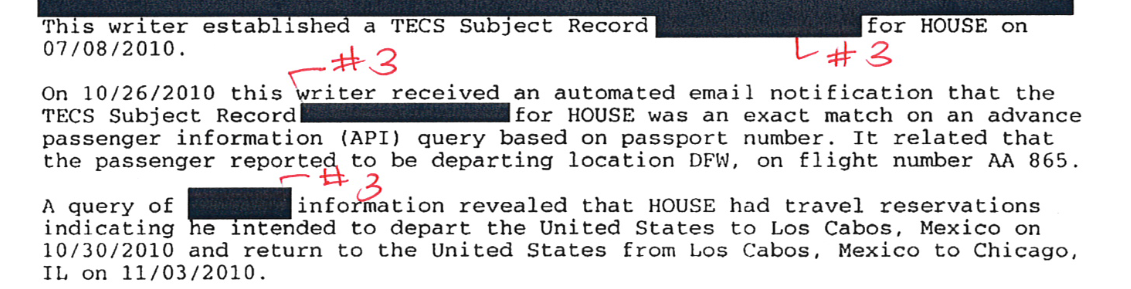
Vanishing from these multiple databases is any form of targeting. The DHS plans to pipe its LPR collection to DEA and other law enforcement agencies as a live feed, allowing agencies on the receiving end to browse the collection at will and/or add it to databases they control.
“CBP intends to provide DEA access to CBP LPR information… through a real-time streaming service.” Each agency will have a complete copy of the data collected by the other, so that they can merge and mine it and use it for “pre-crime” profiling.
The Impact Assessment notes privacy will, yes, be "impacted," but that's the way it goes. Many, many US citizens who have never crossed the border will have their license plate/location data added to multiple law enforcement databases. But what option does the DHS have? Not policing the "border?" Not helping the DEA out with the Drug War? From the PIA [PDF]:
Privacy Risk: There is a risk to individual participation in that individuals do not have an opportunity to consent to CBP’s retention and use of their license plate data.
Mitigation: This risk is not mitigated given the purpose of the collection. Many areas of both public and private property have signage that alerts individuals that the area is under surveillance; however, this signage does not consistently include a description of how and with whom such data may be shared. Moreover, the only way to opt out of such surveillance is to avoid the impacted area, which may pose significant hardships and be generally unrealistic.
As Papers, Please! notes, this PIA is a nice addition to the DHS's collection, but it's supposed to be released prior to roll out and the public is supposed to be notified via the Federal Register about additional collections of personally-identifiable info by government agencies. None of this has happened in a timely manner, making these collections illegal until the assessments are in place and notices properly published. The DHS -- along with its component agencies -- routinely ignore statutory requirements but, to date, not a single agency official has been punished for disobeying the law.
As for US citizens, they can expect this Kudzu-like growth of surveillance to continue, especially around airports or borders, even as the country remains only minimally threatened by terrorist activity or illegal entry into the country.
Permalink | Comments | Email This Story
No Surprises There: That Bootleg Moe's Tavern In Argentina Opened Under Another Name Thanks To Copyright Claims
 Remember that Moe's Tavern that was being built near Buenos Aires, Argentina? Well it's now open under under the name 'Ribbon' (I would have gone with Woe's Tavern), and is void of any direct references to the Simpsons, thanks to copyright claims by the Fox Broadcasting Company. As far as I can tell, the interior and exterior will still resemble Homer's favorite watering hole, it just won't have any Simpsons pictures or themed memorabilia (picture of the bar area before the change, after the jump). Wonderful, so now our only option for the Moe's Tavern experience are the ones at Universal Studios, complete with crying children and $11 beers. "Greaaaaat, $66 just to get drunk." You can say that again, Homer. "Wait -- where's Maggie?!" Relax -- she can't be far, she did drive us here.
Keep going for a shot of the interior bar area before lawyers got involved.
Remember that Moe's Tavern that was being built near Buenos Aires, Argentina? Well it's now open under under the name 'Ribbon' (I would have gone with Woe's Tavern), and is void of any direct references to the Simpsons, thanks to copyright claims by the Fox Broadcasting Company. As far as I can tell, the interior and exterior will still resemble Homer's favorite watering hole, it just won't have any Simpsons pictures or themed memorabilia (picture of the bar area before the change, after the jump). Wonderful, so now our only option for the Moe's Tavern experience are the ones at Universal Studios, complete with crying children and $11 beers. "Greaaaaat, $66 just to get drunk." You can say that again, Homer. "Wait -- where's Maggie?!" Relax -- she can't be far, she did drive us here.
Keep going for a shot of the interior bar area before lawyers got involved. Thanks to Matias, who agrees now we'll just have to meet up and drink beer in the parking lot of our old high school.
Hopefully For The Last Time: The US Has Zero New Works Enter The Public Domain On January 1st
For many years now, during the first week of January, we write a post about Public Domain Day. That's the day -- January 1st -- where works that have reached the statutory limit reach the public domain. The Public Domain Review has an excellent collection of the Class of 2018 -- showing what works entered the public domain this week in the "life plus 50" copyright countries (Canada, New Zealand, and many countries in Asia and Africa) and the "life plus 70" copyright countries (most of the EU, Brazil, Israel, Russia, Turkey, Nigeria). For life plus 70 countries, the works of Aleister Crowley and Winston Churchill are now in the public domain. For the life plus 50 countries, Rene Magritte's paintings, the song compositions of Woody Guthrie and Otis Redding, and the writings of Jean Toomer are now in the public domain -- among many others.
Except, as we note each and every year, there is no such "graduating class" in the US. Because, thanks to Disney's heavy lobbying, copyright keeps getting extended and extended and extended. If you're interested, the Center for the Study of the Public Domain at Duke University has also put together its depressing annual "What Could Have Entered the Public Domain..." list for the US, if the law had remained as it was prior to 1978, when the maximum length of copyright was 56 years. Under that setup, Josepher Heller's Catch-22, Salinger's Franny & Zooey and Robert Heinlein's Stranger in a Strange Land all would have entered the public domain. Grok that. Movies including Breakfast at Tiffany's, West Side Story, and The Guns of Navarone all would have entered the public domain as well. And, of course, a ton of music:
What 1961 music could you have used without fear of a lawsuit? If you wanted to find guitar tabs or sheet music and freely use some of the influential music from 1961, January 1 2018 would have been a rocking day for you under earlier copyright laws. Patsy Cline’s classic Crazy (Willie Nelson) would be available. So would Stand By Me (Ben E. King, Jerry Leiber, Mike Stoller), Runaway (Del Shannon, Max Crook), and Let’s Twist Again (Kal Mann, Dave Appell). You could publicly perform or set short films to Surfin' (Brian Wilson, Mike Love) or Crying (Roy Orbison, Joe Melson), all without permission or fee. Today these musical works remain copyrighted until 2057
There's much more as well. As the Center notes in a companion post, this should be seen as highly problematic. Locking up our culture like this does no one any good -- except for a very, very, very, very small number of copyright holders on the few works that are still economically viable. Even worse, because things are locked up for so long, so much of our culture becomes orphan works -- which tend to disappear entirely, as no one can even figure out who holds the copyright in question, should they even want to make use of it. And, without the public domain, we lose access to potentially wonderful aspects of culture:
What happens when works enter the public domain? Sometimes, wonderful things. The 1947 film It’s A Wonderful Life entered the public domain in 1975 because its copyright was not properly renewed after the first 28-year term. The film had been a flop on release, but thanks to its public domain status, it became a holiday classic. Why? Because TV networks were free to show it over and over again during the holidays, making the film immensely popular. But then copyright law reentered the picture…. In 1993, the film’s original copyright holder, capitalizing on a recent Supreme Court case, reasserted copyright based on its ownership of the film’s musical score and the short story on which the film was based (the film itself is still in the public domain). Ironically, a film that only became a success because of its public domain status was pulled back into copyright.
The one bit of good news, hopefully on the horizon is that this should be the last year that nothing enters the public domain on Public Domain Day. While Disney and other big copyright holders have been able to continually push out the eventual entrance of new works into the public domain in the US, if nothing changes, next January we will finally have works published in 1923 enter the public domain in the US. There had been rumblings about another attempt at copyright term extension in the US a few years back, but it's been much quieter in the past few years, as I think even the lobbying powerhouses in the music and movie industries have realized this isn't a fight they could win, or one really worth having. That doesn't mean someone won't try to extend the term again, but I hope most people now recognize what a bad idea it would be.
Of course, it's still ridiculous that it's only now that those works from the 1920s are entering the public domain -- while other countries are at least getting works from the 1940s or 1960s. Rather than worrying about copyright term extension, it seems we should really be exploring ways to bring copyright term back down to a much more reasonable time frame.
Permalink | Comments | Email This Story
Facebook Allowing Israeli Security Forces To Shape The News Palestineans See
Facebook continues to increase its stranglehold on news delivery, reducing pipelines of info to a nonsensically-sorted stream for its billions of users. Despite the responsibility it bears to its users to keep this pipeline free of interference, Facebook is ingratiating itself with local governments by acting as a censor on their behalf.
While Facebook has fought back against government overreach in the United States, it seems less willing to do so in other countries. The reporting tools it provides to users are abused by governments to stifle critics and control narratives. And that's on top of the direct line it opens to certain governments, which are used to expedite censorship. That's what's happening in Israel, as Glenn Greenwald reports:
[I]sraeli officials have been publicly boasting about how obedient Facebook is when it comes to Israeli censorship orders:
Shortly after news broke earlier this month of the agreement between the Israeli government and Facebook, Israeli Justice Minister Ayelet Shaked said Tel Aviv had submitted 158 requests to the social media giant over the previous four months asking it to remove content it deemed “incitement.” She said Facebook had granted 95 percent of the requests.
She’s right. The submission to Israeli dictates is hard to overstate: As the New York Times put it in December of last year, “Israeli security agencies monitor Facebook and send the company posts they consider incitement. Facebook has responded by removing most of them.”
This is especially troubling given the context of the Palestinian-Israeli relationship. By favoring Israel's view of "incitement," Facebook is censoring news streams read by Palestinians, giving them a government-approved view of current events. While Facebook is apparently reluctant to take down pro-Israeli calls for violence, it's been moving quickly to delete almost everything Israeli security forces deem "incitement." The info Palestinians see -- filtered through Facebook -- provides a mostly one-sided depiction of ongoing unrest.
What makes this censorship particularly consequential is that “96 percent of Palestinians said their primary use of Facebook was for following news.” That means that Israeli officials have virtually unfettered control over a key communications forum of Palestinians.
This isn't just a "war-torn Middle East" problem. It's everyone's problem. As Greenwald points out, the company -- which was willing to fight for the rights of US citizens -- seems far less willing to do so when the government's target is a foreigner.
Facebook now seems to be explicitly admitting that it also intends to follow the censorship orders of the U.S. government. Earlier this week, the company deleted the Facebook and Instagram accounts of Ramzan Kadyrov, the repressive, brutal, and authoritarian leader of the Chechen Republic, who had a combined 4 million followers on those accounts. To put it mildly, Kadyrov — who is given free rein to rule the province in exchange for ultimate loyalty to Moscow — is the opposite of a sympathetic figure: He has been credibly accused of a wide range of horrific human rights violations, from the imprisonment and torture of LGBTs to the kidnapping and killing of dissidents.
But none of that dilutes how disturbing and dangerous Facebook’s rationale for its deletion of his accounts is. A Facebook spokesperson told the New York Times that the company deleted these accounts not because Kadyrov is a mass murderer and tyrant, but that “Mr. Kadyrov’s accounts were deactivated because he had just been added to a United States sanctions list and that the company was legally obligated to act.”
That's all it takes: being placed on a list by a government. It's not that Facebook should become a platform for evil people to spread their message, but that it should take more than a government saying it doesn't like someone for Facebook to start deleting accounts. On top of that, Facebook is handling this in classic Facebook moderation mode:
Others who are on the same sanctions list, such as Venezuelan President Nicolas Maduro, remain active on both Facebook and Instagram.
Sanctions list members should be punished by governments, not private companies. If the US government wants to claim an Instagram account equates to a sanction violation, it's welcome to make that argument in court. The problem with Facebook is its actions are consistently inconsistent. It points to a sanction list it's not even following. It battles overbroad warrants in court, fighting back against baseless intrusions by the government, but grants the government enough credibility to disappear anyone nominated for sanctions by the administration,
Around the world, it continues to treat some governments as more equal than others, and it stills seems to prefer access to users to protecting users, especially in countries where censorious actions are the norm. Facebook wants to be all things to all people, but mainly it just wants all people. Sacrificing a few ethical standards is the most expedient choice. While Facebook is welcome to inconsistently apply its moderation standards on its own, it's extremely troubling it's willing to do the same on behalf of world governments. While both may look like censorship, only the latter actually is. And in the long run, it will be the latter that does the most permanent damage.
Permalink | Comments | Email This Story
FCC Announces National Roll Out Of Amber Alerts But For Cops
BrindleSo when are we getting an alert for nearby cops ready to shoot up your house with military grade equipment?
The FCC has done away with Net Neutrality. In its place, we get videos of Ajit Pai mocking his opponents, served up in a melange of mishandled memes. We also, apparently, get this: a future where our lives are interrupted by push notifications that treat grown-ass police officers like kidnapped children. (h/t That Anonymous Coward)
The Federal Communications Commission today added a new alert option—called a “Blue Alert”—to the nation’s emergency alerting systems. Blue Alerts can be used by state and local authorities to notify the public of threats to law enforcement and to help apprehend dangerous suspects.
Blue Alerts warn the public when there is actionable information related to a law enforcement officer who is missing, seriously injured or killed in the line of duty, or when there is an imminent credible threat to an officer. A Blue Alert could quickly warn you if a violent suspect may be in your community, along with providing instructions on what to do if you spot the suspect and how to stay safe.
Warning people about violent suspects in their area is somewhat useful -- a severe weather alert but for crime. But there's no reason for a system like this to prioritize crimes against police officers. Adding mere threats to the mix just adds a bunch of junk info of nearly no use to the citizens on the receiving end of these alerts. At best, people will clear them from their screen as quickly as they do interloping Amber Alerts. At worst, they'll decide to play Batman and put themselves and officers at risk by attempting to Do Something.
This is being rolled out nationally, following two years of prep that commenced after the passage of the Rafael Ramos and Wenjian Liu National Blue Alert Act, named after two NYPD officers who died in an ambush attack. It's a DOJ initiative, but one that requires the assistance of the FCC to utilize the national Emergency Alert System. The FCC is also there to nudge wireless providers towards compliance with "voluntary" guidelines for pushing these alerts to cell phone users.
At this point, 28 states have already implemented some form of "Blue Alert" system. The national roll out will encompass the remaining states and US territories. That's what the FCC is announcing: the use of two alert networks to tell people cops are in danger.
Today's Order provides a 12-month implementation period for Blue Alerts to be delivered over the Emergency Alert System and 18 months for delivery over the Wireless Emergency Alert system.
This bill should never have been made law. There's nothing out there that suggests distributing this information outside of law enforcement networks will have any net safety benefit for the public. Taking it nationwide only adds to "Alert" market saturation. Cops have strong support systems and plenty of firepower on their side, unlike missing seniors (Silver Alert) or kidnapped children (Amber Alert). And, unlike targeted weather alerts, a Blue Alert offers up almost no information usable by the general public. If a suspect is still on the loose, the most beneficial information is only implicit: cops are searching for a suspect who hurt/killed one of theirs. For citizens in the area, the best option is to shelter in place. That way they (and their vehicles) won't be mistaken for suspects' and filled with bullet holes.
In all seriousness, the Blue Alert system only serves one purpose: to elevate law enforcement officers above the people they serve, granting their victimhood a higher status than that granted to their fellow citizens.
Permalink | Comments | Email This Story
New York State Eyes Its Own Net Neutrality Law
Numerous states say they'll be crafting their own net neutrality protections in the wake of the FCC's recent vote to dismantle the rules. ISPs of course predicted this, which is why Comcast and Verizon successfully lobbied the FCC to include provisions in its "Restoring Internet Freedom" order that bans states from protecting consumers from privacy and net neutrality violations, or other bad behavior by incumbent ISPs. In ISP lobbying land, stopping states from writing protectionist law is an assault on "states rights," but when states actually try to help consumers you'll note the concern for states rights magically disappears.
Regardless, New York State, California and Washington have all indicated that they will attempt to test the FCC's state preemption authority on this front in the new year by crafting their own net neutrality legislation. You'll recall that the FCC already had its wrist slapped by the courts for over-reach when it tried to preempt states from passing anti-community broadband laws, quite literally written by large ISPs, intended to hamstring creative solutions (including public/private partnerships) for the telecom industry's broadband competition logjam.
But even if the FCC wins this new legal fight over state authority, folks like New York Assemblymember Patricia Fahy argue there's numerous steps states and cities can take to protect consumers on the net neutrality front without running afoul of the FCC's order. The text of her proposal (pdf) includes numerous proposals, including refusing to do business with companies that repeatedly violate net neutrality:
"If you are going to be a contractor and want to work with New York, then you must meet the principles,” Fahy tells Fast Company. She hopes that this approach will get around a roadblock known as preemption. The Constitution generally gives the federal government final authority over commercial activities that cross state lines. But while New York can’t require ISPs to uphold net neutrality, it can use its “power of the purse” to punish ISPs that don’t.
"There’s a decent amount of precedent for saying, if you want a state contract, you have to meet such and such requirements,” she says, noting construction contracts contingent on certain labor practices or the use of U.S.-made steel."
Again we'll see how this all pans out in the new year. States will likely face the same problem as the federal government did when trying to define net neutrality violations amidst a sea of ISP lobbying influence. Regardless, the FCC's battles with the states will be just one part of a cavalcade of lawsuits filed against the FCC in the new year for over-stepping its authority, ignoring the public, and rushing through what's potentially the least-popular decision in tech-policy history.
This same sequence of events played out earlier this year when the GOP and Trump administration rushed to kill consumer broadband privacy protections, resulting in numerous states attempting to create their own broadband privacy laws. And while Comcast, Verizon and AT&T lobbyists like to whine that states are wreaking havoc by creating discordant, inconsistent consumer protections, they tend to ignore the fact that this wouldn't be happening if they hadn't spent millions of dollars gutting popular, over-arching protections on the federal level.
Permalink | Comments | Email This Story
Nation-State Hacking: 2017 in Review
If 2016 was the year government hacking went mainstream, 2017 is the year government hacking played the Super Bowl halftime show. It's not Fancy Bear and Cozy Bear making headlines. This week, the Trump administration publicly attributed the WannaCry ransomware attack to the Lazarus Group, which allegedly works on behalf of the North Korean government. As a Presidential candidate, Donald Trump famously dismissed allegations that the Russian government broke into email accounts belonging to John Podesta and the Democratic National Committee, saying it could easily have been the work of a "400 lb hacker" or China. The public calling-out of North Korean hacking appears to signal a very different attitude towards attribution.
Lazarus Group may be hot right now, but Russian hacking has continued to make headlines. Shortly after the release of WannaCry, there came another wave of ransomware infections, Petya/NotPetya (or, this author's favorite name for the ransomware, "NyetYa"). Petya was hidden inside of a legitimate update to accounting software made by MeDoc, a Ukrainian company. For this reason and others, Petya was widely attributed to Russian actors and is thought to have primarily targeted Ukrainian companies, where MeDoc is commonly used. The use of ransomware as a wiper, a tool whose purpose is to render the computer unusable rather than to extort money from its owner, appears to be one of this year's big new innovations in the nation-state actors' playbook.
WannaCry and Petya both owe their effectiveness to a Microsoft Windows security vulnerability that had been found by the NSA and code named EternalBlue, which was stolen and released by a group calling themselves the Shadow Brokers. US agencies losing control of their hacking tools has been a recurring theme in 2017. First companies, hospitals, and government agencies find themselves targeted by re-purposed NSA exploits that we all rushed to patch, then Wikileaks published Vault 7, a collection of CIA hacking tools that had been leaked to them, following it up with the publication of source code for tools in Vault 8.
This year also saw developments from perennial bad actor Ethiopia. In December, Citizen Lab published a report documenting the Ethiopian government's ongoing efforts to spy on journalists and dissidents, this time with the help of software provided by Cyberbit, an Israeli company. The report also tracked Cyberbit as their salespeople demonstrated their surveillance product to governments including France, Vietnam, Kazakhstan, Rwanda, Serbia, and Nigeria. Other perennial bad actors also made a splash this year, including Vietnam, whose government was linked to Ocean Lotus, or APT 32 in a report from FireEye. The earliest known samples from this actor were found by EFF in 2014, when they were used to target our activists and researchers.
This article is part of our Year In Review series. Read other articles about the fight for digital rights in 2017.
LIKE WHAT YOU'RE READING? SUPPORT DIGITAL FREEDOM DEFENSE TODAY!
Intelligence Community Apparently Wants More Snowdens, Continues Ouster Of Official Whistleblower Channel
The Intelligence Community -- sixteen government agencies engaged in intelligence work under the ODNI's direction -- doesn't have much in the way of effective oversight. It's also not fond of whistleblowers, despite several legislative efforts to force the IC to play nice with those who report wrongdoing. Because of this, it's been repeatedly rocked by leaks. That's the sort of thing that happens when someone clamps down on the official whistleblowing routes: the pressure has to escape somewhere.
Things will get worse in the IC, especially for whistleblowers, before it gets any better… or if it gets any better. A few months ago, the IC began ousting its in-house oversight. Dan Meyers, the Inspector General for the IC, is slowly and steadily being stripped of his power. Not only is Meyers barred from communicating with whistleblowers, but he's forbidden from briefing Congress or IC agencies about his office's tasks. He's also been stripped of his staff.
Things have gone from bad to worse, Jenna McLaughlin reports:
The chairman of the the U.S. Senate Judiciary Committee is demanding to know why an employee in charge of whistleblower outreach was removed from his workplace “pending a tribunal.”
“I just learned that Dan Meyer, the Executive Director of Intelligence Community Whistleblowing and Source Protection, was placed on administrative leave and escorted out of his offices pending a tribunal before senior executives to consider his proposed termination,” wrote Sen. Chuck Grassley, a Republican from Iowa, in a letter sent November 29 to Director of National Intelligence Dan Coats and Wayne Stone, the acting director of Office of the Inspector General of the Intelligence Community.
No one's saying why Meyer is being booted from the IG's office, but it appears to be related to the Trump administration's war on leakers. There's no room in the current administration for whistleblowing, and that's going to be a problem going forward. Removing lifeboats won't prevent a ship from being sunk.
Some inside the intelligence community remain concerned that sidelining Meyer, who helps employees field complaints legally, could inadvertently lead to the next major leaker, like former NSA contractor Edward Snowden.
Meyer is out as Inspector General and no replacement has been picked to head the IC's internal oversight. Senator Grassley, who's generally been good on whistleblower issues, seems to feel Meyer's ouster is retaliatory -- that his office is viewed as a threat to the government for encouraging whistleblowers to come forward with evidence of misconduct or malfeasance.
Grassley argued it is important that Meyer be protected from retaliation for managing his whistleblower protection program, and demanded any records and documents relating to his case.
“For the agency to take such a drastic personnel action while there is no confirmed, permanent Inspector General in place irreparably undermines the independence of that office,” he wrote.
The lack of a successor is concerning. It shows the agencies involved in the ouster aren't interested in any form of oversight, much less honoring laws protecting whistleblowers. IC employees with concerns will have no official outlet to bring their complaints and concerns to. This leaves only unofficial routes, which certainly can't be the administration's intention. Agencies with the power to violate rights en masse via unauthorized or misused surveillance can't be left to sort out their own internal issues.
Permalink | Comments | Email This Story
FBI Celebrates Taking Down A 'Terrorist' Who Told Undercover Agents He Couldn't Go Through With An Attack
The FBI has proudly announced its kicking of another goal into the unguarded War on Terrorism net. And the press rejoices:
The enthusiastic republishing of the FBI's narrative does little more than rewrite the DOJ's press release. Very few have dug into the charging documents. If they had, they might not have depicted a terrorist attack that was never going to happen as somehow being "thwarted" by the arrest of a 26-year-old man reeling from the recent loss of his children in a custody battle.
According to the criminal complaint [PDF], Everitt Jameson was planning to detonate explosives at Pier 39 in San Francisco, a popular destination for tourists. The lead-up to Jameson's arrest (and supposed "thwarting") was filled with FBI informants and undercover agents, but not a single actual member of a terrorist group.
The investigation began with a paid informant passing on Jameson's Facebook activity to the FBI.
On September 19, 2017, a credible FBI Confidential Human Source (CHS) who has accurately reported to the FBI on national security matters in the past, reported a suspicious Facebook account. The Facebook persona was Everitt Aaron Jameson, vanity everittj. The Facebook id # was hidden. The CHS reported Jameson was "Liking" and "Loving" posts that were pro-ISIS and pro-terrorism. To provide an example of the types of posts Jameson was "Liking" and "Loving" during this time period, the CHS reported to the FBI that Jameson "loved" a post on November 29, 2017 that is an image of Santa Claus standing in New York with a box of dynamite. The text of the post reads, "ISIS post image of Santa with dynamite threatening attack on New York." The Propaganda poster shows Santa Claus standing on a roof next to a box of dynamite looking out over a crowd of shoppers with the words "We meet at Christmas in New York… soon." Under this post, Jameson selected the "Like" option and then selected the "Heart" option to signify that he "Loved" the post.
As we've noted before, "liking" social media posts is not the same thing as endorsing the content. Jameson may have liked the sentiments expressed, but it doesn't immediately follow he would be willing to engage in violent acts of terrorism. That's not what the FBI thought, though. Rather than monitor the account and open a preliminary investigation, the FBI decided to get involved. Undercover agents began communicating with Jameson pretending to be ISIS members. Over the next couple of months, agents frequently exchanged messages and met with Jameson, nudging him towards committing an act of terrorism.
Jameson pledged his limited utility to the cause, fulfilling the expected "material support" charges by offering use of his tow truck and his (very brief) background as a US Marine. (Jameson was discharged shortly after basic training for failing to disclose his asthma.) He also said he could kick in about $400 a month.
Jameson did state he was considering something along the lines of the San Bernardino shootings or the New York attack in which a vehicle was driven into a crowd. But the FBI was more interested in getting Jameson to build bombs. Jameson was compliant, but seemingly unable to actually acquire the supplies to build them.
UCE2 asked Jameson what assistance the UCE2 could provide. Jameson stated that he needed ammunition, powder, tubing, and nails. When asked what kind of a weapon he would need, Jameson noted that he would prefer an assault rifle. He also explained that he was trained in both the M-16 and an AK-47 rifle. Jameson also stated that he needed timers and remote detonators (presumably for the explosive charges Jameson previously described to the UCE2). Jameson said that he could get the PVC pipe, nails, and powder (presumably, black powder used for commercial explosives and ammunition).
That conversation happened on December 16th. On December 18th, no further preparation for the attack had been done by Jameson. The undercover agent tried to arrange another meeting about the attack plans, but was rebuffed by Jameson.
Later during the evening, the UCE2 contacted Jameson to discuss arranging a follow-up meeting. Jameson responded by indicating that he had been "very busy tonight." Moreover, Jameson told the UCE2, "I also don't think I can do this after all. I've reconsidered." The UCE2 stated, "We only can do Allahs will," and Jameson replied "In Sha Allah one day I can. But I can't."
Rather than keep tabs on the little terrorist that couldn't, the FBI decided to call in its markers. It acquired a search warrant for Jameson's residence one day later. The search uncovered some handguns, a rifle, 13 rounds of ammunition, and four fireworks. The feds also found his handwritten note pledging allegiance to ISIS and Jameson's will, signed and executed on November 11th.
As far as the complaint states, Jameson was never in contact with any suspected ISIS members. All discussions about a terrorist attack involved at least one FBI undercover agent. Jameson himself took himself out of play by stating he couldn't go through with the planned attack. This statement was made before supplies were gathered or a storage area obtained to assemble and store the bombs. The "terrorist" who "thwarted" his own attack sounds very much like a person looking for some sort of direction in his life after a traumatic divorce and chose exactly the wrong sort of people to identify with. That his closest contacts during this period were FBI agents interested in securing a terrorism bust does little to further the narrative of ticking terrorist time bomb disarmed at the last minute by heroic G-men.
One wonders how many discussions about attacking America Jameson would have engaged in if simply left alone. Or if he would have come up with plans to blow up part of San Francisco if he hadn't found supposedly like-minded ISIS supporters to talk to. It's impossible to say Jameson never would have engaged in violence, but the criminal complaint shows Jameson did nothing more than click Facebook buttons before the FBI got involved. And for that, he's probably going to go to prison for a long time. It seems Jameson would have benefited from a few more positive role models. But steering confused and depressed people away from sympathizing with ISIS doesn't make headlines. And it certainly doesn't help keep the lights on at the FBI.
Permalink | Comments | Email This Story
Predictive Text Algorithm Writes A New Harry Potter Chapter
 This is 'The Handsome One' a new Harry Potter chapter written by a predictive text artificial intelligence program after analyzing the seven original books. The highlights while I go wave my own magic wand at a bathroom urinal:
Within roughly three full pages of the new book titled Harry Potter and the Portrait of What Looked Like a Large Pile of Ash, Ron begins eating Hermione's family, two Death Eaters kiss, Harry blinds himself, Hermione sticks a Death Eater's face in mud, and Harry falls down a staircase for several months.Well that got out of hand pretty quick. "Still a better love story than Twilight." I don't know why everybody gives Twilight such a hard time, I liked it. FULL DISCLOSURE: I've never read the books though, I only bought the movies. "BOUGHT?!" They're not that bad! Keep going to read the pages.


 Thanks to Lynsey P and Ash, who agree they need to turn this AI program onto some Jurassic Park erotic fan fiction.
Apple Bullies Pharmacy Over Trademark Because All The Apples Are Belong To Them
For roughly as long as Apple went through business-puberty and grew up into a big-boy company, it has held the somewhat strange belief that only it is allowed to use anything resembling an image of an apple as part of any kind of corporate branding. This has resulted in all kinds of bullying episodes and disputes over the logos of other companies that have little to no resemblance to Apple's iconic logo and typically involve companies that don't remotely compete with it either.
But if Apple was hoping for some kind of chilling effect to be the result of these bullying efforts, it's only logical that this chilling effect would need to be renewed now and again. Fortunately, some silly pharmacy called Red Apple Interactive Pharmacy had the audacity to file a trademark application for the following logo.

Does that look like Apple's iconic logo?

No, it does not. Does the pharmacy compete with Apple in any way related to anything in trademark law? No, it does not. Did any of that stop Apple from opposing the trademark application of Red Apple Interactive Pharmacy. No, it most certainly did not.
Apple filed its opposition yesterday, December 18, claiming that the applied-for mark would cause a likelihood of confusion and dilution by blurring.
The document filed by Apple cited the company’s apple logo, the mark ‘Apple’ and the mark ‘Apple Watch’ as some of the registrations used to oppose the applied-for mark.
The Apple logo covers classes 9 (computer hardware and programs); 25 (analysis and consultation in the field of business information management); 29 (data storage services); and 41 (education and training services).
This is bullying in its purest form. There is not a shred of potential or real customer confusion about which to worry in this case. The logos aren't similar enough to cause concern, the companies are not competing, and even the most moronic hurried person is not walking going to try to buy prescription drugs thinking its from the same company that made their iPhone.
One would think there were better efforts on which to spend Apple's valuable time beyond these frivolous, bullying efforts.
Permalink | Comments | Email This Story
Facebook's Collection And Use Of Data From Third-Party Sources Is 'Abusive', Says Germany's Competition Authority
As Techdirt has reported previously, Facebook is having various problems in the European Union because of the region's privacy laws. It turns out that data protection is not the only area where it is coming under scrutiny. Germany's competition authority, the Bundeskartellamt, has just made a preliminary assessment that Facebook's data collection is "abusive":
the authority assumes that Facebook is dominant on the German market for social networks. The authority holds the view that Facebook is abusing this dominant position by making the use of its social network conditional on its being allowed to limitlessly amass every kind of data generated by using third-party websites and merge it with the user's Facebook account. These third-party sites include firstly services owned by Facebook such as WhatsApp or Instagram, and secondly websites and apps of other operators with embedded Facebook APIs.
This is not about privacy, then, but about Facebook's alleged abuse of its dominant position in the German market. The German competition authority is not worried about Facebook's use of personal data gathered directly on its own sites -- not yet, at least -- but the way in which data is transmitted back to Facebook from third-party sites, as a detailed background document (pdf) explains :
The current proceeding examines the terms and conditions Facebook is enforcing with regard to data from third party sources. These are on the one hand data generated by the use of services owned by Facebook, such as WhatsApp or Instagram, and on the other data generated by the use of third party websites and apps. If a third-party website has embedded Facebook products such as the 'like' button or a 'Facebook login' option or analytical services such as 'Facebook Analytics', data will be transmitted to Facebook via APIs the moment the user calls up that third party's website for the first time. These data can be merged with data from the user's Facebook account, even if the user has blocked web tracking in his browser or device settings. In the authority's preliminary assessment, Facebook's terms and conditions in this regard are neither justified under data protection principles nor are they appropriate under competition law standards
The detailed analysis from the German competition authority makes an interesting point about the nature of Facebook's business model, and the fact that its users have no choice about accepting its terms and conditions:
Facebook offers its service for free. Its users therefore do not suffer a direct financial loss from the fact that Facebook uses exploitative business terms. The damage for the users lies in a loss of control: they are no longer able to control how their personal data are used. Facebook's users are oblivious as to which data from which sources are being merged to develop a detailed profile of them and their online activities. On account of the merging of the data, individual data gain a significance the user cannot foresee. Because of Facebook's market power users have no option to avoid the merging of their data, either. Facebook's merging of the data thus also constitutes a violation of the users' constitutionally protected right to informational self-determination.
The competition authority's finding is preliminary: Facebook now has the opportunity "to comment on the allegations and provide justification for its conduct or offer possible solutions." The company has already responded with a blog post by Yvonne Cunnane, Head of Data Protection, Facebook Ireland, in which she writes:
Although Facebook is popular in Germany, we are not dominant. We're just one part of how people interact, and we must constantly innovate to ensure we're meeting people’s expectations -- from designing new features to improving reliability to giving people better controls over their experience on Facebook. If we fail, people will go elsewhere -- as history has shown with other technology services over the years.
This is a crucially important battle for Facebook. If the German competition authority issues a final ruling next year that Facebook is abusing its dominant position through its use of data from third parties, it could order the US company to cease aggregating data in this way. That would be a major blow to Facebook's current business model, in Europe at least, since it is likely that other competition authorities there would take the same line. Facebook derives much of its power as an advertising medium from the vast quantities of data gathered from all around the Web that it collects and uses for profiling.
As if Facebook did not have enough problems in the EU, France's data protection agency has just ordered WhatsApp to stop sharing user data with its parent company, or face fines. Although these would be small under current legislation, once the EU's new General Data Protection Regulation comes into force next year, they could be up to 4% of Facebook's global turnover.
Follow me @glynmoody on Twitter or identi.ca, and +glynmoody on Google+
Permalink | Comments | Email This Story
New net neutrality legislation would ban blocking and throttling of data

Last week the FCC voted to kill net neutrality regulations, which has prompted a huge backlash among Americans and some legislators in Washington DC. Republican Representative Marsha Blackburn from Tennessee has now introduced legislation that will ban ISPs from blocking or throttling specific content.
The new legislation doesn’t address other concerns that net neutrality did address, like fast lanes for certain content. ISPs would be required to disclose the terms of their service to customers and would finally put a federal law in place that isn’t subject to the whims of one FCC commissioner to another.
“An open internet and preserving that open internet is what people want to see happen. Let’s preserve it. Let’s nail it down. Let’s stop the ping-ponging from one FCC commission to another. This is something where the Congress should act.”
Representative Blackburn isn’t the only lawmaker to call for legislation, either. Senator John Thune has also publicly called for legislation that would make the rules of net neutrality more clear and less subject to regulatory capture by taking the decision out of the hands of the FCC.
Study Of Las Vegas PD Body Cameras Shows Reductions In Complaints, Use Of Force
We're nowhere closer to reaching a Unified Theory of Police Body Cameras, but at least we're still compiling data. So far, there's no definitive proof body cameras reduce police misconduct, but there's at least some evidence they're better than nothing at all.
Early adopters showed a surprising amount of reduction in use of force by officers. A 2012 study in Rialto, California showed a 67% drop in force usage by officers wearing cameras. Since then, results have been all over the map. The largest study conducted to date -- covering the Washington DC PD's rollout of its body camera pilot program -- suggested cameras weren't reducing force usage or lowering the number of citizen complaints. A second study of the same group seemed to indicate the problem wasn't that cameras had no deterrent effect, but that officers were still very selective about camera activation -- hence the lack of improvement.
Another study has been released -- this one compiled by UNLV and the Center for Naval Analyses. It shows mainly positive results from the Las Vegas PD's body camera program. (via Grits for Breakfast)
Among those wearing cameras, the study showed a 37 percent reduction in the number of officers involved in at least one use-of-force incident and a 30 percent reduction in the number of officers with at least one complaint filed against them.
The study estimated the cameras could save Metro $4 million a year as the result of fewer complaints and the quicker resolution of complaints.
Not only were complaints reduced, but officers with cameras did more policework.
Officers wearing the cameras issued 6.8 percent more citations and made 5.2 percent more arrests than officers without cameras, the study found.
Contrary to officers' fears cameras would be used by supervisors to play misconduct "gotcha," the cameras were instrumental in clearing officers of misconduct allegations far more frequently. From the report [PDF]:
Officers reported few problems regarding civilian reactions to BWCs, little change in their own behavior while wearing BWCs, and few issues regarding how non-camera-wearing officers reacted to BWCs. On balance, officers mentioned more positives than negatives regarding BWCs, noting their satisfaction with how BWCs protected them when civilians filed complaints and allowed them to introduce their own narratives as they approached a call for service or a potentially serious incident.
According to the study, camera footage has been used to close more than 500 internal investigations, with 462 of those exonerating the officer. The remaining cases resulted in disciplinary actions, including the termination of one officer. While it still seems odd such a high percentage of officers would be cleared, the fact remains officers' fears of managerial gotcha tactics are unfounded.
The addition of body cameras has another positive effect, one that goes straight to the bottom line. With footage available for use in internal investigations, the cameras' initial cost is far outweighed by net savings for taxpayers. From the study summary [PDF]:
When considering the investigator’s modified hourly wage and hours spent investigating a complaint of misconduct, considerable cost savings are realized when BWC video is available. Rather than a combined 91 hours of investigative time costing $6,776 without BWCs, the estimate is slightly over 7 hours of investigative time costing $554, for a difference of over $6,200 per complaint of misconduct.
This initial study should be followed by others if we're going to able to glean any info about the long-term effects of body camera deployment. As officers become used to carrying around a semi-neutral witness to every interaction with the public, there's a chance the tools of accountability will become tools of officer exoneration only. Cameras are in use in dozens of law enforcement agencies, but footage often remains exempt from public disclosure, shielding officers from outside accountability. On top of that, footage seems most likely to go "missing" when officers appear to have engaged in misconduct. Without strict disciplinary measures, the problem with "missing" recordings will only get worse.
Permalink | Comments | Email This Story
Shocker: FOIA Request Shows Yet Another Core Justification For Repealing Net Neutrality Was Bullshit
We've pretty well established by now that the FCC's repeal of net neutrality is being justified by a lot of fluff and nonsense with no factual basis in reality. Like claims that net neutrality killed sector investment, which are easily debunked by SEC filings, earnings reports, and numerous public CEO comments to investors (who, unlike you, they're legally not allowed to lie to). From Ajit Pai's claims that net neutrality emboldens fascists in North Korea and Iran, to his most recent claim that net neutrality fears were overhyped because Twitter still somehow works, blatant bullshit is the foundation of this entire repeal effort.
For years now, one constant bit of bullshit spread by ISPs was the claim that the Obama-era White House somehow "illegally pressured" Tom Wheeler's FCC into passing tougher net neutrality rules. As we noted at the time that claim was nonsensical, since there's no law stopping the White House from expressing its opinion on what policy should be. From Bill Clinton urging then FCC boss Reed Hundt to ban alcohol ads on TV, to George W Bush telling then FCC boss Michael Powell to deregulate media ownership, such behavior is historically perfectly normal.
Again, this fact didn't stop ISPs and their water carriers in Congress and key media outlets from repeatedly trying to claim that Obama engaged in all manner of shifty behavior to force the FCC to create the rules. The Wall Street Journal in 2014, for example, professed that "unusual, secretive efforts inside the White House" caused FCC boss Tom Wheeler to shift his position from weaker, Title I based rules, to tougher Title II based rules. The idea that Obama's White House had undertaken a covert "federal takeover of the internet" quickly became gospel across countless partisan echoverses.
The criticism was enough to drive investigations in both the Senate and by the FCC’s Inspector General. And while nobody from either government body could be bothered to tell the public the outcome of these investigations, Motherboard recently filed several FOIA requests that now show the outcome of these investigations wound up being a giant bupkis:
"After reviewing more than 600,000 emails, the independent office found that there was no collusion between the White House and the FCC: “We found no evidence of secret deals, promises, or threats from anyone outside the Commission, nor any evidence of any other improper use of power to influence the FCC decision-making process."
Which again, was what we suggested back in early 2015. None of the claims that heralded Obama's "illegal takeover of the internet" had the slightest bit of evidence in support of them, noted the FCC Inspector General's report:
"Nothing we found refuted the factual findings in the Senate Staff Report,” the IG wrote (bolding by agency). “More importantly, nothing we found in the complete, unredacted record evidenced any undue influence that would have militated in favor of a more comprehensive investigation."
What the Inspector General found, then, were career public servants doing their job: “Nothing in these, or in any other emails appeared to indicate there was pressure to delay the Order from the December meeting from any source other than concerned FCC staffers,” the report found, adding that there was “no indication” that a draft of the net neutrality regulations had been circulated improperly.
Obama's first FCC boss Julius Genachowski was arguably a wishy washy fence sitter. But his replacement Tom Wheeler wound up actually being the rare type of person capable of changing his mind based on the available evidence. And when the available evidence (and the courts) made it clear that you can't have effective net neutrality rules without classifying ISPs as common carriers until Title II of the Communications Act, that's exactly what Wheeler did. He didn't make an evidence-based decision because of some secret White House cabal, he did it because that was his fucking job. And he's subsequently been punished for it.
Of course the very idea that net neutrality (aka wanting a healthy, competitive internet) is somehow partisan was already bullshit in and of itself. It's a construct built by the telecom industry's lobbying and policy apparatus, perpetuated by numerous ISP-funded groups. The express goal is to divide the public, sow dissent, and stall meaningful reform of a broken, uncompetitive market. If you hadn't noticed, this tactic has proven immeasurably successful.
Permalink | Comments | Email This Story