Adam Victor Brandizzi
Shared posts
 Expanded from
29 Jun 12:47

Ranger Ron's Wilderness survival guide
 Expaded from Oglaf's feed by Oglaf comic's expander.
Adam Victor Brandizzi likes this
28 Jun 11:23
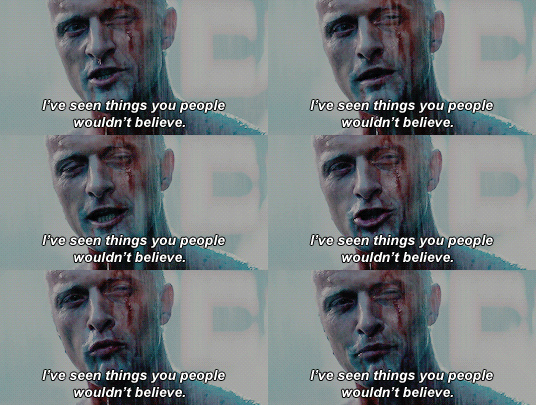
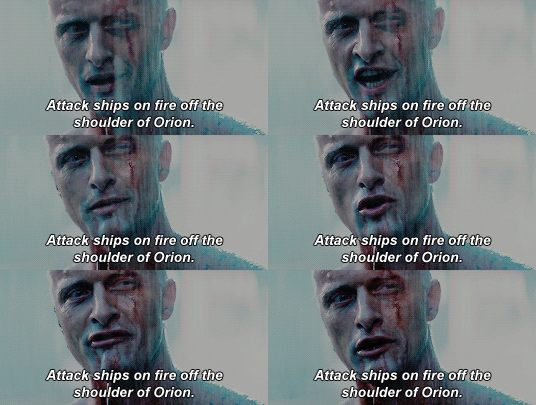
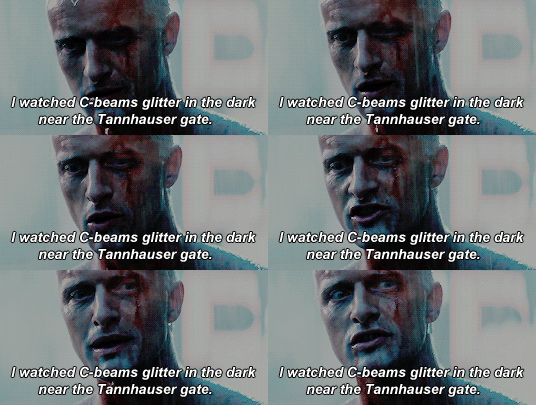
vintagegal: Blade Runner (1982) dir. Ridley Scott
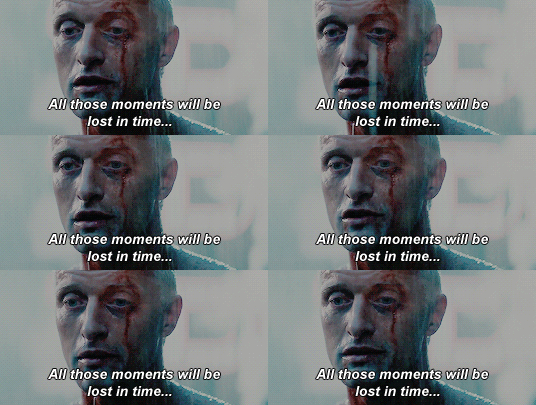
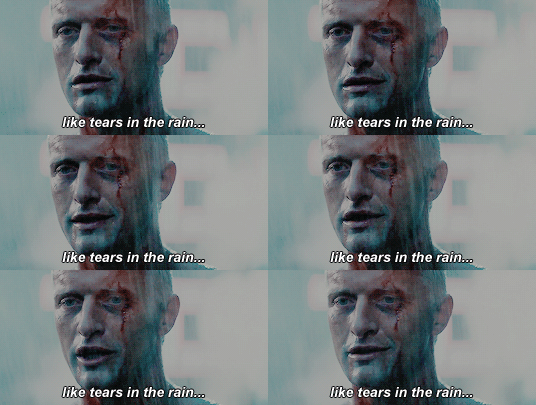
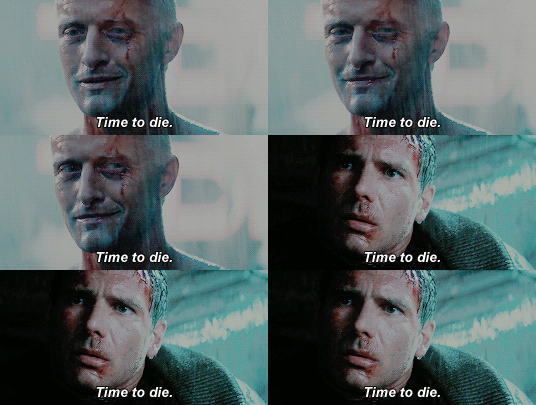


Mbanfi, Markku.lempinen and 5 others like this
27 Jun 17:17

My Elevator Call-Button Moves
My Elevator Call-Button Moves
firehose, Randy Laue and 4 others like this
27 Jun 17:16
Alice in Wonderland
by Omar and Sheila Rayyan
Through the years, Omar has done some paintings inspired by the world of Lewis Carroll's Alice's Adventures in Wonderland. None of these were done for publication. The first two he created (The Caterpillar and Croquet)
were done for a special online exhibition featuring several artist's
interpretation of Alice in Wonderland. The rest were done just for fun,
or by request as commissions from art collectors.
Here they are, in no particular order.
 |
| ...and Burbled as it Came! - watercolor |
 |
| The White Knight - watercolor |
 |
| The Caterpillar - watercolor |
 |
| Croquet - watercolor |
 |
| Now, Dinah, tell me the truth: did you ever eat a bat? - watercolor |
 |
| A Queer-looking Party - watercolor |
 |
| The Mock Turtle - watercolor |
 |
| Interlude with the Gryphon - watercolor |
 |
| In Uffish Thought He Stood - watercolor |
Adam Victor Brandizzi likes this

27 Jun 17:13
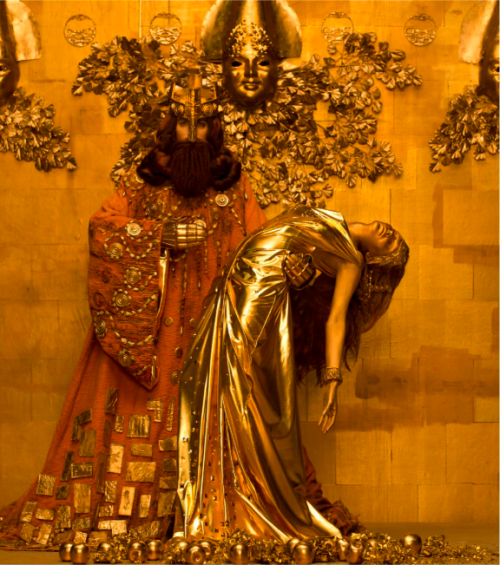
brandizzi: moika-palace: Life Ball 2015 Style Bible. Inspired...


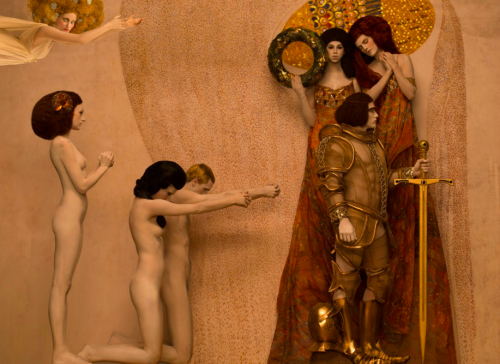
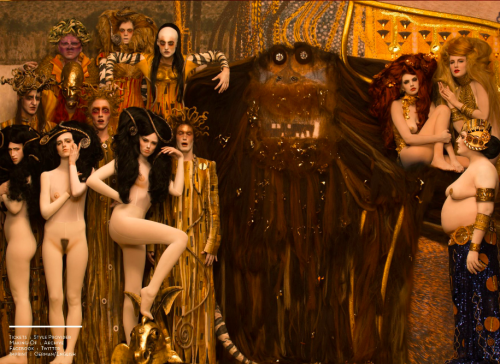
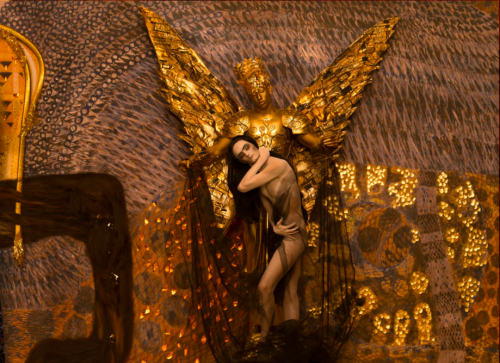
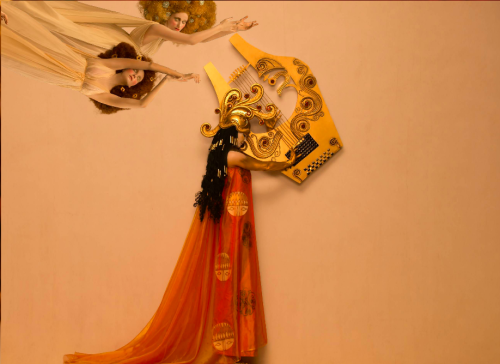

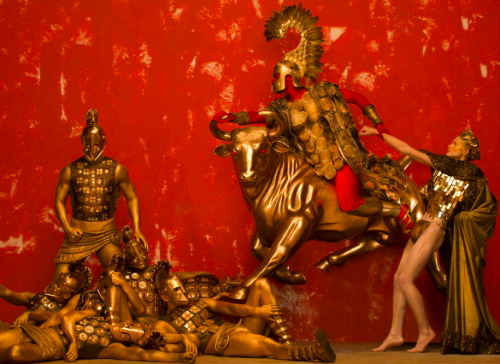
Adam Victor Brandizzi likes this
27 Jun 02:00
Study: Kids can learn as much from ‘Sesame Street’ as from preschool
NEW YORK — Most Americans born since the mid-1960s have a favorite “Sesame Street” skit. Jennifer Kotler Clarke watched hers on a black-and-white television set in her family’s Bronx apartment. There were two aliens: One of them had long arms that didn’t move, while the other had short, moving arms. The aliens wished to eat apples from a tree, and they succeeded, after a couple of minutes, by working together. “Let’s call this cooperation,” one of them says. “No,” the other replies, “let’s call it Shirley.”
Clarke grew up to be the show’s vice president for research and evaluation, and she has long believed that the program’s laughs and lessons stick with children. Now, landmark academic research appears to back her up.
The most authoritative study ever done on the impact of “Sesame Street,” to be released Monday, finds that the famous show on public TV has delivered lasting educational benefits to millions of American children — benefits as powerful as the ones children get from going to preschool.
The paper from the University of Maryland’s Melissa Kearney and Wellesley College’s Phillip Levine finds that the show has left children more likely to stay at the appropriate grade level for their age, an effect that is particularly pronounced among boys, African Americans and children who grow up in disadvantaged areas.
After “Sesame Street” was introduced, children living in places where its broadcast could be more readily received saw a 14 percent drop in their likelihood of being behind in school. Levine and Kearney note in their paper that a wide body of previous research has found that Head Start, the pre-kindergarten program for low-income Americans, delivers a similar benefit.
How to explain the impact of 'Sesame Street' to your kids

The researchers also say those effects probably come from “Sesame Street’s” focus on presenting viewers with an academic curriculum, heavy on reading and math, that would appear to have helped prepare children for school.
While it might seem implausible that a TV show could have such effects, the results build on Nixon-era government studies that found big short-term benefits in watching the show, along with years of focus-group studies by the team of academic researchers who help write “Sesame Street” scripts. Several outside researchers have reviewed the study, and none are known to have questioned its results.
The new findings offer comforting news for parents who put their children in front of public TV every day and/or memorized entire Elmo DVDs, unwittingly.
They also raise a provocative question, at a time when many lawmakers are pushing to expand spending on early-childhood education: Do kids need preschool if a TV show works just as well?
Yes, say the economists — and the “Sesame Street” educational team. Head Start, Kearney and Levine write, was designed to provide more than an academic boost: It delivers family support, medical and dental services, and development of emotional skills that help kids in social settings.
Levine and Kearney see the study as a clear lesson in the value of a (very cheap) mass-media complement to preschool. The potentially controversial implication they embrace from the study isn’t about early-childhood education. It’s about college, and the trend toward low-cost massive open online courses, or MOOCs.
“Sesame Street,” Levine and Kearney write, was the original MOOC. “If we can do this with ‘Sesame Street’ on television, we can potentially do this with all sorts of electronic communications,” Kearney said in an interview. “It’s encouraging because it means we might be able to make real progress in ways that are affordable and scalable.”
In this "Sesame Street" clip, Martial Arts Master takes on Cookie Monster as a student of Biscotti Karate. Can he train Cookie Monster to be The Biscotti Kid? (Sesame Street)
The research can’t say whether the show continues to deliver such high benefits to children, said Diane Whitmore Schanzenbach, an economist at Northwestern University’s School of Education and Social Policy, who has read drafts of the paper and given feedback to the authors.
But, she said, it clearly shows “the importance of childhood education, which is really having its moment right now.”
The economists’ study was brought to you, so to speak, by the letters U, H and F.
“Sesame Street” debuted in 1969 with a diverse cast of humans and brightly colored fuzzy Muppets, including Oscar the Grouch, Bert and Ernie, and, of course, Big Bird. It was the country’s first explicitly educational children’s program, and it was an immediate hit: In the early 1970s, one-third of all American toddlers watched it.
That’s a Super Bowl-level audience share. But it’s even more striking because another third of the nation’s toddlers couldn’t have watched the show if they wanted to — they didn’t have the right antenna to tune in to their local public television station.
This was well before the popularization of cable. TV broadcasts arrived over the air, on two different kinds of signals. The higher-quality signal was known as VHF, or Channels 1 to 13 on a standard TV set. The lower-quality signal was called UHF, and many households at that time were unable to tune it in. By a quirk of federal licensing, the public broadcasting channels in many major cities, including New York and Boston, aired on VHF channels, while others, including Los Angeles and Washington, aired on UHF.
As a result, about two-thirds of the nation’s households were able to watch “Sesame Street.” The other third weren’t.
Levine read about that divide in early 2014. He realized it was the sort of rare natural experiment that economists live for — two groups of people, divvied up by fate and the Federal Communications Commission, who could be compared over time to see whether there was a difference in their educational outcomes.
“It’s econometrically phenomenal,” he said, “because it’s essentially random, who had UHF and who had VHF.”
Levine and Kearney pinpointed which cities had high or low levels of access to the show. Then they used census data to track children from those cities throughout school, to see whether they were staying at grade level. They couldn’t study individual people, or even determine whether people in particular areas watched the show. But they found a large and statistically meaningful effect on the educational progress of children who, because of where they lived, were much more likely to be able to watch. (The effect appears to fade out before high school graduation, they also found.)
“Sesame Street” writers design their shows to have those effects.
From the start, the program rooted its scripts in an academic curriculum designed to help children — particularly low-income urban kids — prepare for school.
At first the writers focused on basics: letters, numbers, cooperation. Over the decades they expanded to incorporate research on what children needed to succeed in the classroom and in life. “We’re constantly changing the show, for good reasons,” said Rosemarie Truglio, the senior vice president of global educational content at Sesame Workshop.
When writers wanted to emphasize science learning, Truglio said in an interview in “Sesame Street” offices just off Central Park in Manhattan, they turned Super Grover into a one-Muppet embodiment of the scientific method.
When they realized that media-soaked children needed more help paying attention and controlling impulses, they decided to make an example out of Cookie Monster — the character who cannot resist sweets.
“As an educator, I was a little worried about that,” Truglio said. “Because he was going to fail, a lot.” Then she realized that was the point: Children needed to see someone struggle with the attention issues they struggle with, and try multiple techniques to overcome them. In one recent skit, modeled on the “Karate Kid” movies, Cookie Monster needs three tries to learn a special move from his sensei, but he finally masters listening with his whole body and, as a reward, he earns a cookie belt.
Which he eats.
“Sesame Street” researchers aggressively test their shows via focus groups to see what works. Their success, they said, rests on a simple formula that wraps education in entertainment, harnessing the power of human narrative. They said the approach could easily extend to college students — to MOOCs — as well as preschoolers.
“Storytelling is critical,” Clarke said. “If you organize information in storytelling, children are more likely to learn it. And adults are, too.”
Like Clarke, Kearney grew up loving “Sesame Street.” (Levine, her co-author, was of school age when the show hit the air.) Kearney remembers running through her house with her sisters, singing a Big Bird song about the alphabet. Her favorite character was the Count — the one who most resembled an economist.
mkvande, Adam Victor Brandizzi likes this

26 Jun 23:10




How to Use a Simple Pocket Notebook to Improve Your Life
Adam Victor BrandizziJa usei muito mas acabei parando devido ao smartphone. Sjnto falta. Tentei até usar os dois, mas nao conzeguia equilíbrio. Essas dicas porém parecem funcionar, vou tentar.

It’s really hard to believe, but I have to say that one of the most—and possibly the most—profound changes I’ve made in my life over the last several years was the simple decision to start carrying a pocket notebook and a pen with me wherever I go. Unless I’ve made a mental miscue when swapping out a finished notebook or something, I do not leave the house without my pocket notebook resting in my hip pocket or my shirt pocket, with a trusty pen right there beside it for jotting notes.
This post originally appeared on The Simple Dollar.
The Benefits of a Pocket Notebook
Why has this been such a profound switch for me? Simply put, it’s helped me in every single aspect of my life.
I don’t forget names or phone numbers or other contact information. Sure, I can put that information into my smartphone, but this ensures that I’ll always be able to do it, even if my smartphone is out of battery life. This also lets me add specific notes about the person right after their contact information so that I know why I jotted it down rather than just tossing a number into my phone without any context.
If I discover a task that I need to do, it’s immediately saved so I don’t forget about it. I don’t have to try to hold it in my head and hope that I remember it later. I just pull out my notebook anywhere and jot it down.
When I have a fleeting idea, I don’t lose it or have to work extra hard to remember it. Sometimes, I’ll have a great idea for an article for The Simple Dollar or hear a great idea on a podcast or on the radio. A note in my pocket notebook enables me to remember it so that I can investigate it further when the time is more convenient.
I don’t get distracted nearly as much by those fleeting ideas, either. When these ideas pop into my head, I either have to try to hold them in my head for a while until I have an opportunity to do something with them, which distracts me from whatever I’m doing, or I have to let them go. A pocket notebook solves this dilemma, as I can just write down that idea immediately and move back to the task at hand without that thought distracting me or without having to lose it.
I’m much better at learning things, both when I plan to or when an opportunity for learning pops up unexpectedly. Through using my pocket notebook for taking notes during classes, lectures, and so forth, I’ve landed upon a very good strategy that really works well for absorbing and processing the new things that I learn. I’ll explain that in detail in a bit, but the pocket notebook was key.
My “brainstorming” is much more effective than ever before. Not only can I brainstorm almost anywhere that I’m at, the results of that brainstorm are already part of a trusted system, so I can pick up the results of that brainstorm at a later date and actually do something with it.
These things—and many others—have contributed greatly to the quality of my personal, professional, and spiritual life.
The Gear
Before I get into the details of how I actually use my pocket notebook, let’s talk about what I use.
What Kind of Pocket Notebook?
Most of the time, I’m carrying a Field Notes pocket notebook. I’ve tried a bunch of different kinds of pocket notebooks and this seems to hit a sweet spot for me for several reasons.
Sometimes a glowing screen can't replace the feel and flexibility of old fashioned pen and… Read more Read more
First, it’s bound with staples rather than a metal spiral. I used to use generic pocket notebooks, which were bound either at the top or sides with a metal spiral. It didn’t take me long to see the problems with that binding, as the metal spiral felt uncomfortable in my pocket and, with much wear, the notebooks kind of fell apart. The metal spiral would often poke me in the leg, the pages would start to fall out, and if I got even a drop of moisture in there, it turned into a disaster. They just didn’t work. The staple binding is essential, as it keeps sharp metal away from my leg and makes the notebook far less bulky.
Second, the paper quality is good. I can write on it clearly and legibly with almost any kind of pen or pencil I can throw at it. There are some differences between editions of Field Notes, but all of them work well with the pens (and sometimes pencils) that I use.
Third, it stands up really well to living in my pocket for a few weeks, no matter what I might be doing. For the most part, Field Notes stand up really well in my pocket. After a day or two, the notebook slightly curves to the contour of my body and you can start to see some cover scuffing shortly thereafter, but the notebooks hold up incredibly well. Even through lots of hiking and all kinds of activity, they don’t fall apart.
Finally, they’re available in a graph paper format. I just prefer jotting down thoughts on graph paper. It’s easier for me to do things like create checkboxes, write horizontally or vertically as needed, and create simple diagrams and pictures as needed.
It doesn’t hurt that I find them very aesthetically pleasing, too.
My only complaint with them is the relative price. Usually, you’ll find a three pack of them—48 pages each—for $9.99 at MSRP. I can sometimes find them a bit cheaper than that. The problem is that I blow through one of these in about a week. I personally find it worth it, but if I could find a less expensive alternative that had the same features, I’d use it. (Most other notebooks that are similar are either the same price or have some sort of significant flaw.)
What about page size? When I first tried pocket notebooks, I was really apprehensive about page size. How would it handle large blocks of notes? I’ve found that this hasnever been an issue. I’ve never ran out of space for anything other than one or two very large drawings, and those were mostly due to starting a drawing without any organization in mind. The additional size of a larger notebook is far more of a drawback than the relative small page size of a pocket notebook.
What Kind of Pen?
I really have three requirements for my pocket pen.
One, it must write with a very high level of reliability on the pocket notebooks that I use. “Dud” pens aren’t acceptable, nor are pens that sometimes choose to write only at a certain angle. These pens need to be faithful and reliable, always writing when I pull one out to jot down a note.
Two, it must not leave excessive ink on the paper. If the pen leaves behind big blots of ink during normal writing, then that ink is going to smudge all over the place and make the things I’ve written become completely illegible. That’s not acceptable.
Three, it must never leak in my pocket. If a pen leaks in my pocket, I’m done with it immediately. If the same type of pen leaks twice, I’m done with that type of pen. This should never happen.
I prefer pens that write with a finer tip, but that’s a personal preference.
In the end, after trying a lot of pens, my preferred pen is the Uniball Signo 207 Ultra Micro. These pens are a home run for each of the above criteria and can be bought in bulk for a reasonable price per pen.
How I Use the Pocket Notebook
My process for actually using my pocket notebook is loosely based on the ideas presented in the book “Getting Things Done” by David Allen. In that book, Allen describes a very robust strategy for keeping track of tasks and pieces of information that one might accumulate. While I do not use Allen’s full system, I do use big parts of it, and my pocket notebook is a key part of that.
Gathering
“Gathering” simply refers to how I actually use my pocket notebook for taking notes and collecting things.
While we might associate note-taking with school, it's something most of us continue doing for … Read more Read more
Everything I might possibly want to think about later is written down in my pocket notebook. If there’s even a chance I might want to reflect on it later, it goes in my pocket notebook. I don’t try to filter in advance—I just put everything in there.
I have no qualms about taking it out almost anywhere; if anyone asks, I tell them that they just told me something important that I want to remember or think about later. I’ve found that, over the years, people actually find this to be a pretty positive thing. People are subtly flattered if you tell them that they just said something important enough to you that you want to write it down to think about it later.
Think about it—what if you were telling someone something and they said, “That’s really interesting! Thanks for telling me! I’m going to jot that down so I can look into it more later!” and then wrote down what you said.
Most things are stored as simple notes, prefaced by a dash. I use a small dash or a dot at the start of each separate note. Most of my collection is just a long series of these notes.
I don’t worry about order or organization within my pocket notebook, as I’ll process all of it later. For the most part, I don’t worry about organizing those ideas at all as I write them down. Most of the material in that book is just a sequence of unrelated notes.
I’ll stick paper scraps right into my notebook with a paper clip—things like receipts and business cards so on. I usually have two paper clips attached to the back cover of the notebook. If I find a piece of paper I want to keep and deal with later, I’ll just stick it into that paper clip.
If I’m going to take longer notes on something, I draw a single line through one of the blank lines as a separator before and after the notes, and I title what the notes are about and where I took them. Let’s say, for example, that I watch a lecture for an online class or that I actually attend an event where there is a speaker. I’ll just make a single line in my notebook, write a title of the class or lecture or book chapter or whatever on the next line, and then start taking notes. When it’s finished, I draw another single line below it. (If I have any stray thoughts during this, I skip a page or two and jot it down, then go back to the notes.)
I keep my pocket notebook in front of me on the desk while I’m working (with a pen beside it). I find that I have a lot of stray ideas while I am working, so having that notebook in the most convenient place possible makes it easy to jot down notes as they come to mind. (Sometimes, I’ll just enter them directly into programs if I already know what to do with them.)
Processing
Processing means that I go through my pocket notebook and figure out what to do with all of the little notes I’ve taken.
I process my pocket notebook a couple times a day (unless I’m on vacation or something). I just sit down at my computer, pull out my notebook, and start dealing with the stuff I’ve written down there.
I start at the previous double line. I use a double line as a separator to indicate where I stopped processing my notebook last time. Thus, when I’m ready to process, I go backwards from my most recent note to the previous double line and start there.
I move names and addresses to my address book and social media contacts to appropriate social media accounts. Usually, I have a note there that explains why I should follow up with this person, and if that’s the case, I either follow up immediately or add an entry to my to-do list explaining that I should follow up (which is what I do if the follow-up requires any significant thought).
I recopy notes from classes or from things I’ve learned. This is key, and it’s helped me to process and absorb information far better than I’ve ever done before. Whenever I’m reading a book where I’m trying to learn something, attending a talk, or listening to a course lecture (I take a lot of online classes for personal enrichment), I take notes in my pocket notebook.
Those notes are great for helping me process the information as I’m hearing it, but they don’t do much for helping me to absorb it. I find that the best absorption—meaning that I integrate the ideas into my thinking and interpretation of the world—happens when I recopy those notes.
So, what I usually do is copy them into Evernote. I make a new note in Evernote with the name of the talk and then transfer my notes from my pocket notebook onto the computer within that Evernote note. As I go along, I’ll look up things that I’m unsure of and add those details to my notes.
For years, I kept hearing how awesome Evernote was: how it could store everything you possibly… Read more Read more
This process is incredibly helpful for actually learning material. I had no idea how useful this really was, and I truly wish I had known about it when I was in college. It has helped me to really understand lots of different subjects.
I add to-dos to my to-do program. If an item constitutes a task I need to take care of, I either do it immediately or I add it to my to-do program of choice, Todoist. (During the day, I usually just follow my to-do list and try to crank through as many things as I can find on it.)
I figure out what to do with the other miscellaneous things I’ve written down. There are usually several other miscellaneous things that I need to deal with—things to look up, expenses to record in You Need a Budget, and so on. There’s usually an obvious thing to do with each one of these things and I try to just do it right then and there; if it’s not feasible, I turn it into another to-do.
I make a double line when I’m finished. When I reach the bottom of the last page of notes, I just make a double line, as before, so that I know where to start processing the next time.
Swapping Out Old Notebooks
Eventually a notebook fills up. When that happens, I have to do something!
When an old notebook is full, I put it in a storage box, not for posterity but in case I need to see it again in the next week or two. I do have a box full of old notebooks, but I don’t have any need to keep them, per se. I do sometimes need to refer back to the past couple of notebooks because I have this sense that I’ve forgotten something (but it’s very rare that I have, because my system just takes care of everything).
My grandmother kept a notebook much like this one and I truly have enjoyed reading through that notebook and seeing her random thoughts and gift ideas. She liked writing down the weather each day and making notes on things she was cooking or gift ideas for people. I suppose my children and grandchildren might enjoy this, too, when they have my old notebooks.
I start a new notebook by putting my name and contact info on the inside of the front cover, along with offering a reward if it’s found. The Field Notes notebooks that I normally use have a blank space on the inside cover for just this information. If such a space isn’t present, I either use the inside front cover or the front page of the notebook for this kind of note. I’ve actually had lost pocket notebooks returned to me twice because of this.
If I’m getting close to the end of a book, I start carrying around its replacement. I don’t like to run out of pages, so I usually start carrying a new notebook when the previous notebook is down to the last several pages. That way, I can just switch to the new one immediately when the old one runs out.
Final Thoughts
These days, I rarely leave home without my pocket notebook. It’s become such an essential part of my daily routine that I don’t even think about grabbing it when an idea pops into my head. I just pull out the notebook, jot down that idea or that fact, and put it back, almost without any effort at all.
It saves me time. It saves me money. It helps me build social connections. It helps me to learn. It helps me to avoid forgetting important things.
Technology is awesome. With a smartphone in your pocket and a laptop on your desk, you only need to … Read more Read more
It’s simply an essential part of my life.
How to Use a Simple Pocket Notebook to Change Your Life | The Simple Dollar
Trent Hamm is a personal finance writer at TheSimpleDollar.com. After pulling himself out of his own financial crisis, he founded the site in late 2006 to help others through financially difficult situations; today the site has become a finance, insurance, and retirement resource. Contact Trent at trent AT the simple dollar DOT com; please send site inquiries to inquiries AT the simple dollar DOT com. Photo by tvnewsbadge (Flickr).
mkvande, Adam Victor Brandizzi likes this
26 Jun 22:01

The Wave Cabinet Opens Like a Paper Fan
by Christopher Jobson

As part of a long series of functional sculptures by New York artist Sebastian ErraZuriz, the Wave Cabinet merges the form of a credenza with an elaborate system of 100 wooden slats that allows the piece to open in rolling, wave-like patterns. Like many of his other novel designs, ErraZuriz says his intention is to elicit curiosity and cause viewers to do a double-take when looking at a recognizable object that suddenly behaves in new ways. “I am inviting people to look at one of the simplest forms of furniture design and to forget that we’re talking about furniture, instead to see it as a way of breaking a box.” Watch the video below to see it in action, and also see his equally fun Explosion Cabinet. (via The Kid Should See This, Prosthetic Knowledge)


Greenchalk, Rndmailbox and 7 others like this
26 Jun 21:48
Cronologia do casamento gay na América
by Tiago de Thuin
Pessoas de orientações sexuais diferentes podem se casar em qualquer rincão dos EUA, país mais populoso das Américas, a partir de hoje. O fato é comemorado, com razão, nas redes sociais brazucas. O curioso é que já vi até gente que desconhece que, no segundo mais populoso país das Américas, o casamento gay (sou muito velho pra escrever LGBTTAP) já é realidade faz anos. Nem houve montagem de photoshop com Dilma ou Sérgio Cabral (que, ao contrário de Obama, tinham relação com a decisão das Cortes) soltando arco íris das mãos. Pra ajudar a preencher essa lacuna, aqui uma brevíssima cronologia de Obergefell vs. Hodges (o caso americano) e da ADPF 132 (o caso brasileiro).
1830 - Com a edição do Código Penal do 1º Império, a homossexualidade deixa de ser crime.
1962 - Illinois é o primeiro estado a descriminalizar a homossexualidade.
2003 - No julgamento do caso Lawrence vs. Texas, a Suprema Corte descriminaliza a homossexualidade em todo o território nacional.
5/3/2004 - Casamento gay é legalizado no Rio Grande do Sul, por decisão do tribunal de justiça.
17/5/2004 - Casamento gay é legalizado em Massachussetts, por decisão da corte suprema estadual.
27/2/2008 - Governo do Rio de Janeiro entra com a ADPF132, ação no STF pedindo a equiparação plena entre casais hetero e homoafetivos.
1/9/2009 - Vermont é o primeiro estado a legalizar o casamento gay por decisão do parlamento.
5/5/2011 - União civil estável é reconhecida para todo o Brasil, no julgamento pelo Supremo Tribunal Federal da ADPF132.
14/5/2013 - O conselho nacional de justiça esclarece que o julgamento da ADPF 132 significa casamento mesmo, e nenhum cartório pode se eximir de celebrar casamento gay.
19/7/2013 - O casal Obergefell entra com ação contra o estado de Ohio por não reconhecer seu casamento, realizado em Maryland.
26/6/2015 - A Corte Suprema dos Estados Unidos, no julgamento da ação Obergefell vs. Hodges, torna válido o casamento gay em todo o território nacional.
1830 - Com a edição do Código Penal do 1º Império, a homossexualidade deixa de ser crime.
1962 - Illinois é o primeiro estado a descriminalizar a homossexualidade.
2003 - No julgamento do caso Lawrence vs. Texas, a Suprema Corte descriminaliza a homossexualidade em todo o território nacional.
5/3/2004 - Casamento gay é legalizado no Rio Grande do Sul, por decisão do tribunal de justiça.
17/5/2004 - Casamento gay é legalizado em Massachussetts, por decisão da corte suprema estadual.
27/2/2008 - Governo do Rio de Janeiro entra com a ADPF132, ação no STF pedindo a equiparação plena entre casais hetero e homoafetivos.
1/9/2009 - Vermont é o primeiro estado a legalizar o casamento gay por decisão do parlamento.
5/5/2011 - União civil estável é reconhecida para todo o Brasil, no julgamento pelo Supremo Tribunal Federal da ADPF132.
14/5/2013 - O conselho nacional de justiça esclarece que o julgamento da ADPF 132 significa casamento mesmo, e nenhum cartório pode se eximir de celebrar casamento gay.
19/7/2013 - O casal Obergefell entra com ação contra o estado de Ohio por não reconhecer seu casamento, realizado em Maryland.
26/6/2015 - A Corte Suprema dos Estados Unidos, no julgamento da ação Obergefell vs. Hodges, torna válido o casamento gay em todo o território nacional.
Adam Victor Brandizzi likes this
26 Jun 21:47
It Is Accomplished | The Dish on WordPress.com

As Gandhi never quite said,
First they ignore you. Then they laugh at you. Then they attack you. Then you win.
I remember one of the first TV debates I had on the then-strange question of civil marriage for gay couples. It was Crossfire, as I recall, and Gary Bauer’s response to my rather earnest argument after my TNR cover-story on the matter was laughter. “This is the loopiest idea ever to come down the pike,” he joked. “Why are we even discussing it?”
Those were isolating days. A young fellow named Evan Wolfson who had written a dissertation on the subject in 1983 got in touch, and the world immediately felt less lonely. Then a breakthrough in Hawaii, where the state supreme court ruled for marriage equality on gender equality grounds. No gay group had agreed to support the case, which was regarded at best as hopeless and at worst, a recipe for a massive backlash. A local straight attorney from the ACLU, Dan Foley, took it up instead, one of many straight men and women who helped make this happen. And when we won, and got our first fact on the ground, we indeed faced exactly that backlash and all the major gay rights groups refused to spend a dime on protecting the breakthrough … and we lost.
In fact, we lost and lost and lost again. Much of the gay left was deeply suspicious of this conservative-sounding reform; two thirds of the country were opposed; the religious right saw in the issue a unique opportunity for political leverage – and over time, they put state constitutional amendments against marriage equality on the ballot in countless states, and won every time. Our allies deserted us. The Clintons embraced the Defense of Marriage Act, and their Justice Department declared that DOMA was in no way unconstitutional the morning some of us were testifying against it on Capitol Hill. For his part, president George W. Bush subsequently went even further and embraced the Federal Marriage Amendment to permanently ensure second-class citizenship for gay people in America. Those were dark, dark days.
I recall all this now simply to rebut the entire line of being “on the right side of history.” History does not have such straight lines. Movements do not move relentlessly forward; progress comes and, just as swiftly, goes. For many years, it felt like one step forward, two steps back. History is a miasma of contingency, and courage, and conviction, and chance.
But some things you know deep in your heart: that all human beings are made in the image of God; that their loves and lives are equally precious; that the pursuit of happiness promised in the Declaration of Independence has no meaning if it does not include the right to marry the person you love; and has no force if it denies that fundamental human freedom to a portion of its citizens. In the words of Hannah Arendt:
“The right to marry whoever one wishes is an elementary human right compared to which ‘the right to attend an integrated school, the right to sit where one pleases on a bus, the right to go into any hotel or recreation area or place of amusement, regardless of one’s skin or color or race’ are minor indeed. Even political rights, like the right to vote, and nearly all other rights enumerated in the Constitution, are secondary to the inalienable human rights to ‘life, liberty and the pursuit of happiness’ proclaimed in the Declaration of Independence; and to this category the right to home and marriage unquestionably belongs.”
This core truth is what Justice Kennedy affirmed today, for the majority: that gay people are human. I wrote the following in 1996:
Homosexuality, at its core, is about the emotional connection between two adult human beings. And what public institution is more central—more definitive—of that connection than marriage? The denial of marriage to gay people is therefore not a minor issue. It is the entire issue. It is the most profound statement our society can make that homosexual love is simply not as good as heterosexual love; that gay lives and commitments and hopes are simply worth less. It cuts gay people off not merely from civic respect, but from the rituals and history of their own families and friends. It erases them not merely as citizens, but as human beings.
We are not disordered or sick or defective or evil – at least no more than our fellow humans in this vale of tears. We are born into family; we love; we marry; we take care of our children; we die. No civil institution is related to these deep human experiences more than civil marriage and the exclusion of gay people from this institution was a statement of our core inferiority not just as citizens but as human beings. It took courage to embrace this fact the way the Supreme Court did today. In that 1996 essay, I analogized to the slow end to the state bans on inter-racial marriage:
The process of integration—like today’s process of “coming out”—introduced the minority to the majority, and humanized them. Slowly, white people came to look at interracial couples and see love rather than sex, stability rather than breakdown. And black people came to see interracial couples not as a threat to their identity, but as a symbol of their humanity behind the falsifying carapace of race.
It could happen again. But it is not inevitable; and it won’t happen by itself. And, maybe sooner rather than later, the people who insist upon the centrality of gay marriage to every American’s equality will come to seem less marginal, or troublemaking, or “cultural,” or bent on ghettoizing themselves. They will seem merely like people who have been allowed to see the possibility of a larger human dignity and who cannot wait to achieve it.
I think of the gay kids in the future who, when they figure out they are different, will never know the deep psychic wound my generation – and every one before mine – lived through: the pain of knowing they could never be fully part of their own family, never be fully a citizen of their own country. I think, more acutely, of the decades and centuries of human shame and darkness and waste and terror that defined gay people’s lives for so long. And I think of all those who supported this movement who never lived to see this day, who died in the ashes from which this phoenix of a movement emerged. This momentous achievement is their victory too – for marriage, as Kennedy argued, endures past death.
I never believed this would happen in my lifetime when I wrote my first several TNR essays and then my book, Virtually Normal, and then the anthology and the hundreds and hundreds of talks and lectures and talk-shows and call-ins and blog-posts and articles in the 1990s and 2000s. I thought the book, at least, would be something I would have to leave behind me – secure in the knowledge that its arguments were, in fact, logically irrefutable, and would endure past my own death, at least somewhere. I never for a millisecond thought I would live to be married myself. Or that it would be possible for everyone, everyone in America.
But it has come to pass. All of it. In one fell, final swoop.
Know hope.
Adam Victor Brandizzi likes this
26 Jun 20:44
06/24/15 PHD comic: 'The Bedtime Routine'
| Piled Higher & Deeper by Jorge Cham |
www.phdcomics.com
|
|
 |
||
|
title:
"The Bedtime Routine" - originally published
6/24/2015
For the latest news in PHD Comics, CLICK HERE! |
||
Reader, Adam Victor Brandizzi likes this


26 Jun 19:21
Saturday Morning Breakfast Cereal - This is Incredible
by admin@smbc-comics.com


Adam Victor Brandizzi likes this

26 Jun 18:49

Malika Favre – Domain West Hollywood

Malika Favre – Domain West Hollywood

Malika Favre – Domain West Hollywood

Malika Favre – Domain West Hollywood

Malika Favre – Domain West Hollywood
nevver: Somehwere, Malika Favre
Malika Favre – Domain West Hollywood
Malika Favre – Domain West Hollywood
Malika Favre – Domain West Hollywood
Malika Favre – Domain West Hollywood
Malika Favre – Domain West Hollywood
Somehwere, Malika Favre
Adam Victor Brandizzi likes this


26 Jun 01:58

Cinquenta centavos, por favor!
Adam Victor BrandizziE quem compra pinga com cinquenta centavos?!
Adam Victor Brandizzi likes this
26 Jun 00:59
How to Recognize a Vicious Circle (rerun)
by Scott Meyer

I have an important announcement:
As of the end of July I will stop producing new Basic Instructions comics. This may seem sudden, but it’s been several months in coming. A while ago I worked all day slowly wringing a comic out of my brain (some days are harder than others). When I was almost done I realized that I had rewritten, almost word for word, three whole panels of a comic I’d made years before. That, my friends, is not a good sign.
I always said that if I got to a point where I was repeating myself I would stop. I’m sorry, but I’m convinced that we’ve reached that point.
After I’ve run my last new comic I plan to start rerunning every Basic Instructions, in the order they were created, at a rate of three a week. At that pace, it will take over six years to reach the end. If you read the comic on GoComics you’ll get the reruns, but here at basicinstructions.net I will also be commenting on the reruns as I post them. Some of the comments will be like a full blog post. Others may be a single sentence, but there will be something. That’s also where I will tell you about what’s going on with my fiction writing career, which is going to become my primary focus.
I’ll say this again closer to the actual end, but I am deeply grateful to everyone who reads Basic Instructions. This comic has kept me sane through more than one job I didn’t enjoy, and gave me the extra income and promotional platform I needed to transition into a career that I love. I just don’t want to waste your time, and I certainly don’t want you to waste your money supporting me while I waste your time.
Adam Victor Brandizzi likes this
25 Jun 23:05
A ofensiva contra as “pedaladas fiscais”
by João Villaverde
Nos últimos posts cá do blog, apresentamos uma entrevista exclusiva com o Advogado-Geral da União (AGU), Luís Inácio Adams, que explicou a defesa do governo Dilma Rousseff no processo das “pedaladas fiscais” e na análise das contas de 2014 do governo. Apresentamos também a defesa formal do ex-secretário do Tesouro Nacional, Arno Augustin, um dos principais responsáveis pelas pedaladas fiscais.
Agora é a hora de discutirmos o outro lado.
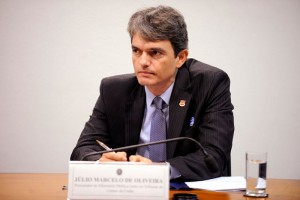
O Estadão publica hoje os principais trechos da entrevista concedida pelo procurador Júlio Marcelo de Oliveira, do Ministério Público de Contas, que atua no Tribunal de Contas da União (TCU) justamente nos dois casos mais espinhosos para o governo Dilma neste momento: as pedaladas fiscais e a análise das contas do governo.
Abaixo, a entrevista completa concedida por Oliveira ao blog ontem de seu gabinete no TCU:

Júlio Marcelo de Oliveira, procurador do Ministério Público de Contas
Em sua defesa formal ao TCU, Arno Augustin se isentou da responsabilidade pelos pagamentos dos bancos com recursos próprios, deixando claro que não cabia a ele decidir isso, como secretário do Tesouro. Os bancos afirmam que não tinham como não pagar os benefícios sociais obrigatórios, mesmo sem o dinheiro do Tesouro. E o governo, como um todo, nega que haja um crime de responsabilidade fiscal em tudo isso, as pedaladas, porque eram contratos de prestação de serviço e não uma operação de crédito. Como o sr. vê essa defesa?
Júlio Marcelo de Oliveira: Na minha opinião, a culpa é compartilhada. Os bancos aceitaram fazer esse papel, certamente não foi por vontade e iniciativa própria, e isso trouxe um ônus inesperado que eles tiveram que suportar pagamentos com recursos próprios. O Tesouro tem participação direta porque deixou de repassar os recursos. Se houve discussão entre os ministérios setoriais e os bancos é porque o Tesouro foi omisso no repasse dos recursos que estavam programados e eram necessários. Também não se trata de um mero contrato de prestação de serviço. Foi uma situação atípica que ocorreu a partir de 2013 e ao longo de 2014, que atingiu um volume importante, não foi nada residual ou marginal. Isso permitiu ao governo gastar em 2014 como se tivesse tendo aumento de receita, mas estava tendo perda de argumentação. Essa linha de defesa a mim não convence.
O governo também nega que as pedaladas fiscais tinham como objetivo a melhora artificial das contas públicos. Qual era o objetivo então, na avaliação do sr.?
OLIVEIRA: O objetivo era esse mesmo, o de apresentar uma situação fiscal melhor do que a real, permitir gastos não obrigatórios, valores ampliados e dar maior performance em ano eleitoral. E a Lei de Responsabilidade Fiscal (LRF) existe para evitar justamente isso. A LRF está aí para dar uma disciplina fiscal todos os anos e, em especial, no ano eleitoral. O Brasil tinha farra fiscal em anos eleitorais e a LRF entrou para impedir isso. Mas em 2014 ela não foi seguida.
A LRF, aliás, completa agora 15 anos. Como o sr. vê o debate sobre a lei nesses dois casos no TCU?
OLIVEIRA: Há um amadurecimento da sociedade, que passou a entender que não há governo grátis. A ação do governo precisa de um financiamento, ele não pode ser uma fábrica de promessas. Tudo o que ele pretende fazer precisa sair de algum lugar, seja com imposto ou com endividamento. Estamos agora em situação de desajuste fiscal, é por isso que precisamos hoje de um ajuste fiscal. O desajuste de 2013 e 2014 começa a ser pago agora e é por isso que devemos insistir na discussão sobre o que aconteceu nas contas públicas.
E quanto a eventuais punições, como procurador, o que o sr. defende?
OLIVEIRA: As consequências… elas são fundamentais. As falhas que ocorreram não foram periféricas na LRF. Foram falhas centrais, nos pilares da lei. Você tem uma meta fixada numa lei, que é o superávit primário, e a LRF, para evitar que o governo vá executando o orçamento de qualquer maneira, com o mecanismo dos decretos de programação financeira, feitos a cada dois meses para ir controlando e ajustando. Tudo isso foi ignorado em 2014: a meta fiscal, a LRF e os decretos de programação orçamentária e financeira, que não refletiam a situação real das contas públicas. Se a programação financeira puder ser fantasiosa, todo o resto perde o sentido. Aí a meta no final do ano perde a importância. Isso tem que ter consequência. No caso das contas do governo, a consequência é clara: a rejeição das contas, com desdobramentos posteriores no Congresso, a quem cabe a definição. Nas pedaladas cabe a responsabilização individual.
Como será isso?
OLIVEIRA: Sempre, tanto em processo penal quanto em administrativo, é importante individualizar as condutas para definir para cada agente qual é o grau de participação, se foi mentor ou executor, se havia mais ou menos influência, se houve resistência para cumprir ou não determinada ordem. Ao final, alguns podem ser punidos e outros não, claro.
O governo entrou com recurso no TCU para não ter que corrigir os R$ 24,5 bilhões que continuam pendurados no BB e no BNDES por conta dos subsídios. Como o sr. vê o mérito deste recurso?
OLIVEIRA: Se eu tiver a oportunidade de opinar nesse recurso vou opinar pelo desprovimento. Essa prática é ilegal, um flagrante descumprimento legal, o artigo 36 da LRF veda peremptoriamente que um banco público financie seu controlador. Não pode prolongar no tempo essa situação. Tem que fazer o ajuste que é necessário fazer e fazer isso logo. O governo precisa se encaixar dentro das normas. Se existe a norma, ele precisa cumprir. Não consigo ver espaço para ele postergar esses pagamentos devidos. Assim vai abrir o precedente e a partir daí todos os governos estaduais poderão buscar bancos regionais e sair pendurando dívidas. Hoje as portarias preveem dois anos, mas podem ser alongadas a 4, a oito. A norma precisa ser cumprida.
No caso das contas de 2014, a reprovação seria uma forma de “colocar o governo nas normas”?
OLIVEIRA: É o que eu penso. Há questões que são graves e centrais, não são detalhes que podem ser consideradas ressalvas. São centrais, condizem com o eixo da execução orçamentária e financeira. Se a programação orçamentária foi feita infringindo normas e leis, violando a própria lei orçamentária e os números ainda por cima são maquiados, como que o TCU pode aprovar essas contas?
O governo afirma que atrasos pontuais nos repasses do Tesouro existem desde 2001 e que nem por isso o TCU deixou de aprovar as contas federais.
OLIVEIRA: Acho que as contas de 2013 já deveriam ter sido rejeitadas, quando as pedaladas começaram. Mas naquele momento ninguém sabia. A história começou a ser revelada em 2014 e nós entramos no caso no fim do ano passado. A dimensão das pedaladas fiscais também foi outra em 2014, muito maior. Houve intenção de fraudar a execução orçamentária e financeira para fingir que estava buscando a meta quando se sabia que a meta era inatingível. Em 2014 tivemos uma situação inédita, de descumprimento frontal da LRF e da Lei Orçamentária, algo que não houve nos anos anteriores. Então é natural que a reação do TCU em relação as contas de 2014 seja muito diferente dos anos anteriores.
O que o sr. achou dessa inédita decisão dos ministros do TCU de conceder 30 dias para a presidente esclarecer distorções nas contas de 2014?
OLIVEIRA: Achei acertada. Poderiam ter concedido esse prazo logo que as contas chegaram aqui no TCU, para que o tribunal pudesse cumprir os 60 dias do prazo constitucional de análise das contas. Mas dado o ineditismo da situação, o fato de historicamente não ter tido nenhuma rejeição das contas nos últimos 78 anos, o TCU entendeu que não estava preparado para a rejeição das contas sem antes permitir o contraditório. Embora seja só um parecer, porque o julgamento cabe ao Congresso, o TCU decidiu pela prudência.
O presidente do Senado, Renan Calheiros (PMDB-AL), afirmou nessa semana que estuda criar uma espécie de Autoridade Fiscal Independente. O que o sr. acha disso?
OLIVEIRA: Pelo que vi de notícias, não vi o texto da PEC nem sua justificativa, mas de tudo o que vi, inclusive declarações do presidente do Senado, me parece que tudo o que essa Autoridade Fiscal Independente faria o TCU já faz. Se hoje estamos discutindo pedaladas fiscais é porque, diante das revelações, o TCU conseguiu comprovar e condenar a prática. O TCU aponta para a sociedade brasileira que isso foi um problema. Talvez esteja faltando uma interação entre o TCU e o Congresso Nacional, uma ação mais próxima do TCU com o Congresso, algo que seja mais formalmente definido. Semestralmente o presidente do TCU apresentar ao Congresso um relatório com a situação fiscal do País, não sei. Num momento de austeridade fiscal, criar mais um órgão, com um conjunto de técnicos, de analistas, vai ter uma sede… o TCU já oferece isso, o custo já está colocado. Falta eventualmente uma interação maior entre o TCU e o Congresso Nacional.
O sr. já começou a sofrer pressões. Foi dito nos últimos dias nas redes sociais que o sr. teria convocado manifestações de movimentos sociais que acompanharam o TCU no julgamento das contas e que teria participado de passeatas pelo impeachment da presidente Dilma Rousseff.
OLIVEIRA: Não vejo cobrança da sociedade e da imprensa como uma pressão equivocada. É legítima, faz parte do jogo democrático. Agora que fique claro: eu não convoquei nenhuma manifestação, apenas disse que considero muito saudável que tivessem movimentos sociais preocupados com o julgamento das contas do governo no TCU. Acho isso realmente muito bom e vou apoiar sempre. Mas eu não convoquei ato nenhum e também não participei de manifestação pelo impeachment. Esse tipo de questionamento, por mais que possa ser de mau gosto, faz parte da democracia. Quem tem atuação pública tem que conviver. No Ministério Público, quando uma ilegalidade no governo é apontada, sempre a oposição vai aplaudir e a situação vai ficar incomodada. Se um dia mudar os atores aqui no plano federal, os papeis serão invertidos. Antes quem que procurava o MP, anos atrás? Os partidos que hoje estão no governo. Então sempre o MP vai ser aplaudido pela oposição e vai incomodar a situação.
****
Os últimos posts do blog:
A defesa do governo Dilma no TCU – uma entrevista exclusiva com o Advogado-Geral da União (AGU).
O que diz Arno Augustin sobre as “pedaladas fiscais”
****
Aproveito para convidar o leitor a conferir o especial multimídia (textos, animações e linha do tempo com fotos e links) sobre as pedaladas fiscais. Há explicações simplificadas sobre todo o processo, uma animação e uma linha do tempo com todas as 56 reportagens do Estadão sobre o assunto, entre dezembro de 2013 e agora, junho de 2015. A cronologia das pedaladas é sempre atualizada.
Visite clicando aqui -> As Pedaladas Fiscais do governo Dilma
Adam Victor Brandizzi likes this
25 Jun 22:23

Art of War
164
Art of War - June 25, 2015, 9 a.m.
If I had less self control, this comic would be 100% ripping on PHP. — php
Share Url: http://cube-drone.com/comics/c/art-of-war
25 Jun 22:21
E se a França fosse a grande potência mundial? Veja o que ocorreu na Líbia…
by gustavochacra
Algumas pessoas têm mania de achar que os EUA são responsáveis por todas as guerras que vão mal no mundo. Sem dúvida, a intervenção no Iraque foi grotesca. Mas, no geral, os EUA talvez sejam a melhor potência possível. Imagine como seria se a ditatorial China ou a Rússia dominassem o planeta? Dá para ter uma ideia pela ex-União Soviética. E, obviamente, não seria melhor, como não foi no passado, se britânicos ou franceses fossem as grandes potências.
A França, como sabemos, levou adiante a Guerra da Argélia nos anos 1960, incomparavelmente mais sangrenta do que a do Iraque. E, na Primavera Árabe, foi responsável direta pela Guerra da Líbia, com dezenas de milhares de mortos e esquecida por algum motivo, apesar de o país ser controlado por milícias extremistas, muitas delas ligadas à Al Qaeda e ao ISIS, também conhecido como Grupo Estado Islâmico ou Daesh.
A Líbia era, até 2011, uma ditadura estável comandada por Muamar Kadafi. Não muito diferente da Arábia Saudita, aliada de americanos e franceses. Com a diferença de as mulheres terem mais direitos em Trípoli do que em Riad, embora, claro, bem aquém de nações ocidentais. O regime de Kadafi era péssimo, mas havia abdicado de seu programa de armas de destruição em massa e, por mais maluco que fosse, vinha adotando um tom moderado.
Na época, no entanto, a França conseguiu convencer outras nações de que era necessária uma intervenção para apoiar rebeldes e derrubar Kadafi. Vimos o resultado, tão ruim quanto no Iraque, onde, por pior que esteja, há um governo eleito na capital Bagdá.
Segundo e-mails tornados públicos neste mês pelo Congresso dos EUA que investiga o atentado terrorista em Benghasi, um agente da CIA claramente afirmou em 22 de março de 2011 que os serviços de inteligência da França, então presidida por Sarkozy, foram os responsáveis pela formação de grupos rebeldes, antes inexistentes. Ele relata tudo. Em troca, os franceses exigiam que os rebeldes, quando tomassem o poder, priorizassem empresas francesas na área de petróleo em contratos. A ideia toda seria do “intelectual” Bernard-Henry Levy. Que fique claro, o atual governo francês não tem culpa pelas trapalhadas do anterior, assim como Obama não tem pelas trapalhadas de Bush.
No fim, a China, que não participou da intervenção, que se deu bem. Mas imaginem se fossem os EUA, em vez da França, que tivesse orquestrado esta operação? Basta lembrar o que ocorreu no Iraque e a gritaria contra os americanos.
Guga Chacra, comentarista de política internacional do Estadão e do programa Globo News Em Pauta em Nova York, é mestre em Relações Internacionais pela Universidade Columbia. Já foi correspondente do jornal O Estado de S. Paulo no Oriente Médio e em NY. No passado, trabalhou como correspondente da Folha em Buenos Aires
Comentários islamofóbicos, antissemitas, anticristãos e antiárabes ou que coloquem um povo ou uma religião como superiores não serão publicados. Tampouco são permitidos ataques entre leitores ou contra o blogueiro. Pessoas que insistirem em ataques pessoais não terão mais seus comentários publicados. Não é permitido postar vídeo. Todos os posts devem ter relação com algum dos temas acima. O blog está aberto a discussões educadas e com pontos de vista diferentes. Os comentários dos leitores não refletem a opinião do jornalista
Acompanhe também meus comentários no Globo News Em Pauta, na Rádio Estadão, na TV Estadão, no Estadão Noite no tablet, no Twitter @gugachacra , no Facebook Guga Chacra (me adicionem como seguidor), no Instagram e no Google Plus.
Adam Victor Brandizzi likes this


25 Jun 16:17
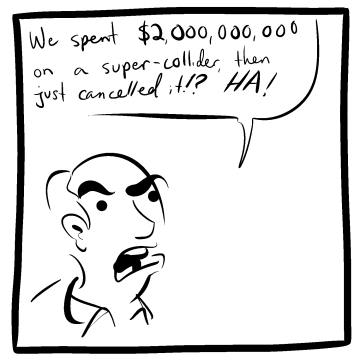
Saturday Morning Breakfast Cereal - Conspiracy Theorists
by admin@smbc-comics.com

Adam Victor Brandizzi likes this
